
Life, 1928-02-02 · page 18 of 38
Life — February 2, 1928 — page 18: what you’re looking at
What you’re looking at
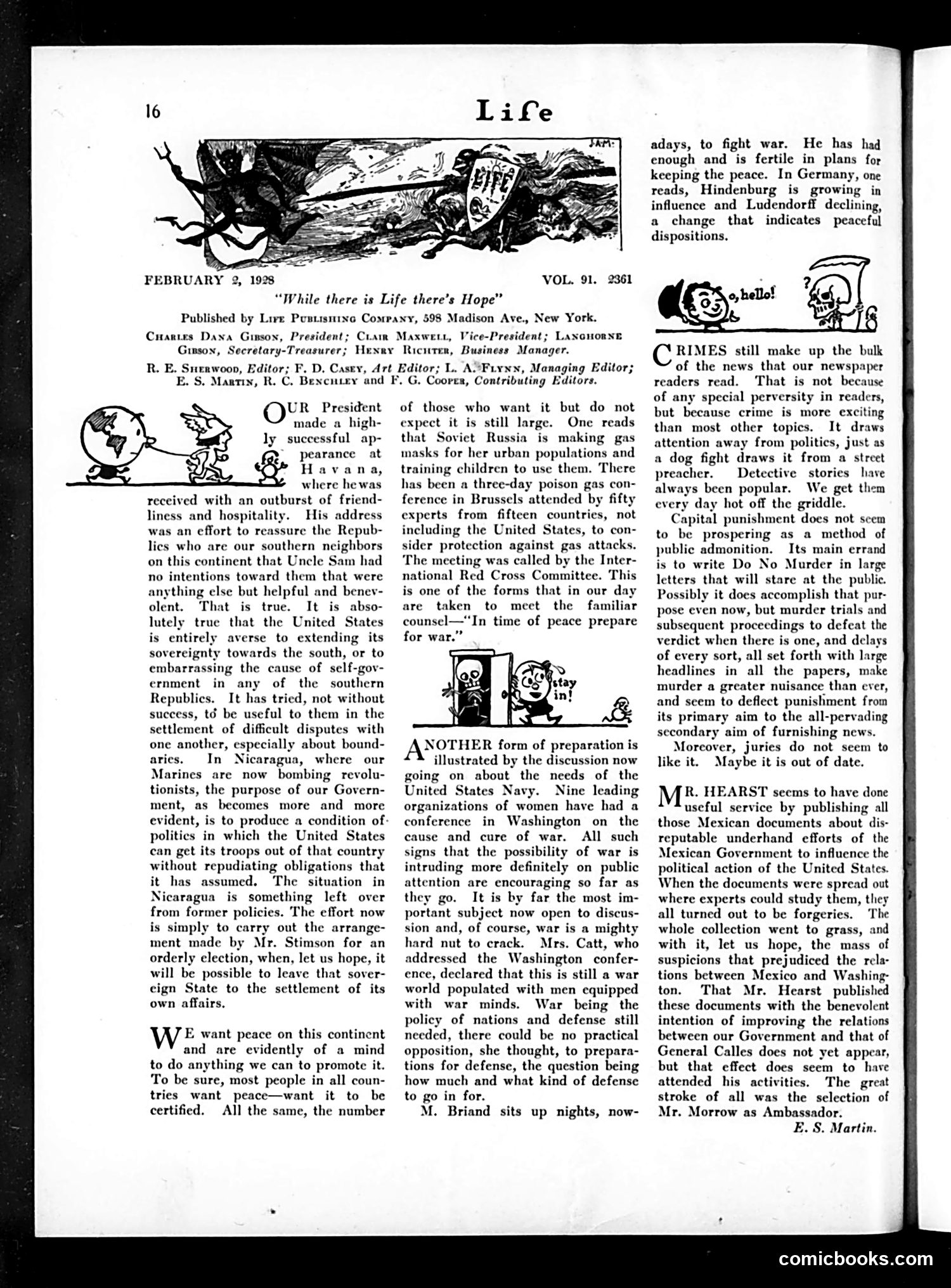
This page contains editorial commentary on peace and defense preparedness rather than a political cartoon. The main illustration shows a globe character greeting another figure—likely representing the U.S. President and America's diplomatic stance. The editorial discusses the President's "successful appearance" at a Pan-American reception, where he reportedly received "an outburst of friendliness and hospitality." The text notes this was meant to reassure Southern neighbors of American sovereignty, especially regarding Nicaragua and Marines operations. The broader argument critiques American preparations for war while claiming to want peace. It references ongoing Navy discussions about defense needs and mentions documents published by Mr. Hearst regarding Mexican-American relations. The tone suggests skepticism about whether America's peace rhetoric matches its military actions.
📄 Transcribed text from this page (OCR, searchable)
Machine-transcribed from the original scan — historical spelling and the odd misread are preserved.
VOL. 91. 2361 “While there is Life there’s Hope” Published by Lire Pustisnixc Company, 598 Madison Ave., New York. Cuantes Dana Ginson, President; Cram Maxwett, Vice-President; Lancuorxe Ginsox, Secretary-Treasurer; Hexay Ricuten, wenwoon, Editor; F. D, Casey, Art Editor; R. E. Business Manager. L. ASFiyxx, Managing Editor; E. S. Maamin, R. C. Bencutey and F, G, Coorer, Contributing Editors. UR President made a high- ly successful ap- pearance at Havana, where he was received with an outburst of friend- liness and hospitality. His address was an effort to reassure the Repub- lics who are our southern neighbors on this continent that Uncle Sam had no intentions toward them that were anything else but helpful and benev- olent. That is true. It is abso- lutely true that the United States is entirely averse to extending its sovereignty towards the south, or to embarrassing the cause of self-gov- ernment in any of the southern Republics. It has tried, not without success, td be useful to them in the settlement of difficult disputes with one another, especially about bound- aries. In Nicaragua, where our Marines are now bombing revolu- tionists, the purpose of our Govern- ment, as becomes more and more is to produce a condition of- in which the United States can get its troops out of that country without repudiating obligations that it has assumed. The situation in Nicaragua is something left over from former policies. The effort now is simply to carry out the arrange- ment made by Mr. Stimson for an orderly election, when, let us hope, it will be possible to leave that sover- cign State to the settlement of its own affairs. WE want peace on this continent and are evidently of a mind to do anything we can to promote it. To be sure, most people in all coun- tries want peace—want it to be certified. All the same, the number of those who want it but do not expect it is still large. One reads that Soviet Russia is making gas masks for her urban populations and training children to use them. There has been a three-day poison gas con- ference in Brussels attended by fifty experts from fifteen countries, not including the United States, to con- sider protection against gas attacks. The meeting was called by the Inter- national Red Cross Committee. This is one of the forms that in our day are taken to meet the familiar counsel—“In time of peace prepare NOTHER form of preparation is ustrated by the discussion now going on about the needs of the United States Navy. Nine leading organizations of women have had a conference in Washington on the cause and cure of war. All such signs that the possibility of war is intruding more definitely on public attention are encouraging so far as they go. It is by far the most im- portant subject now open to discus- sion and, of course, war is a mighty hard nut to crack. Mrs. Catt, who addressed the Washington confer- ence, declared that this is still a war world populated with men equipped with war minds. War being the policy of nations and defense still needed, there could be no practical opposition, she thought, to prepara- tions for defense, the question being how much and what kind of defense to go in for. M. Briand sits up nights, now- adays, to fight war. He has had enough and is fertile in plans for keeping the peace. In Germany, one reads, Hindenburg is growing in influence and Ludendorff declining, a change that indicates peaceful dispositions, Cc RIMES still make up the bulk of the news that our newspaper readers read. That is not because of any special perversity in readers, but because crime is more exciting than most other topics. It draws attention away from politics, just as a dog fight draws it from a street preacher. Detective stories have always been popular. We get them every day hot off the griddle. Capital punishment does not scem to be prospering as a method of public admonition. Its main errand is to write Do No Murder in large letters that will stare at the public. Possibly it does accomplish that pur- pose even now, but murder trials and subsequent proceedings to defeat the verdict when there is one, and delays of every sort, all set forth with large headlines in all the papers, make murder a greater nuisance than ever, and seem to deflect punishment from its primary aim to the all-pervading secondary aim of furnishing news. Moreover, juries do not seem to like it. Maybe it is out of date. R. HEARST seems to have done useful service by publishing all those Mexican documents about dis- reputable underhand efforts of the Mexican Government to influence the political action of the United States. When the documents were spread out where experts could study them, they all turned out to be forgeries. The whole collection went to grass, and with it, let us hope, the mass of suspicions that prejudiced the rela- tions between Mexico and Washing- ton. That Mr. Hearst published these documents with the benevolent intention of improving the relations between our Government and that of General Calles does not yet appear, but that effect does seem to have attended his activities. The great stroke of all was the selection of Mr. Morrow as Ambassador. E. S. Martin. comicbooks.com