
Life, 1928-02-02 · page 9 of 38
Life — February 2, 1928 — page 9: what you’re looking at
What you’re looking at
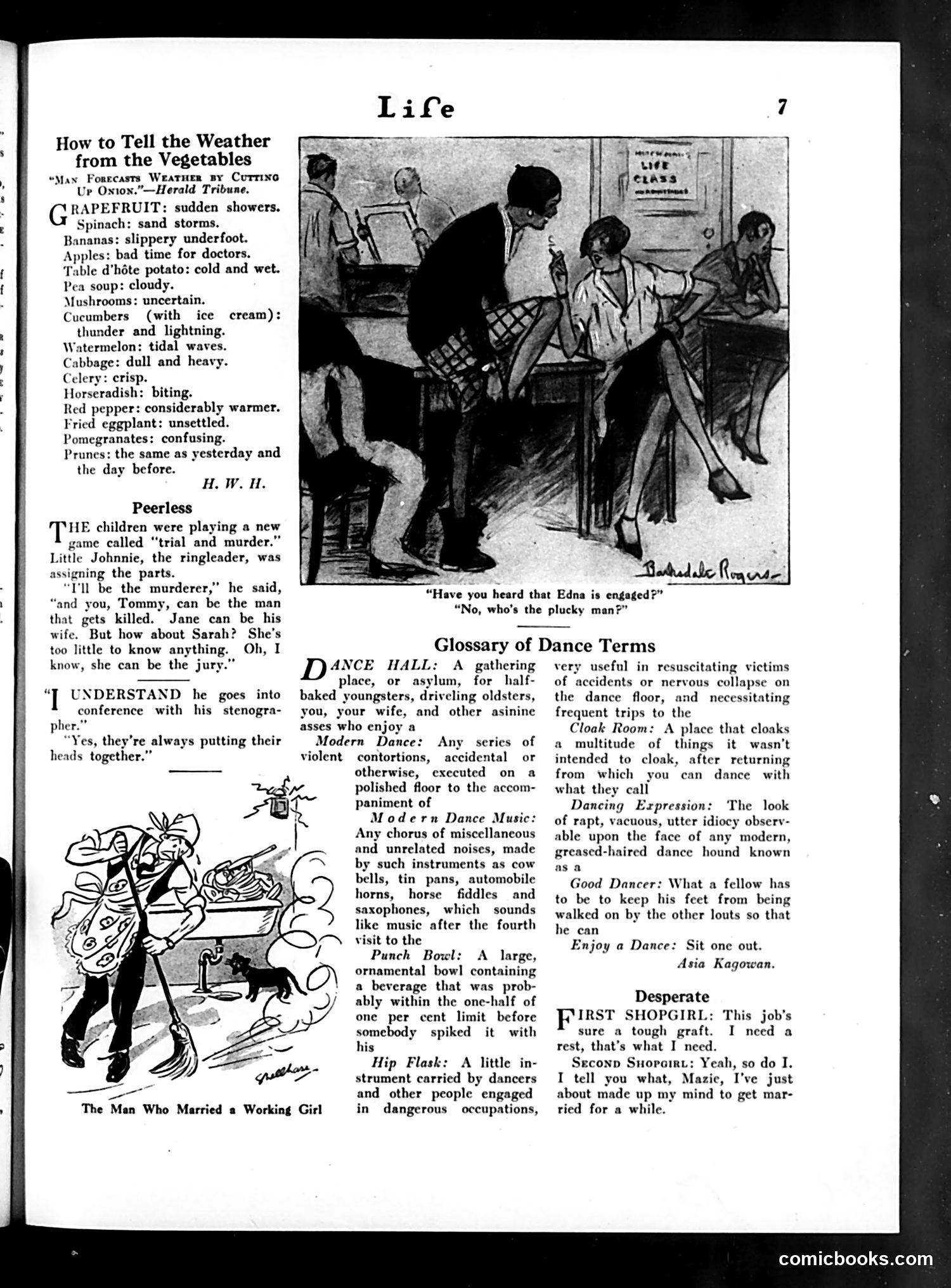
This page contains several humorous sections typical of Life's satirical format: **"How to Tell the Weather from Vegetables"** is a whimsical piece satirizing pseudo-scientific fortune-telling by linking produce characteristics to weather predictions (grapefruit = showers, spinach = sand storms, etc.). It mocks superstitious or absurd reasoning. **"Peerless"** is a children's game narrative poking fun at childhood logic and role-playing, where young players casually discuss murder and death as entertainment—likely satirizing both children's morbid curiosity and period melodrama tropes. The main cartoon "Have you heard that Edna is engaged?" depicts a social gathering, likely mocking gossip culture and shallow engagement discussions among the upper classes. **"Glossary of Dance Terms"** humorously defines modern dance jargon with exaggerated, critical descriptions, satirizing the pretentiousness of contemporary dance culture.
📄 Transcribed text from this page (OCR, searchable)
Machine-transcribed from the original scan — historical spelling and the odd misread are preserved.
How to Tell the Weather from the Vegetables “May Forecasts WeatHer sy Currine Up Omion.”—Herald Tribune. RAPEFRUIT: sudden showers. Spinach: sand storms. Bananas: slippery underfoot. Apples: bad time for doctors. Table d’héte potato: cold and wet. Pea soup: cloudy. Mushrooms: uncertain. Cucumbers (with ice thunder and lightning. Watermelon: tidal waves. Cabbage: dull and heavy. Celery: crisp. Horseradish: biting. Red pepper: considerably warmer. Fried eggplant: unsettled. Pomegranates: confusing. Prunes: the same as yesterday and the day before. cream): H.W. H. Peerless HE children were playing a new game called “trial and murder.” Little Johnnie, the ringleader, was assigning the parts. “I'll be the murderer,” he said, “and you, Tommy, can be the man that gets killed. Jane can be his wife. But how about Sarah? She’s too little to know anything. Oh, I know, she can be the jury.” “I UNDERSTAND he goes into conference with his stenogra- pher.” “Yes, they’re always putting their heads together.” The Man Who Married a Working Girl “Have you heard that Edna is engaged?” “No, who's the plucky man?” Glossary of Dance Terms ANCE HALL: A gathering place, or asylum, for half- baked youngsters, driveling oldsters, you, your wife, and other asinine asses who enjoy a Modern Dance: violent contortions, accidental or otherwise, executed on a polished floor to the accom- paniment of Modern Dance Music: Any chorus of miscellaneous and unrelated noises, made by such instruments as cow bells, tin pans, automobile horns, horse fiddles and saxophones, which sounds like music after the fourth visit to the Punch Bowl: A_ large, ornamental bowl containing a beverage that was prob- ably within the one-half of one per cent limit before somebody spiked it with his Hip Flask: A little in- strument carried by dancers and other people engaged in dangerous occupations, Any series of very useful in resuscitating victims of accidents or nervous collapse on the dance floor, and necessitating frequent trips to the Cloak Room: A place that cloaks a multitude of things it wasn't intended to cloak, after returning from which you can dance with what they call Dancing Expression: The look of rapt, vacuous, utter idiocy observ- able upon the face of any modern, greased-haired dance hound known asa Good Dancer: What a fellow has to be to keep his feet from being walked on by the other louts so that he can Enjoy a Dance: Sit one out. Asia Kagowan. Desperate IRST SHOPGIRL: This job's sure a tough graft. I need a rest, that’s what I need. Seconp Suopairt: Yeah, so do I. I tell you what, Mazie, I’ve just about made up my mind to get mar- ried for a while. comicbooks.com