
Life, 1928-02-02 · page 28 of 38
Life — February 2, 1928 — page 28: what you’re looking at
What you’re looking at
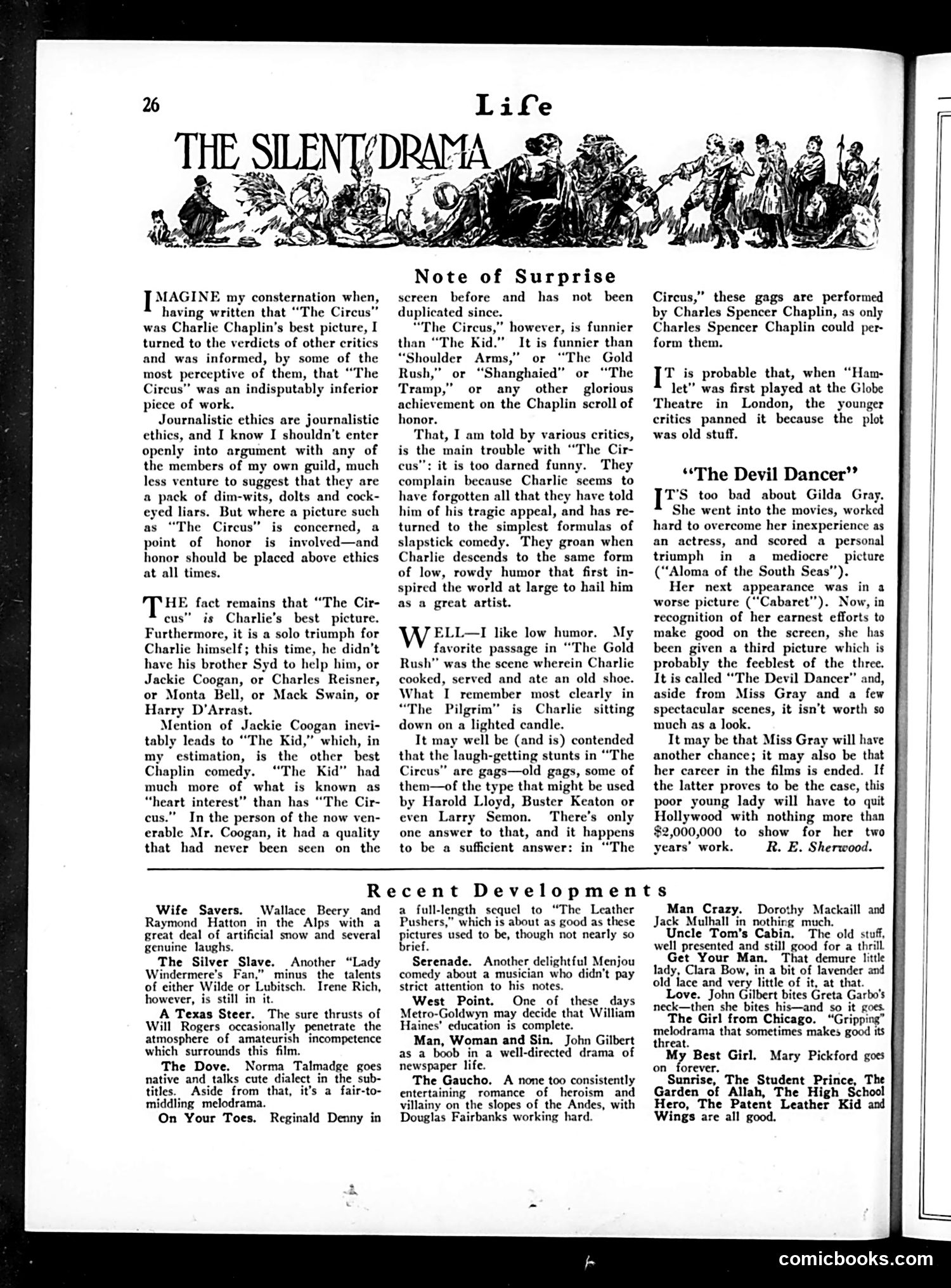
This is a film review column defending Charlie Chaplin's *The Circus* against critical dismissal. The author argues that other critics wrongly condemned the film for being "too funny" and reverting to slapstick rather than Chaplin's celebrated "tragic appeal." The writer defends low humor by citing Chaplin's best moments—eating a shoe in *The Gold Rush*, sitting on a candle in *The Pilgrim*—arguing that when Chaplin performs old gag formulas, his genius elevates them above similar comedians like Buster Keaton. The piece also critiques how dancer-turned-actress Gilda Gray has received progressively worse film roles despite earnest effort (*The Devil Dancer* being the poorest), suggesting her movie career may be ending despite earning $2 million. The satire targets critical snobbery—the notion that Chaplin's worth depends on pathos rather than comedy craft.
📄 Transcribed text from this page (OCR, searchable)
Machine-transcribed from the original scan — historical spelling and the odd misread are preserved.
MAGINE my consternation when, having written that “The Circus” was Charlie Chaplin’s best picture, I turned to the verdicts of other critics and was informed, by some of the most perceptive of them, that “The Circus” was an indisputably inferior piece of work. Journalistic ethics are journalistic ethics, and I know I shouldn't enter openly into argument with any of the members of my own guild, much less venture to suggest that they are a pack of dim-wits, dolts and cock- eyed liars. But where a picture such as “The Circus” is concerned, a point of honor is involved—and honor should be placed above ethics at all times. HE fact remains that “The Cir- cus” is Charlie’s best picture. Furthermore, it is a solo triumph for Charlie himself; this time, he didn’t have his brother Syd to help him, or Jackie Coogan, or Charles Reisner, or Monta Bell, or Mack Swain, or Harry D’Arrast. Mention of Jackie Coogan inevi- tably leads to “The Kid,” which, in my estimation, is the other best Chaplin comedy. “The Kid” had much more of what is known as “heart interest” than has “The Cir- cus.” In the person of the now ven- erable Mr. Coogan, it had a quality that had never been scen on the Note of Surprise screen before and has not been duplicated since. “The Circus,” however, is funnier than “The Kid.” It is funnier than “Shoulder Arms,” or “The Gold Rush,” or “Shanghaied” or “The Tramp,” or any other glorious achievement on the Chaplin scroll of honor. That, I am told by various critics, is the main trouble with “The Cir- cus”: it is too darned funny. They complain because Charlie seems to have forgotten all that they have told him of his tragic appeal, and has re- turned to the simplest formulas of slapstick comedy. They groan when Charlie descends to the same form of low, rowdy humor that first in- spired the world at large to hail him as a great artist. ELL—I like low humor. My favorite passage in “The Gold Rush” was the scene wherein Charlie cooked, served and ate an old shoe. What I remember most clearly in “The Pilgrim” is Charlie sitting down on a lighted candle. It may well be (and is) contended that the laugh-getting stunts in “The Circus” are gags—old gags, some of them—of the type that might be used by Harold Lloyd, Buster Keaton or even Larry Semon. There’s only one answer to that, and it happens to be a sufficient answer: in “The Circus,” these gags are performed by Charles Spencer Chaplin, as only Charles Spencer Chaplin could per- form them. I? is probable that, when “Ham- let” was first played at the Globe Theatre in London, the younger critics panned it because the plot was old stuff. “The Devil Dancer” T’S too bad about Gilda Gray. She went into the movies, worked hard to overcome her inexperience as an actress, and scored a_ personal triumph in a mediocre picture (‘‘Aloma of the South Seas’’). Her next appearance was in a worse picture (“Cabaret”). Now, in recognition of her earnest efforts to make good on the screen, she has been given a third picture which is probably the feeblest of the three. It is called “The Devil Dancer’ and, aside from Miss Gray and a few spectacular scenes, it isn’t worth so much as a look. It may be that Miss Gray will have another chance; it may also be that her carcer in the films is ended. If the latter proves to be the case, this poor young lady will have to quit Hollywood with nothing more than $2,000,000 to show for her two years’ work. R. E. Sherwood. Recent Developments Wife Savers. Wallace Beery and Raymond Hatton in the Alps with a great deal of artificial snow and several genuine laughs. The Silver Slave. Another “Lady Windermere’s Fan,” minus the talents of either Wilde or Lubitsch. Irene Rich, however, is still in it. A Texas Steer. The sure thrusts of Will Rogers occasionally penetrate the atmosphere of amateurish incompetence which surrounds this film. The Dove. Norma Talmadge goes native and talks cute dialect in the sub- titles. Aside from that, it’s a fair-to- middling melodrama. On Your Toes. Reginald Denny in a full-length sequel to “The Leather Pushers,” which is about as good as these pictures used to be, though not nearly so brief. Serenade. Another delightful Menjou comedy about a musician who didn’t pay strict attention to his notes. West Point. One of these days Metro-Goldwyn may decide that William Haines’ education is complete. Man, Woman and Sin. John Gilbert as a boob in a well-directed drama of newspaper life. The Gaucho. A none too consistently entertaining romance of heroism and villainy on the slopes of the Andes, with Douglas Fairbanks working hard. Man Crazy. Dorothy Mackaill and Jack Mulhall in nothing much. Uncle Tom’s Cabin. The old stuff, well presented and still good for a thrill Get Your Man. That demure little lady, Clara Bow, in a bit of lavender and old lace and very little of it, at that. Love. John Gilbert bites Greta Garbo's neck—then she bites his—and so it goes. The Girl from Chicago. melodrama that sometimes makes good its threat. My Best Girl. on_ forever. Sunrise, The Student Prince, The Garden of Allah, The High School Hero, The Patent Leather Kid and Wings are all good. Mary Pickford goes “Gripping” [ comicbooks.com