
Life, 1928-02-02 · page 23 of 38
Life — February 2, 1928 — page 23: what you’re looking at
What you’re looking at
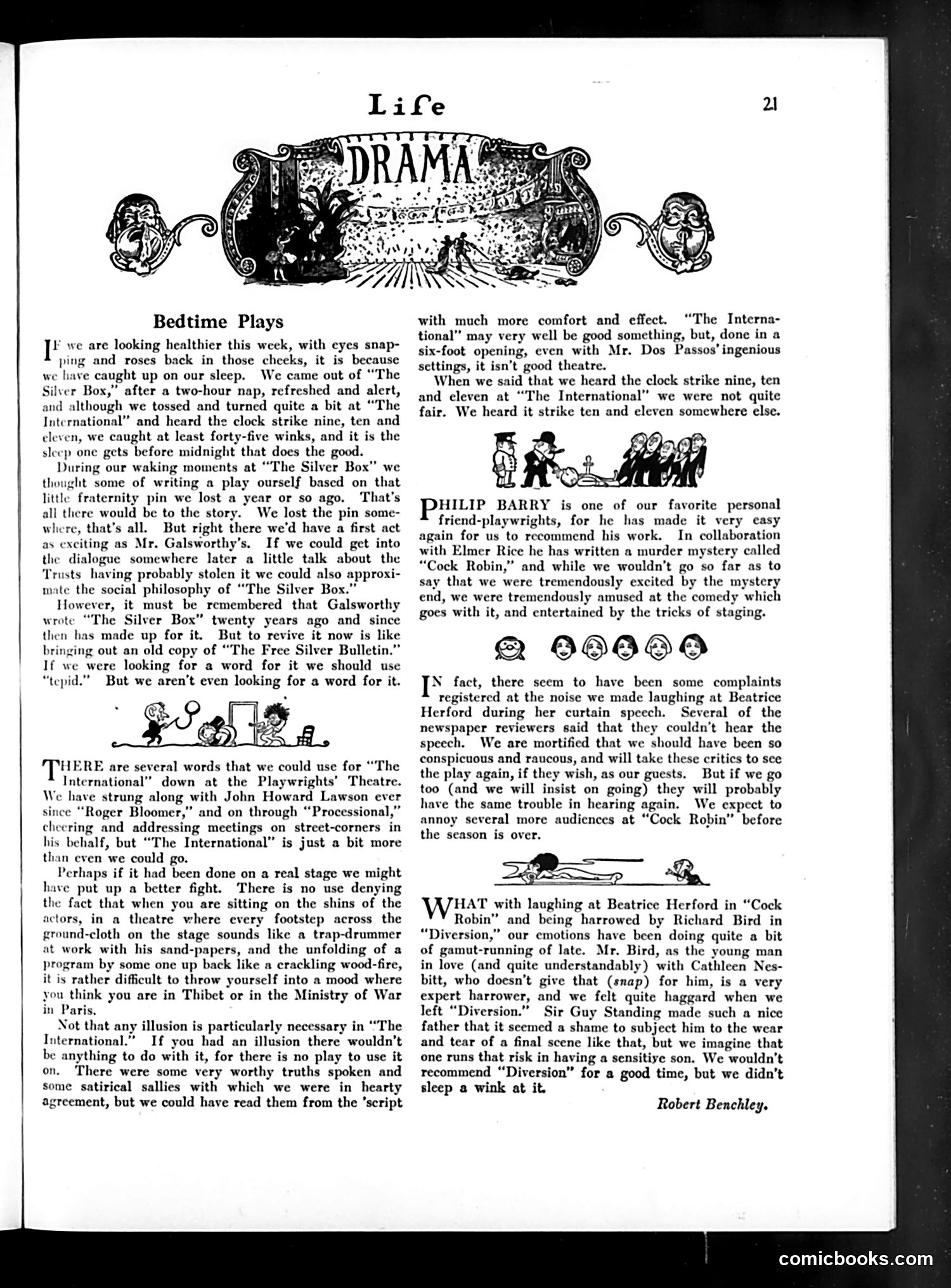
This theater review column critiques three Broadway productions. The author playfully dismisses John Howard Lawson's "The International" as tedious propaganda—full of worthy socialist messages about trusts and class struggle, but dramatically inert. The satirical point is that Lawson's play preaches rather than entertains; you might as well read the script at home. By contrast, Philip Barry's "Cock Robin" (a murder mystery co-written with Elmer Rice) succeeds because it prioritizes entertainment and clever staging tricks over political messaging. The reviewer praises Barry as a "favorite personal friend-playwright." The reference to Galsworthy's "The Silver Box" and "Free Silver Bulletin" anchors the piece in a broader critique: outdated theatrical and political material. The humor lies in the tension between avant-garde political theater and commercial entertainment—a recurring 1920s debate about drama's purpose.
📄 Transcribed text from this page (OCR, searchable)
Machine-transcribed from the original scan — historical spelling and the odd misread are preserved.
Bedtime Plays ¥ we are looking healthier this week, with eyes snap- ping and roses back in those cheeks, it is because we have caught up on our sleep. We came out of “The Silver Box,” after a two-hour nap, refreshed and alert, and although we tossed and turned quite a bit at “The International” and heard the clock strike nine, ten and eleven, we caught at least forty-five winks, and it is the sleep one gets before midnight that does the good. During our waking moments at “The Silver Box” we thought some of writing a play ourself bascd on that little fraternity pin we lost a year or so ago. That's all there would be to the story. We lost the pin some- where, that’s all, But right there we'd have a first act as exciting as Mr. Galsworthy’s. If we could get into the dialogue somewhere later a little talk about the Trusts having probably stolen it we could also approxi- mate the social philosophy of “The Silver Box.” However, it must be remembered that Galsworthy fhe Silver Box” twenty years ago and since then has made up for it. But to revive it now is like bringing out an old copy of “The Free Silver Bulletin.” If we were looking for a word for it we should use “tepid.” But we aren't even looking for a word for it. : | HERE are several words that we could use for “The International” down at the Playwrights’ Theatre. We have strung along with John Howard Lawson ever since “Roger Bloomer,” and on through “Processional,” cheering and addressing meetings on street-corners in his behalf, but “The International” is just a bit more than even we could go. Perhaps if it had been done on a real stage we might have put up a better fight. There is no use denying the fact that when you are sitting on the shins of the actors, in a theatre where every footstep across the ground-cloth on the stage sounds like a trap-drummer at work with his sand-papers, and the unfolding of a program by some one up back like a crackling wood-fire, it is rather difficult to throw yourself into a mood where you think you are in Thibet or in the Ministry of War in Paris, Not that any illusion is particularly necessary in “The International.” If you had an illusion there wouldn’t be anything to do with it, for there is no play to use it on. There were some very worthy truths spoken and some satirical sallies with which we were in hearty agreement, but we could have read them from the ‘script with much more comfort and effect. “The Interna- tional” may very well be good something, but, done in a six-foot opening, even with Mr. Dos Passos’ ingenious settings, it isn’t good theatre. When we said that we heard the clock strike nine, ten and eleven at “The International” we were not quite fair. We heard it strike ten and eleven somewhere else. HILIP BARRY is one of our favorite personal friend-playwrights, for he has made it very easy again for us to recommend his work. In collaboration with Elmer Rice he has written a murder mystery called “Cock Robin,” and while we wouldn't go so far as to say that we were tremendously excited by the mystery end, we were tremendously amused at the comedy which goes with it, and entertained by the tricks of staging. QA Y9OHOHH N fact, there seem to have been some complaints registered at the noise we made laughing at Beatrice Herford during her curtain speech. Several of the newspaper reviewers said that they couldn't hear the speech. We are mortified that we should have been so conspicuous and raucous, and will take these critics to see the play again, if they wish, as our guests. But if we go too (and we will insist on going) they will probably have the same trouble in hearing again. We expect to annoy several more audiences at “Cock Robin” before the season is over. HAT with laughing at Beatrice Herford in “Cock Robin” and being harrowed by Richard Bird in “Diversion,” our emotions have been doing quite a bit of gamut-running of late. Mr. Bird, as the young man in love (and quite understandably) with Cathleen Nes- bitt, who doesn’t give that (snap) for him, is a very expert harrower, and we felt quite haggard when we left “Diversion.” Sir Guy Standing made such a nice father that it seemed a shame to subject him to the wear and tear of a final scene like that, but we imagine that one runs that risk in having a sensitiye son. We wouldn't recommend “Diversion” for a good time, but we didn’t sleep a wink at it. Robert Benchley. comicbooks.com