
A complete issue · 39 pages · 1927
Life — January 13, 1927
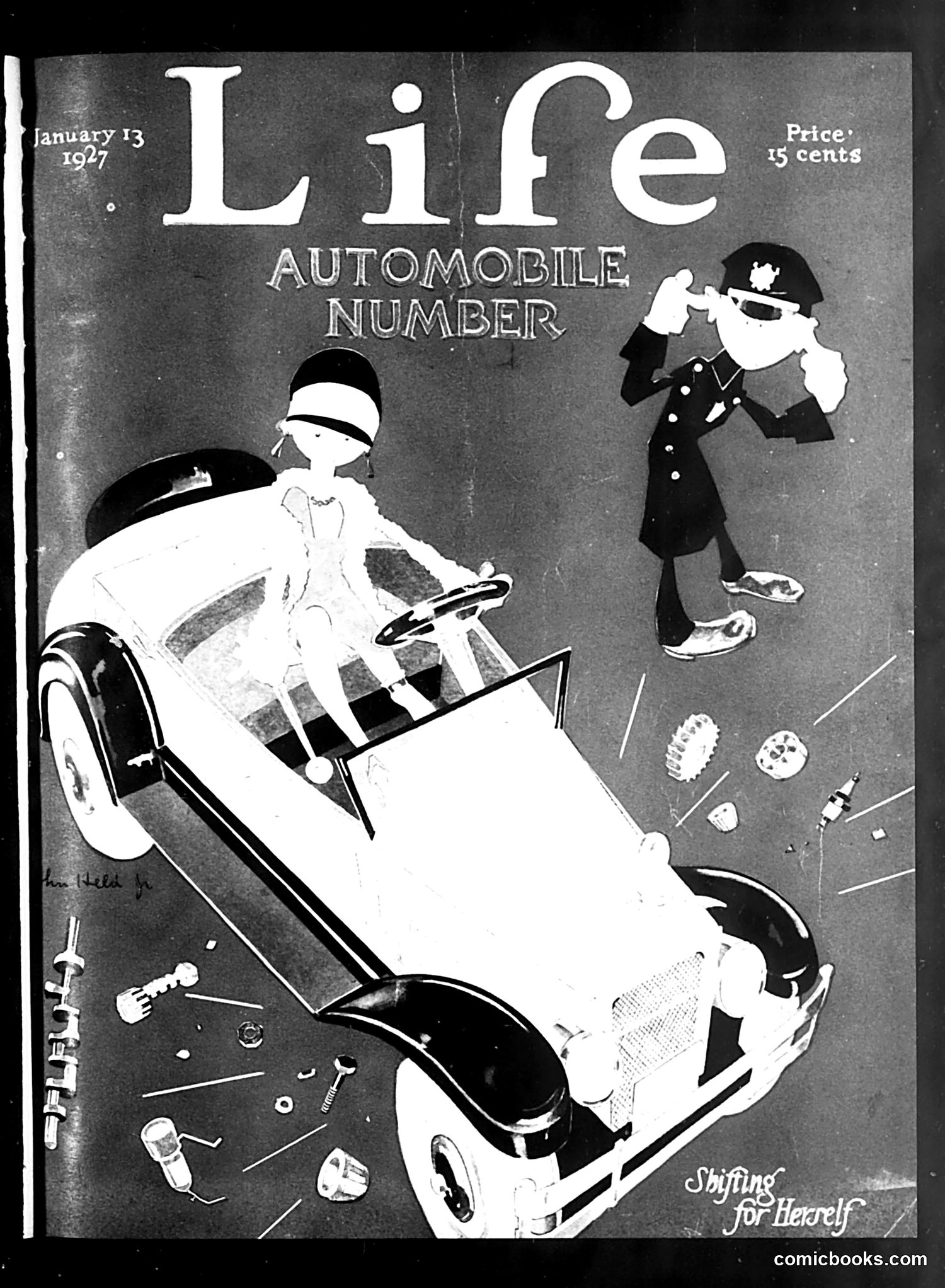
This "Automobile Number" cover satirizes the booming 1920s car culture. The illustration shows a fashionably dressed woman driving a streamlined automobile while a male figure (appearing to be a traffic officer or policeman) gestures frantically from the roadside, seemingly unable to stop her. The scattered mechanical parts at the bottom suggest automobile maintenance or breakdown concerns. The caption "Shifting for Herself" plays on automotive terminology while commenting on women's increasing independence and mobility during the Jazz Age—automobiles gave women unprecedented freedom from chaperonage. The officer's helpless pose humorously depicts society's inability to control this new female autonomy. The satire celebrates and gently mocks 1920s social change through the metaphor of automotive freedom.
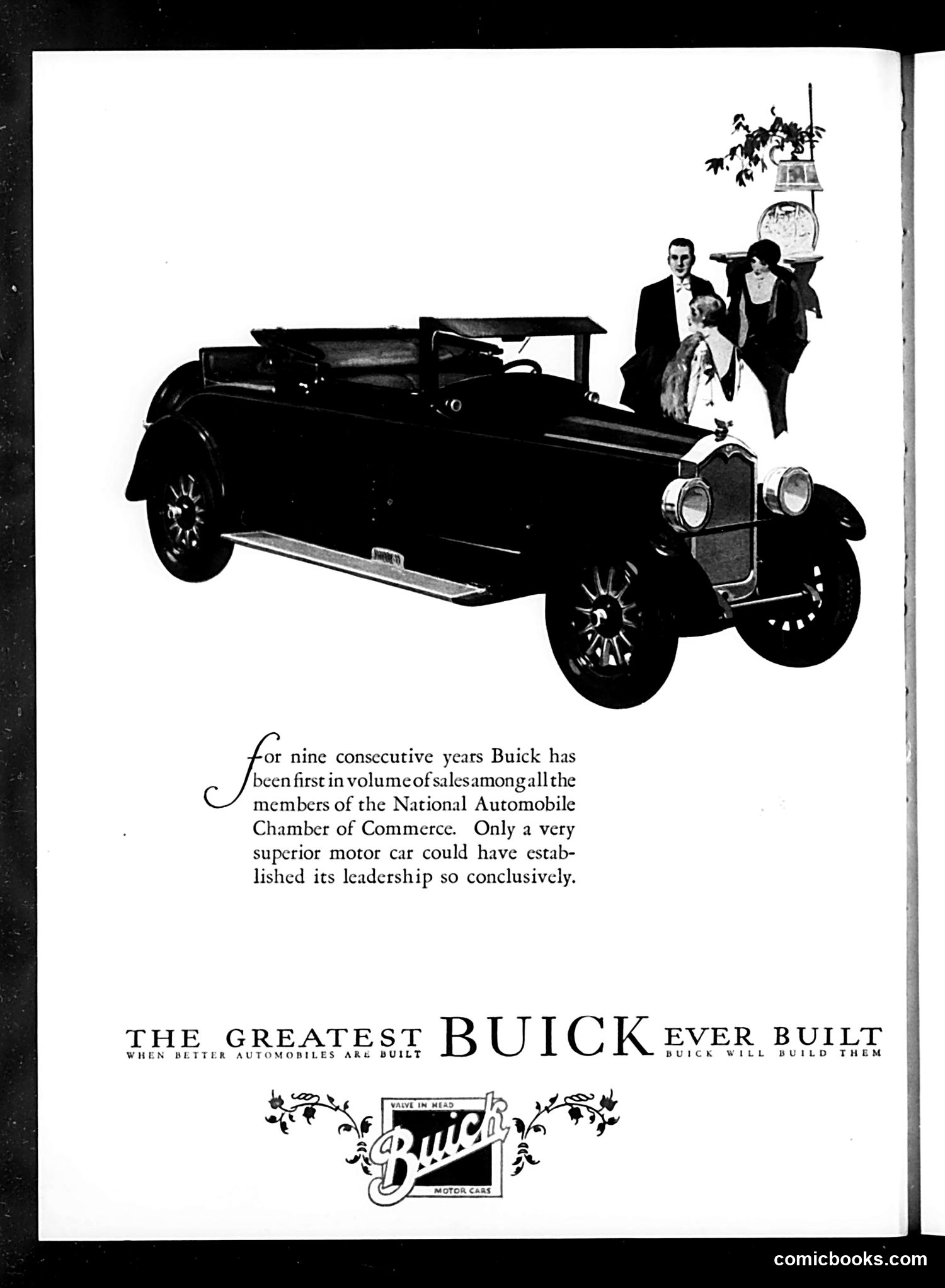
This is **not satire or a political cartoon** — it's a straightforward **advertisement for Buick automobiles**. The page features a luxury car from approximately the 1920s with three well-dressed figures (representing affluent buyers or owners). The ad makes a straightforward sales pitch: Buick claims nine consecutive years as the top-selling automobile among National Automobile Chamber of Commerce members, arguing this sales leadership proves superior quality. The tagline "The Greatest Buick Ever Built" and "When Better Automobiles Are Built, Buick Will Build Them" are standard advertising copy emphasizing brand prestige and reliability. There is no hidden political commentary or satire here — this is period commercial advertising aimed at affluent consumers, using sales statistics and luxury imagery to establish brand authority.
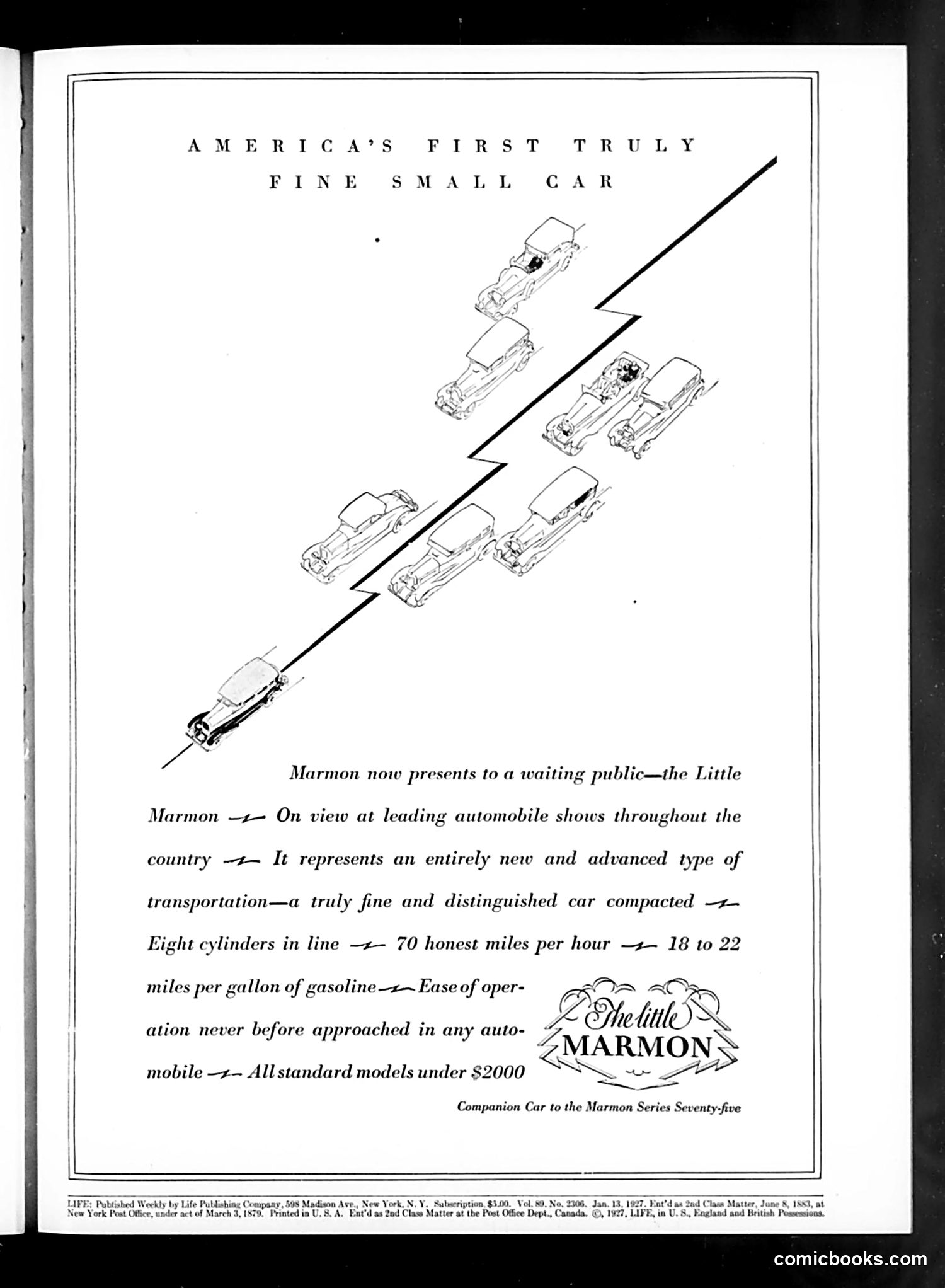
This page is primarily **advertising, not satire or political commentary**. It promotes the "Little Marmon," described as "America's First Truly Fine Small Car." The content is a straightforward product advertisement featuring: - Multiple illustrated views of the compact automobile - Marketing claims: eight-cylinder engine, 70 mph capability, 18-22 mpg fuel efficiency, under $2000 price - Emphasis on advanced engineering and ease of operation The diagonal zigzag lines organizing the car illustrations appear purely decorative/compositional rather than satirical. The Marmon logo concludes the ad, identifying it as a "Companion Car to the Marmon Series Seventy-five." This represents typical 1920s automotive advertising—no political message or satire is evident.
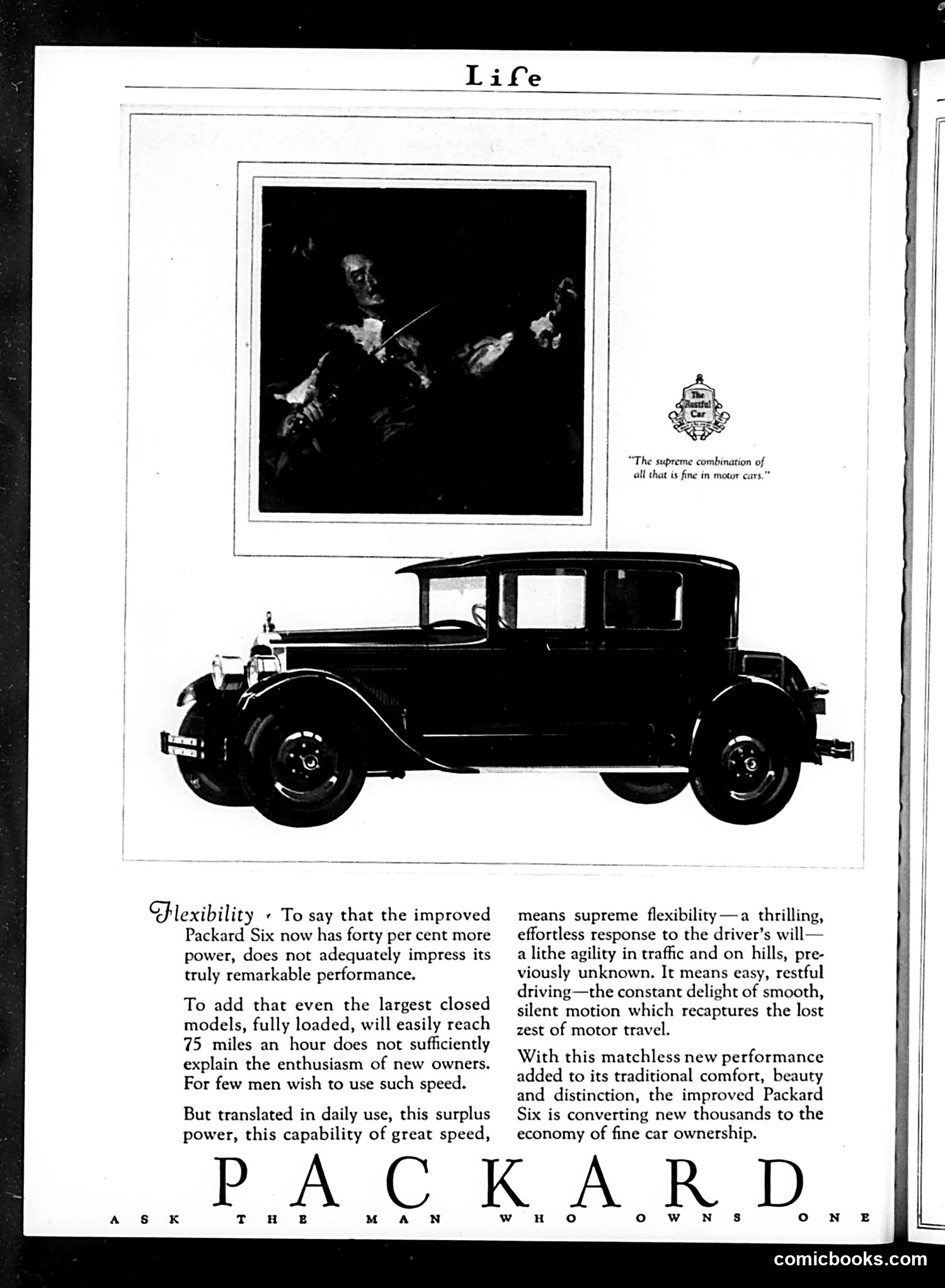
This page is **primarily an advertisement for Packard automobiles**, not satire or political commentary. The top image appears to be a classical or historical painting (subject unclear from reproduction quality), used decoratively to establish luxury and prestige. The accompanying tagline—"The supreme combination of all that is fine in motor cars"—connects high culture to the product. The main content discusses the improved Packard Six's performance: increased power, speed capability (75 mph), and "flexibility" for daily driving. The text emphasizes how the car combines practical performance with traditional comfort and "beauty and distinction." This is straightforward automotive marketing leveraging cultural refinement and technical specifications to appeal to wealthy consumers, not satire or social commentary.
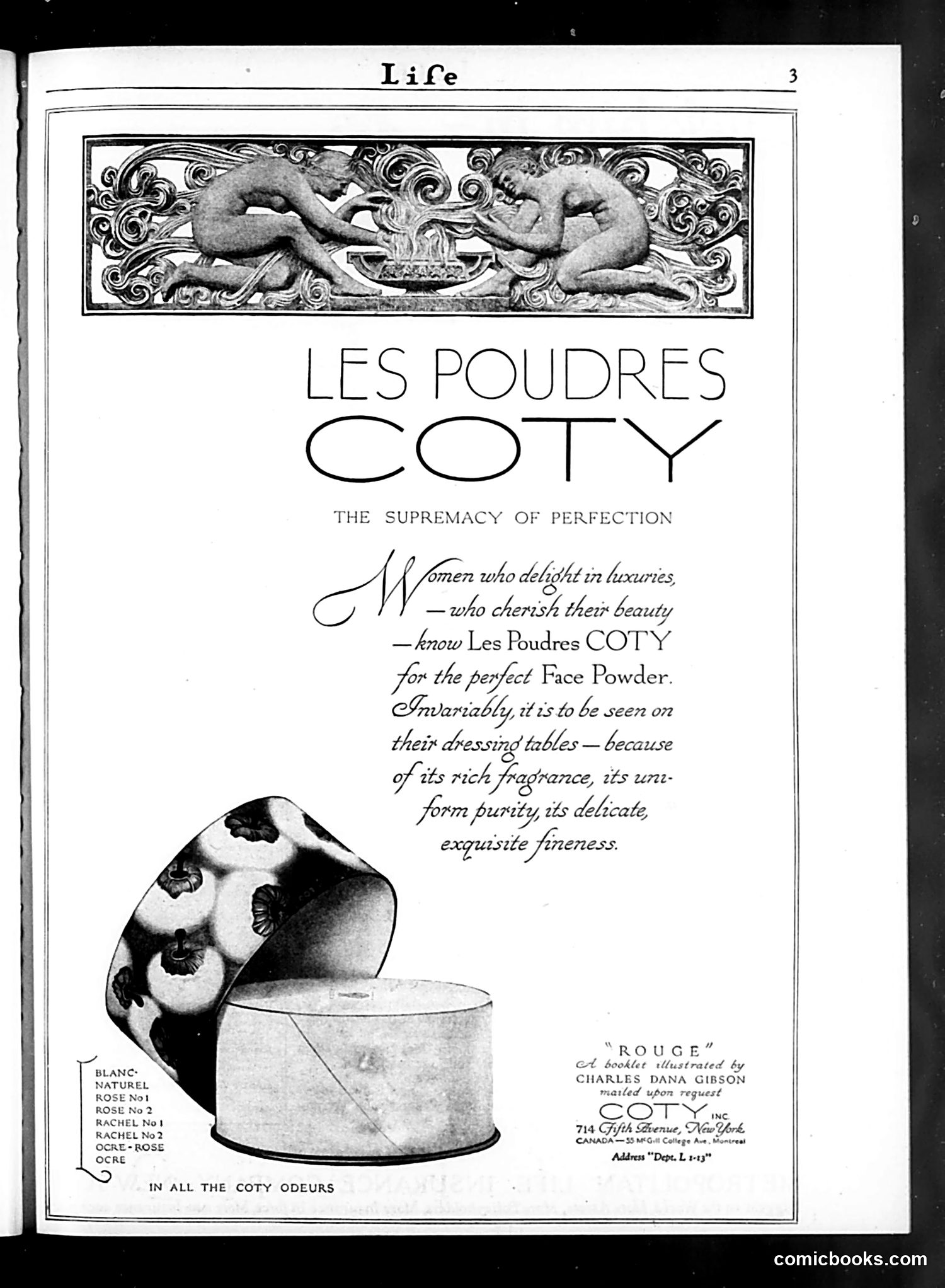
This page is **primarily an advertisement**, not a political cartoon. It promotes "Les Poudres COTY," a luxury face powder brand, presented in *Life* magazine (page 3). The decorative header shows two classical cherubs flanking an ornamental urn—standard Art Deco aesthetic for high-end cosmetics advertising of this era. The text uses period-appropriate luxury marketing language, targeting wealthy women who "delight in luxuries" and "cherish their beauty." It emphasizes the powder's "rich fragrance," "uniform purity," and "exquisite fineness." The product image shows an ornate powder box with decorative patterning. Listed shades include "Blanc," "Naturel," "Rose," and "Rachel." **There is no satirical content or political commentary**—this is straightforward premium cosmetics marketing positioned within *Life*'s pages, reflecting early 20th-century advertising practices in literary magazines.
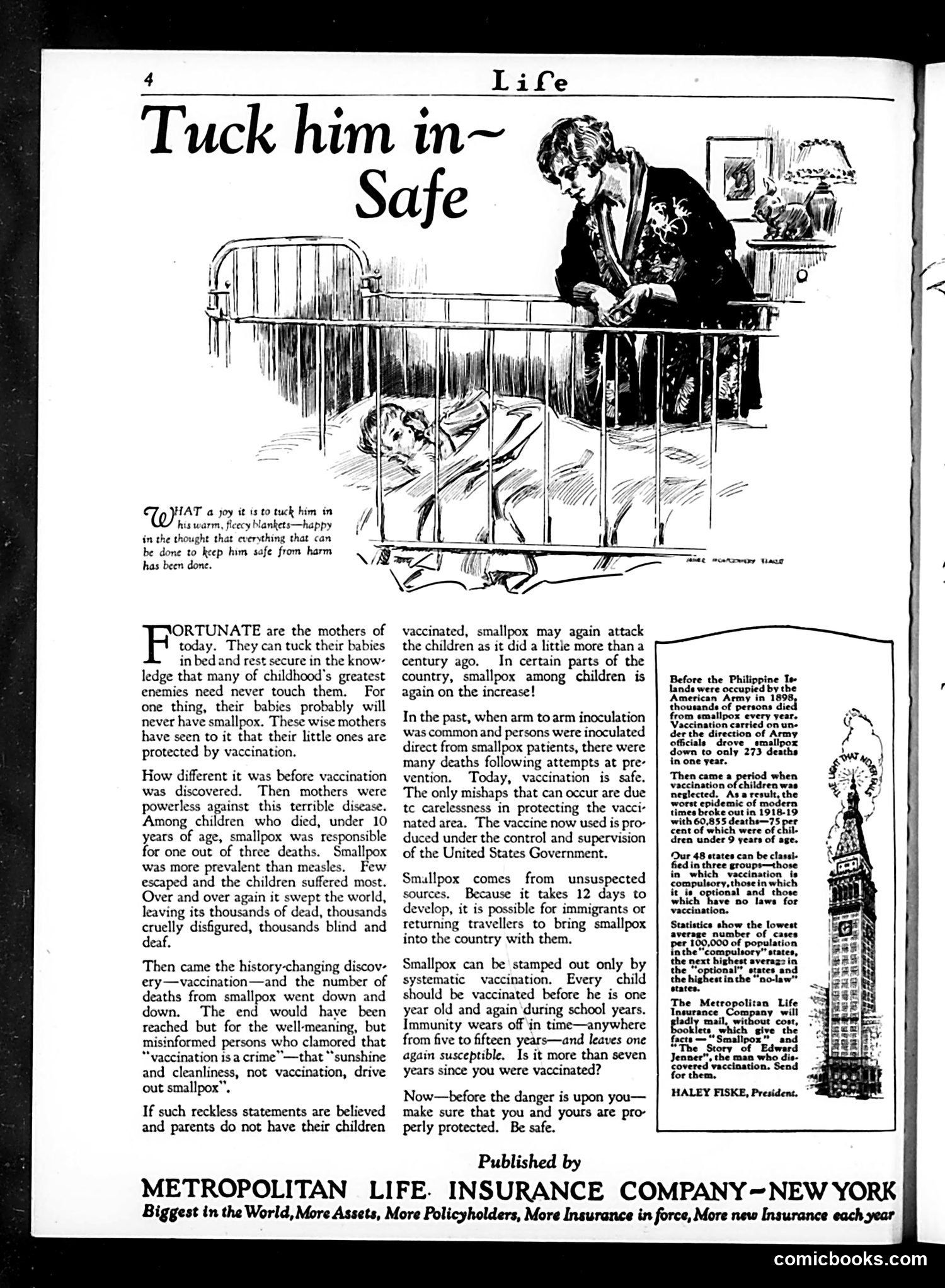
This Metropolitan Life Insurance advertisement promotes childhood vaccination against smallpox. The illustration shows a mother tucking a child safely into bed, with the headline promising security through vaccination. The text argues that mothers can now protect children from smallpox—historically a devastating childhood disease—through safe vaccination under government supervision. It contrasts this with the pre-vaccination era, when smallpox killed thousands, often disfiguring survivors. The ad addresses parental hesitation by emphasizing vaccination's safety and necessity, noting that immunity fades over time. The emotional appeal—a child "safe" in bed—suggests that vaccination provides the peace of mind mothers seek. This is primarily insurance company advertising rather than political satire, promoting public health while marketing life insurance protection.
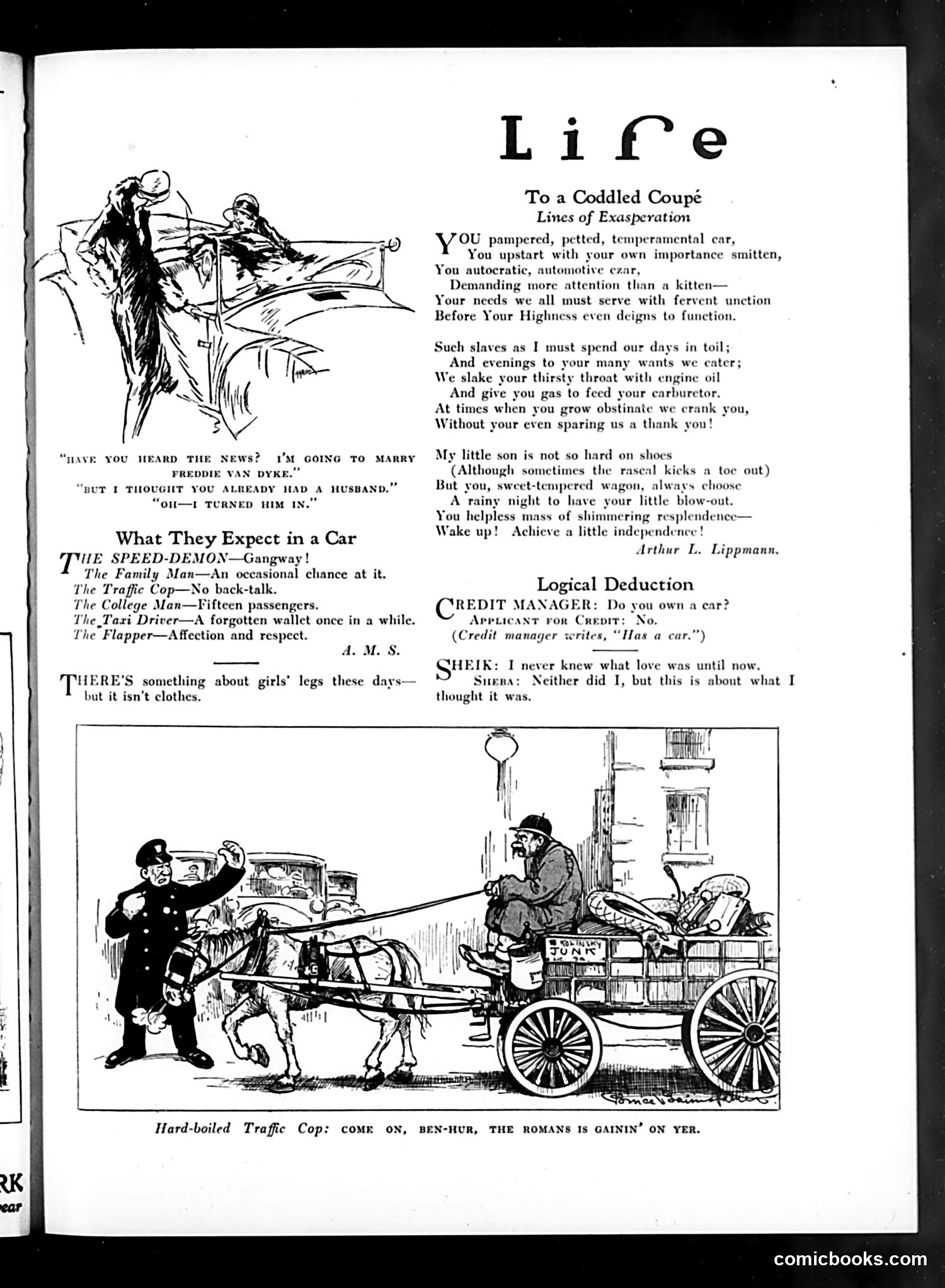
This page satirizes early automotive culture and gender dynamics. The poem "Life: To a Coddled Coupé" mocks pampered car owners—depicted as demanding and spoiled. It contrasts them with working people ("slaves") who maintain vehicles while receiving no gratitude. The section "What They Expect in a Car" humorously lists different driver stereotypes: the speed-obsessed "Family Man," the evasive traffic violator, the college student, the taxi driver, and the "Flapper" (fashionable young woman). The bottom cartoon shows a traffic cop stopping a horse-drawn cart, titled "Hard-boiled Traffic Cop." This juxtaposes old-fashioned transportation with modern enforcement, satirizing how automobile regulations were becoming absurdly stringent even as society was transitioning from horses to cars. The overall tone criticizes both automotive entitlement and overzealous traffic policing.
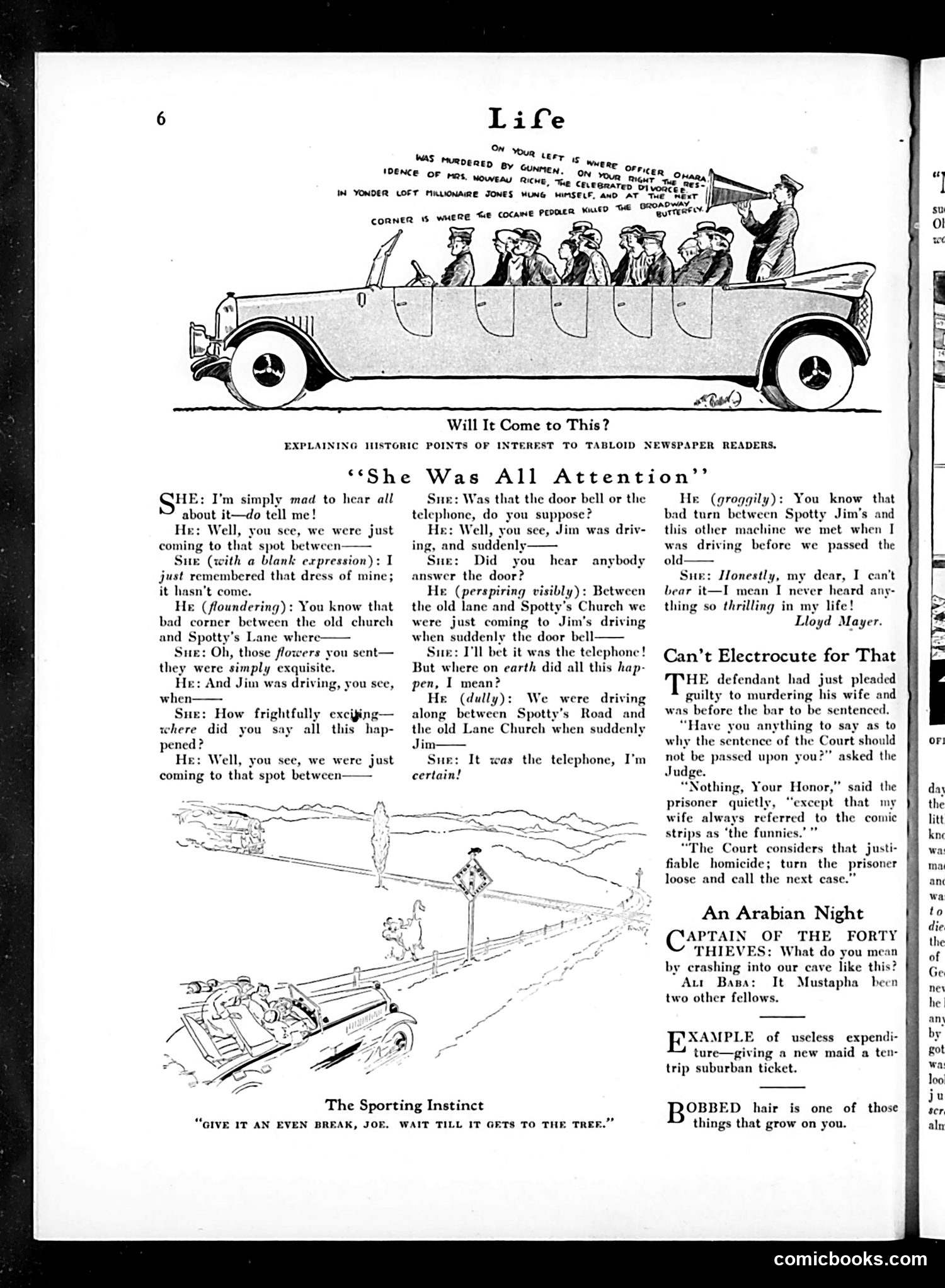
This page contains three distinct pieces of satire: 1. **"Will It Come to This?"** - The top cartoon depicts a car full of well-dressed passengers with a man using a megaphone. The caption suggests satirizing the growing use of automobiles and possibly concerns about noise pollution or reckless driving culture in early 20th-century America. 2. **"She Was All Attention"** - A dialogue-based comic mocking miscommunication between a couple about a car accident, playing on the confusion between a doorbell and automobile noise. 3. **"The Sporting Instinct"** - A landscape scene showing a car chase or reckless driving scenario, captioned with working-class dialogue suggesting satire of dangerous driving behavior. These pieces collectively mock emerging automobile culture and the social disruptions it caused in early American society.
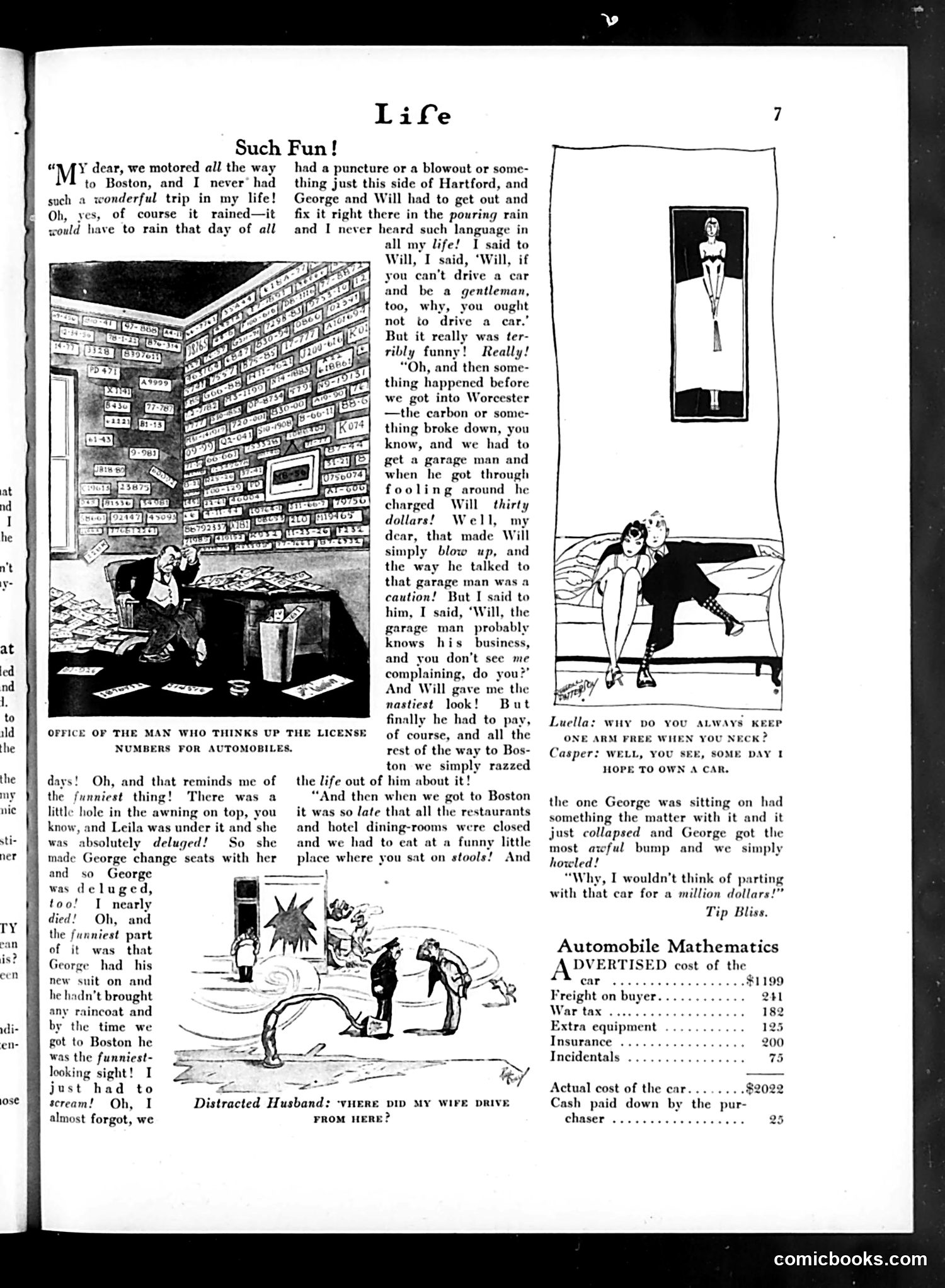
This page satirizes early automobile ownership through humorous anecdotes. The main narrative mocks the complications and expense of car ownership—including breakdowns, repairs, and unexpected costs that accumulate during a trip to Boston. The cartoon "Office of the Man Who Thinks Up the License Numbers for Automobiles" depicts a cluttered office overwhelmed with license plate combinations, satirizing bureaucratic absurdity in vehicle registration. The "Automobile Mathematics" section exposes the real cost of car ownership, showing that while advertised at $1,199, actual expenses (freight, taxes, insurance, incidentals) total $9,022—nearly eight times the sticker price. This was likely meant to satirize aggressive marketing tactics and hidden costs facing early 20th-century automobile buyers, making car ownership appear far more expensive than advertisements suggested.
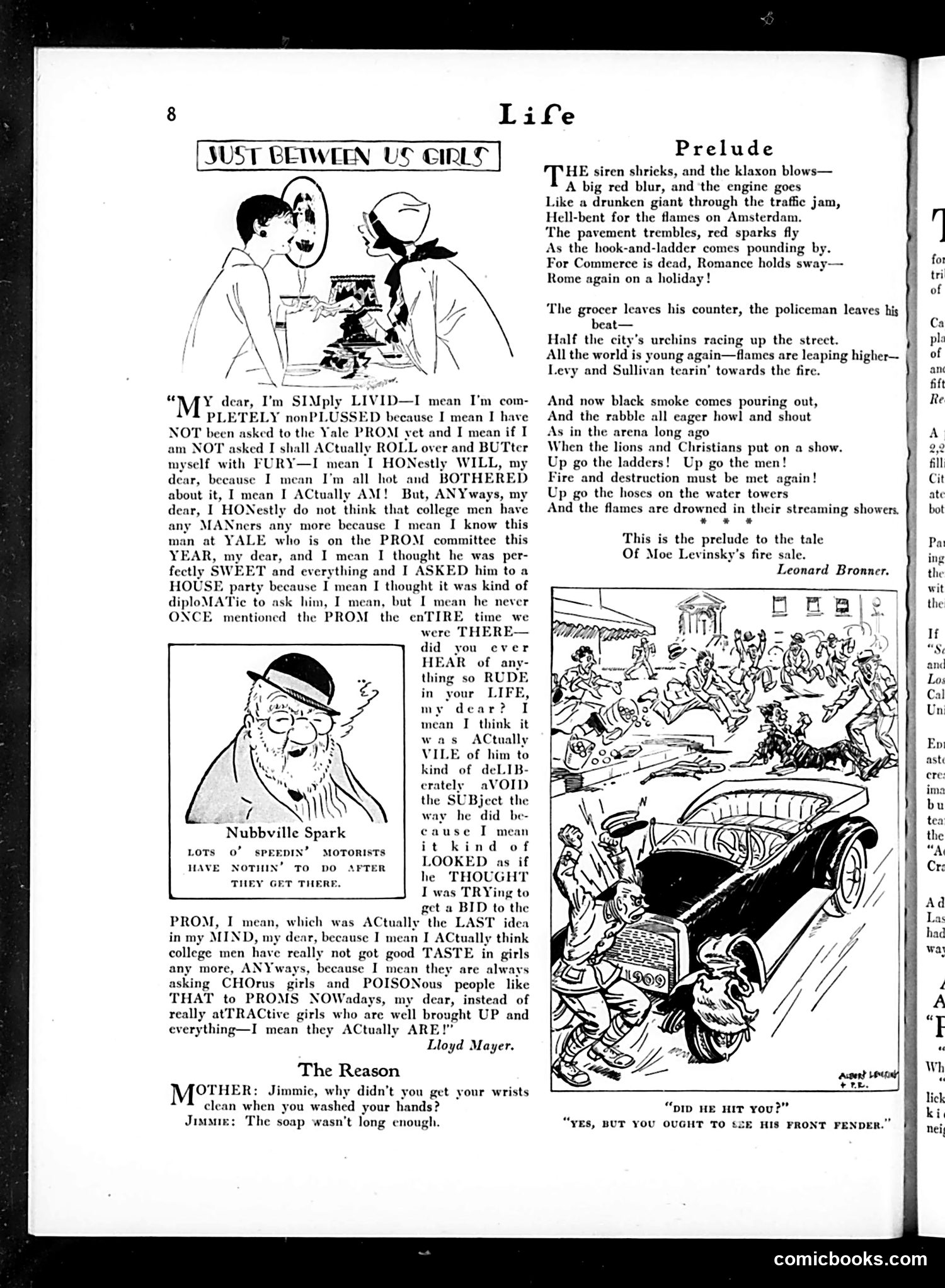
This page contains several humorous pieces mocking social conventions of the era: **"Just Between Us Girls"** presents an exaggerated monologue by a young woman complaining about being called "livid" and "nonplussed" at a prom, then contradicting herself repeatedly while criticizing college men's behavior and taste in girls. **"The Reason"** is a brief joke about a mother asking why her son didn't wash his wrists—he claims the soap wasn't long enough. **"Prelude"** is a poem by Leonard Bronner describing urban chaos and fire, introducing a story about Moe Levinsky's fire sale. The illustration shows a car accident scene with the caption "Did he hit you?" / "Yes, but you ought to see his front fender"—a typical joke format mocking insurance claims and defensive driving excuses common to the period.
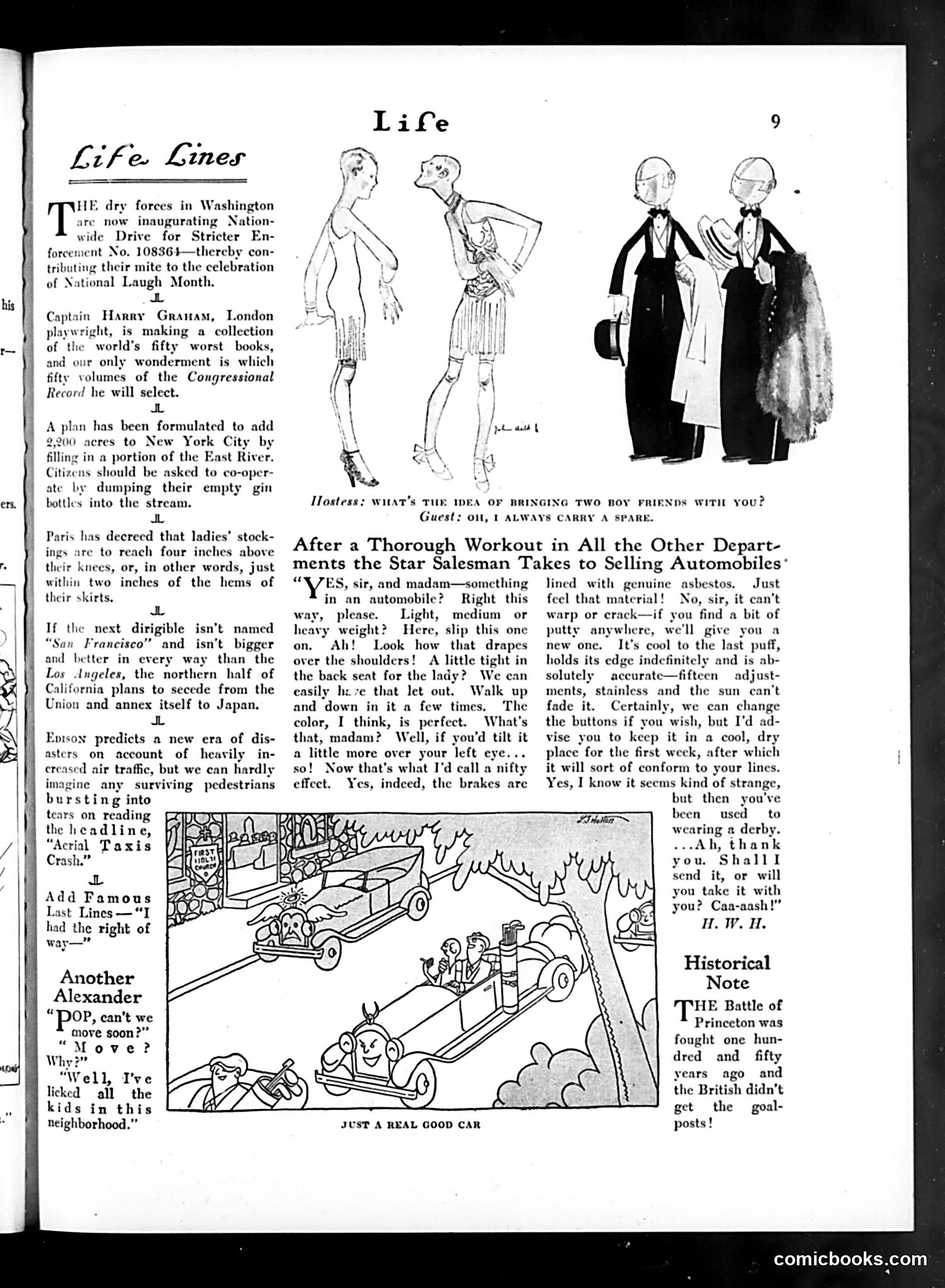
This page contains humor and social commentary typical of early 20th-century Life magazine. **"Life Lines" column** includes brief satirical items about contemporary issues: Washington's "Stricter Enforcement" of National Laugh Month, Captain Harry Graham's collection of "world's fifty worst books," and Paris fashion dictating that women's stockings reach four inches above the knee—presented as absurd news items. **Main cartoon "Just a Real Good Car"** satirizes automobile salesmen's exaggerated pitch tactics. The salesman discusses impractical features (color, drapes, brake positioning) with overwrought enthusiasm, while the caption emphasizes the deception involved in car sales. The comic shows multiple vehicles in a showroom-like setting, mocking how salesmen prioritize style over substance. The humor targets both salesmen's dishonesty and consumer gullibility regarding new automobiles.
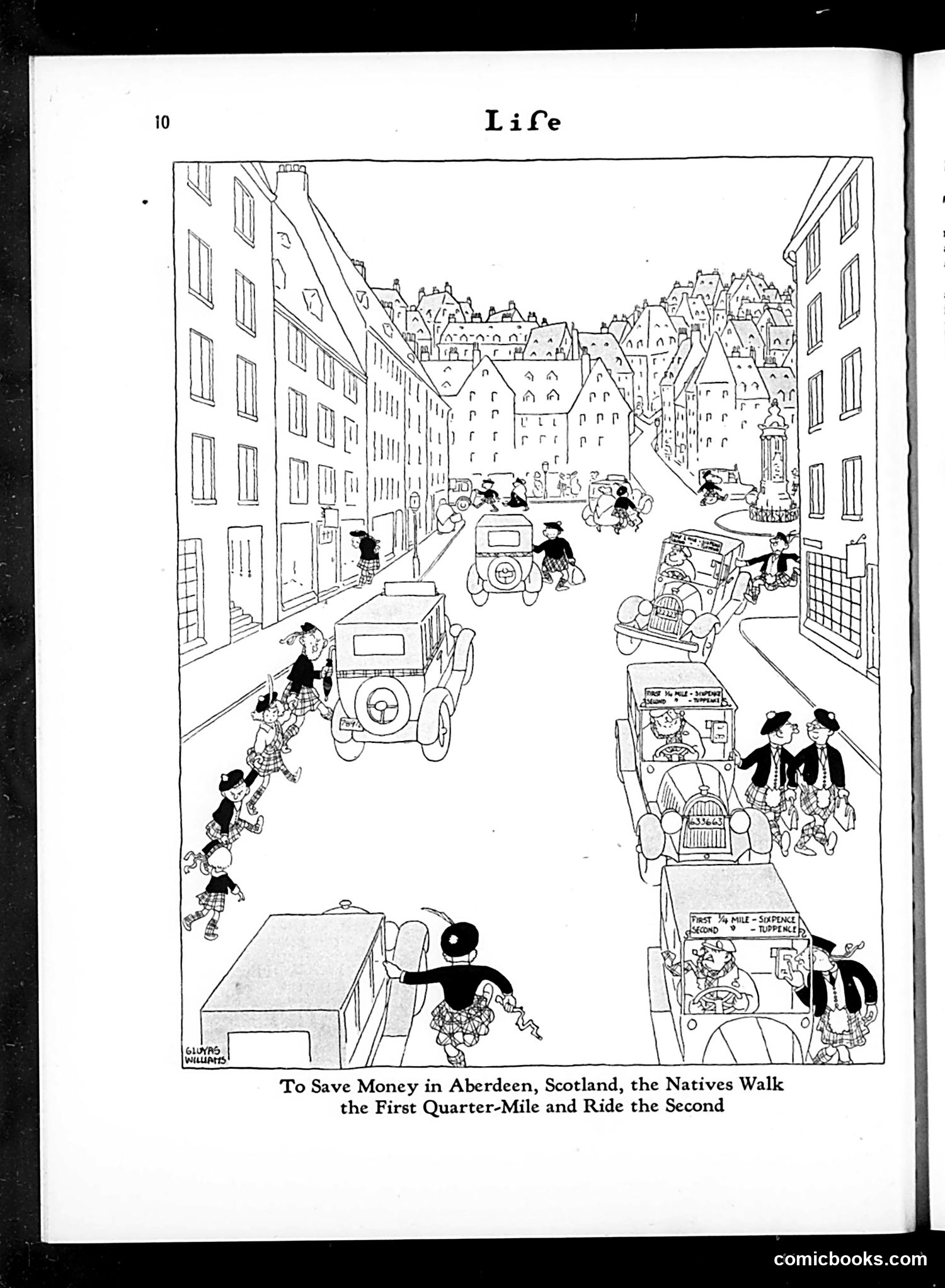
This is a humorous cartoon satirizing Scottish frugality, specifically targeting residents of Aberdeen. The joke plays on the stereotype of Scots being extremely thrifty or miserly. The illustration shows a street scene where locals practice an economical transportation method: they walk the initial quarter-mile of a journey, then ride in vehicles (appearing to be shared taxis or buses) for the remaining distance. This absurd compromise—splitting short trips between walking and riding—is presented as a typical money-saving strategy among Aberdonians. The cartoon relies on period ethnic/regional stereotyping common in early 20th-century American humor magazines, mocking Scottish cultural attitudes toward spending.
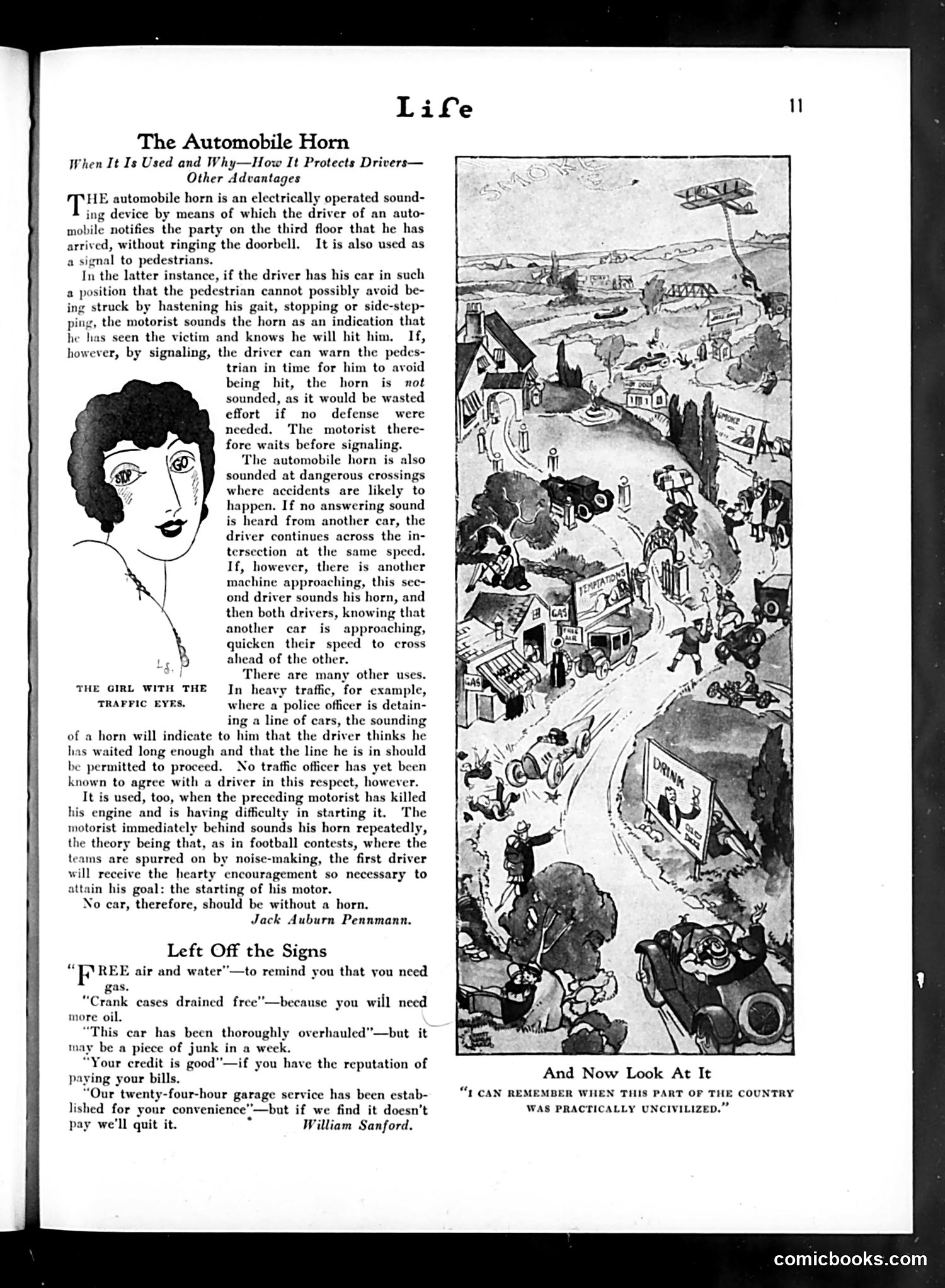
This page contains two articles about early automobile safety and etiquette. **"The Automobile Horn"** discusses when drivers should use horns to warn pedestrians and other vehicles. The accompanying illustration shows "The Girl with the Traffic Eyes"—a woman with exaggerated eyes marked with "60" (likely referring to speed), satirizing women drivers' supposed obliviousness to traffic dangers. The article humorously compares horn-sounding to football teams' noise-making for encouragement. **"Left Off the Signs"** is a brief satire by William Sanford mocking garage service claims. It jokes that garages advertise "free" services (air, water, drained cases) but conveniently omit mentioning actual costs—suggesting garages are unreliable and dishonest about hidden fees. Both pieces reflect 1920s anxieties about automobile safety, traffic culture, and consumer trust.
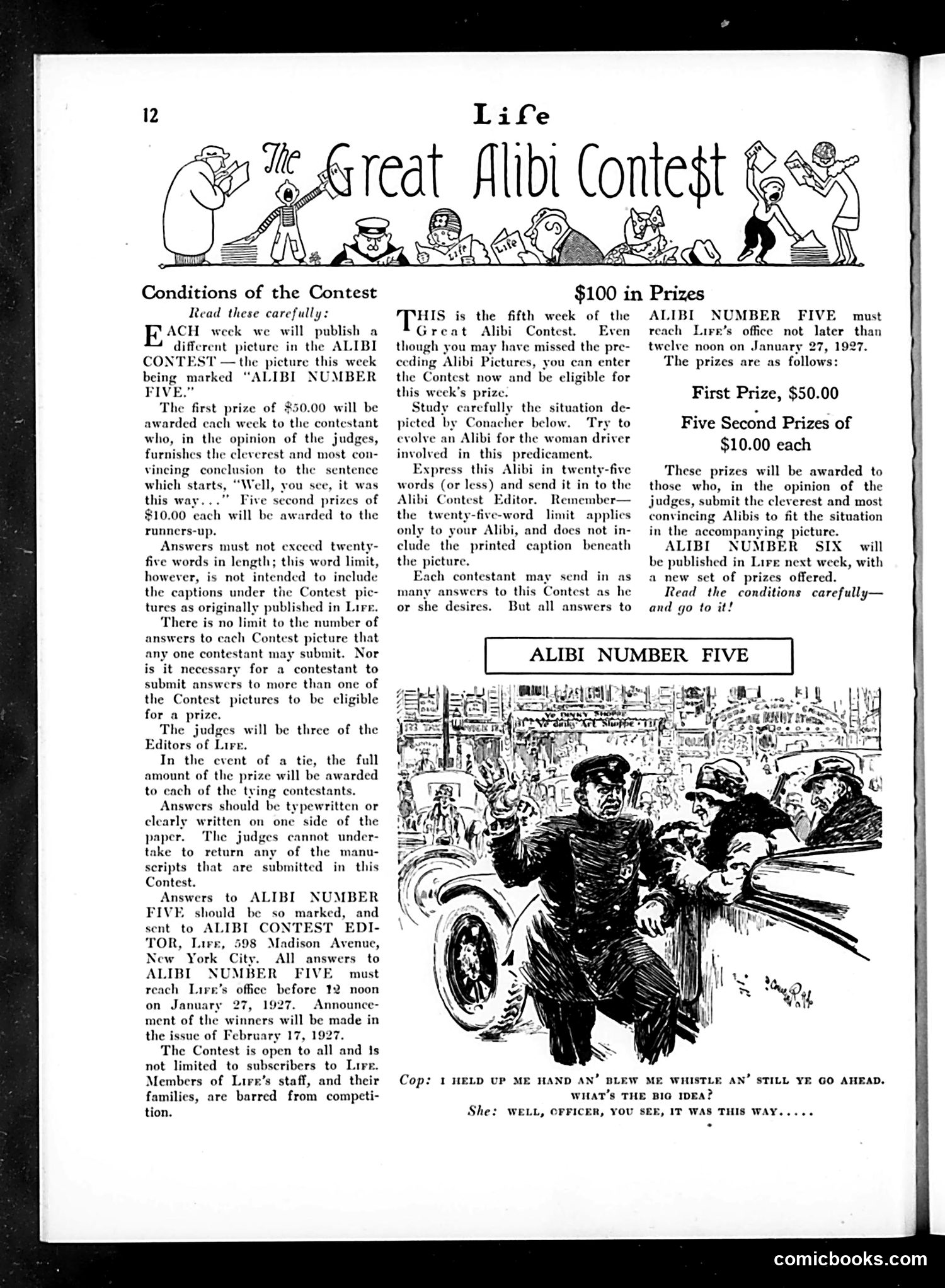
This page announces Life magazine's fifth weekly "Alibi Contest," offering $100 in prizes ($50 first place, five $10 second places). The featured cartoon depicts a traffic stop: a police officer has pulled over a car driven by a woman. The officer says "I HELD UP ME HAND AN' BLEW ME WHISTLE AN' STILL YE GO AHEAD. WHAT'S THE BIG IDEA?" The woman responds "WELL, OFFICER, YOU SEE, IT WAS THIS WAY....." The joke plays on the contest's theme: the woman is about to offer an "alibi"—an excuse or explanation for her traffic violation. The cartoon satirizes both female drivers (a common comedy target in the 1920s) and the universal human tendency to offer elaborate justifications when caught breaking rules. Readers could submit their own humorous alibis to win prizes.
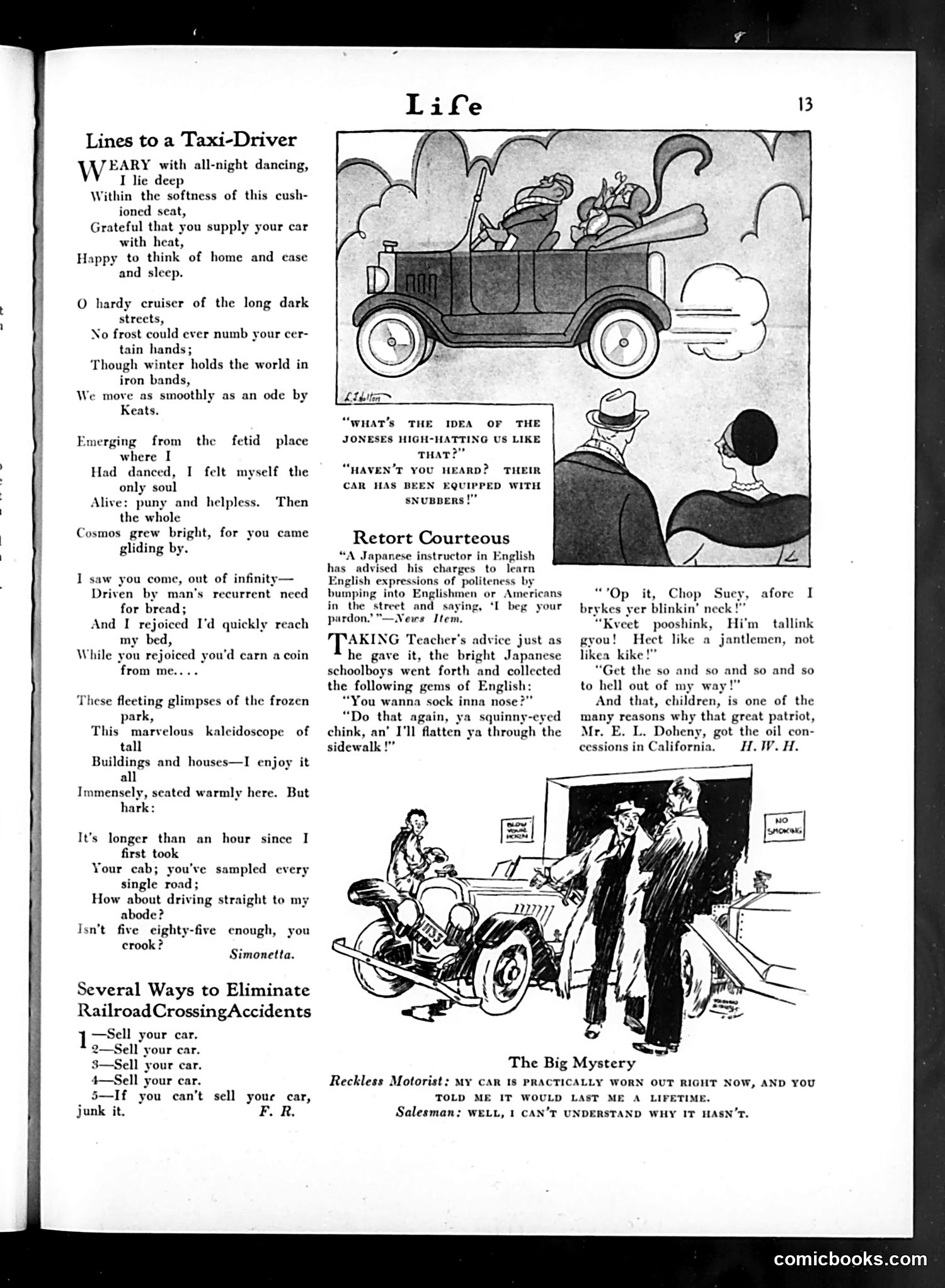
This page contains three unrelated humorous pieces targeting early automotive culture: 1. **"Lines to a Taxi-Driver"** (poem): Praises taxi drivers as hardworking heroes navigating dark city streets, suggesting their service is underappreciated—a romanticization of working-class labor. 2. **"Retort Courteous"**: A cartoon mocking Japanese English-language instruction. It portrays a Japanese instructor teaching crude English slang to students, who then awkwardly repeat phrases like "You wanna sock inna nose?" The joke relies on ethnic stereotyping, suggesting Japanese people produce comical, incorrect English. 3. **"Several Ways to Eliminate Railroad Crossing Accidents"**: A darkly humorous list sardonically suggesting car owners simply sell their vehicles to prevent accidents—critiquing reckless drivers and automobile safety concerns of the era. The satire generally targets automotive culture, linguistic mishaps, and working-class experience.
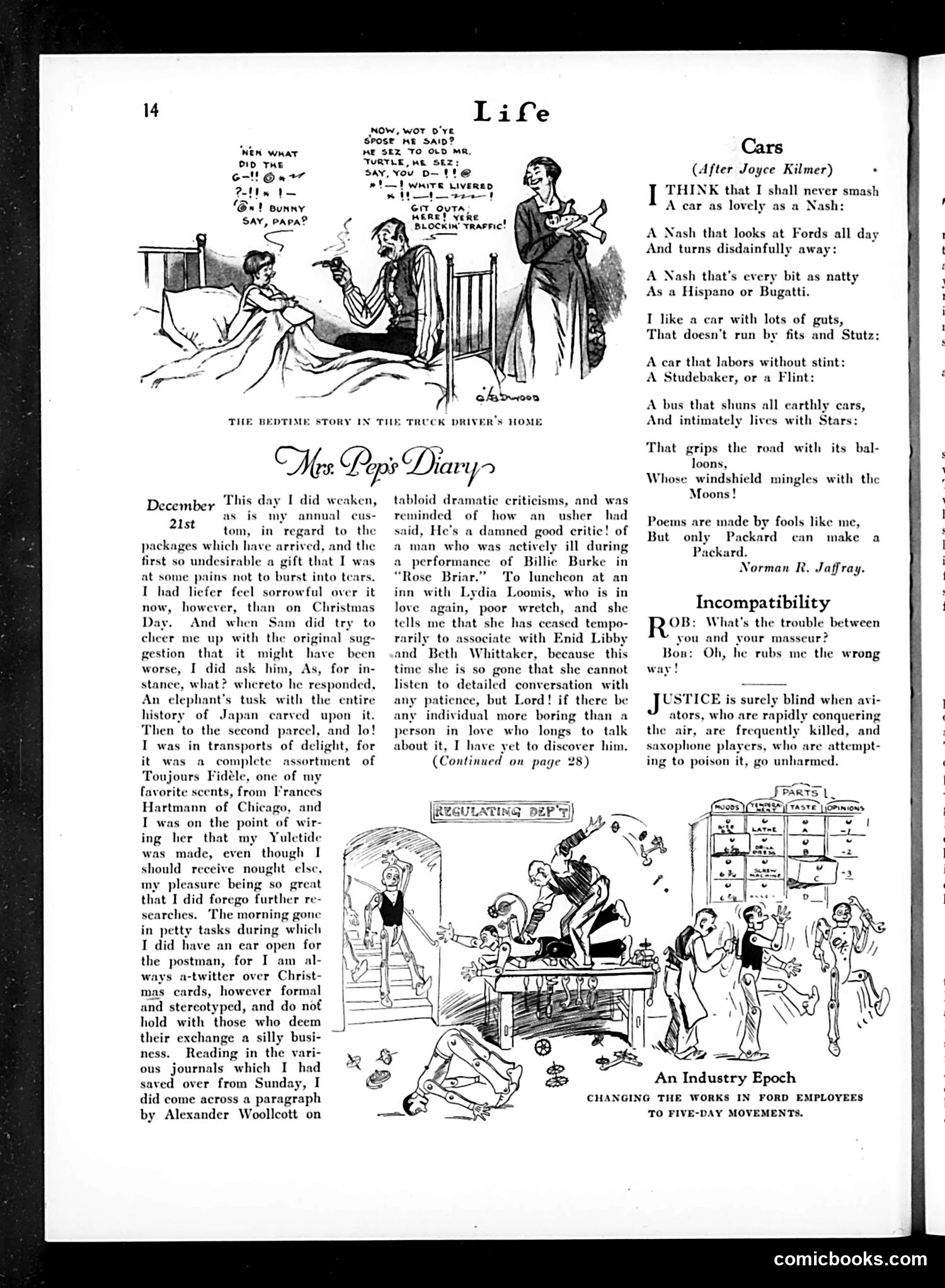
This page from *Life* magazine contains three distinct pieces: 1. **"The Bedtime Story in the Truck Driver's Home"** (top cartoon): A humorous domestic scene showing a truck driver telling his children a bedtime story, with speech bubbles containing exaggerated truck-driver dialect and slang—satirizing how working-class men speak and the rough language they use around children. 2. **"Cars" poem** (right): A lighthearted verse mocking American automobile culture and brand preferences, particularly Nash and Packard vehicles—poking fun at car enthusiasts' devotion to specific makes. 3. **"An Industry Epoch"** (bottom cartoon): Depicts Ford factory workers adjusting to a five-day work week (vs. the traditional six-day schedule), showing the organizational chaos and human adjustment this labor reform caused in manufacturing plants. All three pieces reflect 1920s-era American working-class life and industrial changes.
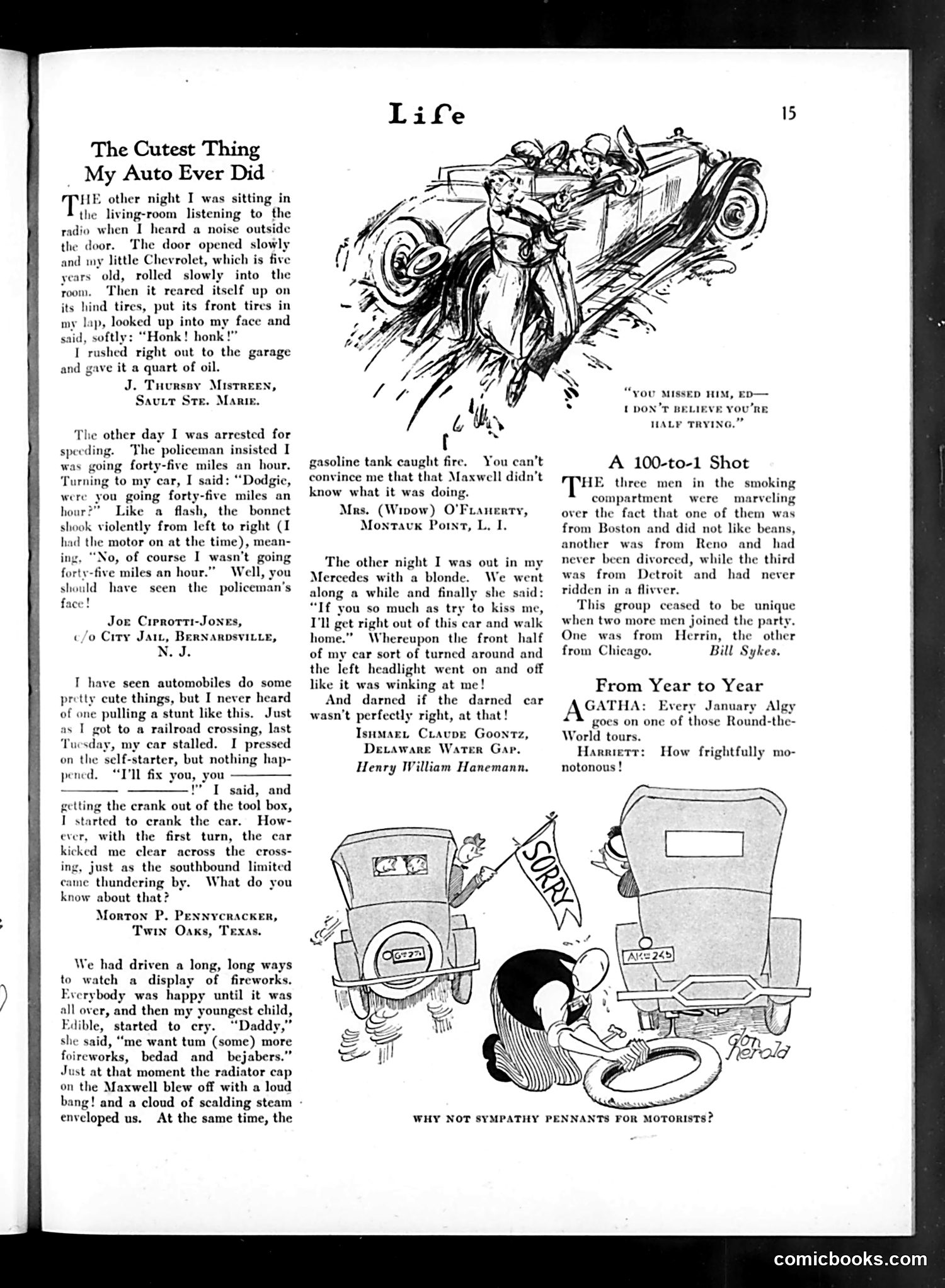
This page contains humorous anecdotes about automobile mishaps, reflecting early 20th-century car culture anxieties. **"The Cutest Thing My Auto Ever Did"** collects reader submissions about vehicle malfunctions—a Chevrolet that honks and self-lubricates, a car stalling at a railroad crossing, and a vehicle with a malfunctioning headlight. **"A 100-to-1 Shot"** jokes about three men in a smoking compartment, one of whom had never been divorced—presented as statistically improbable. **"From Year to Year"** mocks Agatha's predictable annual Round-the-World tours. The bottom cartoon, **"Why Not Sympathy Pennants for Motorists?"** depicts a disabled vehicle with flat tire, sarcastically suggesting motorists deserve sympathy emblems like soldiers displayed. The satire targets early automobiles' unreliability and motorists' various predicaments.
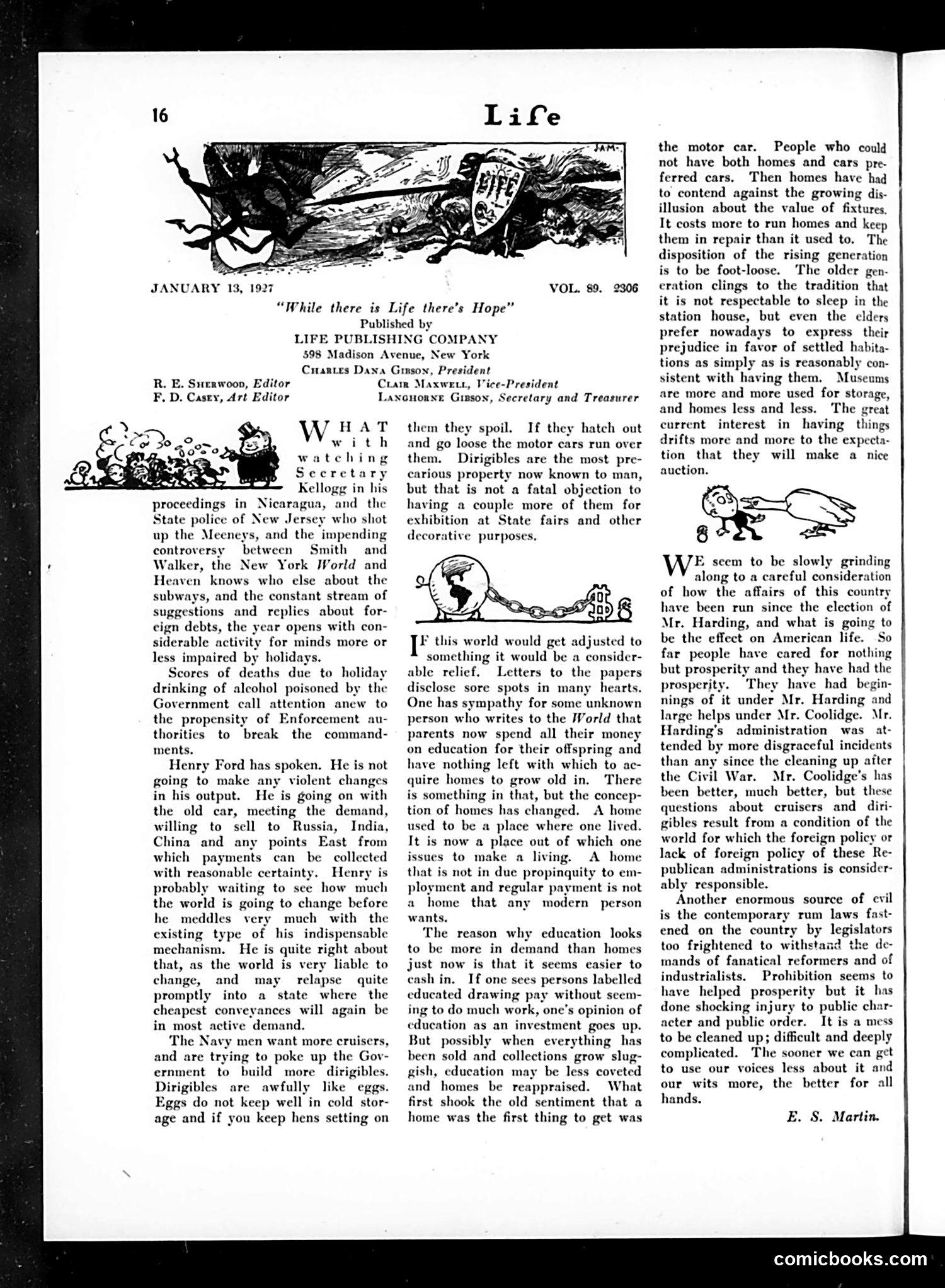
This page contains editorial commentary rather than political cartoons. The main illustrated elements are small decorative vignettes—a sleeping figure and a globe wrapped in chain. The editorial discusses Henry Ford's recent statements about future industrial changes. It critiques how Americans obsess over prosperity while ignoring deeper social problems. The text references the Harding administration's record and discusses contemporary issues: housing conditions, education funding, Prohibition's failures, and rum laws. The cartoon elements are minimal and illustrative rather than satirical. The globe-in-chains image appears to symbolize economic constraints or global problems. The overall tone is pessimistic about American society's priorities under current leadership, suggesting citizens care only about material wealth despite widespread social ills.
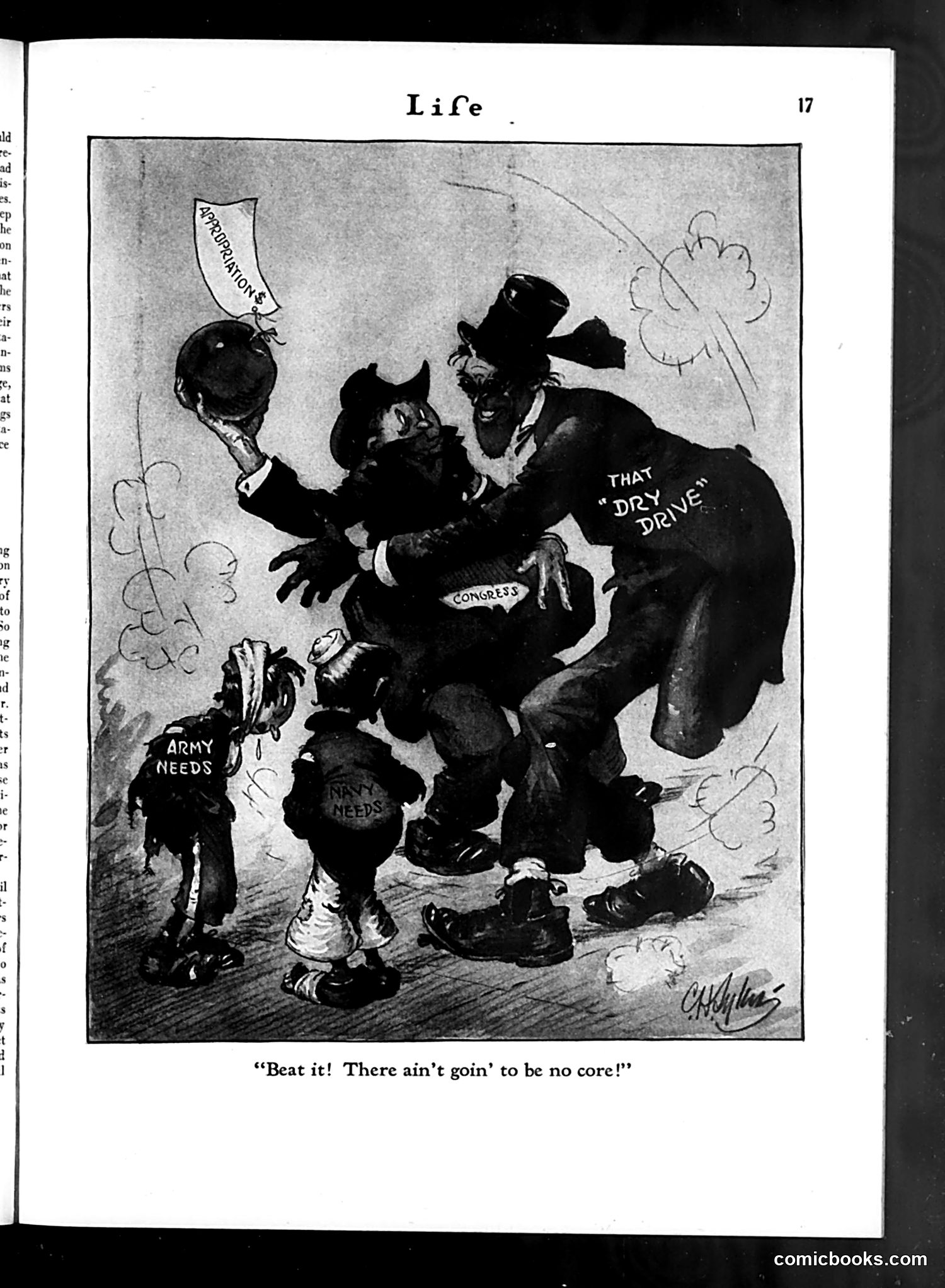
This political cartoon depicts three figures in top hats labeled "Congress," "Army Needs," and "Navy Needs" juggling a globe marked "Reprehensions" while a tall figure labeled "That Dry Drive" watches. One small figure is marked "Army Needs." The satire criticizes Congressional inability to balance competing military budget demands during what appears to be a military appropriations debate. The "dry drive" likely references Prohibition-era politics or a specific legislative initiative. The cartoon suggests Congress is struggling to manage the globe (world affairs) while juggling contradictory military and naval expenditure requests, implying governmental incompetence or comic mismanagement of resources and priorities during a tense period.
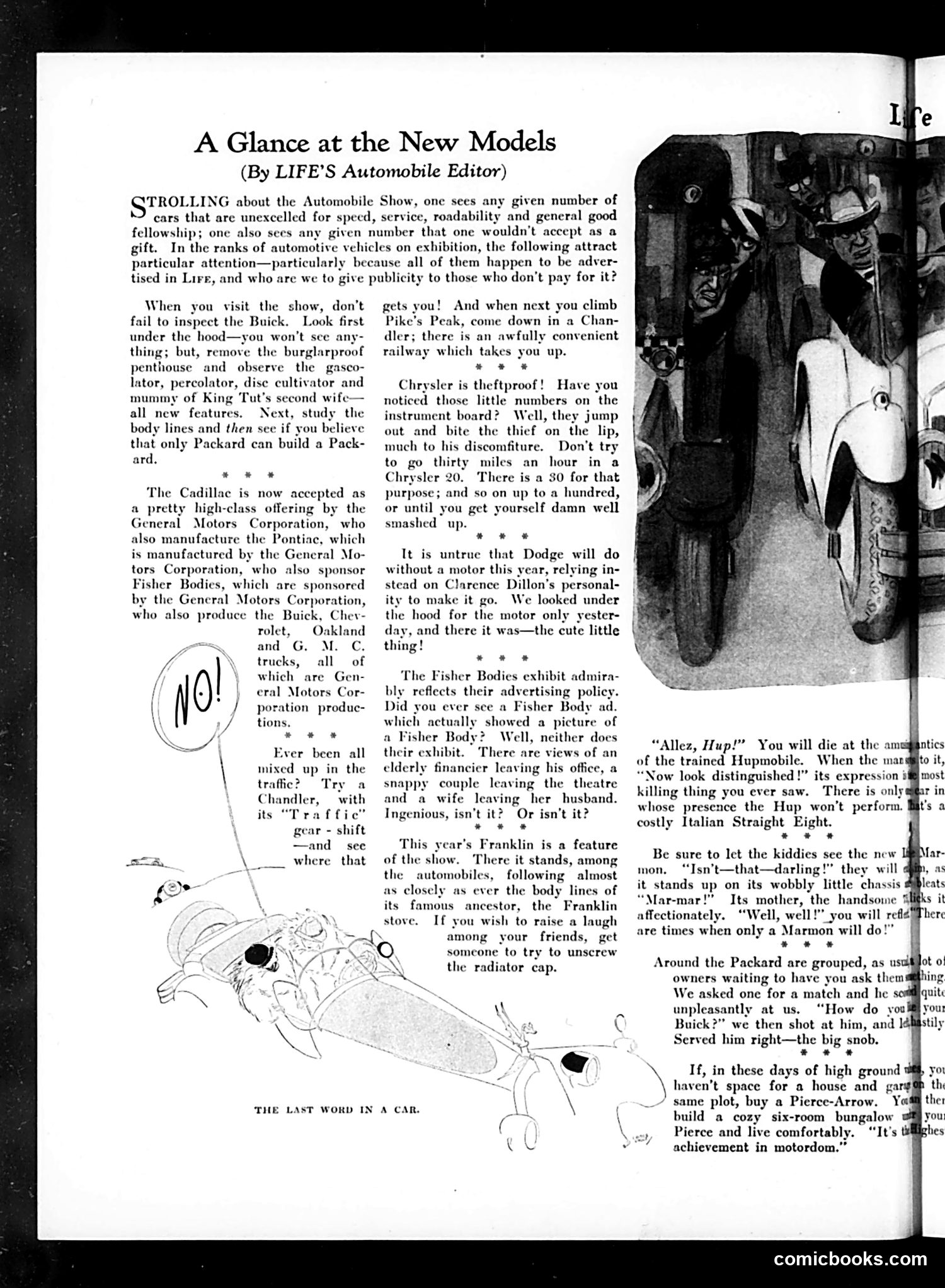
This is satirical automotive journalism from Life magazine's "Automobile Editor," poking fun at car manufacturers and their advertising claims at an auto show. The main joke: Life's editor mocks cars **advertised in Life itself**, openly admitting the magazine gives favorable coverage to paying advertisers while dismissing non-advertisers. This is self-aware satire about media corruption. Specific targets include: - **General Motors' monopoly**: Cadillac, Pontiac, Buick, Chevrolet all owned by GM—mocked for circular corporate ownership - **Absurd marketing claims**: Chrysler's "thief-proof" numbers; Dodge's implied motorlessness; Franklin's resemblance to a stove - **Fisher Bodies' ads**: Criticized for never showing actual car bodies, only lifestyle imagery - **Packard owners**: Portrayed as snobbish elites The cartoon ("The Last Word in a Car") appears to be a mechanical diagram joke, though details are unclear. The humor relies on readers' familiarity with specific 1920s car models and their advertising campaigns—now obscure references.
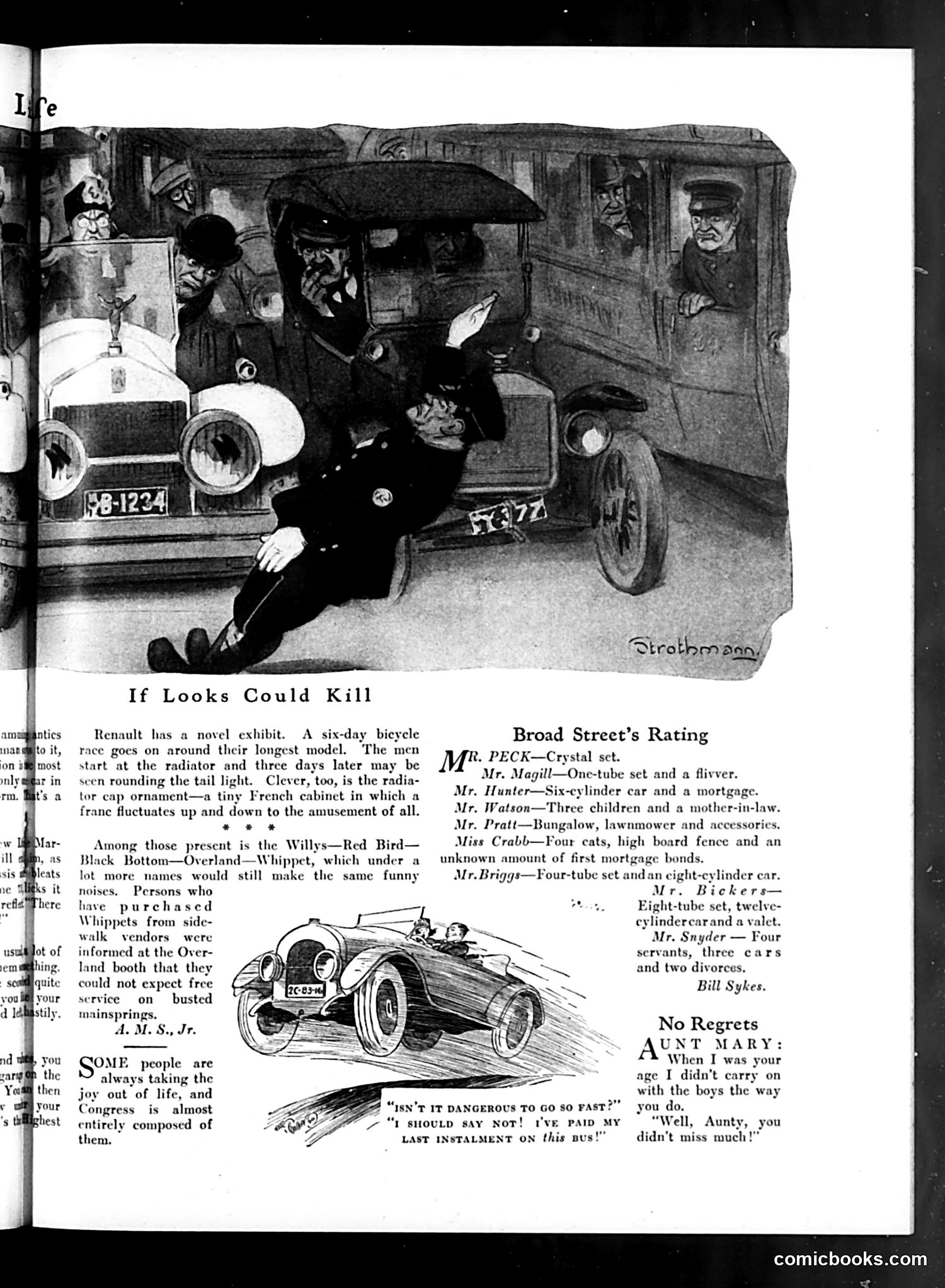
This page satirizes 1920s American consumer culture and automobiles. The top cartoon, "If Looks Could Kill," mocks the Renault automobile exhibit featuring a six-day bicycle race around their car—absurd marketing theater. The humor targets both the car industry's gimmickry and the various American car brands (Willys, Whippet, Overland) competing for buyers, suggesting they all make identical "funny noises." The "Broad Street's Rating" section humorously ranks people by their possessions—crystal radios, cars, mortgages, children, and servants—satirizing how 1920s Americans defined social status through consumer goods. The bottom cartoon jokes about reckless driving and installment purchasing. A driver speeds dangerously but claims he's paid off his bus payment, so driving fast is justified. The final exchange between "Aunt Mary" and her niece mocks generational differences about dating behavior, a recurring 1920s anxiety about youth morality. Overall: satire of consumerism, automobile culture, and social anxieties of the Jazz Age.
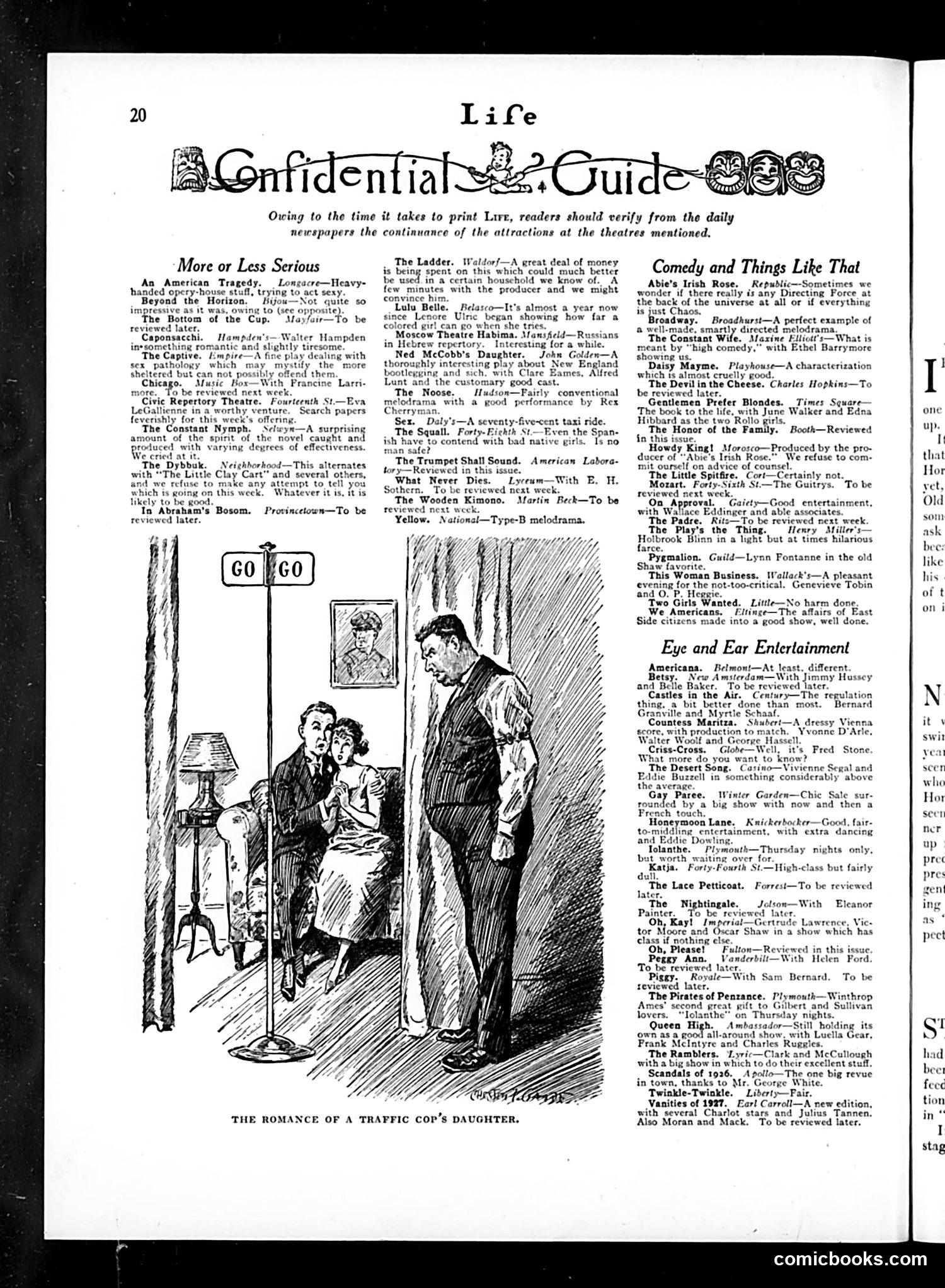
This page from Life magazine's "Confidential Guide" consists primarily of **theater reviews and listings**, not political cartoons. The single illustration—captioned "The Romance of a Traffic Cop's Daughter"—depicts a humorous domestic scene: a young couple sits together while a stern traffic cop stands in the doorway, suggesting parental disapproval of the romance. The illustration plays on a common early-20th-century social anxiety: the "respectable" working-class father objecting to his daughter's suitor. The traffic cop represents civic authority and working-class dignity, making the scenario both relatable and comedic to Life's audience. The extensive theater reviews use satirical commentary—sometimes caustic, sometimes affectionate—to assess current Broadway productions. References like "Abie's Irish Rose" and "Gentlemen Prefer Blondes" were popular hits of the era. The tone is sophisticated mockery aimed at theater-goers familiar with current productions.
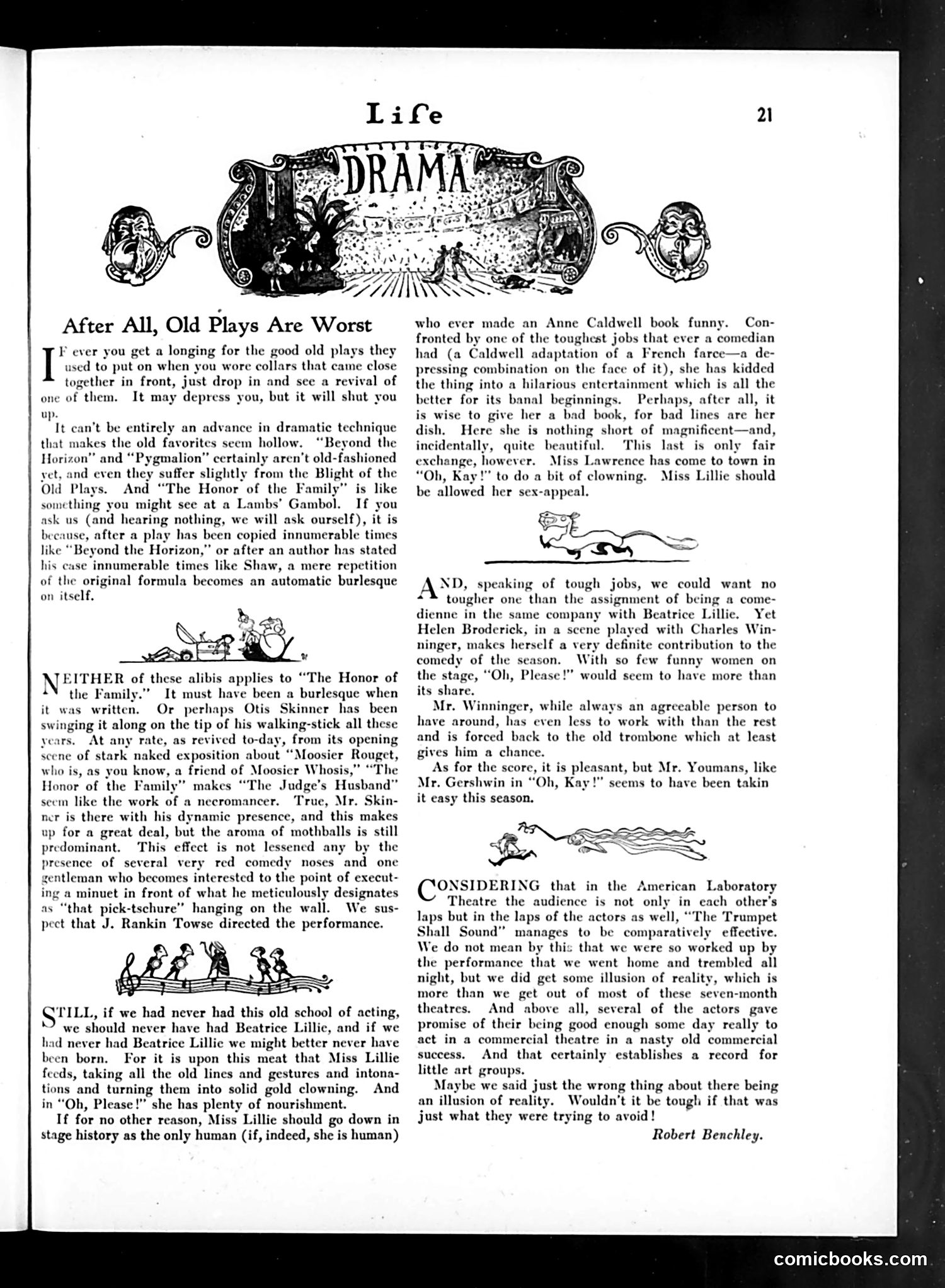
This is a theater review by Robert Benchley critiquing Broadway revivals and current productions. The piece contrasts tired old plays with fresh comedic talent. **Key figures mentioned:** - **Beatrice Lillie** - a comedienne praised as brilliantly transforming weak material into "solid gold clowning" - **Otis Skinner** - an aging actor in "The Honor of the Family," a revival the reviewer finds dated despite Skinner's "dynamic presence" - **Helen Broderick** and **Charles Winninger** - supporting players in "Oh, Please!" (a current production) - **Anne Caldwell** - writer of weak theatrical material that even talented performers struggle with **The satire:** Benchley argues that old plays, when revived repeatedly, become self-parodies—their formulas grow stale. However, he celebrates how Lillie's comedic genius can redeem even "bad books." The humor lies in praising performers for making the unmakeable work, while gently mocking dated theatrical conventions and tired material.
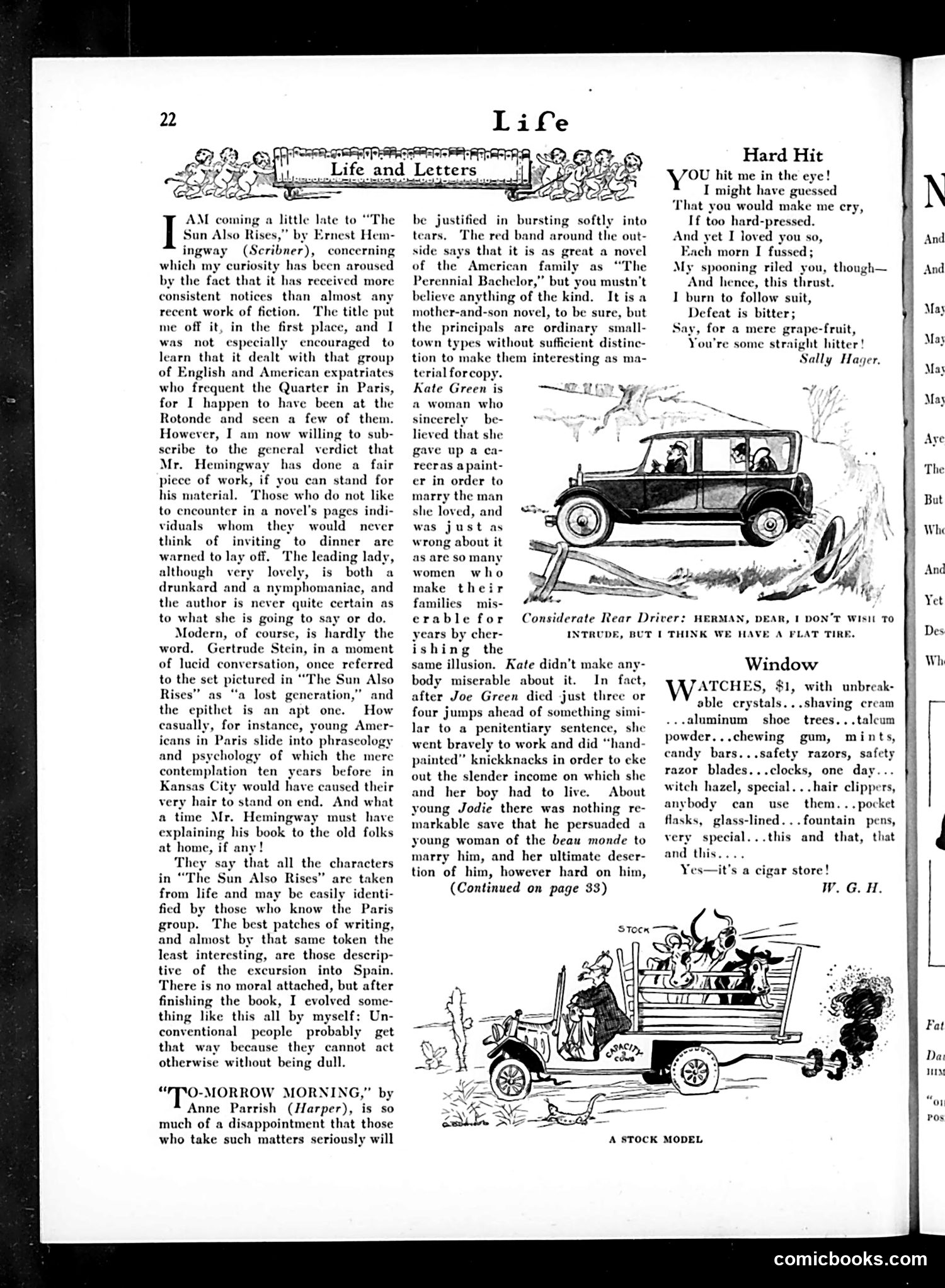
This page from *Life* magazine reviews two novels and includes satirical cartoons about automobiles. The main literary critiques discuss Hemingway's *The Sun Also Rises* (dismissing the "lost generation" of Paris expatriates as morally questionable but well-written) and Anne Parrish's *Tomorrow Morning* (criticized as disappointingly ordinary). The cartoons mock early automobile culture: "Considerate Rear Driver" shows a car hitting someone, with the caption sarcastically praising restraint. "A Stock Model" depicts a ramshackle vehicle barely holding together, satirizing cheaply-made mass-produced cars. The poem "Hard Hit" appears to be a lighthearted romantic quarrel, possibly with car-crash innuendo given the page's automotive theme. The "Window" section advertises novelty items—watches, cosmetics, office supplies—typical of 1920s mail-order catalogs, reflecting post-WWI consumer culture. Overall, the page captures *Life*'s satirical tone about modern society: skepticism toward artistic movements, mockery of new technology's absurdities, and commercialism.
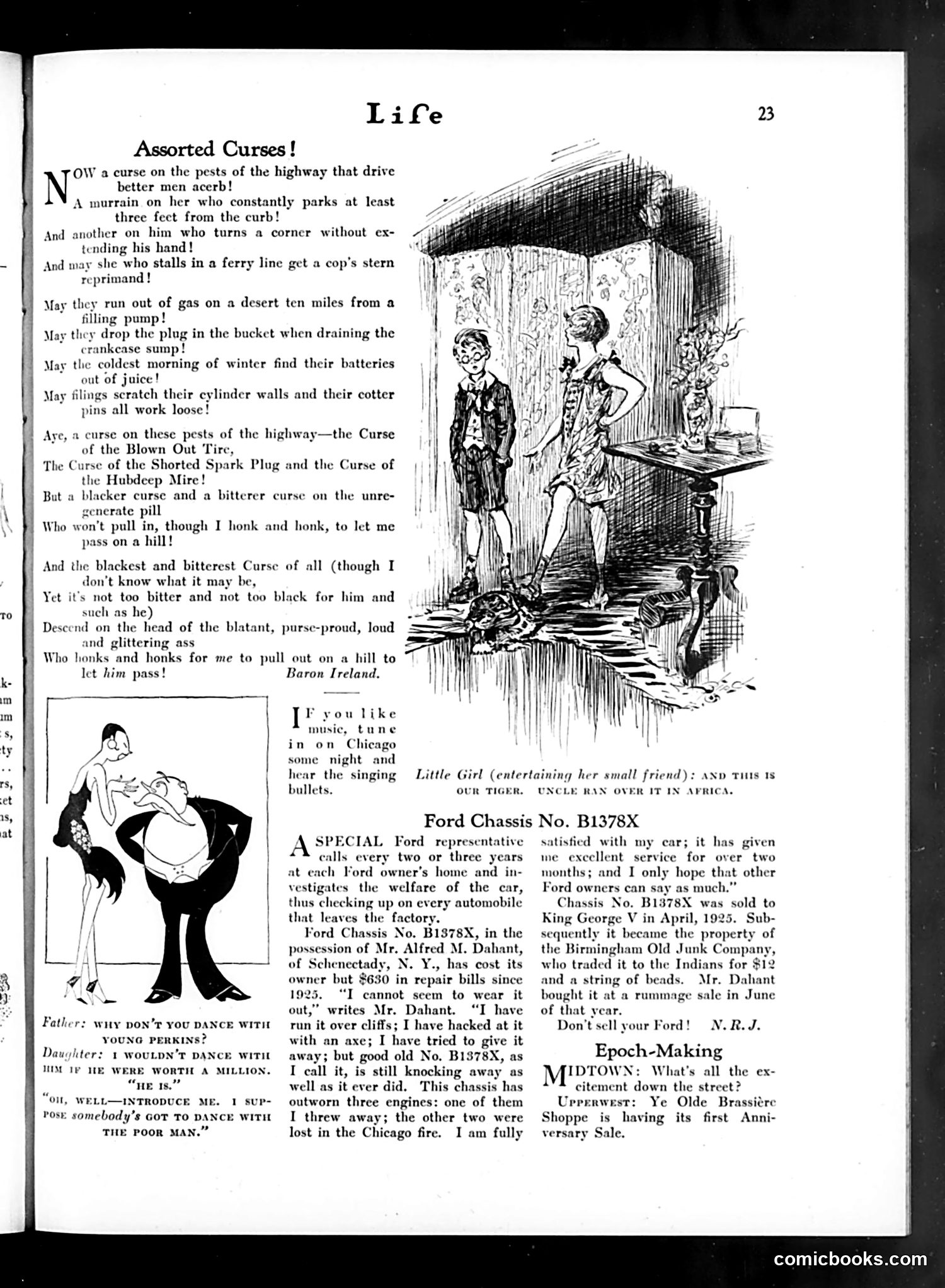
This page combines period automotive humor with social comedy from what appears to be the 1920s era. **"Assorted Curses"** is a humorous poem by Baron Ireland cursing dangerous or inconsiderate drivers—those who park poorly, fail to signal turns, run out of gas, and most irritatingly, refuse to pull over on hills to let faster drivers pass. The satire mocks both mechanical car failures and driver etiquette violations of the early automobile age. **The cartoon** below shows a father scolding a daughter for refusing to dance with young Perkins. She replies she wouldn't dance with him even if he were wealthy. The father's solution—introduce himself to Perkins so *he* can dance with the "poor man"—satirizes class anxiety and parental desperation to help an undesirable suitor. **The Ford Chassis story** humorously documents an absurdly durable car that's been abused extensively (run over cliffs, hacked with axes) yet survives, eventually ending up traded to "Indians for beads"—reflecting period attitudes and colonial stereotypes.
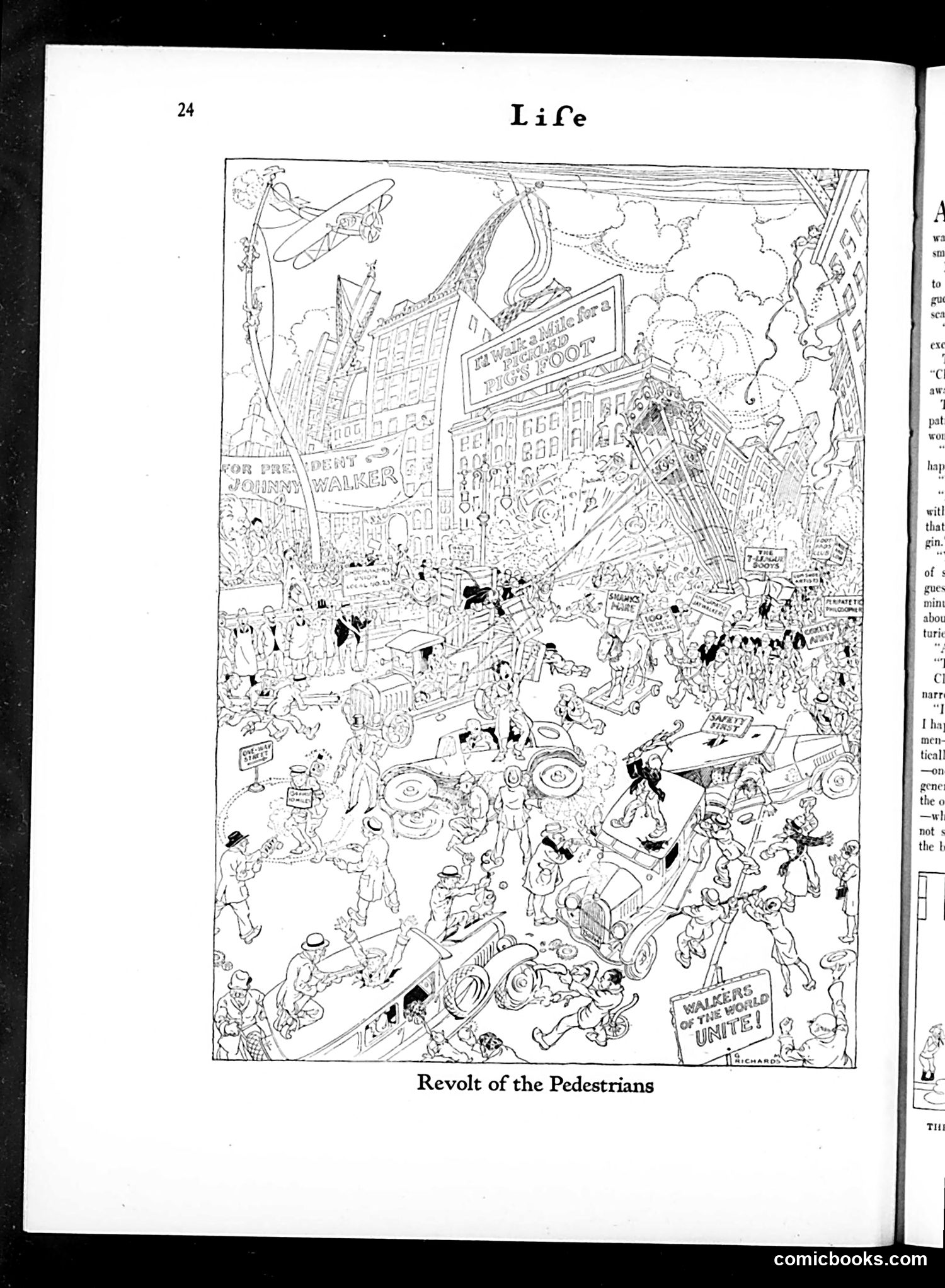
This satirical illustration depicts a chaotic urban street scene titled "Revolt of the Pedestrians." The cartoon shows pedestrians apparently rising up against automobiles—vehicles are overturned, and masses of people occupy the street in what appears to be organized resistance. The satire targets the growing dominance of cars in American cities during the early-to-mid 20th century. Visible storefront signs (including "Johnny Walker") and tall buildings establish an urban setting, while the airplane overhead suggests modernity. The "Workers of the World Unite!" banner references labor organizing rhetoric, humorously applied to pedestrians defending street space against vehicular traffic. The joke critiques how automobile proliferation was displacing pedestrian life from city streets—a genuine urban tension of the era.
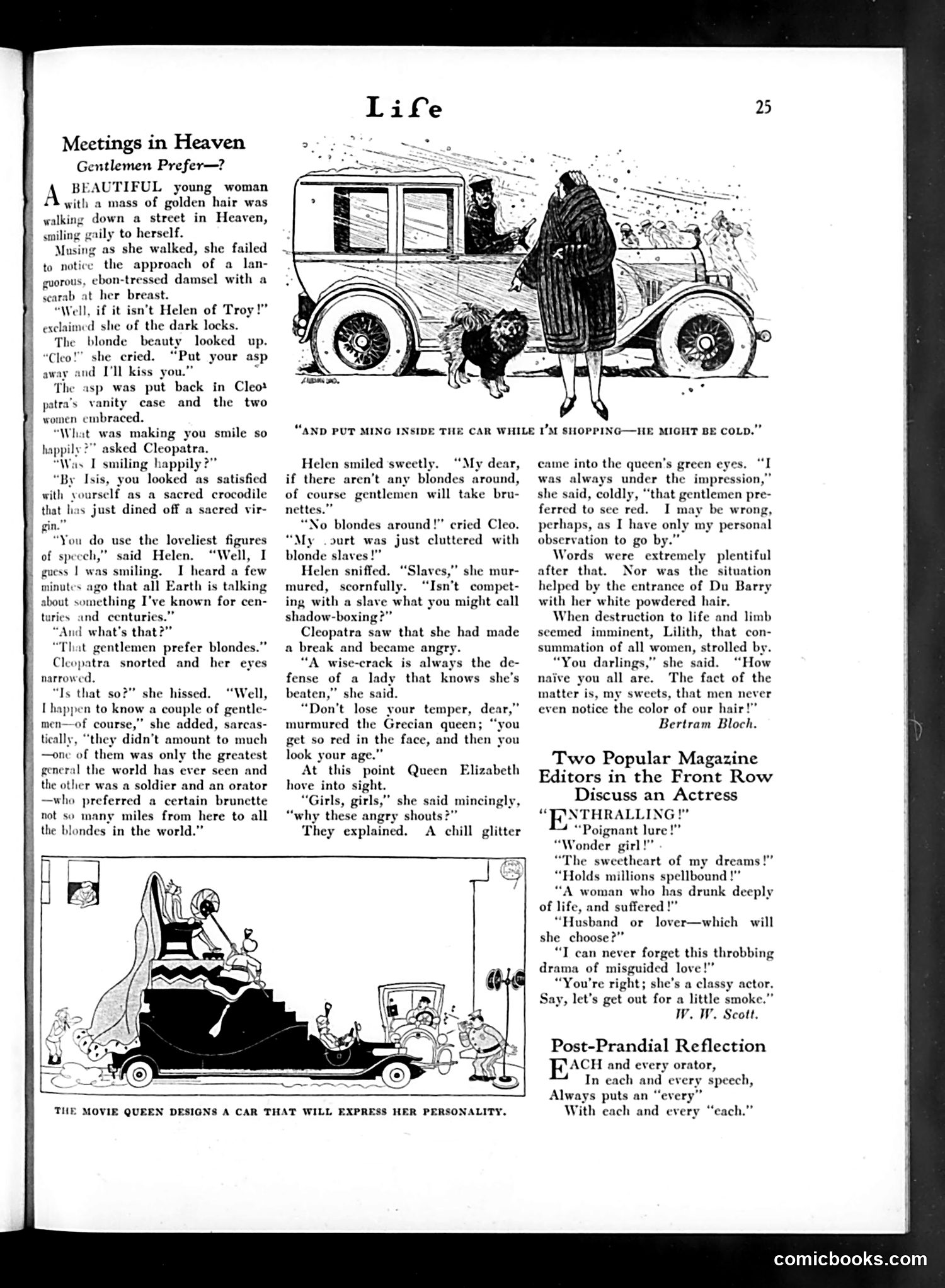
This page satirizes the famous 1920s catchphrase "Gentlemen Prefer Blondes" through a humorous dialogue set in Heaven featuring historical and mythological women: Helen of Troy, Cleopatra, Queen Elizabeth, and Du Barry. **The satire:** The sketch mocks the trendy belief that men universally prefer blondes by having these famous women—each renowned for their power over men—debate the claim. Cleopatra and Helen argue about their respective romantic conquests, with Elizabeth and Du Barry entering to add their perspectives. The joke's punchline comes when Lilith (representing primordial womanhood) reveals the joke's on all of them: men don't actually notice hair color at all. **Secondary content:** A cartoon shows a wealthy woman designing a custom car to "express her personality," satirizing consumer culture and status-seeking. **Lower section:** Two magazine editors discussing an actress use overwrought, pretentious language ("poignant lure," "throbs"), then deflate it with casual cynicism ("classy actor...let's get out for a smoke")—mocking both theatrical criticism and editorial pretension.
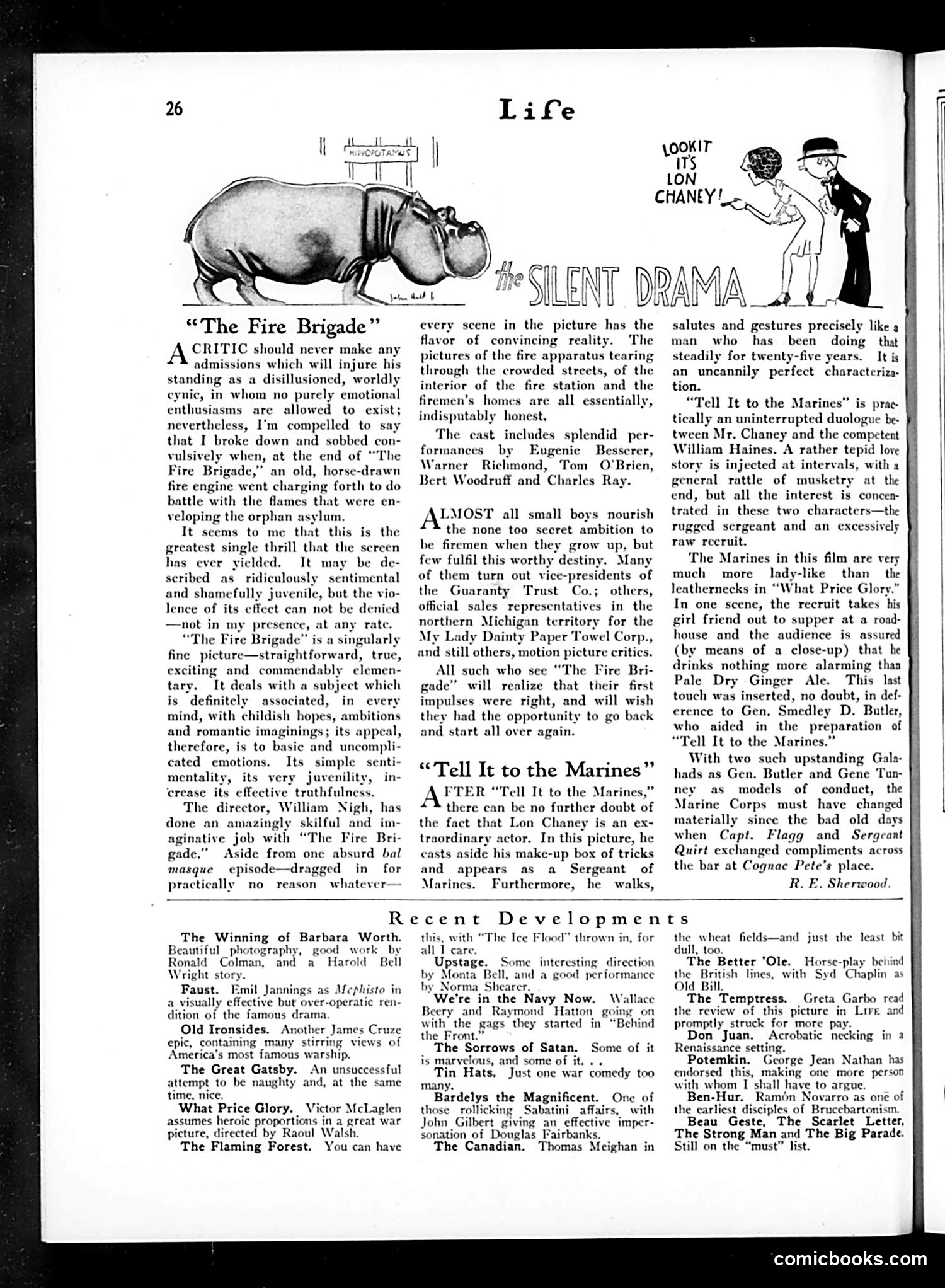
This is a film criticism page from Life magazine reviewing two silent films: "The Fire Brigade" and "Tell It to the Marines." The cartoon at top right mocks actor **Lon Chaney**, famous for elaborate makeup disguises. It shows him removing a grotesque mask, with the caption "LOOK! IT'S LON CHANEY!"—the joke being that Chaney's real face is as striking as his theatrical transformations. The reviews themselves are satirical critiques of sentimentality in cinema. The critic admits to crying at "The Fire Brigade" (an orphan-rescue film with a fire engine climax), then mocks this reaction as emotionally manipulative yet effective. The "Tell It to the Marines" section jokes about the film's sanitized portrayal of Marines—notably showing the recruit drinking only ginger ale rather than alcohol, attributed to General Smedley D. Butler's involvement. This implies the film was cleaned up for respectability, contrasting with the grittier "What Price Glory." The satire targets both filmmakers' manipulation of emotion and military cooperation in softening the Marines' public image.
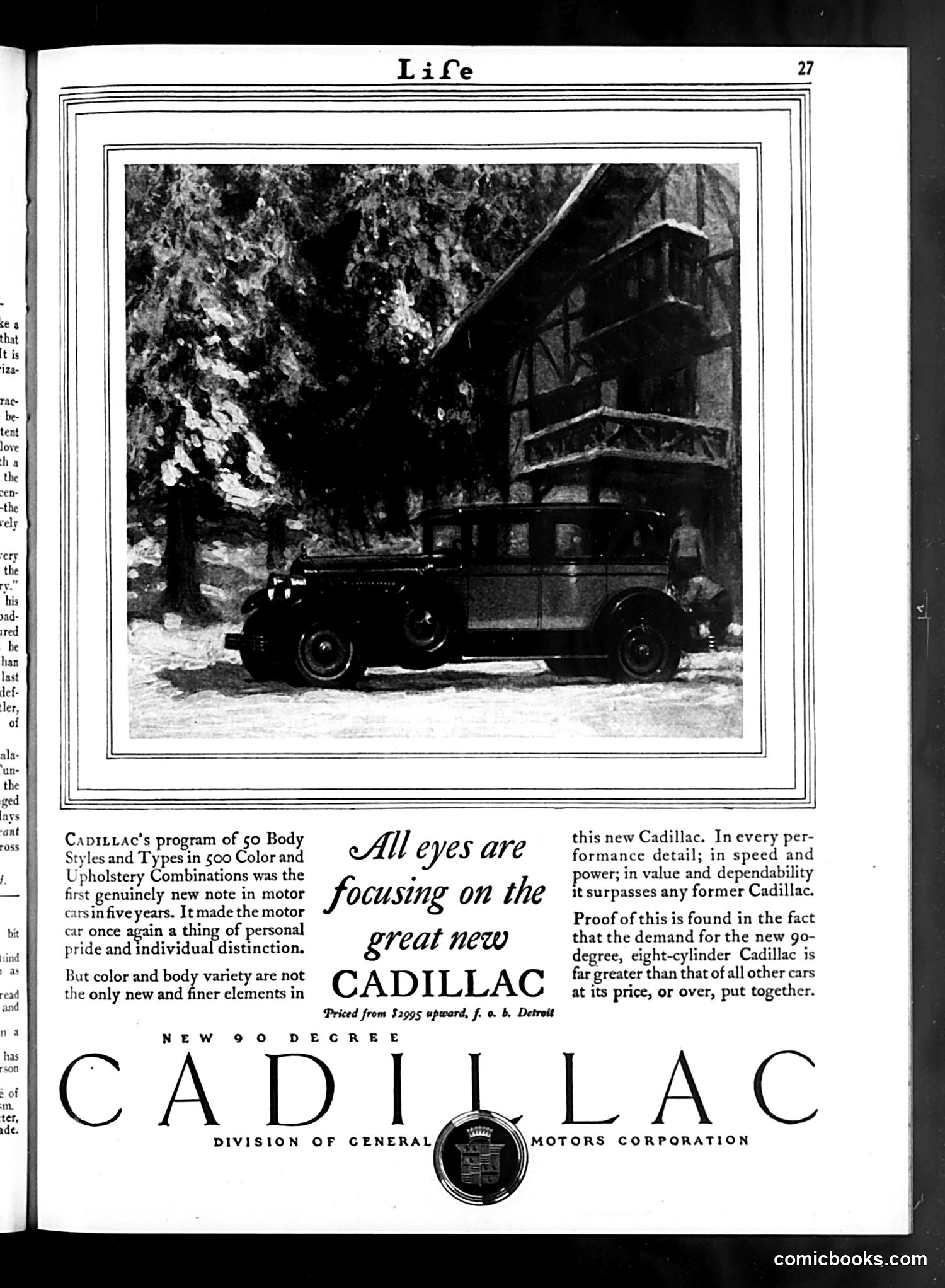
This is **primarily an advertisement**, not a cartoon or satire. It's a Cadillac motor car ad from Life magazine, page 27. The page promotes Cadillac's "New 90 Degree" eight-cylinder automobile, emphasizing its customization options (50 body styles in 500 color/upholstery combinations). The photograph shows a 1920s-era sedan parked beneath ivy-covered architecture, presenting the vehicle as refined and distinguished. The advertising copy claims this new model surpasses previous Cadillacs in "speed and power" and "value and dependability," and asserts demand exceeds that of "all other cars at its price, or over." The phrase "all eyes are focusing on the great new CADILLAC" uses the attention-grabbing language typical of period automobile marketing. There is **no political satire or social commentary** evident—this is straightforward luxury car promotion aimed at wealthy consumers seeking personal distinction through automotive choice.
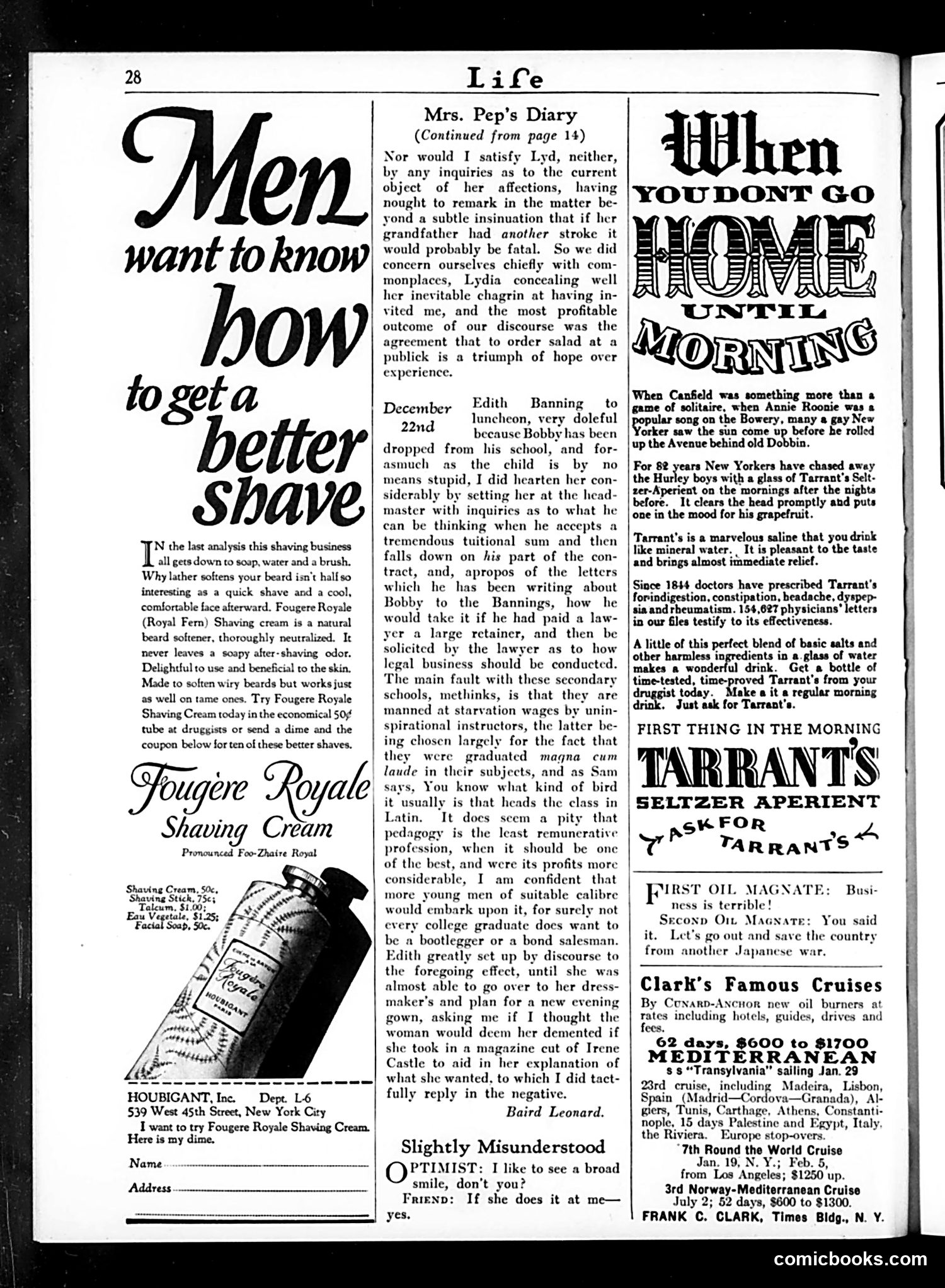
This page mixes editorial content with period advertising. The main feature is "Mrs. Pep's Diary," a serialized humor column satirizing upper-class social life. The December 22nd entry mocks pretentious attitudes—particularly criticizing secondary schools for paying teachers starvation wages while hiring instructors based solely on academic credentials ("magna cum laude") rather than teaching ability. The writer humorously suggests this explains why incompetent teachers accept these positions. The page also includes: - A Fougere Royale shaving cream advertisement - "Slightly Misunderstood," a brief joke playing on misinterpreted flirtation - Tarrant's Seltzer-Aperient ads referencing "the mornings after" (implying hangovers from Prohibition-era nightlife) - Travel advertisements The satire targets education system failures and class pretension typical of 1920s Life magazine humor.
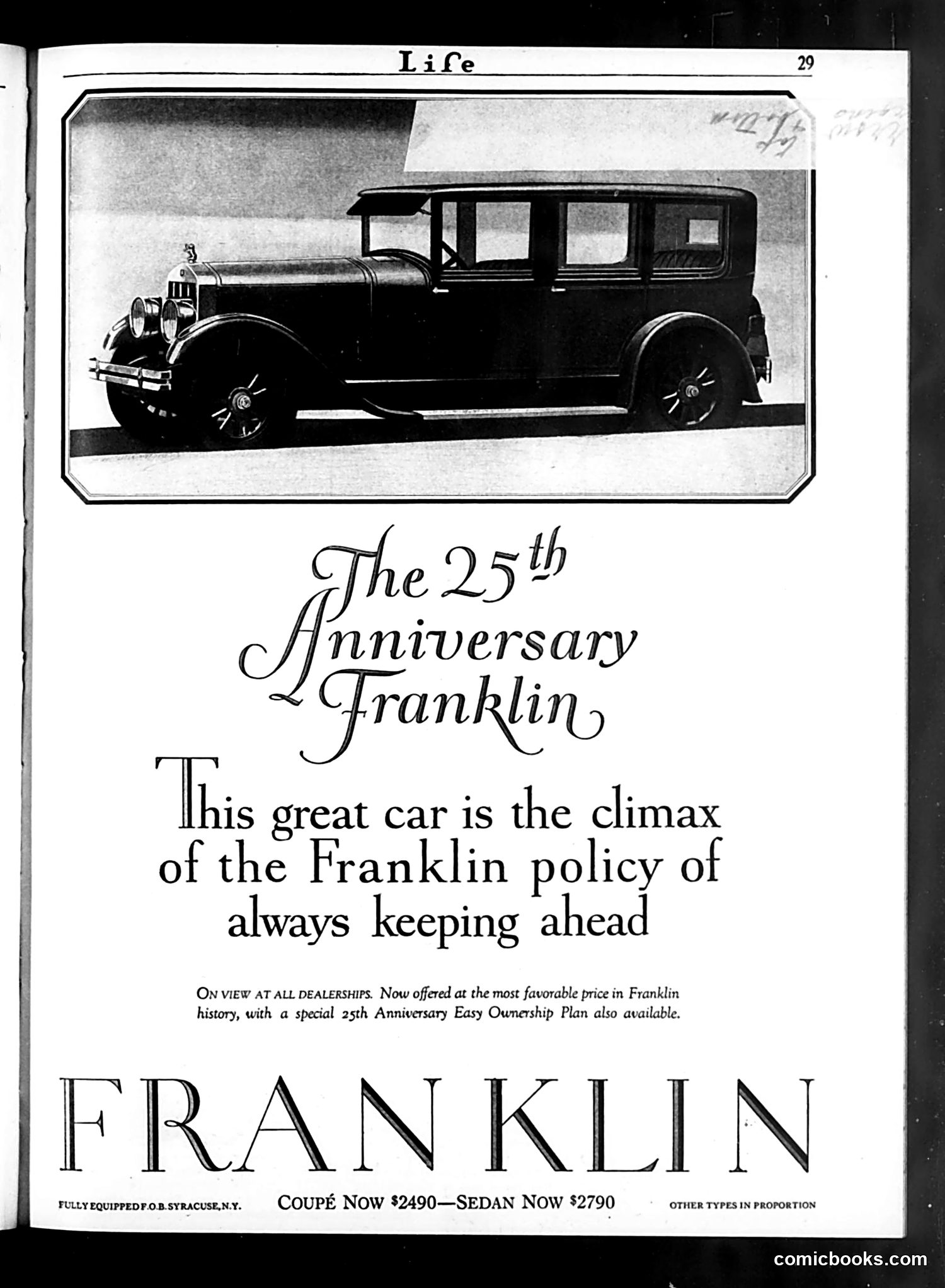
This is a Franklin automobile advertisement, not political satire. It celebrates the Franklin car company's 25th anniversary by presenting their latest model as the "climax" of their business philosophy of "always keeping ahead." The image shows a side-view of a 1920s sedan with characteristic period styling. The ad emphasizes affordability, promoting special pricing and an "Easy Ownership Plan" available through dealerships. It lists two models: a Coupe at $2490 and a Sedan at $2790. The decorative typography and formal layout are typical of 1920s advertising in *Life* magazine. There is no satirical content here—this is straightforward commercial promotion for a luxury automobile brand.
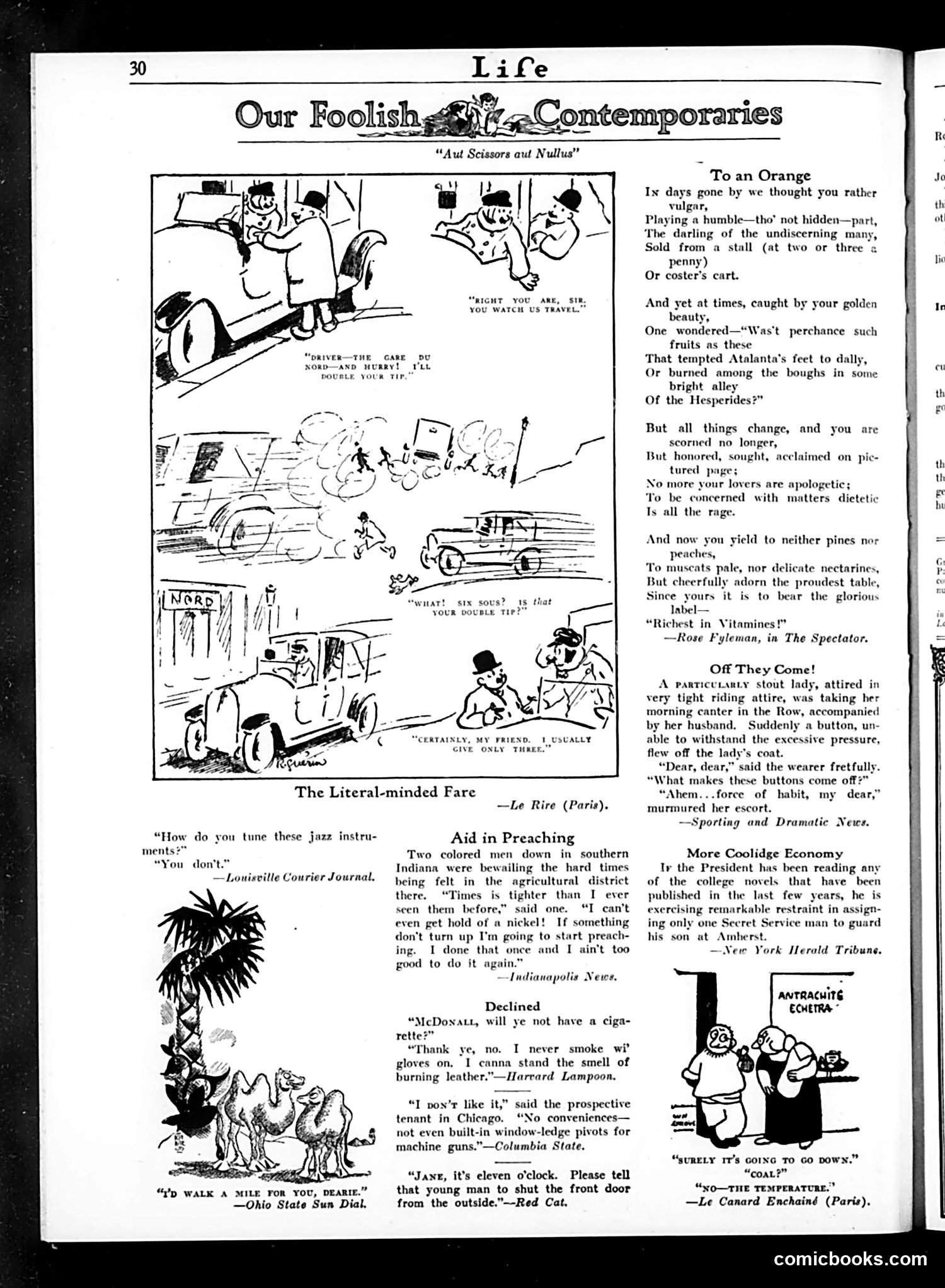
This page contains humor pieces and light satirical content typical of 1920s Life magazine. **"The Literal-minded Fare"** shows a comic strip about a taxi driver and passenger negotiating fare in Paris—the joke hinges on literal interpretation of French currency and travel distances. **Brief anecdotes** include social humor: jazz musicians, a Scottish man refusing cigarettes due to burning leather smell, a Chicago tenant worried about "machine gun pivots" (likely referencing Prohibition-era gangster violence), and a woman whose button pops off her riding coat—her husband quips it's "force of habit." **"To an Orange"** is a sentimental poem about oranges becoming fashionable due to vitamin marketing (the "Richest in Vitamines!" label), contrasting their former humble status. **"More Coolidge Economy"** jokes that President Calvin Coolidge's frugality extends to assigning only one Secret Service agent to guard his son at Amherst College—implying dangerous cost-cutting. Overall, the page reflects 1920s concerns: economic uncertainty, Prohibition, nutritional fads, and Coolidge-era politics.
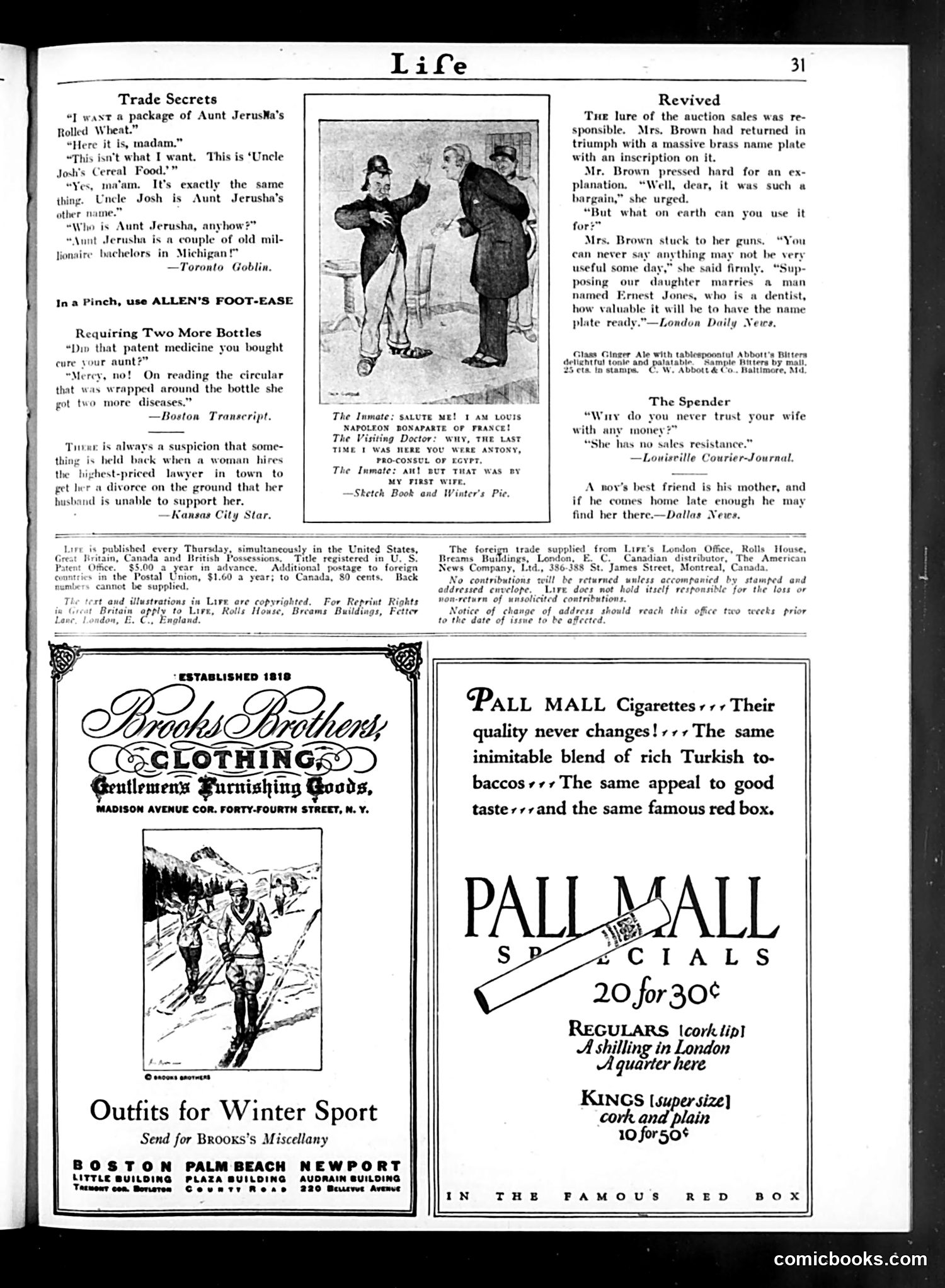
This page contains several brief satirical anecdotes mocking consumer culture and gender relations: **"Trade Secrets"** jokes about deceptive marketing—a woman unknowingly receives the "wrong" cereal brand, revealing that competing products are identical despite different names. The joke satirizes how manufacturers create artificial distinctions. **"Requiring Two More Bottles"** mocks patent medicine's false claims: a "cure" actually causes new diseases when the patient reads the side effects. **The asylum cartoon** depicts a delusional inmate claiming to be Napoleon Bonaparte. When a doctor notes he previously claimed to be Mark Antony, the inmate responds "that was by my first wife"—absurdist humor about shifting delusions. **"Revived"** shows a wife defending an absurd auction purchase (a brass nameplate), rationalized by speculating about a hypothetical future son-in-law who might be a dentist named Jones—satirizing women's frivolous spending habits. **"The Spender"** briefly mocks wives' inability to manage money ("no sales resistance"). The page also contains period advertisements for clothing, cigarettes, and patent medicines.
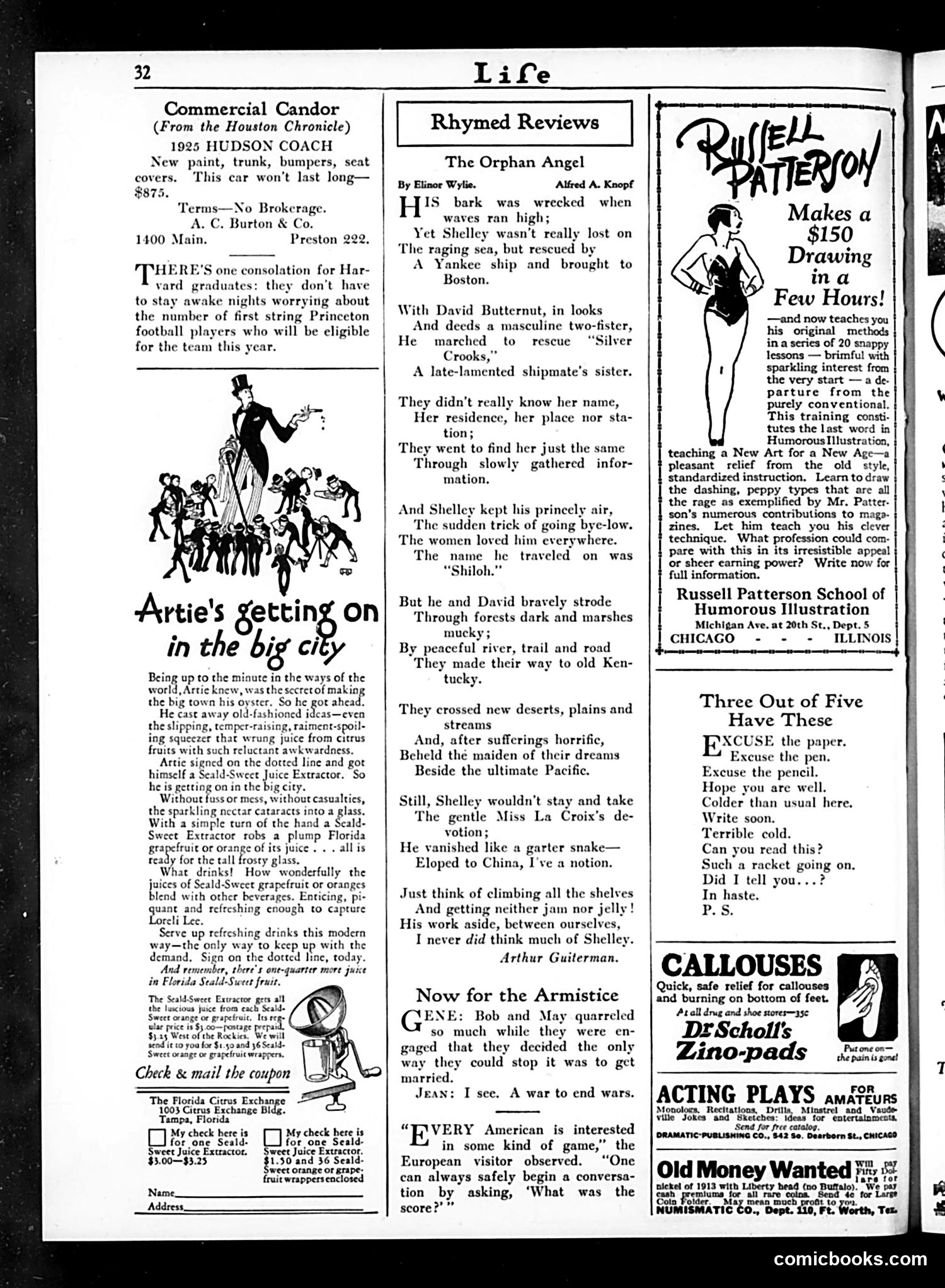
This page contains **mostly advertisements and light humor**, typical of 1920s Life magazine. The main cartoon, "Artie's Getting On in the Big City," satirizes modern consumerism and social climbing. Artie abandons old-fashioned manual labor (squeezing citrus fruit by hand) to purchase a Seald-Sweet Juice Extractor, symbolizing how urbanites adopt newfangled gadgets to appear sophisticated and efficient. The joke: being "modern" means replacing practical skills with commercial products—a gentle jab at conspicuous consumption and the marketing culture of the era. The "Rhymed Reviews" section offers a verse summary of Elinor Wylie's novel *The Orphan Angel*, describing a Romantic adventure involving rescue and travel. The remaining content includes brief comedy quips (Harvard vs. Princeton football rivalry; a couple ending quarrels through marriage as "a war to end wars") and period advertisements for juice extractors, drawing lessons, and remedies. The page reflects 1920s concerns: modernization, product marketing, and upper-class leisure activities.
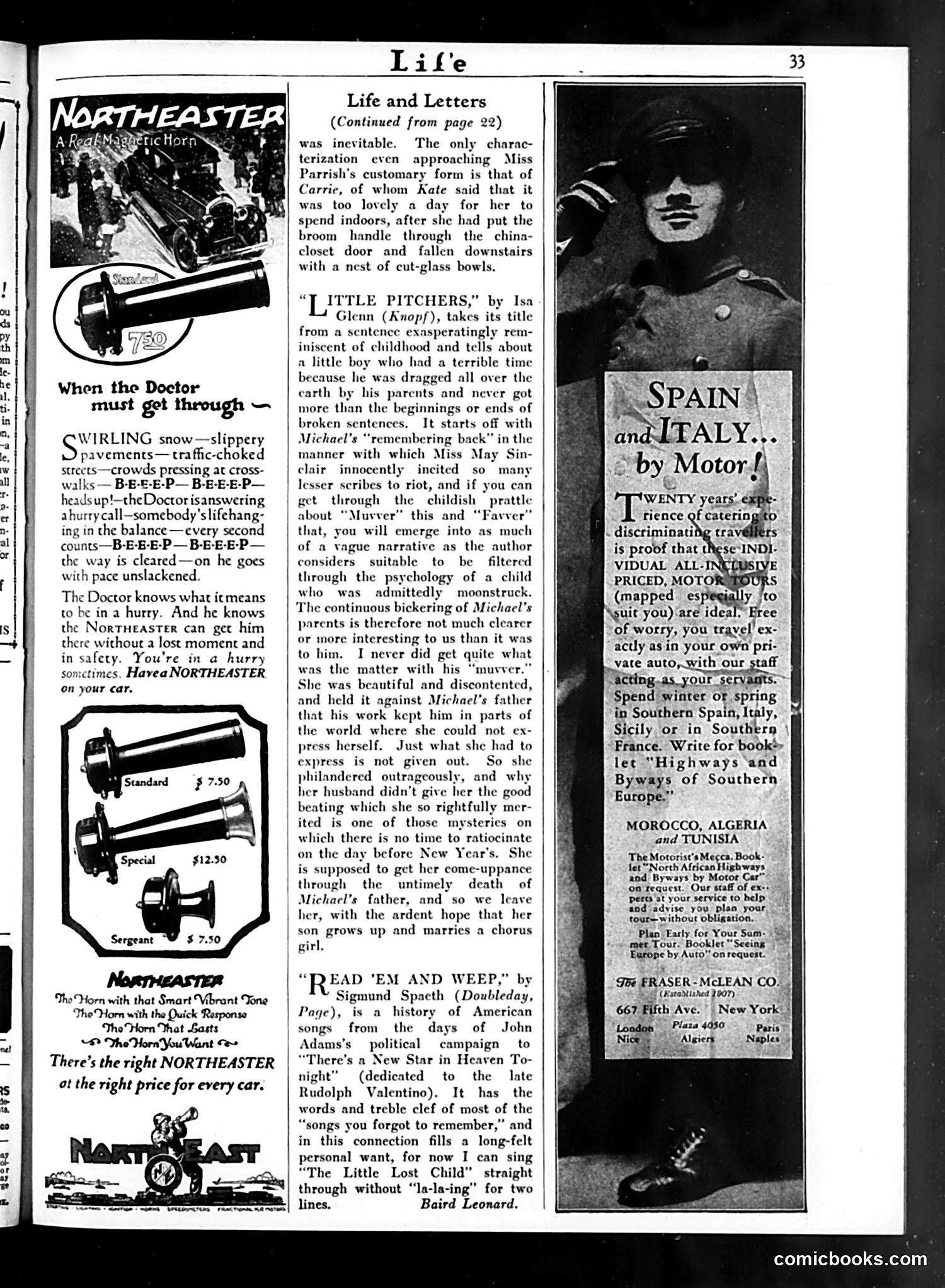
This page contains primarily **advertising and book reviews**, not political satire. **Left side**: The "Northeaster" car horn advertisement uses dramatic, urgent language about a doctor racing through snowy streets to reach an emergency patient. The repeated "B-E-E-E-P" sounds emphasize the horn's reliability and urgency—a common advertising technique associating the product with life-saving importance. **Right side**: Book reviews by Baird Leonard critique three recent publications: Isa Glenn's *Little Pitchers* (about a neglected child), Sigmund Spaeth's *Read 'Em and Weep* (an American songbook with lyrics), and another title. Leonard's tone is satirical about the novels themselves—mocking their narrative choices and character motivations—rather than political commentary. The travel advertisements for Spain, Italy, and North Africa round out the page, typical content for *Life* magazine of this era.
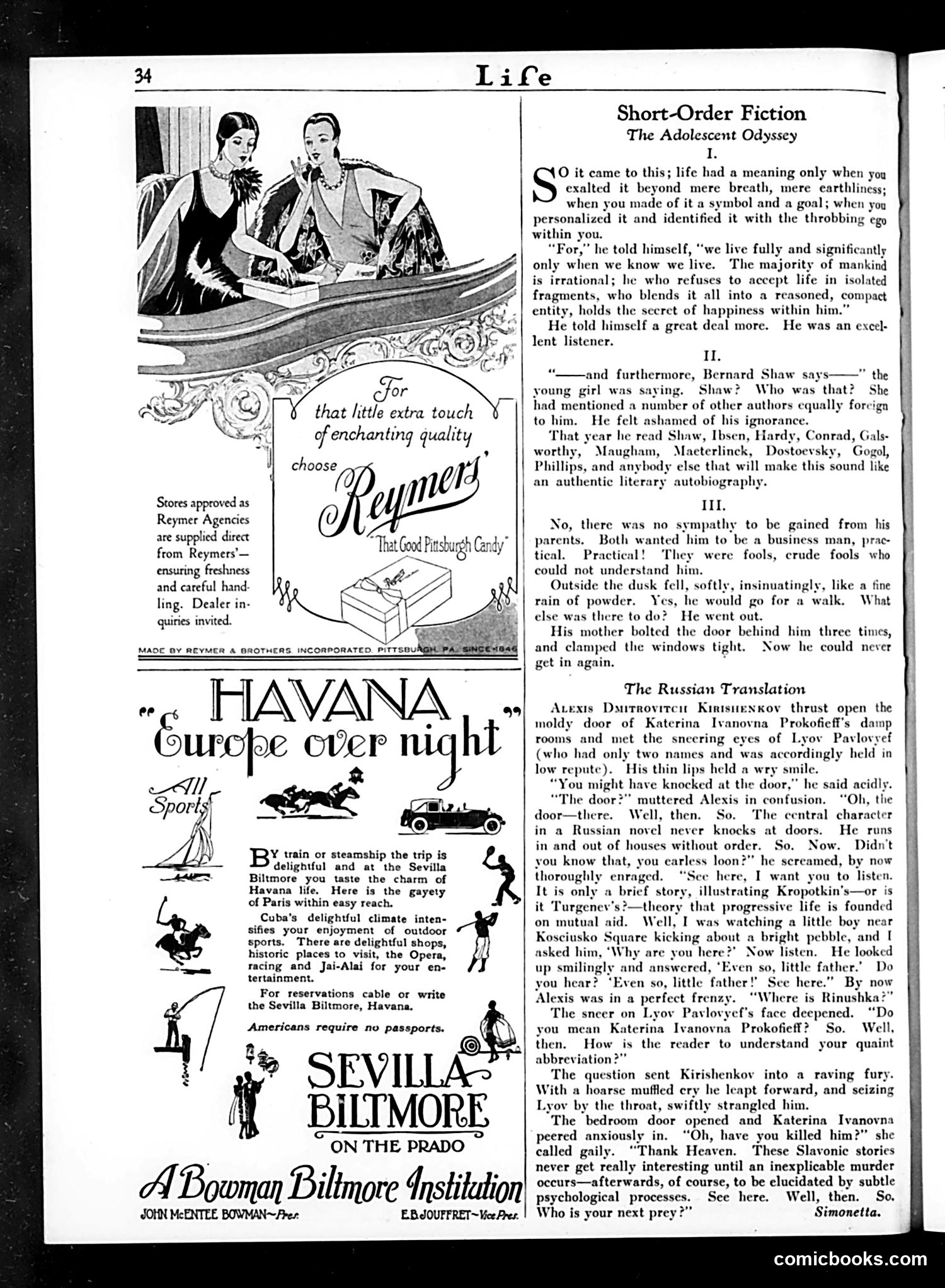
This page mixes advertisements with satirical fiction. The ads promote Reynmer's candy, Havana tourism, and the Sevilla Biltmore hotel—typical 1920s luxury marketing. The satirical content comprises two interconnected short stories mocking pretentious young intellectuals. "The Adolescent Odyssey" ridicules a self-important youth who affects philosophical seriousness, frantically reads canonical authors (Shaw, Ibsen, Conrad, Dostoevsky) to seem cultured, and romanticizes his alienation from "crude" practical parents—only to be locked out by his exasperated mother. "The Russian Translation" escalates the satire by parodying Russian literary conventions and characters with deliberately absurd Russian names. It mocks readers who admire Russian literature's supposed sophistication, suggesting they're gulled by obscure names and affected philosophical discourse about "mutual aid" and progressive theory. Together, these pieces satirize American intellectual pretension: the assumption that literary sophistication equals depth, and that citing European authors demonstrates intelligence rather than mere affectation.
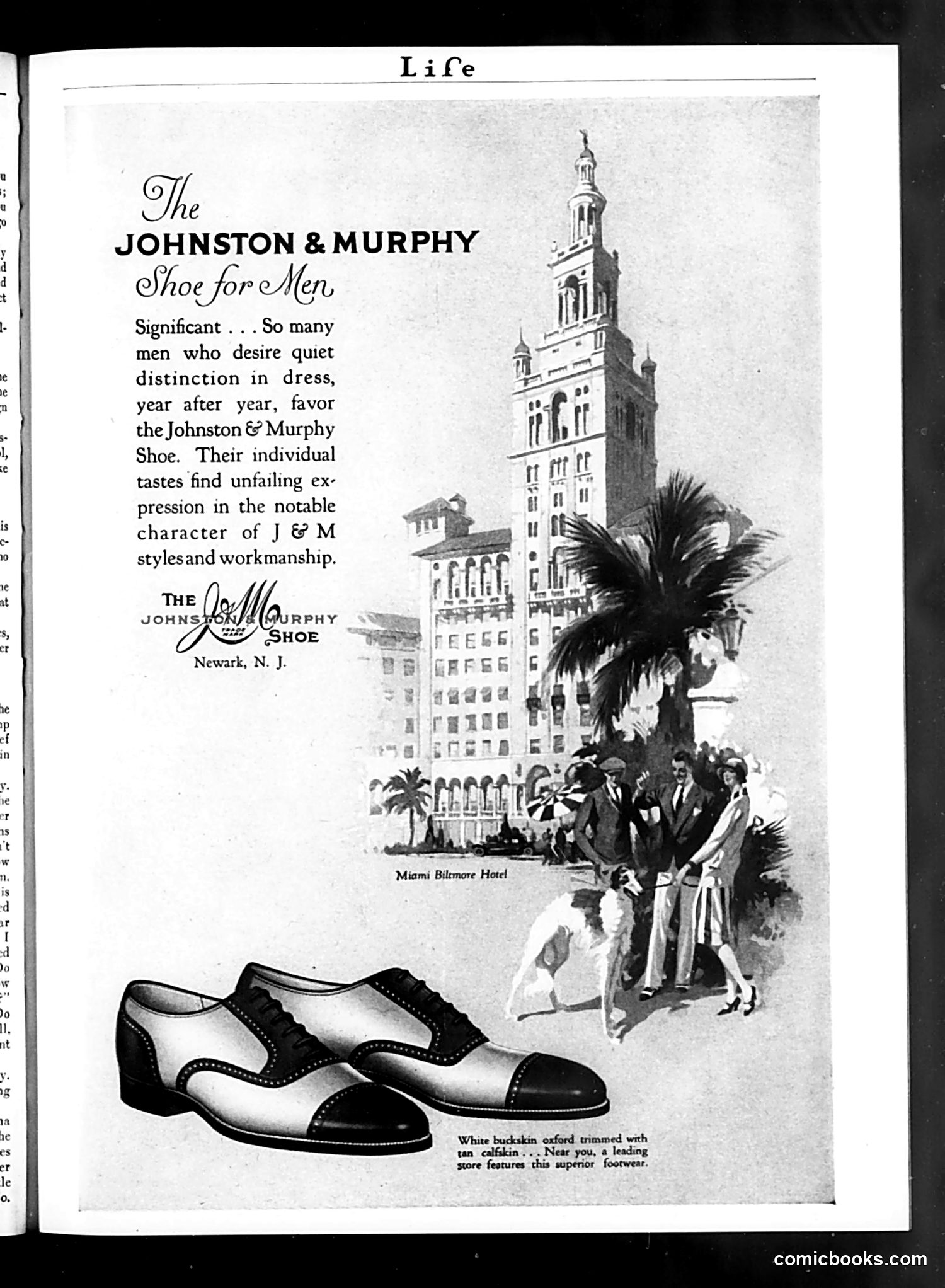
This is a **Johnston & Murphy shoe advertisement**, not political satire. The page promotes men's dress shoes through aspirational imagery rather than humor or commentary. The ad features an illustration of the Miami Biltmore Hotel—a luxurious Florida resort—with well-dressed men and women gathered outside, suggesting sophistication and leisure. Below is a detailed drawing of a white buckskin oxford shoe trimmed in tan calf leather. The advertising copy emphasizes that discerning men seeking "quiet distinction in dress" choose Johnston & Murphy shoes for their superior "character" and "workmanship." The tropical hotel setting associates the shoes with upscale travel and refined social standing. This is **entirely commercial messaging**: there is no satire, political reference, or joke to decode. It's a straightforward luxury goods advertisement using aspirational imagery typical of interwar American magazine advertising.
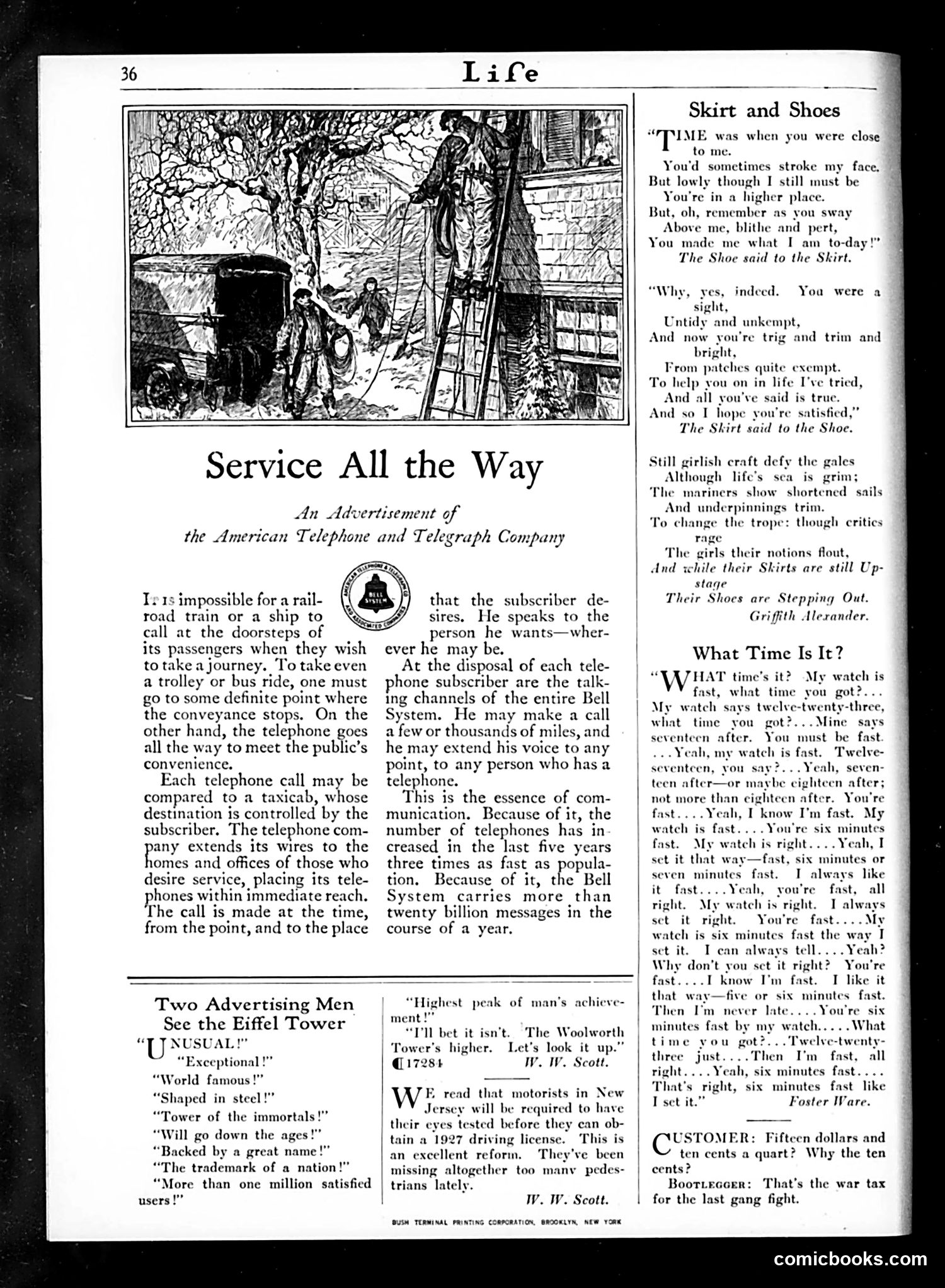
This page contains multiple short pieces typical of Life's satirical format: **Main Advertisement**: AT&T's "Service All the Way" promotes telephone superiority over transportation—you don't go to the phone; it comes to you conceptually through universal accessibility. **"Skirt and Shoes" Poem**: A personified dialogue where shoes credit themselves for elevating a skirt from "untidy and unkempt" to "trig and trim." The poem playfully reverses traditional class hierarchy—footwear claims to have improved clothing's station. The final stanza uses nautical metaphor ("Skirts are still Upstage / Their Shoes are Stepping Out"), likely commenting on 1920s women's fashion and social mobility. **"Eiffel Tower" Joke**: Two ad men argue whether the Eiffel Tower or Woolworth Building is taller, deciding to "look it up"—mocking American boosterism and competition with European landmarks. **"What Time Is It?" Piece**: Rapid-fire dialogue about watches running fast; likely satirizes Americans' obsession with punctuality and the absurdity of collectively running ahead of actual time. The page emphasizes Life's mix of commercial content and social satire.

I can see this is a very dark, low-contrast image from what appears to be a historical publication. The page is predominantly black with only a white margin visible on the left side and the "comicbooks.com" watermark at the bottom right. Unfortunately, the image quality and contrast are too poor for me to reliably discern any cartoon content, text, figures, or caricatures that would be necessary to identify the political or social references and explain the satire to a modern reader. The OCR text provided contains only a website attribution with no article or caption content. To properly analyze this page as requested, I would need either a higher-contrast image or clearer source material showing the actual cartoon and accompanying text.