
Life, 1927-01-13 · page 22 of 39
Life — January 13, 1927 — page 22: what you’re looking at
What you’re looking at
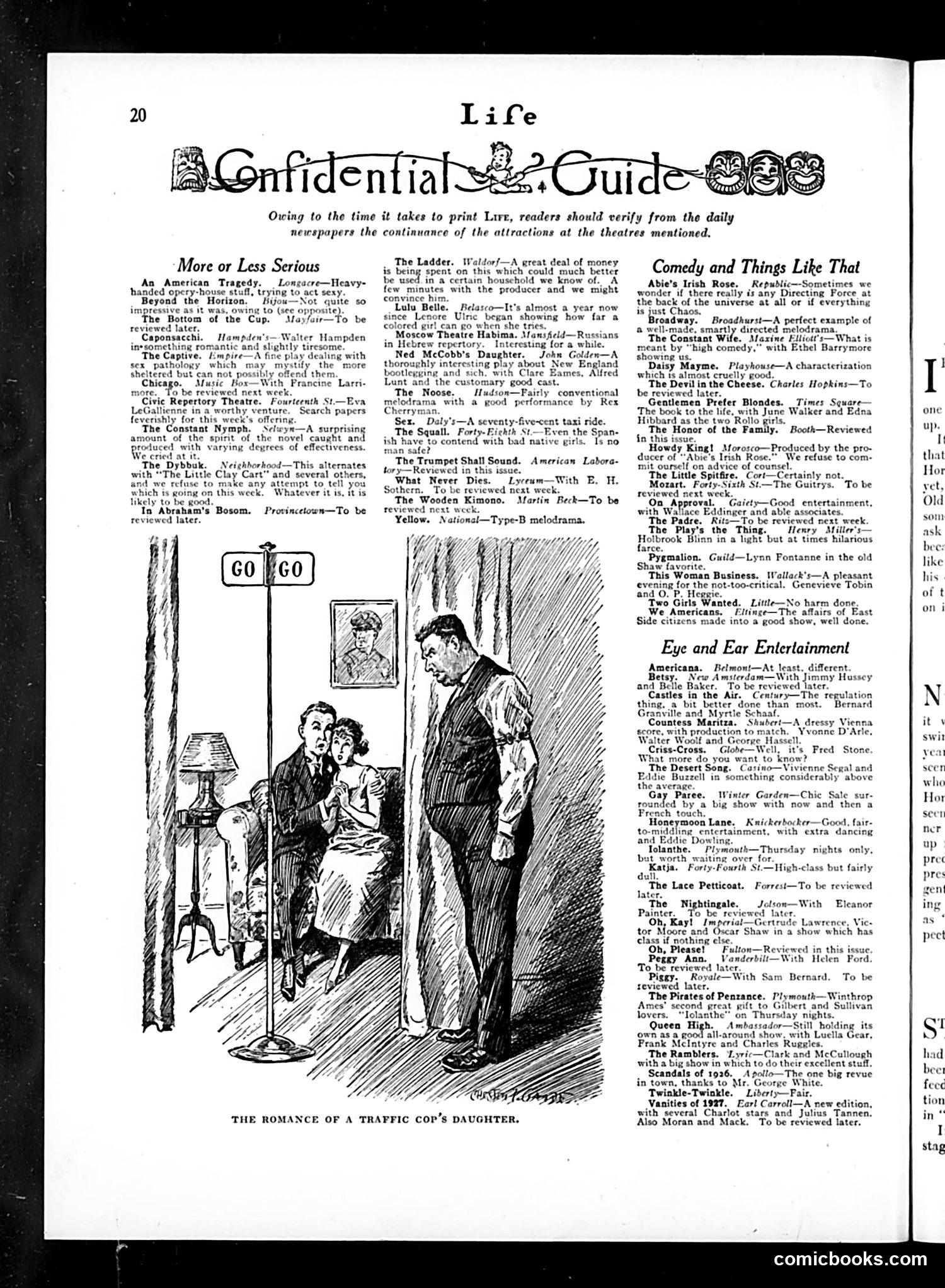
This page from Life magazine's "Confidential Guide" consists primarily of **theater reviews and listings**, not political cartoons. The single illustration—captioned "The Romance of a Traffic Cop's Daughter"—depicts a humorous domestic scene: a young couple sits together while a stern traffic cop stands in the doorway, suggesting parental disapproval of the romance. The illustration plays on a common early-20th-century social anxiety: the "respectable" working-class father objecting to his daughter's suitor. The traffic cop represents civic authority and working-class dignity, making the scenario both relatable and comedic to Life's audience. The extensive theater reviews use satirical commentary—sometimes caustic, sometimes affectionate—to assess current Broadway productions. References like "Abie's Irish Rose" and "Gentlemen Prefer Blondes" were popular hits of the era. The tone is sophisticated mockery aimed at theater-goers familiar with current productions.
📄 Transcribed text from this page (OCR, searchable)
Machine-transcribed from the original scan — historical spelling and the odd misread are preserved.
Owing to the time it takes to print Live, readers should verify from the daily newspapers the continuance of the attractions at the theatres mentioned. More or Less Serious An American Tragedy. _ Loncacre—Heavy- handed opcery-house stufl, trying to act sexy. Beyond the Horizon.’ Bijou—Not quite so impressive as it was, owing to (see opposite). The Bottom of the Cup. Mayfair—To be reviewed later. Caponsacchi. Hampden's— inesomething romantic and slightly tiresome. The Captive. Empire play dealing with sex pathology which mystify the mos sheltered but can not possibly o rt Chicago. Music Box—With Pranci more. To be reviewed next week. Civic Repertory Theatre. Fourteenth St—Eva LeGallienne in a wo: venture, Search papers feverishly for this week's offe The Constant Nymph. Selwyn—A surprising amount of the spirit of the novel caught and roduced with varying degrees of effectiveness. We cried at it. The Dybbuk. _Neighdorhood—This alternates with “The Little Clay Cart” and several others, and we refuse to make any attempt to tell you which is going on this week. Whatever it is, it is likely to be good. To Abraham's Bosom. Provincetown—To be reviewed 4 Hampden The Ladder. Weldorf—A great deal of money is being spent on this which could much better be used in a certain houschold we know of. A few minutes with the producer and we might convince him. Lulu Belle. Belasco—It's almost a year now ore Ulnic began showing how far a ‘girl can go when she tries. __ Moscow Theatre Habima. Mansfeld—Russians in Hebrew repertory. Interesting for a while. Ned McCobb's Daughter. 7 thoroughly interesting play abo bootlegging and sich, with Clare Eames, Alfred d the customary good cast. The Noose. Hudson—Fairly conventional melodrama with a good performance by Rex Cherry Daly's—A seventy-five-cent taxi ride. _ The Squall. Forty. Eickth St.—Even the Span- ish have to contend with bad native girls. Is no man safe? The Trumpet Shall Sound. American Labora- fory—Reviewed in this issue. What Never Dies. Lyceum—With E, H. Sothern. To be reviewed next weck. The Wooden Kimono. Martin Beck—To be reviewed next week. Yellow. National—Type-B melodrama. THE ROMANCE OF A TRAFFIC COP’S DAUGHTER. Comedy and Things Like That Abie’s Irish Rose. Republic—-Sometimes we ere really is any Directing Force at the back of the universe at all or if everything Broadhurst—A perfect example of a well-made, smartly directed melodrama. The Constant Wife. Maxine Elliott’ s—What is meant by “high comedy,” with Ethel Barrymore showing us. Daisy Mayme. Playhouse—A characterization which 1s almost cruelly good. The Devil in the Cheese. Charles Hopkins—To be reviewed later. Gentlemen Prefer Blondes. 71 Square— es The book to the life, with June Walker and Edna Hibbard as the two Rollo girls. The Honor of the Family. Booth—Reviewed in this issue. Howdy King! Morosco—Produced by the pro- We refuse to com- ducer of “Abie's Irish Rose. mit ourself on advice of counsel. The Little Spitfire. Cor!—Certainly not. Mozart. Forty-Sixth St.—The Guitrys. “To be reviewed next wee oval. Gaiety—Good entertainment, ce Eddinger and able associates. re. Rits—To be reviewed next week The Play's the Thing. © Henry Miller’s— Holbrook Blinn in a light but at times hilarious farce. Pygmalion. Guild—Lynn Fontanne in the old Shaw favorit ‘his Woman Business. IWallack’s—A pleasant evening for the not-too-critical. Genevieve Tobin and O. P. Hegsie. Two Girls Wanted. Littlh—No harm done. We Americans. Fitinge—The affairs of East Side citizens made into a good show, well done. Eye and Ear Entertainment Americana. Belmon!—At least, di Betsy. New A msterdam—With Ji and Belle Baker. To be reviewed later. Castles in the Air. Century—The regulation thing, a bit better done than most. Bernard Granville Counte: A dressy Vienna score, with production to match. Yvonne D'Arle, Walter Woolf and George Hassell. Criss-Cross. Glob it's. Fred Stone. What more do you want to know? The Desert Song. Casino—Vivienne Segal and Eddie Buzzell in something considerably above the average. Gay Paree. Winter Garden—Chic Sale sur- rounded by a big show with now and then a French touch. Honeymoon Lane. Knickerbocker—Good, fair- to-middling entertainment, with extra dancing and Eddie Dowling. Tolanthe. Plymouth—Thursday nights only, but worth waiting over for. Katja. Forty-Fourth St.—High-class but fairly al papihe Lace Petticoat. Forrest—To be reviewed ater. The Nightingale. — Jolson—With Eleanor Painter, To be reviewed later. Oh, Kay! Imperial—Gertrude Lawrence, Vie~ tor Moore and Oscar Shaw in a show which has class if nothing else . Fulton—Reviewed in this issue. Vanderbilt—With Helen Ford. Piggy. Royale—With Sam Bernard. To be reviewed later. The Pirates of Penzance. P’!ymouth—Winthrop Ames’ second great gift to Gilbert and Sul lovers. “Iolanthe” on Thursday nights. Queen High. Ambassador—Still holding its own as a good all-around show, with Luella Gear, Frank McIntyre and Charles Ruggles. ‘The Ramblers. ‘Lyric—Clark and McCullough with a big show in which to do their excellent stuff. Scandals of 1926. A pollo—The one big revue in town, thanks to Mr. George White. Twinkle-Twinkle. Liderty—Pai Vanities of 1927. Earl Carroll—A new edition, with several Charlot stars and Julius Tannen. Also Moran and Mack. To be reviewed later. I one up. if that Hor yet, Old som ask bee: like his of t on i it vy swit yea seen who Hor seen ner up prec pres gent peet had beet feec tion in“ stag comicbooks.com