
Life, 1927-01-13 · page 18 of 39
Life — January 13, 1927 — page 18: what you’re looking at
What you’re looking at
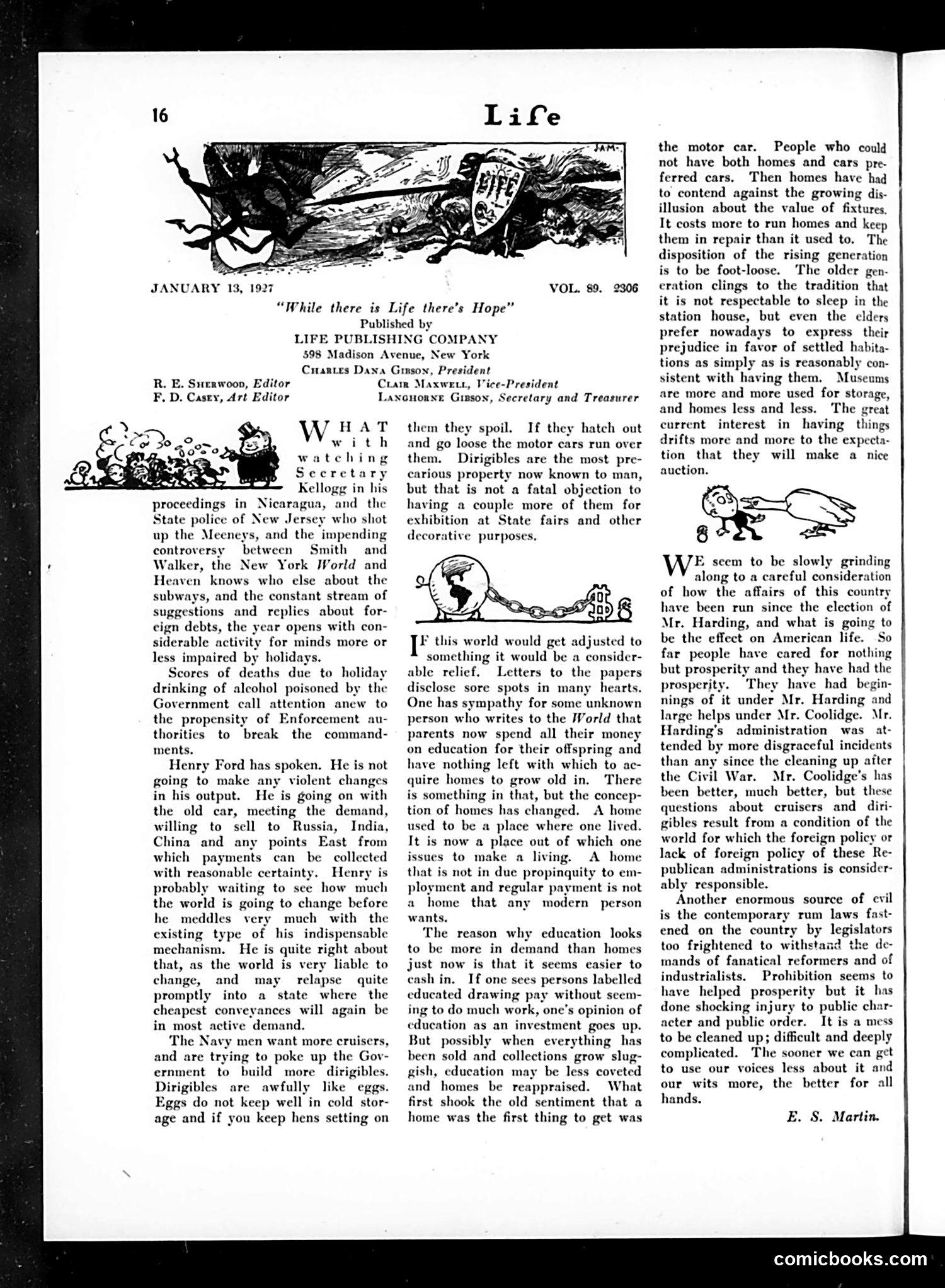
This page contains editorial commentary rather than political cartoons. The main illustrated elements are small decorative vignettes—a sleeping figure and a globe wrapped in chain. The editorial discusses Henry Ford's recent statements about future industrial changes. It critiques how Americans obsess over prosperity while ignoring deeper social problems. The text references the Harding administration's record and discusses contemporary issues: housing conditions, education funding, Prohibition's failures, and rum laws. The cartoon elements are minimal and illustrative rather than satirical. The globe-in-chains image appears to symbolize economic constraints or global problems. The overall tone is pessimistic about American society's priorities under current leadership, suggesting citizens care only about material wealth despite widespread social ills.
📄 Transcribed text from this page (OCR, searchable)
Machine-transcribed from the original scan — historical spelling and the odd misread are preserved.
VOL. 89. 2306 “While there is Life there’s Hope” Published by LIFE PUBLISHING COMPANY 598 Madison Avenue, New York Cuantes Dana Ginsox, President R. E. Surrwoon, Editor F. D. Casey, Art Editor AY HAT with watching Secretary Kellogg in his proceedings in Nicaragua, and the State police of New Jersey who shot up the Meeneys, and the impending controversy between Smith and Walker, the New York World and Heaven knows who else about the subways, and the constant stream of suggestions and replies about for- cign debts, the year opens with con- siderable ity for minds more or less impaired by holidays. Scores of deaths due to holiday drinking of alcohol poisoned by the Government call attention anew to the propensity of Enforcement au- thorities to break the command- ments, Henry Ford has spoken. He is not going to make any violent changes in his output. He is going on with the old car, meeting the demand, willing to sell to Russia, India, China and any points East from which payments can be collected with reasonable certainty. Henry is probably waiting to see how much the world is going to change before he meddles very much with the existing type of his indispensable mechanism. He is quite right about that, as the world is very liable to change, and may relapse quite promptly into a state where the cheapest conveyances will again be in most active demand. The Navy men want more cruisers, and are trying to poke up the Gov- ernment to build more dirigibles. Dirigibles are awfully like eggs. Eggs do not keep well in cold stor- age and if you keep hens setting on Cram Maxwewt, Vice-President Lanouonne Ginson, Secretary and Treasurer them they spoil. If they hatch out and go loose the motor cars run over them. Dirigibles are the most pre- carious property now known to man, but that is not a fatal objection to having a couple more of them for exhibition at State fairs and other decorative purposes, F this world would get adjusted to something it would be a consider- able relief. Letters to the papers disclose sore spots in many hearts. One has sympathy for some unknown person who writes to the World that parents now spend all their money on education for their offspring and have nothing left with which to ac- quire homes to grow old in. There is something in that, but the concep- tion of homes has changed. A home used to be a place where one lived. It is now a place out of which one issues to make a living. A home that is not in due propinquity to em- ployment and regular payment is not a home that any modern person wants. The reason why education looks to be more in demand than homes just now is that it seems easier to cash in. If one sees persons labelled educated drawing pay without scem- ing to do much work, one’s opinion of education as an investment goes up. But possibly when everything has been sold and collections grow slug- gish, education may be less coveted and homes be reappraised. What first shook the old sentiment that a home was the first thing to get was the motor car. People who could not have both homes and cars pre- ferred cars. Then homes have had to contend against the growing dis- illusion about the value of fixtures, It costs more to run homes and keep them in repair than it used to. The disposition of the rising generation is to be foot-loose. The older gen- eration clings to the tradition that it is not respectable to sleep in the station house, but even the elders prefer nowadays to express their prejudice in favor of settled habita- tions as simply as is reasonably con- sistent with having them. Museums are more and more used for storage, and homes less and less. The great current interest in having things drifts more and more to the expecta- tion that they will make a_ nice auction. E seem to be slowly grinding along to a careful consideration of how the affairs of this country have been run since the election of Mr. Harding, and what is going to be the effect on American life. So far people have cared for nothing but prosperity and they have had the prosperity. They have had_begin- nings of it under Mr. Harding and large helps under Mr. Coolidge. Mr. Harding's administration was _at- tended by more disgraceful incidents than any since the cleaning up after the Civil War. Mr. Coolidge’s has been better, much better, but these questions about cruisers and diri- gibles result from a condition of the world for which the foreign policy or lack of foreign policy of these Re- publican administrations is consider- ably responsible. Another enormous source of evil is the contemporary rum laws fast- ened on the country by legislators too frightened to withstand the de- mands of fanatical reformers and of industrialists. Prohibition seems to have helped prosperity but it has done shocking injury to public char- acter and public order. It is a mess to be cleaned up; difficult and deeply complicated. The sooner we can get to use our voices less about it and our wits more, the better for all hands. E. S. Martin. comicbooks.com