
Life, 1927-01-13 · page 38 of 39
Life — January 13, 1927 — page 38: what you’re looking at
What you’re looking at
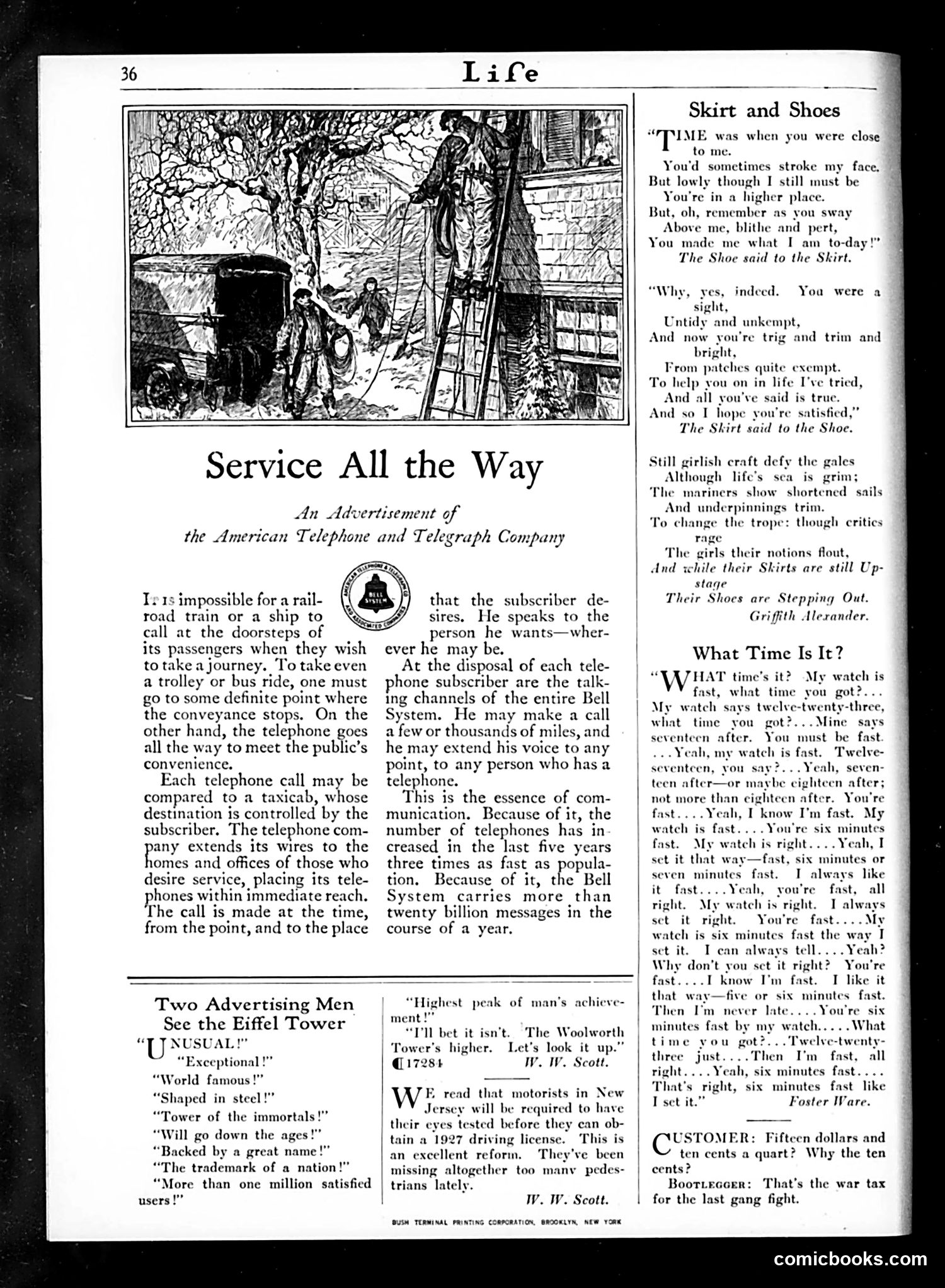
This page contains multiple short pieces typical of Life's satirical format: **Main Advertisement**: AT&T's "Service All the Way" promotes telephone superiority over transportation—you don't go to the phone; it comes to you conceptually through universal accessibility. **"Skirt and Shoes" Poem**: A personified dialogue where shoes credit themselves for elevating a skirt from "untidy and unkempt" to "trig and trim." The poem playfully reverses traditional class hierarchy—footwear claims to have improved clothing's station. The final stanza uses nautical metaphor ("Skirts are still Upstage / Their Shoes are Stepping Out"), likely commenting on 1920s women's fashion and social mobility. **"Eiffel Tower" Joke**: Two ad men argue whether the Eiffel Tower or Woolworth Building is taller, deciding to "look it up"—mocking American boosterism and competition with European landmarks. **"What Time Is It?" Piece**: Rapid-fire dialogue about watches running fast; likely satirizes Americans' obsession with punctuality and the absurdity of collectively running ahead of actual time. The page emphasizes Life's mix of commercial content and social satire.
📄 Transcribed text from this page (OCR, searchable)
Machine-transcribed from the original scan — historical spelling and the odd misread are preserved.
Service All the Way An Advertisement of the American Telephone and Telegraph Company Tris impossible for a rail- road train or a ship to call at the doorsteps of its passengers when they wish to take a journey. To take even a trolley or bus ride, one must go to some definite point where the conveyance stops. On the other hand, the telephone goes all the way to meet the public’s convenience. Each telephone call may be compared to a taxicab, whose destination is controlled by the subscriber. The telephone com- any extends its wires to the Fores and offices of those who desire service, placing its tele- phones within immediate reach, The call is made at the time, from the point, and to the place that the subscriber de- sires. He speaks to the person he wants—wher- ever he may be. At the disposal of each tele- hone subscriber are the talk- ing channels of the entire Bell System. He may make a call a few or thousands of miles, and he may extend his voice to any point, to any person who has a telephone. This is the essence of com- munication. Because of it, the number of telephones has in creased in the last five years three times as fast as popula- tion. Because of it, the Bell System carries more than twenty billion messages in the course of a year. Two Advertising Men See the Eiffel Tower “World famous!" “Shaped in steel!” “Tower of the immortals!” “Will go down the ages!” “Backed by a great name!” “The trademark of a nation!” “More than one million satisfied users !”" “Highest peak of man’s achieve- ment!” “Tl bet it isn’t. The Woolworth Tower's higher. Let's look it up.” 1728 W. Scott. F, read that motorists in New Jerscy will be required to have their eyes tested before they can ob- tain a 1927 driving license. This is an excellent reform. They've been | missing altogether too manv pedes- trians lately. W.W. Scott. USM TERMINAL PRINTING RATION, BROOKLYN, NEW YORE Skirt and Shoes “MIME was when you were close to me. You'd sometimes stroke my face, But lowly though I still must be You're in a higher place. But, oh, remember as you s Above me, blithe and pert, You made me what I am to-day!” The Shoe said to the Skirt. “Why, yes, indeed. You ght, Untidy and unkempt, And now you're trig and trim and bright, From patches quite exempt. To help you on in life I've tried, And all you've said is true. And so I hope you're satisfied,” The Skirt said to the Shoe. were a Still girlish craft defy the gales Although life’s sea is grim; The mariners show shortened sails And underpinnings trim. To change the trope: though critics rage The girls their notions flout, dnd while their Skirts are still Up- stage Their Shoes are Stepping Out. Griffith Alerander. What Time Is It? “V HAT time's it? fast, what time My watch says twelve what time you got?...Mine says seventeen after. You must be fi ah, my watel T My watch is you got?... wenty-three, rafter; . You're I'm fast. My watch is re six minutes fast. My watch is right....Yeah, I set it that way—fast, six minutes or seven minutes fast. I always like it fast....Yeah, you're fast, right. My watch is right. I alw set it) righ You're fast.. watch is six minutes fast the way set it. I can always tell. ...Yeah? Why don’t you set it right? You're fast....I know I'm fast. I like it that way—five or six minutes fast. Then I'm never late....You're six minutes fast by my watch... ..What time you got?...Twelve-twenty- three just....Then I'm fast, all right....Yeah, six minutes fast.... That's right, six minutes fast like I set it.” Foster Ware. teen after—or 1 not more t fast....Y: USTOMER: Fifteen dollars and ten cents a quart? Why the ten cents? Bootteccer: That's the war tax for the last gang fight. comicbooks.com