
Life, 1927-01-13 · page 24 of 39
Life — January 13, 1927 — page 24: what you’re looking at
What you’re looking at
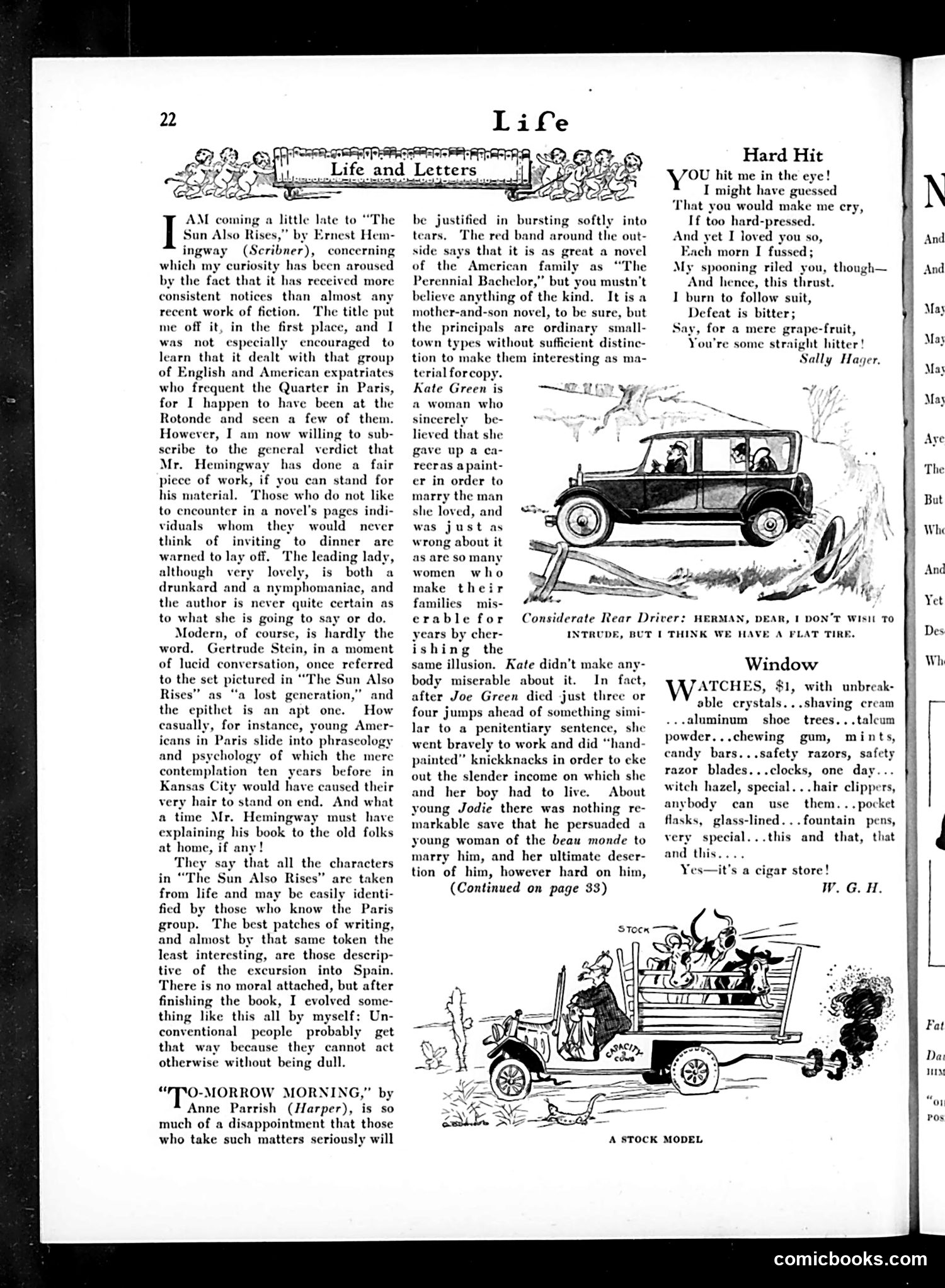
This page from *Life* magazine reviews two novels and includes satirical cartoons about automobiles. The main literary critiques discuss Hemingway's *The Sun Also Rises* (dismissing the "lost generation" of Paris expatriates as morally questionable but well-written) and Anne Parrish's *Tomorrow Morning* (criticized as disappointingly ordinary). The cartoons mock early automobile culture: "Considerate Rear Driver" shows a car hitting someone, with the caption sarcastically praising restraint. "A Stock Model" depicts a ramshackle vehicle barely holding together, satirizing cheaply-made mass-produced cars. The poem "Hard Hit" appears to be a lighthearted romantic quarrel, possibly with car-crash innuendo given the page's automotive theme. The "Window" section advertises novelty items—watches, cosmetics, office supplies—typical of 1920s mail-order catalogs, reflecting post-WWI consumer culture. Overall, the page captures *Life*'s satirical tone about modern society: skepticism toward artistic movements, mockery of new technology's absurdities, and commercialism.
📄 Transcribed text from this page (OCR, searchable)
Machine-transcribed from the original scan — historical spelling and the odd misread are preserved.
Kut AM coming a little late to “The Sun Also Rises,” by Ernest Hem- ingway (Scribner), concerning which my curiosity has been aroused by the fact that it has received more consistent notices than almost any recent work of fiction. The title put me off it, in the first place, and I was not especially encouraged to learn that it dealt with that group of English and American expatriates who frequent the Quarter in Paris, for I happen to have been at the Rotonde and seen a few of them. However, I am now willing to sub- scribe to the general verdict that Mr. Hemingway has done a fair piece of work, if you can stand for his material. Those who do not like to encounter in a novel's pages indi- viduals whom they would never think of inviting to dinner are warned to lay off. The leading lady, although very lovely, is both a drunkard and a nymphomaniac, and the author is never quite certain as to what she is going to say or do. Modern, of course, is hardly the word, Gertrude Stein, in a moment of lucid conversation, once referred to the set pictured in “The Sun Also Rises” as “a lost generation,” and the epithet an apt one. How casually, for instance, young Amer- icans in Paris slide into phraseology and psychology of which the mere contemplation ten years before in Kansas City would have caused their very hair to stand on end. And what a time Mr. Hemingway must have explaining his book to the old folks at home, if any! They say that all the characters in ne Sun Also Rises” are taken from life and may be easily identi- fied by those who know the Paris group. The best patches of writing, and almost by that same token the least interesting, are those descrip- tive of the excursion into Spain. There is no moral attached, but after finishing the book, I evolved some- thing like this all by myself: Un- conventional people probably get that way because they cannot act otherwise without being dull. “(TO-MORROW MORNING,” by Anne Parrish (Harper), is so much of a disappointment that those who take such matters seriously will be justified in bursting softly into tears. The red band around the out- side says that it is as great a novel of the American family as “The Perennial Bachelor,” but you mustn't believe anything of the kind. It is a mother-and-son novel, to be sure, but the principals are ordinary small- town types without sufficient distine- tion to make them interesting as ma- terial forcopy. Kate Green is a woman who sincerely —be- lieved that she gave up a ca- recras apaint- er in order to marry the man she loved, and was just as wrong about it as are somany women who make their families mis- erable for years by cher- ishing the same illusion. Kate didn't make any- body miserable about it. In fact, after Joe Green died just three or four jumps ahead of something simi- lar to a penitentiary sentence, she went bravely to work and did “hand- painted” knickknacks in order to cke out the slender income on which she and her boy had to live. About young Jodie there was nothing re- markable save that he persuaded a young woman of the beau monde to marry him, and her ultimate deser- tion of him, however hard on him, (Continued on page 33) Hard Hit ‘OU hit me in the eye! I might have guessed ‘That you would make me ery, If too hard-pressed. And yet I loved you so, Each morn I fussed; My spooning riled you, though— And hence, this thrust. I burn to follow suit, Defeat is bitter; Say, for a mere grape-fruit, You're some straight hitter! Sally Hager. Considerate Rear Driver: HERMAN, DEAR, | DON’T WIsii TO INTRUDE, BUT | THINK WE HAVE A PLAT TIRE. Window ATCHES, $1, with unbreak- able crystals...shaving cream ---aluminum shoe trees...talcum powder...chewing gum, mints, candy bars...safety razors, safety razor blades...clocks, one day... witch hazel, special. . hair clippers, anybody can them. . . pocket flasks, glass-lined...fountain pens, very special...this and that, that and this. Yes—it’s a cigar store! W. G. H. use A STOCK MODEL comicbooks.com