
Life, 1927-01-13 · page 23 of 39
Life — January 13, 1927 — page 23: what you’re looking at
What you’re looking at
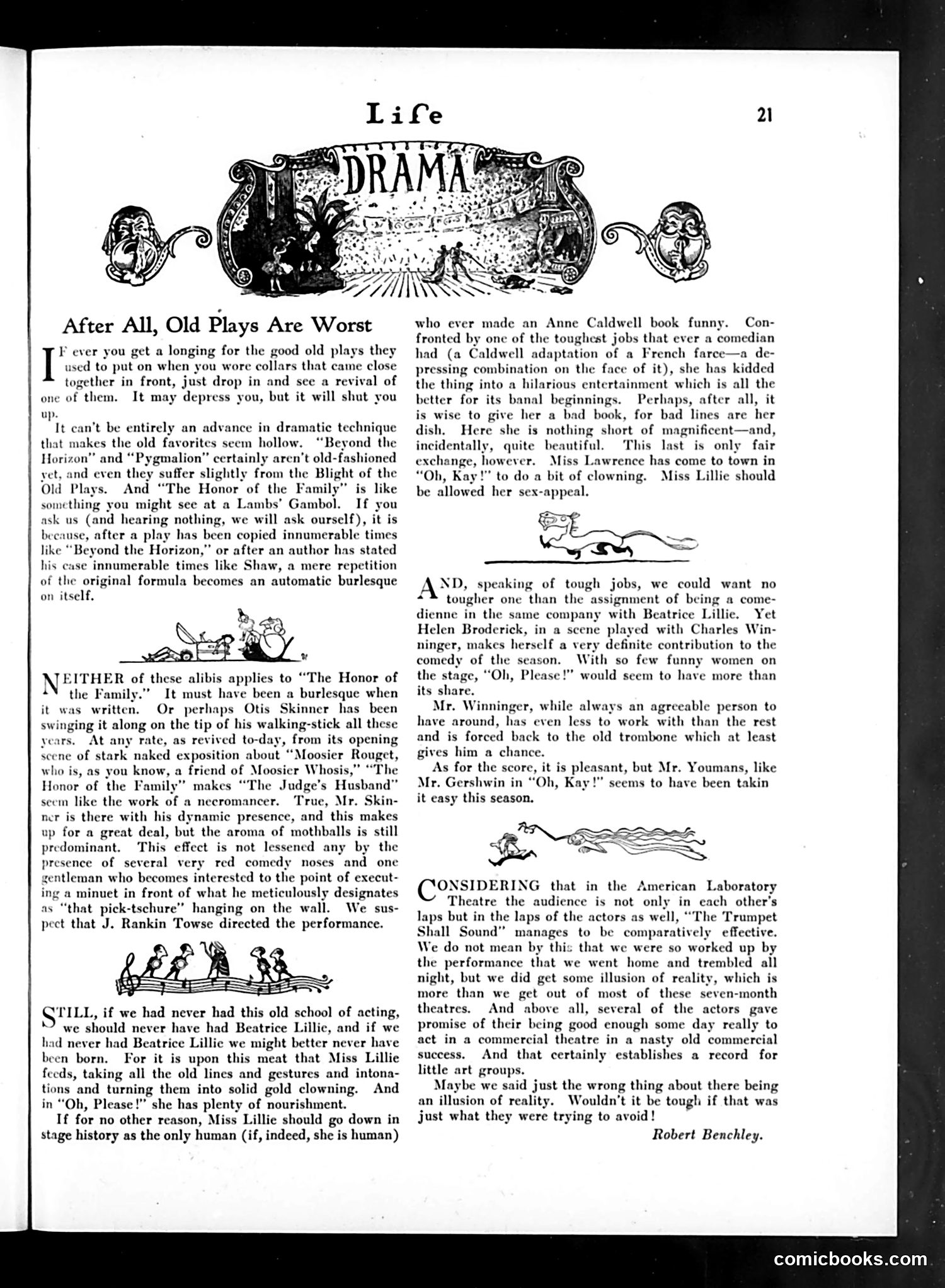
This is a theater review by Robert Benchley critiquing Broadway revivals and current productions. The piece contrasts tired old plays with fresh comedic talent. **Key figures mentioned:** - **Beatrice Lillie** - a comedienne praised as brilliantly transforming weak material into "solid gold clowning" - **Otis Skinner** - an aging actor in "The Honor of the Family," a revival the reviewer finds dated despite Skinner's "dynamic presence" - **Helen Broderick** and **Charles Winninger** - supporting players in "Oh, Please!" (a current production) - **Anne Caldwell** - writer of weak theatrical material that even talented performers struggle with **The satire:** Benchley argues that old plays, when revived repeatedly, become self-parodies—their formulas grow stale. However, he celebrates how Lillie's comedic genius can redeem even "bad books." The humor lies in praising performers for making the unmakeable work, while gently mocking dated theatrical conventions and tired material.
📄 Transcribed text from this page (OCR, searchable)
Machine-transcribed from the original scan — historical spelling and the odd misread are preserved.
After All, Old Plays Are Worst F ever you get a longing for the good old plays they I used to put on when you wore collars that caw together in front, just drop in and see a revival of one of them. It may depress you, but it will shut you up. Me can’t be entirely an advance in dramatic technique that makes the old favorites seem hollow. “Beyond the Horizon” and “Pygmalion” certainly arcn’t old-fashioned yet, and even they suffer slightly from the Blight of the Old Play And “The Honor of the Family” is like something you might see at a Lambs’ Gambol. If you ask us (and hearing nothing, we will ask ourself), it is because, after a play has been copied innumerable times like “Beyond the Horizon,” or after an author has stated his case innumerable times like Shaw, a mere repetition of the original formula becomes an automatic burlesque on itself, THER of these alibis applies to “The Honor of the Family.” It must have been a burlesque when it was written. Or perhaps Otis Skinner has been swinging it along on the tip of his walking-stick all these At any rate, as revived to-day, from its opening rk naked exposition about “Moosier Re who is, as you know, a friend of Moosier Whosis,” Honor of the Family” makes “The Judge's Husband” seem like the work of a necromancer. True, Mr. Skin- ner is there with his dynamic presence, and this makes up for a great deal, but the aroma of mothballs is still predominant. This effect is not lessened any by the presence of several very red comedy noses and one gentleman who becomes interested to the point of execut- ing a minuet in front of what he meticulously designates as “that pick-tschure” hanging on the wall. We sus- pect that J. Rankin Towse directed the performance. a years, scene of s\ “TILL, if we had never had this old school of acting, we should never have had Beatrice Lillic, and if we had never had Beatrice Lillie we might better never have een born. For it is upon this meat that Miss Lillie s, taking all the old lines and gestures and intona- tions and turning them into solid gold clowning. And in “Oh, Please!” she has plenty of nourishment. If for no other reason, Miss Lillie should go down in stage history as the only human (if, indeed, she is human) who ever made an Anne Caldwell book funny. Con- fronted by one of the toughest jobs that ever a comedian had (a Caldwell adaptation of a French farce—a de- pressing combination on the face of it), she has kidded the thing into a hilarious entertainment which is all the better for its beginnings. Perhaps, after all, it is wise to give her a bad book, for bad lines are her dish, Here she is nothing short of magnificent—and, incidentally, quite beautiful. This last is only fair exchange, however. Miss Lawrence has come to town in “Oh, Kay!" to do a bit of clowning. Miss Lillie should be allowed her sex-appeal. ND, speaking of tough jobs, we could want no tougher one than the assignment of being a come- dienne in the same company with Beatrice Lillie. Yet Helen Broderick, in a scene played with Charles Win- ninger, makes herself a very definite contribution to the comedy of the season. With so few funny women on the stage, “Oh, Please!" would seem to have more than its share. Mr. Winninger, while always an agreeable person to have around, has even less to work with than the rest and is forced back to the old trombone which at least gives him a chance. As for the score, it is ple Mr. Gershwin in “Oh, Kay it easy this season, nt, but Mr. Youmans, like * seems to have been takin ONSIDERING that in the American Laboratory Theatre the audience is not only in each other's laps but in the laps of the actors as well, “The Trumpet Shall Sound” manages to be comparatively effective. We do not mean by this that we were so worked up by the performance that we went home and trembled all night, but we did get some illusion of reality, which is more than we get out of most of these seven-month theatres. And above all, several of the actors gave promise of their being good enough some day really to act in a commercial theatre in a nasty old commercial success. And that certainly establishes a record for little art groups. Maybe we said just the wrong thing about there being an illusion of reality. Wouldn't it be tough if that was just what they were trying to avoid! Robert Benchley. comicbooks.com