
Life, 1927-01-13 · page 13 of 39
Life — January 13, 1927 — page 13: what you’re looking at
What you’re looking at
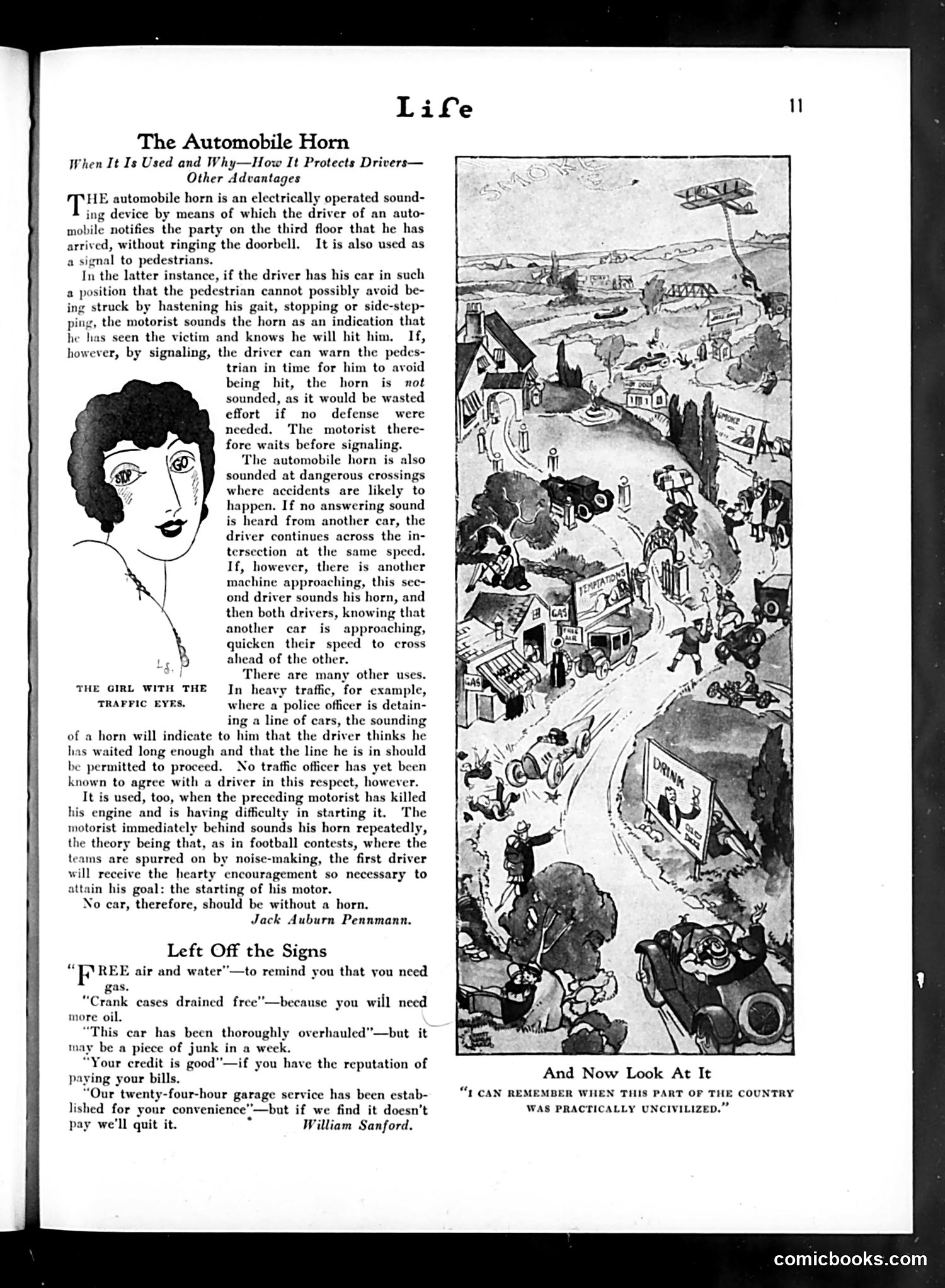
This page contains two articles about early automobile safety and etiquette. **"The Automobile Horn"** discusses when drivers should use horns to warn pedestrians and other vehicles. The accompanying illustration shows "The Girl with the Traffic Eyes"—a woman with exaggerated eyes marked with "60" (likely referring to speed), satirizing women drivers' supposed obliviousness to traffic dangers. The article humorously compares horn-sounding to football teams' noise-making for encouragement. **"Left Off the Signs"** is a brief satire by William Sanford mocking garage service claims. It jokes that garages advertise "free" services (air, water, drained cases) but conveniently omit mentioning actual costs—suggesting garages are unreliable and dishonest about hidden fees. Both pieces reflect 1920s anxieties about automobile safety, traffic culture, and consumer trust.
📄 Transcribed text from this page (OCR, searchable)
Machine-transcribed from the original scan — historical spelling and the odd misread are preserved.
Life The Automobile Horn When It Is Used and Why—How It Protects Drivers— Other Advantages HE automobile horn is an electrically operated sound- ing device by means of which the driver of an auto- mobile notifies the party on the third floor that he has arrived, without ringing the doorbell. It is also used as a signal to pedestrians. In the latter instance, if the driver has his car in such a position that the pedestrian cannot possibly avoid be- ing struck by hastening his gait, stopping or side-step- the motorist sounds the horn as an indication that » has seen the victim and knows he will hit him. If, however, by signaling, the driver can warn the pedes- trian in time for him to avoid being hit, the horn is not sounded, as it would be wasted effort if no defense were needed. The motorist there- fore waits before signaling. The automobile horn is also sounded at dangerous crossings where accidents are likely to happen. If no answering sound is heard from another car, the driver continues across the in- tersection at the same speed. If, however, there is another machine approaching, this sec- ond driver sounds his horn, and then both drivers, knowing that another car is approaching, quicken their speed to cross ahead of the other. There are many other uses. THE GIRL WITH THE In heavy traffic, for example, TRAFFIC RYES. where a police officer is detain- ing a line of cars, the sounding of a horn will indicate to him that the driver thinks he has waited long enough and that the line he is in should be permitted to proceed. No traffic officer has yet been known to agree with a driver in this respect, however. It is used, too, when the preceding motorist has killed his engine and is having difficulty in starting it. The motorist immediately behind sounds his horn repeatedly, the theory being that, as in football contests, where the teams are spurred on by noise-making, the first driver will receive the hearty encouragement so necessary to attain his goal: the starting of his motor. No car, therefore, should be without a horn, Jack Auburn Pennmann. Left Off the Signs “F REE air and water"”—to remind you that you need gas. “Crank cases drained free"’—because you will need more oil. “This car has been thoroughly overhauled”—but it may be a piece of junk in a week. “Your credit is good"—if you have the reputation of paylog your bills 8 J : And Now Look At It “Our twenty-four-hour garage service has been estab- “1 CAN REMEMBER WHEN THIS PART OP THE COUNTRY lished for yonr convenience"—but if we find it doesn’t WAS PRACTICALLY UNCIVILIZED.” pay we'll quit it. . William Sanford. comicbooks.com