
Life, 1927-01-13 · page 28 of 39
Life — January 13, 1927 — page 28: what you’re looking at
What you’re looking at
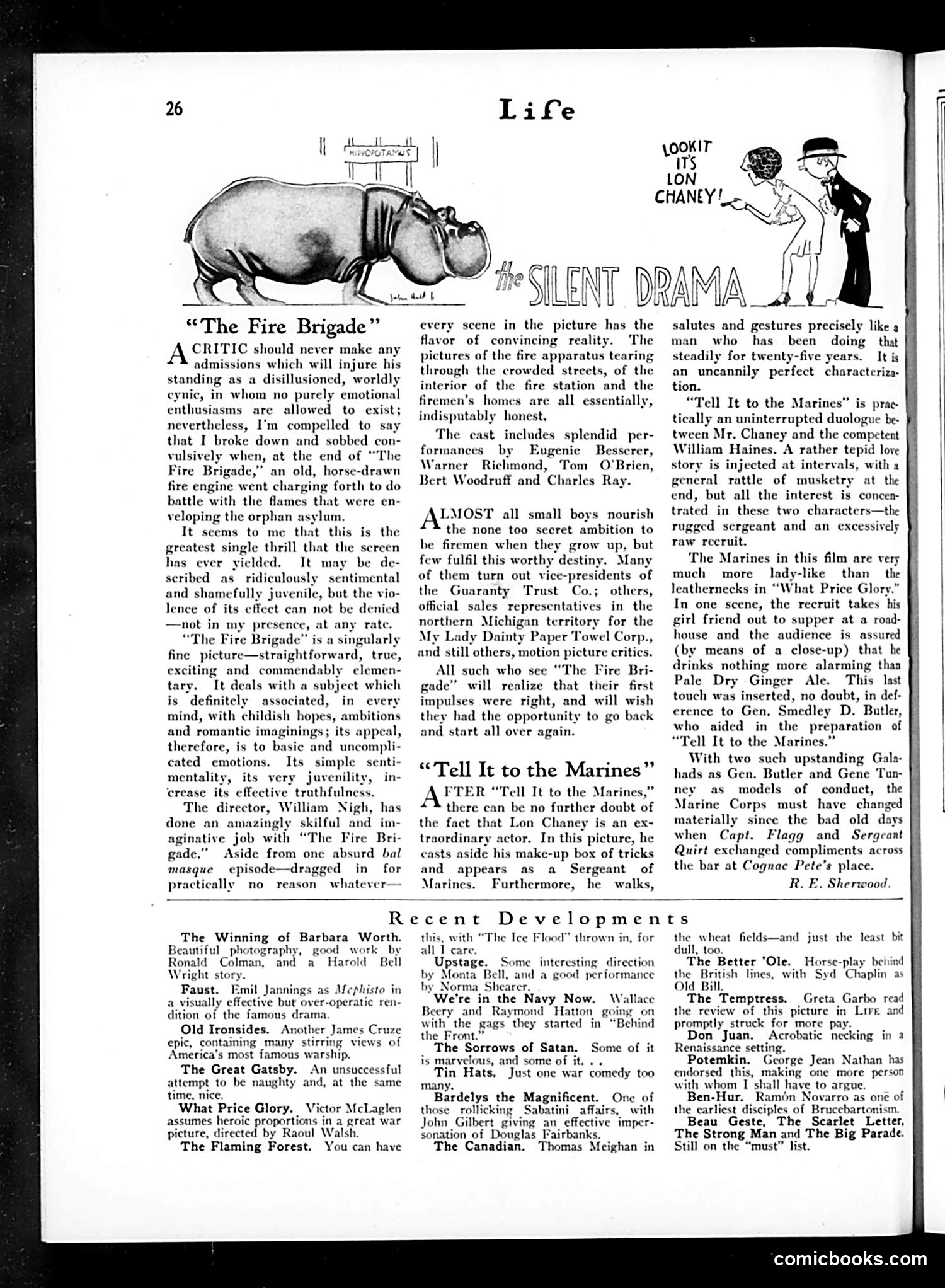
This is a film criticism page from Life magazine reviewing two silent films: "The Fire Brigade" and "Tell It to the Marines." The cartoon at top right mocks actor **Lon Chaney**, famous for elaborate makeup disguises. It shows him removing a grotesque mask, with the caption "LOOK! IT'S LON CHANEY!"—the joke being that Chaney's real face is as striking as his theatrical transformations. The reviews themselves are satirical critiques of sentimentality in cinema. The critic admits to crying at "The Fire Brigade" (an orphan-rescue film with a fire engine climax), then mocks this reaction as emotionally manipulative yet effective. The "Tell It to the Marines" section jokes about the film's sanitized portrayal of Marines—notably showing the recruit drinking only ginger ale rather than alcohol, attributed to General Smedley D. Butler's involvement. This implies the film was cleaned up for respectability, contrasting with the grittier "What Price Glory." The satire targets both filmmakers' manipulation of emotion and military cooperation in softening the Marines' public image.
📄 Transcribed text from this page (OCR, searchable)
Machine-transcribed from the original scan — historical spelling and the odd misread are preserved.
“The Fire Brigade” CRITIC should never make any admissions which will injure his standing as a disillusioned, worldly cynic, in whom no purely emotional enthusiasms are allowed to exist; nevertheless, I’m compelled to say that I broke down and sobbed vulsively when, at the end of Fire Brigade,” an old, horse-drawn fire engine went charging forth to do battle with the flames that were en- veloping the orphan asylum, It seems to me that this is the greatest single thrill that the screen has ever yielded. It may be de- scribed as ridiculously sentimental and shamefully juvenile, but the vio- lence of its effect can not be denied —not in my presence, at any rate. “The Fire Brigade” is a singularly fine picture—straightforward, true, exciting and commendably eclemen- tary. It deals with a subject which is definitely associated, in every mind, with childish hopes, ambitions and romantic imaginings; its appeal, therefore, is to basic and uncompli- cated emotions. Its simple senti- mentality, its very juvenility, in- ‘crease its effective truthfulness. The director, William Nigh, has done an amazingly skilful and im- aginative job with “The Fire Bri- gade.” Aside from one absurd bal masque episode—dragged in for practically no reason whatever every scene in the a has the flavor of convincing reality. The pictures of the fire apparatus tearing through the crowded streets, of the interior of the fire station and the firemen’s homes are all essentially, indisputably honest. The cast includes splendid per- formances by Eugenie Besserer, Warner Richmond, Tom O'Brien, Bert Woodruff and Charles Ray. LMOST all small boys nourish the none too secret ambition to be firemen when they grow up, but few fulfil this worthy destiny. Many of them turn out vice-presidents of the Guaranty Trust Co.; others, official sales representatives in the northern Michigan territory for the My Lady Dainty Paper Towel Corp., and still others, motion picture critics. All such who see “The Fire Bri- gade” will realize that their first impulses were right, and will wish they had the opportunity to go back and start all over again. “Tell It to the Marines” FTER “Tell It to the Marines,” there can be no further doubt of the fact that Lon Chaney is an ex- traordinary actor. In this picture, he casts aside his make-up box of tricks and appears as a Sergeant of Marines. Furthermore, he walks, \OOKIT ITs LON @ CHANEY! _) salutes and gestures eaypnecigcte like a man who has been doing that steadily for twenty-five years. an uncannily perfect characteriza tion. “Tell It to the Marines” is prac tically an uninterrupted duologue be- tween Mr. Chaney and the competent William Haines. A rather tepid love story is injected at intervals, with a general rattle of musketry at the end, but all the interest is concen- trated in these two characters—the rugged sergeant and an excessively raw recruit. The Marines in this film are very much more lady-like than the leathernecks in “What Price Glory.” In one scene, the recruit takes his girl friend out to supper at a road- house and the audience is assured (by means of a close-up) that he drinks nothing more alarming than Pale Dry Ginger Ale. This last touch was inserted, no doubt, in def- erence to Gen. Smedley D. Butler, who aided in the preparation of “Tell It to the Marines.” With two such upstanding Gala- hads as Gen. Butler and Gene Tun- ney as models of conduct, the Marine Corps must have changed materially since the bad old days when Capt. Flagg and Sergeant Quirt exchanged compliments across the bar at Cognac Pete’s place. R. E. Sherwood. Recent The Winning of Barbara Worth. Beautiful photography, good work by Ronald Colman, and a Harold Bell Wright story. Faust. Emil Jannings as Mephisto in a visually effective but over-operatic ren- dition of the famous drama. Old Ironsides. Another James Cruze epic, containing many stirring views of America’s most famous warship. The Great Gatsby. An unsuccessful attempt to be naughty and, at the same time, nice. What Price Glory. Victor McLaglen assumes heroic proportions in a great war picture, directed by Raoul Walsh. The Flaming Forest. You can have this, with “The Ice Flood” all I care. Upstage. Some interesting direction by Monta Bell, and a good perfor by Norma, Shearer. We're in the Navy Now. Beery and mond Hatton with the they started in “Behind the Front.” The Sorrows of Satan. Some of it is marvelous, and some of it. . . at Hats. Just one war comedy too thrown in, for en pardelys the Magnificent. One of those _ rollicking batini affairs, with John Gilbert giving an. effective imper- sonation of Douglas Fairbank: The Canadian. Thomas Meighan in Developments the wheat fields—and just the least bit dull, too. The Better ‘Ole. Horse-play beiind the British lines, with Syd Chaplin as Old Bill. The Temptress. Greta Garbo read the review of this picture in Lire and promptly struck for more pay. Don Juan. Acrobatic necking in a Renaissance setting. Potemkin. Gcorge Jean Nathan has endorsed this, making one more person with whom I shall have to argue. Ben-Hur. Ramon Novarro as one of the earliest disciples of Brucebartonism. Beau Geste, The Scarlet Letter, The Strong Man and The Big Parade. Still on the “must” list. Itis | comicbooks.com