
A complete issue · 41 pages · 1926
Life — August 26, 1926
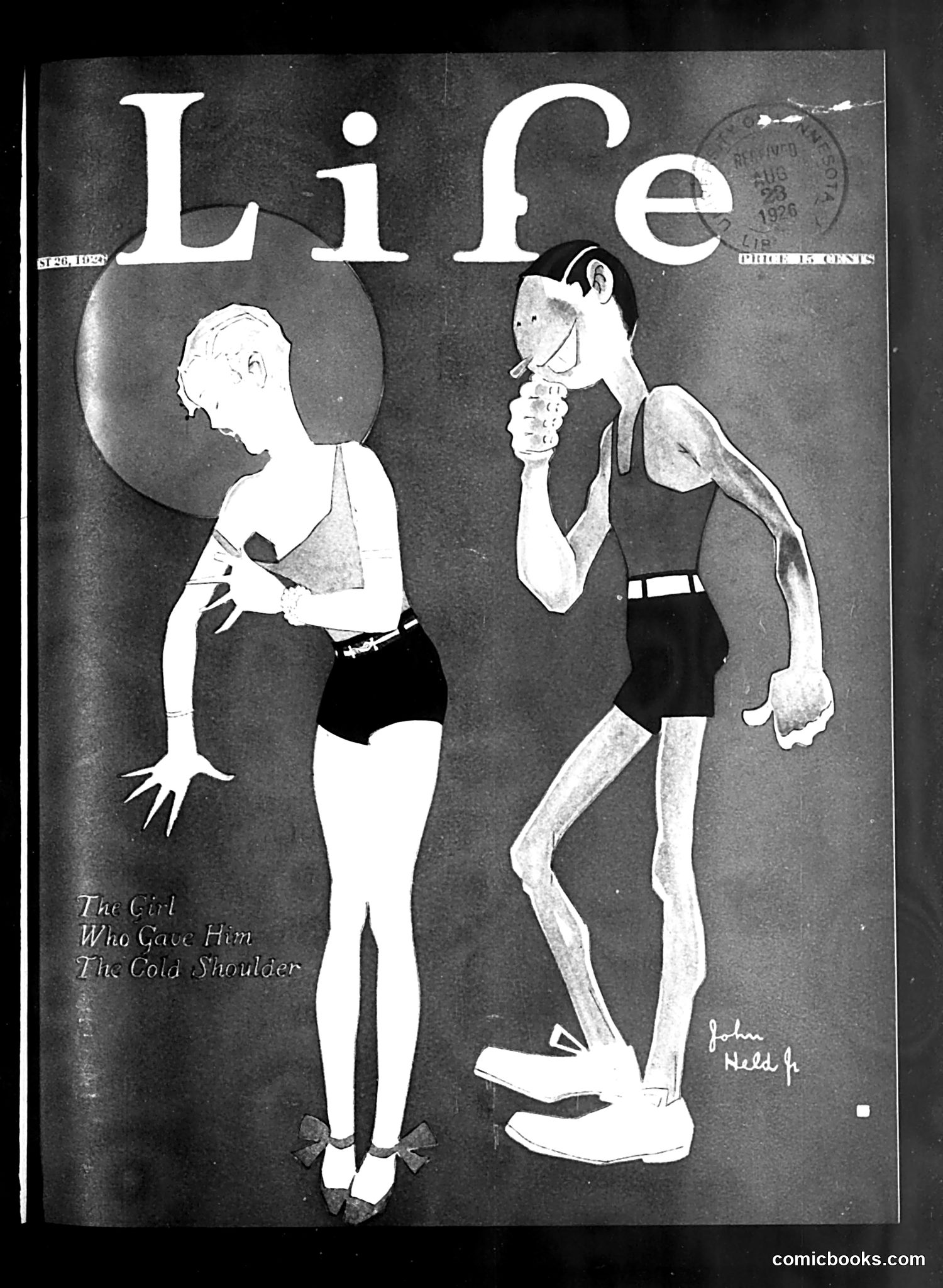
This *Life* magazine cover satirizes dating and romantic rejection in the 1920s. The illustration shows a man holding a mirror, apparently rejected by a woman turning away with an indifferent gesture. The caption "The Girl Who Gave Him The Cold Shoulder" references the contemporary phrase for romantic dismissal. The exaggerated caricature style—his grotesque, eager expression contrasted with her cool detachment—mocks the desperation of spurned suitors during this era of changing gender dynamics. The 1920s saw increased female independence and dating freedom, which challenged traditional male courtship expectations. This cover humorously depicts that cultural tension: a man's investment in romance literally mirrored back as futile, while the woman maintains power through indifference. The artist's signature appears to be John Held Jr., known for such satirical 1920s imagery.
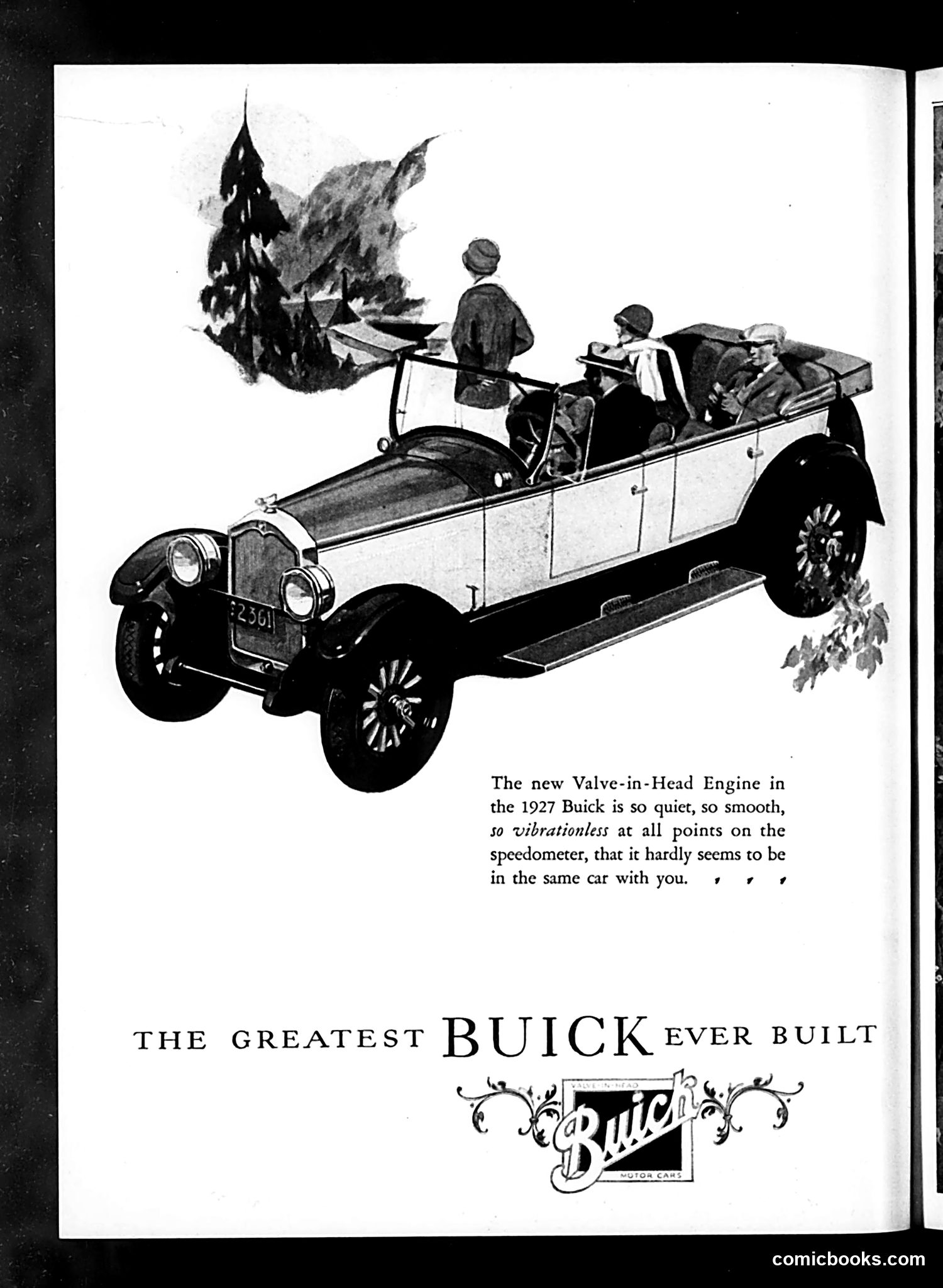
This is a **1927 Buick automobile advertisement**, not political satire. The image shows a luxury car of the era with passengers, accompanied by decorative foliage in the upper left corner. The advertisement emphasizes the 1927 Buick's new Valve-in-Head Engine technology, claiming it operates so smoothly and without vibration that passengers "hardly seem to be in the same car with you." This was a significant engineering selling point at the time—modern engines were notably smoother and quieter than earlier models. The tagline "The Greatest Buick Ever Built" reflects competitive marketing within the early automotive industry. There is no political or social satire present; this is straightforward commercial advertising from Life magazine's pages.
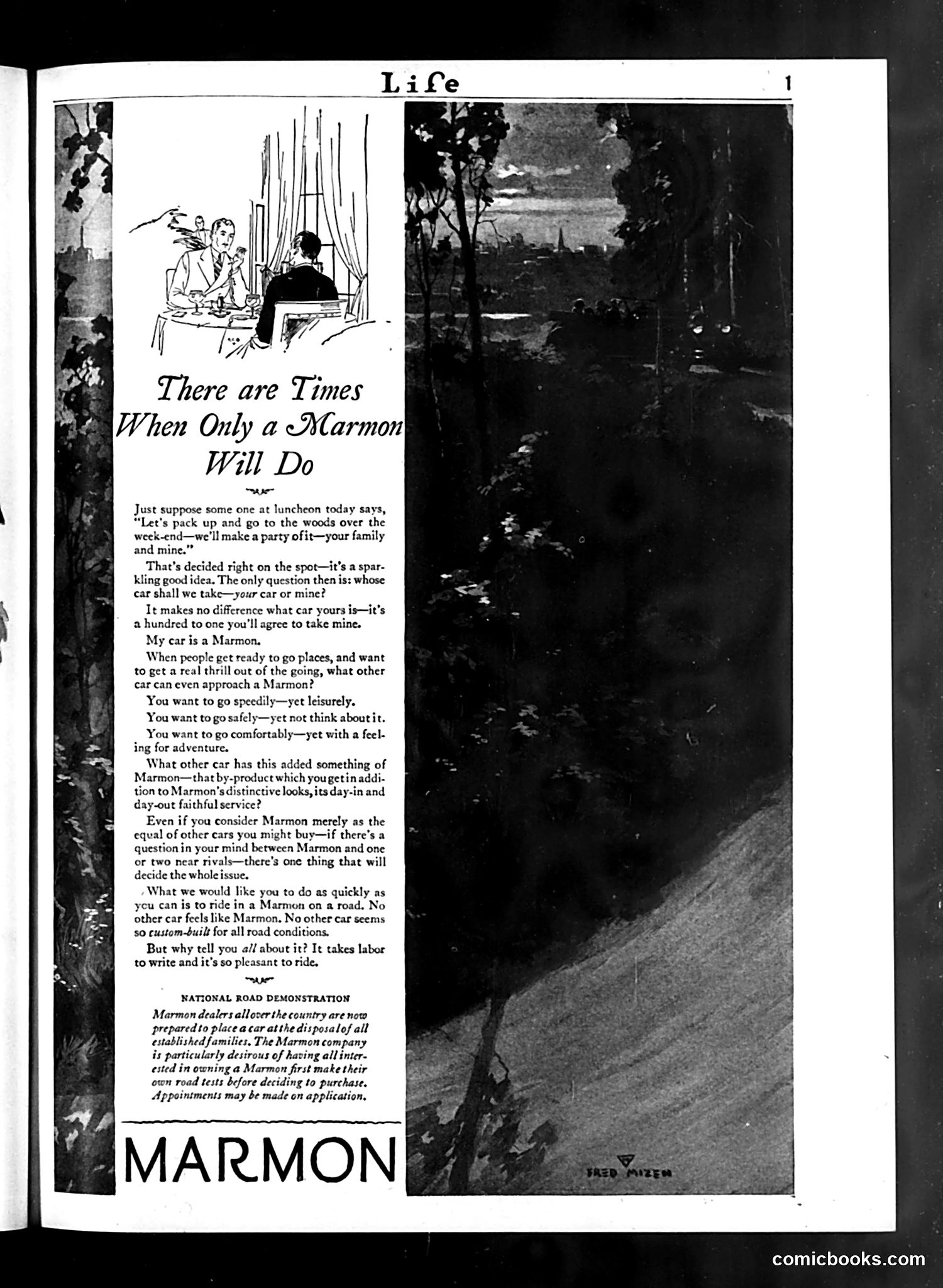
This page is primarily a **Marmon automobile advertisement**, not political satire. The ad uses a common early 20th-century marketing approach: a lifestyle narrative rather than product specifications. The cartoon shows two people at lunch discussing a weekend outing. The ad's argument is that when choosing between cars for recreation, a Marmon stands out because it delivers "speed," "safety," "comfort," and "adventure" simultaneously—qualities the copywriter claims no competing vehicle matches. The text emphasizes Marmon's "custom-built" construction and reliability on various road conditions. A note at bottom mentions the company's "National Road Demonstration" program, allowing potential buyers test drives before purchase. This is straightforward commercial persuasion, not commentary on social or political issues.
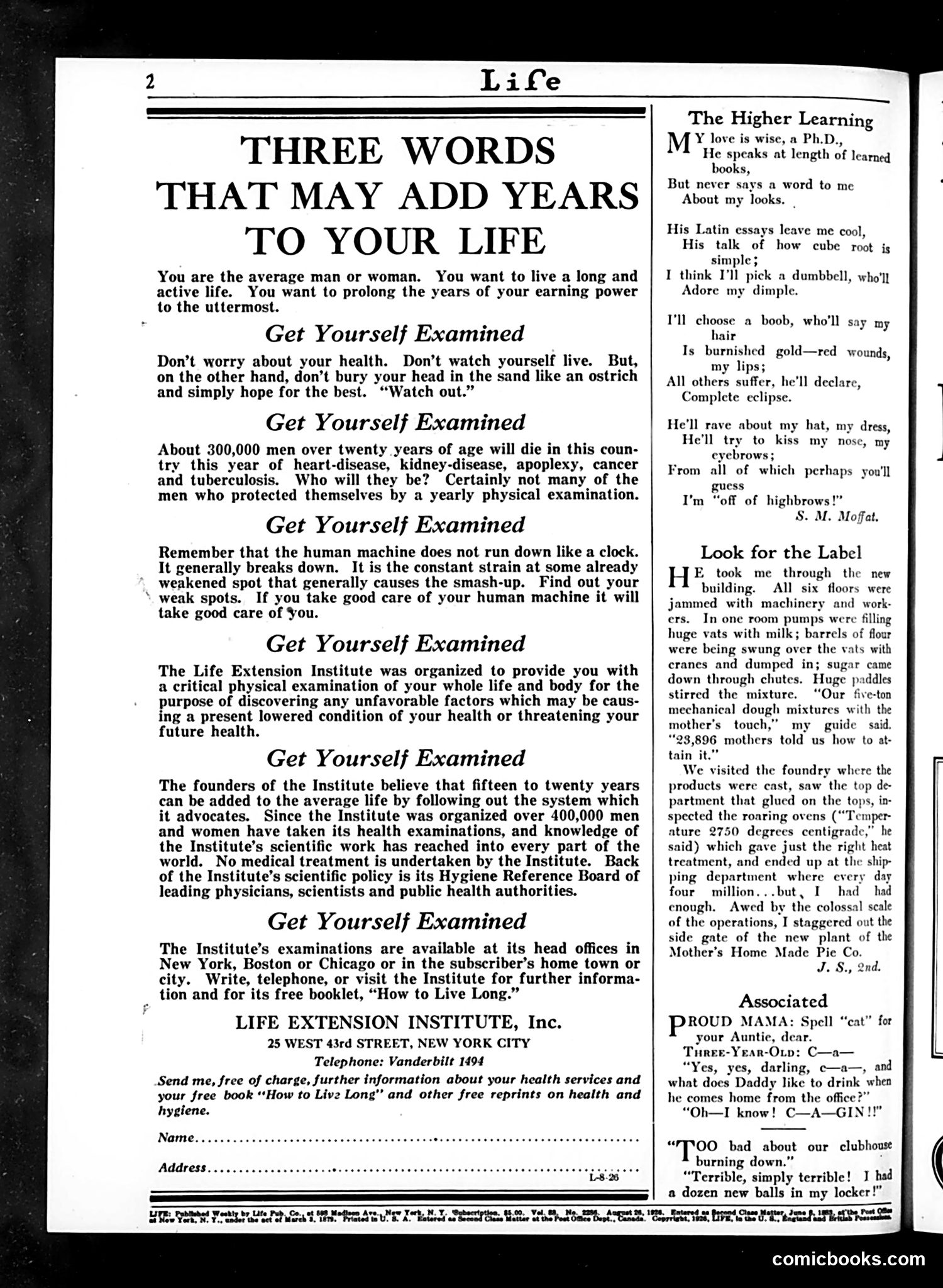
This page is primarily **advertising and editorial content**, not political satire. The left side features an advertisement for the Life Extension Institute, promoting health examinations with the repeated slogan "Get Yourself Examined." The copy emphasizes that regular physical checkups can extend lifespan by detecting diseases like heart disease, kidney disease, and tuberculosis early. The right side contains two unrelated pieces: a poem titled "The Higher Learning" mocking an intellectual boyfriend, and a brief narrative "Look for the Label" describing a factory tour. This represents typical early 20th-century Life magazine content—mixing consumer health promotion, light domestic humor, and industrial celebration—rather than political commentary.
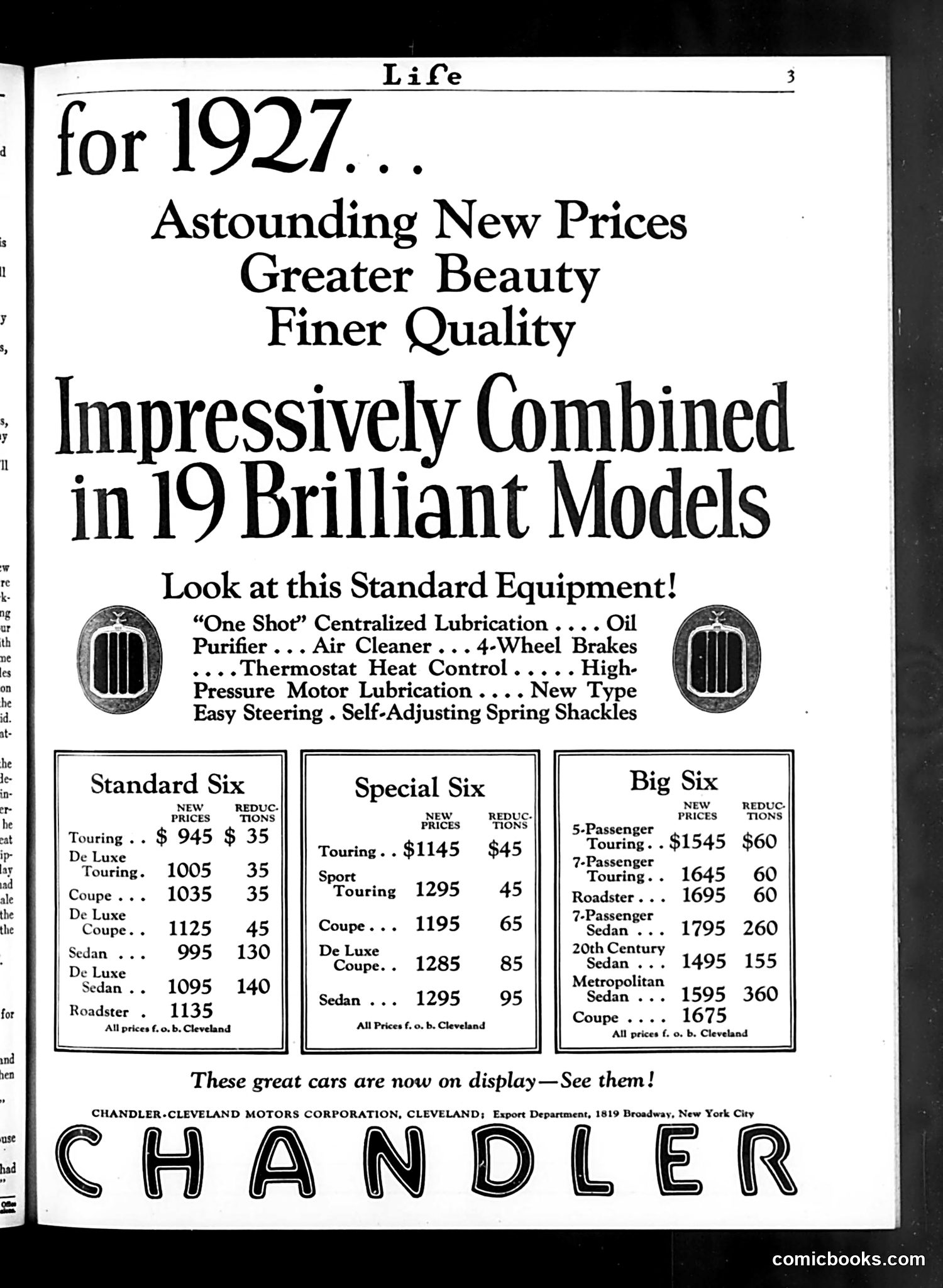
This page is **not a cartoon or satirical content** — it is a straightforward automobile advertisement for Chandler automobiles, published in Life magazine for 1927. The ad promotes three car models (Standard Six, Special Six, and Big Six) with their prices and standard features. The emphasis on "Astounding New Prices," "Greater Beauty," and "Finer Quality" reflects 1920s marketing aimed at middle-class buyers during the economically prosperous decade preceding the 1929 stock market crash. Notable features listed — centralized lubrication, thermostat heat control, four-wheel brakes — were advanced automotive technology for the era. The ad's placement in Life (then a humor/satire magazine) represents how magazines of this period mixed editorial and advertising content throughout their pages.
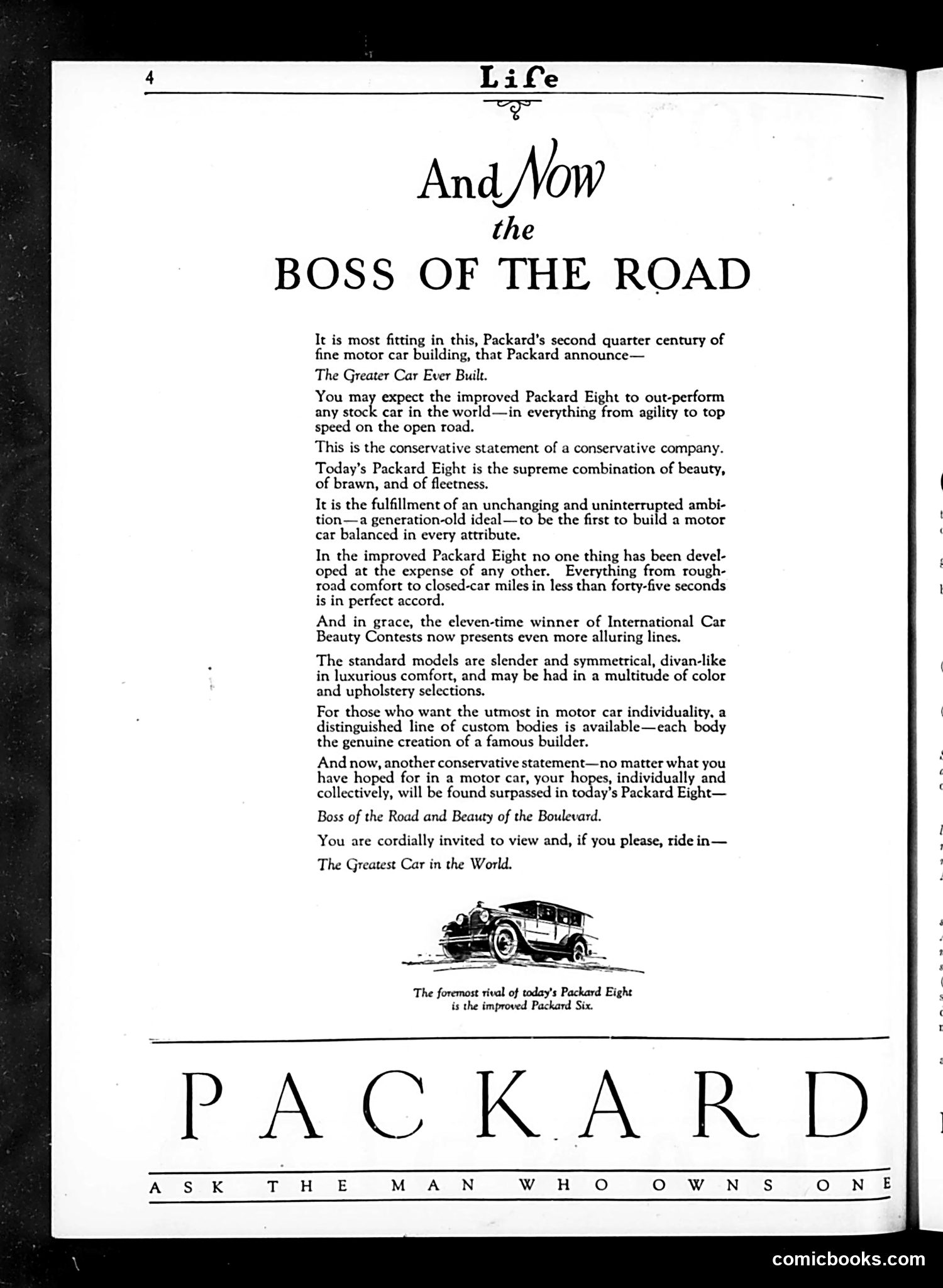
This is **not satirical content** but rather a **straightforward automobile advertisement** for the Packard Eight motor car, appearing in Life magazine. The page promotes Packard's "second quarter century" of car manufacturing, claiming the Packard Eight as "The Greatest Car Ever Built." The ad emphasizes performance features ("out-perform any stock car"), luxury ("divan-like in luxurious comfort"), and aesthetic appeal, referencing the car's "eleven-time winner of International Car Beauty Contests." The small illustration shows a vintage open-air automobile typical of the 1920s-30s era. The tagline "Boss of the Road and Beauty of the Boulevard" encapsulates the dual appeal to both performance and status-conscious buyers. This represents typical period advertising: aspirational, technically detailed, and targeting affluent consumers.
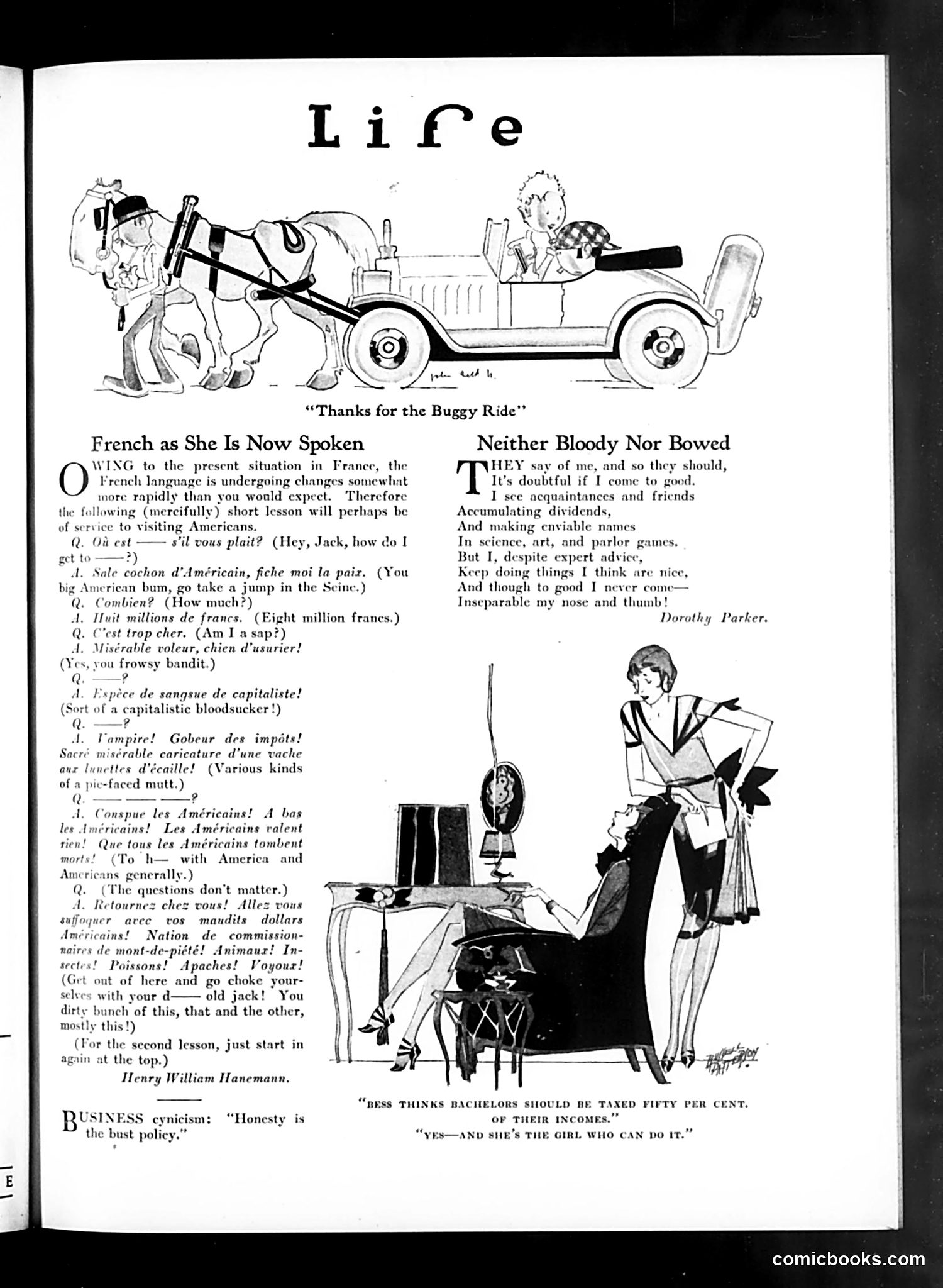
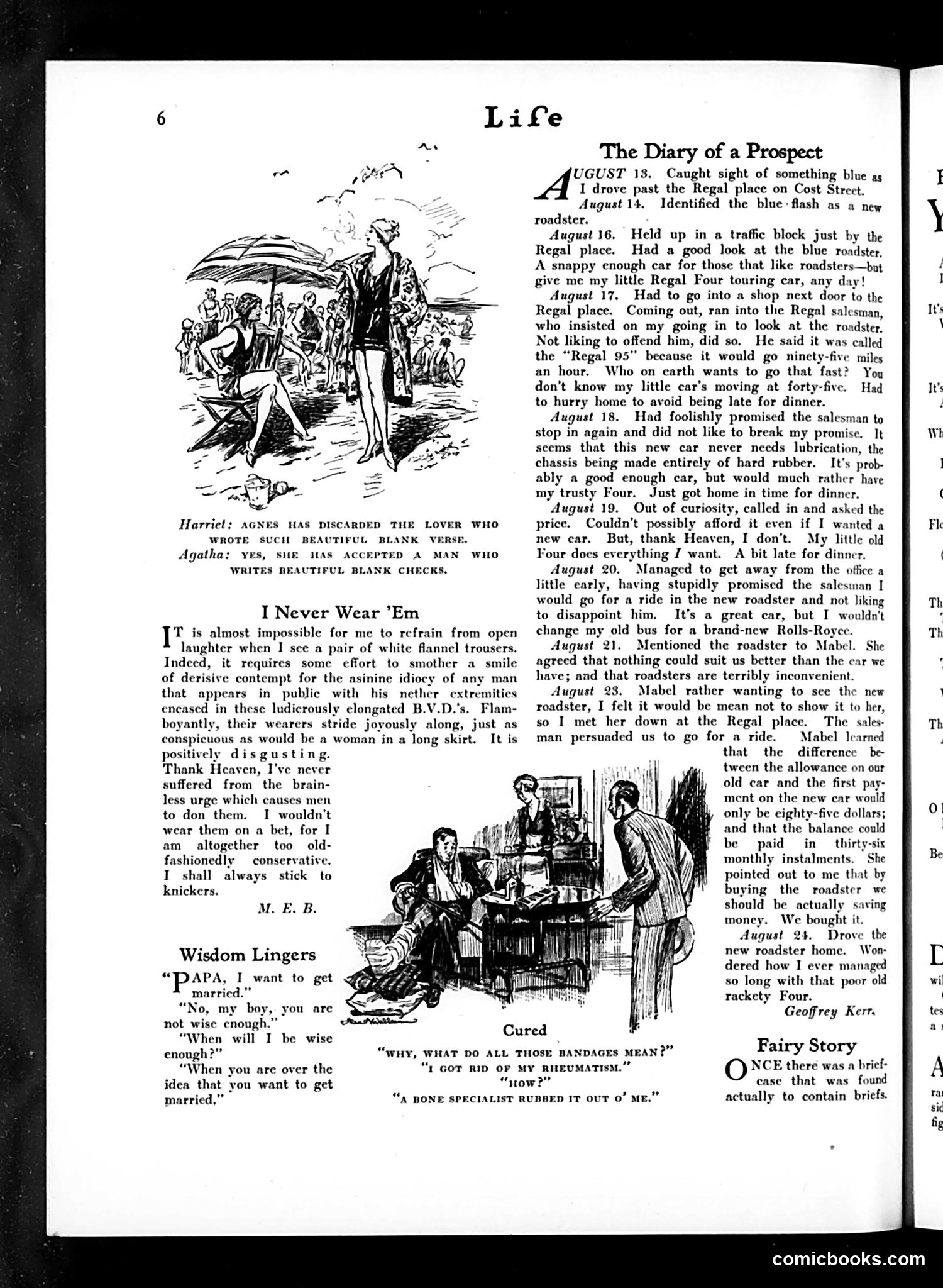
This page contains three distinct pieces of period humor: **"The Diary of a Prospect"** chronicles a man's experience test-driving a new "Regal" roadster in August, documenting his growing attachment to the vehicle despite its high cost and his salesman's pressure tactics. **"I Never Wear 'Em"** mocks men who wear white flannel trousers, calling the style "disgusting" and "old-fashioned." The author pledges allegiance to knickers instead—a comment on evolving menswear fashion standards of the era. **"Wisdom Lingers"** presents a brief dialogue where a father advises his son that wisdom comes only after marriage. **"Cured"** shows a doctor's humorous diagnosis: a patient's bandages and complaints of rheumatism are cured by a "bone specialist" rubbing it out. The joke plays on folk remedies versus modern medicine. These reflect early 20th-century concerns: automobile culture, fashion debates, and medical quackery.
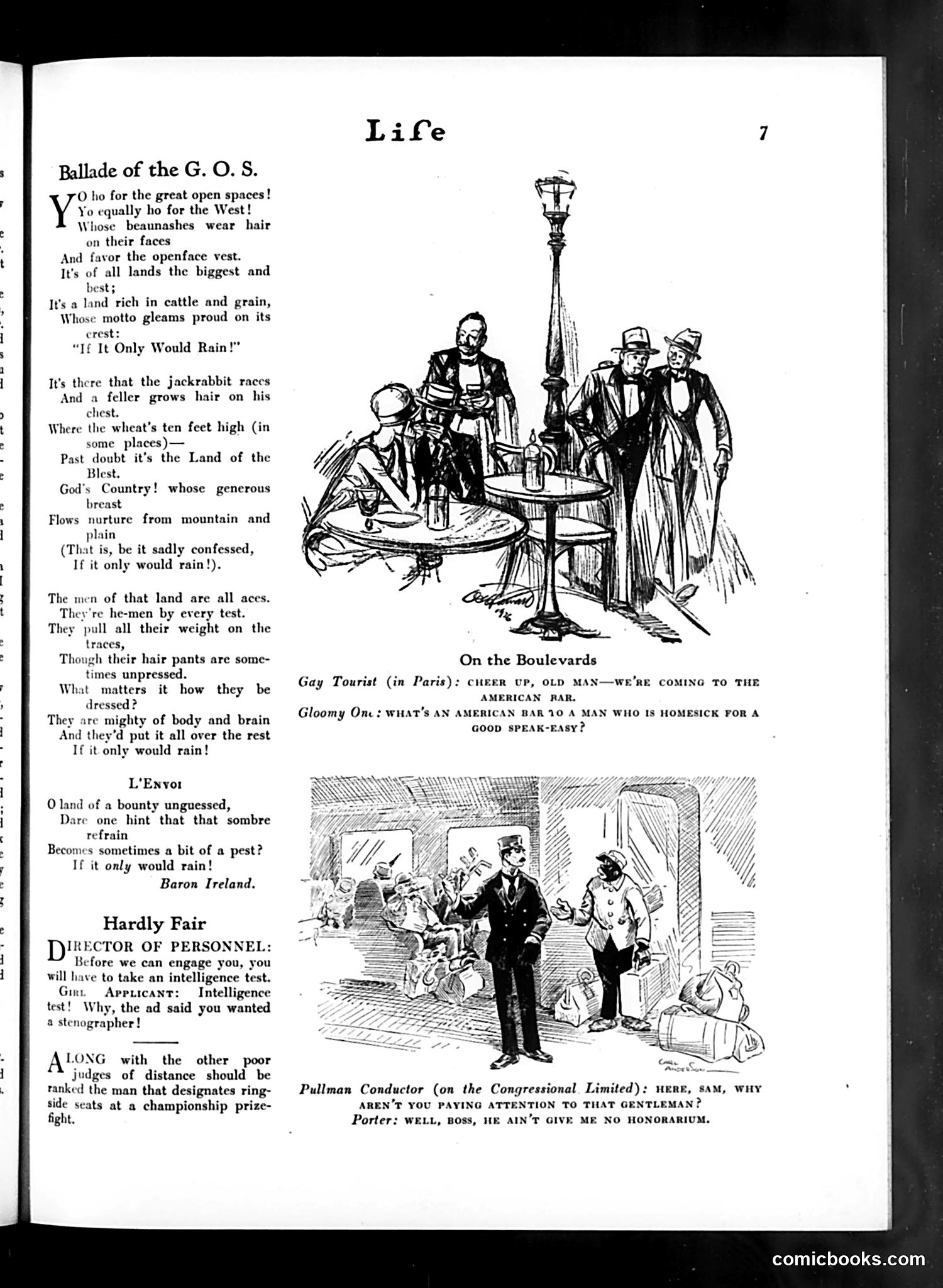
This page contains two separate satirical cartoons about American life and stereotypes: **"On the Boulevards"** depicts a Parisian tourist encountering an American at a bar, with the American characterized as homesick and wanting "a good speak-easy"—a reference to Prohibition-era illegal bars. **"Pullman Conductor"** shows a railroad conductor dismissing a passenger's complaint about a gentleman not paying attention, with the conductor refusing to intervene, saying the man "ain't give me no honorarium." This satirizes corruption among railroad staff who apparently required bribes to enforce civility. Both cartoons mock American behavior and values—the first portraying American tourists abroad as crass and drink-obsessed, the second critiquing workplace corruption and the commodification of basic service standards.
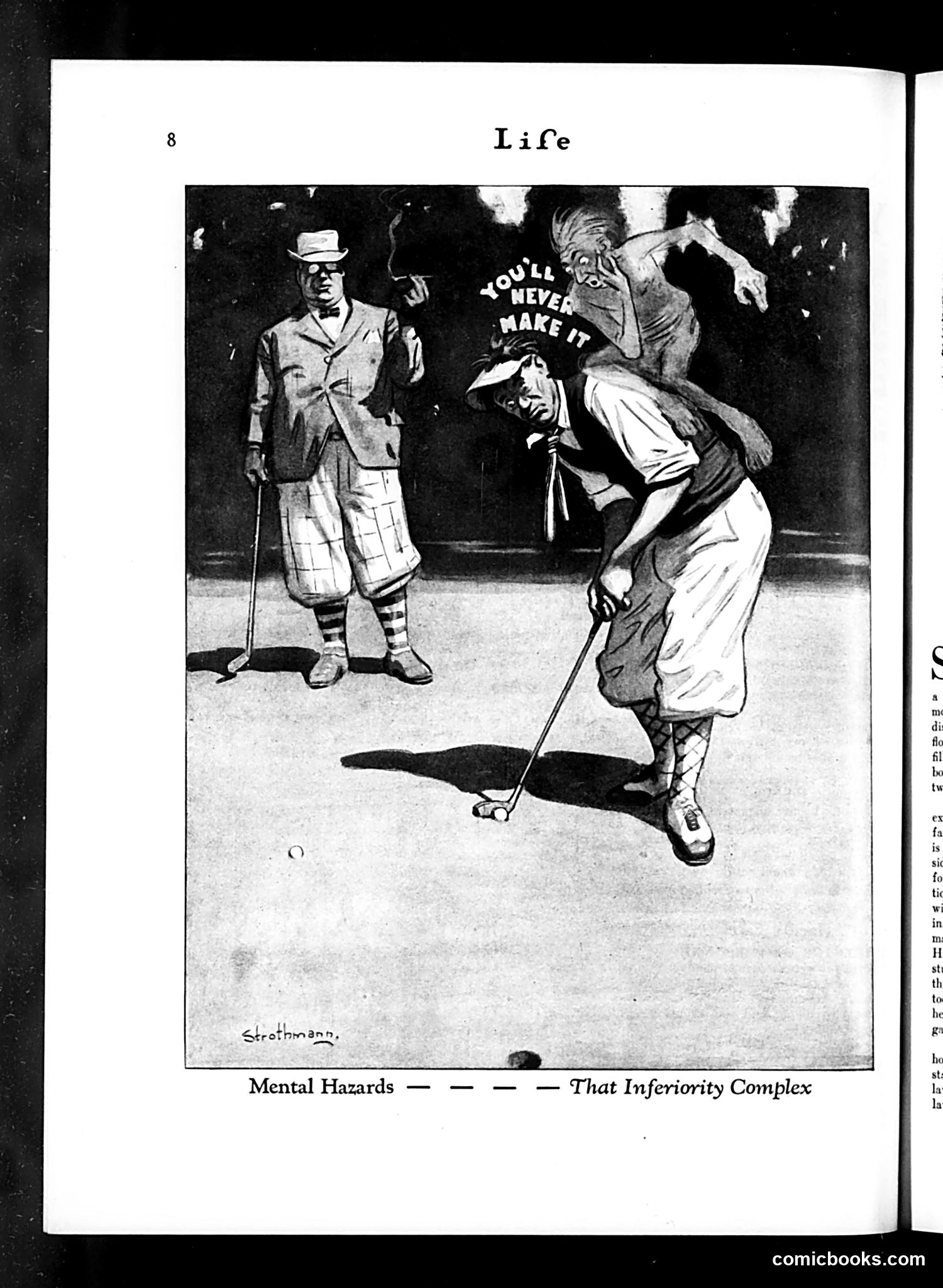
This cartoon satirizes golf as a sport that exposes psychological vulnerabilities. A golfer about to putt displays extreme anxiety—hunched posture, strained expression—while an observer (likely a friend or caddie) watches. The sign reading "YOU'LL NEVER MAKE IT" represents the golfer's internalized self-doubt or "inferiority complex," a psychological term popular in early 20th-century discourse. The joke targets how golf reveals character flaws: the sport's difficulty and precision requirements can trigger anxiety and self-defeating thoughts. The cartoon suggests that recreational activities expose deeper mental/emotional issues—a commentary on how performance pressure, even in leisure, can undermine confidence. The illustration is credited to Strothmann, a Life magazine cartoonist.
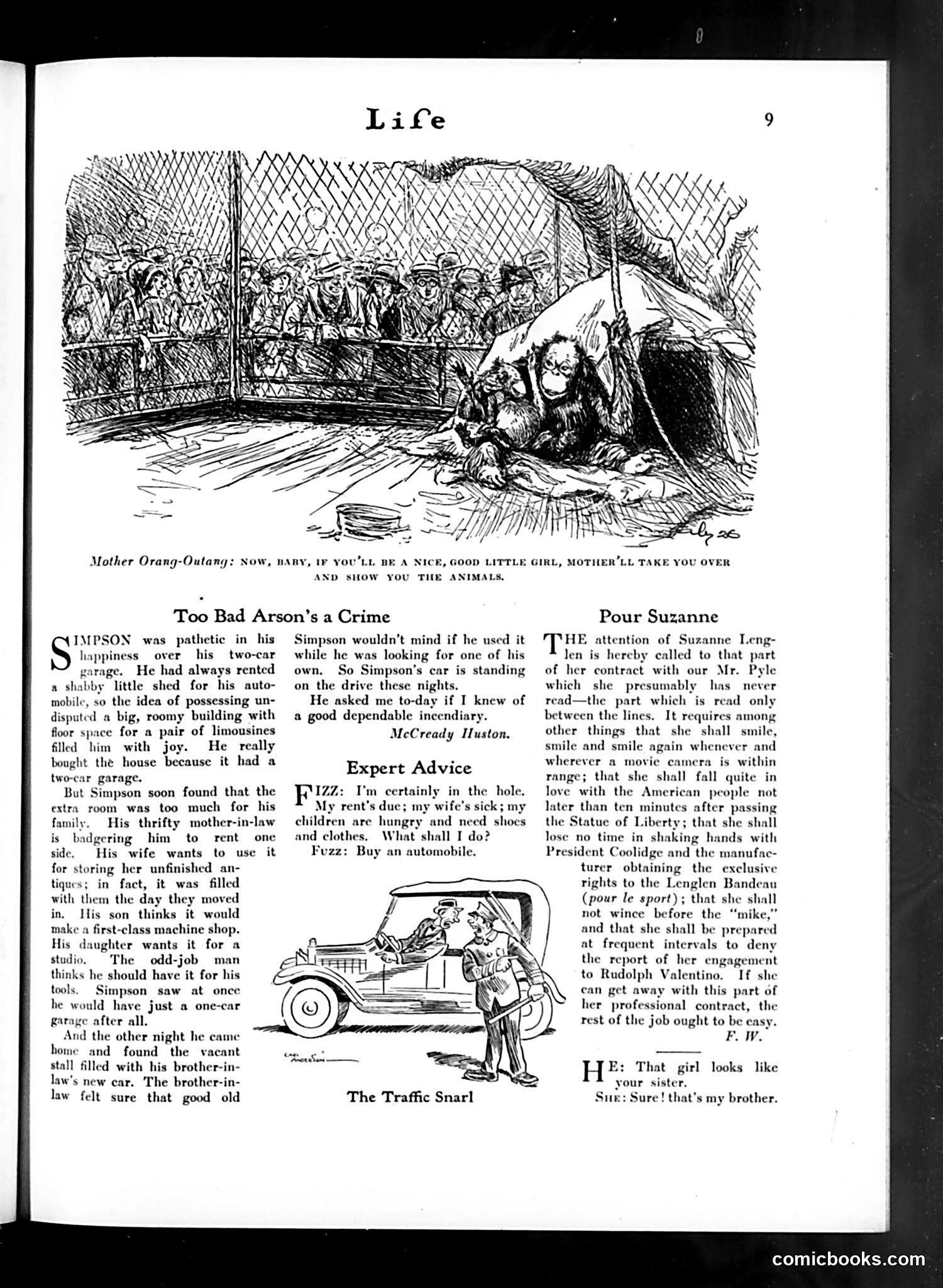
This page contains three satirical pieces about 1920s urban life: **"Too Bad Arson's a Crime"** mocks a man named Simpson who rents garage space but found it worthless for storing cars. His solution: fill it with his brother-in-law's new automobile, hoping the brother-in-law will feel obligated to rent it from him. The joke targets both Simpson's scheming and the absurdity of the real estate situation. **"The Traffic Snarl"** cartoon illustrates urban congestion—a common complaint in automobile-era cities. **"Poor Suzanne"** discusses a contract dispute with actress Suzanne Lenglen, detailing her obligations to film producers and public appearances. The page captures 1920s anxieties: real estate speculation, automobile culture's complications, and celebrity exploitation.
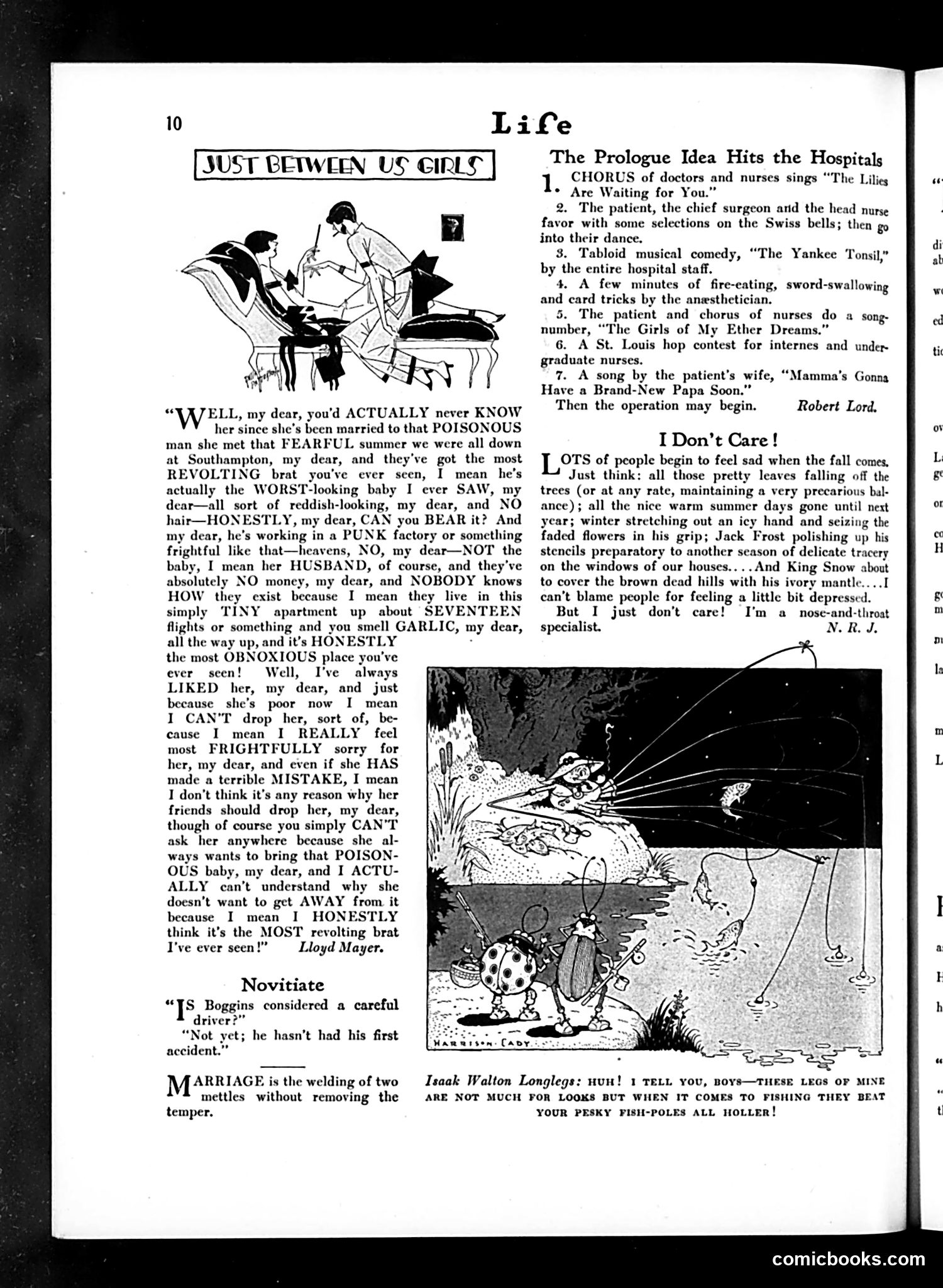
This page contains satirical commentary on marriage and social attitudes. The main piece, attributed to Lloyd Mayer, is a woman's complaint about her friend's husband—describing him as "poisonous," working in a "punk factory," living in a revolting apartment, and being the "most obnoxious" person she's encountered. The satire targets how women of this era were expected to accept or defend their friends' poor marital choices without complaint. The bottom includes brief humorous definitions ("Novitiate," "Marriage") and a cartoon showing insects fishing, with a caption from "Isaac Walton Longlegs" making a crude joke comparing fishing prowess to masculine appeal. The overall tone mocks social conventions around marriage and courtship among the educated classes.
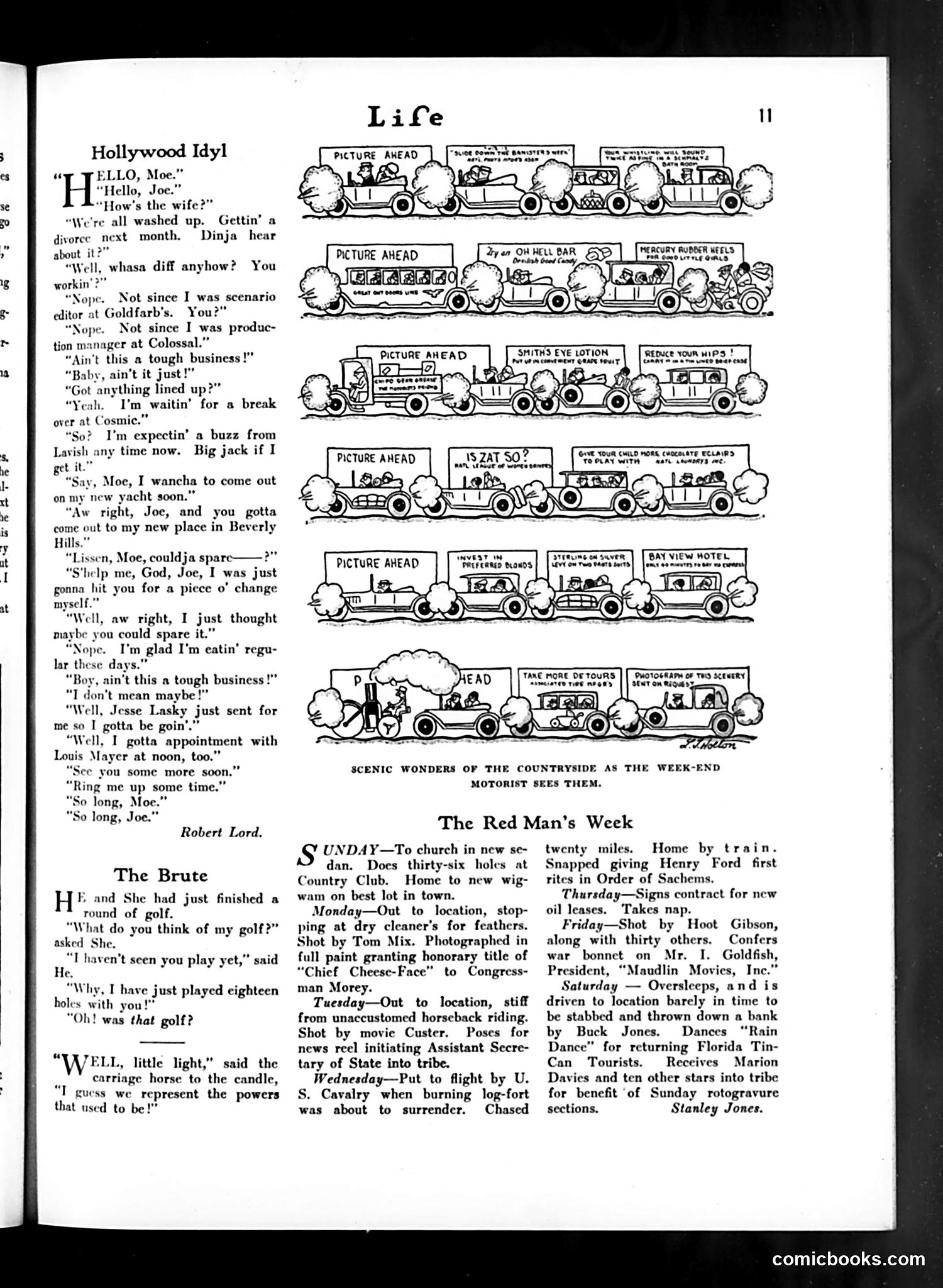
This page contains two distinct sections: **"Hollywood Idyl" (left):** A humorous dialogue between two industry figures discussing Hollywood business. References include mentions of working for "Golfarb's," being a "production manager at Colossal," and figures like "Jesse Lasky" and "Louis B. Mayer"—all real early film industry executives. The satire mocks Hollywood's commercial culture and the casual, transactional nature of entertainment business dealings. **"Scenic Wonders of the Countryside" (right):** A comic strip showing cars driving past roadside attractions and billboards, satirizing the emerging American motorist culture and commercial tourism of the 1920s. **"The Red Man's Week":** A brief satirical column about Native Americans depicted through stereotyped scenarios, reflecting the period's problematic racial attitudes. The overall page reflects Life magazine's satirical commentary on contemporary American consumer culture and entertainment.
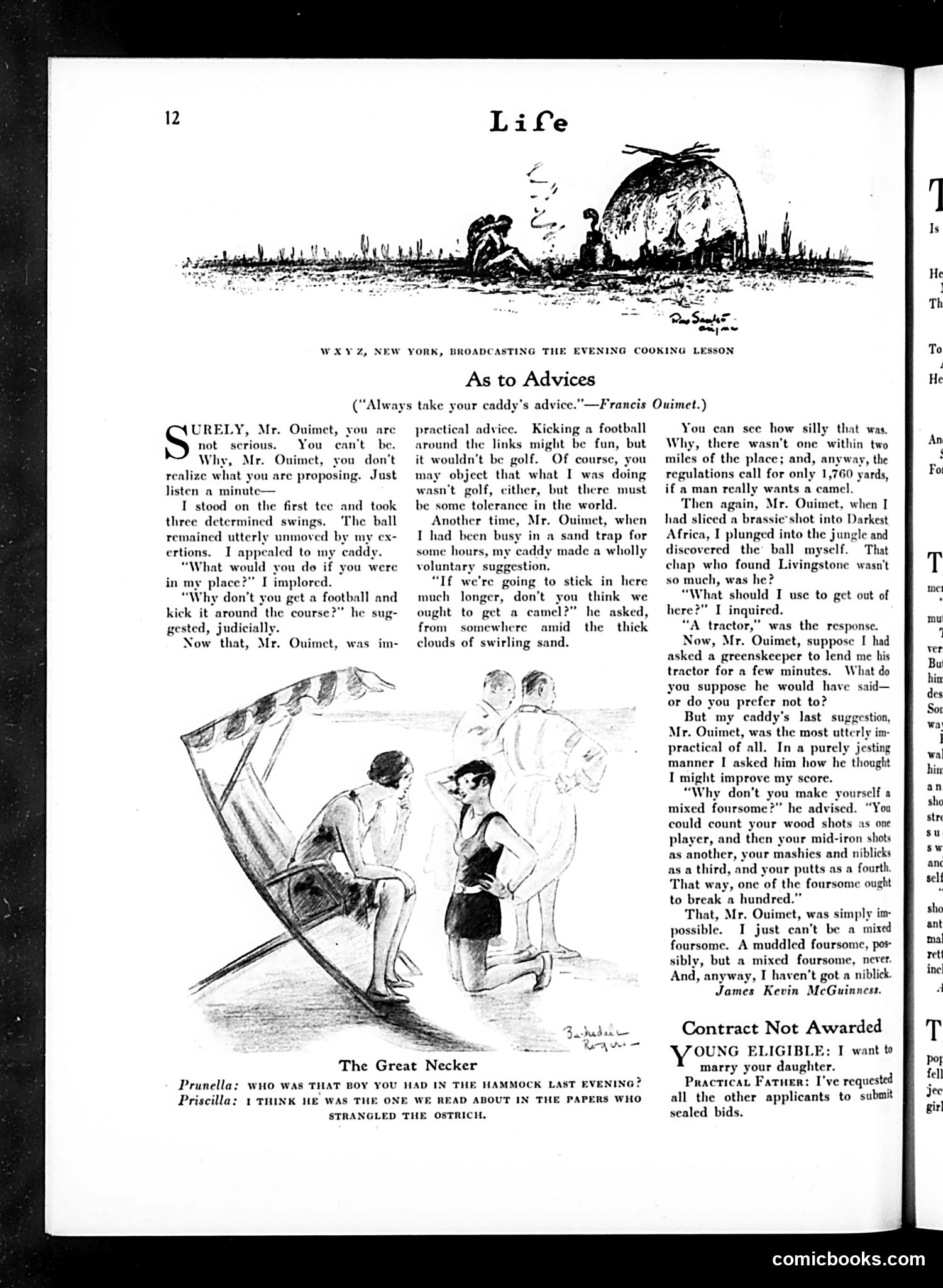
This page from *Life* magazine contains a humorous article titled "As to Advices" featuring a golf anecdote. The main cartoon depicts golfers in a sand trap, illustrating the article's satirical narrative about Mr. Onimet receiving increasingly absurd suggestions from his caddy to improve his golf game. The satire mocks the tendency of amateur golfers to accept unsolicited advice from anyone nearby—even caddies—leading to ridiculous situations. The closing joke suggests turning golf into a "mixed foursome" (counting different shots as different clubs), which the author dismisses as impractical. The page also includes a small joke section and an advertisement section. The cartoon's style and the genteel tone reflect early 20th-century upper-class leisure activities and the social dynamics of golf culture.
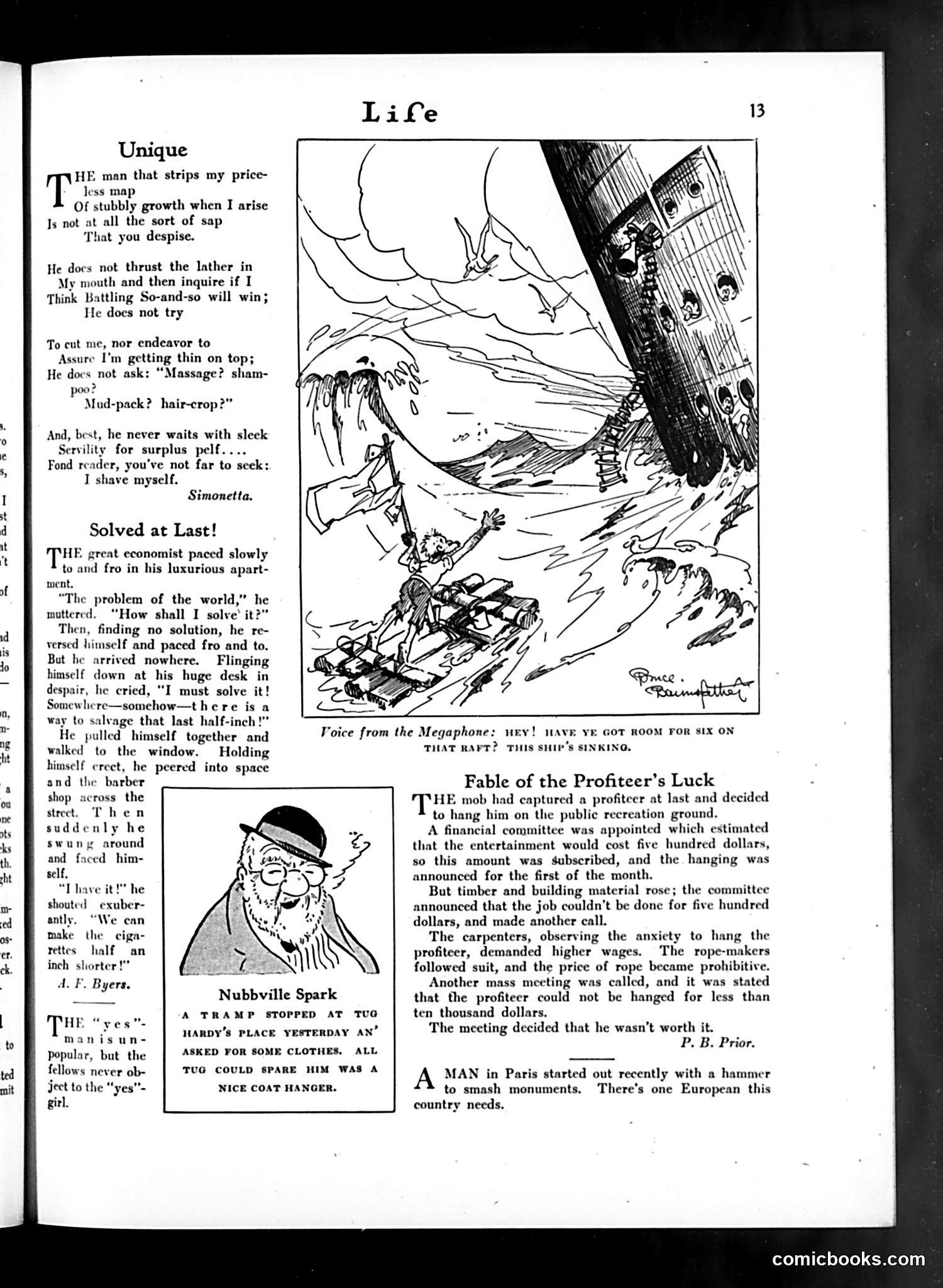
This page contains three distinct satirical pieces: 1. **"Unique"** (Simonetta): A poem mocking a particular man who strips maps and doesn't employ typical barber-shop tactics or excessive salesmanship—apparently praising restraint in service. 2. **"Solved at Last!"**: A cartoon about an economist pacing his apartment, obsessing over "the problem of the world." He eventually solves it by walking to his barber shop, where the solution apparently materializes. The satire mocks economists' grandiose pretensions and the absurdity of finding solutions in mundane places. 3. **"Fable of the Profiteer's Luck"**: Text describing mob capture of a profiteer destined for execution. A financial committee debates costs; the rope-makers demand higher wages, and rope prices become prohibitive—so execution is indefinitely delayed. This satirizes how capitalism and labor disputes can absurdly thwart even extreme penalties.
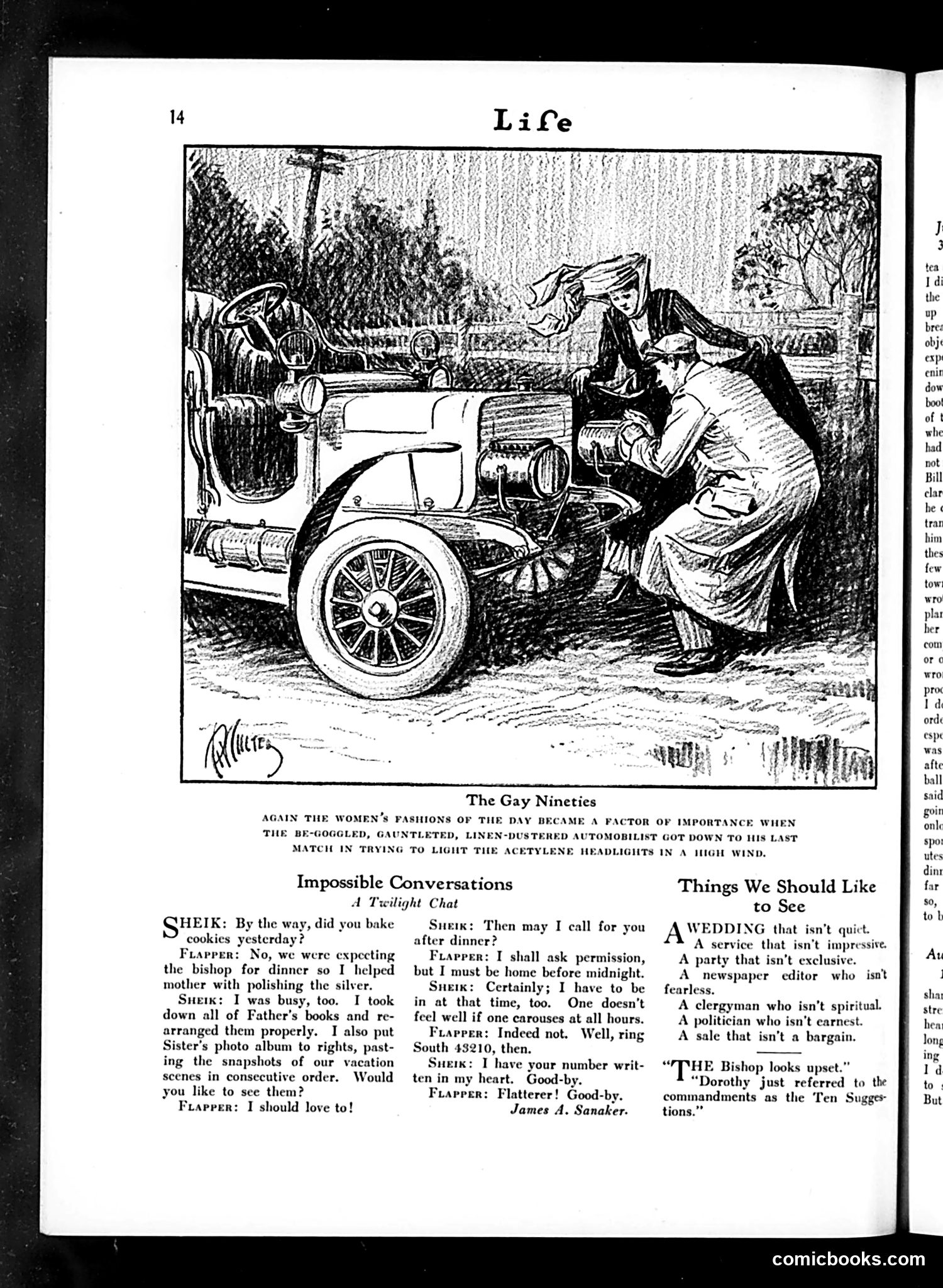
This illustration satirizes 1890s automobiles and gender fashion. The main cartoon shows a woman in period dress struggling with an early motorcar's acetylene headlights during windy conditions—the caption explains the comedic situation: "when the be-goggled, gauntleted, linen-dusted automobilist got down to his last match in trying to light the acetylene headlights in a high wind." The satire targets two elements: the unreliability of primitive automobile technology and how women's fashionable accessories (goggles, gauntlets, linen dusters) became necessary protective gear for early motoring. The "Gay Nineties" title references the 1890s era when automobiles were novel luxury items requiring specialized clothing and considerable technical fussiness to operate.
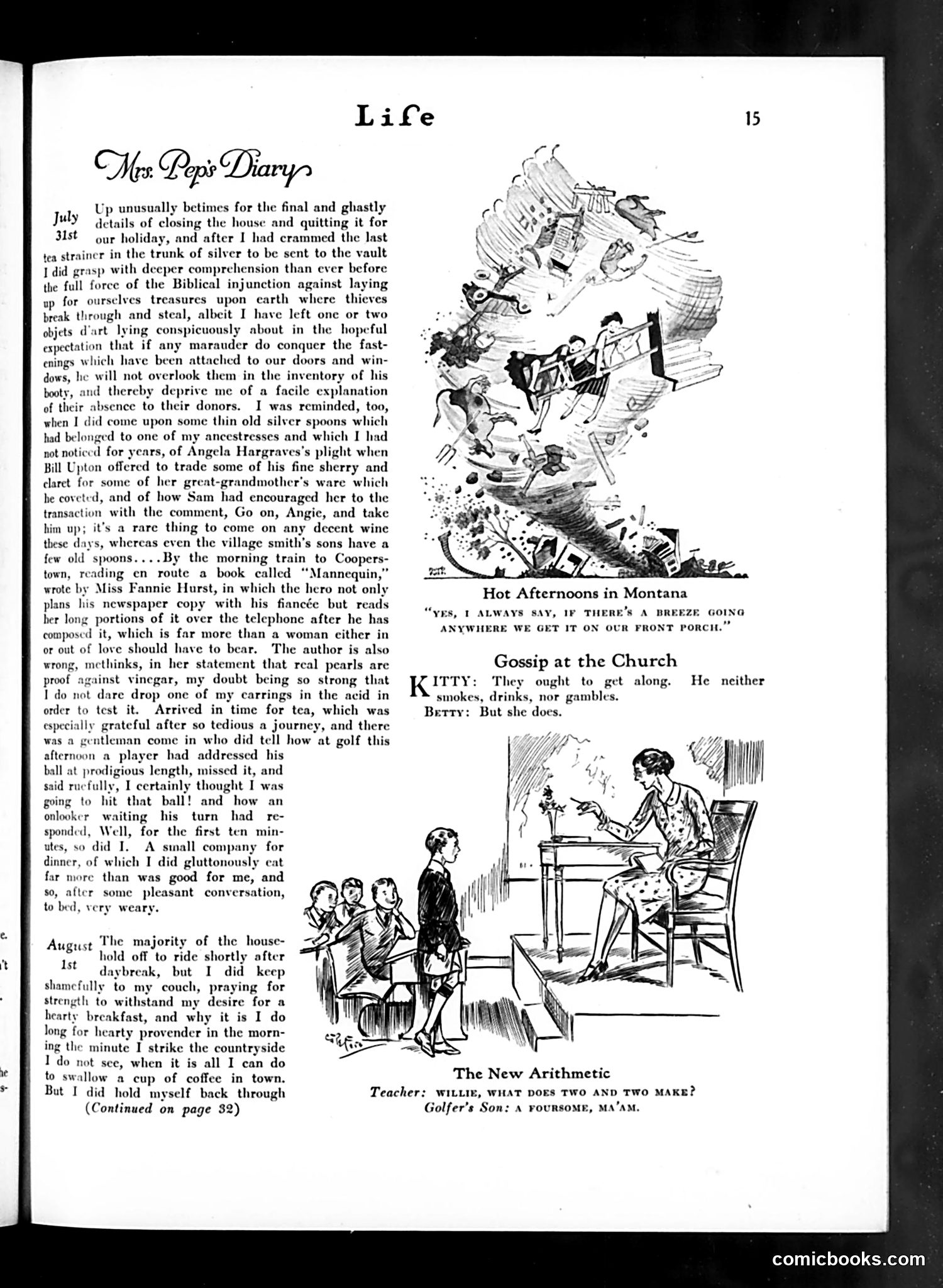
This page contains three separate humorous pieces from *Life* magazine: 1. **"Mrs. Pep's Diary"** (July 31st-August 1st): A satirical diary entry about closing up a house for vacation, with particular emphasis on securing silver valuables against theft—exaggerated by the author's paranoid descriptions of precautions taken. 2. **"Hot Afternoons in Montana"**: An illustration captioned "Yes, I always bring a book going anywhere we get it on our front porch," depicting what appears to be domestic leisure activity, likely satirizing casual summer reading habits. 3. **"Gossip at the Church"** and **"The New Arithmetic"**: Two brief joke sketches. The church gossip joke contrasts two women's perceptions of a third person. The arithmetic joke plays on a child's unexpected answer to a basic math question, relying on wordplay or absurdist humor typical of early 20th-century comedy.
This page contains editorial commentary rather than political cartoons. The text discusses three contemporary issues: 1. **Catholic criticism of Methodists**: The editor argues Catholics shouldn't criticize Methodists for their role in Prohibition, since Catholics themselves supported it initially. 2. **France's war debts**: References M. Clemenceau's letter about France's financial troubles post-WWI, suggesting the U.S. government must address the crisis seriously. 3. **Mexico**: Discusses ongoing Mexican instability and suggests the U.S. should not intervene militarily, despite Republican papers criticizing the government's handling of Mexican affairs. The small decorative illustrations are generic vignettes, not specific political cartoons. The page reflects 1920s American concerns: Prohibition enforcement, international relations, and domestic political debate.
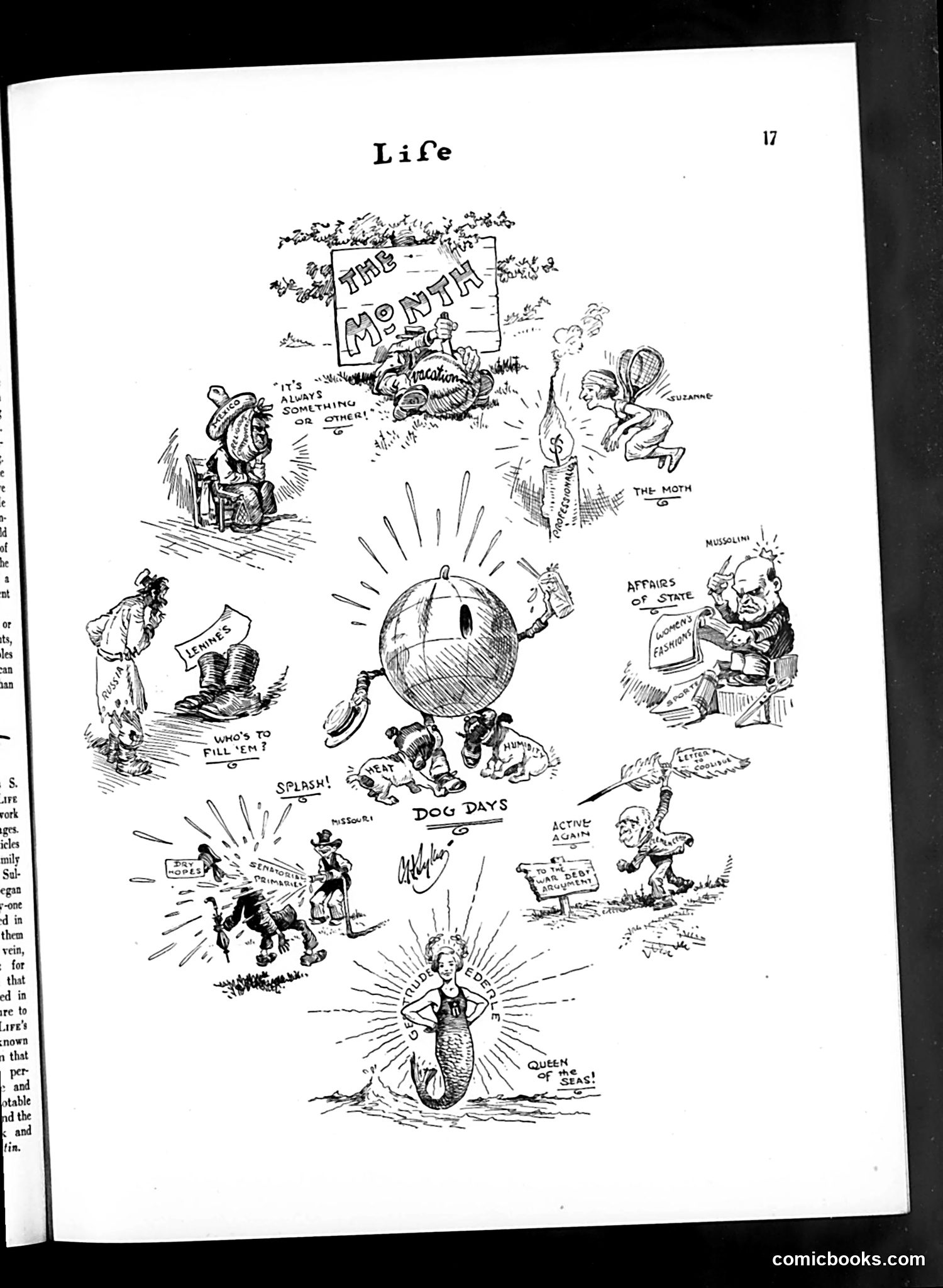
This is a wheel-of-fortune style cartoon titled "The Month" showing various topical subjects orbiting a central sphere. The visible labels include: - **"Dog Days"** (lower left) - likely referencing summer heat/doldrums - **"Queen of the Seas"** (bottom) - possibly about naval/maritime affairs - **"Mussolini"** and **"Affairs of State"** (right side) - referencing Italian fascism and politics - **"The Moth"** (upper right) - unclear reference - **"Who's to Blame?"** and **"Lemons"** (left side) - suggesting economic complaint The cartoon's point appears satirical commentary on current events and public concerns of its era (likely 1920s-1930s based on style), presenting them as an interconnected wheel of fortune. The fragmented OCR text makes specific political context difficult to confirm, but this is clearly topical editorial commentary on contemporary issues.
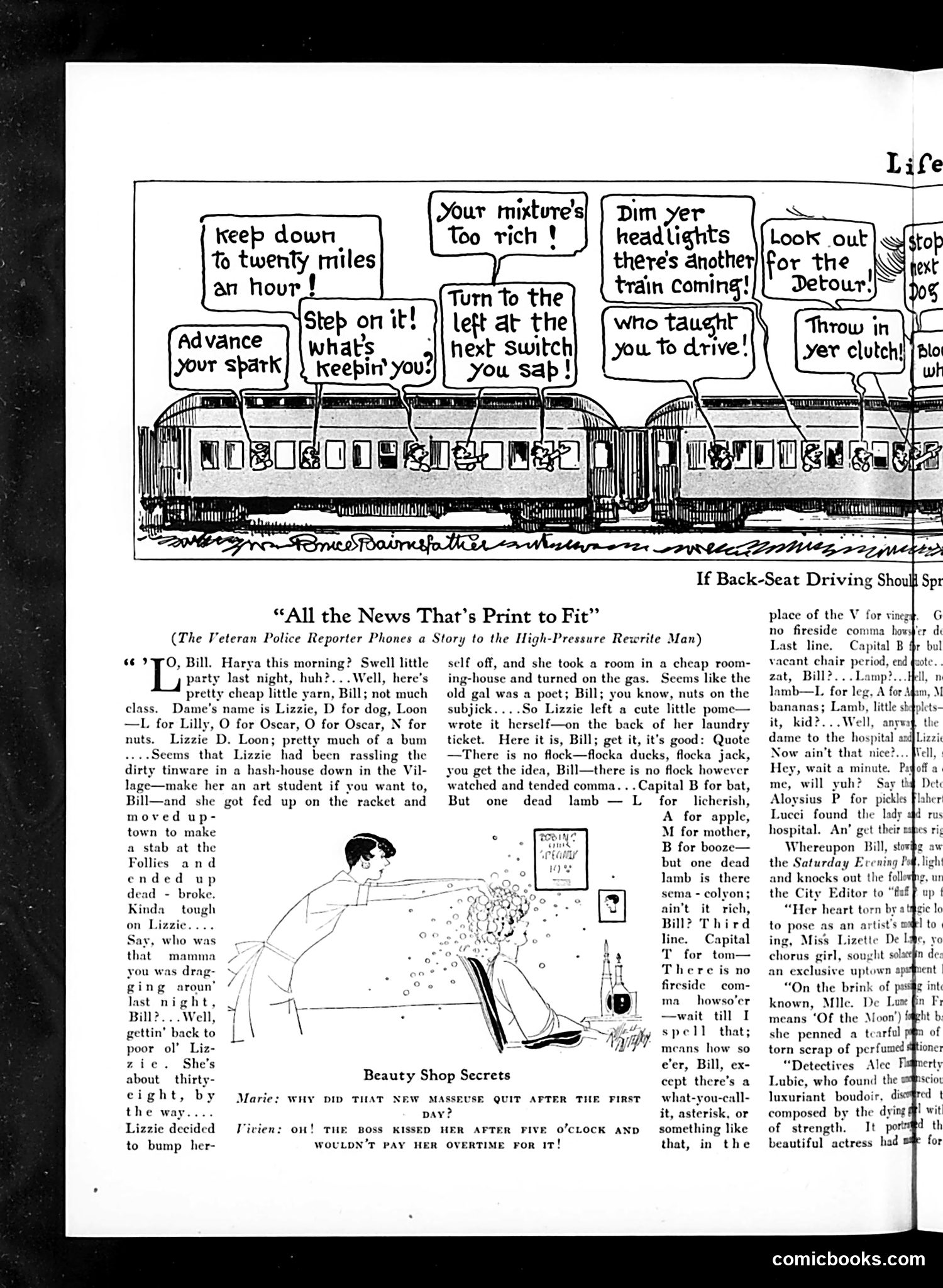
This page satirizes early 20th-century journalism sensationalism through two pieces: **Top cartoon**: Depicts backseat drivers shouting contradictory, panicked instructions at a driver—"Keep down to twenty miles," "Step on it!", "Dim yer headlights," "Look out for the train!" The satire mocks people who give constant, conflicting, unhelpful advice while not driving themselves. **Main story "All the News That's Print to Fit"**: A police reporter phones a mundane suicide story to a rewrite man, who sensationalizes it absurdly. The reporter mentions "Lizzie D" (a hash-house worker who turned to the Follies), while the rewrite man fabricates melodramatic details—transforming her into a "beautiful actress" with a "luxuriant boudoir," adding invented poetry and mystery detectives. **The satire**: Life mocks how newspapers transform ordinary tragedies into sensational fiction through editorial embellishment, showing the gap between actual events and printed "news." **Bottom section**: A brief joke about beauty shop workplace exploitation (unpaid overtime).
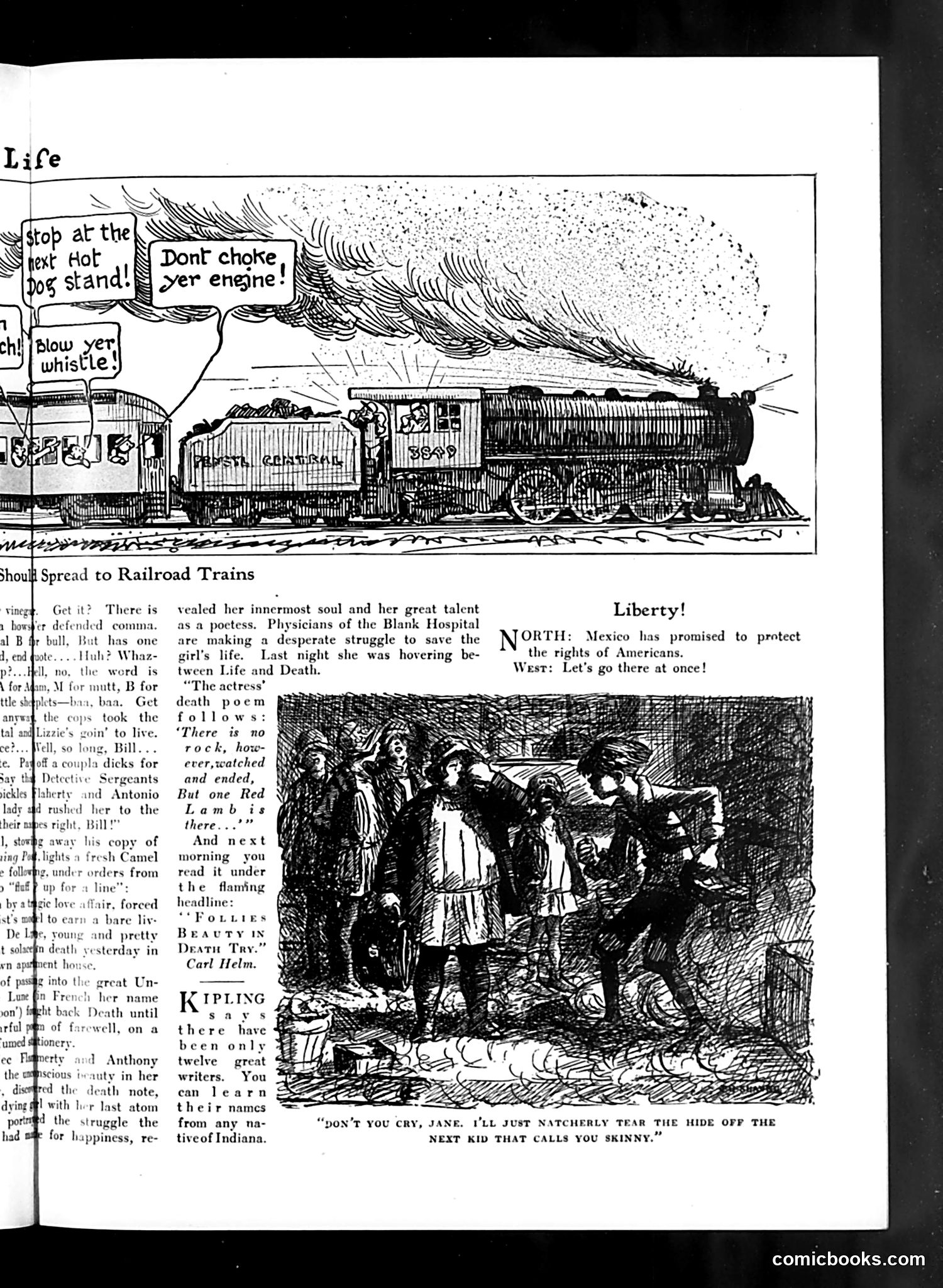
**Top Cartoon ("Spread to Railroad Trains"):** A steam locomotive with anthropomorphized "Life" characteristics receives driving instructions from a conductor. The joke satirizes safety advice: commands like "stop at the next hot dog stand" and "don't choke yer engine" humorously treat the train as a living being needing basic life care, parodying how such safety messaging might be explained to the general public. **"Liberty!" Section:** This appears to be satirical commentary on American interventionism. The dialogue between "North" and "West" characters responds to Mexico's promise to protect American rights by immediately advocating military involvement ("Let's go there at once!"). The accompanying illustration depicts what appears to be a frontier or conflict scene, likely mocking American eagerness for military intervention in Mexican affairs—a reference to early 20th-century U.S.-Mexico tensions. The page mixes humorous mechanical satire with political commentary typical of *Life* magazine's era.
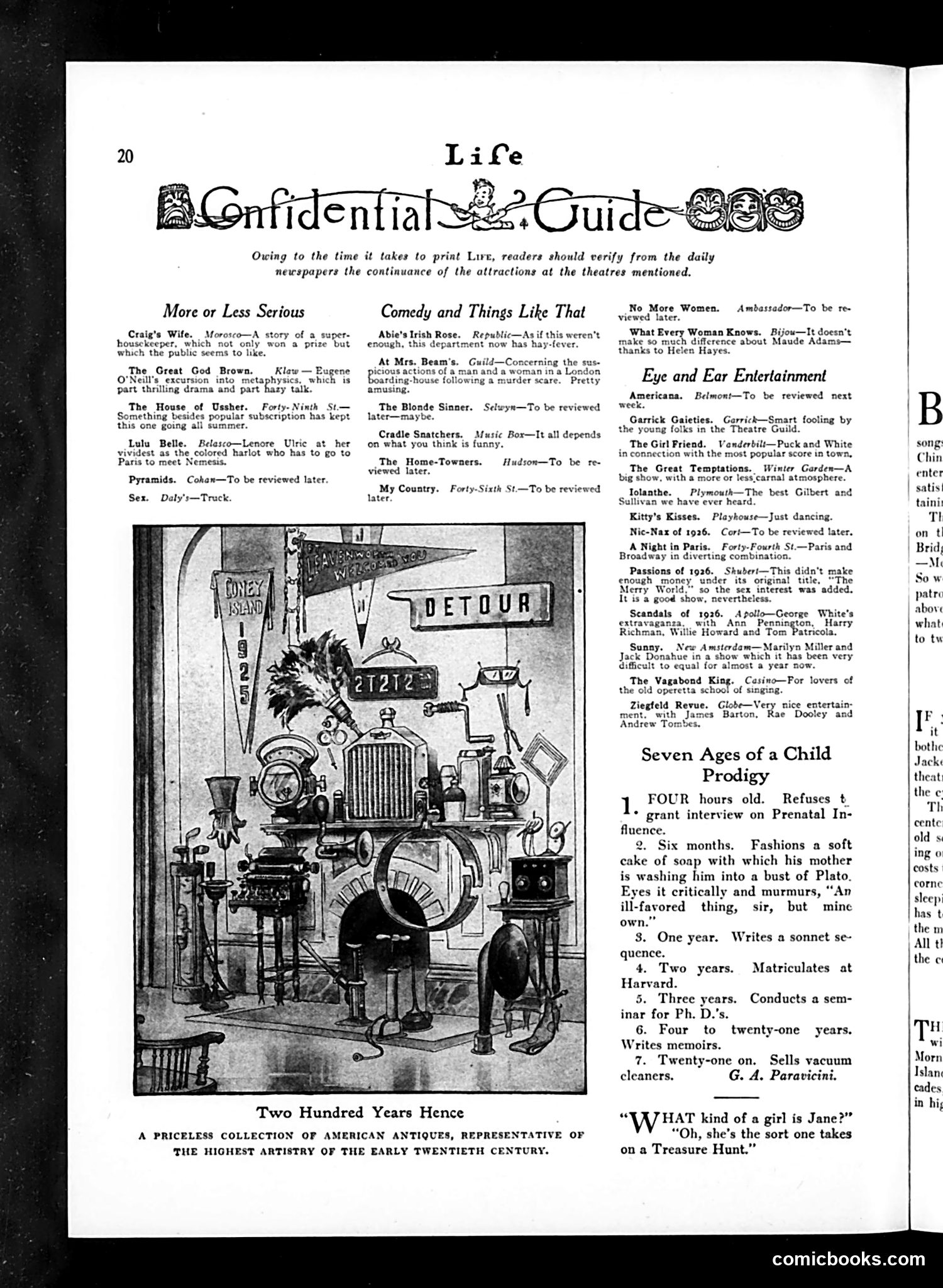
This page's central image satirizes early 20th-century American consumer culture and technological accumulation. The illustration depicts a cluttered, absurd assemblage of period machines, automobiles, household devices, and Victorian furniture stacked together chaotically—labeled as "a priceless collection of American antiques, representative of the highest artistry of the early twentieth century." The satire's target is clear: Life mocks the era's obsession with mass-produced goods and mechanical gadgetry, suggesting that future generations will view our contemporary consumer products as primitive, cluttered "antiques" worthy of museum display. The joke implies Americans mistake industrial output and technical novelty for genuine artistry and cultural achievement. The accompanying "Seven Ages of a Child Prodigy" column extends this satirical theme, mocking precocious overachievement—a child writing sonnets at one year, matriculating at Harvard at two, conducting seminars at three. Both features ridicule American society's excessive faith in progress, technology, and early achievement as markers of civilization.
This 1910s *Life* magazine article satirizes Chinese theater in New York's Chinatown, employing racial stereotypes typical of the era. The author mocks nearly every aspect: the sparse, minimal staging; actors performing in high falsetto voices with exaggerated gestures that audiences ignore; a bored, indifferent property-man; and an orchestra consisting of "squawky horns" and a cymbal player described as "the hero"—the only element receiving serious attention. The piece relies on contemptuous caricature of Chinese theatrical conventions as incomprehensible and tedious to American audiences. References to "tong wars" and "yellow cousins" reflect contemporary prejudices. The comparison to "The Yellow Jacket" (a Broadway play mimicking Chinese theater) suggests the author views authentic Chinese performance as inherently ridiculous rather than artistically different. The satire targets perceived absurdity in unfamiliar cultural forms rather than offering genuine theater criticism.
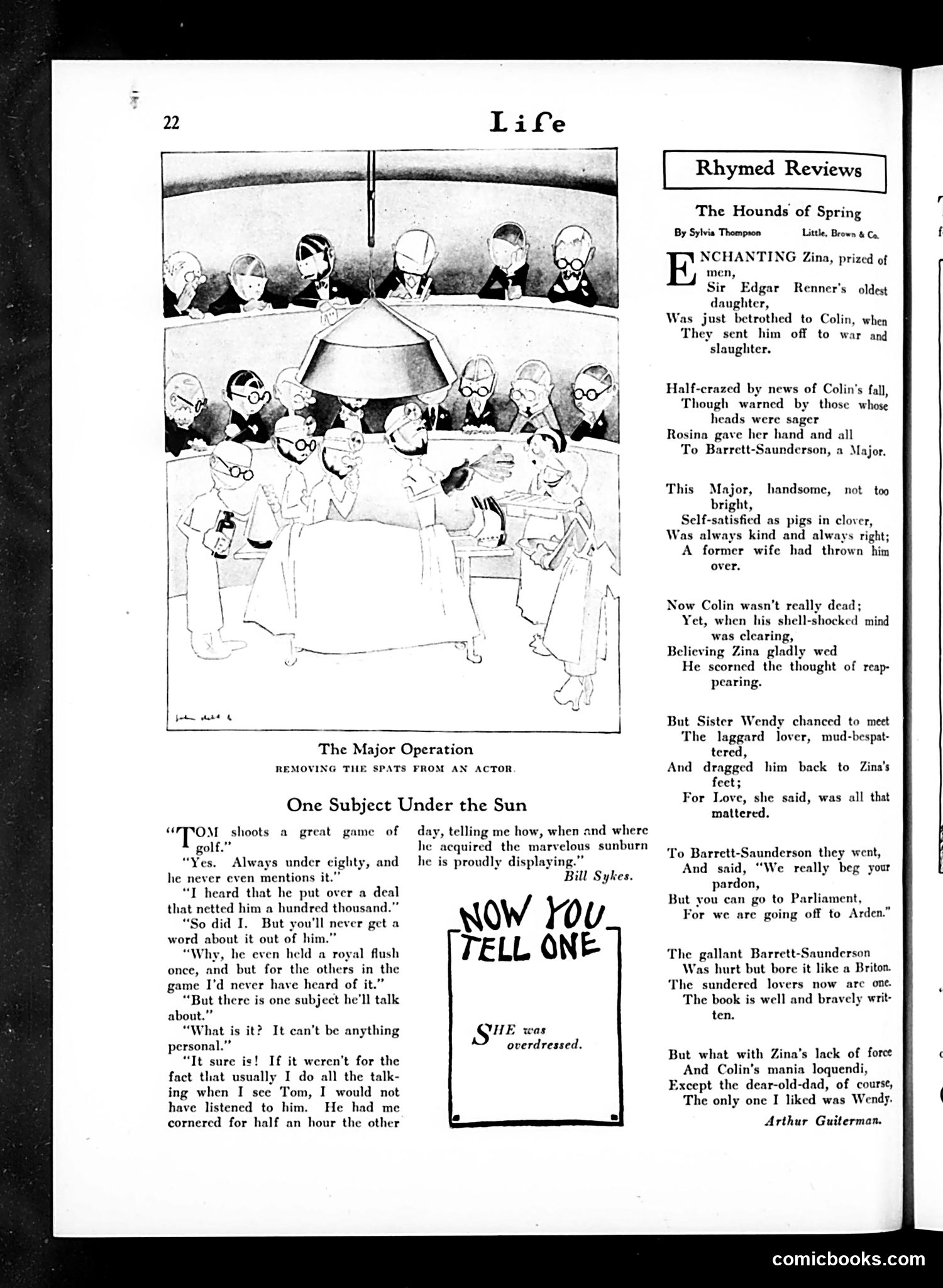
**The Main Cartoon:** "The Major Operation" satirizes actors' vanity. The joke depicts a surgical procedure to remove "spats" (decorative leg coverings) from an actor—a visual pun suggesting that removing this affectation requires actual surgery. It mocks theatrical self-importance. **"One Subject Under the Sun":** A humorous anecdote about a man (Tom) who never boasts about his business deals or poker wins, yet obsessively discusses how he acquired his suntan. The joke satirizes misplaced priorities—he's reticent about genuine accomplishments but vain about his appearance. **"The Hounds of Spring" Review:** Arthur Guiterman critiques Sylvia Thompson's novel. The romance follows Zina, who marries Major Barrett-Saunderson after her fiancé Colin is reported dead in war. Colin returns shell-shocked; sister Wendy reunites them. Guiterman finds the female lead weak and Colin tediously verbose ("mania loquendi"—excessive talking), praising only Wendy. The review is gently satirical about romantic fiction tropes.
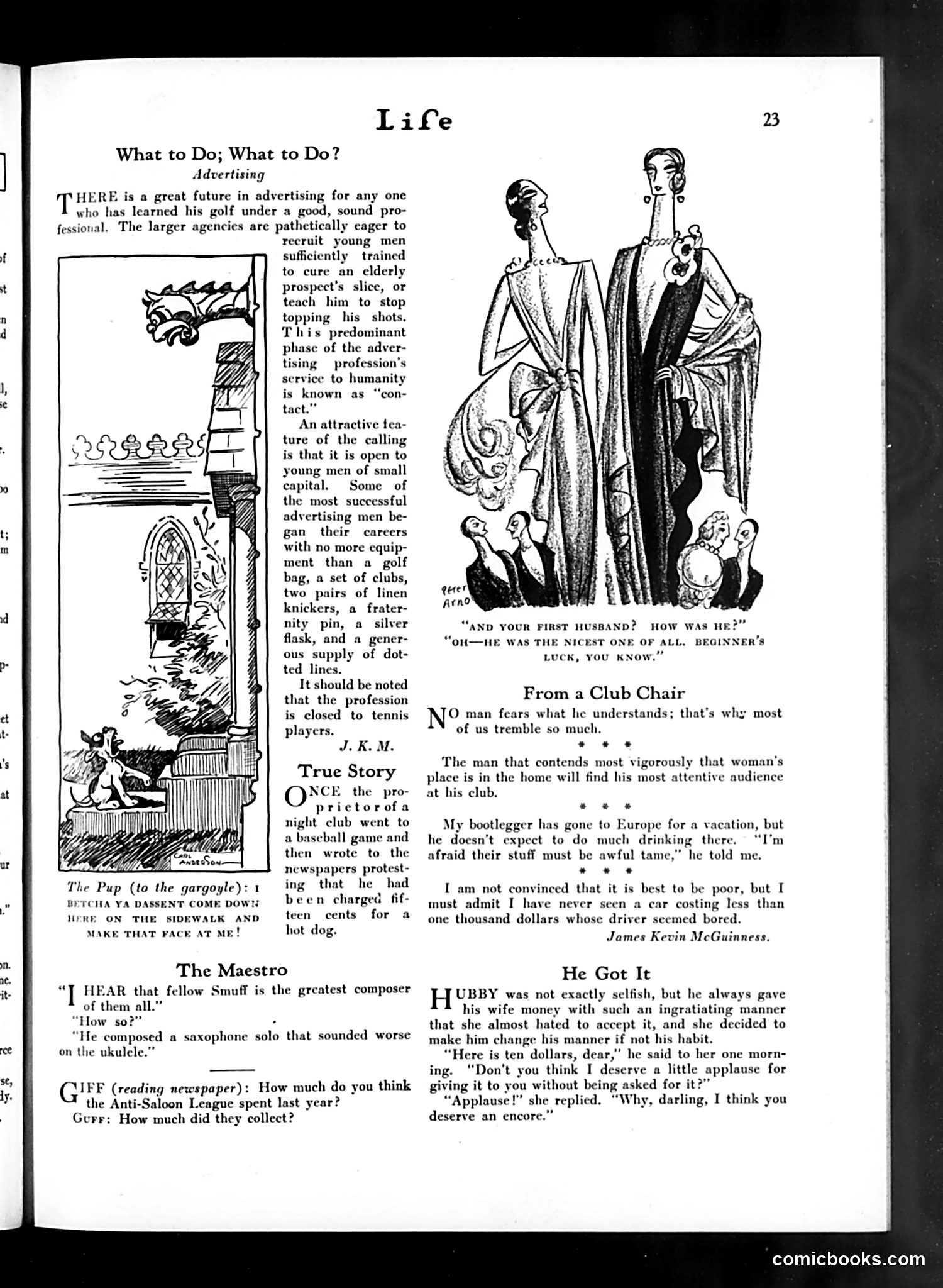
This page from *Life* magazine contains several brief satirical pieces mocking American social conventions of the era (likely 1920s-30s, given Prohibition references). The main column humorously critiques advertising professionals who use golf as their primary "business development" tool—implying that success in advertising depends less on actual skill than on ability to schmooze clients on the golf course. Other pieces mock contemporary absurdities: a nightclub owner complaining about hot dog prices; the disconnect between men who advocate "women's place is in the home" while spending time at their clubs; bootleggers operating during Prohibition; and marital dynamics around gift-giving. The cartoons and illustrations are period comic sketches supporting these themes—a gargoyle confrontation and musical satire about saxophones sounding worse on ukuleles. The humor targets hypocrisy, materialism, and changing social behaviors in modern American life, with particular jabs at the leisure class and business culture.
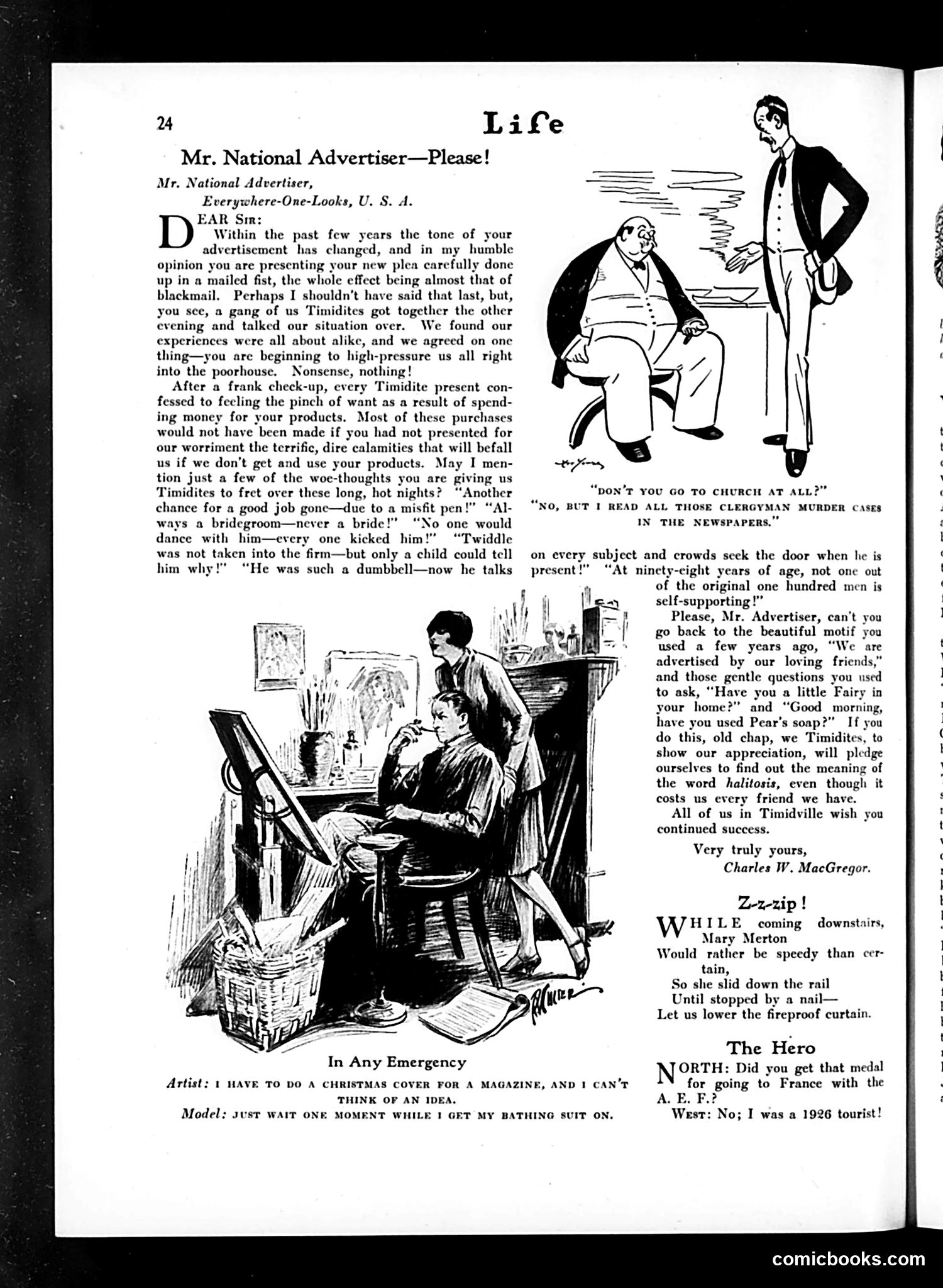
This letter-to-the-editor satirizes aggressive early 20th-century advertising tactics. The writer, representing "Timidites" (timid people), complains that advertisers have shifted from gentle, positive appeals ("We are advertised by our loving friends," "Have you a little Fairy in your home?") to fear-mongering high-pressure sales pitches. The satire targets ads that exploit anxiety and insecurity—fear of job loss, social rejection, romantic failure, and aging—to coerce purchases. The writer humorously claims these manufactured worries have financially squeezed his group into poverty. He pleads for advertisers to return to the older, kinder approach. The accompanying cartoons mock related themes: one shows an artist and model in an "emergency" situation (likely referencing absurdist advertising creativity), another mocks a tourist claiming war service for prestige. The satire exposes how advertising had become manipulative psychological warfare rather than honest product information—a surprisingly modern critique for this era.
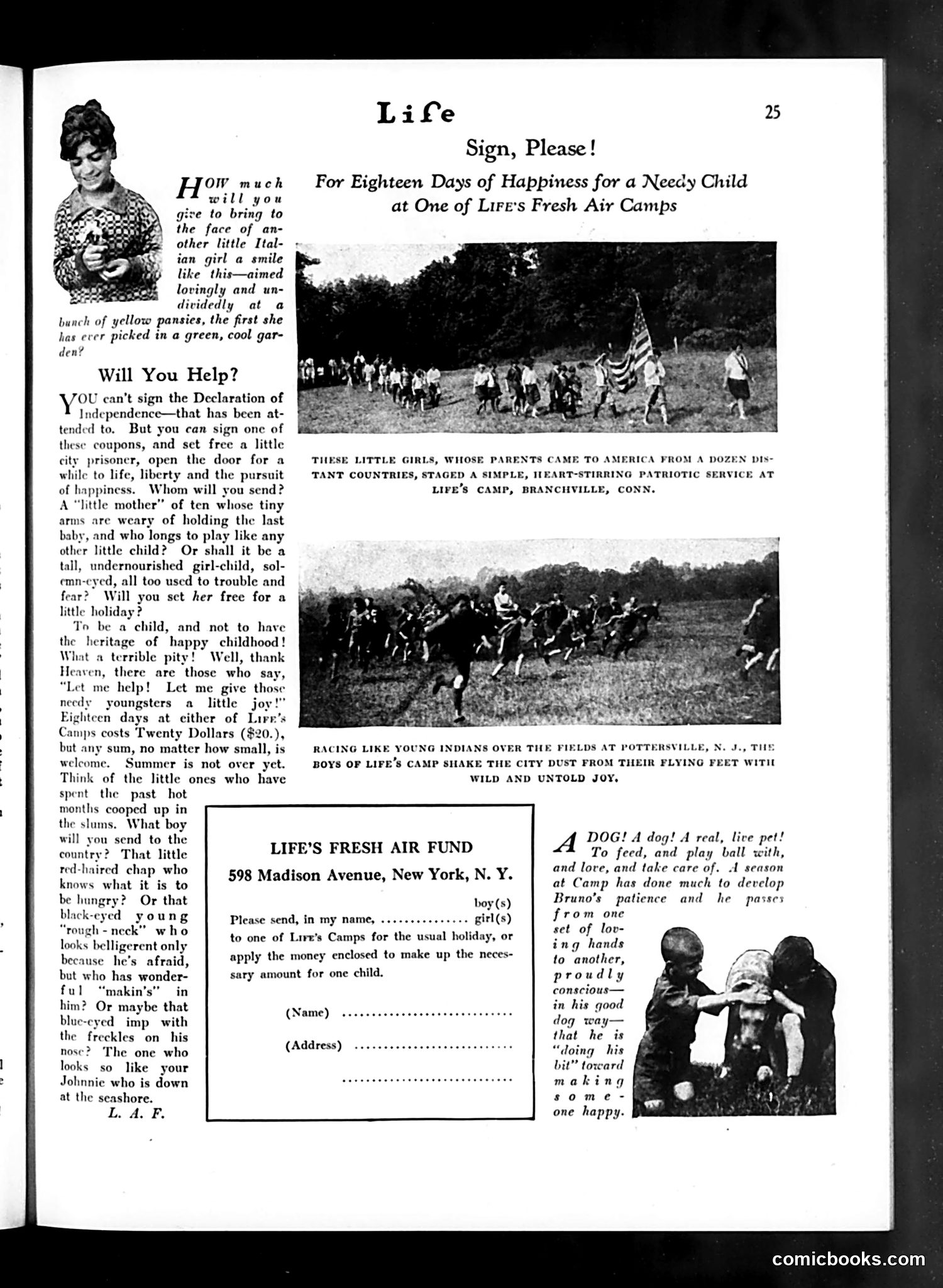
This is a charitable fundraising appeal, not a cartoon. It promotes Life magazine's "Fresh Air Fund," which sent poor urban children—particularly immigrant children from Italian and other European backgrounds—to summer camps in the countryside. The page uses emotional appeals featuring photographs of children enjoying outdoor activities (racing, playing with a dog named Bruno) to convince readers to donate $20 to sponsor eighteen days of camp for one needy child. The text emphasizes urban poverty ("cooped up in the slums") and contrasts it with rural happiness, reflecting early 20th-century Progressive Era attitudes about nature's moral benefits for poor children. The patriotic framing—with children staging "a patriotic service" at camp—suggests this charitable work as an American civic duty, helping assimilate immigrant children while providing them temporary escape from tenement life.
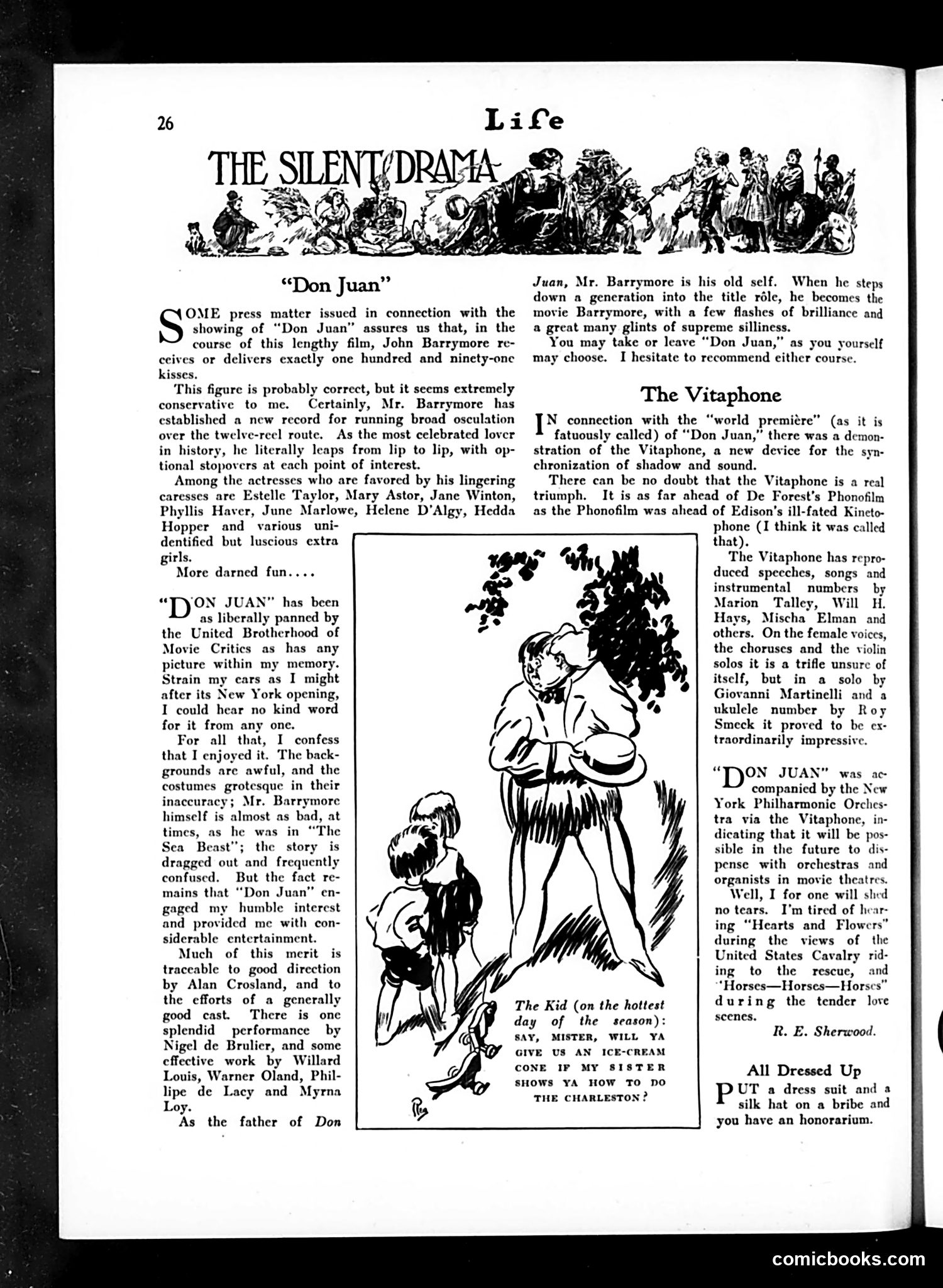
This page reviews John Barrymore's film *Don Juan* (1926), focusing on two main topics: **The Don Juan Review**: The critic humorously notes that press materials claim Barrymore delivers 191 kisses in the film—which the reviewer finds conservatively low. The review acknowledges the film's poor production values (awful backgrounds, grotesque costumes, weak acting) but admits to enjoying it anyway, crediting director Alan Crosland and the cast. **The Vitaphone**: The page discusses a new sound synchronization technology demonstrated with the film's premiere. The writer praises it as superior to earlier competing systems (De Forest's Phonofilm, Edison's Kinetophone), noting successful reproductions of speeches, songs, and orchestral music. **The Cartoon**: Shows a child asking an ice cream vendor for a cone in exchange for his sister demonstrating the Charleston dance—reflecting the 1920s cultural obsession with this popular dance craze. **Final Quip**: A satirical definition equating formal dress with bribery, likely commentary on political or social corruption of the era.
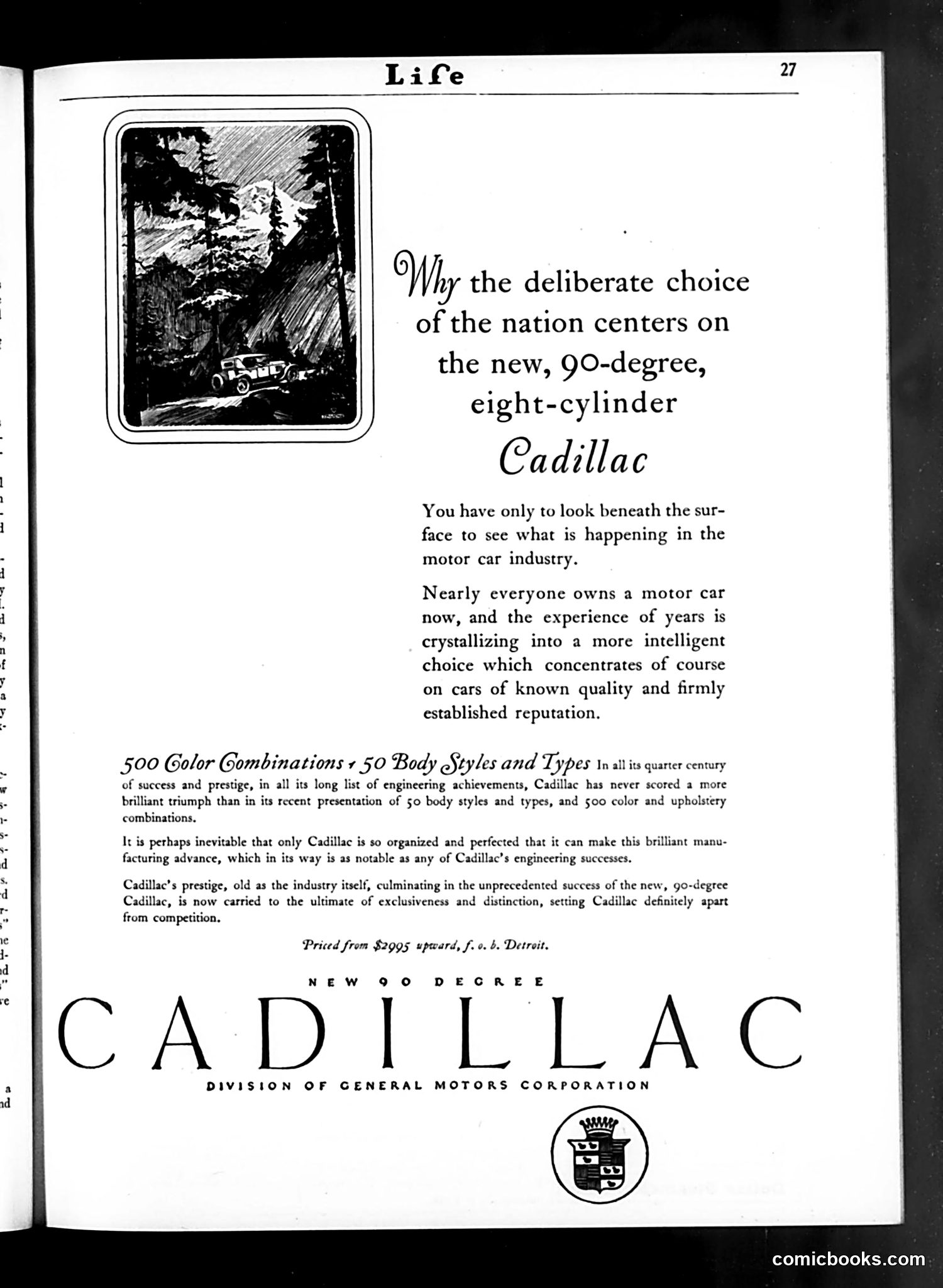
This is **not a cartoon or satirical content**—it's a straightforward **automobile advertisement** for Cadillac, appearing in Life magazine (page 27). The page promotes Cadillac's new 90-degree eight-cylinder engine and boasts of 500 color combinations and 50 body styles. The ad argues that as car ownership became widespread, consumers would make "intelligent" choices favoring established luxury brands like Cadillac. The small illustration at top left depicts a scenic mountain landscape with a car, a common advertising trope emphasizing the freedom and prestige of automobile ownership. The ad's appeal is **class-based**: it suggests that discriminating buyers naturally gravitate toward Cadillac's "exclusiveness and distinction," positioning the brand above competition. Starting price of $2,995 was substantial for the era, reinforcing its luxury positioning. There is no satire here—Life magazine carried substantial advertising revenue alongside its editorial content.
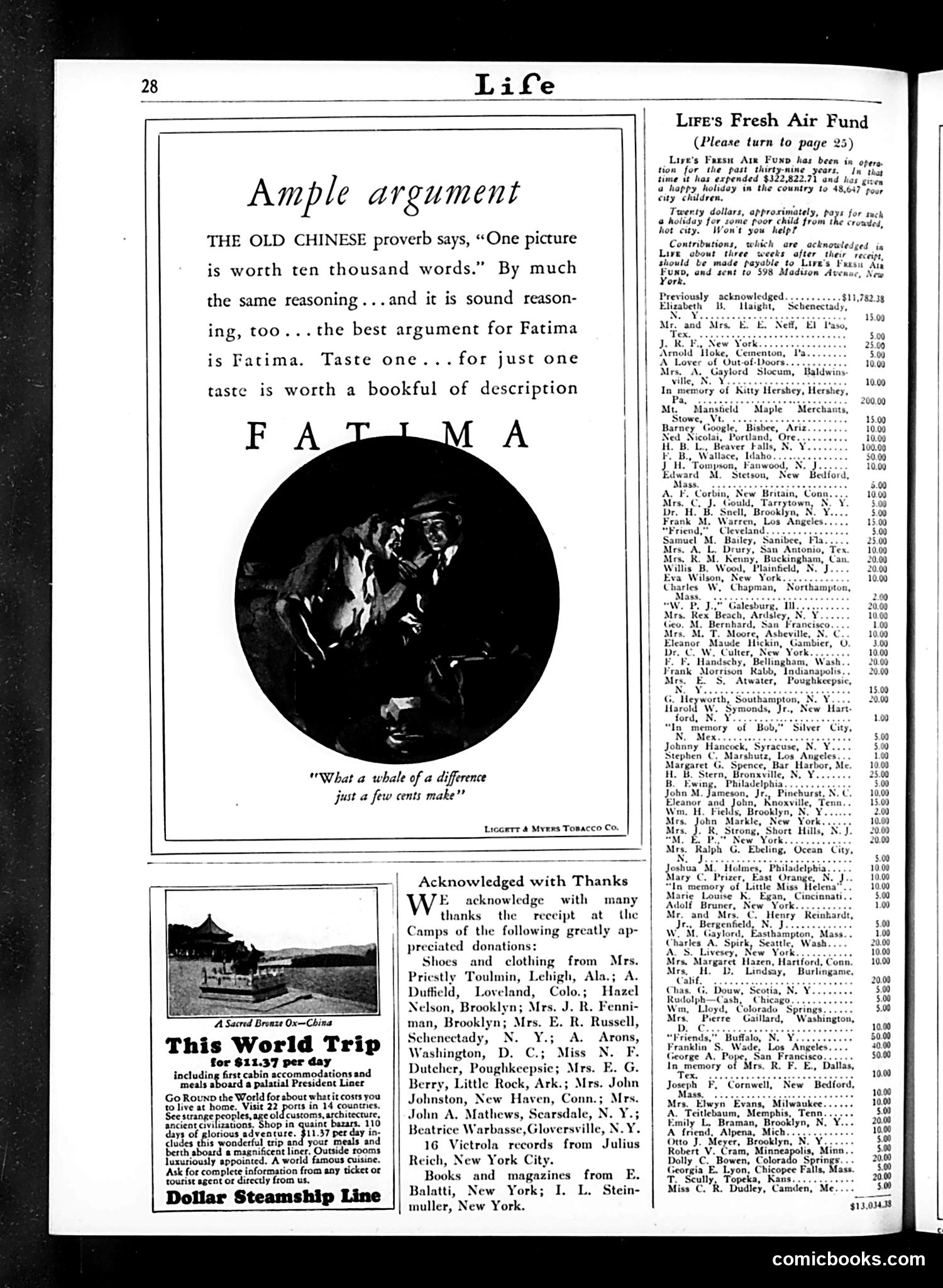
This page combines a **cigarette advertisement** with acknowledgments of charitable donations to Life's Fresh Air Fund. The main visual—a circular photograph of a person smoking—promotes **Fatima brand cigarettes** with the tagline "What a whale of a difference just a few cents make," arguing that taste justifies the product's cost. The ad cites a Chinese proverb that "one picture is worth ten thousand words" to justify advertising through imagery rather than description. The right side lists donors to Life's Fresh Air Fund, which provided summer holidays for poor city children—a genuine charitable cause that Life magazine supported. This juxtaposition is notable: a major cigarette company advertisement shares space with fundraising for children's welfare, reflecting early 20th-century attitudes where such contradictions weren't yet publicly controversial. The page also advertises Dollar Steamship Line's world cruises and acknowledges in-kind donations of shoes, clothing, records, and books to the Fresh Air camps.
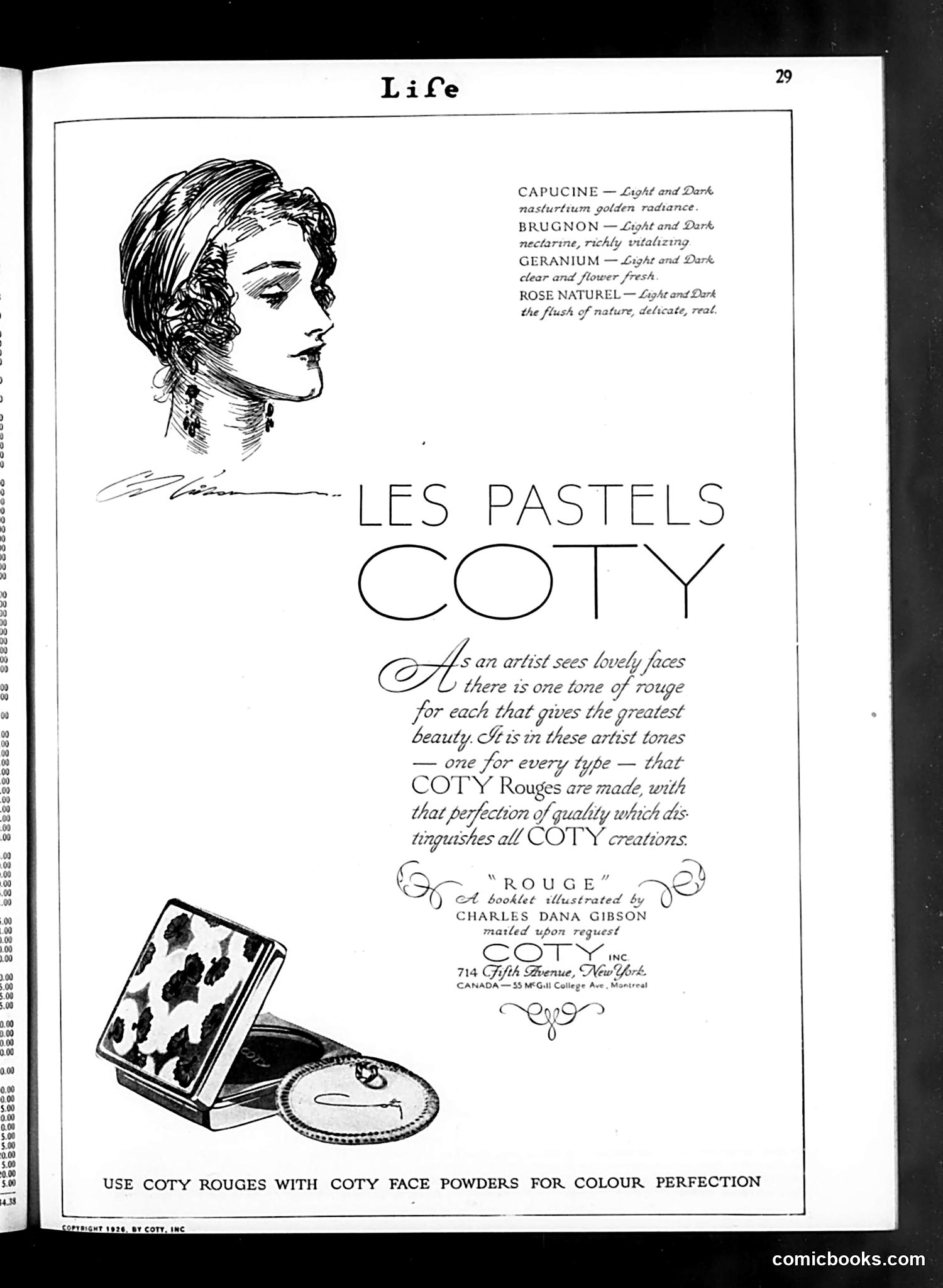
The page is a Coty rouge advertisement from Life magazine. It features an elegant line-drawn portrait of a woman's profile (likely illustrating the "artist sees lovely faces" concept) alongside product imagery—a rouge compact and face powder container. The ad emphasizes that Coty produces different rouge shades ("Capucine," "Brugnon," "Geranium," "Rose Naturel") to flatter different complexions, using the appeal of artistic sophistication. It credits Charles Dana Gibson (the famous illustrator of the "Gibson Girl") with the design, lending prestige to the product. The tagline urges consumers to "use Coty rouges with Coty face powders for colour perfection." This is straightforward commercial advertising aimed at female consumers, promoting cosmetic products through appeals to beauty, sophistication, and artistic taste—typical messaging for 1920s-era women's cosmetics marketing.
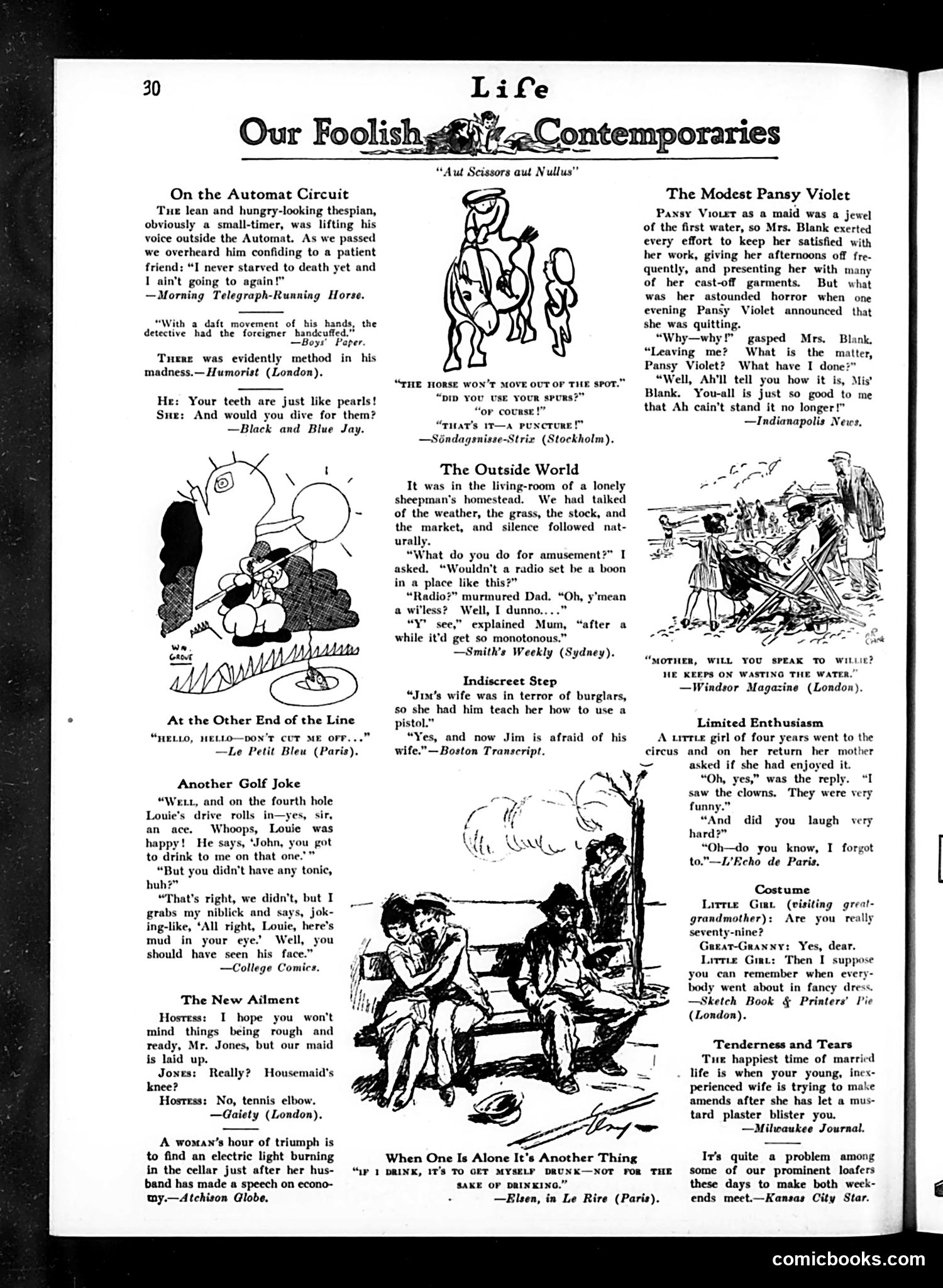
This page from Life magazine presents short humorous anecdotes and jokes drawn from international publications—a common format for the era. The content satirizes everyday social situations of the 1920s-30s. Key recurring themes include: **Social absurdities**: A struggling actor who claims he's never starved, an elderly couple finding a radio too monotonous for rural life, and a maid who quits a generous employer because she's too content. **Gender dynamics**: A wife who becomes dangerous after learning to use a pistol; a woman celebrating finding a burnt-out lightbulb as proof her husband isn't economizing as claimed. **Class commentary**: The "Pansy Violet" piece uses dialect humor to depict a servant whose gratitude becomes unbearable, reflecting period attitudes about domestic workers. **Modern absurdism**: References to "tennis elbow" as a fashionable ailment replacing traditional "housemaid's knee." The cartoons (simple line drawings) illustrate selected jokes. The overall tone is gentle mockery of pretension, complacency, and social contradictions—typical of Life's satirical approach. Sources cited are international publications, emphasizing the magazine's cosmopolitan scope.
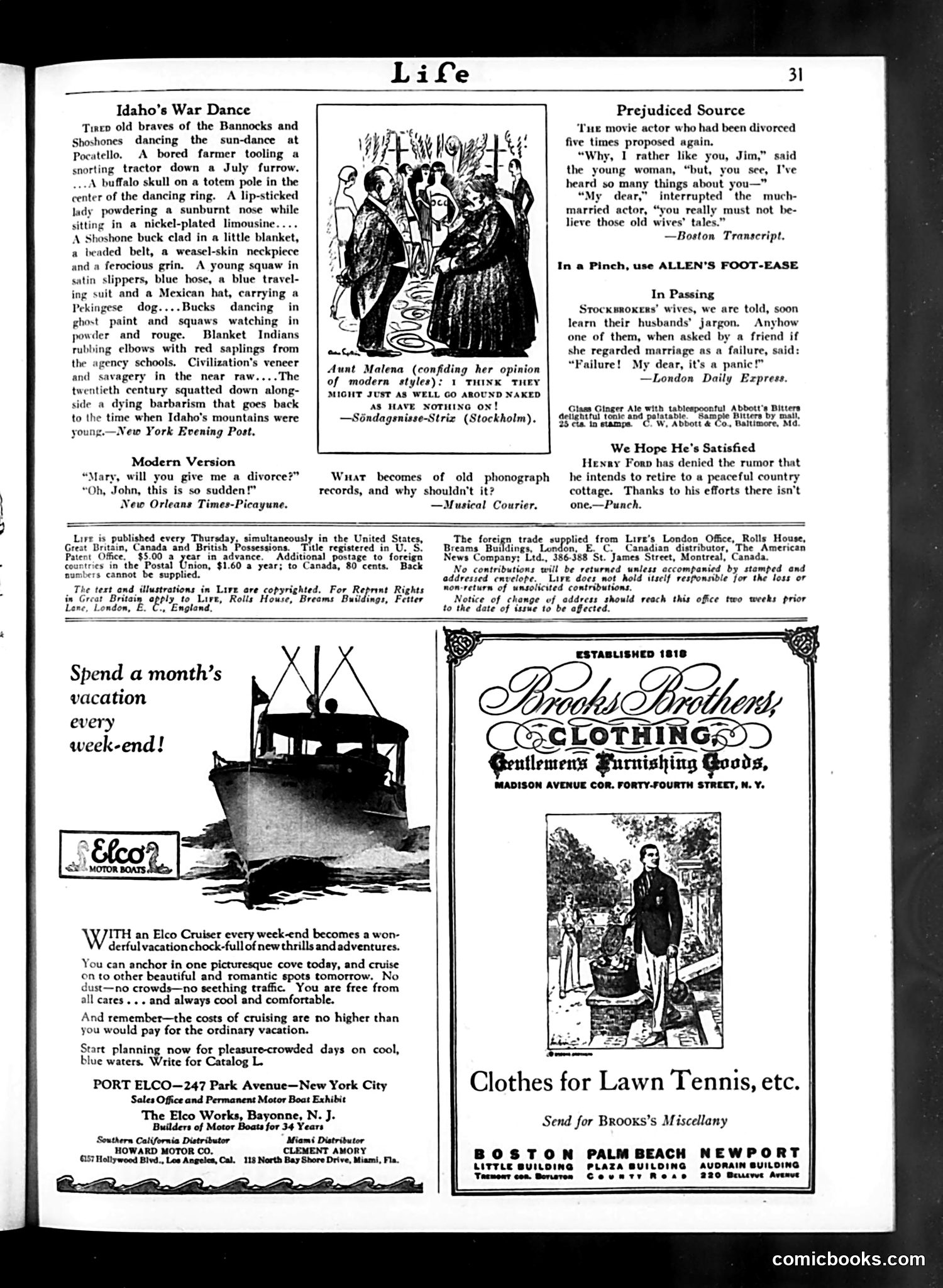
This page contains **short humorous items and advertisements** rather than political cartoons. The content includes: **"Idaho's War Dance"** — A satirical observation contrasting traditional Native American ceremonial practices (Bannock and Shoshone sun-dances) with modern American intrusions: bored farmers, powdered ladies in limousines, and Indigenous people wearing Western accessories. The piece critiques how "civilization's veneer" clashes with and corrupts indigenous culture. **"Modern Version"** — A brief joke about divorce becoming casual and expected. **Other brief humor items** mock modern fashion (women dressing provocatively), stockbrokers' wives learning financial jargon, and Henry Ford's industrial impact leaving no peaceful countryside. The page is primarily **commercial advertising** for Elco motor boats, Brooks Brothers clothing, and various consumer products. These ads dominate the layout and appear more significant than the editorial content. The humor throughout reflects 1920s attitudes toward Native Americans, gender roles, and industrial modernity—assuming readers would find satire in contrasting "primitive" traditions with modern American commercialism.
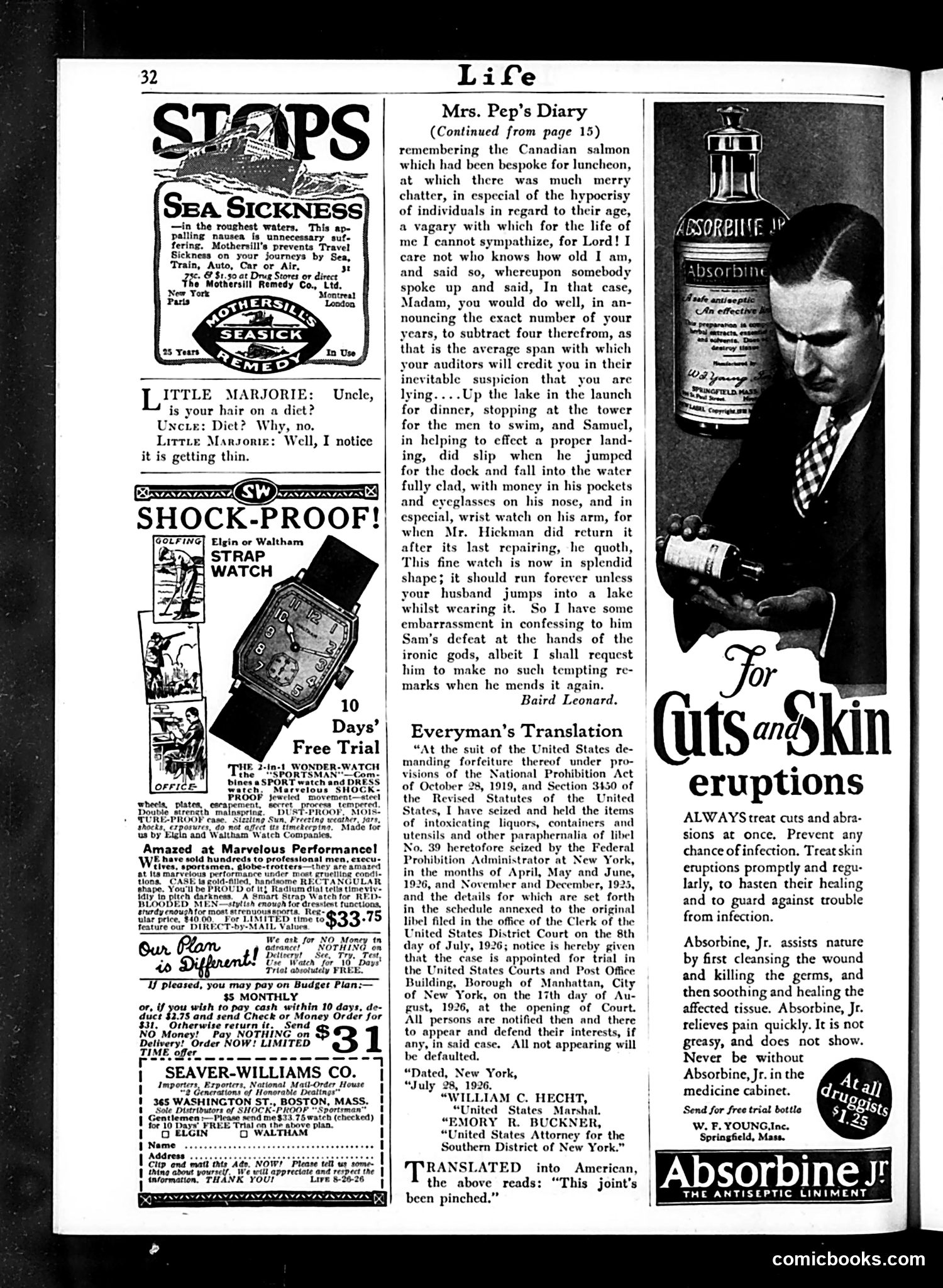
This page from Life magazine (circa 1926, based on dates visible) is primarily **advertising and society content** rather than political satire. **Key content:** - **"Mrs. Pep's Diary"**: A humorous society column describing a wealthy woman's social gathering and lake outing. The joke involves a servant (Samuel) falling fully clothed into the water—ironic because the homeowner's husband had recently jumped in a lake wearing an expensive watch the jeweler said would last "forever." - **Small cartoon joke**: "Little Marjorie" teases her uncle about his thinning hair, suggesting he's on a "diet." - **Bulk of page**: Product advertisements (sea sickness remedy, shock-proof watches, mail-order goods) typical of 1920s magazines. - **"Everyman's Translation"**: A legal notice about Prohibition-era liquor seizures, translated into plain language—reflecting the era's active enforcement of the 1919 Prohibition Act. The satire is mild and domestic rather than political; it mocks wealthy social pretensions and the irony of life's small disasters.
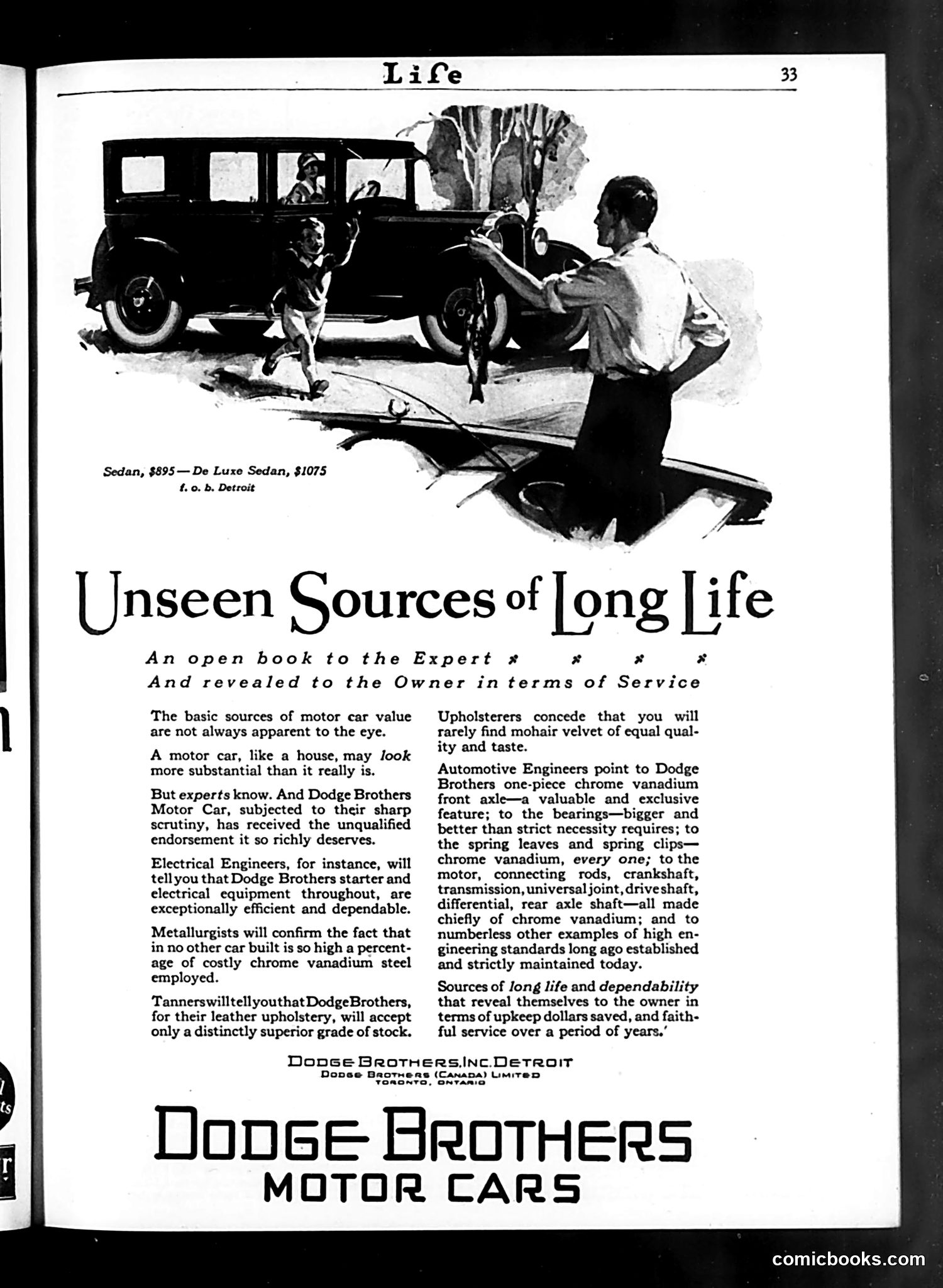
This is **not a cartoon or satire**—it's a straightforward automobile advertisement from Life magazine, page 33. The ad promotes Dodge Brothers Motor Cars (priced $895–$1,075, f.o.b. Detroit). The illustration shows a man examining a sedan while two figures gesture toward it, depicting the idea of expert inspection. The ad's strategy is to appeal to buyers by listing endorsements from various professional experts—electrical engineers, metallurgists, tanners, and automotive engineers—who allegedly verify the car's quality in hidden ways (chrome vanadium steel, superior upholstery, precision bearings, etc.). The headline "Unseen Sources of Long Life" and subheading "An open book to the Expert" frame quality as something invisible to ordinary consumers but proven by specialists. This reflects early-20th-century advertising that used technical authority and expert credibility to justify premium pricing during competitive car manufacturing. The ad contains no satire or political commentary—it's earnest marketing.
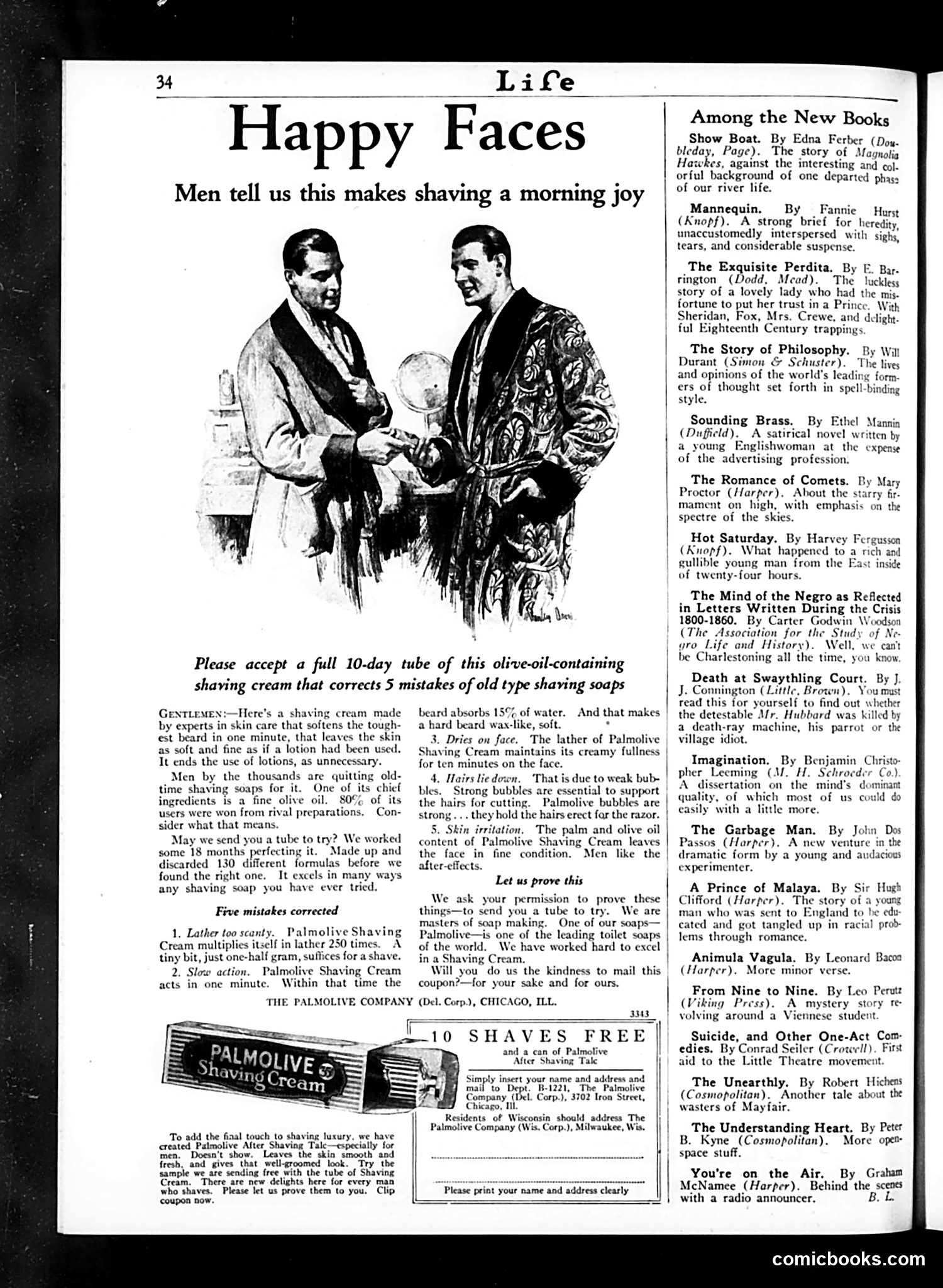
This page is primarily a **Palmolive shaving cream advertisement** disguised as editorial content in *Life* magazine, a satirical publication from the 1920s era. **The "cartoon"**: The illustration shows two well-dressed men in what appears to be a morning shaving routine—one man presenting a product to another. This isn't satirical commentary; it's straightforward advertising using the aspirational imagery common to the period. **The appeal**: The ad emphasizes masculinity and grooming as markers of respectability, claiming the cream corrects "5 mistakes of old type shaving soaps." It lists technical benefits (softens beard in one minute, maintains lather for ten minutes) that would appeal to men seeking efficiency and quality. **Context**: The adjacent book reviews suggest *Life*'s educated readership. The juxtaposition—serious literary criticism alongside consumer advertising—reflects how 1920s magazines blended editorial and commercial content far more seamlessly than modern publications typically do. **No political satire is present here**—this is period commercial messaging targeting middle-class male consumers.
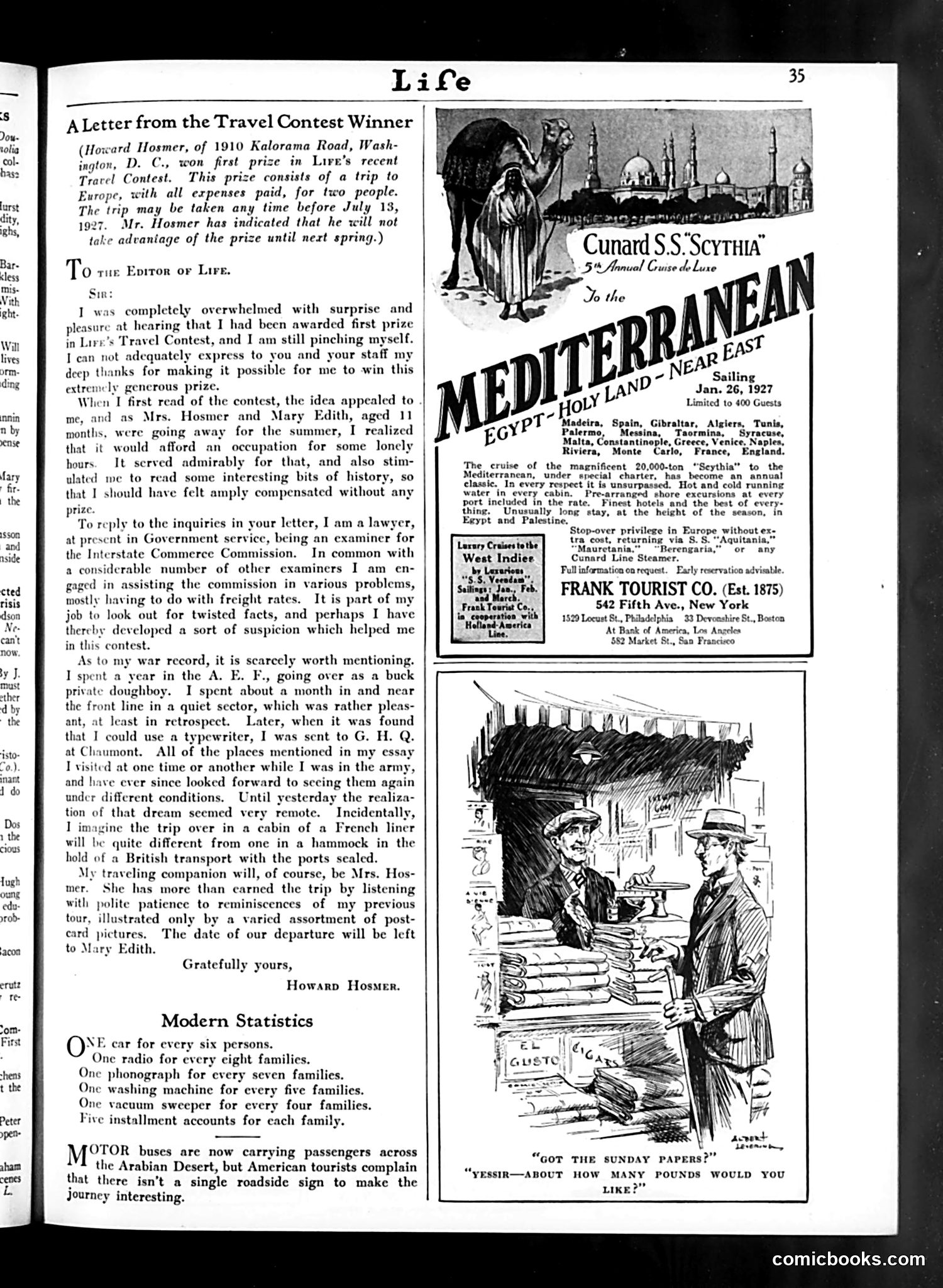
This page contains a letter from Howard Hosmer, winner of *Life* magazine's travel contest, who won an all-expenses-paid European trip for two people. Hosmer describes his background as a lawyer in government service (Interstate Commerce Commission examiner) and a World War I veteran, explaining how entering the contest motivated him to read history. The accompanying cartoon, captioned "Got the Sunday Papers?" depicts what appears to be a newspaper vendor or porter asking a traveler about purchasing newspapers, likely satirizing the American tourist obsession with staying informed while abroad—a commentary on American travel habits and dependence on news. The page also includes cruise and travel advertisements typical of the 1920s leisure industry, reflecting the era's growing accessibility of European travel for middle-class Americans.
This satirical piece mocks the moral contradictions of 1920s American businessmen. Written as a mock-biblical "commandment" list, it exposes hypocrisy in business culture: The satire targets entrepreneurs who claim "Service" and "equal opportunity" while actually prioritizing profit above ethics. Key targets include: bribing bosses ("Honor thy Boss"), spreading damaging rumors ("Dirty Dig"), theft disguised as "Putting Something Over," and murderous business practices presented as "commendable." The piece ridicules the masculine posturing of executives ("genuine He-man considers it effeminate...to be anything remotely resembling a purist") and the performative success culture where debt-fueled appearances matter more than actual achievement. Author Sterling Patterson uses religious language to highlight the gap between stated American values and actual business conduct—a common satirical technique in 1920s *Life* magazine, which frequently critiqued corporate greed and hypocrisy.
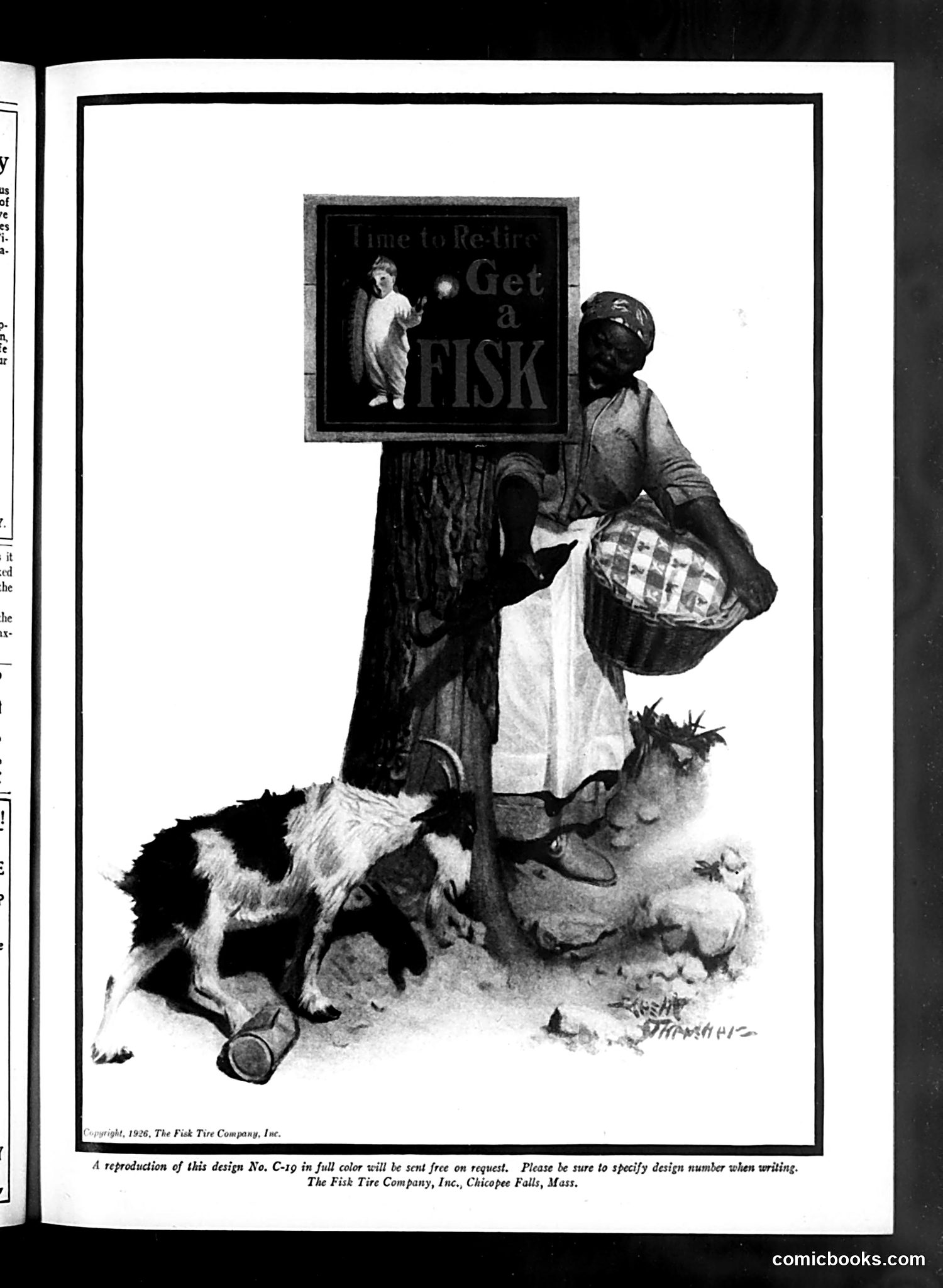
This is a **1926 advertisement for Fisk Tires**, not political satire. The image features the famous "Fisk Boy" mascot—a recognizable character from Fisk's advertising campaigns—depicted as a cherubic figure in nightclothes holding a candle and basket. The sign reads "Time to Re-tire? Get a FISK," a pun playing on "retire" and "re-tire" (replace tires). The boy is accompanied by a dog, and the scene suggests nighttime, evoking the company's iconic "Time to Re-tire" slogan that became their trademark marketing message. This is **corporate advertising**, not political commentary. The Fisk Boy became one of early 20th-century advertising's most recognizable icons.
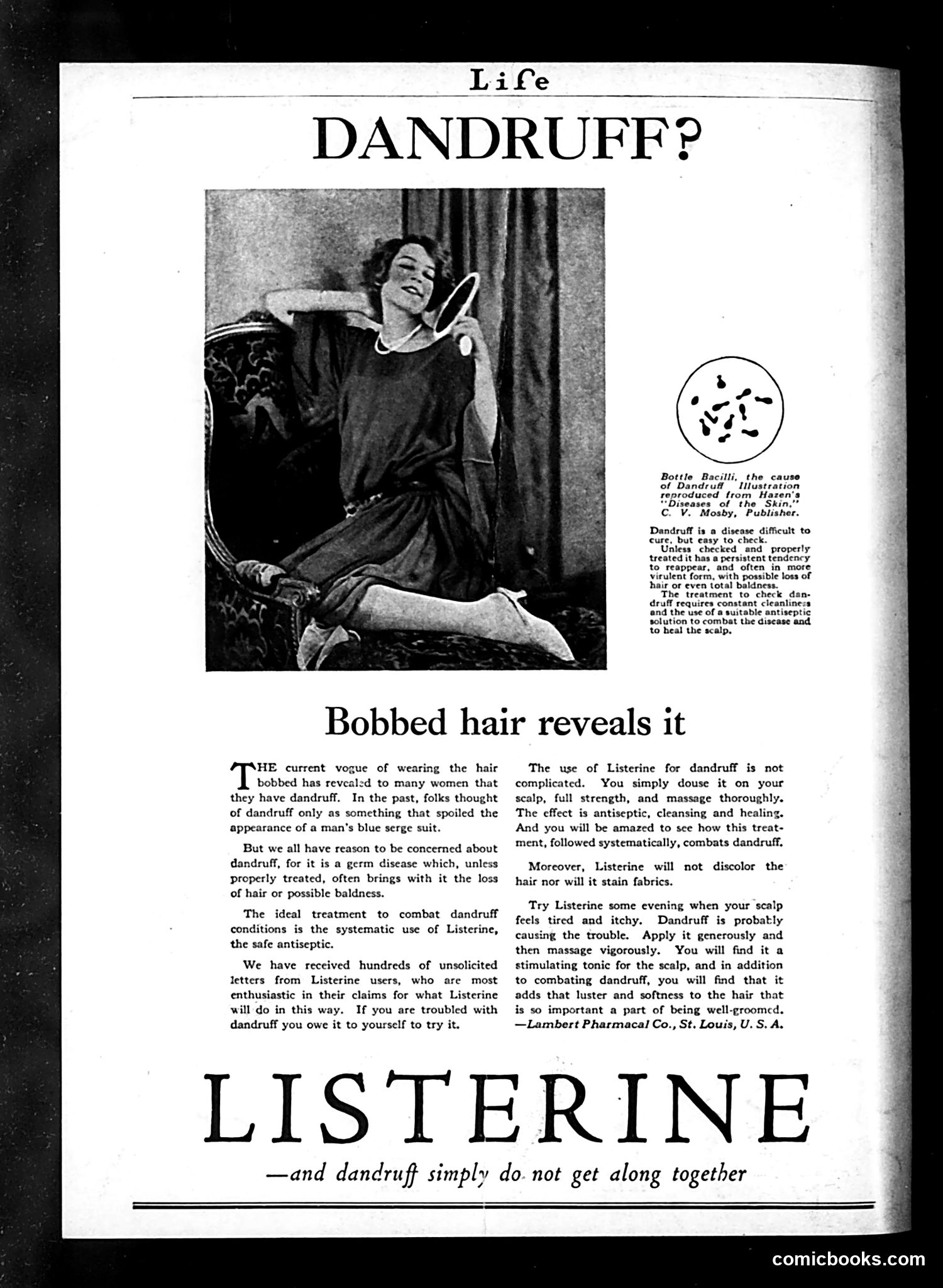
This is a **Listerine advertisement**, not political satire. The page uses the then-fashionable "bobbed hair" hairstyle (short hair popular in the 1920s) as its hook: the ad claims this modern style reveals dandruff problems previously hidden by longer hair. The image shows a woman with bobbed hair examining her scalp with a mirror—suggesting newly visible dandruff. The advertisement positions Listerine as the solution, claiming it combats the "germ disease" through antiseptic treatment. The accompanying scientific illustration of "Bottle Bacilli" (dandruff-causing microorganisms) lends medical authority to the pitch. The ad emphasizes that dandruff, if untreated, causes hair loss and baldness—appealing to women's grooming concerns. This reflects early 20th-century marketing: using social trends (bobbed hair) and pseudoscientific claims ("germ disease") to sell a multipurpose product (Listerine was marketed for various ailments).

I can see this is a heavily darkened or degraded page from what appears to be a historical publication, but the image quality is too poor for me to reliably identify specific cartoon content, figures, or text beyond the watermark "comicbooks.com" at the bottom. The page appears to contain satirical content typical of Life magazine, but I cannot make out sufficient detail to accurately identify: - Specific caricatured figures or their identities - Political or social references - The satirical point or joke being made Rather than speculate about unclear details, I must acknowledge that this image's contrast and condition prevent me from providing the accurate historical analysis you're requesting. A clearer version of the page would be needed for proper interpretation.