
Life, 1926-08-26 · page 25 of 41
Life — August 26, 1926 — page 25: what you’re looking at
What you’re looking at
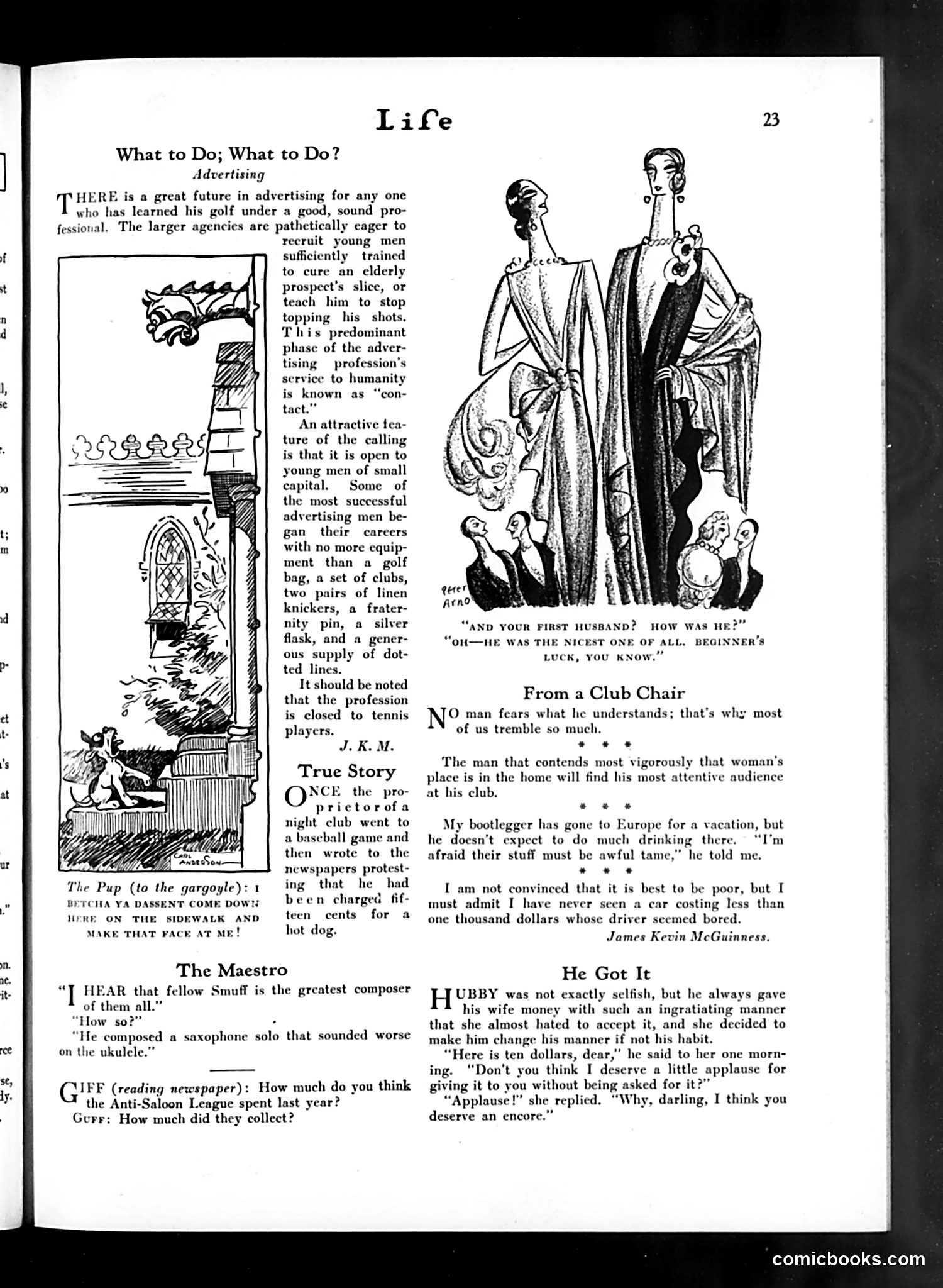
This page from *Life* magazine contains several brief satirical pieces mocking American social conventions of the era (likely 1920s-30s, given Prohibition references). The main column humorously critiques advertising professionals who use golf as their primary "business development" tool—implying that success in advertising depends less on actual skill than on ability to schmooze clients on the golf course. Other pieces mock contemporary absurdities: a nightclub owner complaining about hot dog prices; the disconnect between men who advocate "women's place is in the home" while spending time at their clubs; bootleggers operating during Prohibition; and marital dynamics around gift-giving. The cartoons and illustrations are period comic sketches supporting these themes—a gargoyle confrontation and musical satire about saxophones sounding worse on ukuleles. The humor targets hypocrisy, materialism, and changing social behaviors in modern American life, with particular jabs at the leisure class and business culture.
📄 Transcribed text from this page (OCR, searchable)
Machine-transcribed from the original scan — historical spelling and the odd misread are preserved.
Li What to Do; What to Do? Advertising HERE is a great future in advertising for any one who has learned his golf under a good, sound pro- fessional. The larger agencies are pathetically eager to recruit young men sufficiently trained to cure an elderly prospect’s slice, or teach him to stop topping his shots. This predominant phase of the adver- tising profession’s service to humanity is known as “con- tact.” An attractive tea- ture of the calling is that it is open to young men of small capital. Some of the most successful advertising men be- gan their careers with no more equip- ment than a golf bag, a set of clubs, two pairs of linen knickers, a frater- nity pin, a silver flask, and a gener- ous supply of dot- ted lines. It should be noted that the profession is closed to tennis players. J.K.M. True Story NCE the pro- prictorofa night club went to a baseball game and then wrote to the newspapers protest- ing that he had been charged fif- teen cents for a hot dog. The Pup (to the gargoyle): 1 BETCHA YA DASSENT COME DOWN HERE ON THE SIDEWALK AND MAKE THAT FACE AT ME! The Maestro “T HEAR that fellow Smuff is the greatest composer of them all.” “How so?” . “He composed a saxophone solo that sounded worse on the ukulele.” GIFF (reading newspaper): How much do you think the Anti-Saloon League spent last year? Gurr: How much did they collect? “AND YOUR FIRST HUSBAND? HOW WAS H “OH—HE WAS THE NICEST ONE OF ALL. BEG » You know.” From a Club Chair O man fears what he understands; that’s why most of us tremble so much. ** * The man that contends most vigorously that woman's place is in the home will find his most attentive audience at his club. “2 # My bootlegger has gone to Europe for a vacation, but he doesn’t expect to do much drinking there. “I'm afraid their stuff must be awful tame,” he told me. *“* © I am not convinced that it is best to be poor, but I must admit I have never seen a car costing less than one thousand dollars whose driver seemed bored. James Kevin McGuinness, He Got It UBBY was not exactly selfish, but he always gave his wife money with such an ingratiating manner that she almost hated to accept it, and she decided to make him change his manner if not his habit. “Here is ten dollars, dear,” he said to her one morn- ing. “Don't you think I deserve a little applause for giving it to you without being asked for it?” “Applause!” she replied. “Why, darling, I think you deserve an encore.” comicbooks.com