
Life, 1926-08-26 · page 28 of 41
Life — August 26, 1926 — page 28: what you’re looking at
What you’re looking at
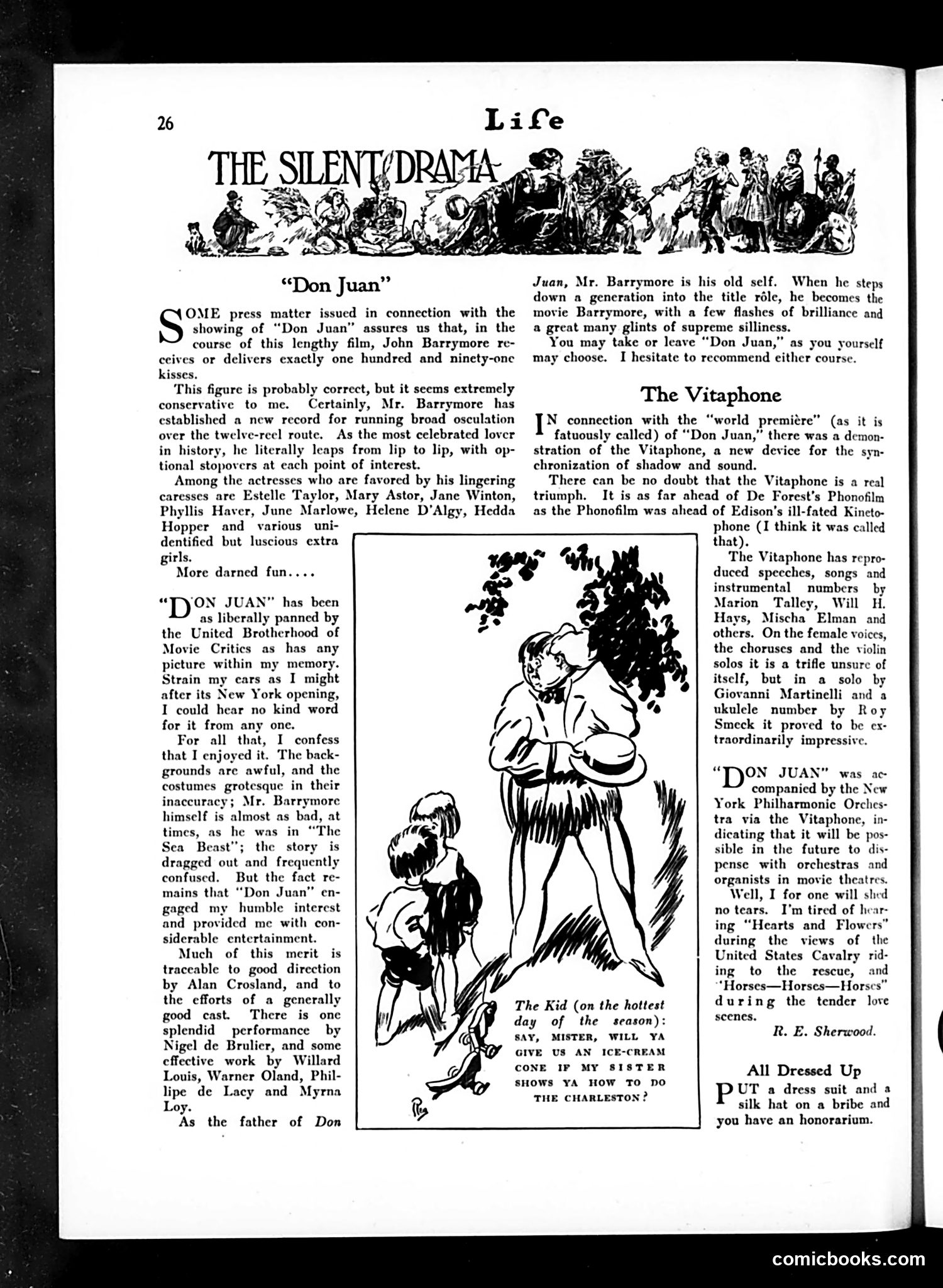
This page reviews John Barrymore's film *Don Juan* (1926), focusing on two main topics: **The Don Juan Review**: The critic humorously notes that press materials claim Barrymore delivers 191 kisses in the film—which the reviewer finds conservatively low. The review acknowledges the film's poor production values (awful backgrounds, grotesque costumes, weak acting) but admits to enjoying it anyway, crediting director Alan Crosland and the cast. **The Vitaphone**: The page discusses a new sound synchronization technology demonstrated with the film's premiere. The writer praises it as superior to earlier competing systems (De Forest's Phonofilm, Edison's Kinetophone), noting successful reproductions of speeches, songs, and orchestral music. **The Cartoon**: Shows a child asking an ice cream vendor for a cone in exchange for his sister demonstrating the Charleston dance—reflecting the 1920s cultural obsession with this popular dance craze. **Final Quip**: A satirical definition equating formal dress with bribery, likely commentary on political or social corruption of the era.
📄 Transcribed text from this page (OCR, searchable)
Machine-transcribed from the original scan — historical spelling and the odd misread are preserved.
showing of “Don Juan” assures us that, in the course of this lengthy film, John Barrymore re- ceives or delivers exactly one hundred and ninety-once kisses. This figure is probably correct, but it seems extremely conservative to me. Certainly, Mr. Barrymore has established a new record for running broad osculation over the twelve-reel route. As the most celebrated lover in history, he literally leaps from lip to lip, with op- tional stopovers at each point of interest. Among the actresses who are favored by his lingering caresses are Estelle Taylor, Mary Astor, Jane Winton, Phyllis Haver, June Marlowe, Helene D’Algy, Hedda Hopper and various uni- dentified but luscious extra girls. More darned fun.... GS iten press matter issued in connection with the “TYON JUAN” has been as liberally panned by the United Brotherhood of Movie Critics as has any picture within my memory. Strain my cars as I might after its New York opening, I could hear no kind word for it from any one. For all that, I confess that I enjoyed it. The back- grounds are awful, and the costumes grotesque in their inaccuracy; Mr. Barrymore himself is almost as bad, at times, as he was in “The Sea Beast”; the story is dragged out and frequently confused. But the fact re- mains that “Don Juan” en- gaged my humble interest and provided me with con- siderable entertainment. Much of this merit is traceable to good direction by Alan Crosland, and to Juan, Mr. Barrymore is his old self. When he steps down a generation into the title réle, he becomes the movie Barrymore, with a few flashes of brilliance and a great many glints of supreme silliness. You may take or leave “Don Juan,” as you yourself may choose. I hesitate to recommend either course. The Vitaphone N connection with the “world premitre” (as it is fatuously called) of “Don Juan,” there was a demon- stration of the Vitaphone, a new device for the syn- chronization of shadow and sound. . There can be no doubt that the Vitaphone is a real triumph. It is as far ahead of De Forest's Phonofilm as the Phonofilm was ahead of Edison's ill-fated Kineto- phone (I think it was called that). The Vitaphone has repro- duced speeches, songs and instrumental numbers by Marion Talley, Will H. Hays, Mischa Elman and others. On the female voices, the choruses and the violin solos it is a trifle unsure of itself, but in a solo by Giovanni Martinelli and a ukulele number by Roy Smeck it proved to be ex- traordinarily impressive. “TYON JUAN” was ac companicd by the New York Philharmonic Orches- tra via the Vitaphone, in- dicating that it will be pos- sible in the future to dis- pense with orchestras and organists in movie theatres. Well, I for one will shed no tears. I'm tired of hear- ing “Hearts and Flowers” during the views of the United States Cavalry rid- ing to the rescue, and ‘Horses—Horses—Horscs” the efforts of a gencrally good cast. There is one splendid performance by Nigel de Brulicr, and some effective work by Willard Louis, Warner Oland, Phil- lipe de Lacy and Myrna Loy. As the father of Don The Kid (on the hottest day of the season): SAY, MISTER, WILL YA GIVE US AN ICE-CREAM CONE IF MY SISTER SHOWS YA HOW TO DO THE CHARLESTON? during the tender love scenes. R. E. Sherwood. All Dressed Up UT a dress suit and a silk hat on a bribe and you have an honorarium. comicbooks.com