
Life, 1926-08-26 · page 18 of 41
Life — August 26, 1926 — page 18: what you’re looking at
What you’re looking at
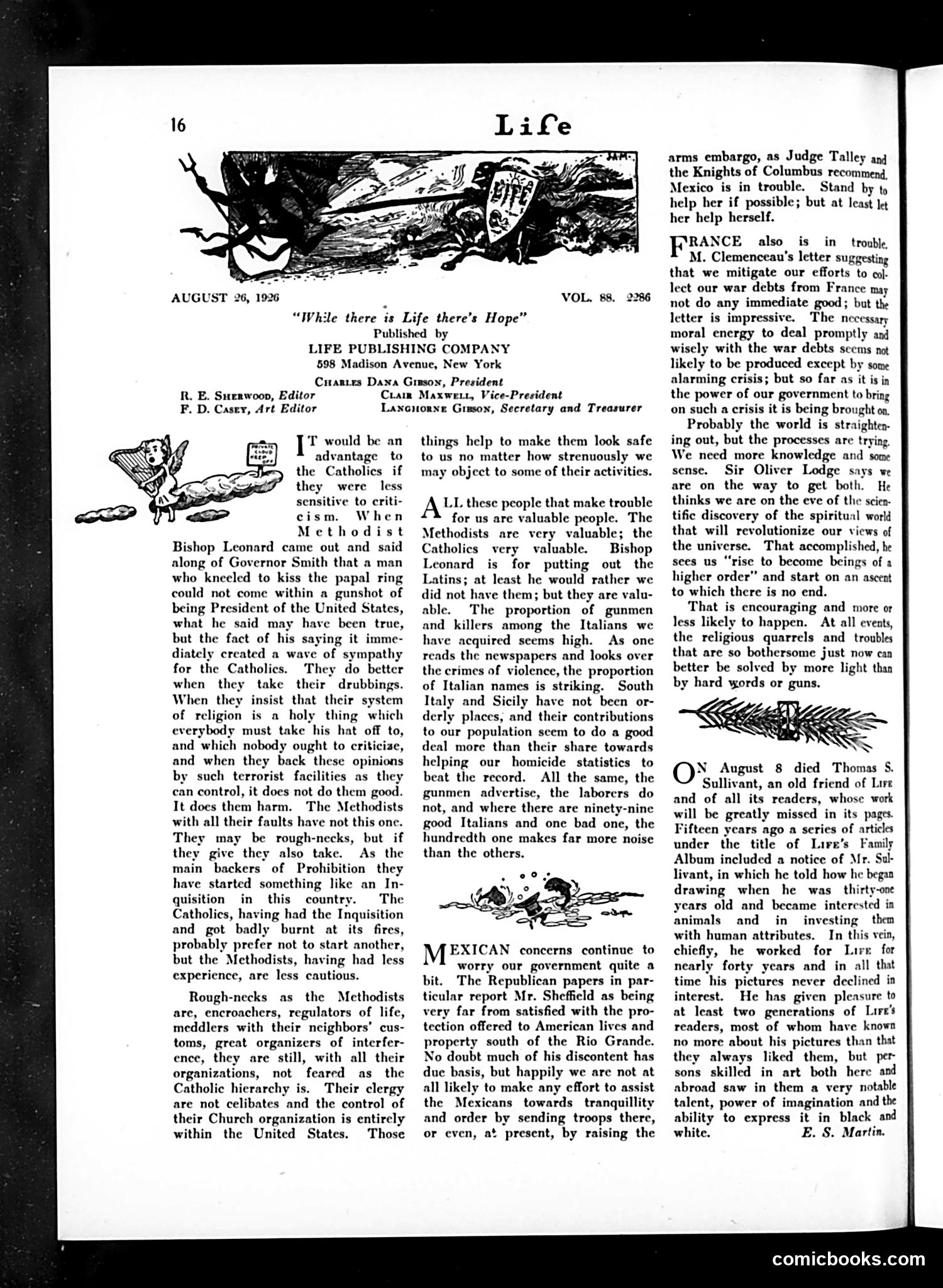
This page contains editorial commentary rather than political cartoons. The text discusses three contemporary issues: 1. **Catholic criticism of Methodists**: The editor argues Catholics shouldn't criticize Methodists for their role in Prohibition, since Catholics themselves supported it initially. 2. **France's war debts**: References M. Clemenceau's letter about France's financial troubles post-WWI, suggesting the U.S. government must address the crisis seriously. 3. **Mexico**: Discusses ongoing Mexican instability and suggests the U.S. should not intervene militarily, despite Republican papers criticizing the government's handling of Mexican affairs. The small decorative illustrations are generic vignettes, not specific political cartoons. The page reflects 1920s American concerns: Prohibition enforcement, international relations, and domestic political debate.
📄 Transcribed text from this page (OCR, searchable)
Machine-transcribed from the original scan — historical spelling and the odd misread are preserved.
AUGUST 26, 1926 “While there is Life there’s Hope” Published by LIFE PUBLISHING COMPANY 598 Madison Avenue, New York Cuartes Dana Ginson, President R. E. Suerwoon, Editor F. D. Casey, Art Editor T would be an advantage to the Catholics if they were less sensitive to criti- cism. When Methodist Bishop Leonard came out and said along of Governor Smith that a man who kneeled to kiss the papal ring could not come within a gunshot of being President of the United States, what he said may have been true, but the fact of his saying it imme- diately created a wave of sympathy for the Catholics. They do better when they take their drubbings. When they insist that their system of religion is a holy thing which everybody must take his hat off to, and which nobody ought to criticize, and when they back these opinions by such terrorist facilities as they can control, it does not do them good. It does them harm. The Methodists with all their faults have not this one. They may be rough-necks, but if they give they also take. As the main backers of Prohibition they have started something like an In- quisition in this country. The Catholics, having had the Inquisition and got badly burnt at its fires, probably prefer not to start another, but the Methodists, having had less experience, are less cautious. Rough-necks as the Methodists are, encroachers, regulators of life, meddlers with their neighbors’ cus- toms, great organizers of interfer- ence, they are still, with all their organizations, not feared as the Catholic hierarchy is. Their clergy are not celibates and the control of their Church organization is entirely within the United States. Those Cram Maxwett, Vice-President Laxcuorne Greson, Secretary and Treasurer things help to make them look safe to us no matter how strenuously we may object to some of their activities. All these people that make trouble for us are valuable people. The Methodists are very valuable; the Catholics very valuable. Bishop Leonard is for putting out the Latins; at least he would rather we did not have them; but they are valu- able. The proportion of gunmen and killers among the Italians we have acquired seems high. As one reads the newspapers and looks over the crimes of violence, the proportion of Italian names is striking. South Italy and Sicily have not been or- derly places, and their contributions to our population seem to do a good deal more than their share towards helping our homicide statistics to beat the record. All the same, the gunmen advertise, the laborers do not, and where there are ninety-nine good Italians and one bad one, the hundredth one makes far more noise than the others. @ (6058 sal is I EXICAN concerns continue to worry our government quite a bit. The Republican papers in par- ticular report Mr. Sheffield as being very far from satisfied with the pro- tection offered to American lives and property south of the Rio Grande. No doubt much of his discontent has duc basis, but happily we are not at all likely to make any effort to assist the Mexicans towards tranquillity and order by sending troops there, or even, at present, by raising the arms embargo, as Judge Talley and the Knights of Columbus recommend, Mexico is in trouble. Stand by to help her if possible; but at least Jet her help herself. RANCE also is in trouble, M. Clemenceau’s letter suggesting that we mitigate our efforts to ol- lect our war debts from France may not do any immediate good; but the letter is impressive. The necessary moral energy to deal promptly and wisely with the war debts scems not likely to be produced except by some alarming crisis; but so far as it is in the power of our government to bring on such a crisis it is being brought on, Probably the world is straighten- ing out, but the processes are trying. We need more knowledge and some sense. Sir Oliver Lodge says we are on the way to get both. He thinks we are on the eve of the scien- tific discovery of the spiritual world that will revolutionize our views of the universe. That accomplished, he sees us “rise to become beings of a higher order” and start on an ascent to which there is no end. That is encouraging and more or less likely to happen. At all events, the religious quarrels and troubles that are so bothersome just now can better be solved by more light than by hard yords or guns. August 8 died Thomas S. Sullivant, an old friend of Lire and of all its readers, whose work will be greatly missed in its pages. Fifteen years ago a series of articles under the title of Lire’s Family Album included a notice of Mr. Sul- livant, in which he told how he began drawing when he was _ thirty-one years old and became interested in animals and in investing them with human attributes. In this vein, chiefly, he worked for Lire for nearly forty years and in all that time his pictures never declined in interest. He has given pleasure to at least two generations of Lire’s readers, most of whom have known no more about his pictures than that they always liked them, but per sons skilled in art both here and abroad saw in them a very notable talent, power of imagination and the ability to express it in black and white. E. S. Martin. comicbooks.com