
Life, 1926-08-26 · page 32 of 41
Life — August 26, 1926 — page 32: what you’re looking at
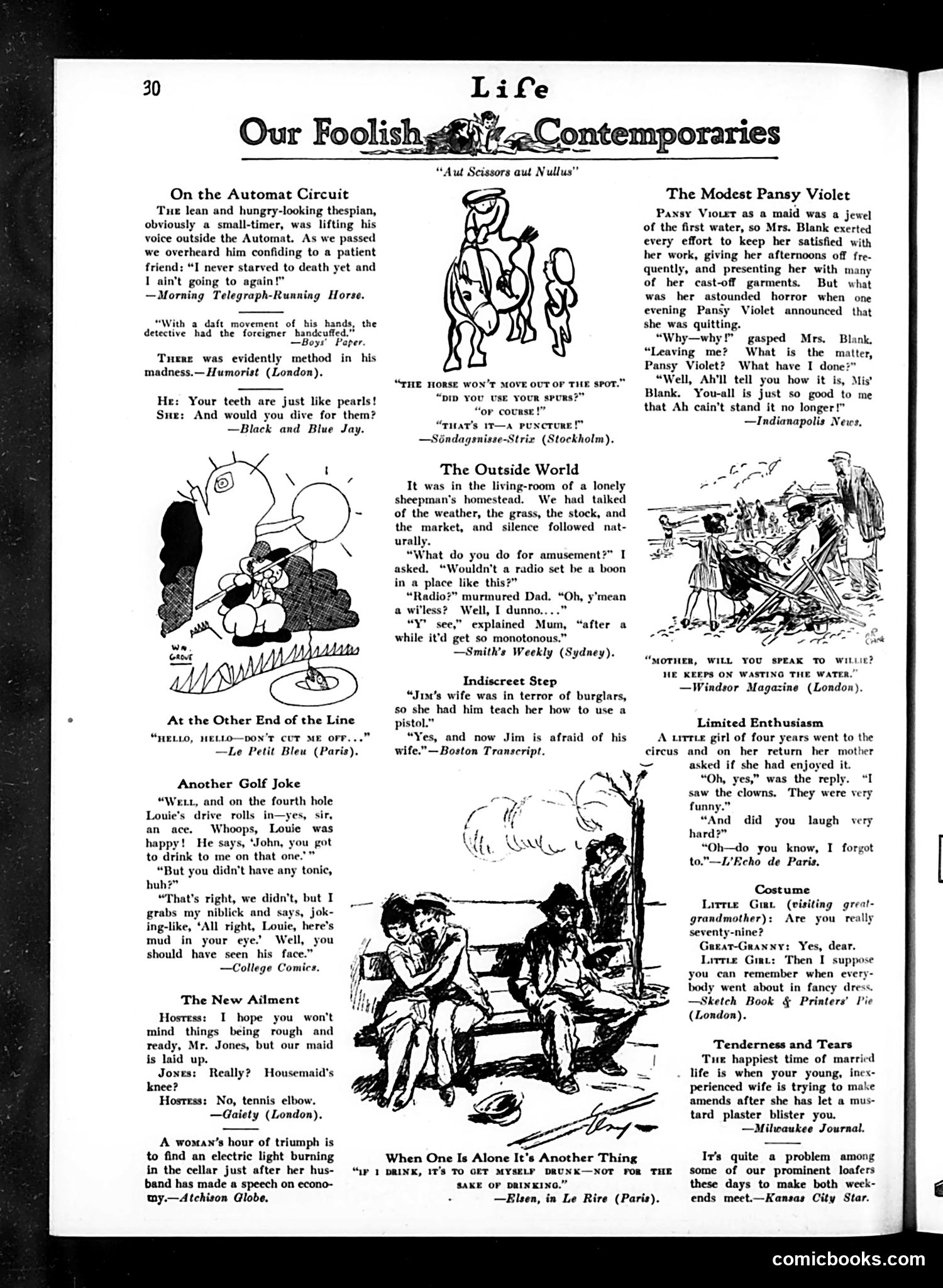
What you’re looking at
This page from Life magazine presents short humorous anecdotes and jokes drawn from international publications—a common format for the era. The content satirizes everyday social situations of the 1920s-30s. Key recurring themes include: **Social absurdities**: A struggling actor who claims he's never starved, an elderly couple finding a radio too monotonous for rural life, and a maid who quits a generous employer because she's too content. **Gender dynamics**: A wife who becomes dangerous after learning to use a pistol; a woman celebrating finding a burnt-out lightbulb as proof her husband isn't economizing as claimed. **Class commentary**: The "Pansy Violet" piece uses dialect humor to depict a servant whose gratitude becomes unbearable, reflecting period attitudes about domestic workers. **Modern absurdism**: References to "tennis elbow" as a fashionable ailment replacing traditional "housemaid's knee." The cartoons (simple line drawings) illustrate selected jokes. The overall tone is gentle mockery of pretension, complacency, and social contradictions—typical of Life's satirical approach. Sources cited are international publications, emphasizing the magazine's cosmopolitan scope.
📄 Transcribed text from this page (OCR, searchable)
Machine-transcribed from the original scan — historical spelling and the odd misread are preserved.
ntemporaries On the Automat Circuit ‘Tue lean and hungry-looking thespian, obviously a small-timer, was lifting his voice outside the Automat. As we passed we overheard him confiding to a patient friend: “I never starved to death yet and I ain't going to again!” —Morning Telegraph-Running Horse. “With a daft movement of his hands, the detective had the foreigner handcuffed.” —Boys’ Poper. Tnenz was evidently method in his madness.—Humorist (London). He: Your teeth are just like pearls! Sue: And would you dive for them? —Black and Blue Jay. At the Other End of the Line “HELLO, MELLO—DON'T CUT ME ete —Le Petit Bleu (Paris). Another Golf Joke “Went, and on the fourth hole Louie's drive rolls in—yes, sir, an ace. Whoops, Louie was happy! He says, ‘John, you got to drink to me on that one.” “But you didn’t have any tonic, hu “That's right, we didn’t, but I grabs my niblick and says, jok- ing-like, ‘All right, Louie, here's mud in your eye.’ Well, you should have seen his face.” —College Comics. The New Ailment Hostess: I hope you won't mind things being rough and ready, Mr. Jones, but our maid is laid up. Jones: knee? Hostess: No, tennis elbow. —Gaiety (London). Really? Housemaid’s A wosan’s hour of triumph is to find an electric light burning in the cellar just after her hus- band has made a speech on econo- my.—Atchison Globe. “THE HORSE WON’T MOVE OUT OF “pip YOU USE YOUR SPUR: “or course !” “vuat’s 1T—A PUNCTURE!” —Séndagsnisse-Strix (Stockholm). The Outside World It was in the living-room of a lonely sheepman's homestead. We had talked of the weather, the grass, the stock, and the market, and silence followed nat- urally. “What do you do for amusement?” I asked. “Wouldn't a radio set be a boon in a place like this?” “Radio?” murmured Dad. “Oh, y'mean iless? Well, I dunno... .” see,” explained Mum, “after a while it'd get so monotonous.” —Smith’s Weekly (Sydney). a Indiscreet Step “Jim’s wife was in terror of burglars, so she had him teach her how to use a pistol.” “Yes, and now Jim is afraid of his wife.”—Boston Transcript. When One Is Alone It’s Another Thing “IP 1 DRINK, IT'S TO GET MYSELF DRUNK—NOT FOR THE SAKE OF DRINKING.” —Elsen, in Le Rire (Paris). The Modest Pansy Violet Pansy Vioter as a maid was a jewel of the first water, so Mrs. Blank exerted every effort to keep her satisfied with her work, giving her afternoons off fre- quently, and presenting her with many of her cast-off garments. But what was her astounded horror when one evening Pansy Violet announced that she was quitting. “Why—why!” gasped Mrs, Blank, “Leaving me? What is the matter, Pansy Violet? What have I done? “Well, Ah'll tell you how it is, Mis’ Blank. You-all is just so good to me that Ah cain’t stand it no longer!” —Indianapolis News, “MOTHER, WILL YOU SPEAK TO WILLIE? HE KEEPS ON WASTING THE WATER.” —Windsor Magazine (London). Limited Enthusiasm A uirtte girl of four years went to the and on her return her mother asked if she had enjoyed it. “Oh, yes,” was the reply. “I saw the clowns. They were very funny.” “And hard?” “Oh—do you know, I forgot to."—L’Echo de Paris, did you laugh very Costume Lirtte Gra (visiting great- grandmother): Are you really seventy-nine? Gaeat-Granny: Yes, dear. Livriz Giat: Then I suppose you can remember when every- body went about in fancy dress, —Sketch Book § Printers’ Pie (London). Tenderness and Tears Tur happiest time of married life is when your young, inex- perienced wife is trying to make amends after she has let a mus- tard plaster blister you. —Milwaukee Journal. It’s quite a problem among some of our prominent loafers these days to make both week- ends meet.—Kansas City Star. comicbooks.com