
Life, 1926-08-26 · page 23 of 41
Life — August 26, 1926 — page 23: what you’re looking at
What you’re looking at
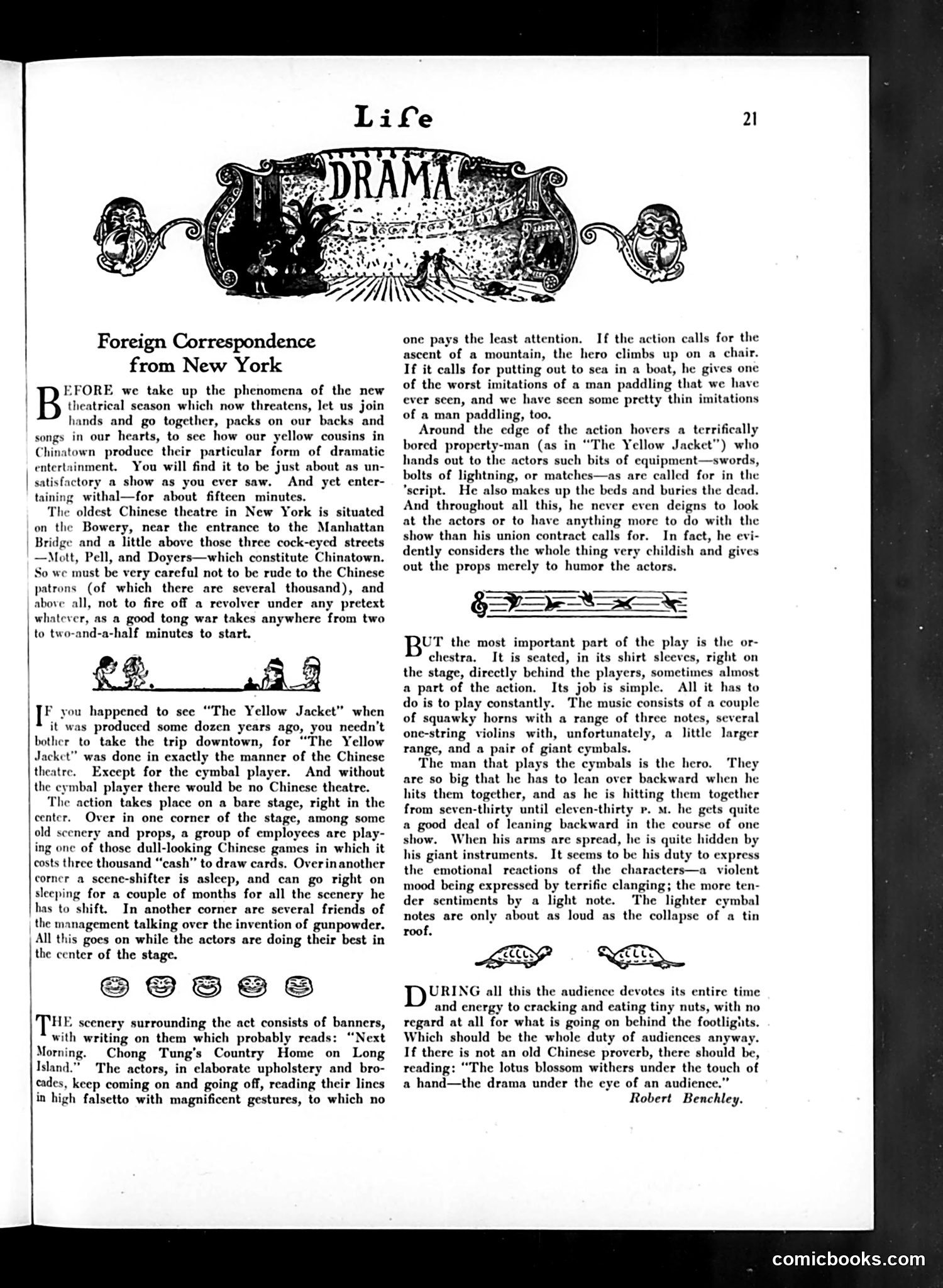
This 1910s *Life* magazine article satirizes Chinese theater in New York's Chinatown, employing racial stereotypes typical of the era. The author mocks nearly every aspect: the sparse, minimal staging; actors performing in high falsetto voices with exaggerated gestures that audiences ignore; a bored, indifferent property-man; and an orchestra consisting of "squawky horns" and a cymbal player described as "the hero"—the only element receiving serious attention. The piece relies on contemptuous caricature of Chinese theatrical conventions as incomprehensible and tedious to American audiences. References to "tong wars" and "yellow cousins" reflect contemporary prejudices. The comparison to "The Yellow Jacket" (a Broadway play mimicking Chinese theater) suggests the author views authentic Chinese performance as inherently ridiculous rather than artistically different. The satire targets perceived absurdity in unfamiliar cultural forms rather than offering genuine theater criticism.
📄 Transcribed text from this page (OCR, searchable)
Machine-transcribed from the original scan — historical spelling and the odd misread are preserved.
Foreign Correspondence from New York | B teste we take up the phenomena of the new theatrical season which now threatens, let us join hands and go together, packs on our backs and songs in our hearts, to see how our yellow cousins in Chinatown produce their particular form of dramatic nment. You will find it to be just about as un- satisfactory a show as you ever saw. And yet enter- taining withal—for about fifteen minutes. The oldest Chinese theatre in New York is situated on the Bowery, near the entrance to the Manhattan Bridge and a little above those three cock-eyed streets —Mott, Pell, and Doyers—which constitute Chinatown. So we must be very careful not to be rude to the Chinese patrons (of which there are several thousand), and above all, not to fire off a revolver under any pretext whatever, as a good tong war takes anywhere from two to two-and-a-half minutes to start. F you happened to see “The Yellow Jacket” when it was produced some dozen years ago, you needn't bother to take the trip downtown, for “The Yellow Jacket” was done in exactly the manner of the Chinese theatre. Except for the cymbal player. And without the cymbal player there would be no Chinese theatre. The action takes place on a bare stage, right in the center. Over in one corner of the stage, among some old scenery and props, a group of employees are play- ing one of those dull-looking Chinese games in which it costs three thousand “cash” to draw cards. Overinanother corner a scene-shifter is asleep, and can go right on sleeping for a couple of months for all the scenery he has to shift. In another corner are several friends of the management talking over the invention of gunpowder. All this goes on while the actors are doing their best in the center of the stage. SSesee® HE, scenery surrounding the act consists of banners, with writing on them which probably reads: “Next Morning. Chong Tung’s Country Home on Long Island.” The actors, in elaborate upholstery and bro- cades, keep coming on and going off, reading their lincs in high falsetto with magnificent gestures, to which no one pays the least attention. If the action calls for the ascent of a mountain, the hero climbs up on a ch If it calls for putting out to sea in a boat, he gives one of the worst imitations of a man paddling that we have ever seen, and we have scen some pretty thin imitations of a man paddling, too. Around the edge of the action hovers a terrifically bored property-man (as in “The Yellow Jacket”) who hands out to the actors such bits of equipment—swords, bolts of lightning, or matches—as are called for in the *script. He also makes up the beds and buries the dead. And throughout all this, he never even deigns to look at the actors or to have anything more to do with the show than his union contract calls for. In fact, he evi- dently considers the whole thing very childish and gives out the props merely to humor the actors. S35 ]]S5 Ber the most important part of the play is the or- chestra. It is seated, in its shirt sleeves, right on the stage, directly behind the players, sometimes almost a part of the action. Its job is simple. All it has to do is to play constantly. The music consists of a couple of squawky horns with a range of three notes, several one-string violins with, unfortunately, a little larger range, and a pair of giant cymbals. The man that plays the cymbals is the hero. They are so big that he has to lean over backward when he hits them together, and as he is hitting them together from seven-thirty until eleven-thirty p. mM. he gets quite a good deal of leaning backward in the course of one show. When his arms are spread, he is quite hidden by his giant instruments. It seems to be his duty to express the emotional reactions of the characters—a violent mood being expressed by terrific clanging; the more ten- der sentiments by a light note. The lighter cymbal notes are only about as loud as the collapse of a tin roof. JEEP ROOD, CS o S i URING all this the audience devotes its entire time and energy to cracking and eating tiny nuts, with no regard at all for what is going on behind the footligits. Which should be the whole duty of audiences anyway. If there is not an old Chinese proverb, there should be, reading: “The lotus blossom withers under the touch of a hand—the drama under the eye of an audience.” Robert Benchley. comicbooks.com