
A complete issue · 44 pages · 1925
Life — May 7, 1925
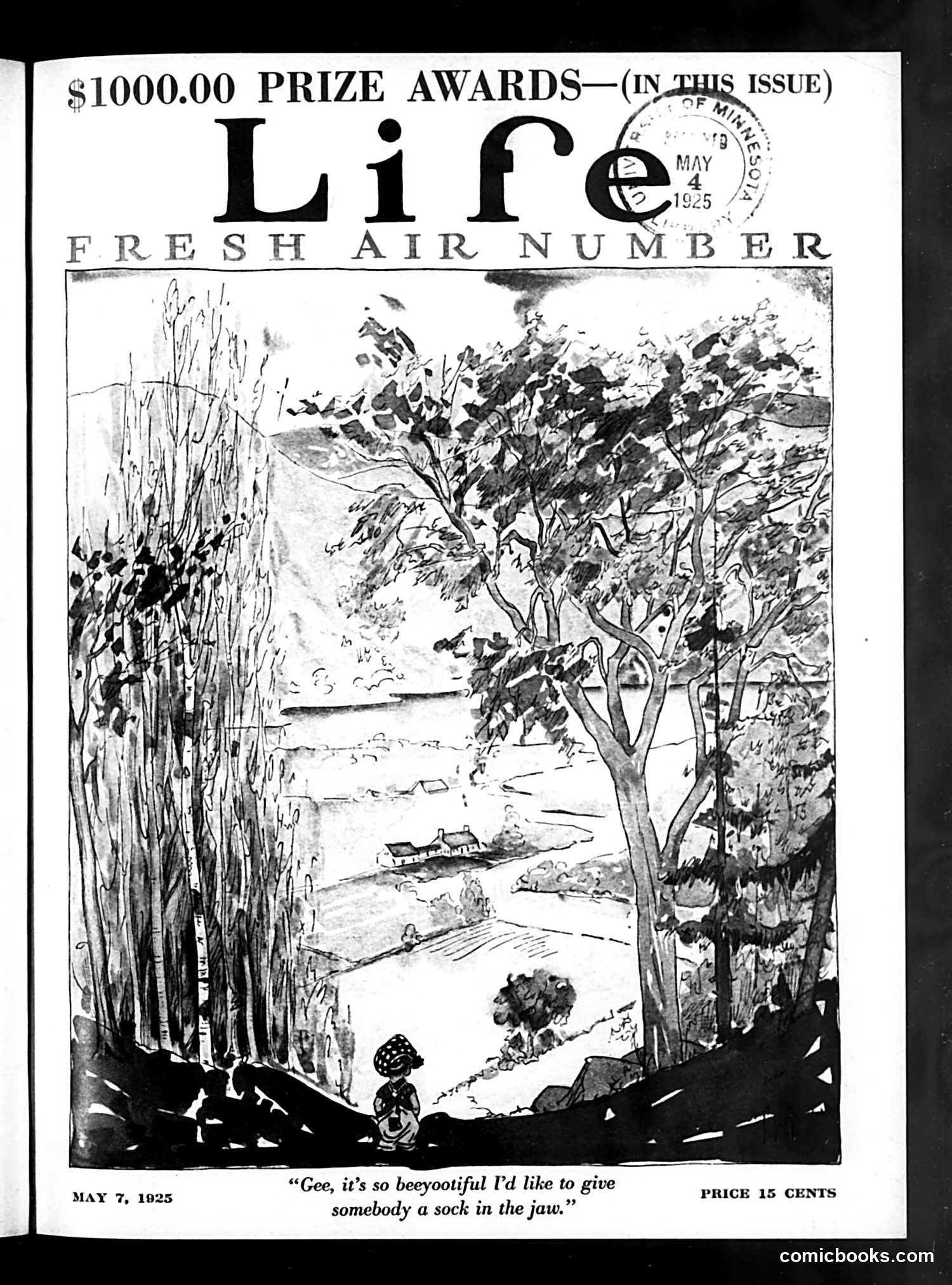
This is the cover of Life magazine's May 7, 1925 issue, featuring a landscape illustration framed by trees overlooking water with a distant boat. The caption reads: "Gee, it's so beeyootiful I'd like to give somebody a sock in the jaw." The satire appears to target the contradiction between aesthetic appreciation and violent impulse — suggesting that even when confronted with natural beauty, the speaker's instinct remains aggressive. This reflects 1920s satirical humor about American manners and social behavior. The page advertises a $1,000 prize award contest ("in this issue"), suggesting readers could submit entries. The 15-cent price point and "Fresh Air Number" subtitle indicate this was a special themed edition of the magazine.
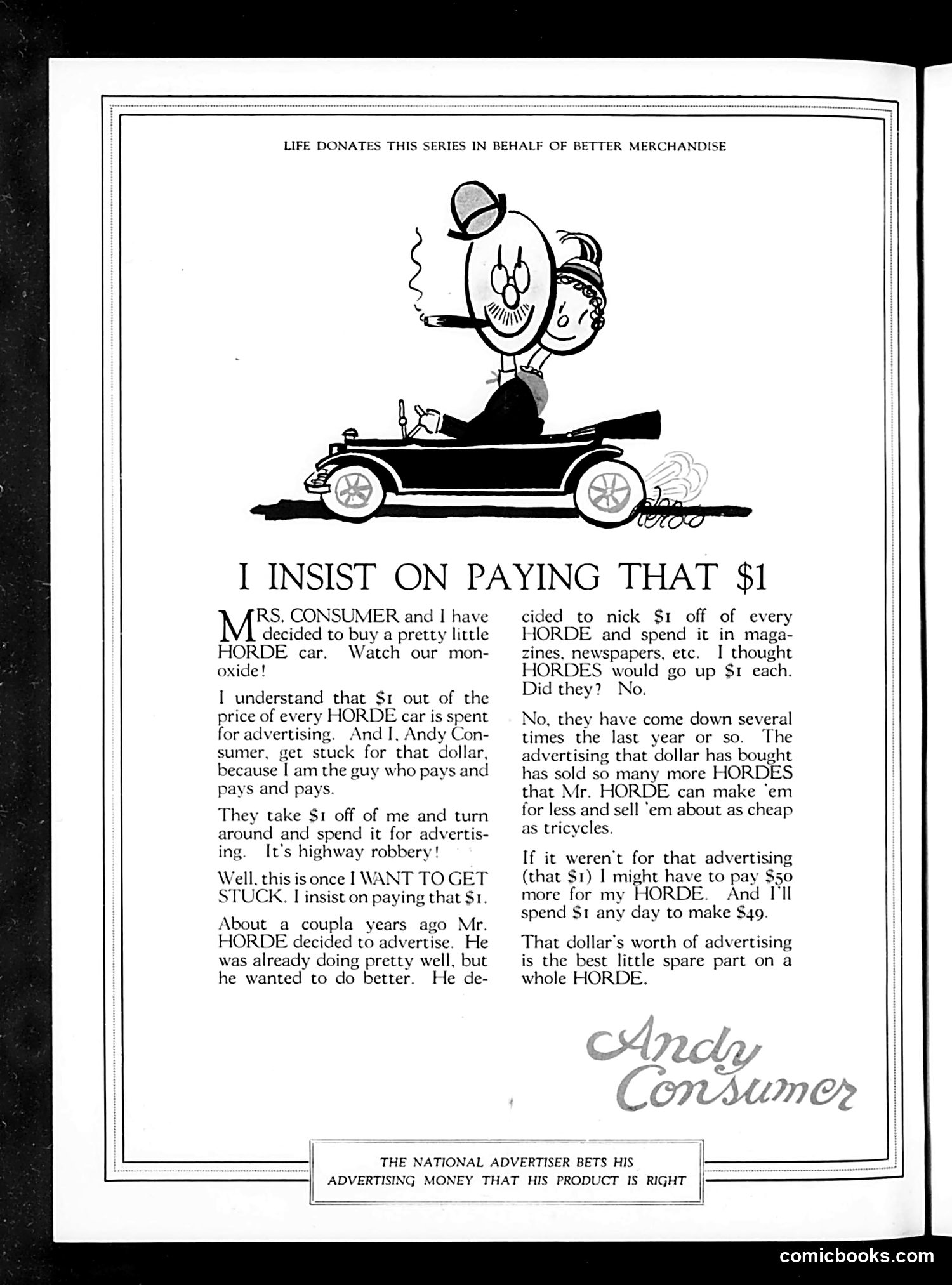
This is a Life magazine advertisement for Horde automobiles, featuring "Andy Consumer" as the narrator. The satire targets consumer complaints about advertising costs. Andy Consumer argues that he *insists* on paying the $1 advertising surcharge built into every Horde car's price. His counterintuitive position is that this advertising dollar is actually beneficial: it allows Horde to reduce manufacturing costs through economies of scale, ultimately making cars cheaper than they'd otherwise be. The cartoon shows a wealthy couple in a convertible car, illustrated in period style (early 20th century). The ad's message reflects Depression-era or post-war arguments about advertising's role in mass production and consumer benefit—the notion that advertising spending justifies itself by enabling lower consumer prices through increased sales volume.
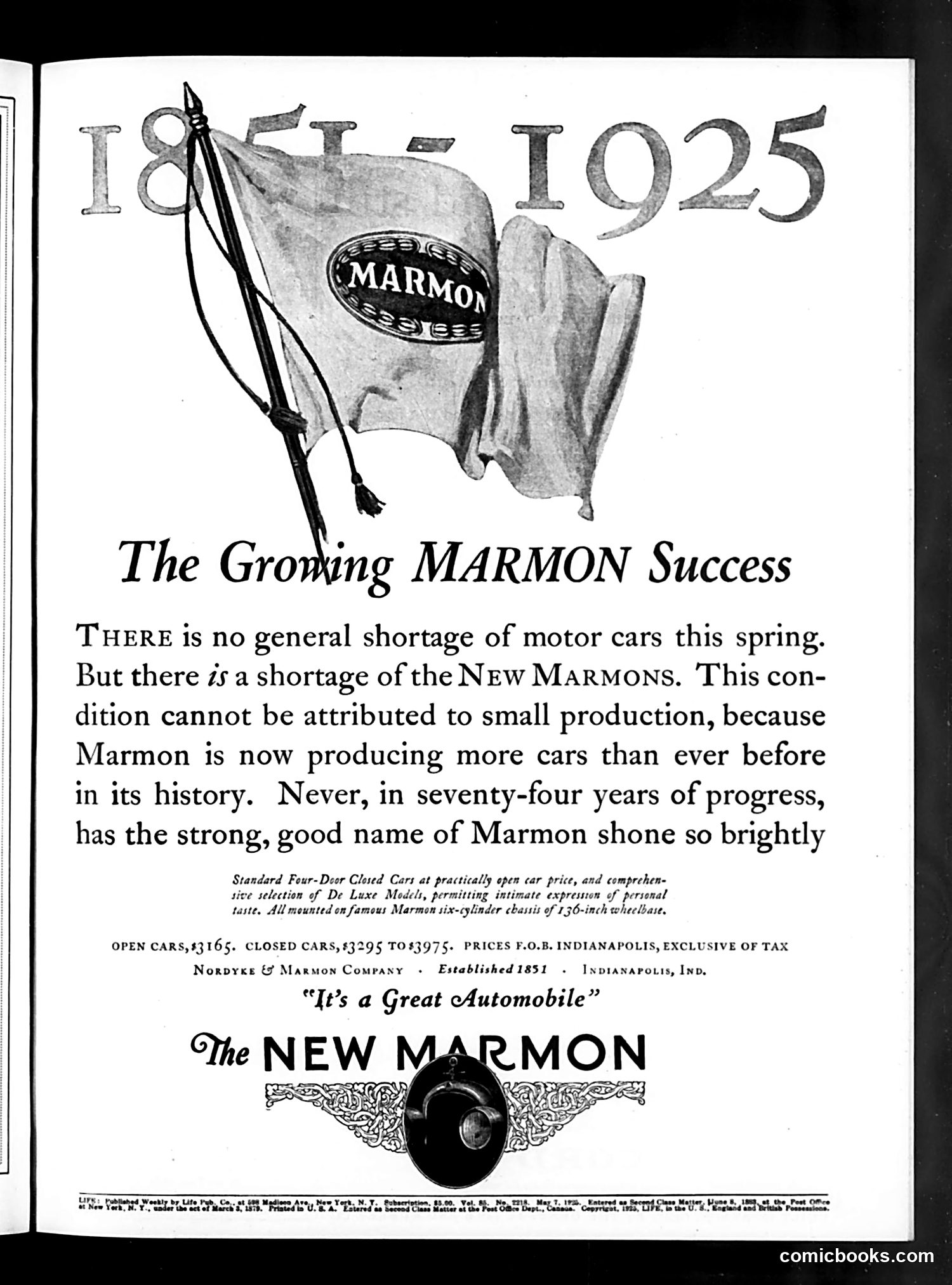
This is primarily a **Marmon automobile advertisement**, not political satire. The page announces "The Growing Marmon Success" from 1925. The visual shows a flag bearing the Marmon logo, appearing to celebrate the company's achievements. The text claims Marmon is producing record numbers of cars despite a shortage of "New Marmons" in the market—a supply-demand success story. The advertisement emphasizes Marmon's 74-year history and quality, positioning the brand as prestigious. Pricing information and specs are provided for potential buyers. There is **no political cartoon or satire here**—this represents straightforward 1920s automotive marketing designed to highlight brand prestige during a competitive manufacturing era.
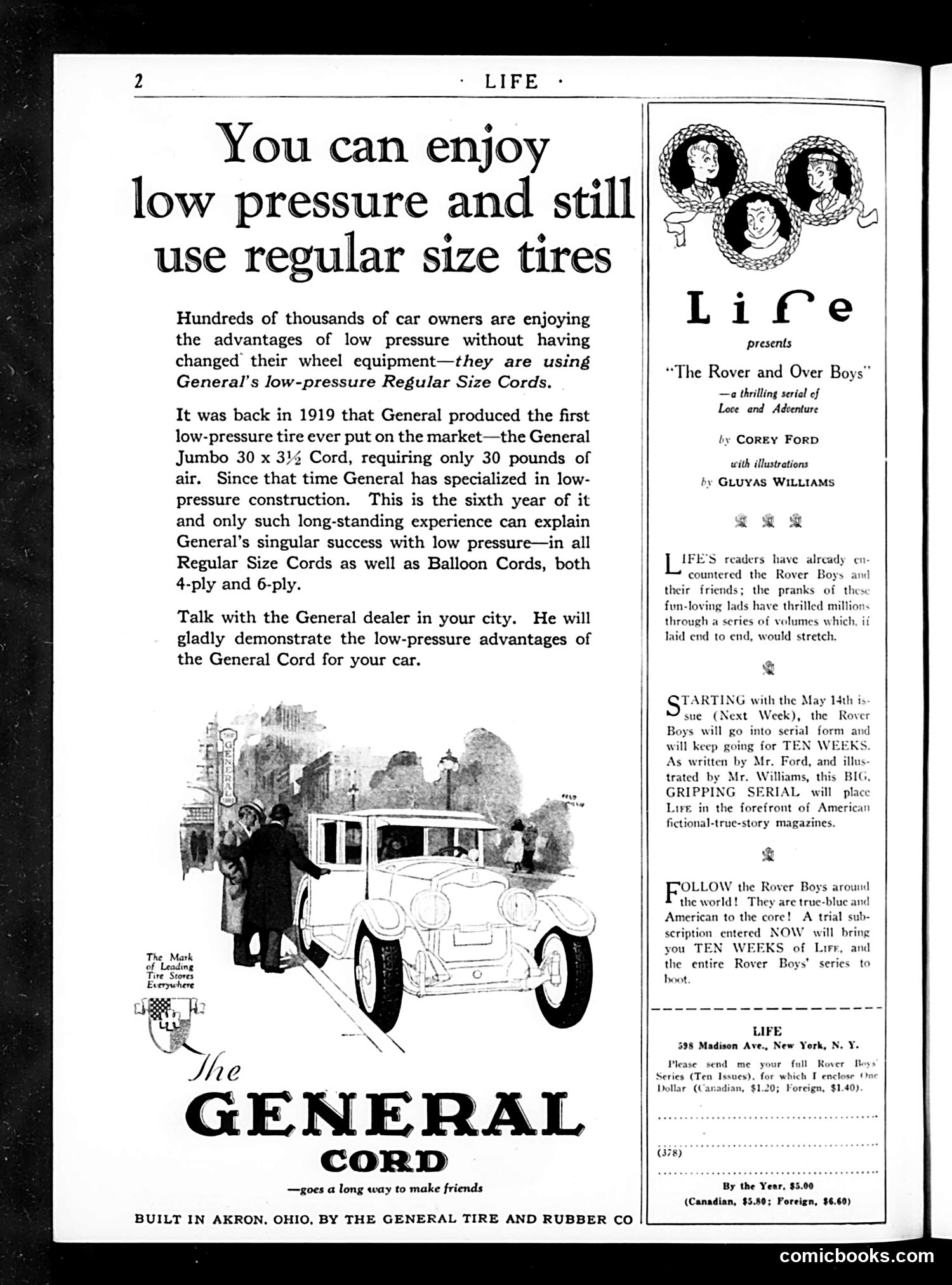
This page contains **no political cartoon or satire**. Instead, it features two advertisements: **Left side:** A General Cord tire advertisement emphasizing that drivers can use low-pressure tires in standard-size wheels without equipment changes. The ad references General's 1919 innovation of low-pressure tires and shows a vintage automobile with well-dressed figures, appealing to practical car owners. **Right side:** A promotion for "The Rover and Over Boys," a serialized adventure story by Corey Ford with illustrations by Gluvas Williams, running ten weeks in Life magazine. It's positioned as entertainment for readers already familiar with the Rover Boys series. The page is primarily **commercial content**—product advertising and magazine promotion—typical of Life's business model in this era, rather than satirical commentary.
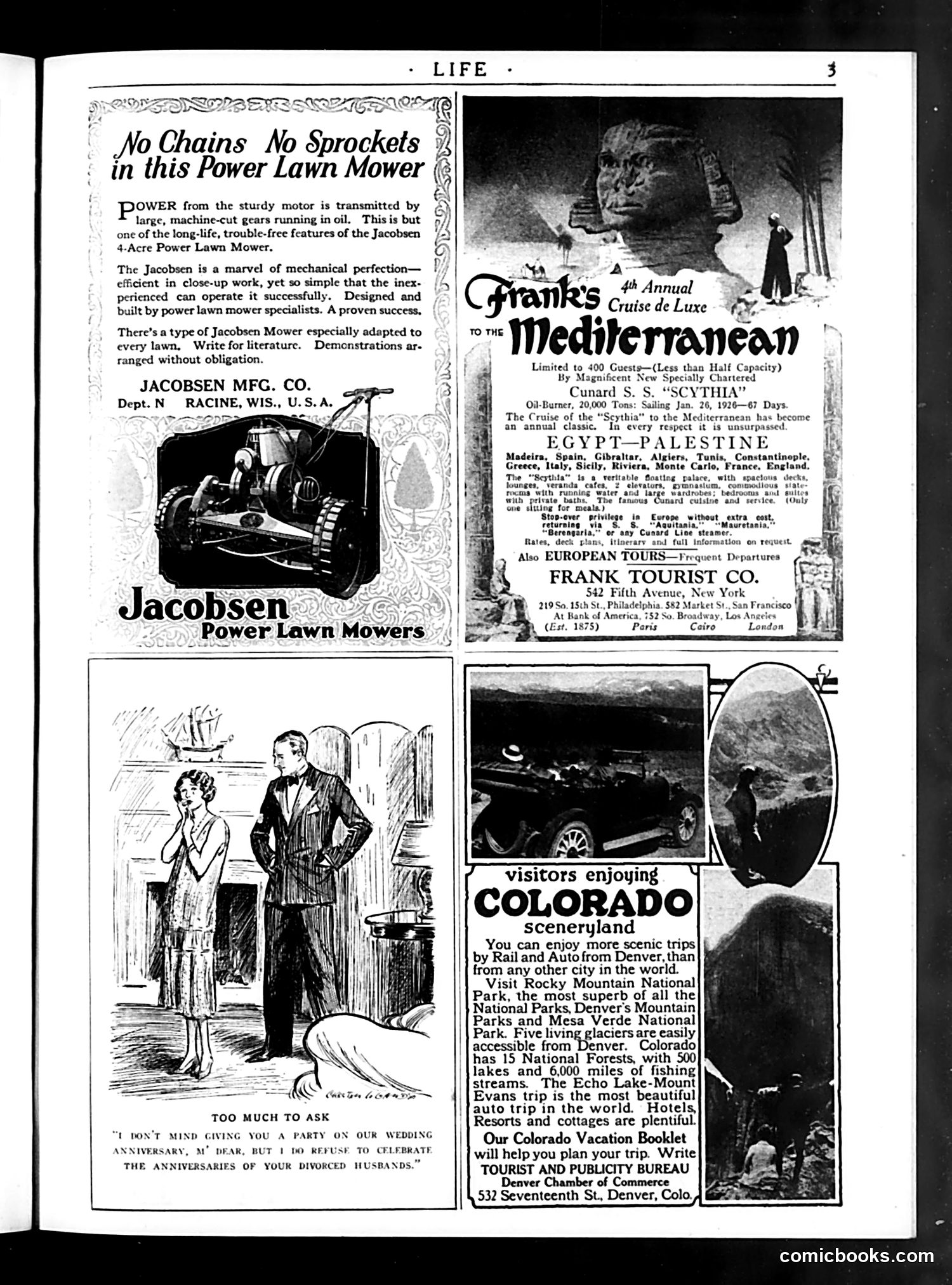
This page is primarily **advertising**, not satirical content. The ads include: 1. **Jacobsen Power Lawn Mowers** — highlighting mechanical innovation (chain-less, sprocket-less design) 2. **Frank's Cruise de Luxe to the Mediterranean** — a luxury cruise advertised with Egyptian imagery (sphinx, pharaoh) 3. **Colorado Scenery Tourism** — promoting Rocky Mountain National Park and outdoor attractions The only cartoon is a small sketch captioned "TOO MUCH TO ASK" depicting a couple discussing wedding anniversaries, with the man saying he won't give his wife a party to celebrate their divorced husbands' anniversaries—a mild joke about remarriage and modern social attitudes. The page reflects 1920s consumer culture and travel marketing more than political satire.
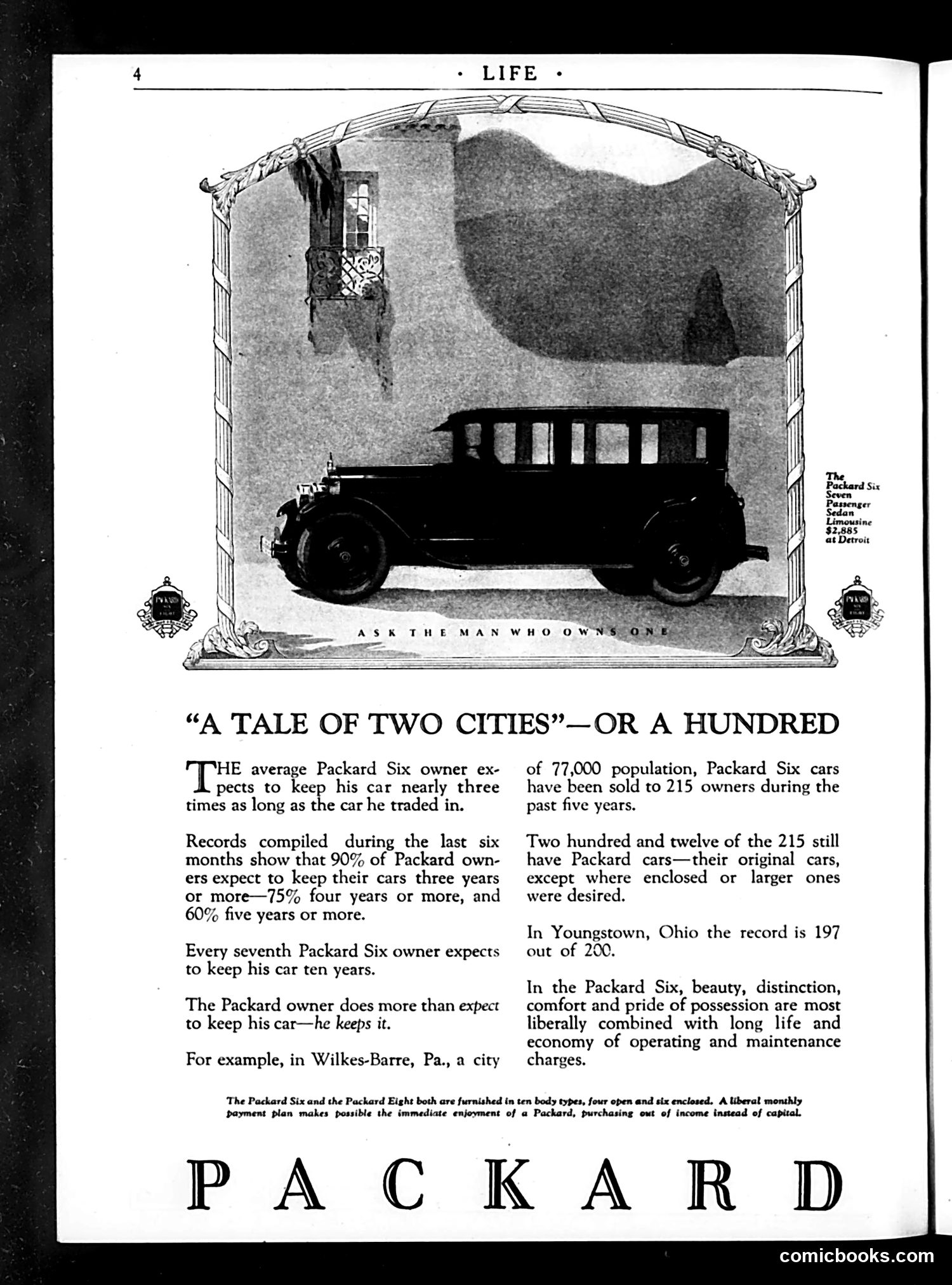
This is primarily a **Packard automobile advertisement**, not political satire. The page showcases the Packard Six sedan with marketing claims about owner loyalty and durability. The image depicts a luxury automobile silhouetted against a European landscape (suggested by the mountainous backdrop and balconied building), emphasizing the car's sophisticated appeal. The text's main argument: Packard owners keep their cars exceptionally long—90% retain theirs three+ years, 75% keep them four+ years, and 60% keep them five or more years. One in seven owners expects to keep theirs ten years. The advertisement cites Wilkes-Barre, PA and Youngstown, Ohio as examples where retention rates are particularly high (197 of 200 cars still owned). The tagline "Ask the man who owns one" was Packard's actual advertising slogan, emphasizing owner satisfaction as proof of quality.
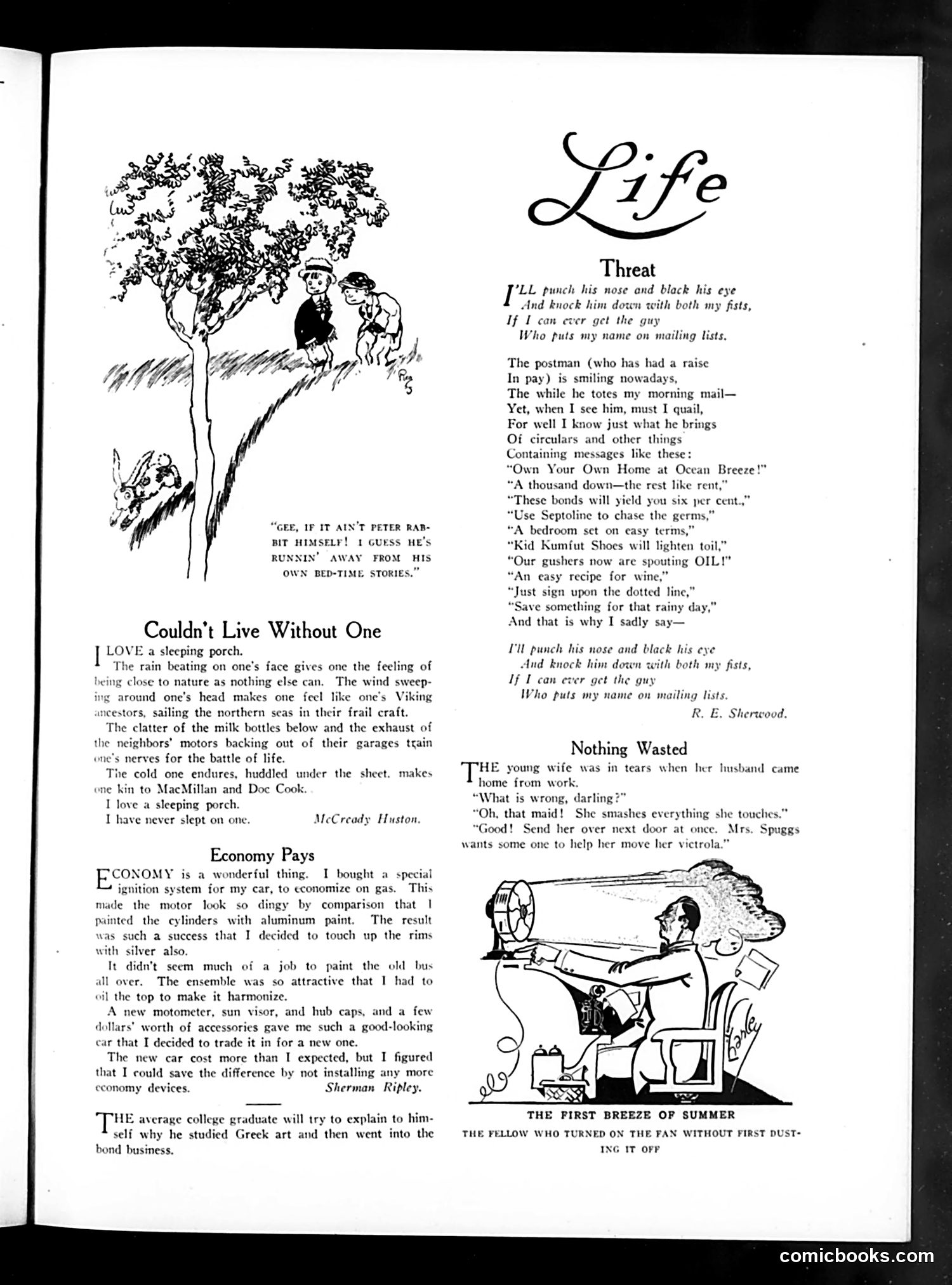
This page contains three humorous pieces satirizing everyday American life: **"Threat"** (top right) by R.E. Sherwood mocks annoying direct-mail advertising. The speaker threatens violence against a postman who delivers unwanted circulars advertising consumer goods ("Own Your Own Home at Ocean Breeze," easy payment schemes, etc.). The joke targets the proliferation of junk mail and aggressive marketing tactics of the era. **"Couldn't Live Without One"** praises sleeping porches—common features in early 20th-century homes providing fresh air and connection to nature. **"Nothing Wasted"** (bottom) depicts a husband helping his tearful wife move a victrola (record player), joking that she "smashes everything" except this prized possession. **"Economy Pays"** describes upgrading a car's appearance through inexpensive cosmetic modifications rather than buying new.
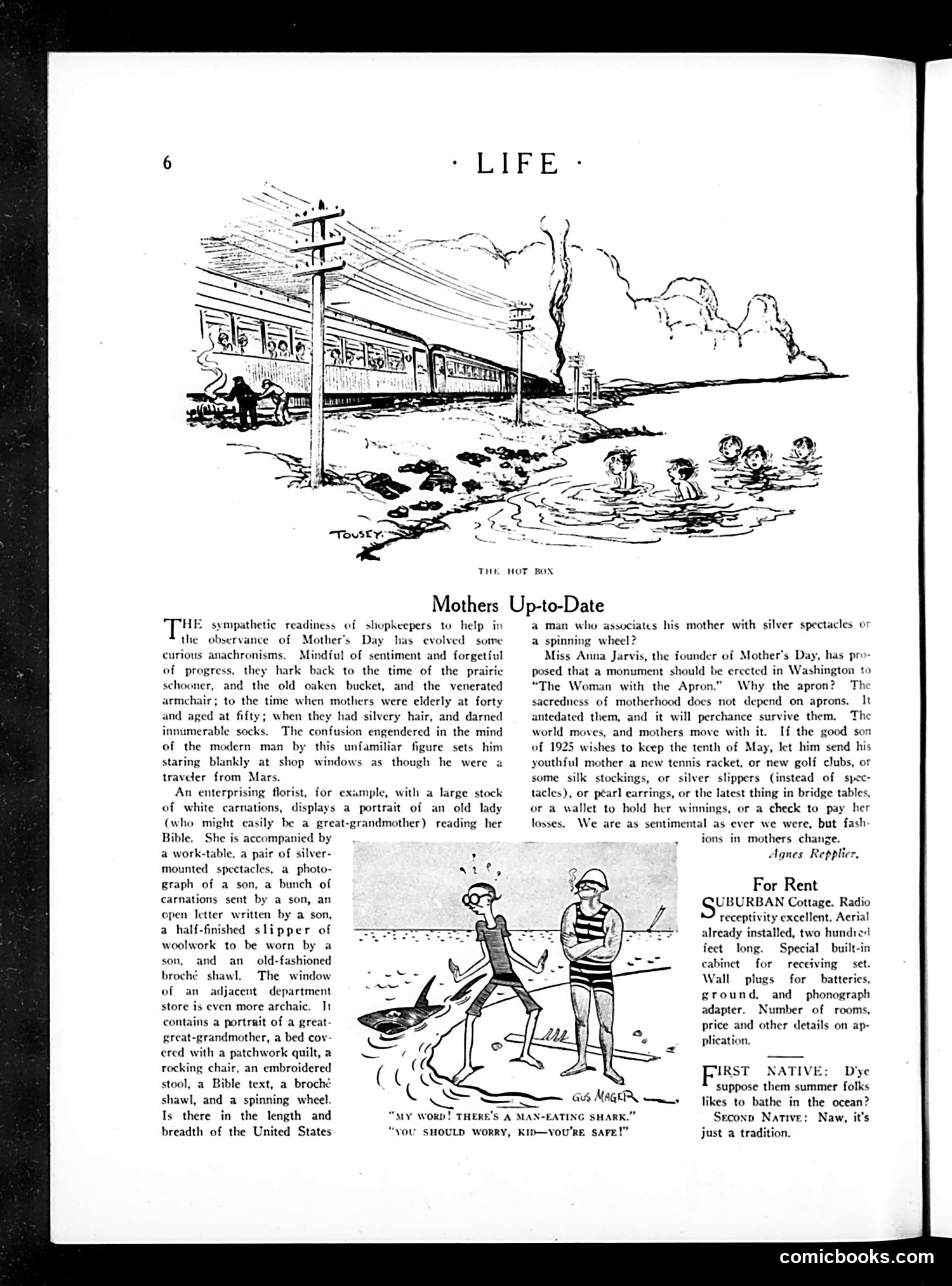
This page contains two distinct items: **"The Hot Box" (top illustration)**: A satirical cartoon showing a train passing children swimming in a nearby body of water. The caption reads "My word! There's a man-eating shark—you should worry, kid—you're safe!" The joke appears to mock parental reassurance during the early 20th century, suggesting that children swimming near railroad tracks faced worse dangers than sharks. **"Mothers Up-to-Date" (main article)**: Text discussing how modern mothers have evolved from their predecessors. It includes observations about florists, old-fashioned furnishings, and changing maternal values. A second cartoon shows two children at a beach; the joke contrasts "First Native" (wanting ocean bathing) with "Second Native" (accepting it as tradition). The page satirizes changing attitudes toward motherhood and childhood safety in contemporary society.
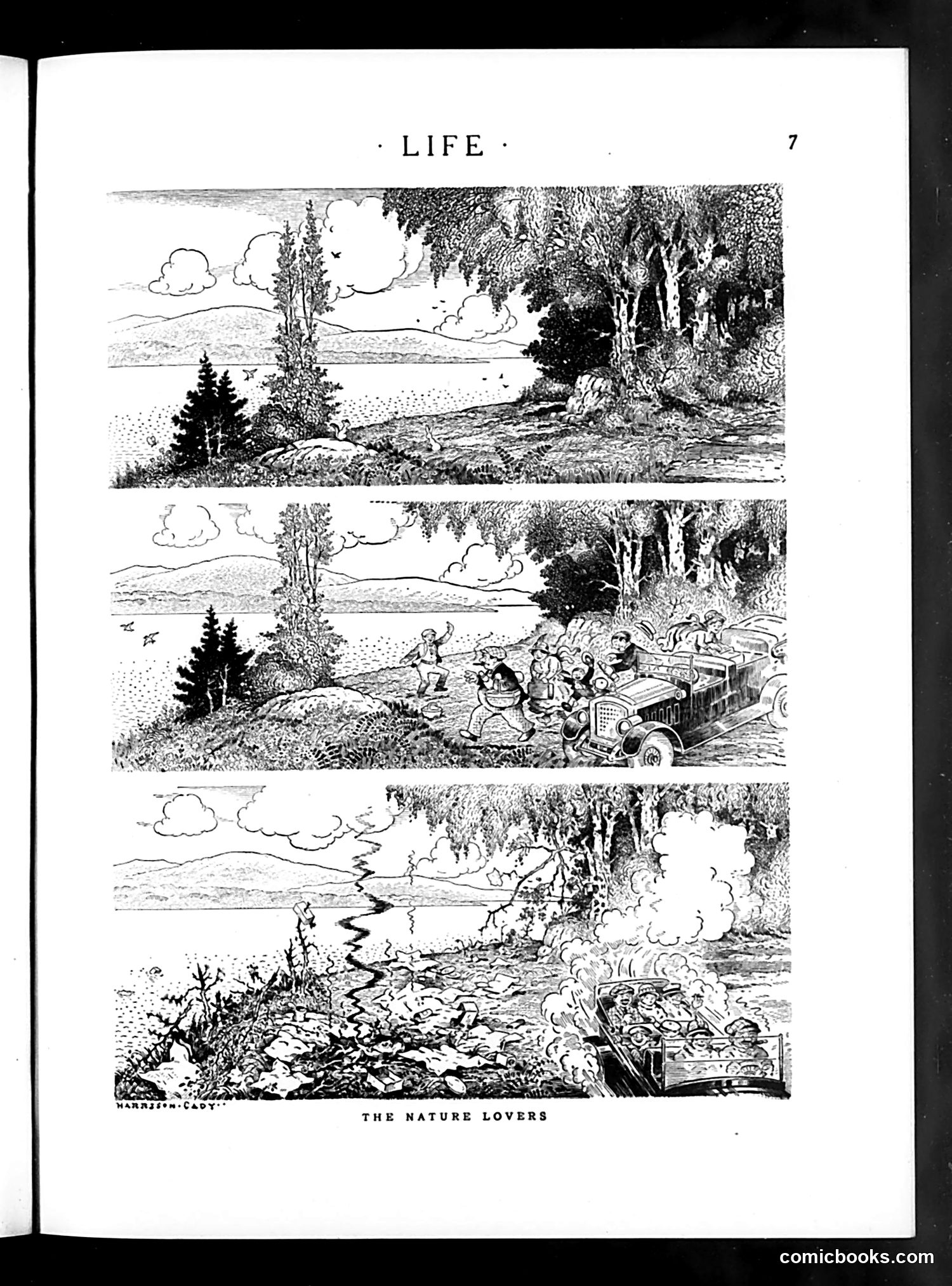
This three-panel comic satirizes the contrast between appreciating nature and modern intrusions. The top panel shows an idyllic natural landscape. The middle panel depicts the same scene invaded by automobiles and crowds of people on an outing, suggesting how recreational tourism disrupts wilderness. The bottom panel shows nature further degraded—the landscape now littered and damaged, with what appears to be people boating amid environmental destruction. The satire targets the irony of "nature lovers" who claim to appreciate the outdoors while their presence and vehicles damage it. This reflects early 20th-century anxieties about automobiles, mass recreation, and environmental degradation as leisure activities became increasingly popular and mechanized.
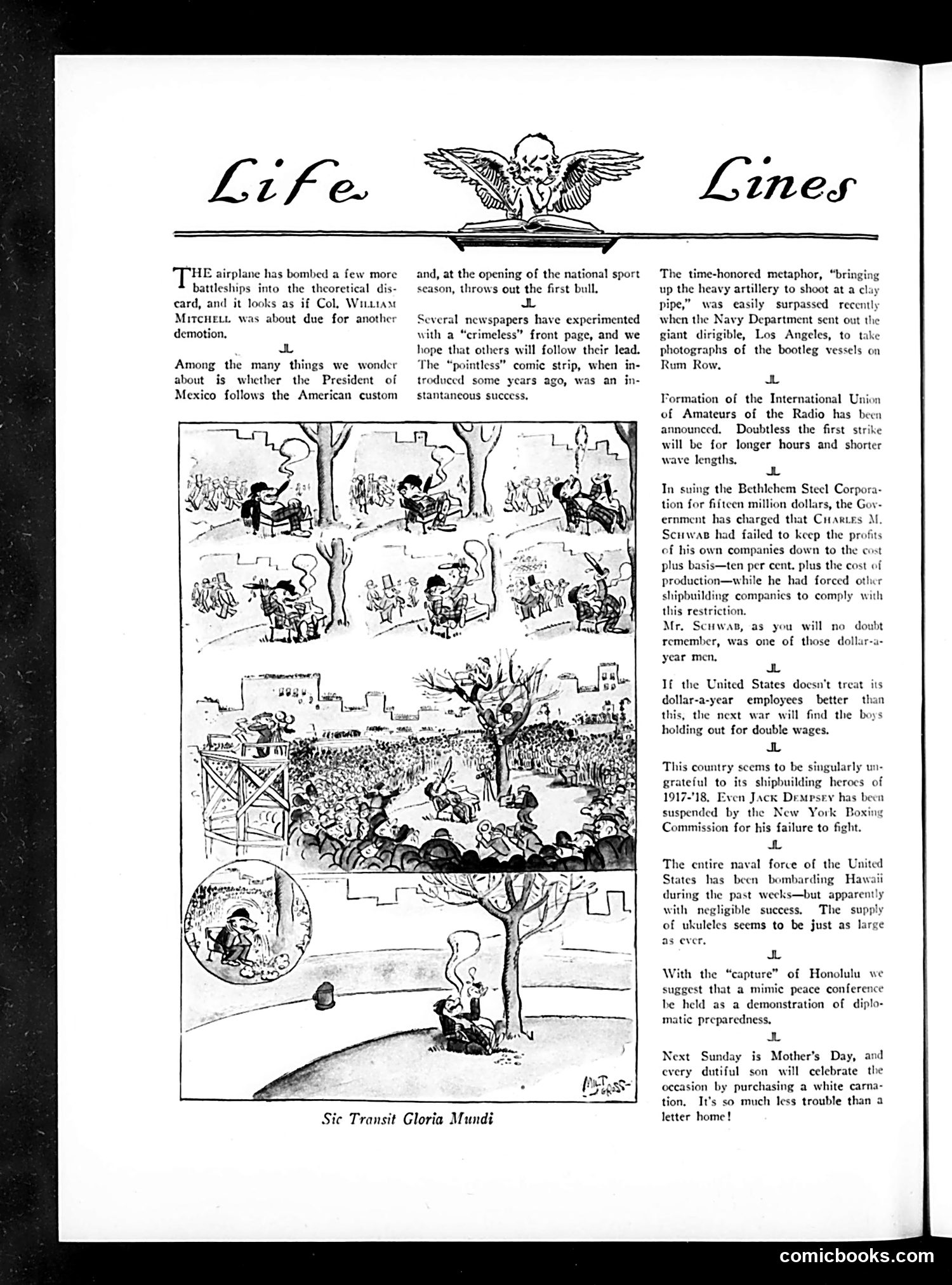
This is a satirical commentary page from *Life* magazine featuring a multi-panel cartoon titled "Sic Transit Gloria Mundi" (Thus passes the glory of the world). The cartoon appears to satirize **changing public attitudes and social dynamics**, showing various scenes of ordinary life across different settings—parks, crowds, domestic scenes. The progression suggests the ephemeral nature of popularity or public attention. The adjacent text discusses contemporary issues: **Col. William Mitchell's airplane bombing demonstrations**, "crimeless" newspaper front pages, the **International Union of Radio Amateurs**, **Charles Schwab and Bethlehem Steel labor disputes**, **Jack Dempsey's boxing suspension**, and **bombing campaigns in Hawaii**. The overall tone mocks American society's fickleness, labor disputes, and military activities, warning that public heroes and causes fade quickly—hence the Latin motto about transient glory.
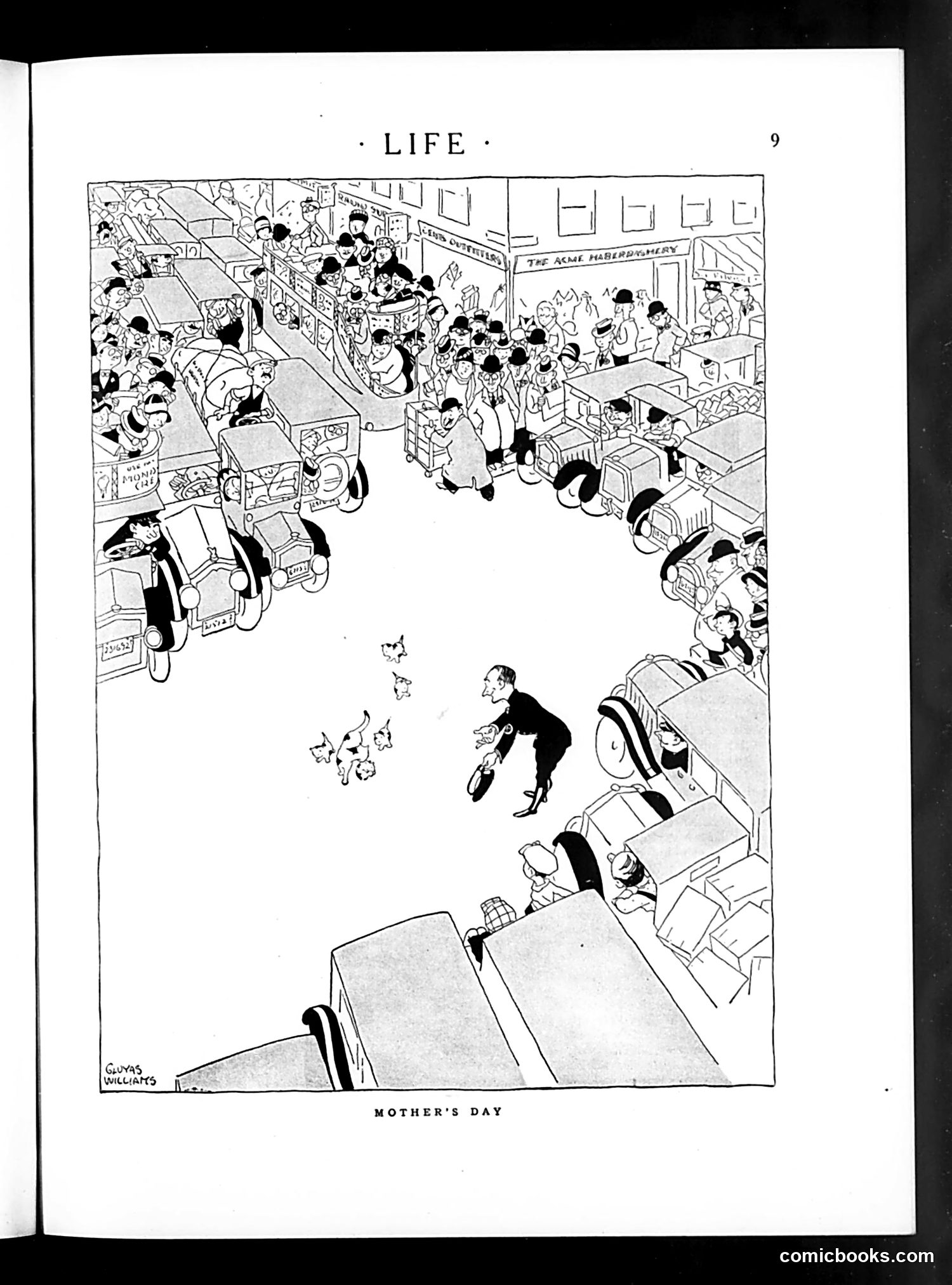
This cartoon by Gluyas Williams depicts a chaotic urban parking lot on Mother's Day. The humor satirizes the collision between two cultural forces: the sentimental commercialization of Mother's Day and the frantic realities of modern urban life. In the center, a man attempts to ride a bicycle while juggling multiple cats—likely representing his desperate attempt to manage the holiday's expectations while navigating a crowded, car-filled lot. The surrounding crowds and parked vehicles emphasize urban congestion and commercial excess. The joke appears to be that Mother's Day, marketed as a day of rest and appreciation, instead places men in ridiculous, stressful situations trying to coordinate crowded shopping venues and transportation amid chaos. The cats suggest domestic complications adding to his burden.
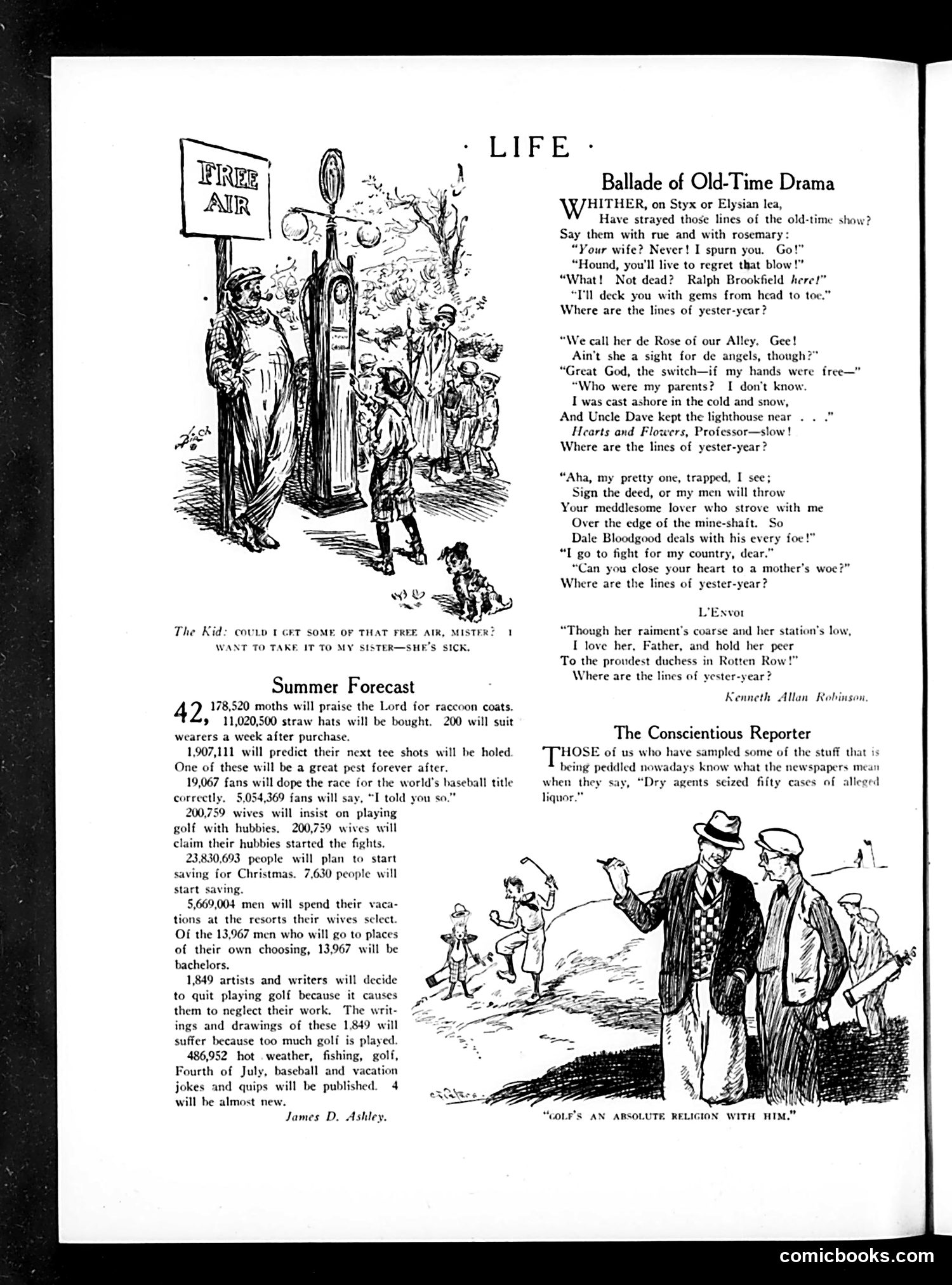
This page contains three distinct pieces: **"Free Air" Cartoon**: Depicts a child at a gas pump labeled "FREE AIR," wanting to take some to a sick sister. The joke satirizes how gas stations advertise "free air" as a service perk while profiting from fuel sales—the only thing genuinely free is worthless to the customer. **"Ballad of Old-Time Drama"**: A poem by Kenneth Allan Robinson lamenting melodramatic theater conventions (lost love, separation, moral absolutes) by repeatedly asking "Where are the lines of yester-year?"—reflecting early 20th-century shift away from Victorian theatrical styles. **"Summer Forecast"**: Humorous predictions about American leisure and consumption habits, written by James D. Ashley. Appears to mock mass-market behaviors and statistics. **"The Conscientious Reporter"**: A cartoon about newspaper reporters and liquor seizures during Prohibition.
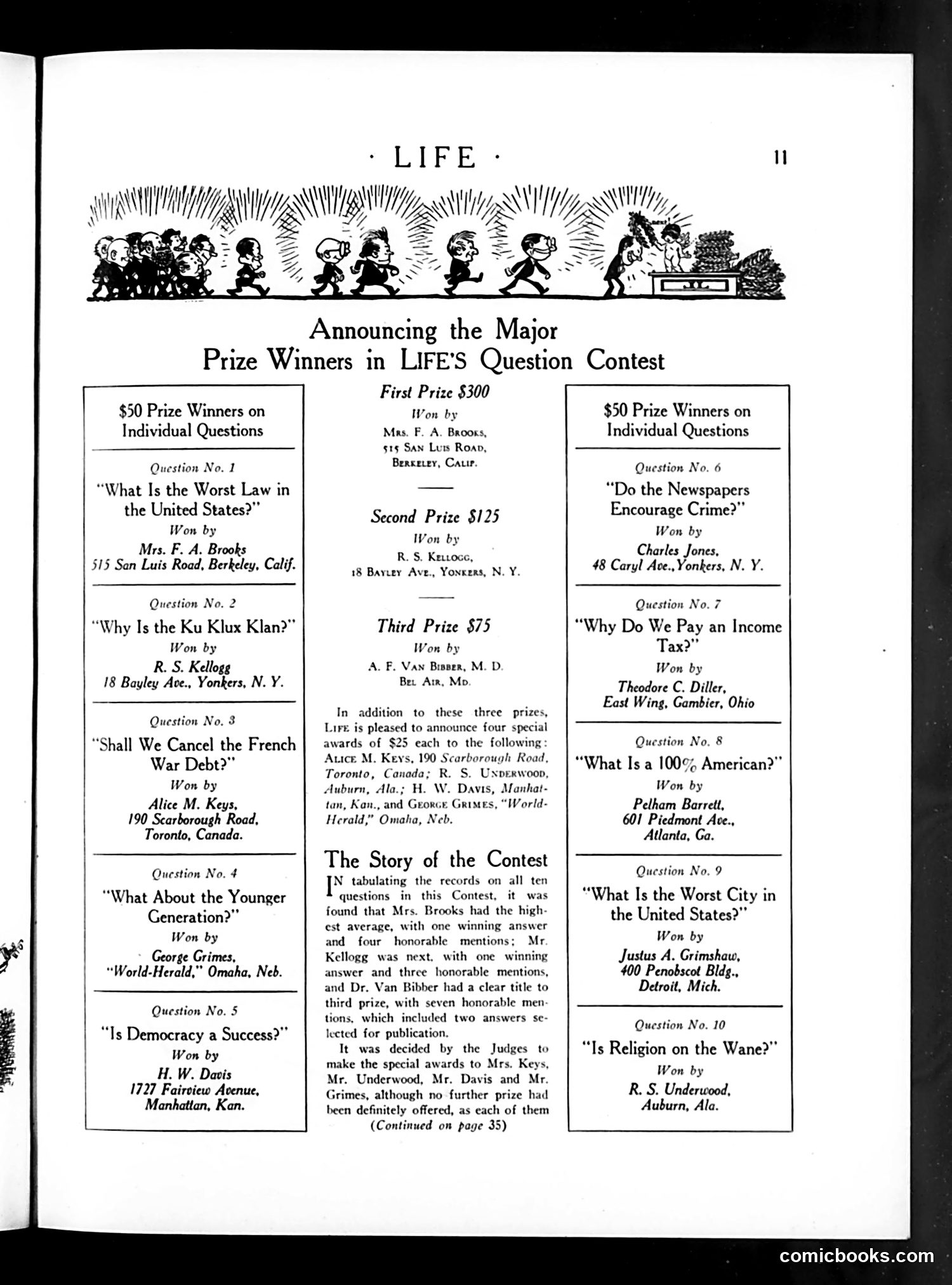
This page announces winners of LIFE magazine's "Question Contest"—a reader participation contest posing ten contentious social and political questions. The cartoon header shows silhouetted figures progressing left-to-right, culminating in what appears to be a scene of leisure or victory, symbolizing the contest's journey. The ten questions reflect 1920s American anxieties: the Ku Klux Klan's resurgence, the French War debt, income taxation, immigration policy ("What Is a 100% American?"), crime, municipal governance, and religion's role in society. Winners received prizes ranging from $50 to $300. The contest format invited ordinary readers to tackle major political controversies of the era, suggesting both LIFE's satirical engagement with public debate and broader public anxiety about these unresolved national issues.
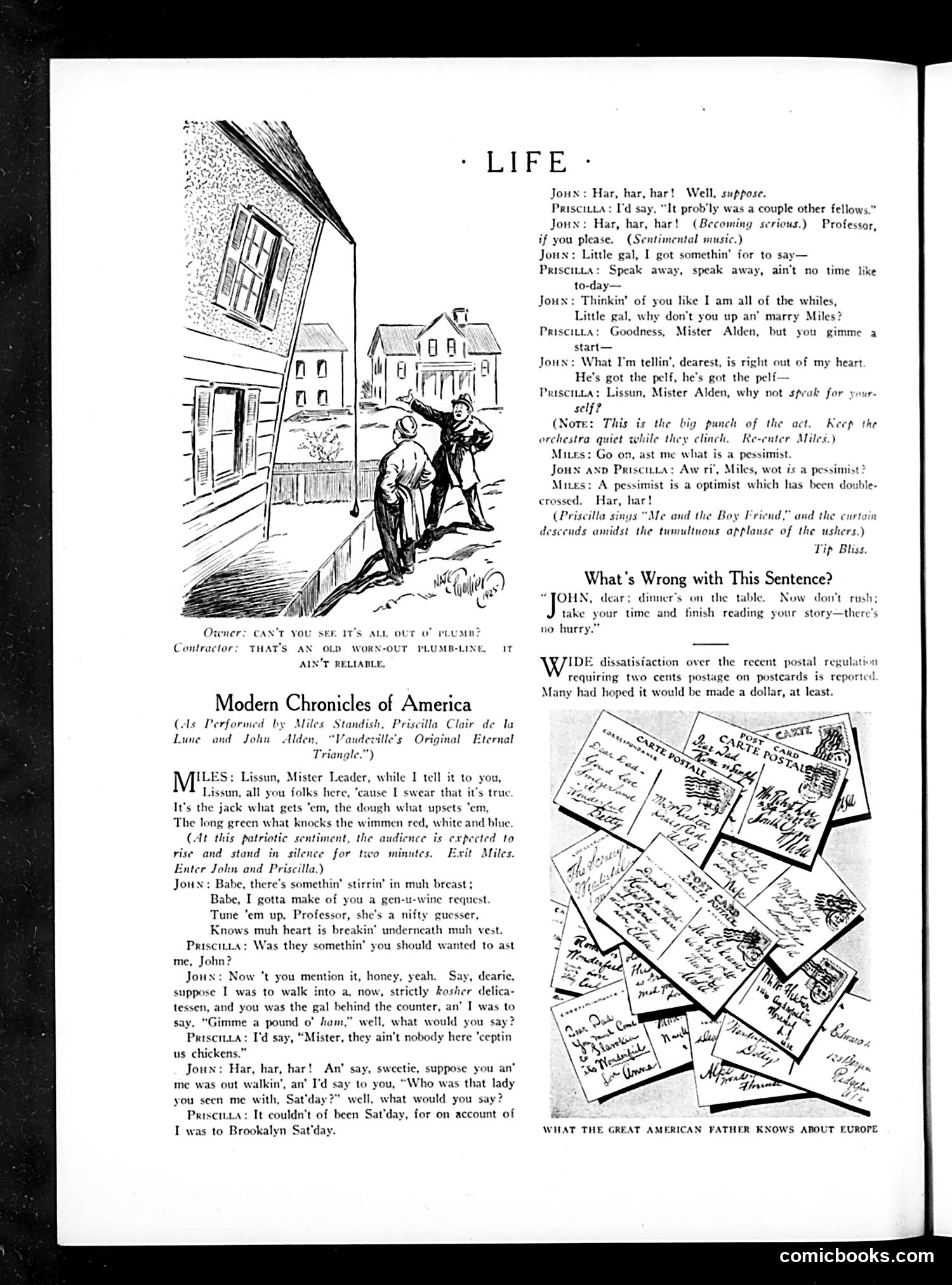
This page contains theatrical content rather than political commentary. The main feature is "Modern Chronicles of America," a comedic sketch featuring characters named Miles, John, and Priscilla discussing romantic matters in vernacular dialogue. The sketch satirizes everyday American social dynamics—particularly courtship customs and male-female interactions—through witty banter. The illustration shows figures in period dress on a street, and there's a separate instructional feature titled "What's Wrong with This Sentence?" addressing postal regulations. The bottom illustration depicts postcards with handwriting, captioned "What the Great American Father Knows About Europe"—likely mocking American tourists' limited European knowledge or travel experiences. This appears to be entertainment and humor content rather than political satire.
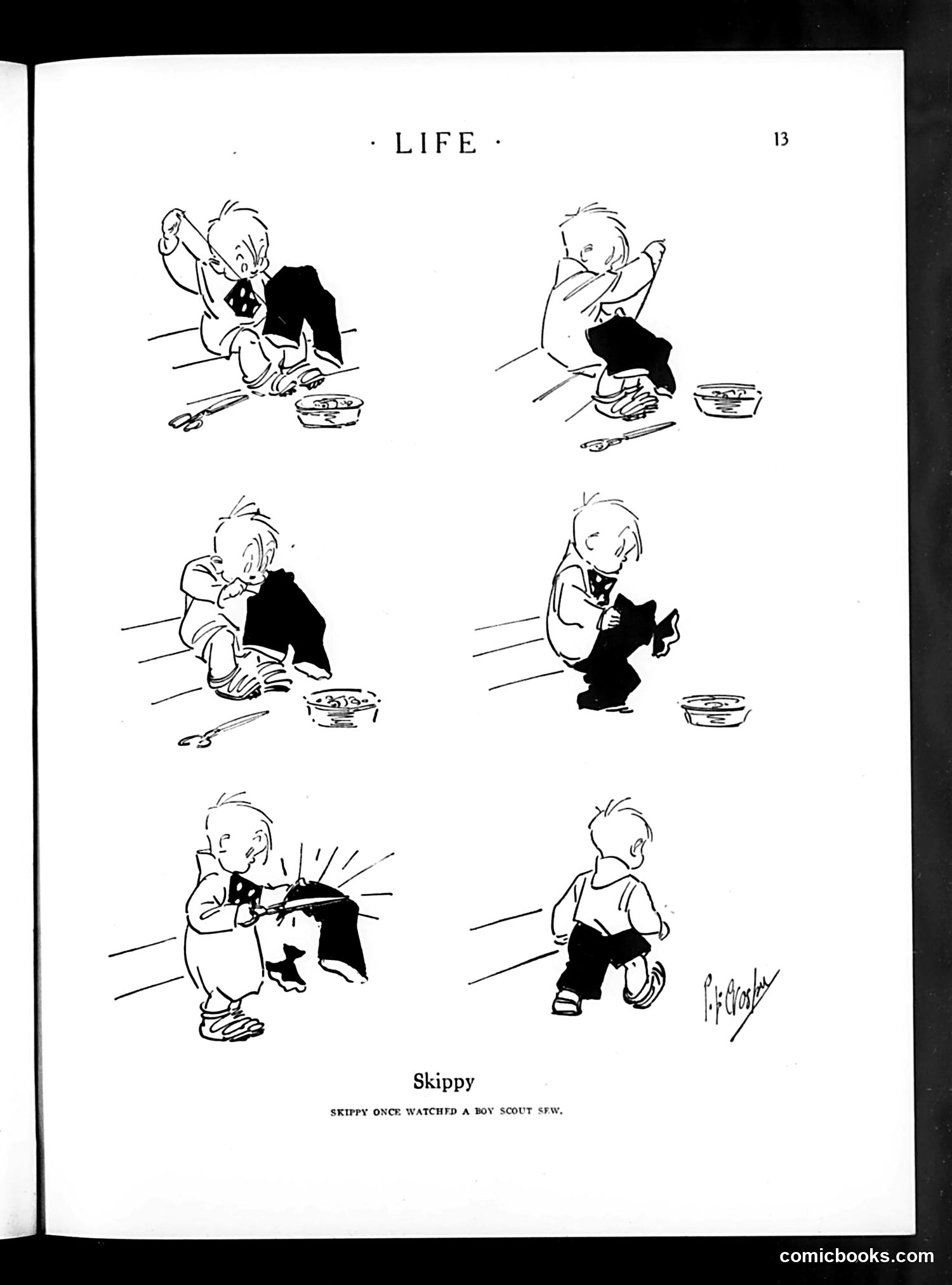
This is a six-panel comic strip titled "Skippy" with the caption "Skippy once watched a boy scout sew." The strip shows a young child named Skippy imitating what he observed: eating messily, sitting cross-legged, attempting to sew (with visible struggle and frustration in the fifth panel where he's tangled in fabric), and finally walking away from the activity. The humor derives from the contrast between the orderly, disciplined Boy Scout and Skippy's chaotic, clumsy imitation. The joke satirizes how children imperfectly mimic adult activities they observe, particularly the comic incongruity of a small child attempting the fine motor skill of sewing while struggling comically with the material. It's gentle humor about childhood mimicry and incompetence.
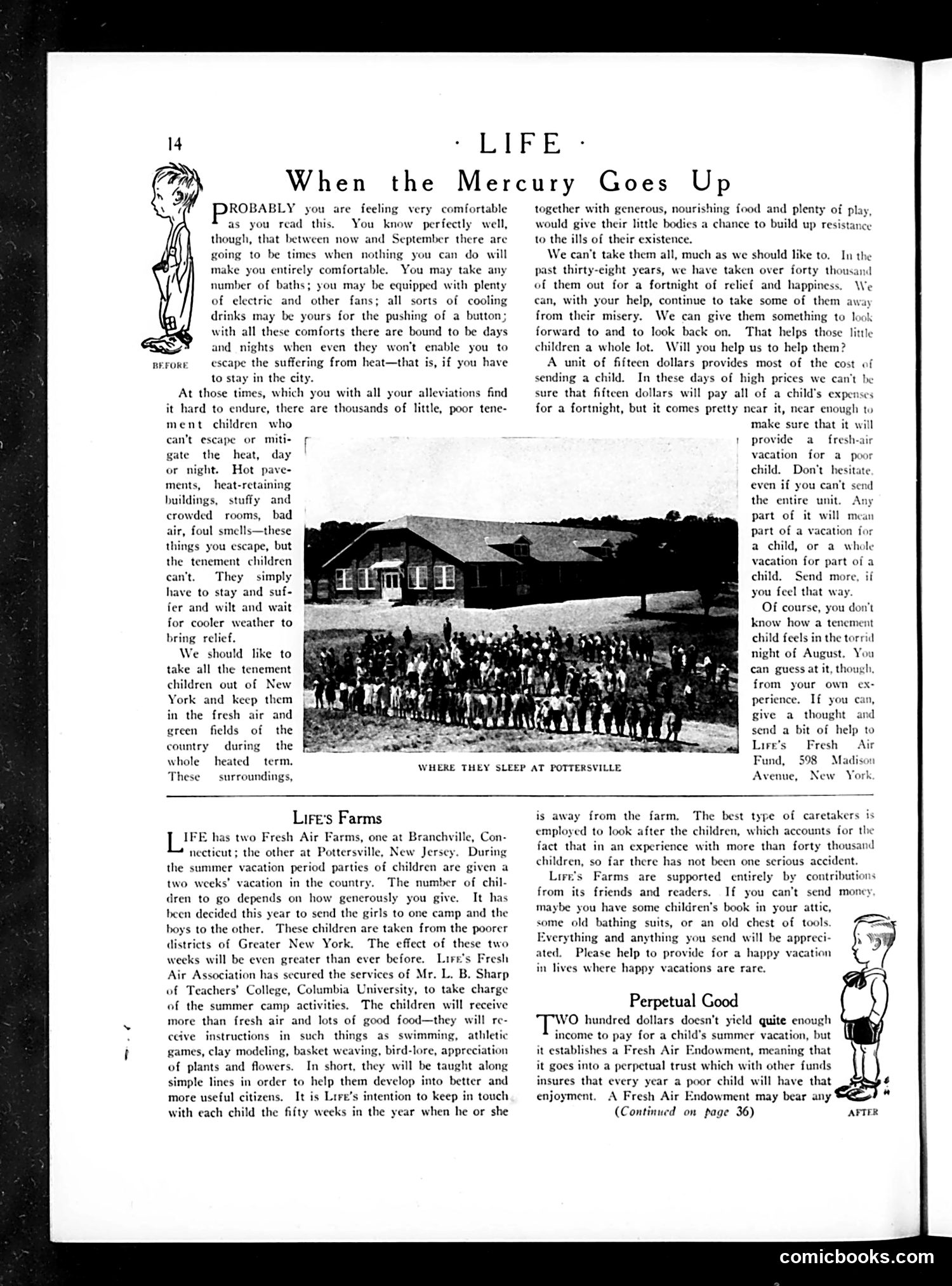
This is **not satirical content** but rather a **charitable appeal** from Life magazine's editorial pages. The piece advocates for sending poor tenement children from New York City to fresh-air camps during summer heat waves. The illustration shows a large group of children gathered outside a rural building at "Potterysville." The argument is humanitarian: tenement housing lacks ventilation and cooling during hot months, causing child suffering. The author proposes that even partial funding ($15 for a fortnight) helps. Life endorses two specific "Fresh Air Farms" in Connecticut and New Jersey that provide supervised summer vacations for underprivileged urban children. The small cartoon figure (top left) simply illustrates an overheated, uncomfortable child—a visual aid to the fundraising message rather than satire.
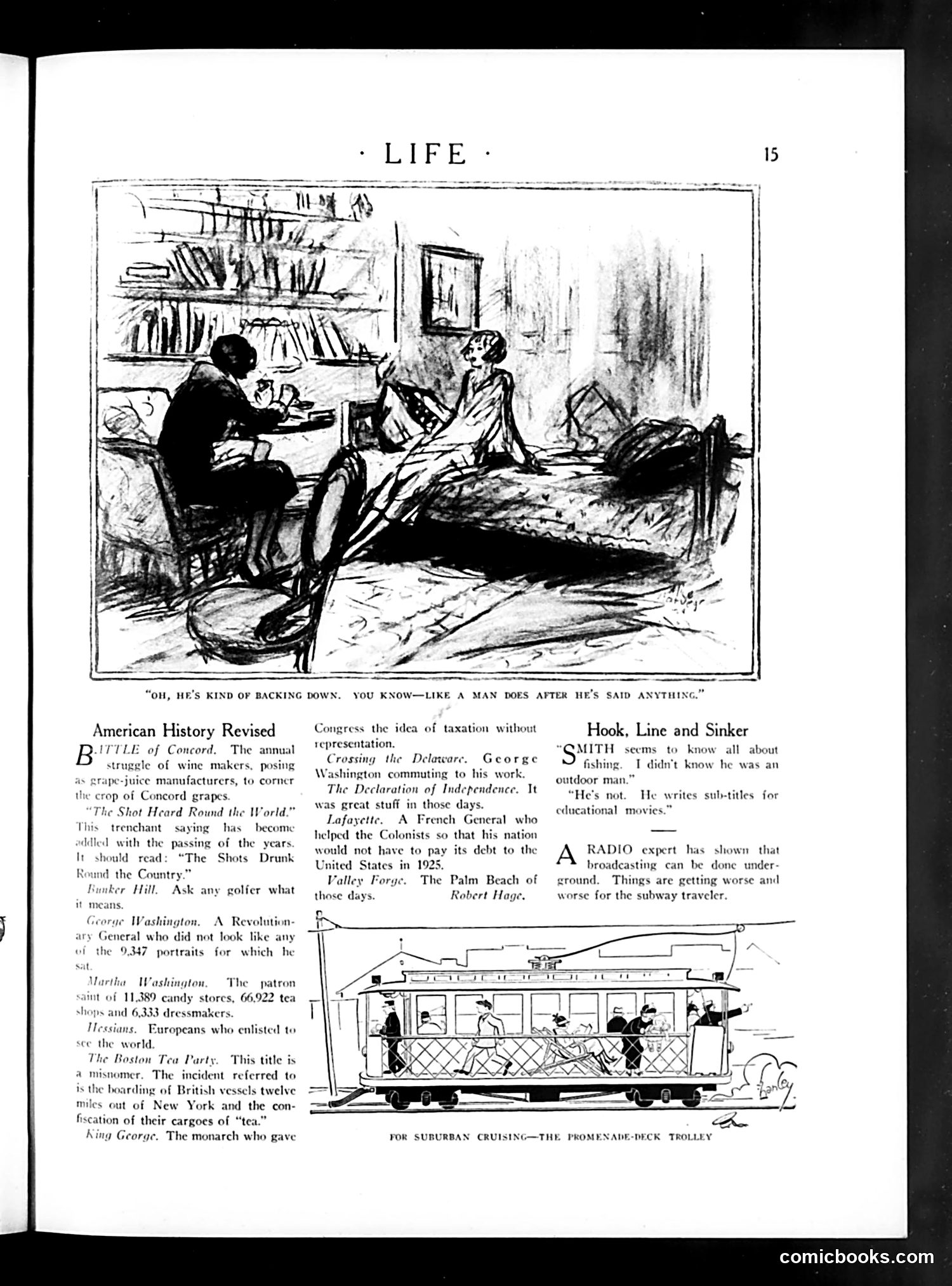
The top cartoon depicts a man at a desk speaking to a woman seated on a bed, with the caption: "Oh, he's kind of backing down. You know—like a man does after he's said anything." This is domestic satire about marital dynamics—specifically, how men retreat from statements they've made, presumably when confronted by their wives. The humor relies on the then-common stereotype of wives as domineering forces that made men recant their positions. Below are brief historical anecdotes about American history (Martha Washington, taxation debates) and two advertisements: one for "Hook, Line and Sinker" (about fishing/movies), and another for a "Promenade-Deck Trolley" (suburban transportation). The page demonstrates Life's mix of domestic humor and consumer advertising typical of the era.
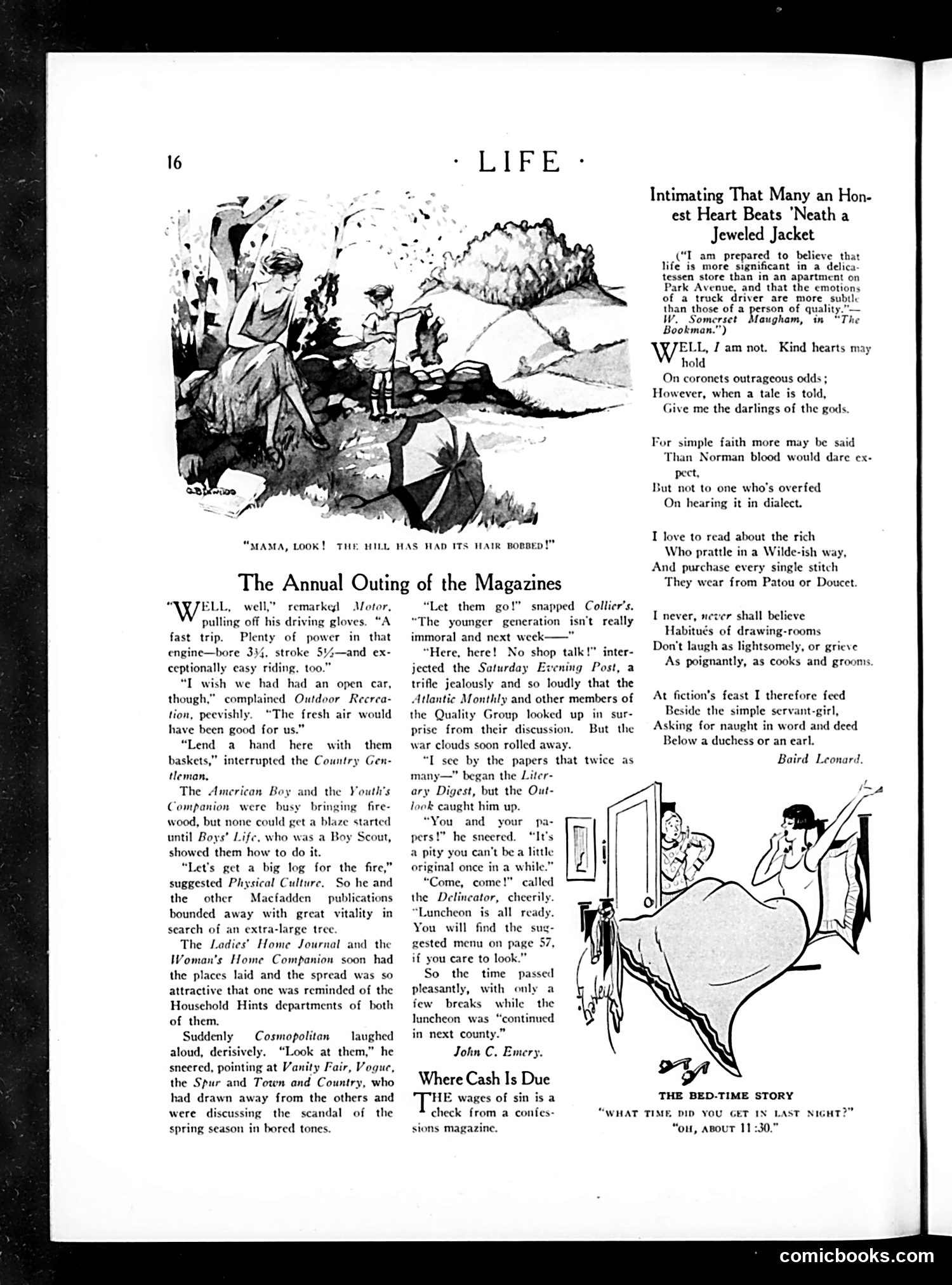
This satirical story personifies major American magazines of the era as characters on a picnic outing. Each publication is characterized by its editorial identity: *Motor* boasts about engines; *Outdoor Recreation* seeks fresh air; *Physical Culture* (a Macfadden publication) displays athletic vigor; *Ladies' Home Journal* and *Woman's Home Companion* excel at domestic arrangements. The satire targets class divisions in publishing. Fashion magazines (*Vogue*, *Vanity Fair*, *Town and Country*) snobbishly distance themselves, discussing "scandal" in "bored tones." Quality publications (*Atlantic Monthly*, *Saturday Evening Post*) jealously guard their prestige. Trade publications like *Literary Digest* and *Outlook* squabble over circulation claims. The humor lies in personifying these magazines' predictable editorial voices and competitive hierarchies—showing how different publications served distinct social classes and reader demographics, each maintaining its carefully cultivated identity even in leisure.
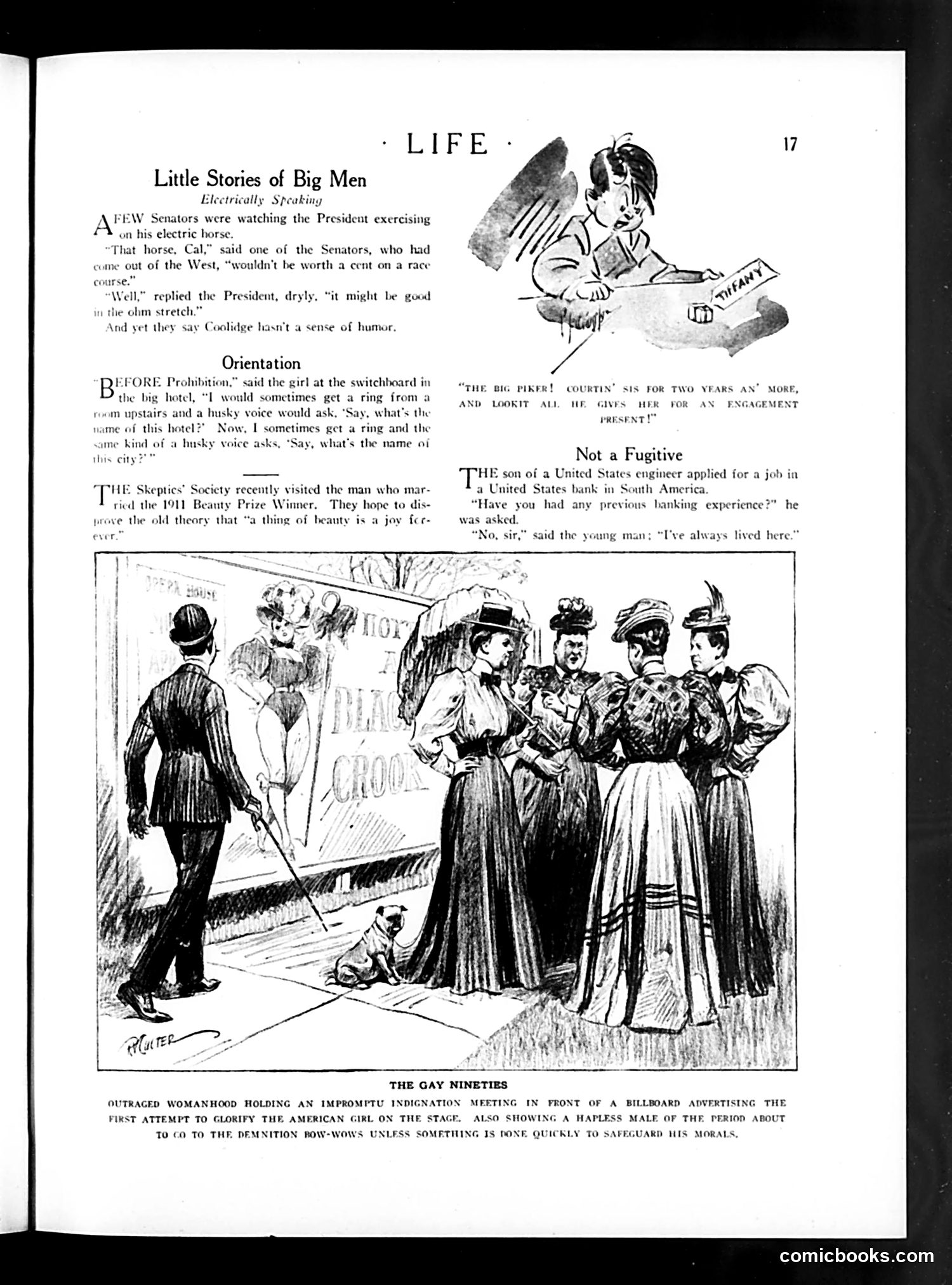
This page contains several brief satirical pieces typical of Life's humor: **"Electrically Speaking"** jokes about President Coolidge's electric exercise horse, with a Senator making an "ohm stretch" pun—wordplay on electrical resistance units. The joke implies Coolidge was known as humorless, so the pun itself becomes the satire. **"Orientation"** satirizes Prohibition's disorienting effects: hotel guests formerly asked the hotel's name while drunk; now they don't even know what city they're in—suggesting Prohibition-era visitors are equally intoxicated despite the ban. **The main cartoon, "The Gay Nineties,"** shows women protesting a billboard advertising American girls on stage. The caption explains they're "outraged" by this theatrical promotion and worried about a nearby man's moral corruption. It's satirizing 1890s prudishness about female performers and public morality—presented as quaintly overwrought to Life's 1920s readers. Each piece mocks specific social attitudes: Coolidge's reputation, Prohibition's failure, and Victorian-era moral panic.
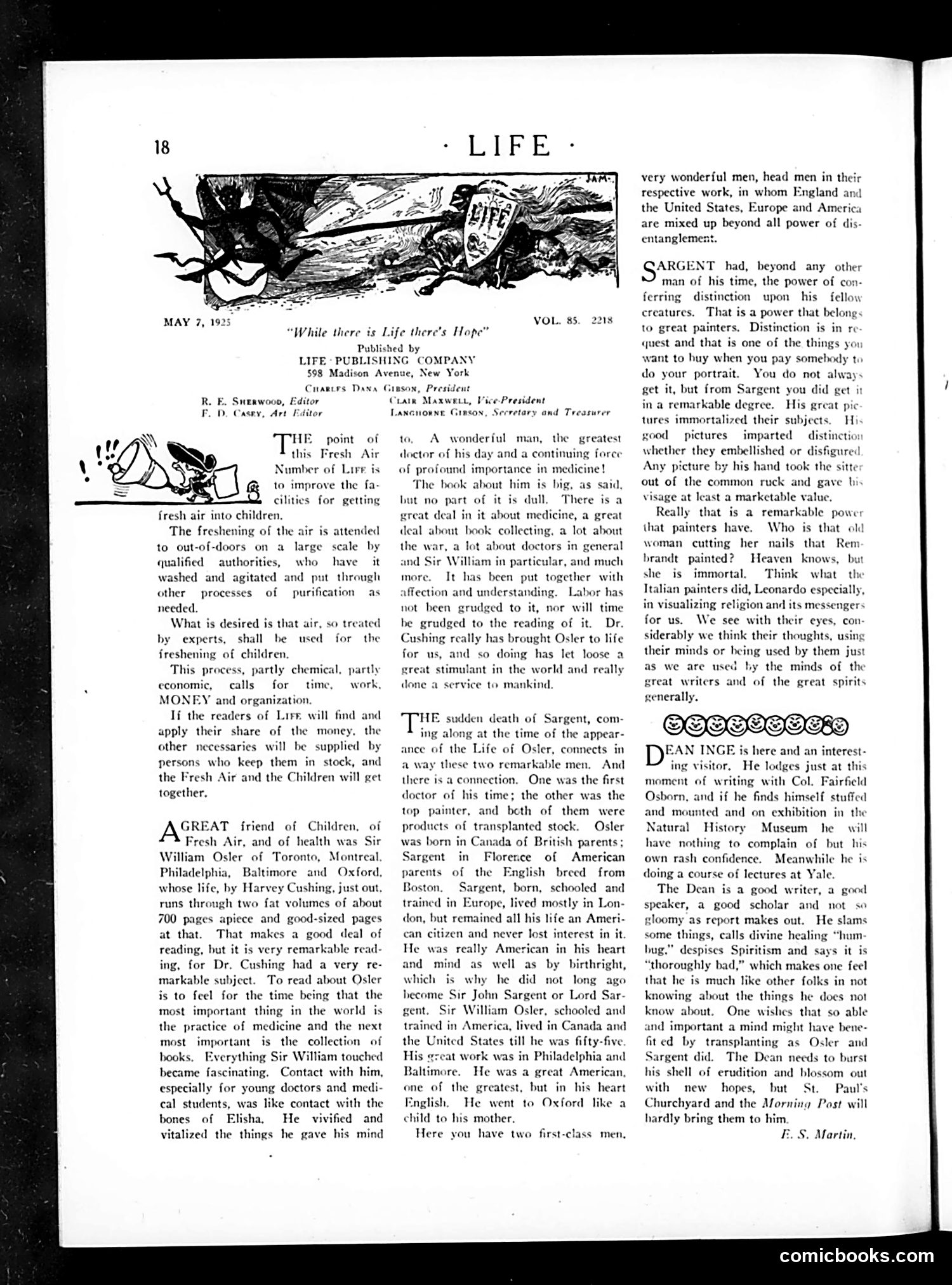
This page is primarily **editorial content, not satire**. The small cartoon at top ("While there is Life there's Hope") appears generic—showing a figure amid debris—likely illustrating the "Fresh Air Number" theme about improving children's health through outdoor air exposure. The main content celebrates two recently deceased figures: **Sir William Osler** (a famous Canadian-born physician) and **John Singer Sargent** (the renowned American-born painter). The editor contrasts these "transplanted" men of distinction—Osler trained in America but remained English at heart; Sargent trained in Europe but remained American at heart. The piece argues both men exemplified how talent transcends nationality, representing the shared cultural inheritance between England and America. This reflects early 20th-century Anglo-American cultural pride and the idea that great figures belong to both nations. The "Fresh Air" editorial preceding this likely advocates for children's health initiatives—a progressive-era concern.
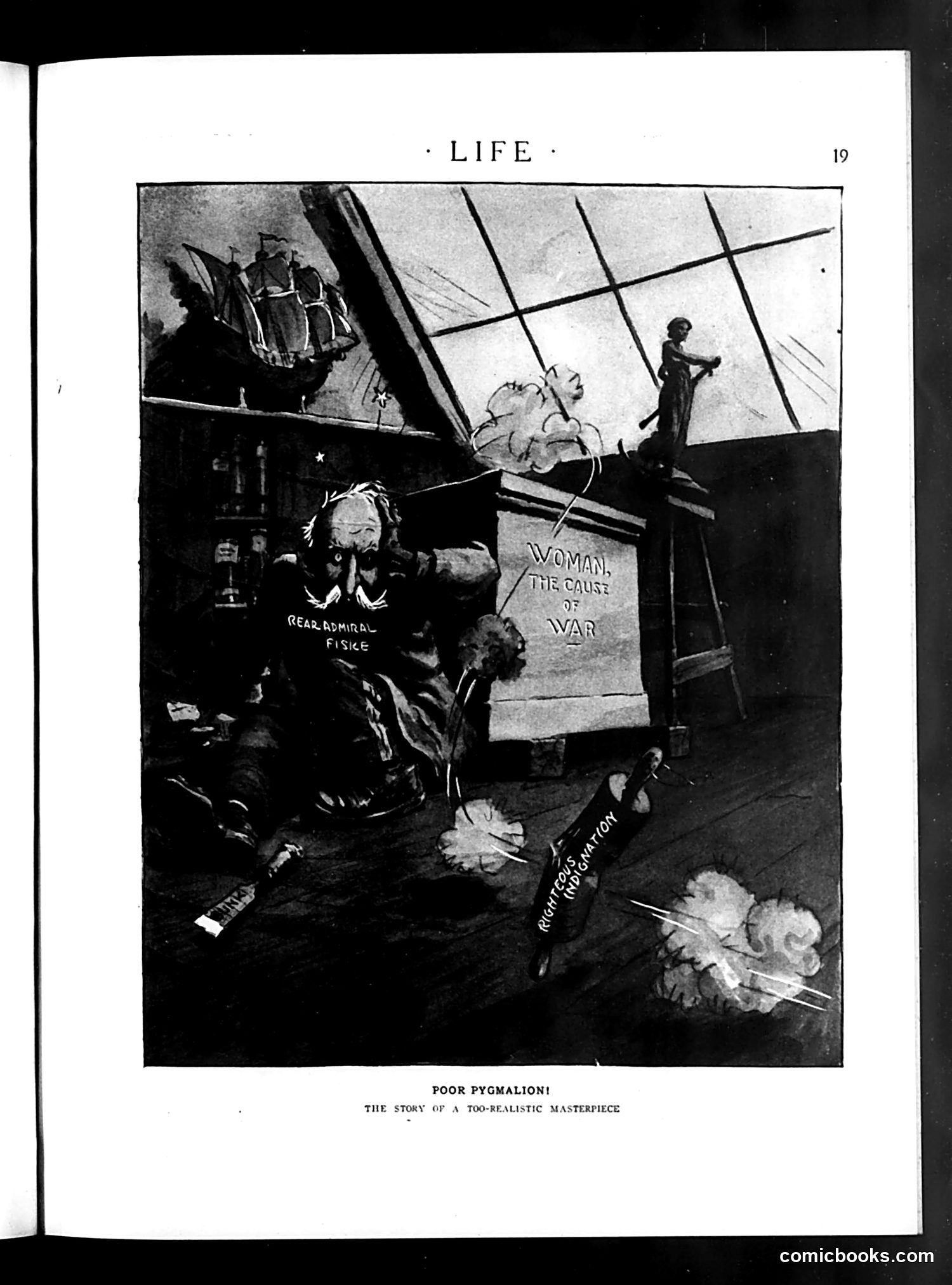
This satirical illustration references the classical myth of Pygmalion, the sculptor who fell in love with his own statue. The cartoon appears to depict various allegorical figures aboard a ship, including labeled elements like "Rear Admiral Fissice" and "Woman, The Cause of War." The satire seems to critique the consequences of creating overly realistic art or propaganda—suggesting that making something too lifelike (the "masterpiece") leads to unintended complications. The nautical setting and multiple figures suggest this comments on wartime or geopolitical tensions, with "Woman" and "War" explicitly labeled as central concerns. The title's ironic tone ("Poor Pygmalion!") suggests the artist/creator has become trapped or endangered by their own creation—a commentary on how realistic depictions of conflict or gender dynamics can backfire or create real-world consequences.
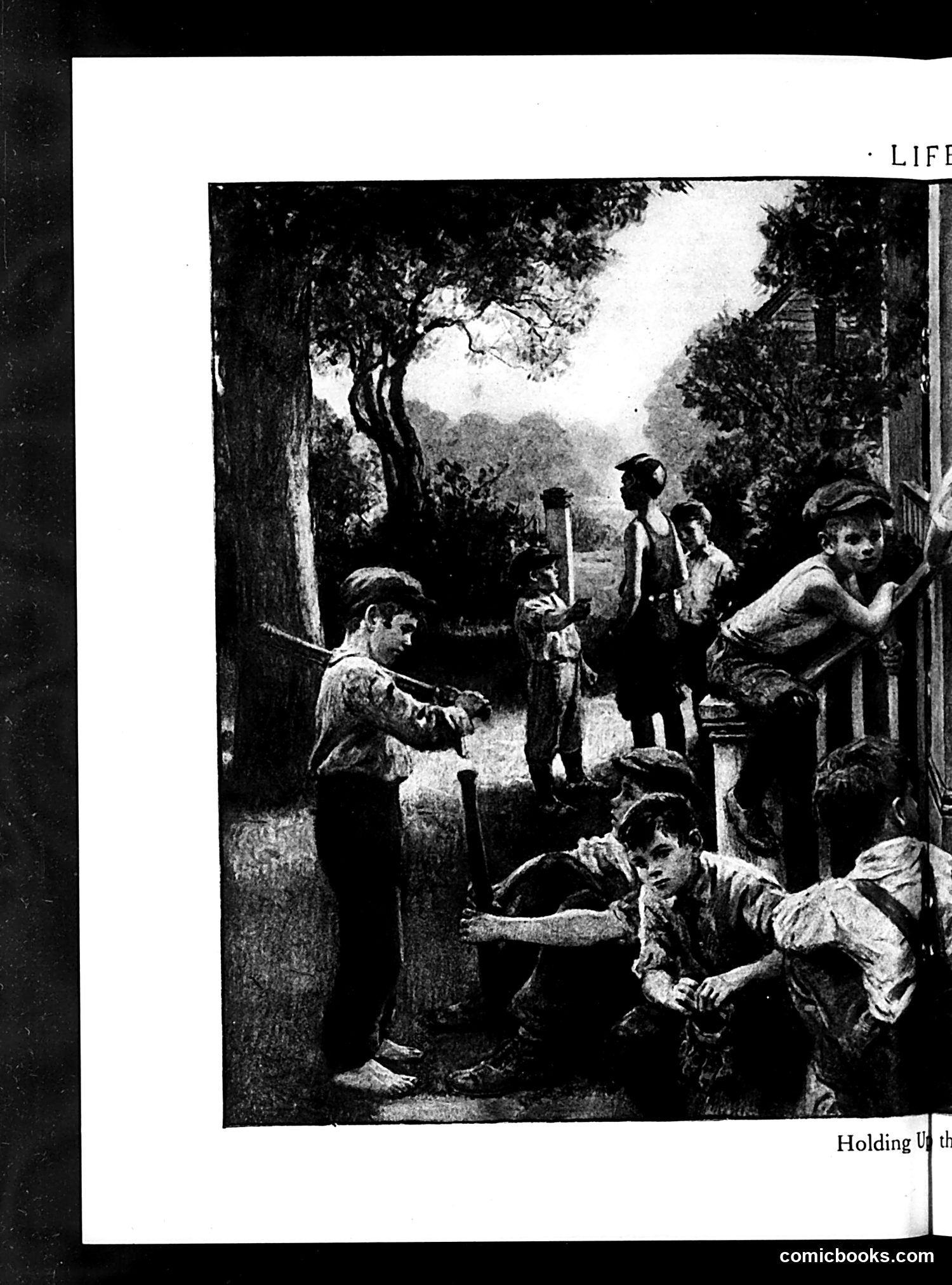
This appears to be a satirical illustration from *Life* magazine showing a group of boys engaged in what looks like a street game or activity beneath overhanging trees. The partial caption reads "Holding U th[e]" (text cut off). Without the complete caption or date, the specific satire is difficult to identify with certainty. However, the composition—with boys of various ages gathered in an outdoor setting near a house—suggests social commentary on youth behavior, urban play, or possibly childhood games during a particular era. The illustration's style and the magazine's satirical focus indicate this likely critiques some aspect of American youth culture or social conditions, but the cut-off text prevents precise identification of the target. More context would be needed for accurate interpretation.
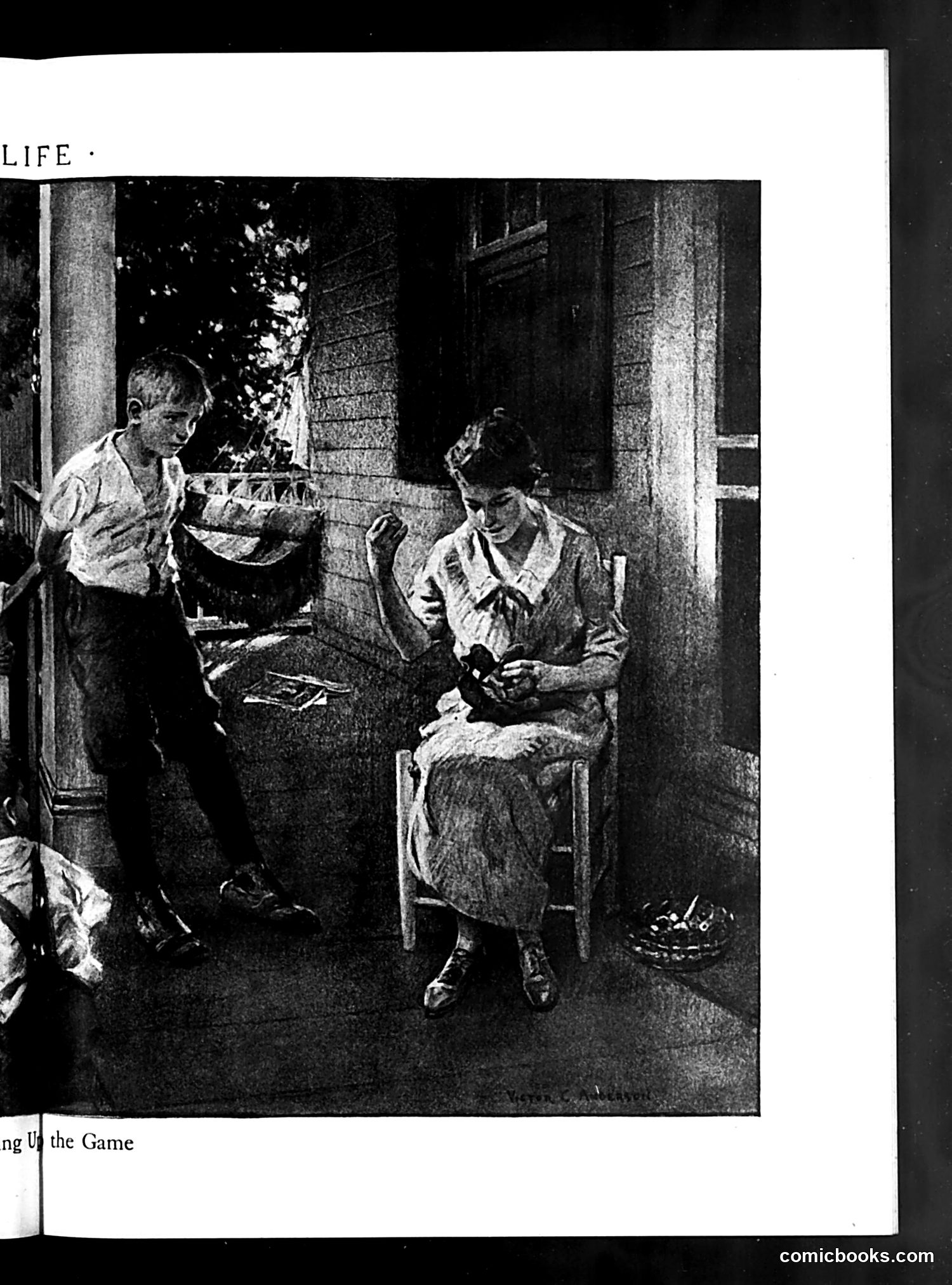
This page appears to be from **Life magazine** and shows a black and white photograph rather than a traditional political cartoon. The image depicts two figures in what seems to be a modest domestic setting—a woman seated and a man standing nearby, both appearing to engage in some form of manual work or craft activity. The partial caption visible reads "ng U the Game," which is incomplete and doesn't clarify the specific subject. Without the full caption or article text, I cannot definitively identify the figures, the historical context, or what social commentary this image was meant to convey. The grainy quality and composition suggest this is **documentary or social commentary photography** rather than satirical cartooning, but the exact satirical point remains unclear from the visible portion alone.
This theatrical review critiques contemporary Broadway plays, particularly mocking their absurd plots while defending others. The page discusses "Thrills," a play involving an author named Armand Valery who seduces a married woman by claiming he's "demonstrating" a play's ending to her—a transparent, ridiculous excuse the author expects audiences to accept. The reviewer admits enjoying "Taps," an old German military play, despite its melodramatic nature. The piece compares "Taps" to the more recent American play "What Price Glory?"—both critiques of military hierarchy and class distinctions, though "Taps" (pre-WWI German) challenged Prussian officer pretensions while "What Price Glory?" challenges American military pomposity. The satire targets both silly contemporary theatrical plots and critics' own inconsistent tastes—enjoying "Taps" while dismissing "Thrills," suggesting prejudice toward German culture despite appreciating German drama.
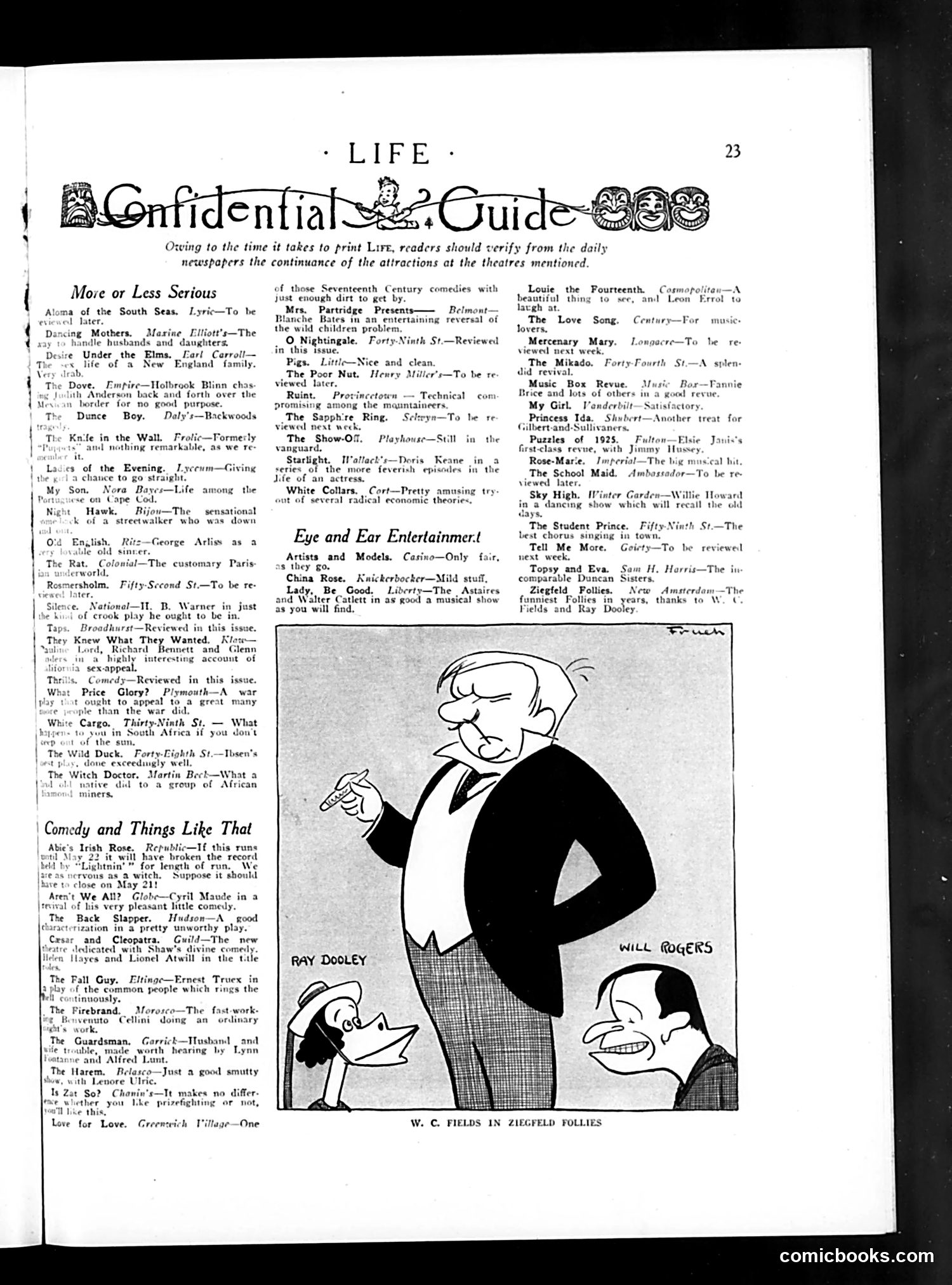
This page from **Life magazine** (likely 1920s, based on theatrical references) is a **theater guide and review section** rather than political satire. The main illustration features caricatures of **Ray Dooley, Will Rogers,** and **W.C. Fields** in the "Ziegfeld Follies"—a famous Broadway revue. These are **entertainment personalities**, not political figures. The cartoon is promotional, showing recognizable comedians to advertise current theatrical productions. The bulk of the page lists Broadway shows with brief, often sarcastic reviews. The humor is **entertainment-focused**: mocking weak plots ("pretty unworthy play"), celebrating long runs, and noting which shows succeed or fail. References like "Abie's Irish Rose" potentially breaking records, or noting a show's "length of run" reflect 1920s Broadway culture. The tone is gossipy and insider—aimed at readers interested in New York theater. **No significant political content is present** on this page.
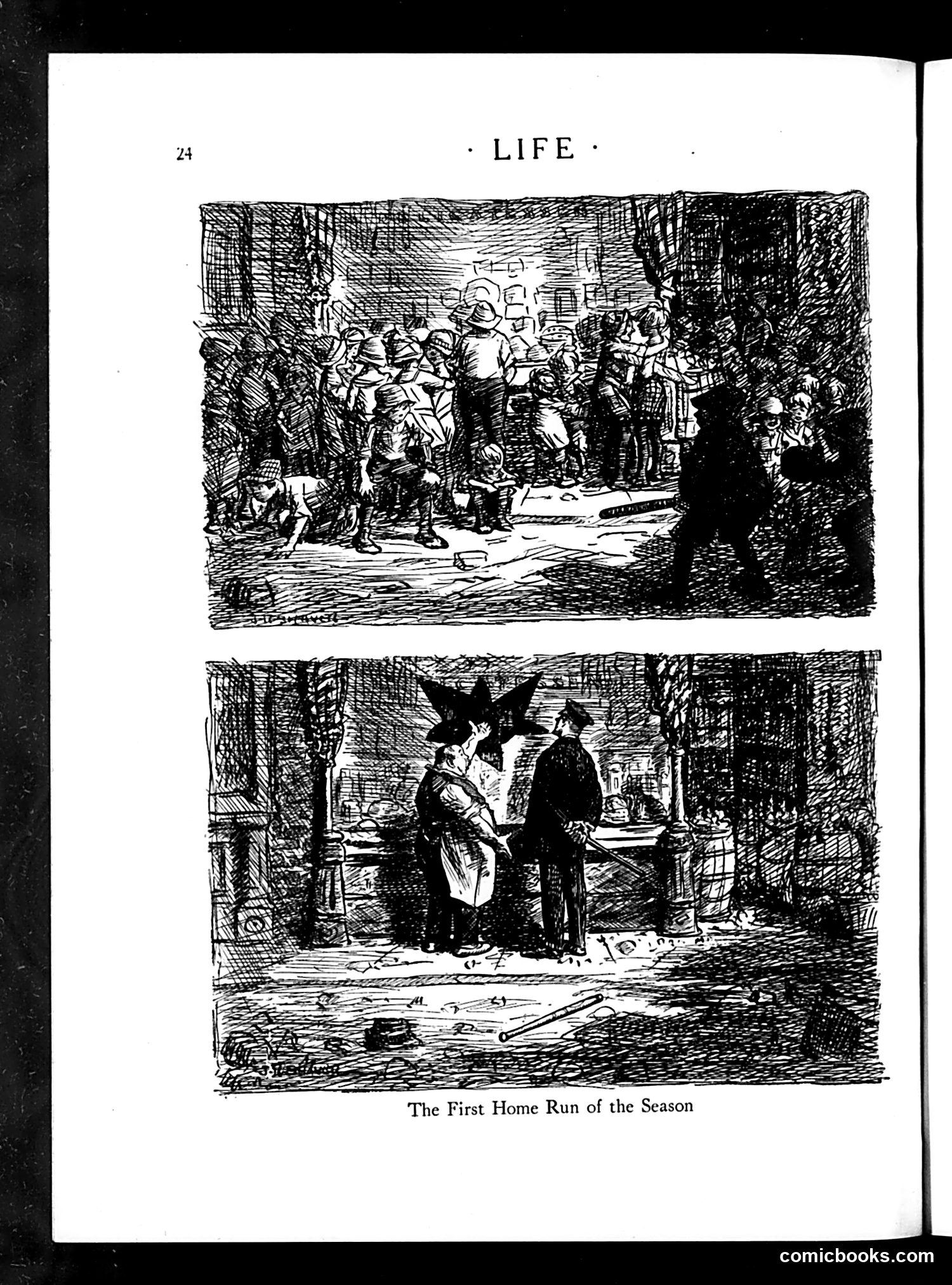
This page from *Life* magazine presents two pen-and-ink sketches titled "The First Home Run of the Season." The imagery appears to use baseball as metaphorical commentary on social or political matters, a common satirical approach in early *Life* publications. The top panel shows a crowd scene in what appears to be a street or public setting. The bottom panel depicts an indoor domestic scene with figures in period dress. The baseball reference in the title suggests the cartoonist is using sports terminology metaphorically—"home run" likely represents a significant social or political success or victory rather than literal baseball. Without additional context about the publication date or surrounding articles, the specific political/social reference remains unclear, though the juxtaposition of public and private scenes hints at commentary on American society or domestic life.
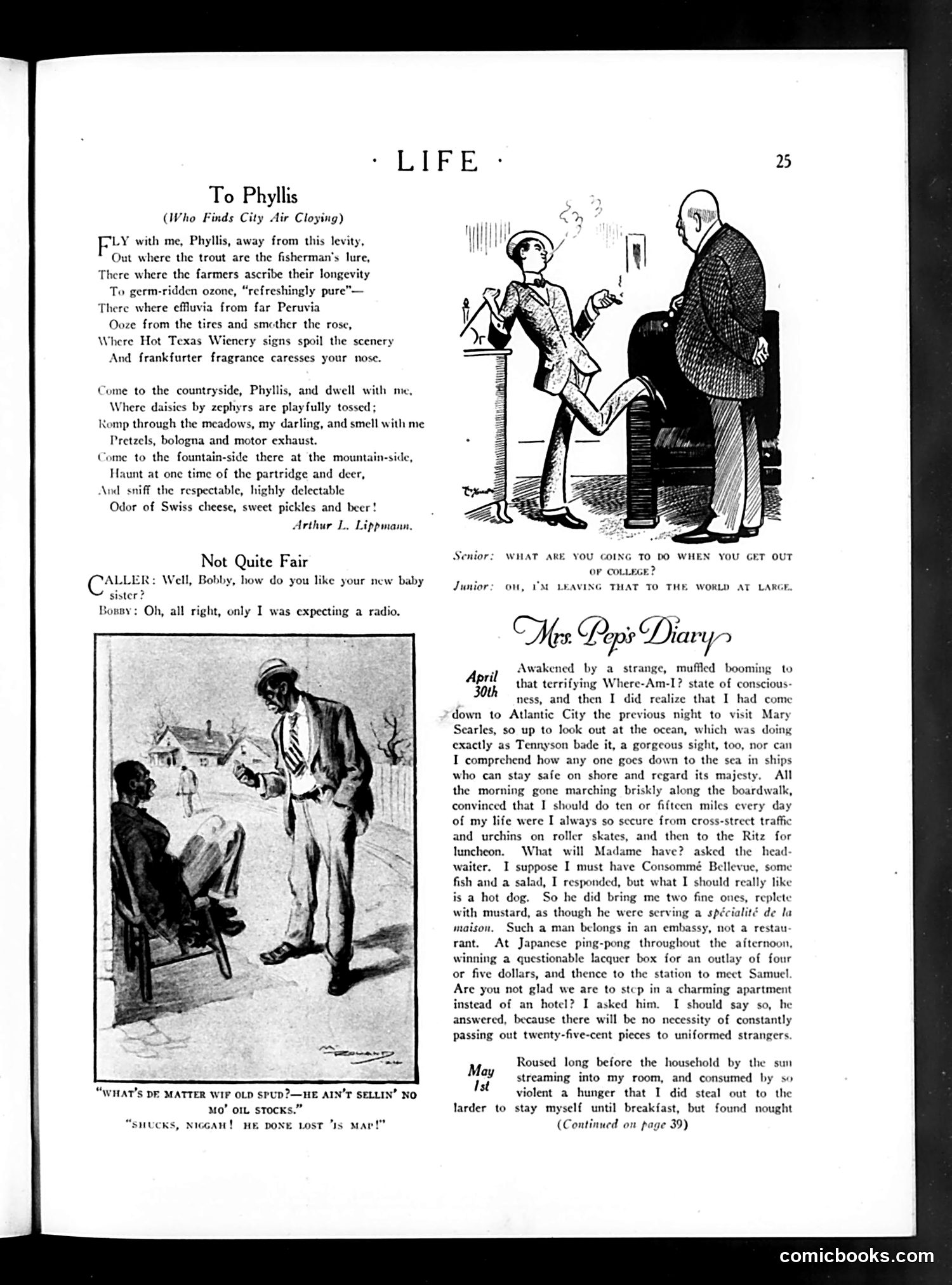
This page contains satirical content mocking urban life and social pretensions circa early 20th century. **"To Phyllis" poem**: Arthur L. Lippmann satirizes the romanticization of rural life. The speaker ironically invites "Phyllis" to escape the city for "pure" countryside air, but then reveals the rural landscape is equally polluted—overrun with hot dog stands, frankfurter odors, motor exhaust, and commercial signage. The joke exposes the hypocrisy of those claiming rural superiority while that landscape becomes increasingly industrialized and commercialized. **"Not Quite Fair" cartoon**: Shows someone asking a caller about his new "baby sister." The caller responds he was expecting a radio, satirizing consumer culture and the trivial priorities of American life—a child's birth matters less than acquiring the latest technology. **"Miss Pep's Diary"**: A society woman's account of Atlantic City leisure, gently mocking pretentious dining customs and upper-class affectations.
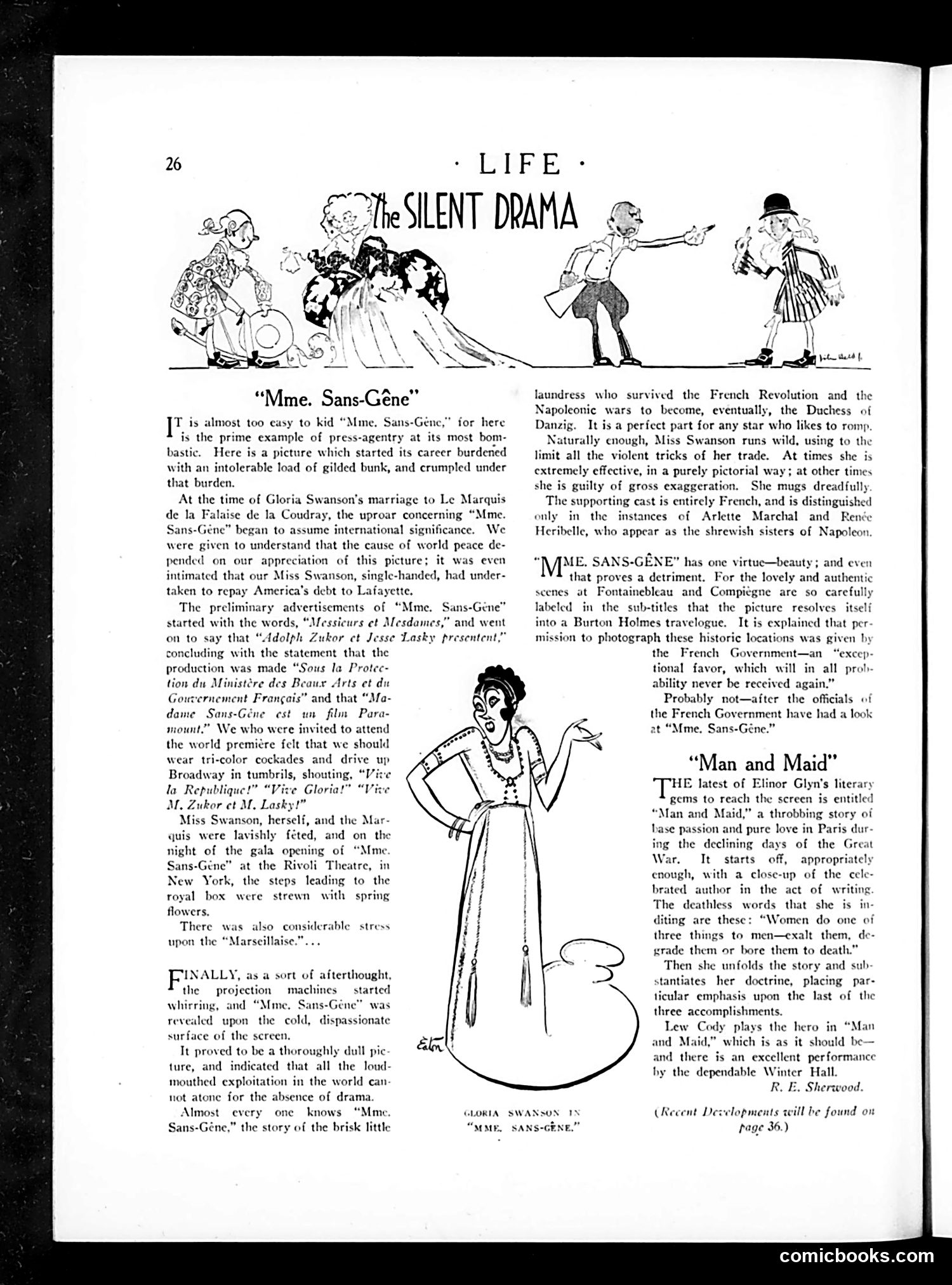
This page critiques the film "Mme. Sans-Géne," starring Gloria Swanson. The satire targets excessive movie studio publicity rather than the film itself. **The Setup:** Paramount Pictures promoted this French historical comedy with enormous fanfare, especially after Swanson's marriage to a French marquis. Studios claimed the film served American-French diplomatic interests and required government protection. **The Joke:** Despite all the elaborate marketing—tri-color cockades, official French sponsorship, gala premiere at the Rivoli Theatre with flower-strewn steps—the actual film proved "thoroughly dull." The review argues that no amount of "loud-mouthed exploitation" compensates for absent drama. **The Point:** Life ridicules how studios weaponized patriotism and European prestige to sell mediocre entertainment. The cartoon header emphasizes this gap between hype and reality. The piece also briefly reviews "Man and Maid," noting similar hollow pretension in Elinor Glyn's literary adaptation.
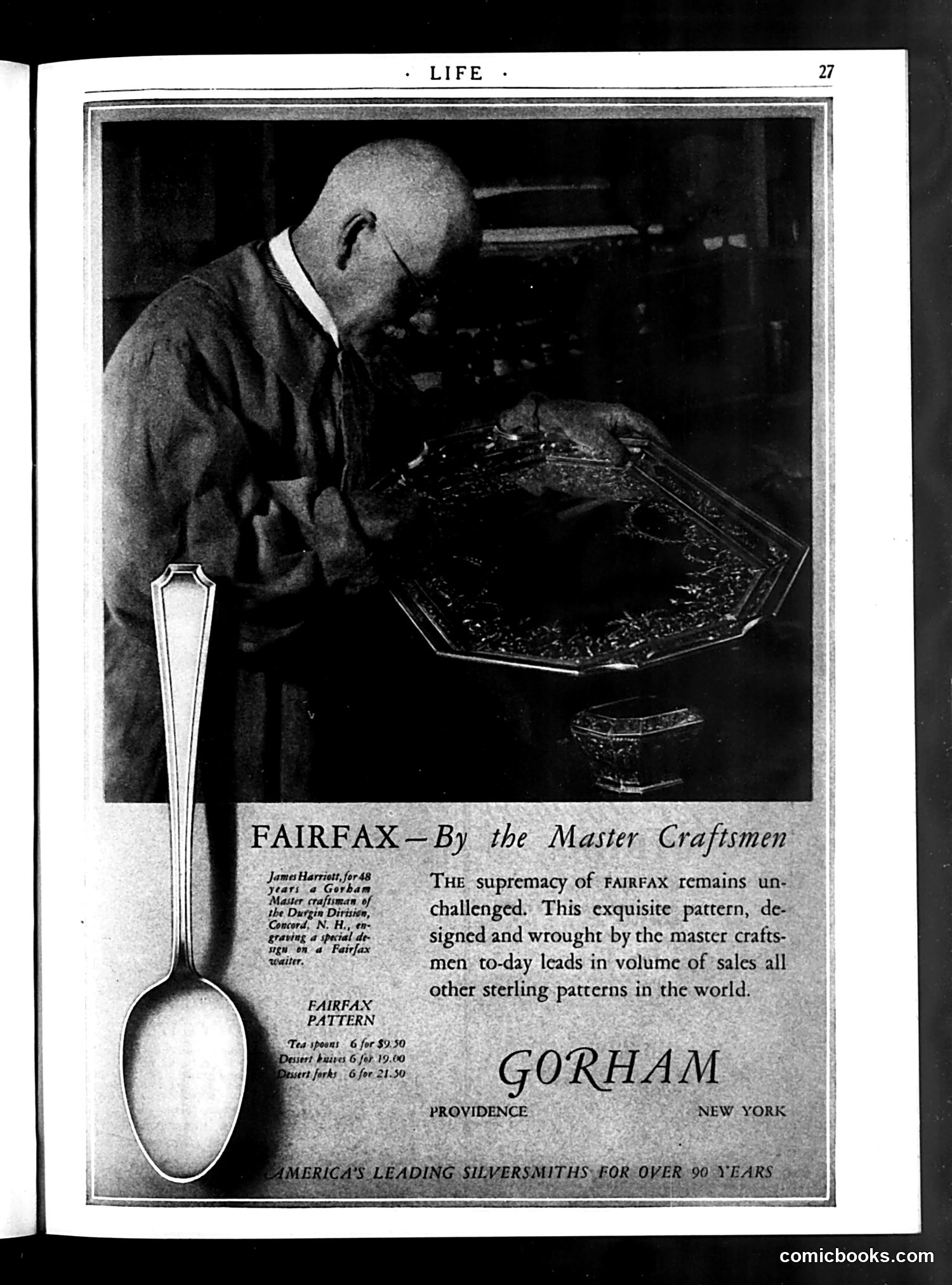
This is primarily a **product advertisement**, not political satire. It's a Gorham silverware ad promoting their "Fairfax" sterling silver pattern. The image shows a craftsman (identified as James Harriott, a master craftsman with 48 years experience) examining an ornate silver tray, demonstrating the quality and artisanal skill behind the product. The accompanying spoon displays the elegant pattern design. The ad's pitch emphasizes exclusivity and superiority: the Fairfax pattern supposedly outsells all other sterling patterns globally, suggesting it represents the pinnacle of American craftsmanship. The reference to "Master Craftsmen" and the craftsman's long tenure appeals to tradition and expertise. For modern readers: this is early-20th-century luxury marketing, positioning expensive silverware as both a status symbol and proof of superior American manufacturing—a common advertising strategy of the era when such goods were genuine investments for affluent households.
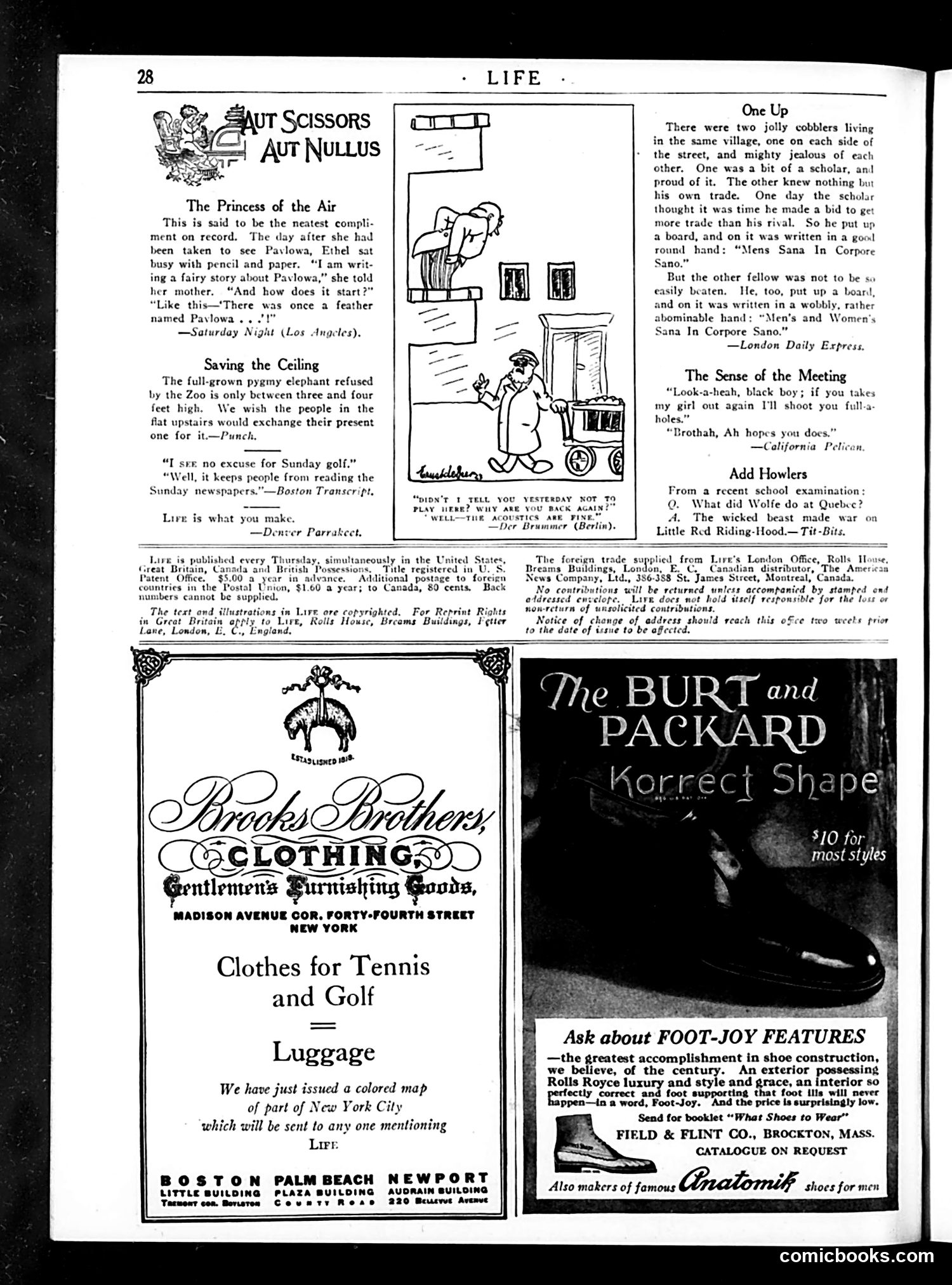
This page from Life magazine contains several humorous anecdotes and jokes typical of early 20th-century satirical humor: **"The Princess of the Air"**: A compliment to the famous Russian ballerina Anna Pavlova—a child, after seeing her perform, writes a fairy tale beginning "There was once a feather named Pavlowa," cleverly comparing the dancer's ethereal lightness to a feather. **"Saving the Ceiling"**: A joke about noisy neighbors upstairs, wishing they'd exchange their "pygmy elephant" (loud person) for an actual small zoo elephant. **The cartoon** shows a man being confronted about repeatedly playing a flute/pipe despite being told to stop, with a Berlin publication's caption noting the irony that "the acoustics are fine"—implying the neighbor can hear perfectly well and continues anyway. **"One Up"** and **"The Sense of the Meeting"**: Period humor involving dialect and social satire. The page is primarily **advertising** for Brooks Brothers clothing and Foot-Joy shoes, with Life's masthead and subscription information at bottom.
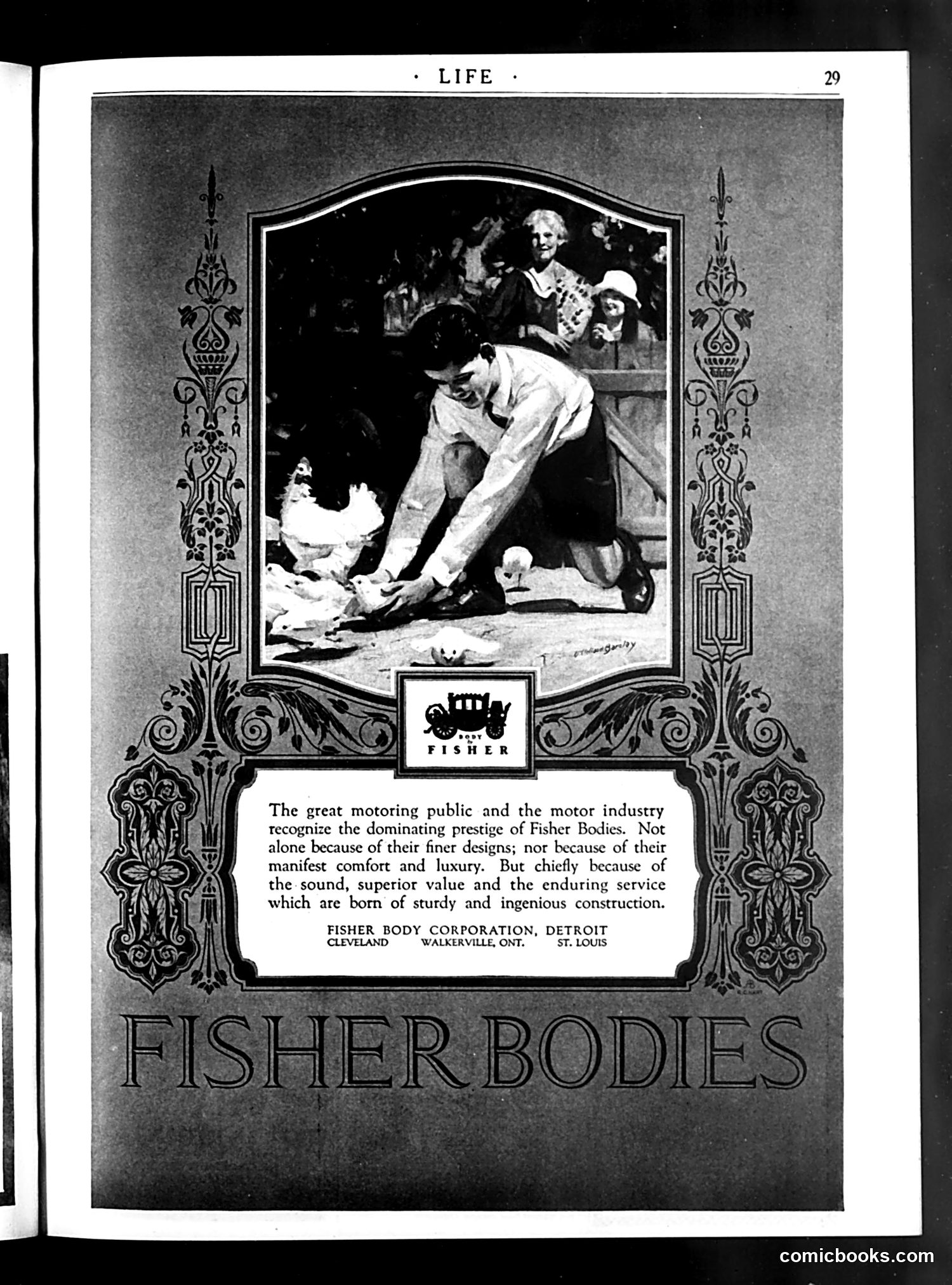
This is a **Fisher Body Corporation advertisement**, not a political cartoon. It appeared in *Life* magazine (page 29) promoting automobile bodies manufactured by Fisher. The image shows a craftsman carefully constructing or inspecting a car body, with well-dressed onlookers observing in the background. The ad argues that Fisher Bodies dominate the market not merely for aesthetic design or luxury features, but because of superior construction quality and lasting value. The ornate decorative border and formal presentation style were typical of early 20th-century automotive advertising. Fisher Body Corporation, headquartered in Detroit with plants in Cleveland, Walkerville (Ontario), and St. Louis, was a major supplier of car bodies to the automobile industry during this era.
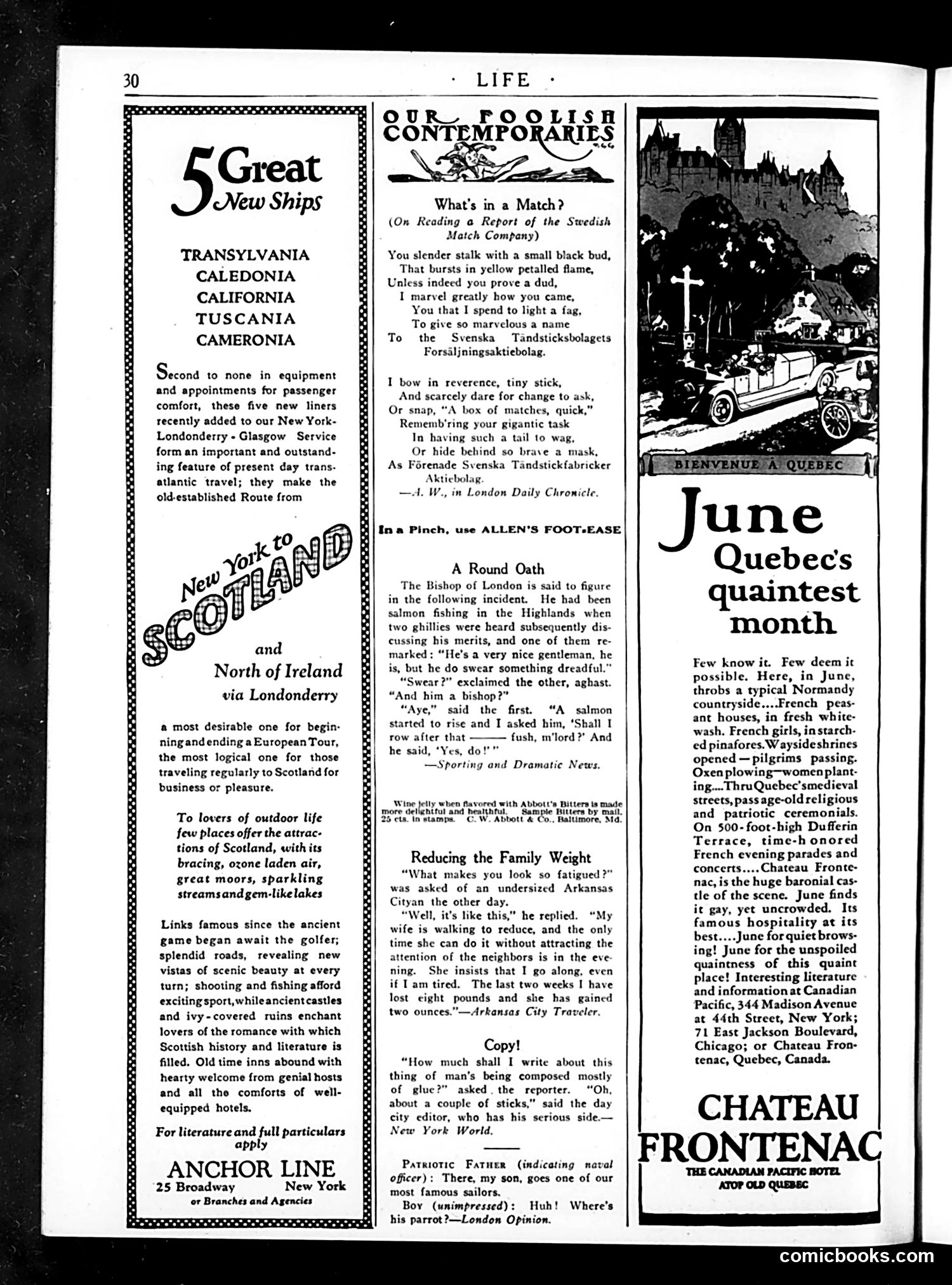
This page is primarily **advertising and light humor content**, not political satire. The main elements are: **Left side:** An Anchor Line steamship advertisement promoting five new transatlantic liners (Transylvania, Caledonia, etc.) traveling New York to Scotland via Londonderry, emphasizing comfort and Scotland's attractions for tourists. **Center:** Humorous short pieces including: - A poem mocking the absurdly long Swedish name for a match company ("Svenska Tandsticksbolagets Forsaljningsaktiebolag") - Anecdotes about a Bishop of London swearing while fishing and an Arkansas man losing weight by accompanying his wife's evening walks **Right side:** An advertisement for Chateau Frontenac hotel in Quebec, describing June as "Quebec's quaintest month." The humor is gentle, relying on wordplay, irony, and domestic comedy rather than political commentary. This reflects Life's character as a genteel, middle-class publication focused on travel, consumer goods, and mild social observation rather than hard-hitting satire.
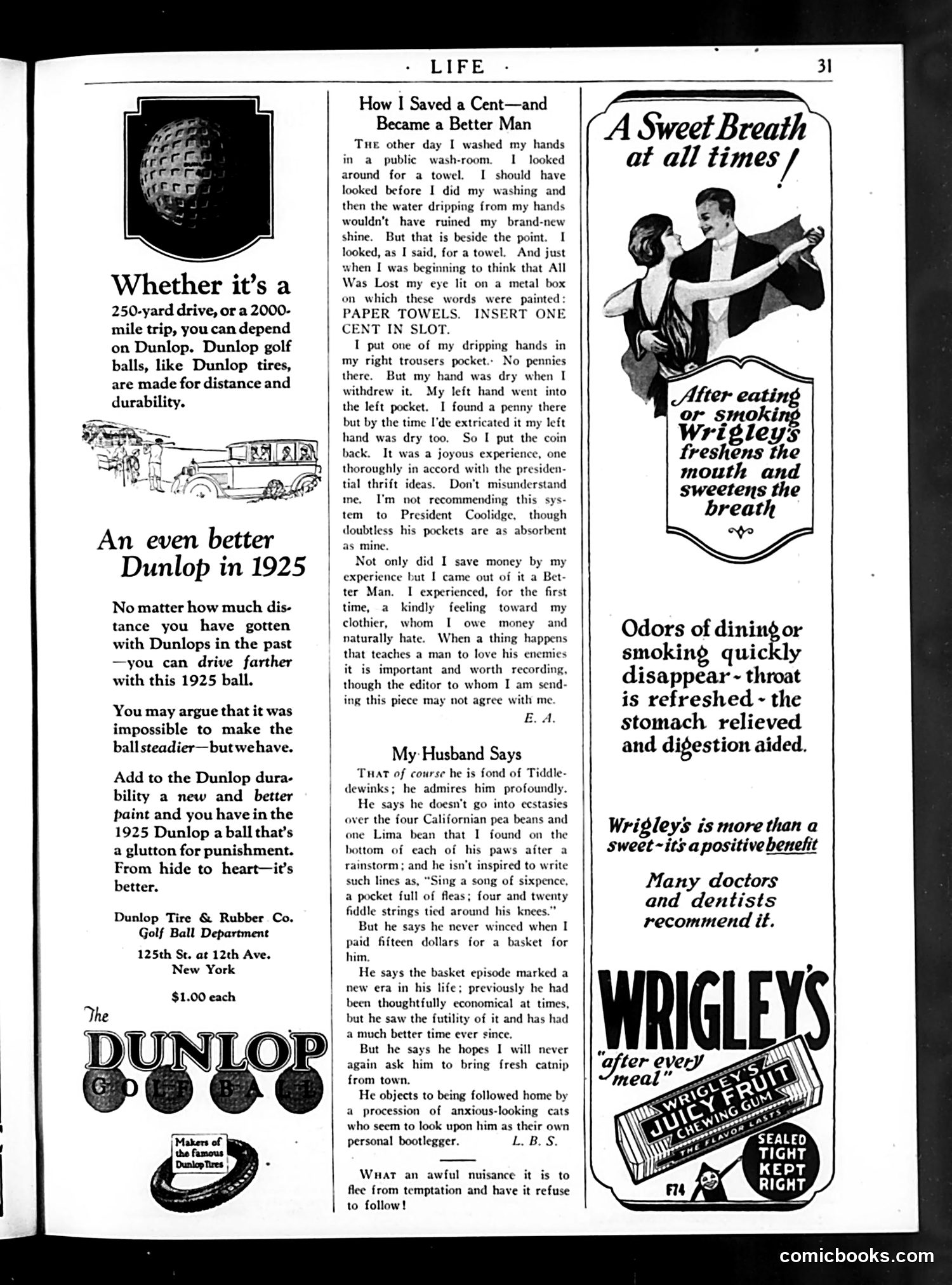
This page is primarily **advertising and light humor columns**, not political satire. The left side features a **Dunlop golf ball advertisement** emphasizing durability and improved design for the 1925 model—standard product marketing of the era. The center contains two humorous personal essays. "How I Saved a Cent" mocks penny-pinching thrift (associated with President Coolidge's administration) through an anecdote about a public paper-towel dispenser. "My Husband Says" is a domestic humor piece about a cat owner whose husband doesn't understand why she spent fifteen dollars on a cat basket, though he's stopped objecting—likely satirizing spousal financial disagreements. The right side shows **Wrigley's chewing gum advertising**, claiming health benefits including fresher breath and digestive aid—claims typical of 1920s advertising before modern consumer protection regulations. No specific political figures are caricatured; the Coolidge reference is merely contextual to the thrift theme.
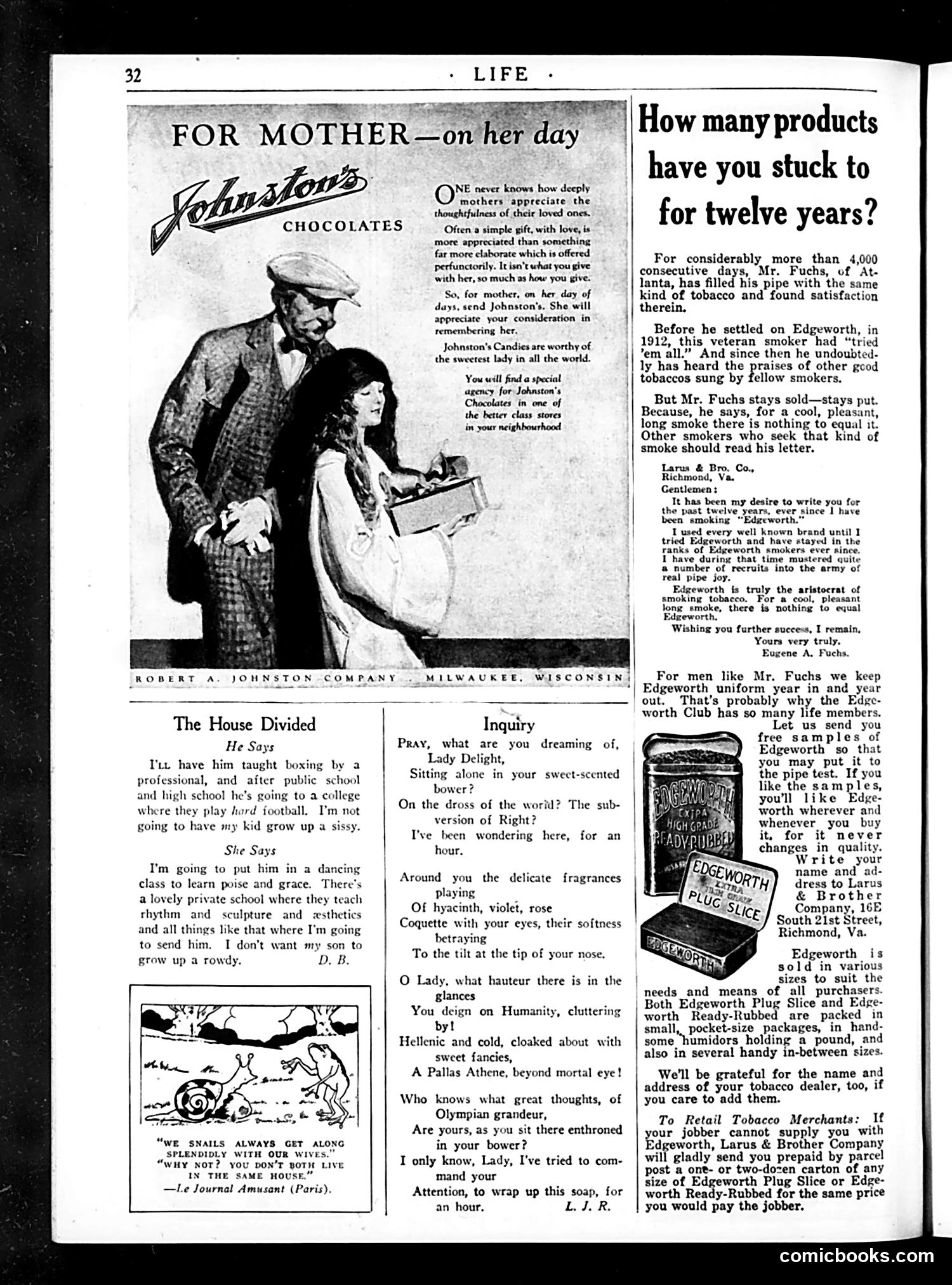
This is primarily **advertising**, not satire. The page contains three ads (Johnston's Chocolates for Mother's Day, Edgeworth pipe tobacco) and filler content. The **"House Divided"** section depicts a common domestic gender conflict of the 1910s-20s: a father wants his son raised "tough" (boxing, football) while the mother insists on refinement (dancing, art classes). The accompanying joke from a Paris publication jokes that married couples can coexist peacefully only if they don't live together. This reflects period anxieties about masculinity and changing gender roles. The **"Inquiry"** poem is flirtatious Victorian verse, likely filler content—a man admires a woman's beauty and mysterious thoughts. The **Edgeworth tobacco ad** is a testimonial claiming one Atlanta customer has smoked the same brand for 12+ years, emphasizing product loyalty and consistency. This reflects early-20th-century advertising techniques using real customer letters as proof of quality.
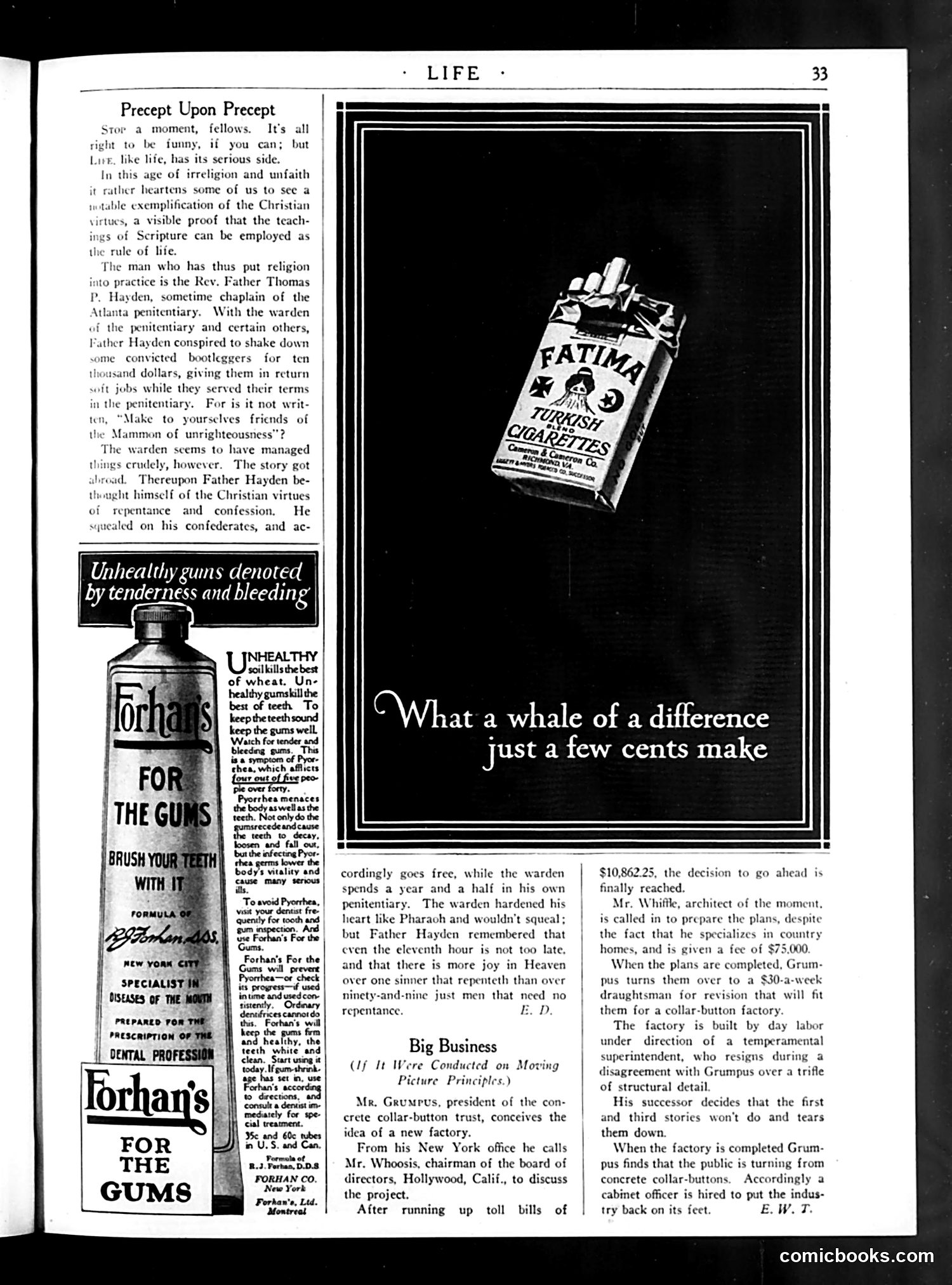
This page satirizes corruption and inefficiency through two pieces: **"Precept Upon Precept"** (top): A scathing article mocking Rev. Father Thomas P. Hayden, chaplain at Atlanta penitentiary. Hayden and the warden conspired to extort $10,000 from convicted bootleggers in exchange for prison jobs. When exposed, Hayden used religious repentance to escape punishment while the warden served time—the satire being that he cynically weaponized Christian confession to avoid consequences. **"Big Business"** (bottom): A satirical fictional account of concrete collar-button manufacturing conducted with Hollywood movie-industry absurdity: executives spend $10,862.25 in long-distance calls to decide on a factory; an expensive architect designs country homes instead; workers tear down completed stories; a cabinet officer is hired to salvage a failing product. The joke: wasteful, incompetent decision-making disguised as ambitious enterprise. Both pieces skewer corruption, hypocrisy, and institutional inefficiency prevalent in 1920s America.
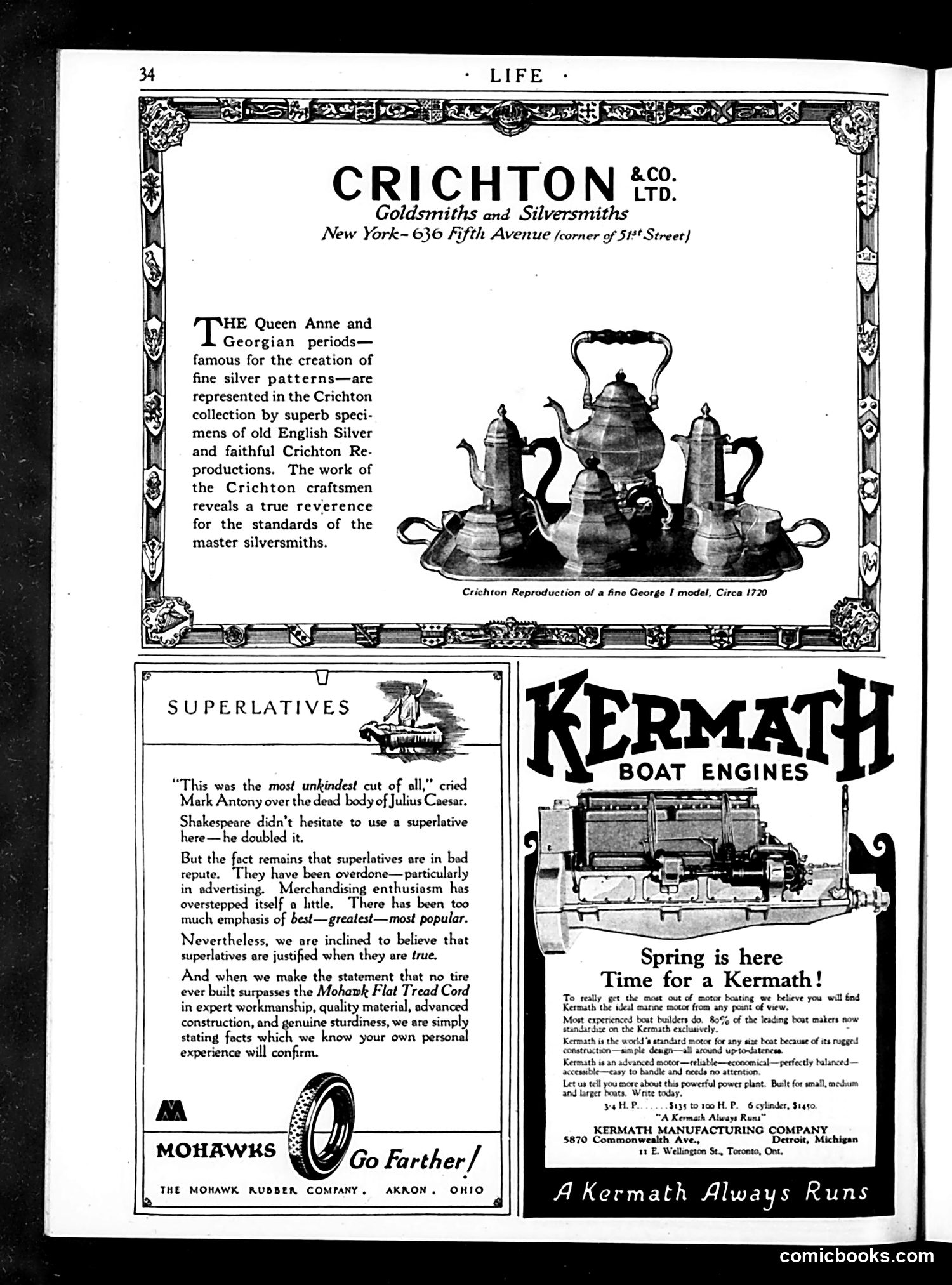
This is primarily an **advertising page**, not a political cartoon. It contains four unrelated commercial advertisements: 1. **Crichton & Co.** (top): A silversmith company showcasing reproductions of Georgian-era silver tea sets, targeting wealthy consumers. 2. **Superlatives** (left-middle): A Mohawk Rubber Company ad that humorously addresses advertising culture itself. It references Shakespeare's line from *Julius Caesar* about "the most unkindest cut" to argue that while superlatives are overused in advertising, they're justified when truthful. This is meta-commentary on advertising excess—acknowledging readers' skepticism about exaggerated marketing claims while defending honest ones. 3. **Kermath Boat Engines** (right): A motorboat engine manufacturer claiming their product is the industry standard. 4. **Mohawk Rubber** (bottom-left): "Go Farther!" tagline for tires. The Superlatives section is the most editorial content, essentially admitting that advertising had become hyperbolic by this era and attempting to rebuild consumer trust through claimed honesty.
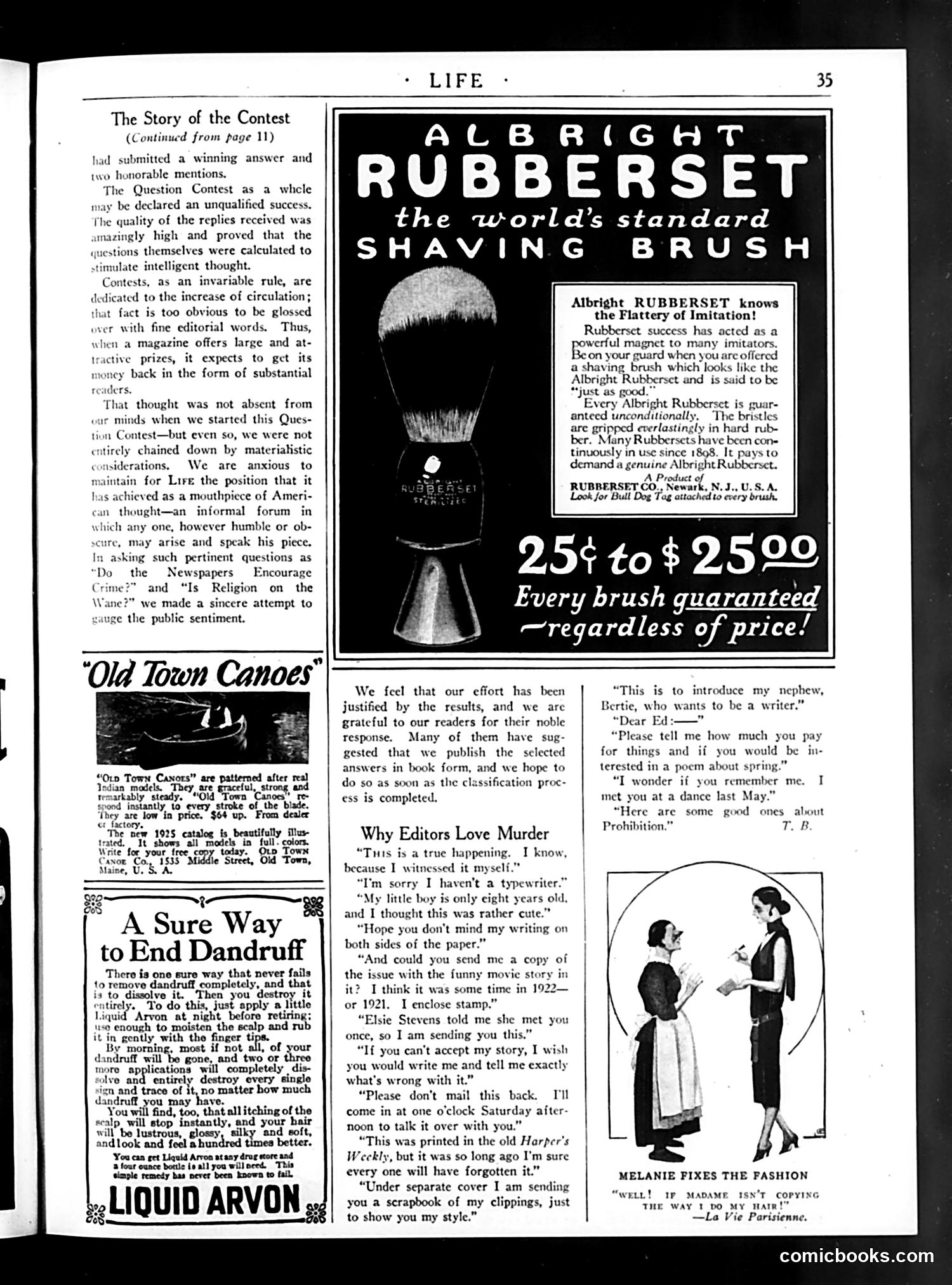
This page is primarily **advertisements and magazine content**, not political satire. The main elements are: **Advertisements:** Albright Rubberset shaving brushes, Liquid Arvon dandruff treatment, and Old Town Canoes dominate the layout with typical 1920s marketing claims. **Editorial Content:** "The Story of the Contest" discusses Life's recent question contest, explaining how it balanced circulation-building with serving as a "forum" for public thought on serious topics like crime and religion. **"Why Editors Love Murder"** presents humorous reader submissions—a common magazine feature showing amusing letters from the public. These snippets satirize *human nature* rather than politics: people's vanity, poor writing skills, and eagerness to see their work published. The cartoon titled "Melanie Fixes the Fashion" (bottom right) depicts a woman showing a man a hairstyle, illustrating period fashion concerns. This page reflects **early 1920s consumer culture and magazine humor** rather than political commentary.
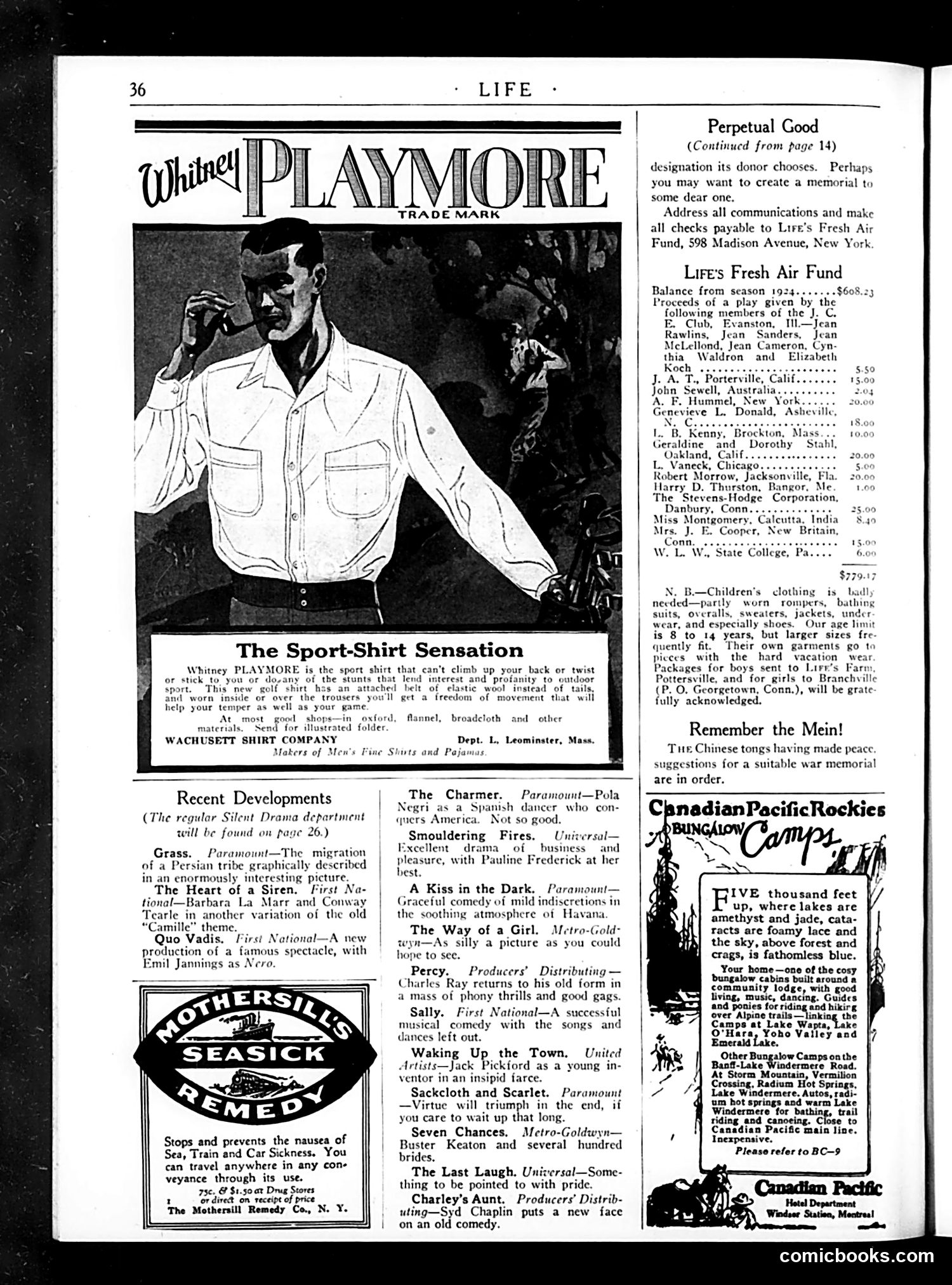
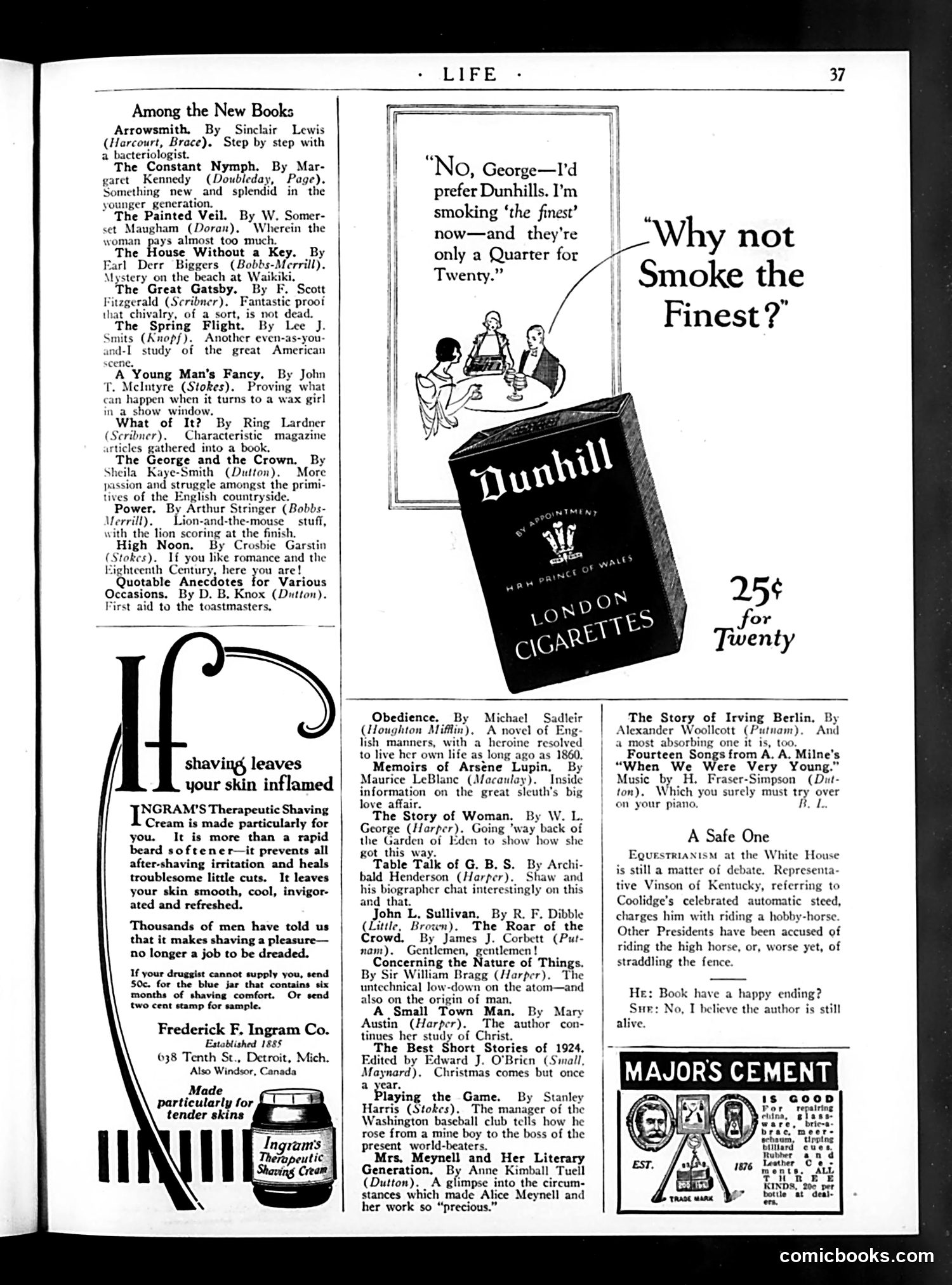
This page is primarily a **book review section and advertisements** from what appears to be the 1920s. The main cartoon advertisement is for **Dunhill cigarettes**. It depicts a social scene where one man persuades another to try Dunhills instead of cheaper alternatives, emphasizing they're "the finest" yet cost only "a Quarter for Twenty" (25 cents for 20 cigarettes). The humor relies on **aspirational snobbery**—smoking premium cigarettes as a status symbol while maintaining they're affordable. The page also features advertisements for **Ingram's Therapeutic Shaving Cream** and **Major's Cement**, typical consumer products of the era. The book reviews list notable 1920s titles including F. Scott Fitzgerald's *The Great Gatsby* and works by Sinclair Lewis, emphasizing the era's literary culture. **No political satire** is present here—this is straightforward commercial content aimed at middle-class American readers, reflecting 1920s consumer culture and reading habits.
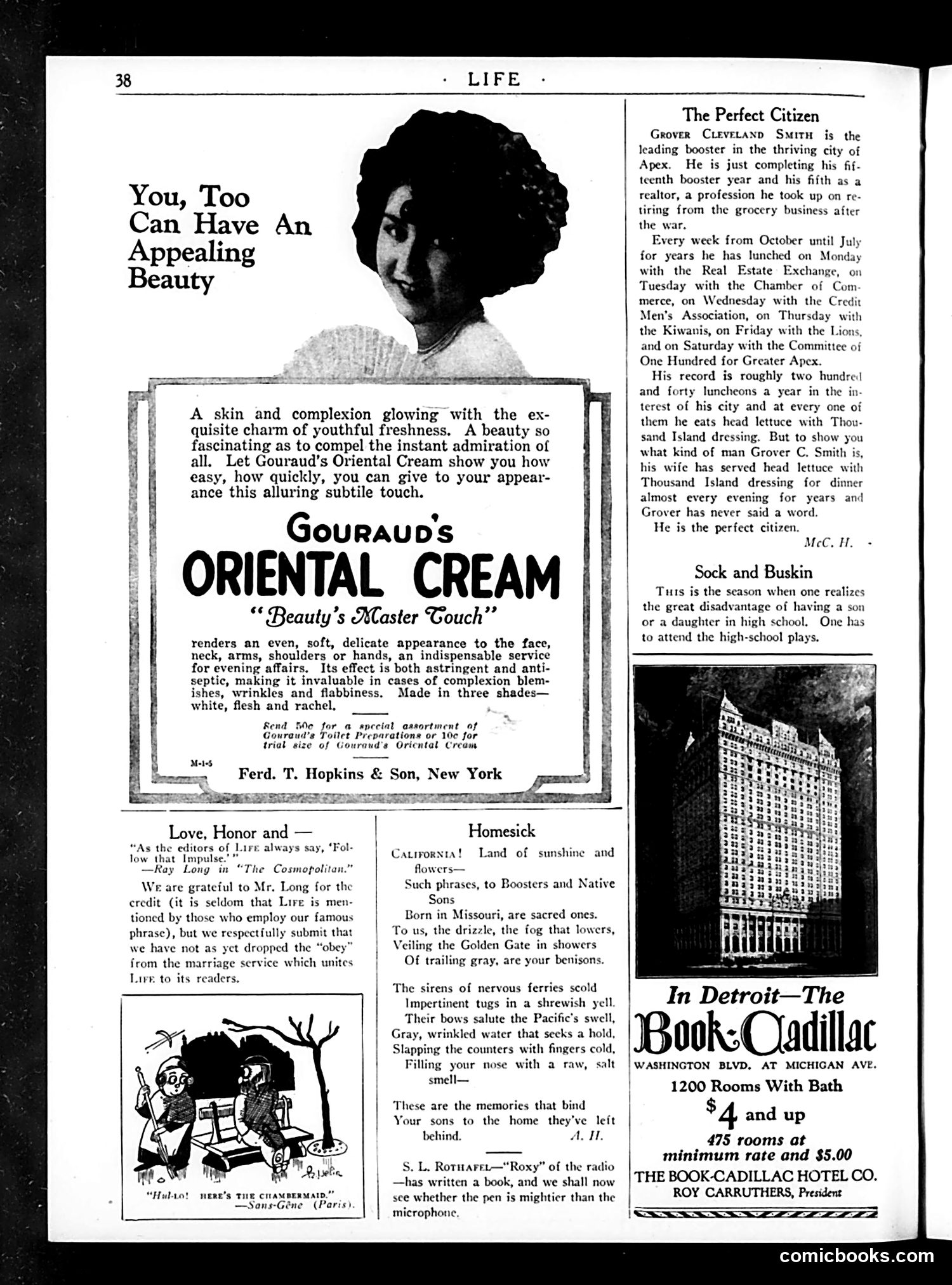
This page contains satirical commentary on American civic culture and gender expectations: **"The Perfect Citizen"** mocks the obsessive "booster" culture of early 20th-century small towns. Grover C. Smith epitomizes hollow civic virtue—attending endless luncheons with service clubs (Kiwanis, Lions, Rotary equivalents) while eating identical meals. The satire peaks in the final twist: his wife serves him the same head lettuce dinner *every evening* for years without complaint, yet he never acknowledges it. The joke exposes how civic "perfection" masks emotional emptiness and marital indifference, presenting unquestioning obedience as virtue. **"Love, Honor and —"** responds to editor Ray Long's phrase "Follow that Impulse" by noting that *Life* magazine still uses the traditional marriage vow including "obey." This satirizes how publications urge readers toward modern impulses while traditional gender hierarchies remain embedded in institutions. Both pieces critique unthinking conformity and unexamined tradition in American life, particularly regarding gender roles and civic performance.
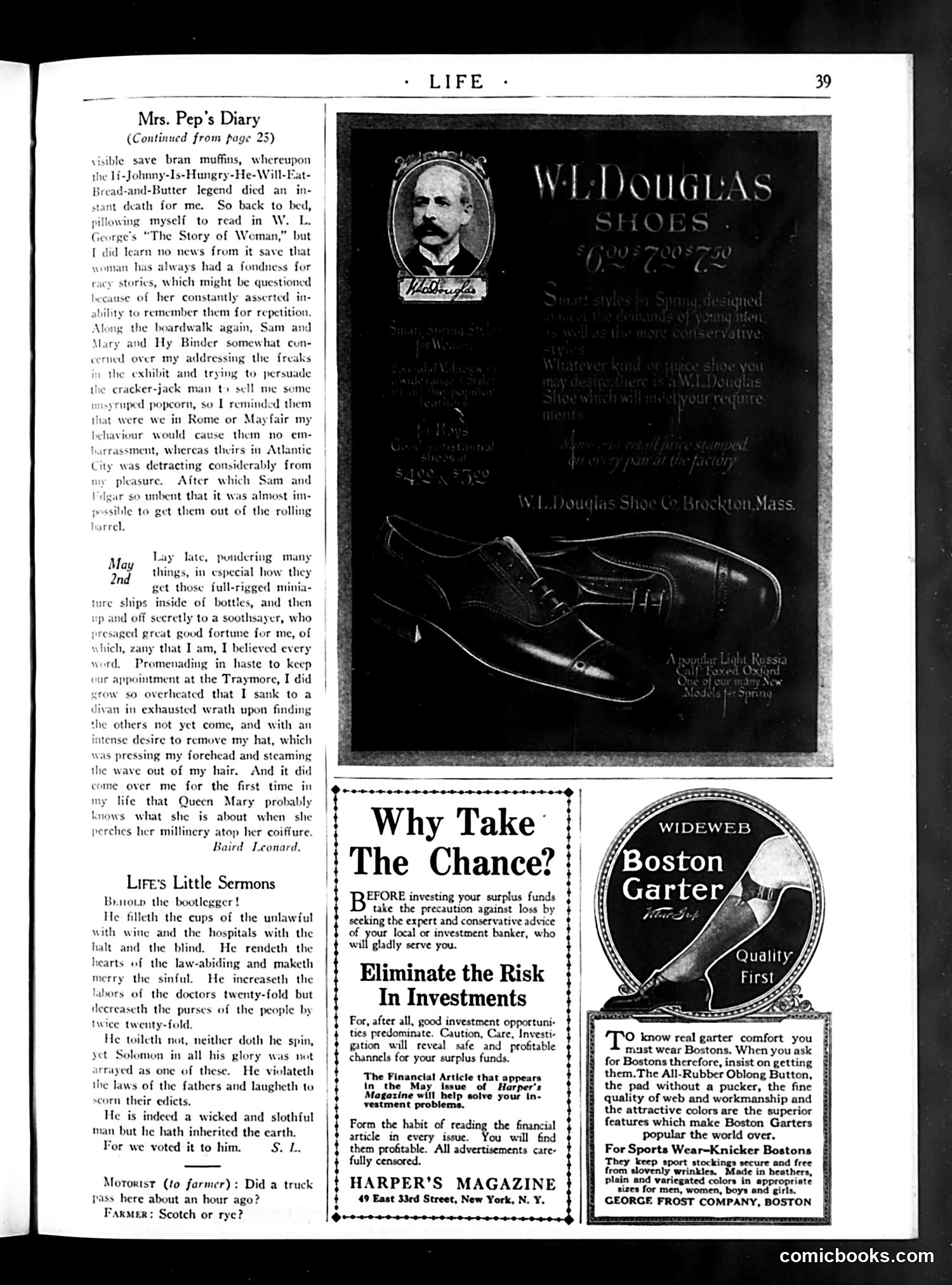
This page mixes satirical diary entries with advertisements and humor typical of *Life* magazine's format. **The Satire:** "Mrs. Pep's Diary" humorously chronicles Atlantic City vacationing, social pretensions, and petty observations (e.g., Queen Mary's hat-wearing). "Life's Little Sermons" uses faux-biblical language to mock Prohibition-era bootleggers—describing their lawlessness and hypocrisy with ironic reverence ("He hath inherited the earth"). A brief joke about a motorist asking a farmer if a truck passed by plays on Prohibition: the farmer asks "Scotch or rye?" (whiskey types), suggesting rural bootlegging. **The Advertisements:** Full-page shoe ads (W.L. Douglas, Boston Garter) and Harper's Magazine's investment advice represent typical commercial content. Notably, Harper's advertises financial guidance to protect "surplus funds"—relevant to 1920s economic concerns. **The Context:** This reflects post-WWI American culture: Prohibition's prevalence, economic anxieties, and the magazine's blend of intellectual satire with commercial interests.
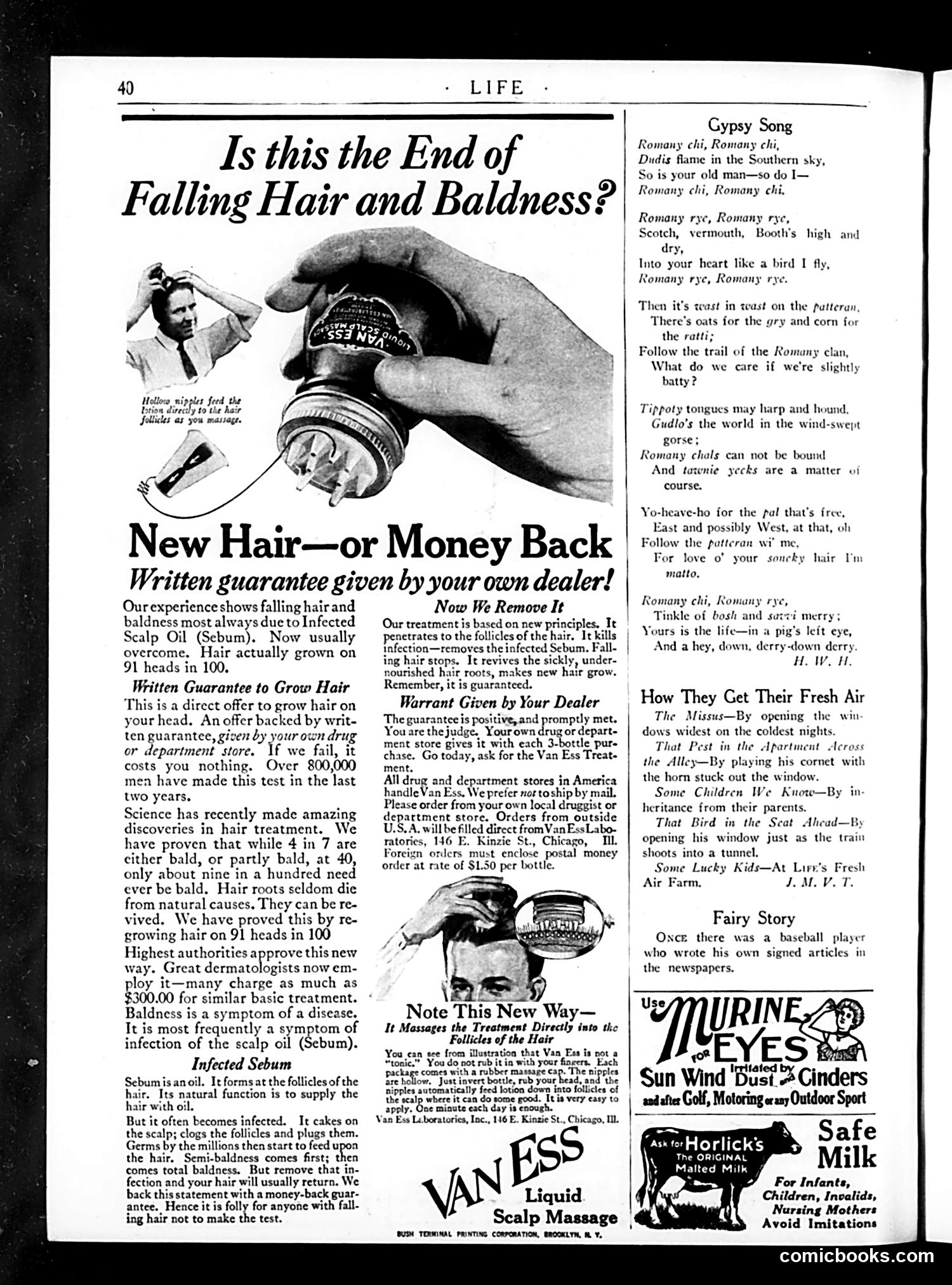
This page is primarily **advertising rather than satire or political commentary**. The dominant content is a Van Ess hair-growth treatment advertisement claiming to cure baldness through a new scientific method targeting "infected sebum" (scalp oil). The ad features testimonial language, a money-back guarantee, and an illustration of the product's massage cap applicator. The appeal targets insecure male readers—noting that "4 in 7" men are bald or partially bald by age 40—while promising that dermatologists charge $300 for similar treatments. This was characteristic of early-20th-century patent medicine marketing: pseudoscientific claims, manufactured urgency, and celebrity/authority endorsement. The page's sidebar contains a "Gypsy Song" and other brief content, but these are minor features. No political figures or satirical cartoons are present. This represents typical Life magazine space allocation: advertising subsidizing content production.
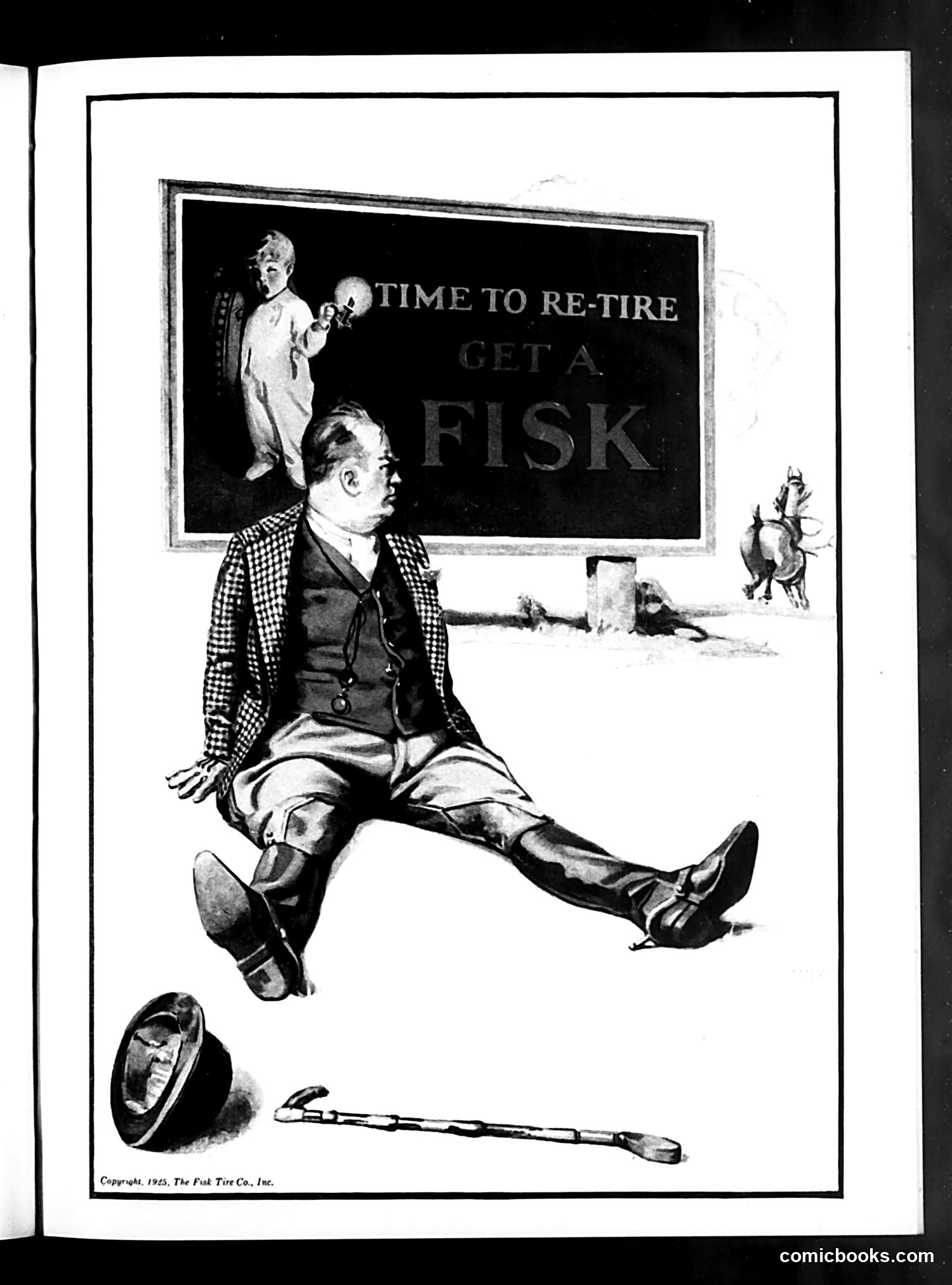
This is a **Fisk Tire advertisement** rather than political commentary. It features a rotund, middle-aged man in formal attire who has kicked off his shoes and appears exhausted or carefree. Behind him is a billboard reading "TIME TO RE-TIRE / GET A FISK." The ad uses a visual pun: "re-tire" (meaning to retire from work) plays on "tire" (the product). A small child and horse appear in the background, suggesting pastoral leisure. The discarded shoes and relaxed pose suggest retirement comfort and freedom. This reflects 1920s advertising strategy—using humor and wordplay to market consumer products to middle-class audiences. The imagery associates Fisk tires with successful leisure and rest, appeals common in post-WWI American advertising.
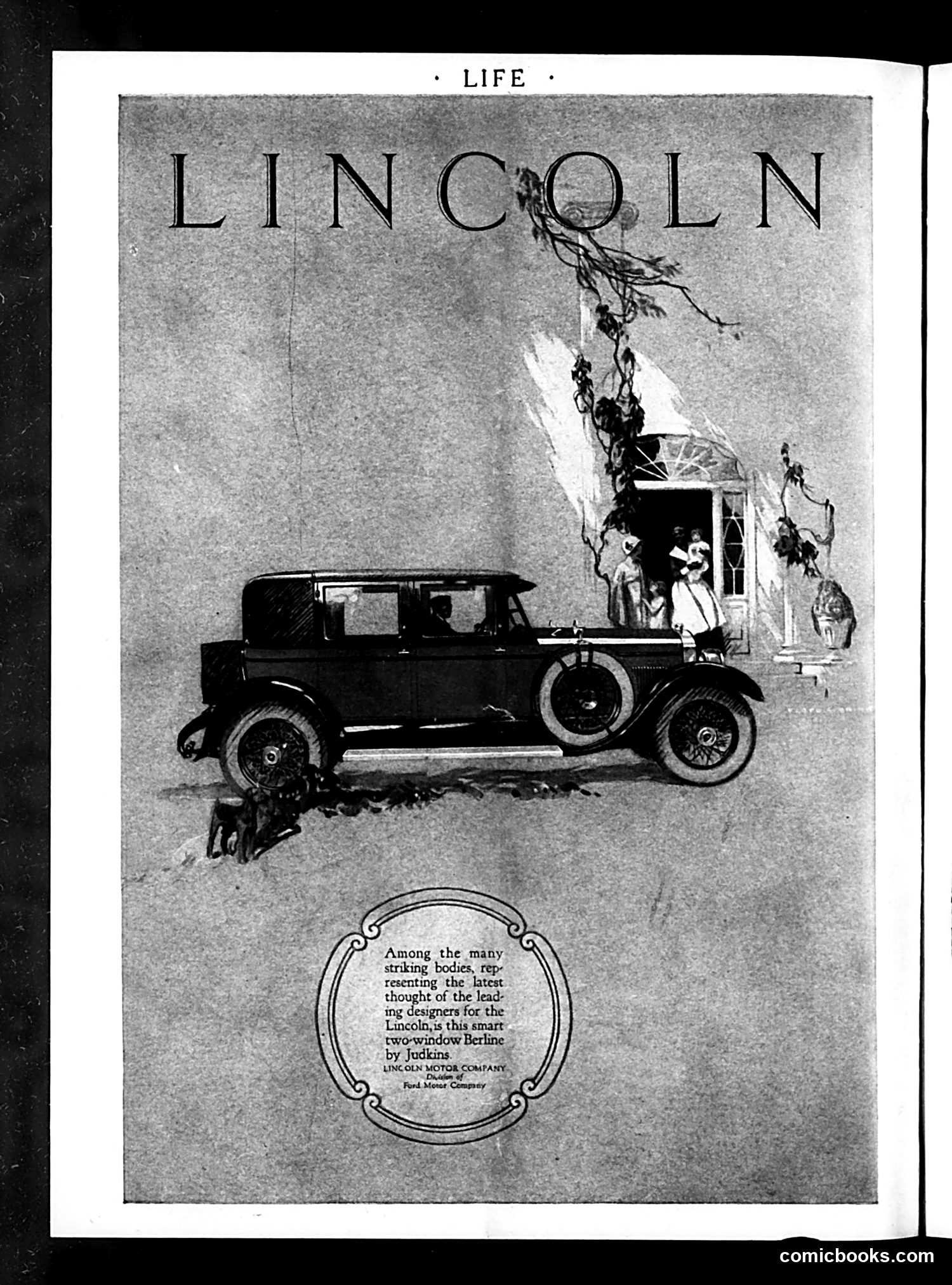
This is an advertisement for Lincoln automobiles, not political satire. The page features a luxury car—specifically a "two-window Berline by Judkins"—positioned as representing "the latest thought of the leading designers." The illustration depicts an elegant sedan parked before a mansion with climbing vines, emphasizing the vehicle's association with wealth and sophistication. The text credits both the Lincoln Motor Company and Ford Motor Company (Lincoln's parent), positioning this model as among many "striking bodies" available to discerning buyers. The advertisement targets affluent readers of *Life* magazine by linking automobile ownership to status and refined taste rather than making any satirical point.