
Life, 1925-05-07 · page 24 of 44
Life — May 7, 1925 — page 24: what you’re looking at
What you’re looking at
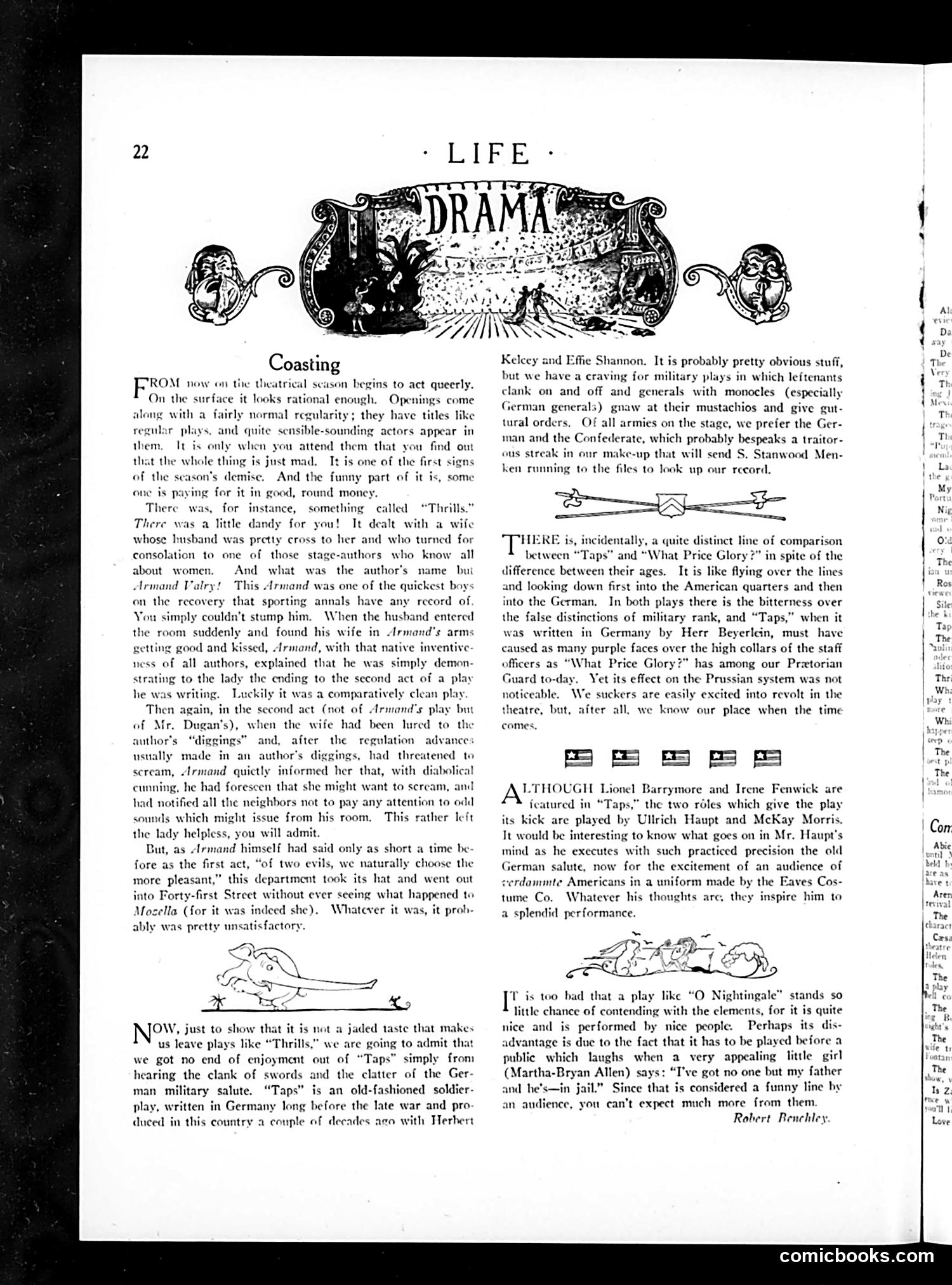
This theatrical review critiques contemporary Broadway plays, particularly mocking their absurd plots while defending others. The page discusses "Thrills," a play involving an author named Armand Valery who seduces a married woman by claiming he's "demonstrating" a play's ending to her—a transparent, ridiculous excuse the author expects audiences to accept. The reviewer admits enjoying "Taps," an old German military play, despite its melodramatic nature. The piece compares "Taps" to the more recent American play "What Price Glory?"—both critiques of military hierarchy and class distinctions, though "Taps" (pre-WWI German) challenged Prussian officer pretensions while "What Price Glory?" challenges American military pomposity. The satire targets both silly contemporary theatrical plots and critics' own inconsistent tastes—enjoying "Taps" while dismissing "Thrills," suggesting prejudice toward German culture despite appreciating German drama.
📄 Transcribed text from this page (OCR, searchable)
Machine-transcribed from the original scan — historical spelling and the odd misread are preserved.
Coasting ROM now on the theatrical season begins to act queerly. On the surface it looks rational enough. Openings come they have titles like regular plays, and quite sensible-sounding actors appear in them. It is only when you attend them that you find out that the whole thing is just mad. Tt is one of the first signs of the season's demise, And the funny part of it is, some one is paying for it in good, round money. There was, for instance, something called rill There was a little dandy for you! It dealt with a wife whose husband was pretty cross to her and who turned for age-authors who know all along with a fairly normal regularity consolation to one of those s' about women. And what was the author's name bui Armand Vatry! This Armand was one of the quickest boys on the recovery that sporting annals have any record of You simply couldn't stump him. When the husband entered the room suddenly and found his wife in Armand’s arms getting good and kis Irmand, with that native inventi ness of all authors, explained that he was simply demon- strating to the lady the ending to the second act of a play he was writing. Luckily it was a comparatively clean play Then again, in the second act (not of Armand’s play but of Mr. Dugan’s), when the wife had been lured to the author's “diggings” and, ter the regulation advances usually made in an author's diggings, had threatened to scream, “Irmand quictly informed her that, with diabolic cunning, he had forescen that she might want to scream, and ified all the neighbors not to pay any attention to odd sounds which might issue from his room. This rather left the lady helpless, you will admit. But, as lrmand himself had fore as the first “of two © more pleasant,” this department took its hat and went out into Forty-first Street without ever seeing what happened to Mozella (for it was indeed she). Whatever it was, it prob- ably was pretty unsatisfactory. ey BVRa 6 ZN YN had ne d only as short a time be- Is, we naturally choose the OW, just to show that it is not a jaded taste that makes us leave plays like “Thrills,” we are going to admit that we got no end of enjoyment out of “Taps” simply from hearing the clank of swords and the clatter of the Ger- man military salute. “Taps” is an old-fashioned soldier- play, written in Germany long before the late war and pro. duced in this country a couple of decades ara with Herbert Kelcey and Effie Shannon. It is probably pretty obvious stuff, but we have a craving for military plays in which leftenants clank on and off and generals with monocles (especially German generals) gnaw at their mustachios and give gut- tural orders, Of all armies on the stage, we prefer the Ger- man and the Confederate, which probably bespeaks a traitor- ous streak in our make-up that will send S. Stanwood Men- ken running to the files to look up our record. eo HERE is, incidentally betwee a quite distinct line of comparison aps” and “What Price Glory?” in spite of the difference between their ages. It is like flying over the lines and looking down first into the American quarters and then into the German. In both plays there is the bitterness over the false distinctions of military rank, and “Taps,” when it was written in Germany by Herr Beyerlein, must have caused as many purple faces over the high collars of the staff officers as “What Price Glory?” has among our Przetorian Guard to-day. Yet its effect on the Prussian system was not excited into revolt in the theatre, but, after all, we know our place when the time noticeable. We suckers are easily comes, LTHOUGH Lionel Barrymore and Irene Fenwick are featured in “Taps,” the two réles which give the play its kick are played by Ullrich Haupt and McKay Morris. It would be interesting to know what goes on in Mr. Haupt's mind as he executes with such practiced precision the old German salute, now for the excitement of an audience of verdammte Americans in a uniform made by the Eaves Cos- tume Co. Whatever his thoughts are, they inspire him to a splendid performance. | . is too bad that a play like “O Nightingale” stands so little chance of contending with the elements, for it is quite nice and is performed by nice people. Perhaps its dis- advantage is due to the fact that it has to be played before a public which laughs when a very appealing little girl (Martha-Bryan Allen) says: “I've got no one but my father and he’s—in jail.” Since that is considered a funny line by an audience, you can’t expect much more from them. Robert Renchley. te J comicbooks.com