
Life, 1925-05-07 · page 8 of 44
Life — May 7, 1925 — page 8: what you’re looking at
What you’re looking at
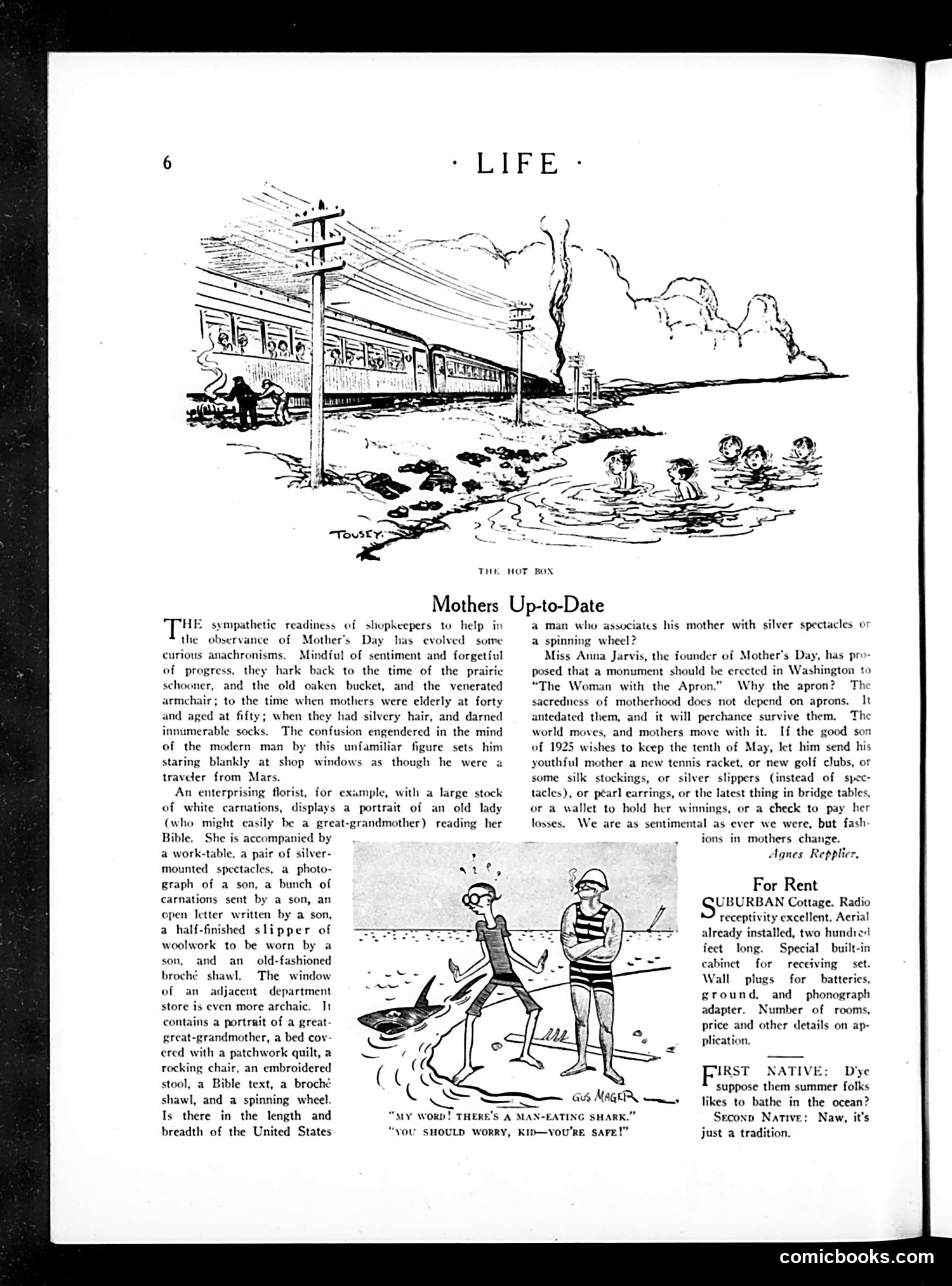
This page contains two distinct items: **"The Hot Box" (top illustration)**: A satirical cartoon showing a train passing children swimming in a nearby body of water. The caption reads "My word! There's a man-eating shark—you should worry, kid—you're safe!" The joke appears to mock parental reassurance during the early 20th century, suggesting that children swimming near railroad tracks faced worse dangers than sharks. **"Mothers Up-to-Date" (main article)**: Text discussing how modern mothers have evolved from their predecessors. It includes observations about florists, old-fashioned furnishings, and changing maternal values. A second cartoon shows two children at a beach; the joke contrasts "First Native" (wanting ocean bathing) with "Second Native" (accepting it as tradition). The page satirizes changing attitudes toward motherhood and childhood safety in contemporary society.
📄 Transcribed text from this page (OCR, searchable)
Machine-transcribed from the original scan — historical spelling and the odd misread are preserved.
“Tousty. THE HOT BOX Mothers Up-to-Date HE. sympathetic readiness of shopkeepers to help in the observance of Mother's Day has evolved some curious anachronisms. Mindful of sentiment and forgetful of progress, they hark back to the time of the prairie schooner, and the old oaken bucket, and the venerated armchair; to the time when mothers were elderly at forty and aged at fifty; when they had silvery hair, and darned innumerable socks. The confusion engendered in the mind of the modern man by this unfamiliar figure sets him staring blankly at shop windows as though he were a traveler from Mars. An enterprising florist, for example, with a large stock of white carnations, displays a portrait of an old lady (who might easily be a great-grandmother) reading her Bible. She is accompanied by a work-table, a pair of silver- mounted spectacles, a photo- graph of a son, a bunch of carnations sent by a son, an open letter written by a son, a man who associates his mother with silver spectacles or a spinning wheel? Miss Anna Jarvis, the founder of Mother's Day, has pro- posed that a monument should be erected in Washington to “The Woman with the Apron.” Why the apron? The sacredness of motherhood docs not depend on aprons. It antedated them, and it will perchance survive them. The world moves, and mothers move with it. If the good son of 1925 wishes to keep the tenth of May, Iet him send his youthful mother a new tennis racket, or new golf clubs, or some silk stockings, or silver slippers (instead of spec- tacles), or péarl earrings, or the latest thing in bridge tables, or a wallet to hold her winnings, or a check to pay her We are as sentimental as ever we were, but fash , ions in mothers change. Agnes Replies. For Rent UBURBAN Cottage. Radio receptivity excellent. Aerial losses. a half-finished slipper of woolwork to be worn by a son, and an old-fashioned broché shawl. The window of an adjacent department store is even more archaic. It contains a portrait of a great- great-grandmother, a bed cov- ered with a patchwork quilt, a rocking chair, an embroidered stool, a Bible text, a broché shawl, and a spinning wheel. Is there in the length and breadth of the United States “MY WORD! THERE'S A 3 “YOU SHOULD WORRY, KID—YOU’RE SAFE!” already installed, two hundre fect long. Special built-in cabinet for receiving _ set. Wall plugs for batteries, ground, and phonograph adapter. Number of rooms, price and other details on ap- plication. IRST NATIVE: D'ye suppose them summer folks likes to bathe in the ocean? Stconp Native: Naw, it’s just a tradition. Gus Mage AN-EATING SHARK.” comicbooks.com