
Life, 1925-05-07 · page 20 of 44
Life — May 7, 1925 — page 20: what you’re looking at
What you’re looking at
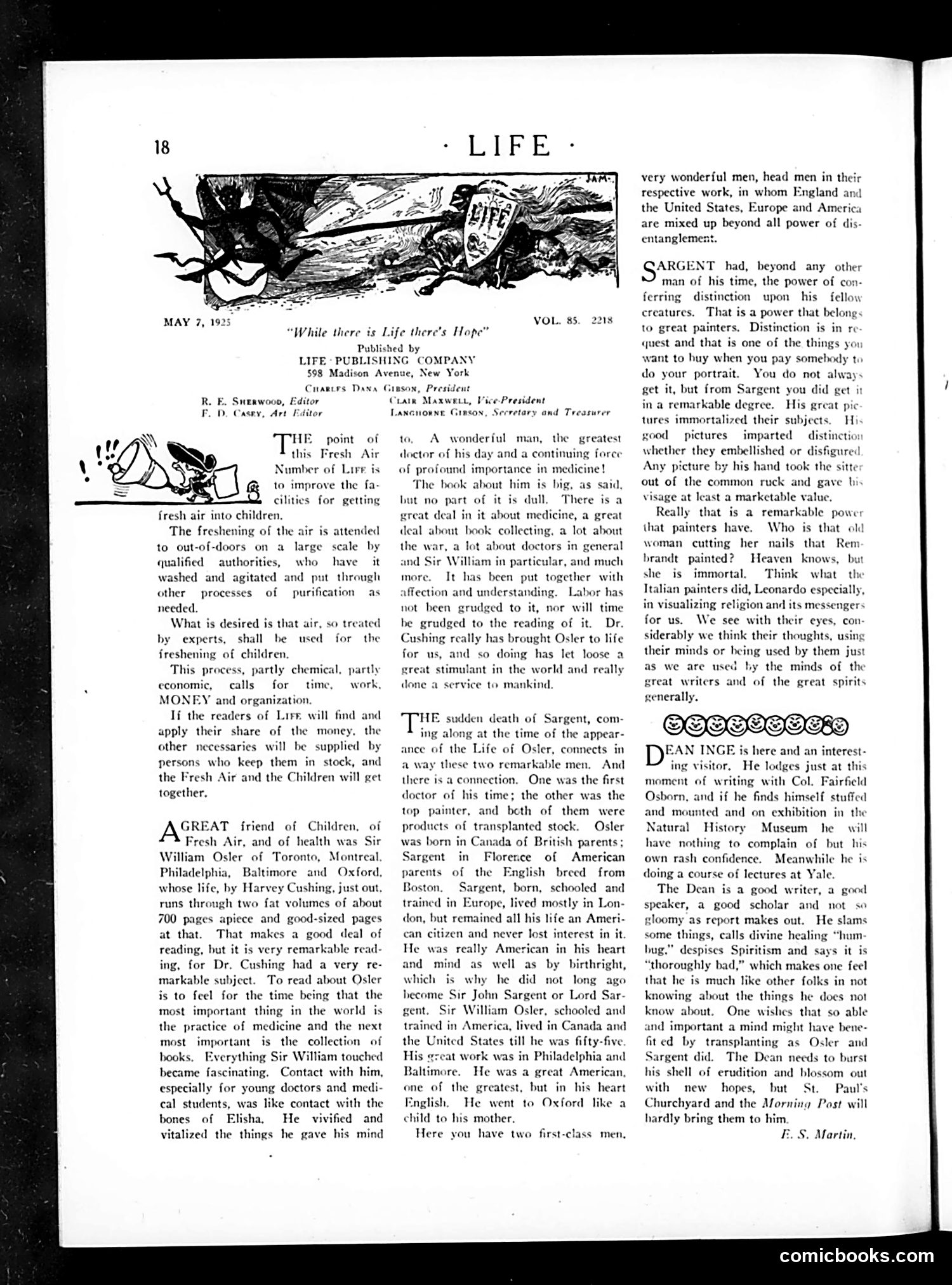
This page is primarily **editorial content, not satire**. The small cartoon at top ("While there is Life there's Hope") appears generic—showing a figure amid debris—likely illustrating the "Fresh Air Number" theme about improving children's health through outdoor air exposure. The main content celebrates two recently deceased figures: **Sir William Osler** (a famous Canadian-born physician) and **John Singer Sargent** (the renowned American-born painter). The editor contrasts these "transplanted" men of distinction—Osler trained in America but remained English at heart; Sargent trained in Europe but remained American at heart. The piece argues both men exemplified how talent transcends nationality, representing the shared cultural inheritance between England and America. This reflects early 20th-century Anglo-American cultural pride and the idea that great figures belong to both nations. The "Fresh Air" editorial preceding this likely advocates for children's health initiatives—a progressive-era concern.
📄 Transcribed text from this page (OCR, searchable)
Machine-transcribed from the original scan — historical spelling and the odd misread are preserved.
MAY 7, 19. “While there is Life there's Hope Published by LIFE: PUBLISHING COMPANY $98 Madison Avenue, New York Crartrs Dawa Giesox, Presi R. E. Sueawooo, Editor F.D. Casny, Art Editor HE point of this Fresh Air Number of Lire is to improve the fa cilities for getting fresh air into children, The freshening of the air is attended to out-of-doors on a large scale by qualified authorities, have it washed and agitated and put through other purification as needed. who processes of What is desired is that air, so treated by experts, shall be freshening of children. used for the This process, partly chemical, partly economic, calls for — time, MONEY and organization. If the readers of Lirr will find and apply their share of the money, the other necessaries will be supplied by persons who keep them in. stock, and the Fresh Air and the Children will get together, work GREAT friend of Children, of Fresh Air, and of health was Sir William Osler of Toronto, Montreal. Philadelphia, Baltimore and Oxford, whose life, by Harvey Cushing, just out. runs through two fat volumes of about 700 pages apiece and good-sized pages at that. That makes a good deal of reading, but it is very remarkable read- ing, for Dr. Cushing had a very re- markable subject. To read about Osler is to feel for the time being that the most important thing in the world is the practice of medicine and the next most important is the collection of hooks. Everything Sir William touched became fascinating. Contact with him, especially for young doctors and medi- cal students, was like contact with the bones of Elisha. He vivified and vitalized the things he gave his mind Cram Maxweit, Vi Lancnomne € President Bson, Secretary and Treasurer to. A wonderful doctor of his day of profound importance in medicine! man, the greatest and a continuing force The book about him is big, as said, but no part of it is dull. There is a great deal in it about medicine, a great deal about | the war, a lot a and Sir V more. « collecting, a lot about out doctors in general illiam in particular, and much It has been put together with affection and understanding. Labor has not been grudged to it, nor will time be grudged to the reading of it. Dr. Cushing really has brought Osler to life for us, and so doing has let loose a great stimulant in the world and really done a service to mankind. HE. sudden death of Sargent, com- ing along at the time of the appear- ance of the Life of Osler, connects in a way these two remarkable men. And there is a connection. One was the first doctor of his time; the other was the top painter, and beth of them were products of transplanted stock. Osler was born in Canada of British parent argent in Florence of American parents of the English breed from Boston, Sargent, born, schooled and trained in Europe, lived mostly in Lon- don, but remained all his life an Ameri- can citizen and never lost interest in it He was really American in his heart and mind as well as by birthright, which is he did not long ago hecome Sir John Sargent or Lord Sar- gent. Sir William Osler, schooled and trained in America, lived in Canada and the United States till he fifty-five. His ¢reat work was in Philadelphia and Baltimore. He was a great American, one of the greatest, but in his heart English, He went to Oxford like a child to his mother. why Here you have two first-class men, very wonderful men, head men in their respective work, in whom England and the United States, Europe and America are mixed up beyond all power of dis entanglement. ARGENT had, beyond any other man of his time, the power of con- ferring distinction upon his fellow creatures. That is a power that belongs to great painters, Distinction is in r¢ quest and that is one of the things you want to huy when you pay somebody to do your portrait. You do not always get it, but from Sargent you did get it in a remarkable degree. His great pic tures immortalized their subjects. Hi good pictures imparted — distinctior whether they embellished or disfigured Any picture by his hand took the sitte out of the common ruck and gave b visage at Ieast a marketable value. Really that is a remarkable power that painters have. Who is that old woman cutting her nails that brandt painted? Heaven knows, but she is immortal. Think what the Italian painters did, Leonardo especially, in visualizing religion and its messengers for us. We see with their ¢: siderably we think their thoughts, using their minds or heing used by them just as we are used hy the minds of the great writers and of the great spirits generally, OC SSCSIeSe D 2AN INGE is here and an interest- ing visitor, He lodges just at this moment of writing with Col. Fairfield Osborn, and if he finds himself stuffed and mounted and on exhibition in the Natural History Museum he will have nothing to complain of but his own rash confidence. Meanwhile he is doing a course of lectures at Yale. The Dean is a good writer, a good speaker, a good scholar and not so gloomy as report makes out. He slams some things, calls divine healing “hum bug,” despises Spiritism and says it is “thoroughly bad,” which makes one feel that he is much like other folks in not knowing about the things he does not know about. One wishes that so able and important a mind might have bene- fited by transplanting as Osler and Sargent did. The Dean needs to burst his shell of erudition and blossom out with new hopes, but St. Paul's Churchyard and the Morning Post will hardly bring them to him. F. S. Martin. Rem. comicbooks.com