
Life, 1925-05-07 · page 28 of 44
Life — May 7, 1925 — page 28: what you’re looking at
What you’re looking at
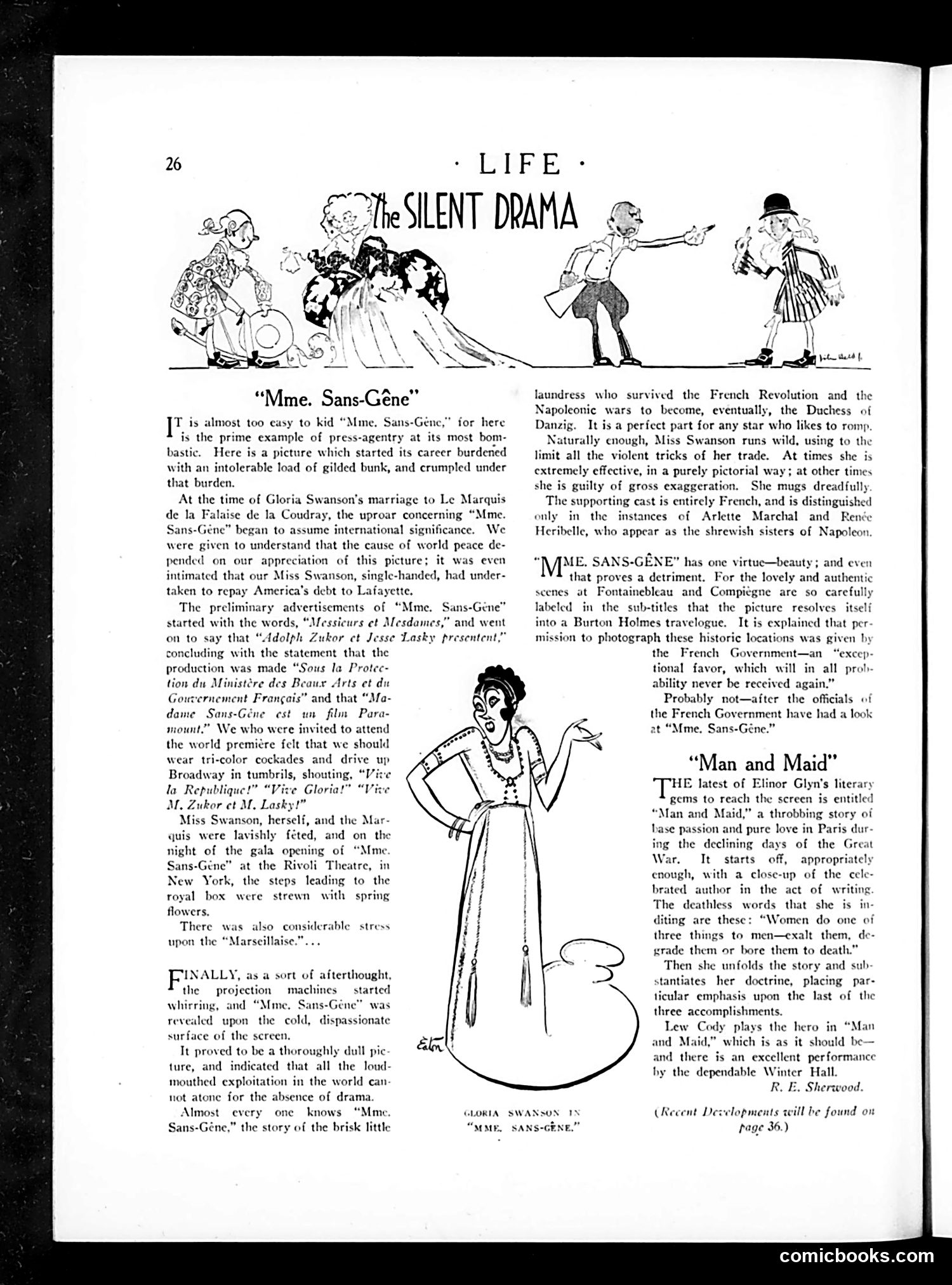
This page critiques the film "Mme. Sans-Géne," starring Gloria Swanson. The satire targets excessive movie studio publicity rather than the film itself. **The Setup:** Paramount Pictures promoted this French historical comedy with enormous fanfare, especially after Swanson's marriage to a French marquis. Studios claimed the film served American-French diplomatic interests and required government protection. **The Joke:** Despite all the elaborate marketing—tri-color cockades, official French sponsorship, gala premiere at the Rivoli Theatre with flower-strewn steps—the actual film proved "thoroughly dull." The review argues that no amount of "loud-mouthed exploitation" compensates for absent drama. **The Point:** Life ridicules how studios weaponized patriotism and European prestige to sell mediocre entertainment. The cartoon header emphasizes this gap between hype and reality. The piece also briefly reviews "Man and Maid," noting similar hollow pretension in Elinor Glyn's literary adaptation.
📄 Transcribed text from this page (OCR, searchable)
Machine-transcribed from the original scan — historical spelling and the odd misread are preserved.
‘ BIFE “Mme. Sans-Géne” T is almost too casy to kid “Mme. Sans-Gene,” for here is the prime example of press-agentry at its most bom- bastic. Here is a picture which started its career burdened with an intolerable load of gilded bunk, and crumpled under that burden. At the time of Gloria Swanson’s marriage to Le Marquis de la Falaise de la Coudray, the uproar concerning “Mme. Sans-Géne” began to assume international significance. We were given to understand that the cause of world peace de- pended on our appreciation of this picture; it was even intimated that our Miss Swanson, single-handed, had under- taken to repay America’s debt to Lafayette, The preliminary advertisements of “Mme. Sans-Gine” started with the words, “Messicurs et Mesdames,” and went on to say that “Adolph Zukor ct Jesse Lasky presentent,” concluding with the statement that the production was made “Sous la Protec- tion du Ministére des Beaux Arts et du Gouvernement Francais” and that “Ma- dame Sans-Géne est un film Para- mount.” We who were invited to attend the world premiére felt that we should wear tri-color cockades and drive up Broadway in tumbrils, shouting, “Vi: la Republique!” “Vive Gloria!” “Vive M. Zukor ct M. Lasky!” Miss Swanson, herself, and the Mar- quis were lavishly féted, and on the night of the gala opening of “Mme. Sans-Géne” at the Rivoli Theatre, in New York, the steps leading to the royal box strewn with spring flowers. There upon the “Marseillaise.”... were was also considerable stress INALLY, the whirring, and “ a sort of afterthought, projection machines started “Mme, Sans-Géne™ upon the cold, surface of the screen, It proved to be a thoroughly dull pic ture, and indicated that all the loud- mouthed exploitation in the world can not atone for the absence of drama. Almost every knows “Mme. Sans-Géne,” the story of the brisk little was revealed dispassionate one GLORIA ME. SWANSON 1 ENE. SAN The SILENT DRAMA laundress who survived the French Revolution and the Napoleonic wars to become, eventually, the Duchess of Danzig. It is a perfect part for any star who likes to romp. Naturally enough, Miss Swanson runs wild, using to the limit all the violent tricks of her trade. At times she is extremely effective, in a purely pictorial w at other times she is guilty of gross exaggeration. She mugs dreadfully The supporting cast is entirely French, and is distinguish only in the instances of Arlette Marchal and Renée Heribelle, who appear as the shrewish sisters of Napoleon. “VME SANS-GENE” has one virtue—beauty; and even that proves a detriment. For the lovely and auther scenes at Fontainebleau and Compi¢gne are so carefull labeled in the sub-titles that the picture resolves into a Burton Holmes travelogue. It is explained that per- mission to photograph these historic locations was given by the French Government—an “excep- tional favor, which will in all prob- ability never be received again.” Probably not—after the officials of the French Government have had a look at “Mme. Sans-Géne.” ‘Man and Maid” THE latest of Elinor Glyn’s literary gems to reach the screen is entitled “Man and Maid,” a throbbing story of base passion and pure love in Paris dur- ing the declining days of the Great War. It starts off, appropriately enough, with a close-up of the cele- brated author in the act of writing The deathless words that she diting are these: “Women do one of three things to men—exalt them, de- grade them or bore them to death.” Then she unfolds the story and sub stantiates her doctrine, placing par- ticular emphasis upon the t of the three accomplishments. Lew Cody plays the hero in “Man and Maid,” which is as it should be— and there is an excellent performance hy the dependable Winter Hall. R. E, Sherwood. itsel is in (Recent Developments will be found on page 36.) comicbooks.com