
Life, 1925-05-07 · page 18 of 44
Life — May 7, 1925 — page 18: what you’re looking at
What you’re looking at
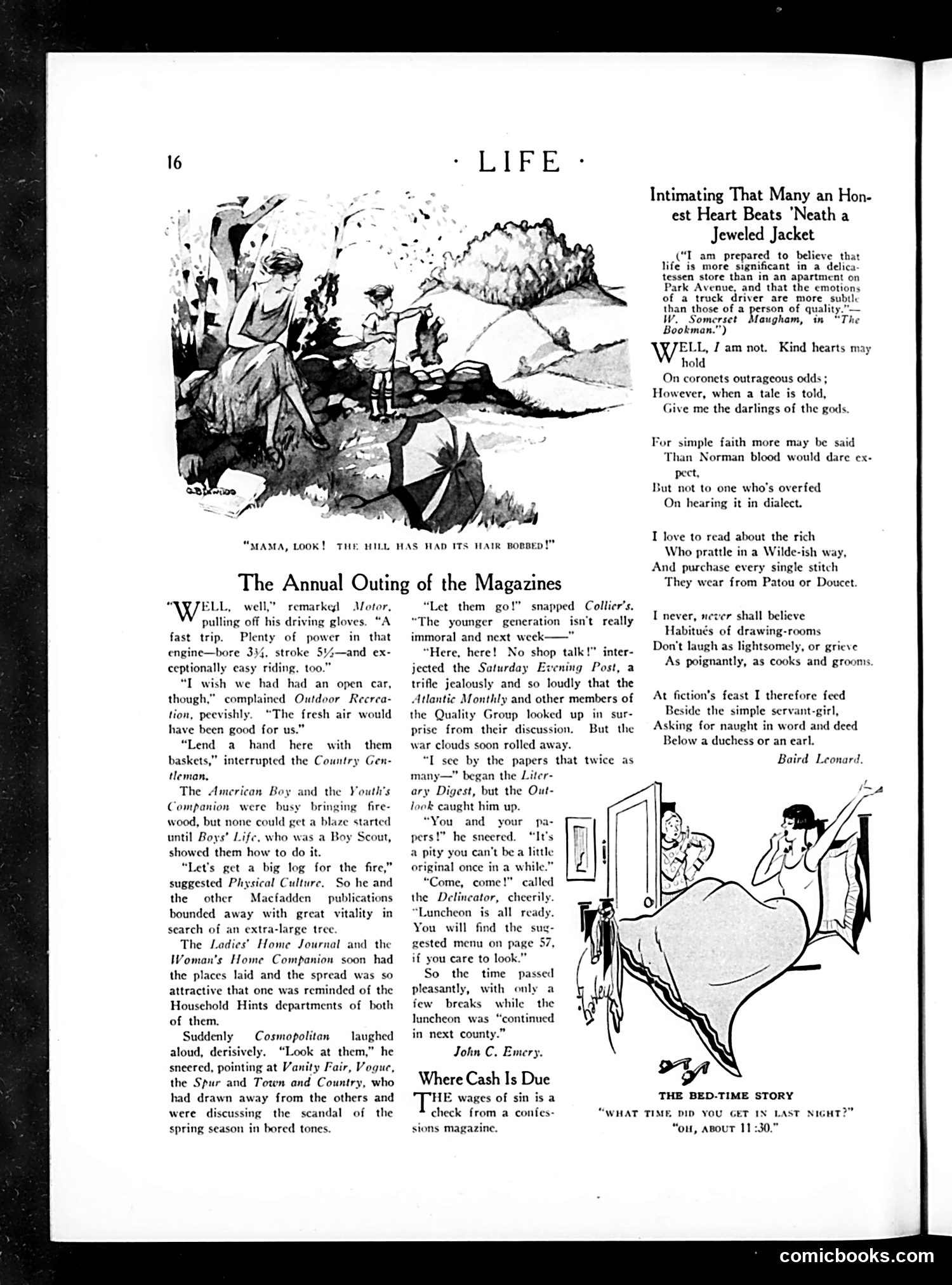
This satirical story personifies major American magazines of the era as characters on a picnic outing. Each publication is characterized by its editorial identity: *Motor* boasts about engines; *Outdoor Recreation* seeks fresh air; *Physical Culture* (a Macfadden publication) displays athletic vigor; *Ladies' Home Journal* and *Woman's Home Companion* excel at domestic arrangements. The satire targets class divisions in publishing. Fashion magazines (*Vogue*, *Vanity Fair*, *Town and Country*) snobbishly distance themselves, discussing "scandal" in "bored tones." Quality publications (*Atlantic Monthly*, *Saturday Evening Post*) jealously guard their prestige. Trade publications like *Literary Digest* and *Outlook* squabble over circulation claims. The humor lies in personifying these magazines' predictable editorial voices and competitive hierarchies—showing how different publications served distinct social classes and reader demographics, each maintaining its carefully cultivated identity even in leisure.
📄 Transcribed text from this page (OCR, searchable)
Machine-transcribed from the original scan — historical spelling and the odd misread are preserved.
“MAMA, LOOK! THE MILL HAS HAD ITS HAIR BopsED!” The Annual Outing of the Magazines as ELL, well,” remarkegl Motor, pulling off his driving gloves. “A fast trip. Plenty of power in that engine—bore 334, stroke 5Y%—and ex- ceptionally easy riding, too.” “I wish we had had an open car, though,” complained Outdoor Reerea- tion, peevishly. “The fresh air would have been good for us.” “Lend a hand here with them baskets,” interrupted the Country Gen- tleman, The American Boy and the Youth's Companion were busy bringing fire- wood, but none could get a blaze started until Boys’ Life, who was a Boy Scout, showed them how to do it. “Let's get a big log for the fire,” suggested Physical Culture. So he and the other Macfadden publications bounded away with great vitality in search of an extra-large tree. The Ladies’ Home Journal and the Woman's Home Companion soon had the places laid and the spread was so attractive that one was reminded of the Household Hints departments of both of them, Suddenly Cosmopolitan laughed aloud, derisively. “Look at them,” he sneered, pointing at Vanity Fair, Vogue, the Spur and Town and Country, who had drawn away from the others and were discussing the scandal of the spring season in bored tones. “Let them go!” snapped Collier's. “The younger generation isn't really immoral and next week: = “Here, here! No shop talk!” inter- jected the Saturday ning Post, a trifle jealously and so loudly that the Atlantic Monthly and other members of the Quality Group looked up in sur- prise from their discussion. But the war clouds soon rolled away. “I see by the papers that twice as many began the Liter- ary Digest, but the Out- look caught him up. “You and your pa- pers!” he sneered. “It’s a pity you can't be a little original once in a while.” “Come, come!” called the Delineator, cheerily. “Luncheon is all ready. You will find the sug- gested menu on page 57, if you care to look.” So the time passed pleasantly, with only a few breaks while the luncheon was “continued in next county.” John C. Emery. Where Cash Is Due HE wages of sin is a check from a confes- sions magazine. Intimating That Many an Hon- est Heart Beats ‘Neath a Jeweled Jacket CT am prepared to believe that life is more significant in a delics tessen store than in an apartment on Park Avenue, and that the emotions of a truck driver are more subtle than those of a person of quality W. Somerset’ Maugham, in Bookman.”) ELL, J am not. Kind hearts may hold On coronets outrageous odds ; However, when a tale is told, e me the darlings of the gods. For simple faith more may be said Than Norman blood would dare ex- pect, But not to one who's overfed On hearing it in dialect. I love to read about the rich Who prattle in a Wilde-ish way, And purchase every single stitch They wear from Patou or Doucet. I never, never shall believe Habitués of drawing-rooms Don't laugh as lightsomely, or grieve As poignantly, as cooks and grooms. At fiction’s feast I therefore feed Beside the simple servant-girl, Asking for naught in word and deed Below a duchess or an earl. Baird Leonard. a THE BED-TIME STORY “WHAT TIME DID YOU GET IN LAST NIGHT?” “ou, aout 11:30.” comicbooks.com