
A complete issue · 72 pages · 1924
Life — December 4, 1924
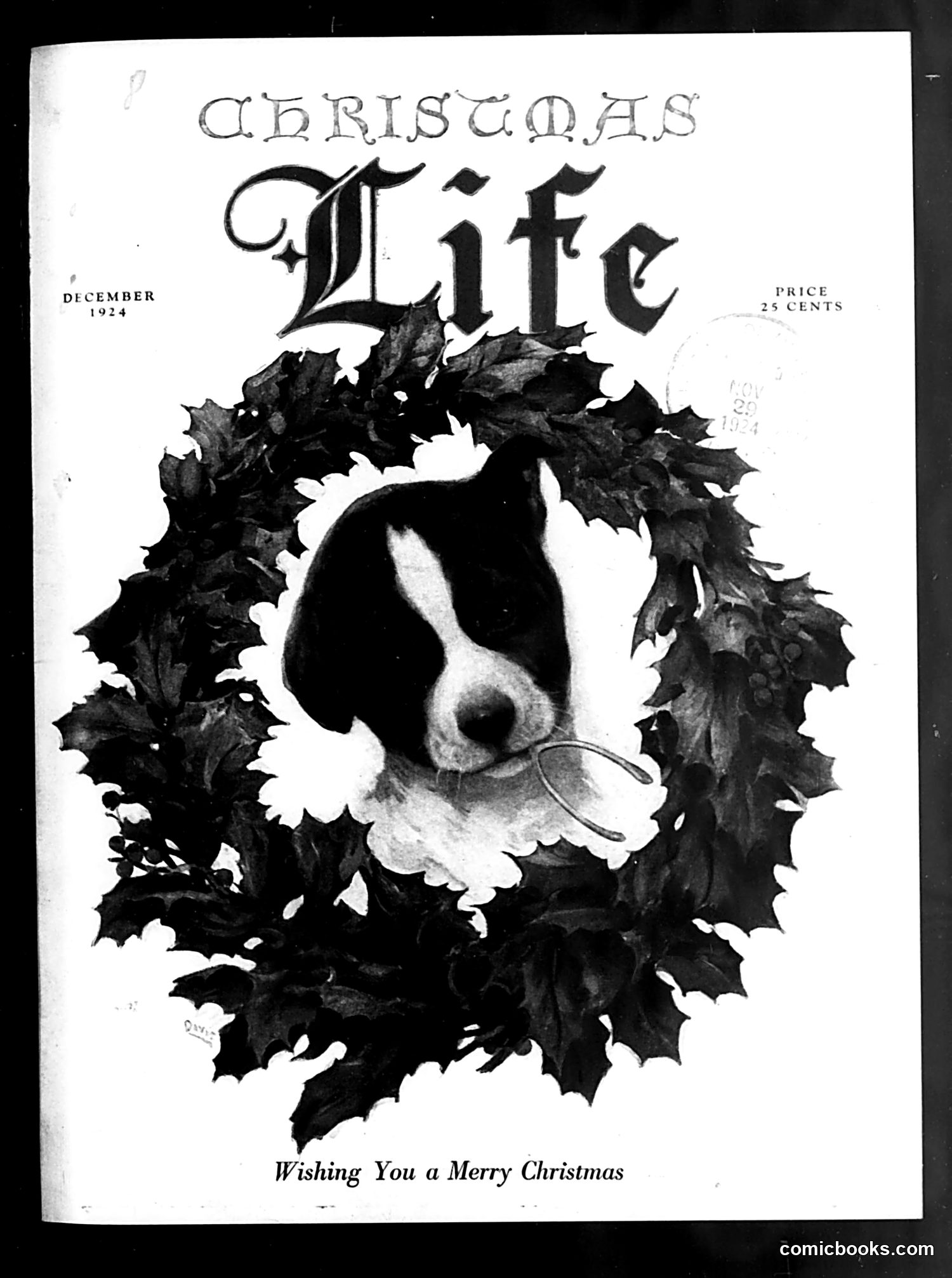
This is a straightforward Christmas greeting cover featuring a dog's head surrounded by holly leaves and berries. The dog appears to be a spaniel or similar breed, rendered in a sentimental style typical of 1920s magazine illustration. The cover contains no political satire or social commentary. Instead, it's a seasonal greeting card design—common for Life's December issues. The message "Wishing You a Merry Christmas" is purely festive. At 25 cents, this was Life's standard price at the time. The image represents the magazine's shift toward lighter, humaninterest content during the holiday season, rather than the satirical political commentary Life was known for during other months.
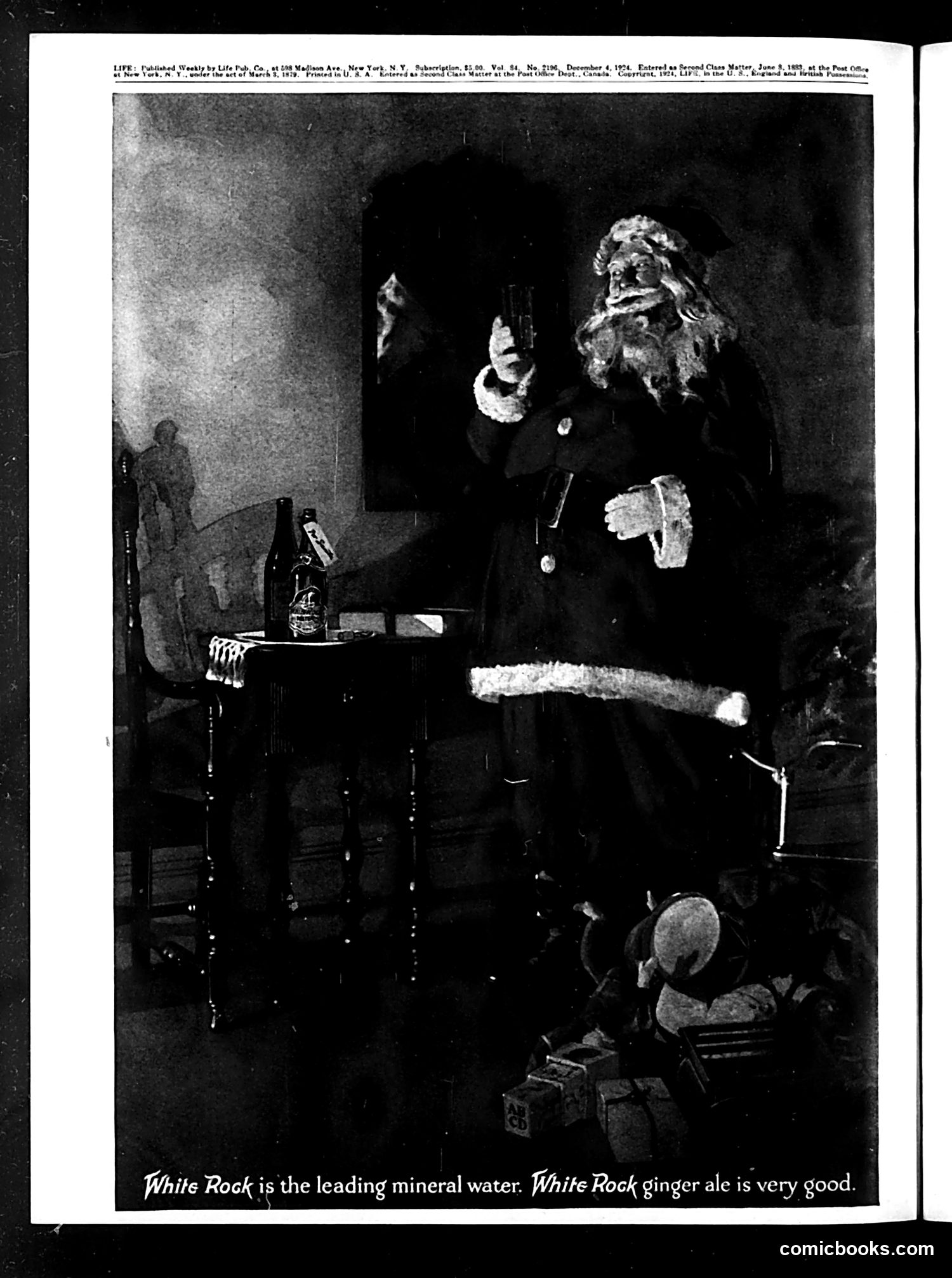
This appears to be primarily a **White Rock beverage advertisement** rather than political satire or comics content. The image shows two figures in what seems to be a theatrical or dramatic scene—a bearded man in period costume and a smaller figure (possibly a child or character in costume) in an interior setting. The text at bottom reads: "White Rock is the leading mineral water. White Rock ginger ale is very good." The dramatic staging and costumes suggest the ad uses theatrical entertainment or storytelling to promote the brand, a common early 20th-century advertising technique. Without additional context about which Life issue this is from or what narrative this depicts, the specific theatrical reference remains unclear. The page functions primarily as a product advertisement rather than social or political commentary.
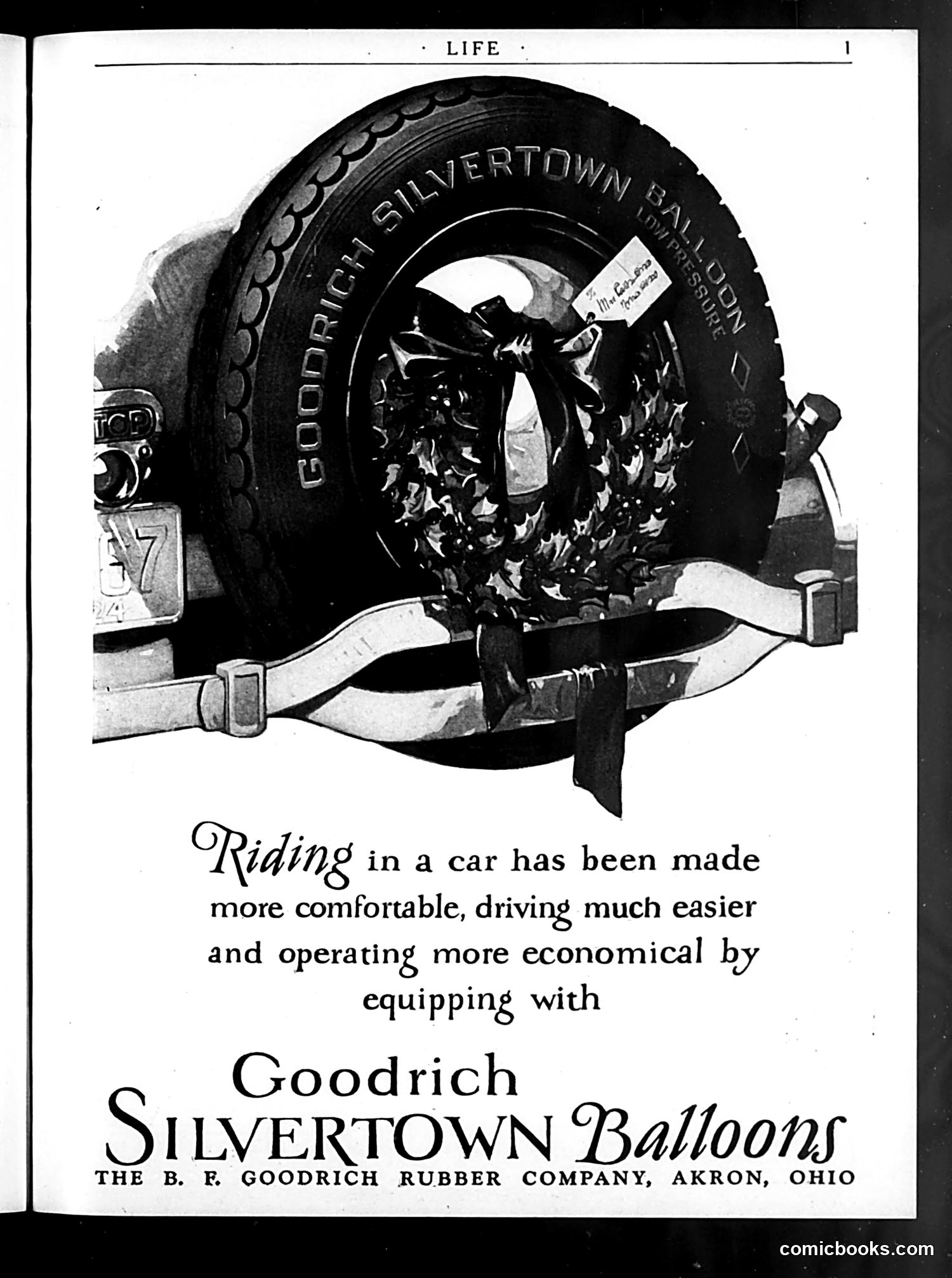
This is a **straightforward advertisement, not satire or political commentary**. It promotes Goodrich Silvertown Balloons (tires) from the B.F. Goodrich Rubber Company in Akron, Ohio. The image shows a large tire being held by two hands, with text claiming the product makes car riding "more comfortable, driving much easier and operating more economical." There is no political cartoon, caricature, or satirical joke present. The "Life" magazine masthead indicates this appeared in the publication, but the content is purely commercial advertising typical of early-to-mid 20th century magazines, which regularly mixed editorial content with advertisements. A modern reader would simply see it as a vintage tire ad making product claims through visual appeal.
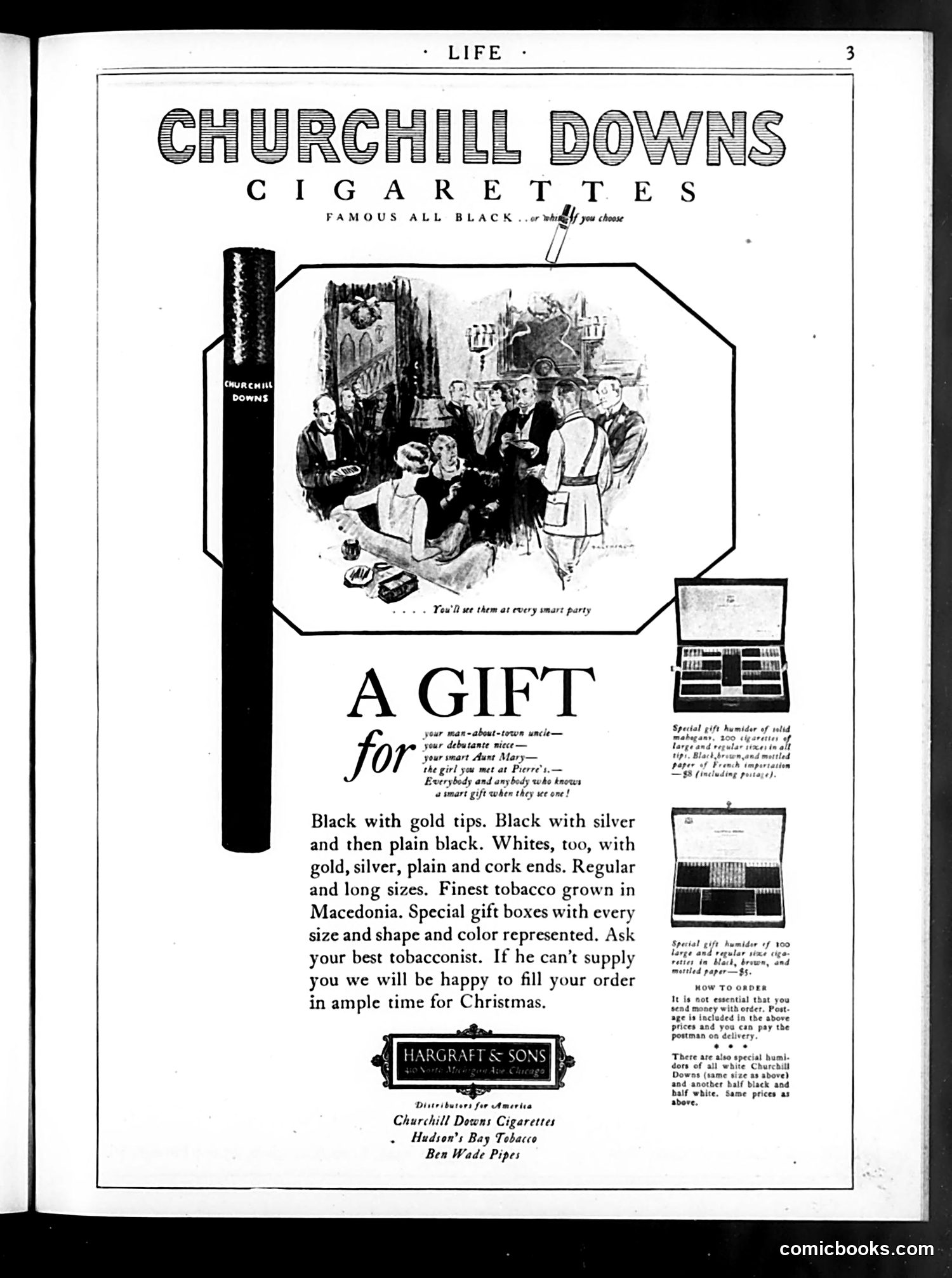
This is primarily a **cigarette advertisement**, not political satire. The ad promotes "Churchill Downs" brand cigarettes as an ideal gift, with the tagline "You'll see them at every smart party." The illustration depicts a sophisticated social gathering of well-dressed men and women in what appears to be an elegant interior, establishing the product's association with high-class society and refinement. The advertisement emphasizes variety—offering black cigarettes with gold or silver tips, white cigarettes with similar finishes, multiple sizes, and special gift boxes. It claims the tobacco is "Finest...grown in Macedonia" and directs customers to tobacconists or to order directly. The distributor was **Hargraft & Sons** of New York. This represents typical early-20th-century luxury goods marketing targeting affluent consumers.
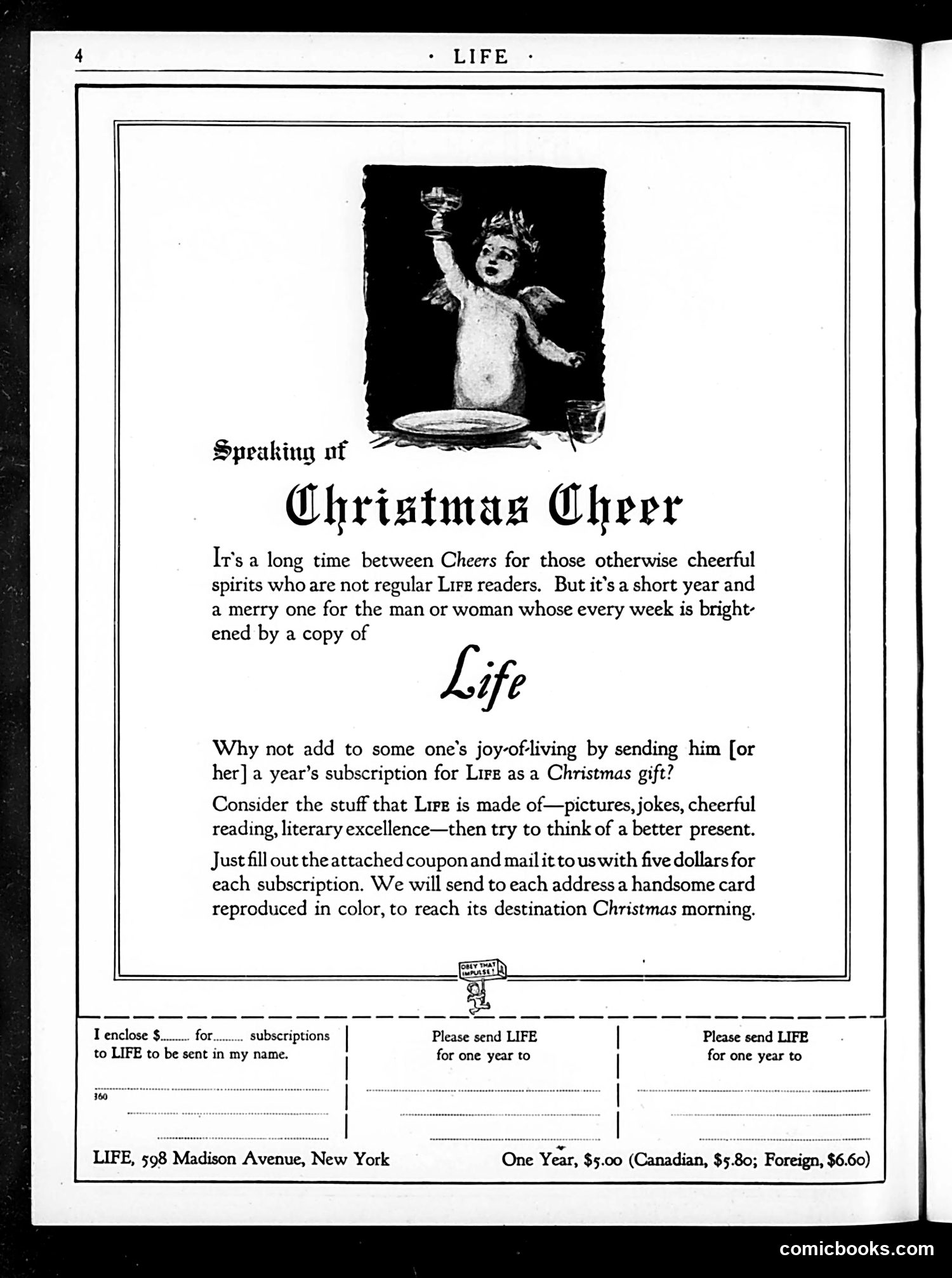
This page is primarily a **Christmas subscription advertisement** for *Life* magazine itself, not political satire or commentary. The illustration shows a **cherub or putti** (classical baby angel figure) holding aloft what appears to be a torch or light source, positioned above a plate—visualizing the metaphorical concept of bringing "cheer" into one's home. The ad argues that a year-long *Life* subscription ($5.00) makes an ideal Christmas gift because the magazine delivers "pictures, jokes, cheerful reading, literary excellence" weekly throughout the year. It promises the recipient will receive a handsome color Christmas card when the subscription is ordered. This is essentially a mid-century gift-giving pitch capitalizing on holiday shopping, positioning the magazine as a source of domestic joy and entertainment.
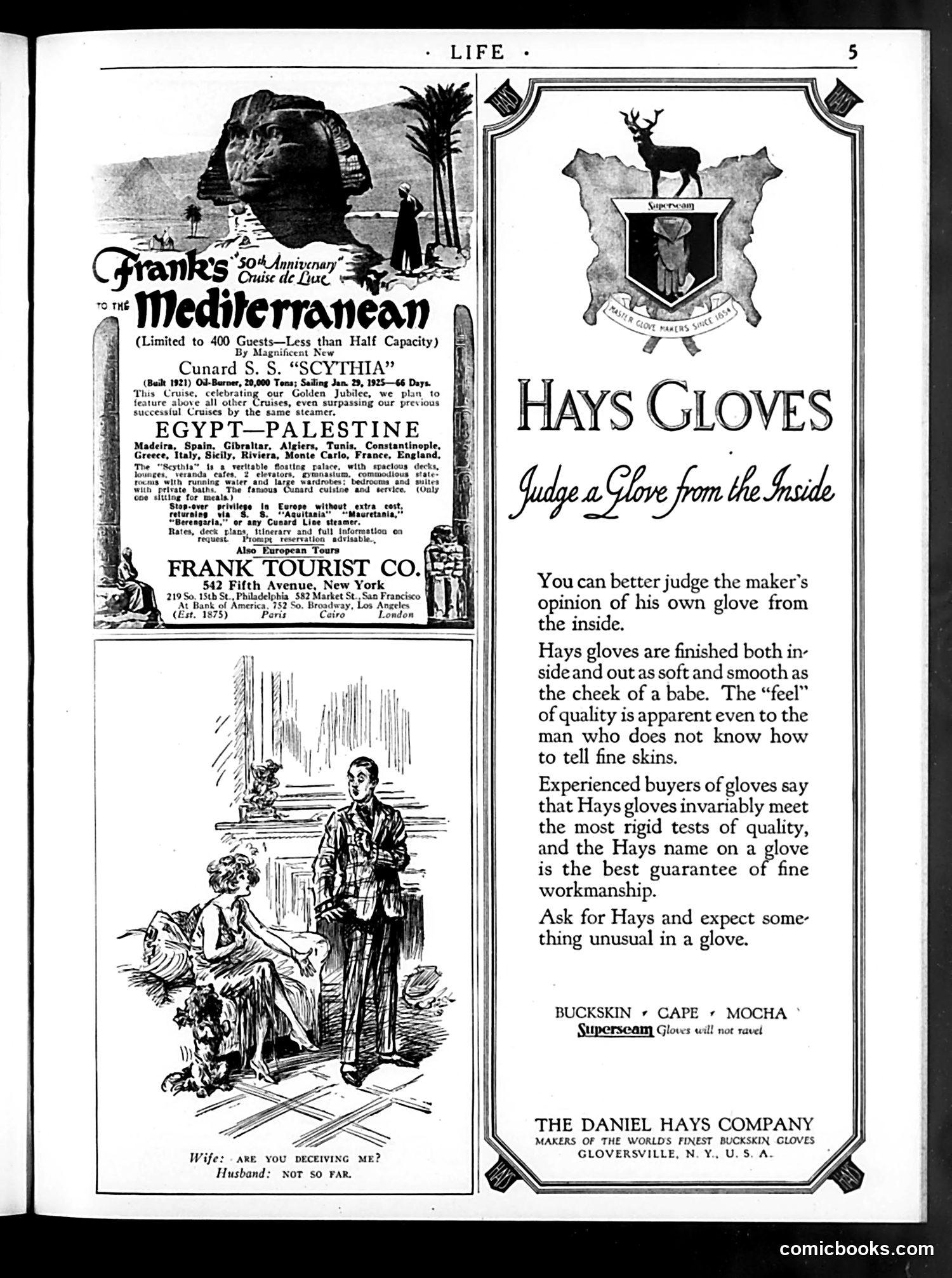
This page contains **two separate advertisements** rather than satirical cartoons. **Left side:** Frank Tourist Co. advertises a Mediterranean cruise on the S.S. "Scythia," visiting Egypt and Palestine. The ad features Egyptian imagery (sphinx, palm trees) and mentions this is their 50th anniversary cruise with limited capacity. **Right side:** Hays Gloves advertisement emphasizing quality craftsmanship. The tagline "Judge a Glove from the Inside" promotes their attention to interior finishing. The small cartoon below—showing a wife accusing her husband of deception—appears to be a generic marital humor illustration unrelated to gloves, likely a recycled comic used as filler. This is primarily a **commercial advertisement page**, not political satire.
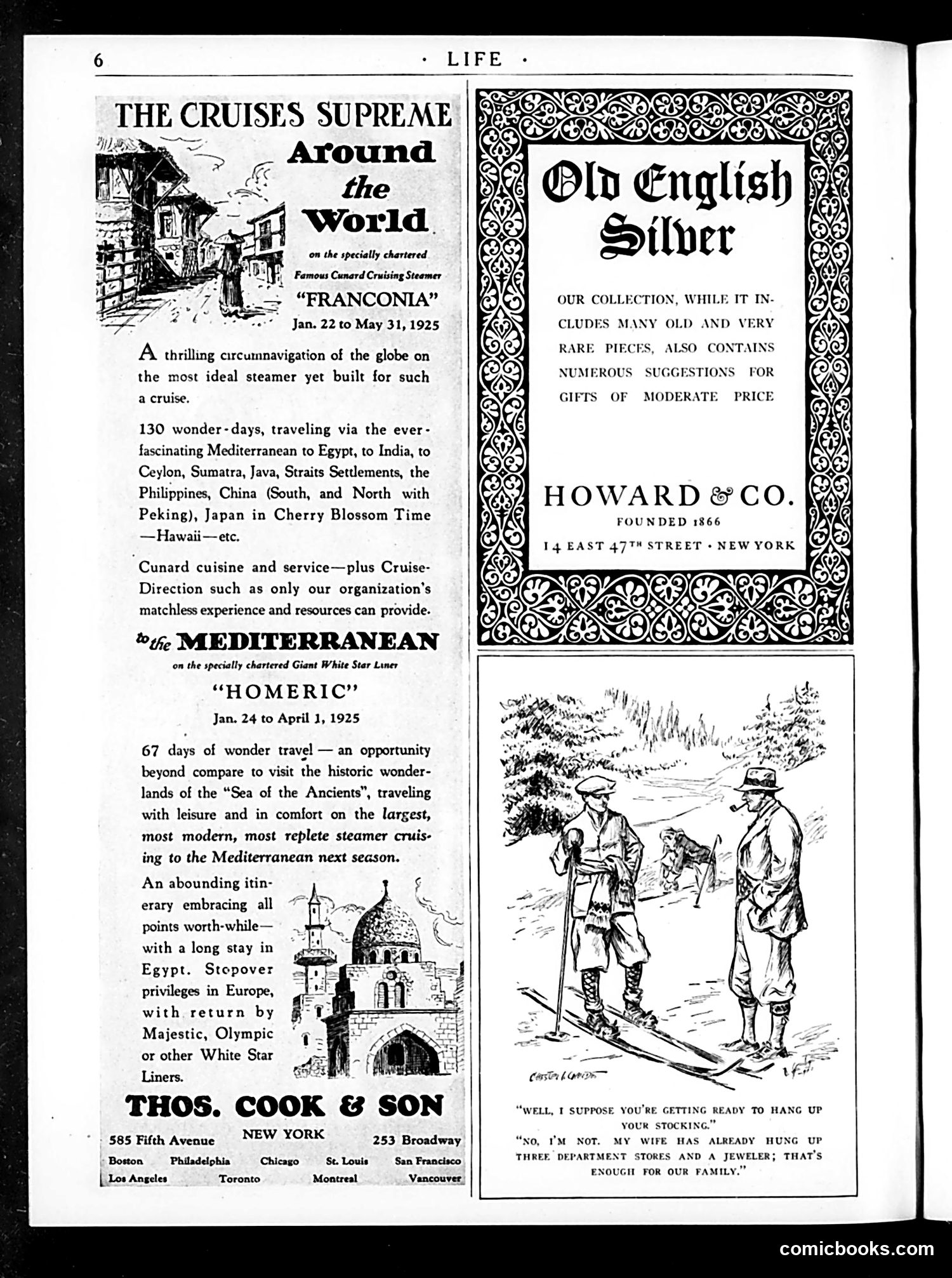
This page is primarily **advertisements** for luxury travel and goods, with one small cartoon at bottom right. The cartoon depicts two men in conversation about Christmas stockings. One man says he's "not" getting ready to hang up his stocking because his wife "has already hung up three department stores and a jeweler; that's enough for our family." **The satire**: This is a common 1920s joke about wives' excessive holiday shopping and consumerism. The husband uses hyperbole—claiming his wife has literally "hung up" entire stores rather than stockings—to mock the extravagance of modern consumer culture and women's spending habits during the Christmas season. The joke reflects period anxieties about commercialism and gender roles around shopping and gift-giving.
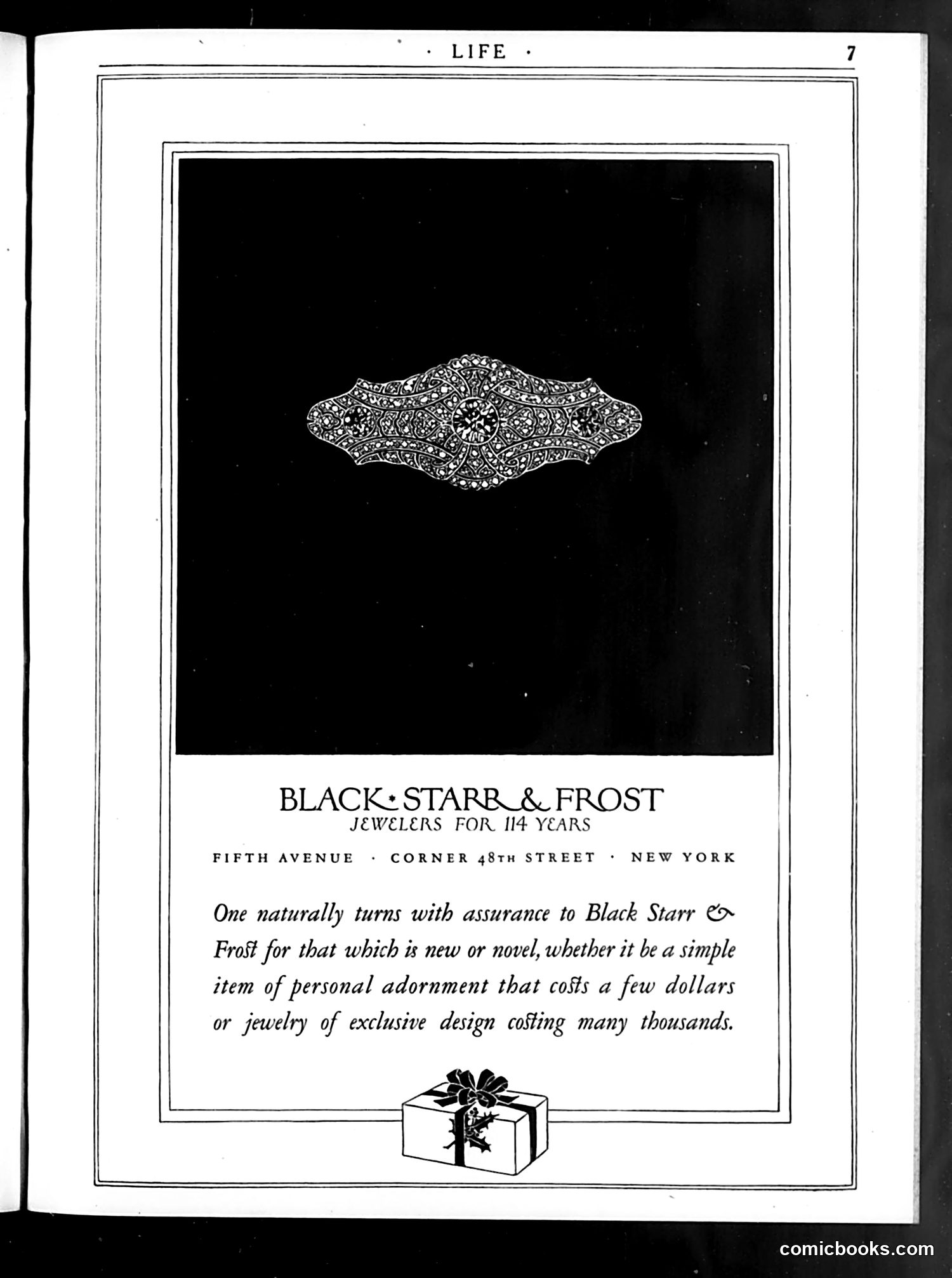
This is a **full-page advertisement**, not editorial content or satire. It advertises Black, Starr & Frost, a jewelry company located at Fifth Avenue and 48th Street in New York. The ad features an ornate brooch or pin illustrated at top against a black background. Below the company name and address, italicized copy appeals to customers seeking novelty in jewelry—whether affordable items or exclusive, expensive pieces. A small gift box with ribbon appears at the bottom. There is **no political cartoon or satire** on this page. It's a straightforward luxury goods advertisement emphasizing the jeweler's 114-year heritage and range of products for different budgets.
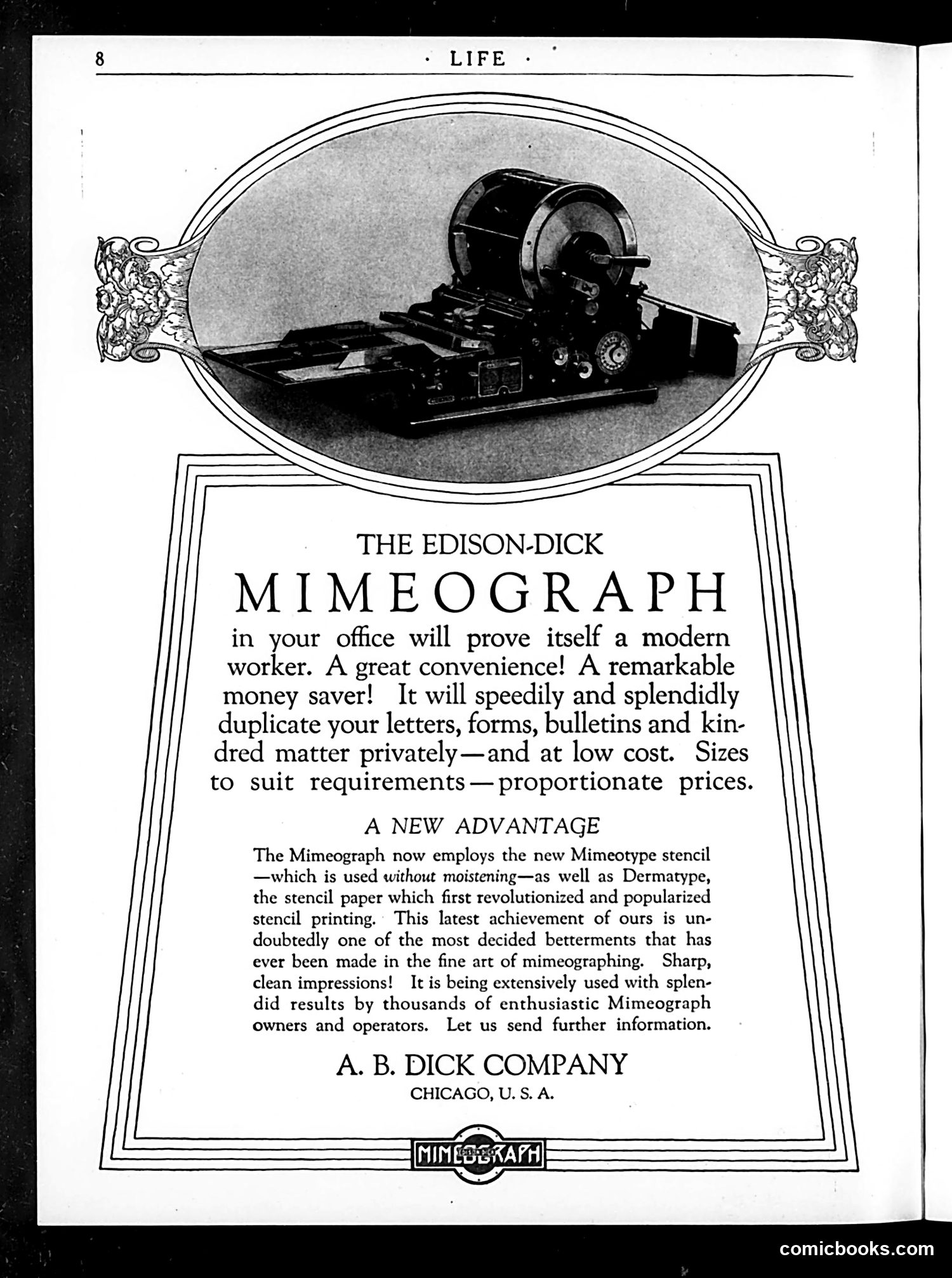
This page is primarily **advertising**, not editorial content or satire. It advertises the Edison-Dick Mimeograph machine, a duplicating device for office use. The advertisement highlights the mimeograph's practical benefits: it quickly and cheaply reproduces letters, forms, and bulletins. The "new advantage" emphasized is the Mimeotype stencil, which operates without moistening—an improvement over previous stencil methods like Dermatype. The image shows the mechanical device itself. The ad targets office managers and business owners, positioning the mimeograph as a modern, cost-effective solution for document reproduction. **For modern readers:** Before photocopiers and digital printing, mimeographs were essential office technology. This ad emphasizes labor and cost savings—standard advertising appeals then as now.
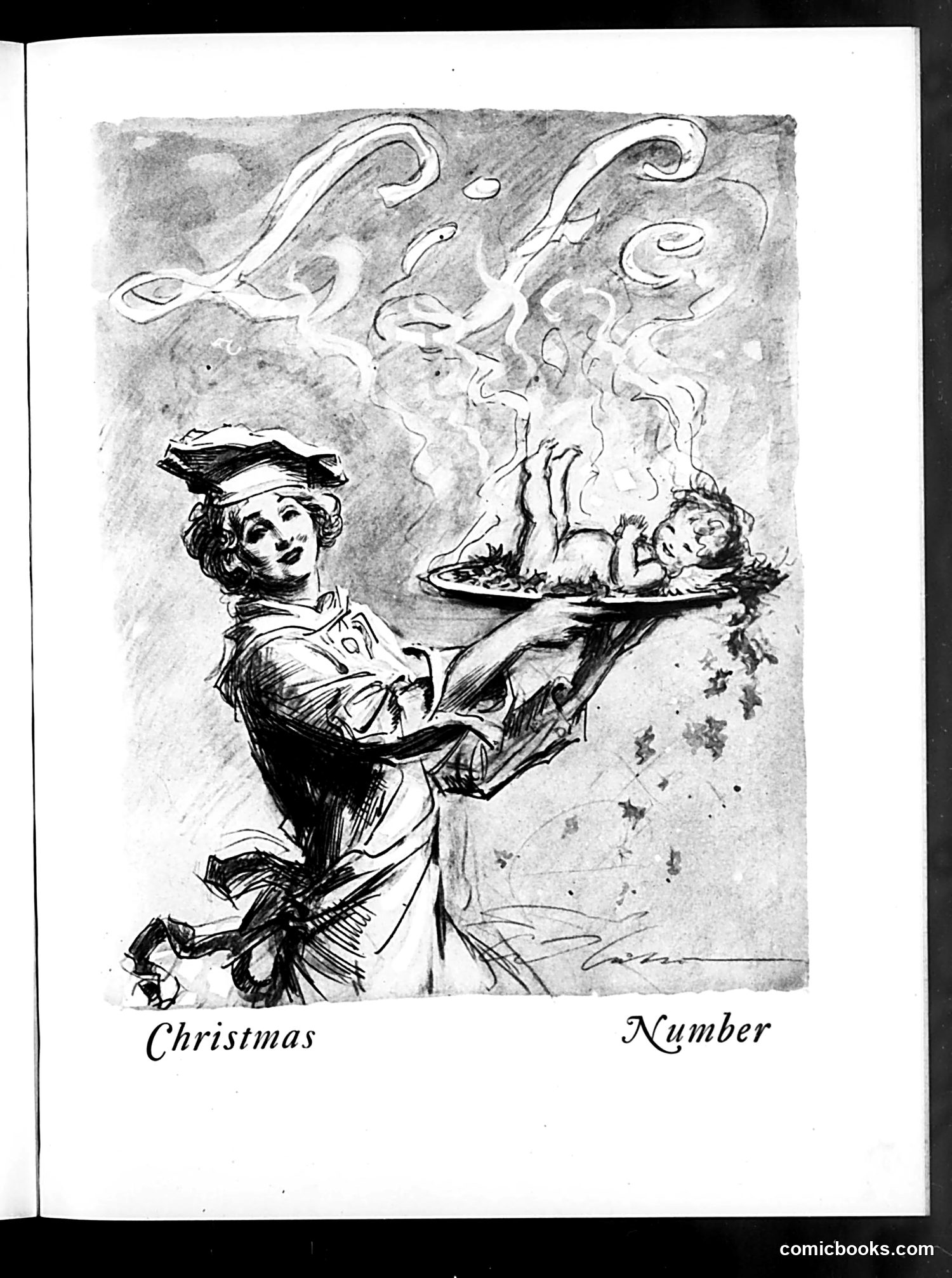
This is a title page for a "Christmas Number" issue of Life magazine. The illustration shows a cheerful chef or cook in period dress (appears to be early 20th century) presenting a steaming roasted bird—likely a turkey or chicken—on a platter, while a cherub or cupid figure floats above, also gesturing toward the dish. The satire appears gentle and festive rather than political. It plays on Christmas dinner traditions, with the chef figure embodying hospitality and culinary skill. The cherub adds whimsical, classical allusion to the holiday feast. The overall message seems to celebrate Christmas abundance and holiday entertaining—a lighthearted seasonal cover rather than sharp social commentary.
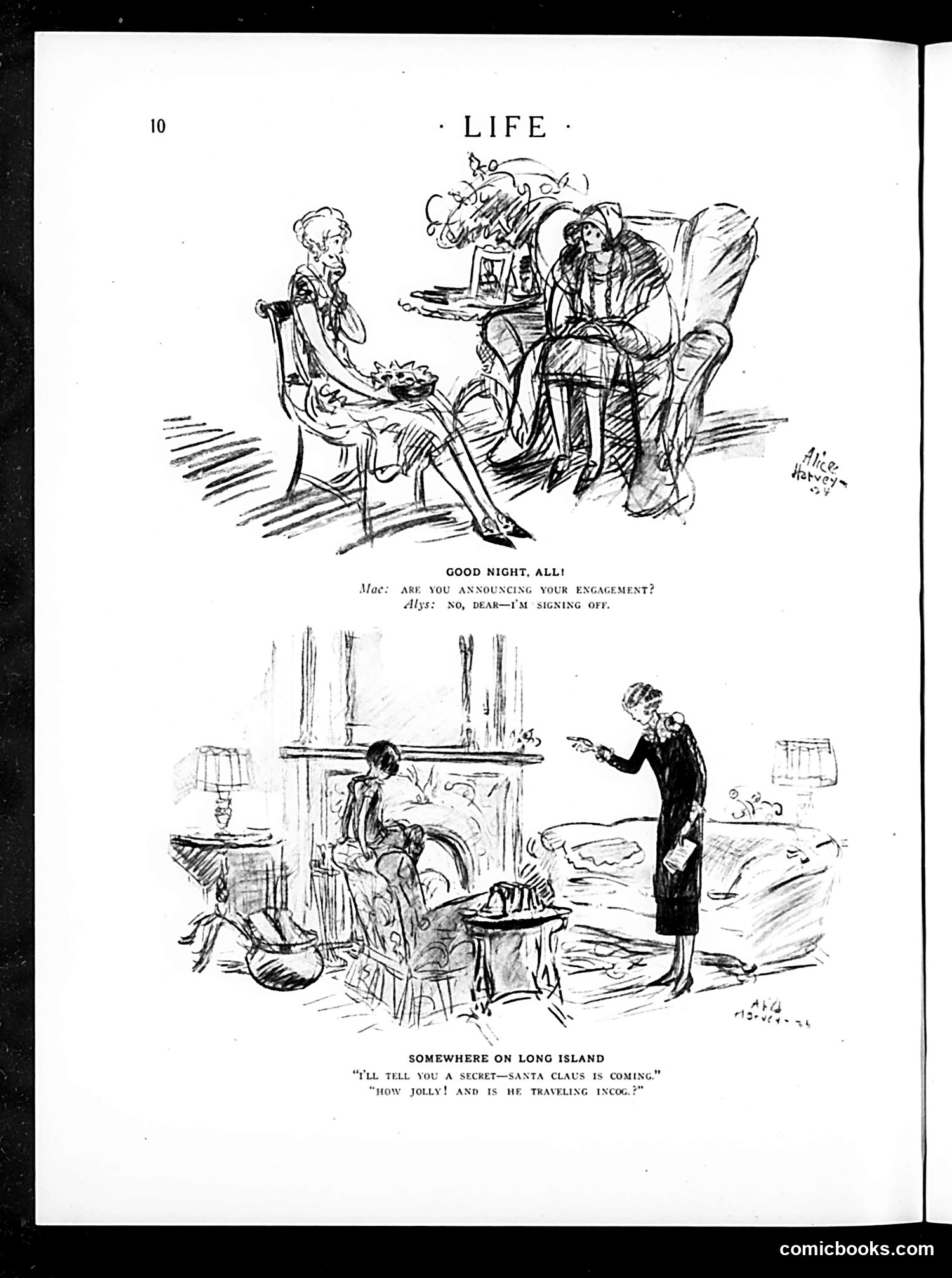
This page contains two satirical cartoons from *Life* magazine. The **top cartoon** ("Good Night, All!") depicts a social gathering where Mac asks Alyss if she's announcing an engagement. Alyss replies she's "signing off"—a joke about radio broadcasts, suggesting she's ending her social season or availability like a radio station closing down for the night. The **bottom cartoon** ("Somewhere on Long Island") shows a domestic scene where someone tells a child that "Santa Claus is coming" and asks "How jolly! And is he traveling incog[nito]?"—meaning in disguise or secretly. This appears to be gentle satire about parental deception regarding Santa Claus, with the Long Island setting suggesting upper-class suburban life. Both cartoons use wordplay and domestic humor typical of early-to-mid 20th-century magazine satire.
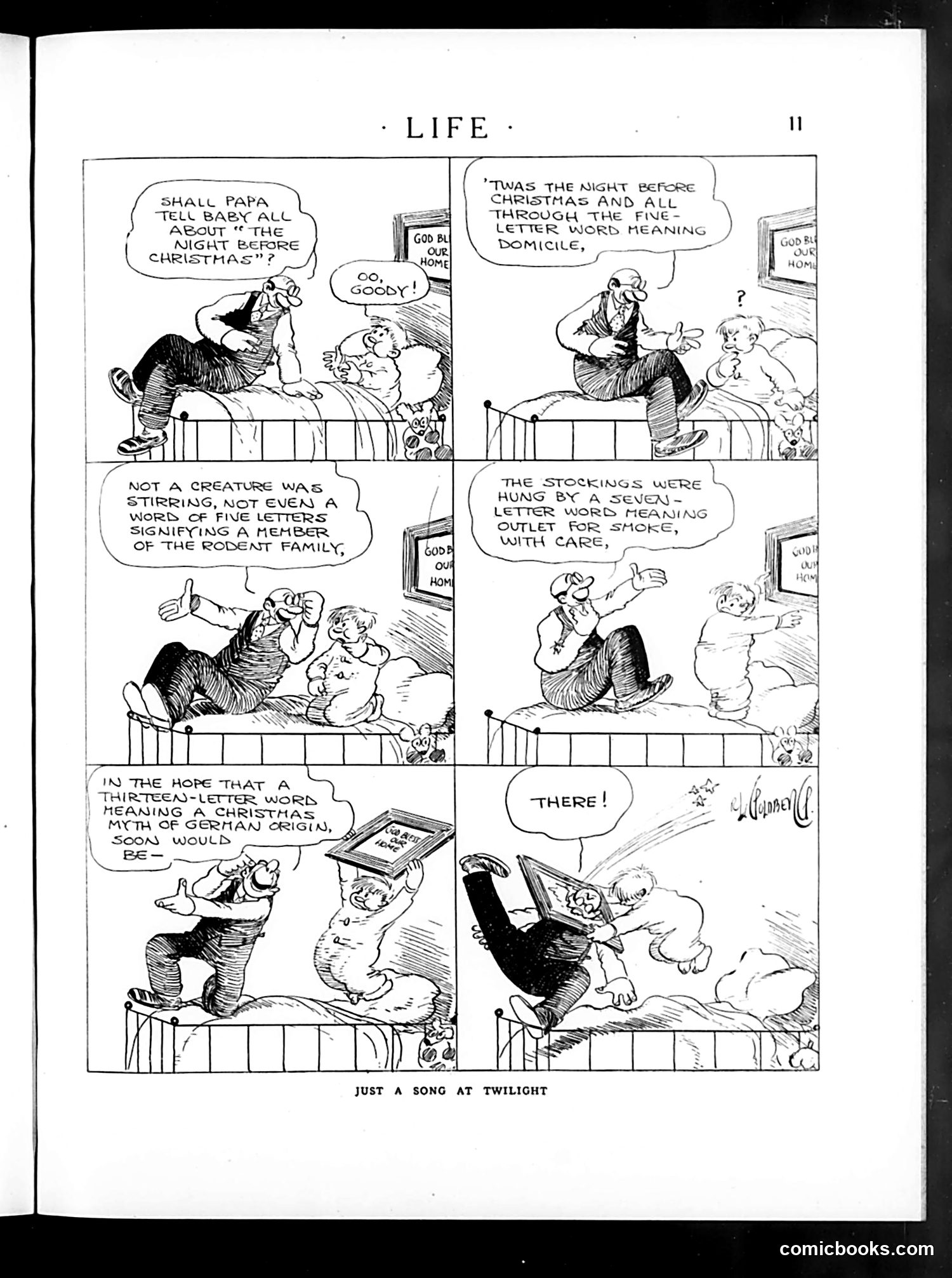
This six-panel comic depicts a father telling his young child the story of "'The Night Before Christmas'" on Christmas Eve. The father recites the famous poem, beginning with "'Twas the night before Christmas and all through the house..." The humor culminates when the child asks about "domicile"—a fancy word meaning house—and the father attempts to explain it using increasingly elaborate thirteen-letter words. His explanation becomes so convoluted that by the final panel, he's literally falling backward off the bed in exasperation. The satire mocks overly pedantic fathers who cannot simply answer children's questions but instead launch into unnecessarily complex explanations, turning a simple bedtime story into an exhausting vocabulary lesson. The title suggests this domestic frustration is merely background music to Christmas evening.
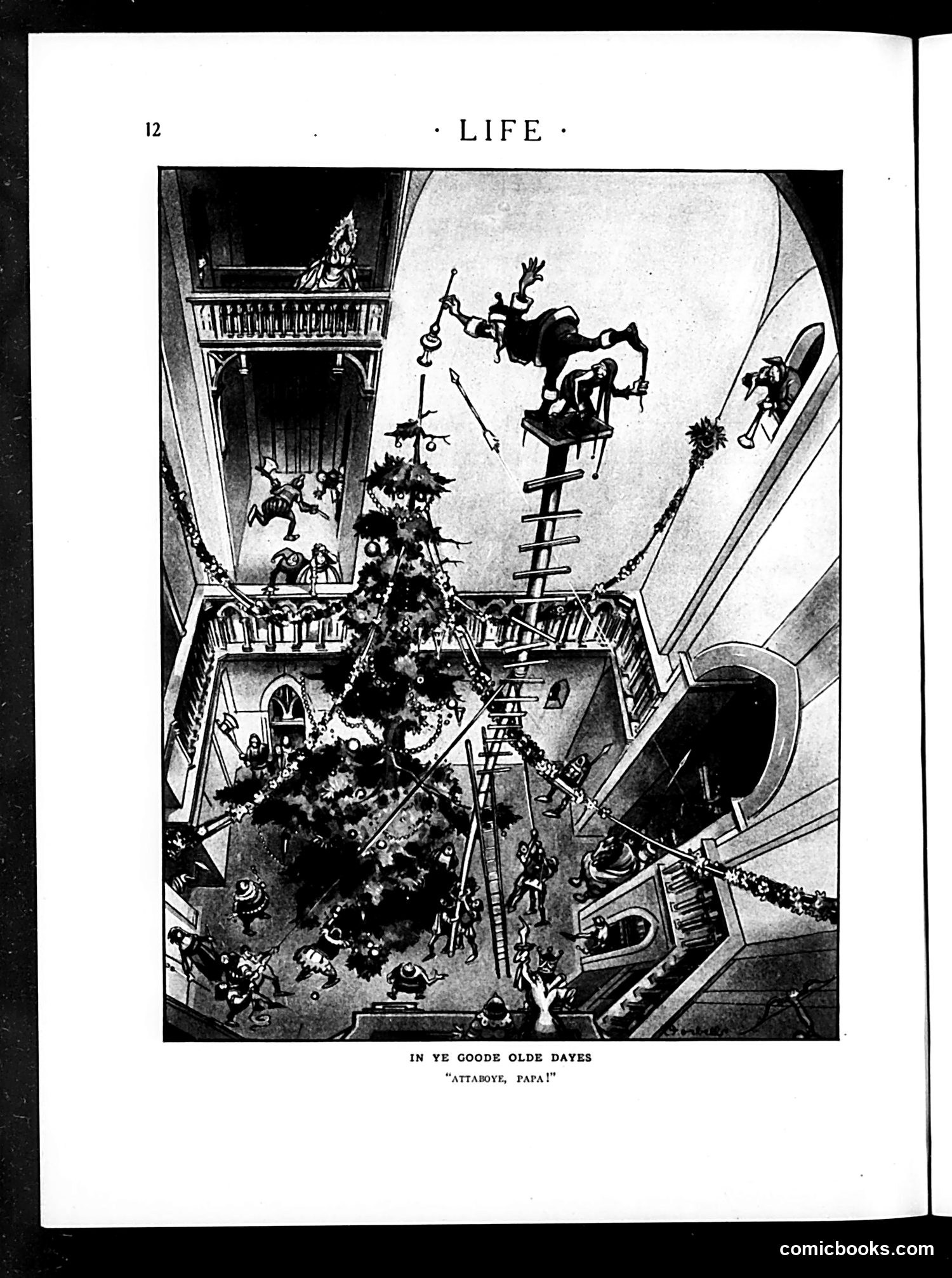
This satirical cartoon depicts a chaotic Christmas scene viewed from above, with a decorated tree at center surrounded by architectural elements of a home. Multiple figures appear to be engaged in frantic activity—some climbing ladders, others suspended in mid-air, and people scattering in various directions. The caption's archaic spelling ("Ye Goode Olde Dayes") suggests nostalgic commentary. The exclamation "Attaboy, Papa!" likely indicates a father figure creating mayhem, possibly through reckless Christmas decoration or gift-related mishaps. The vertical perspective emphasizes the disorder and slapstick nature of domestic holiday preparation, satirizing the gap between idealized "olden days" and chaotic reality.
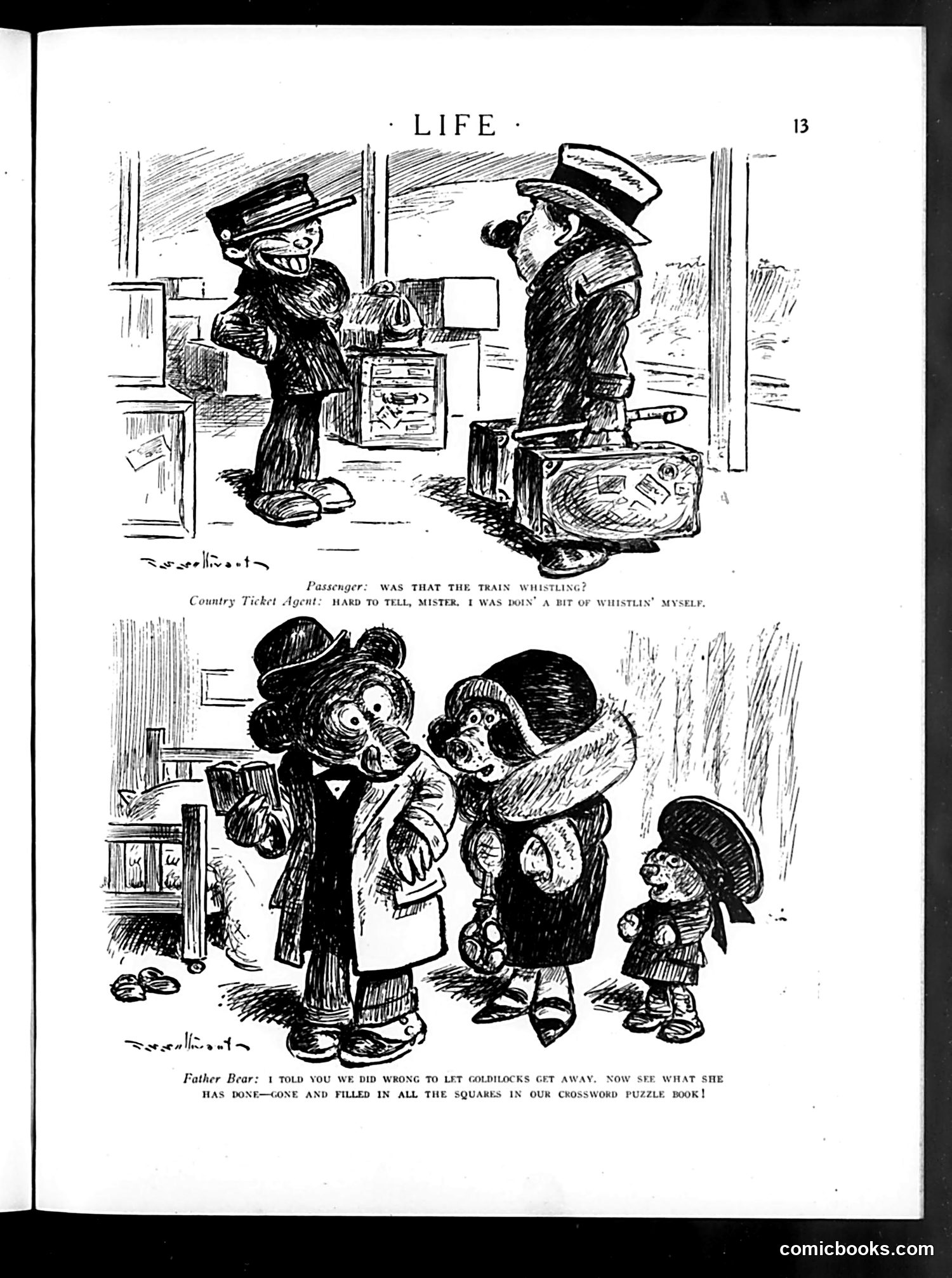
This page contains two cartoon jokes: **Top cartoon**: A country ticket agent responds to a passenger's question about train whistling by claiming he was "doin' a bit of whistlin' myself." The humor relies on the agent's evasive, implausible response—suggesting he was making noise to cover up the train's actual whistling, a common deflection tactic. **Bottom cartoon**: Father Bear scolds his family for letting Goldilocks escape and then filling "all the squares in our crossword puzzle book." This is a Goldilocks reference playing on the then-popular activity of crossword puzzles. The joke's humor comes from the absurd complaint that the child filled in their puzzle book—a petty grievance compared to the intruder's larger transgression. Both are lighthearted domestic/everyday humor typical of early 20th-century satirical magazines.
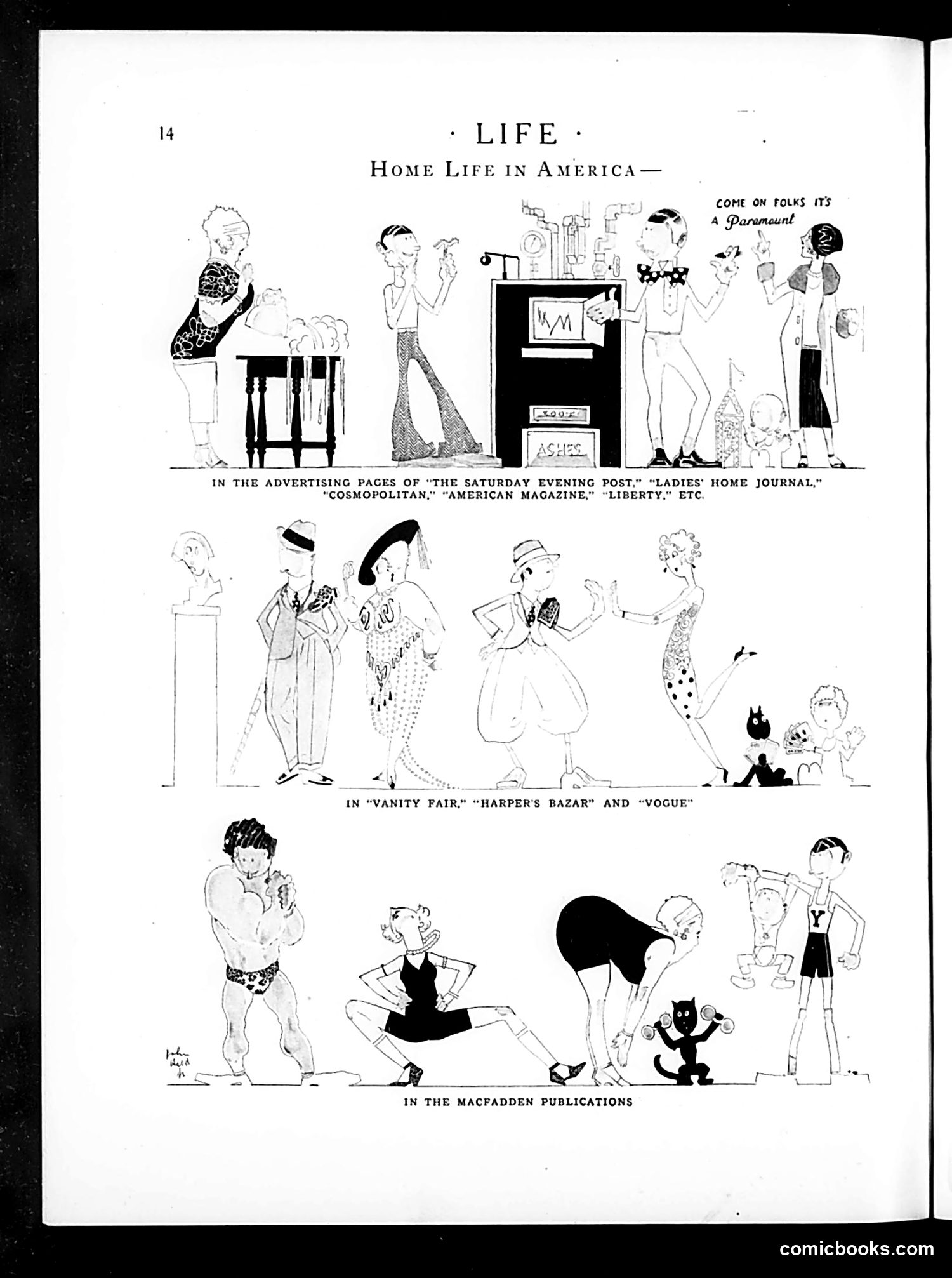
This page from *Life* magazine satirizes how American domestic life is portrayed in popular magazines and advertisements of the era. The three sections show figures in various domestic and social scenarios—cooking, socializing, fashion, childcare, and leisure activities. The satire targets the idealized, often exaggerated depictions of home life found in: - Ladies' magazines (*Saturday Evening Post*, *Ladies' Home Journal*, *Cosmopolitan*) - Fashion publications (*Vanity Fair*, *Harper's Bazaar*, *Vogue*) - Entertainment publications (*MacFadden Publications*) The crude, caricatured drawings mock how these magazines presented artificially stylized versions of American domesticity and consumerism. The exaggerated poses and proportions suggest the magazines' unrealistic portrayals of women's roles, fashion standards, and family dynamics—highlighting the gap between advertising fantasies and actual lived experience.
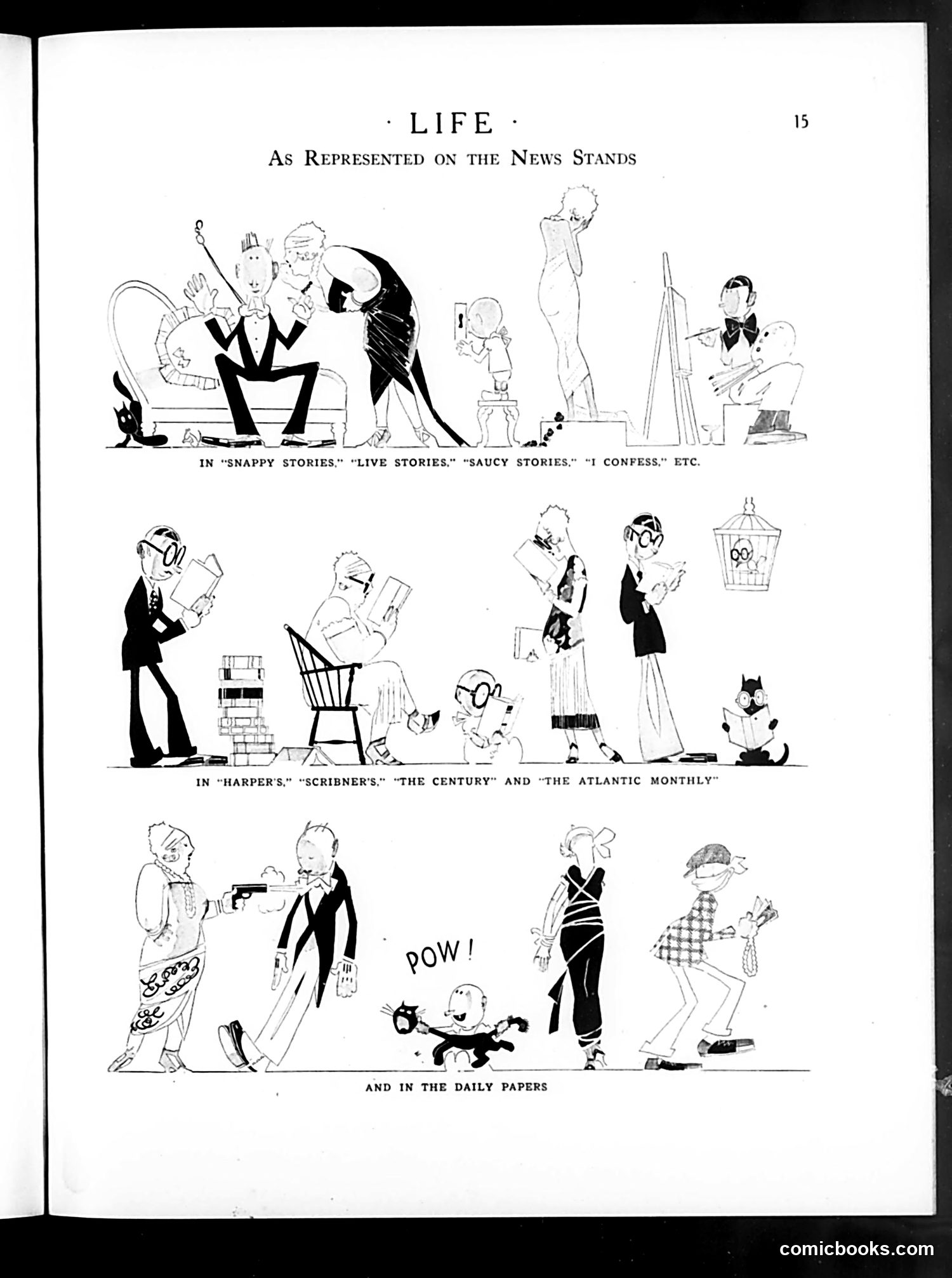
This satirical page mocks the sensationalist content of various American publications. The top panel shows exaggerated stories from scandal sheets ("snappy stories," "live stories," "saucy stories," "I confess") featuring melodramatic scenes—seduction, crime, domestic chaos. The middle panel references reputable magazines like Harper's, Scribner's, The Century, and The Atlantic Monthly, depicting more refined (though still dramatic) domestic and social scenarios. The bottom panel, "And in the Daily Papers," shows violence and crime—a shooting scene with "POW!" The cartoon satirizes the stark contrast between highbrow magazines' pretensions and the lurid, sensationalist content dominating newsstand offerings, suggesting American publications exploit scandal and violence to sell copies regardless of their stated sophistication.
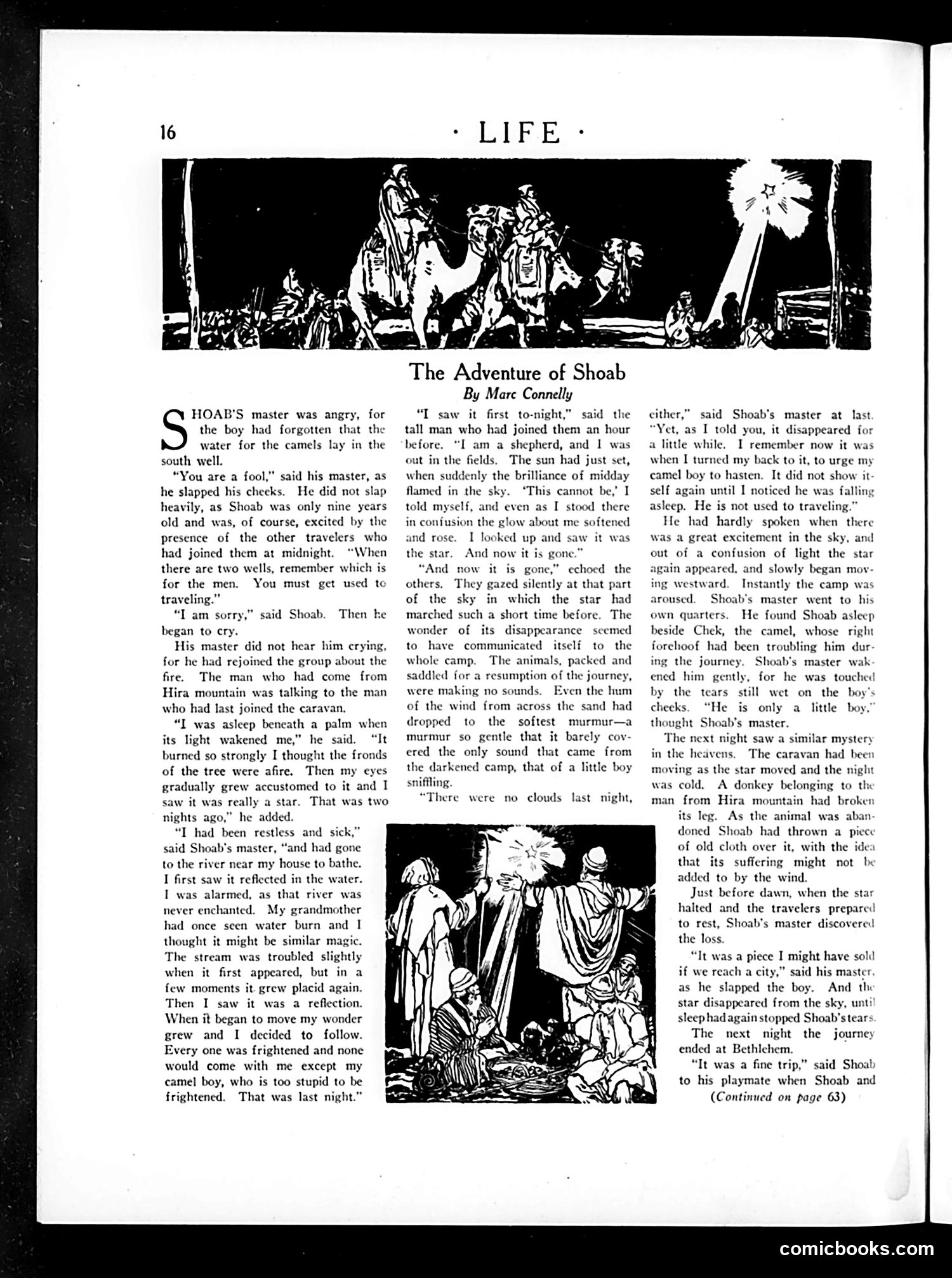
This is a fictional short story by Marc Connelly (not a political cartoon), appearing in *Life* magazine. It depicts the journey of the biblical Magi following the Star of Bethlehem, told from the perspective of a caravan including a nine-year-old camel boy named Shoab. The narrative establishes the story's spiritual and dramatic stakes: multiple travelers independently witness a mysterious star appearing and disappearing in the night sky, prompting them to follow it. Shoab's master, initially harsh with the boy for negligence, gradually shows compassion as the journey unfolds. The story emphasizes themes of wonder, humility, and kindness—particularly the master's recognition that Shoab is "only a little boy" and the boy's own mercy toward a suffering donkey. This appears to be a sentimental retelling of the Nativity story for a general American audience, focusing on human character rather than theological doctrine.
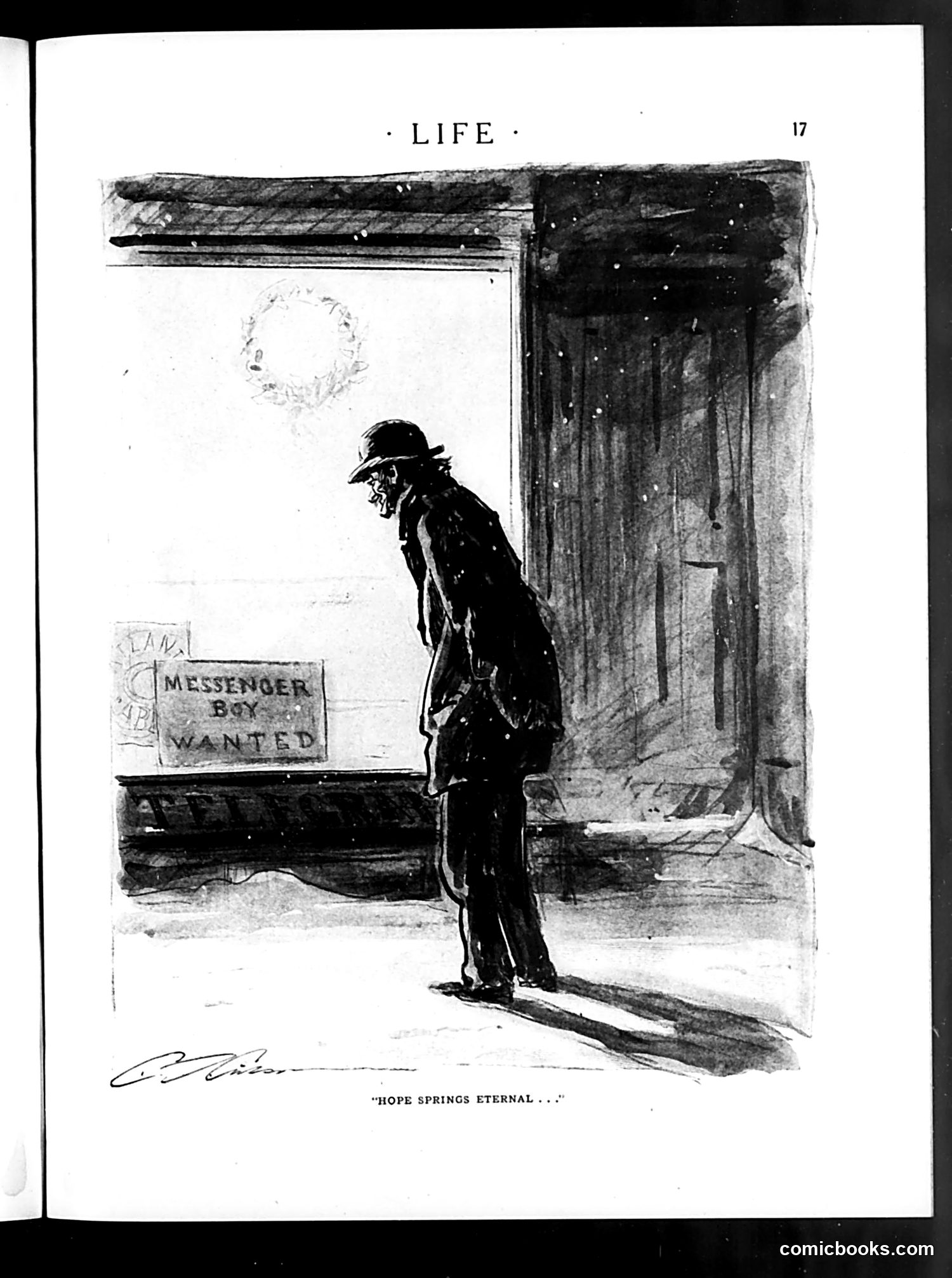
This cartoon depicts an elderly, shabby man in a worn coat and hat standing before a storefront window displaying a "Messenger Boy Wanted" sign. The figure appears to represent an aging or desperate job-seeker. The title, a reference to Alexander Pope's famous line about hope, suggests ironic commentary on persistent optimism despite bleak circumstances. The satire critiques either economic hardship or age discrimination in employment. An elderly man continuing to search for even entry-level "messenger boy" positions—traditionally young workers' jobs—underscores his desperation and society's indifference to aging workers. The drawing style and composition emphasize his hunched, weathered appearance, reinforcing themes of struggle and diminished prospects.
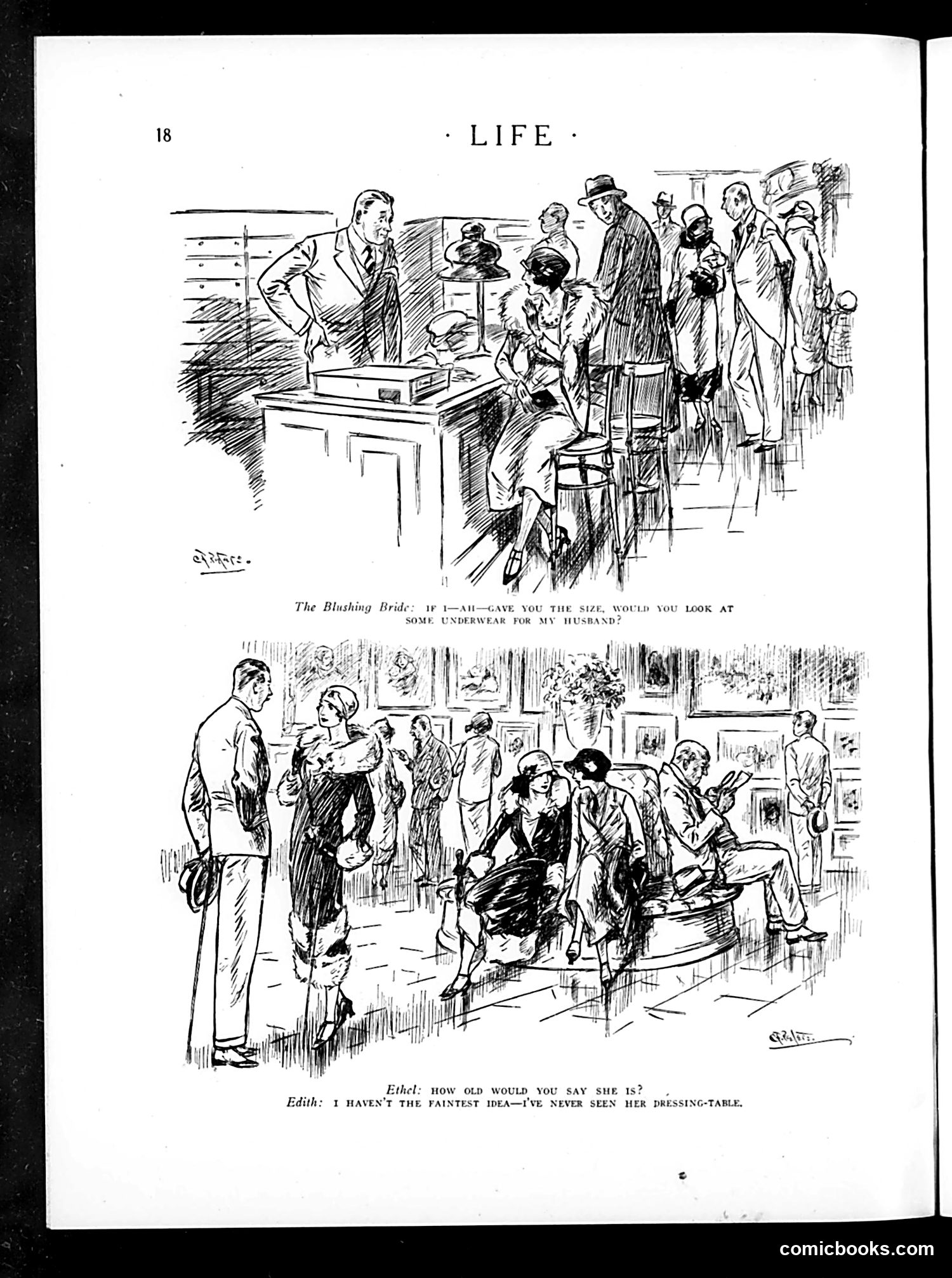
**Top cartoon** ("The Blushing Bride"): A newly married woman, embarrassed at what appears to be a formal gathering or store, asks strangers to help her buy underwear for her husband. The joke satirizes the innocence expected of brides—she's so inexperienced she needs public assistance with marital matters. **Bottom cartoon** ("Ethel"): Two women discuss a third woman's age. One claims she can't guess because she's "never seen her dressing-table"—implying that a woman's true age is only revealed by examining her cosmetics and grooming products. The satire mocks both women's vanity and the cultural obsession with female appearance and age-concealment. Both comics humorously target women's social roles and expectations in early 20th-century society.
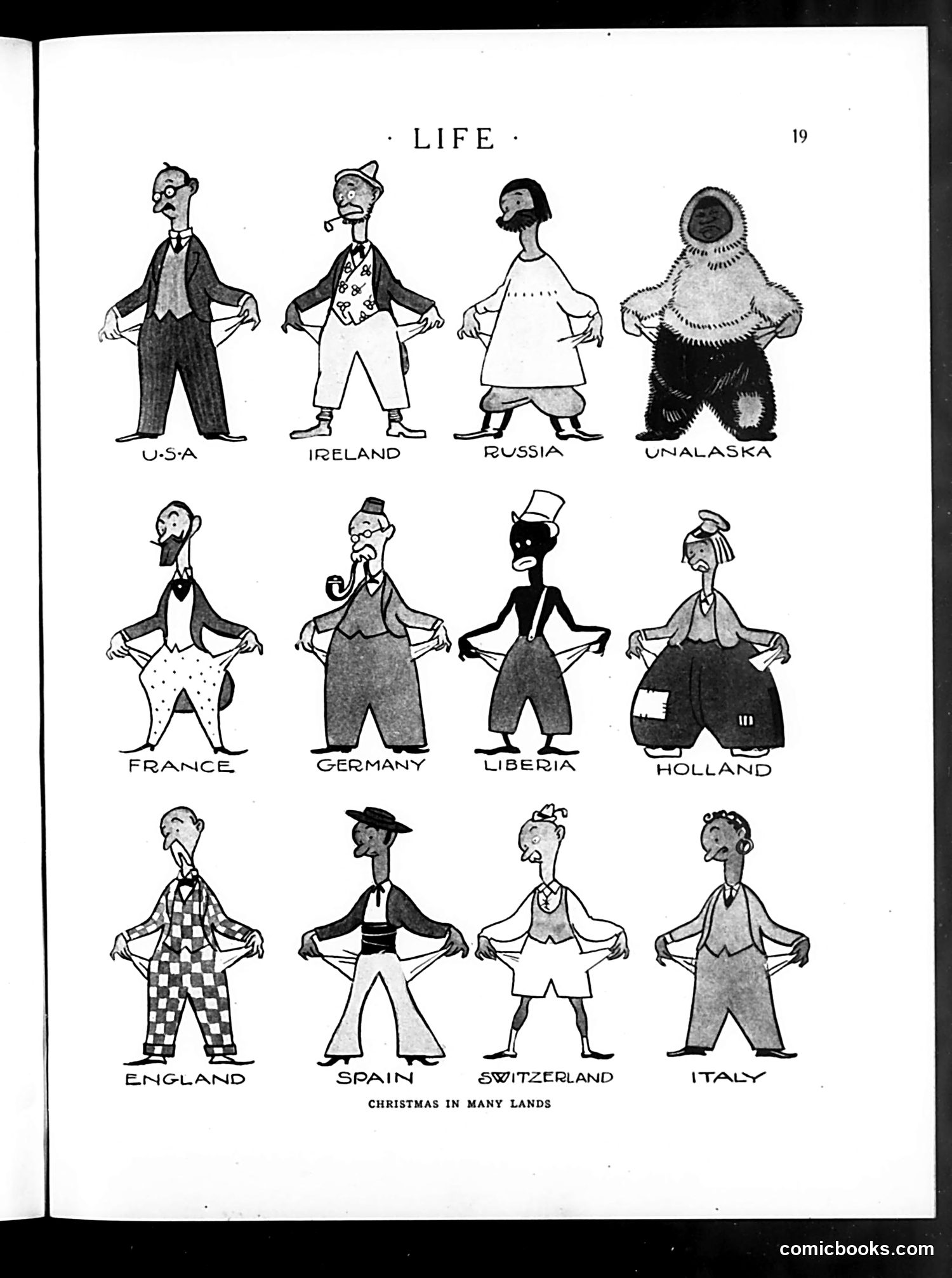
This satirical cartoon shows twelve national stereotypes depicted as caricatured figures celebrating Christmas. Each character embodies exaggerated traits associated with their country: USA appears thin and formal; Ireland shows a stereotypical "Irish" face; Russia wears heavy fur clothing; Unalaska depicts an Indigenous person in traditional dress; France displays an oversized rear end (a common European stereotype about French people); Germany shows a rotund figure; Liberia presents a dark-skinned caricature; Holland depicts a wide-bodied figure; England wears a checkered pattern; Spain shows an exaggerated profile; Switzerland appears neutral in dress; Italy displays characteristic gesturing. The humor relies on crude national and ethnic stereotypes common to early 20th-century American satire, reflecting how Life magazine's audience viewed foreign cultures through deeply prejudiced lenses.
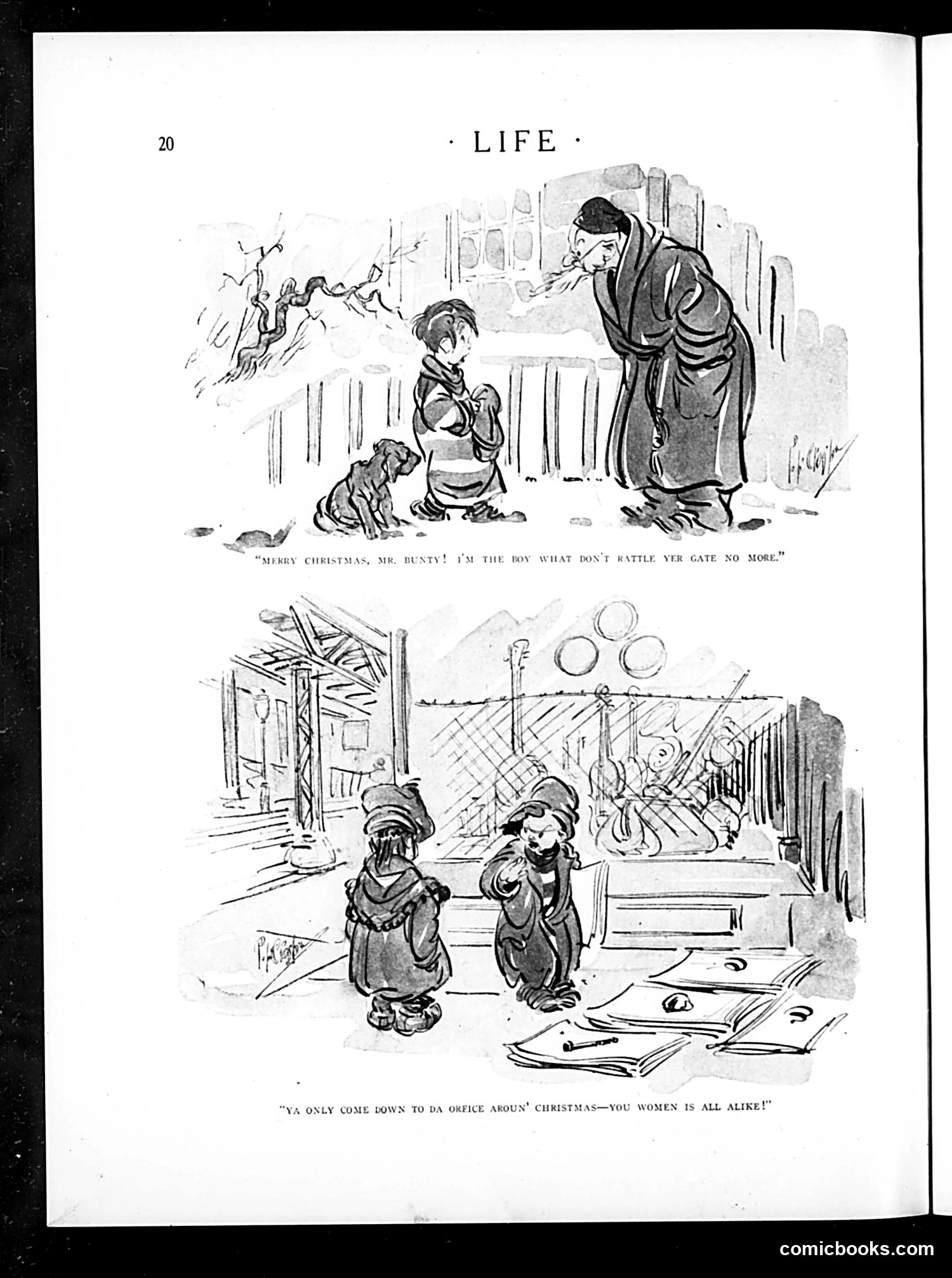
This page contains two Christmas-themed cartoons satirizing working-class life and gender roles in early 20th-century America. **Top cartoon:** A poor boy and dog approach a wealthy man's gate on Christmas, seeking charity. The boy's line—"I'm the boy what don't rattle yer gate no more"—suggests he's previously begged there, implying desperate poverty and the humiliation of repeated rejection. **Bottom cartoon:** Office workers (appearing to be women) celebrate Christmas at their workplace. The caption mocks their situation: they only get to leave the office briefly on Christmas, emphasizing workplace drudgery and limited freedom. Both cartoons use humor to critique economic inequality and harsh working conditions during the holiday season—highlighting the contrast between wealthy households and struggling poor/working-class people.
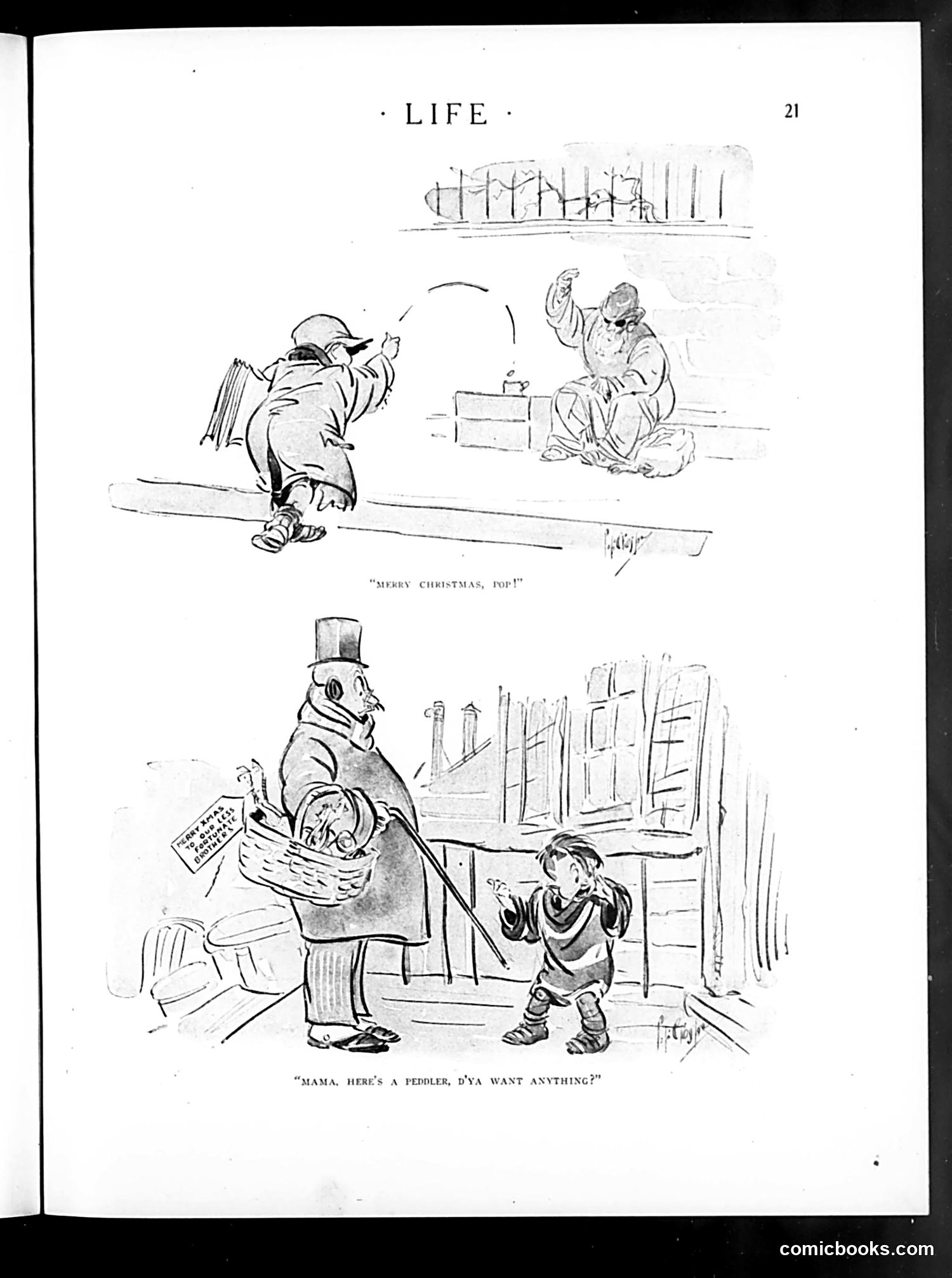
This page contains two cartoon panels depicting Christmas-themed domestic scenes. **Top panel:** Titled "MERRY CHRISTMAS, POP!" shows a child enthusiastically greeting an adult, capturing a sentimental holiday moment between parent and child. **Bottom panel:** Titled "MAMA, HERE'S A PEDDLER, D'YA WANT ANYTHING?" depicts a street vendor at a doorway while a small child alerts their mother to the salesman's presence. Both cartoons appear to be gentle, observational humor about family life and domestic economics—the second specifically addressing the common practice of street peddlers visiting homes during the holiday season to hawk goods. The humor likely derives from the child's innocent, straightforward announcement rather than satirizing any particular political figure or event.
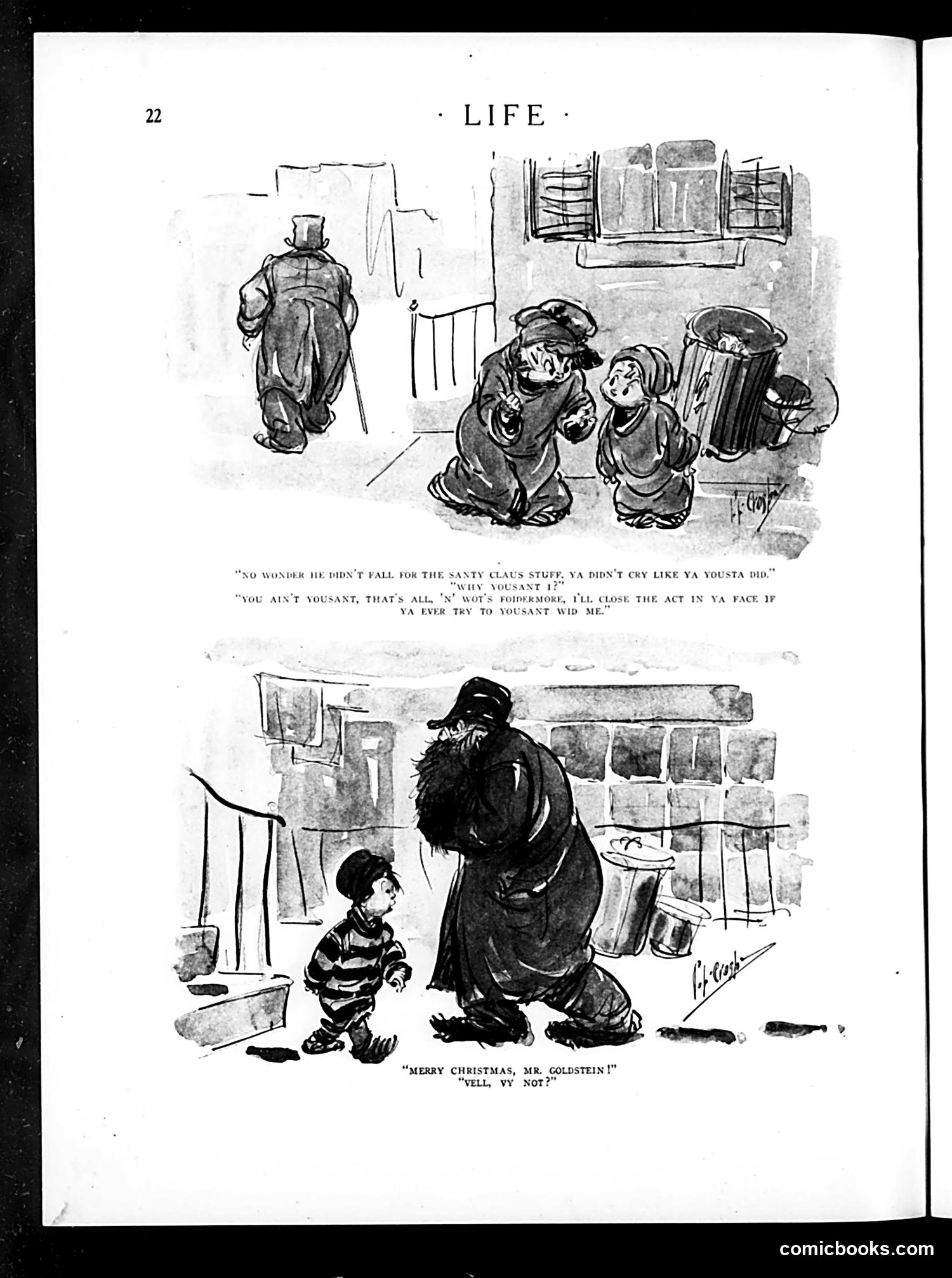
This page contains two satirical cartoons about poverty and Jewish immigrants in early 20th-century America. **Top cartoon:** Two working-class adults discuss a child who no longer believes in Santa Claus—suggesting childhood innocence lost to harsh economic reality. The dialogue uses heavy immigrant dialect ("yousant," "foidermore"). **Bottom cartoon:** A small child wishes "Merry Christmas, Mr. Goldstein!" to a poor Jewish man in a tenement. His response "Vell, vy not?" appears resigned rather than joyful, implying even holiday cheer cannot relieve his poverty. Both cartoons use ethnic stereotypes (Yiddish-inflected speech) and depict immigrant poverty as the magazine's subject matter. The humor derives from the contrast between Christmas sentiment and economic hardship facing these communities.
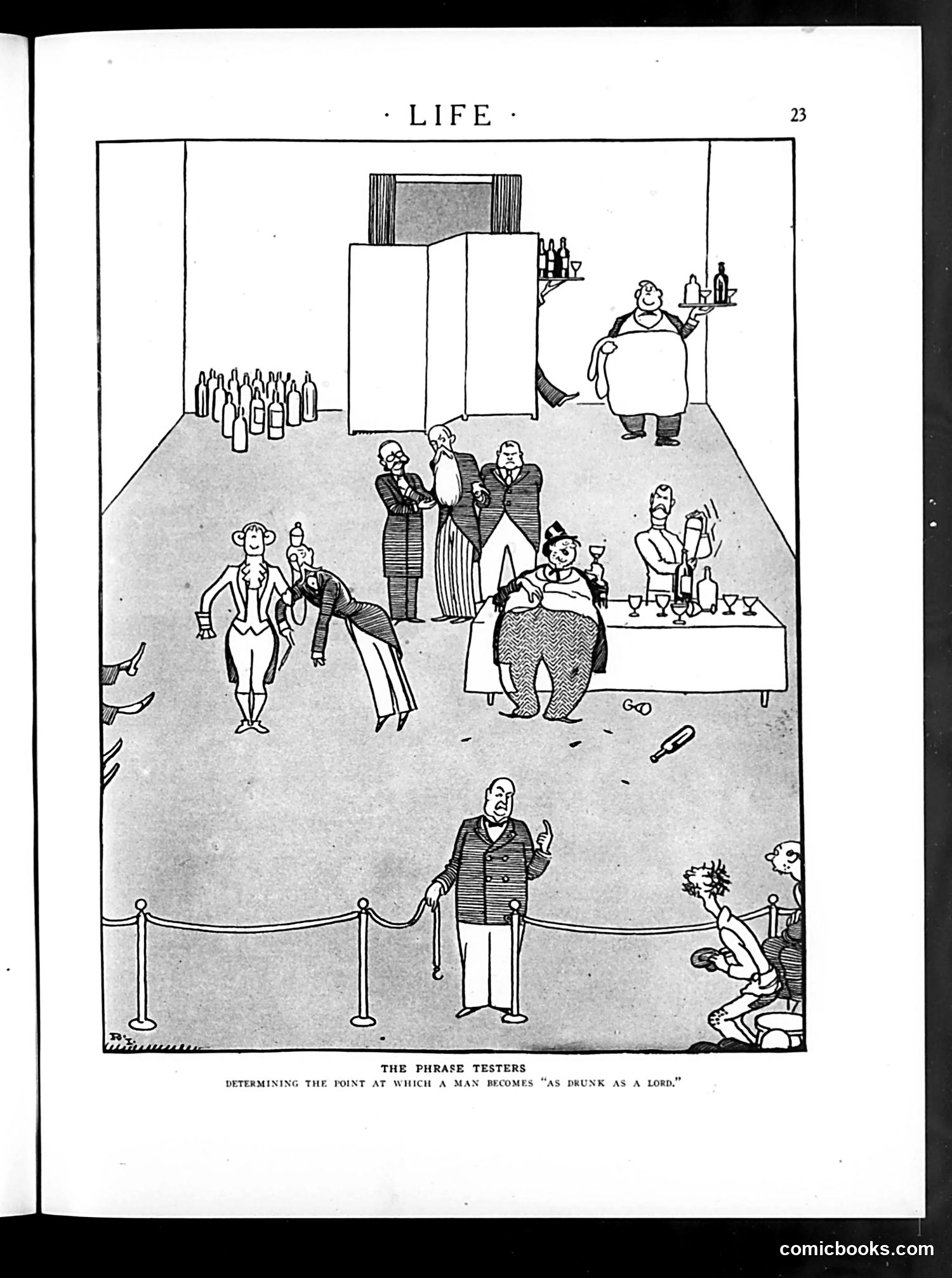
This satirical cartoon depicts a laboratory-like scene where various figures test the phrase "as drunk as a lord." The setup shows what appears to be controlled experimentation with alcohol consumption, with different men at varying stages of intoxication arranged like subjects in a scientific study. There's a formal atmosphere suggested by the roped-off area and observing figures, implying this is a serious inquiry into the exact point of drunkenness that justifies the common expression. The satire mocks both the precision of scientific method applied to a trivial social question, and the casual acceptance of aristocratic excess—the phrase itself suggesting lords were famously prone to heavy drinking. The cartoon's humor lies in treating drinking as a measurable, documentable phenomenon worthy of formal investigation.
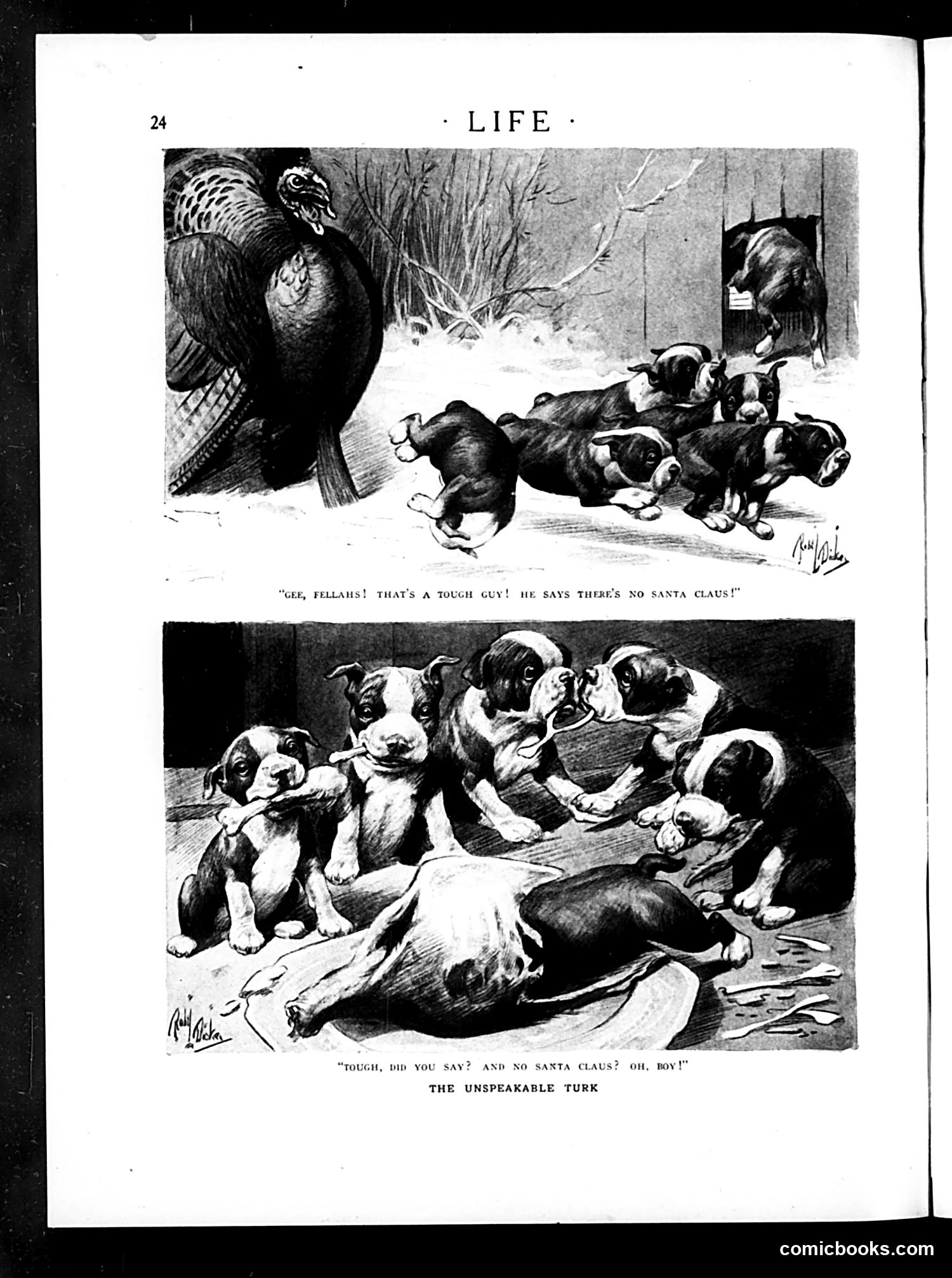
This two-panel cartoon satirizes the Ottoman Empire ("the Turk") through animal allegory. The top panel shows puppies cowering before a menacing turkey, with one declaring the turkey "a tough guy" who denies Santa Claus exists. The bottom panel depicts the puppies gathered around, apparently discussing this revelation. The satire likely references Ottoman aggression in the Balkans or Middle East during the late 19th/early 20th century—a period when the declining Ottoman Empire was called "the sick man of Europe." The "Unspeakable Turk" was a contemporary phrase for Ottoman brutality and oppression. The joke equates Ottoman power with a threatening turkey confronting naive puppies, mocking both Ottoman military reputation and Western anxiety about Ottoman actions. The Santa Claus reference suggests cynical disillusionment imposed by Turkish aggression on innocent parties.
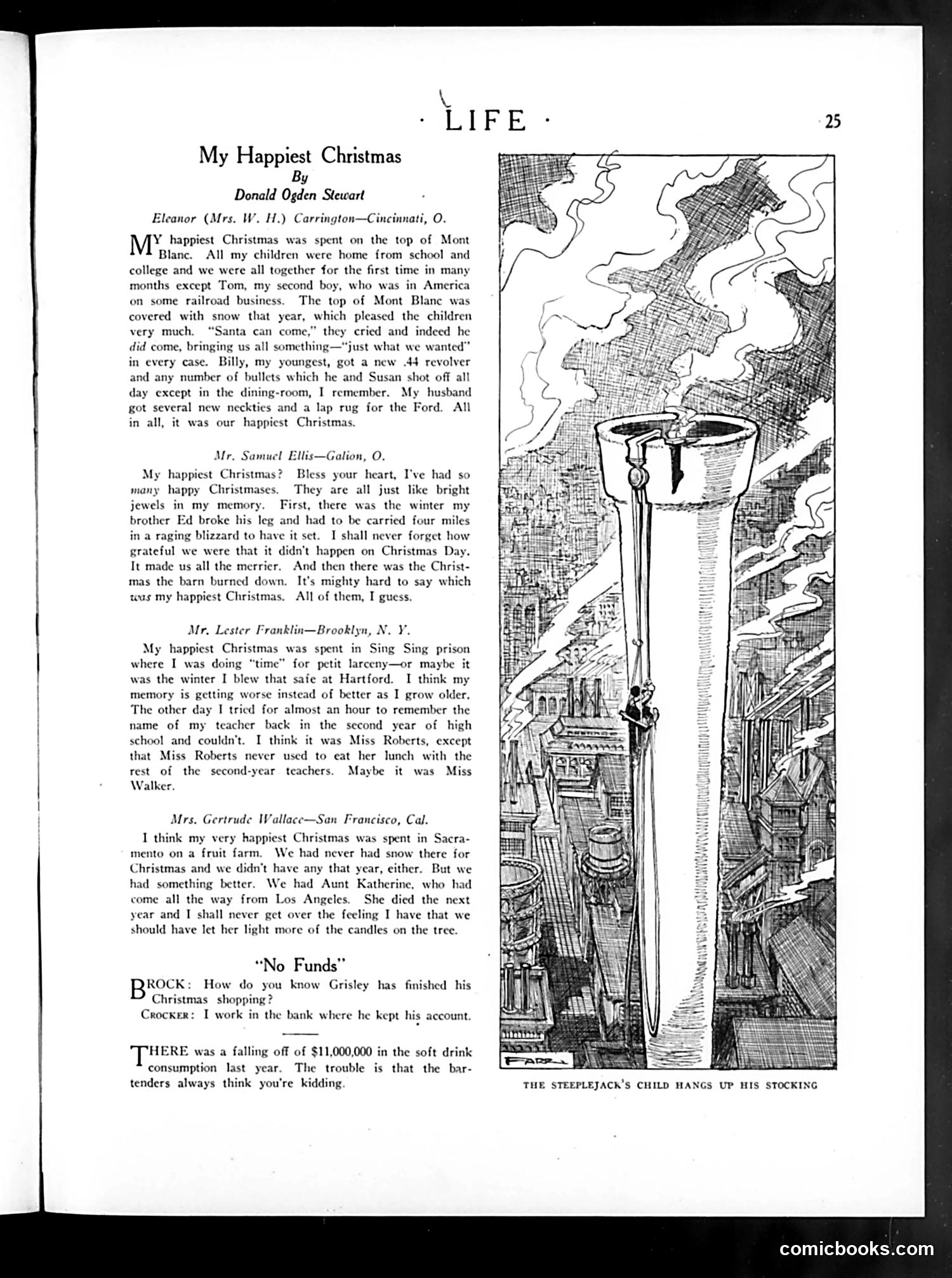
This page satirizes sentimental Christmas stories through absurd contrasts. The humor lies in juxtaposing mundane or dark life experiences with saccharine nostalgia: **Eleanor's story** mocks wealthy privilege—Christmas atop Mont Blanc with children casually firing a .44 revolver as entertainment. **Lester Franklin's contribution** is darkly comic: his "happiest" Christmas memories include time in Sing Sing prison and safecracking, yet he's concerned about forgetting his high school teacher's name—mundane memory loss overshadowing serious crimes. **The "No Funds" joke** satirizes consumerism: a banker knows Grisley finished Christmas shopping because his account is now empty. The illustration shows a steeljack's child hanging a stocking from a precarious urban height—visual irony suggesting danger where Christmas warmth should exist. The overall satire critiques how Americans romanticize Christmas regardless of circumstances, and how sentimental holiday narratives can mask absurdity, criminality, or class disparity.
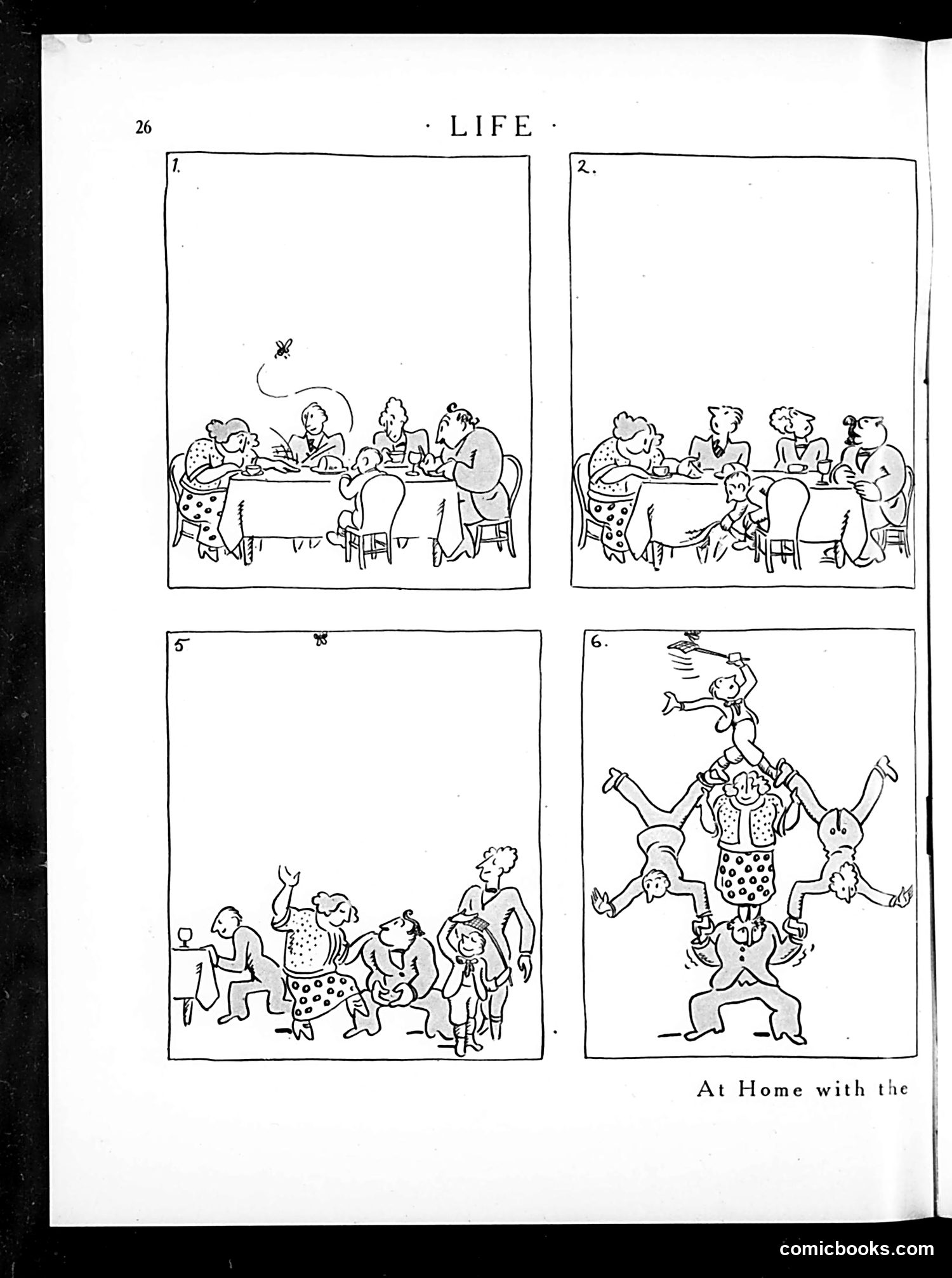
This four-panel comic depicts domestic family life, likely from the early-to-mid 20th century. The sequence shows: 1. **Panel 1:** A family dinner scene with multiple adults and children seated around a table 2. **Panel 2:** A similar dinner gathering, possibly showing a different moment or variation 3. **Panel 3:** Children playing or running around energetically indoors 4. **Panel 4:** Adults stacked or piled atop one another in an exaggerated, chaotic pose The humor appears to satirize the chaos and physical comedy of managing a large household—the contrast between orderly meal times and wild, uncontrolled domestic pandemonium. The final panel's absurd stacking likely exaggerates the exhaustion or overwhelming nature of family life, a relatable theme in early 20th-century American humor.
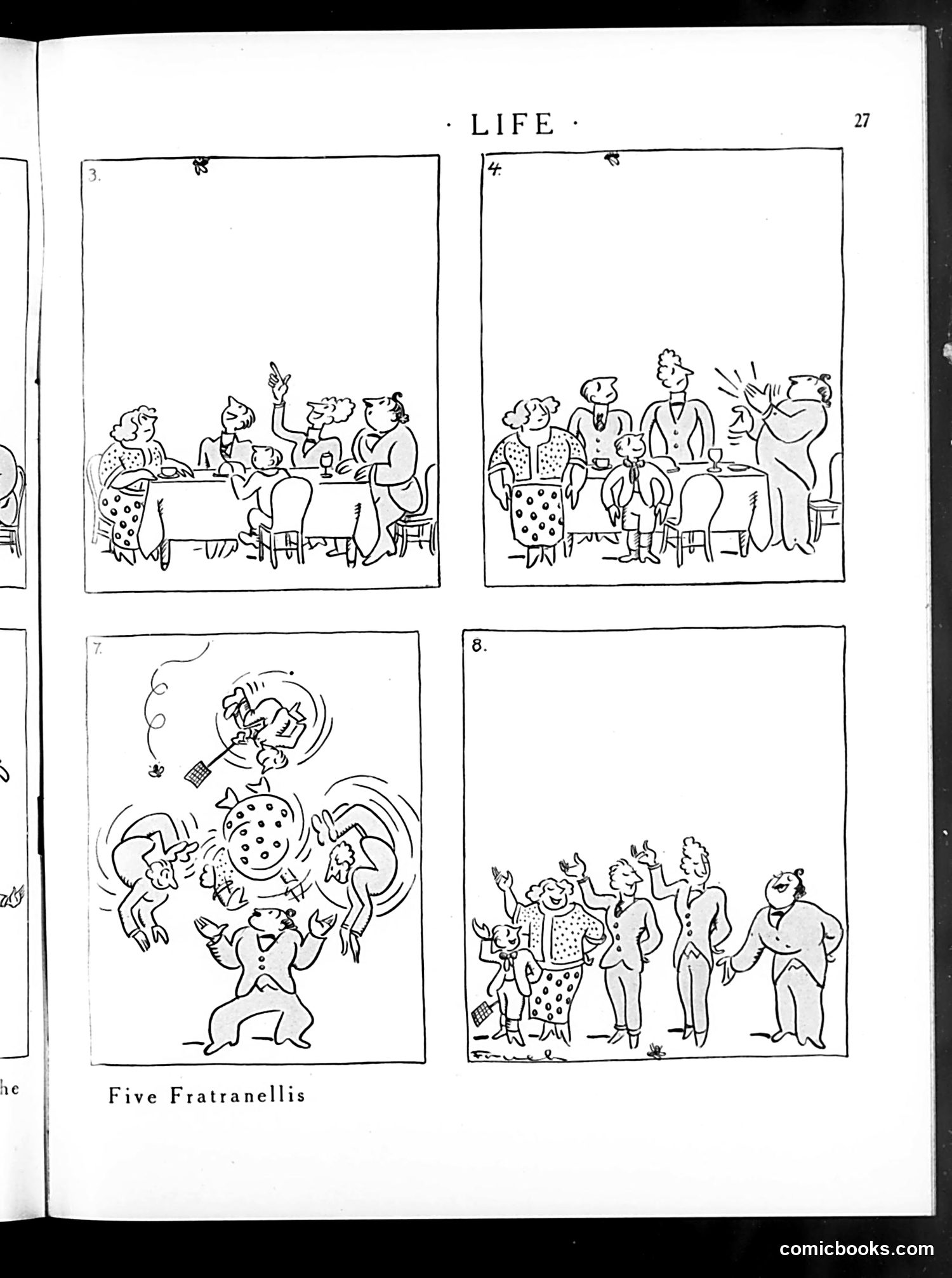
This four-panel comic sequence titled "Five Fratranellis" depicts what appears to be a chaotic family dinner scene. The panels show: 1-2. A family meal with multiple people seated at a table, relatively orderly 3. A juggling figure (likely the father) frantically tossing dishes and food in the air 4. The family standing together, apparently after the chaos The satire targets domestic disorder and incompetence—specifically a father's inability to manage a simple family dinner, resulting in catastrophic breakdown. "Fratranellis" likely references an Italian family name, suggesting this may be satirizing immigrant or working-class family life. The humor derives from the exaggerated contrast between civilized dining and complete domestic collapse, a common theme in early-20th-century American humor magazines.
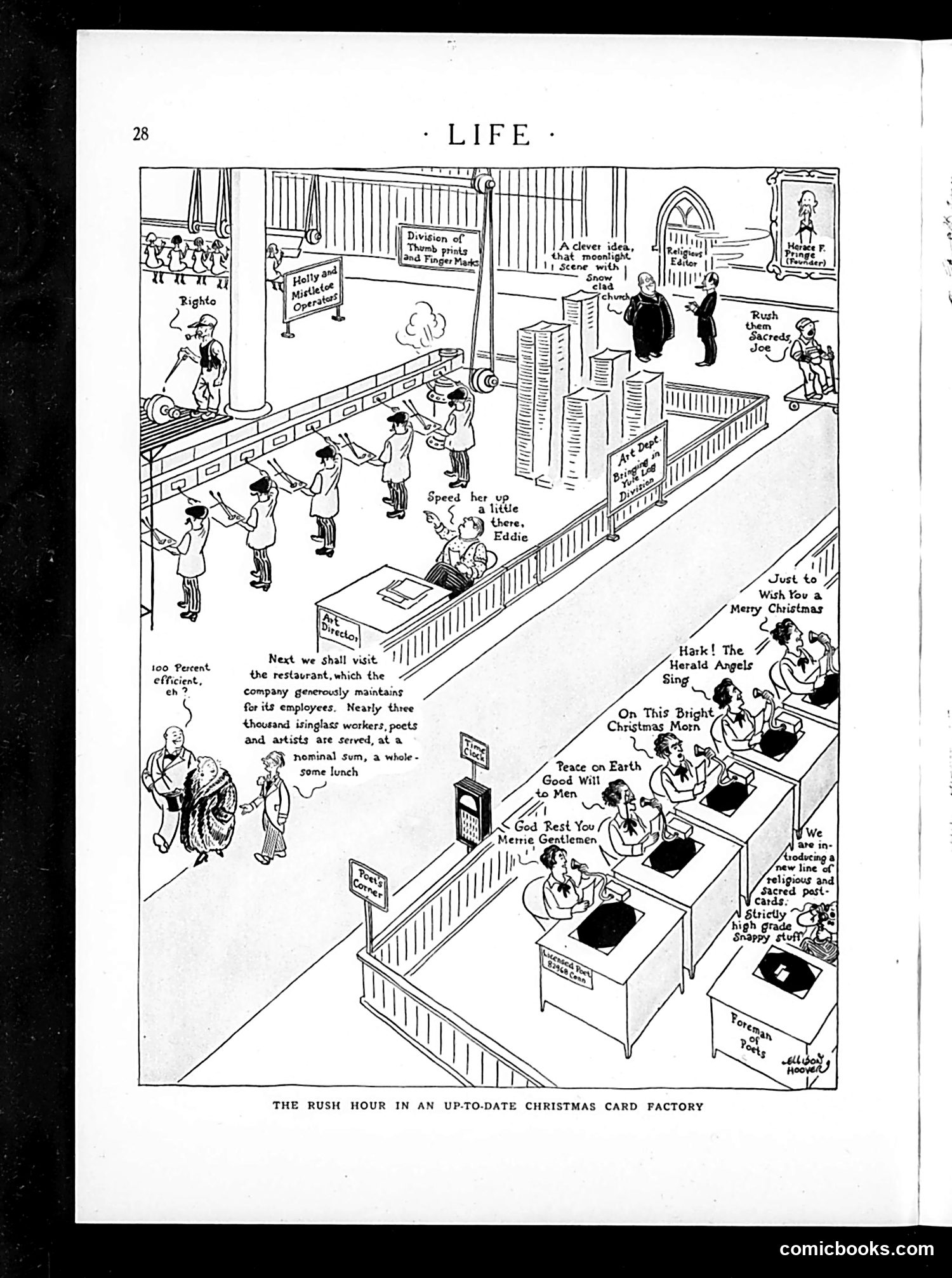
This satirical cartoon depicts the industrial production of Christmas cards during the holiday rush. The humor lies in the contrast between the *sentiment* of Christmas cards and the *reality* of their mass manufacturing. The factory floor shows workers in assembly-line positions, producing cards bearing messages of peace, goodwill, and Christian virtue ("Peace on Earth," "God Rest You Merry Gentlemen," "Hark! The Herald Angels Sing"). The satire is that these messages of spiritual meaning and human warmth are churned out mechanically by hundreds of workers—including, the text notes, "isinglass workers, poets and artists"—as mere commercial products, served lunch at cost. The cartoon mocks the contradiction: genuine expressions of holiday sentiment are mass-produced in industrial conditions, reducing sacred or heartfelt wishes to commodities. It critiques commercialization of Christmas and the gap between the idealistic message and exploitative labor reality.
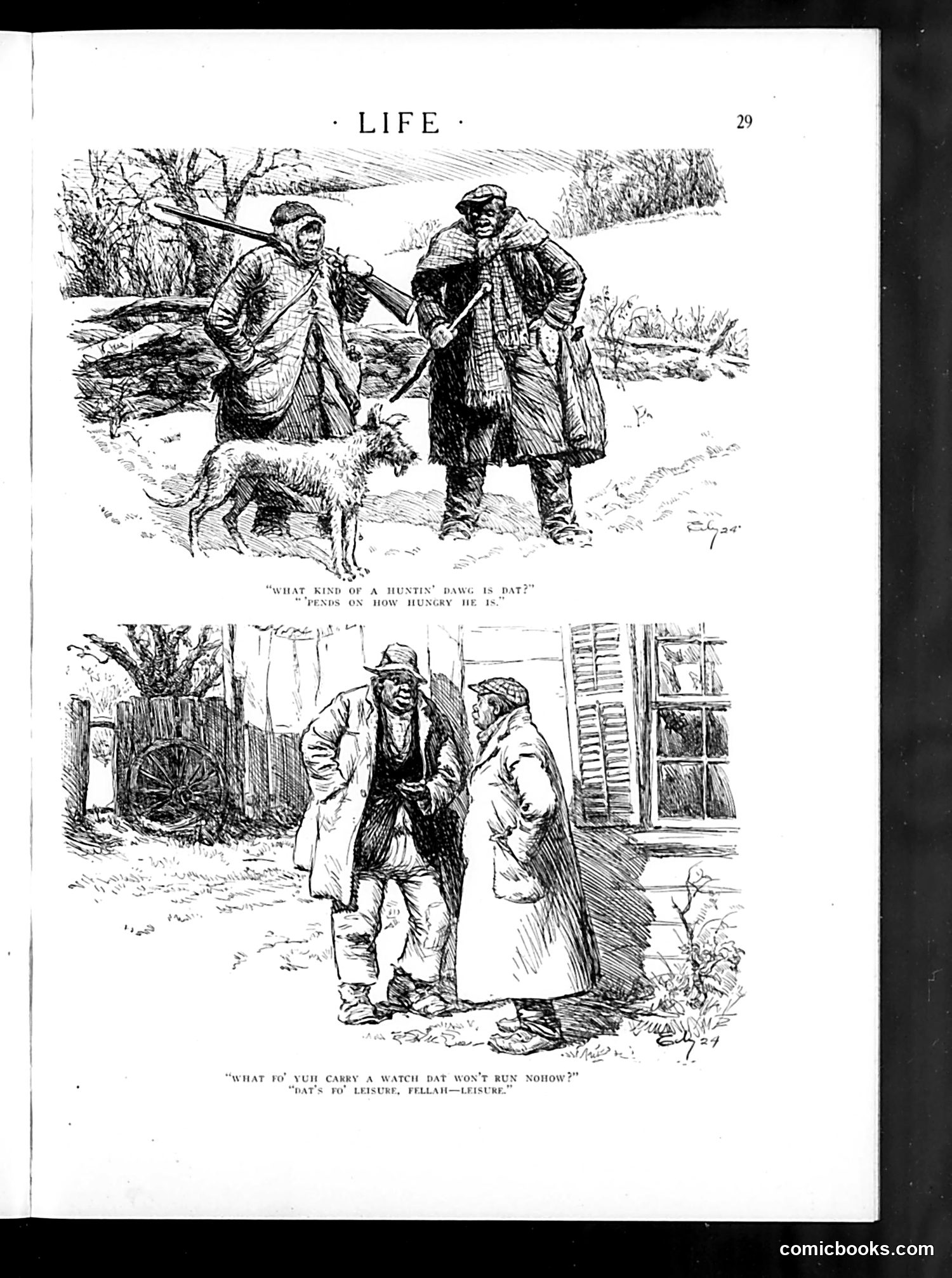
This page contains two rural/working-class humor comics. The top panel depicts hunters discussing a hunting dog's value, with the joke turning on the dog's usefulness depending on hunger—implying a lean, desperate situation where even a poor hunting dog becomes valuable. The bottom panel shows two men, one carrying a broken watch. When asked why he carries a non-functional timepiece, he replies it's "for leisure"—the humor lying in the irony that someone poor enough to own a broken watch claims it serves a leisure purpose, suggesting either self-deception or sardonic resignation to poverty. Both comics use dialect and rural settings to satirize working-class desperation during economically hard times (likely Depression-era), treating poverty with dark humor rather than sympathy. The caricatured dialect was typical of early 20th-century American satirical magazines.
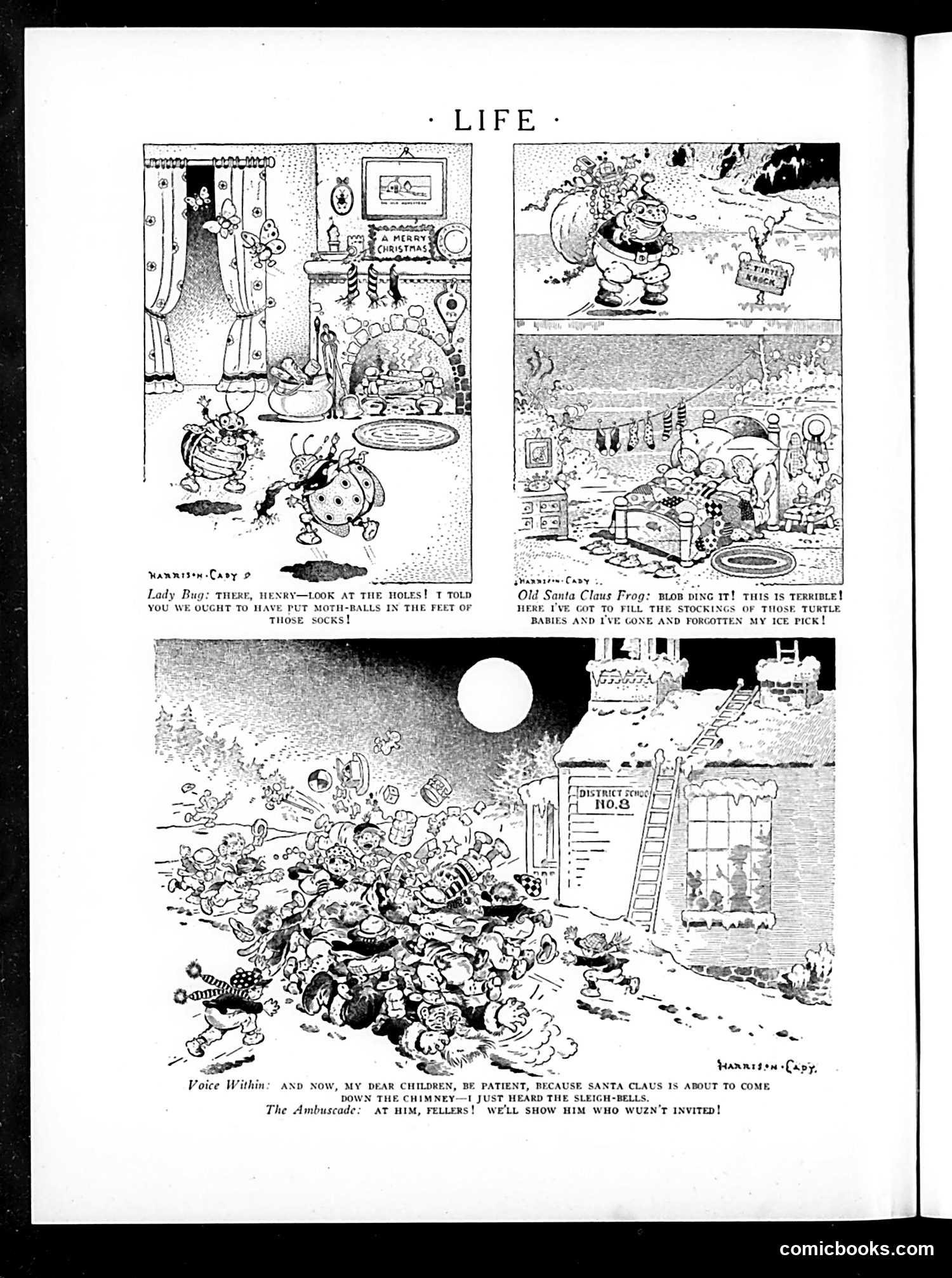
This is a humorous Christmas-themed comic page with multiple panels by cartoonist Wannigee Cary, featuring anthropomorphized animals in holiday scenarios. **Top panels:** A lady bug and Henry discuss moth-eaten socks needing mothballs; a frustrated Santa Claus frog complains about overstuffed stockings for turtle babies and a forgotten ice pick. **Bottom panel:** The main joke depicts an "ambuscade" (ambush)—a group of animals planning to attack Santa Claus as he descends the chimney, apparently because they "weren't invited" to Christmas celebrations. **The satire** appears to mock: - Holiday domestic mishaps and preparations - The commercialized excess of Christmas gift-giving - Social exclusion and resentment among the marginalized (represented by excluded animals plotting against Santa) This reflects early 20th-century *Life* magazine's satirical approach to American consumer culture and social commentary, using animal characters as stand-ins for human society's ironies.
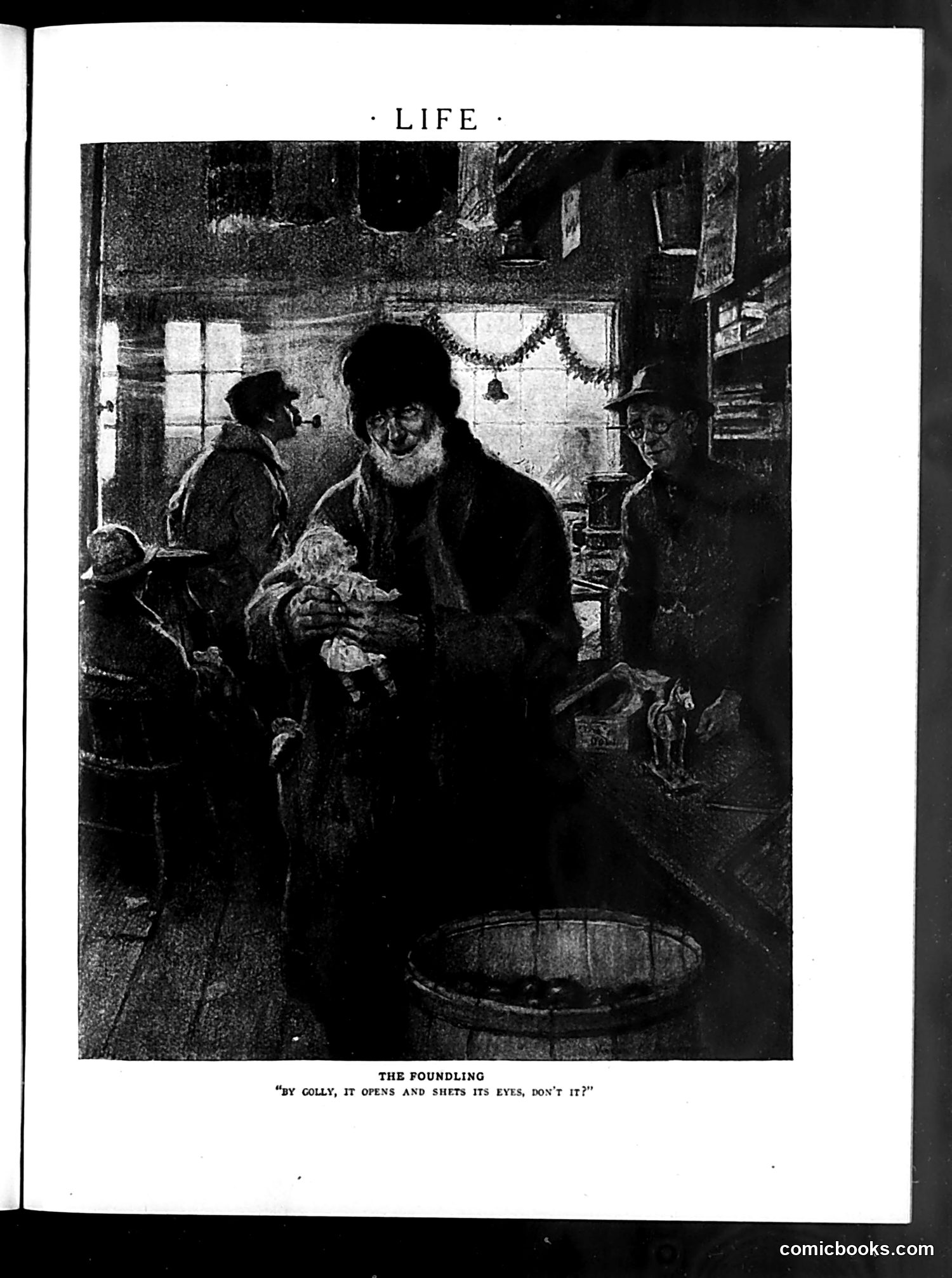
This satirical illustration depicts what appears to be a working-class or poor domestic scene. An older woman in worn clothing holds an infant while speaking to others gathered around—likely a foundling (abandoned child) that has been discovered. Her quoted dialogue, expressing wonder at the baby's basic biological functions ("opens and shets its eyes"), suggests crude, unsophisticated observers marveling at an infant as though it were a novelty or curiosity rather than a human child deserving compassion. The satire likely critiques indifference toward abandoned children or poverty-stricken circumstances of the era, or perhaps mocks the callous attitudes of working-class characters toward foundlings. The cluttered, dim interior and period clothing suggest this depicts social conditions of the late 19th or early 20th century.
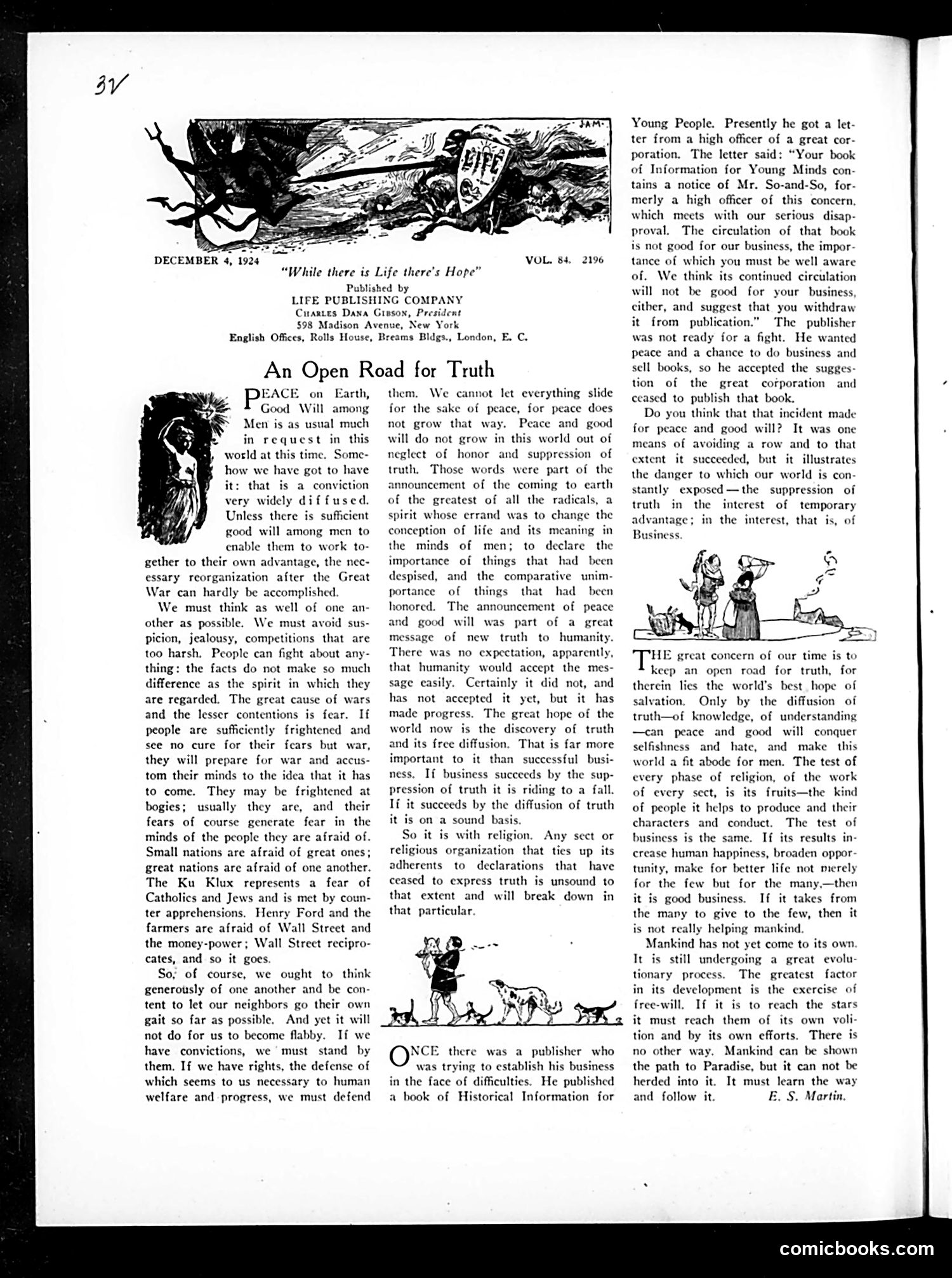
This page presents an editorial essay arguing for intellectual honesty and free discourse as essential to social progress. The author critiques institutions—corporations, religious organizations, and political groups—that suppress truth to serve their interests. The specific case illustrates the point: a publisher issued a factual history book mentioning a corporate executive unfavorably. The corporation demanded the book be withdrawn, claiming it harmed their business. The author uses this to argue that suppressing inconvenient facts in pursuit of profit or reputation corrupts both business and society. The piece references contemporary anxieties: post-WWI peace-building, the Ku Klux Klan, and tensions between labor (farmers) and capital (Wall Street). The core argument is that genuine peace and progress require truth-telling, not managed narratives—a principle the author believes transcends whether business thrives.
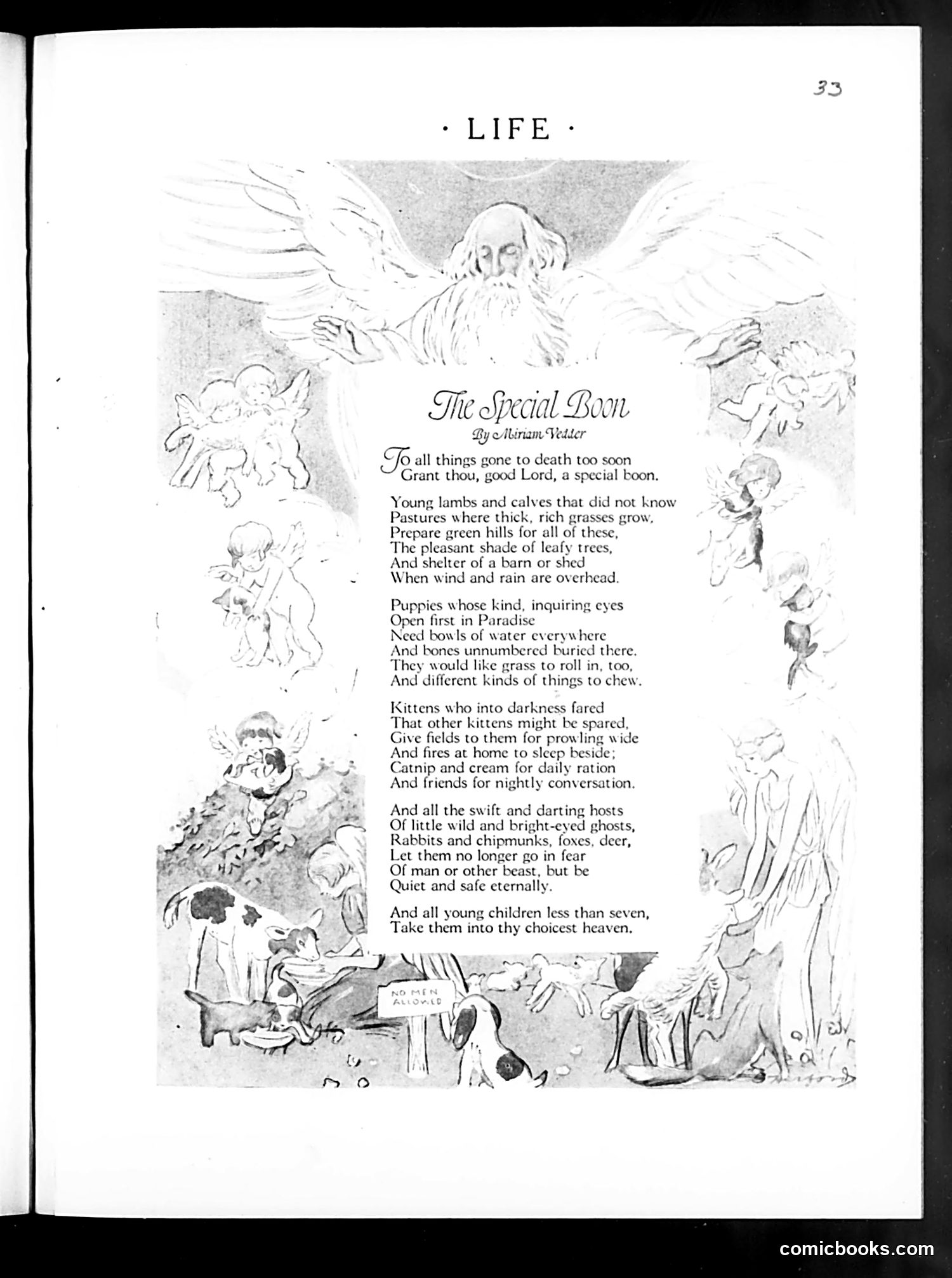
This is a sentimental poem with accompanying illustration, not political satire. Vedder's work presents a prayer requesting divine compassion for creatures who died prematurely or suffered—young animals that never experienced pastoral comfort, pets sacrificed or lost, and children who died before age seven. The imagery shows angels surrounding the prayer, with pastoral and domestic scenes below depicting the peaceful afterlife the poem requests: green fields, shelter, water, toys, and comfort for animals and infants. Rather than satirizing anything, this appears earnest—a Victorian-era meditation on mercy and afterlife for the innocent. It reflects period attitudes about animal welfare and childhood mortality, offering consolation through religious imagery and the promise of heavenly peace for those who suffered on earth.
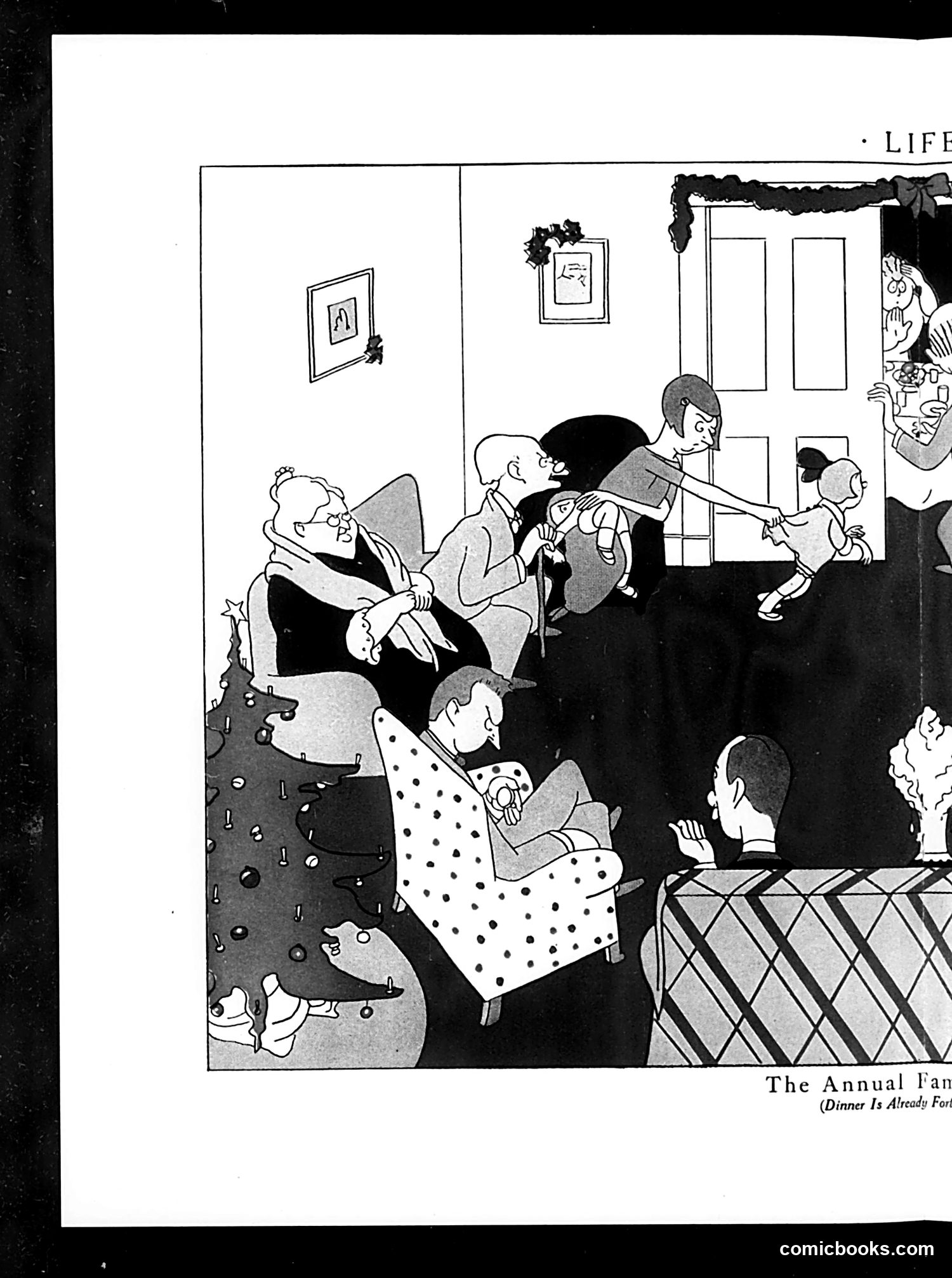
This cartoon depicts a chaotic holiday dinner scene, likely from the early-to-mid 20th century based on the art style. The title "The Annual Fan (Dinner Is Already For...)" suggests satire about a traditional family gathering gone wrong. The scene shows multiple generations—elderly relatives, parents, children, and babies—crammed together in apparent disorder. A Christmas tree is visible on the left. The humor appears to target the complications of large family dinners: overcrowding, generational tension, children's misbehavior, and the stress of hosting. The composition emphasizes chaos and cramped conditions, satirizing the romanticized ideal of harmonious holiday family gatherings that often prove chaotic in reality.
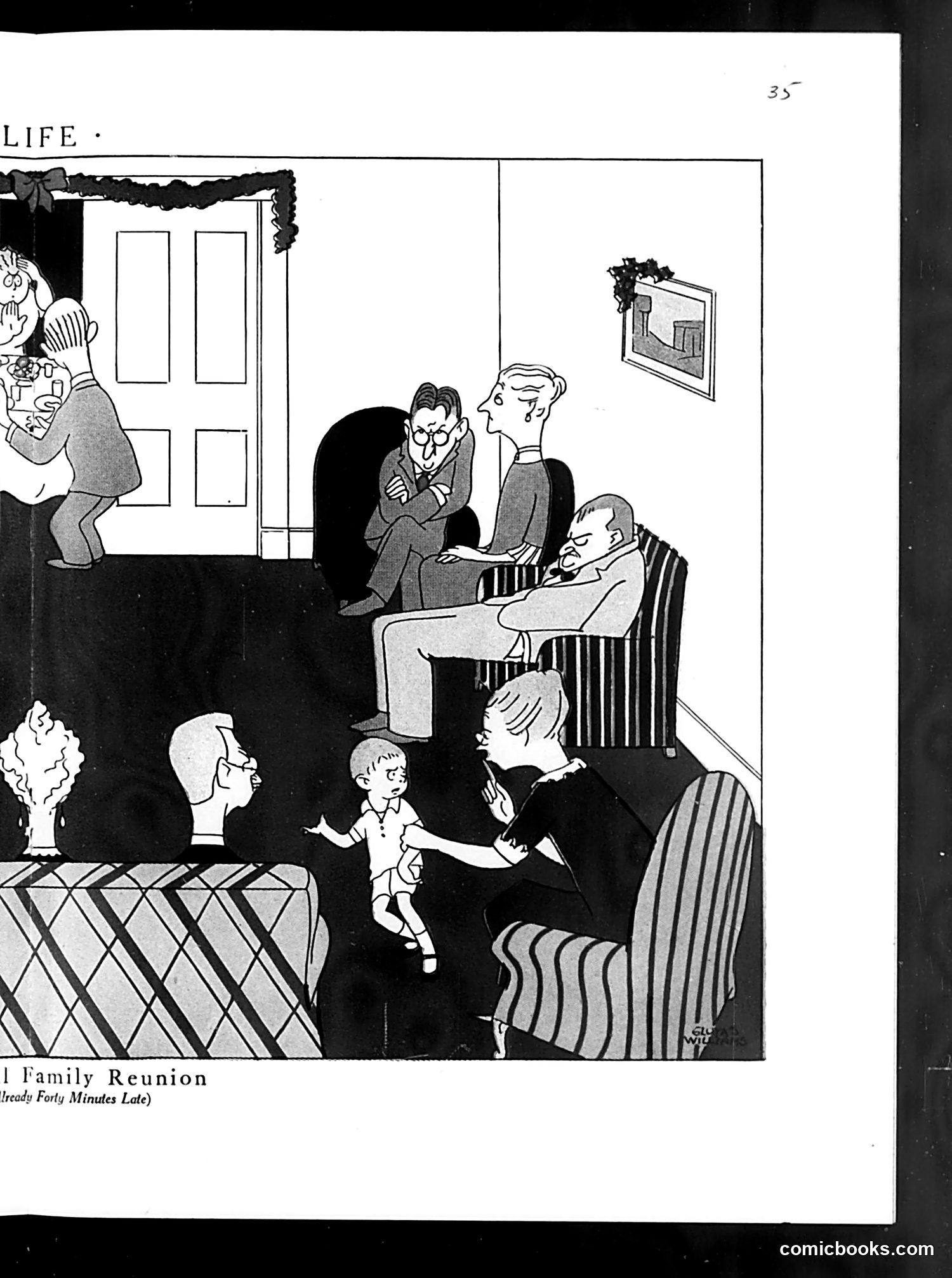
This cartoon satirizes the chaos of a family gathering running behind schedule. The scene shows multiple generations crowded in a living room—adults, children, and elderly relatives—with evident tension and impatience. One man sits prominently in a chair while others stand or cluster around; a woman near the door appears to be checking the time or expressing frustration. The joke targets the universal experience of family events where punctuality fails despite expectations. The subtitle "(Already Forty Minutes Late)" emphasizes how delays compound frustration. The cramped composition and varied expressions convey the awkwardness and irritation typical of delayed family gatherings. This is gentle social satire about domestic life rather than political commentary—reflecting mid-twentieth-century American anxieties about family obligations and scheduling.
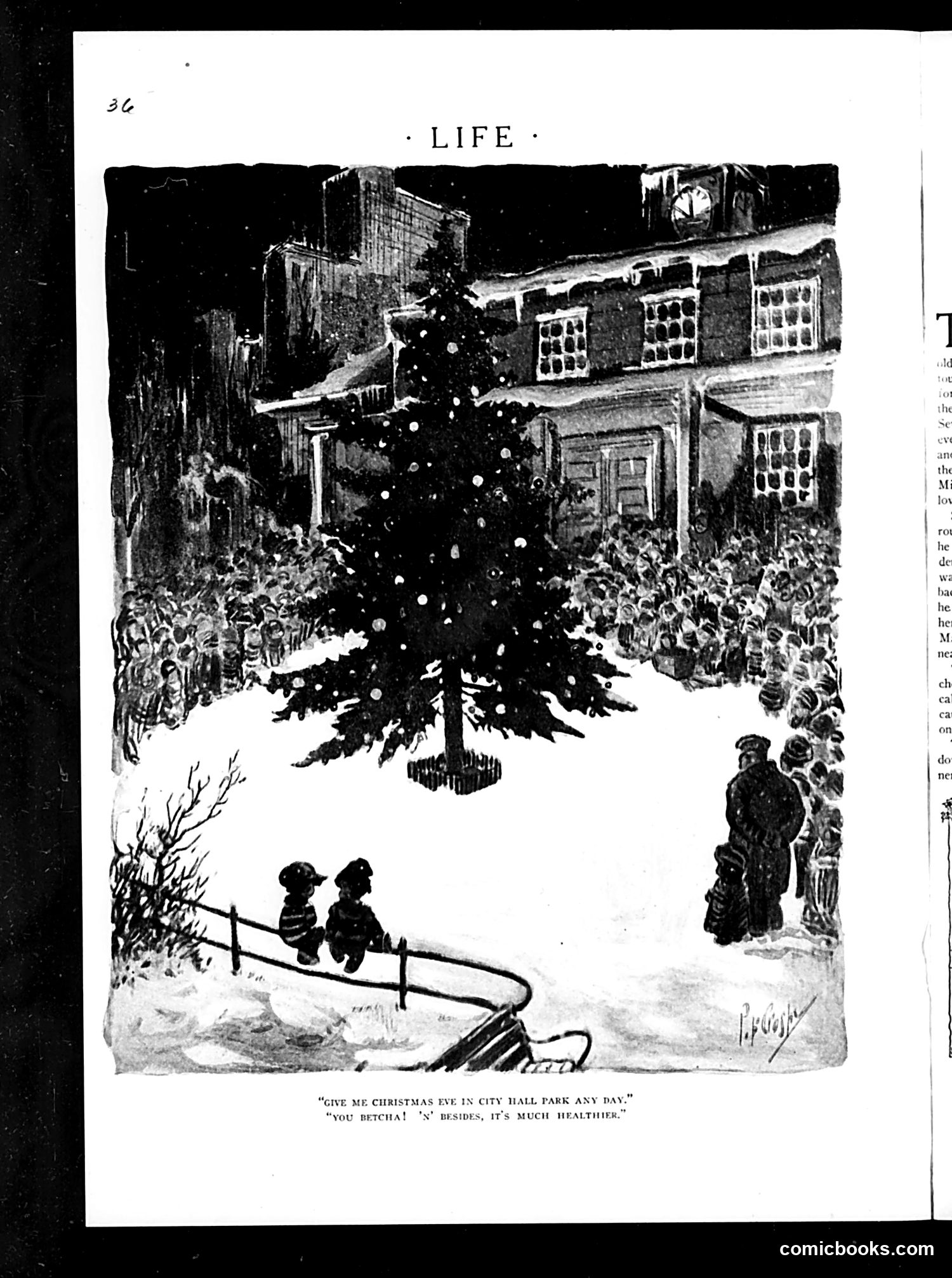
This is a single-panel cartoon depicting a snowy Christmas Eve scene in City Hall Park. Two figures in the foreground stand at a railing, with one making the quoted statement preferring the park's Christmas celebration to an unspecified alternative (likely an indoor venue or formal event). The cartoon satirizes urban preferences and social attitudes toward Christmas celebrations. The speaker dismisses a more formal or upscale option ("you petcha") in favor of the public park gathering, which they claim is "much healthier." The large decorated Christmas tree surrounded by crowds of townspeople suggests a democratic, inclusive celebration accessible to ordinary citizens rather than the wealthy or privileged. The humor appears to mock either snobbish preferences for exclusive celebrations or, conversely, working-class pride in their public festivities. The exact target of satire remains somewhat unclear without additional context about contemporary social debates regarding Christmas observances.
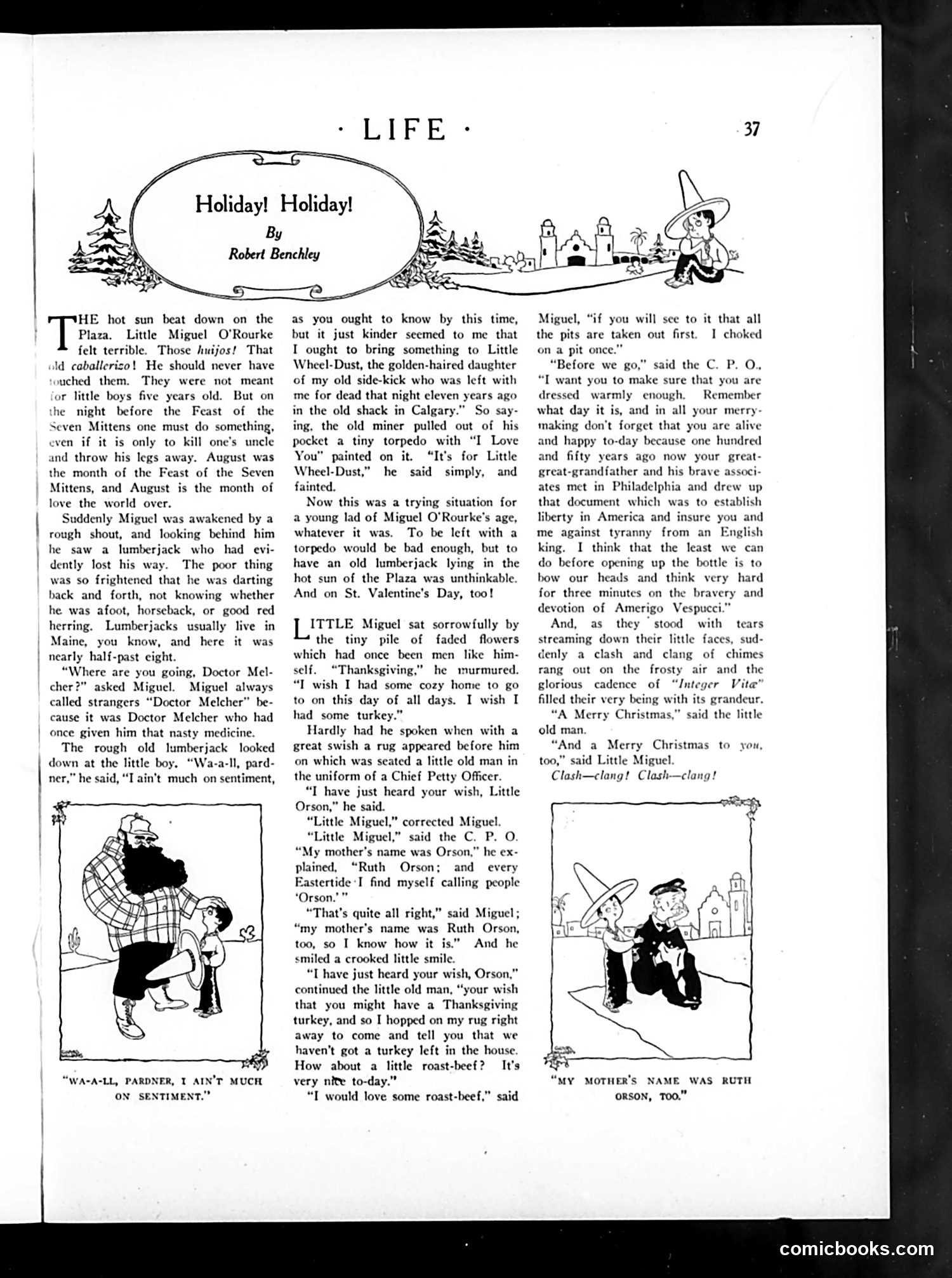
This is a absurdist satirical short story rather than a political cartoon. Benchley (a well-known American humorist) deliberately creates nonsensical narrative to mock sentimentality and patriotic rhetoric. The "plot" is deliberately incoherent: a boy named Miguel encounters a confused lumberjack who gives him a tiny torpedo as a gift, then a Chief Petty Officer appears on a magic rug offering roast beef. The C.P.O. interrupts to lecture Miguel about the American founding, invoking Philadelphia and liberty—exactly 150 years prior (suggesting publication around 1926). **The satire**: Benchley mocks how adults interrupt children's simple desires with pompous historical lectures and excessive sentiment. The absurd details (the "Feast of the Seven Mittens," the disconnected characters, the meaningless interruptions) undermine the gravity of both patriotic appeals and sentimental gift-giving. It's humor through deliberate illogic—poking fun at overwrought American mythology and earnest sentimentality.
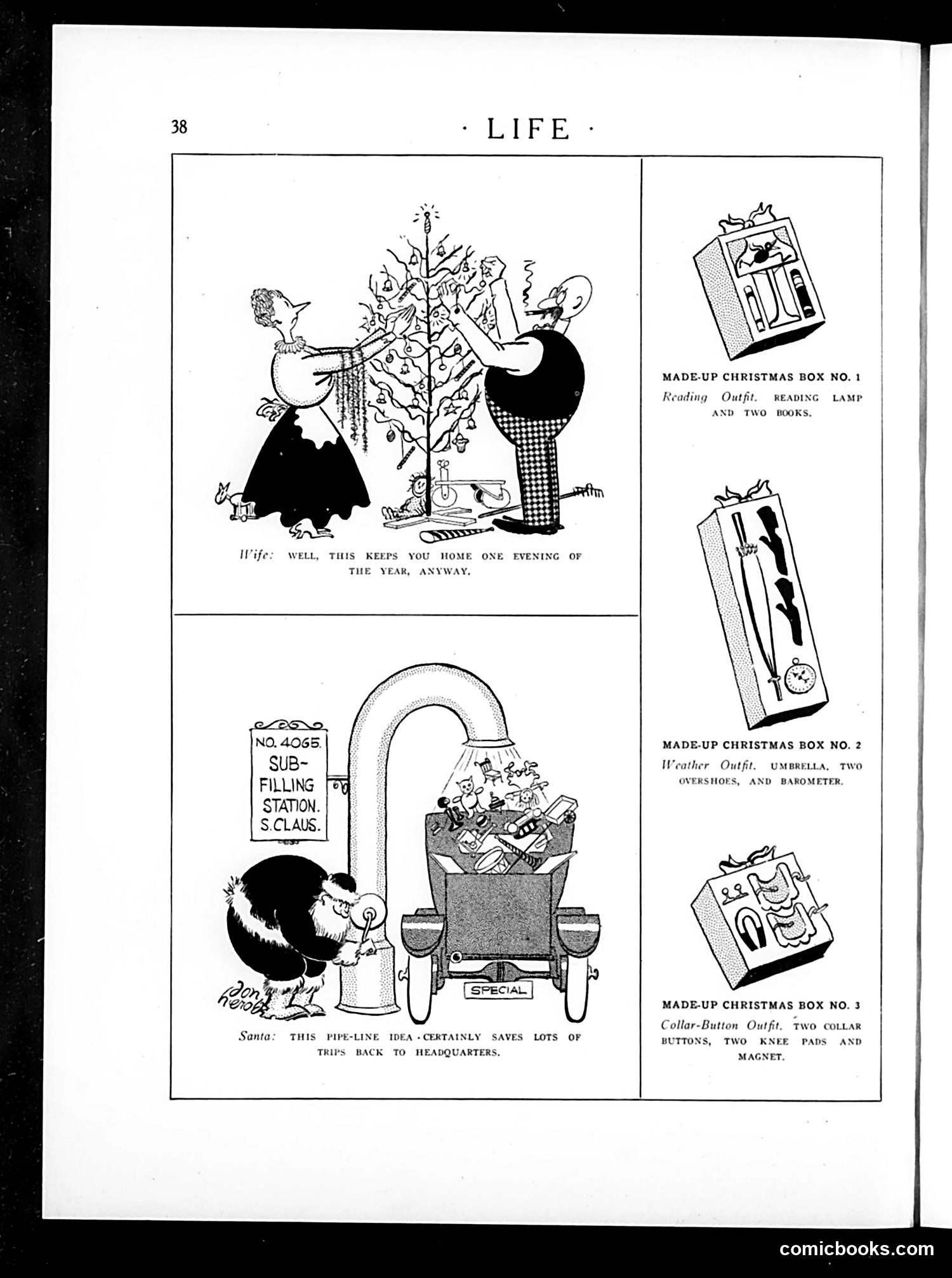
This page satirizes impersonal, utilitarian Christmas gift-giving through three cartoons paired with advertised "made-up Christmas boxes." **Top cartoon:** A husband gives his wife a Christmas tree—a deliberately modest gift. Her sarcastic response ("this keeps you home one evening of the year, anyway") mocks the gift's inadequacy and suggests marital tension. **Bottom cartoon:** Santa uses a "pipe-line" delivery system to efficiently dispense gifts, reducing Christmas to bureaucratic logistics. His comment about "saves lots of trips" satirizes the commercialization and mechanization of the holiday. **Right sidebar:** The three "Made-Up Christmas Boxes" advertise banal items (reading lamp, umbrella, collar buttons)—practical rather than thoughtful gifts that exemplify the satirical point: Christmas has become about obligatory, impersonal consumer goods rather than genuine gift-giving. The humor mocks both lazy gift-givers and the consumerist holiday culture.
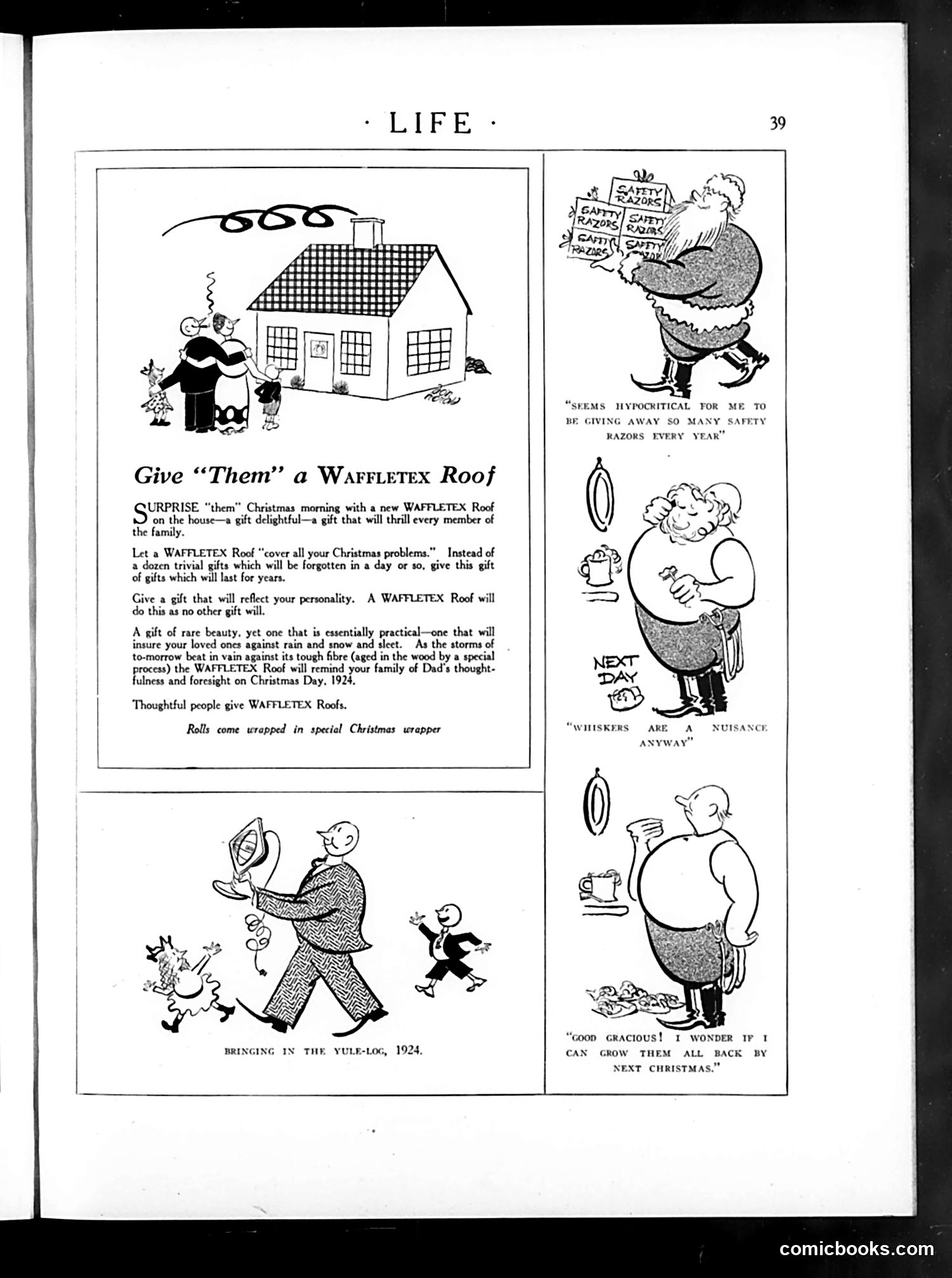
This is primarily a **product advertisement** for Waffletex Roof roofing material, presented as a satirical gift suggestion for Christmas 1924. The ad humorously proposes giving a roof as an ideal Christmas present—framing practical home improvement as romantic gift-giving. The page includes accompanying **comic cartoons** mocking gift-giving absurdities: - A figure laden with safety razors expresses guilt about "giving away so many safety razors every year" - A rotund man jokes about whiskers being a "nuisance" - The same figure wonders if he can regrow them by next Christmas These comics satirize **excessive or impractical gift-giving customs**—safety razors and similar consumables that require repeated purchasing. The Waffletex ad exploits this critique by positioning roofing as the *sensible* alternative: a durable, lasting gift "which will last for years" rather than trivial items "forgotten in a day or so." The satire targets both consumer culture and masculine gift-giving anxieties of the 1920s.
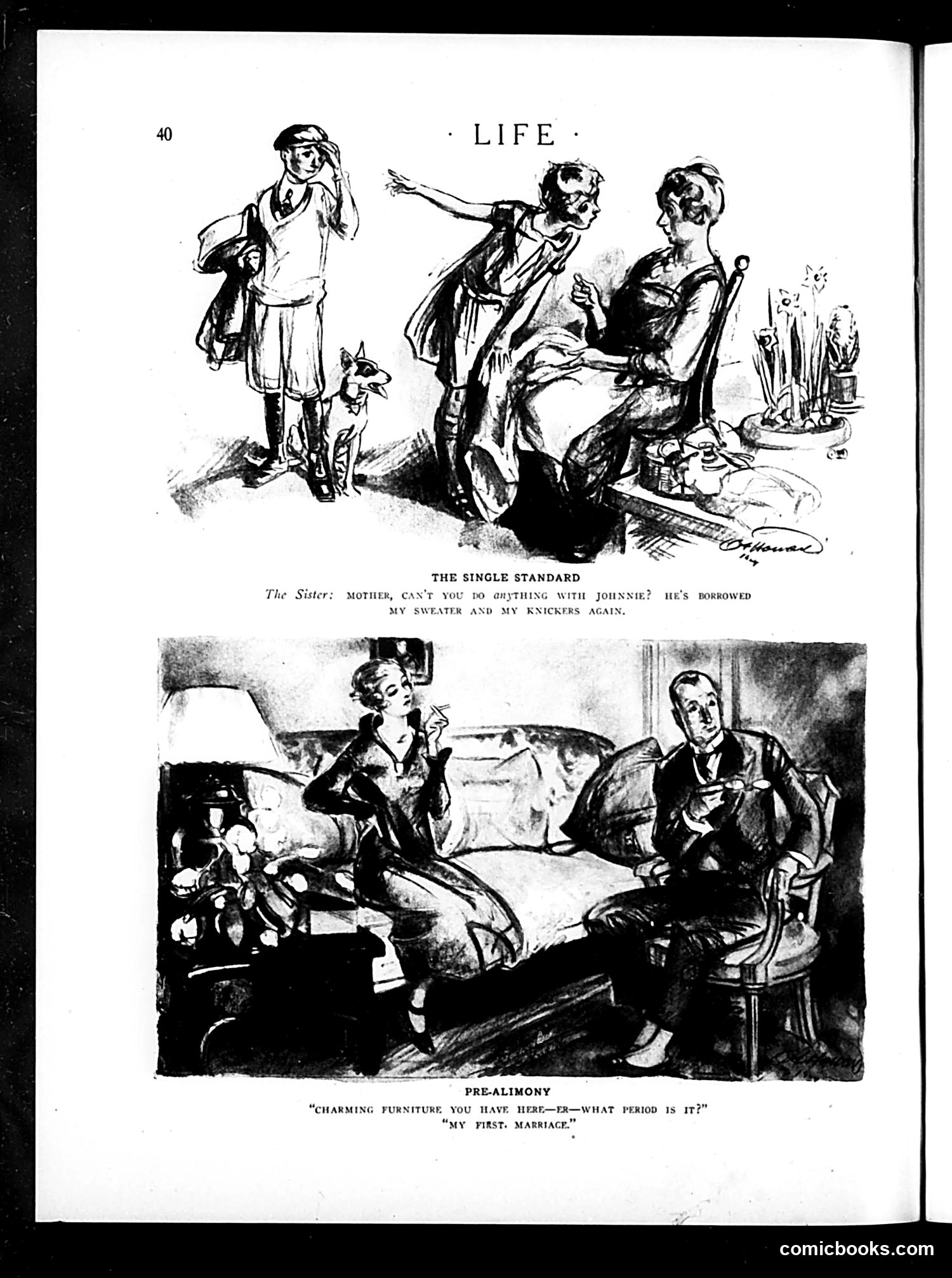
This page presents two satirical cartoons about gender relations and marriage. **"The Single Standard"** mocks the double standard regarding morality and property. A sister complains to their mother that her brother "Johnnie" repeatedly borrows her sweater and knickers (underwear). The cartoon's title ironically suggests applying a "single standard" — implying women shouldn't tolerate men's casual appropriation of their belongings or bodies. **"Pre-Alimony"** depicts a newlywed couple examining furniture in their home. When asked about the furniture's period, the wife replies "My first marriage" — a darkly humorous reference to the expectation that she'll be married multiple times and accumulate possessions from each marriage. This satirizes both pessimistic marriage prospects and the financial settlements (alimony) women might expect from divorces. Both cartoons critique gender inequalities and marital instability in early 20th-century society.
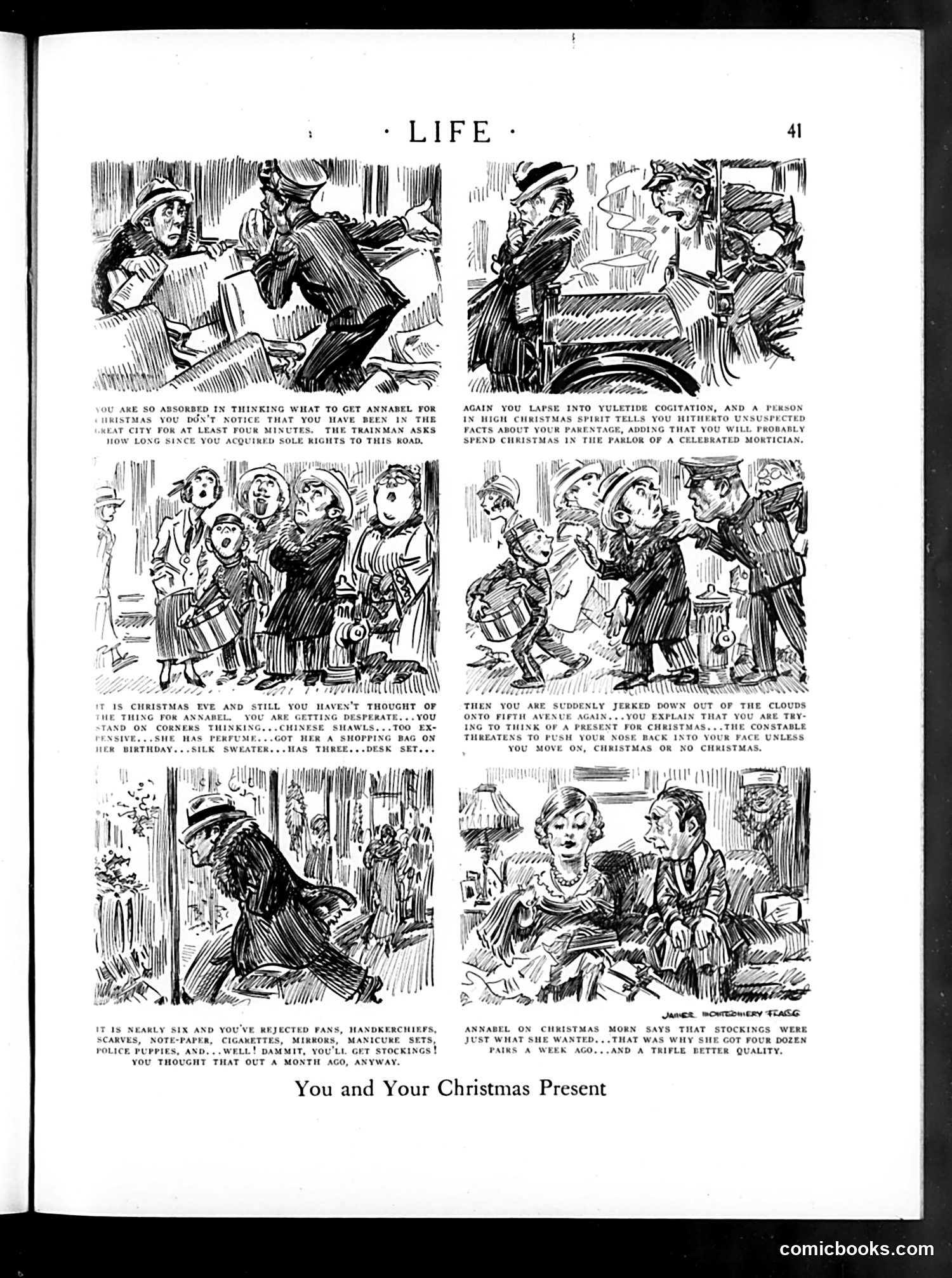
This satirical comic strip depicts the frustrations of holiday shopping in early 20th-century urban America. The narrative follows an absent-minded man so preoccupied with finding a gift for "Annabel" that he causes comical chaos: he blocks train traffic, gets verbally abused by a stranger, and is threatened with arrest by a police officer for obstructing Fifth Avenue pedestrians. The humor targets the stress of Christmas shopping and male indecision—he cycles through rejected gift options (scarves, cigarettes, mirrors) before defaulting to stockings. The final panel delivers the satirical punchline: Annabel reveals she already owns four dozen pairs of stockings, making his agonized deliberation entirely pointless. The strip mocks both the commercial pressures of Christmas and masculine shopping incompetence.
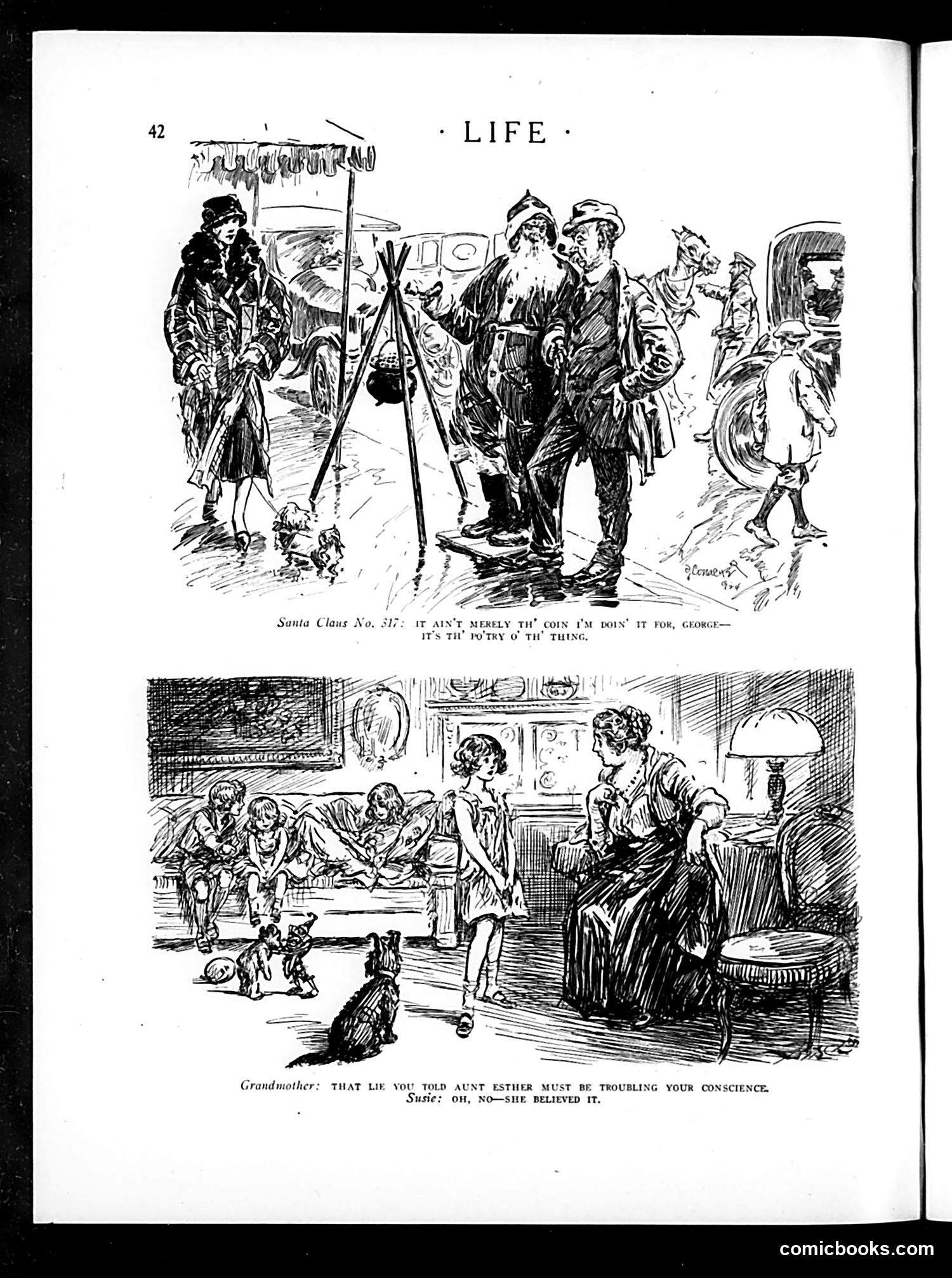
**Top cartoon ("Santa Claus No. 317"):** Shows people on skis confronted by someone collecting money. The caption suggests the collector claims it's not about profit but "the joy of the thing"—satirizing people who justify exploitative or mercenary behavior with noble-sounding excuses. **Bottom cartoon:** A grandmother confronts a young person about lying to Aunt Esther. When the grandmother suggests the lie should trouble their conscience, the child responds "Oh, no—she believed it." The satire targets the moral laziness of lying successfully without guilt, and perhaps generational attitudes toward dishonesty. Both cartoons use domestic scenarios to mock hypocrisy and the absence of genuine moral conviction in everyday life—characteristic of Life magazine's satirical approach to American society.
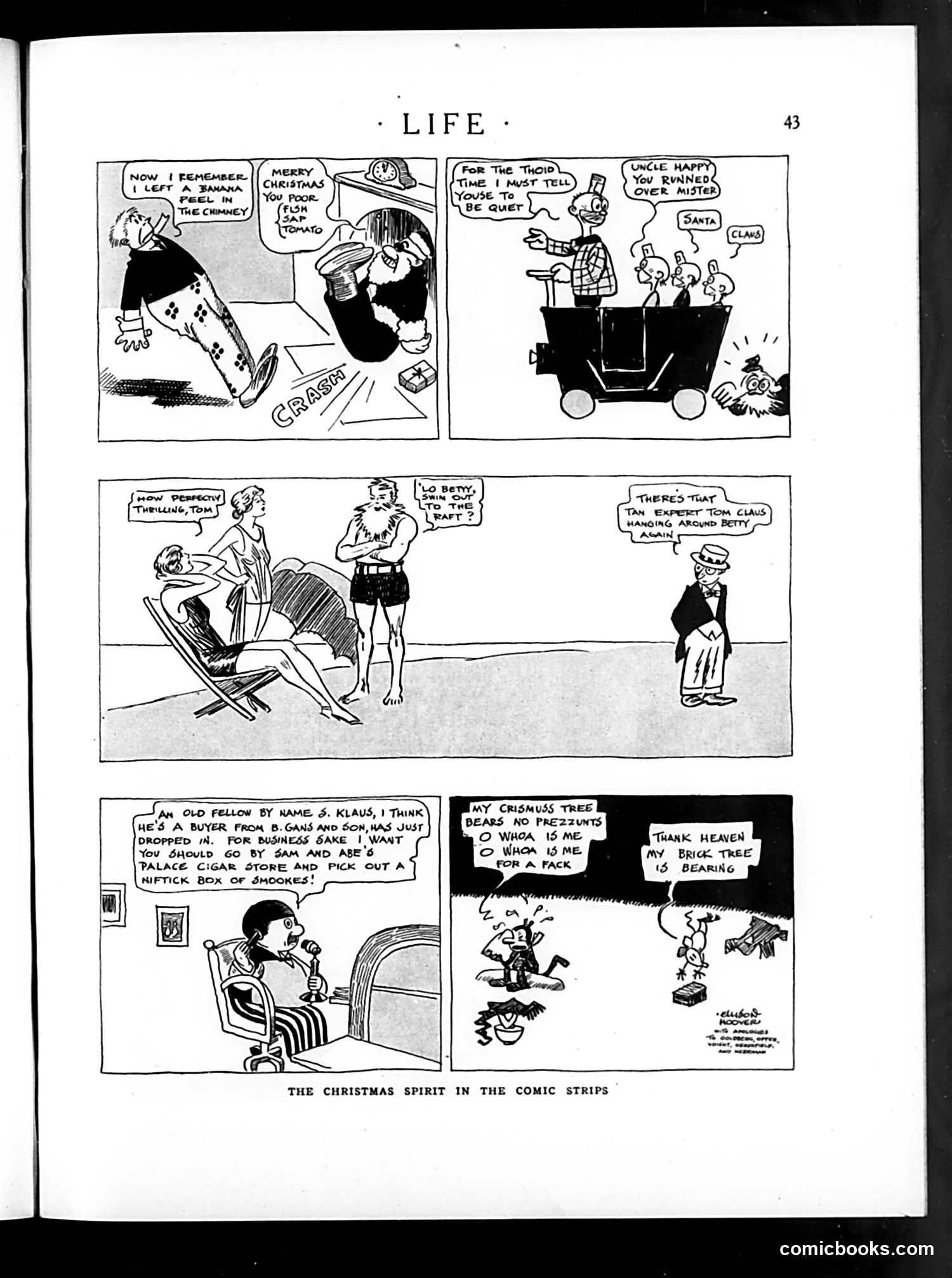
This page collects several Christmas-themed comic strips satirizing holiday consumer culture and sentimentality. The strips mock: 1. **Commercial Christmas**: References to department stores (B. Gans and Son), gift-giving obligations, and business deals disguised as holiday cheer. 2. **Santa Claus mythology**: One strip shows children on Santa's sleigh making demands ("Santa! Claus!"), satirizing commercialized gift-expecting. 3. **Working-class reality**: A character mentions an old fellow "S. Klaus" dropping by for "business sake"—suggesting even Santa operates as a commercial agent rather than symbol of generosity. 4. **Ironic piety**: The final strip's tree "bearing no presents" yet offering "thank heaven"—contrasting modest reality with expected prosperity. The overall message critiques how American consumer culture has co-opted Christmas spirituality, reducing the holiday to shopping, gift transactions, and commercial networking rather than genuine charitable spirit.
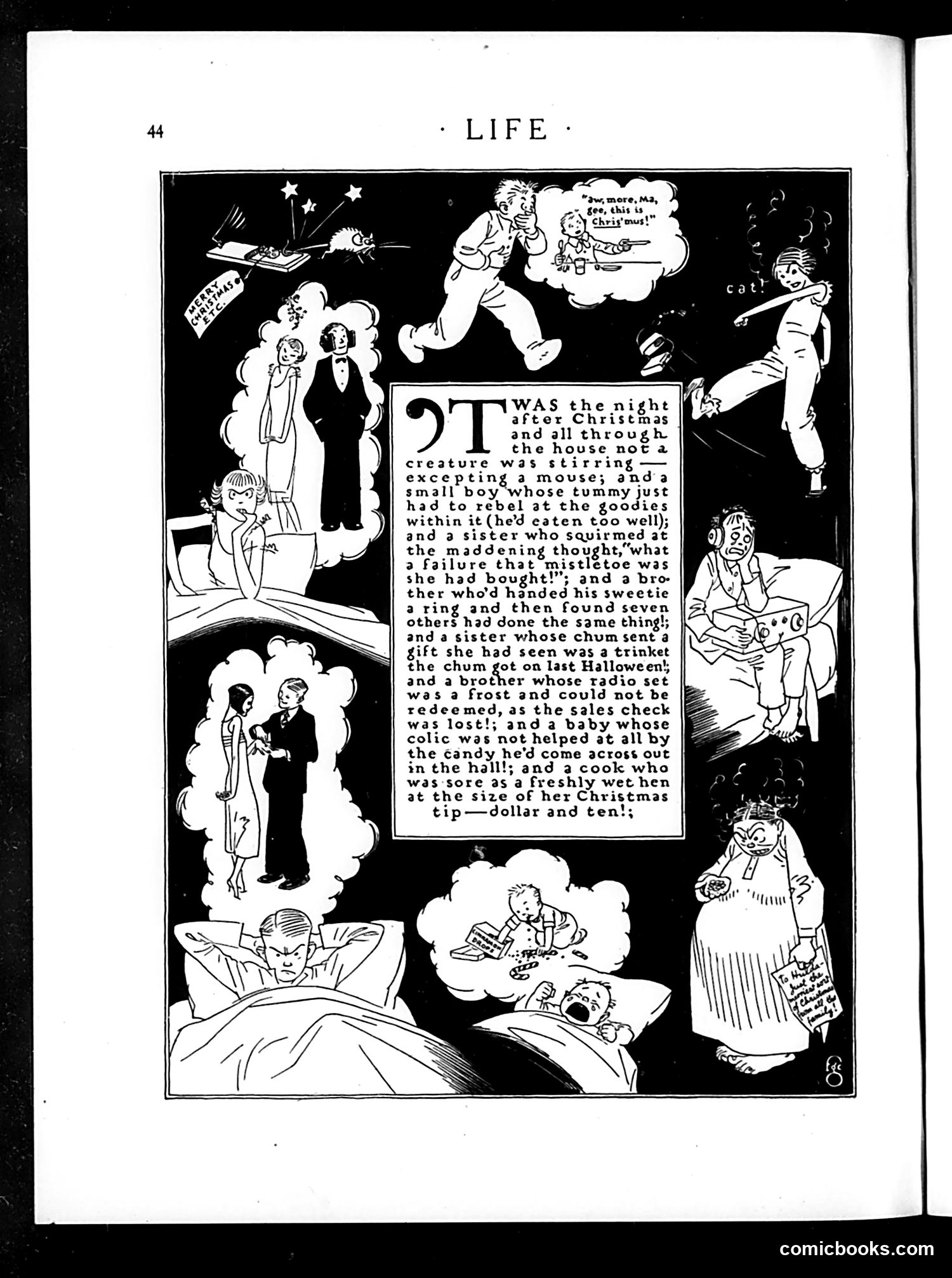
This is a humorous post-Christmas commentary presented as a twisted version of "Twas the Night Before Christmas." Rather than peaceful slumber, the illustration shows a household in chaos, with various family members experiencing common holiday disappointments: - A boy with indigestion from overeating - A sister's failed romantic gambit (mistletoe gift) - A brother whose engagement ring was duplicated by seven other men - Another brother with a defective, unreturnable radio - A baby suffering colic from found candy - A cook bitter about her meager tip The satire mocks post-holiday letdowns and buyer's remorse—the gap between Christmas expectations and reality. The exaggerated miseries reflect 1920s consumer culture anxieties: failed romance, defective purchases, inadequate compensation for service workers, and children's overindulgence. The art style suggests this is from Life's humor section, using recognizable domestic scenes for comedic social commentary.
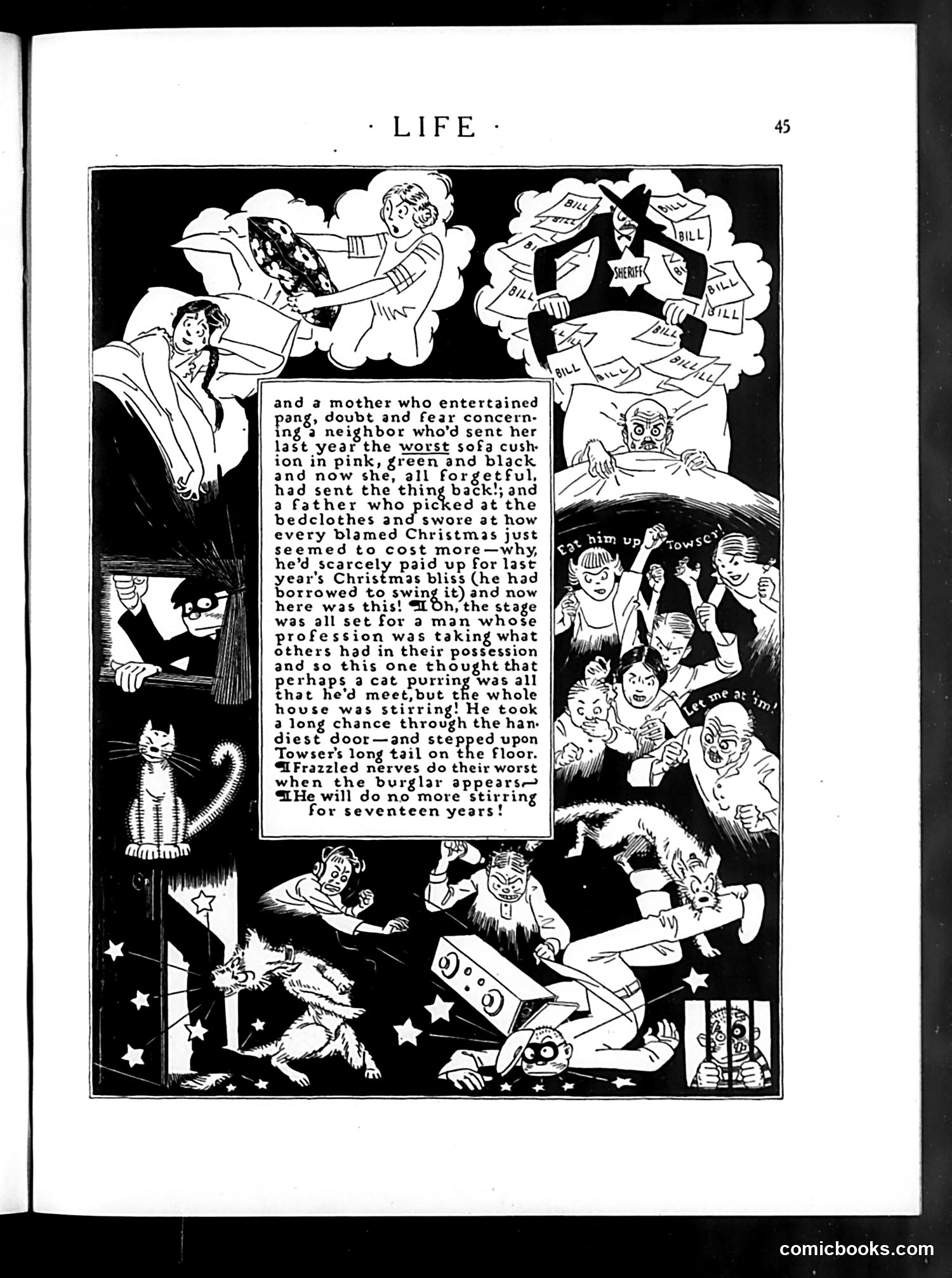
This is a comedic cautionary tale about a burglar's bad luck. The narrative describes a household in chaos: a mother annoyed about regifting a terrible sofa cushion, a father stressed over Christmas debt and borrowing money. A burglar enters expecting an easy target, assuming only a purring cat awaits—instead, the entire frazzled household is awake and stirring. The burglar's downfall comes when he steps on the family dog's (Towser's) tail on the floor. The punchline: his violent reaction to the dog triggers such commotion that he's incapacitated for seventeen years, unable to commit further crimes. The satire mocks both the stressed American consumer (burdened by Christmas spending) and presents burglary as comically defeated by domestic chaos rather than police intervention. It's darkly humorous about financial anxiety and family stress during the holiday season.
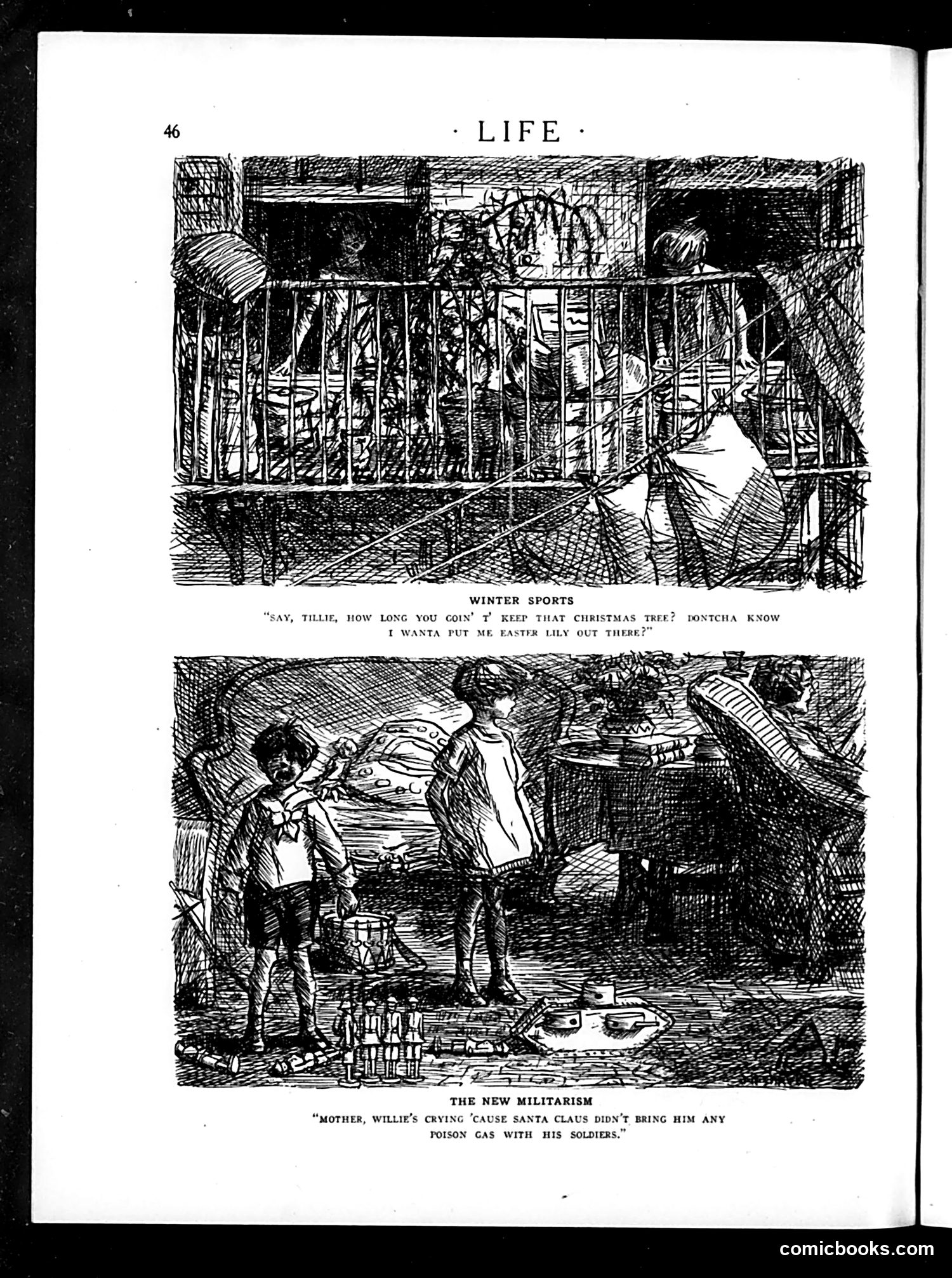
This page contains two satirical cartoons from *Life* magazine, likely from the early 20th century (given the "New Militarism" reference): **Top cartoon ("Winter Sports"):** Shows children discussing keeping a Christmas tree on a balcony/railing. The dialogue uses exaggerated dialect ("Dontcha know") typical of period ethnic humor, depicting working-class children. **Bottom cartoon ("The New Militarism"):** More pointed social commentary. A child named Willie cries because Santa Claus didn't bring poison gas with his soldiers. This darkly satirizes militarism and weapons proliferation—the cartoon suggests that modern warfare has become so normalized that children expect lethal weapons as Christmas gifts. The "New Militarism" title indicates concern about military expansion and the arms race. The cartoon criticizes how militaristic culture has pervaded society, even children's expectations. This reflects early-20th-century anxieties about industrial warfare and militarization, possibly referencing pre-WWI tensions or the Great War itself.
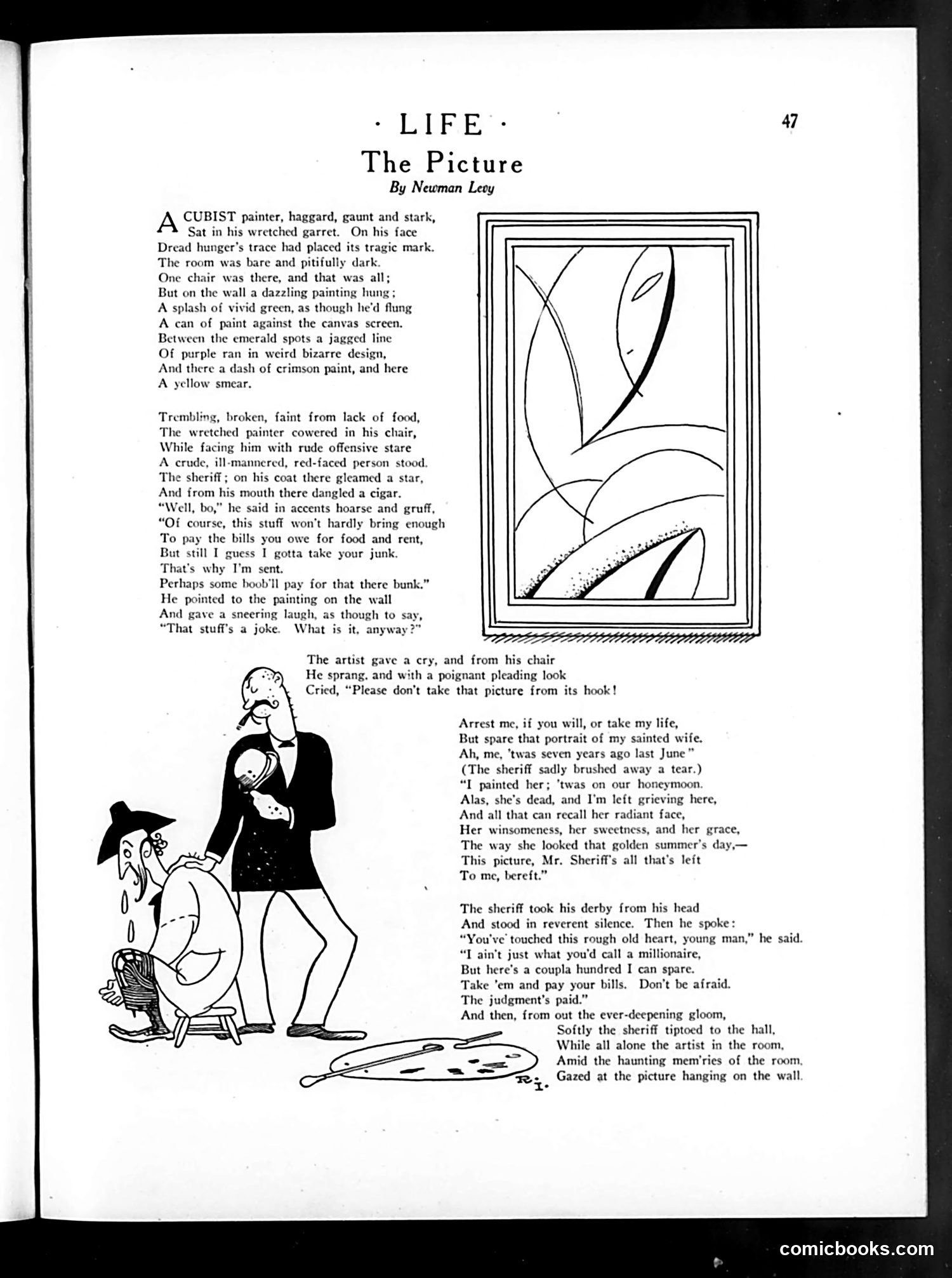
This poem satirizes early modernism (specifically Cubism) through a sentimental narrative. A starving Cubist painter faces eviction by a stereotypical tough sheriff. When the officer mocks the abstract painting on the wall as worthless junk, the artist reveals it's actually a portrait of his deceased wife from their honeymoon. The satire operates on two levels: it ridicules Cubist art as incomprehensible ("That stuff's a joke"), while simultaneously using sentimentality to redeem it—the "worthless" modernist work gains value only when reframed as representational portraiture tied to emotion. The sheriff, portrayed as a rough, unsophisticated lawman, becomes moved by the romantic story and pays the artist's debts. The joke reflects early 20th-century cultural anxiety about avant-garde art: it's either meaningless abstraction *or* it must serve traditional purposes (representation, sentiment) to justify its existence.
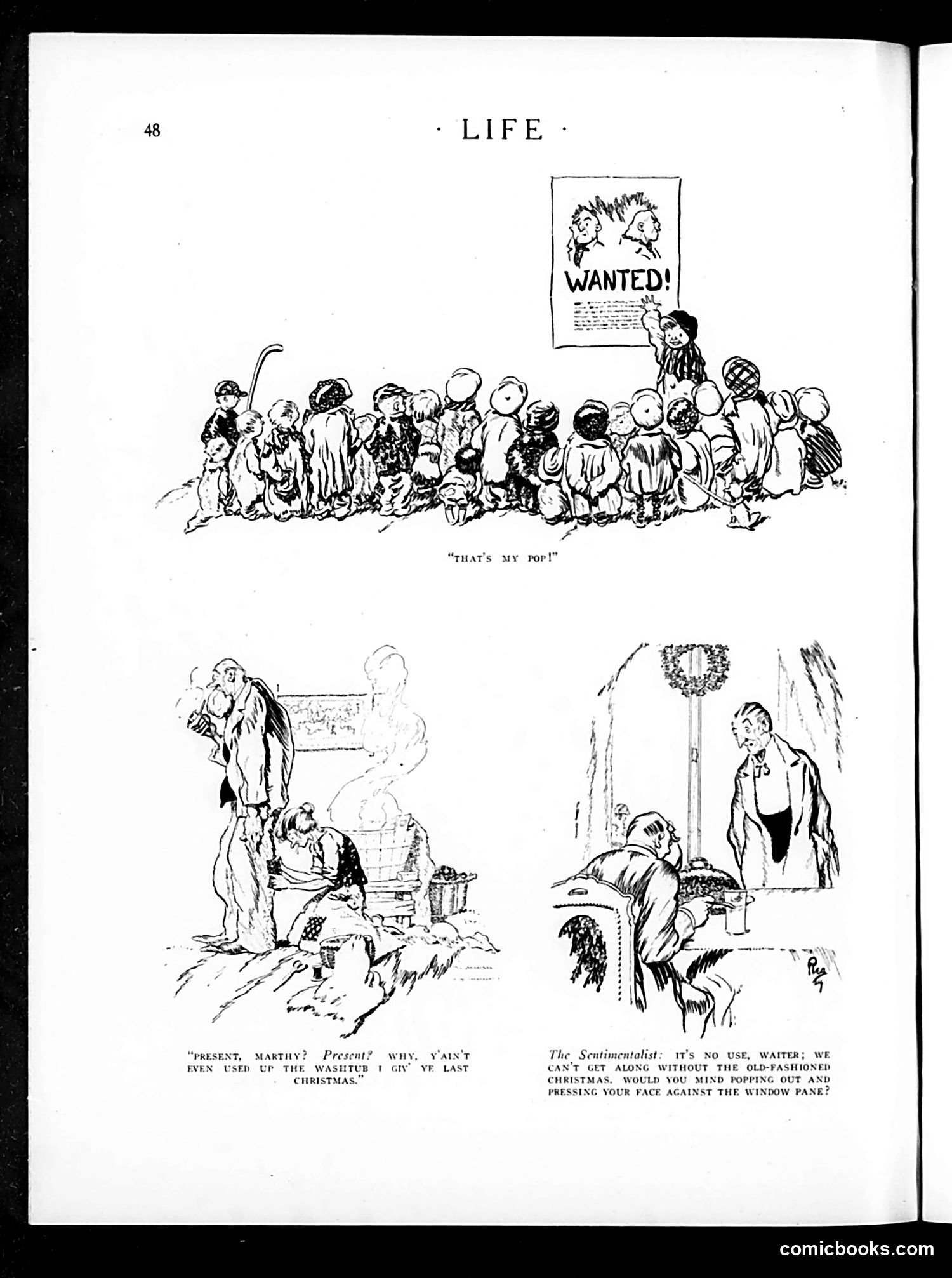
This page contains three separate satirical cartoons mocking Christmas gift-giving and sentimentality: **Top cartoon:** Children gather around a "WANTED" poster, with one exclaiming "That's my pop!" — satirizing poverty and the desperation of families during hard times when parents might be wanted by authorities. **Bottom left:** A poor couple discusses meager Christmas presents. The husband notes they've exhausted even their washtub as a gift, mocking the desperation of the impoverished to find anything to exchange during the holidays. **Bottom right:** Titled "The Sentimentalist," a wealthy waiter dismisses his date's nostalgia for old-fashioned Christmases, then requests she press her face against the window—likely so passersby see him with an attractive companion, exposing his superficiality beneath his sentimental complaints. The page satirizes class disparities, the commercialization of Christmas, and hollow sentimentality among the well-to-do.
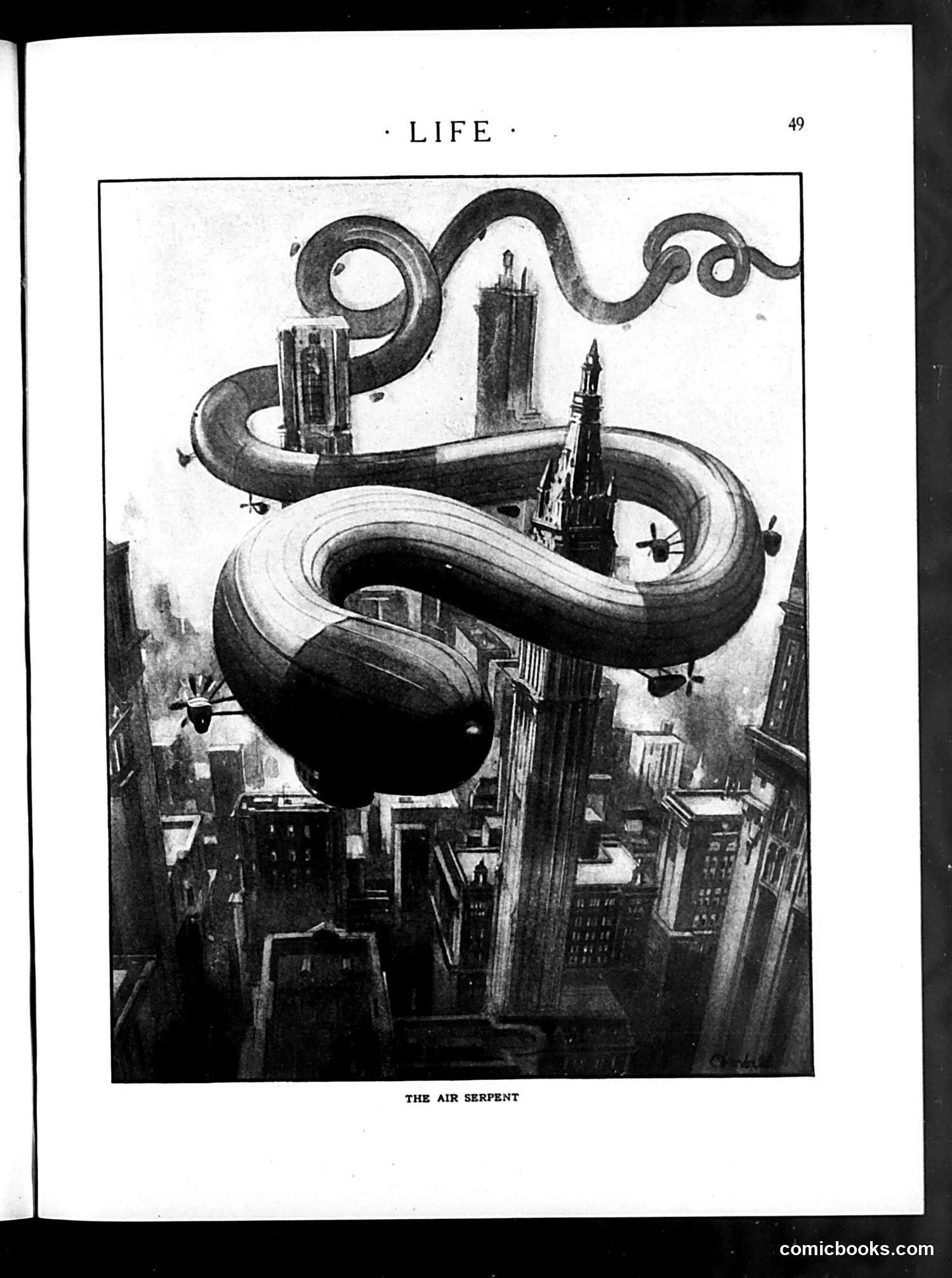
This is a surreal political cartoon depicting a giant serpent coiling through an urban cityscape. The serpent's body wraps around tall buildings (appearing to be skyscrapers like those in New York City), while its head looms ominously over the metropolitan area. The "air serpent" likely represents a perceived threat or danger associated with aviation or aerial warfare. Given Life magazine's satirical nature and the Art Deco style suggesting early-to-mid 20th century, this probably comments on anxieties about airplane technology, air power, or military aviation threats to cities. The serpent's dominating, menacing pose over civilian infrastructure suggests public concern about aerial vulnerability—a timely anxiety during the interwar period or early WWII era.
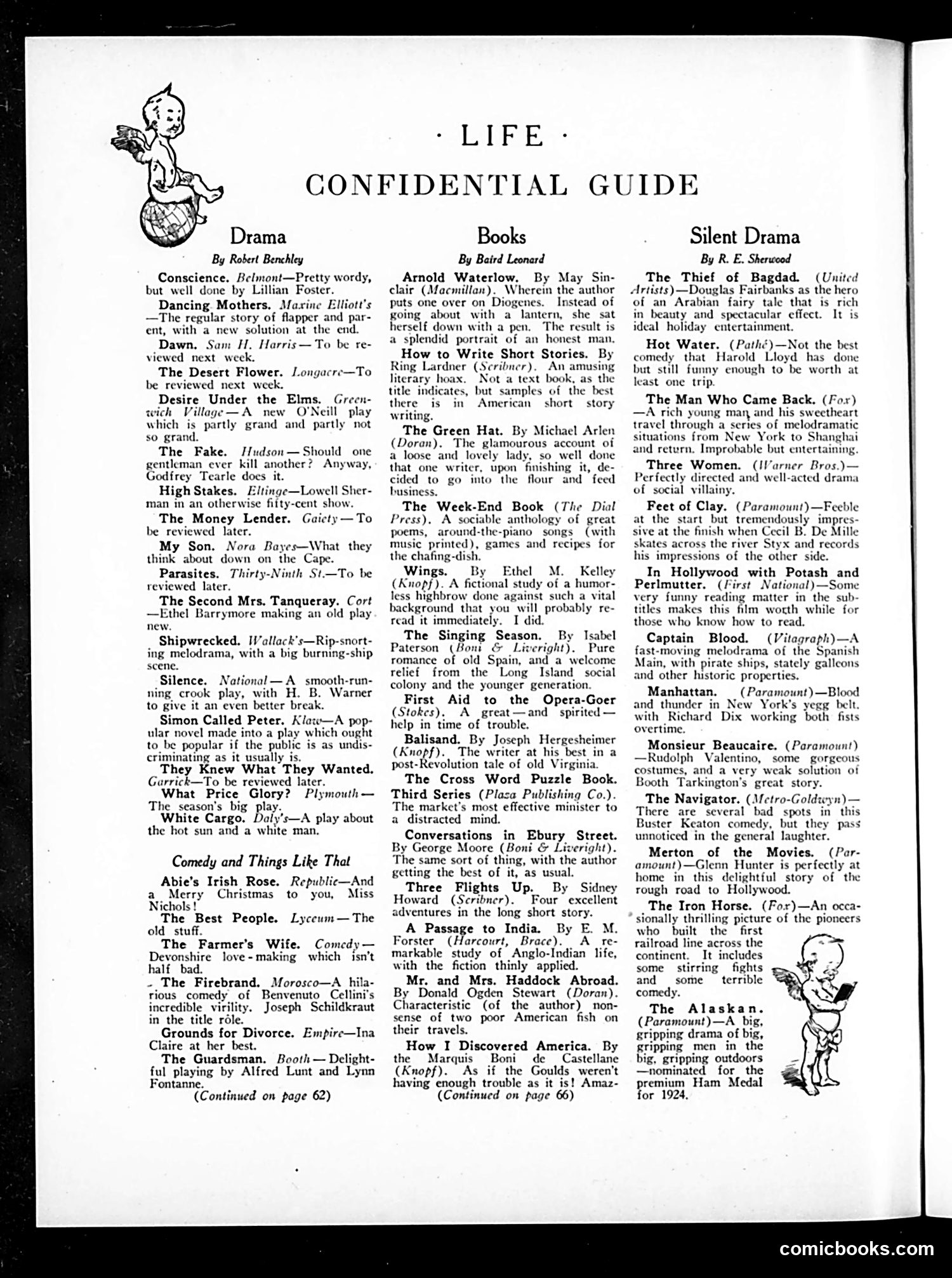
This page is a **theater and book review section**, not political satire. It's a straightforward critical guide to current Broadway plays and newly published books, written by humorist Robert Benchley (drama) and Baird Leonard (books). The reviews are brief, witty critiques typical of 1920s entertainment journalism. Notable references include: - **"What Price Glory?"** - flagged as "the season's big play" - **O'Neill's "Desire Under the Elms"** - a new play receiving mixed praise - **Ring Lardner's book** - described as an "amusing literary hoax" - **Michael Arlen's "The Green Hat"** - contemporary bestseller about a "loose and lovely lady" The tone is gossipy and irreverent, reflecting Life's satirical voice. The small cartoons of a child-like figure are decorative rather than substantive. This is entertainment journalism aimed at sophisticated New York readers interested in theater and literature.
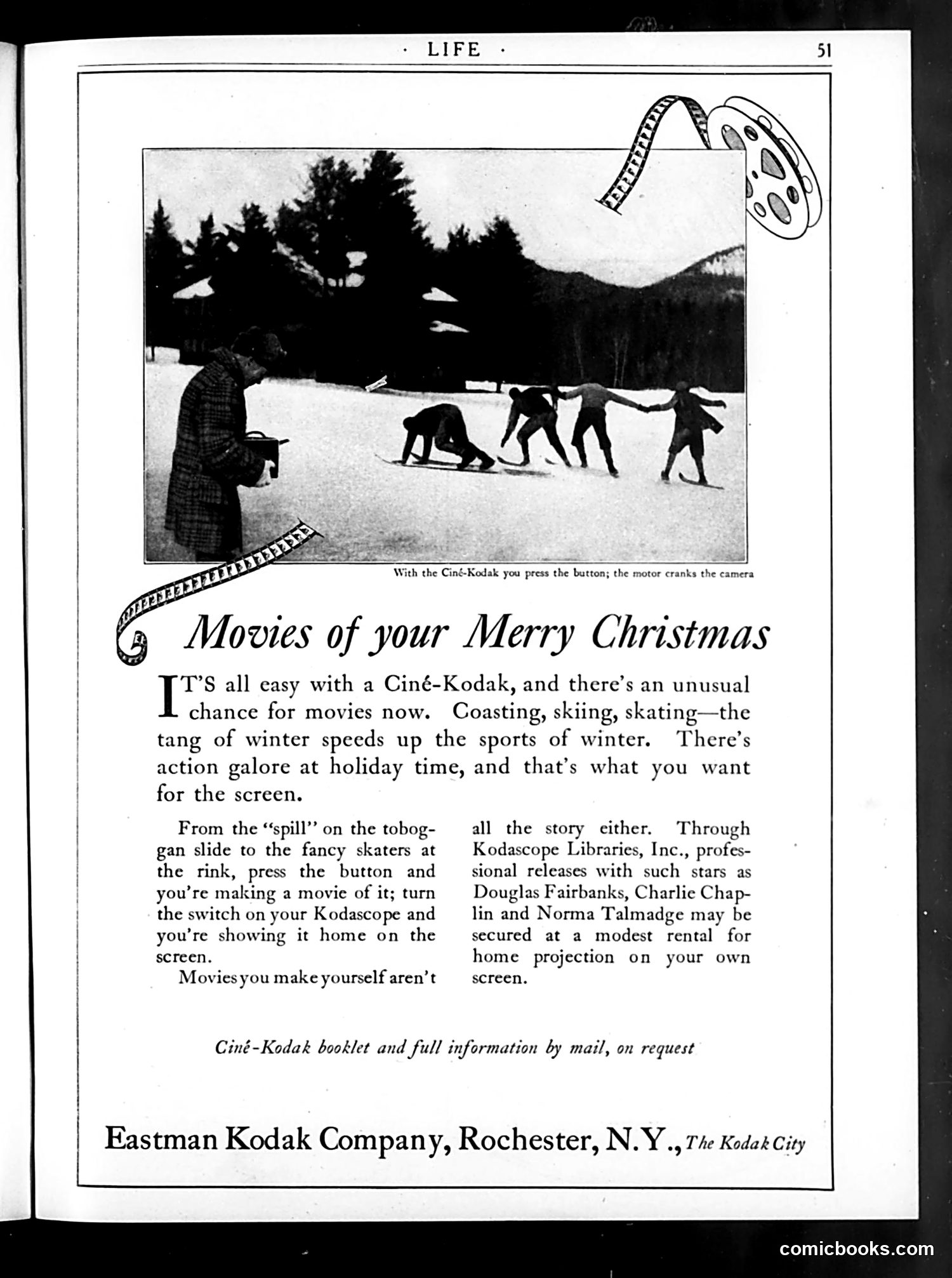
This is primarily **advertising content**, not satire or political commentary. It's a Kodak advertisement for the Ciné-Kodak home movie camera, published in *Life* magazine. The page promotes amateur filmmaking for Christmas, showing a winter scene where someone operates a camera while others engage in outdoor activities (skating, sledding). The ad emphasizes the camera's ease of use—"press the button; the motor cranks the camera"—making home movie-making accessible to ordinary consumers. The pitch combines two appeals: customers can film their own family moments, or rent professional films featuring silent-era stars like Douglas Fairbanks and Charlie Chaplin for home viewing. This represents an early moment in consumer cinema history, when home movie projection was becoming a novelty Christmas gift concept for middle-class families. The tone is straightforward marketing, not humorous commentary.
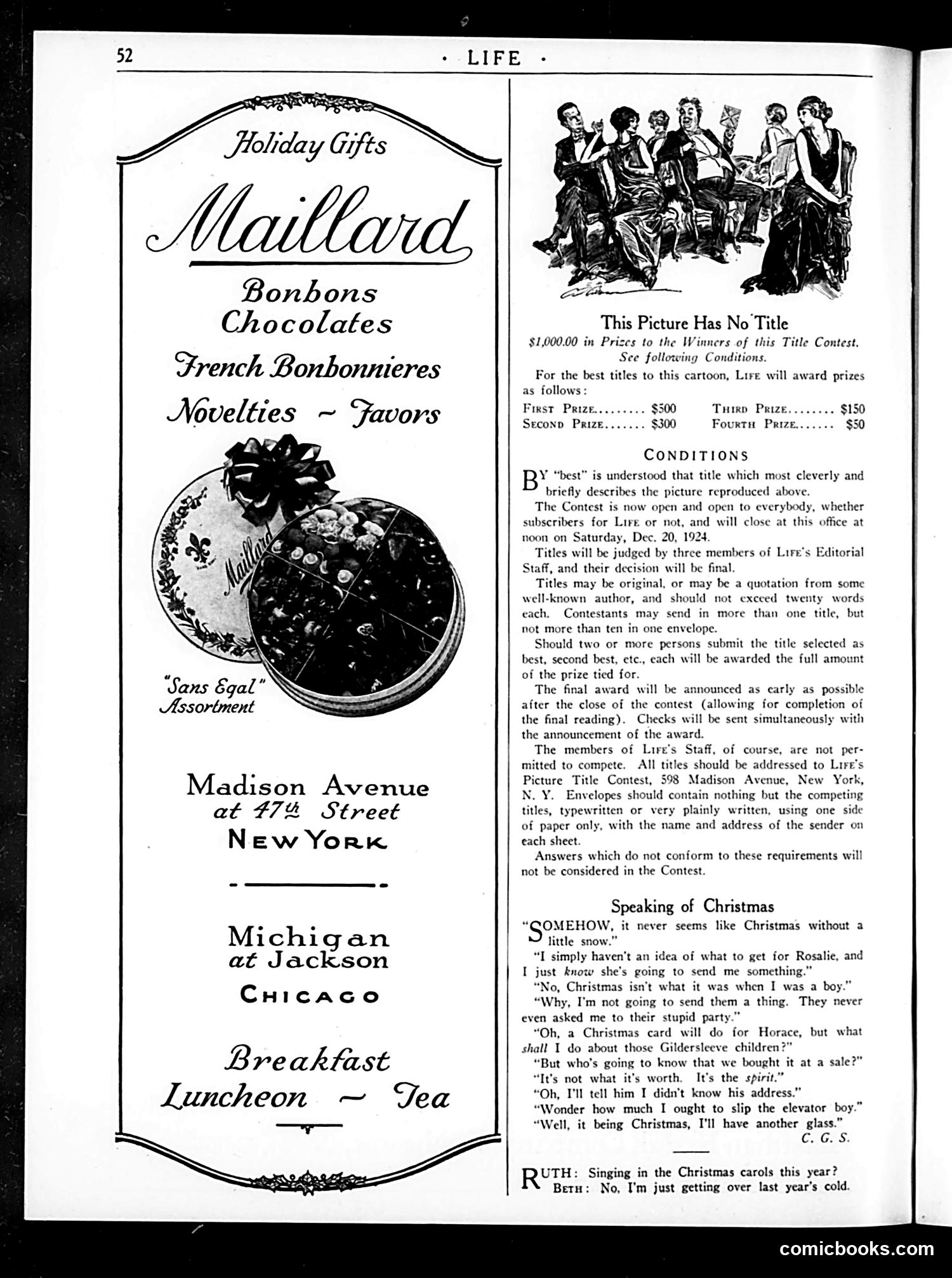
This page is primarily **advertising and editorial content** rather than political satire. The left side features luxury product ads (Maillard chocolates and bonbons, restaurant listings). The right side contains two elements: 1. **A title-naming contest**: Life presents an untitled cartoon depicting well-dressed people at what appears to be a social gathering, offering $1,000 in prizes for the best caption. The contest closes December 20, 1924. 2. **"Speaking of Christmas"**: A satirical humor piece capturing cynical holiday attitudes through brief character vignettes—people complaining about gift-giving obligations, social anxiety about presents, and insincere Christmas sentiment. The final exchange between "Ruth" and "Beth" jokes about avoiding caroling due to illness. The humor targets middle-class materialistic anxieties and social pretense surrounding Christmas gift-exchange culture, suggesting the holiday had become burdensome rather than meaningful by the 1920s.
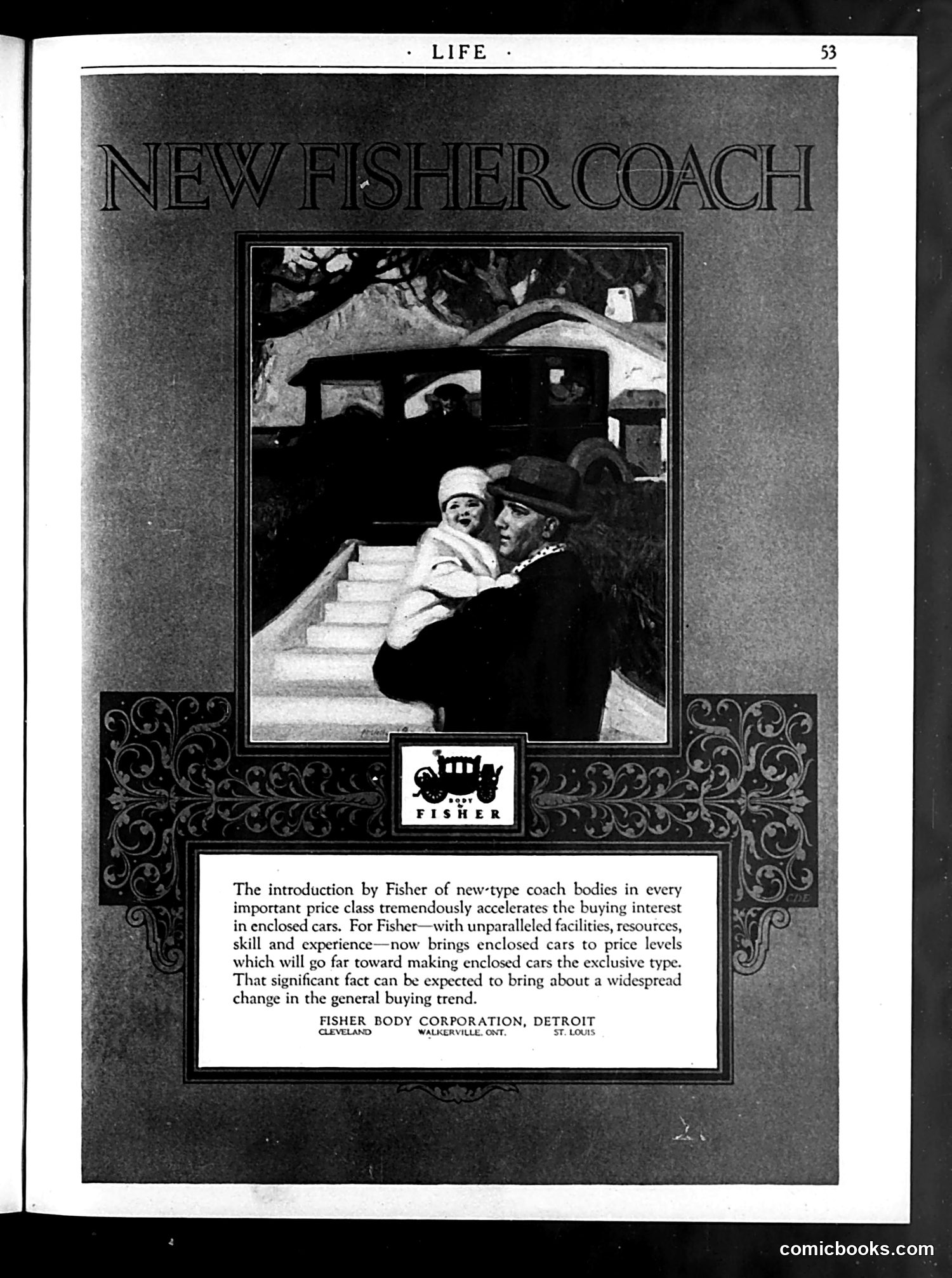
This is primarily an **advertisement**, not satire or political commentary. The page promotes Fisher Body Corporation, an automotive supplier that manufactured car bodies. The image shows a man (likely a coach or salesman) demonstrating an enclosed automobile body to a potential buyer—two figures examining a car. The accompanying text emphasizes Fisher's innovation: they're introducing enclosed coach bodies across multiple price points, making them affordable to average consumers rather than just wealthy buyers. The advertisement's point is straightforward: Fisher's manufacturing capabilities are democratizing enclosed cars, shifting the market away from open vehicles. This represents genuine automotive industry progress from the 1920s era, when enclosed cars were still a luxury feature. The "new-type coach" represents a significant technological and commercial shift Fisher claims to be leading.
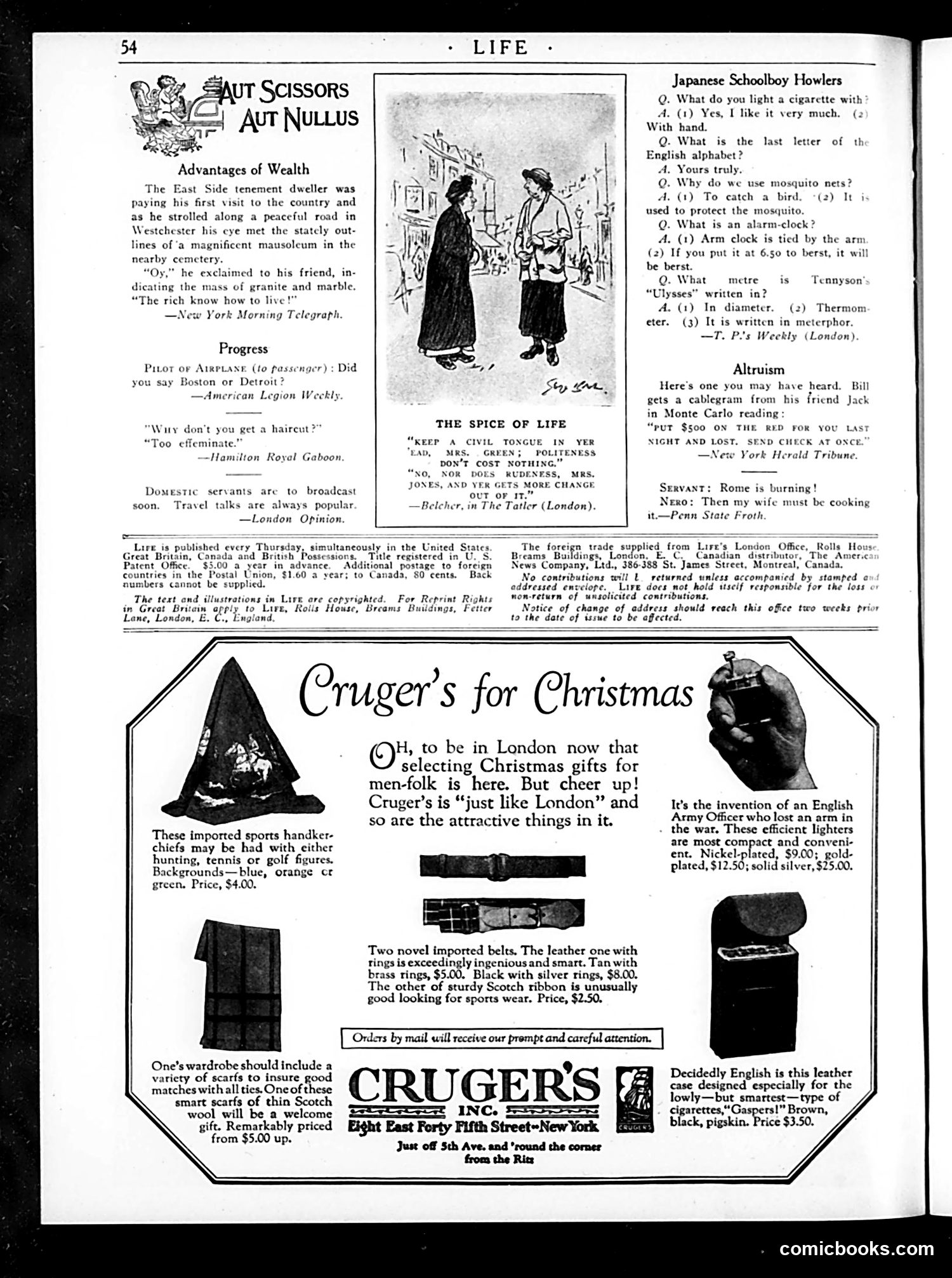
This page primarily contains **humorous filler content and advertising** rather than political satire. The small jokes scattered throughout—"Advantages of Wealth," "Progress," "The Spice of Life," and "Altruism"—are brief one-liners poking fun at everyday situations: a tenement dweller marveling at a rich person's mausoleum, a pilot asking passengers their destination, and servants gossiping. These are gentle social humor, not sharp satire. The "Japanese Schoolboy Howlers" section presents purportedly amusing mistranslations or misunderstandings by Japanese students—typical early 20th-century ethnic humor that would be considered offensive today. The bulk of the page is a **Cruger's department store Christmas gift advertisement** featuring imported British goods (handkerchiefs, scarves, belts, cigarette cases, lighters) aimed at male gift-givers, emphasizing British/English sophistication. This represents the magazine's advertising revenue model. No major political figures or events are referenced.
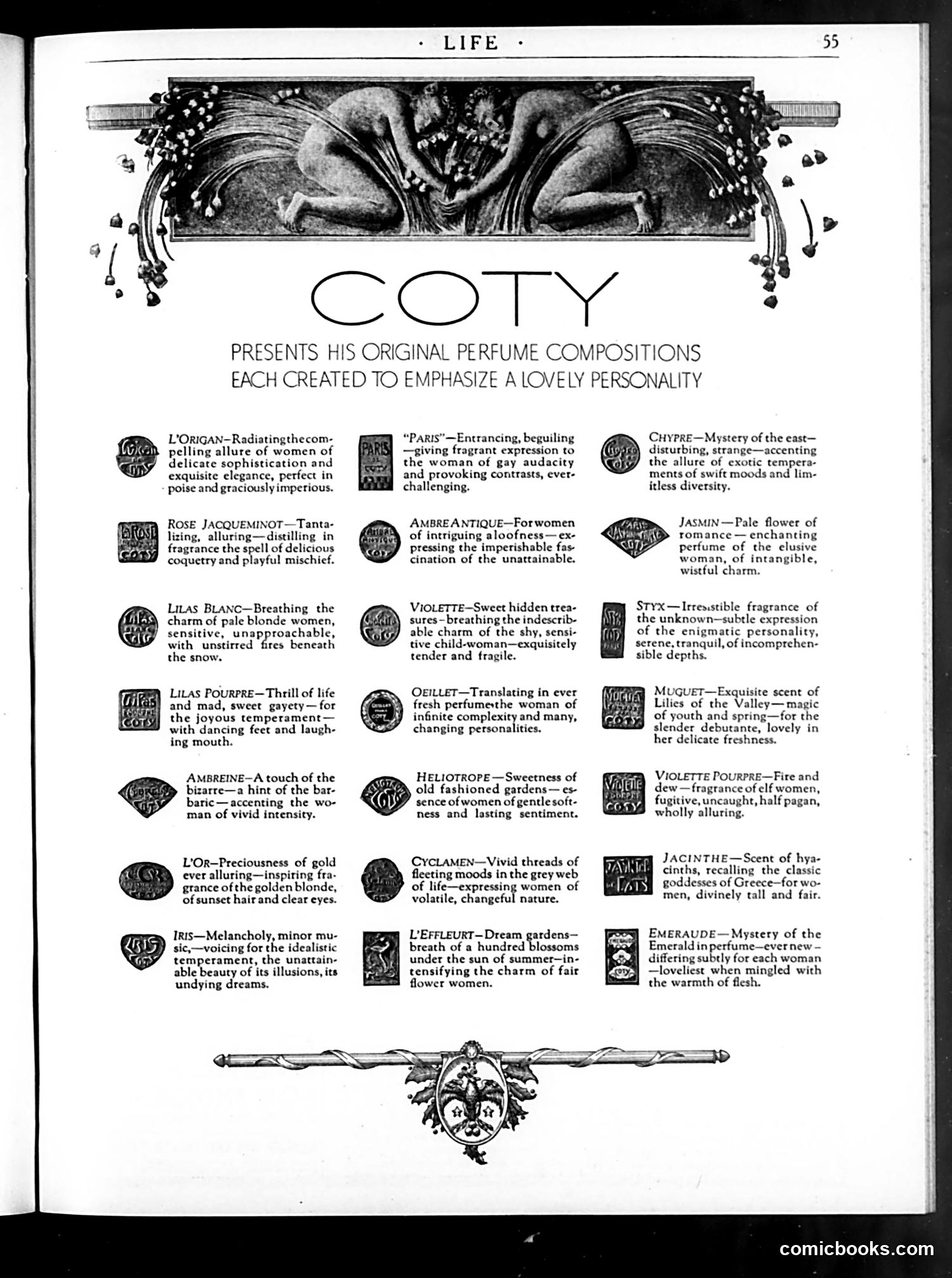
This is a **perfume advertisement**, not political satire. The page presents "Coty," a luxury fragrance brand, showcasing their line of original perfume compositions. Each scent is paired with an ornamental logo and poetic description linking the fragrance to idealized female personality types. The copywriting employs flowery, pseudo-psychological language to match perfumes to women's temperaments—from "L'Organ" for "delicate sophistication" to "Ambreine" for women of "vivid intensity." The descriptions reveal early 20th-century gender stereotypes: women are categorized as demure, coquettish, mysterious, volatile, or romantic. The decorative Art Deco styling and classical references (Greek goddesses, dream gardens) position Coty as an upscale, cultured product for affluent women. This is essentially aspirational marketing using personality psychology to sell fragrance.
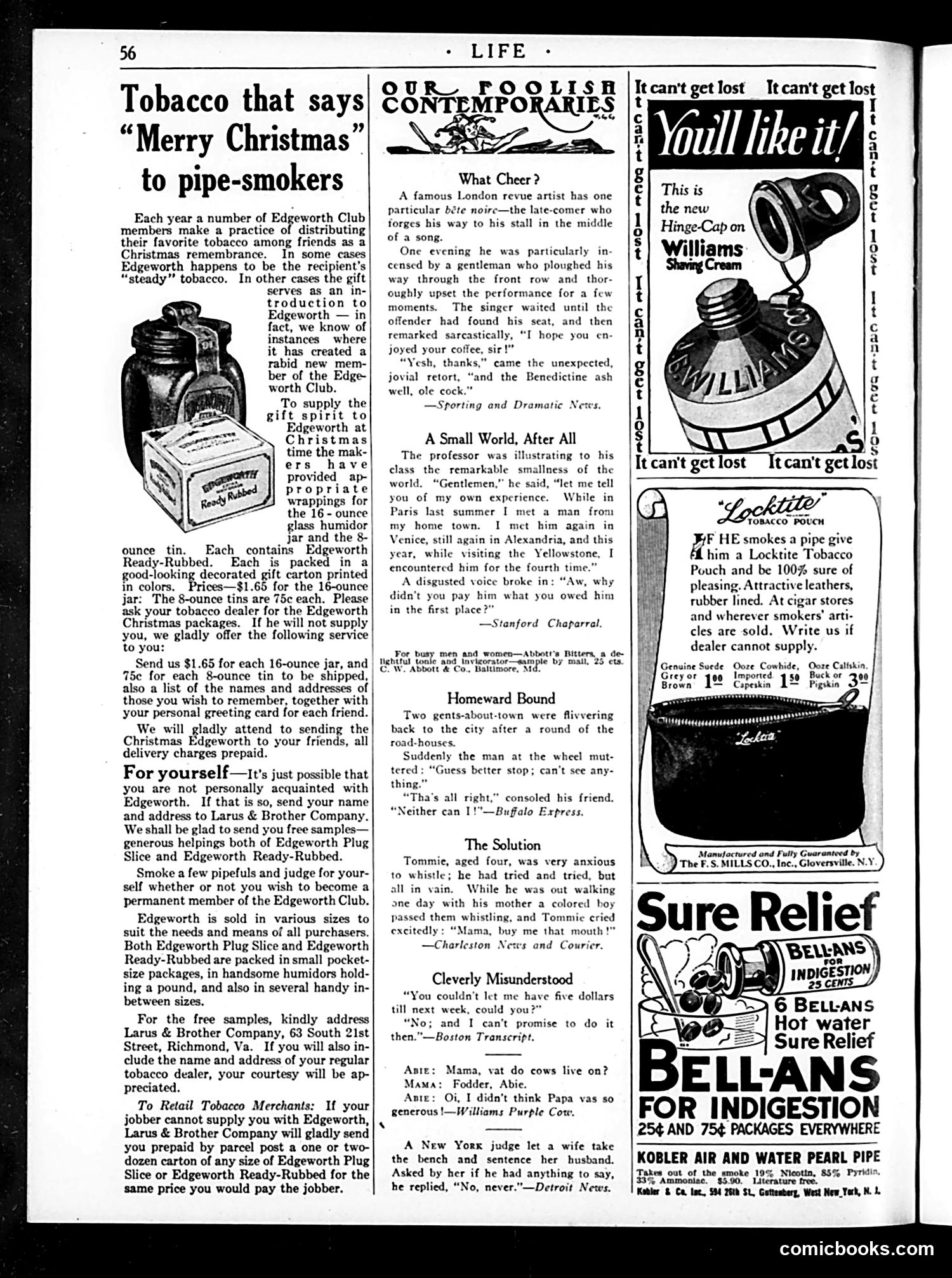
This page is primarily **advertising**, not satire or political commentary. The main content is a large Edgeworth tobacco advertisement promoting pipe tobacco as Christmas gifts, marketed to "pipe-smokers" through the "Edgeworth Club." The page includes several short **humorous anecdotes** (not political cartoons): - "What Cheer?" mocks a rude theater patron who interrupts a performance - "A Small World, After All" is a joke about repeatedly encountering the same person while traveling, with a punchline suggesting he'd skipped out on a debt - "Cleverly Misunderstood" plays on misheard dialogue between a mother and son These are lighthearted jokes typical of early 20th-century magazines, not satirical commentary. The page also features advertisements for other products: Williams pipe caps, Luckite tobacco pouches, and Bellans indigestion remedy—representing typical consumer goods marketed in *Life* during this era.
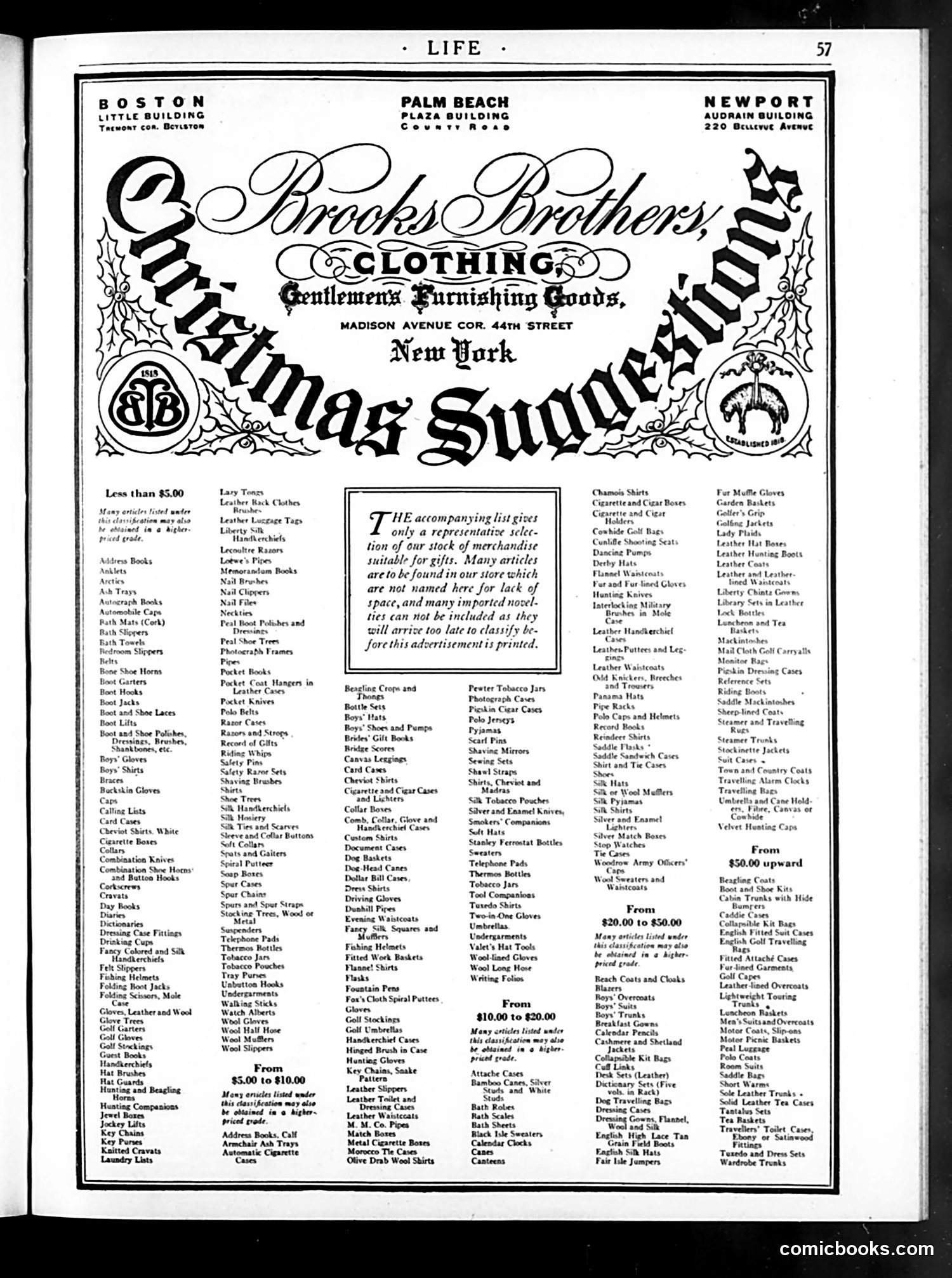
This is entirely a **department store advertisement**, not a political cartoon. Brooks Brothers, the established men's clothing retailer, ran this full-page Christmas gift guide in *Life* magazine. The ornate decorative border frames the company's locations (Boston, Palm Beach, Newport, and their flagship New York store at Madison Avenue and 44th Street). The central text explains the accompanying merchandise list is "only a representative selection" of inventory, with many items unavailable due to late printing. The page is organized by price ranges ($5 and under, $5-10, $10-20, $20-50, and $50+ upward), listing hundreds of gift options: leather goods, grooming supplies, smoking accessories, sporting equipment, and clothing. The note about items arriving "too late to classify" reflects wartime or post-war production delays. There is **no satire or political commentary**—this is a straightforward commercial appeal to affluent male consumers seeking quality gifts.
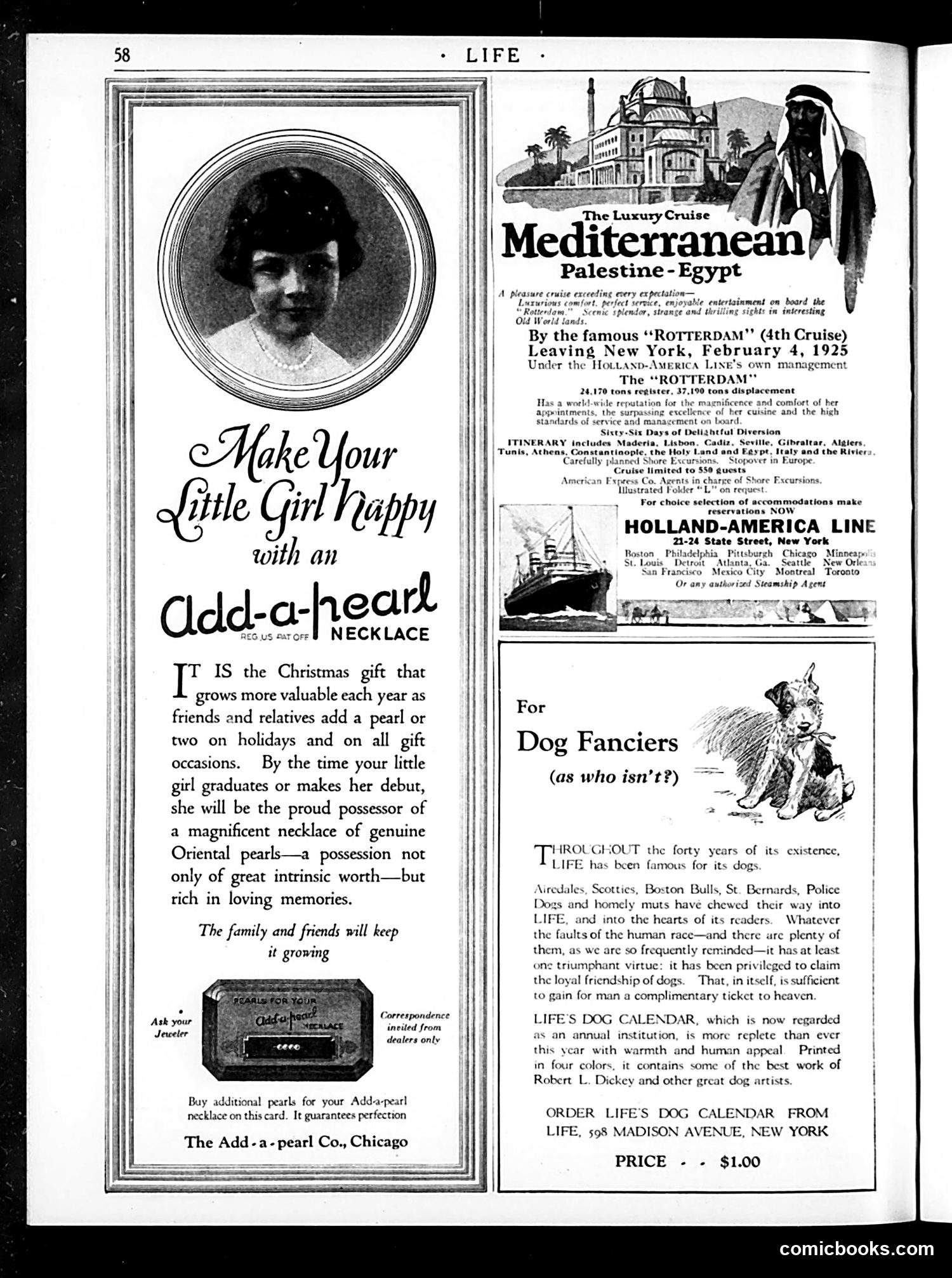
This page contains no political cartoons or satire. Instead, it features three commercial advertisements typical of 1920s Life magazine: 1. **Add-a-Pearl Necklace** (left): A jewelry advertisement promoting a necklace that grows as family and friends gift pearls on holidays and special occasions, eventually becoming a valuable heirloom by adulthood. Targets affluent parents seeking meaningful gifts for daughters. 2. **Mediterranean Cruise** (top right): Promotes luxury travel on the Holland-America Line's ship "Rotterdam," departing February 4, 1925, for Palestine and Egypt—appealing to wealthy travelers seeking exotic experiences. 3. **Life's Dog Calendar** (bottom right): Advertises an annual calendar featuring dog illustrations by Robert L. Dickey and other artists. The text humorously suggests dogs possess moral superiority to humans, making ownership redemptive for mankind. All three ads reflect 1920s affluence and consumer culture rather than political satire.
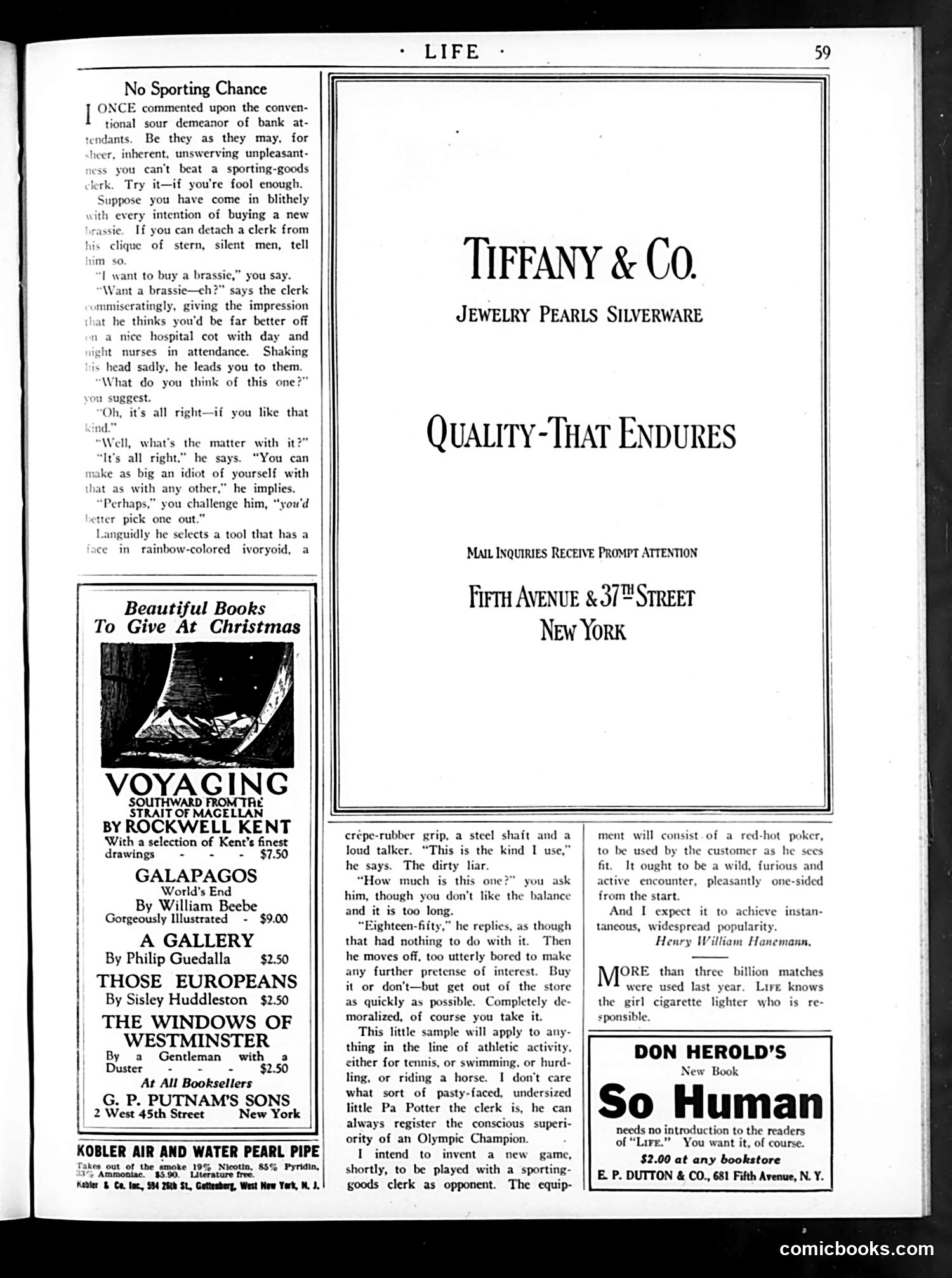
This humorous article mocks the notoriously rude and dismissive behavior of sporting goods store clerks. The author describes attempting to buy golf equipment (a "brassie"—a golf club) and encountering a clerk who treats the customer with contempt, suggesting they'd be "better off" in a hospital and implying they're making foolish choices. The clerk's tactics include displaying boredom, offering vague non-answers about pricing ("Eighteen-fifty"), and generally making the customer feel unwelcome—yet expecting them to complete the purchase anyway. The satire culminates in the author's proposal to invent a new game using "a sporting-goods clerk as opponent," inverting the power dynamic. This reflects early 20th-century consumer frustrations with retail service standards and exploits the contrast between the clerk's technical expertise and their deliberate social unpleasantness—a recognizable character type of the era.
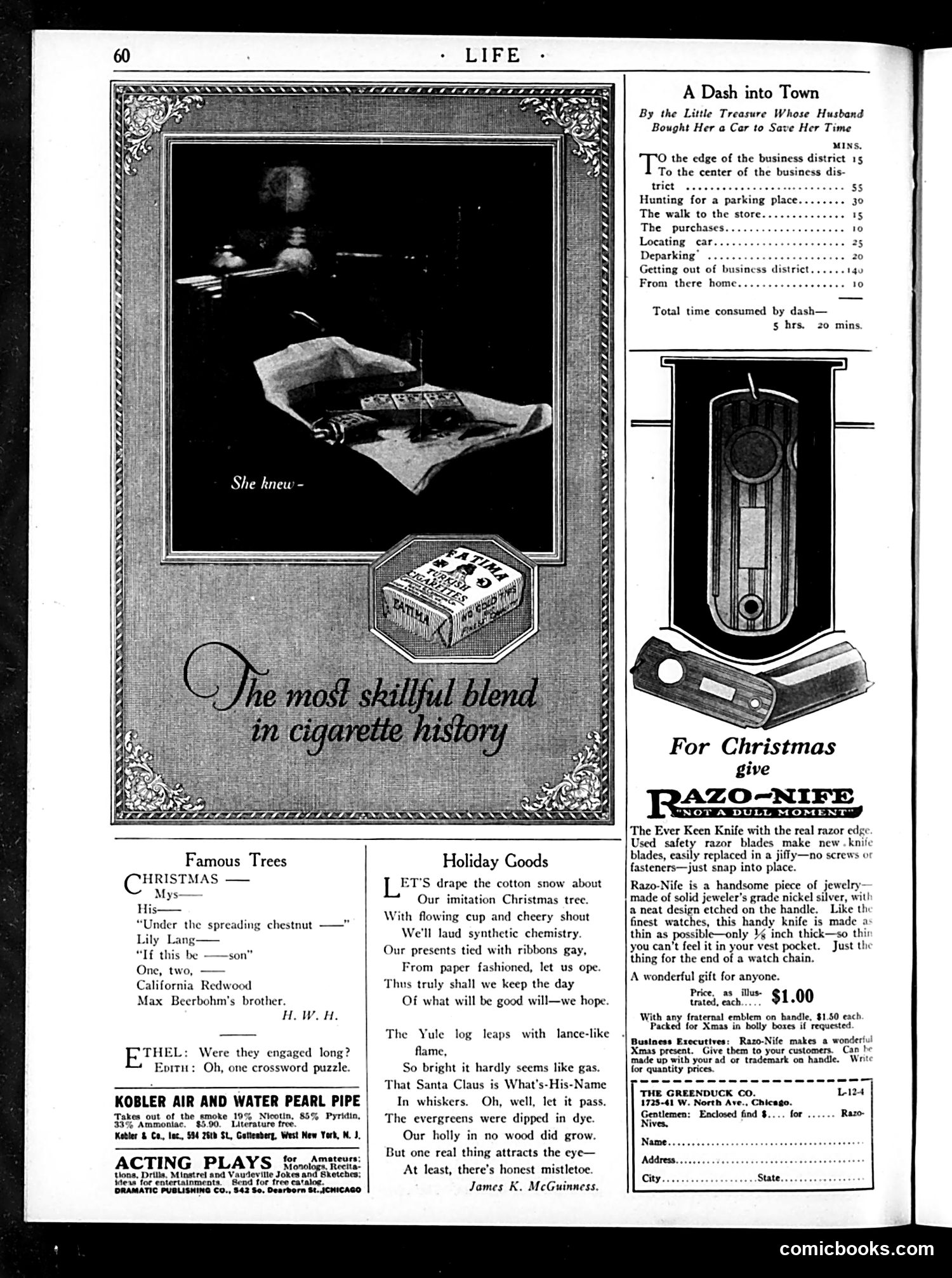
This satirical article mocks the false economy of wives receiving automobiles as time-saving devices. The cartoon's joke: a woman undertakes a shopping trip to town that consumes **5 hours and 20 minutes** — despite her husband buying her a car supposedly to save her time. The breakdown itemizes every inefficiency: 15 minutes to reach the business district, 30 minutes hunting for parking, 15 minutes walking to the store, then reversing the process. The punchline is implicit: **the car actually wastes time** through traffic, parking hassles, and navigation rather than saving it. This targets early 1920s consumer culture and gender dynamics — the husband's well-intentioned "gift" is exposed as impractical. The satire critiques both automotive marketing claims and the assumption that modern conveniences automatically benefit women, while the cartoon's image of a woman clutching money and a map reinforces the satiric tone of resigned frustration.
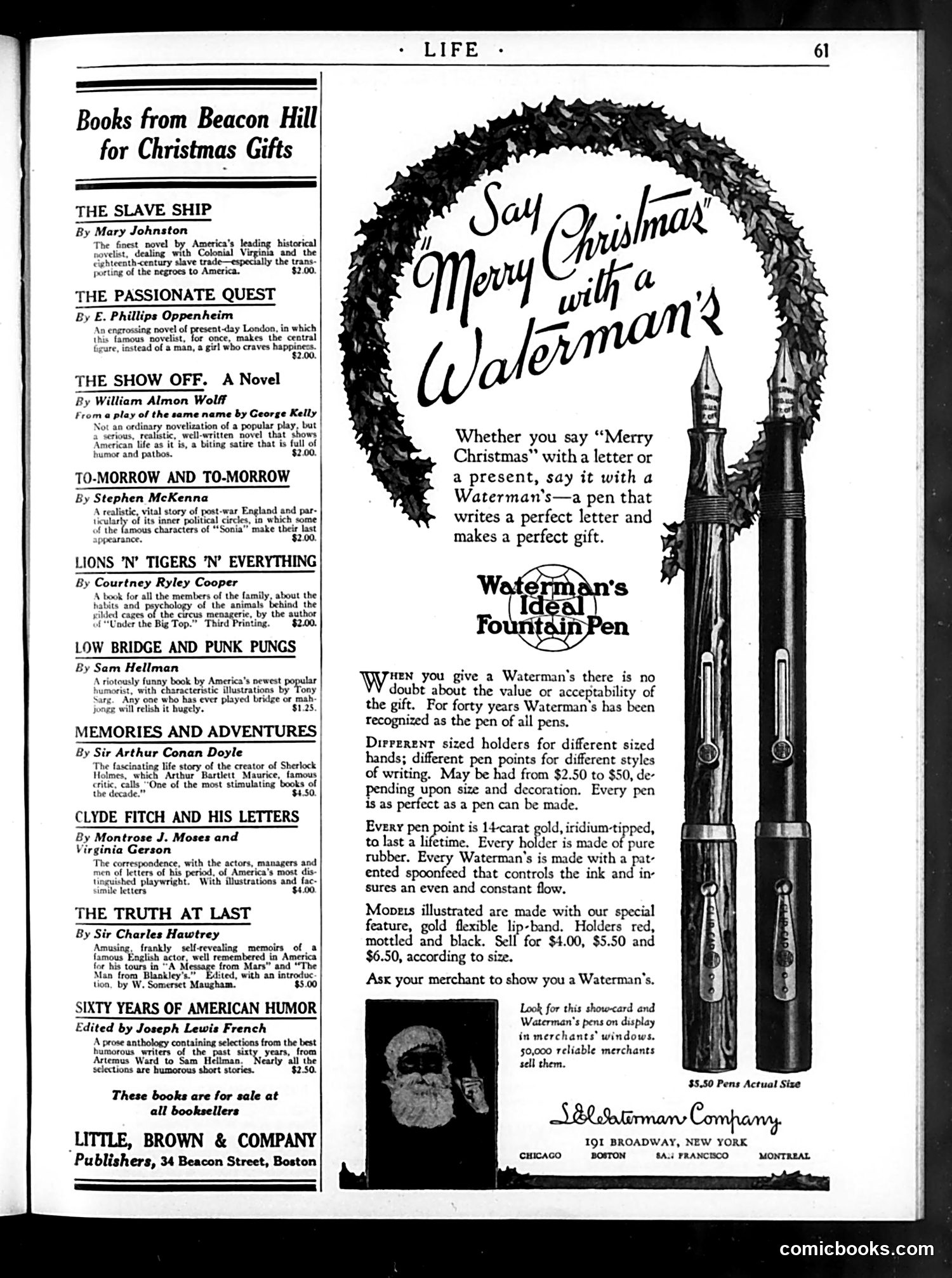
This page is primarily **advertising and book promotion**, not political satire. The left column advertises Christmas gift books from publisher Little, Brown & Company, featuring titles like Mary Johnston's *The Slave Ship* and Arthur Conan Doyle's memoirs—typical early 20th-century literary fare. The dominant right side is a **Waterman's fountain pen advertisement**. There is no cartoon or political commentary. The ad uses decorative flourishes (an evergreen wreath, two ornate pens) to market fountain pens as ideal Christmas gifts, emphasizing quality ("14-carat gold, iridium-tipped") and prestige ("recognized as the pen of all pens"). This reflects the era's commercial publishing landscape: Life magazine subsidized its satirical content through premium advertisements aimed at educated, affluent readers who purchased quality goods and literature.
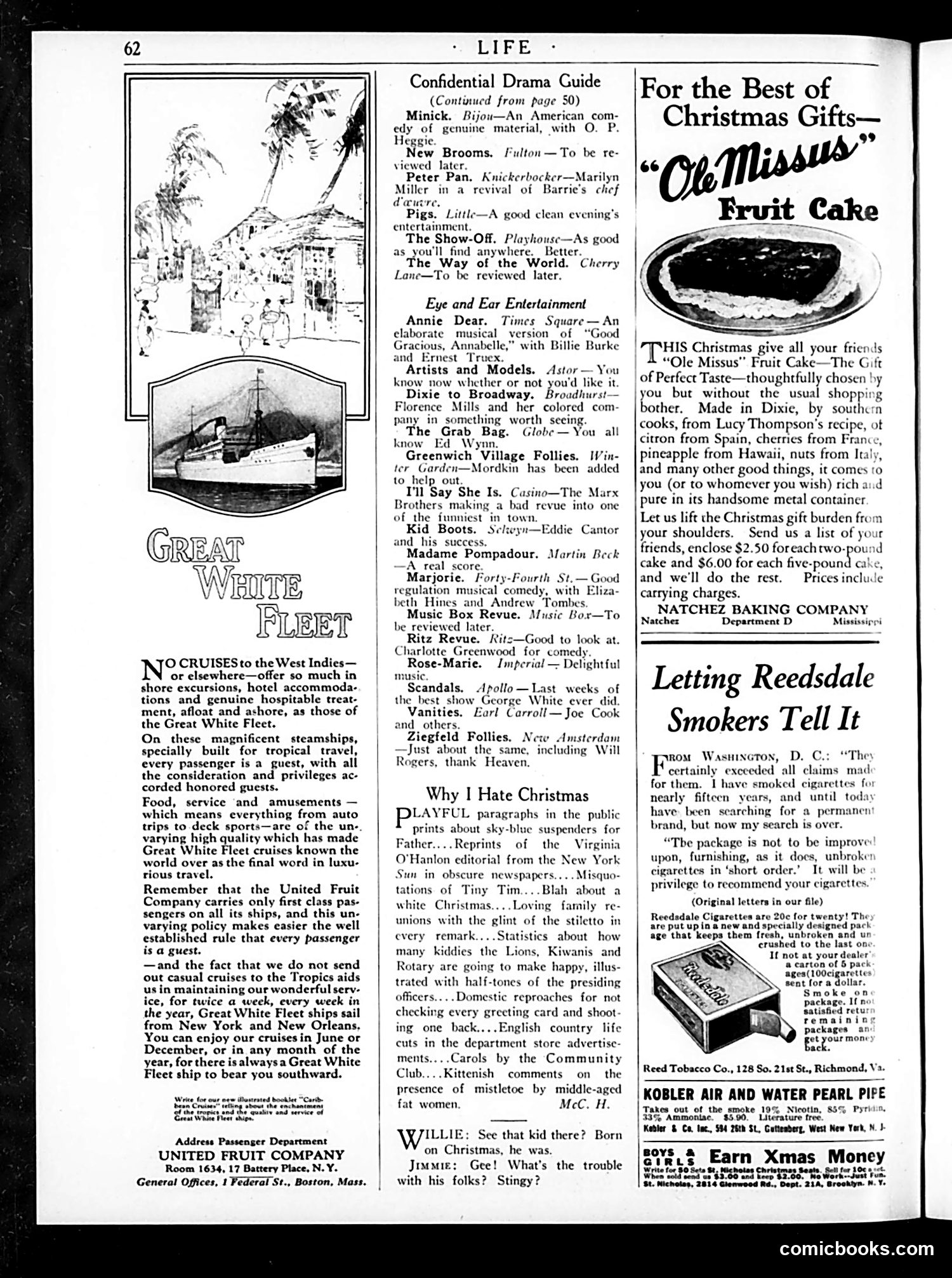
This page combines advertising, theater reviews, and satirical commentary typical of Life magazine's format. **Main Content:** The "Great White Fleet" advertisement (left) promotes luxury Caribbean cruises by the United Fruit Company, emphasizing first-class service and tropical travel. **The Satire:** "Why I Hate Christmas" mocks commercialized Christmas culture. The author ridicules tired holiday clichés: sentimental newspaper reprints (referencing the famous "Yes, Virginia, there is a Santa Claus" editorial), Dickens references ("Tiny Tim"), greeting card obligations, and forced family sentiment ("the glint of the stiletto in every remark"—suggesting underlying family tension). The piece satirizes how civic organizations (Lions, Kiwanis, Rotary) publicize charitable acts, department store nostalgia, and awkward office mistletoe moments with middle-aged women. **Context:** This reflects 1920s cynicism about commercialized holidays and suggests Life's audience appreciated irreverent social commentary alongside theater listings and luxury advertising.
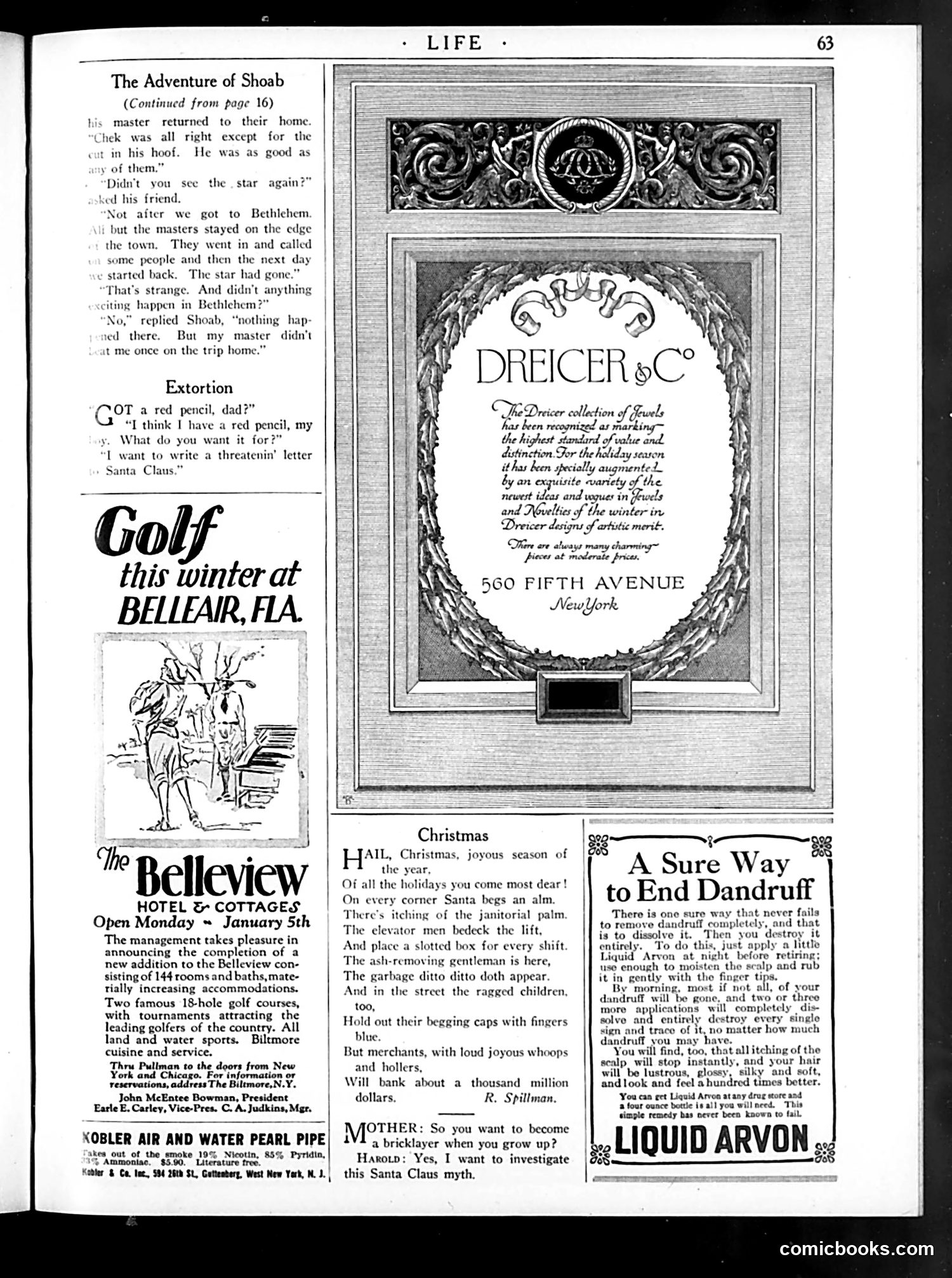
This page contains multiple satirical pieces and advertisements typical of early 20th-century Life magazine: **"The Adventure of Shoab"** continues a narrative about a camel's journey to Bethlehem, apparently a humorous retelling paralleling the Nativity story. **"Extortion"** is a brief joke: a child asks his father for a red pencil to write a "threatenin' letter" to Santa Claus—satire on Christmas commercialism and the expectation that Santa brings material gifts. **"Christmas"** (by R. Spillman) is satirical verse mocking the season's supposed joy while highlighting urban poverty and commercialism: bellhops, janitors, and street children solicit tips/alms during the holidays, while merchants profit enormously. **"Mother and Harold"** presents a child's dark humor: Harold wants to become a bricklayer "to investigate this Santa Claus myth"—implying he'll debunk the fiction. The remaining content is period advertisements for golf resorts, jewelry, and dandruff treatment. The satire here targets Christmas's commercialization, tipping culture, and the gap between holiday sentiment and economic reality.
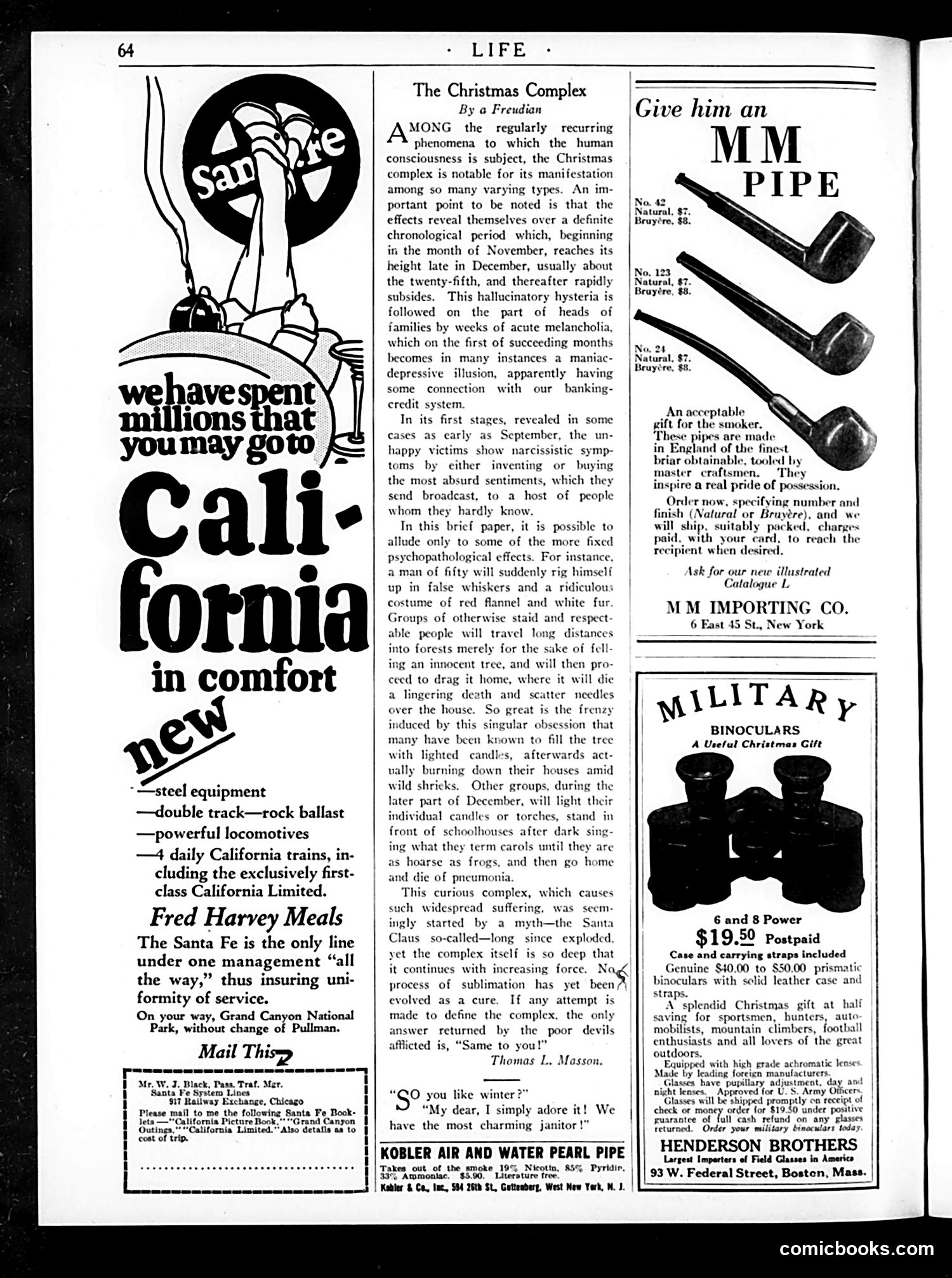
This page features a humorous essay by Thomas L. Masson that satirizes Christmas hysteria using mock-Freudian psychological language. The piece ridicules the "Christmas complex"—a supposed mental condition affecting people annually from November through December. Masson parodies holiday behaviors as pathological symptoms: people compulsively buying thoughtless gifts for strangers, men dressing as absurd Santas, families dragging trees home to die indoors, and carolers standing outside schoolhouses until hoarse. He mockingly diagnoses Christmas decoration fires, pneumonia from caroling, and post-holiday depression as manifestations of this "complex," supposedly traced to the myth of Santa Claus. The satire targets the commercialization, excess, and social conformity of Christmas celebration, presenting ordinary holiday traditions as collectively insane behavior worthy of psychiatric analysis. The joke relies on treating frivolous seasonal customs with exaggerated clinical seriousness.
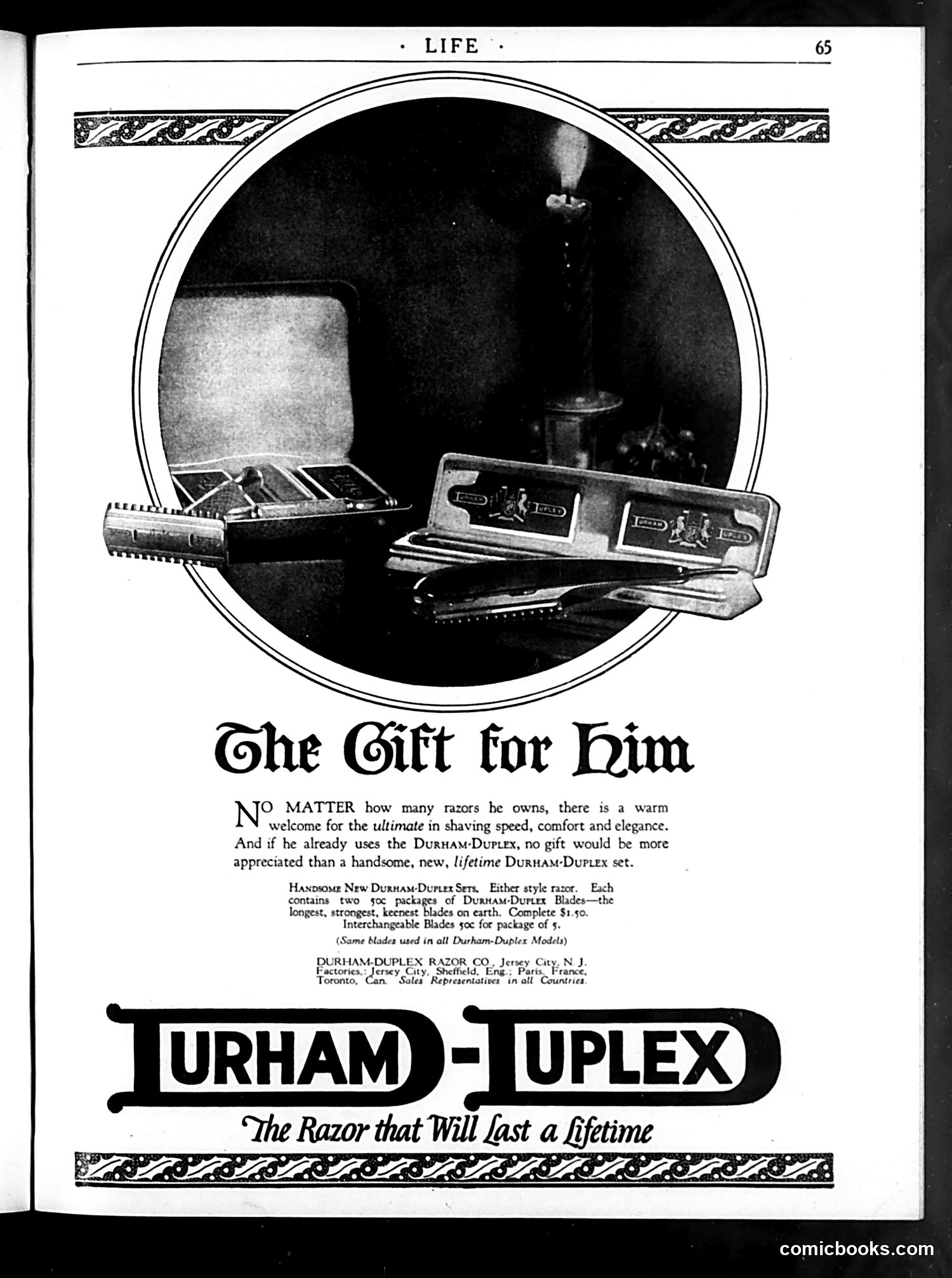
This is a **product advertisement**, not satire or political commentary. It's a full-page ad for Durham-Duplex safety razors, published in *Life* magazine (page 65). The image shows shaving products—razors and blade packages—arranged in a circular vignette against a dark background with a vintage mirror or shaving setup. The text pitches the Durham-Duplex as an ideal gift for men, emphasizing durability ("lifetime"), quality ("longest, strongest, keenest blades"), and affordability ($1.50 for a complete set with two blade packages). The marketing angle targets gift-givers: even if a man owns multiple razors, a new Durham-Duplex set is presented as uniquely welcome. The company lists factories and sales representatives globally, suggesting an established international brand. There is no cartoon, satire, or political reference here—merely vintage commercial advertising typical of early 20th-century *Life* magazine content.
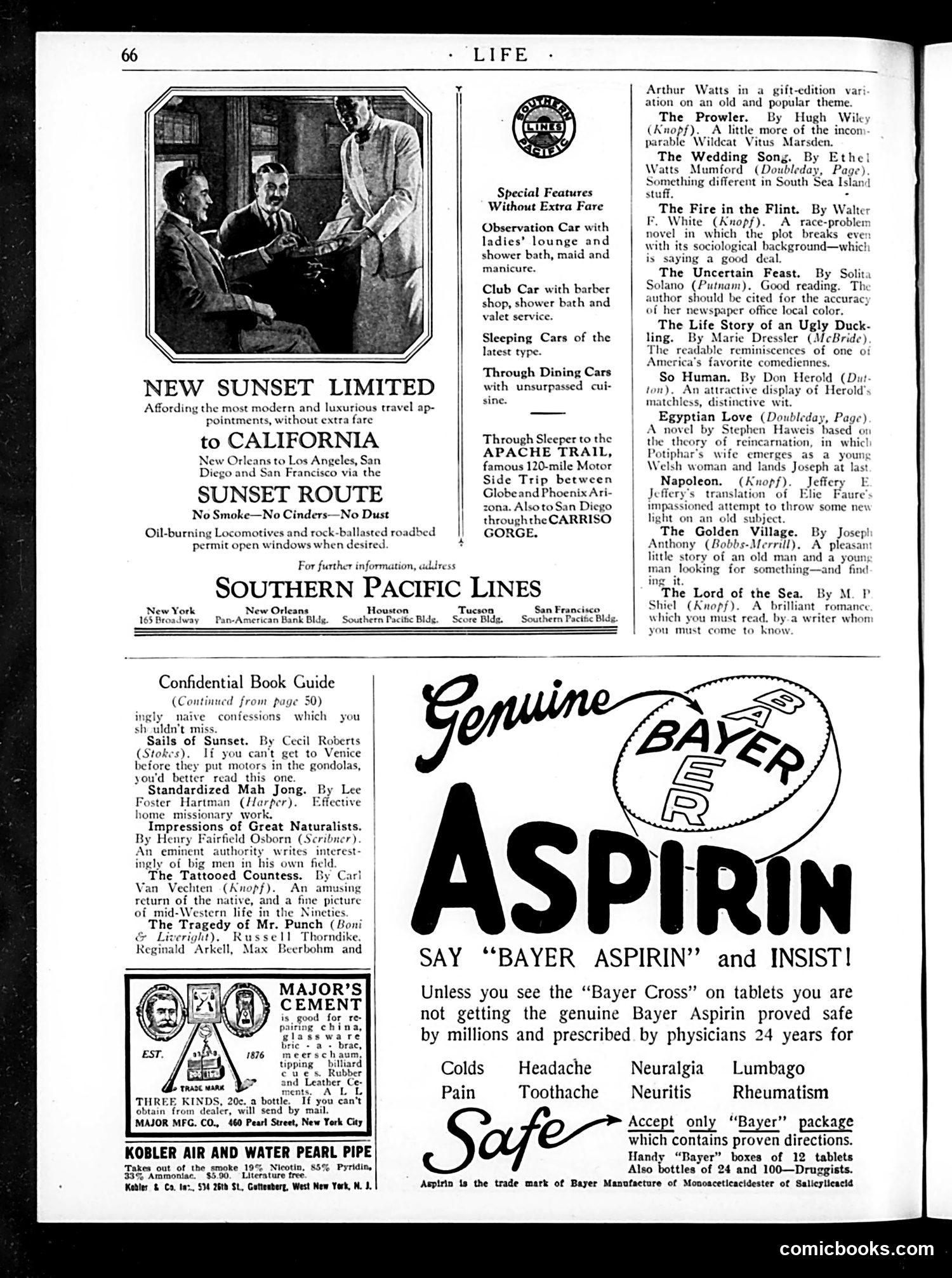
This page is primarily **advertising and book reviews**, not political satire. The upper portion features a Southern Pacific railroad advertisement for the "New Sunset Limited" train service to California, highlighting luxury amenities (observation cars, dining cars, sleeping cars) and emphasizing comfort ("No Smoke—No Cinders—No Dust"). The right column contains brief book reviews from the "Confidential Book Guide," covering novels of the era including works on race relations (*The Fire in the Flint*), Venice, and literature generally. The dominant feature is a large **Bayer Aspirin advertisement** warning consumers to look for the "Bayer Cross" trademark, claiming the genuine product has been "proved safe by millions and prescribed by physicians 24 years." This reflects early 20th-century patent and trademark concerns—Bayer's aspirin faced competition from generic substitutes. **No political cartoons appear on this page.** The content is straightforward commercial advertising and literary promotion typical of Life magazine's format during this period.
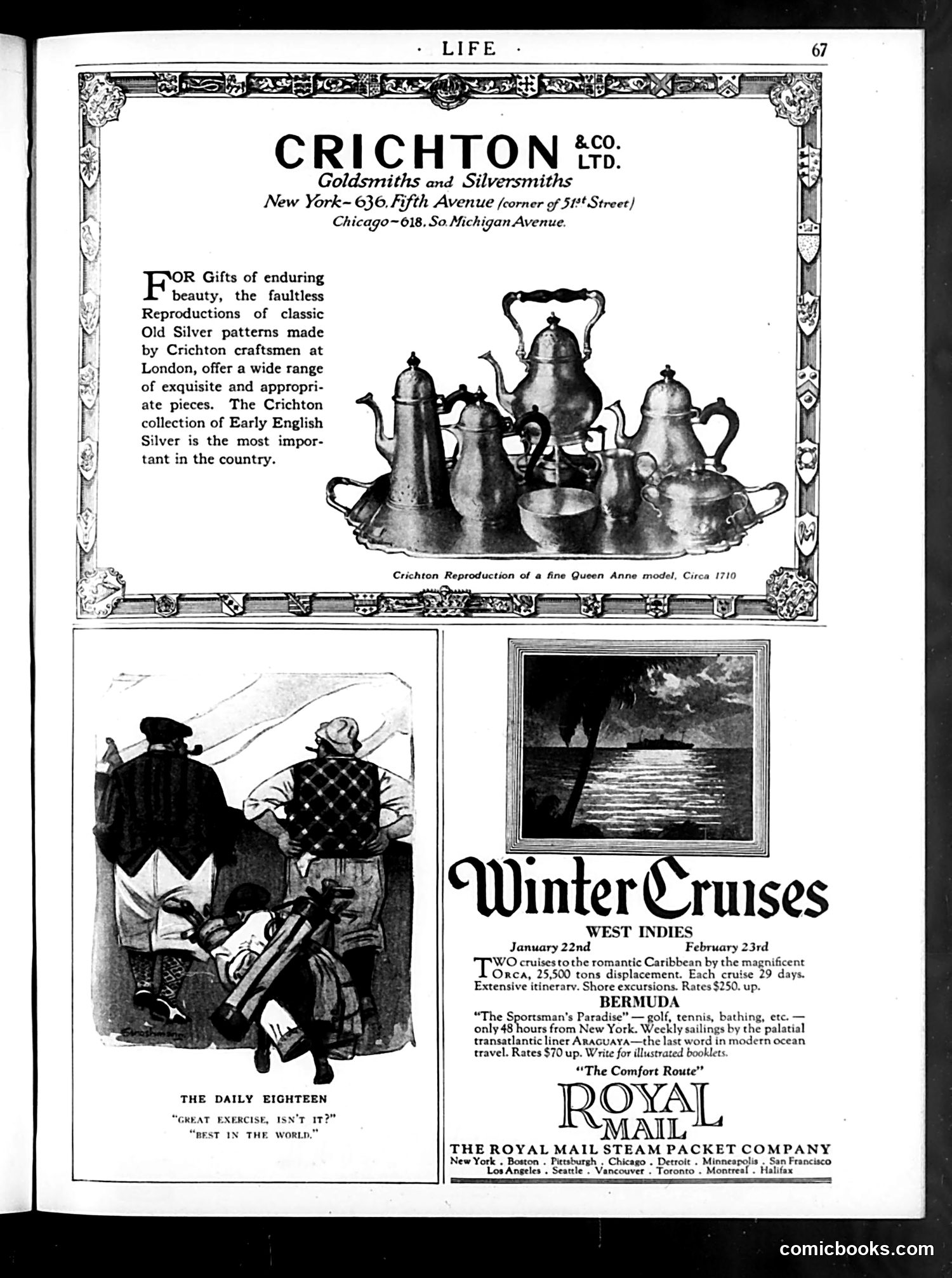
This page is primarily **advertising**, not political satire. It contains three distinct ads: 1. **Crichton & Co.** (top): A luxury silversmith promoting reproductions of classical Old English silver patterns for gift-giving. 2. **The Daily Eighteen** (bottom left): A cartoon showing two men in a boat, captioned "Great exercise, isn't it?" and "Best in the world." This appears to be an ad for rowing or nautical recreation, using humor to promote physical fitness. 3. **Winter Cruises/Royal Mail** (right): Travel advertisements for Caribbean cruises and Bermuda trips, emphasizing leisure and luxury transportation. The page reflects early 20th-century consumer culture, targeting wealthy readers with luxury goods and leisure travel. The "Daily Eighteen" cartoon's specific meaning is unclear without additional context—it may reference a specific rowing club or exercise regimen popular at the time.
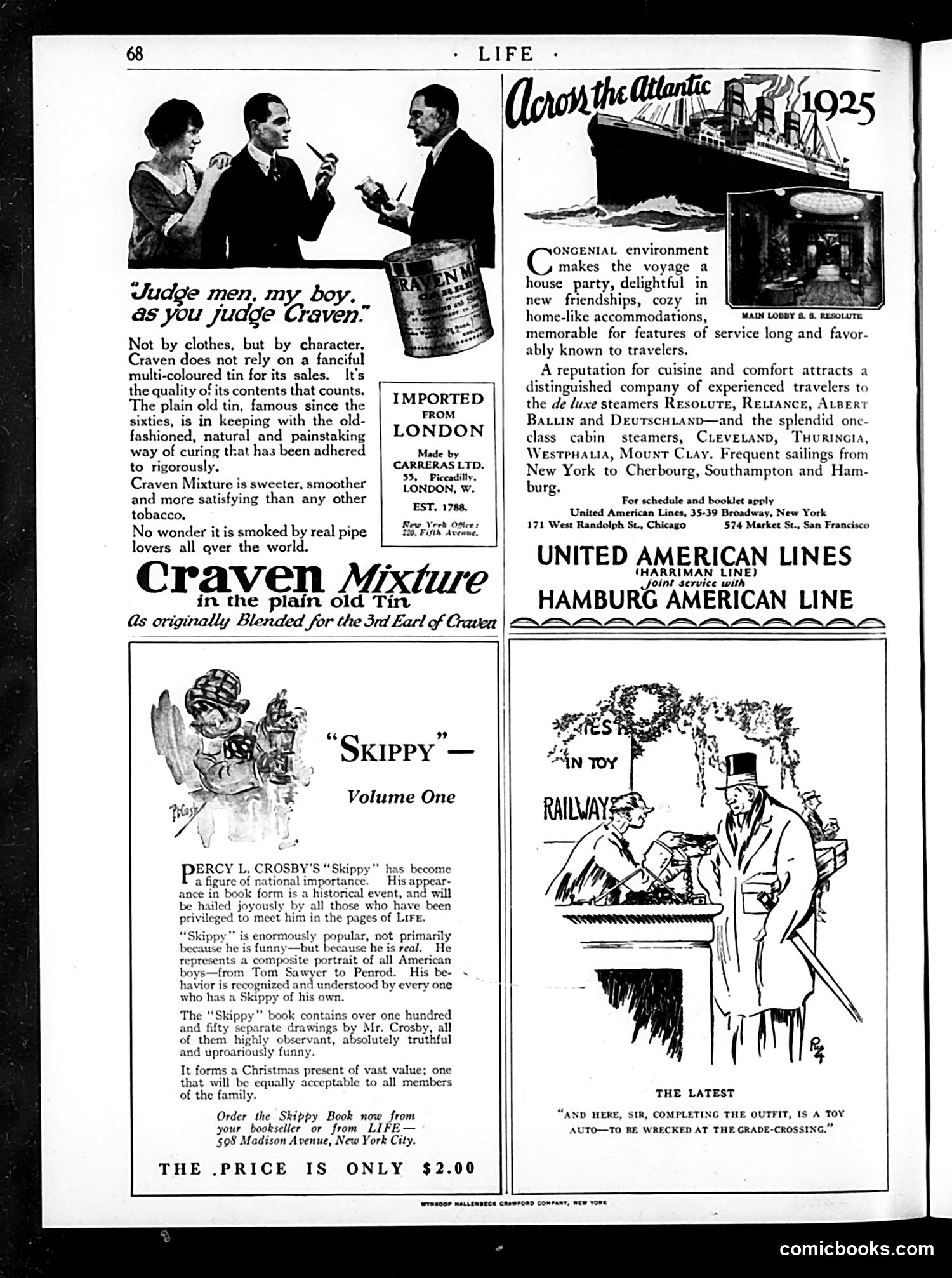
This is primarily an **advertising page** mixing product promotions with comic content. The top-left features a **Craven Mixture tobacco ad** using a moral appeal: "Judge men...as you judge Craven"—emphasizing character over appearance. The tin's plain design supposedly reflects quality craftsmanship since the 1760s, targeting pipe smokers who valued substance over style. The right side advertises **transatlantic steamships** (United American Lines, Hamburg American Line), promoting luxury ocean travel with amenities like fine dining and comfortable cabins for wealthy travelers. The bottom contains promotional material for **"Skippy"** (by Percy Crosby)—a comic strip character described as representing "all American boys" from Tom Sawyer to Penrod. The book collection cost $2.00. The final cartoon shows a toy train set ad with dark humor: a salesman presents a toy auto "to be wrecked at the grade-crossing"—satirizing both childhood play and the era's growing automobile safety concerns. The page reflects 1925 consumer culture targeting middle-to-upper-class readers.
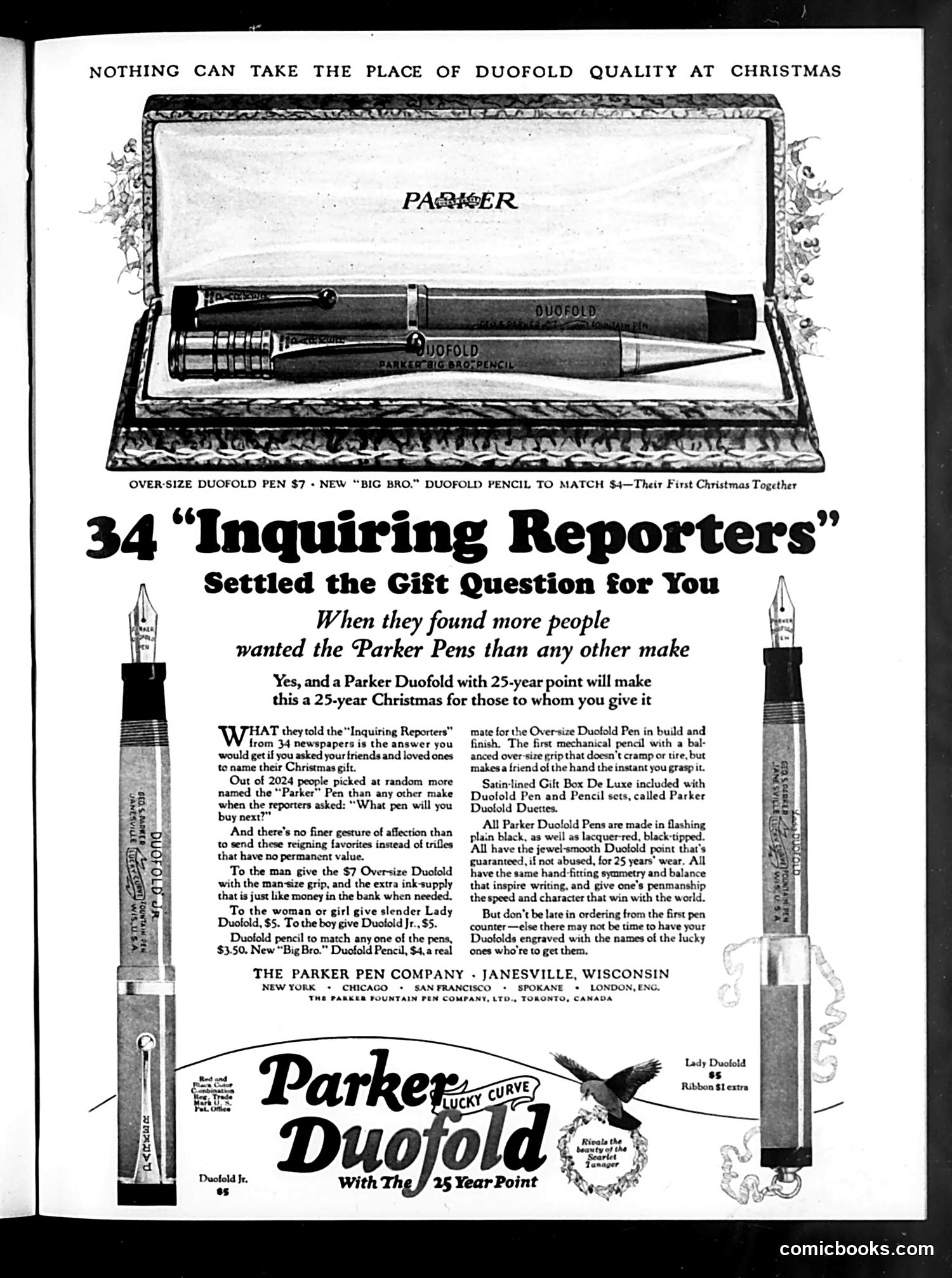
This is primarily a **Christmas advertisement for Parker fountain pens**, not political satire. The page uses a marketing gimmick rather than satire: it claims that 34 newspaper "Inquiring Reporters" surveyed 2,024 people, who named Parker pens as their preferred gift choice more than any competitor. The appeal targets gift-givers by suggesting Parker Duofolds are the socially validated choice—endorsed by democratic polling rather than advertising alone. The product line offers tiered options: expensive "Oversize" models for men ($7), "Lady Duofold" for women ($5), and cheaper "Duofold Jr." for boys ($5), matching 1920s gender conventions. The "25-year point" guarantee frames the pen as a lasting investment—a "25-year Christmas"—appealing to practicality alongside sentiment. This is straightforward commercial advertising with no political cartoon content.
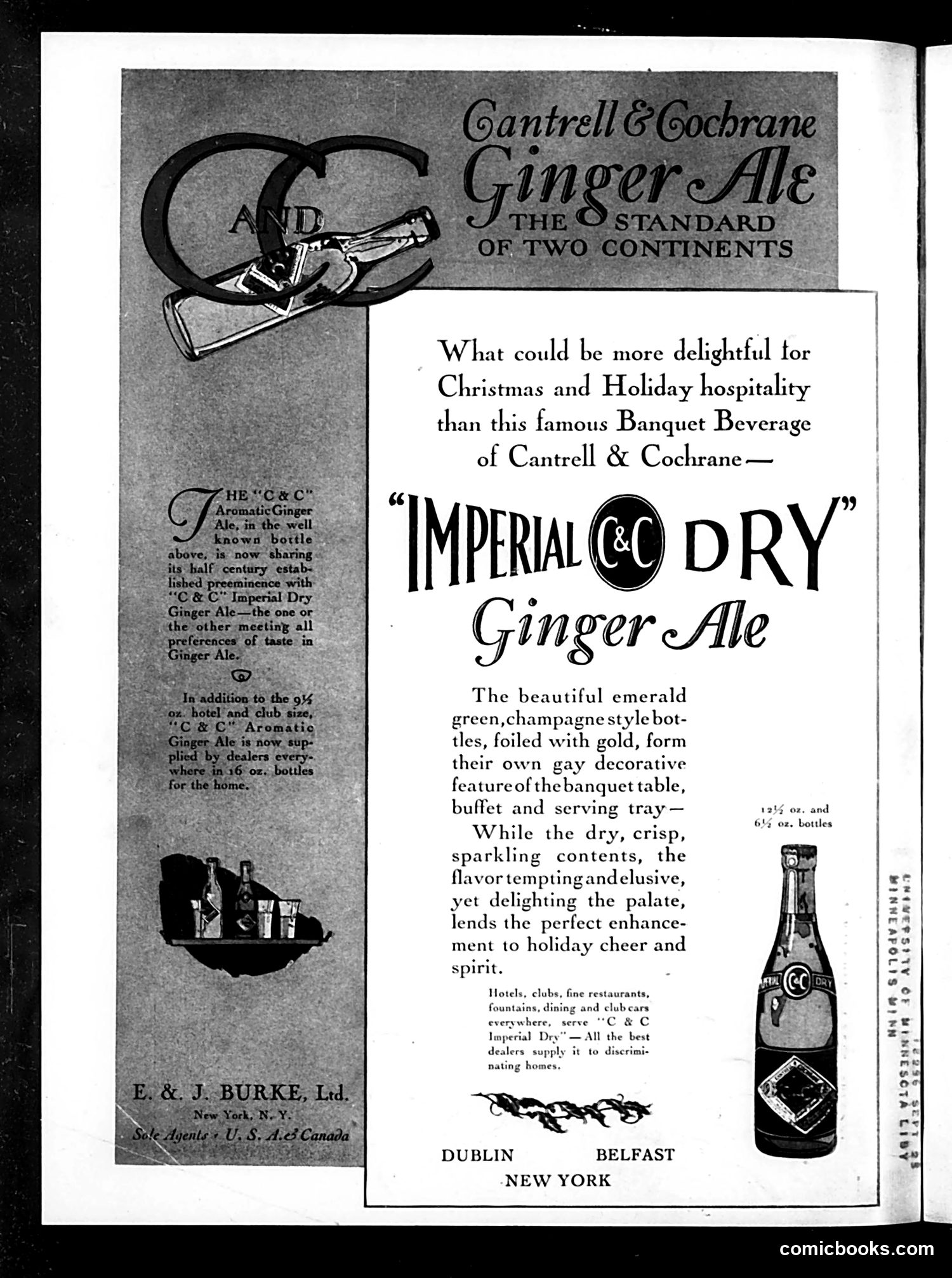
This page is primarily **advertising**, not satire or political commentary. It contains two ads for Cantrell & Cochrane's "Imperial Dry" Ginger Ale, a British beverage brand. The left ad emphasizes the product's long-established reputation ("half century"), positioning it as a prestigious choice. The right ad targets holiday entertaining, highlighting the elegant emerald-green bottles "foiled with gold" as decorative table features. The copy appeals to upscale venues—hotels, clubs, fine restaurants—to establish brand prestige. There is no cartoon or political joke here. This is straightforward commercial messaging from the Prohibition era (note the emphasis on a non-alcoholic ginger ale as a "banquet beverage"), marketed to affluent consumers seeking sophisticated holiday hospitality options. The ads reflect period advertising conventions: emphasis on tradition, elegance, and social status.