
Life, 1924-12-04 · page 49 of 72
Life — December 4, 1924 — page 49: what you’re looking at
What you’re looking at
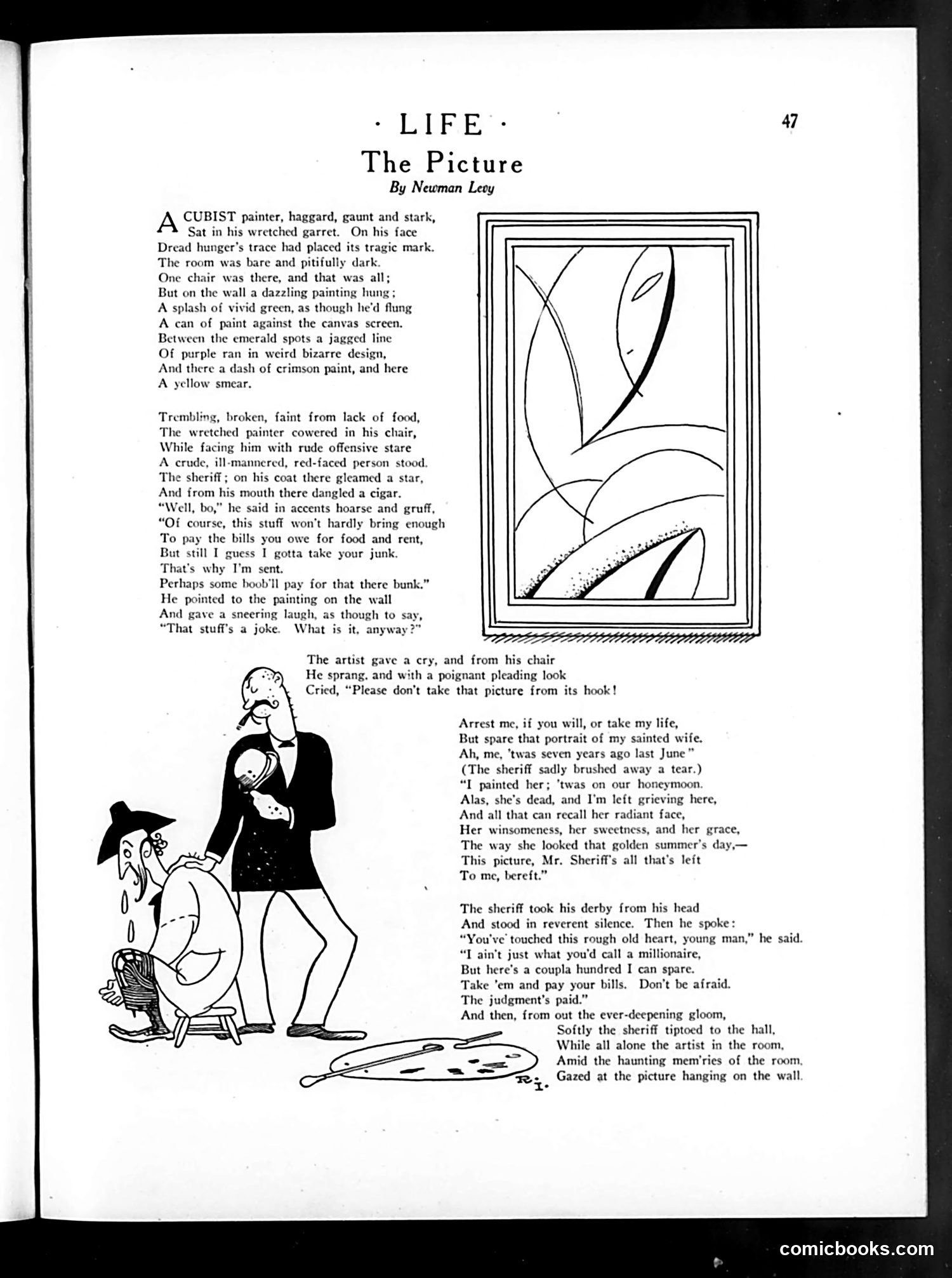
This poem satirizes early modernism (specifically Cubism) through a sentimental narrative. A starving Cubist painter faces eviction by a stereotypical tough sheriff. When the officer mocks the abstract painting on the wall as worthless junk, the artist reveals it's actually a portrait of his deceased wife from their honeymoon. The satire operates on two levels: it ridicules Cubist art as incomprehensible ("That stuff's a joke"), while simultaneously using sentimentality to redeem it—the "worthless" modernist work gains value only when reframed as representational portraiture tied to emotion. The sheriff, portrayed as a rough, unsophisticated lawman, becomes moved by the romantic story and pays the artist's debts. The joke reflects early 20th-century cultural anxiety about avant-garde art: it's either meaningless abstraction *or* it must serve traditional purposes (representation, sentiment) to justify its existence.
📄 Transcribed text from this page (OCR, searchable)
Machine-transcribed from the original scan — historical spelling and the odd misread are preserved.
- LIFE: The Picture By Newman Leoy A CUBIST painter, haggard, gaunt and stark, Sat in his wretched garret. On his face Dread hunger’s trace had placed its tragic mark. The room was bare and pitifully dark One chair was there, and that was all; But on the wall a dazzling painting hung; A splash of vi green, as though he'd flung A can of paint against the canvas screen. Between the emerald spots a jagged line Of purple ran in weird bizarre design, And there a dash of crimson paint, and here A yellow smear, Trembling, broken, faint from lack of food, The wretched painter cowered in his chair, While facing him with rude offensive stare A crude, ill-mannered, red-faced person stood. The sheriff; on his coat there gleamed a star, And from his mouth there dangled a cigar. “Well, bo,” he said in accents hoarse and gruff, “Of course, this stuff won't hardly bring enough To pay the bills you owe for food and rent, But still I guess I gotta take your junk. That’s why I'm sent. Perhaps some boob'll pay for that there bunk.” He pointed to the painting on the wall And gave a sneering laugh, as though to say “That stuff’s a joke. What is it, anyway? The artist gave a cry, and from his chair He sprang, and with a poignant pleading look Cried, “Please don’t take that picture from its hook! Arrest me, if you will, or take my life, But spare that portrait of my sainted wife. Ah, me, ‘twas seven years ago last June” (The sheriff sadly brushed away a tear.) “I painted her; ‘twas on our honeymoon. Alas, she’s dead, and I'm left grieving here, And all that can recall her radiant face, Her winsomeness, her sweetness, and her grace, The way she looked that golden summer's day,— This picture, Mr. Sheriff's all that's left To me, bereft.” The sheriff took his derby from his head And stood in reverent silence. Then he spoke: “You've touched this rough old heart, young man,” he said. “I ain't just what you'd call a millionaire, But here’s a coupla hundred I can spare. Take ‘em and pay your bills. Don’t be afraid. The judgment’s paid.” And then, from out the ever-deepening gloom, Softly the sheriff tiptoed to the hall, While all alone the artist in the room, Amid the haunting mem'ries of the room, Gazed at the picture hanging on the wall comicbooks.com