
Life, 1924-12-04 · page 34 of 72
Life — December 4, 1924 — page 34: what you’re looking at
What you’re looking at
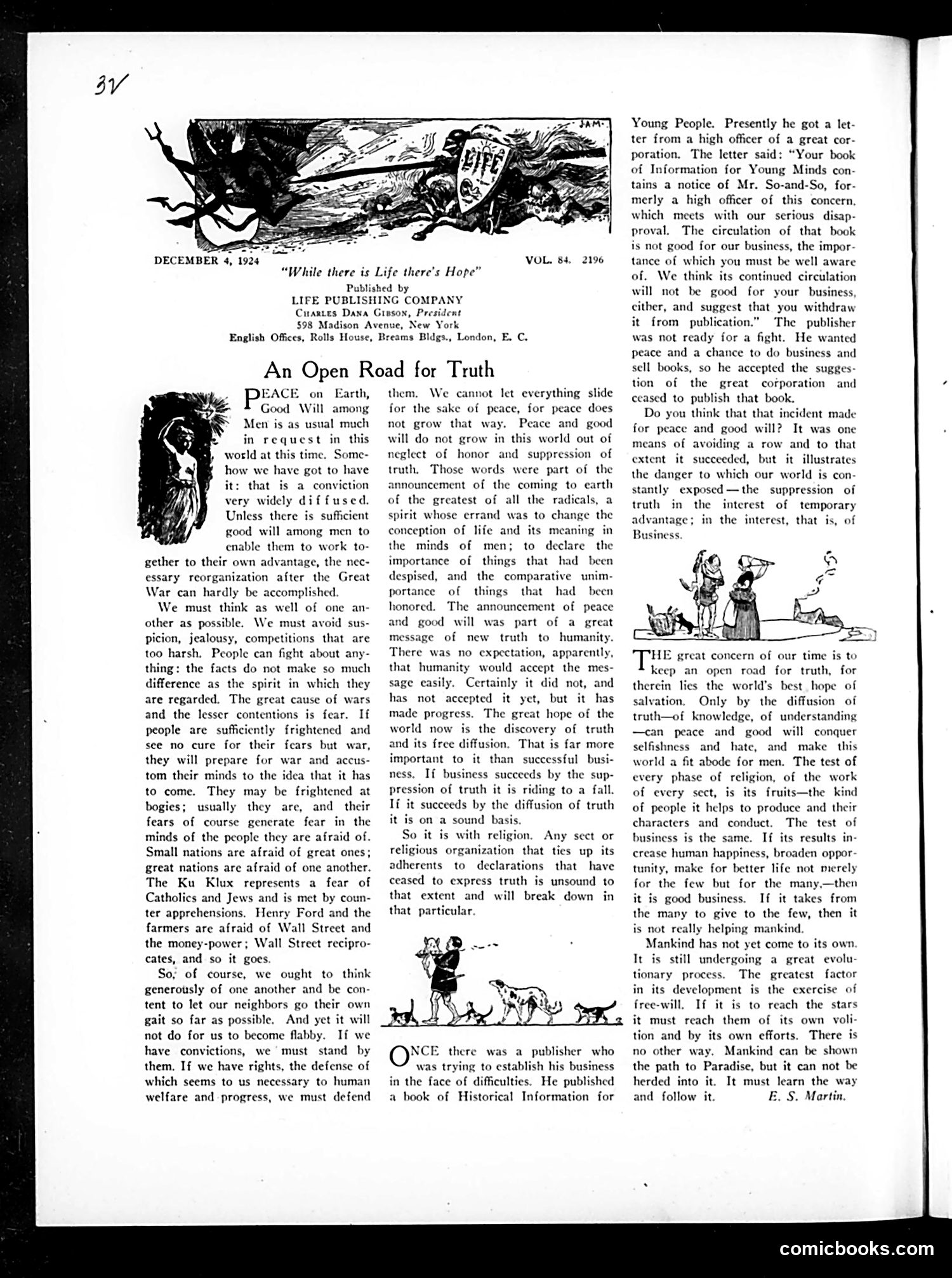
This page presents an editorial essay arguing for intellectual honesty and free discourse as essential to social progress. The author critiques institutions—corporations, religious organizations, and political groups—that suppress truth to serve their interests. The specific case illustrates the point: a publisher issued a factual history book mentioning a corporate executive unfavorably. The corporation demanded the book be withdrawn, claiming it harmed their business. The author uses this to argue that suppressing inconvenient facts in pursuit of profit or reputation corrupts both business and society. The piece references contemporary anxieties: post-WWI peace-building, the Ku Klux Klan, and tensions between labor (farmers) and capital (Wall Street). The core argument is that genuine peace and progress require truth-telling, not managed narratives—a principle the author believes transcends whether business thrives.
📄 Transcribed text from this page (OCR, searchable)
Machine-transcribed from the original scan — historical spelling and the odd misread are preserved.
VOL, 84. 2196 “While there is Life there's Hope” Published by LIFE PUBLISHING COMPANY Cuartes Dana Gisson, President $98 Madison Avenue, New York English Offices, Rolls House, Breams Bldgs., London, E. C. An Open Road for Truth ACE on Earth, Good Will among Men is as usual much in request in this world at this time. Some- how we have got to have it: that is a conviction very widely dif fused. Unless there is sufficient good will among men to enable them to work to- gether to their own advantage, the nec- essary reorganization after the Great War can hardly be accomplished. We must think as well of one an- other as possible. We must avoid sus- picion, jealousy, competitions that are too harsh. People can fight about any- thing: the facts do not make so much difference as the spirit in which they are regarded. The great cause of wars and the lesser contentions is fear. If people are sufficiently frightened and see no cure for their fears but war, they will prepare for war and accus- tom their minds to the idea that it has to come. They may be frightened at bogies; usually they are, and their fears of course gencrate fear in the minds of the people they are afraid of. Small nations are afraid of great ones; great nations are afraid of one another. The Ku Klux represents a fear of Catholics and Jews and is met by coun- ter apprehensions. Henry Ford and the farmers are afraid of Wall Street and the money-power; Wall Strect recipro- cates, and so it goes. So, of course, we ought to think generously of one another and be con- tent to let our neighbors go their own gait so far as possible. And yet it will not do for us to become flabby. If we have convictions, we must stand by them. If we have rights, the defense of which seems to us necessary to human welfare and progress, we must defend them. anot let everything slide for the of peace, for peace does not grow that way. Peace and good will do not grow in this world out of We ¢ neglect of honor and suppression of truth, Those words were part of the announcement of the coming to earth of the greatest of all the radicals, a spirit whose errand was to change the conception of life and its meaning in the minds of men; to declare the importance of things that had despised, and the comparative unim- portance of things that had honored. The announcement of peace and good will was part of a gr message of new truth to humanity. There was no expectation, apparent! that humanity would accept the mes- sage easily. Certainly it did not, and has not accepted it yet, but it has made progress. The great hope of the world now is the discovery of truth and its free diffusion, That is far more important to it than successful busi- ness. If business succeeds by the sup- pression of truth it is riding to a fall. If it succeeds by the diffusion of truth it is on a sound basis. So it is with religion. Any sect or religious organization that ties up its adherents to declarations that have ceased to express truth is unsound to that extent and will break down in that particula been been ‘CE there was a publisher who was trying to establish his business in the face of difficulties. He published a book of Historical Information for Young People. Presently he got a let- ter from a high officer of a great cor- poration. The letter said: “Your book of Information for Young Minds con- tains a notice of Mr. So-and-So, for- merly a high officer of this concern, which meets with our serious disap- proval. The circulation of that book is not good for our business, the impor- tance of which you must be well aware of. We think its continued circulation will not be good for your business, cither, and suggest that you withdraw it from publication.” The publisher was not ready for a fight. He wanted peace and a chance to do business and sell books, so he accepted the sugges- tion of the great corporation and ceased to publish that book. Do you think that that incident made for peace and good will? It was one means of avoiding a row and to that extent it succeeded, but it illustrates the danger to which our world is con stantly exposed—the suppression of truth in the interest of temporary advantage; in the interest, that is, of Business. THE great concern of our time is to cep an open road for truth, for therein lies the world’s best hope of salvation, Only by the diffusion of truth—of knowledge, of understanding —can peace and good will conquer selfishness and hate, and make this world a fit abode for men. The test of every phase of religion, of the work of every sect, is its fruits—the kind of people it helps to produce and their characters and conduct. The test of business is the same. If its results in- crease human happiness, broaden oppor- tunity, make for better life not merely for the few but for the many,—then it is good business. If it takes from the many to give to the few, then it is not really helping mankind. Mankind has not yet come to its own It is still undergoing a great evolu- tionary process. The greatest factor in its development is the exercise of free-will, If it is to reach the stars it must reach them of its own voli tion and by its own efforts. There is no other way. Mankind can be shown the path to Paradise, but it can not be herded into it. It must learn the way and follow it. E. S. Martin, comicbooks.com