
Life, 1924-12-04 · page 52 of 72
Life — December 4, 1924 — page 52: what you’re looking at
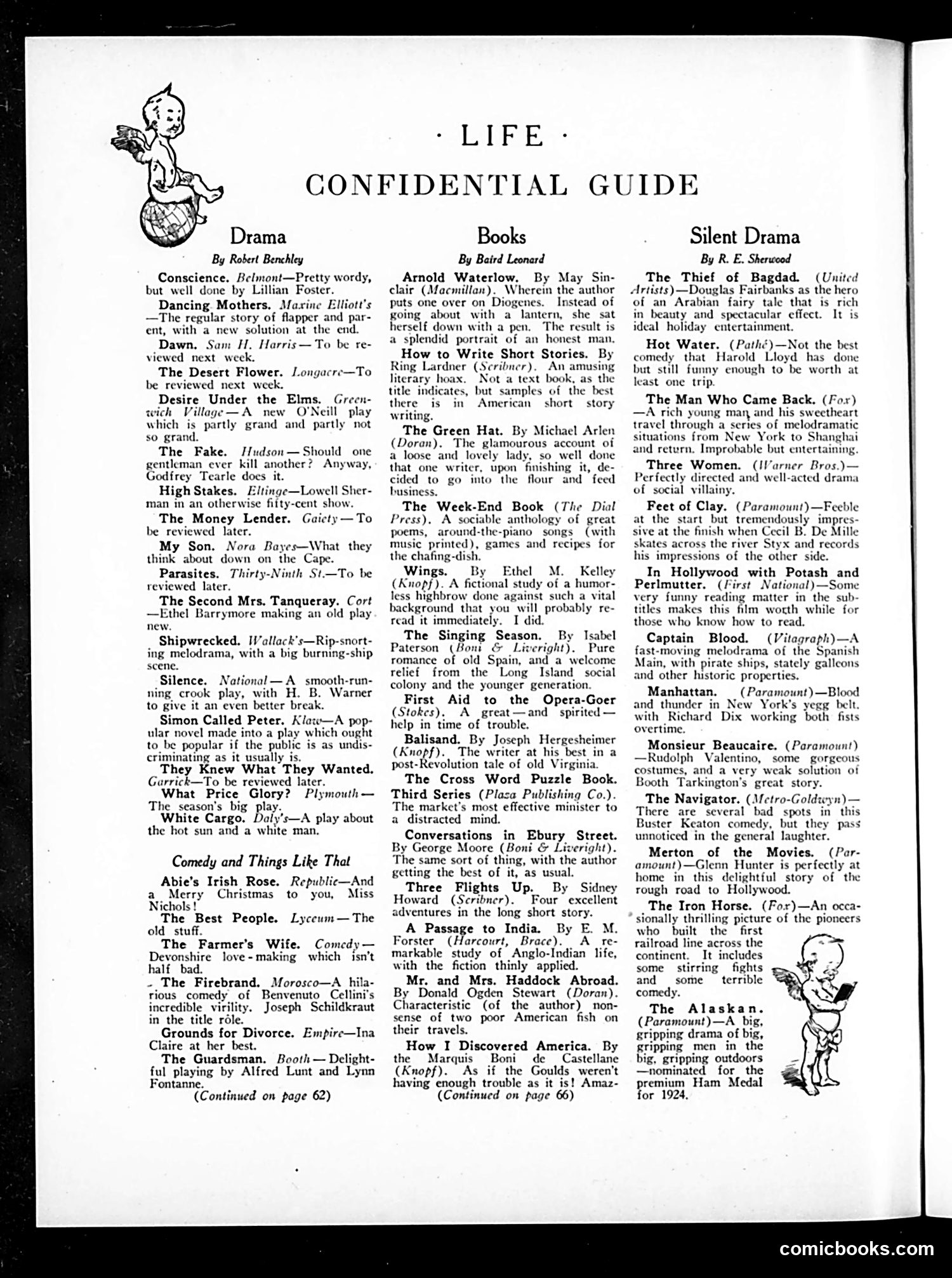
What you’re looking at
This page is a **theater and book review section**, not political satire. It's a straightforward critical guide to current Broadway plays and newly published books, written by humorist Robert Benchley (drama) and Baird Leonard (books). The reviews are brief, witty critiques typical of 1920s entertainment journalism. Notable references include: - **"What Price Glory?"** - flagged as "the season's big play" - **O'Neill's "Desire Under the Elms"** - a new play receiving mixed praise - **Ring Lardner's book** - described as an "amusing literary hoax" - **Michael Arlen's "The Green Hat"** - contemporary bestseller about a "loose and lovely lady" The tone is gossipy and irreverent, reflecting Life's satirical voice. The small cartoons of a child-like figure are decorative rather than substantive. This is entertainment journalism aimed at sophisticated New York readers interested in theater and literature.
📄 Transcribed text from this page (OCR, searchable)
Machine-transcribed from the original scan — historical spelling and the odd misread are preserved.
IEE CONFIDENTIAL GUIDE Drama By Robert Benchley Conscience. Belmont—Pretty wordy, but well done by Lillian Foster. Dancing Mothers. Maxine Elliott's —The regular story of flapper and par- ent, with a new solution at the end. Dawn. Sam H, Harris—To be re- viewed next week. The Desert Flower. Longacre—To be reviewed next week. Desire Under the Elms. Green- wich Village —A new O'Neill play which is partly grand and partly not so grand. The Fake. /H/udson— Should one gentleman ever kill another? Anyway, Godfrey Tearle does it. High Stakes. Eltinge—Lowell Sher- man in an otherwise fiity-cent show. The Money Lender. Gaiety —To be reviewed later. My Son. Nora Bayes—What they think about down on the Cape. Parasites. Thirty-Ninth St. reviewed later. The Second Mrs. Tanqueray. Cort —Ethel Barrymore making an old play new. Shipwrecked. IVallack’s—Rip-snort- ing melodrama, with a big burning-ship scene. Silence. National —A_ smooth-run- ning crook play, with H. B. Warner to give it an even better break. Simon Called Peter. Klaw—A pop- ular novel made into a play which ought to be popular if the public is as undis- criminating as it usually is. They Knew What They Wanted. Garrick—To be reviewed later. What Price clon? Plymouth — The season's big play. White Cargo. Daly’s—A play about the hot sun and a white man. To be Comedy and Things Like That Abie’s Irish Rose. Republic—And a Merry Christmas to you, Miss Nichols! The Best People. old_ stuff. The Farmer's Wife. Devonshire love - making half bad. -,The Firebrand. Morosco—A hila- rious comedy of Benvenuto Cellini’s incredible virility. Joseph Schildkraut in the title role. Grounds for Divorce. Empire—Ina Claire at her best. The Guardsman. Booth — Delight- ful playing by Alfred Lunt and Lynn Fontanne. (Continued on page 62) Lyceum — The Comedy — which isn’t Books By Baird Leonard Arnold Waterlow. By May Sin- clair (Macmillan). Wherein the author puts one over on Diogenes. Instead of going about with a lantern, she sat herself down with a pen. The result is a splendid portrait of an honest man, How to Write Short Stories. By Ring Lardner (Scribner), An amusing literary hoax. Not a text book, as the title indicates, but samples of the best there is in American short story writing. The Green Hat. By Michael Arlen (Doran). The glamourous account of a loose and lovely lady, so well done that one writer, cided busing S. The Week-End Book (The Dial Press). A sociable anthology of great poems, around-the-piano songs (with music printed), games and recipes for the chafing-dish. Wings. By Ethel M. Kelley (Knopf). A fictional study of a humor- less highbrow done against such a vital background that you will probably re- read it immediately. I did. The Singing Season. By Isabel Paterson (Bont & Liveright). Pure romance of old Spain, and a welcome relief from the Long Island social colony and the younger generation. First Aid to the Opera-Goer (Stokes), A great—and spirited — help in time of trouble. Balisand. By Joseph Hergesheimer (Knopf). The writer at his best in a post-Revolution tale of old Virginia. The Cross Word Puzzle Book. Third Series (Plasa Publishing Co.). The market's most effective minister to a distracted mind. Conversations in Ebury Street. By George Moore (Boni & Liveright). The same sort of thing, with the author getting the best of it, as usual. Three Flights Up. By Sidney Howard (Scribner). Four excellent adventures in the long short story. A Passage to India. By E. M. Forster (Harcourt, Brace). A re- markable study of Anglo-Indian life, with the fiction thinly applied. Mr. and Mrs. Haddock Abroad. By Donald Ogden Stewart (Doran). Characteristic (of the author) non- sense of two poor American fish on their travels. How I Discovered America. By the Marquis Boni de — Castellane (Knopf). As if the Goulds weren't having enough trouble as it is! Amaz- (Continued on page 66) upon finishing it, de- 10 go into the flour and feed Silent Drama By R. E. Sherwood The Thief of Bagdad. (United Artists)—Douglas Fairbanks as the hero ‘of an Arabian fairy tale that is rich in beauty and spectacular effect. It is ideal holiday entertainment. Hot Water. (Pathé)—Not the best comedy that Harold Lloyd has done but still funny enough to be worth at least one trip. The Man Who Came Back. (For) ‘A rich young man, and his sweetheart travel through a series of melodramatic situations from New York to Shanghai and return. Improbable but entertaining. Three Women. (Iarner Bros.)— Perfectly directed and well-acted drama of social villainy. Feet of Clay. (Paramount)—Feeble at the start but tremendansty. impres- the finish when Cecil E B. De Mille t ind records his impressions of the other side. In Hollywood with Potash and Perlmutter. (first National) —Some very funny reading matter in the sub- titles makes this film worth while for those who know how to read. Captain Blood. (Vitagraph) fast-moving melodrama of the Spani: Main, with pirate ships, stately galleons and other historic properties. Manhattan. —_(Paramount)—Blood and thunder in New York’s yegg belt. with Richard Dix working both fists overtime. Monsieur Beaucaire. (Paramount) —Rudolph Valentino, some gorgeous costumes, and a very weak solution of Booth Tarkington's great story. The Navigator. (Metro-Goldwyn)— There are several bad spots this Buster Keaton comedy, but they pass unnoticed in the general laughter. Merton of the Movies. (Par- amount)—Glenn Hunter is perfectly at home in this delightful story of the rough road to Hollywood. The Iron Horse. (Fox)—An occa- sionally thrilling picture of the pioneers who built the first railroad line across the continent. It includes some stirring fights and some terrible comedy. The Alaskan. (Paramount)—A big, gripping drama of big, gripping men in the big, gripping outdoors —nominated for the premium Ham Medal for 1924. comicbooks.com