
A complete issue · 36 pages · 1924
Life — July 3, 1924
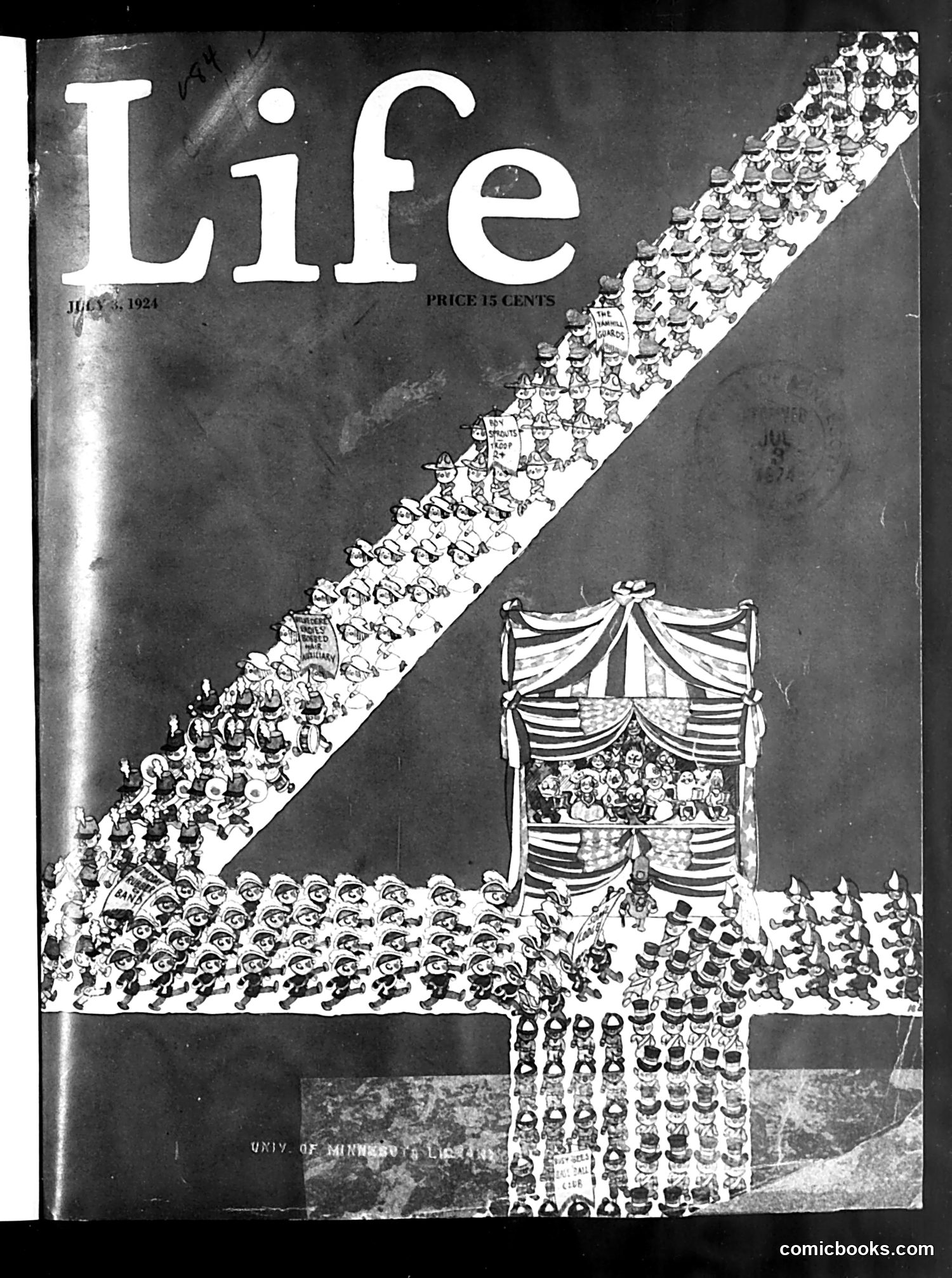
This satirical cover depicts a massive crowd of identical figures climbing a diagonal ramp toward a grandstand draped with American flags. The composition suggests commentary on mass conformity, collective behavior, or possibly public enthusiasm for a political event or leader during the 1924 election period. The repetitive, uniform nature of the climbing figures—all appearing identical—appears to critique herd mentality or uncritical mass participation in some contemporary movement or political phenomenon. The ornate grandstand with patriotic bunting suggests an official or ceremonial context, possibly political. Without additional text identifying specific figures or events, the precise target of satire remains unclear, though the visual metaphor of undifferentiated masses marching toward authority is evident.
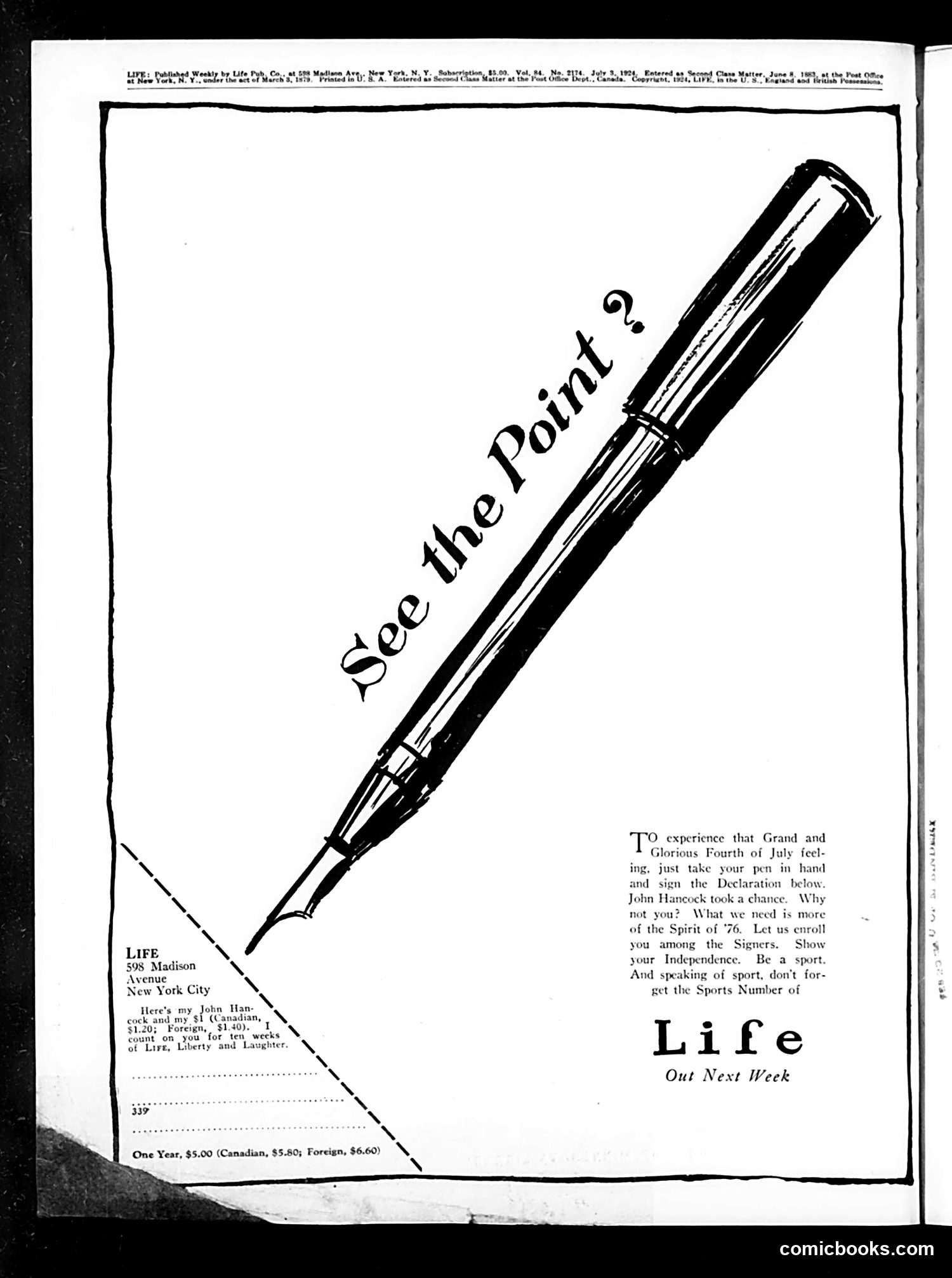
This is primarily a **subscription advertisement** for Life magazine, not a political cartoon. The visual centerpiece is a large pen with the text "See the Point?" — a visual pun playing on the pen's pointed nib. The advertisement references the **Fourth of July and American independence**, encouraging readers to "sign the Declaration" by subscribing. It invokes patriotic language about "the Spirit of '76" and appeals to readers' sense of independence and sportsmanship. The subscription form on the left shows Life's address (598 Madison Avenue, New York City) and pricing. The bottom notes subscription rates: one year cost $5.00 domestically, $5.80 in Canada, and $6.60 internationally. This appears to be a Bicentennial-era advertisement, likely from the 1970s, leveraging patriotic sentiment to drive magazine subscriptions.
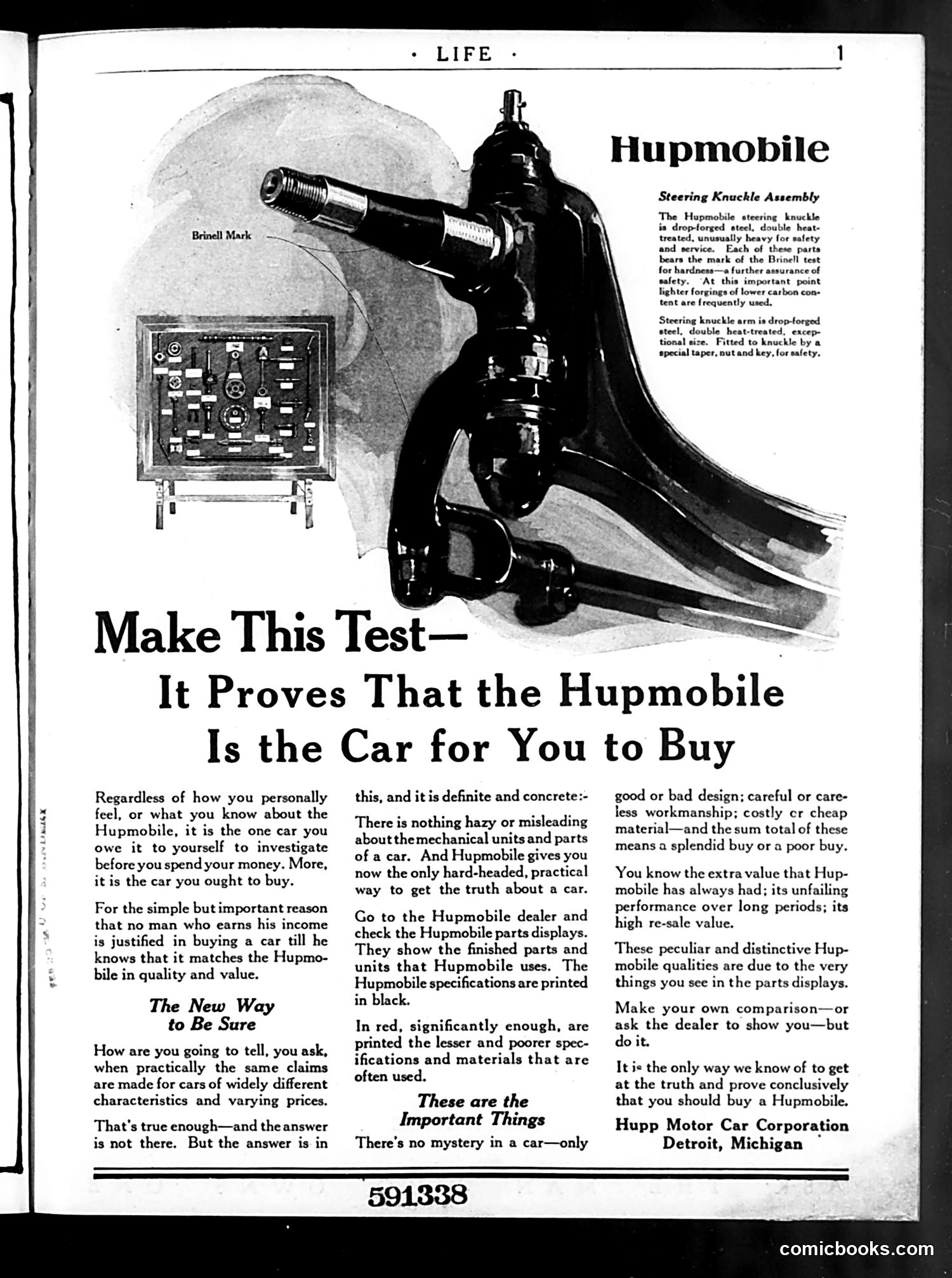
This is **not a cartoon or satire page** — it's a straightforward automobile advertisement for the Hupmobile, published in *Life* magazine. The page features: - A large technical illustration of a **steering knuckle assembly** (car part), labeled with "Brinell Mark" to indicate hardness testing - Promotional text encouraging potential buyers to visit Hupmobile dealers and compare their vehicle's component quality against competitors - The tagline promises that examining parts displays proves the Hupmobile's superior construction **Context for modern readers:** This reflects early-20th-century automotive marketing strategy—when cars were still novel, manufacturers competed on *mechanical quality* and transparency about parts, rather than styling or features. Showing actual components was meant to assure skeptical buyers of durability and honest manufacturing. The Hupp Motor Car Corporation was a real (now defunct) American automaker based in Detroit.
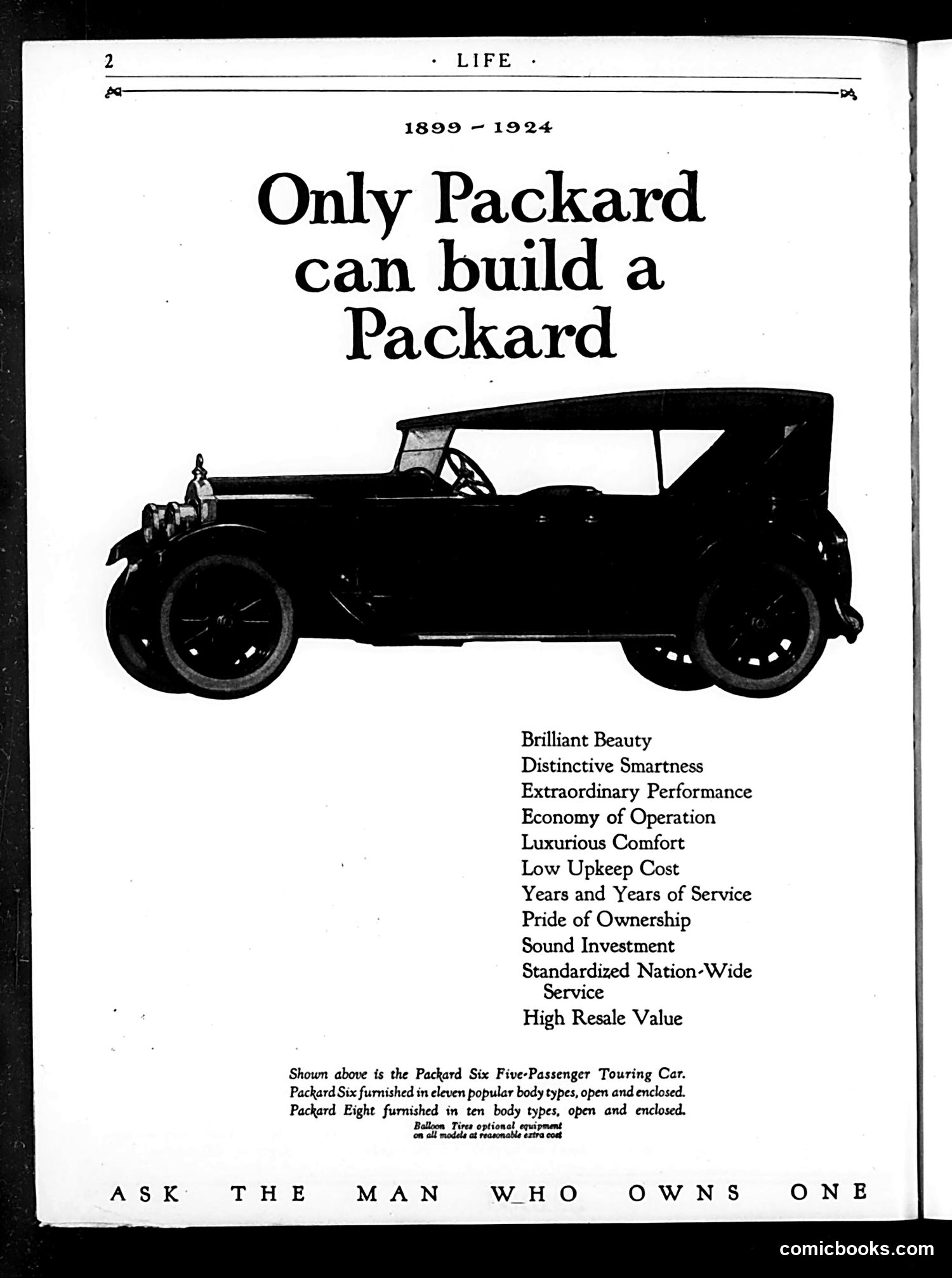
This is **not a cartoon or satire** — it's a **straight automobile advertisement** from Life magazine (1899-1924 era). The page advertises the Packard automobile, featuring a silhouette illustration of a Packard Six Five-Passenger Touring Car. The headline "Only Packard can build a Packard" is a luxury branding claim emphasizing exclusivity and quality control. The text lists selling points: beauty, performance, comfort, low maintenance, reliability, resale value, and nationwide service. The closing line "Ask the man who owns one" was Packard's actual famous slogan. There is no political satire, caricature, or social commentary here — it's premium automotive marketing directed at wealthy consumers during the early automobile era.
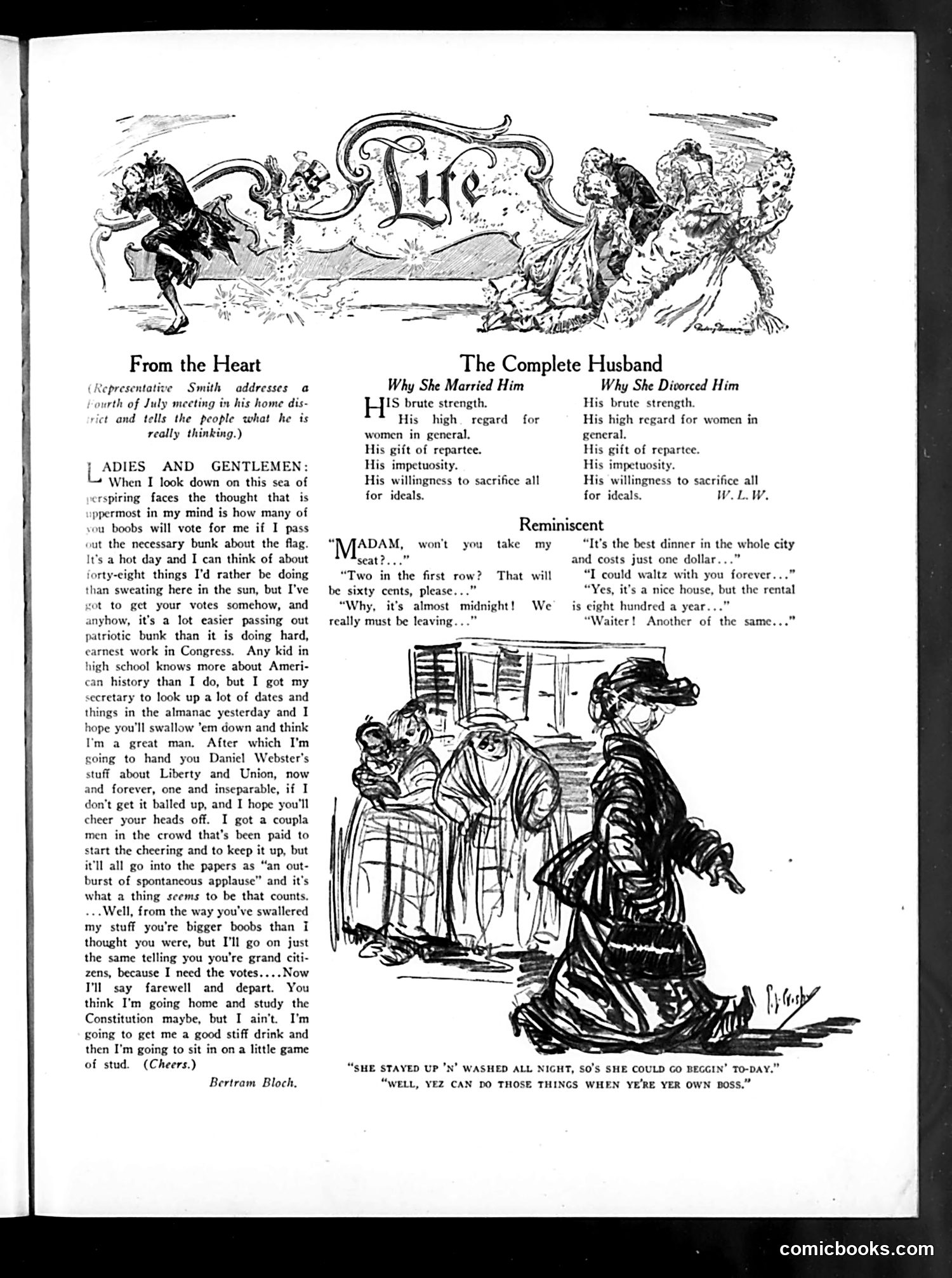
This page from *Life* magazine contains satirical commentary on marriage and gender roles, typical of early 20th-century American humor. **"From the Heart"** features Representative Smith addressing Congress about patriotism and duty, sarcastically contrasting talk of noble sacrifice with the mundane reality of comfortable civilian life—a critique of politicians' rhetoric versus actual commitment. **"The Complete Husband"** presents parallel lists satirizing marriage: qualities women seek versus why they actually marry (brute strength, high regard for women, etc.) versus why they divorce him (the same qualities). The joke critiques how the same masculine traits women initially value become sources of marital conflict. **"Reminiscent"** depicts a couple nostalgically recalling early romance while their present circumstances (modest housing, financial constraints) reveal how romantic ideals clash with married reality. The servant's comment underscores class awareness about domestic life.
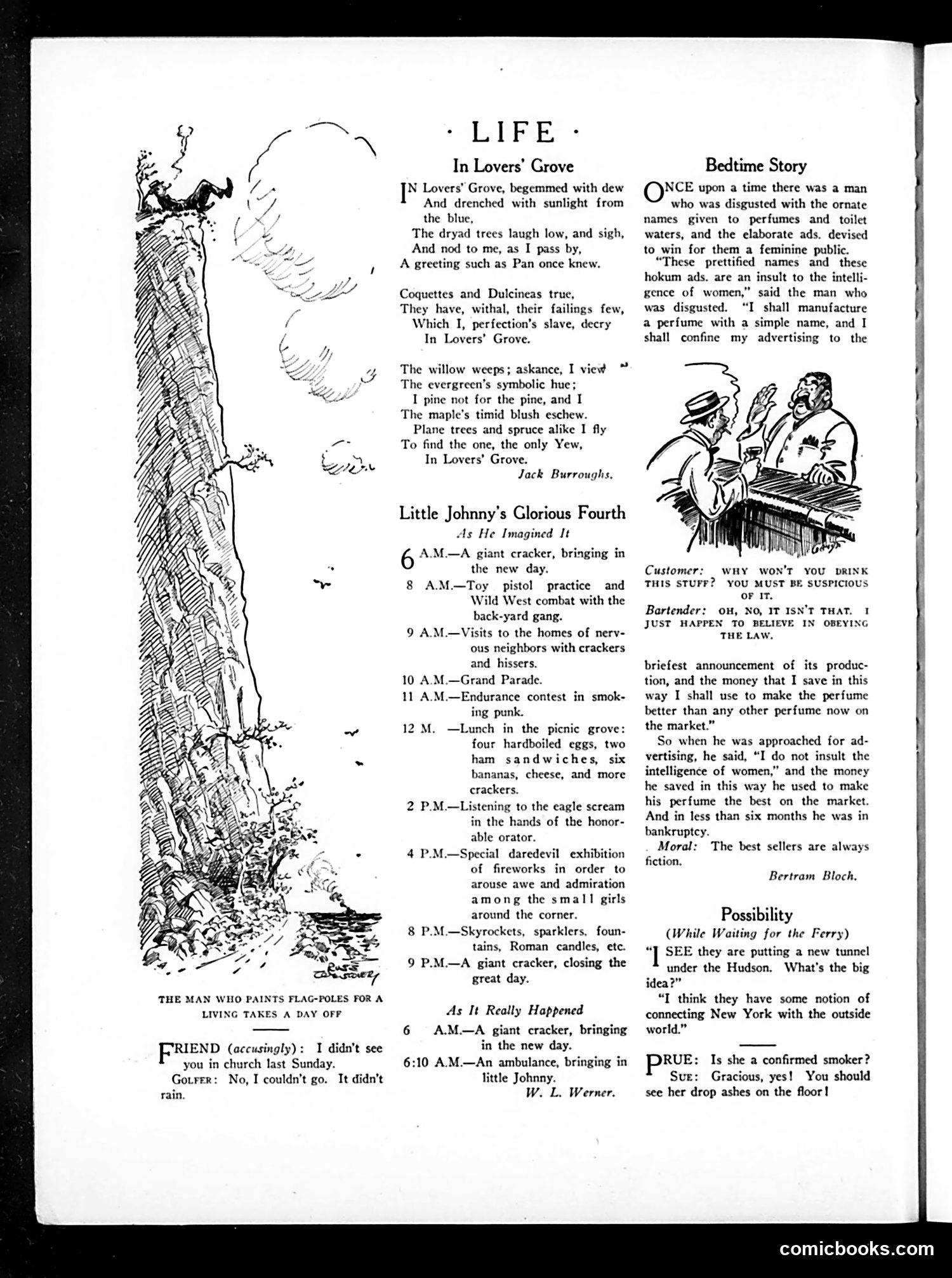
The page contains three separate satirical pieces: 1. **"In Lovers' Grove"** (poem by Jack Burroughs): A romantic nature poem about idealized love, paired with a sketch of a tree trunk—likely mocking sentimental Victorian poetry. 2. **"Little Johnny's Glorious Fourth"** and **"As It Really Happened"**: These paired sections contrast an imaginative child's fantasy Fourth of July (giant crackers, parades, daredevil exhibitions) with reality (just a giant cracker and ambulance bringing in an injured child). This satirizes both children's romantic expectations and the dangers of fireworks. 3. **"Bedtime Story"** and other dialogue pieces: Mock various social pretensions—including a man disgusted with ornate perfume advertising ("an insult to women's intelligence"), and exchanges about tunnel construction and smoking habits that appear to lampoon upper-class social conventions. The overall tone targets romantic sentimentality and social pretension.
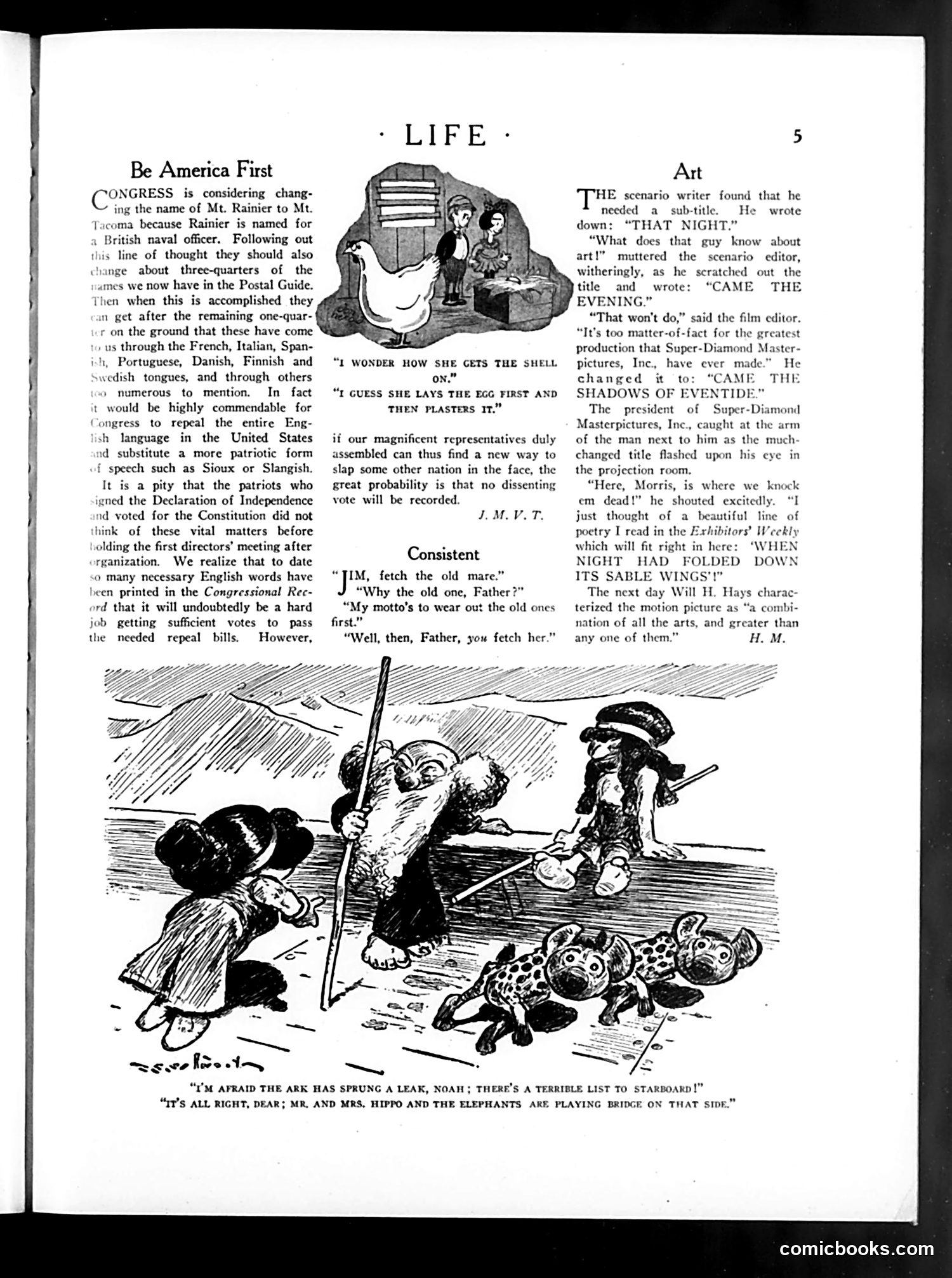
This page contains two separate satirical pieces: **"Be America First"** criticizes Congress for considering renaming Mt. Tacoma because it's named after a British naval officer. The author argues patriotically for keeping English place names in the U.S., sarcastically suggesting we rename all foreign-origin place names instead—which would require massive changes to the Postal Guide. **"Consistent"** presents a brief comic dialogue between a father and child about wearing out old clothing, followed by a cartoon showing anthropomorphized animals (appearing to be monkeys or apes) on what seems to be Noah's Ark, discussing structural damage. The bottom caption references "Noah" and animals playing bridge, making this an absurdist humor piece rather than pointed political satire. Both pieces exemplify Life's typical blend of political commentary and whimsical humor.
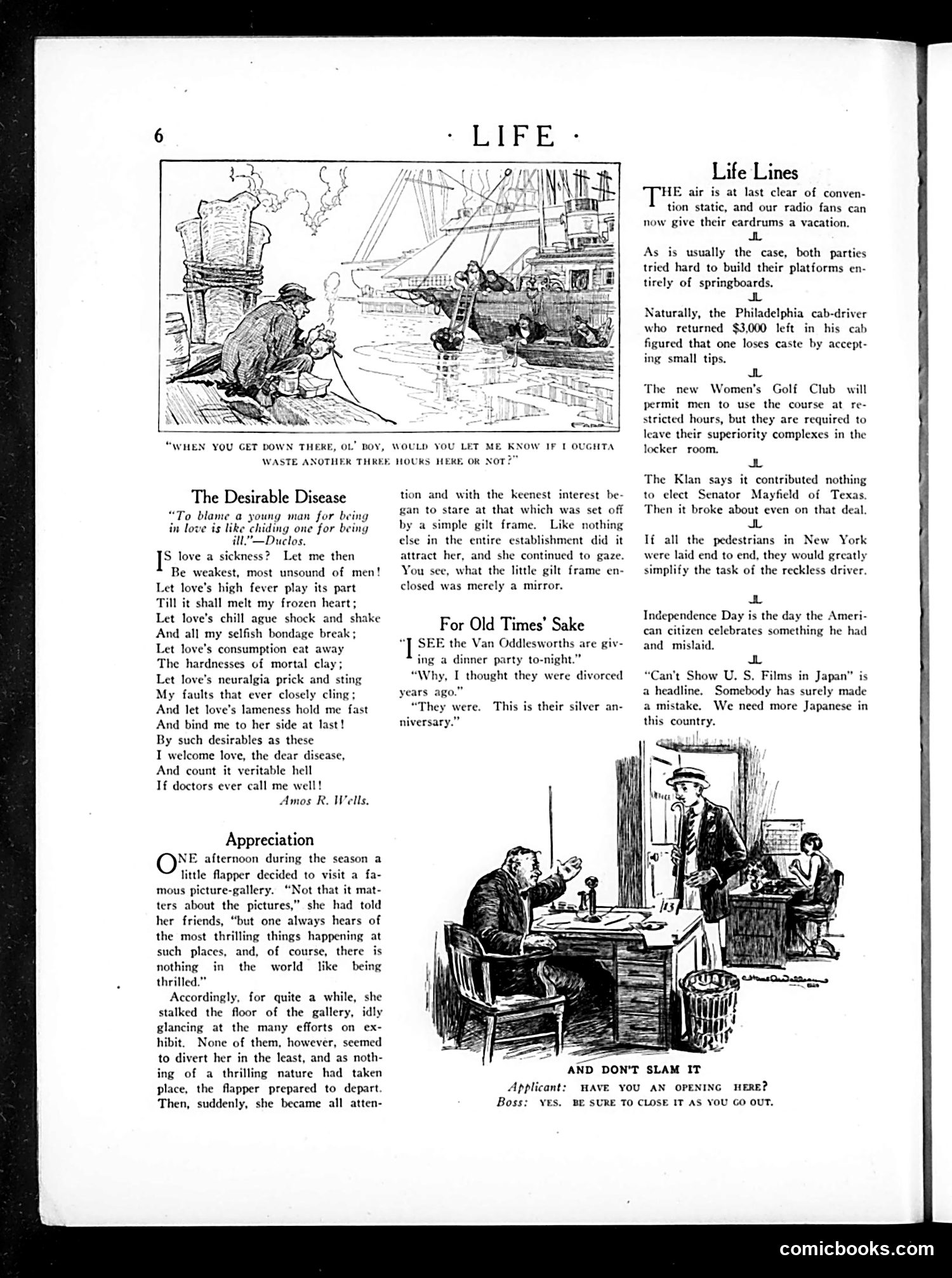
This page contains three separate pieces of humor content typical of Life magazine's satirical format: 1. **"Life Lines"** - Brief social commentary on various topics, including convention radio static, Philadelphia cab drivers keeping tips, and a women's golf club requiring men to use restricted hours. 2. **"The Desirable Disease"** - A poem by Amos R. Wells romanticizing love's afflictions, suggesting love's suffering is preferable to health. 3. **"Appreciation"** and **"For Old Times' Sake"** - Short anecdotes mocking social pretension (a gallery visitor feigning interest in art) and remarking on the Van Oddsworths' marital reunion. 4. **Bottom cartoon** - Shows a job interview where a boss warns an applicant to close the office door quietly, satirizing workplace courtesy and office management clichés of the era.
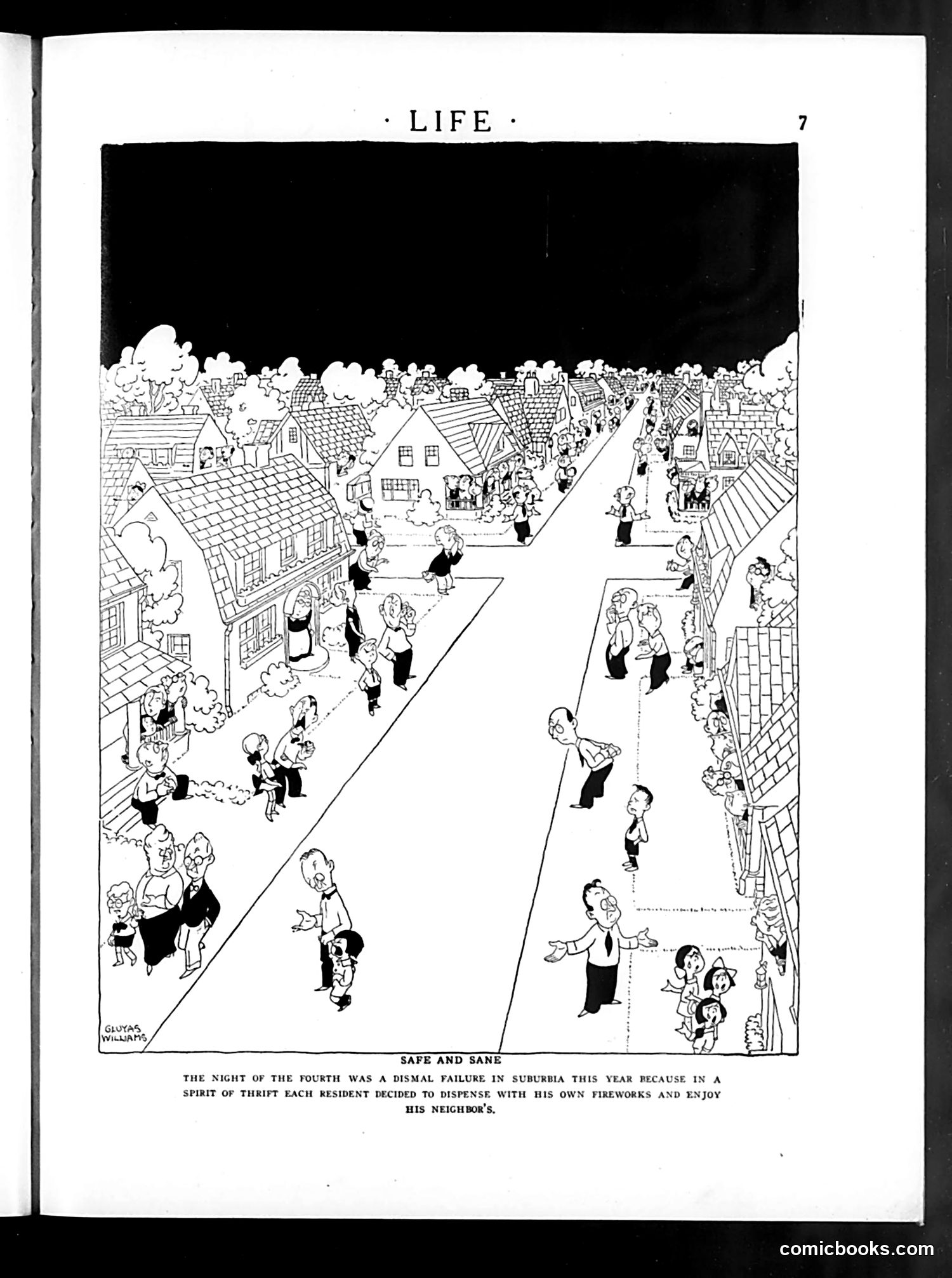
This cartoon satirizes suburban Independence Day celebrations. The caption explains that Fourth of July fireworks displays were disappointing because residents, practicing "thrift" during what appears to be an economically difficult period, skipped buying their own fireworks and instead gathered to watch neighbors' displays. The illustration shows a suburban street with families standing outside homes, seemingly waiting or watching rather than actively celebrating. The satire targets both penny-pinching residents who avoid expense and the resulting lackluster holiday atmosphere. The title "Safe and Sane" likely references contemporary safety campaigns promoting regulated rather than private fireworks. The cartoonist (signed "Gluyas Williams") mocks the tension between thrift and festive tradition in early 20th-century American suburban life.
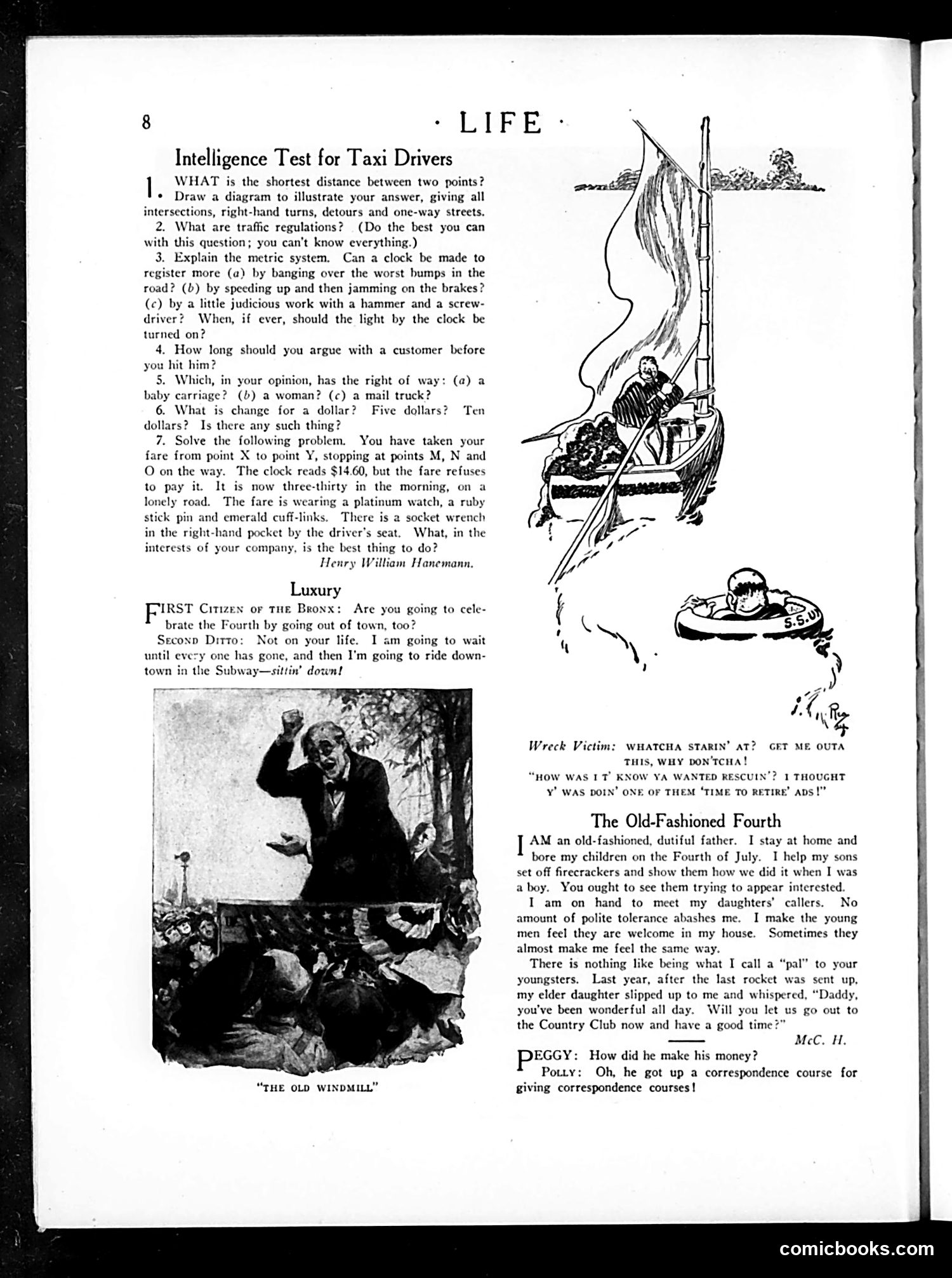
This page contains satirical pieces about American leisure and class: **"Intelligence Test for Taxi Drivers"** presents humorous practical scenarios taxi drivers might face, including moral dilemmas (arguing with customers, handling lost valuables) and mechanical problems. It's satirizing working-class transportation workers as figures worthy of testing. **"Luxury"** mocks wealthy Bronx residents celebrating Independence Day by taking the subway downtown—presenting this as an ironic "luxury" for the rich, satirizing both upper-class pretension and the crowded subway experience. **"The Old-Fashioned Fourth"** depicts a traditional father celebrating July 4th with his children through fireworks, then receiving an unexpected kiss from his daughter. The brief dialogue joke suggests he made money through a correspondence course—poking fun at get-rich-quick schemes popular in that era. The overall tone critiques class divisions and American consumer culture.
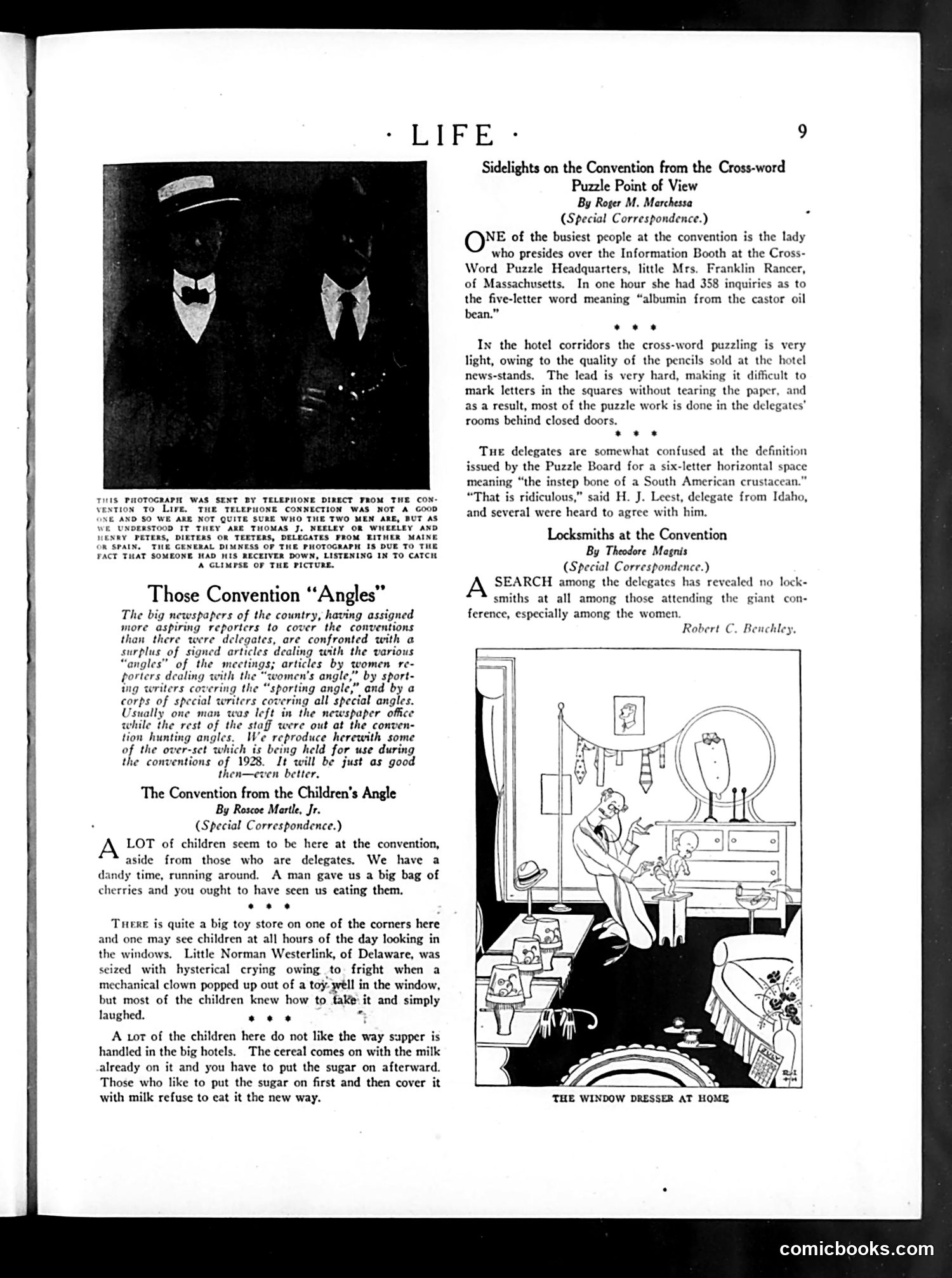
This page from *Life* magazine covers a Cross-Word Puzzle convention, a major cultural phenomenon of the 1920s. The top photograph shows two men in formal wear photographed via telephone, illustrating the novelty of transmitting images long-distance. The main cartoons mock convention attendees. "Those Convention Angles" discusses different journalist perspectives covering the event. "The Convention from the Children's Angle" satirizes children attending—showing their innocent observations about hotel amenities (a toy store, cereal service) that adults might overlook. The "Window Dresser at Home" cartoon illustrates how convention enthusiasm extends to domestic life, with someone arranging their home like a window display, reflecting the period's consumerist fervor surrounding crossword puzzles. The satire captures 1920s American culture's obsession with crossword puzzles and conventions as mass-participation spectacles.
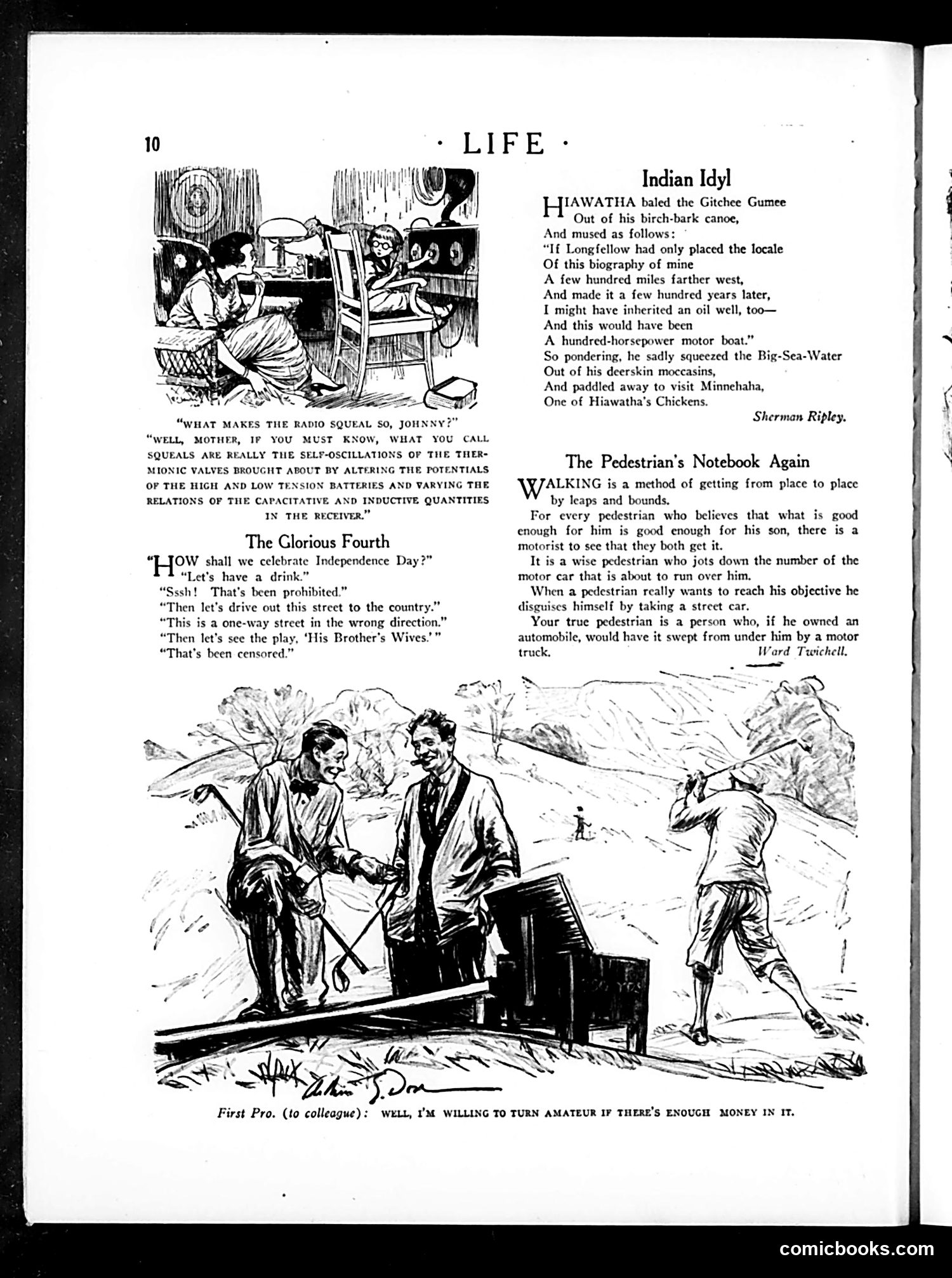
This page contains three satirical pieces: 1. **"Indian Idyl"** (top right): A poem by Sherman Ripley mocking someone named Hiawatha who fantasizes about inheriting oil wealth "a hundred miles farther west," imagining a "hundred-horsepower motor boat" instead of paddling a canoe. This satirizes get-rich-quick schemes and materialism among Native Americans during the oil boom era. 2. **"The Glorious Fourth"** (middle): A joke about Independence Day celebrations being censored or restricted, likely referencing wartime or Prohibition-era restrictions on festivities. 3. **"The Pedestrian's Notebook Again"** (bottom): A humorous column by Ward Tawell contrasting pedestrians with motorists, sardonically noting that a "true pedestrian" would sweep an automobile from under him—poking fun at the era's dangerous automobile-pedestrian conflicts.
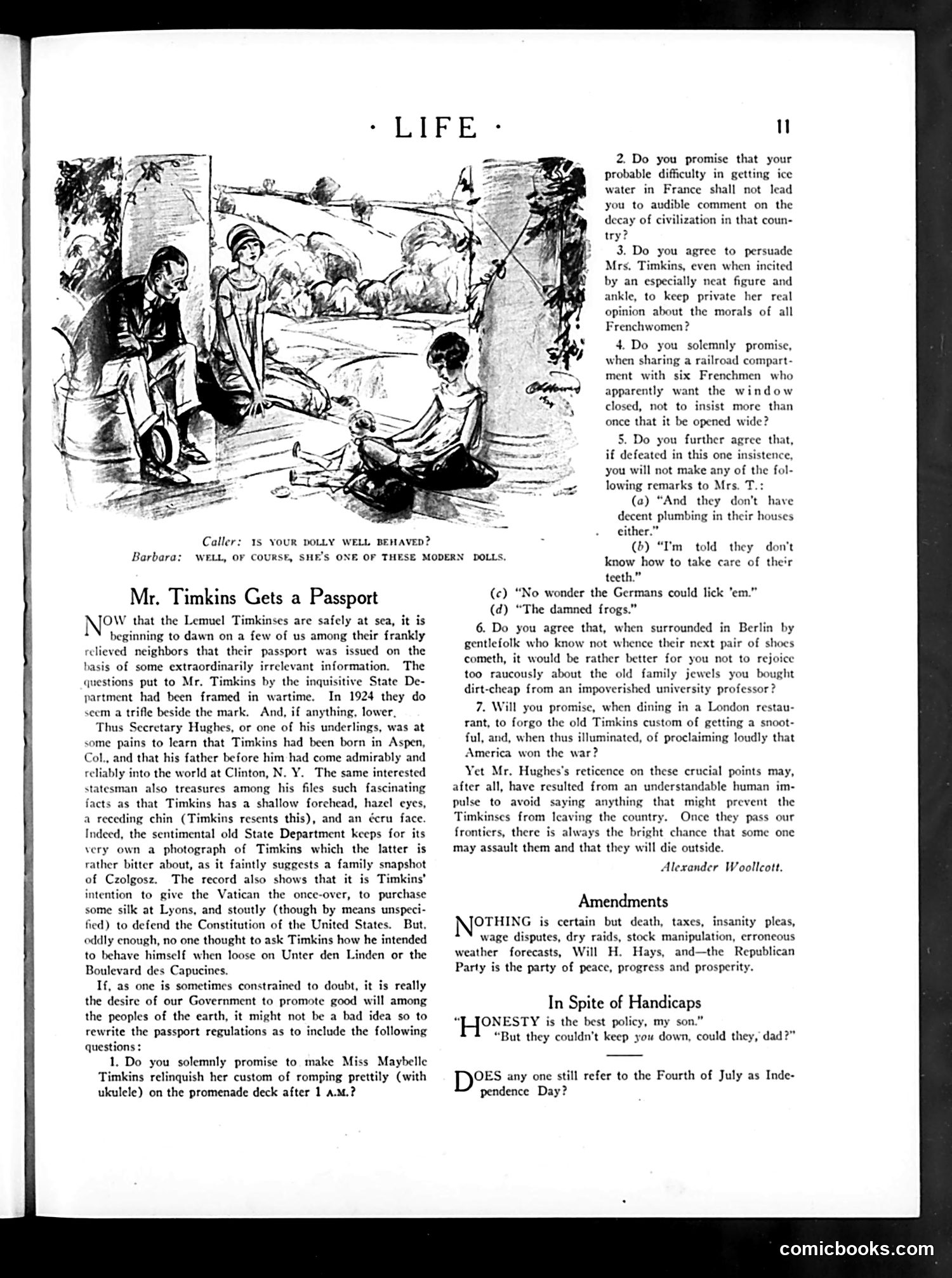
This satirical piece mocks Mr. Lemuel Timkins, who apparently received a passport despite being considered an embarrassment to American diplomacy. The cartoon illustrates a scene where State Department officials quiz Timkins on his behavior abroad, trying to prevent diplomatic disasters. The humor derives from Timkins being such an uncultured, tactless American that officials must extract promises he won't offend foreign dignitaries—he must agree not to rampage through Berlin, refrain from loudly praising American military victory in restaurants, and avoid insulting French plumbing. The satire targets two things: American anxiety about unsophisticated citizens representing the nation abroad, and the stereotype of the "ugly American" whose behavior embarrasses his country internationally. The cartoon suggests some Americans lack the cultural refinement expected of international travelers.
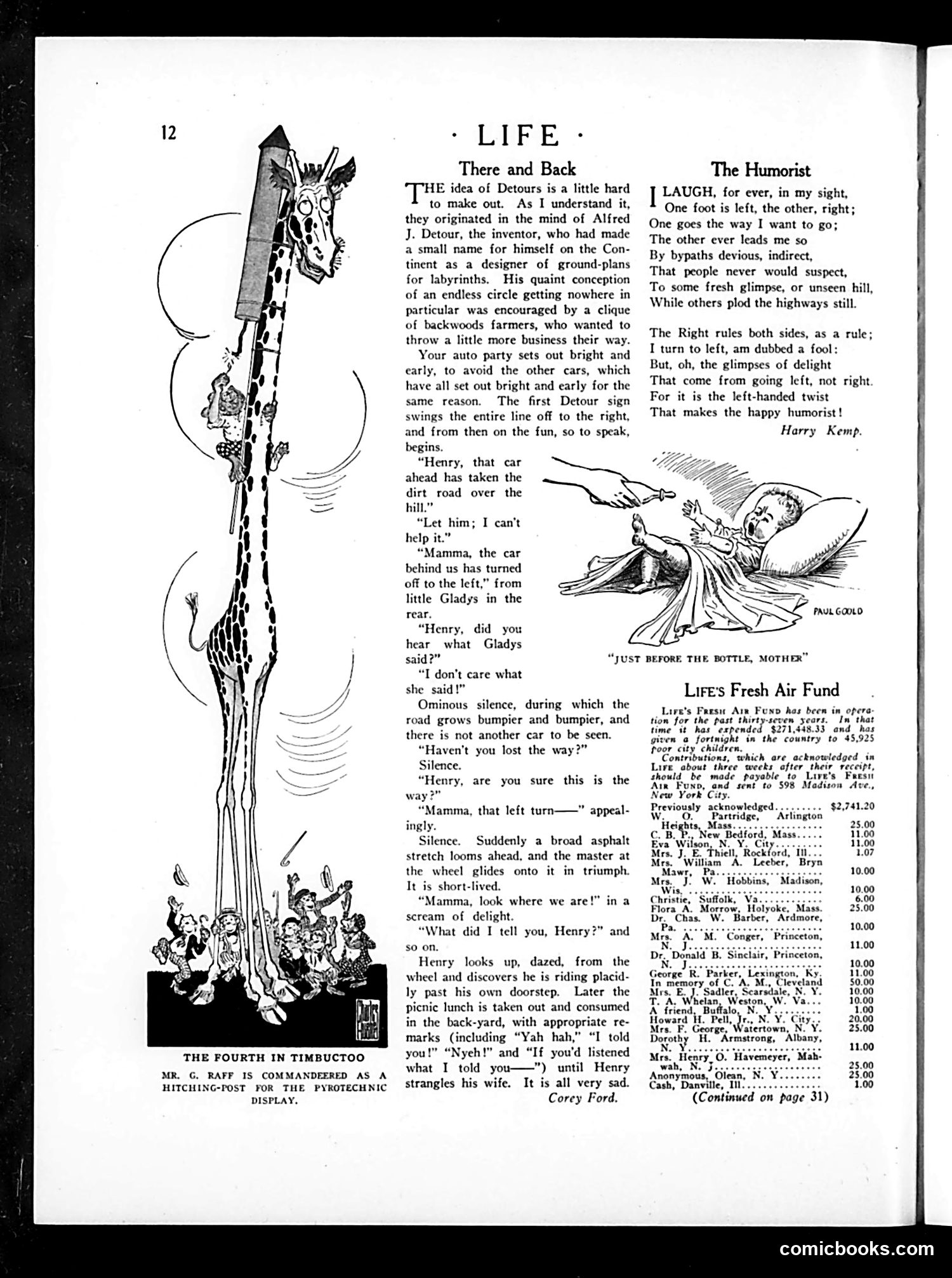
This page contains two distinct pieces: **"The Fourth in Timbuctoo"** (left): A tall giraffe illustration captioned as "Mr. G. Raff is commandeered as a hitching-post for the pyrotechnic display." This is a visual pun—the giraffe's name sounds like "G. Raff," and during a Fourth of July celebration, people literally use the giraffe to tie fireworks to it. The joke plays on the animal's height and the absurdity of the scenario. **"There and Back"** (center-right): A humorous short story by Corey Ford about a family car trip where a father confidently insists he knows the route, leading them astray. The accompanying illustration by Paul Gould shows a frustrated mother and child. **"The Humorist"** (right): A poem by Harry Kemp about left-handedness, accompanied by a casual illustration of a relaxed figure. The page also includes fundraising information for Life's Fresh Air Fund charity.
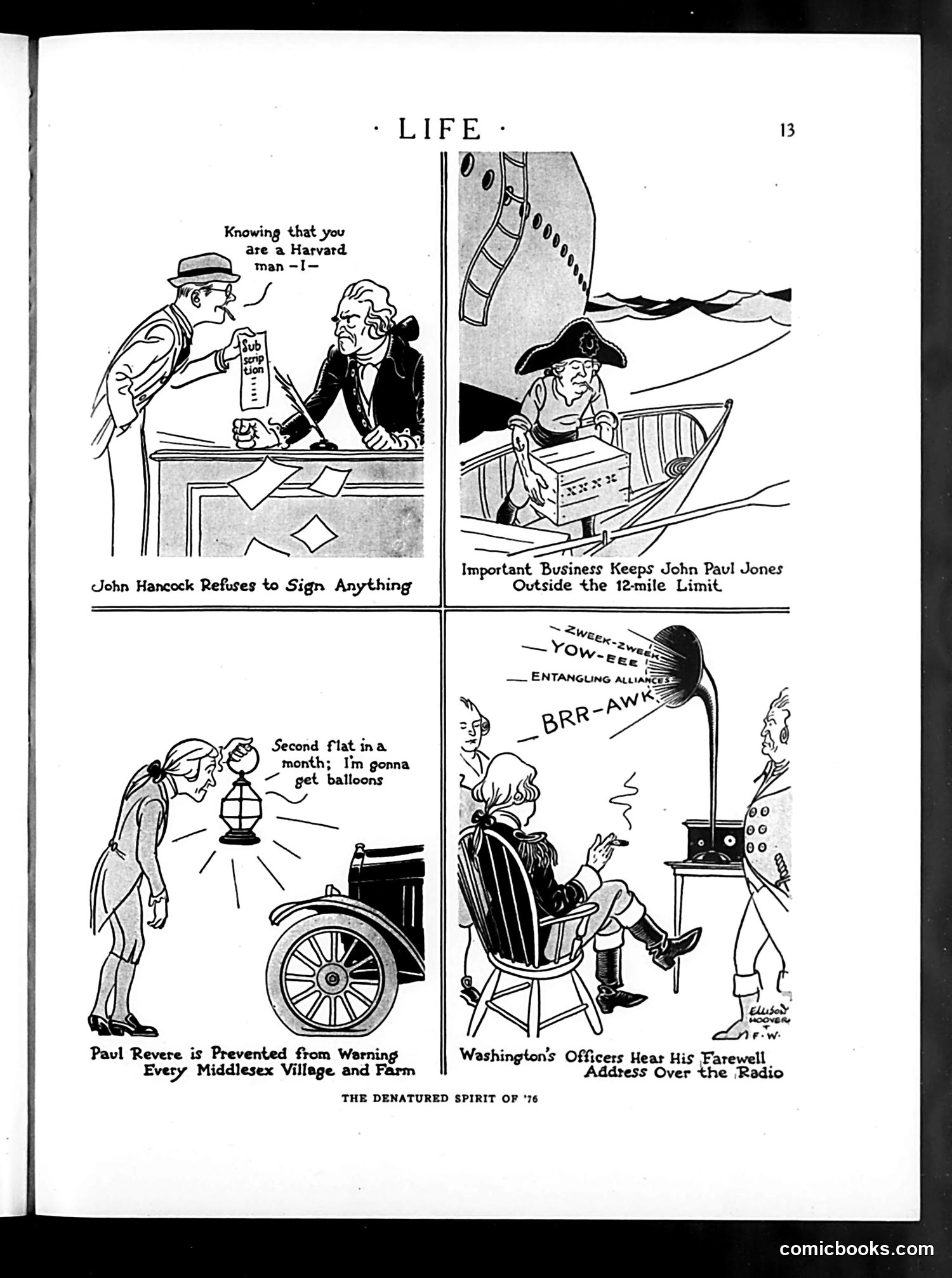
This page contains four satirical cartoons mocking American Revolutionary figures and ideals in what appears to be a post-WWI context. The cartoons include: 1. **"John Hancock Refuses to Sign Anything"** — A Harvard man confronts Hancock, satirizing bureaucratic caution. 2. **"Important Business Keeps John Paul Jones Outside the 12-mile Limit"** — Jones appears confined to offshore waters, suggesting legal restrictions on action. 3. **"Paul Revere is Prevented from Warning Every Middlesex Village and Farm"** — Revere, now concerned with apartment living and "balloons," can't fulfill his historical mission. 4. **"Washington's Officers Hear His Farewell Address Over the Radio"** — Modern technology replacing direct communication. The overall satire suggests Revolutionary ideals have become diminished or constrained by modern bureaucracy, domesticity, and legal/social limitations.
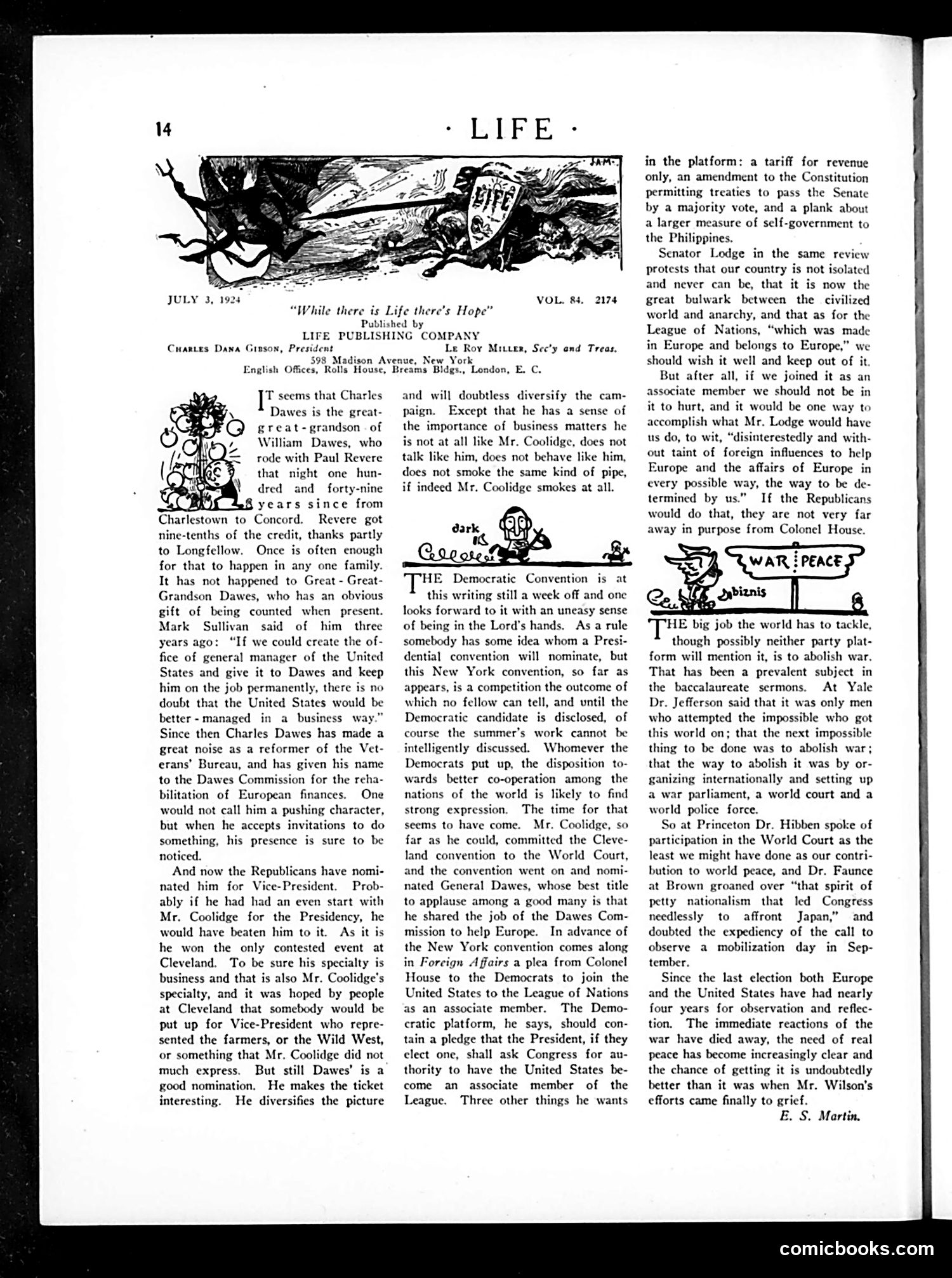
This page from Life (July 3, 1924) discusses the upcoming Democratic Convention, occurring "a week off" from the publication date. The text critiques the Democratic Party's difficulty in selecting a presidential nominee, suggesting the process feels uncertain—"like being in the Lord's hands." The commentary references Charles Dawes (a prominent Republican figure and Vice President under Coolidge) as a potential alternative candidate, humorously noting his business acumen might appeal to Republicans seeking a strong manager. The piece also addresses international relations, particularly America's relationship with the League of Nations and World Court—advocating U.S. participation while acknowledging isolationist resistance. The overall tone is satirical commentary on Democratic Party dysfunction and Republican isolationism during the 1924 election cycle.
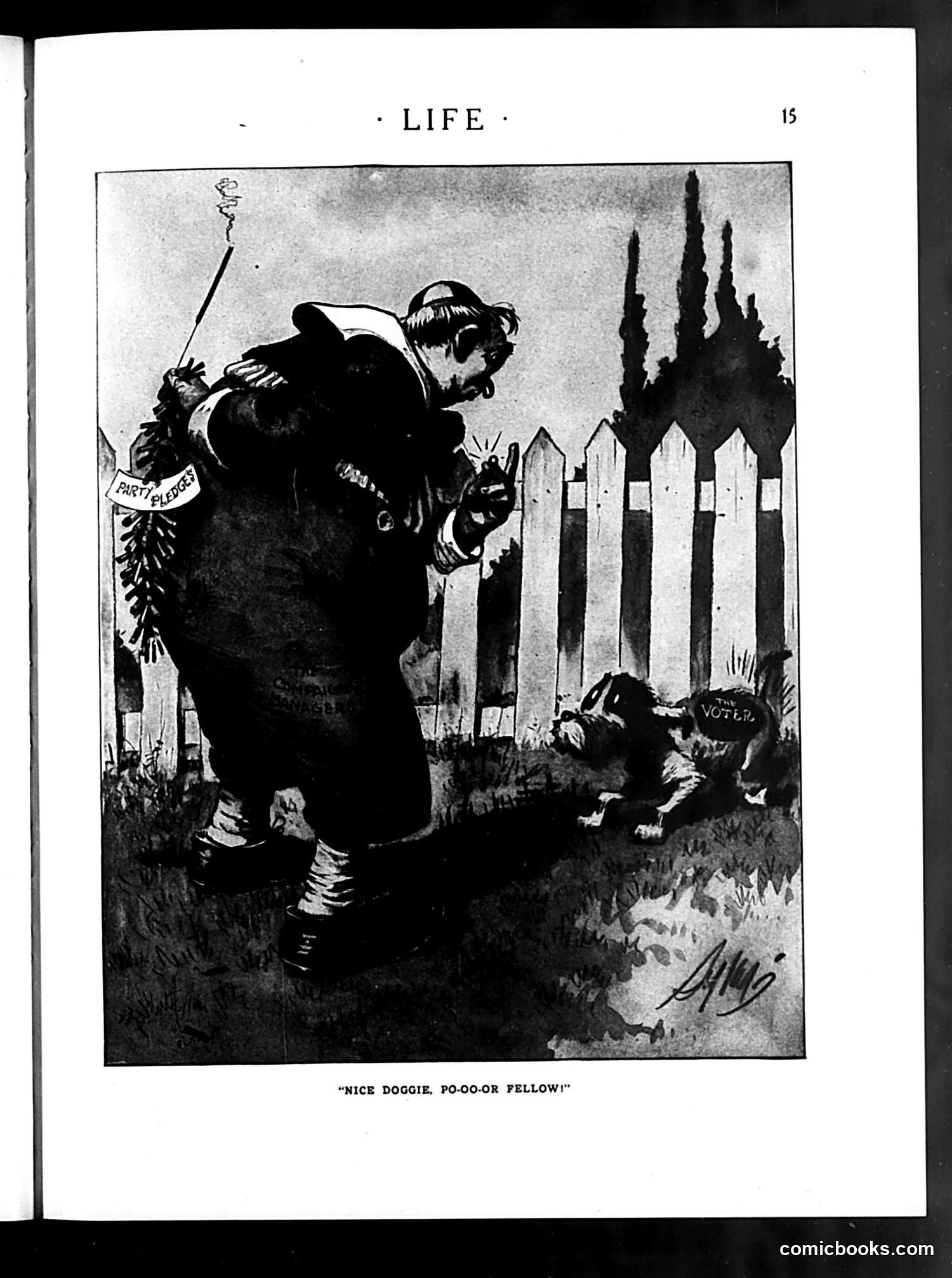
This cartoon depicts a well-dressed man with a bag labeled "PARTY PLEDGES" comforting a small dog labeled "VOTER" at a graveyard. The man appears to be a politician offering sympathy to a voter among the headstones. The satire mocks political promises made during campaigns that fail after elections. The "party pledges" (campaign promises) are presented as hollow comfort to disappointed voters, who are portrayed as dead or dying—suggesting their interests have been abandoned. The graveyard setting reinforces this theme of broken commitments. This reflects early 20th-century cynicism about whether elected officials actually fulfill their campaign promises once in office, portraying voters as victims of political deception.
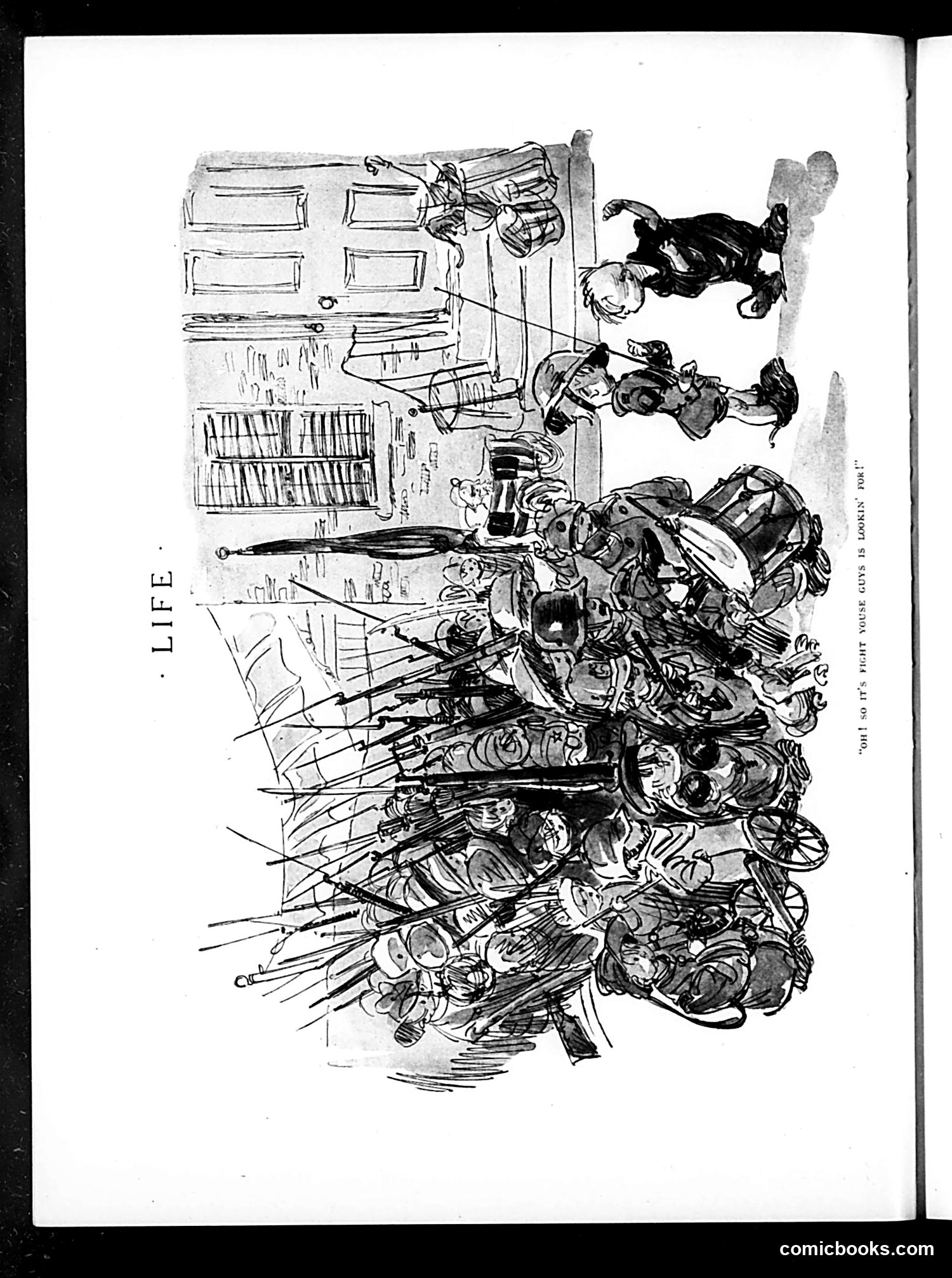
This page appears to be rotated 90 degrees and shows a satirical illustration labeled "LIFE" on the left margin. The sketch depicts a crowded, chaotic street scene with numerous figures engaged in various activities—some appear to be in conflict or disarray, with exaggerated body language and expressions typical of early 20th-century satirical cartooning. The drawing style suggests social commentary on urban life, possibly depicting class tensions, street commerce, or public disorder. The dense composition with many interacting figures suggests the artist is critiquing some aspect of contemporary society, though **without clearer details or caption text visible in the image, the specific political or social reference remains unclear**. The sketch's energetic, somewhat frantic quality implies criticism of urban chaos or social instability.
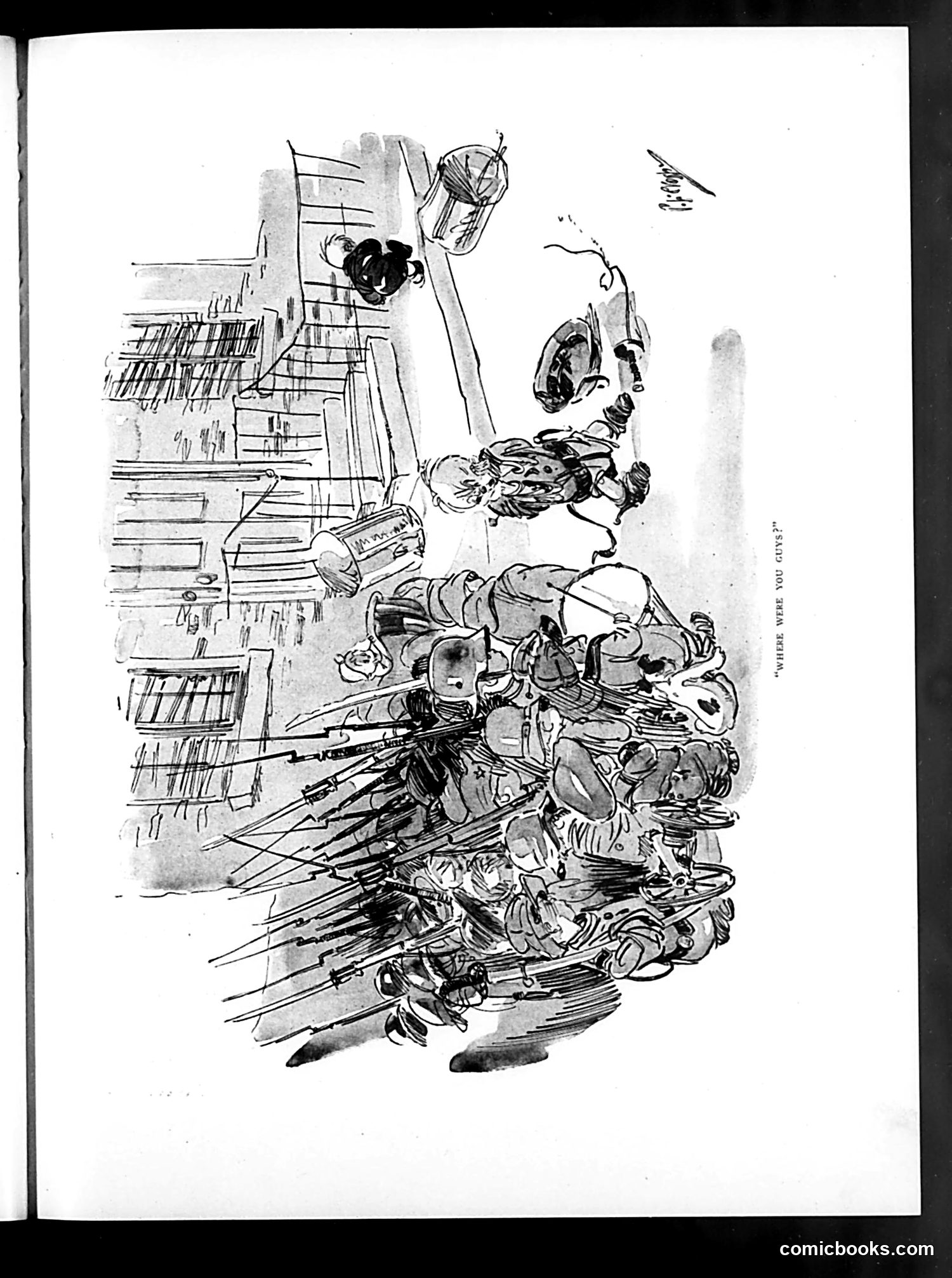
This appears to be a satirical illustration rotated 90 degrees, showing a chaotic scene of multiple figures engaged in what looks like a violent or frenzied activity. The image depicts numerous people wielding what appear to be weapons or implements, rendered in an exaggerated, caricatured style typical of early 20th-century political satire. However, **I cannot definitively identify the specific figures, historical event, or political message** from the image alone. The OCR text provides no caption or explanation to clarify the cartoon's subject, date, or intent. Without additional context—such as the publication date, article title, or visible labels—I cannot accurately explain what social or political issue this satirizes or which public figures it targets. To properly analyze this cartoon, I would need the missing contextual information.
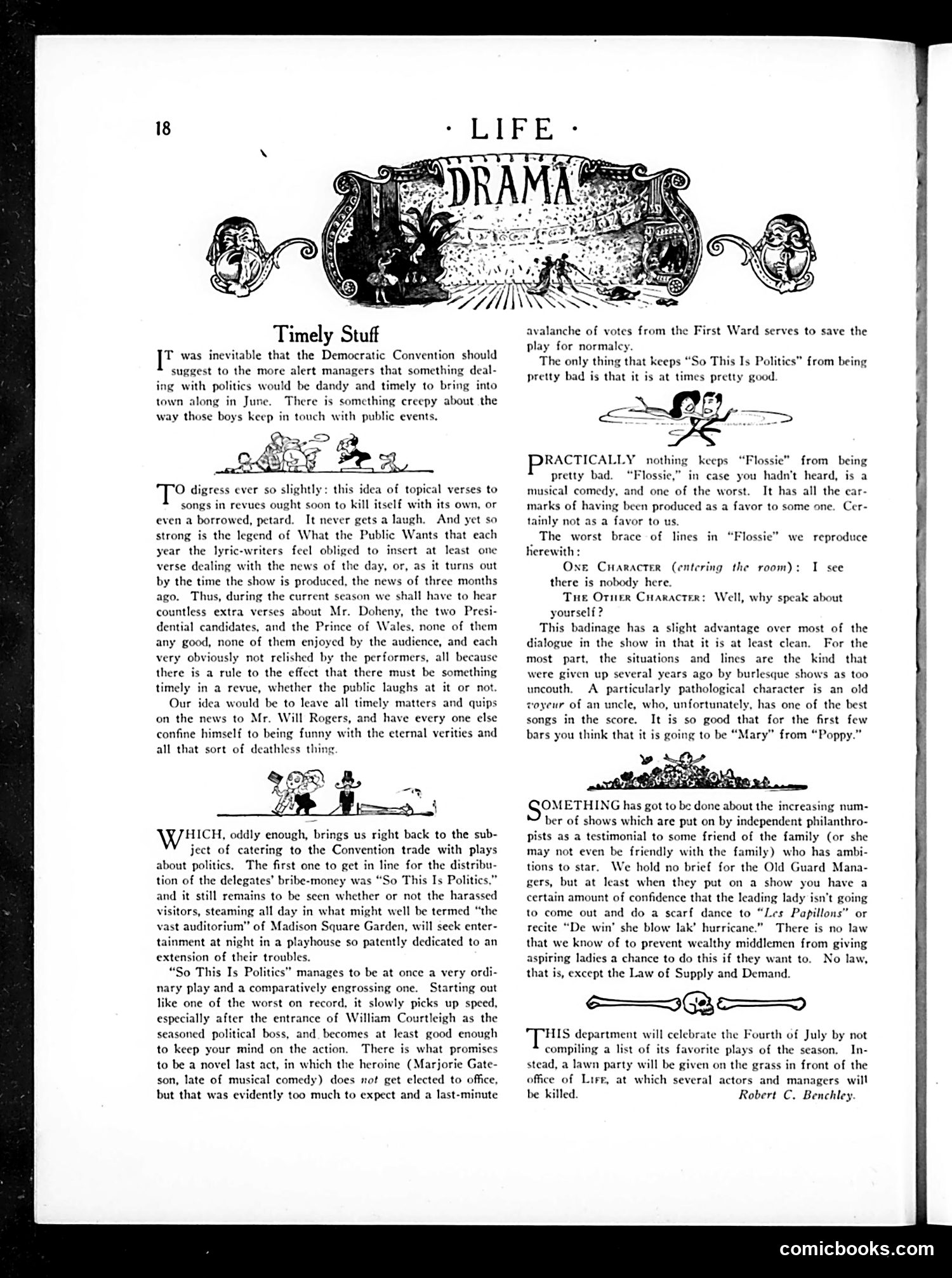
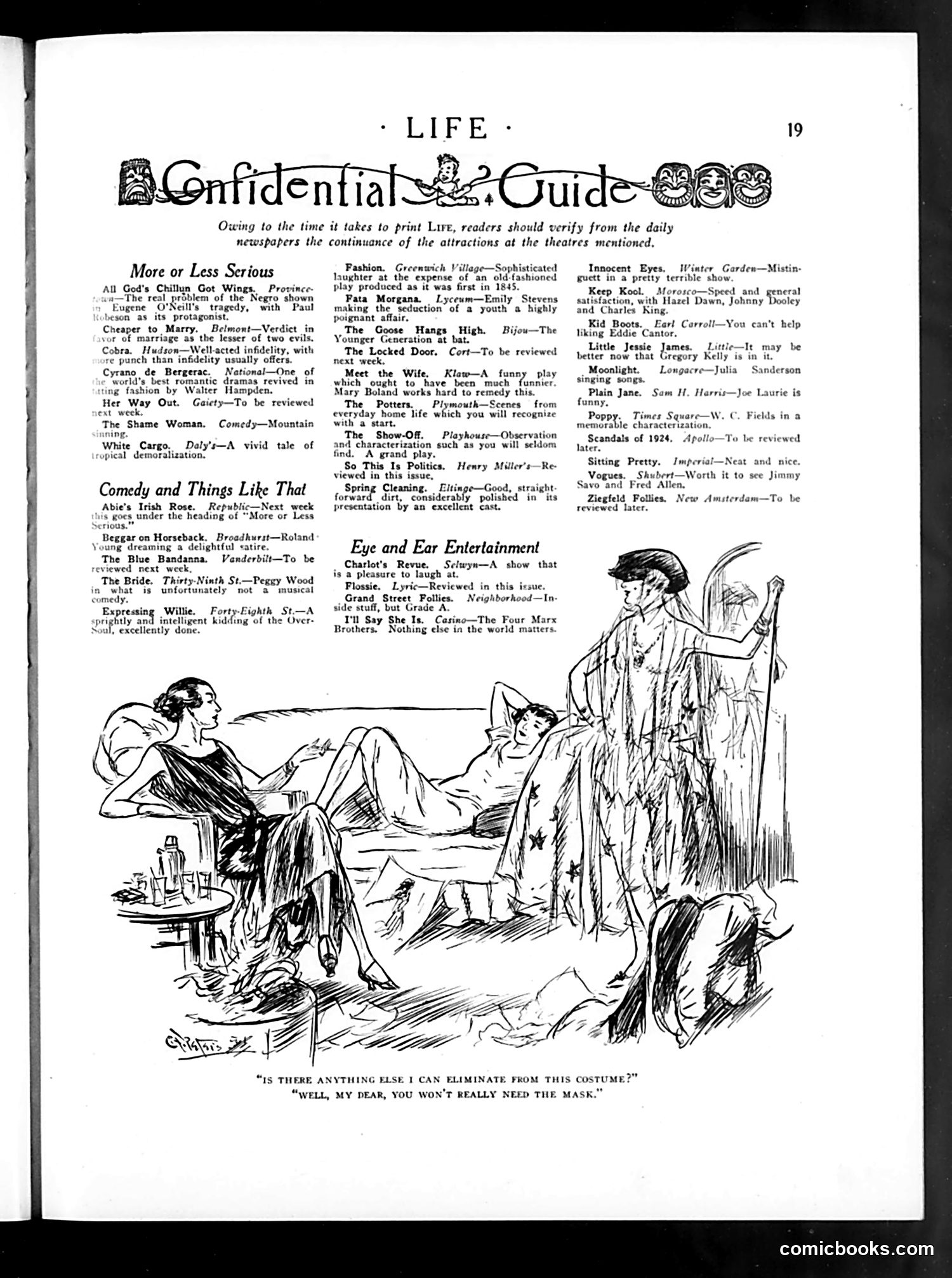
This is a theater criticism column reviewing recent Broadway plays, timed to the Democratic Convention. The critic satirizes how Broadway producers reflexively add topical political jokes to revues, assuming audiences want "timely" content—though these references become stale by opening night. The column reviews two plays: "So This Is Politics," about the Convention itself, which the critic finds mediocre but occasionally engaging (especially with actor William Courtleigh). The heroine implausibly wins election through last-minute First Ward votes—a dig at political corruption and artificial happy endings. "Flossie," a musical comedy, receives harsher treatment as simply bad, with crude dialogue and a pathological uncle character. The critic mocks its reliance on worn-out burlesque humor. Overall, the piece critiques Broadway's desperate pandering to current events while celebrating Will Rogers' topical humor as the superior alternative.
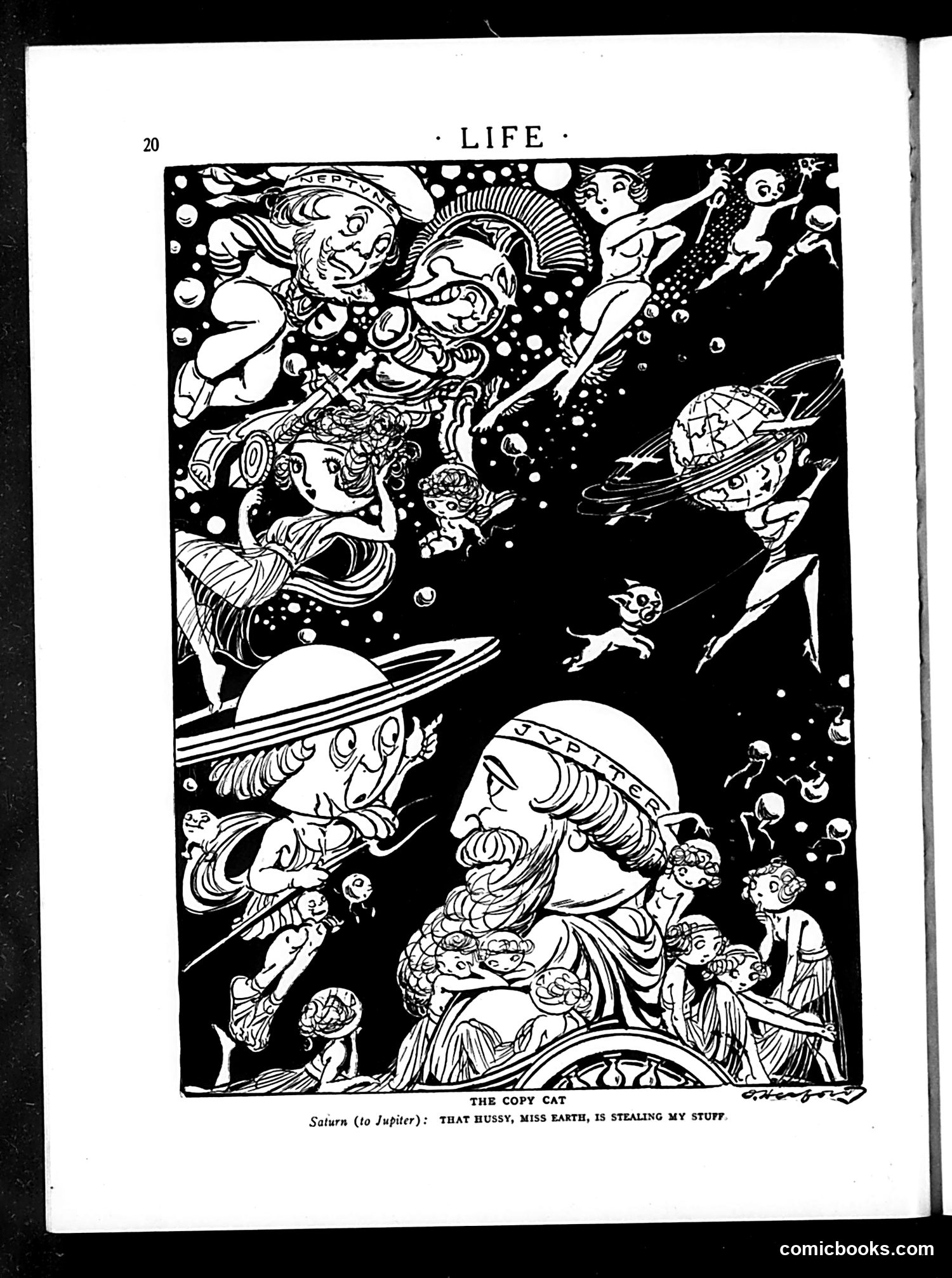
This is a satirical cartoon depicting planetary deities in a cosmic scene. The title "The Copy Cat" suggests mockery of imitation or theft. Saturn (identified in the caption as speaking to Jupiter) accuses "that hussy, Miss Earth" of stealing his belongings—a humorous personification of Earth as a copycat planet. The cartoon uses classical mythology imagery: robed figures representing planetary gods, cherubs, and celestial objects populate a starry black sky. The satire likely comments on how Earth "copies" or mirrors the characteristics of other planets—their rings, moons, atmospheric phenomena, or other astronomical features. The ornate, detailed linework and fantastical style were typical of early 20th-century satirical magazine illustration, making abstract astronomical concepts entertaining through personification and classical allusion.
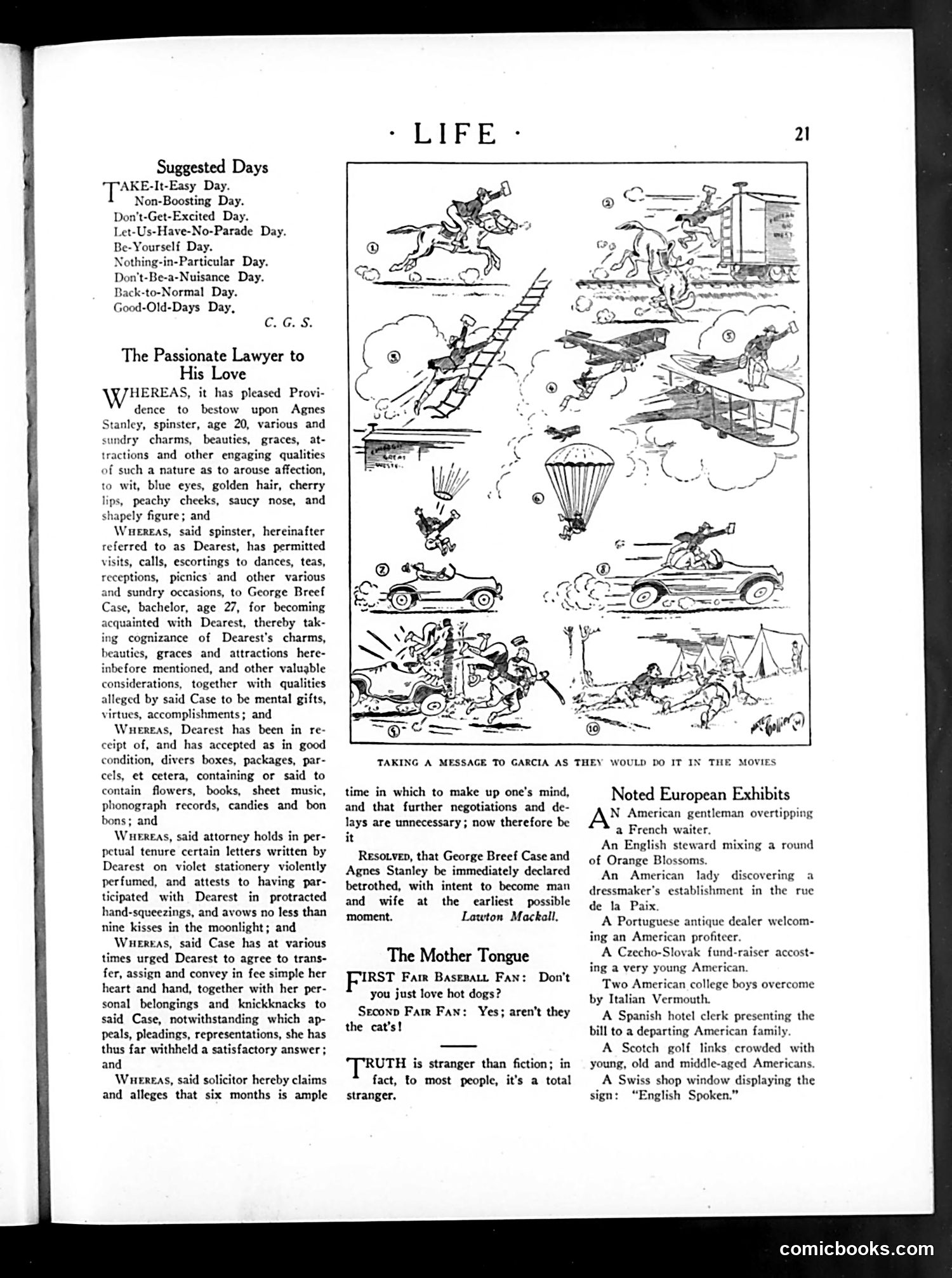
This page contains several satirical pieces mocking American social conventions and sentimentality: **"The Passionate Lawyer to His Love"** parodies legal documents by presenting a marriage proposal in overwrought legal language. It humorously catalogs the suitor's case for immediate betrothal after six months, listing the woman's physical attributes and gifts received as evidence—satirizing both verbose courtship rituals and the transactional nature some perceived in romantic engagements. **The numbered cartoon sequence** (top right) appears to illustrate movie-style melodrama and adventure tropes, likely mocking Hollywood's exaggeration of heroic action. **"The Mother Tongue"** jokes about American slang ("hot dogs," "cat's") used casually. **"Noted European Exhibits"** satirizes American tourists abroad—depicting them as gauche, excessive tippers, heavy drinkers, and culturally oblivious. The Swiss shop sign "English Spoken" implies Americans expect accommodation everywhere, viewing the world as existing for their convenience. The overall tone critiques American provincialism and social pretension during what appears to be the Jazz Age era.
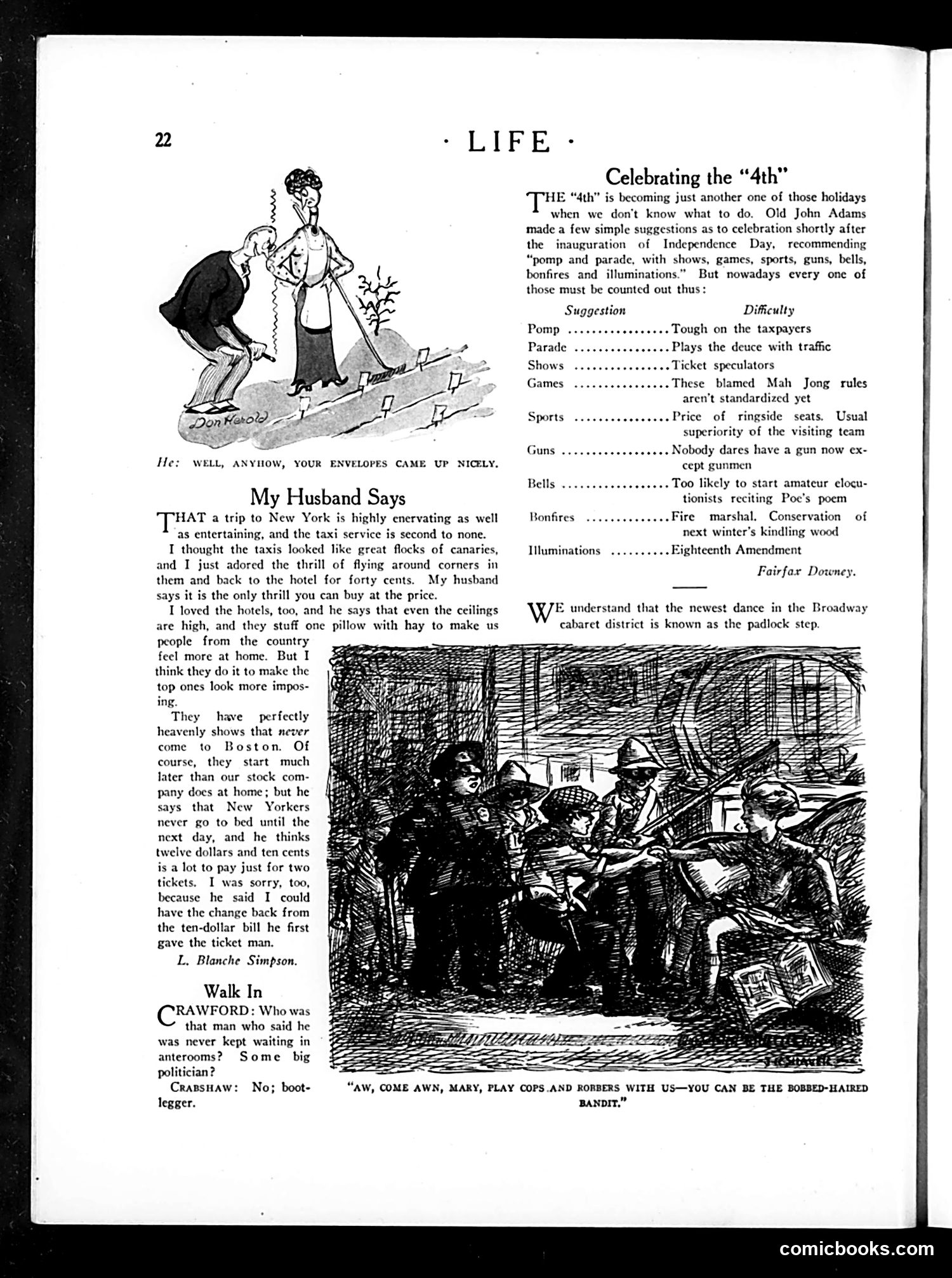
This page contains three satirical pieces poking fun at early 1920s American life: **"My Husband Says"** mocks tourists from the provinces visiting New York City. The humor centers on a country woman's naive wonder at taxis (compared to "canaries"), expensive hotels with deliberately uncomfortable furnishings, and theater prices—while her husband fixates on costs. **"Walk In"** is a brief joke equating bootleggers with politicians, referencing Prohibition-era corruption where illegal liquor dealers operated openly with impunity, much like politicians who never waited in anterooms. **"Celebrating the '4th'"** satirizes Independence Day celebrations becoming impossible. Each traditional element (parades, shows, sports, guns, bells, bonfires, illuminations) faces modern obstacles: traffic congestion, standardization problems, Prohibition laws, and fire marshal regulations. This reflects post-WWI American anxiety about progress and regulation. The bottom cartoon references the "bobbed-haired bandit"—a contemporary criminal figure—showing children's games now mimicking modern crime rather than traditional cops-and-robbers play.
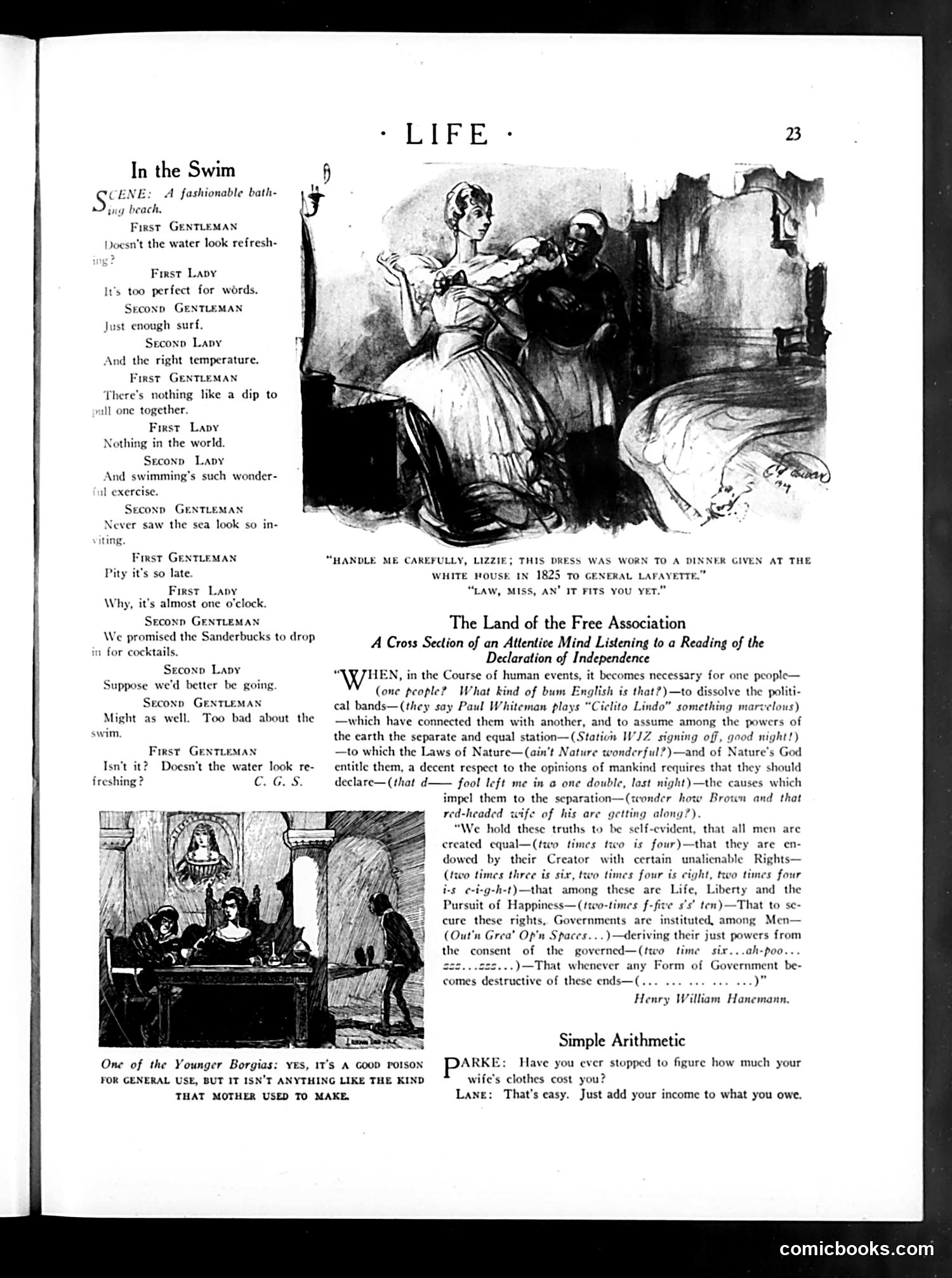
This page contains three distinct satirical pieces: **"In the Swim"** mocks fashionable beach culture, where wealthy people exchange banal pleasantries about perfect swimming conditions while one woman boasts her dress was worn at a White House dinner for the Marquis de Lafayette (early 1800s) — a dated claim meant to be ridiculous. **"The Land of the Free Association"** satirizes inattentive Americans. While someone reads the Declaration of Independence aloud, listeners mentally drift to radio stations (WJZ), multiplication tables, and gossip about affairs. The joke suggests the founding document's ideals bore modern audiences who fixate on trivial concerns. **"Simple Arithmetic"** is a domestic humor quip about marriage finances: a husband's solution to calculating his wife's clothing expenses is to add his income to his debts—implying wives spend beyond means. All three pieces target American social pretension, distraction, and consumer excess circa the 1920s.
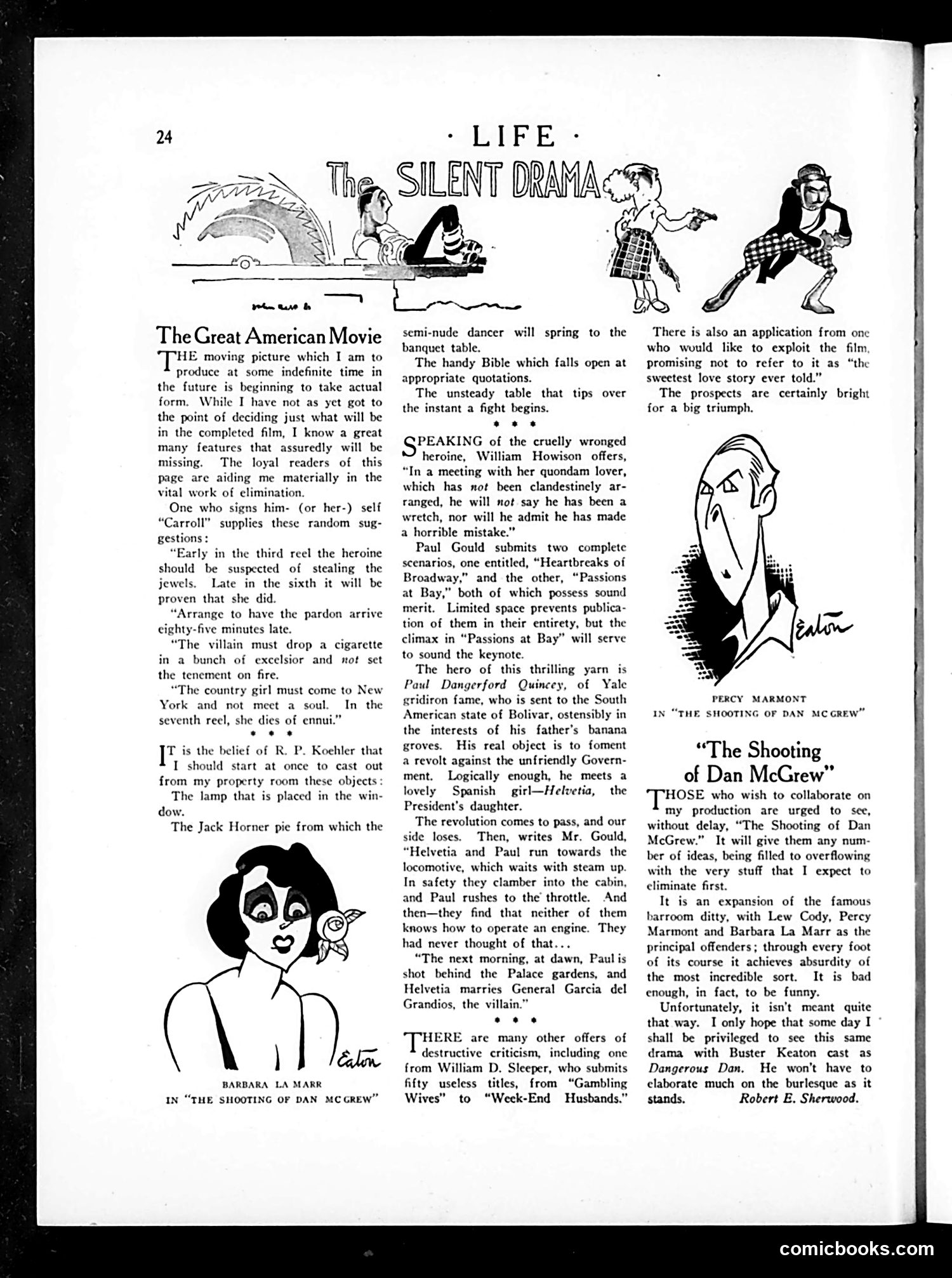
This page satirizes the conventions of silent films, particularly melodramas. The author proposes creating "The Great American Movie" while soliciting reader suggestions for clichés to eliminate. The cartoons show **Barbara La Marr** and **Percy Marmont** from "The Shooting of Dan McGrew"—a film adaptation of Robert Service's famous poem that apparently exemplifies every hackneyed silent-film trope the author mocks. Readers suggest removing tired plot devices: the heroine falsely suspected of theft, last-minute pardons, the Bible conveniently opening to relevant passages, and the tipping-over table triggering fights. One scenario involves a Yale hero inciting South American revolution to meet the President's daughter—climaxing absurdly when neither character knows how to operate a locomotive. The satire targets how silent films relied on predictable melodrama, improbable coincidences, and visual gags. "The Shooting of Dan McGrew" apparently embodied these failings so thoroughly that the author ironically recommends seeing it as a guide to what *not* to do—achieving "absurdity of the most incredible sort."
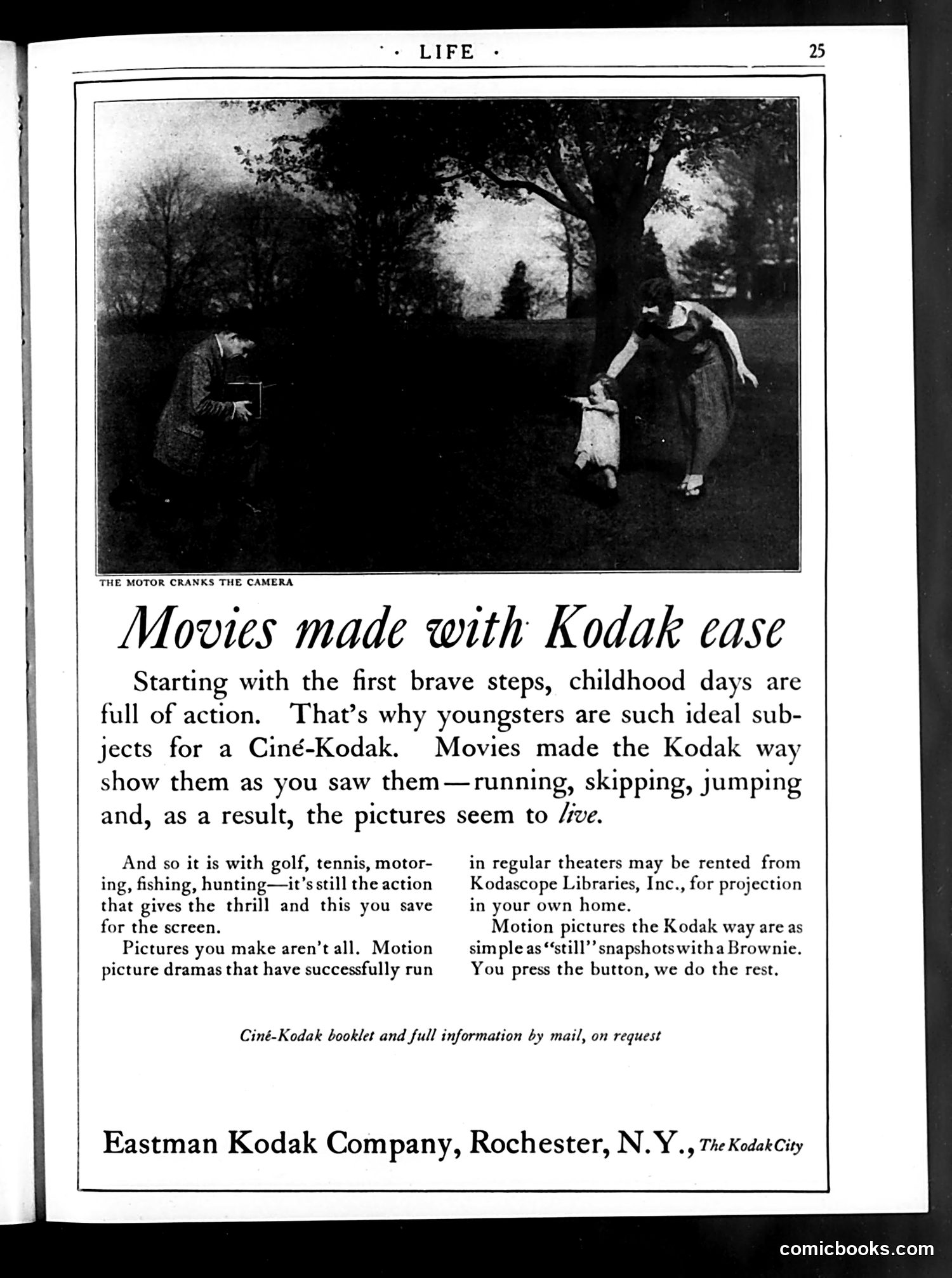
This is primarily an **advertisement**, not satire or political commentary. The page promotes Kodak's Ciné-Kodak motion picture camera to amateur filmmakers. The single photograph shows a man operating an early film camera while recording a child at play outdoors—illustrating the product in use. The image demonstrates the advertisement's central pitch: that Kodak cameras can capture everyday action (children playing, sports, recreation) and make it seem "live" on screen. The text emphasizes ease of use ("You press the button, we do the rest") and positions home movie-making as accessible to ordinary people. It also mentions Kodascope Libraries, Inc., which rented theatrical films for home projection—an early form of home entertainment distribution. This reflects early 20th-century consumer culture promoting amateur filmmaking and domestic entertainment technology to middle-class households.
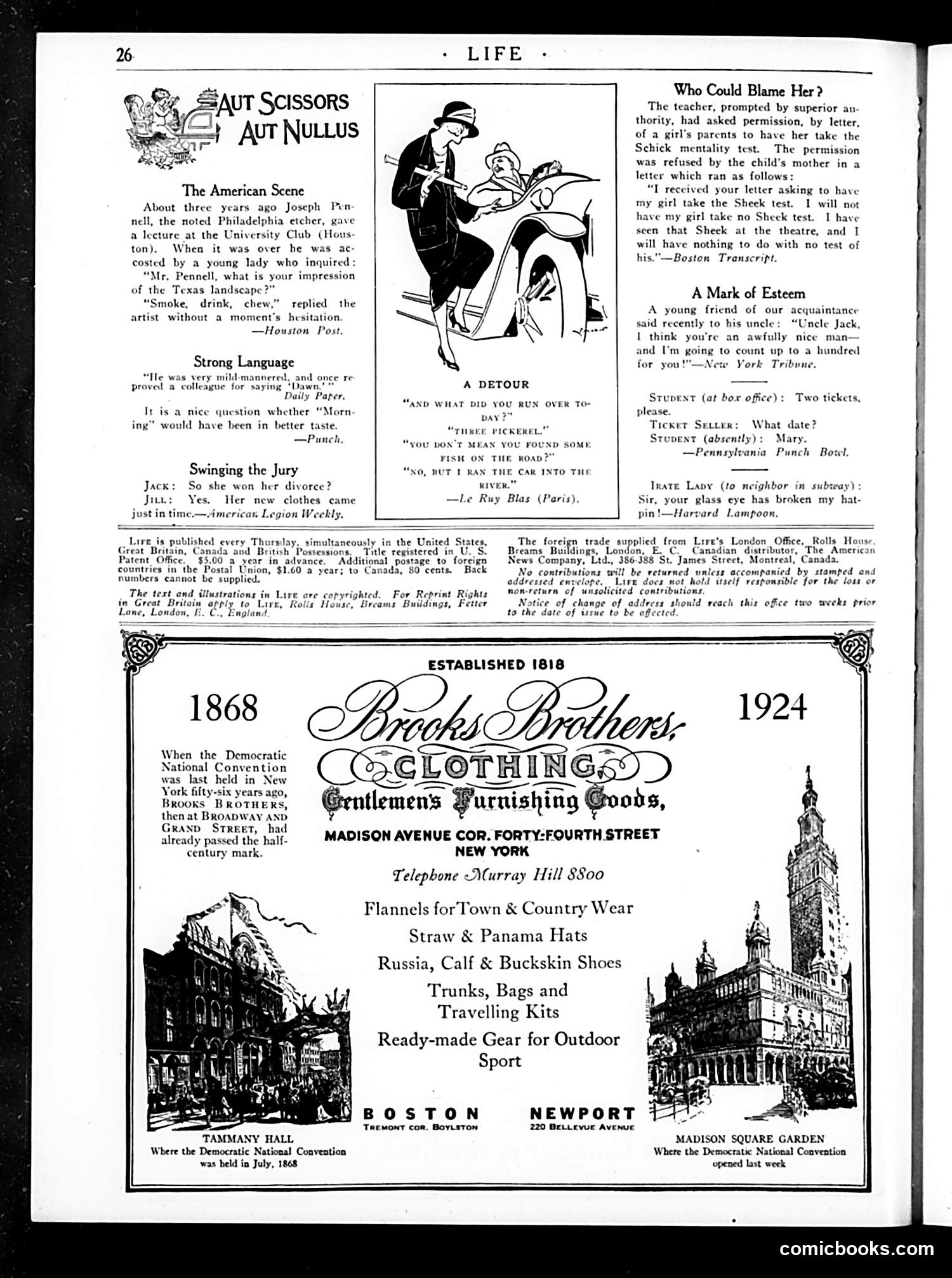
This page is primarily **advertising and filler content** rather than political satire. The dominant feature is a Brooks Brothers clothing advertisement celebrating the company's 56-year anniversary, tying it to Democratic National Conventions held in New York in 1868 and 1924. The upper section contains small humorous anecdotes ("Aut Scissors Aut Nullus"), typical Life magazine filler: - A Philadelphia artist's crude characterization of Texas - Mild wordplay about politeness and language - A joke about divorce clothes - A French car accident pun about "fish" (three pickerel/pickering) Below these are reader-submitted jokes about a teacher's mental test (the "Sheek test"), a compliment to an uncle, and a subway etiquette mishap. **No significant political commentary is present.** The page reflects 1924 consumer culture and the magazine's mix of light humor and advertising targeted at educated, affluent readers.
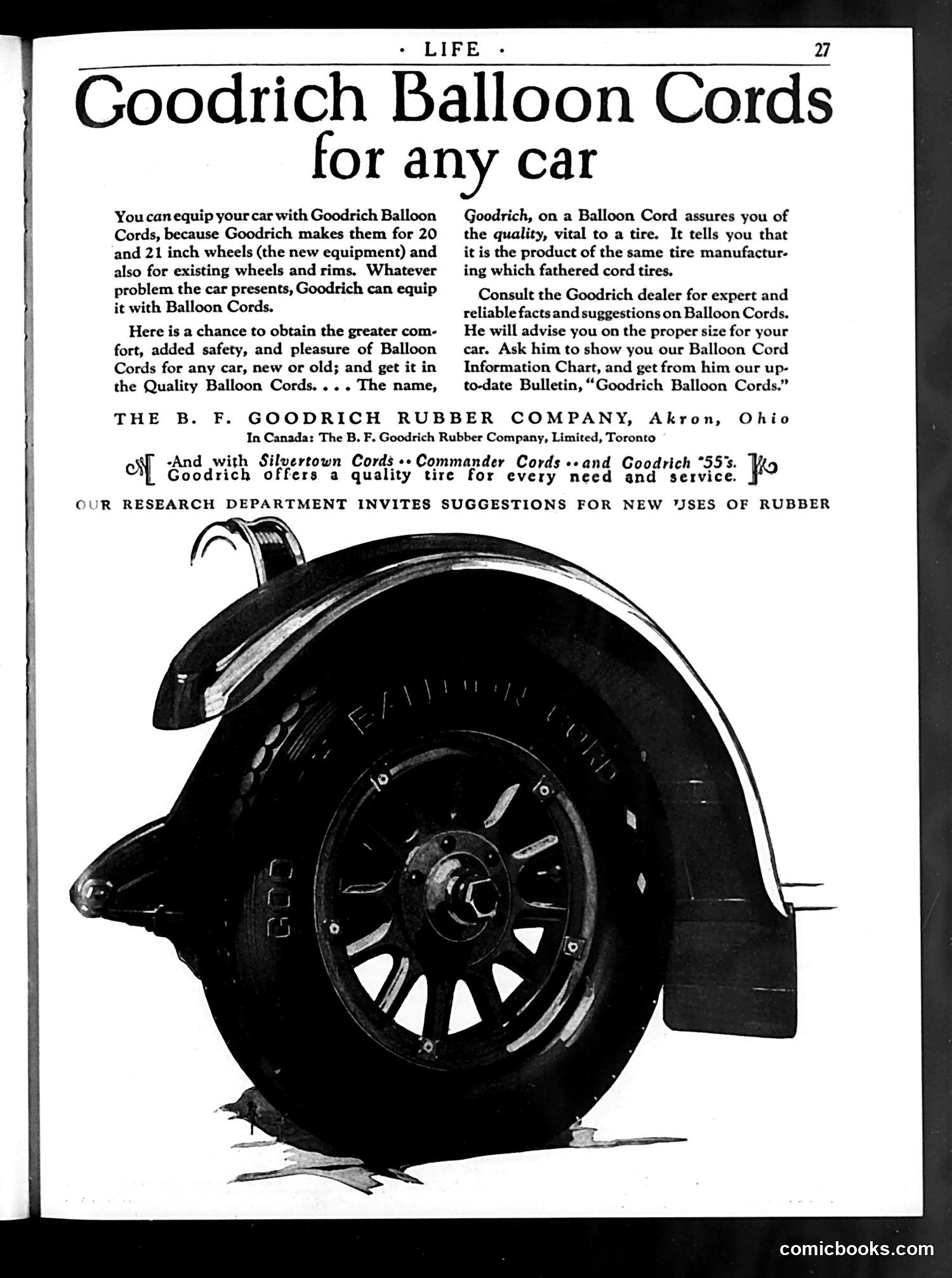
This is primarily **product advertising**, not political satire. The page promotes B.F. Goodrich's "Balloon Cords"—pneumatic tire cords for automobiles, compatible with both new 20-21 inch wheels and existing rims. The image shows a large tire with wheel and fender, presented straightforwardly as a technical/product demonstration rather than commentary. The "joke" element is minimal and visual: the tire and wheel appear anthropomorphically arranged to suggest a face or profile, creating mild visual humor typical of 1920s advertising design. The text emphasizes practical benefits (comfort, safety, compatibility across car models old and new) and directs readers to Goodrich dealers for detailed information. There's no political reference or social satire—this is standard early automotive-era commercial messaging targeting car owners seeking quality tire equipment.
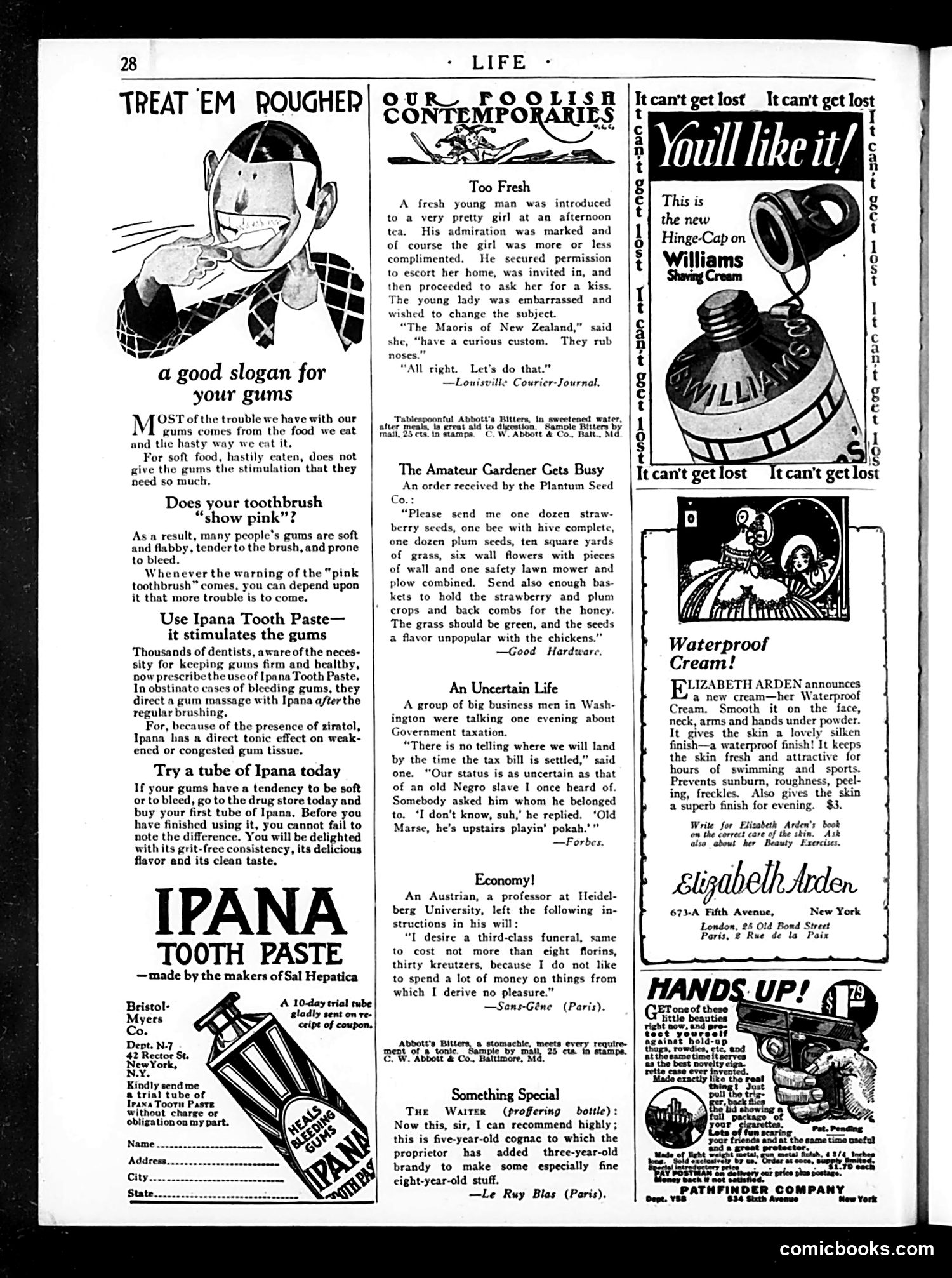
This page from *Life* magazine contains vintage advertisements and humorous anecdotes rather than political cartoons. The main content includes: **"Treat 'Em Rougher"** advertises Ipana Tooth Paste, using the slogan to encourage gum stimulation through vigorous brushing. The ad addresses a real dental concern of the era: bleeding gums from soft food diets. **"Our Foolish Contemporaries"** reprints humor snippets mocking social awkwardness. One anecdote satirizes a young man's presumptuous behavior after being told about Māori nose-rubbing customs—he misses social cues. Another ridicules an overly-ambitious amateur gardener ordering absurd combinations of seeds and equipment. **"An Uncertain Life"** uses a dated racial stereotype (an enslaved person's confused status) as a metaphor for business uncertainty under taxation. The page reflects early-20th-century advertising conventions and period attitudes that would be considered offensive today, particularly regarding racial humor and gender dynamics.
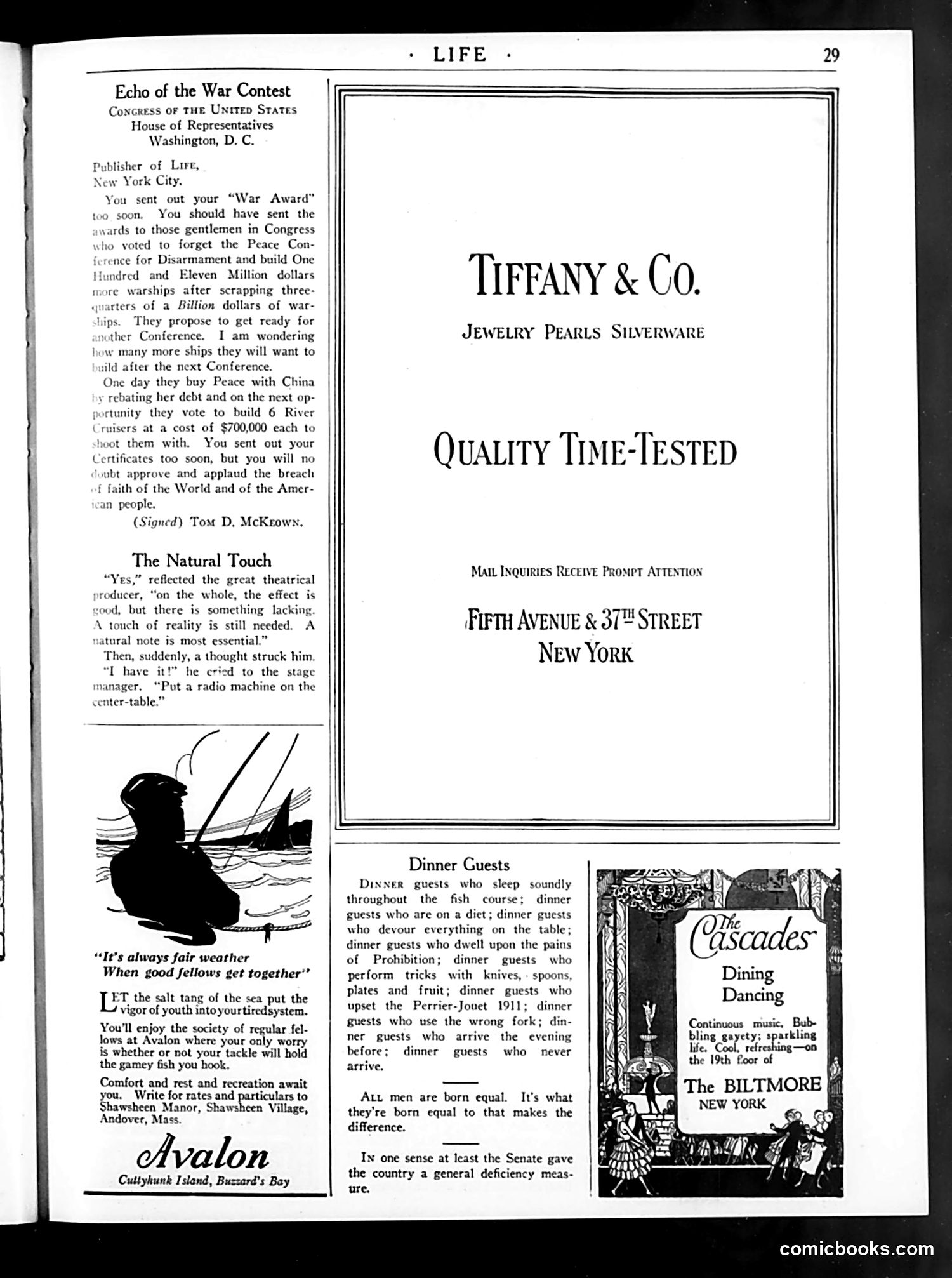
This page contains two main satirical pieces: **"Echo of the War Contest"** is a letter from a congressman (Tom D. McKeown) mocking Life's "War Award." He attacks Congress members who voted against a Peace Conference for Disarmament, then immediately funded eleven million dollars in new warships. The satire highlights hypocrisy: the government preaches peace with China while simultaneously building military capacity. McKeown sarcastically suggests Life award these hypocritical legislators instead. **"The Natural Touch"** is a brief theatrical joke: a producer seeking "reality" in his stage production suddenly realizes he needs a radio machine on the center-table—a contemporary reference suggesting radio's novelty and the absurdity of using modern technology as a "natural" element. The remainder of the page consists of advertisements (Tiffany & Co., Avalon resort, The Biltmore) and a humorous list of undesirable "dinner guests," plus two unrelated aphorisms about equality and Senate deficiency.
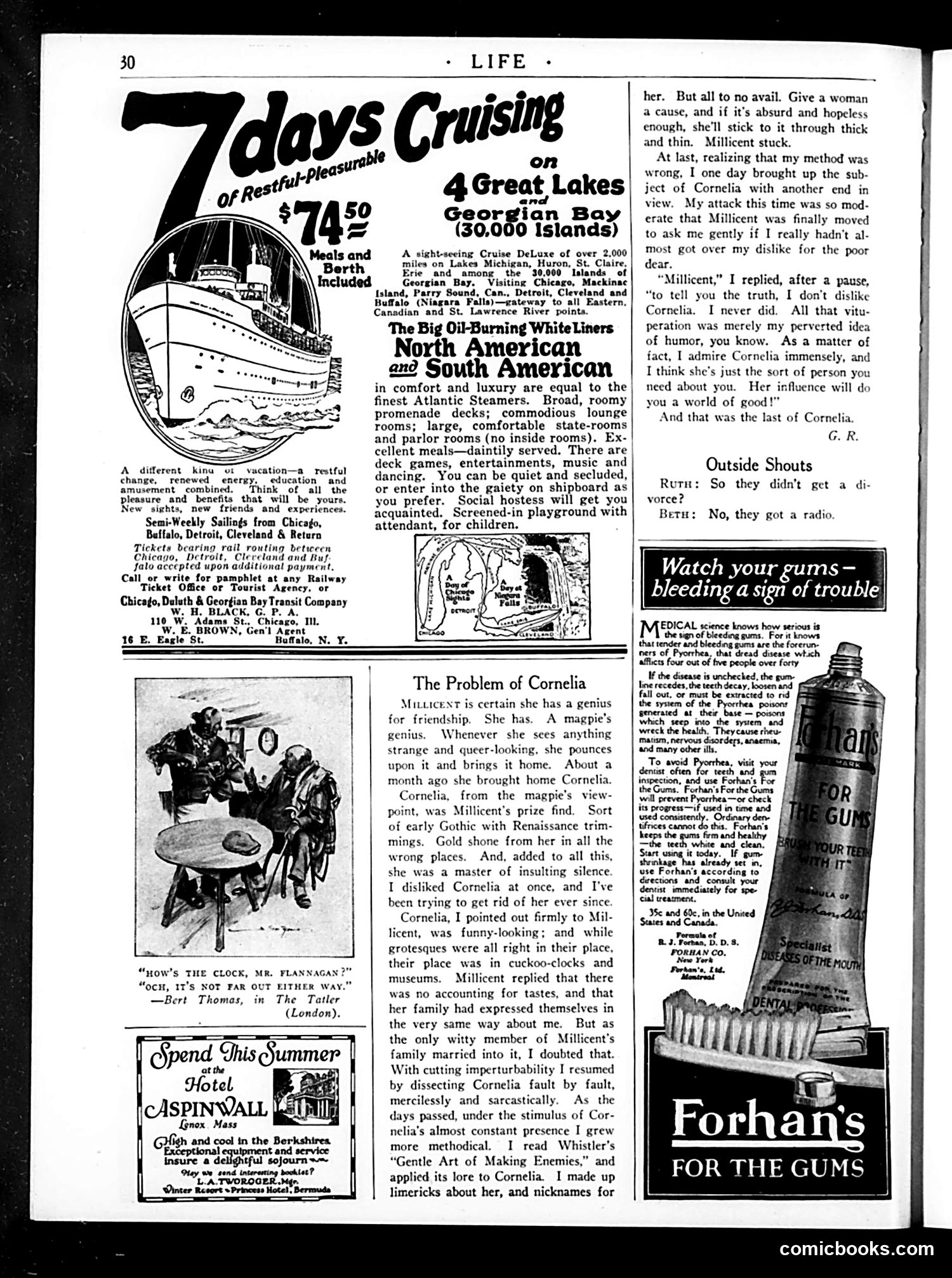
This satirical story mocks the dynamics of domestic persuasion and marital stubbornness. The narrator describes his wife Millicent's eccentric friend Cornelia—physically odd and deliberately silent—whom he despises. The joke: he attempts every rational argument to turn Millicent against Cornelia, only to fail. When he switches tactics, stopping criticism and praising her instead, Millicent finally softens. The satire targets both spouses: Millicent's inexplicable loyalty to an absurd cause, and the narrator's realization that emotional appeal works better than logic with women. The accompanying illustration shows the narrator gesturing at a clock ("How's the clock?"), a visual gag emphasizing the time wasted on this futile domestic debate. This reflects early 20th-century attitudes portraying wives as immune to reason but responsive to flattery—a common trope in Life magazine's humor.
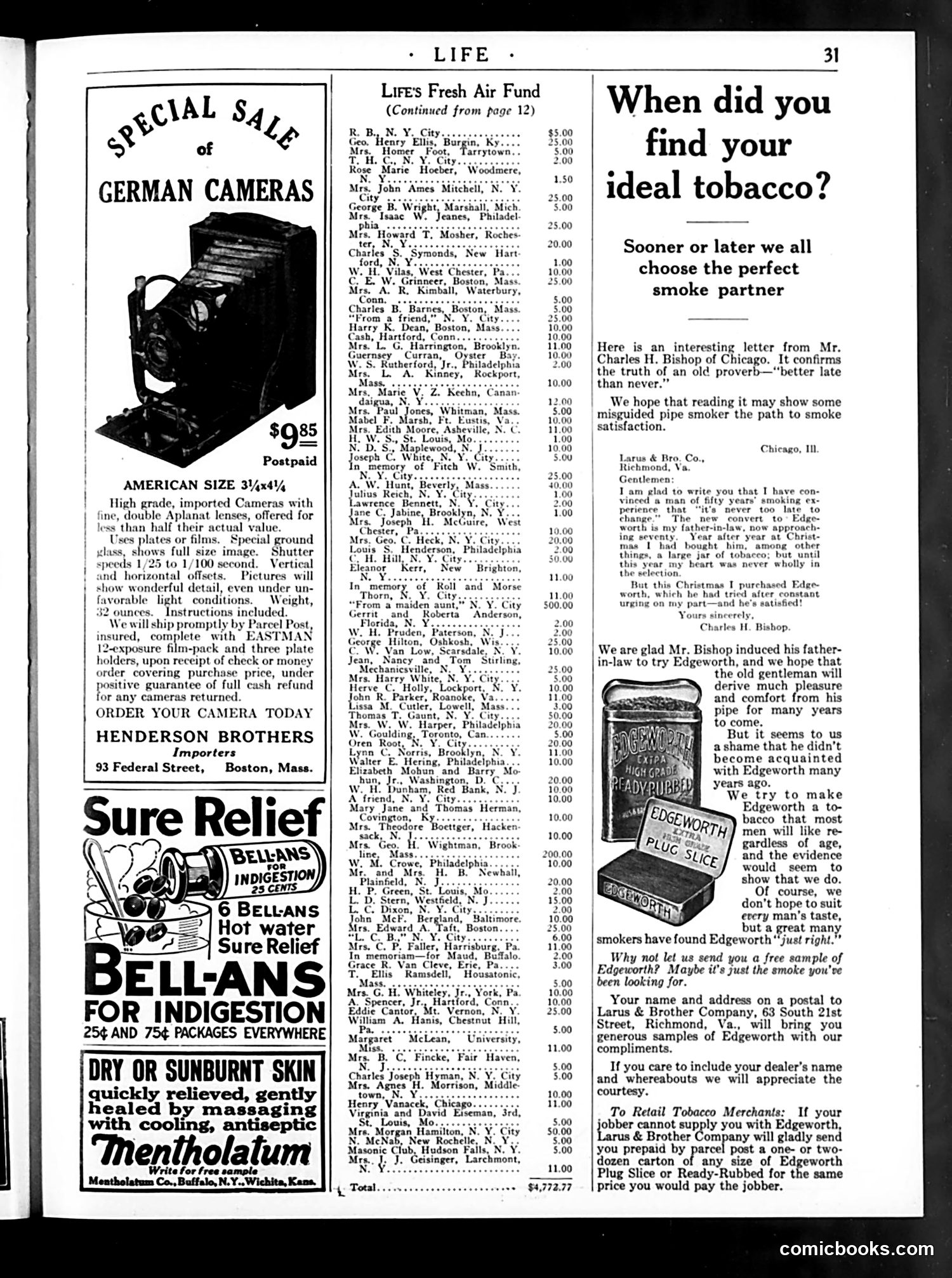
This page is primarily **advertisements and a charitable fund listing**, not political satire. The main content includes: - A camera sales ad (Henderson Brothers) - Patent medicine ads (Bellans for indigestion, Mentholatum for skin) - A "Life's Fresh Air Fund" donor list (a real charity providing outdoor recreation for poor urban children) - An Edgeworth tobacco advertisement featuring a testimonial letter The tobacco ad is notable for its era-appropriate messaging: it promotes switching to pipe smoking via a personal endorsement from a 50-year-old man who converted from other tobacco use. The "ideal tobacco" framing reflects early 20th-century marketing that positioned certain products as lifestyle improvements. There is **no political cartoon** on this page. The satirical magazine *Life* used this space for revenue-generating advertisements alongside charitable appeals and product endorsements typical of 1920s publications.
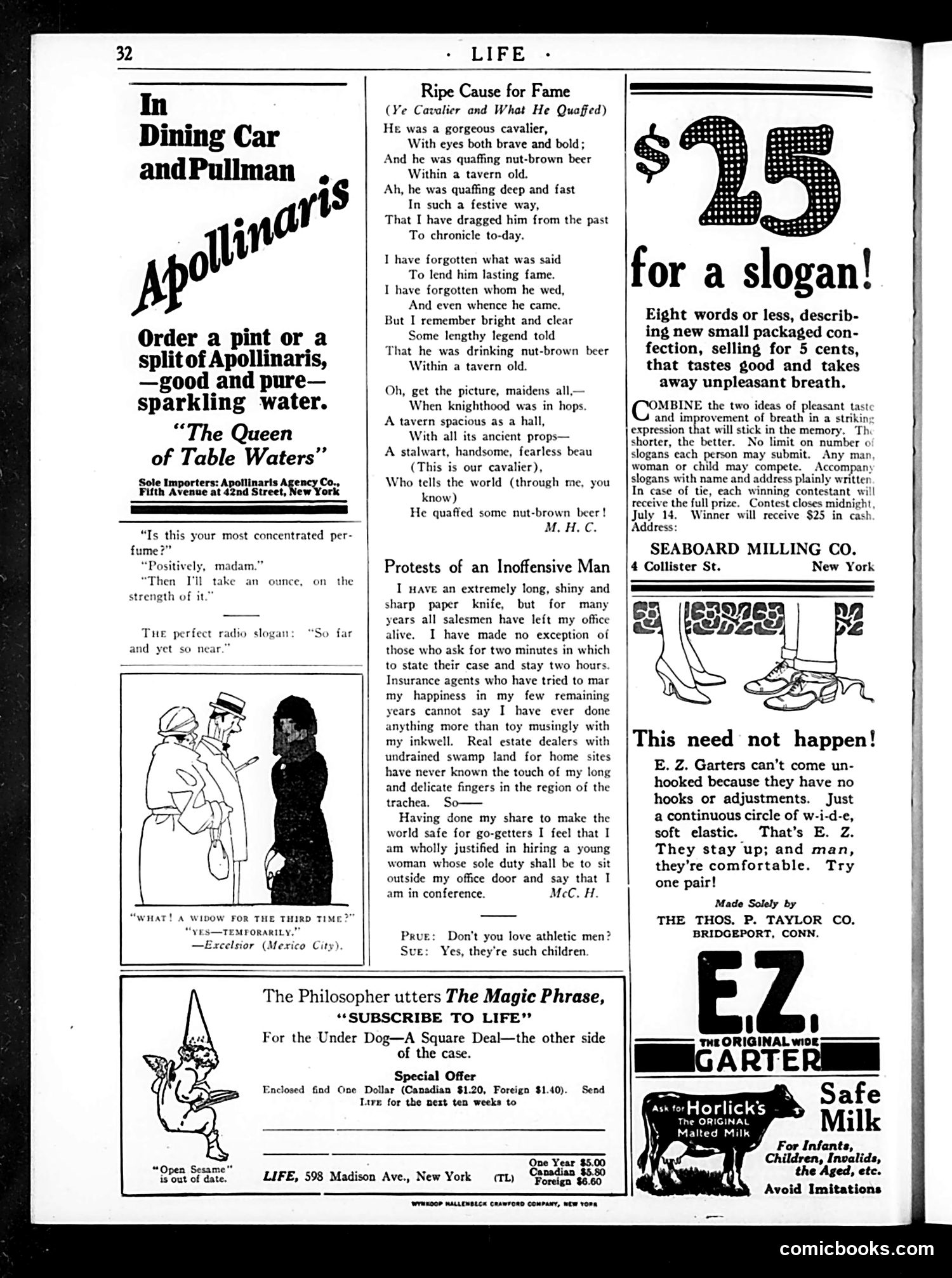
This page combines humor, advertising, and light social commentary typical of *Life* magazine's satirical approach. **The cartoons** mock everyday absurdities: a perfume buyer's logic, radio advertising clichés, and a man's marital pattern ("widow for the third time"). **The poem** "Ripe Cause for Fame" gently satirizes how historical legends survive on trivial details—a cavalier is remembered only for drinking nut-brown beer in a tavern, not for any actual accomplishments. This likely reflects post-WWI skepticism about heroic myths. **"Protests of an Inoffensive Man"** humorously complains about aggressive salesmen and time-wasters, then admits the writer has become so passive he needs a secretary to claim he's "in conference" to avoid them—a joke about modern business annoyances and the narrator's own weakness. **The advertisements** (Apollinaris water, E.Z. Garters, Horlick's Malted Milk, and a slogan contest) represent typical 1920s consumer products marketed with modest claims and practical benefits rather than modern emotional appeals. The page reflects genteel, pre-Depression American humor and consumer culture.
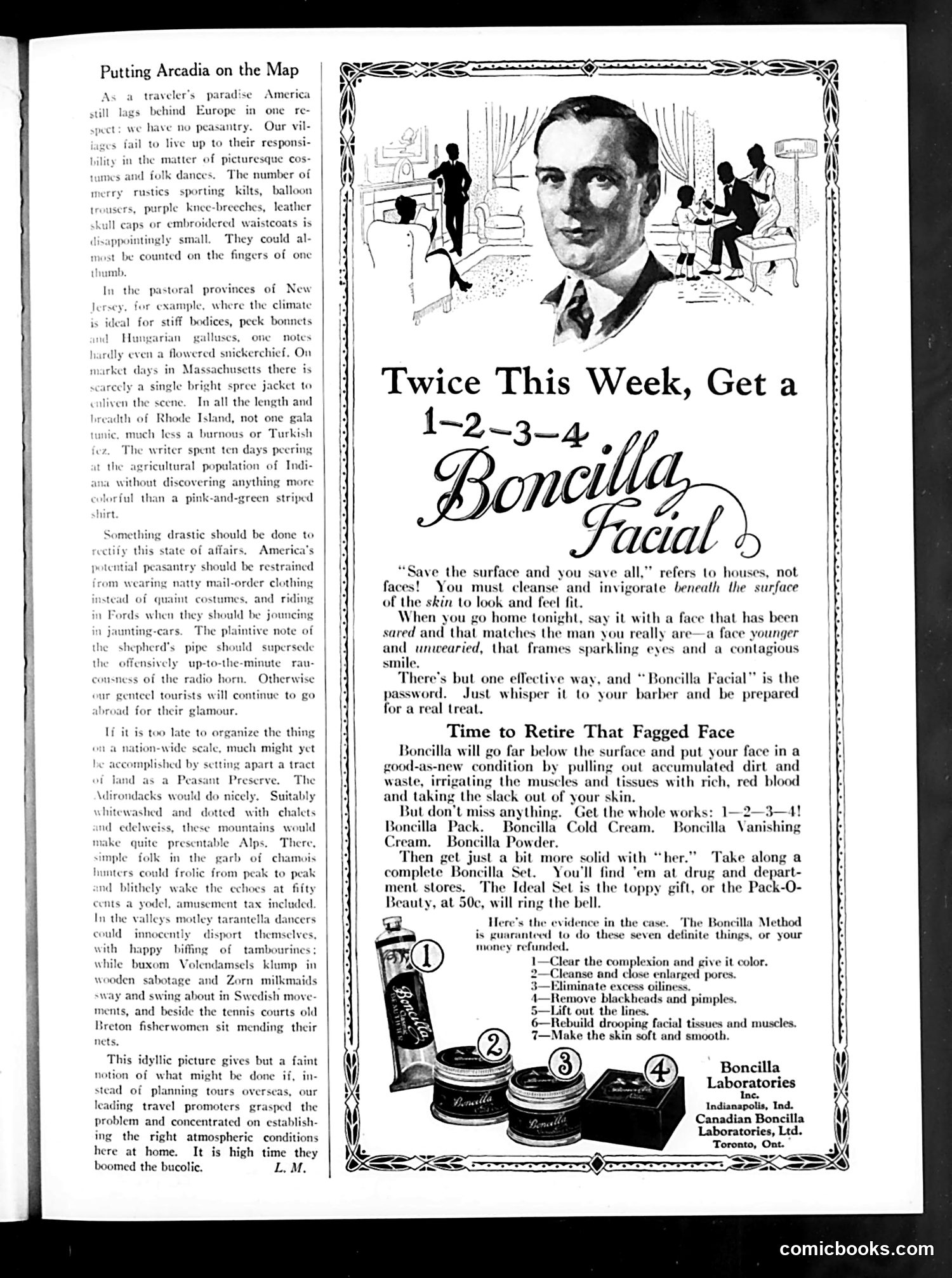
This is a satirical essay mocking American tourists' complaints about lacking "picturesque" peasantry. The author observes that American rural workers wear ordinary mail-order clothing rather than colorful folk costumes—kilts, embroidered vests, Hungarian galluses—that European peasants sport. The satire targets both American travelers seeking "authentic" rustic charm abroad and the implicit snobbery of wealthy tourists expecting rural populations to perform ethnicity for entertainment. The author humorously proposes establishing a "Peasant Preserve" in the Adirondacks, complete with costumed performers doing folk dances, yodeling, and fishing for tourist amusement at fifty cents per yodel. The joke exposes how American tourism industry could manufacture "quaint" experiences by essentially commodifying and staging peasant culture—a critique of tourism's artificial construction of authenticity. The right page is a Boncilla beauty product advertisement, unrelated to the satire.
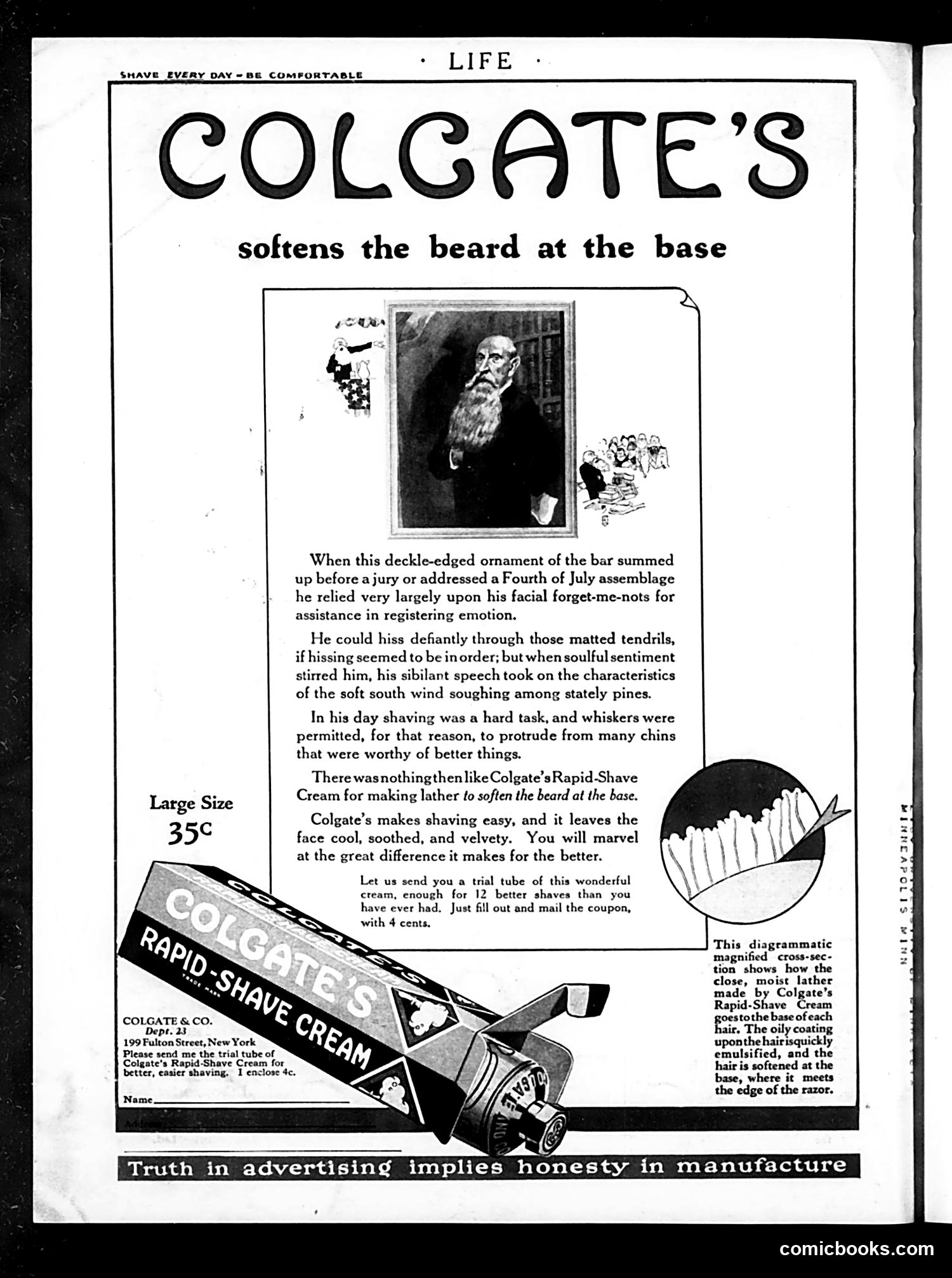
This is primarily a **product advertisement**, not political satire. The page uses humor to market shaving cream by mocking old-fashioned beards. The central figure appears to be a **generic caricature of a 19th-century lawyer or orator**—described as a "deckle-edged ornament of the bar"—with an exaggerated long beard. The satire mocks how such men relied on facial hair to express emotion during courtroom arguments or public speeches, hissing defiantly or speaking "softly" through their whiskers. The joke: in "his day" shaving was difficult, so men kept unsightly beards "that were worthy of better things." Colgate's modern shaving cream solves this problem, making daily shaving easy and comfortable. The accompanying diagram explains the product's mechanism. This reflects early-20th-century advertising that positioned modern consumer goods as solving old-fashioned inconveniences—here, replacing the necessity of keeping a beard due to poor shaving technology.