
Life, 1924-07-03 · page 20 of 36
Life — July 3, 1924 — page 20: what you’re looking at
What you’re looking at
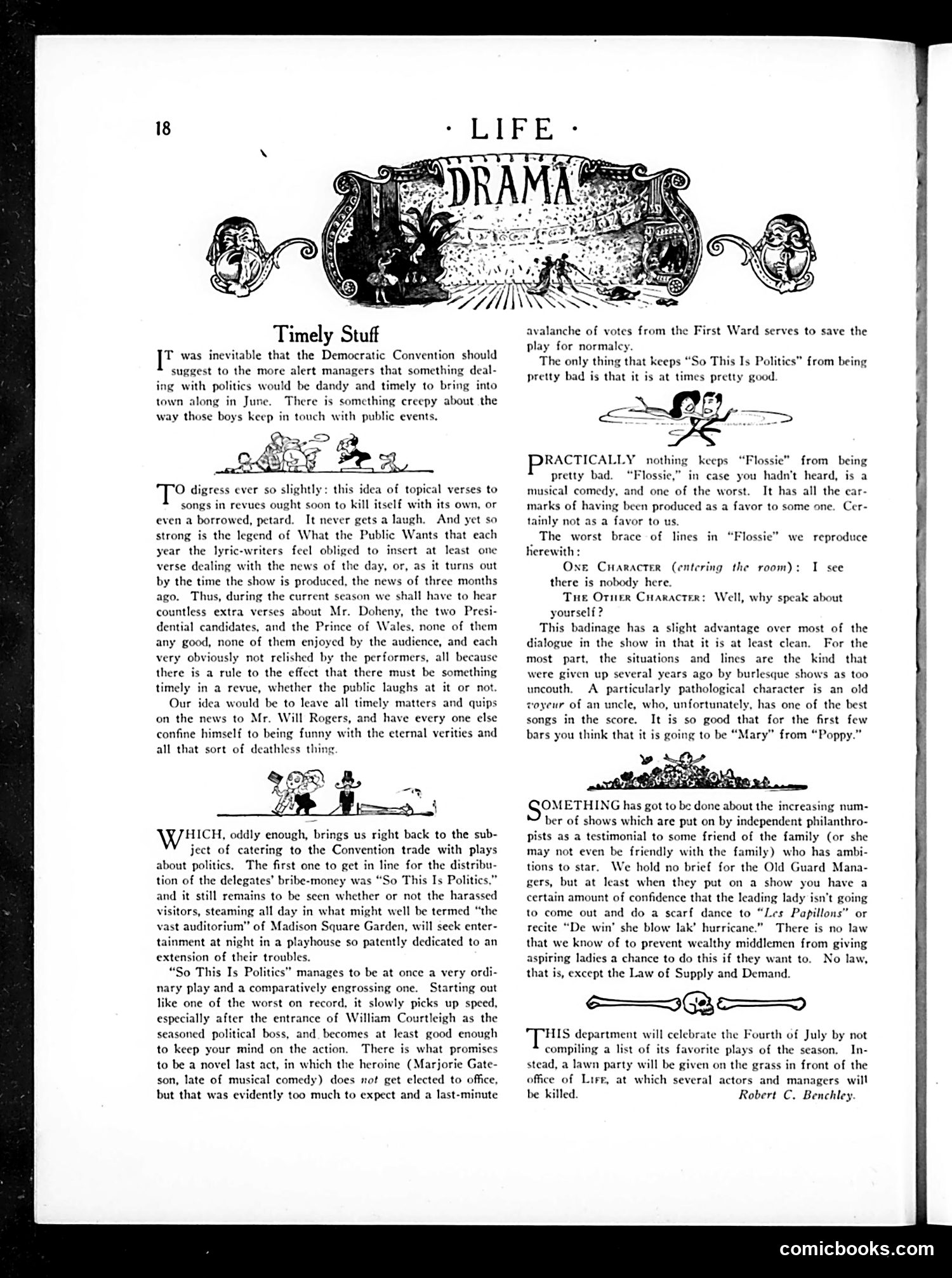
This is a theater criticism column reviewing recent Broadway plays, timed to the Democratic Convention. The critic satirizes how Broadway producers reflexively add topical political jokes to revues, assuming audiences want "timely" content—though these references become stale by opening night. The column reviews two plays: "So This Is Politics," about the Convention itself, which the critic finds mediocre but occasionally engaging (especially with actor William Courtleigh). The heroine implausibly wins election through last-minute First Ward votes—a dig at political corruption and artificial happy endings. "Flossie," a musical comedy, receives harsher treatment as simply bad, with crude dialogue and a pathological uncle character. The critic mocks its reliance on worn-out burlesque humor. Overall, the piece critiques Broadway's desperate pandering to current events while celebrating Will Rogers' topical humor as the superior alternative.
📄 Transcribed text from this page (OCR, searchable)
Machine-transcribed from the original scan — historical spelling and the odd misread are preserved.
Timely Stuff T was inevitable that the Democratic Convention should suggest to the more alert managers that something deal- ing with politics would be dandy and timely to bring into town along in June. There is something creepy about the way those boys keep in touch with public events. 28S Sea 'O digress ever so slightly: this idea of topical verses to songs in revues ought soon to kill itself with its own, or even a borrowed, petard. It never gets a laugh, And yet so strong is the legend of What the Public Wants that each year the lyric-writers feel obliged to insert at least one verse dealing with the news of the day, or, as it turns out by the time the show is produced, the news of three months ago. Thus, during the current season we shall have to hear countless extra verses about Mr. Doheny, the two Presi- dential candidates, and the Prince of Wales, none of them any good, none of them enjoyed by the audience, and each very obviously not relished by the performers, all because there is a rule to the effect that there must be something timely in a revue, whether the public laughs at it or not. Our idea would be to leave all timely matters and quips on the news to Mr. Will Rogers, and have every one else confine himself to being funny with the eternal verities and all that sort of deathless thing WHicH. oddly enough, brings us right back to the sub- ject of catering to the Convention trade with plays about politics, The first one to get in line for the distribu- tion of the delegates’ bribe-money was “So This Is Politics,” and it still remains to be seen whether or not the harassed isitors, steaming all day in what might well be termed “the vast auditorium” of Madison Square Garden, will seek enter- tainment at night in a playhouse so patently dedicated to an extension of their troubles. “So This Is Politics” manages to be at once a very ordi- nary play and a comparatively engrossing one. Starting out like one of the worst on record, it slowly picks up speed, especially after the entrance of William Courtleigh as the seasoned political boss, and becomes at least good enough to keep your mind on the action. There is what promises to be a novel last act, in which the heroine (Marjorie Gate- son, late of musical comedy) does not get elected to office, but that was evidently too much to expect and a last-minute avalanche of votes from the First Ward serves to save the play for normalcy The only thing that keeps “So This Is Politics” from being pretty bad is that it is at times pretty good. RACTICALLY nothing keeps “Flossie” from being pretty bad. “Flossie,” in case you hadn't heard, is a musical comedy, and one of the worst. It has all the car- marks of having been produced as a favor to some one. Cer- tainly not as a favor to us. The worst brace of lines in “Flossie” we reproduce herewith: One Cuaracter (entering the room): I see there is nobody here. Tue Orner Cuaracter: Well, why speak about yourself ? This badinage has a slight advantage over most of the dialogue in the show in that it is at least clean. For the most part, the situations and lines are the kind that were given up several years ago by burlesque shows as too uncouth, A particularly pathological character is an old voyeur of an uncle, who, unfortunately, has one of the best songs in the score. It is so good that for the first few bars you think that it is going to be “Mary” from “Poppy.” OMETHING has got to be done about the increasing num- ber of shows which are put on by independent philanthro- pists as a testimonial to some friend of the family (or she may not even be friendly with the family) who has ambi- tions to star. We hold no brief for the Old Guard Mana- gers, but at least when they put on a show you have a certain amount of confidence that the leading lady isn’t going to come out and do a scarf dance to “Les Papillons” or recite “De win’ she blow lak’ hurricane.” There is no law that we know of to prevent wealthy middlemen from giving aspiring ladies a chance to do this if they want to. No law, that is, except the Law of Supply and Demand. —33>-—> HIS department will celebrate the Fourth of July by not compiling a list of its favorite plays of the season. In- stead, a lawn party will be given on the grass in front of the office of Lire, at which several actors and managers will be killed. Robert C. Benchley. comicbooks.com