
Life, 1924-07-03 · page 16 of 36
Life — July 3, 1924 — page 16: what you’re looking at
What you’re looking at
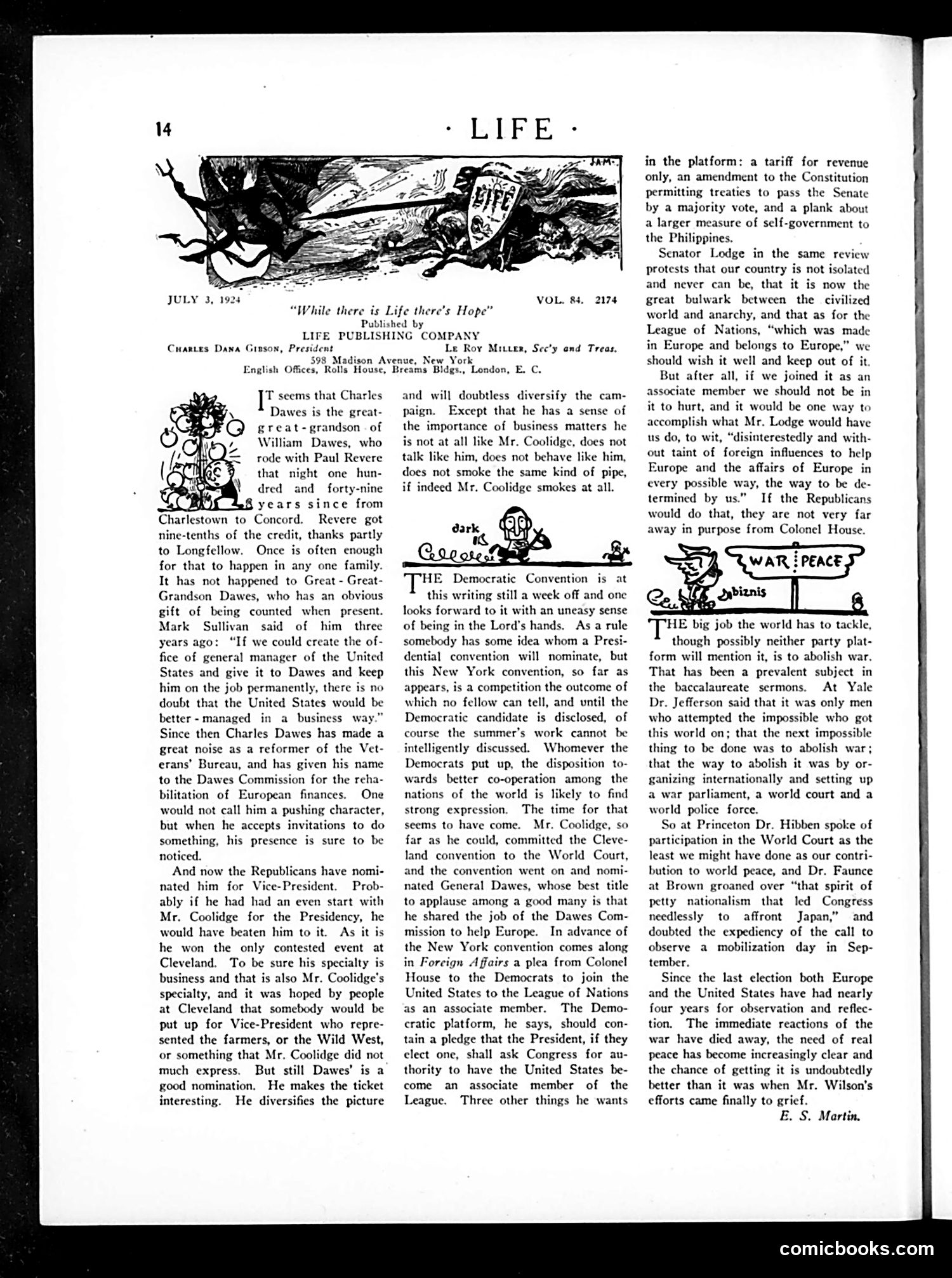
This page from Life (July 3, 1924) discusses the upcoming Democratic Convention, occurring "a week off" from the publication date. The text critiques the Democratic Party's difficulty in selecting a presidential nominee, suggesting the process feels uncertain—"like being in the Lord's hands." The commentary references Charles Dawes (a prominent Republican figure and Vice President under Coolidge) as a potential alternative candidate, humorously noting his business acumen might appeal to Republicans seeking a strong manager. The piece also addresses international relations, particularly America's relationship with the League of Nations and World Court—advocating U.S. participation while acknowledging isolationist resistance. The overall tone is satirical commentary on Democratic Party dysfunction and Republican isolationism during the 1924 election cycle.
📄 Transcribed text from this page (OCR, searchable)
Machine-transcribed from the original scan — historical spelling and the odd misread are preserved.
3, VOL, 84. 2174 “While there is Life there’s Hope” Published by LIFE PUBLISHING COMPANY Cartes Dawa Ginson, President Le Roy Mitten, Sec'y and Treas, 598 Madison Avenue, New York English Offices, Rolls House, Breams Bldgs., London, E. C. T seems that Charles Dawes is the great- great-grandson of William Dawes, who rode with Paul Revere that night one hun- dred and forty-nine S years since from Charlestown to Concord. Revere got nine-tenths of the credit, thanks partly to Longfellow. Once is often enough for that to happen in any one family. It has not happened to Great - Great- Grandson Dawes, who has an obvious gift of being counted when present. Mark Sullivan said of him three years ago: “If we could create the of- fice of general manager of the United States and give it to Dawes and keep him on the job permanently, there is no doubt that the United States would be better - managed in a business way.” Since then Charles Dawes has made a great noise as a reformer of the Vet- erans’ Bureau, and has given his name to the Dawes Commission for the reha- bilitation of European finances, One would not call him a pushing character, but when he accepts invitations to do something, his presence is sure to be noticed. And now the Republicans have nomi- nated him for Vice-President. Prob- ably if he had had an even start with Mr. Coolidge for the Presidency, he would have beaten him to it. As it is he won the only contested event at Cleveland. To be sure his specialty is business and that is also Mr. Coolidge’s specialty, and it was hoped by people at Cleveland that somebody would be put up for Vice-President who repre- sented the farmers, or the Wild West, or something that Mr. Coolidge did not much express. But still Dawes’ is a good nomination. He makes the ticket interesting. He diversifies the picture and will doubtless diversify the cam- paign. Except that he has a sense of the importance of business matters he is not at all like Mr. Coolidge, does not talk like him, does not behave like him, does not smoke the same kind of pipe, if indeed Mr. Coolidge smokes at all. HE Democratic Convention is at this writing still a week off and one looks forward to it with an uneasy sense of being in the Lord's hands. As a rule somebody has some idea whom a Presi- dential convention will nominate, but this New York convention, so far as appears, is a competition the outcome of which no fellow can tell, and until the Democratic candidate is disclosed, of course the summer's work cannot be intelligently discussed. Whomever the Democrats put up, the disposition to- wards better co-operation among the nations of the world ly to find strong expression. The time for that seems to have come. Mr. Coolidge, so far as he could, committed the Cleve- land convention to the World Court, and the convention went on and nomi- nated General Dawes, whose best title to applause among a good many is that he shared the job of the Dawes Com- mission to help Europe. In advance of the New York convention comes along in Foreign Affairs a plea from Colonel House to the Democrats to join the United States to the League of Nations as an associate member. The Demo- cratic platform, he says, should con- tain a pledge that the President, if they elect one, shall ask Congress for au- thority to have the United States be- come an associate member of the League. Three other things he wants in the platform: a tariff for revenue only, an amendment to the Constitution permitting treaties to pass the Senate by a majority vote, and a plank about a larger measure of self-government to the Philippines. Senator Lodge in the same review protests that our country is not isolated and never can be, that it is now the great bulwark between the civilized world and anarchy, and that as for the League of Nations, “which was made in Europe and belongs to Europe,” we should wish it well and keep out of it But after all, if we joined it as an associate member we should not be in it to hurt, and it would be one way to accomplish what Mr. Lodge would have us do, to wit, “disinterestedly and with- out taint of foreign influences to help Europe and the affairs of Europe in every possible way, the way to be de- termined by us.” If the Republicans would do that, they are not very far away in purpose from Colonel House. 'HE big job the world has to tackle, though possibly neither party plat- form will mention it, is to abolish war. That has been a prevalent subject in the baccalaureate sermons. At Yale Dr. Jefferson said that it was only men who attempted the impossible who got this world on; that the next impossible thing to be done was to abolish war; that the way to abolish it was by or- ganizing internationally and setting up a war parliament, a world court and a world police force. So at Princeton Dr. Hibben spoke of participation in the World Court as the least we might have done as our contri- bution to world peace, and Dr. Faunce at Brown groaned over “that spirit of petty nationalism that led Congress needlessly to affront Japan,” and doubted the expediency of the call to observe a mobilization day in Sep- tember. Since the last election both Europe and the United States have had nearly four years for observation and reflec- tion. The immediate reactions of the war have died away, the need of real peace has become increasingly clear and the chance of getting it is undoubtedly better than it was when Mr. Wilson's efforts came finally to grief. E. S. Martin, comicbooks.com