
Life, 1924-07-03 · page 26 of 36
Life — July 3, 1924 — page 26: what you’re looking at
What you’re looking at
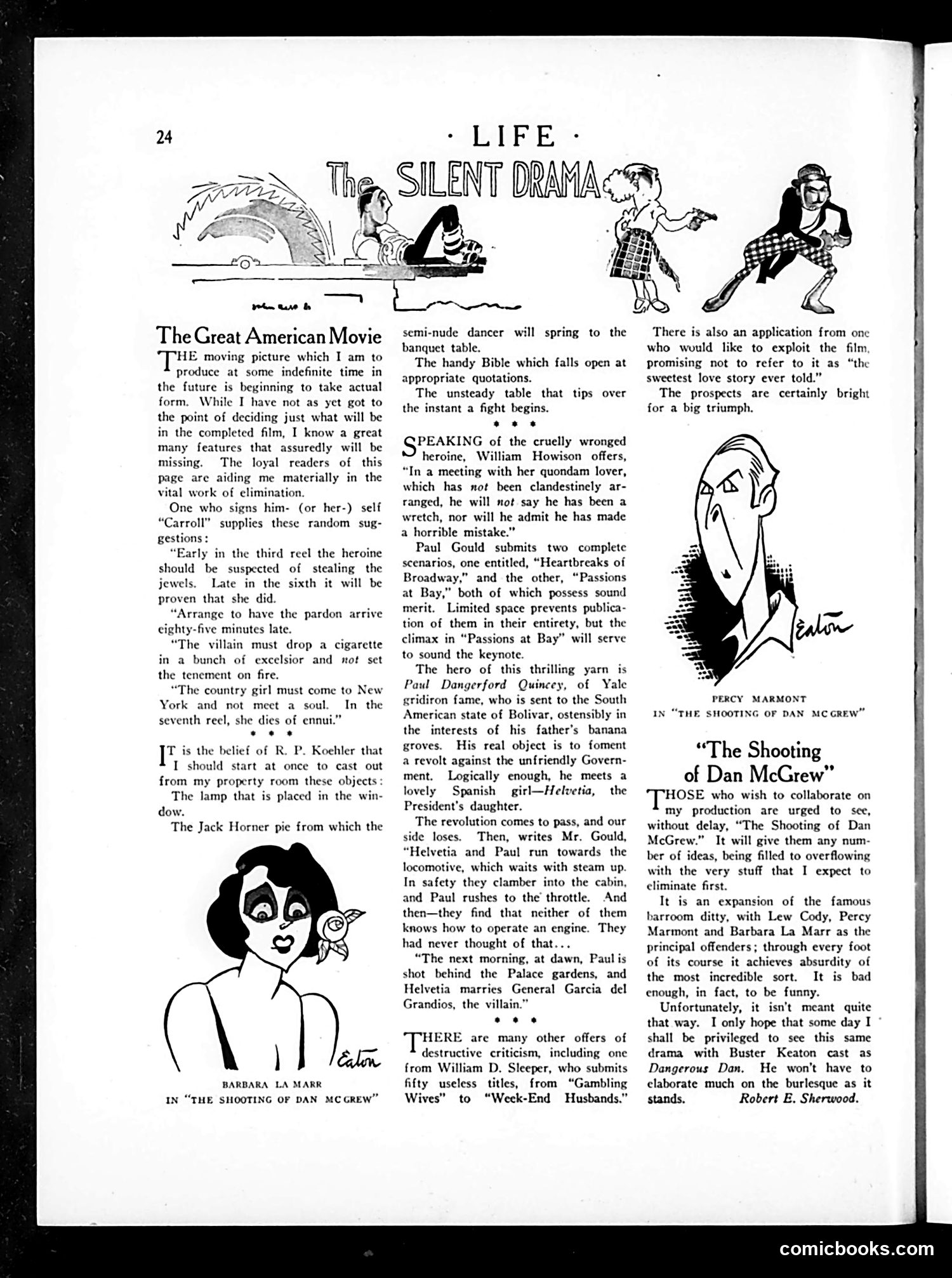
This page satirizes the conventions of silent films, particularly melodramas. The author proposes creating "The Great American Movie" while soliciting reader suggestions for clichés to eliminate. The cartoons show **Barbara La Marr** and **Percy Marmont** from "The Shooting of Dan McGrew"—a film adaptation of Robert Service's famous poem that apparently exemplifies every hackneyed silent-film trope the author mocks. Readers suggest removing tired plot devices: the heroine falsely suspected of theft, last-minute pardons, the Bible conveniently opening to relevant passages, and the tipping-over table triggering fights. One scenario involves a Yale hero inciting South American revolution to meet the President's daughter—climaxing absurdly when neither character knows how to operate a locomotive. The satire targets how silent films relied on predictable melodrama, improbable coincidences, and visual gags. "The Shooting of Dan McGrew" apparently embodied these failings so thoroughly that the author ironically recommends seeing it as a guide to what *not* to do—achieving "absurdity of the most incredible sort."
📄 Transcribed text from this page (OCR, searchable)
Machine-transcribed from the original scan — historical spelling and the odd misread are preserved.
The Great American Movie of Bate moving picture which I am to at some indefinite time in beginning to take actual form, While I have not as yet got to the point of deciding just what will be in the completed film, I know a great many features that assuredly will be missing. The loyal readers of this page are aiding me materially in the vital work of elimination. One who signs him- (or her-) self “Carroll” supplies these random sug- gestions : “Early in the third reel the heroine should be suspected of stealing the jewels. Late in the sixth it will be proven that she did. “Arrange to have the pardon arrive eighty-five minutes late. “The villain must drop a cigarette in a bunch of excelsior and not set the tenement on fire. “The country girl must come to New York and not mect a soul. In the seventh reel, she dies of ennui.” eee T is the belief of R. P. Koehler that I should start at once to cast out from my property room these objects : The lamp that is placed in the win- dow. The Jack Horner pie from which the BARBARA LA MARR IN “THE SHOOTING OF DAN MCGREW” semi-nude dancer will spring to the banquet table. The handy Bible which falls open at appropriate quotations. The unsteady table that tips over the instant a fight begins. eee PEAKING of the cruelly wronged heroine, William Howison offers, “In a meeting with her quondam lover, which has not been clandestinely ar- ranged, he will not say he has been a wretch, nor will he admit he has made a horrible mistake.” Paul Gould submits two complete scenarios, one entitled, “Heartbreaks of Broadway,” and the other, “Passions at Bay,” both of which possess sound merit. Limited space prevents publica- tion of them in their entirety, but the climax in “Passions at Bay” will serve to sound the keynote. The hero of this thrilling yarn is Paul Dangerford Quincey, of Yale gridiron fame, who is sent to the South American state of Bolivar, ostensibly in the interests of his father’s banana groves. His real object is to foment a revolt against the unfriendly Govern- ment. Logically enough, he meets a lovely Spanish girl—Helvetia, the President's daughter. The revolution comes to pass, and our side loses. Then, writes Mr. Gould, “Helvetia and Paul run towards the locomotive, which waits with steam up. In safety they clamber into the cabin, and Paul rushes to the’ throttle. And then—they find that neither of them knows how to operate an engine. They had never thought of that... “The next morning, at dawn, Paul is shot behind the Palace gardens, and Helvetia marries General Garcia del Grandios, the villain.” eee HERE are many other offers of destructive criticism, including one from William D. Sleeper, who submits fifty useless titles, from “Gambling Wives” to “Week-End Husbands.” There is also an application from one who would like to exploit the film. promising not to refer to it as “the sweetest love story ever told.” The prospects are certainly bright for a big triumph, PERCY MARMONT IN “THE SHOOTING OF DAN MCGREW” “The Shooting of Dan McGrew” 'HOSE who wish to collaborate on my production are urged to sce, without delay, “The Shooting of Dan McGrew.” It will give them any num- ber of ideas, being filled to overflowing with the very stuff that I expect to eliminate first. It is an expansion of the famous barroom ditty, with Lew Cody, Percy Marmont and Barbara La Marr as the principal offenders; through every foot of its course it achieves absurdity of the most incredible sort. It is bad enough, in fact, to be funny. Unfortunately, it isn’t meant quite that way. I only hope that some day I shall be privileged to see this same drama with Buster Keaton cast as Dangerous Dan. He won't have to elaborate much on the burlesque as it stands. Robert E. Sherwood. comicbooks.com