
A complete issue · 60 pages · 1924
Life — April 3, 1924
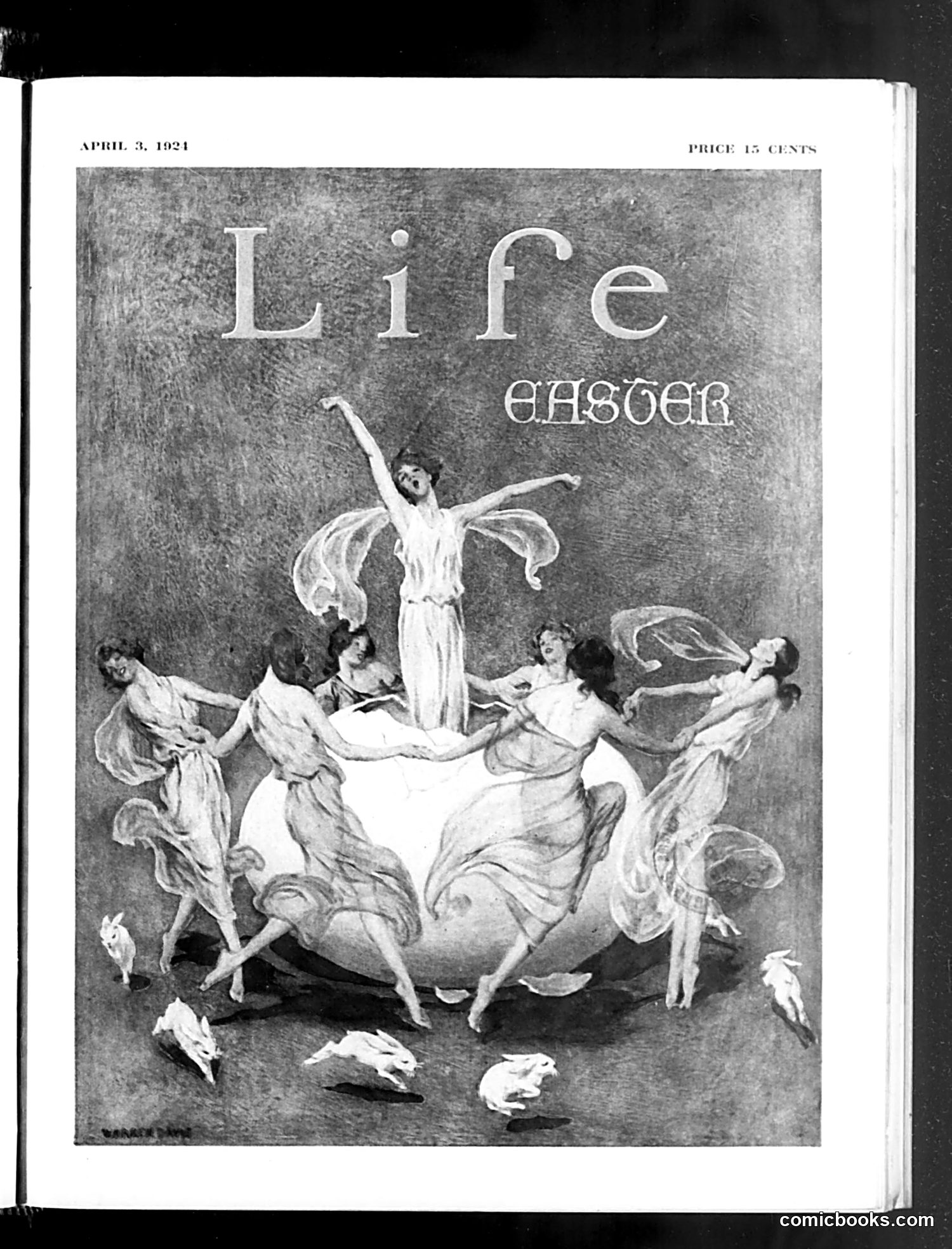
This is a *Life* magazine cover celebrating Easter, dated April 3, 1924. The image depicts a classical allegorical scene of the Resurrection: a central angelic figure in white robes stands triumphantly atop an egg (symbolizing rebirth and renewal), surrounded by dancing cherubs or attendant figures in flowing garments. White rabbits and doves scatter below—familiar Easter iconography representing fertility, peace, and springtime. The artwork combines religious symbolism (the Resurrection) with secular Easter traditions (eggs, rabbits), reflecting how Easter functioned in early 20th-century American culture as both a Christian holiday and a spring celebration. The cover's aesthetic—allegorical, romantic, and classically inspired—was typical of *Life*'s artistic approach to seasonal issues during this era.
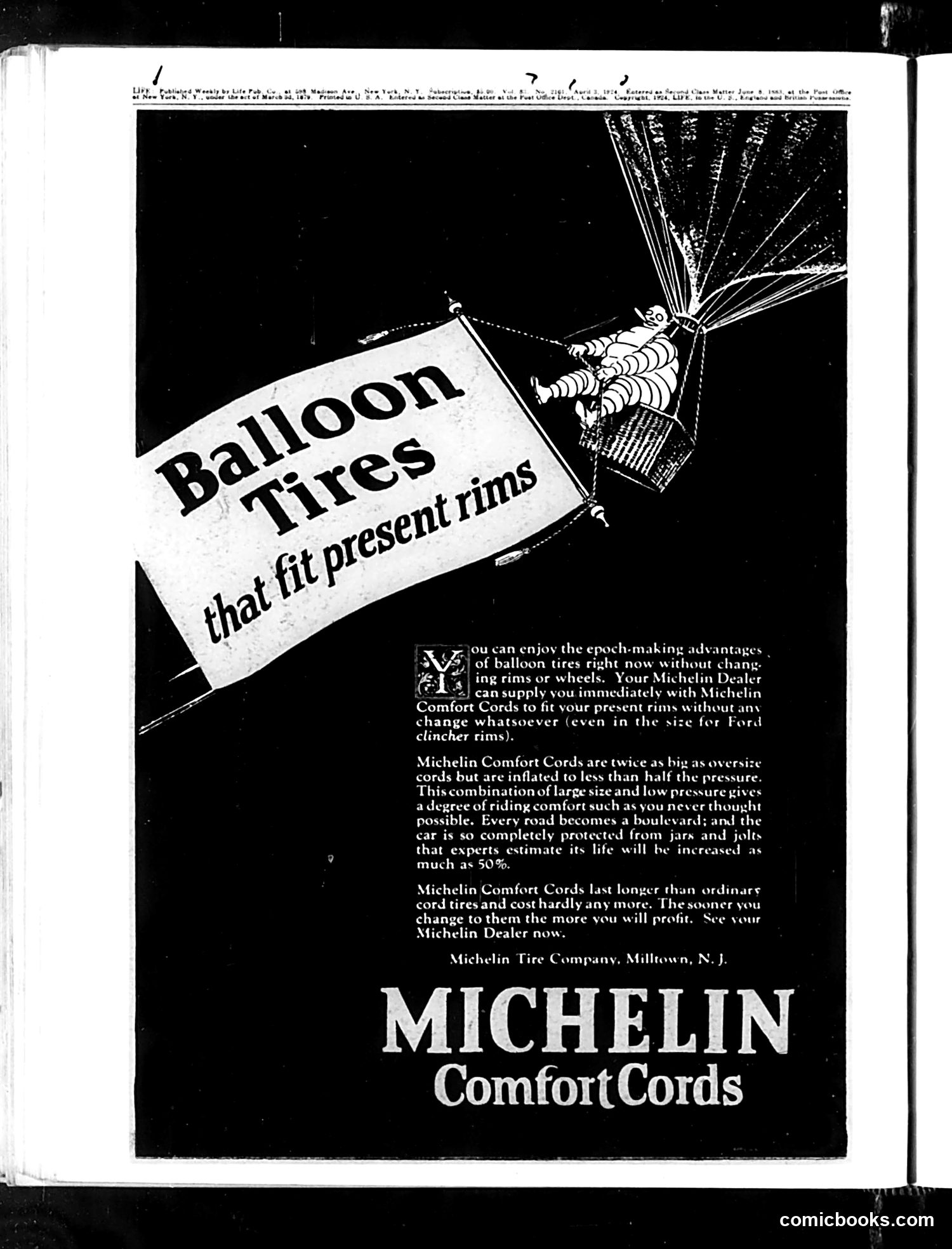
This page is primarily a **Michelin tire advertisement**, not political satire. The ad promotes Michelin Comfort Cords—tire liners that fit existing rims without requiring wheel changes. The visual metaphor uses a **hot air balloon** ascending with a banner reading "Balloon Tires that fit present rims." This cleverly illustrates the product's main selling point: achieving the comfort benefits of balloon tires (which were a newer technology) while maintaining compatibility with existing wheels. The advertisement emphasizes that Comfort Cords are "twice as big as oversize cords" yet inflated to lower pressure, providing superior ride comfort. It claims they last longer than ordinary cord tires and cost barely more. The balloon imagery suggests lightness, elevation, and progress—marketing language for automotive advancement in what appears to be the 1920s-30s era.
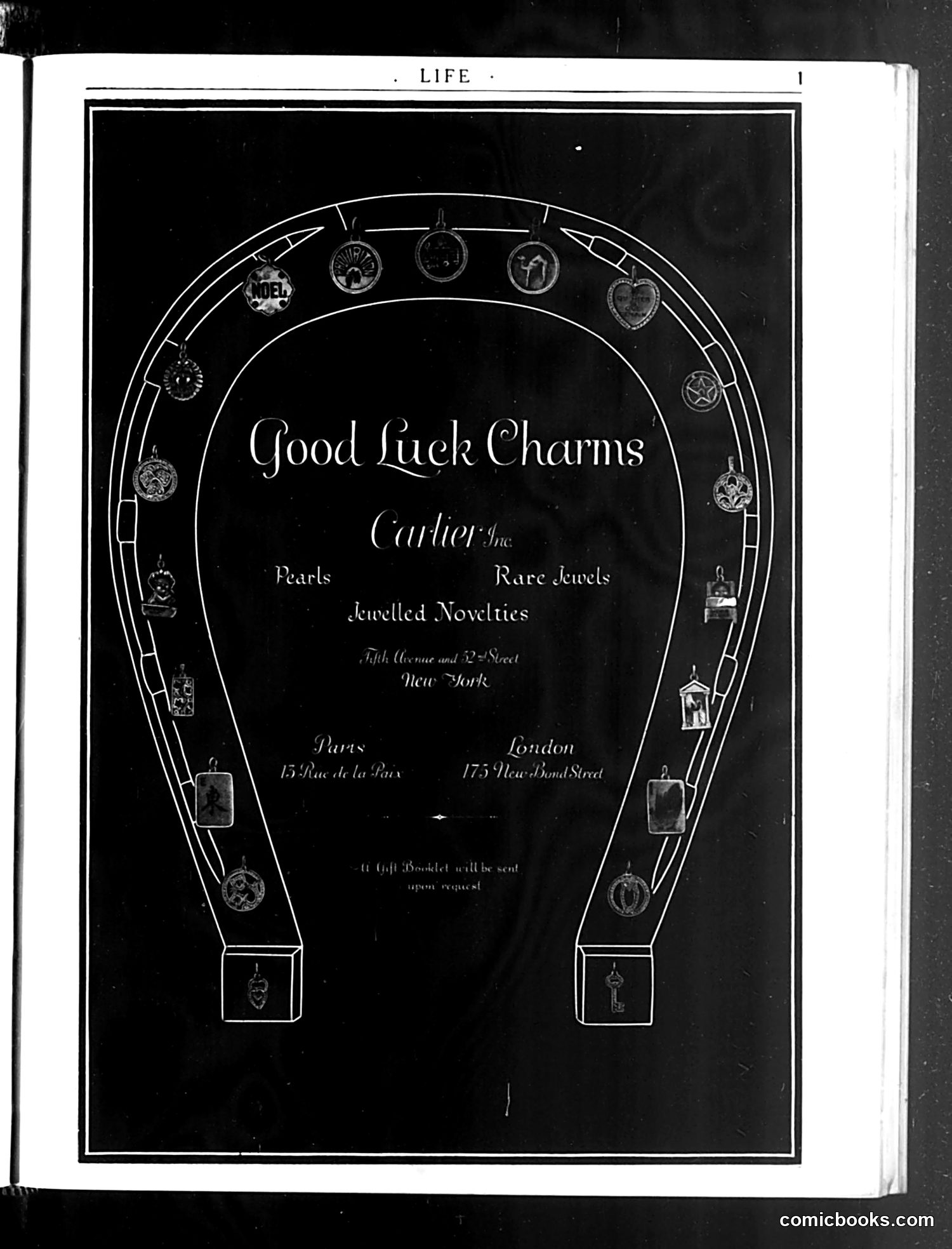
This page is **not a political cartoon or satirical content**—it's a **luxury advertisement** for Cartier, Inc., the high-end jewelry company. The image shows a horseshoe design filled with various good-luck charms (religious medals, lockets, talismans, and decorative pendants). The ad promotes Cartier's "Good Luck Charms" collection, listing their locations: New York (Fifth Avenue and 52nd Street), Paris (15 Rue de la Paix), and London (175 New Bond Street). The horseshoe imagery plays on the traditional Western superstition that horseshoes bring good fortune. By framing their jeweled novelties as "luck charms," Cartier markets luxury items to aspirational consumers seeking both elegance and symbolic protection. This reflects early 20th-century advertising strategy: combining superstition with luxury branding.
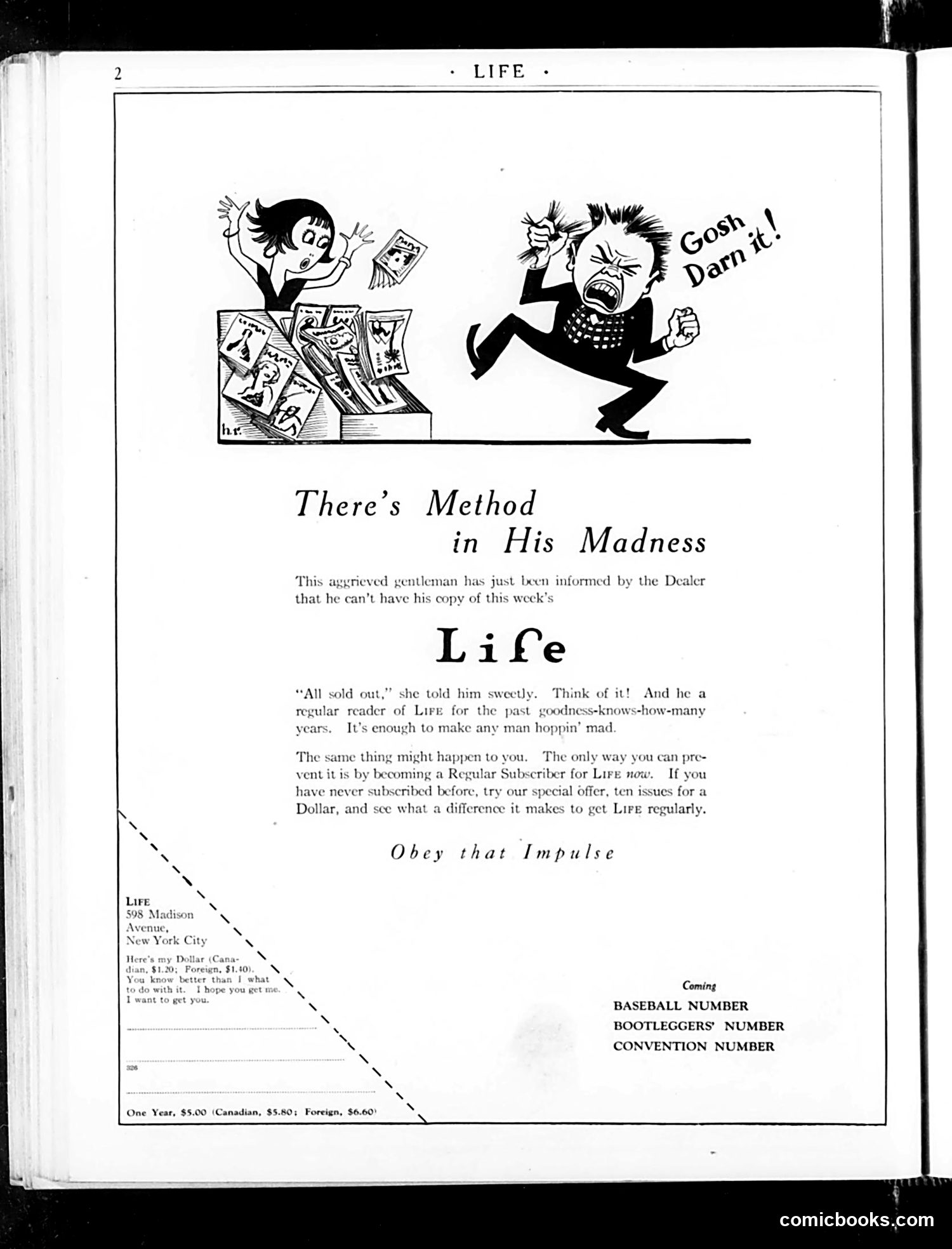
This page is primarily a **subscription advertisement for Life magazine**, not a political cartoon. The illustration depicts a humorous scenario about magazine availability: On the left, a figure frantically juggles copies of Life magazine. On the right, an angry man exclaims "Gosh Darn it!" — he's just learned from his newsdealer that the current week's Life is sold out. The ad's message is straightforward: regular subscription prevents this frustration. The headline "There's Method in His Madness" suggests the dealer's "sold out" strategy actually serves a purpose — it drives subscriptions by creating scarcity. The satire critiques artificial scarcity tactics while promoting Life's subscription offer: ten issues for one dollar. This was common early-20th-century magazine marketing.
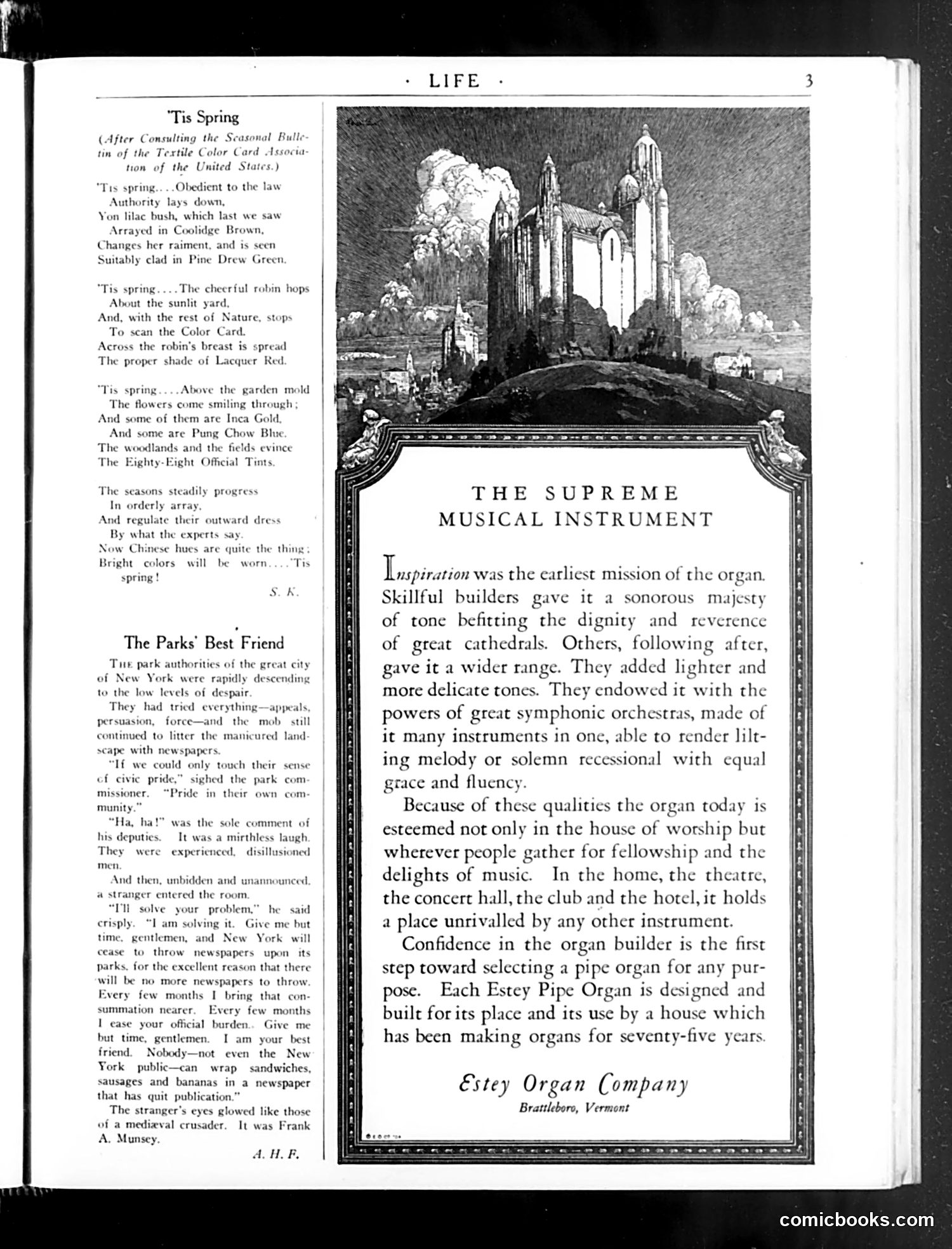
This page contains two distinct sections: **Left column:** Two literary pieces—a poem titled "'Tis Spring" about seasonal renewal and color symbolism (possibly referencing Chinese aesthetic traditions), and a humorous short story called "The Parks' Best Friend" about a homeless stranger in New York who manipulates park attendants into allowing him to stay by flattering their pride and sense of mission. **Right side:** A full-page advertisement for the Estey Pipe Organ Company (Brattleboro, Vermont). The ad features an ornate illustration of a church/cathedral and argues that pipe organs are the "supreme musical instrument" suited for churches, homes, theaters, and concert halls. The page is primarily content and advertising rather than political satire or commentary. The humor is gentle and domestic rather than cutting social critique.
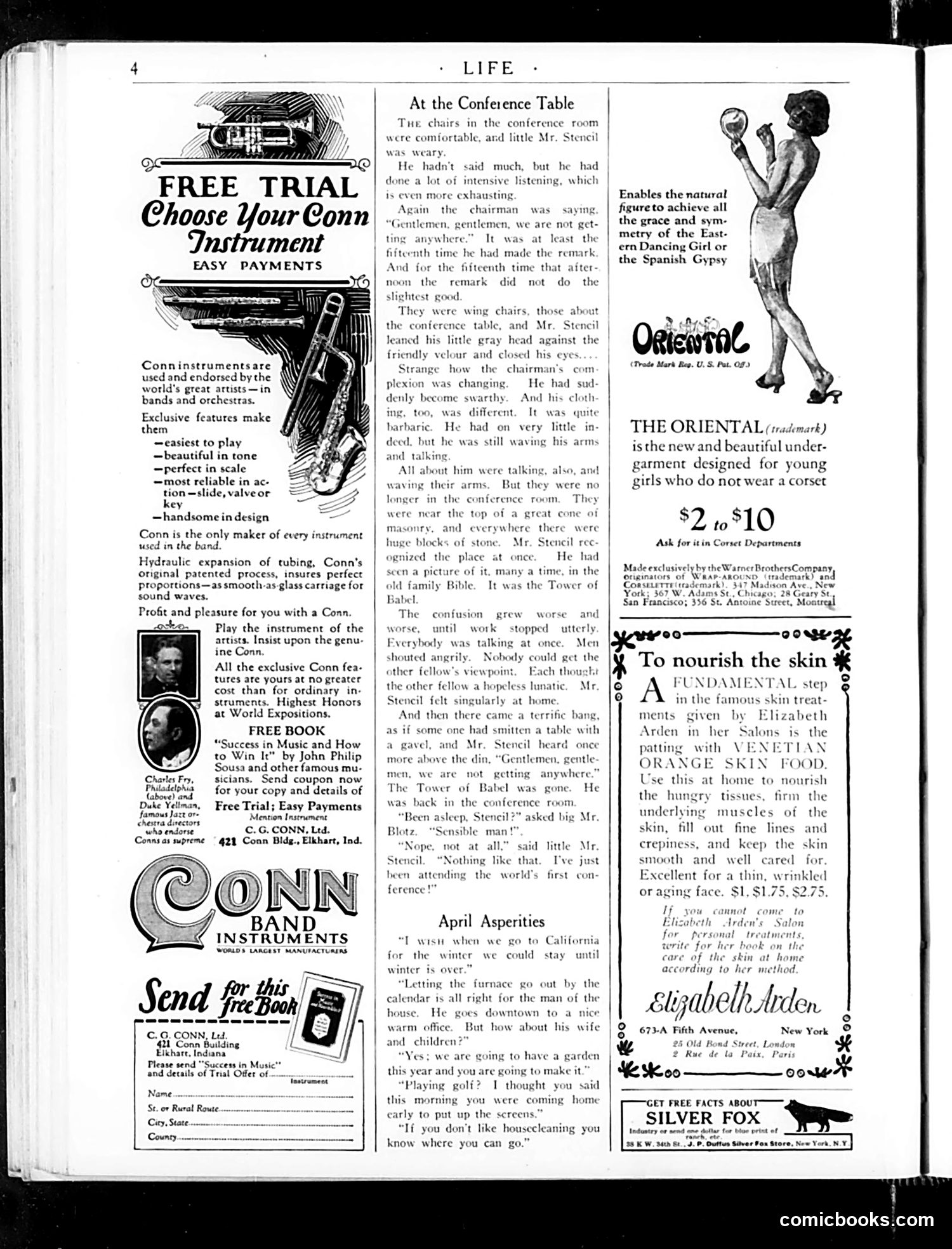
This page is primarily **advertising and fiction** rather than political satire. The left side features ads for **Conn Band Instruments** and a free instructional book. The main narrative, "At the Conference Table," depicts a boring business meeting where the chairman repeatedly uses the phrase "Gentlemen, gentlemen, we are not getting anywhere"—a satirical jab at corporate inefficiency and circular discussion. The right side contains advertisements for **The Oriental** (a corset), **Orange Skin Food** (a cosmetic treatment), and **Silver Fox** (likely a fur product). These reflect early 20th-century consumer culture focused on beauty and luxury goods. The page's humor targets mundane office culture and the era's preoccupation with physical appearance and consumer products rather than engaging in political commentary.
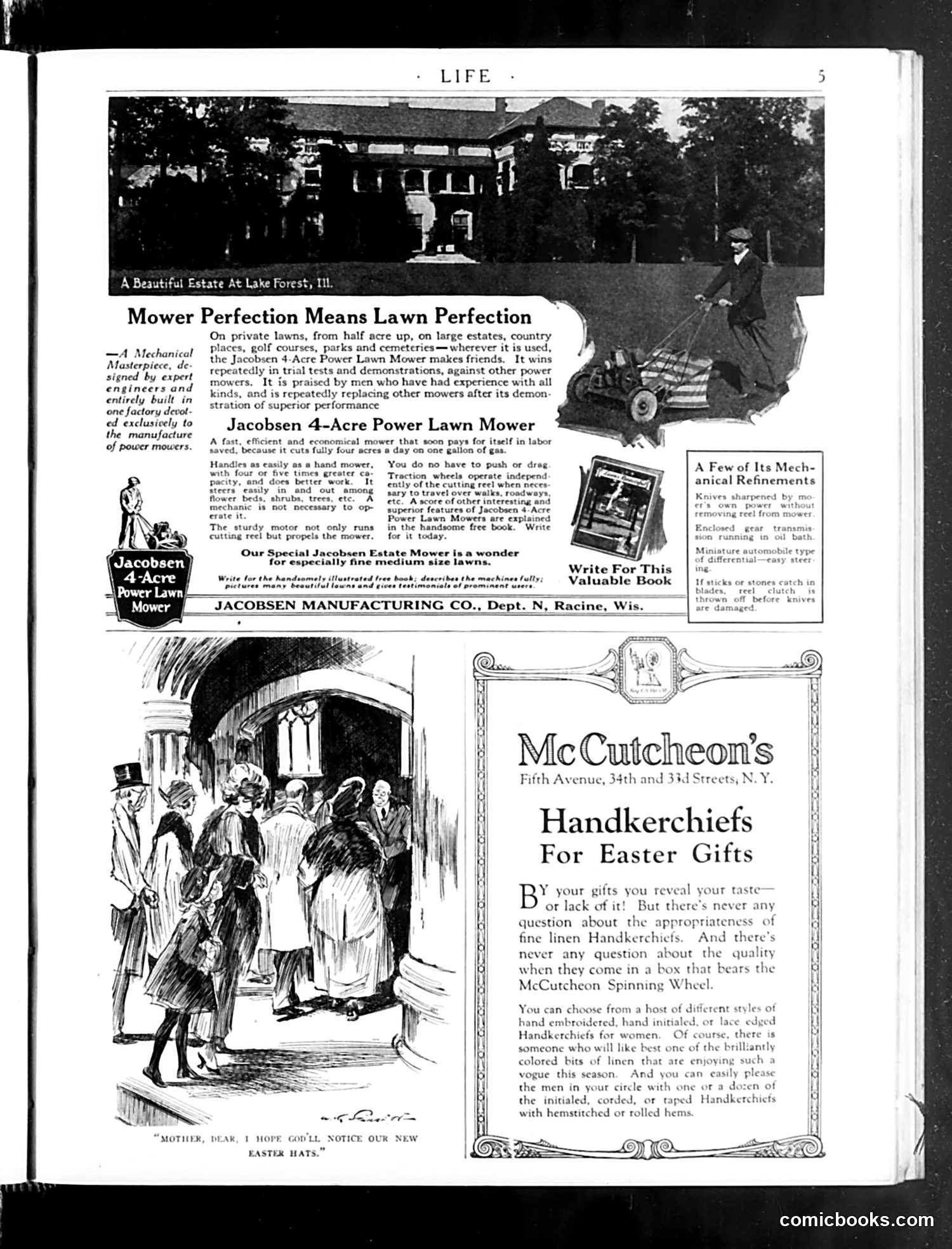
This page is primarily **advertising**, not satire or political commentary. The top half features a **Jacobsen 4-Acre Power Lawn Mower** advertisement, targeting wealthy estate owners. The image shows a man operating the mechanical mower on an expansive lawn, with copy emphasizing labor savings and superior cutting performance. The bottom half contains a **sketch-based advertisement for McCutcheon's Handkerchiefs** (Easter gifts). The cartoon depicts a social scene—people entering what appears to be a church or formal building—with a caption: "Mother, dear, I hope God'll notice our new Easter hats." This gentle humor plays on vanity and Easter tradition, suggesting people dress up primarily to be seen, not for pious reasons. Both ads target affluent early-20th-century readers.
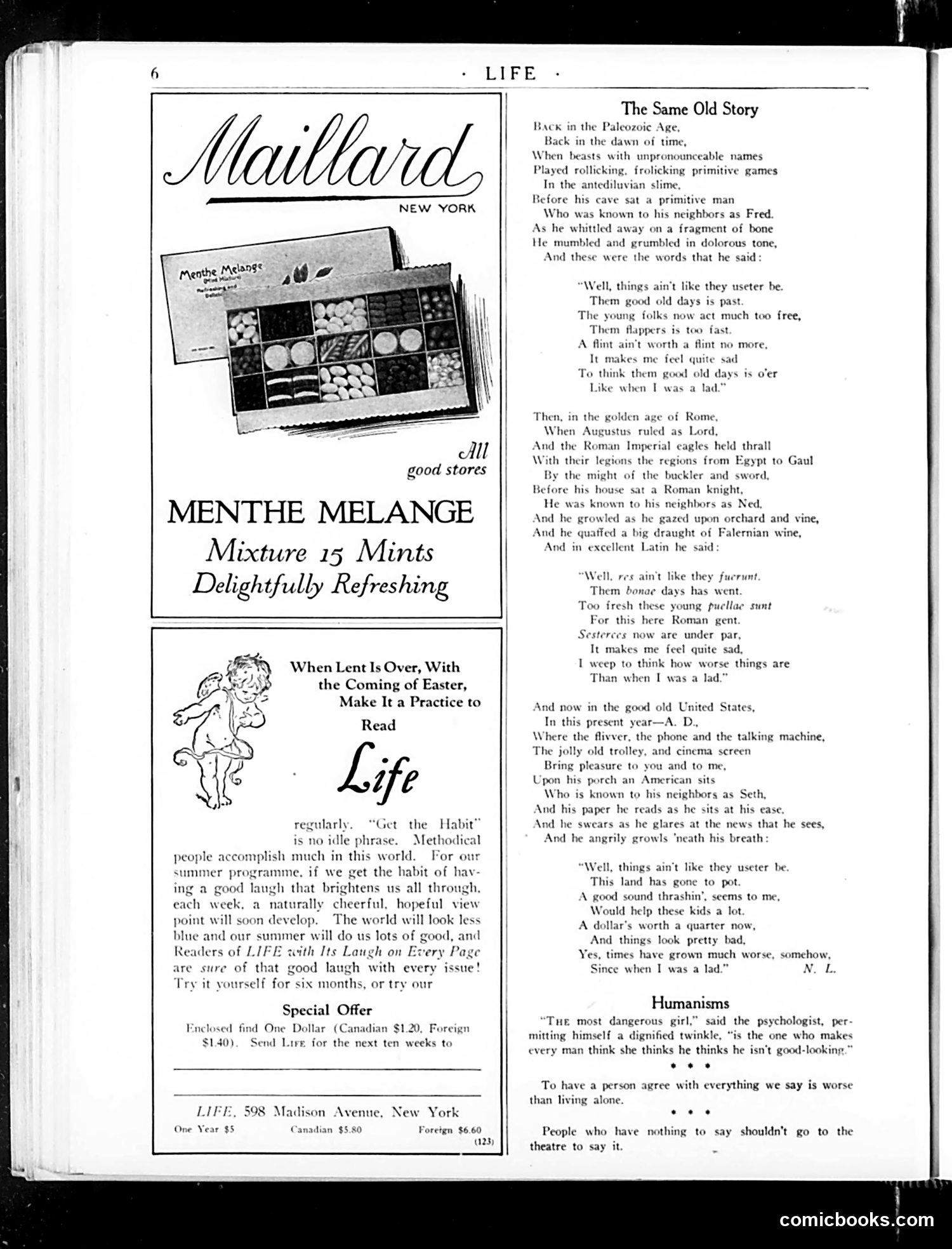
This page is primarily **advertising and editorial content** rather than political satire. The left side features ads for Maillard candy (Menthe Melange mints) and a subscription pitch for *Life* magazine itself, encouraging readers to develop a reading habit during Lent and Easter. The right side contains "The Same Old Story," a **nostalgic poem** comparing complaints across three historical periods: Paleozoic caveman times, Roman imperial era, and modern American times (present day A.D.). The joke is that every generation believes things were better in the past—a timeless human complaint. The three quoted speakers (Fred, Red, and Seth) all lament their respective eras identically, suggesting nostalgia and generational dissatisfaction are universal constants, not legitimate historical observations.
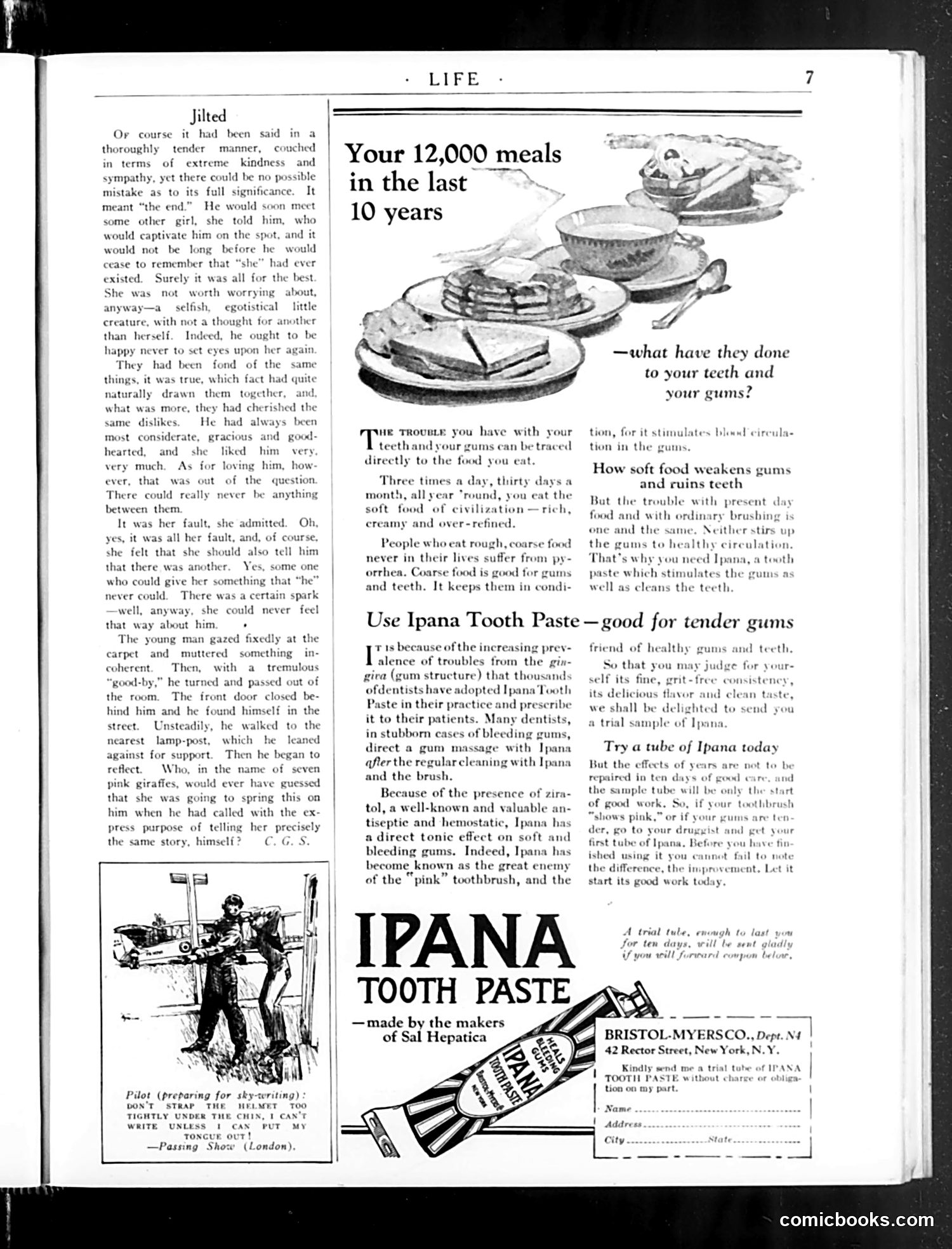
This page is primarily **advertising content** for Ipana Tooth Paste, not political satire. The upper left contains a short story titled "Jilted" about romantic disappointment. The main advertisement uses a health-focused appeal: it warns readers that 12,000 meals in ten years have damaged their teeth and gums. The ad promotes Ipana as a solution, claiming it contains zirconol (a purported antiseptic ingredient) that stimulates blood circulation in gums. The small illustration at bottom left shows a pilot preparing for sky-writing, humorously captioned about not strapping on a helmet—unrelated to the tooth paste pitch. This represents early 20th-century advertising's common strategy: creating health anxiety to sell patent medicines and personal-care products with pseudoscientific claims about ingredient benefits.
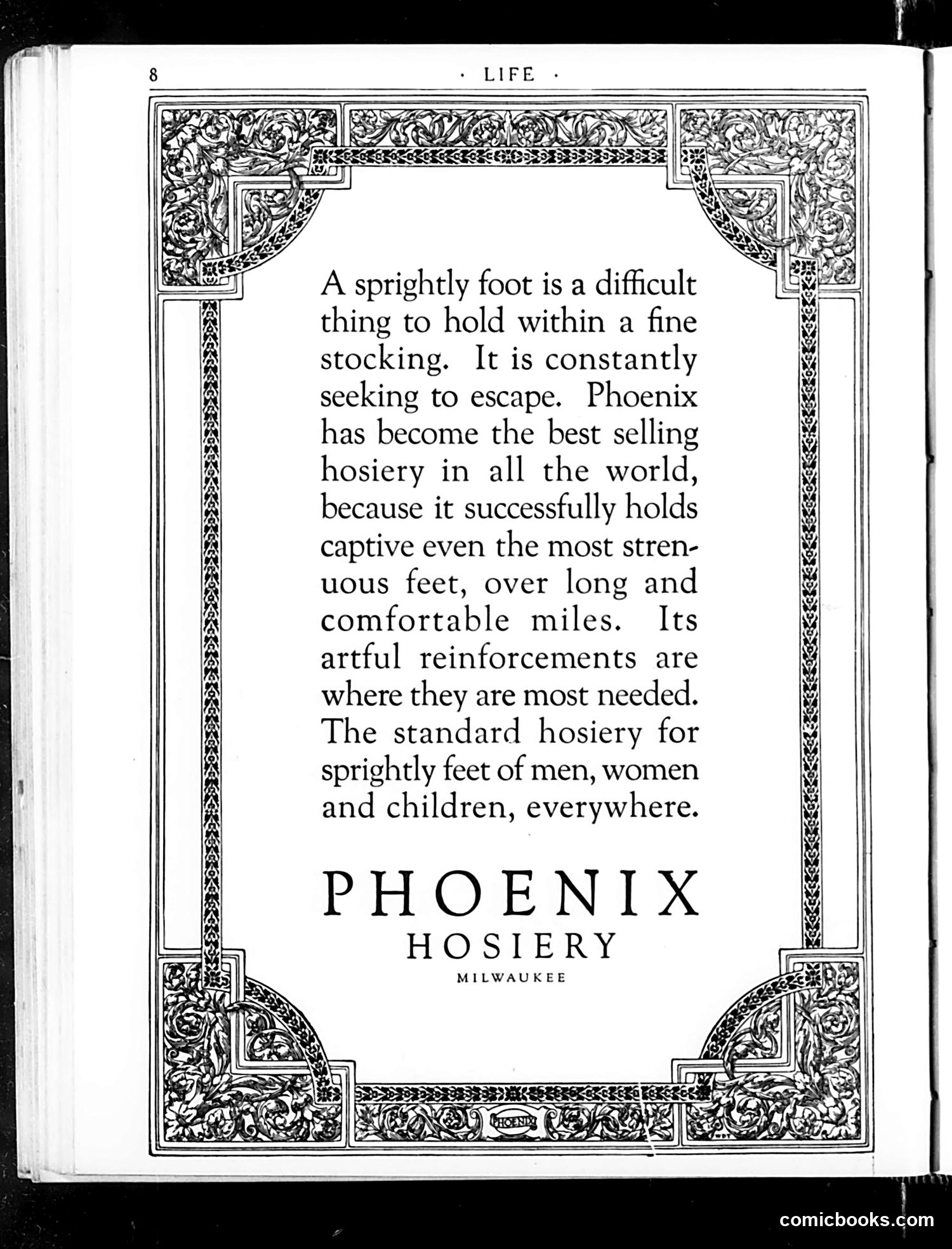
This page is an **advertisement**, not a cartoon or satirical content. It's a full-page ad for Phoenix Hosiery from Milwaukee, appearing in *Life* magazine. The ad uses humorous language to describe the product's appeal: it addresses the problem of keeping hosiery on "sprightly feet" that constantly try to escape from stockings. The copy promises that Phoenix brand successfully restrains even the most active feet over long distances, with reinforcements strategically placed where needed. The ornate decorative border frames the text in a style typical of early 20th-century magazine advertising. There's no political satire here—this is straightforward commercial messaging using wit to sell women's, men's, and children's hosiery.
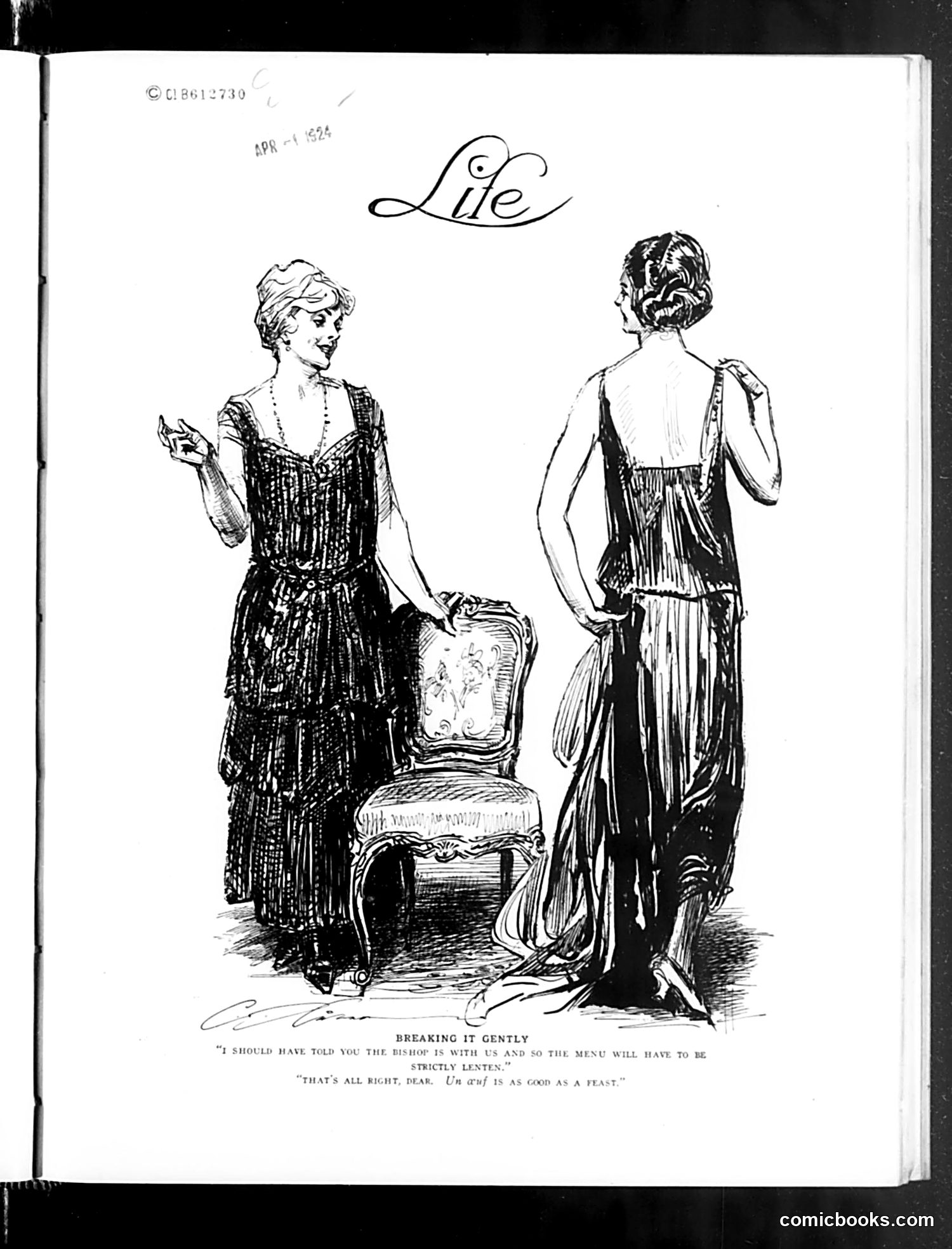
This illustration from *Life* magazine depicts two women in elegant 1920s attire discussing dining arrangements. One woman informs the other that the bishop will be joining them for dinner, requiring the menu to be "strictly lenten" (meatless foods for religious observance). The satire targets the social hypocrisy of the era: wealthy women performing religious piety for a visiting bishop while maintaining lavish lifestyles. The caption's final line—"Un œuf is as good as a feast"—is a pun on "enough," suggesting that modest lenten fare suffices. The joke mocks both the superficial religiosity of the upper class and the idea that they must perform virtue for clergy, despite their typically indulgent ways.
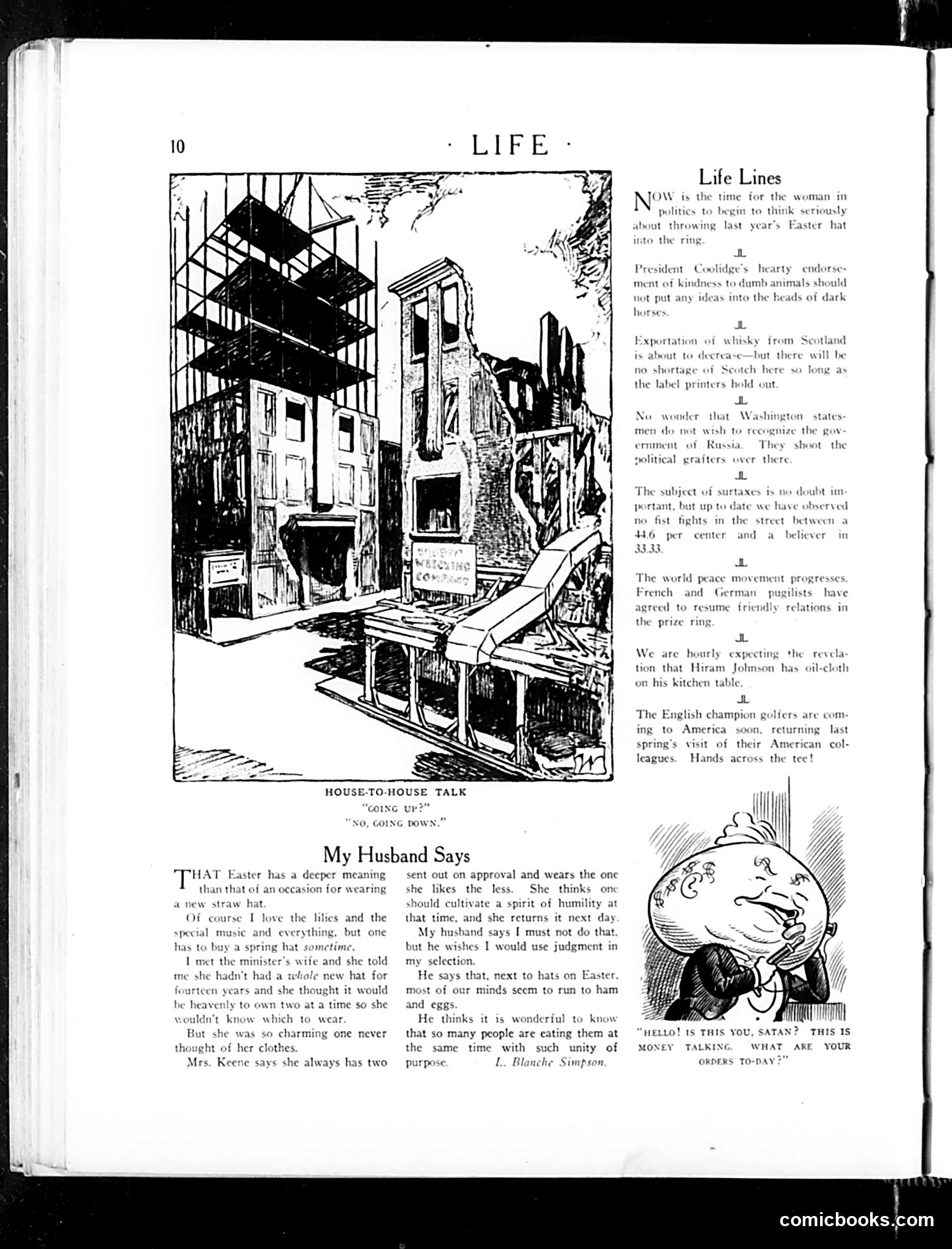
The page contains two distinct sections: **"House-to-House Talk"** (top illustration): A black-and-white sketch showing urban buildings with dialogue about going "up" versus "down"—likely satirizing social class distinctions or residential hierarchies in a city building. **"My Husband Says"** (bottom article): A domestic humor column by L. Blanche Simpson discussing Easter hats and marital perspectives. The author's husband apparently holds particular views about Easter's deeper meaning, hat selection, and eating habits—suggesting gentle satire of gender roles and marital disagreements over taste and tradition. The small cartoon on the right depicts a character asking about "money talking" and someone's "orders to-day"—likely satirizing materialism or business dealings. The "Life Lines" section offers brief social commentary on various topics (Scottish whisky, Washington politics, surface fights, peace movements, etc.), typical of the magazine's satirical approach to contemporary issues.
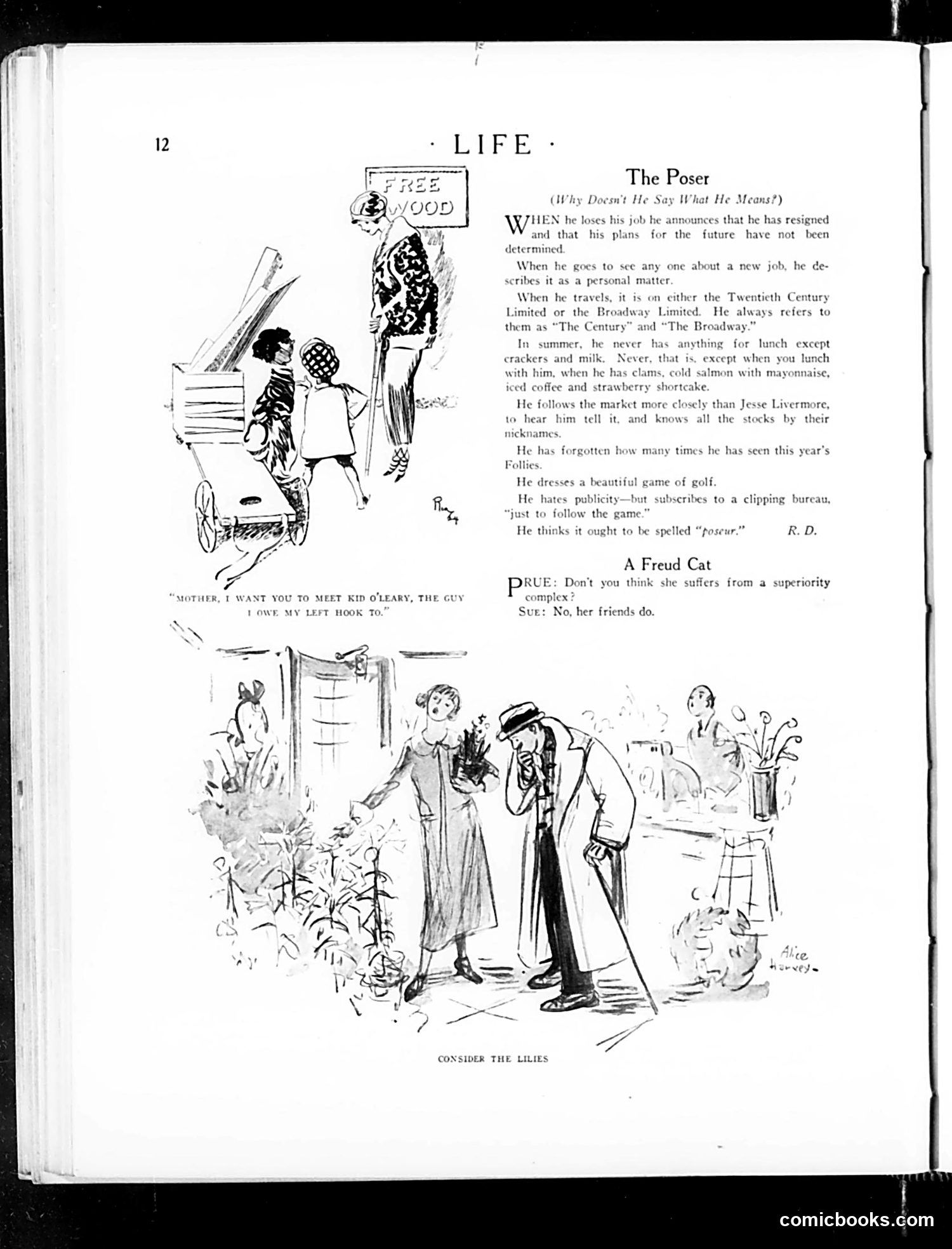
This page contains two satirical pieces from early 20th-century Life magazine: **"The Poser"** (top) mocks an affected man who performs sophistication—name-dropping prestigious trains ("The Century," "The Broadway Limited"), pretending disinterest in lunch details, following stock markets to appear worldly, and adopting golf as a cultured hobby while complaining about publicity. The satire targets wealthy men performing intellectual or financial engagement without substance. **"A Freud Cat"** (bottom) jokes about psychological concepts, likely referencing Freud's theories gaining popularity. One character suggests the woman has a "superiority complex," while she defensively claims her friends don't agree. The cartoon satirizes trendy psychoanalytic terminology being applied casually to social situations, mocking both pseudo-intellectual diagnosis and defensive responses.
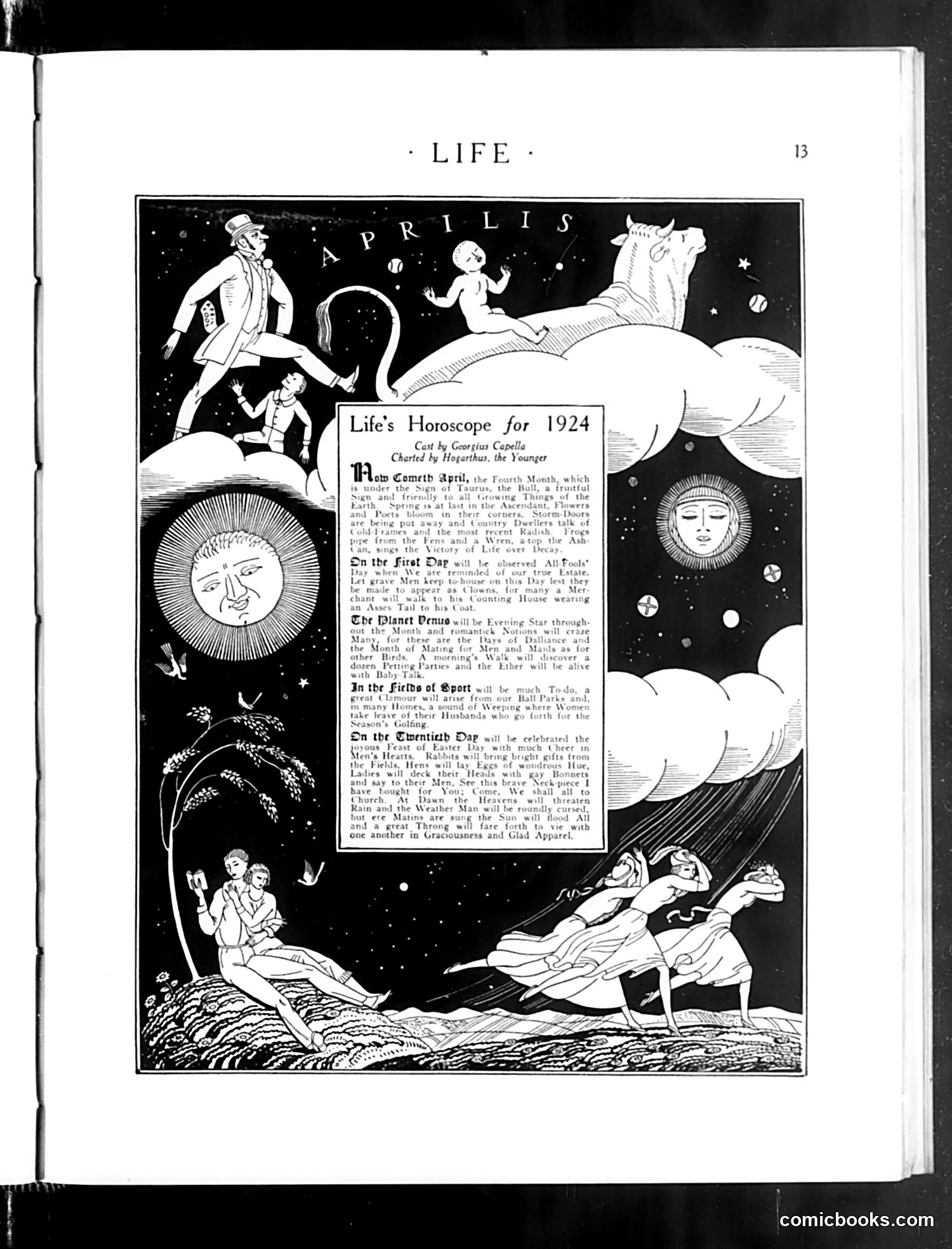
This satirical page presents an astrological horoscope for April 1924, illustrated with Art Deco-style figures and celestial imagery. The horoscope is framed as being "Charted by Hizyartha, the Younger" and offers tongue-in-cheek predictions for various dates and events throughout the month. The satirical intent mocks the popular trend of astrological forecasting during the 1920s. The ornate illustrations—featuring humans interacting whimsically with planetary bodies, cherubs, and mythological elements—parody the pseudo-scientific gravitas with which such predictions were presented to readers. The specific April 1924 predictions appear designed to humorously comment on contemporary social and political events, though the exact references are difficult to identify without additional historical context. The overall effect ridicules both astrology's credibility and 1920s cultural gullibility.
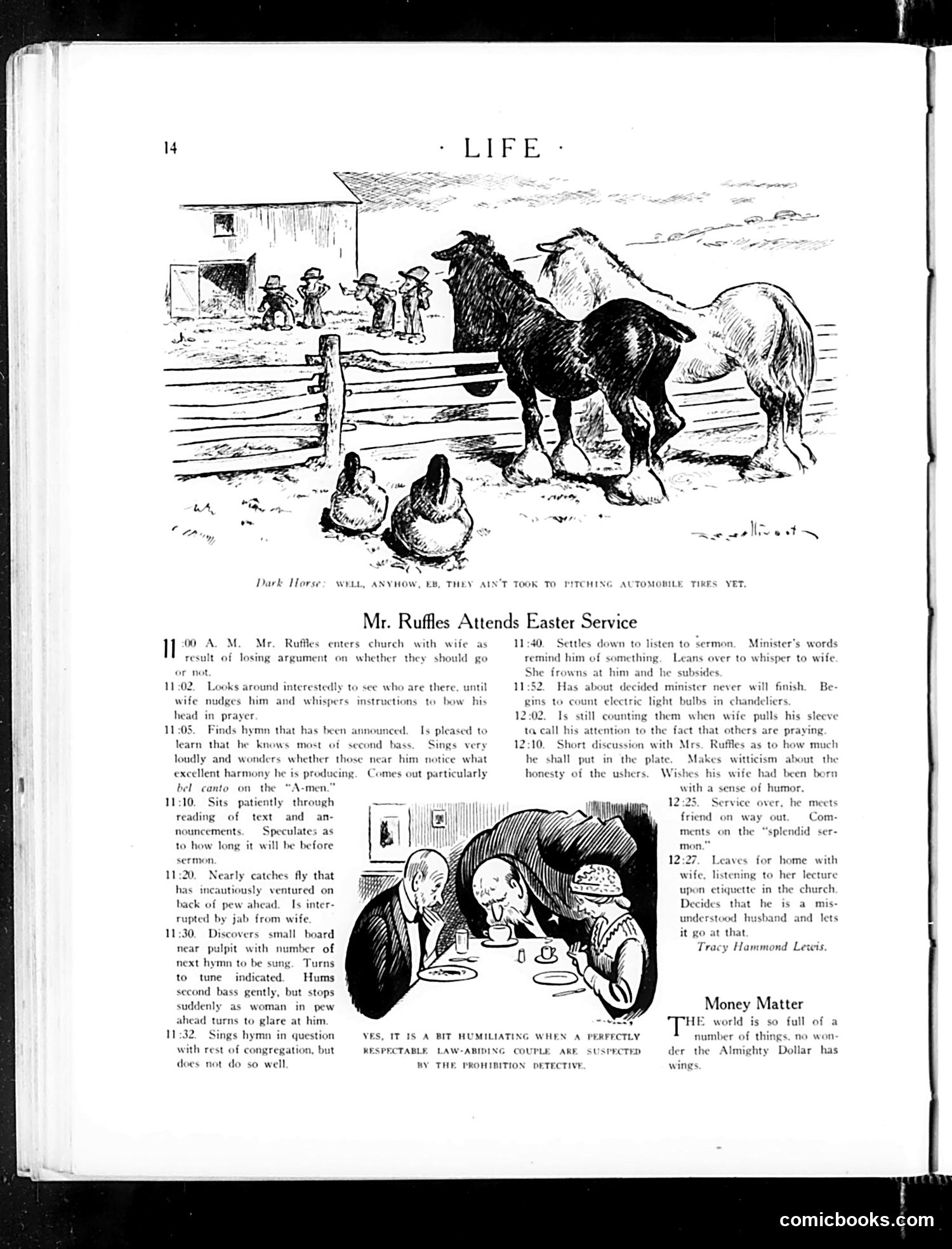
This page contains two satirical pieces: **"Dark Horse" cartoon** (top): Shows farm animals (a dark horse and goat) with chickens in foreground, near a farmhouse. The caption jokes that these animals "ain't took to pitching automobile tires yet"—mocking the absurdity of animals adopting modern technology, likely satirizing either rapid industrialization or public gullibility about technological novelty. **"Mr. Ruffles Attends Easter Service"** (middle): A detailed time-stamped narrative humorously documenting a man's distractions and misbehavior during church—counting light bulbs, fidgeting, making witticisms about hymns. Standard satirical commentary on inattentive churchgoers. **"Money Matter"** (bottom): Brief text beginning a piece about wealth's pervasiveness, with "Almighty Dollar" reference. The page exemplifies *Life* magazine's characteristic humor: gentle mockery of everyday bourgeois life and social pretension.
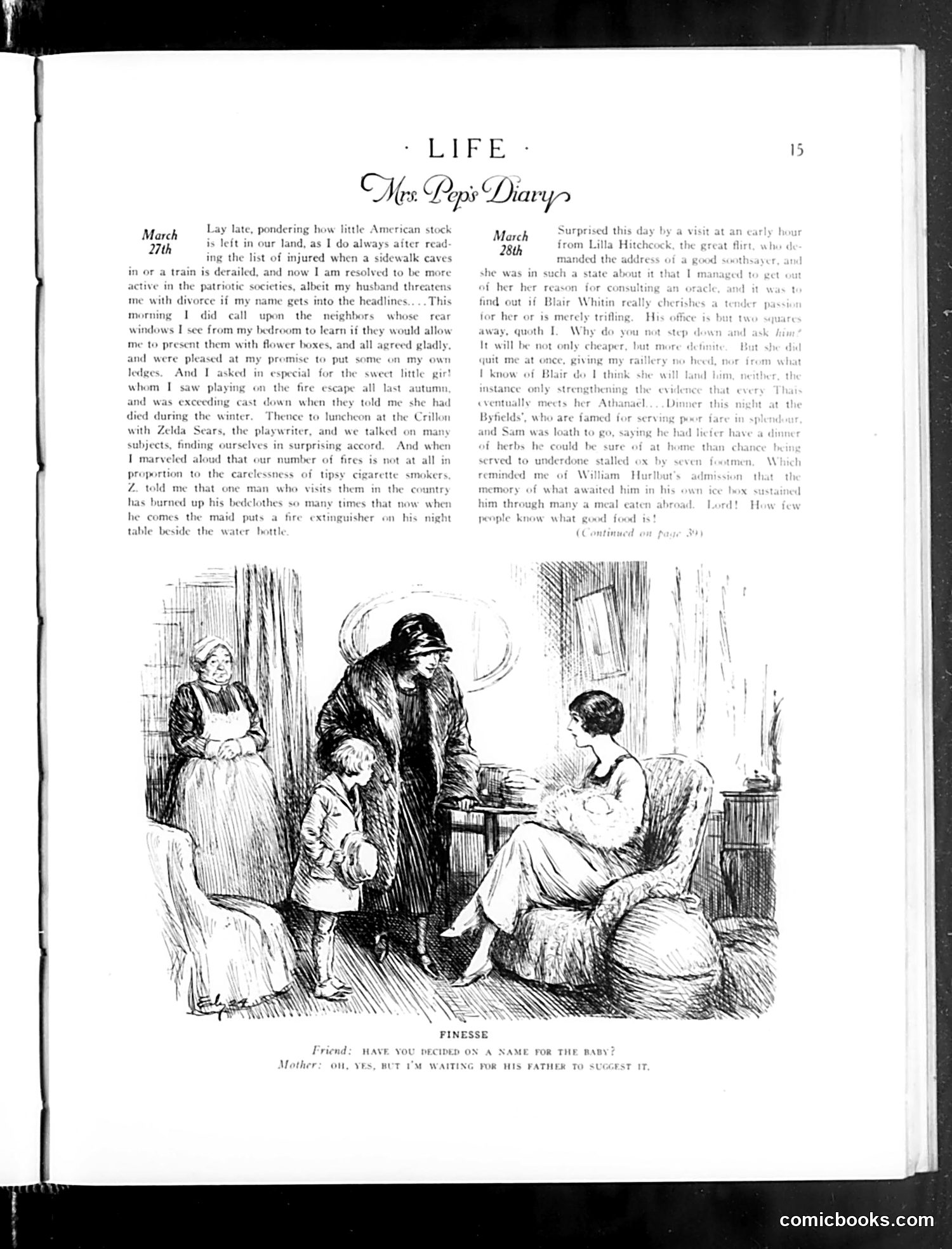
This page contains a satirical diary entry and illustration from the "Mrs. Pep's Diary" column, dated March 26th and 28th. The entries mock upper-class social pretensions and gossip, particularly around patriotic society activities and consulting oracles. The sketch below depicts a social visit where a friend asks a mother about naming her baby. The mother replies she's "waiting for his father to suggest it" — a gentle satire on gender dynamics and decision-making within marriages of the era. The overall tone mocks the superficial concerns of wealthy women: servants, social rivalries, and the leisurely pursuits of the leisured class during what appears to be the World War I period (references to patriotic societies suggest wartime context).
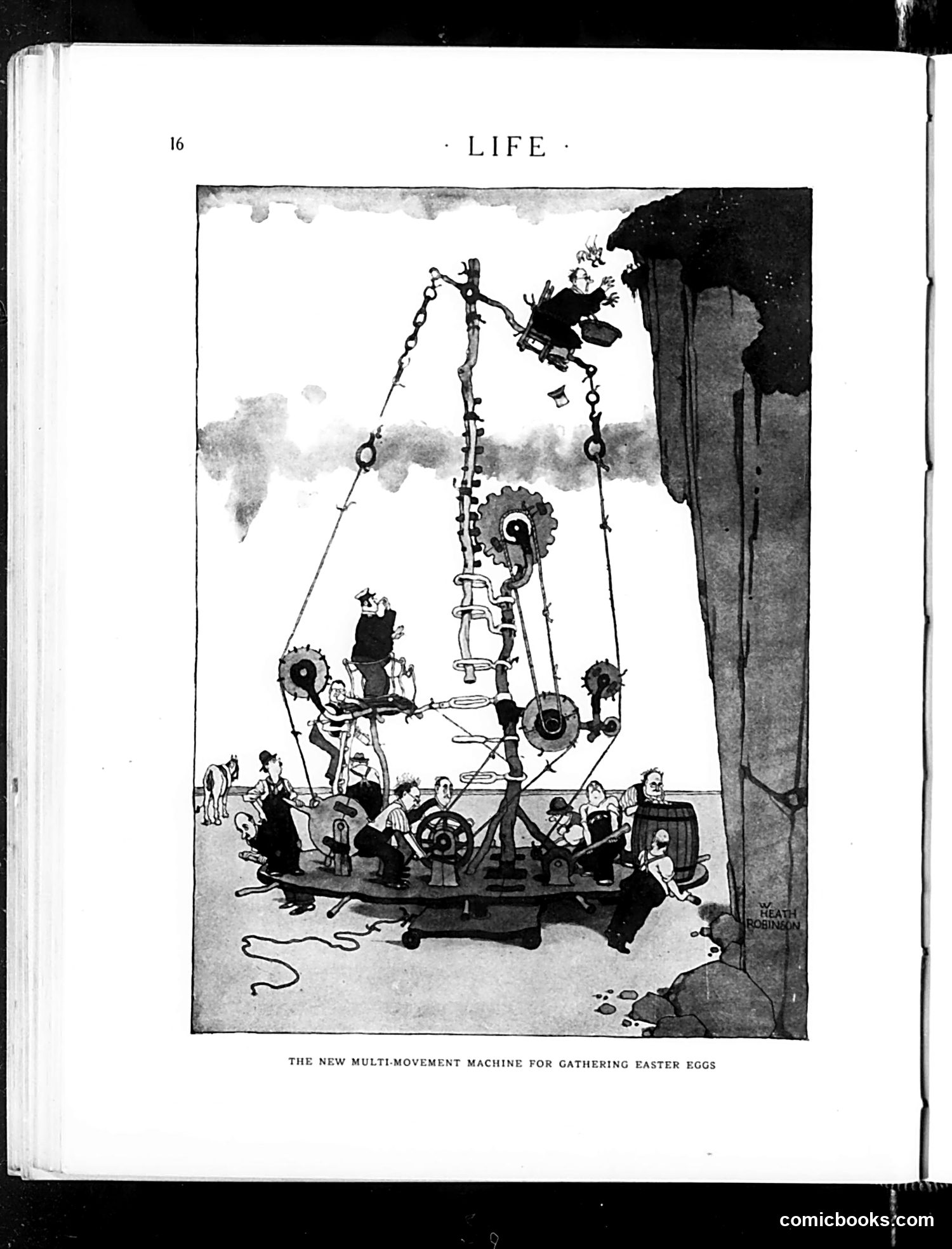
This is a satirical cartoon from *Life* magazine depicting an absurdly over-engineered contraption designed for the simple task of gathering Easter eggs. The illustration shows a Rube Goldberg-style machine with pulleys, gears, chains, and multiple mechanical arms, operated by numerous workers and operators who appear comically overwhelmed by its complexity. The satire mocks the early 20th-century obsession with industrial machinery and "scientific" solutions to everyday problems. Rather than children simply picking up eggs, this cartoon ridicules the era's tendency to over-complicate tasks through mechanical innovation. The many workers frantically managing the device emphasize the absurdity—the machine requires more labor than the original task. It's commentary on industrial-age excess and the impractical application of technology to simple activities.
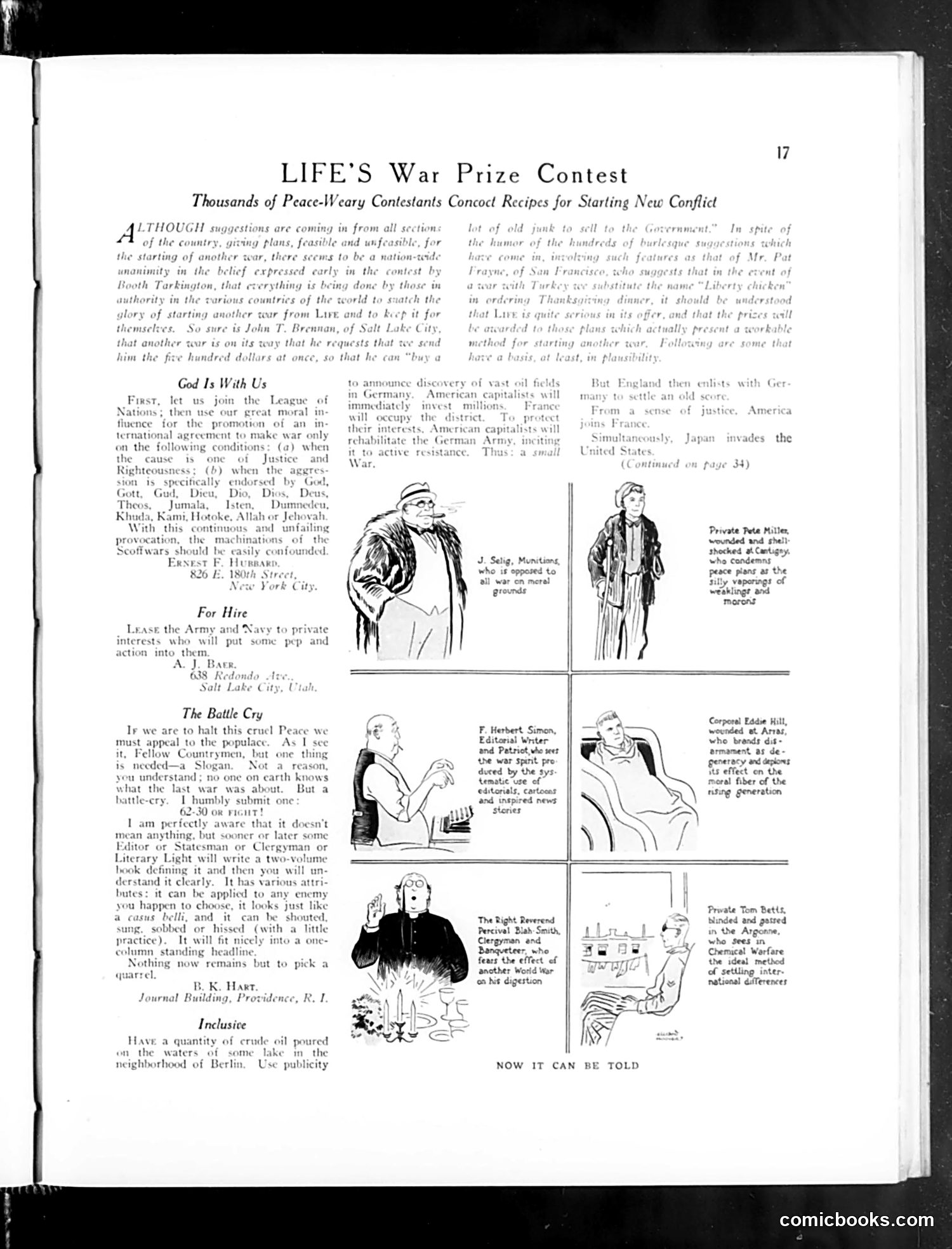
This satirical page mocks post-WWI peace sentiment by holding a darkly humorous "contest" inviting readers to propose recipes for starting new wars. The cartoon figures represent different vocal advocates for renewed conflict: - **Private Pete Miller** (wounded veteran at Cantigny) ironically pushes war despite his injuries - **Corporal Eddie Hill** (wounded at Arras) opposes disarmament, claiming it weakens national character - **Percival Blah Smith** (clergyman/banqueter) worries war's absence will harm young people's moral fiber The satire targets war-hungry voices emerging immediately after WWI's conclusion—veterans, clergy, and politicians claiming peace itself is dangerous. By framing their arguments as "recipes for starting conflict," LIFE ridicules how easily these figures rationalize renewed warfare, suggesting they're so eager for the next war they might as well be consciously plotting it. The piece criticizes militaristic nostalgia and the failure of post-war society to genuinely embrace peace.
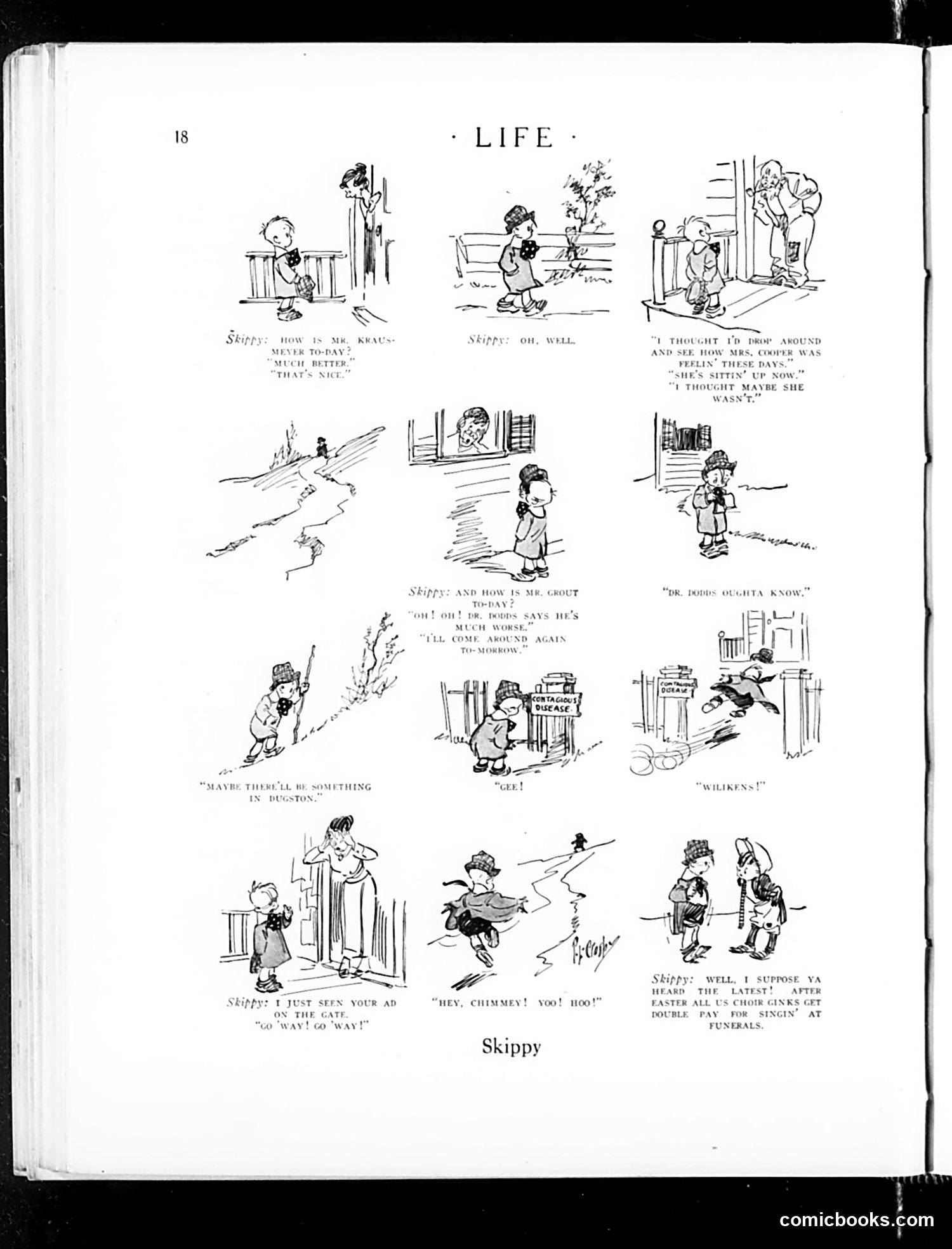
This page features "Skippy," a popular early-20th-century comic strip about a mischievous young boy. The strip depicts Skippy's various childhood escapades and misadventures, including: - Visiting a neighbor (Mrs. Kraus) and finding her sick - Playing outdoors and getting into trouble - Encounters with adults like "Dr. Dodds" and "Wilkins" - A final joke about choir boys earning "double pay for singin' at funerals" The humor derives from Skippy's innocent misunderstandings and the gap between adult and child perspectives. The final panel jokes that if choir boys get paid extra for funeral singing, Skippy's friend has spotted an advertisement for this opportunity—implying dark, child-like humor about profiting from death. The strip satirizes nothing political; rather, it's gentle domestic humor aimed at family audiences, typical of Life magazine's lighter content alongside its satirical pieces.
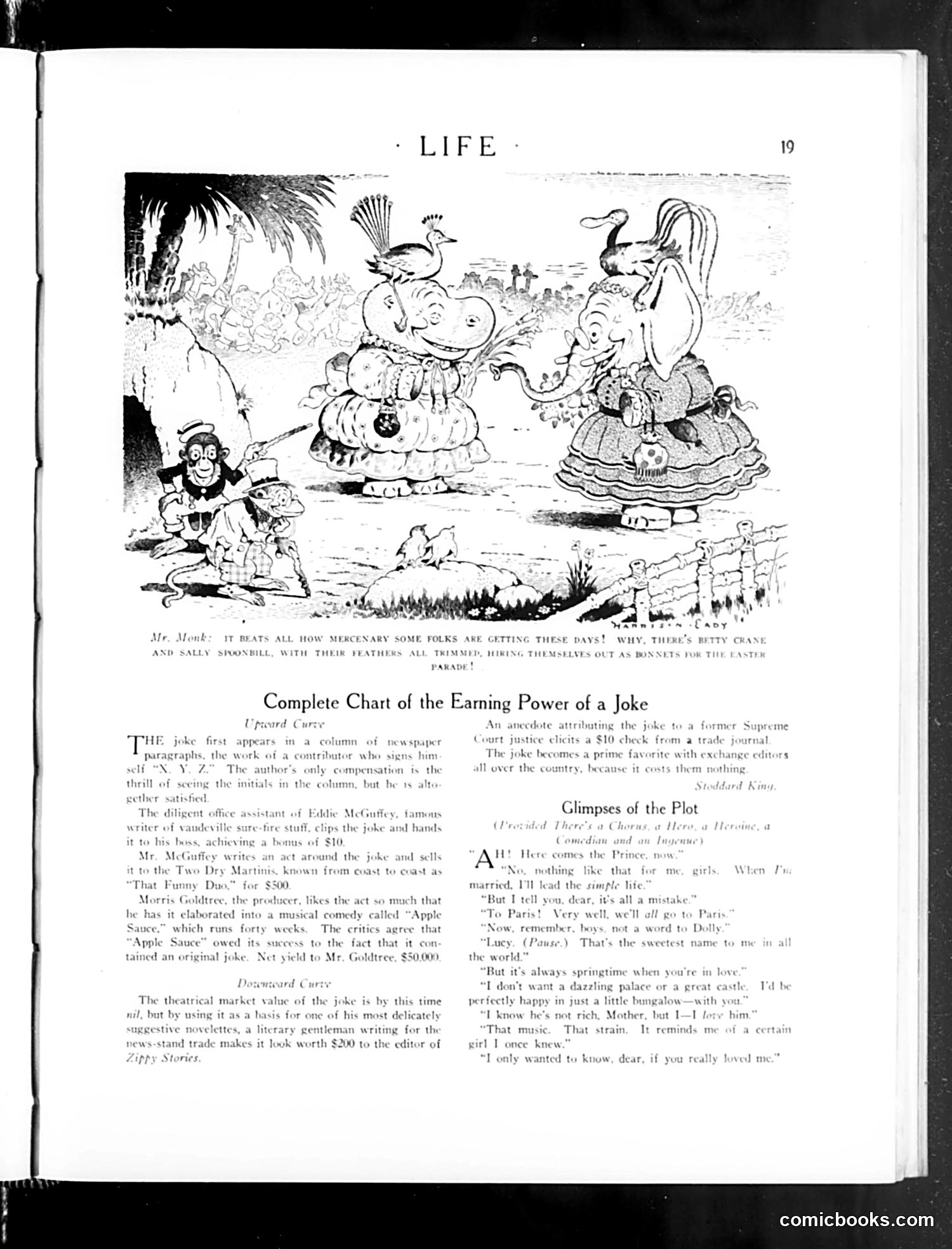
This page satirizes the **commercialization of humor and entertainment** in early 20th-century America. The cartoon at top depicts anthropomorphic birds (likely representing theatrical performers or entertainers) dressed as fashionable ladies, with a monkey character observing. The caption criticizes how "mercenary" people have become, specifically mocking performers who exploit their feathers as Easter bonnet decorations—a commentary on how entertainers commodify even trivial aspects of their acts for profit. Below, "Complete Chart of the Earning Power of a Joke" traces how a single joke generates income as it circulates: from newspaper columnist to office assistant ($10), to vaudeville performers, producers, and eventually theatrical productions earning thousands. The accompanying dialogue snippets mock overwrought dramatic adaptations. The satire targets **theatrical greed and the transformation of simple comedic material into bloated commercial enterprises**, where earnest performers and producers extract maximum profit from minimal creative substance. It's commentary on entertainment industry excess and the degradation of art through monetization.
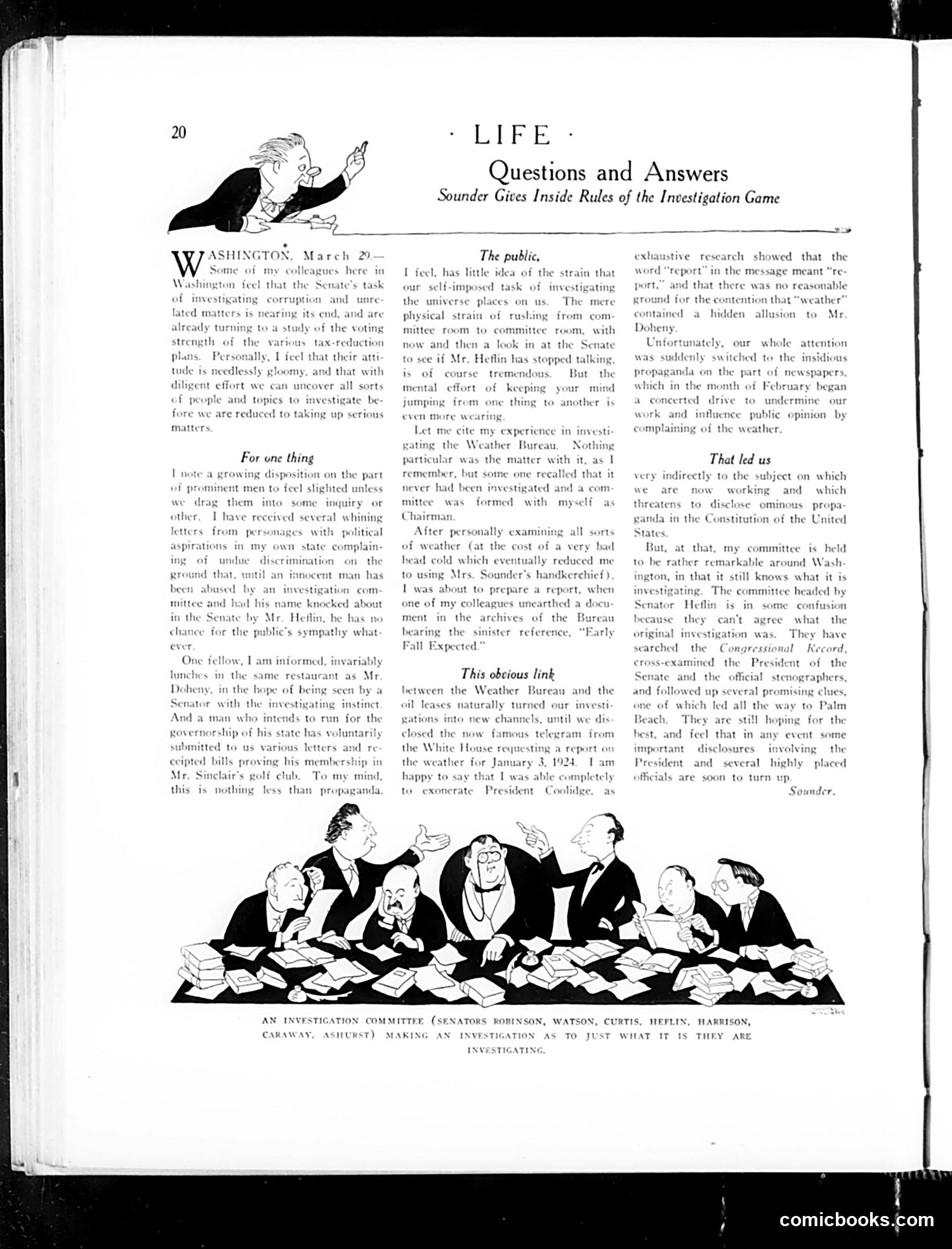
This satirical article mocks Senate investigation committees investigating unspecified corruption. The author (identified as "Sounder") describes how such inquiries become exhausting exercises in bureaucratic confusion—committees shift focus repeatedly, chase tangential leads, and lose sight of their original purpose. The cartoon depicts senators (including Robinson, Watson, Curtis, Heflin, Harrison, and Caraway) buried in mountains of paperwork, illustrating the absurdity of their chaotic investigative process. The satire suggests that Senate investigations are more theater than substance: they generate propaganda through newspapers, distract from actual wrongdoing, and ultimately accomplish little. The implication is that these political exercises—ostensibly about transparency—actually obscure rather than clarify governmental accountability. The article's tone is mordant commentary on institutional incompetence during the Harding administration era, when multiple scandals prompted Senate inquiries.
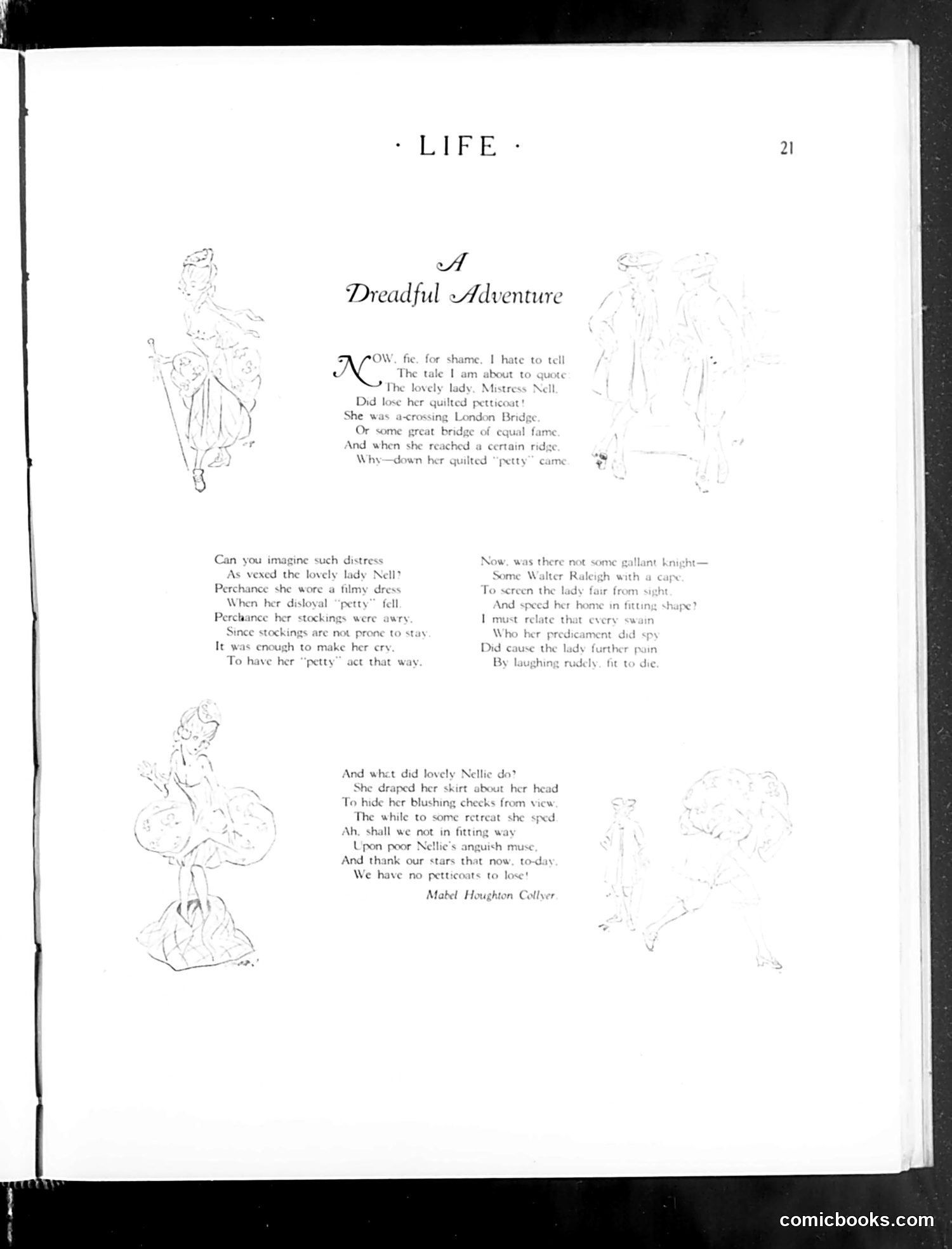
This is a humorous poem by Mabel Houghton Colyer about a lady named Nell experiencing wardrobe malfunction. The illustrated narrative describes her crossing a bridge when her quilted petticoat falls down—a mortifying accident in the era when such undergarments were essential to modesty. The satire targets Victorian propriety: the poem sympathetically catalogs Nell's distress (torn stockings, exposed undergarments) while mocking the absurdity of women's fashion constraints. The punchline celebrates modern times: "thank our stars that now, today / We have no petticoats to lose!" The accompanying sketches show a woman in period dress and figures observing her predicament. The joke reflects early-to-mid 20th-century attitudes toward women's liberation from restrictive Victorian clothing—positioning contemporary readers as enlightened compared to previous generations' fashion tyranny.
This page contains editorial commentary on President Eliot of Harvard (who has just turned 90) and contemporary political figures. The cartoons and text satirize American newspaper consolidation and the 1924 presidential race. **Main figures:** - **President Eliot**: celebrated for remaining vigorous at 90, contrasted with mere survival - **Mr. Munsey**: criticized for consolidating newspapers (the Herald has been absorbed), representing dangerous corporate control of media - **Mr. Coolidge**: the Republican presidential frontrunner - **Mr. McAdoo**: Democratic candidate campaigning in the South - **Al Smith**: New York politician being discussed as a possible candidate **The satire**: The piece mocks how newspaper consolidation reduces editorial diversity and independence—when a man acquires a newspaper, the newspaper acquires the man. It warns that excessive advertising costs and competitive pressures force papers to sacrifice editorial integrity, using Munsey's Herald acquisition as a cautionary example of media monopolization threatening democratic discourse.
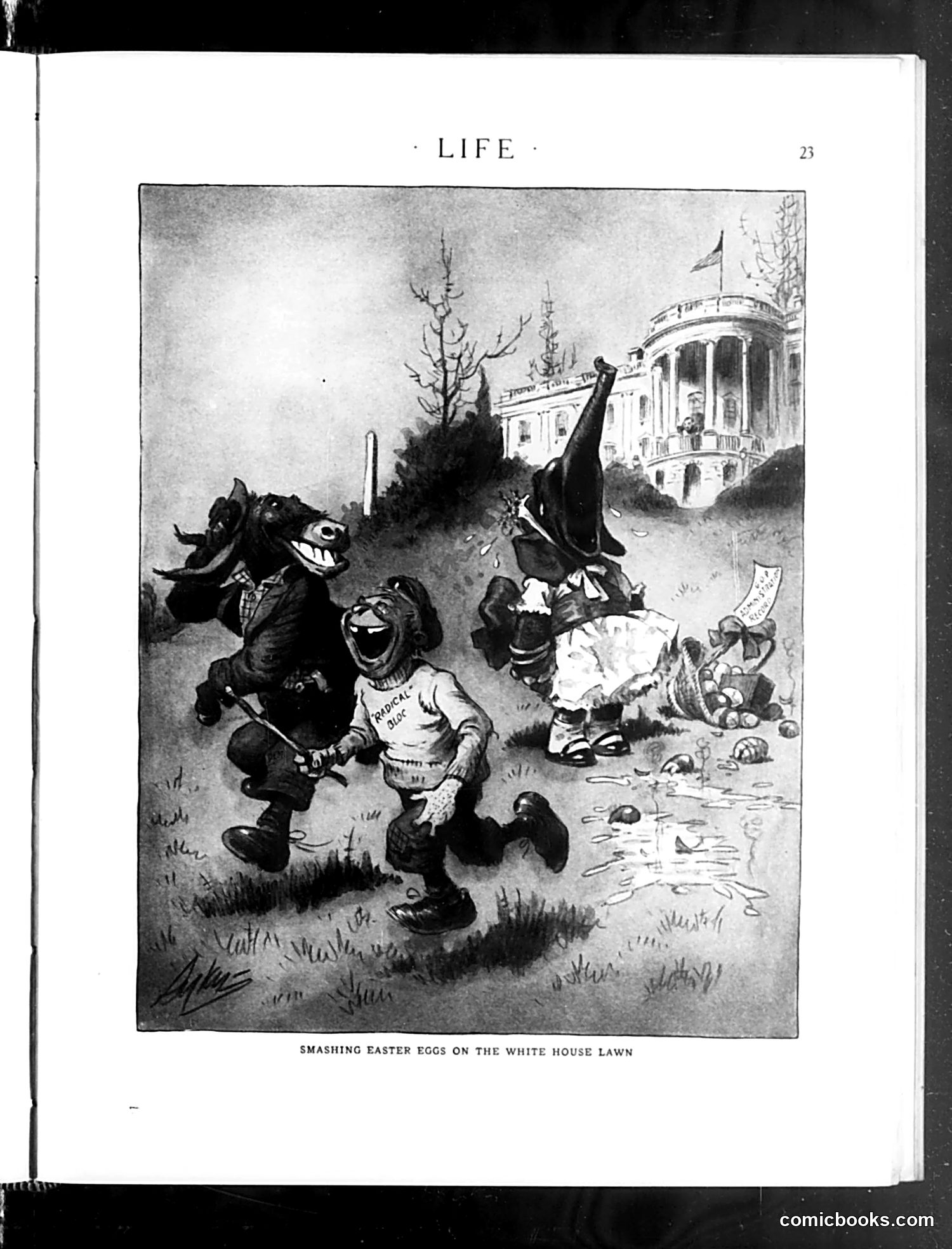
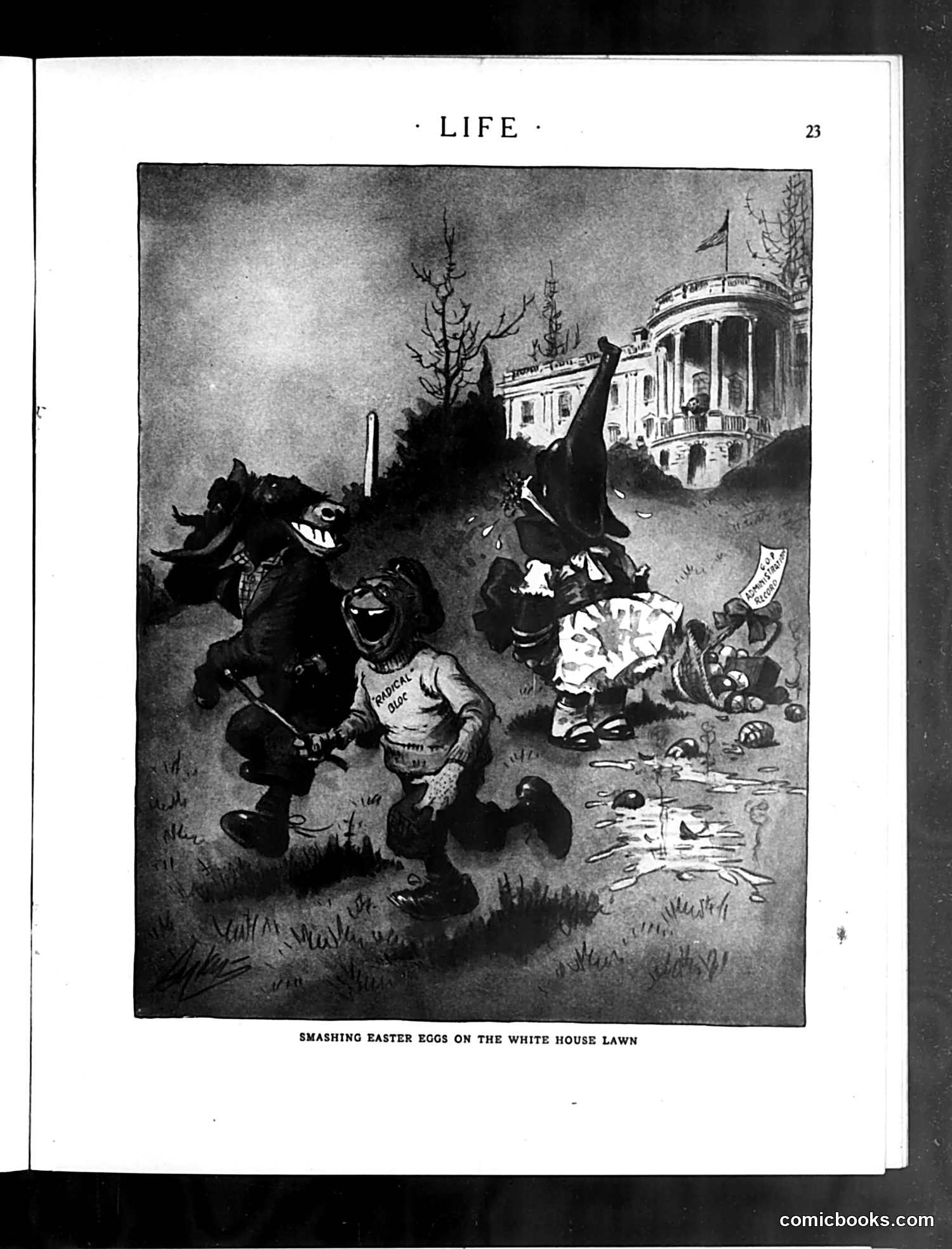
This satirical cartoon depicts an Easter Egg Roll—the White House's traditional spring celebration—as anarchic chaos. Anthropomorphic animal characters, some wearing military or formal attire, violently "smash" Easter eggs on the lawn while the White House looms in the background. The satire appears to critique political figures or government officials as destructive and uncouth, transforming a genteel holiday tradition into mayhem. The exaggerated violence and animal characterization suggest mockery of those in power, portraying them as barbaric rather than dignified stewards of the nation's house. Without visible dates or clearer character labels, the specific political targets remain unclear, though the cartoon likely responds to contemporary scandals or policy disputes from Life magazine's publication era.
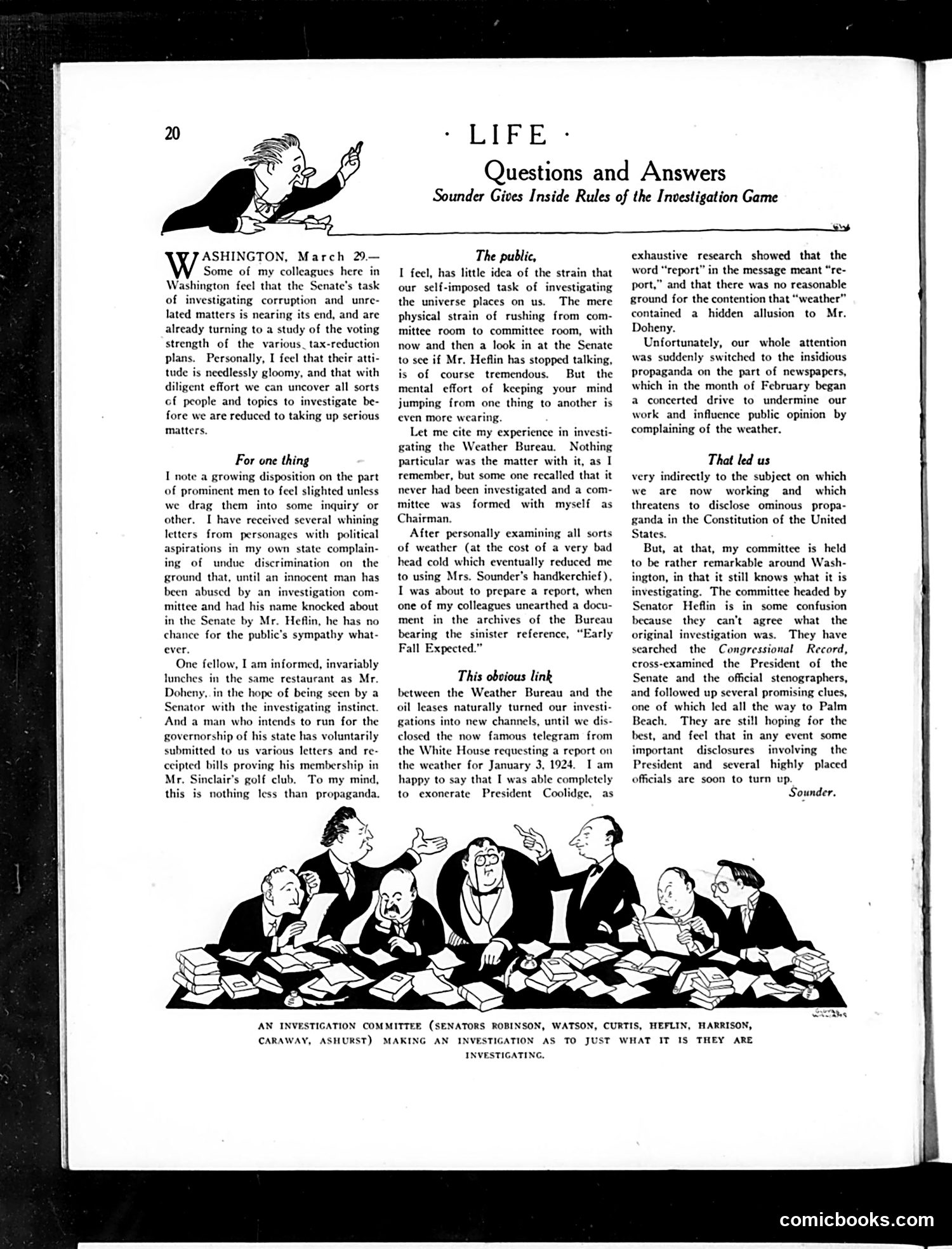
This Life magazine piece satirizes the Senate's sprawling corruption investigations of the early 1920s, particularly targeting their lack of focus and apparent endless scope. **The Context:** The text references real investigations into oil scandals (Teapot Dome, Doheny's involvement) and mentions Senator Thomas Heflin, known for aggressive questioning. The anonymous columnist "Sounder" mocks how senators drag prominent men into inquiries for political theater. **The Satire's Point:** Senators investigate trivial matters (the Weather Bureau) and manufacture connections between unrelated documents (a telegram about January weather somehow linking to oil leases and Doheny). The humor lies in showing how investigations spiral absurdly—starting nowhere, discovering "sinister" documents that mean nothing, and eventually threatening to expose "propaganda in the Constitution." **The Cartoon:** Six senators hunched over mountains of papers, bewildered, perfectly illustrates the text's complaint that even the investigators don't know what they're investigating anymore. The broader critique: Senate investigations have become performative exercises where senators gain publicity by investigating everything and proving nothing.
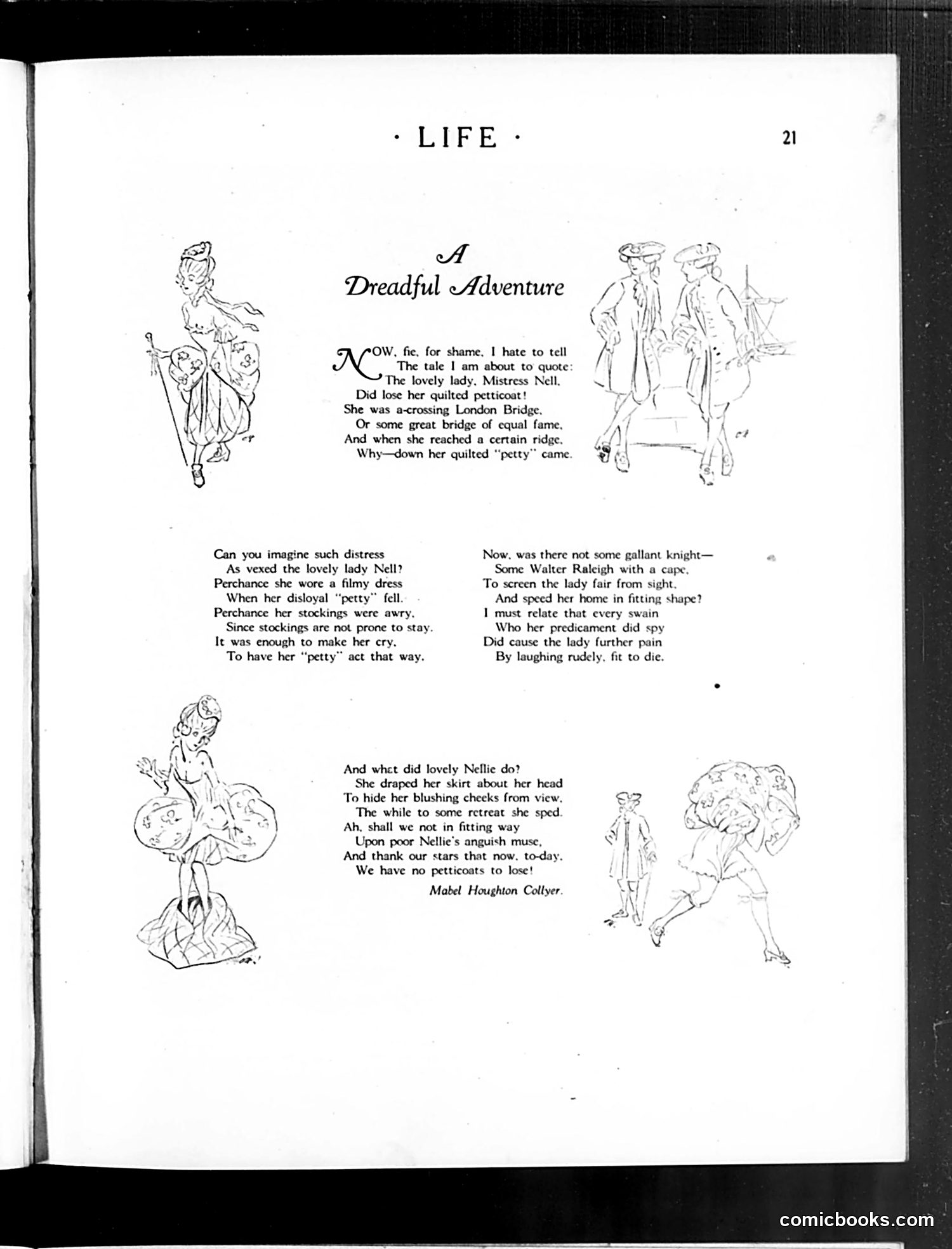
This humorous poem by Mabel Houghton Collyer mocks the exaggerated propriety and fashion anxieties of a bygone era—likely the Victorian or Edwardian period. The "dreadful adventure" is a woman named Nell losing her quilted petticoat while crossing London Bridge, causing her acute embarrassment. The satire works on multiple levels: it ridicules both the absurdity of women's restrictive undergarments and the extreme mortification such an incident supposedly caused. The poem ironically invokes romantic rescue fantasies (a "gallant knight" like Sir Walter Raleigh) while noting that onlookers merely laughed rudely. The concluding couplet—expressing gratitude that "we have no petticoats to lose"—suggests this was written for a modern (early 20th-century) audience, positioning contemporary women as liberated from such fashion constraints and outdated modesty conventions. The accompanying period-costume illustrations underscore the antiquated nature of the scenario being mocked.
This page celebrates **President Charles W. Eliot of Harvard**, who has turned 90. The article praises his vigor and forward-thinking nature despite his advanced age—remarkable for someone in such a traditionally conservative institution. Eliot is presented as a "bold spirit" and "great builder" who remains engaged with progress rather than clinging to the past. The second article criticizes **newspaper publisher Frank Munsey's** consolidation of New York papers. The *Herald* has been merged into the *Tribune*. Life laments that readers once formed emotional attachments to newspapers, but Munsey's aggressive buying, selling, and merging of publications has made loyalty impossible—papers disappear "next week." The writer resignedly accepts that the *Tribune* will handle Republican politics adequately, even if the *Herald* is lost in the process. This reflects Progressive-era anxieties about corporate consolidation destroying beloved institutions.
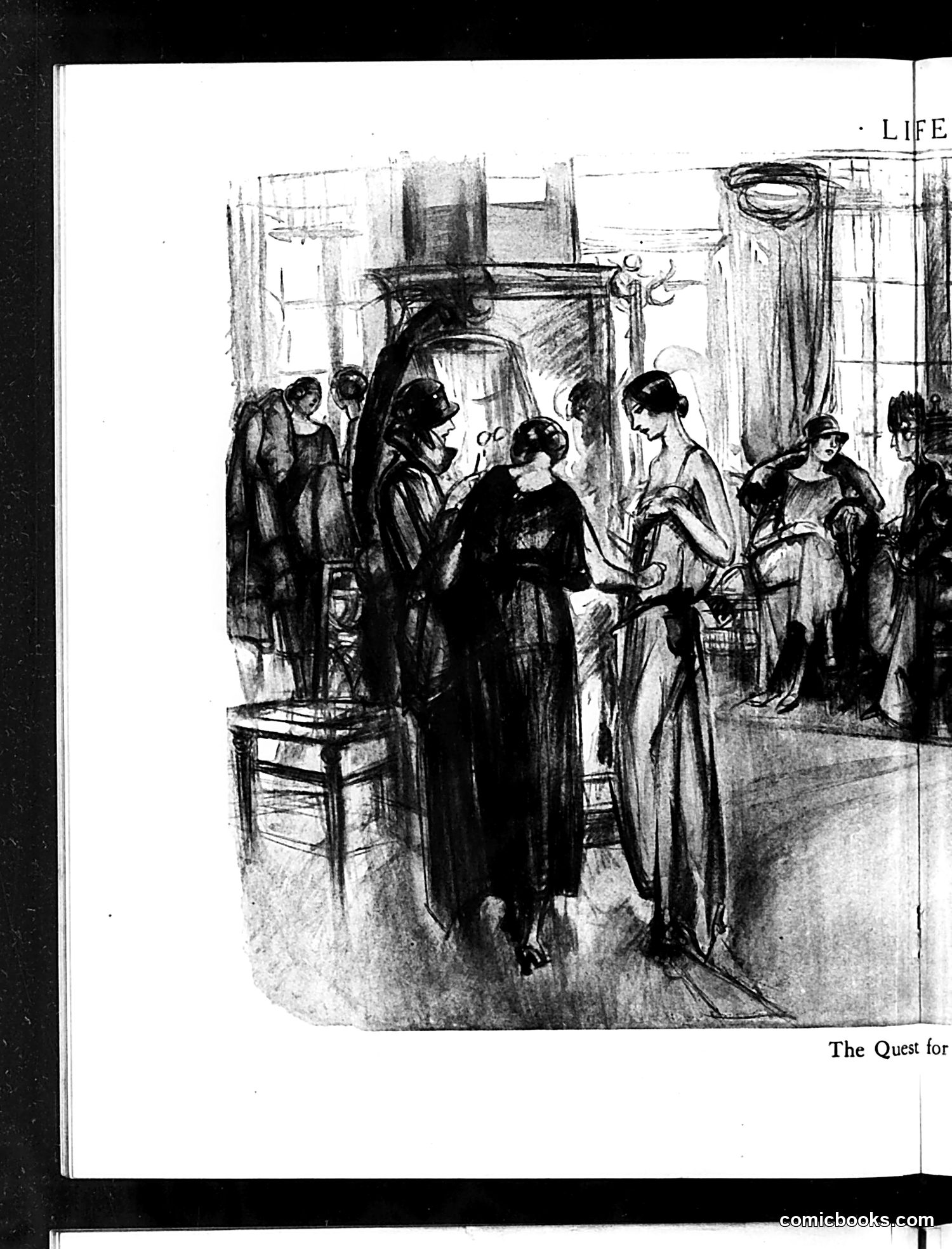
This appears to be an illustration from *Life* magazine showing an indoor social scene, likely from the early-to-mid 20th century. A woman in dark clothing stands centrally among a group of fashionably dressed people in what appears to be an elegant interior space. The partial caption reads "The Quest for..." which suggests this is either satirizing a search or pursuit of some kind—possibly social status, romance, or acceptance. The style of dress and setting suggest commentary on upper-class or high-society behavior. However, without the complete caption visible, the specific satirical target remains unclear. The illustration's exact point—whether mocking social climbers, dating rituals, or something else—cannot be definitively determined from the image alone.
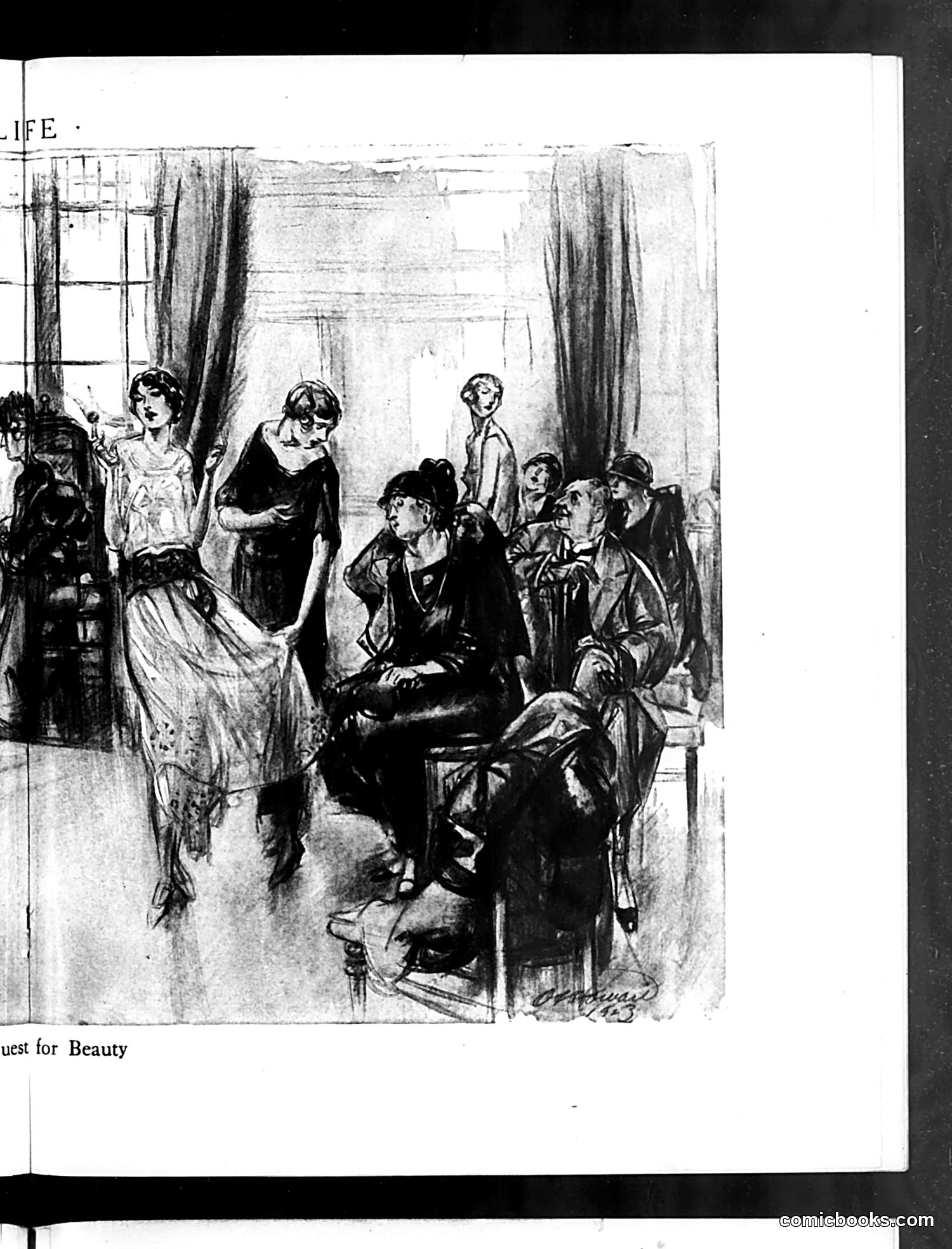
This appears to be an illustration titled "Quest for Beauty" from Life magazine. The sketch shows a woman in an elegant light dress on the left encountering a group of working-class men in darker, worn clothing on the right. The men appear rough and weathered, possibly laborers or soldiers. The satire likely comments on class distinction and the contrast between feminine beauty ideals and masculine working-class reality. The "quest" may mock either women's pursuit of beauty standards or the collision between refined society and working people. The artistic style—loose, expressive sketching—emphasizes this social divide through visual contrast. Without seeing the full article text, the exact satirical target remains unclear, though it addresses contemporary early-20th-century social attitudes about class and gender.
This page contains three satirical theater reviews from Life magazine. The critic savagely mocks Eugene O'Neill's play "Welded," calling it tediously slow and repetitive—actors deliver the same lines ("I love you," "I hate you") so monotonously that the critic threatens to scream. He praises the actors (Ben-Ami and Doris Keane) while blaming O'Neill's script for the play's glacial pacing and dialogue. The critic also reviews Israel Zangwill's "We Moderns," which satirizes 1911 radicals and "advanced" thinkers. Zangwill mocks modernists through caricatured characters representing various contemporary movements: the New Woman (who rides bicycles in bloomers), Cubism, and Free Love—all equipped with pretentious, fake epigrams. The reviews showcase Life's trademark irreverent theater criticism of the era.
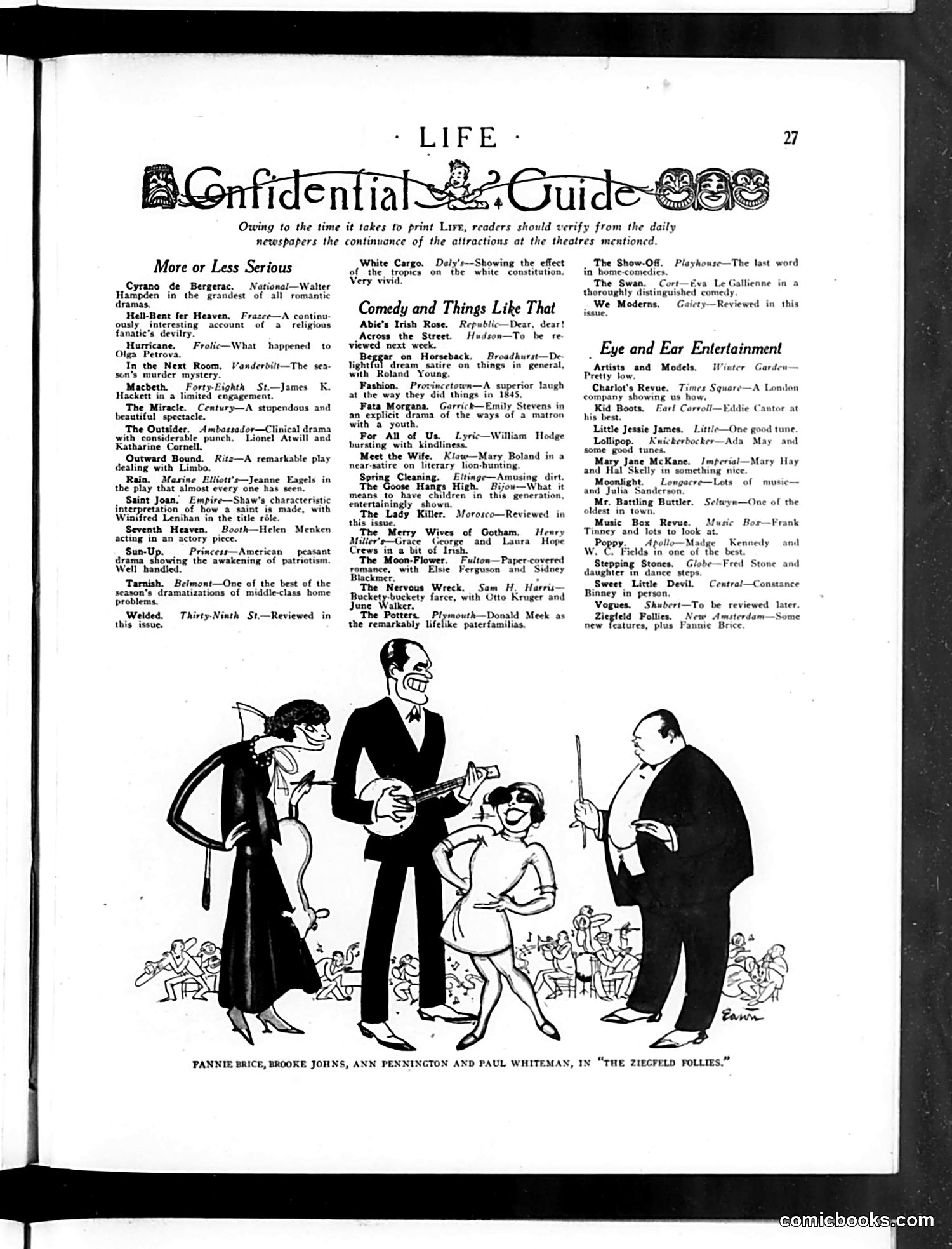
This page from *Life* magazine is a theatre guide listing contemporary Broadway shows (circa early 1920s). The cartoon at bottom illustrates the famous *Ziegfeld Follies*, a lavish revue known for elaborate staging and glamorous performers. The illustration shows four figures: **Fannie Brice** (comedian), **Brooke Johns**, **Ann Pennington** (dancer), and **Paul Whiteman** (bandleader). They're depicted among a crowd of chorus girls, capturing the Follies' characteristic blend of star performers and massive ensemble casts. The satire is gentle—the exaggerated caricatures and the tiny chorus members beneath the stars poke fun at the Follies' grandiose spectacle and its emphasis on star power over individual performers. The page itself serves primarily as an entertainment guide rather than hard political satire, reflecting *Life's* role as both satirical magazine and cultural chronicler of 1920s Broadway.
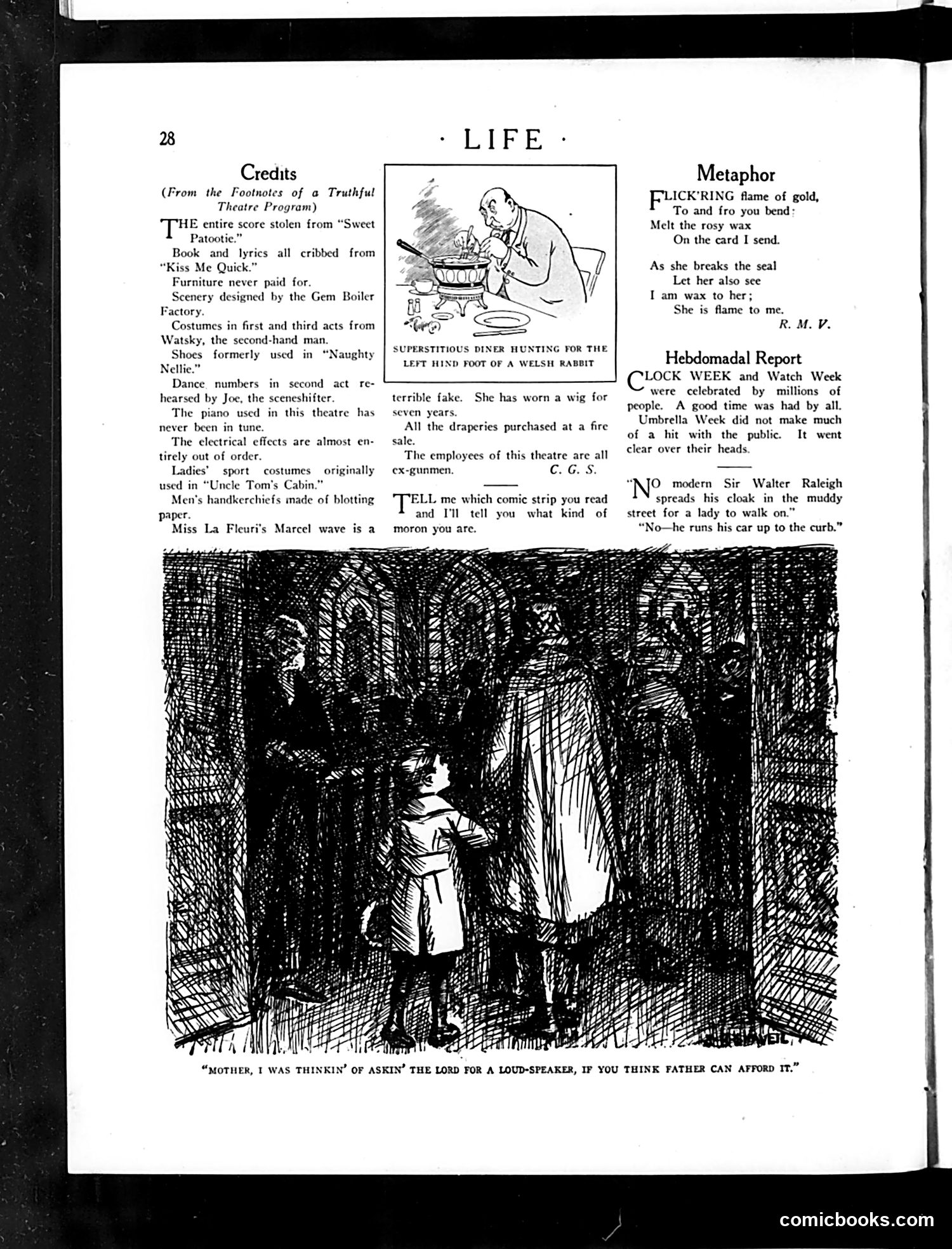
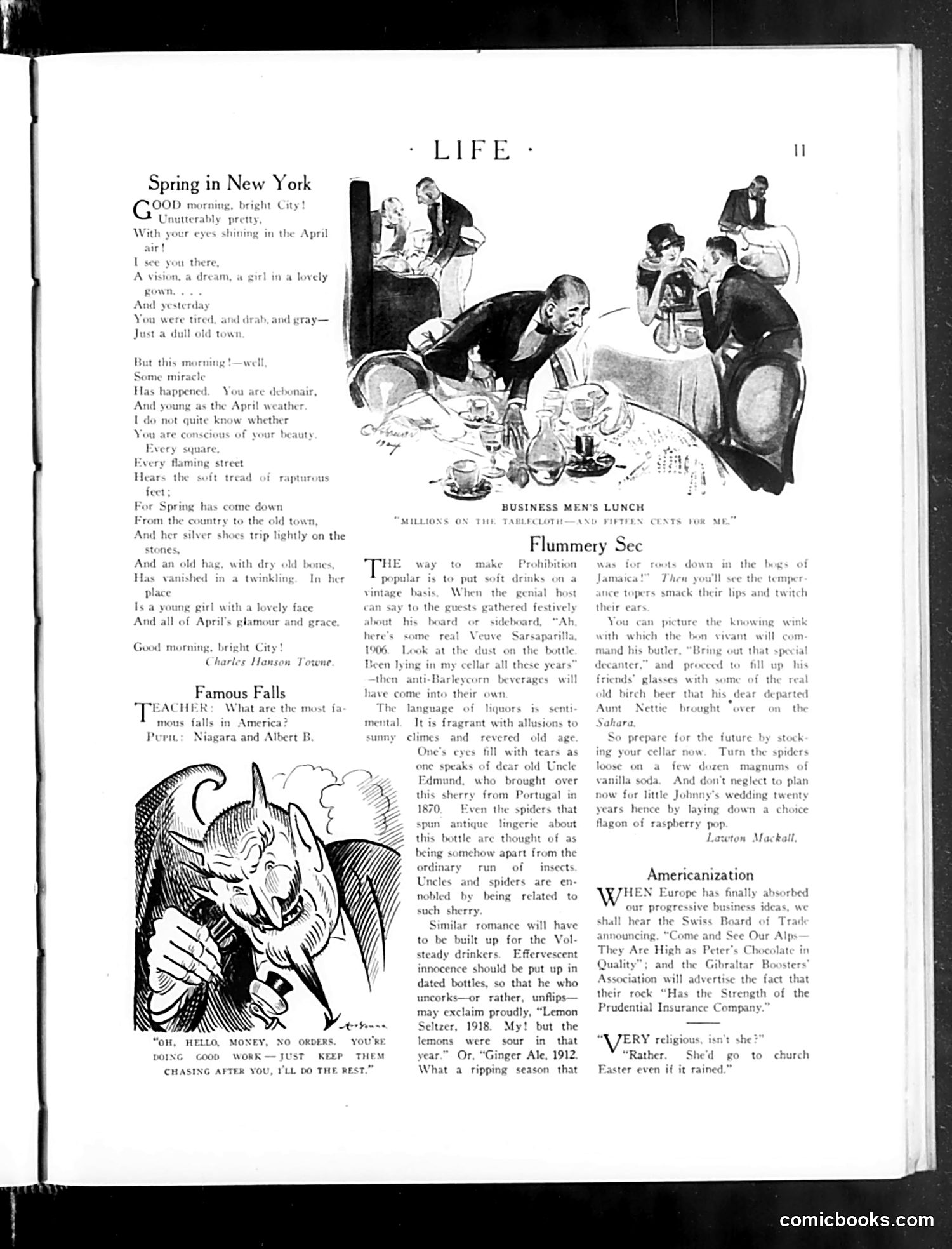
This page contains multiple satirical pieces typical of Life magazine's humor: **"Credits" section**: A mock theatre program that humorously exposes theatrical fraud and penny-pinching—stolen music, unpaid furniture, secondhand costumes from other productions, a never-tuned piano, broken electrical effects, and employees who are "ex-gunmen." This satirizes shabby theater productions and dishonest theater owners who cut corners while charging admission. **"Superstitious Diner" cartoon**: A man searches under a table for a rabbit's foot—a folk superstition about luck—creating absurdist humor. **"Metaphor" poem**: A sentimental love poem using candle wax as extended metaphor. **"Hebdomadal Report"**: Brief satirical notes about themed weeks ("Clock Week," "Watch Week," "Umbrella Week"), with humor in the pun that Umbrella Week "went clear over their heads." **Sir Walter Raleigh reference**: Contrasts the romantic historical legend (spreading his cloak) with modern rudeness (parking car at curb). **Final cartoon**: A child asks God for a loud-speaker if father can afford it—satire on materialism and conspicuous consumption in modern families.
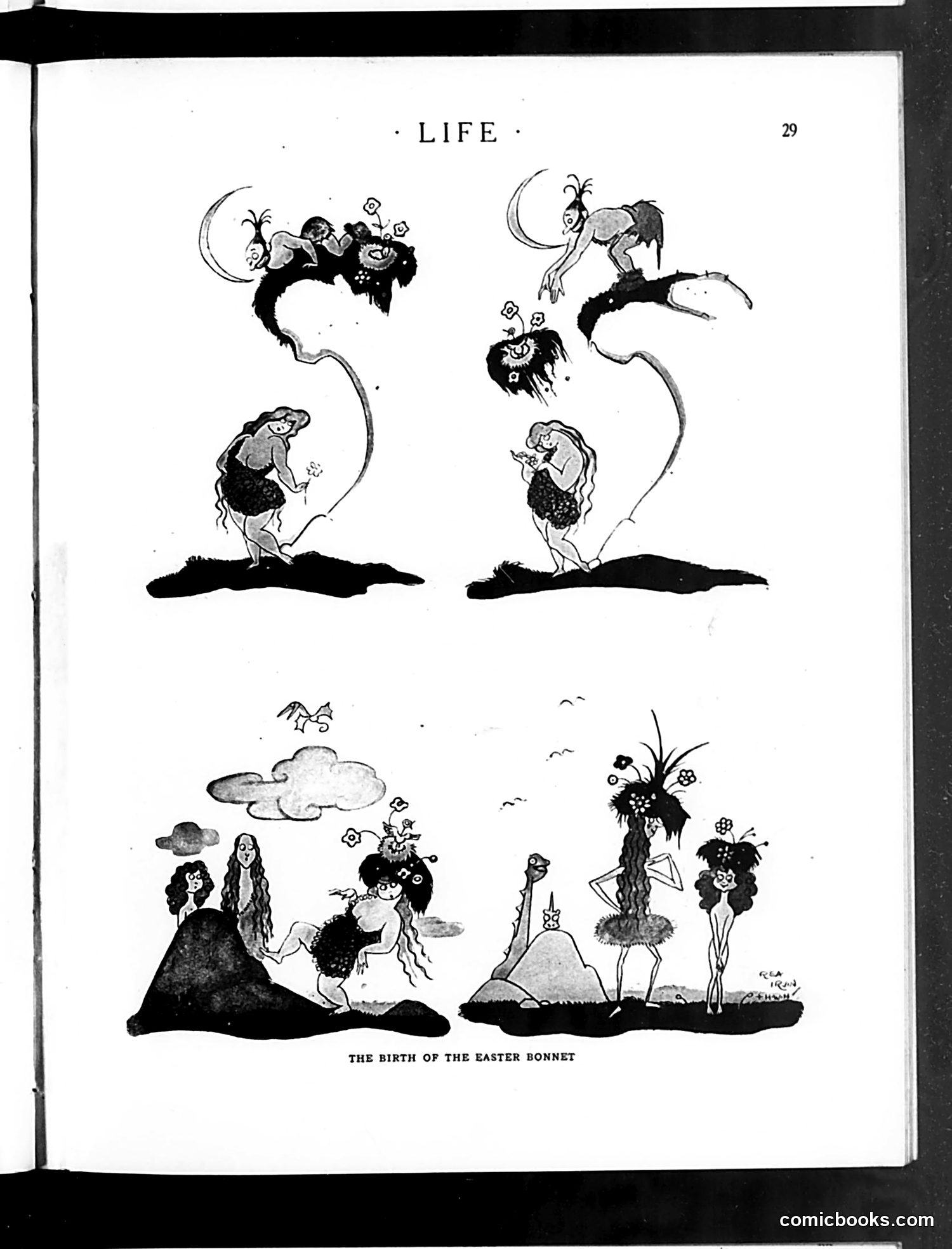
This satirical comic strip depicts the creation of Easter bonnets through absurdist humor. The top panels show women "growing" elaborate hats from their heads like plants, with fantastical creatures and decorations sprouting upward. The bottom panel, labeled "THE BIRTH OF THE EASTER BONNET," illustrates the final result: extravagantly decorated women's hats adorned with flowers, feathers, and other ornaments. The satire targets the early 20th-century fashion tradition of increasingly elaborate Easter bonnets—particularly their ridiculous excess and the cultural obsession with women's hat fashion. By depicting hat creation as a fantastical, almost botanical process involving magical growth, the cartoonist mocks both the impracticality of these designs and the social pressure women faced to wear them.
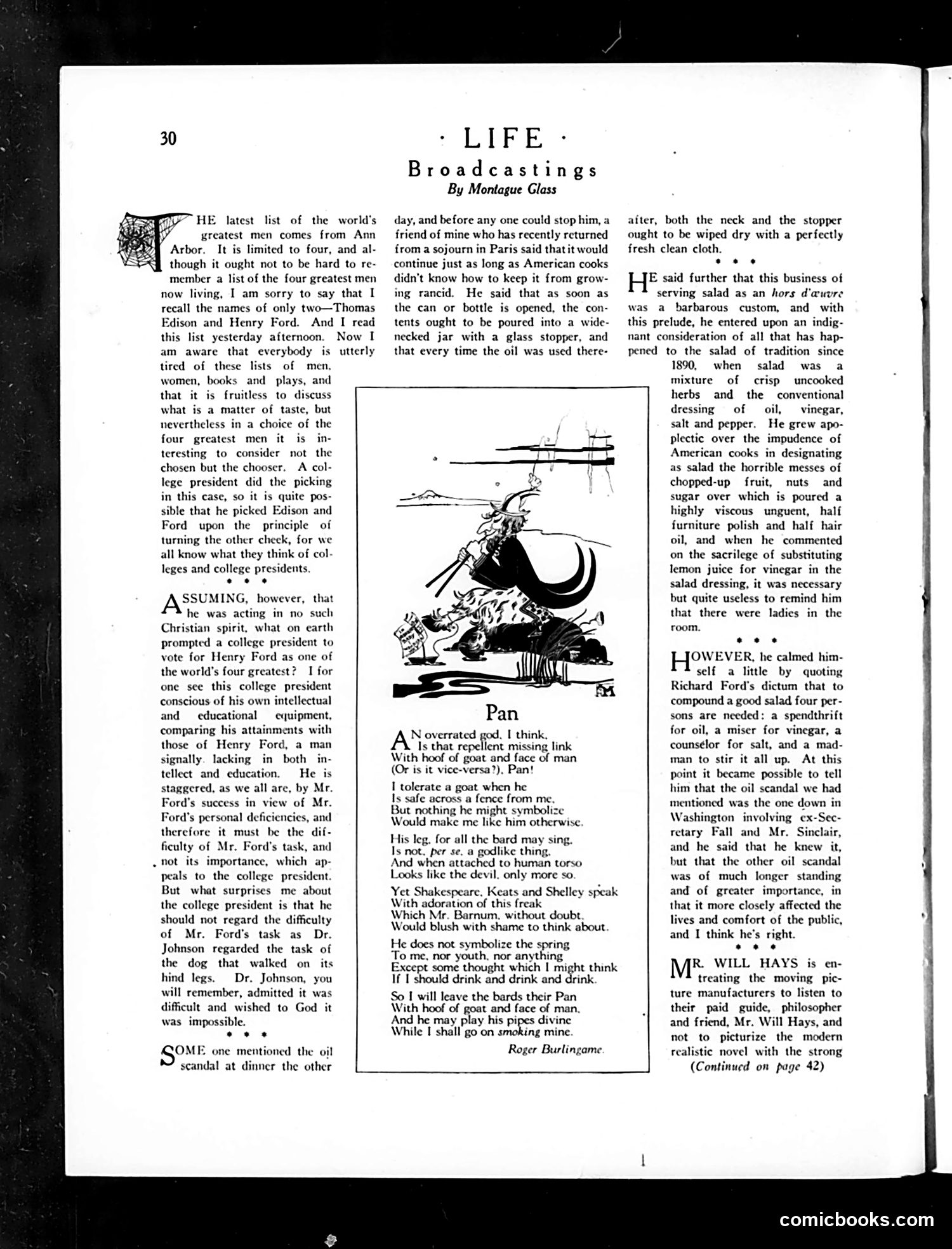
This page satirizes American cultural reverence for industrial titans. The main article by Montague Glass mocks a University of Michigan president's list naming Henry Ford among history's four greatest men. Glass questions the logic: Ford lacks intellectual education, yet the president ranked him alongside Edison—suggesting the president was awed by Ford's *difficulty* rather than *importance* of his task. The accompanying poem "Pan" by Roger Burlingame parodies Romantic poets' idealization of the classical god Pan (half-man, half-goat). Burlingame deflates this tradition, finding Pan repellent rather than symbolic of youth or spring—just a creature that might inspire drunken thoughts. Together, these pieces mock 1920s American culture: the outsized worship of business success over genuine achievement, and the fashionable affectation of quoting classical literature without substance. The satire targets intellectual pretension among college administrators.
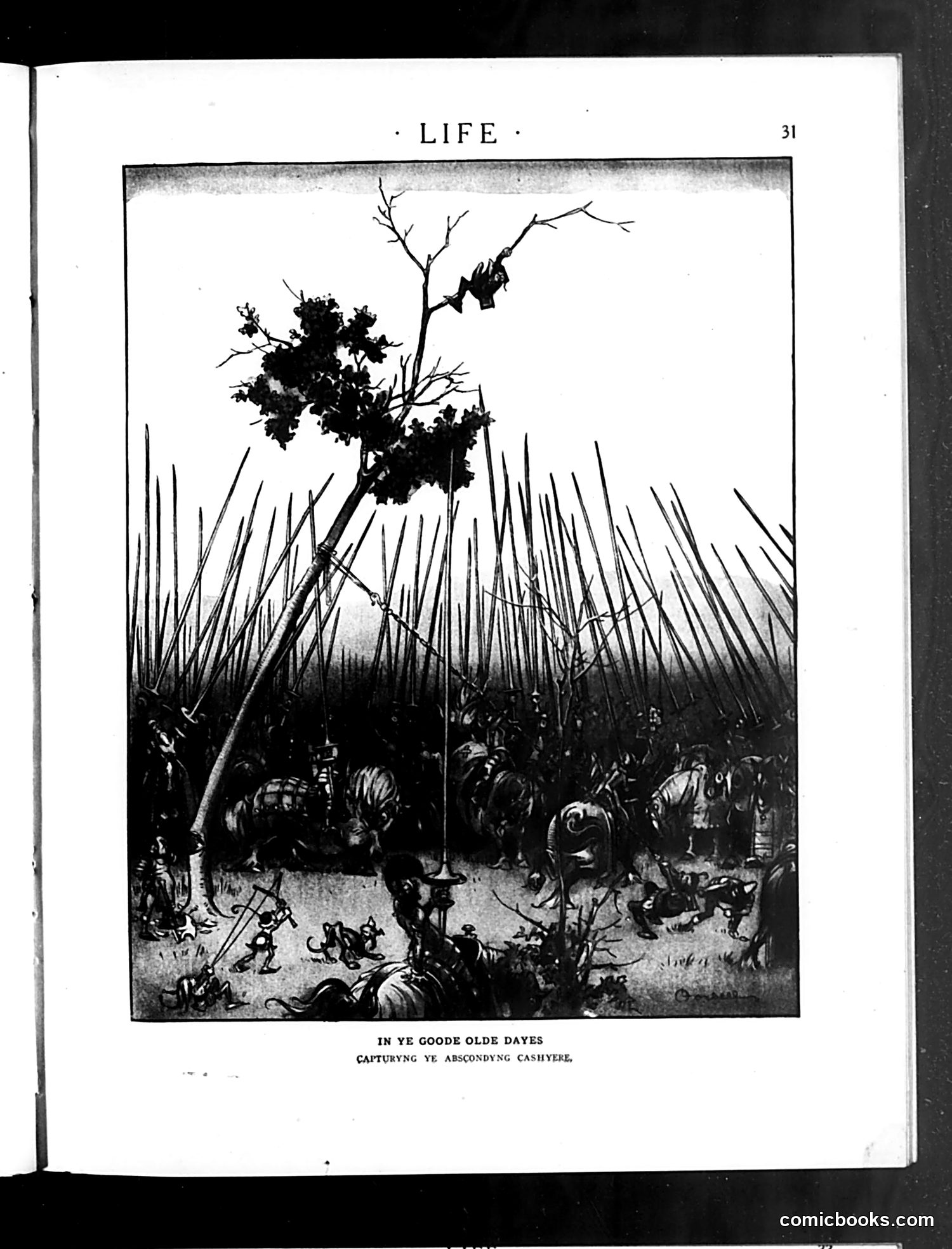
This is a satirical illustration titled "In Ye Goode Olde Dayes: Capturyng Ye Abscondyng Cashyere." The archaic spelling mimics old English to create humor through contrast. The cartoon depicts a historical scene—likely referencing medieval or colonial-era capture or execution—but reimagines it as the apprehension of a fugitive cashier (treasurer/financial officer). The composition shows masses of armed figures surrounding a central figure, with distinctive plant life framing the scene. The satire mocks contemporary financial scandals by presenting modern white-collar crime (embezzlement) through the lens of historical drama. By using "ye goode olde dayes" language, Life magazine suggests that absconding with money is timeless human behavior, treating a contemporary crime story with mock-historical grandiosity. The joke relies on the contrast between serious historical imagery and the mundane modern crime.
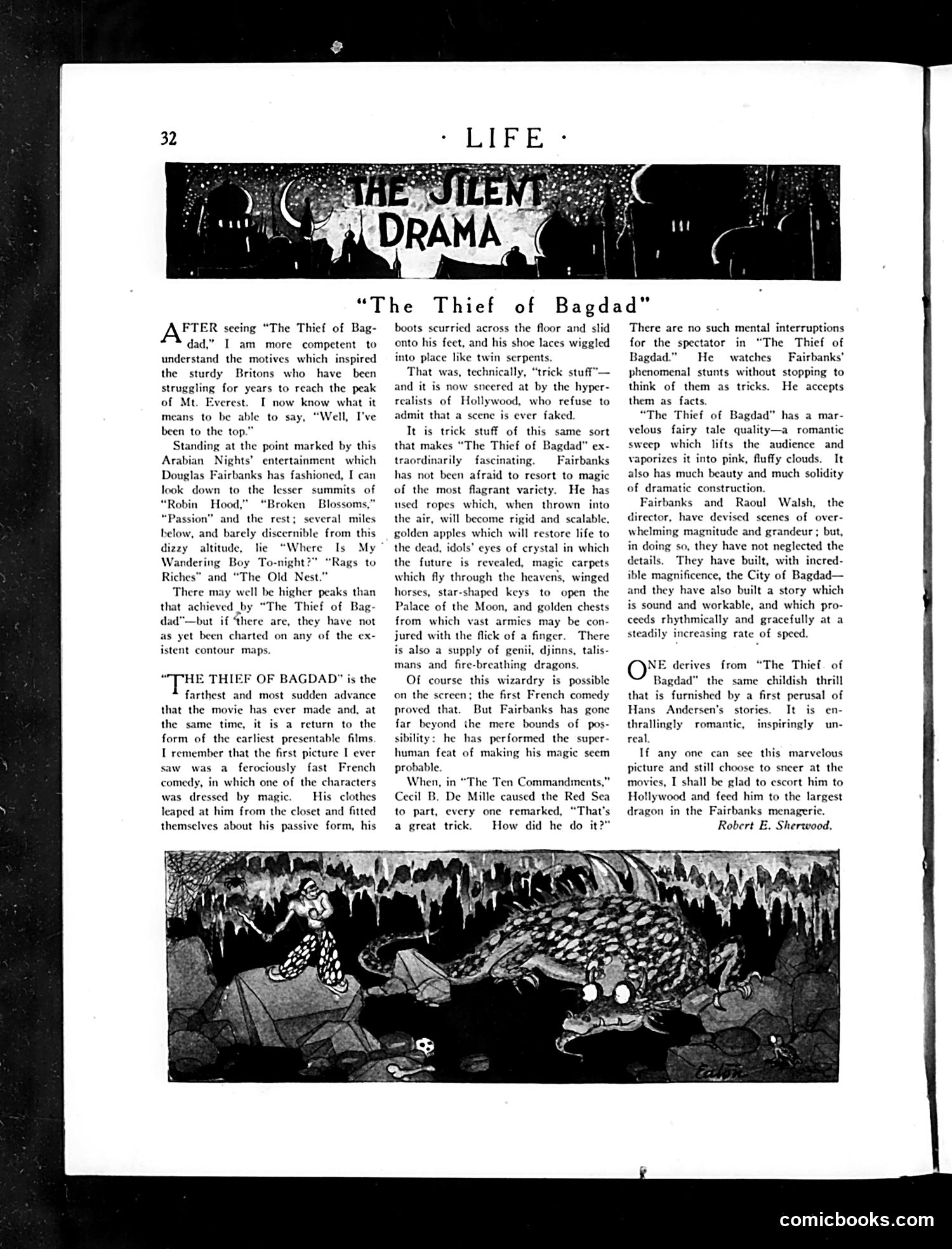
This is a film review by Robert E. Sherwood of Douglas Fairbanks' silent film "The Thief of Bagdad." The critic praises it as cinema's greatest achievement, comparing other Fairbanks films ("Robin Hood," "Broken Blossoms") to lesser mountain peaks. Sherwood argues the film succeeds by embracing theatrical "trick stuff"—magic carpets, flying horses, crystal-eyed idols, golden apples—rather than pretending realism. He contrasts this favorably with Cecil B. DeMille's "Ten Commandments," where audiences consciously notice special effects as tricks. In "Thief of Bagdad," viewers accept the magic as plausible within the film's fairy-tale logic, creating immersive wonder rather than distraction. The review celebrates both the spectacular visuals and solid dramatic construction, praising director Raoul Walsh and Fairbanks for balancing grandeur with narrative coherence.
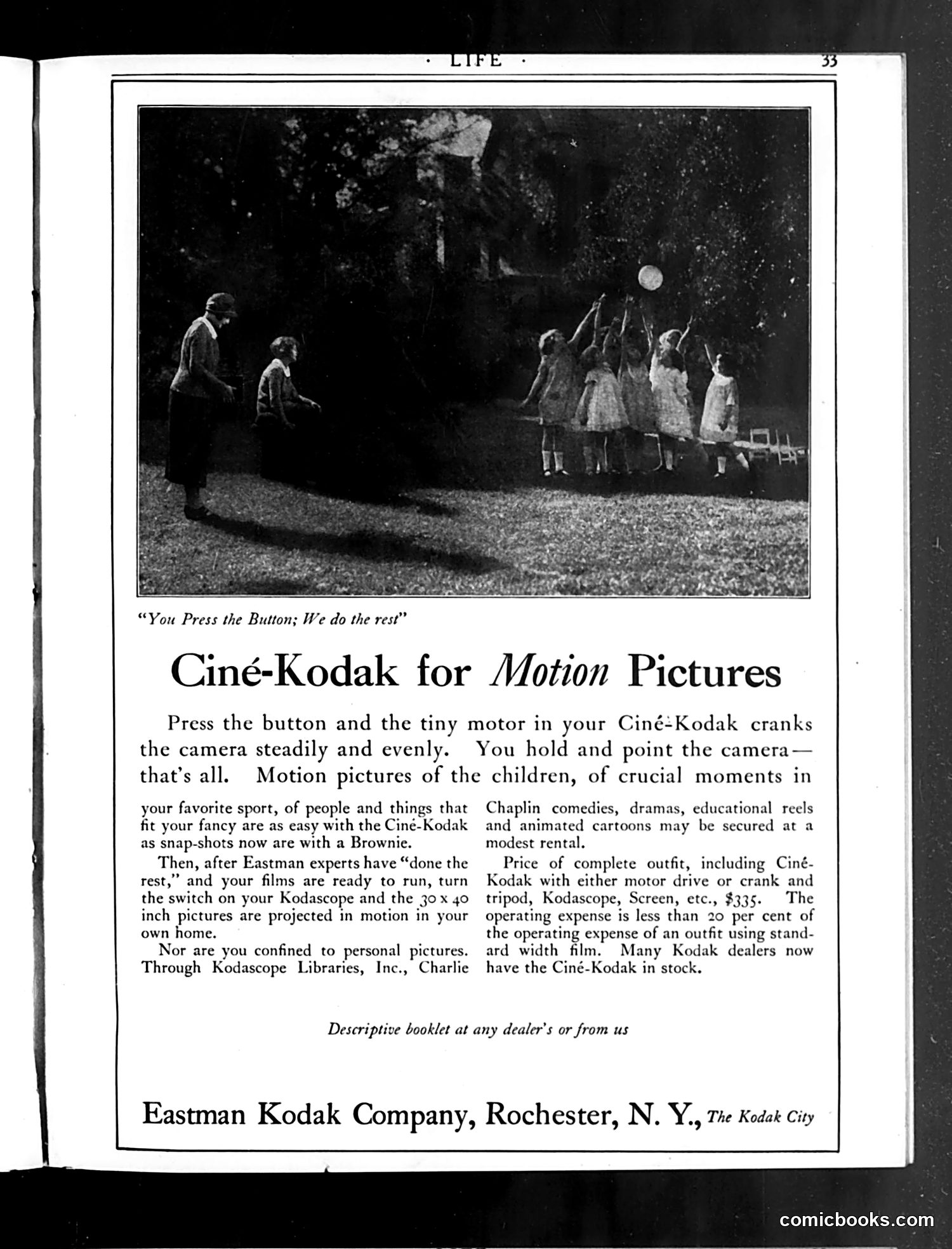
This is a **product advertisement**, not a political cartoon. It promotes Eastman Kodak's new home motion-picture camera system (circa 1920s). The image shows children playing outdoors while adults operate the camera—illustrating the advertised ease of use. The famous slogan "You Press the Button; We do the rest" (Kodak's existing tagline) is adapted here for film: users simply operate the camera, and Kodak handles developing and printing. The advertisement emphasizes **democratization of filmmaking**: amateur users can now capture home movies as easily as still photography, with the option to rent commercial films (including Charlie Chaplin movies) through Kodascope Libraries for home projection. The $335 price point and claim of low operating costs position this as an accessible luxury for middle-class households. This represents early consumer culture marketing—selling not just a product but lifestyle convenience and family memory-making.
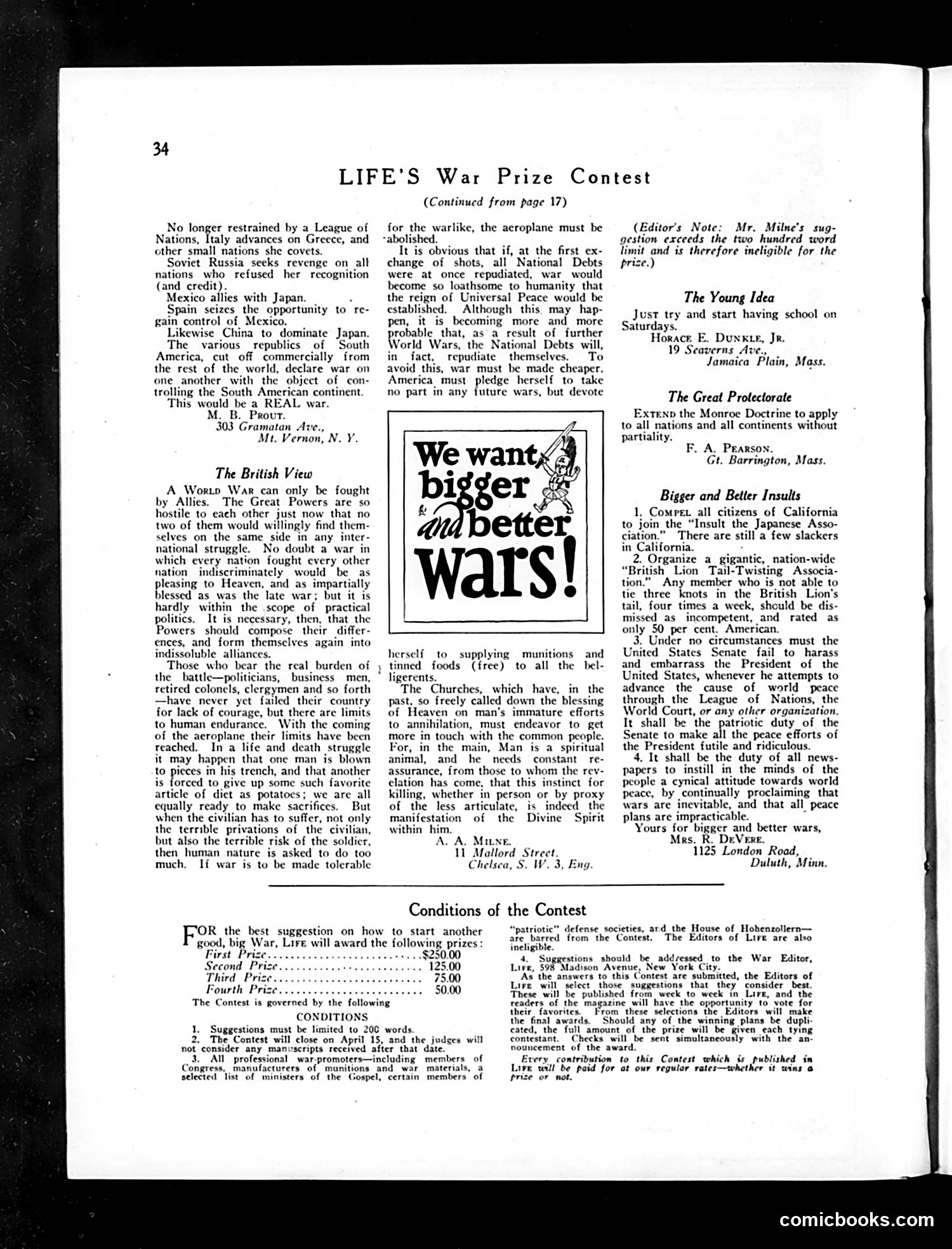
This is a contest page from *Life* magazine soliciting reader suggestions on "how to start another [world] war." The featured cartoon shows a jingoistic figure enthusiastically declaring "We want bigger and better wars!"—expressing the satirical premise absurdly. The submissions ridicule various post-WWI geopolitical tensions: one envisions cascading global conflicts between major powers and their colonies; another sardonically suggests abolishing the airplane and repudiating national debts to make war "tolerable" for civilians. A third proposes extending the Monroe Doctrine globally. The satire targets 1920s-30s militarism and the perceived inevitability of future conflict, while mocking both warmongering rhetoric and the naïve reasoning used to justify military preparedness. The cartoon and submissions collectively suggest that without fundamental change, another catastrophic world war was heading toward inevitability—a grim prophecy later validated by WWII's outbreak.
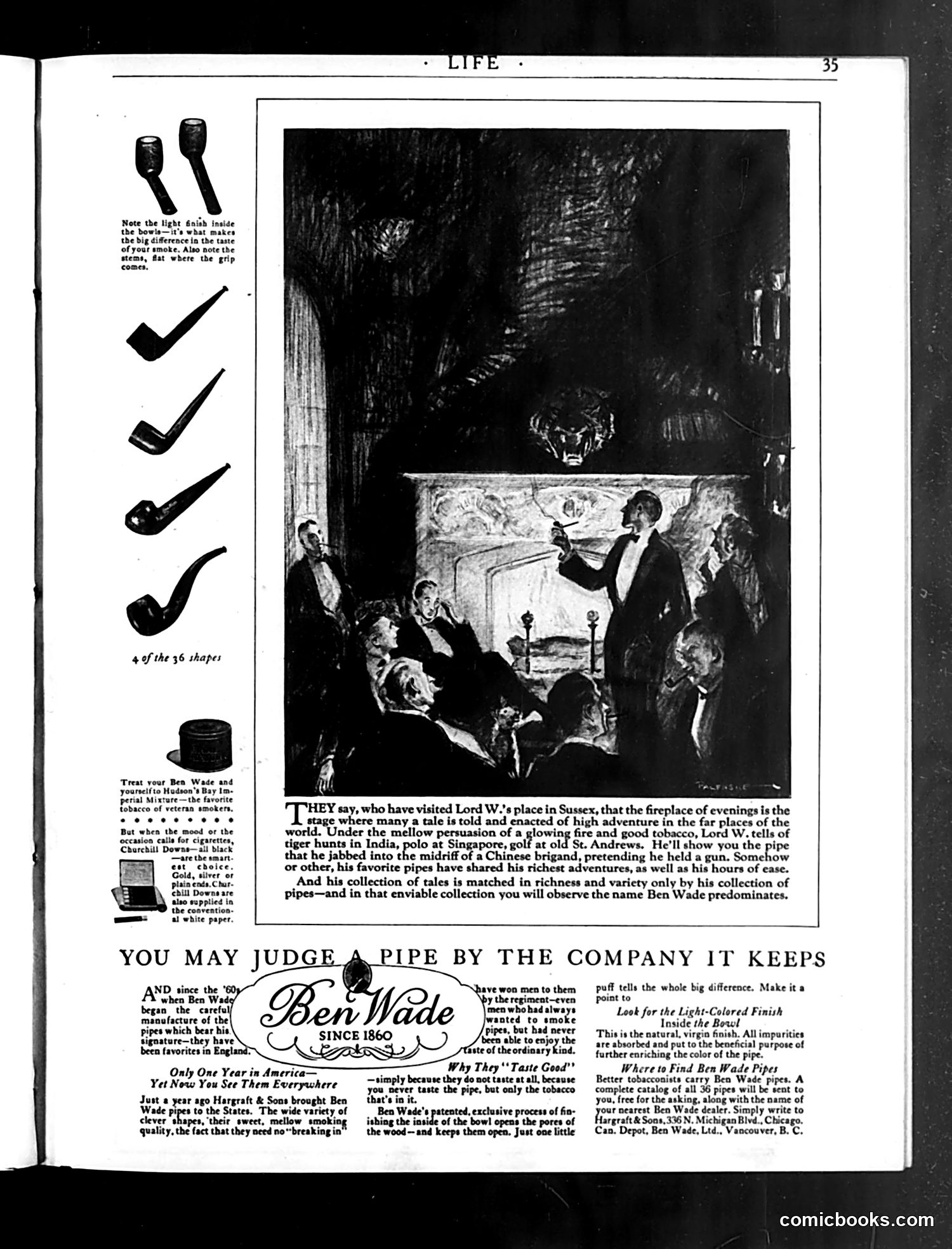
This page is primarily **advertising for Ben Wade pipes**, not satire or political commentary. The layout combines product promotion with lifestyle messaging. The main image shows a gentleman telling adventure stories by a fireplace—a scene meant to associate Ben Wade pipes with cultured leisure and worldly experience. The text references "Lord W." recounting tales of tiger hunts in India, polo, and adventures, suggesting the pipes appeal to aspirational, well-traveled gentlemen. The advertising copy emphasizes the pipe's "light-colored finish inside the bowl" and claims the pipes need no "breaking in"—technical selling points presented as markers of quality. The tagline "You May Judge a Pipe by the Company It Keeps" frames pipe ownership as reflecting one's character and social standing. The left sidebar shows different pipe shapes and promotes Hudson's Bay Imperial Mixture tobacco and Churchill Downs cigarettes—related tobacco products. This is essentially **luxury lifestyle advertising** from the early 20th century, targeting middle-to-upper-class male readers by conflating pipe smoking with sophistication, adventure, and refined taste.
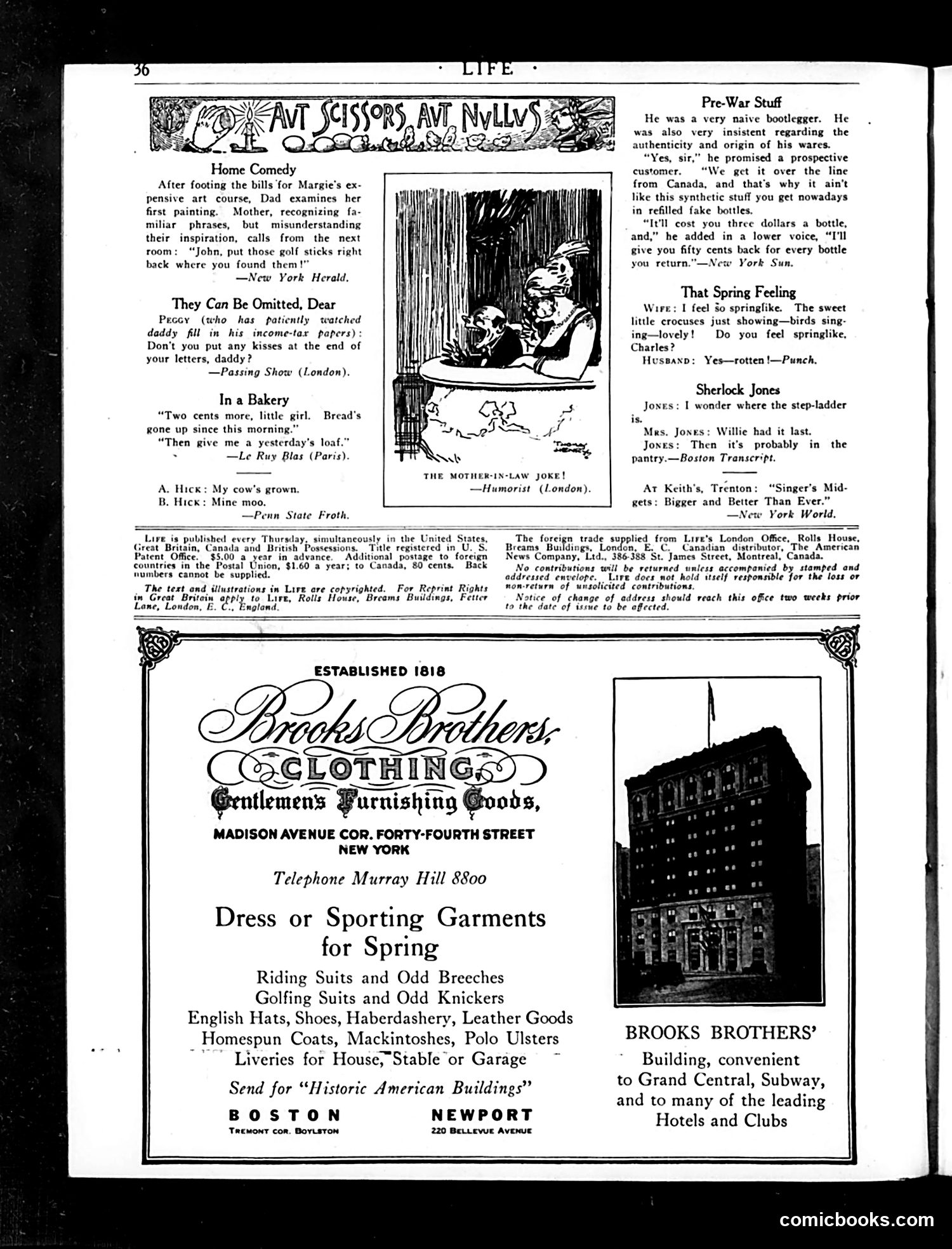
This page contains **short humor pieces and advertisements** rather than political cartoons. The humor items are brief jokes from various sources (New York Herald, Passing Show, etc.) covering domestic topics: a father confused by his daughter's abstract art, a child's logic about bread prices, and married couples' differing perspectives on spring. One piece titled "Pre-War Stuff" is a anecdote about a naive bootlegger during Prohibition, emphasizing the irony of his insistence on authenticity while selling illegal alcohol and offering refunds for returned bottles—a commentary on black-market commerce and consumer fraud during the alcohol ban era. The bulk of the page features a **Brooks Brothers advertisement** for gentlemen's clothing, occupying the lower half. This reflects Life's business model: satirical content funded by luxury brand advertising targeting wealthy male readers. The magazine's masthead indicates simultaneous publication in the U.S., Britain, and Canada, showing its transatlantic circulation.
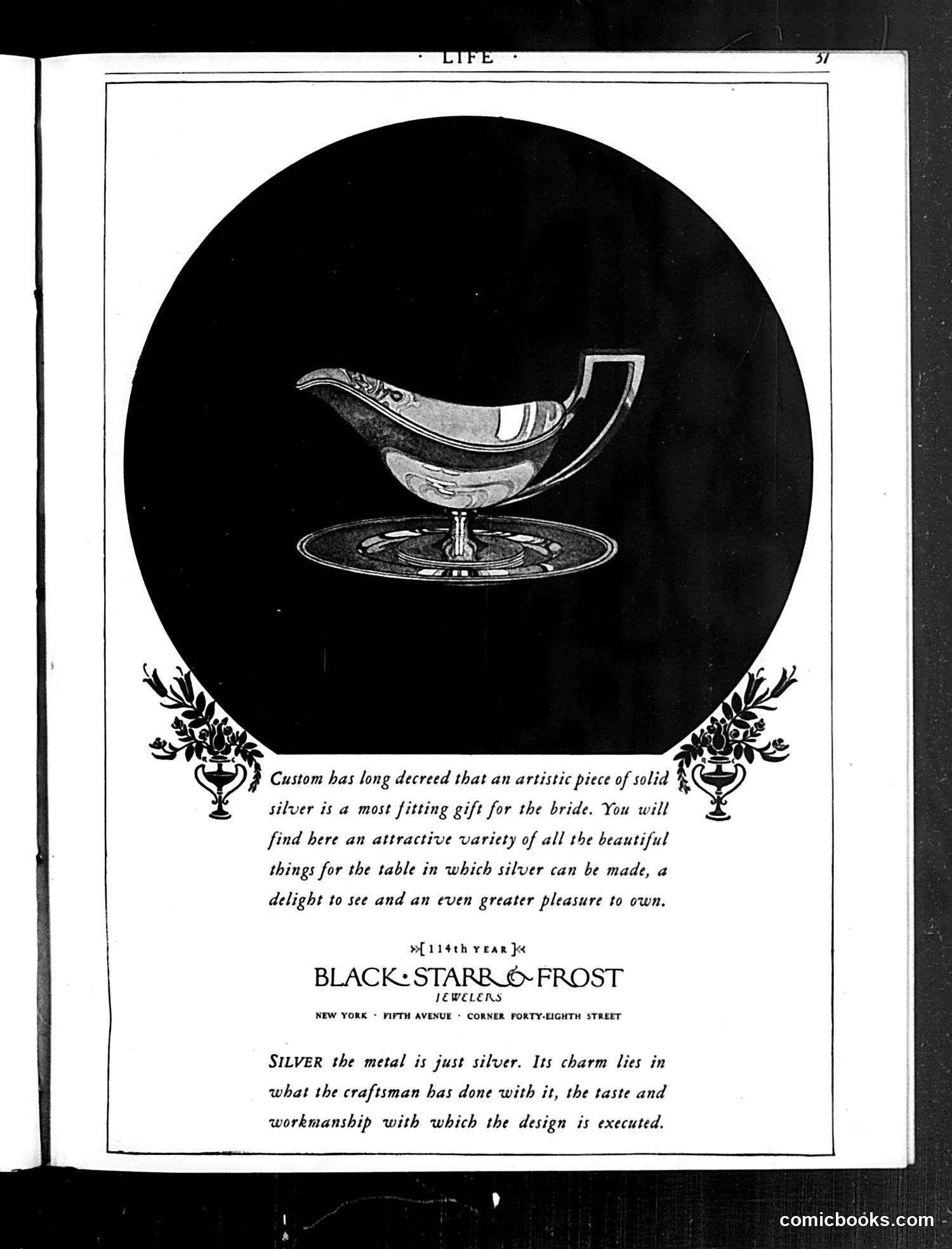
This is a **jewelry advertisement**, not political satire or a cartoon. Black Starr & Frost, a New York jeweler on Fifth Avenue, is advertising silver serving pieces as wedding gifts for brides. The image shows an ornate silver serving dish or gravy boat on a pedestal stand, displayed against a dark background. The ad emphasizes that silver's value derives not from the raw metal itself, but from the craftsman's skill and artistic design—a marketing pitch positioning their products as refined, tasteful luxury goods. The decorative flourishes (urns, floral elements) and formal italic text reflect early-to-mid 20th century advertising aesthetics. This page simply demonstrates how Life magazine monetized its editorial space through high-end advertisements targeting affluent readers shopping for wedding gifts.
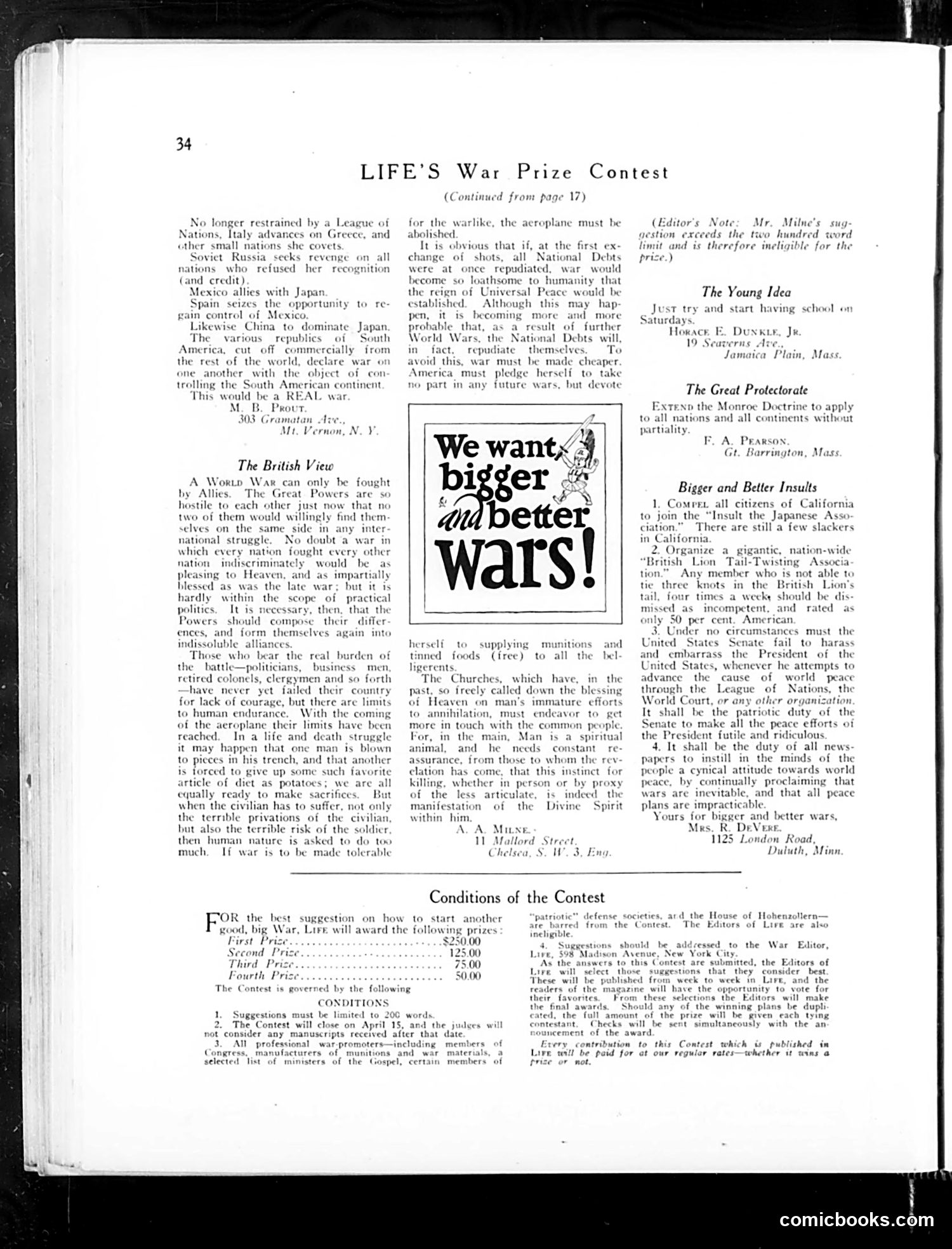
This page presents LIFE's satirical "War Prize Contest," soliciting readers' creative proposals for preventing or conducting future wars. The central cartoon—a bold graphic declaring "We want bigger and better wars!"—functions as dark satire, mocking militaristic jingoism by presenting an absurdly enthusiastic endorsement of warfare. The contest entries reveal period anxieties (1920s-30s): international debt, League of Nations failures, and imperial expansion threats. Proposals range from serious (extend the Monroe Doctrine globally) to absurd (organize "British Lion Tail-Twisting Associations" to insult Japan). The "Young Idea" entry sardonically suggests starting school on Saturdays, implying militarization of civilian life. The accompanying essays ("The British View," "Conditions of the Contest") discuss war's inevitability given national interests and human nature, treating mechanized warfare's civilian casualties as an emerging ethical problem. The satire works by presenting ostensibly rational arguments for accepting warfare as permanent policy—highlighting how normalized militarism had become in interwar discourse.
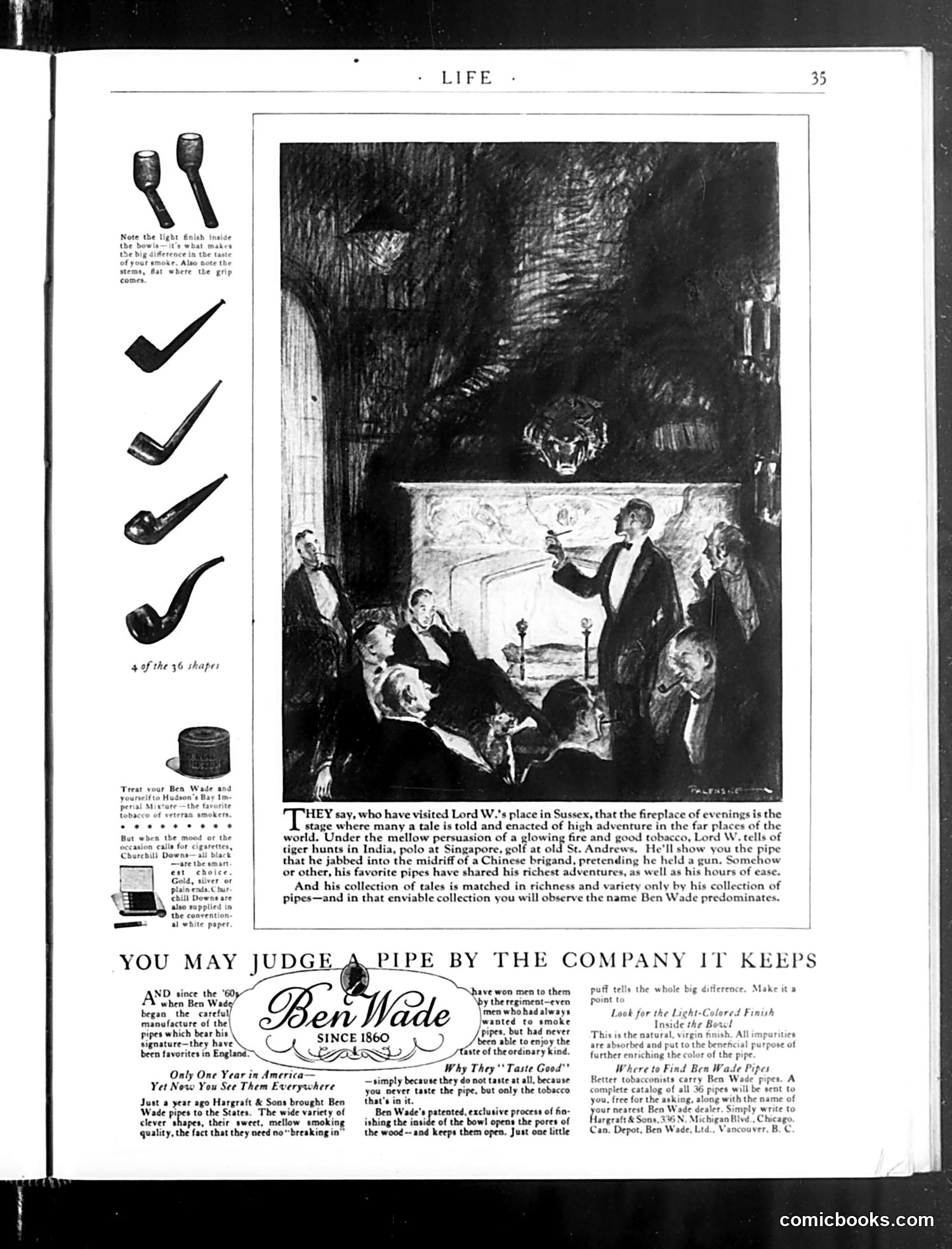
This page is primarily **advertising for Ben Wade pipes**, not political satire. The main illustration shows a gentleman's parlor scene where a man (identified as "Lord W.") entertains guests by recounting adventure stories while smoking—tales of tiger hunts in India, polo in Singapore, and golf in Scotland. The advertisement's pitch is that Ben Wade pipes are sophisticated, gentlemanly accessories associated with worldly adventure and leisure. The key sales point is technical: Ben Wade's "patented, exclusive process" opens the wood's pores, allowing the tobacco flavor to shine without the pipe itself affecting the taste. The left sidebar shows pipe shapes and promotes Hudson's Bay tobacco as a complement. The copy emphasizes that Ben Wade pipes have become instantly popular in America (introduced just one year prior) because they finally made pipe-smoking enjoyable for men who previously disliked it. This reflects early 20th-century marketing: associating consumer products with sophistication, masculinity, and exotic adventure.
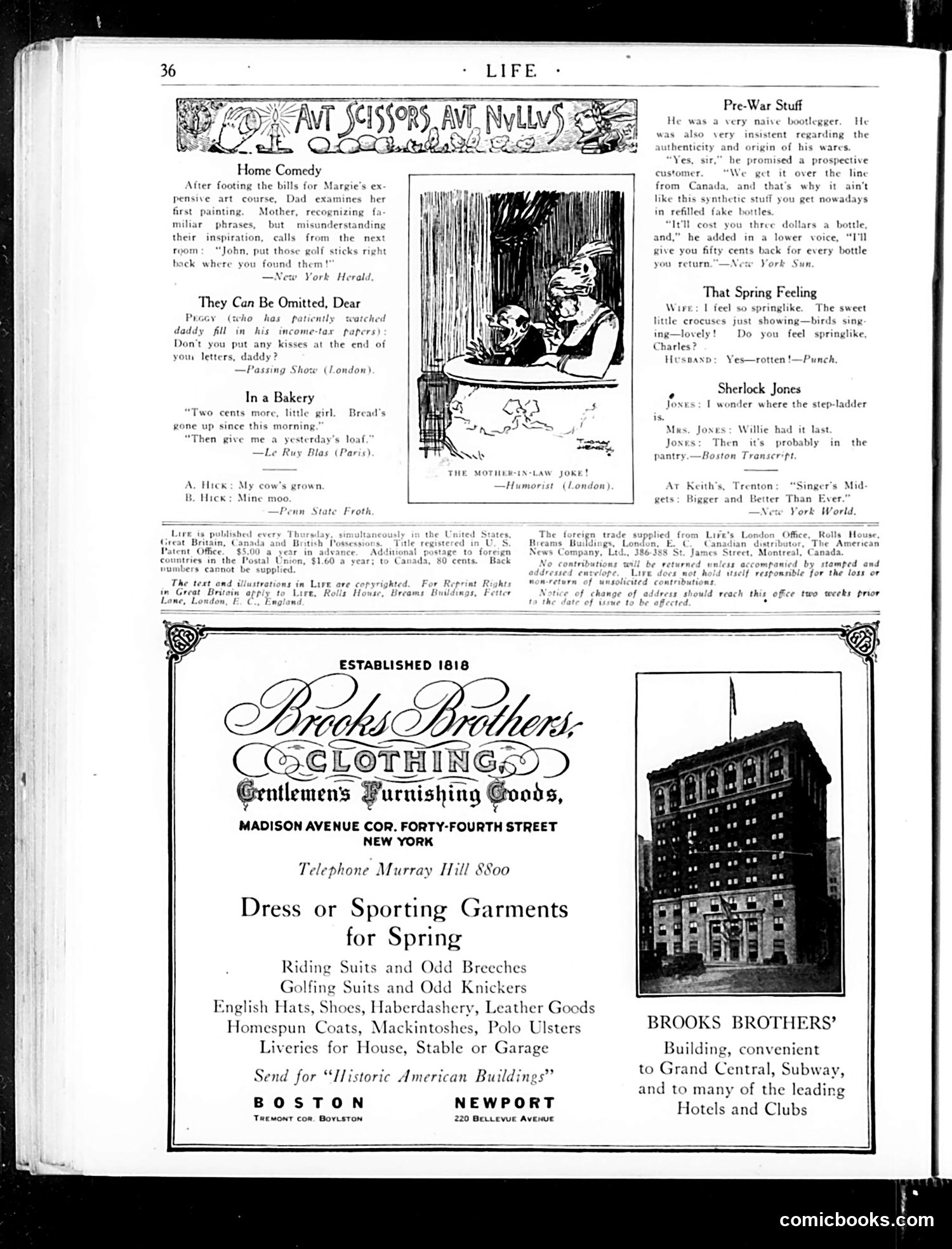
This page combines satirical humor with advertising. The upper section presents four brief comic vignettes mocking domestic and social life: **"Home Comedy"** jokes about a father's golf equipment cluttering the house—a gentle satire on men's recreational priorities. **"They Can Be Omitted, Dear"** depicts a daughter asking her father to include kisses in letters; he refuses, satirizing paternal reserve. **"In a Bakery"** plays on inflation, with bread prices rising between morning and afternoon—a topical jab at post-WWI economic instability (the "Pre-War Stuff" header reinforces this). **"That Spring Feeling"** contrasts romantic optimism about springtime with a husband's cynical "Yes—rotten!" response, mocking marital disenchantment. **"Sherlock Jones"** is a domestic mystery: a missing step-ladder, likely hidden by a child. The cartoons target middle-class anxieties: money troubles, domestic tedium, and changing social norms. The Brooks Brothers advertisement below anchors the page in aspirational gentlemen's fashion, contrasting sharply with the humble humor above.
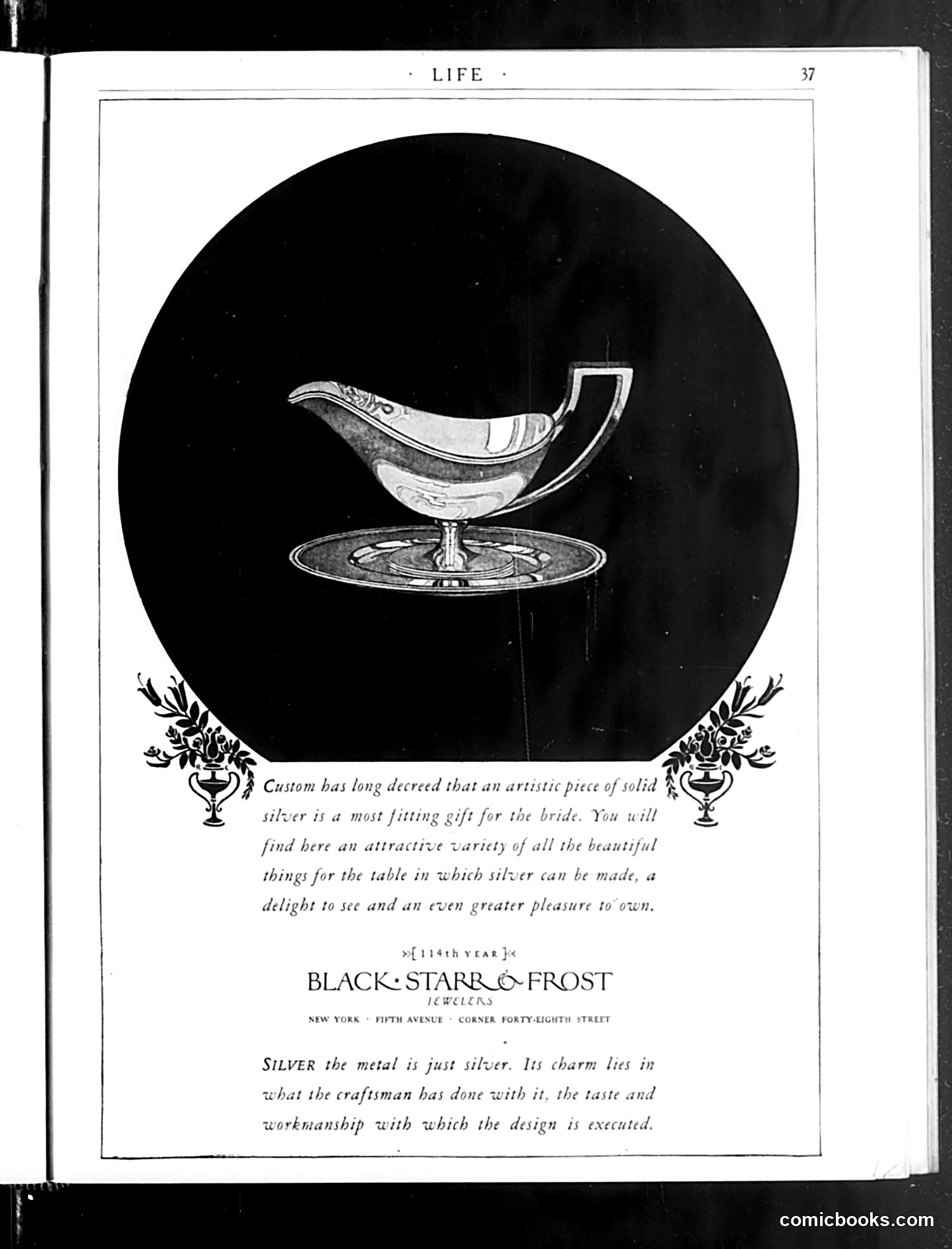
This is primarily an **advertisement**, not political satire. It's a full-page ad from Life magazine (page 37) for Black, Starr & Frost jewelers, promoting silver tableware as bridal gifts. The image shows an ornamental silver gravy boat or sauce vessel on a pedestal stand, photographed against a dark background to highlight its elegant design. Decorative urns flank the text. The advertisement's pitch emphasizes two points: (1) custom dictates silver as appropriate bride gifts, and (2) silver's beauty derives from craftmanship and design execution, not the metal itself. There is no political cartoon or satire present. This represents the commercial content typical of Life magazine during its earlier years, when it balanced humorous editorial content with high-end advertising aimed at affluent readers.
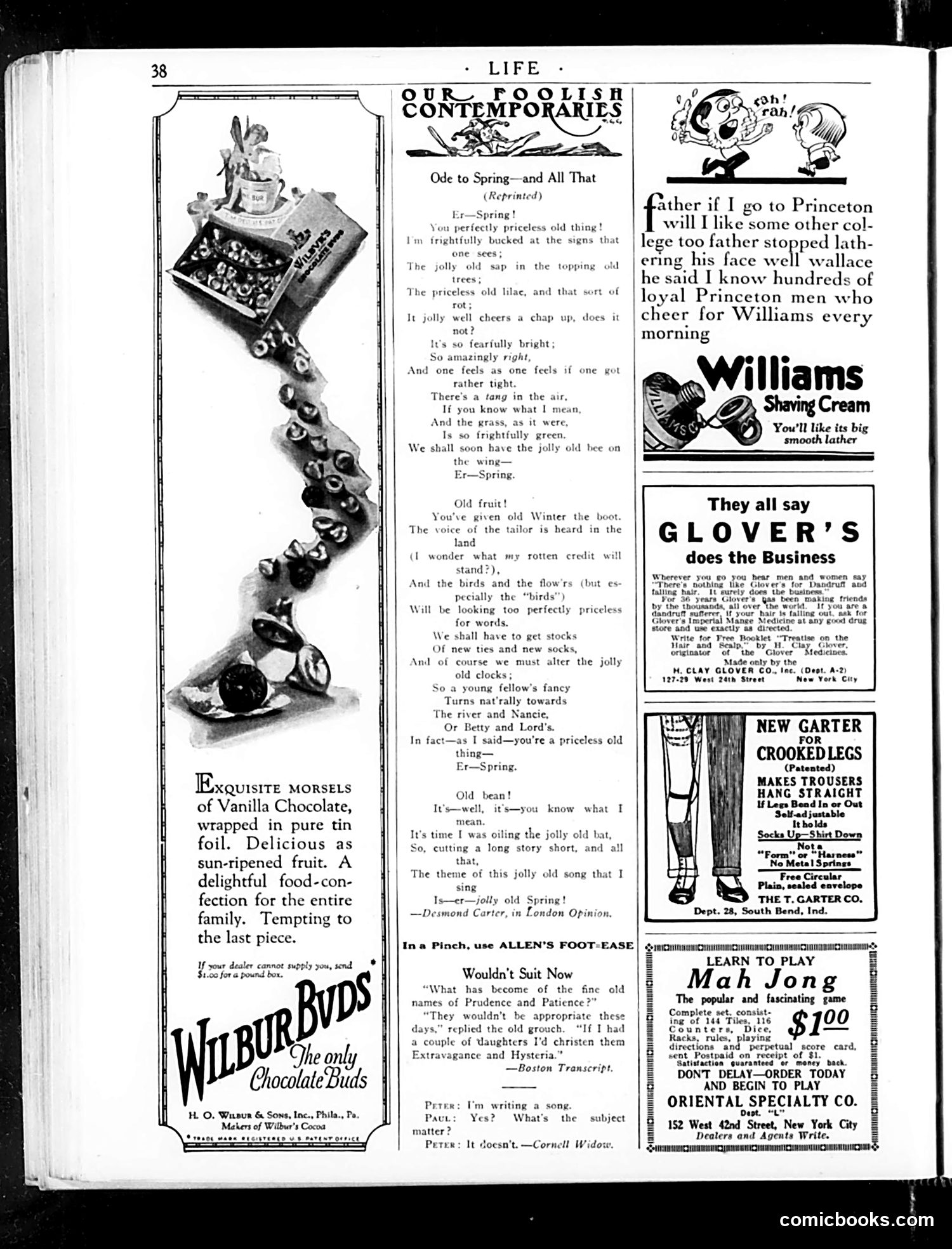
This page from *Life* magazine is primarily **advertising with some satirical content**. The main editorial piece is "Ode to Spring—and All That," a humorous poem mocking the affected, overly sentimental way upper-class British young men speak and write about spring. The speaker uses exaggerated British slang ("jolly," "priceless," "old bean," "old fruit") while romanticizing spring themes—romance, new clothes, riverside outings—in a self-consciously artificial manner. The satire targets this affectation and the predictability of spring poetry itself. A brief dialogue joke mocks Princeton students, suggesting Yale men (Williams) are superior—likely reflecting Ivy League rivalries of the era. The remaining content is **period advertisements** for consumer goods (chocolate, shaving cream, foot powder, Mah Jong games, garters) that occupy most of the page. This advertising mix was typical for *Life* magazine's business model.
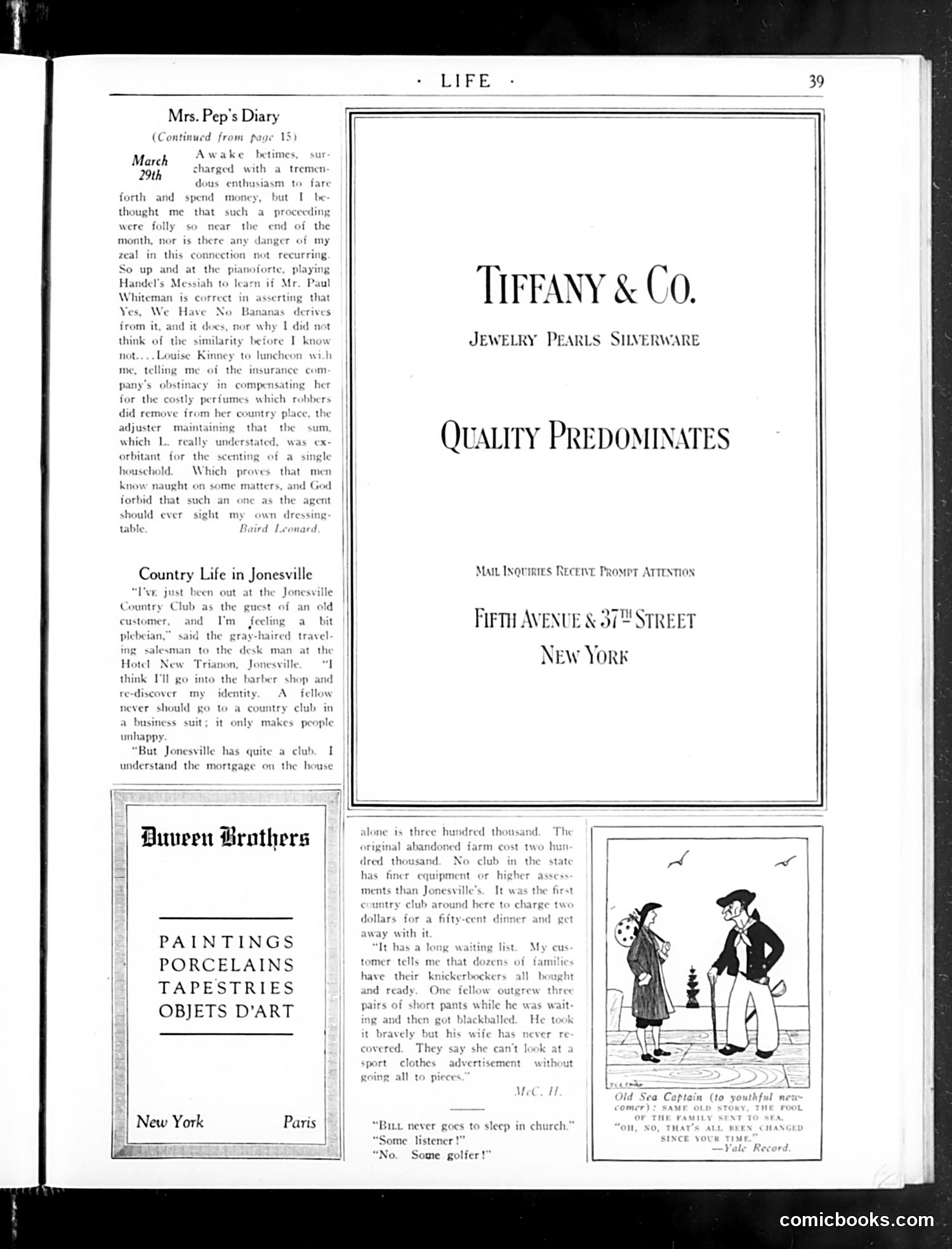
This page combines advertising with satirical content typical of Life magazine's format. **The main cartoon** (bottom right) depicts an "Old Sea Captain (to youthful newcomer)" offering chess advice at a pool. The caption reads: "Oh no, that's all been changed since your time." The joke satirizes how rapidly social customs and rules evolve—even an old-timer's knowledge becomes outdated. The Yale Record attribution suggests this was a college humor piece. **"Country Life in Jonesville"** is a satirical piece mocking small-town American pretension. A traveling salesman describes a country club in Jonesville that, despite its modest town setting, boasts impressive facilities and high membership costs (mortgaged for $300,000). The humor lies in the absurd contrast between the town's size and the club's grandiosity—highlighting how even provincial America aspired to cosmopolitan sophistication. The remainder consists of ads for Tiffany & Co., Duveen Brothers (art dealers), and diary excerpts, filling out the magazine's typical mixed-content format of the era.
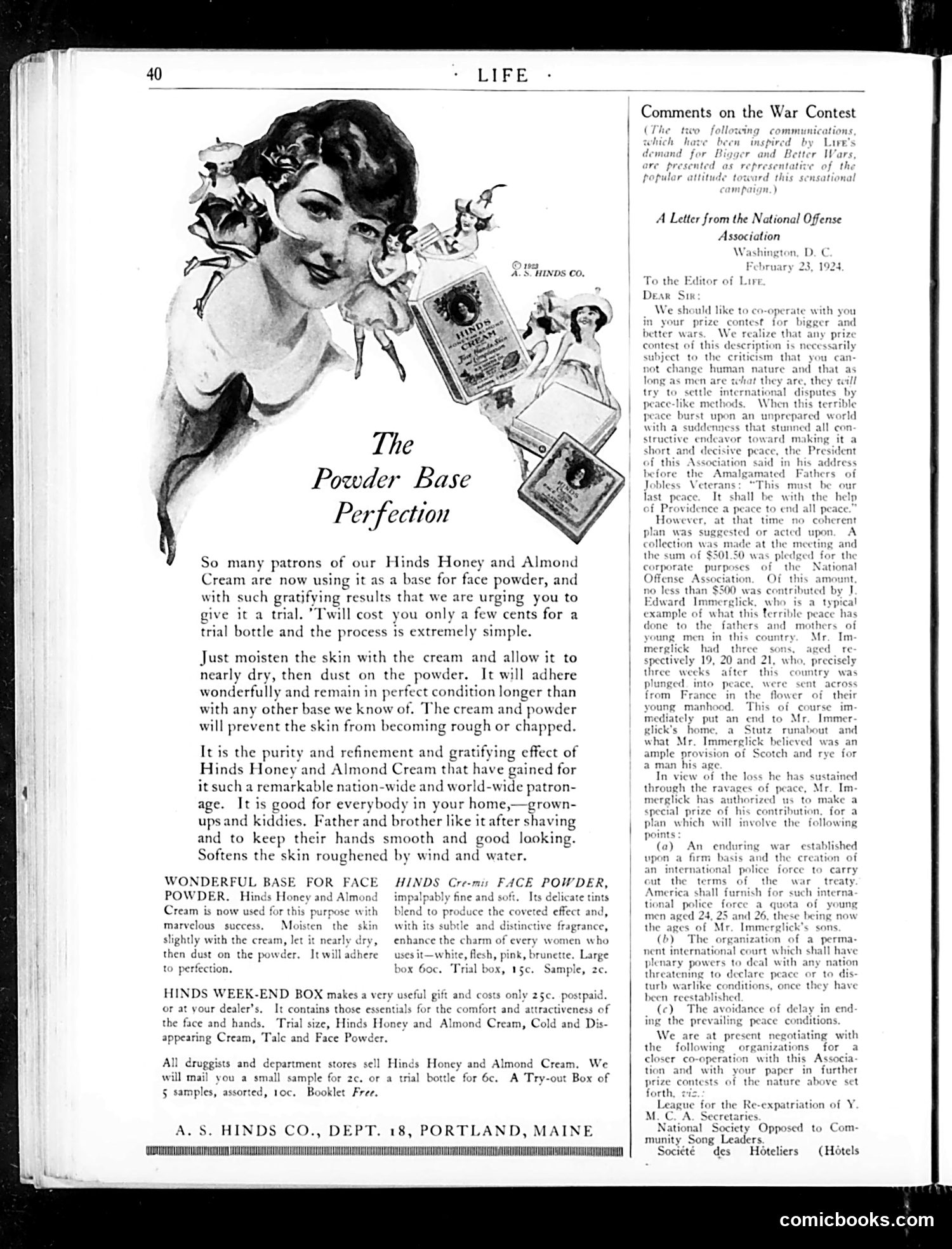
This page is primarily a **1923 advertisement for Hinds Honey and Almond Cream** facial product, featuring a stylized illustration of a woman's face with decorative elements. The ad promotes using the cream as a powder base. The right column contains a satirical letter titled "Comments on the War Contest," addressed to *Life* magazine's editor. It's ostensibly from the "National Offense Association" and mocks post-WWI peace efforts. The satire describes a man (Mr. Immerglock) who contributed $500 to peace initiatives, only to have his three sons conscripted weeks later—contradicting the supposed "peace." The letter sarcastically proposes absurd solutions: establishing international police forces and permanent courts with vague powers. The humor lies in depicting peacetime as somehow **worse than war** for families, and suggesting bureaucratic solutions to fundamentally unsolvable human conflicts. The satire reflects 1920s American skepticism toward the League of Nations and international peace mechanisms following World War I's devastating losses.
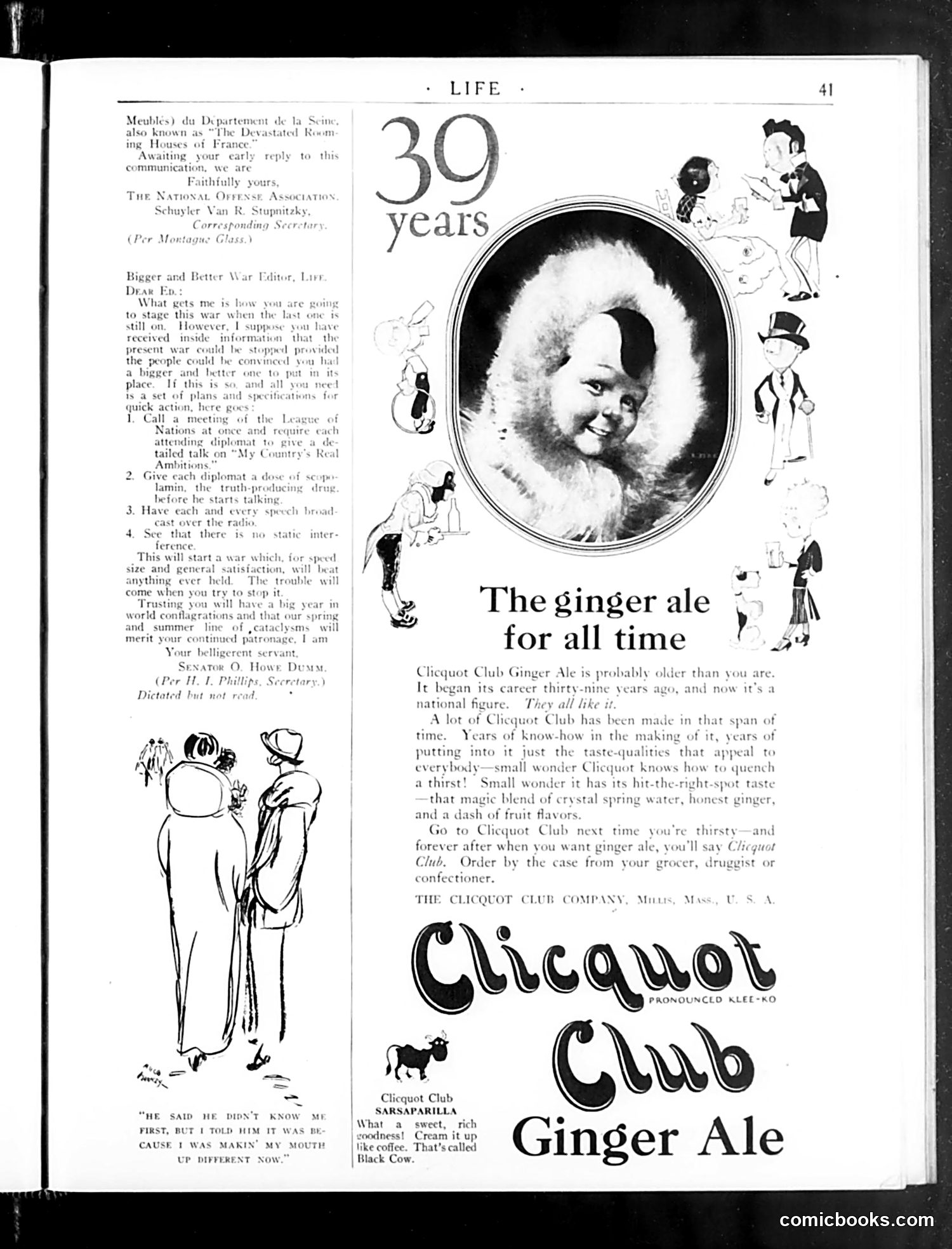
This page is primarily **advertising**, not political satire. The main content features a Clicquot Club Ginger Ale advertisement celebrating the brand's 39-year history, with the slogan "The ginger ale for all time." The left side contains letters to the editor addressing World War I concerns—one writer asks about staging "this war" and another discusses diplomatic efforts, suggesting this is from the WWI era (likely 1910s). The cartoon at bottom left shows two figures in period dress with the caption about "making my mouth up different now"—likely a domestic humor joke unrelated to the war content. The advertisement uses illustrations of well-dressed figures surrounding the product's portrait to convey sophistication and longevity. A secondary ad promotes Clicquot Club Sarsaparilla ("Black Cow"), suggesting the company made multiple beverage products. The page reflects early-20th-century advertising style: emphasizing heritage, quality, and broad consumer appeal during wartime.
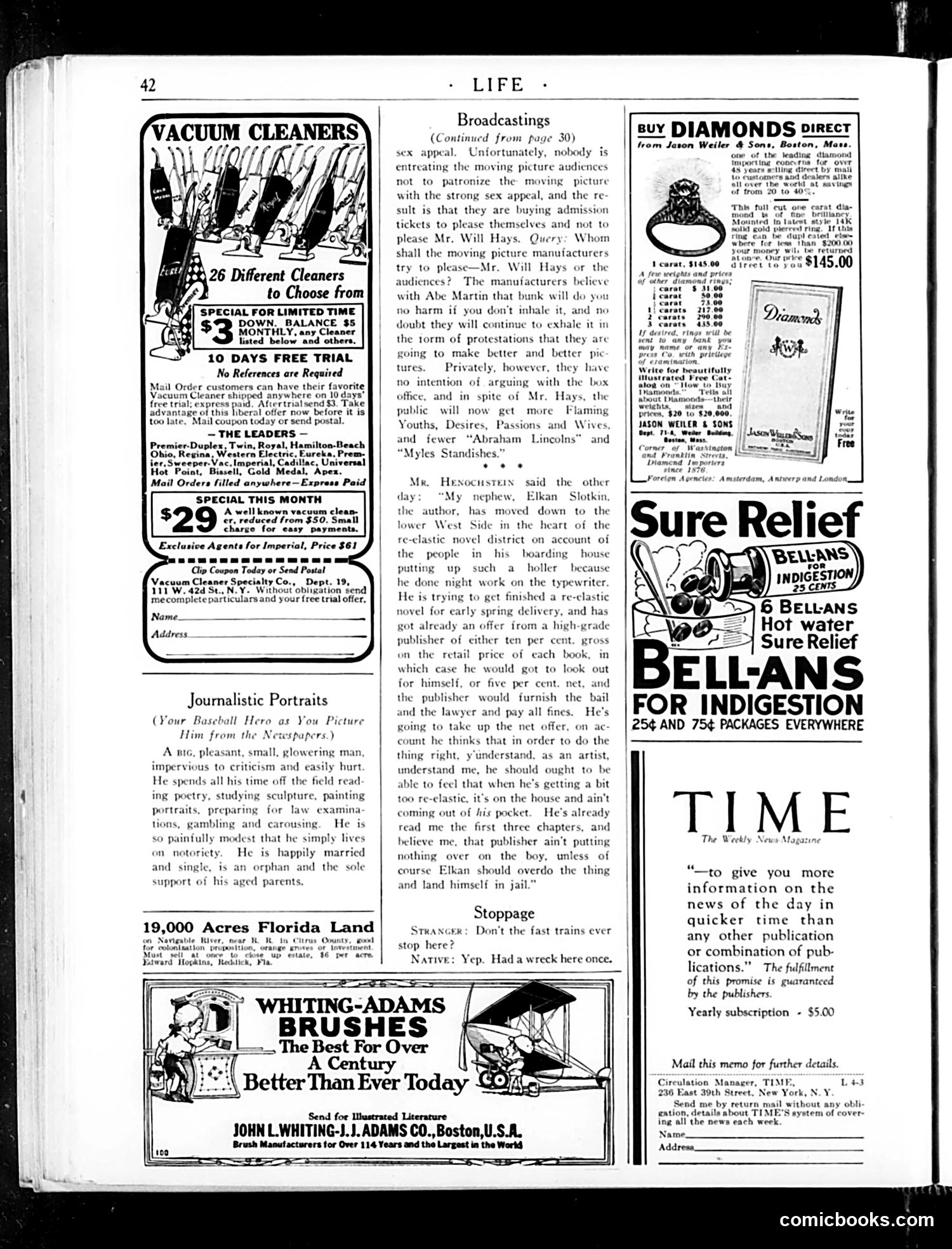
This page is primarily **advertisements and satirical commentary**, not political cartoons in the traditional sense. The main satirical content is in the "Broadcastings" section, which critiques the film industry's hypocrisy. It mocks **Will Hays** (head of film censorship) and movie manufacturers who publicly claim to oppose "sex appeal" films while actually profiting from them. The satire questions whose interests filmmakers serve—Hays's moral standards or audiences' actual desires—highlighting the gap between stated values and commercial practices. The "Journalistic Portraits" section offers a humorous character sketch of a baseball player: someone who appears intellectual and sensitive off-field but is actually motivated by fame and notoriety. The remainder consists of period advertisements: vacuum cleaners, diamonds, Bellans antacid, and TIME magazine subscriptions—typical 1920s advertising with no satirical content.
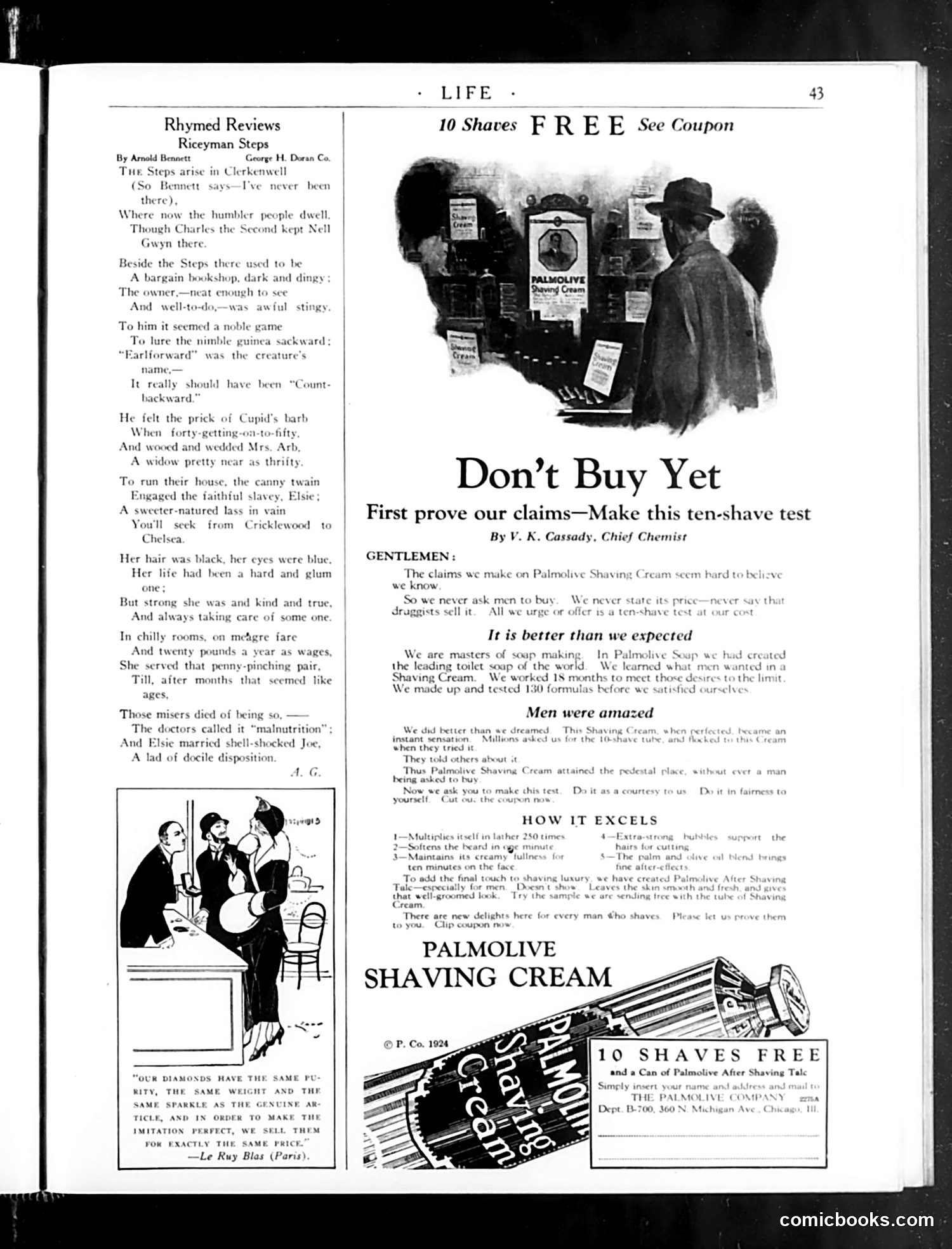
This page combines literary satire with advertising. The left side reviews Arnold Bennett's novel "Riceyman Steps," a satirical poem mocking the book's plot about miserly Londoners. The poem itself contains dark humor—the characters are so stingy they literally starve to death ("malnutrition"), and their servant Elsie escapes by marrying a "shell-shocked Joe" (a World War I veteran). Below the review is a single-panel cartoon illustrating a Le Ruy Blas (Paris) quote mocking fake diamonds sold at genuine prices—the imitation is so perfect, they charge the same amount. The cartoon shows figures examining jewelry, satirizing consumer deception. The page's dominant content is a Palmolive Shaving Cream advertisement urging men not to buy yet, but instead test the product with ten free shaves. The ad uses pseudo-scientific claims ("Chief Chemist," "130 formulas tested") to establish credibility, a common early 20th-century marketing tactic.
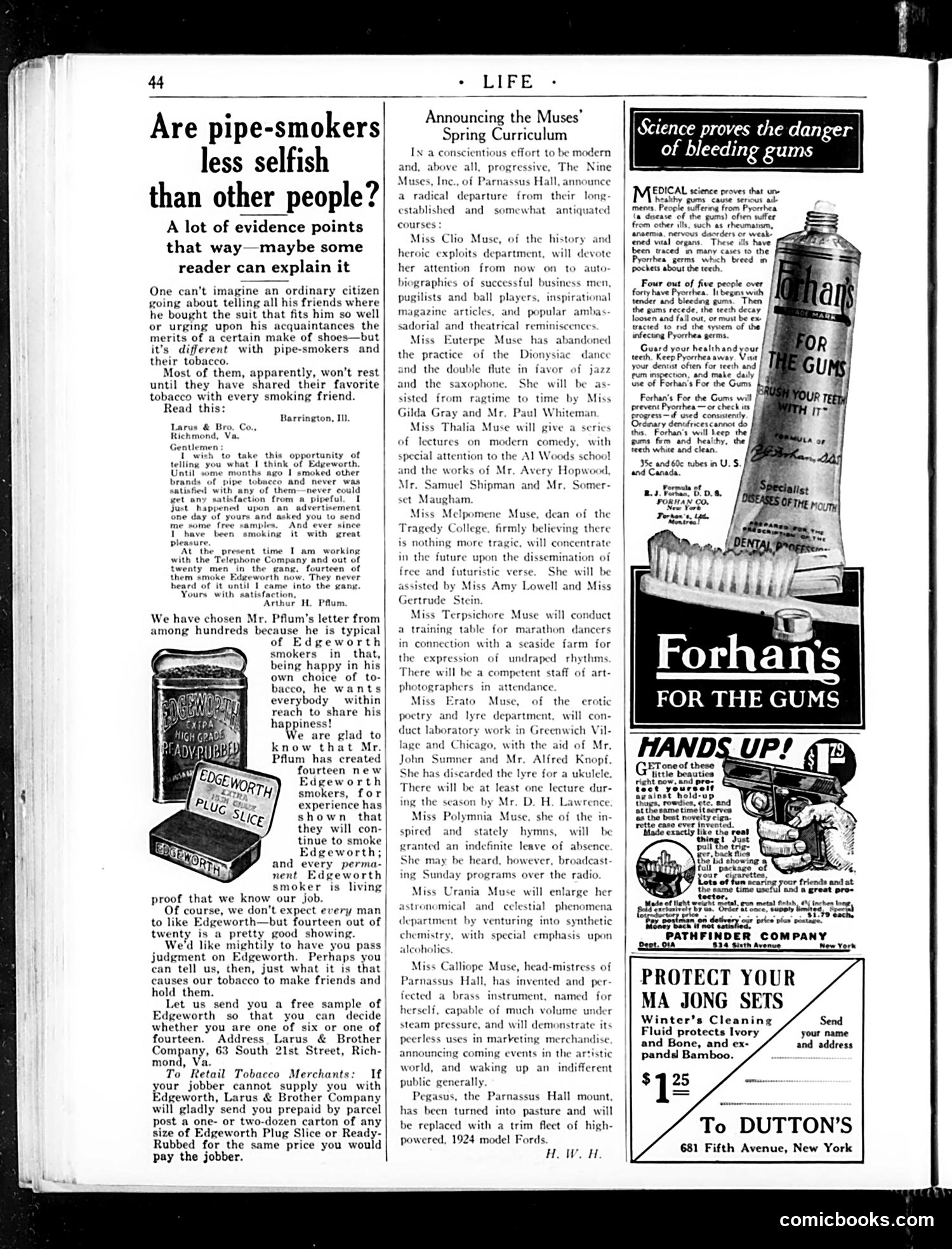
This page combines a tobacco advertisement with social satire. The main article "Announcing the Muses' Spring Curriculum" mocks modernist trends in 1920s culture by reimagining classical Greek muses teaching contemporary subjects instead of their traditional domains. **The satire targets:** - Jazz replacing classical music (Euterpe abandoning "Dionysiac dance" for jazz) - Free verse poetry (Melpomene focusing on "free and futuristic verse," assisted by Amy Lowell and Gertrude Stein—known modernist poets) - Avant-garde theater (Al Woods, Avery Hopwood, Somerset Maugham) - Celebrity culture (dance marathons, "undraped rhythms") - Moral anxieties (John Sumner—likely the anti-vice crusader—mentioned) The accompanying Edgeworth tobacco ad uses a letter praising pipe-smokers' generosity, ironically suggesting they're altruistic while actually promoting product evangelism. The page reflects 1920s tensions between traditional culture and modernist innovation, with Life magazine's conservative stance mocking progressive artistic movements.
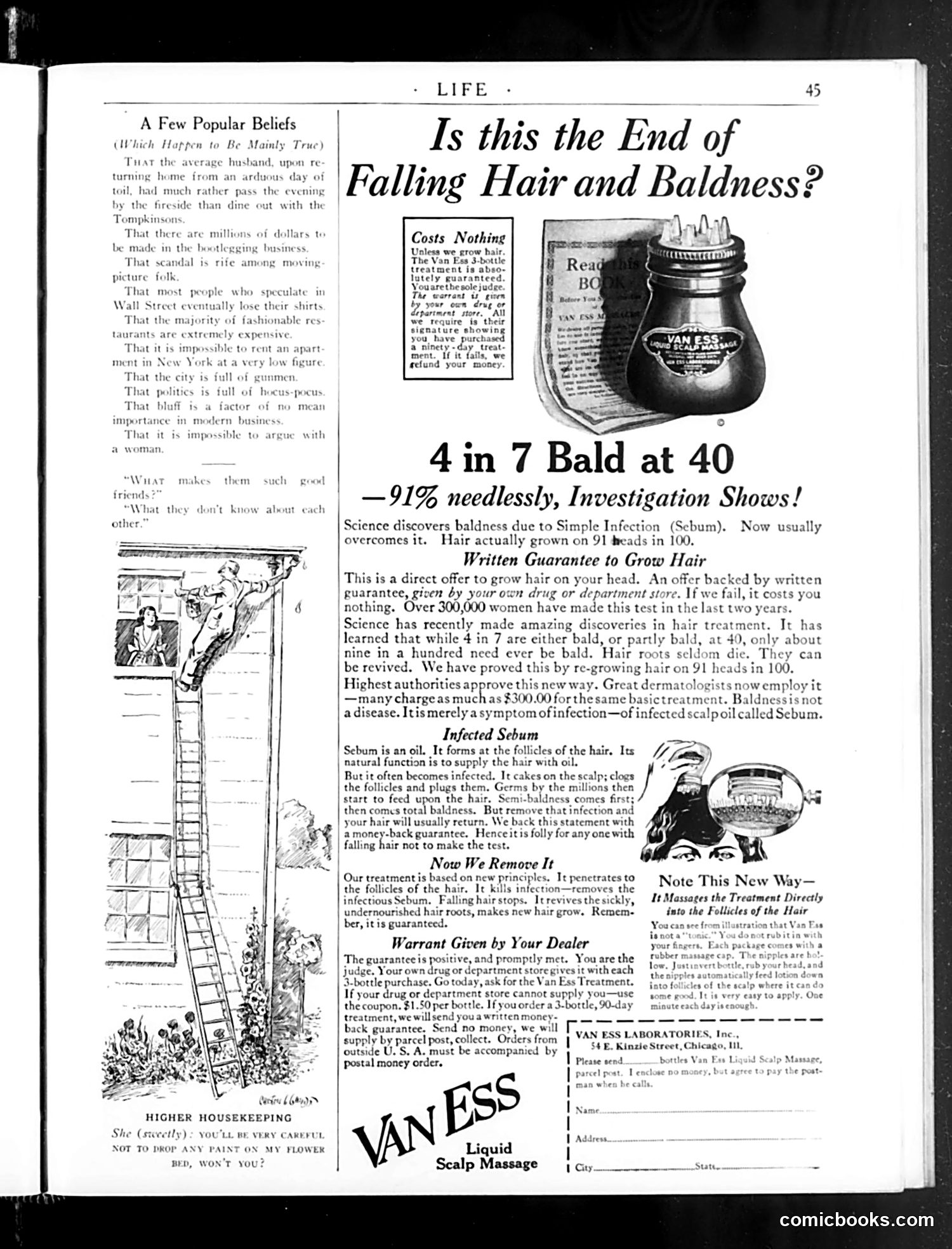
This page is primarily **advertising**, not satire. It promotes Van Ess Liquid Scalp Massage, a hair-loss treatment from early 20th-century America. The advertisement makes dubious scientific claims typical of the era: that baldness results from "infected sebum" (scalp oil) and can be cured by a topical treatment backed by a money-back guarantee. It cites statistics ("4 in 7 bald at 40") and appeals to authority ("Great dermatologists now employ it") to build credibility. The only cartoon on the page—captioned "Higher Housekeeping"—is unrelated humor showing a woman telling a painter not to drip on her flowers. It's filler content. The page reflects period attitudes: baldness was treated as a treatable disease rather than natural aging, and pseudo-scientific explanations were accepted marketing practice. The guaranteed refund was likely illusory protection, as customers would struggle to prove the product failed.
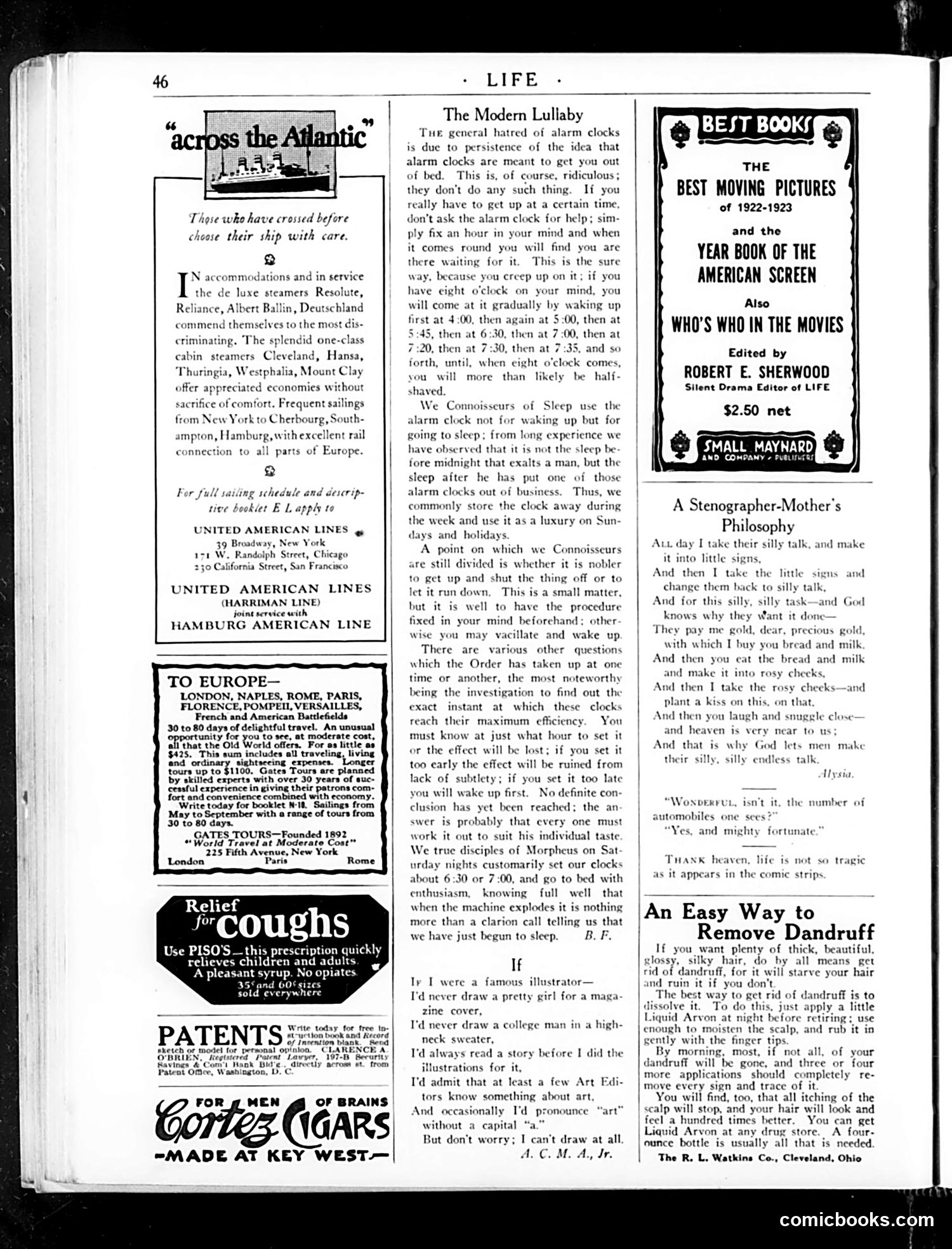
This humorous essay mocks the common frustration with alarm clocks through elaborate philosophical absurdity. The author claims alarm clocks don't actually wake people—they're useless for their stated purpose. Instead, he proposes that people should simply "fix an hour in your mind," then naturally wake gradually through the morning (4:00 AM, 5:00 AM, 5:45 AM, etc.). The satire escalates by suggesting alarm clocks' *real* value is helping people *sleep*—by removing them from the bedroom, one supposedly sleeps better afterward. The piece mocks both the persistence of futile morning routines and pseudo-intellectual "Connoisseurs of Sleep" who debate the "nobility" of stopping versus letting clocks wind down. This 1920s commentary reflects era-specific anxiety about modern technology intruding on natural rhythms, wrapped in deliberately overwrought logic that inverts the alarm clock's purpose entirely for comic effect.
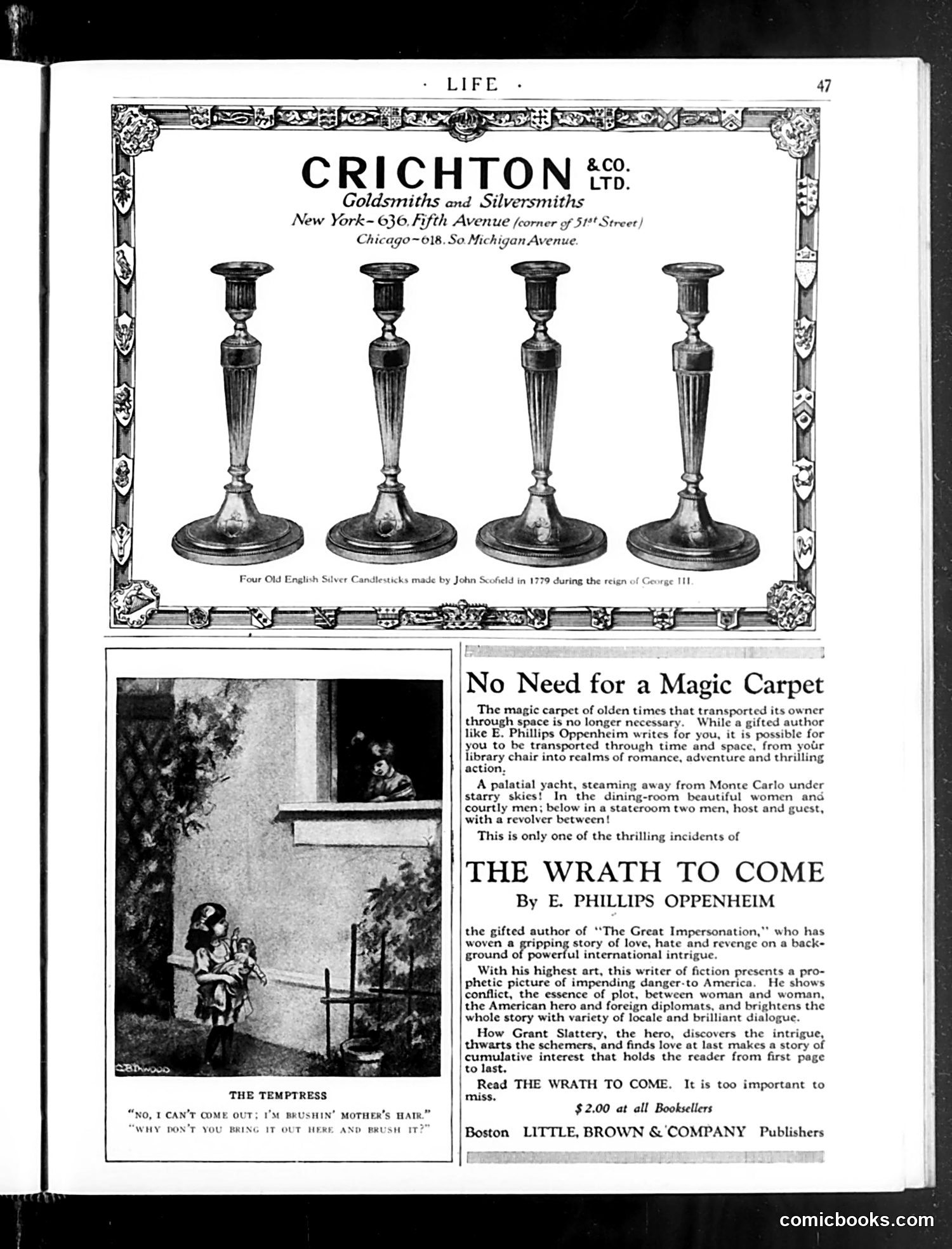
This page is primarily **advertising**, not satire or political commentary. The top section advertises **Crichton & Co.**, a luxury goods retailer, showcasing four Georgian-era silver candlesticks made in 1779—appeals to wealthy collectors valuing antique craftsmanship. Below that is a book advertisement for *The Wrath to Come* by E. Phillips Oppenheim, emphasizing exotic settings (Monte Carlo yachts, diplomatic intrigue) and romantic/suspenseful plotting to entice readers. The small cartoon at bottom—captioned "The Temptress"—depicts a domestic scene where a young woman brushes her mother's hair indoors while a man outside cajoles her to come out. The joke plays on the woman's excuse (dutiful daughter) versus the man's suggestive invitation. This reflects period humor about courtship propriety, with mild innuendo typical of 1920s-era Life magazine's comedic style.
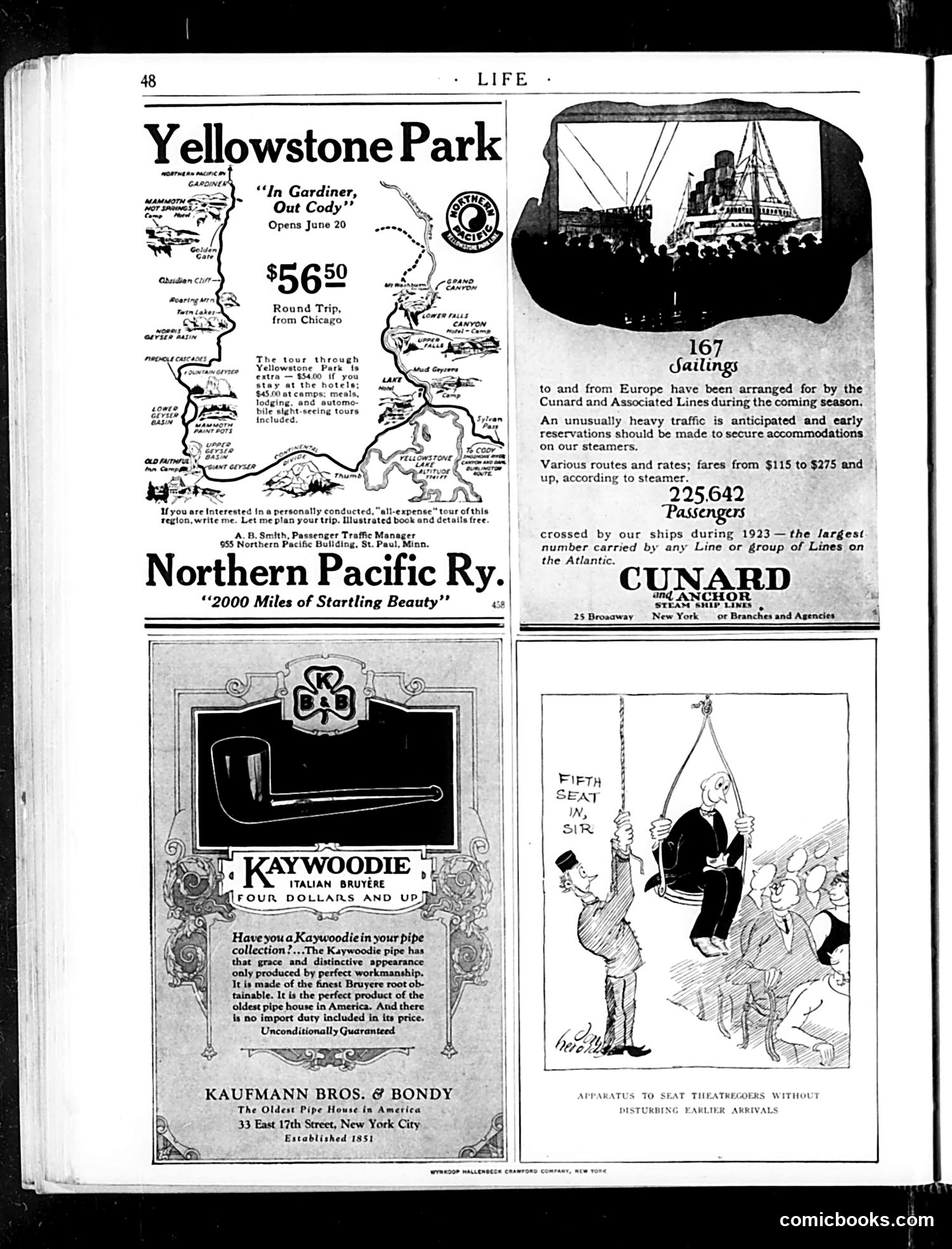
This page is primarily **advertising** for travel and luxury goods typical of the 1920s. The top features a Northern Pacific Railway ad promoting Yellowstone Park tours at $56.50 from Chicago. Below that, Cunard steamship lines advertise European sailings, boasting they carried 225,642 passengers in 1923—the largest number of any shipping line on the Atlantic. A Kaywoodie pipe advertisement emphasizes quality Italian bruyere craftsmanship. The only **satirical content** is a single cartoon at bottom right, captioned "Apparatus to Seat Theatregoers Without Disturbing Earlier Arrivals." It depicts a comedic mechanical contraption—a swing suspended from above—suggesting an absurd solution to the social problem of latecomers disrupting theatre audiences. The joke mocks the inconvenience of theatre etiquette and implied class tensions about proper behavior in public spaces.
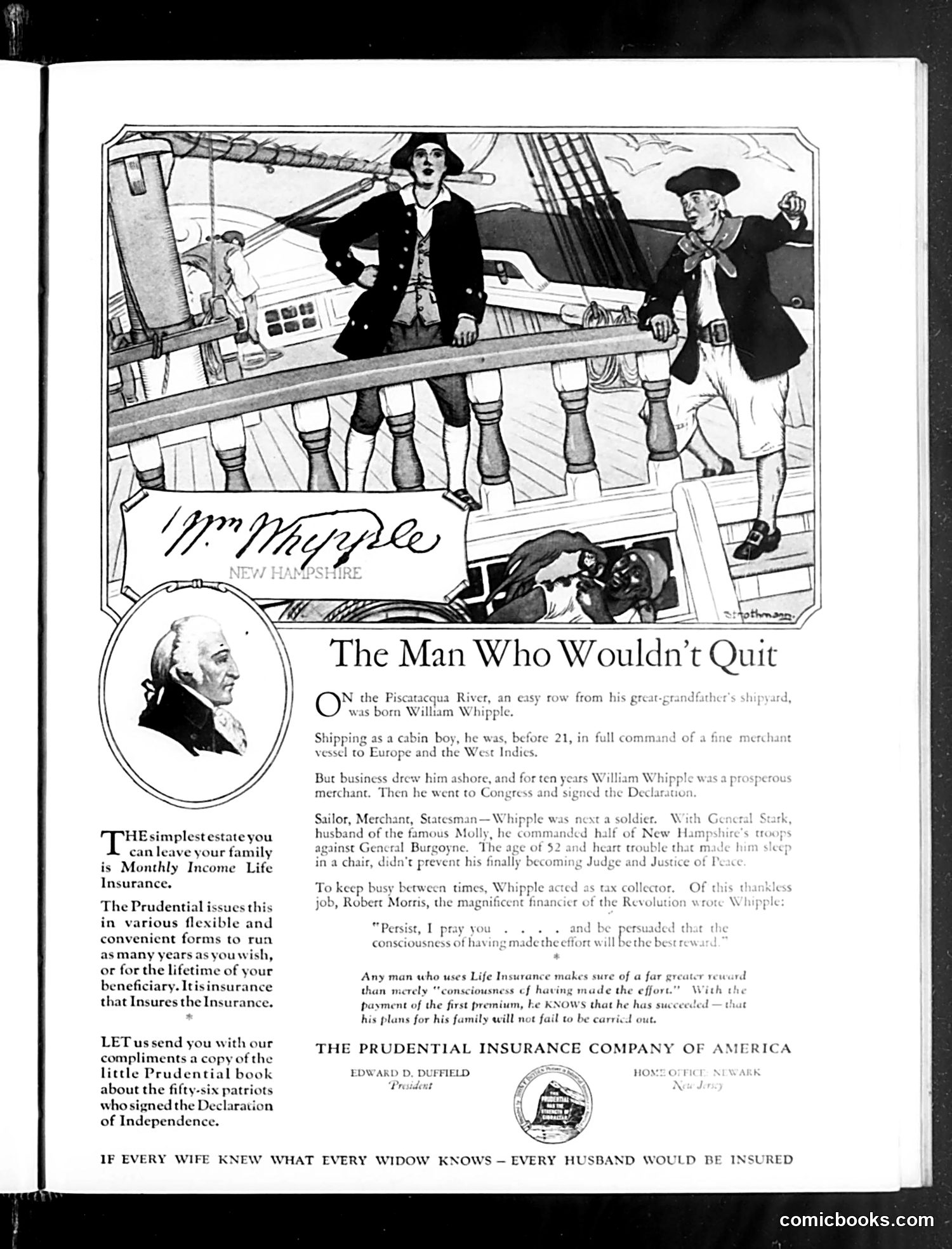
This is a Prudential Insurance advertisement using historical narrative to sell life insurance. The main illustration depicts William Whipple, one of the 56 signers of the Declaration of Independence (born on the Piscatacqua River in New Hampshire). The text traces Whipple's career progression—from cabin boy to merchant to soldier under General Stark to congressman—emphasizing his tireless perseverance. The point is satirical: despite all his accomplishments and service, the ad suggests that even such a patriotic, industrious life lacks true security *without* life insurance for one's family. The ad's closing line ("If every wife knew what every widow knows—every husband would be insured") bluntly plays on widows' financial vulnerability to sell insurance as patriotic duty. It's marketing anxiety about family security by wrapping it in Revolutionary-era respectability.
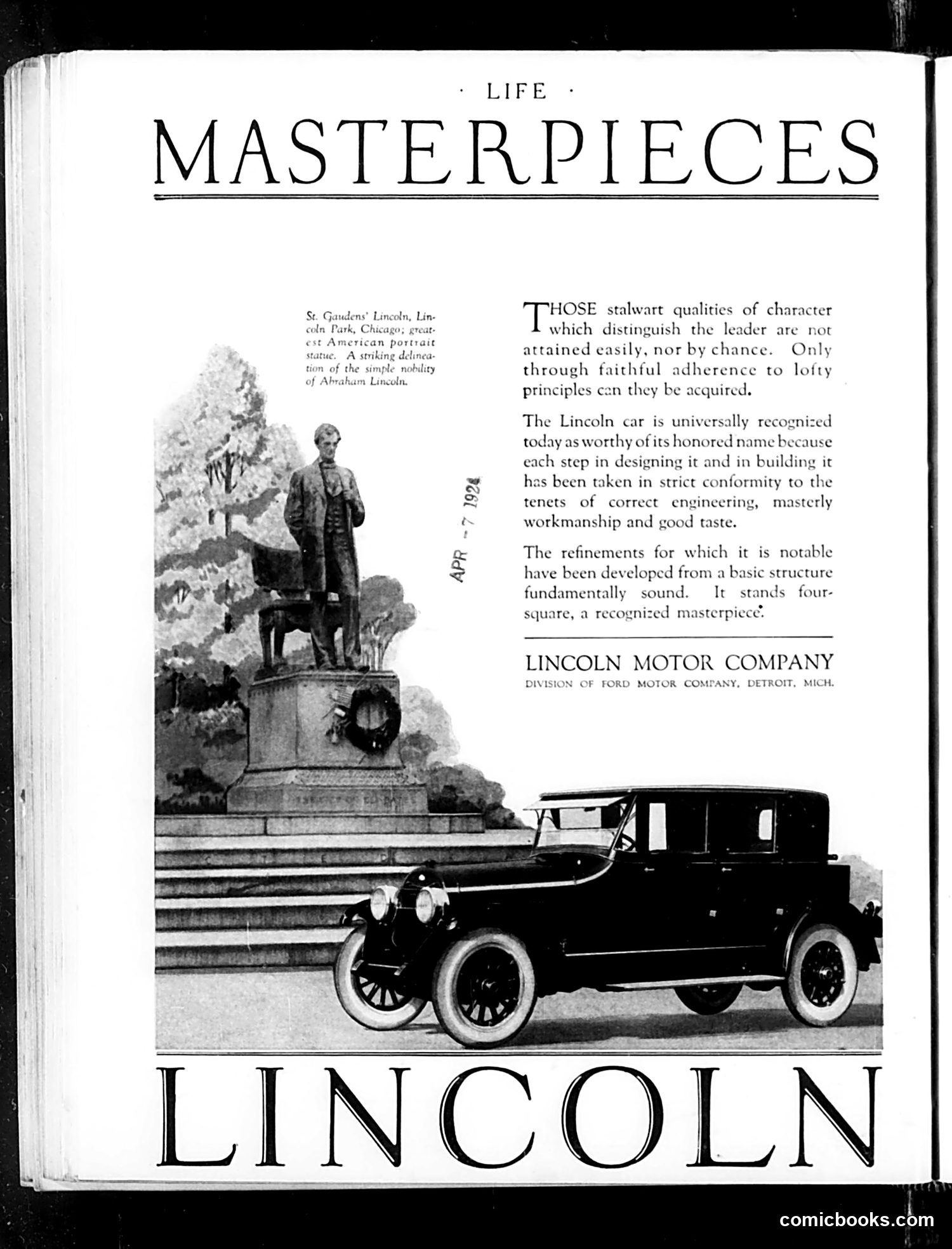
This is primarily an **advertisement**, not satire. The page uses a clever rhetorical strategy rather than humor or political commentary. The ad juxtaposes a statue of Abraham Lincoln (identified in the caption as the "St. Gaudens' Lincoln" in Chicago) with a Lincoln automobile to draw a parallel: just as Lincoln the president embodied noble character and principles, the Lincoln car embodies engineering excellence and craftsmanship. The text explicitly makes this comparison—both the car and the historical figure are described as achieving their status through "faithful adherence to lofty principles" and sound foundational design. This is **branding through association**: by naming their vehicle after Lincoln and displaying his statue, Lincoln Motor Company (a Ford division) attempts to transfer the 16th president's cultural prestige and moral authority to their product. The "masterpiece" framing appeals to consumers' aspirations toward quality and integrity. There is no satire here—this is straightforward aspirational advertising from the 1920s.