
Life, 1924-04-03 · page 28 of 60
Life — April 3, 1924 — page 28: what you’re looking at
What you’re looking at
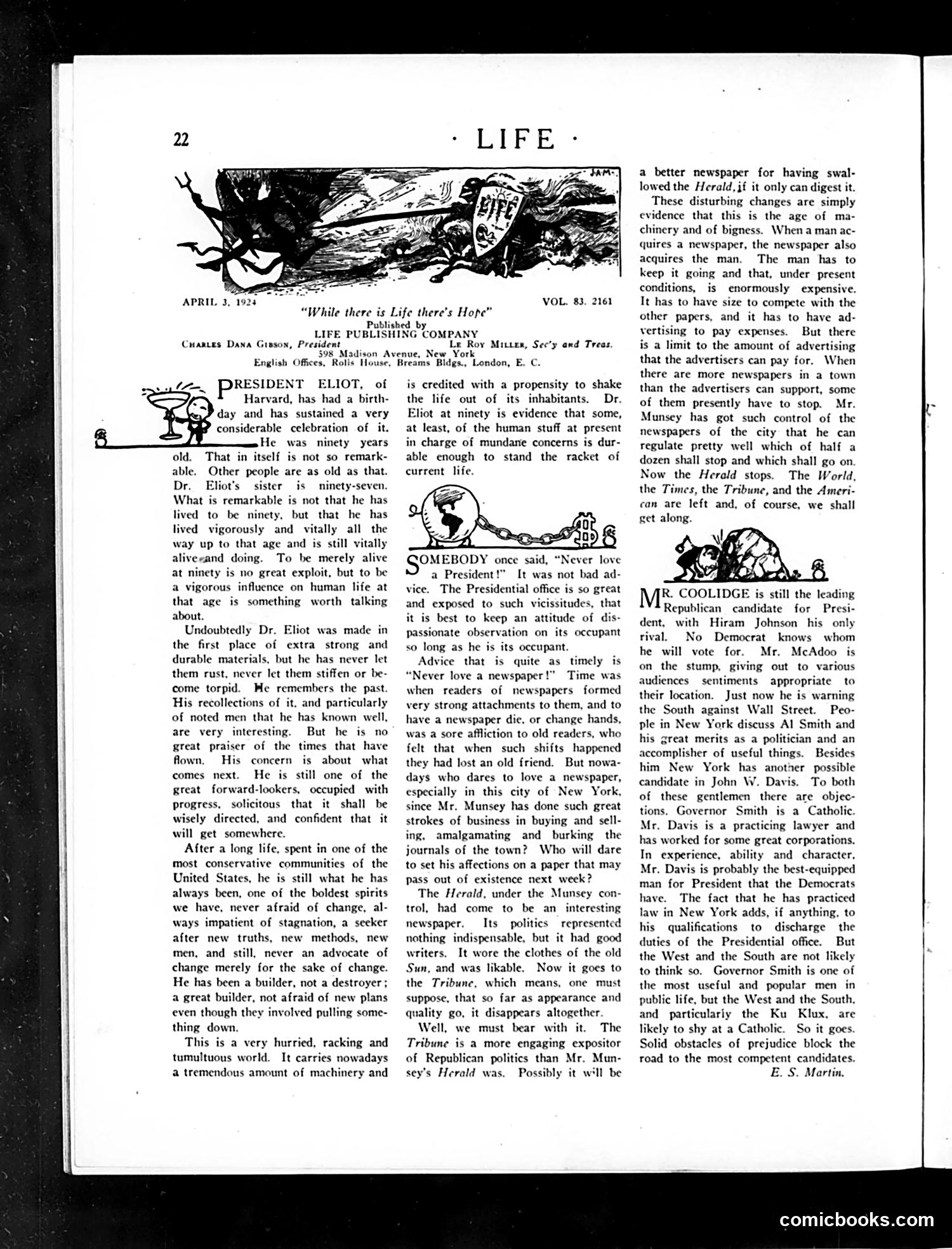
This page celebrates **President Charles W. Eliot of Harvard**, who has turned 90. The article praises his vigor and forward-thinking nature despite his advanced age—remarkable for someone in such a traditionally conservative institution. Eliot is presented as a "bold spirit" and "great builder" who remains engaged with progress rather than clinging to the past. The second article criticizes **newspaper publisher Frank Munsey's** consolidation of New York papers. The *Herald* has been merged into the *Tribune*. Life laments that readers once formed emotional attachments to newspapers, but Munsey's aggressive buying, selling, and merging of publications has made loyalty impossible—papers disappear "next week." The writer resignedly accepts that the *Tribune* will handle Republican politics adequately, even if the *Herald* is lost in the process. This reflects Progressive-era anxieties about corporate consolidation destroying beloved institutions.
📄 Transcribed text from this page (OCR, searchable)
Machine-transcribed from the original scan — historical spelling and the odd misread are preserved.
VOL. 83. 2161 “While there is Life there's Hope” Published by LIFE PUBLISHING COMPANY Le Roy Mittux, Sec'y and Treas. 598 Madison Avenue, New York English Offices, Castes Dana Giason, President RESIDENT ELIOT, of Harvard, has had a birth- day and has sustained a very considerable celebration of it. He was ninety years old. That in itself is not so remark- able. Other people are as old as that. Dr. Eliot’s sister is ninety-seven. What is remarkable is not that he has lived to be ninety, but that he has lived vigorously and vitally all the way up to that age and is still vitally aliveeand doing. To be merely alive at ninety is no great exploit, but to be a vigorous influence on human life at that age is something worth talking about. Undoubtedly Dr. Eliot was made in the first place of extra strong and durable materials, but he has never let them rust, never let them stiffen or be- come torpid. He remembers the past. His recollections of id particularly of noted men that he has known well, are very interesting. But he is no great praiser of the times that have flown, His concern is about what comes next. He is still one of the great forward-lookers, occupied with progress, solicitous that it shall be wisely directed, and confident that it will get somewhere. After a long life, spent in one of the most conservative communities of the United States, he is still what he has always been, one of the boldest spirits we have, never afraid of change, al- ways impatient of stagnation, a seeker after new truths, new methods, new men, and still, never an advocate of change merely for the sake of change. He has been a builder, not a destroyer ; a great builder, not afraid of new plans even though they involved pulling some- thing down, This is a very hurried, racking and tumultuous world. It carries nowadays a tremendous amount of machinery and Rolis House, Breams Bldgs., London, E. C. is credited with a propensity to shake the life out of its inhabitants. Dr. Eliot at ninety is evidence that some, at least, of the human stuff at present in charge of mundane concerns is dur- able enough to stand the racket of current life. SOMEBODY once said, “Never love a President!” It was not bad ad- vice. The Presidential office is so great and exposed to such vicissitudes, that it is best to keep an attitude of dis- passionate observation on its occupant so long as he is its occupant. Advice that is quite as timely is “Never love a newspaper!” Time was when readers of newspapers formed very strong attachments to them, and to have a newspaper die, or change hands, was a sore affliction to old readers, who felt that when such shifts happened they had lost an old friend. But nowa- days who dares to love a newspaper, especially in this city of New York, since Mr. Munsey has done such great strokes of business in buying and sell- ing, amalgamating and burking the journals of the town? Who will dare to set his affections on a paper that may pass out of existence next week? The Herald, under the Munsey con- trol, had come to be an_ interesting newspaper. Its politics represented nothing indispensable, but it had good writers. It wore the clothes of the old Sun, and was likable. Now it goes to the Tribune, which means, one must suppose, that so far as appearance and quality go, it disappears altogether. Well, we must bear with it. The Tribune is a more engaging expositor of Republican politics than Mr. Mun- sey’s Herald was. Possibly it will be a better newspaper for having swal: lowed the Herald, jf it only can digest it. These disturbing changes are simply evidence that this is the age of ma- chinery and of bigness. When a man ac- quires a newspaper, the newspaper also acquires the man. The man has to keep it going and that, under present conditions, is enormously expensive. It has to have size to compete with the other papers, and it has to have ad- vertising to pay expenses. But there is a limit to the amount of advertising that the advertisers can pay for. When there are more newspapers in a town than the advertisers can support, some of them presently have to stop. Mr. Munsey has got such control of the newspapers of the city that he can regulate pretty well which of half a dozen shall stop and which shall go on. Now the Herald stops. The World, the Times, the Tribune, and the Ameri- can are left and, of course, we shall get along. R. COOLIDGE is still the leading Republican candidate for Presi- dent, with Hiram Johnson his only rival. No Democrat knows whom he will vote for. Mr. McAdoo is on the stump, giving out to various audiences sentiments appropriate to their location. Just now he is warning the South against Wall Street. Peo- ple in New York discuss Al Smith and his great merits as a politician and an accomplisher of useful things. Besides him New York has another possible candidate in John W. Davis. To both of these gentlemen there are objec- tions. Governor Smith is a Catholic. Mr. Davis is a practicing lawyer and has worked for some great corporations. In experience, ability and character, Mr. Davis is probably the best-equipped man for President that the Democrats have. The fact that he has practiced law in New York adds, if anything, to his qualifications to discharge the duties of the Presidential office. But the West and the South are not likely to think so. Governor Smith is one of the most useful and popular men in public life, but the West and the South, and particularily the Ku Klux, are likely to shy at a Catholic. So it goes. Solid obstacles of prejudice block the road to the most competent candidates. E. S. Martin. comicbooks.com