
Life, 1924-04-03 · page 38 of 60
Life — April 3, 1924 — page 38: what you’re looking at
What you’re looking at
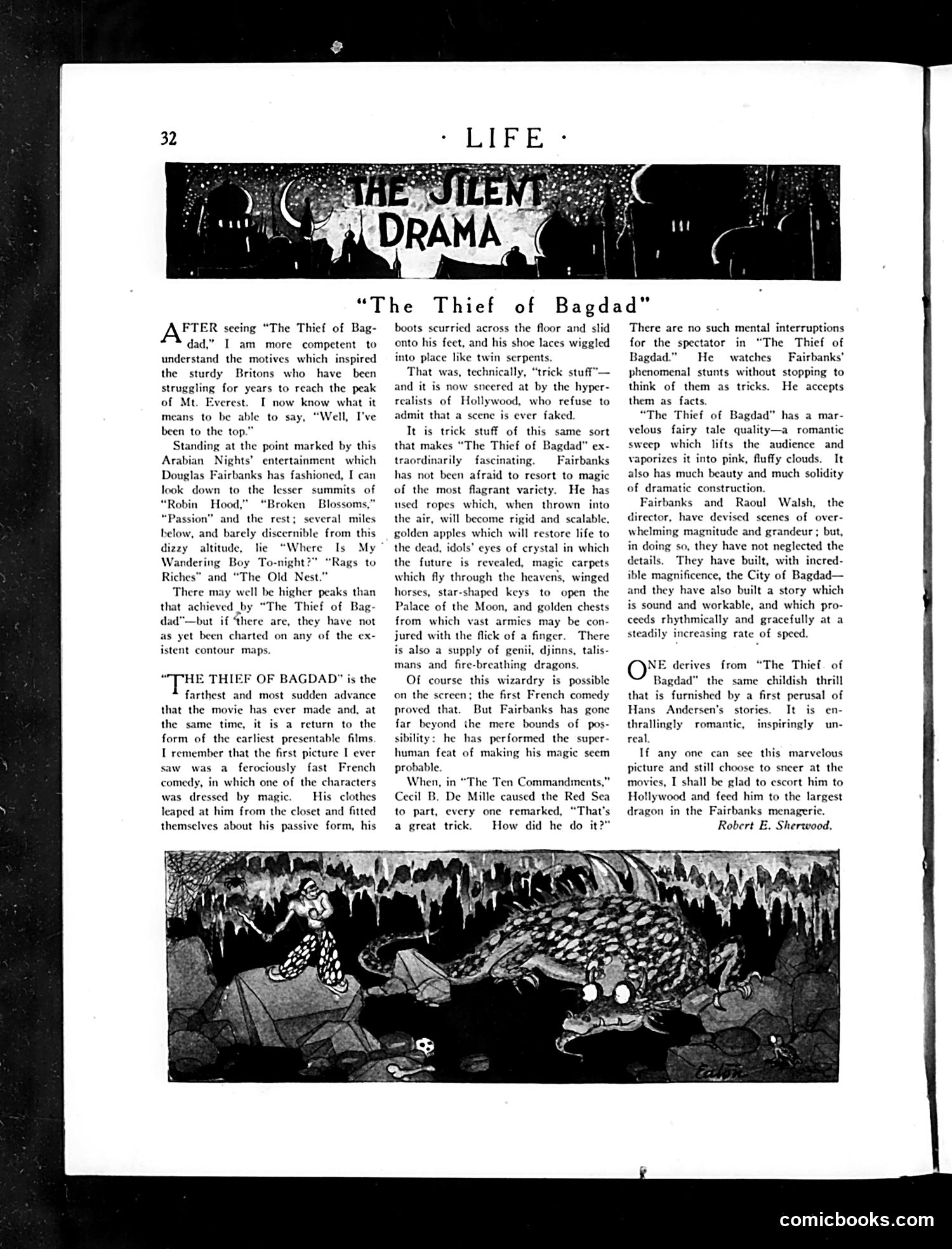
This is a film review by Robert E. Sherwood of Douglas Fairbanks' silent film "The Thief of Bagdad." The critic praises it as cinema's greatest achievement, comparing other Fairbanks films ("Robin Hood," "Broken Blossoms") to lesser mountain peaks. Sherwood argues the film succeeds by embracing theatrical "trick stuff"—magic carpets, flying horses, crystal-eyed idols, golden apples—rather than pretending realism. He contrasts this favorably with Cecil B. DeMille's "Ten Commandments," where audiences consciously notice special effects as tricks. In "Thief of Bagdad," viewers accept the magic as plausible within the film's fairy-tale logic, creating immersive wonder rather than distraction. The review celebrates both the spectacular visuals and solid dramatic construction, praising director Raoul Walsh and Fairbanks for balancing grandeur with narrative coherence.
📄 Transcribed text from this page (OCR, searchable)
Machine-transcribed from the original scan — historical spelling and the odd misread are preserved.
“The TER seeing “The Thief of Bag- dad,” I am more competent to understand the motives which inspired the sturdy Britons who have been struggling for years to reach the peak of Mt. Everest. I now know what it means to be able to say, “Well, I've been to the top.” Standing at the point marked by this Arabian Nights’ entertainment which Douglas Fairbanks has fashioned, I can look down to the lesser summits of “Robin Hood,” “Broken Blossoms,” ssion” and the rest; several miles below, and barely discernible from this dizzy altitude, lie “Where Is My Wandering Boy To-night? Riche: id “The Old Nest There may well be higher peaks than that achieved by “The Thief of Bag- dad"—but if ‘there are, they have not as yet been charted on any of the ex- istent contour maps. “THE THIEF OF BAGDAD” is the farthest and most sudden advance that the movie has ever made and, at the same time, it is a return to the form of the earliest presentable films I remember that the first picture I ever saw was a ferociously fast French comedy, in which one of the characters dressed by magic. His clothes leaped at him from the closet and fitted themselves about his passive form, his boots scurried across the floor and slid onto his feet, and his shoe laces wiggled into place like twin serpents. That was, technically, “trick stuff”"— and it is now sneered at by the hyper- realists of Hollywood, who refuse to admit that cene is ever faked. stuff of this same sort that makes “The Thief of Bagdad” ex- traordinarily fascinating. Fairbanks has not been afraid to resort to magic of the most flagrant varicty. He has used ropes which, when thrown into the air, will become rigid and scalable, golden apples which will restore life to the dead, idols’ eyes of crystal in which the future is revealed, magic carpets which fly through the heavens, winged horses, star-shaped keys to open the Palace of the Moon, and golden chests from which vast armies may be con- jured with the flick of a finger. There is also a supply of genii, djinns, talis- mans and fire-breathing dragons. It is tric Of course this wizardry is possible on the screen; the first French comedy proved that. But Fairbanks has gone far beyond the mere bounds of pos- sibility: he has performed the super- human feat of making his magic seem probable. When, in “The Ten Commandments,” Cecil B. De Mille caused the Red Sea to part, every one remarked, “That's a great trick. How did he do it?” Thief of Bagdad” There are no such mental interruptions for the spectator in “The Thief of Bagdad." He watches Fairbanks’ phenomenal stunts without stopping to think of them as tricks. He accepts them as facts. he Thief of Bagdad” has a mar- velous fairy tale quality—a romantic sweep which lifts the audience and vaporizes it into pink, fluffy clouds. It also has much beauty and much solidity of dramatic construction. Fairbanks and Raoul Walsh, the director, have devised scenes of over- whelming magnitude and grandeur ; but, in doing so, they have not neglected the details. They have built, with incred- ible magnificence, the City of Bagdad— and they have also built a story which is sound and workable, and which pro- ceeds rhythmically and gracefully at a steadily increasing rate of speed. O E derives from “The Thief. of Bagdad" the same childish thrill that is furnished by a first perusal of Hans Andersen's stories. It is en- thrallingly romantic, inspiringly _un- real. If any one can see this marvelous picture and still choose to sneer at the movies, I shall be glad to escort him to Hollywood and feed him to the largest dragon in the Fairbanks menagerie. Robert E. Sherwood. comicbooks.com