
Life, 1924-04-03 · page 32 of 60
Life — April 3, 1924 — page 32: what you’re looking at
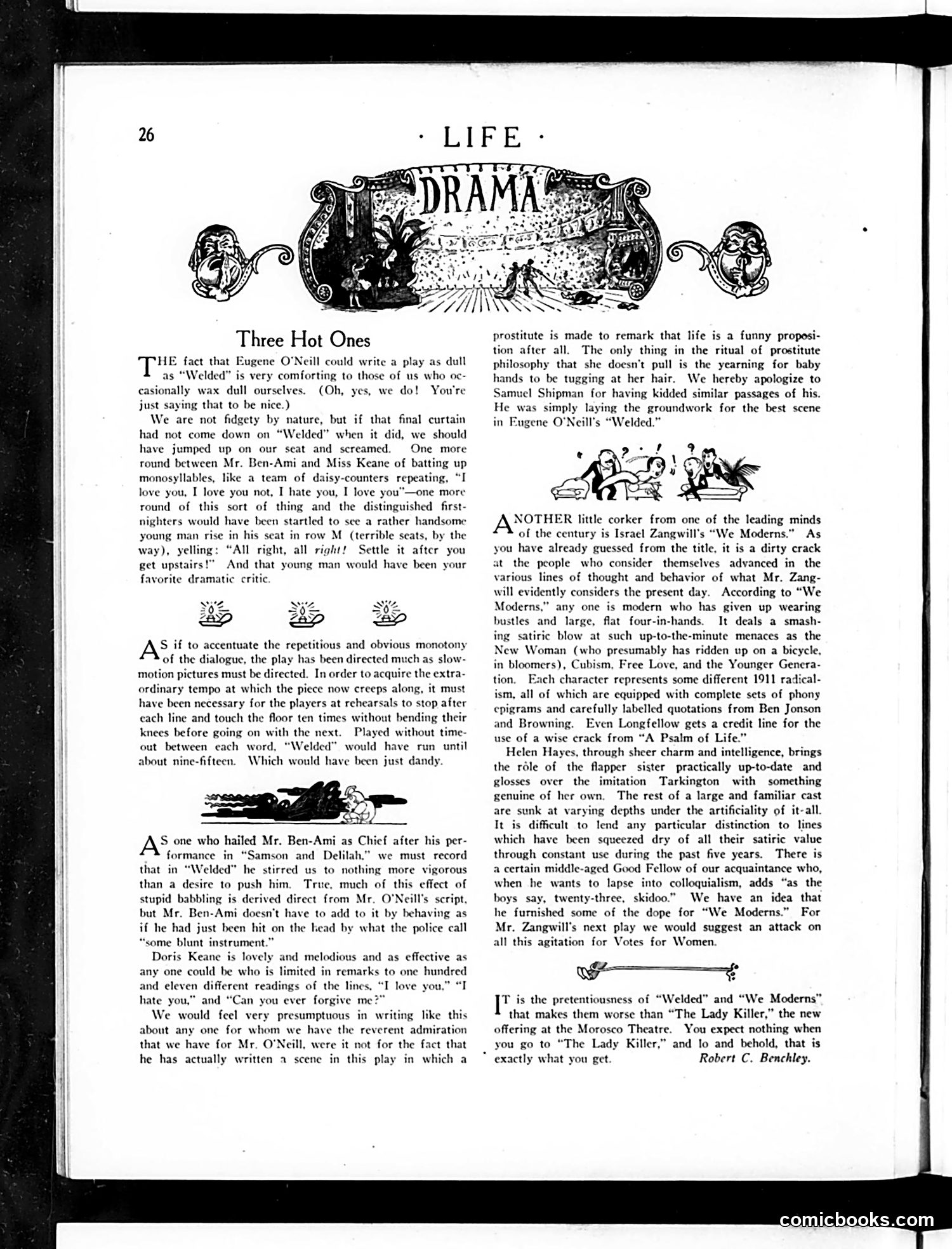
What you’re looking at
This page contains three satirical theater reviews from Life magazine. The critic savagely mocks Eugene O'Neill's play "Welded," calling it tediously slow and repetitive—actors deliver the same lines ("I love you," "I hate you") so monotonously that the critic threatens to scream. He praises the actors (Ben-Ami and Doris Keane) while blaming O'Neill's script for the play's glacial pacing and dialogue. The critic also reviews Israel Zangwill's "We Moderns," which satirizes 1911 radicals and "advanced" thinkers. Zangwill mocks modernists through caricatured characters representing various contemporary movements: the New Woman (who rides bicycles in bloomers), Cubism, and Free Love—all equipped with pretentious, fake epigrams. The reviews showcase Life's trademark irreverent theater criticism of the era.
📄 Transcribed text from this page (OCR, searchable)
Machine-transcribed from the original scan — historical spelling and the odd misread are preserved.
Three Hot Ones HE fact that Eugene O'Neill could write a play as dull as “Welded” is very comforting to those of us who oc- casionally wax dull ourselves. (Oh, yes, we do! You're just saying that to be nice.) We are not fidgety by nature, but if that final curtain had not come down on “Welded” when it did, we should have jumped up on our seat and screamed. One more round between Mr. Ben-Ami and Miss Keane of batting up monosyllables, like a team of daisy-counters repeating, “I love you, I love you not, I hate you, I love you"—one more round of this sort of thing and the distinguished first- nighters would have been startled to see a rather handsome young man rise in his seat in row M (terrible seats, by the way), yelling: “All right, all right! Settle it after you get upstairs!” And that young man would have been your favorite dramatic critic je Ss S% S if to accentuate the repetitious and obvious monotony of the dialogue, the play has been directed much as slow- motion pictures must be directed. In order to acquire the extra- ordinary tempo at which the piece now creeps along, it must have been necessary for the players at rehearsals to stop after cach line and touch the floor ten times without bending their knees before going on with the next. Played without time- out between each word, “Welded” would have run until about nine-fifteen. Which would have been just dandy. a S one who hailed Mr. Ben-Ami as Chief after his per- formance in “Samson and Delilah.” we must record that in “Welded” he stirred us to nothing more vigorous than a desire to push him. True, much of this effect of stupid babbling is derived direct from Mr, O'Neill's script, but Mr. Ben-Ami doesn't have to add to it by behaving as if he had just been hit on the bead by what the police call “some blunt instrument.” Doris Keane is lovely and melodious and as effective as any one could be who is limited in remarks to one hundred and eleven different readings of the lines, “I love you,” “I hate you,” and “Can you ever forgive me We would feel very presumptuous in writing like this about any one for whom we have the reverent admiration that we have for Mr. O'Neill, were it not for the fact that he has actually written a scene in this play in which a ay * exactly what you get. prostitute is made to remark that life is a funny proposi- tion after all, The only thing in the ritual of prostitute philosophy that she doesn't pull is the yearning for baby hands to be tugging at her hair. We hereby apologize to Samuel Shipman for having kidded similar passages of his. He was simply laying the groundwork for the best scene in Eugene O'Neill's “Welded.” NOTHER little corker from one of the leading minds of the century is Israel Zangwill’s “We Moderns.” As. you have already guessed from the title, it is a dirty crack at the people who consider themselves advanced in the rious lines of thought and behavior of what Mr. Zang- will evidently considers the present day. According to “We Moderns,” any one is modern who has given up wearing bustles and large, flat four-in-hands. It deals a smash- ing satiric blow at such up-to-the-minute menaces as the New Woman (who presumably has ridden up on a bicycle, in bloomers), Cubism, Free Love, and the Younger Gencra- tion. Each character represents some different 1911 radical- ism, all of which are equipped with complete sets of phony cpigrams and carefully labelled quotations from Ben Jonson and Browning. Even Longfellow gets a credit line for the use of a wise crack from “A Psalm of Lif Helen Hayes, through sheer charm and intelligence, brings the rdle of the flapper sister practically up-to-date and glosses over the imitation Tarkington with something genuine of her own. The rest of a large and familiar cast are sunk at varying depths under the artificiality of it-all. It is difficult to lend any particular distinction to lines which have been squeezed dry of all their satiric value through constant use during the past five years. There is a certain middle-aged Good Fellow of our acquaintance who, when he wants to lapse into colloquialism, adds “as the boys say, twenty-three, skidoo.” We have an idea that he furnished some of the dope for “We Moderns.” For Mr. Zangwill’s next play we would suggest an attack on all this agitation for Votes for Women. T is the pretentiousness of “Welded” and “We Moderns” that makes them worse than “The Lady Killer,” the new offering at the Morosco Theatre. You expect nothing when you go to “The Lady Killer,” and lo and behold, that is Robert C. Benchley.