
Life, 1924-04-03 · page 26 of 60
Life — April 3, 1924 — page 26: what you’re looking at
What you’re looking at
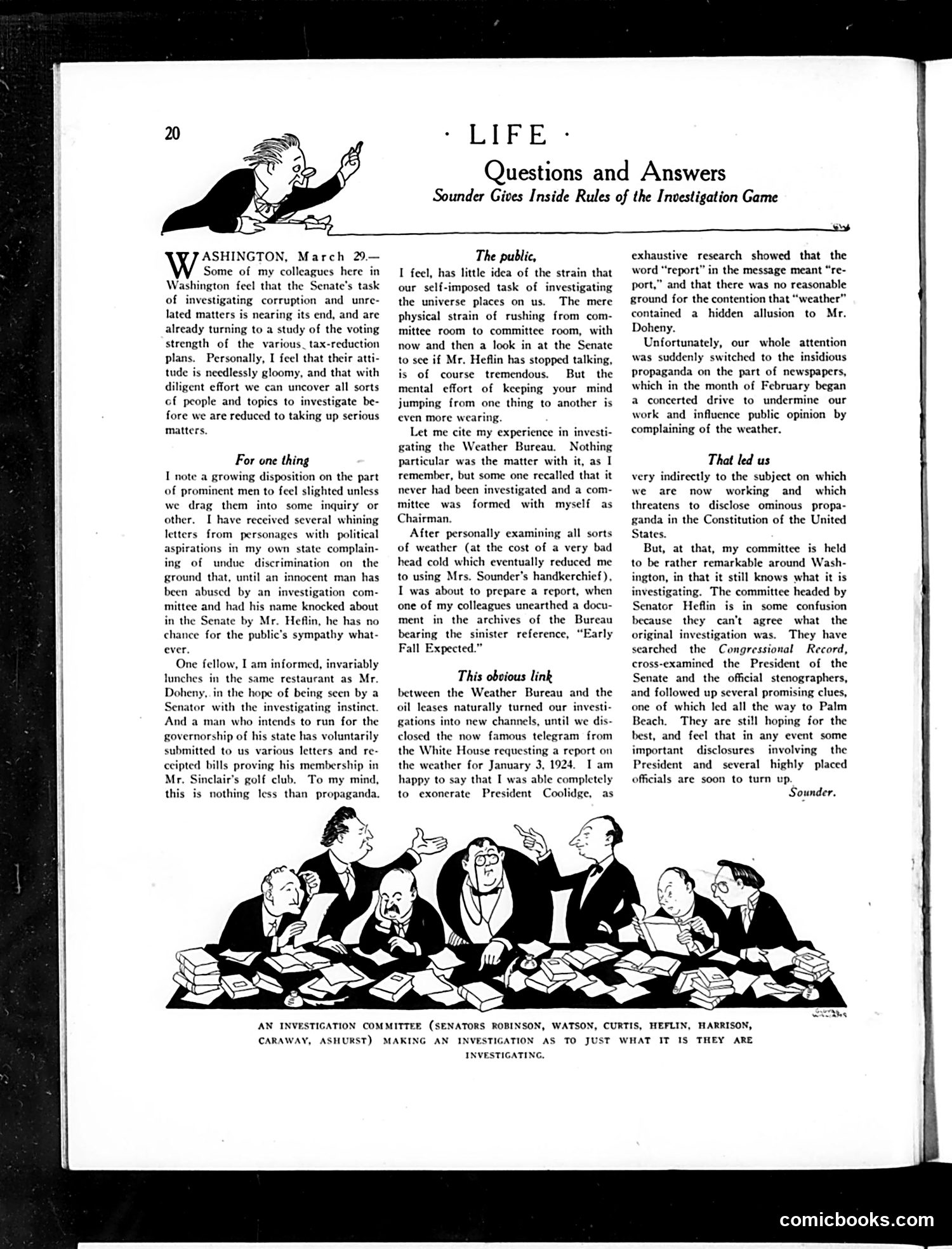
This Life magazine piece satirizes the Senate's sprawling corruption investigations of the early 1920s, particularly targeting their lack of focus and apparent endless scope. **The Context:** The text references real investigations into oil scandals (Teapot Dome, Doheny's involvement) and mentions Senator Thomas Heflin, known for aggressive questioning. The anonymous columnist "Sounder" mocks how senators drag prominent men into inquiries for political theater. **The Satire's Point:** Senators investigate trivial matters (the Weather Bureau) and manufacture connections between unrelated documents (a telegram about January weather somehow linking to oil leases and Doheny). The humor lies in showing how investigations spiral absurdly—starting nowhere, discovering "sinister" documents that mean nothing, and eventually threatening to expose "propaganda in the Constitution." **The Cartoon:** Six senators hunched over mountains of papers, bewildered, perfectly illustrates the text's complaint that even the investigators don't know what they're investigating anymore. The broader critique: Senate investigations have become performative exercises where senators gain publicity by investigating everything and proving nothing.
📄 Transcribed text from this page (OCR, searchable)
Machine-transcribed from the original scan — historical spelling and the odd misread are preserved.
LIFE - Questions and Answers Sounder Gives Inside Rules of the Investigation Game ASHINGTON, March 29.— Some of my colleagues here in ington feel that the Senate's task of investigating corruption and unre- lated matters is nearing its end, and are already turning to a study of the voting strength of the various_tax-reduction plans. Personally, I feel that their atti- tude is needlessly gloomy, and that with diligent effort we can uncover all sorts cf people and topics to investigate be- fore we are reduced to taking up serious matters. For one thing I note a growing disposition on the part of prominent men to feel slighted unless we drag them into some inquiry or other. I have received several whining letters from personages with political aspirations in my own state complain- ing of undue discrimination on the ground that, until an innocent man has been abused by an investigation com- mittee and had his name knocked about in the Senate by Mr. Heflin, he has no chance for the public's sympathy what- ever, One fellow, I am informed, invariably lunches in the same restaurant as Mr. Doheny, in the hope of being seen by a Senator with the investigating instinct. And a man who intends to run for the governorship of his state has voluntarily submitted to us various letters and re- ceipted bills proving his membership in Mr. Sinclair's golf club. To my mind, this nothing less than propaganda. The public, I feel, has little idea of the strain that our self-imposed task of investigating the universe places on us. The mere physical strain of rushing from com- mittee room to committee room, with now and then a look in at the Senate to see if Mr. Heflin has stopped talking, is of course tremendous. But the mental effort of keeping your mind jumping from one thing to another is even more wearing. Let me cite my experience in investi- gating the Weather Bureau. Nothing particular was the matter with it, as I remember, but some one recalled that it never had been investigated and a com- mittee was formed with myself as Chairman, After personally examining all sorts of weather (at the cost of a very bad head cold which eventually reduced me to using Mrs. Sounder’s handkerchief), I was about to prepare a report, when one of my colleagues unearthed a docu- ment in the archives of the Bureau bearing the sinister reference, “Early Fall Expected.” This obvious link between the Weather Bureau and the oil leases naturally turned our investi- gations into new channels, until we dis- closed the now famous telegram from the White House requesting a report on the weather for January 3, 1924. I am happy to say that I was able completely to exonerate President Coolidge, as exhaustive research showed that the word “report” in the message meant “re- port,” and that there was no reasonable ground for the contention that “weather” contained a hidden allusion to Mr. Doheny. Unfortunately, our whole attention was suddenly switched to the insidious propaganda on the part of newspapers, which in the month of February began a concerted drive to undermine our work and influence public opinion by complaining of the weather. That led us very indirectly to the subject on which we are now working and which threatens to disclose ominous propa- ganda in the Constitution of the United States. But, at that, my committee is held to be rather remarkable around Wash- ington, in that it still knows what it is investigating. The committee headed by Senator Heflin is in some confusion because they can’t agree what the original investigation was. They have searched the Congressional Record, cross-examined the President of the Senate and the official stenographers, and followed up several promising clues, one of which led all the way to Palm Beach. They are still hoping for the best, and feel that in any event some important disclosures involving the President and several highly placed officials are soon to turn up. Sounder. AN INVESTIGATION COMMITTEE (SENATORS ROBINSON, WATSON, CURTIS, HEFLIN, HARRISON, CARAWAY, ASHURST) MAKING AN INV! ESTIGATING. TIGATION AS TO JUST WHAT IT 1S THEY ARE comicbooks.com