
A complete issue · 44 pages · 1924
Life — January 10, 1924
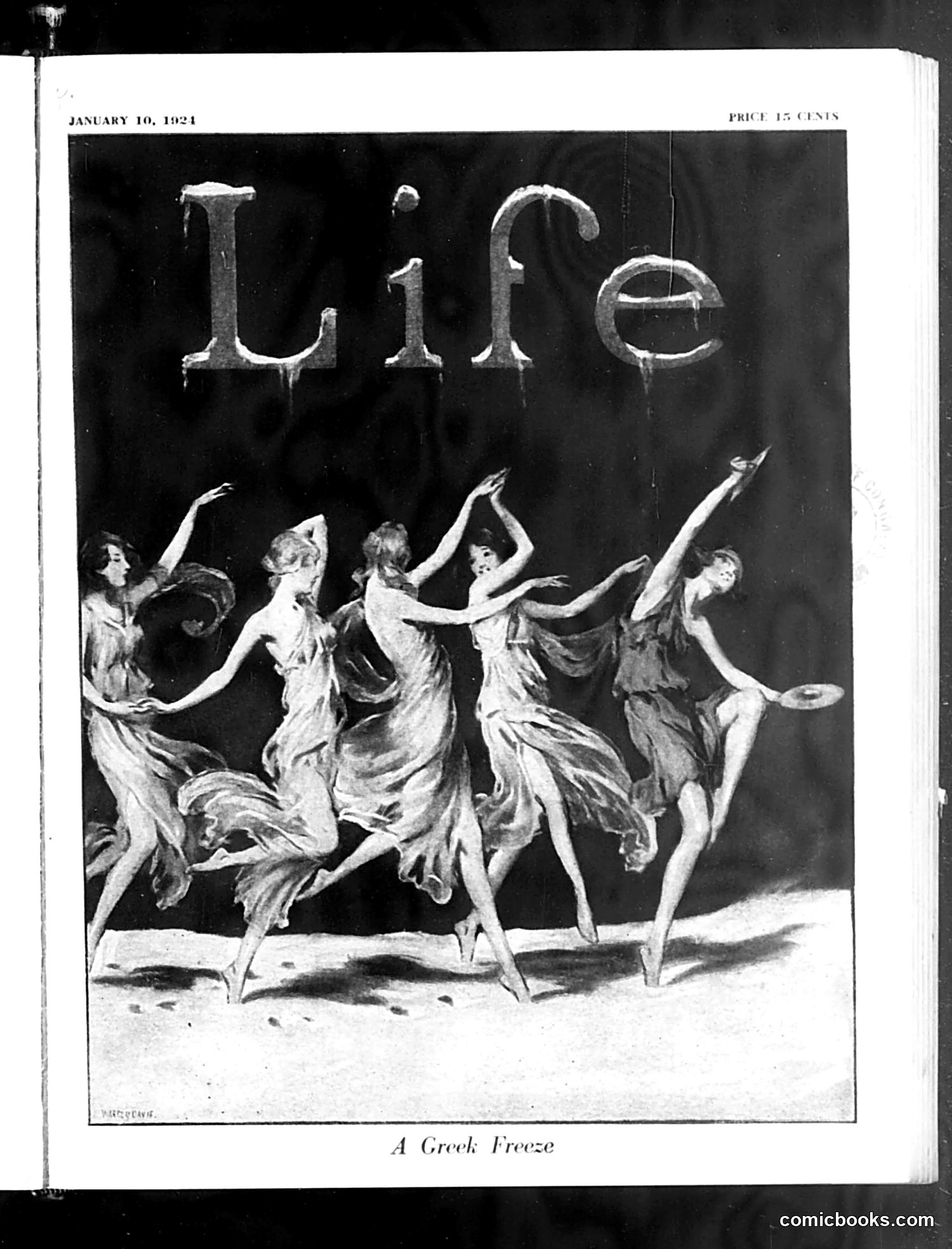
This page features the title "Life" with an illustration labeled "A Greek Freeze" showing multiple classical female figures in draped garments with raised arms in dance-like poses against a dark background. The cartoon appears to be a visual pun playing on the term "freeze"—both referencing classical Greek art ("Greek") and the winter season (January publication date). The figures are styled after Greek sculpture and fresco paintings, hence "freeze" (or frieze, the decorative band in classical architecture). The satire likely comments on contemporaneous trends—possibly the popularity of classical aesthetics in 1920s design, or perhaps mockingly references social or political rigidity presented as "classical" restraint. Without additional context or visible caricatures of specific individuals, the precise satirical target remains unclear, though the image suggests commentary on artistic or cultural fashions of the era.
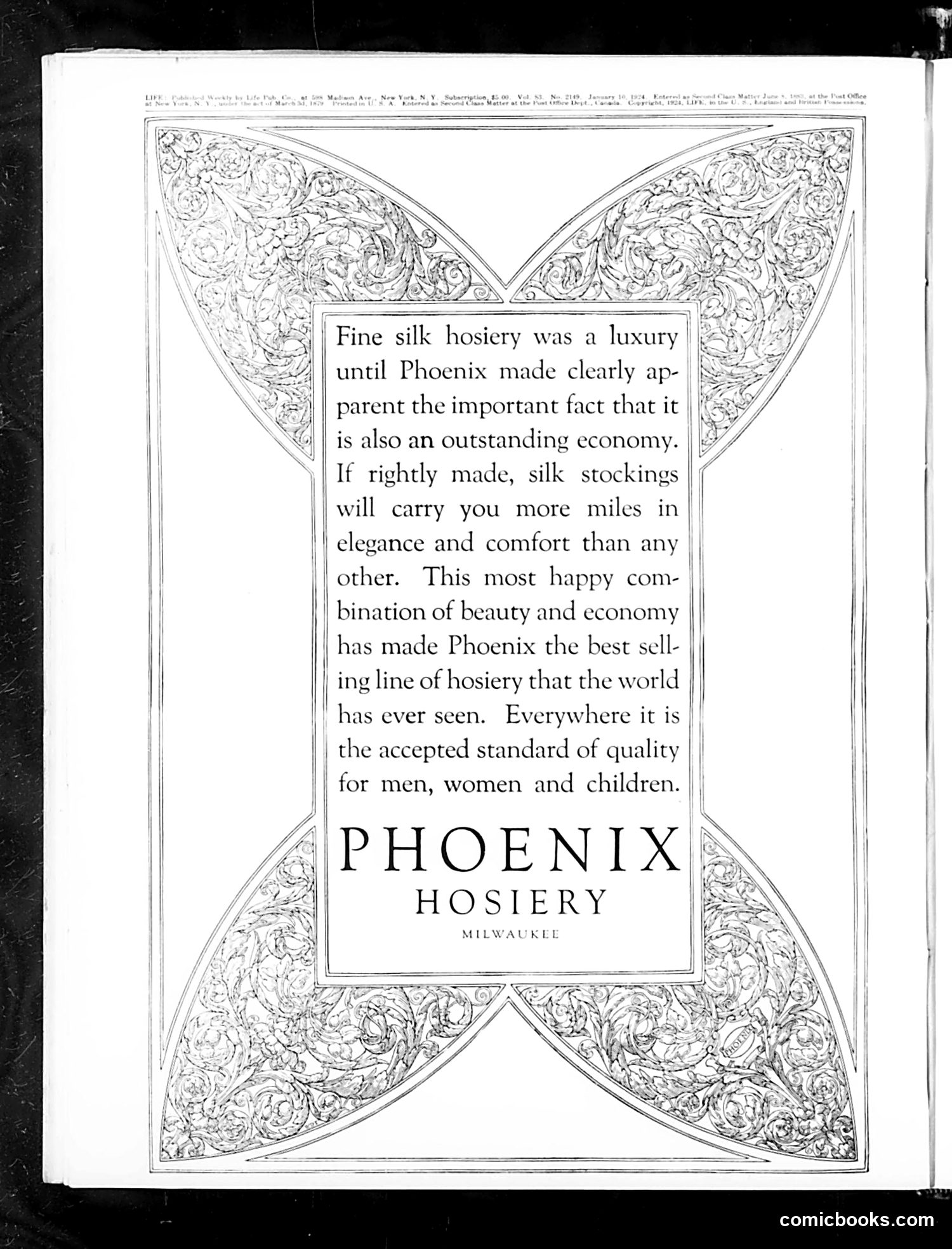
This page is **not a cartoon or satirical content** — it is a straightforward advertisement for Phoenix Hosiery from Milwaukee. The elaborate decorative border (featuring ornate floral/scrollwork designs in four corner sections) is purely aesthetic, typical of early 20th-century magazine advertising design. The ad's text makes a conventional commercial argument: that Phoenix silk stockings combine luxury with affordability and durability, making them the superior choice for "men, women and children." There is no political satire, social commentary, or caricature present. This represents Life magazine's advertising content rather than its editorial/comedic material.
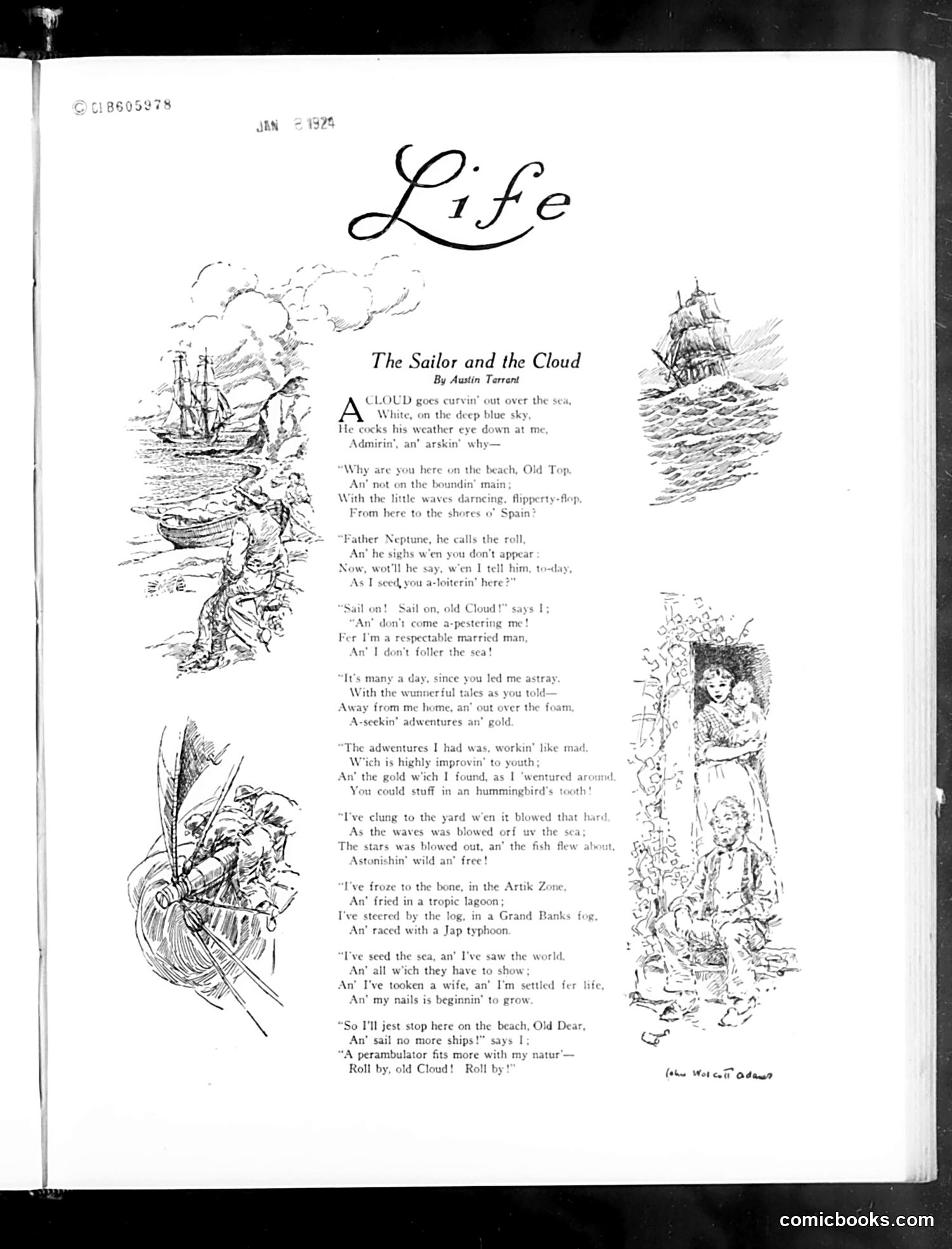
This page contains a narrative poem illustrated with ink drawings, not political satire. The poem depicts a dialogue between an old sailor and a personified cloud, rendered as whimsical character sketches. The sailor recounts his adventurous seafaring past—frozen Arctic expeditions, tropical lagoons, typhoons, and global voyages—contrasting his youthful wanderlust with his current settled life as a married man. The cloud, initially beckoning him back to adventure ("Sail on!"), ultimately accepts his domestication. The illustrations show ships, stormy seas, and the cloud depicted as a playful figure—emphasizing the fantastical, romantic tone rather than social commentary. This appears to be light, nostalgic fiction rather than political humor.
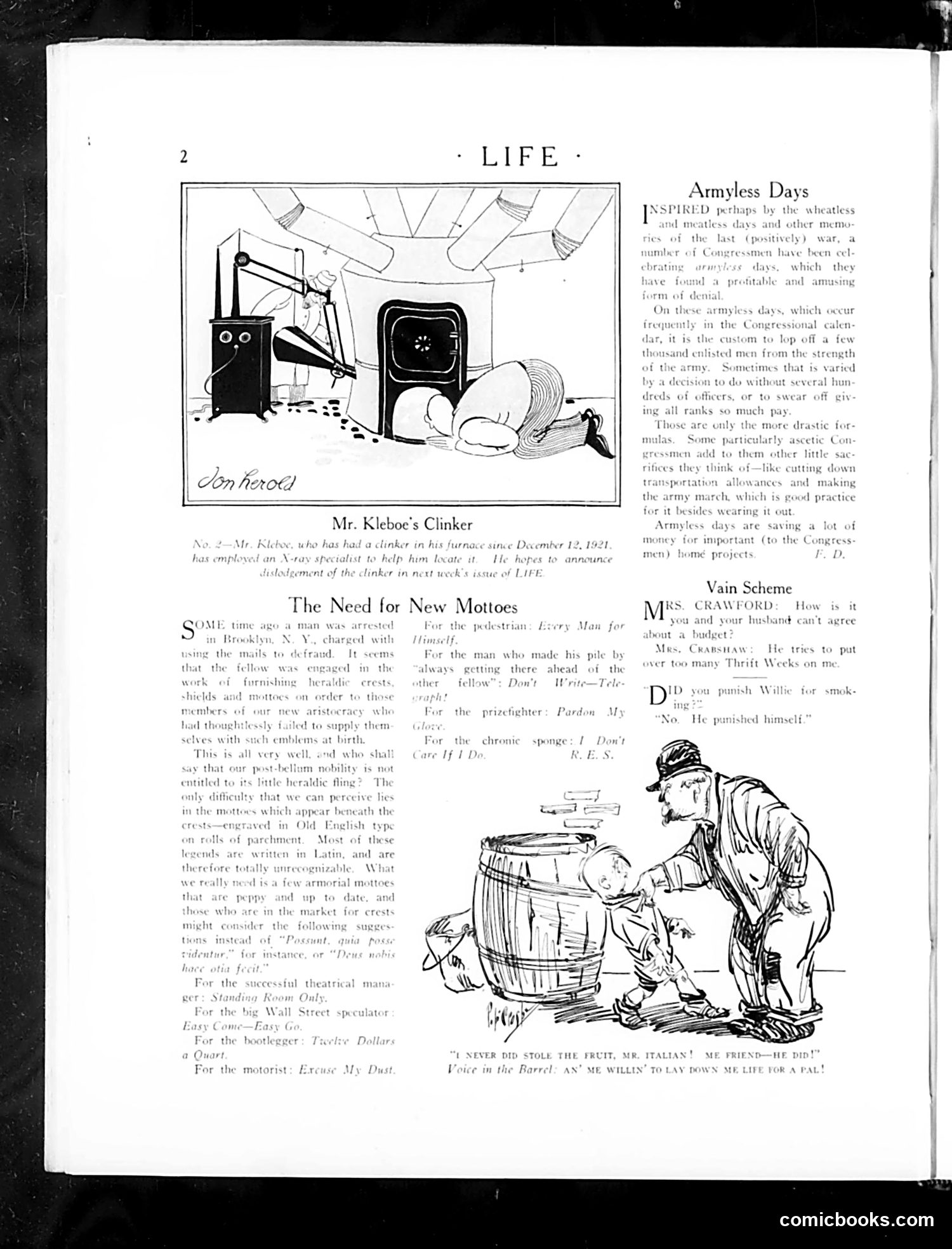
The page contains three distinct pieces of satire: 1. **"Mr. Kleboe's Clinker"** (top): A cartoon about a man with a furnace problem since December 12, 1921, employing an X-ray specialist. The joke appears to mock both the absurdity of hiring specialized professionals for minor domestic issues and post-WWI economic conditions where such services existed. 2. **"The Need for New Mottoes"** (left): Text proposing humorous alternative mottos for various professions—pedestrians, prizefighters, Wall Street speculators, etc.—as social commentary on contemporary occupations and their failings. 3. **"Vain Scheme"** (right): A domestic comedy cartoon showing a couple arguing about budgets and a man named Willie. The humor derives from marital financial disputes. All reflect 1920s American social anxieties about money, class, and domestic life.
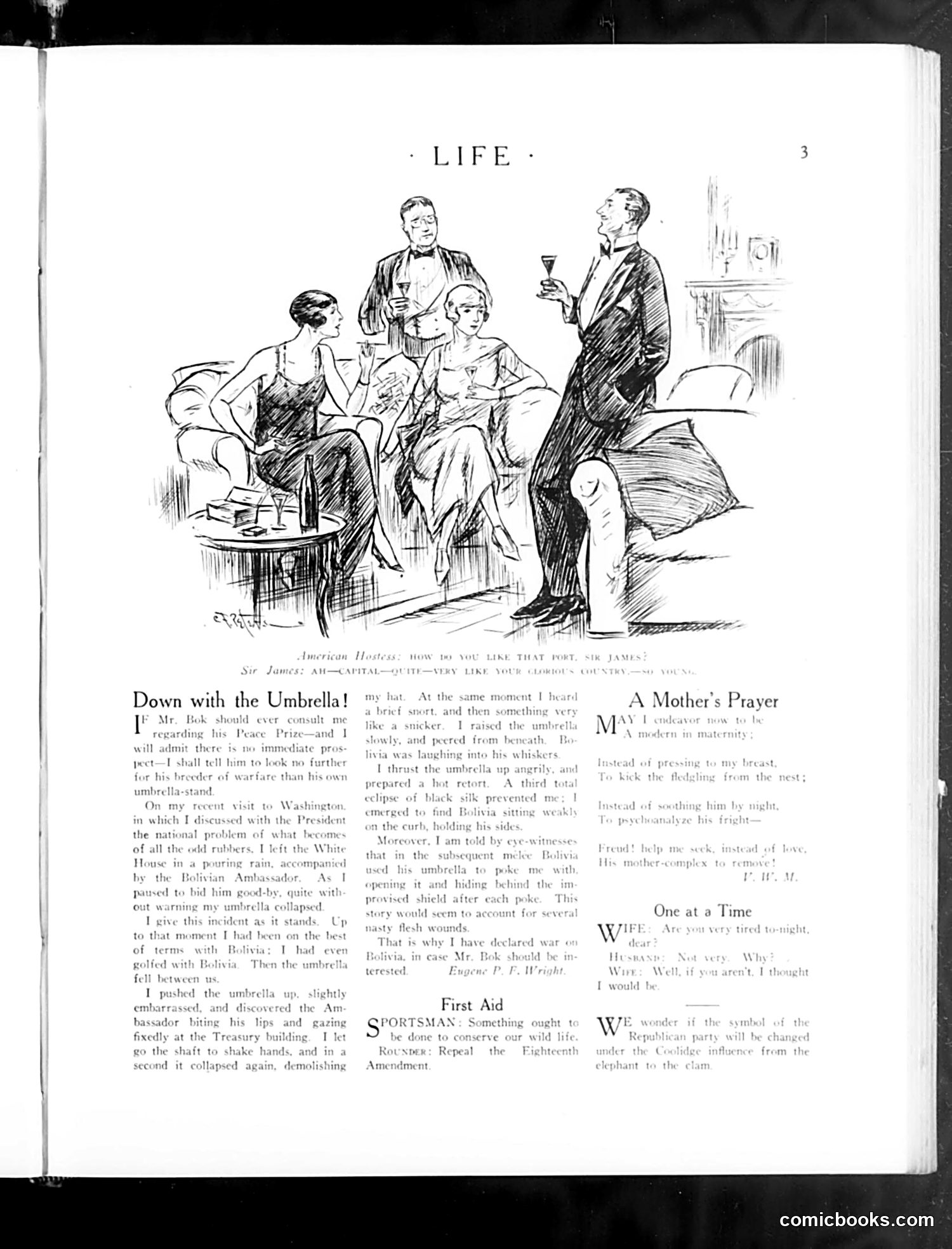
The main cartoon depicts an elegant social gathering where a gentleman discusses an umbrella incident with others holding cocktails. The caption "American Hostess" suggests this is satirizing high-society conversation. The "Down with the Umbrella!" article describes a diplomatic embarrassment: the narrator's umbrella collapsed during a White House visit with the President, then again at the Bolivian Ambassador's residence. The humor derives from this trivial mishap being treated as a serious diplomatic incident—the umbrella's failure becomes a metaphor for social humiliation in formal settings. The page also contains unrelated pieces: "A Mother's Prayer," "First Aid," "One at a Time," and another brief column about Republican party symbols. The satire mocks how high society elevates minor social mishaps into major concerns.
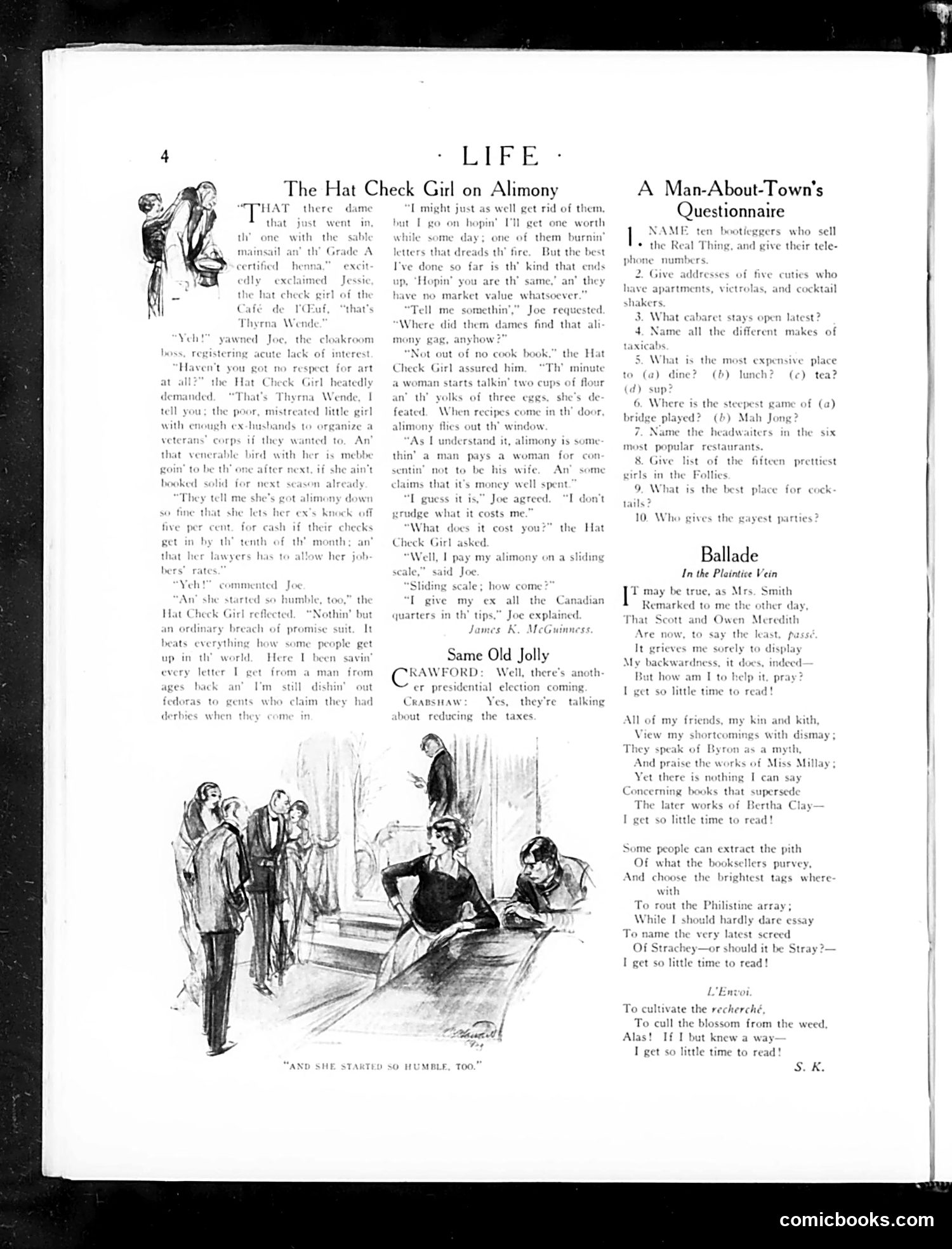
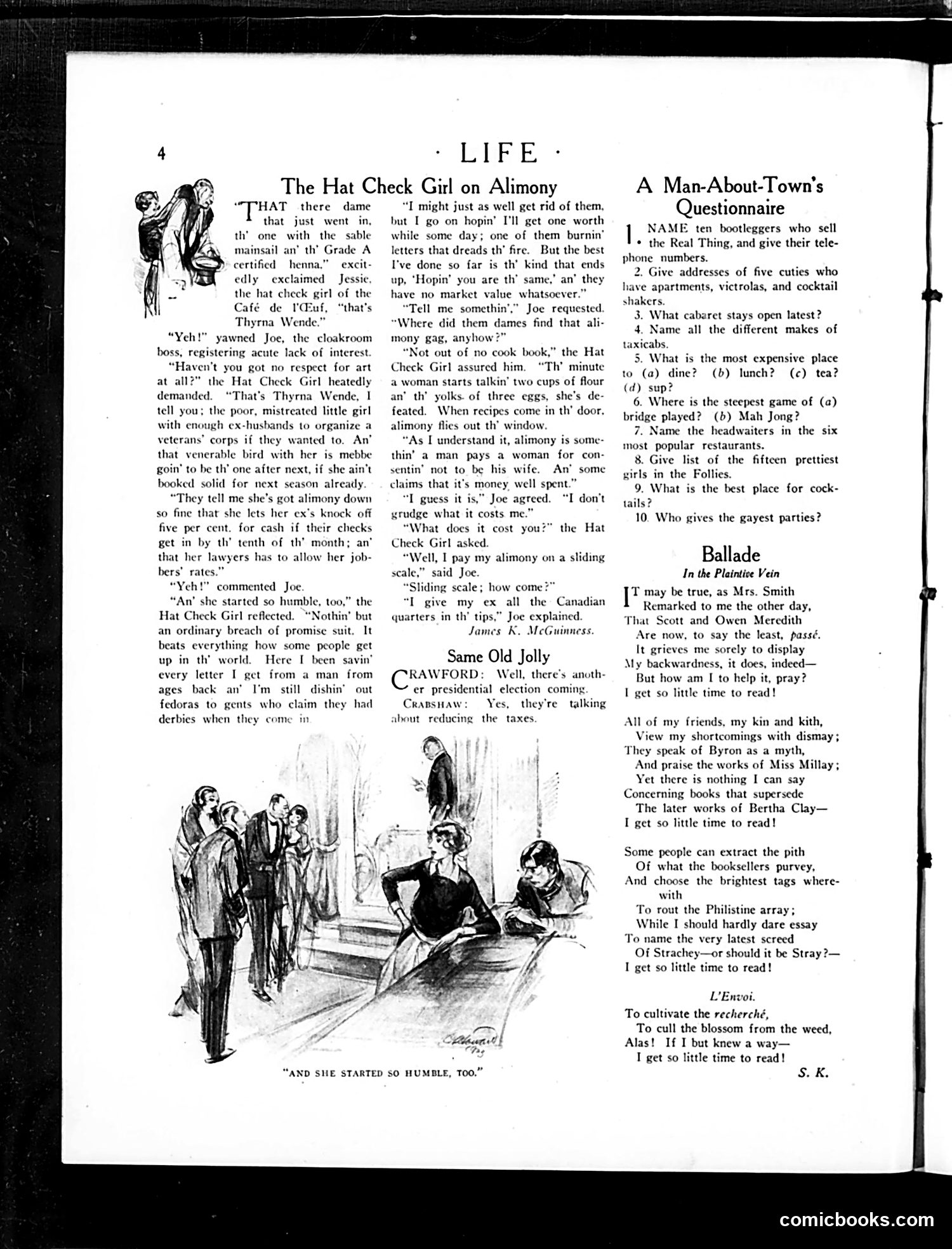
This page contains two satirical pieces reflecting early 20th-century social commentary. **"The Hat Check Girl on Alimony"** presents a dialogue where a hat check girl at the Café de l'Etat discusses her various ex-husbands and alimony payments with a patron named Joe. The satire targets both the economic dependency women faced through alimony and satirizes what appears to be a woman leveraging multiple marriages for financial support—a scandalous concept for the era. **"Same Old Jolly"** is a brief political exchange between Crawford and Carshaw discussing an upcoming presidential election and tax reduction, reflecting standard political humor of the period. The accompanying cartoon illustration depicts men in formal attire, likely illustrating the café scene from the first piece, with a caption reading "And she started so humble, too"—suggesting ironic commentary on social climbing through marriages.
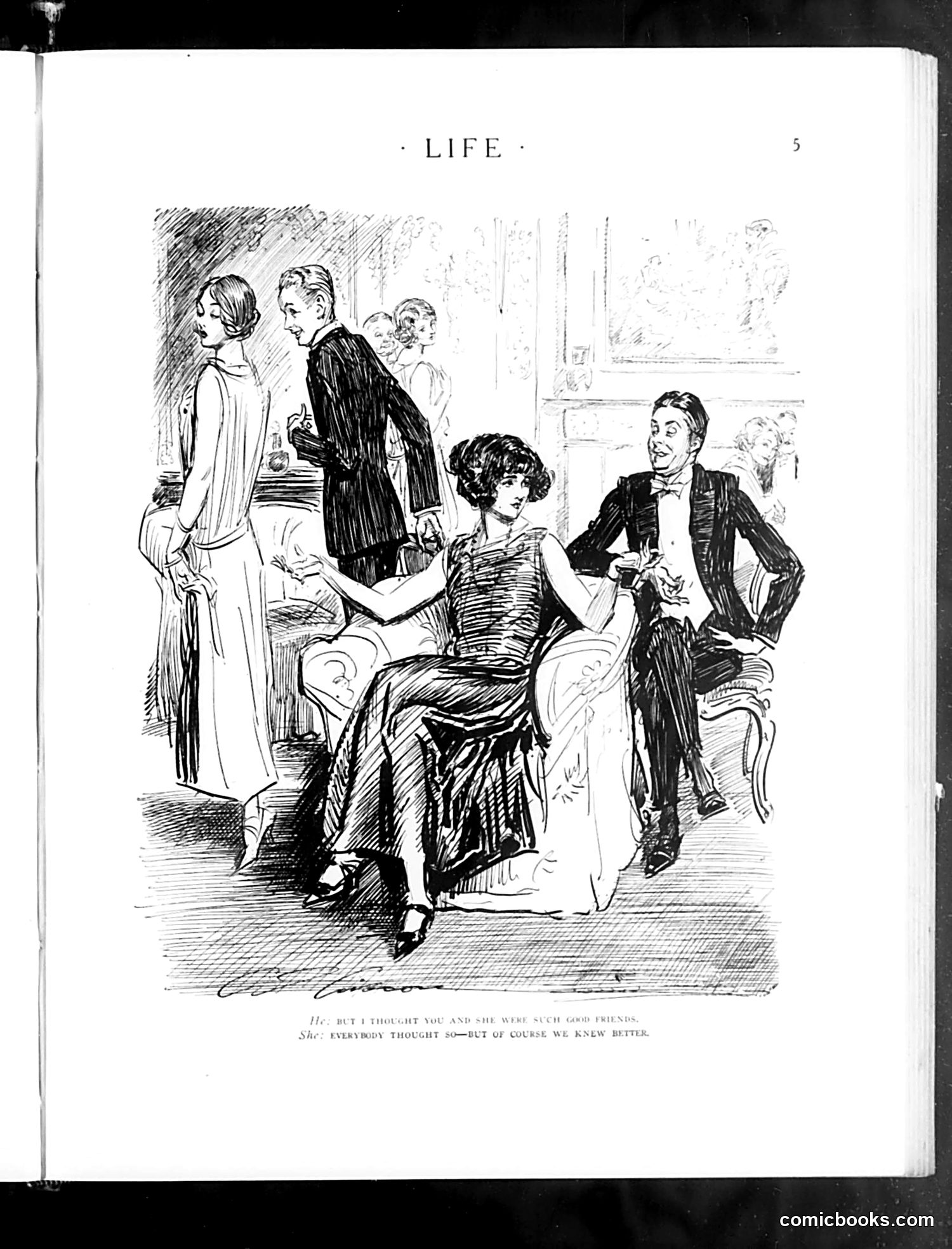
This page from *Life* magazine depicts a social scene at what appears to be a formal gathering or party. The cartoon shows several well-dressed figures in early 20th-century attire, with a woman seated centrally in conversation with a man. The caption reads: "He: BUT I THOUGHT YOU AND SHE WERE SUCH GOOD FRIENDS. / She: EVERYBODY THOUGHT SO—BUT OF COURSE WE KNEW BETTER." The satire targets the hypocrisy of polite society—specifically, how people maintain false friendships for appearance's sake while harboring private animosity. The joke hinges on the gap between public perception and private reality among the social elite. The woman's knowing response suggests that behind elegant facades and social pleasantries, people often dislike those they publicly befriend. This reflects *Life*'s frequent criticism of upper-class social artificiality and duplicity.
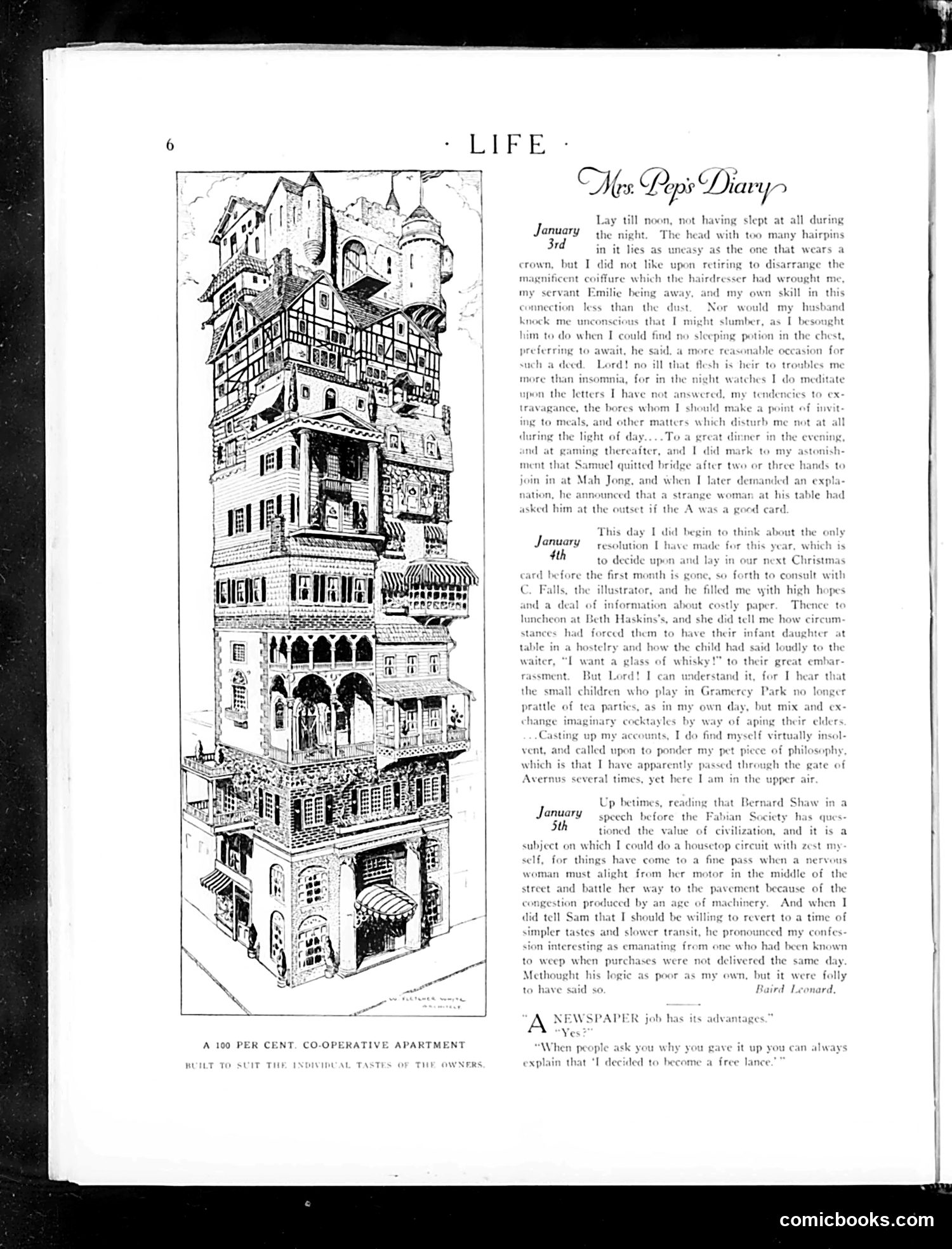
This page from *Life* magazine features "Mrs. Pop's Diary," a satirical column about upper-class domestic life. The accompanying architectural illustration shows an elaborate multi-story apartment building, captioned as "A 100 PER CENT CO-OPERATIVE APARTMENT BUILT TO SUIT THE INDIVIDUAL TASTES OF THE OWNERS." The satire targets wealthy New Yorkers who customized luxury co-op apartments to their exact specifications—a practice that appears absurd when applied to a shared building. The ornate, chaotic design suggests the impracticality of accommodating multiple competing "individual tastes" in a single structure. The diary entries mock the shallow concerns of affluent women: insomnia, servants, social gatherings, and trivial gossip. The final quote about newspaper work as granting "freedom" is likely ironic commentary on modern ambitions.
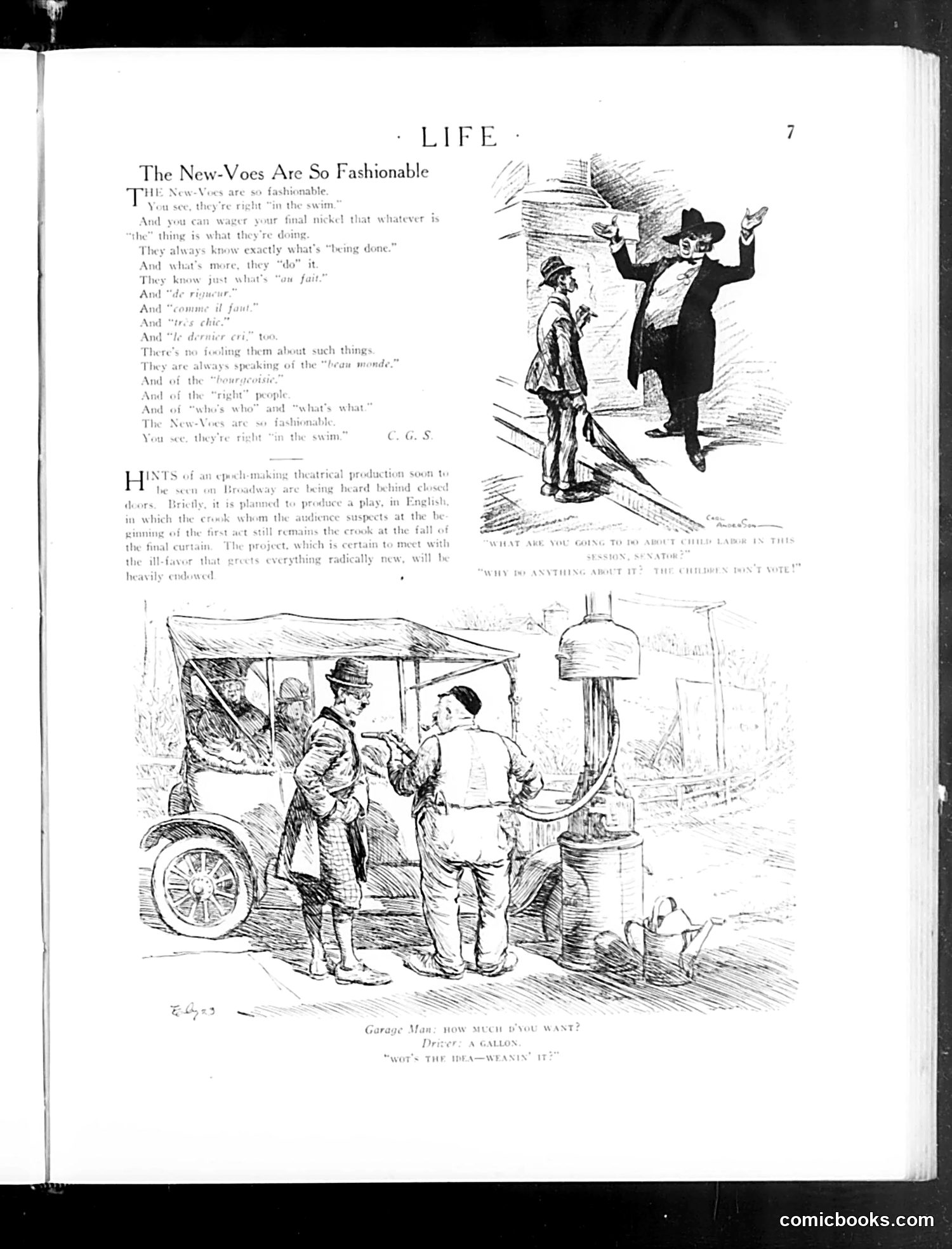
**Top Article: "The New-Woes Are So Fashionable"** This satirical piece (bylined C.G.S.) mocks people who constantly reference trendy phrases and "in" topics—the "beau monde," "bourgeoisie," "right people," etc. It critiques social climbers who adopt fashionable language to appear sophisticated. **Two Cartoons:** 1. **Upper cartoon**: A well-dressed man lectures a working-class figure about child labor in the Senate—while the worker responds that children cannot vote anyway, highlighting the hypocrisy of politicians discussing issues affecting those without political voice. 2. **Lower cartoon**: A garage attendant asks a driver "How much d'you want?" The driver requests "a gallon"—satirizing post-WWI gasoline pricing debates and the common practice of purchasing small quantities due to cost.
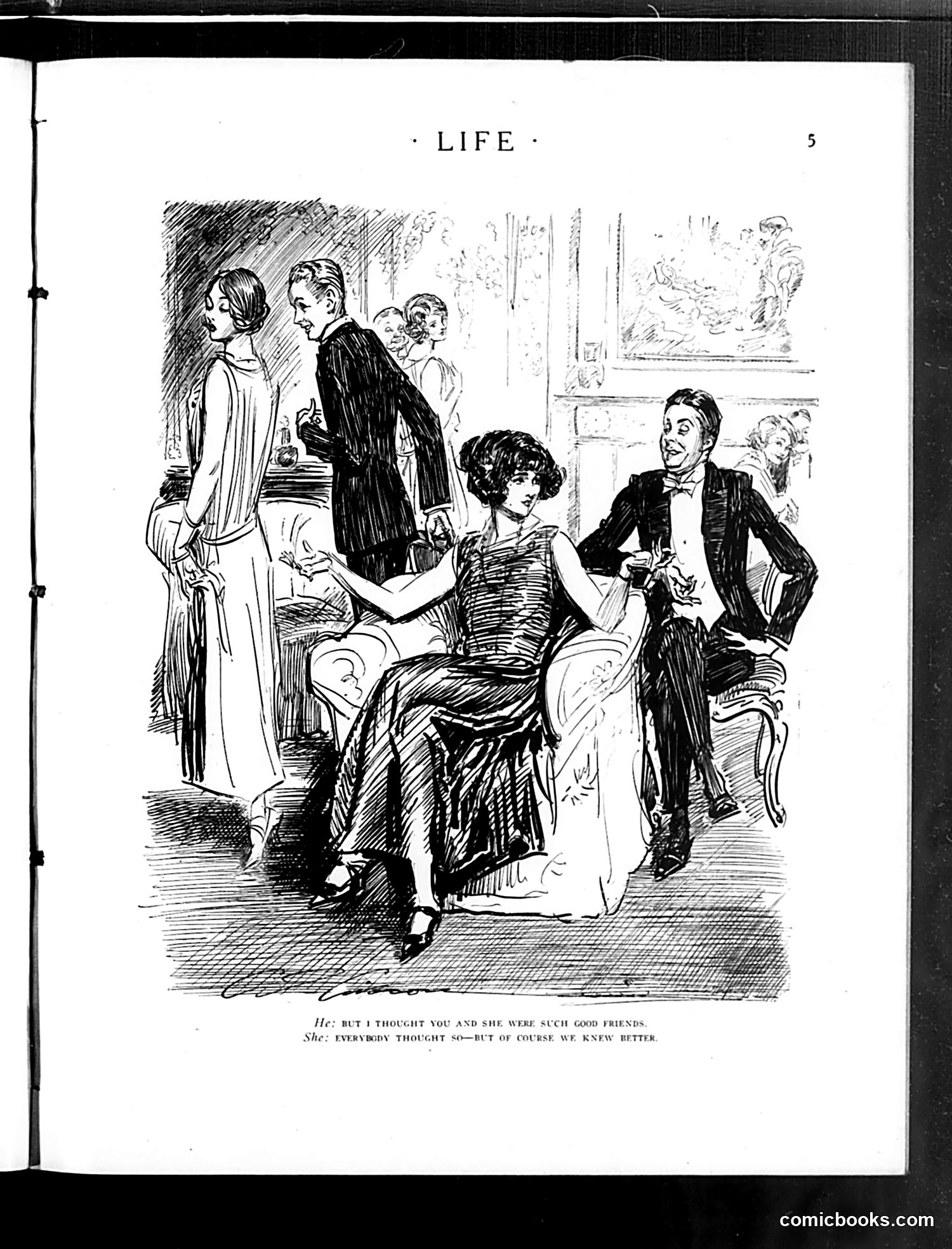
This is a social satire cartoon depicting a salon or party scene. The dialogue reveals the joke's target: a woman is being introduced to a man, and she claims they were "such good friends," while he responds that "everybody thought so—but of course we knew better." The satire mocks the social pretense of the era, where people maintained public appearances of friendship or propriety while privately knowing the true nature of their relationship was different—likely romantic or scandalous. The well-dressed figures in the background and the formal setting emphasize how this duplicity operates within polite society. The humor lies in the woman's candid admission that their private reality contradicted public perception, exposing the gap between social facade and truth.
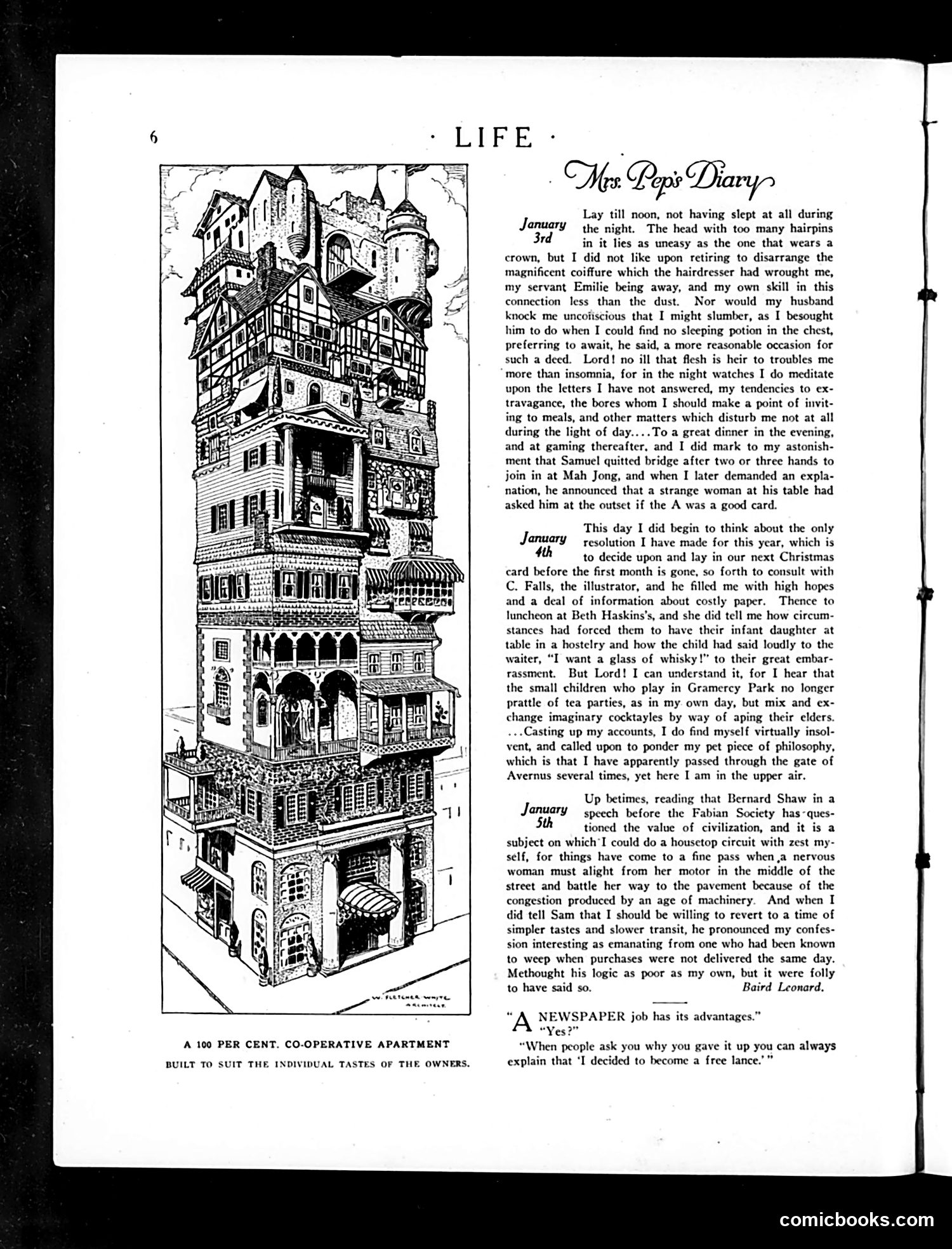
This page features "Mrs. Peps Diary," a satirical column mocking upper-class women's concerns and anxieties. The elaborate architectural illustration depicts "A 100 Per Cent Co-operative Apartment / Built to Suit the Individual Tastes of the Owners"—likely satirizing the impractical complexity of cooperative housing arrangements popular among wealthy New Yorkers. The diary entries mock Mrs. Peps' preoccupations: insomnia from social anxiety, concerns about her hairdresser, elaborate dinner parties, and pseudo-intellectual worries about civilization. The satire targets bourgeois materialism and the performative nature of high society, particularly women's obsession with status symbols and exhausting social obligations. The final quote about newspaper work as liberation from such constraints reinforces the satire's critique of domestic entrapment.
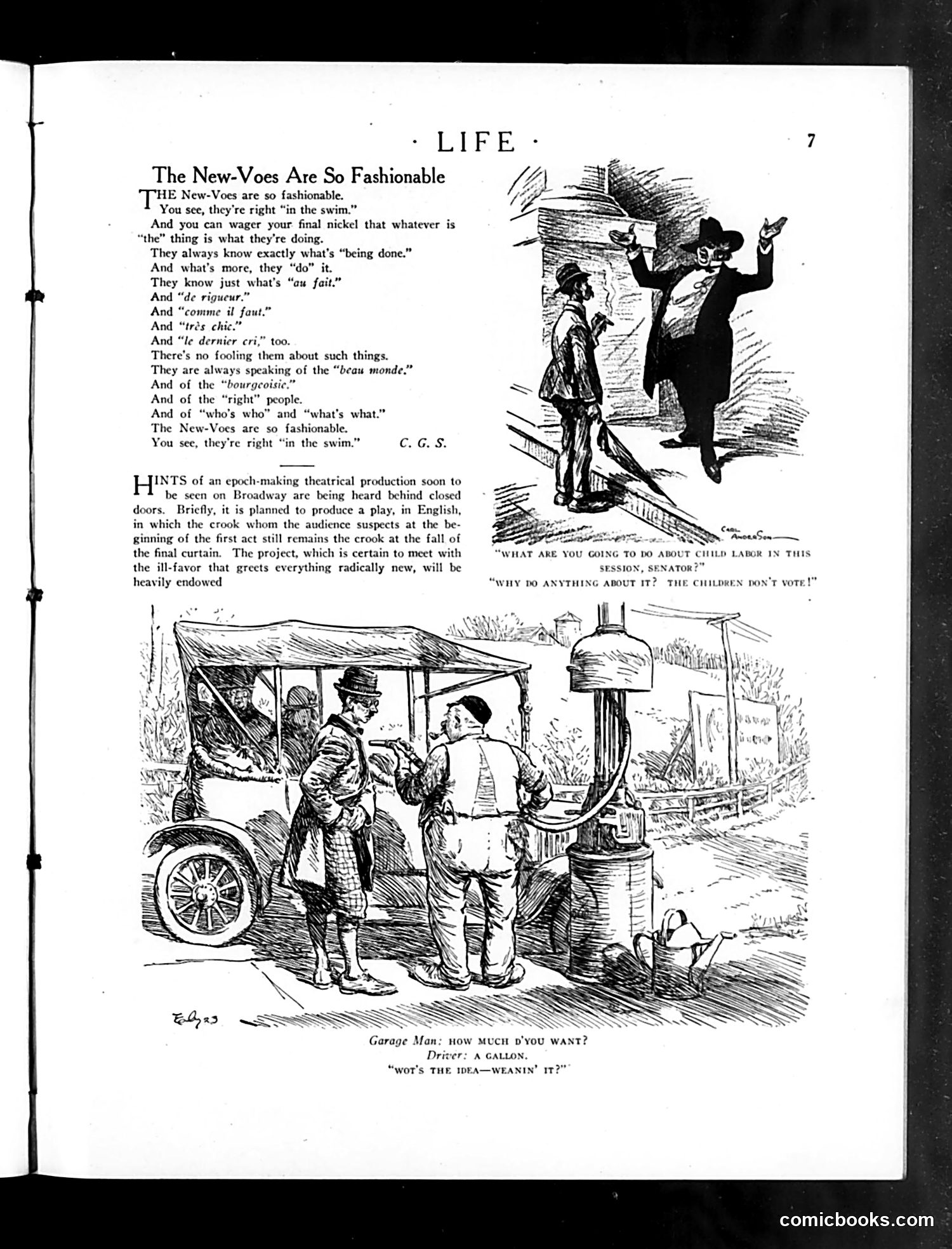
**Top Section - "The New-Voes Are So Fashionable"** This poem by C.G.S. satirizes New York's fashionable society ("New-Voes" = New York elites). It mocks their pretentiousness—their constant use of French phrases ("beau monde," "bourgeoisie," "en fait," "rigueur," "dernier cri"), their obsession with being "in the swim," and their know-it-all attitudes about what's fashionable or proper. **Bottom Cartoon - Gas Station Scene** The sketch depicts a garage attendant and car driver negotiating over fuel. The driver asks "how much d'you want?" The attendant replies "a gallon," but the driver sarcastically responds "wot's the idea—weanin' it?" This likely jokes about fuel scarcity or high prices post-WWI, where drivers expected to purchase more substantial quantities.
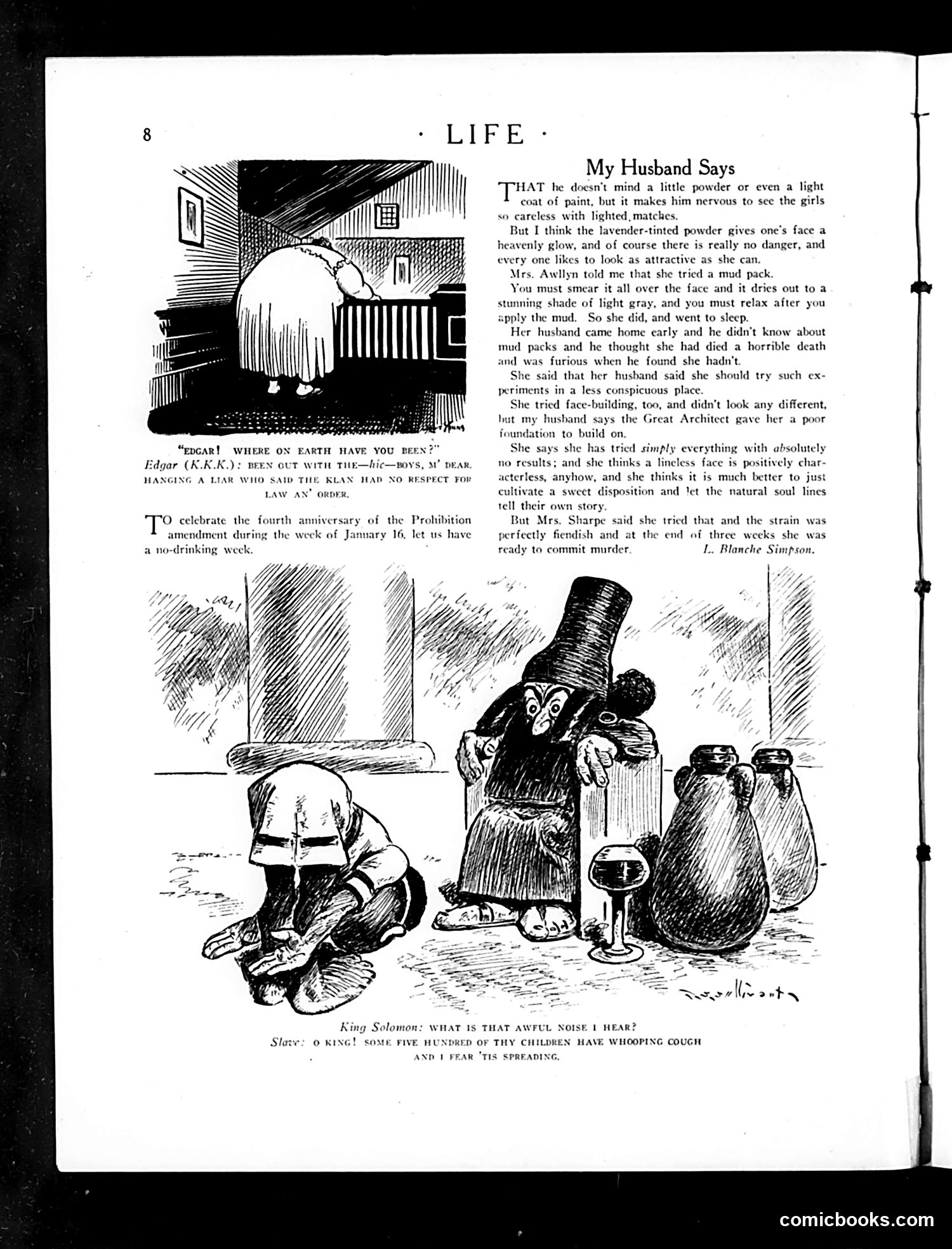
This page contains two distinct satirical pieces: **"My Husband Says"** (top): A humorous advice column mocking women's beauty routines. The article ridicules facial treatments like mud masks and face-building exercises, suggesting they're ineffective and that women's natural features are simply inadequate—a joke at both women's vanity and the era's dubious cosmetic claims. **Lower cartoon**: Depicts Prohibition-era enforcement. King Solomon questions a figure (likely a Prohibition agent or policeman) about "awful noise"—the agent holds a large bottle while children suffer from whooping cough in the background. The satire critiques Prohibition's unintended consequences: the confiscated "medicine" bottles presumably contained alcohol banned by the 18th Amendment (1920), forcing families to suffer without legitimate remedies.
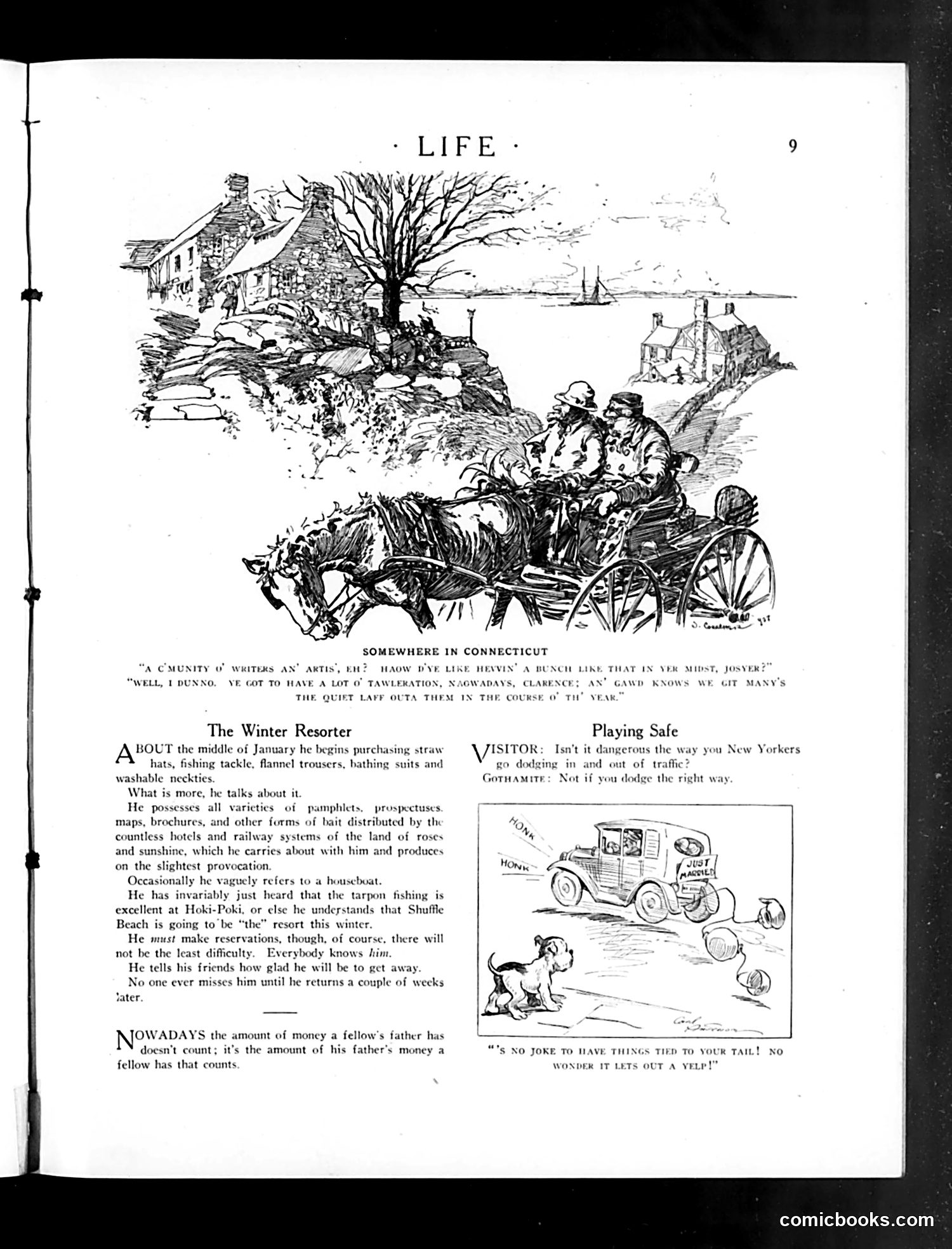
This page contains two distinct pieces of humor content: **Top illustration** ("Somewhere in Connecticut"): A sketch showing men in a horse-drawn cart discussing winter resorts. The dialogue satirizes how wealthy men discuss vacation plans and leisure activities with excessive detail about recreational equipment and destinations. **"The Winter Resorter"**: A satirical essay mocking wealthy men who obsessively plan winter vacations, constantly researching and discussing resort destinations, fishing spots, and travel details. The humor targets their tendency to bore friends with endless vacation planning. **"Playing Safe"**: A cartoon showing a dog disrupting traffic around an automobile, with dialogue about "New Yorkers" and traffic hazards. It satirizes the chaos of early automobiles in urban settings and pedestrian/animal safety concerns. The overall page satirizes leisure-class preoccupations and emerging automotive culture.
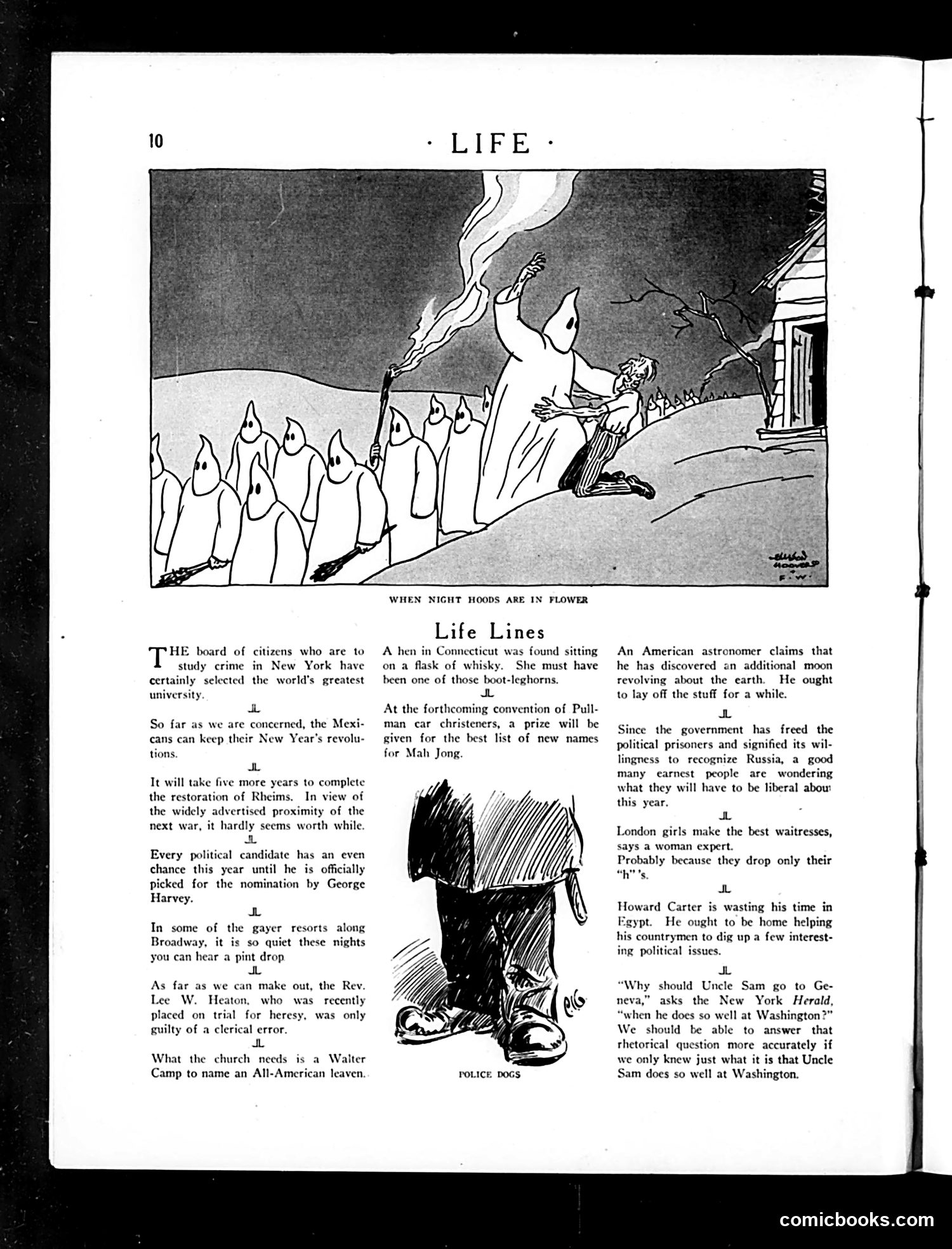
The main cartoon depicts **hooded figures (representing the KKK)** in a nighttime scene with the caption "When Night Hoods Are in Flower." This is direct anti-Ku Klux Klan satire, likely from the 1920s when the KKK experienced a resurgence. The illustration shows the organization's secretive, nocturnal nature and violent activities. Below is a "Life Lines" column of brief satirical observations on current events, including commentary on: - New York's board selecting a "world's greatest university" - References to political prisoners and Russia - Workplace humor and social commentary The secondary cartoon labeled "Police Dogs" appears to mock police authority or enforcement. The page exemplifies **Life magazine's role as a vehicle for political and social criticism** during this era.
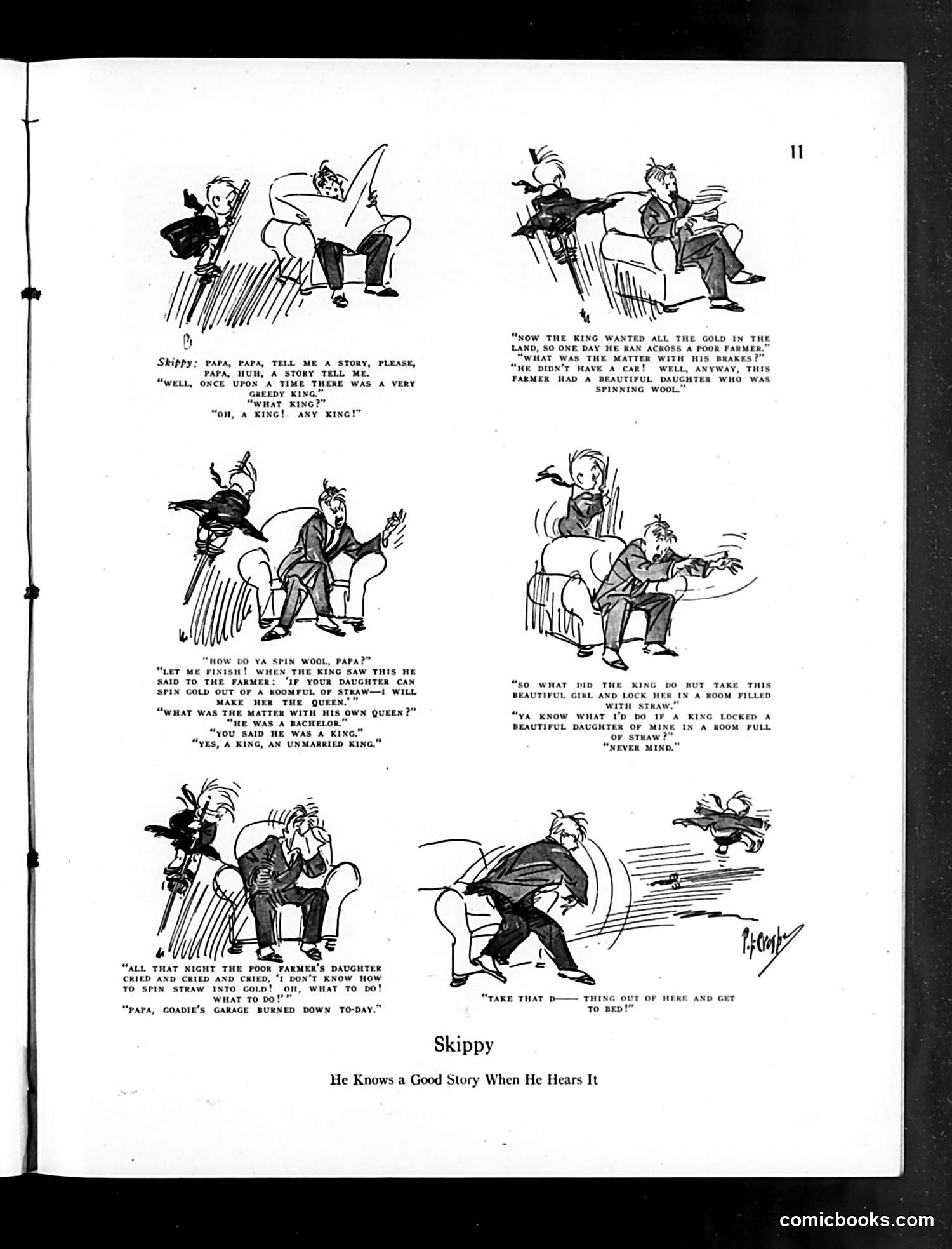
This is a comic strip rather than political satire. It depicts a young boy named Skippy listening to an elaborate tall tale from an adult ("Papa"). The story concerns a greedy king who demands gold from a poor farmer with a beautiful daughter who spins wool. The humor derives from the classic setup of an implausible fairy-tale narrative (spinning straw into gold appears to reference the Rumpelstiltskin tale) being delivered to an eager child. The punchline—the farmer's garage burning down, disrupting the scheme—undercuts the fantasy with mundane reality. The strip's title suggests Skippy appreciates entertaining stories regardless of their logical consistency, a relatable aspect of childhood credulity that audiences would find humorous.
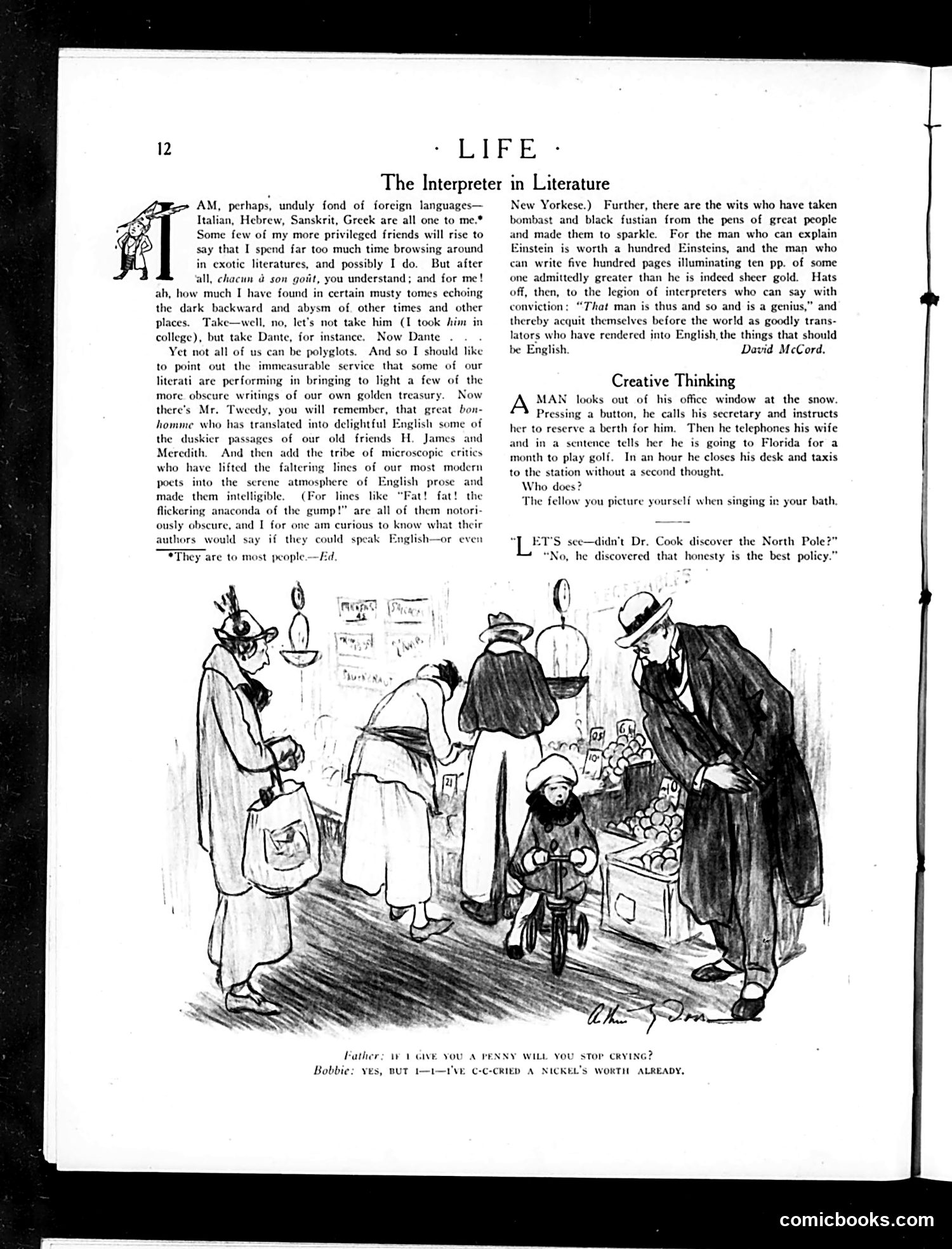
This page contains two satirical pieces about interpreting literature and creative thinking. **"The Interpreter in Literature"** mocks scholars and critics who obsess over translating obscure foreign texts and writing lengthy academic explanations of modern poetry. The author praises those who make difficult literature accessible to English readers, but the tone is tongue-in-cheek—suggesting such interpretive work, while valuable, borders on pedantic over-analysis. **"Creative Thinking"** section includes a cartoon showing a father offering his crying son a penny to stop crying. The boy replies he's already cried a nickel's worth—a joke about how children will negotiate and calculate their emotional labor for profit. It satirizes both parental bribery tactics and childhood shrewdness. The reference to "Dr. Cook discover the North Pole" appears to contrast discovering facts with discovering life principles, emphasizing practical wisdom over mere accomplishment. Both pieces gently mock intellectualism and adult assumptions about straightforward human behavior.
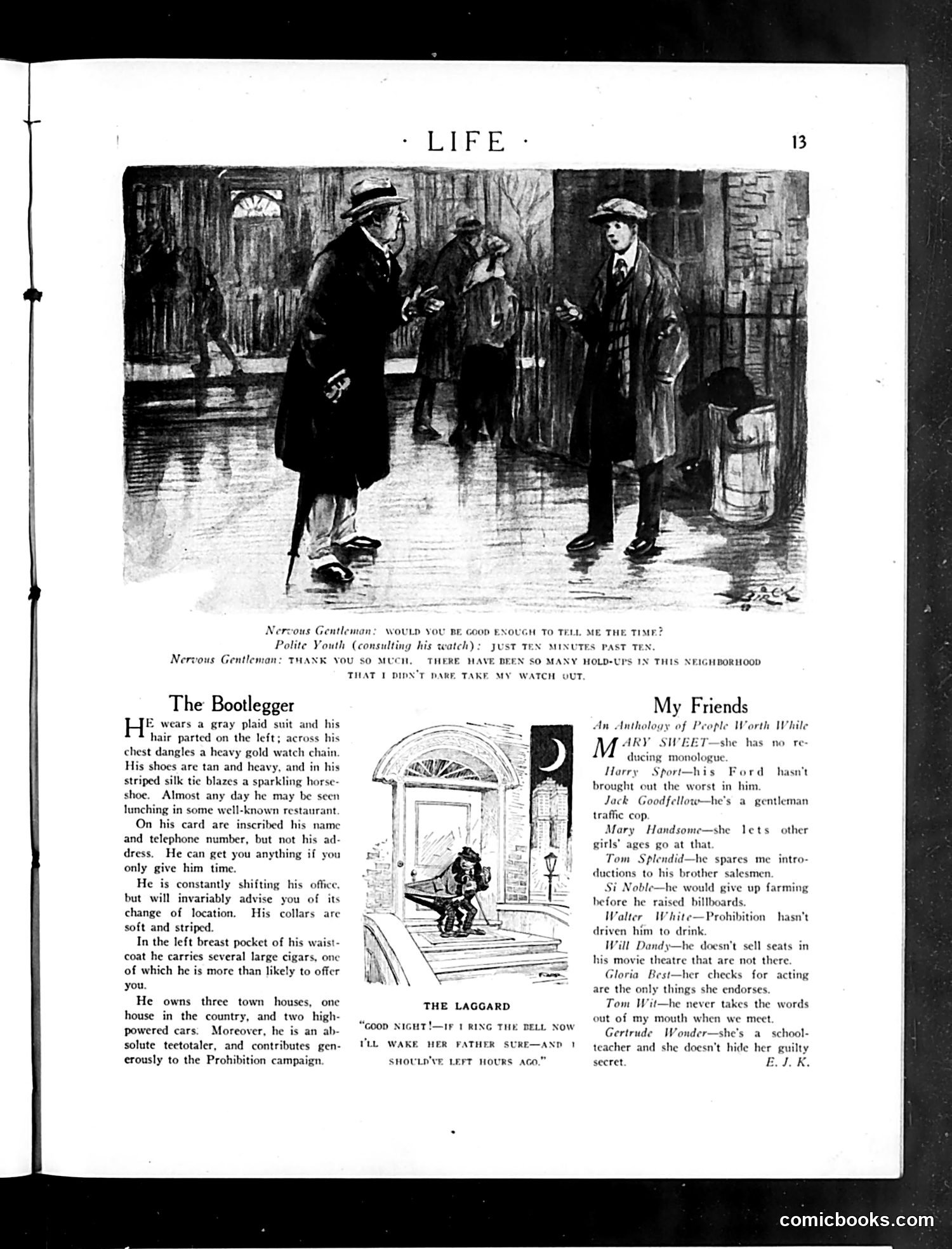
This page contains three distinct satirical pieces from the Prohibition era (likely 1920s-early 1930s): **Top cartoon**: A nervous gentleman asks a young man for the time on a wet street. The joke plays on paranoia—the gentleman fears mugging ("hold-ups in this neighborhood") and won't risk showing his watch, so he asks someone else to check theirs instead. **"The Bootlegger"**: This profile satirizes illegal alcohol dealers who flourished during Prohibition. The irony is central: this flashy criminal—wearing expensive jewelry, owning multiple properties, driving high-powered cars—*claims* to be a "absolute teetotaler" who contributes to Prohibition campaigns. The satire mocks both the bootlegger's hypocrisy and the absurdity of Prohibition itself, which enriched criminals while supposedly promoting temperance. **"My Friends"**: A lighter humor piece providing brief character sketches of various recognizable social types, mostly gentle observations about their quirks or contradictions. The page reflects Jazz Age anxieties about crime, lawlessness, and the unintended consequences of Prohibition policy.
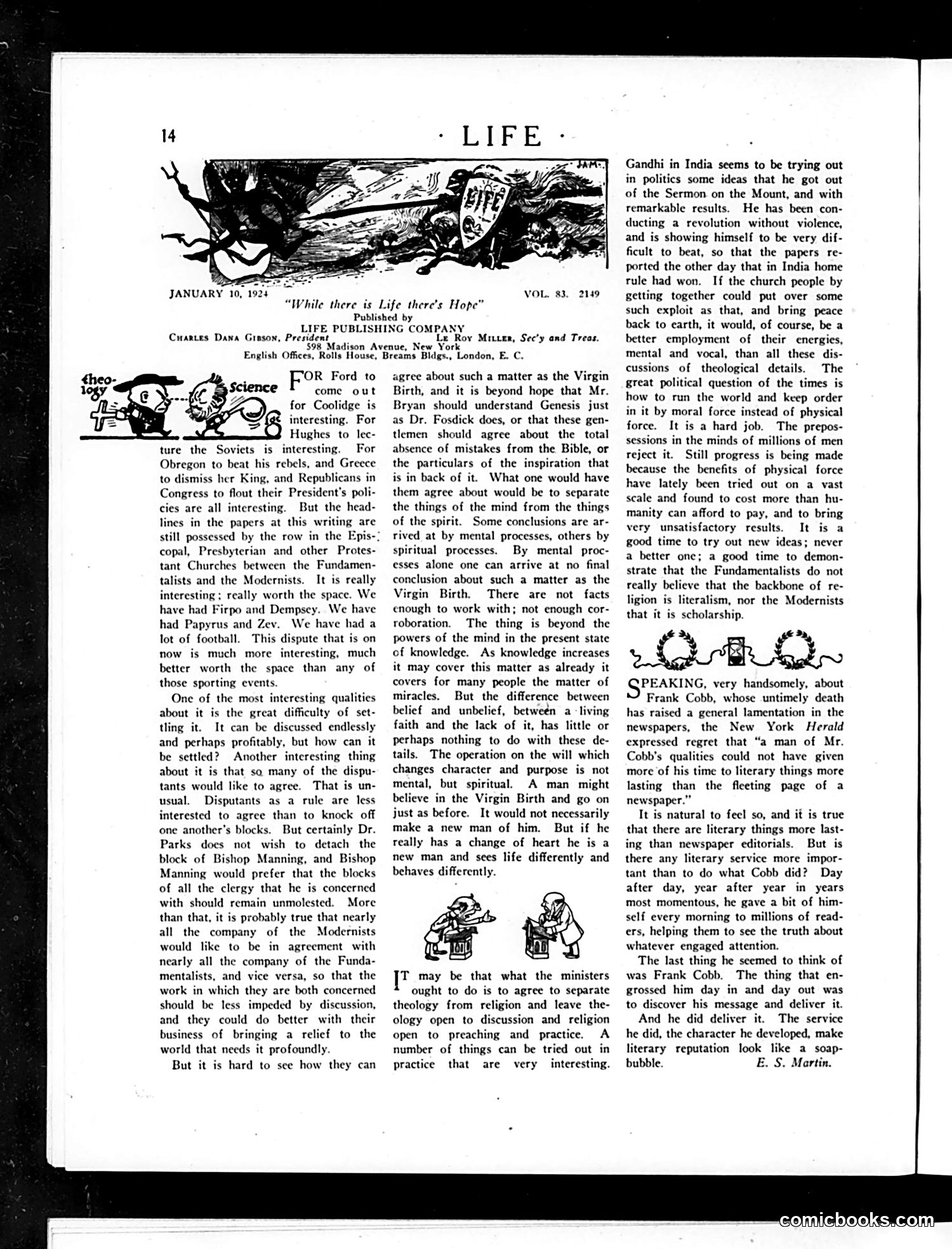
This page discusses the "Fundamentalist-Modernist Controversy," a major Protestant church split of the 1920s. The cartoon's title, "While there is Life there's Hope," plays on the magazine's name. The text sardonically notes that this theological dispute has captured more newspaper attention than major sporting events (boxing champion Dempsey, racehorses Papyrus and Zev). The author identifies key figures: Dr. Bryan (likely William Jennings Bryan, a Fundamentalist), Dr. Fosdick (likely Harry Emerson Fosdick, a Modernist preacher), and Bishop Manning—all real participants in this heated debate over literal Bible interpretation, the Virgin Birth, and modern theology versus traditional faith. The piece argues the real problem: Fundamentalists and Modernists can't agree on factual/intellectual matters, though both want church unity. The author suggests separating theology (open to debate) from religion (focused on spiritual practice and character change)—proposing Gandhi's non-violent approach as an example of practical religion over doctrine.
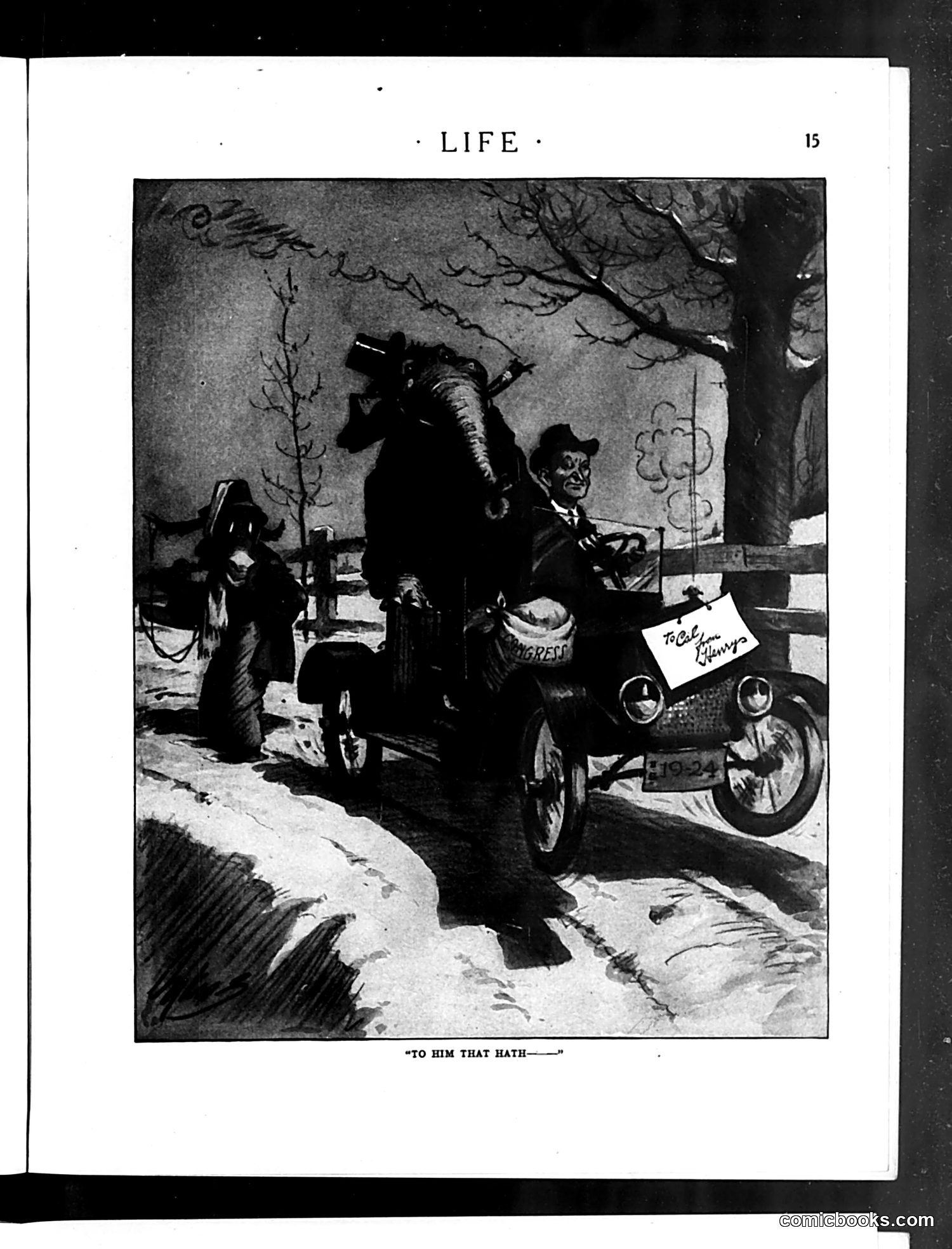
This cartoon satirizes wealth inequality through an exaggerated scene. A large, well-fed figure (appearing to represent a wealthy industrialist or capitalist) sits elevated in a toy car or vehicle, while smaller, impoverished figures surround him in a barren landscape with bare trees. The caption references the biblical phrase "to him that hath, shall be given"—a scripture about compounding advantage for the already-wealthy. The satire critiques how economic systems concentrate resources among the rich while the poor remain marginalized and powerless. The toy vehicle emphasizes the absurdity and childishness of hoarding wealth. This likely reflects early 20th-century American concerns about monopolies, class disparity, and economic injustice during an era of significant labor and progressive reform movements.
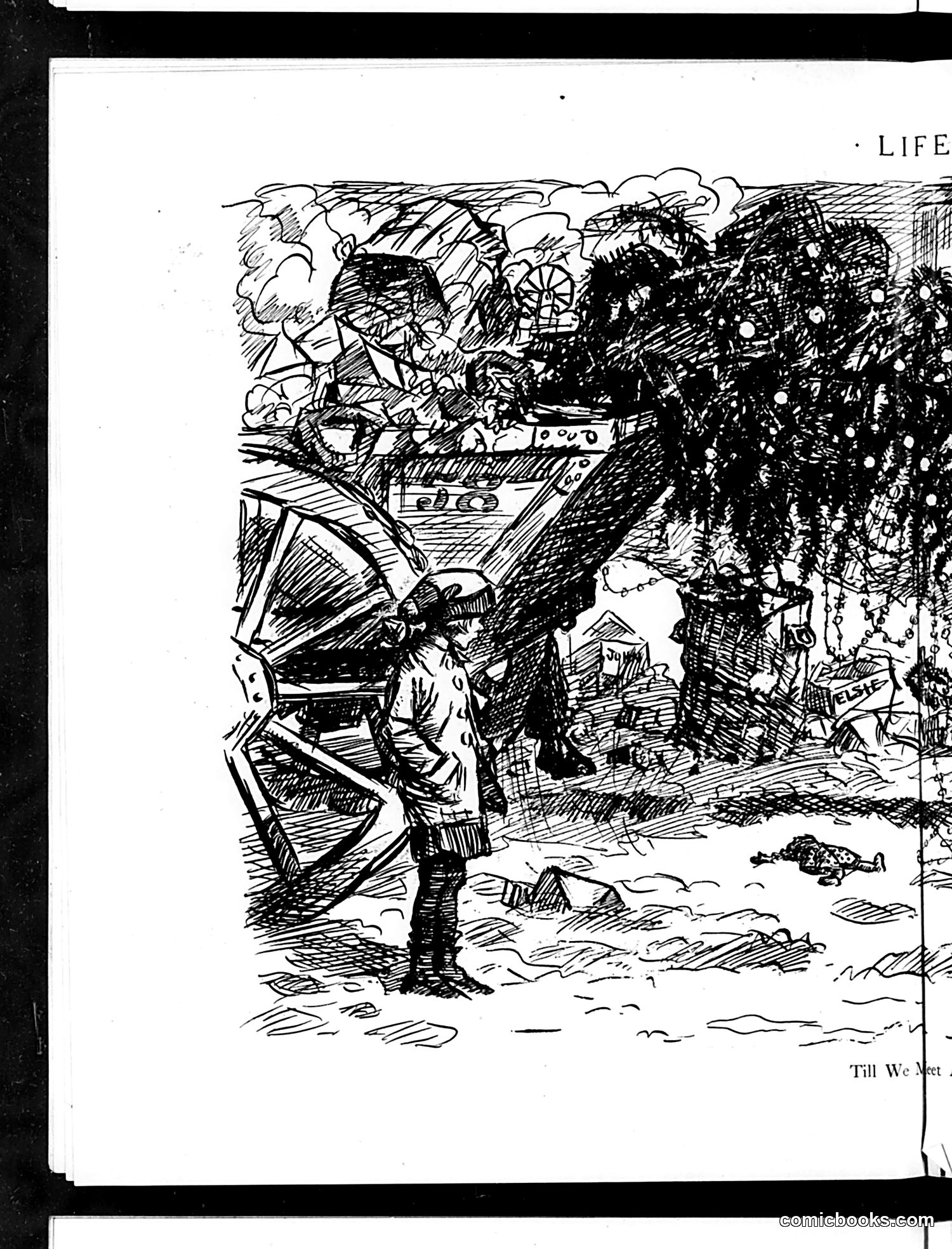
This ink sketch from *Life* magazine depicts a soldier standing alone amid battlefield debris, gazing toward a fortified position with barbed wire and what appears to be enemy fortifications. The caption "Till We Meet" suggests a poignant wartime farewell. The cartoon likely references World War I, given the trench-warfare imagery and the era of *Life's* publication. The solitary figure—possibly representing American or Allied forces—faces an uncertain future confrontation. The sketch's emotional tone conveys both determination and melancholy about future combat. Without visible artist attribution or precise dating on this page fragment, the specific military engagement remains unclear, but the work reflects the magazine's satirical-yet-serious treatment of wartime themes common during the WWI era.
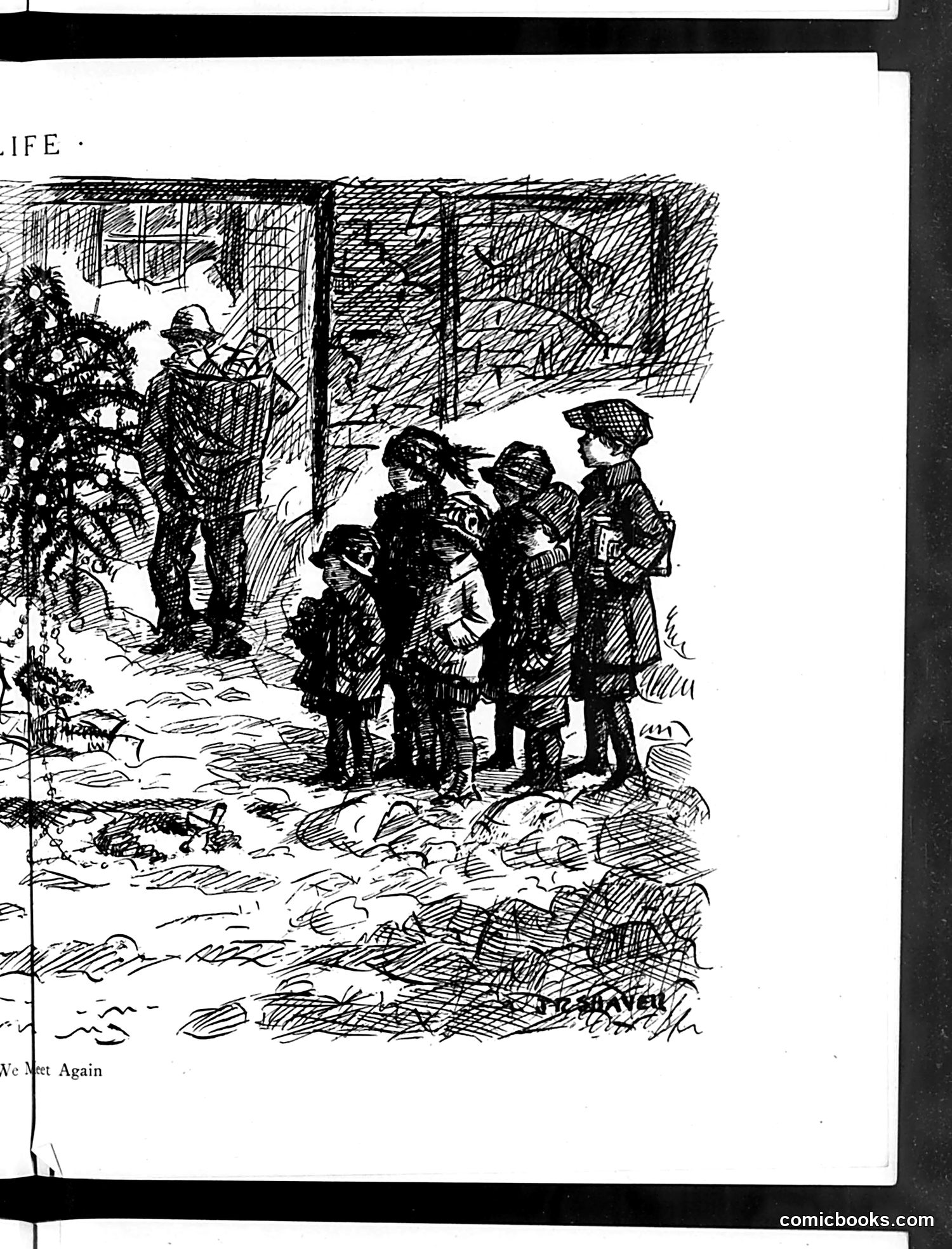
This appears to be a sketch titled "We Meet Again" showing a winter street scene. An adult figure (possibly a nanny or caretaker, given the OCR text reference to "NANNY") stands at a doorway greeting a group of children bundled in winter clothing on a snowy street. The cartoon likely satirizes a domestic or social situation common to early 20th-century Life magazine—possibly commentary on class relations, child welfare, or seasonal hardship. The children's shabby appearance contrasts with the adult's more formal dress, suggesting a social commentary on poverty or inequitable treatment of working-class children. However, the OCR text is too garbled to definitively identify the specific political or social reference intended. The signature appears to be "PERRET" but remains unclear without additional context.
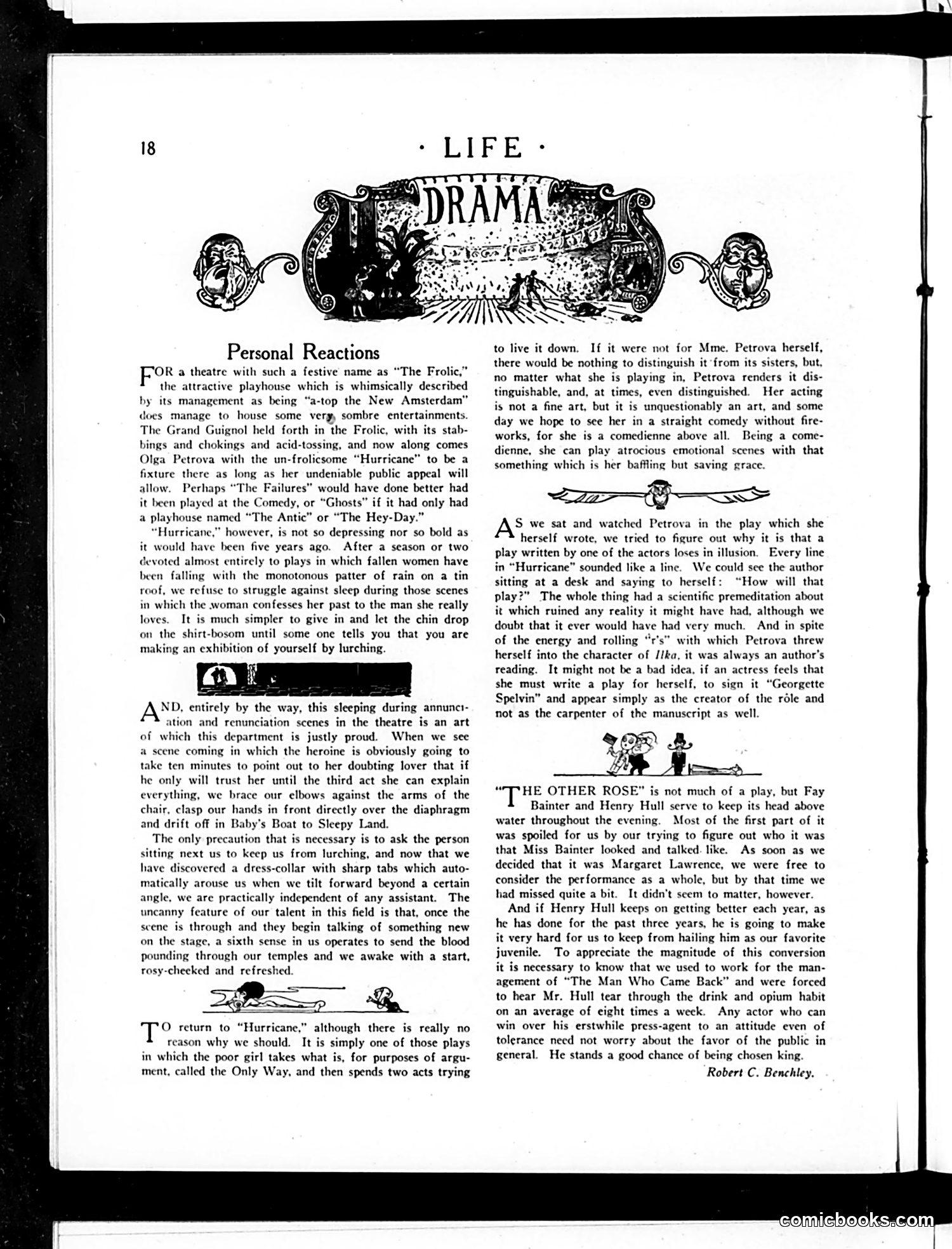
This theater criticism page reviews several Broadway productions, particularly Olga Petrova's play "Hurricane." The critic's main point: Petrova is a talented actress whose presence elevates weak material, but her own playwriting lacks authenticity—every line reads as obviously authored rather than natural dialogue. The humor is self-deprecating: the critic describes their technique for surviving tedious theatrical scenes (the tired "fallen woman confesses to her lover" trope) by deliberately falling asleep, complete with a mechanical collar-device to prevent embarrassing head-drops. The broader satire targets early 20th-century melodrama conventions—particularly plays obsessed with moral redemption through female suffering. By 1910s standards, these plots were exhausted clichés. Petrova's charisma masks "Hurricane's" fundamental triteness. The critic suggests she'd shine better in comedy than in overwrought emotional dramatics. The secondary review of "The Other Rose" praises Henry Hull's theatrical stamina.
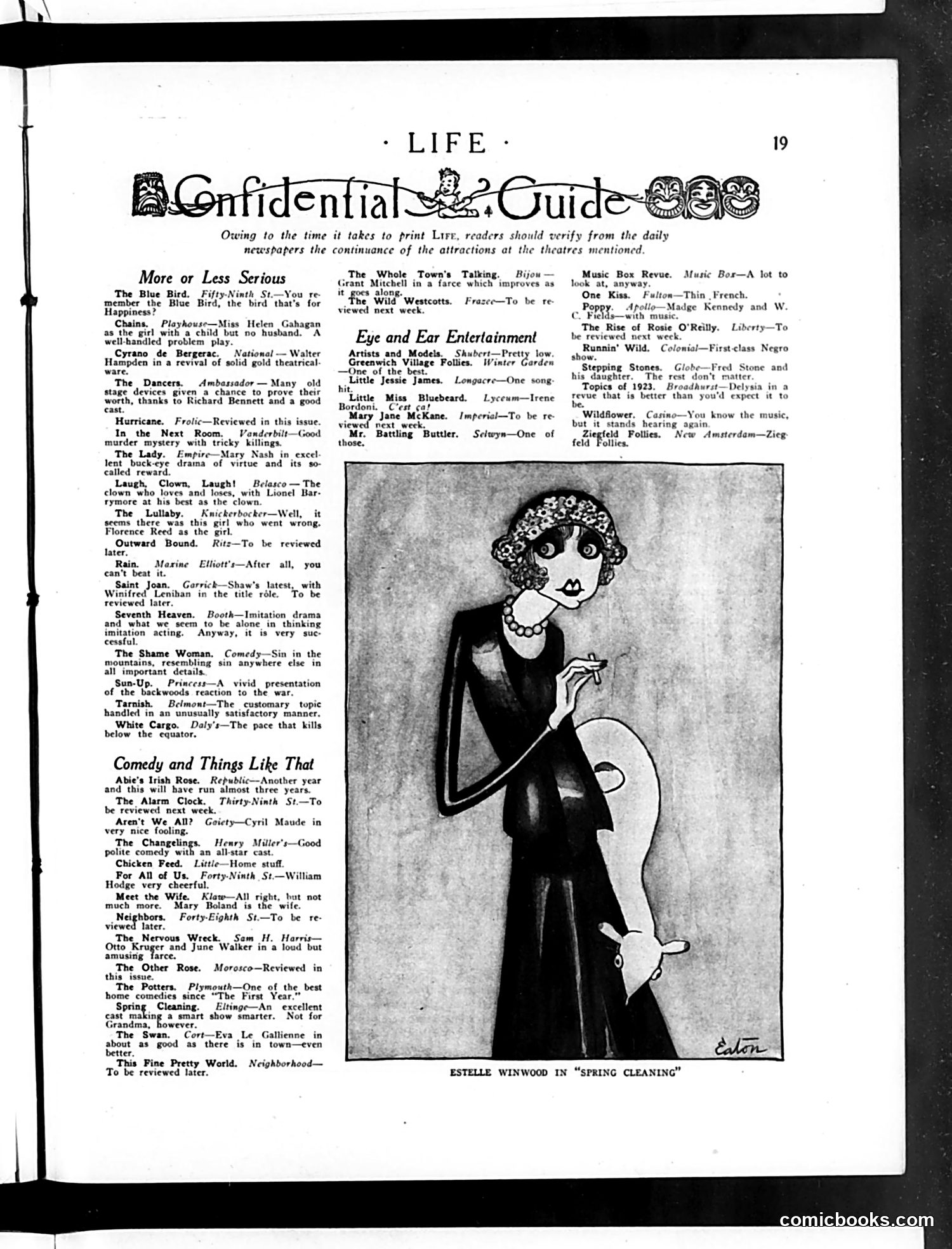
This page is a **theater guide** from Life magazine listing current Broadway shows with brief reviews. The illustration shows **Estelle Winwood** in "Spring Cleaning." The content reflects 1920s theater culture and social attitudes. Notable entries include: - **"Rain"** and **"Tarnish"** — dramas dealing with female sexuality and "fallen women," reflecting Jazz Age anxieties about morality - **"Saint Joan"** — Shaw's recent play featuring women as serious dramatic subjects - **"Runnin' Wild"** — explicitly labeled a "First-class Negro show," reflecting segregated entertainment era - Multiple shows about marriage, divorce, and "problem plays" addressing modern domestic life The tone is urbane and cosmopolitan. References to shows being "not for Grandma" and dismissive comments ("Pretty low") reveal class-conscious gatekeeping about which entertainments were respectable. The guide itself demonstrates Life's role: satirical yet also functioning as cultural arbiter for educated, theater-going audiences in 1920s New York.
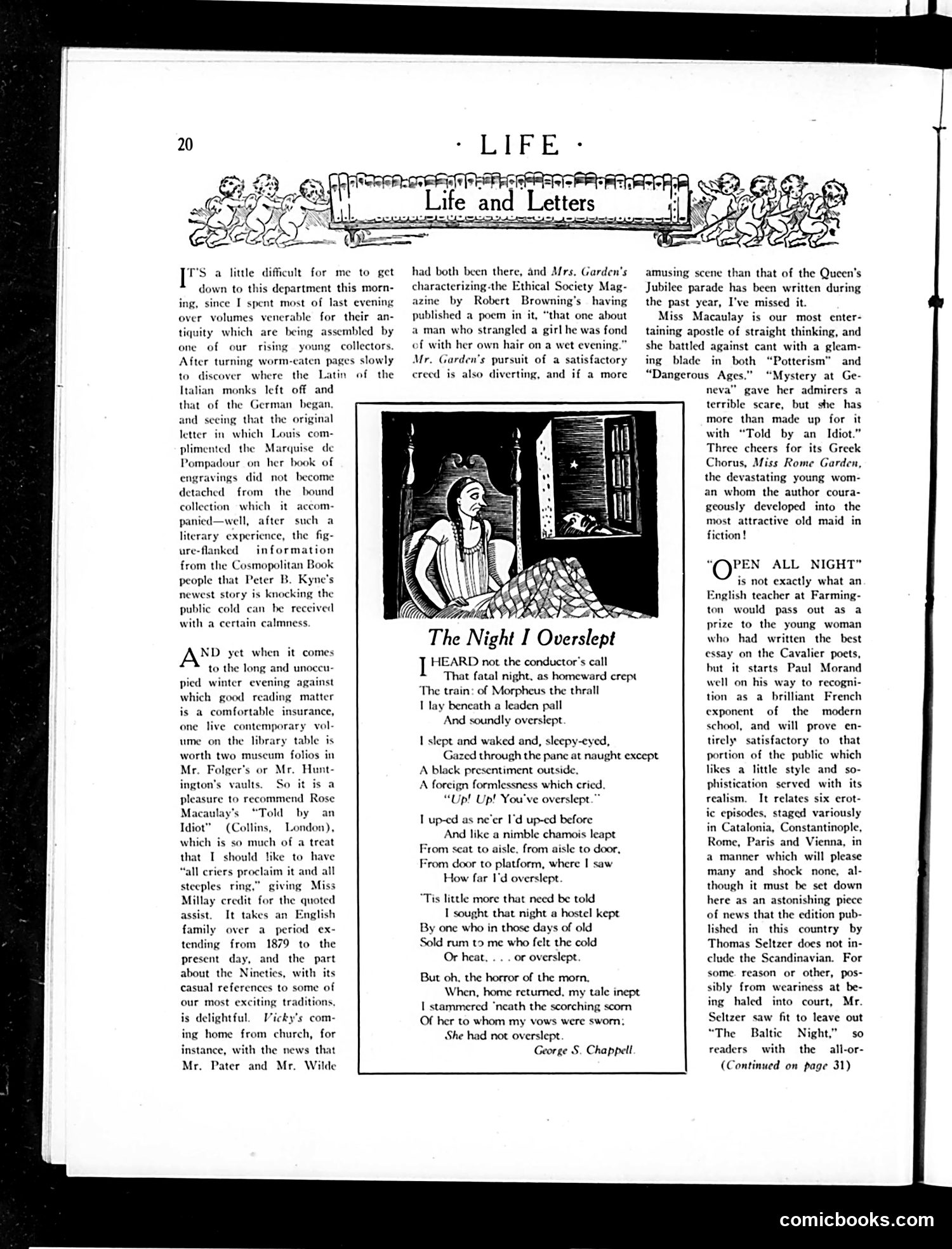
This page from *Life* magazine reviews literary works and includes a humorous poem. The main illustrated piece, "The Night I Overslept" by George S. Chappell, is a comedic narrative poem about a man who oversleeps on a train and faces domestic consequences—his wife is angry he didn't come home. The text discusses Rose Macaulay's novel "Told by an Idiot," praising its satirical treatment of English family life from 1879 onward. A notable reference mocks the "Ethical Society Magazine" by comparing it to work by Robert Browning and mentioning Victorian literary figures (Pater and Wilde), suggesting the magazine publishes pretentious or obscure material. The review celebrates Macaulay's direct attack on cant and hypocrisy—a central concern of early 20th-century literary criticism. The page exemplifies *Life*'s role as a venue for book reviews and light comic verse for educated readers.
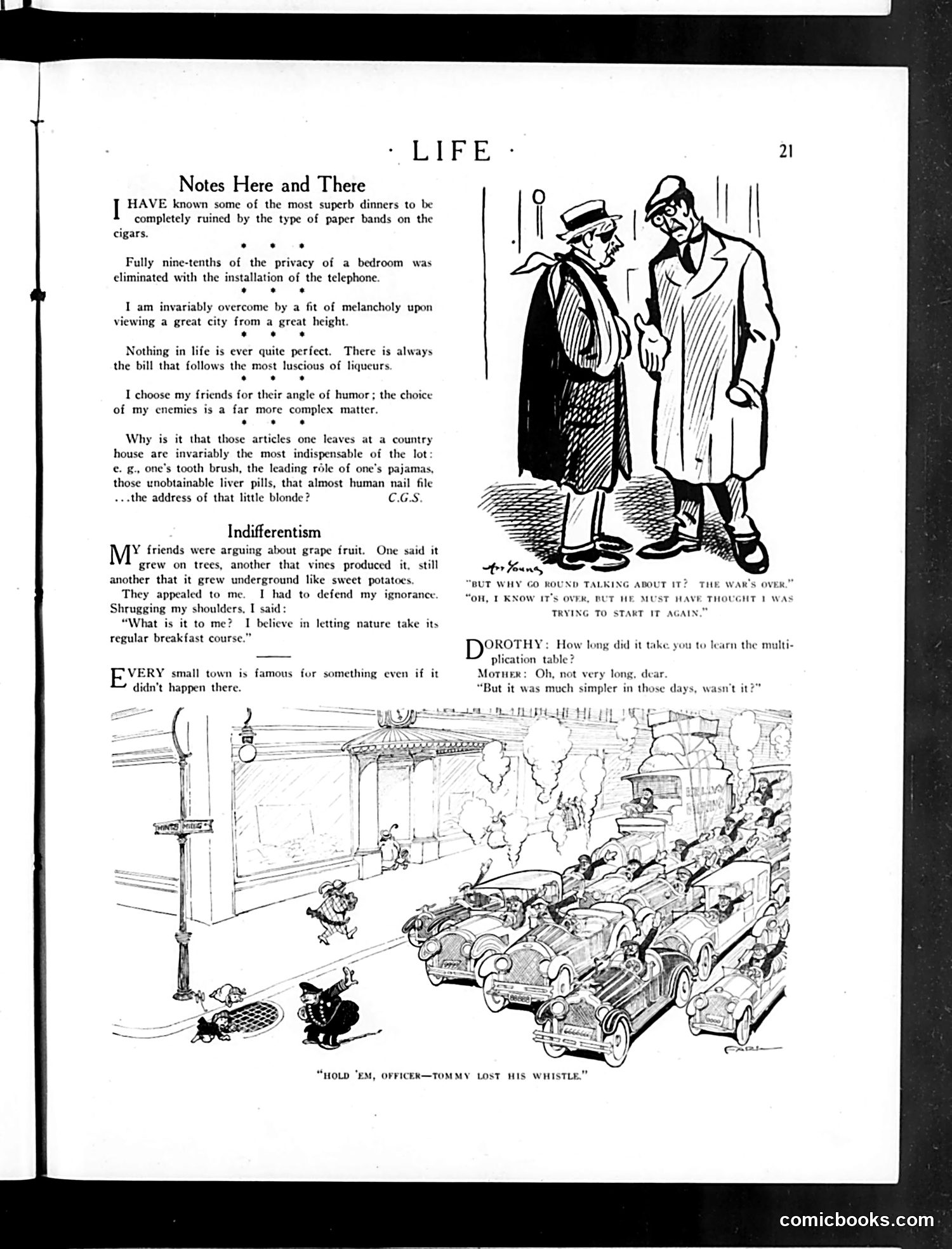
This page collects humorous observations on everyday life alongside several cartoon gags. The top section, "Notes Here and There," contains witty one-liners about modern inconveniences—telephone privacy invasion, cigar bands ruining dinners, and forgotten items at country houses—typical of Life's satirical commentary on upper-class concerns. The main cartoons depict: 1. **Upper cartoon**: Two men discussing something, with dialogue suggesting one mistakenly thought the other was starting a war again—likely referencing post-WWI tensions and how casually people still discuss the recent conflict. 2. **Lower cartoon**: A traffic jam captioned "Hold 'em, officer—Tommy lost his whistle," showing a policeman unable to control automobile congestion. This satirizes early 20th-century urban traffic problems and the ineffectiveness of police in managing the new automobile age. The "Indifferentism" section mocks pretentious dinner-party arguments about trivial matters. Overall, the page reflects Life's focus on satirizing modern urban life and social pretensions.
This page contains film criticism from Life's satirical movie column. The reviewer critiques contemporary silent films with sharp wit: **"Lucretia Lombard"** is dismissed as a tired courtroom melodrama featuring a district attorney and a woman accused of murdering her husband. The reviewer finds it derivative and poorly constructed, though acknowledges the forest fire sequence with fleeing animals is genuinely exciting—ironic praise since the fire merely eliminates an unnecessary character. **"The Secrets of Life"** celebrates Louis H. Tolhurst's microscopic cinematography showing insects (ants, bees, fleas) but uses this as a vehicle for satire about gender roles. The reviewer humorously notes that female insects "control the government, regulate the stock market," suggesting men are "superfluous"—mocking contemporary anxieties about women's increasing independence and power in the 1920s. **"Chronicles of America"** (Yale University series) receives measured praise for ambition despite technical flaws. The reviewer jokingly hopes such films distract Yale students from football to protect his gambling losses. The writing exemplifies Life's characteristic blend of entertainment criticism with social commentary.
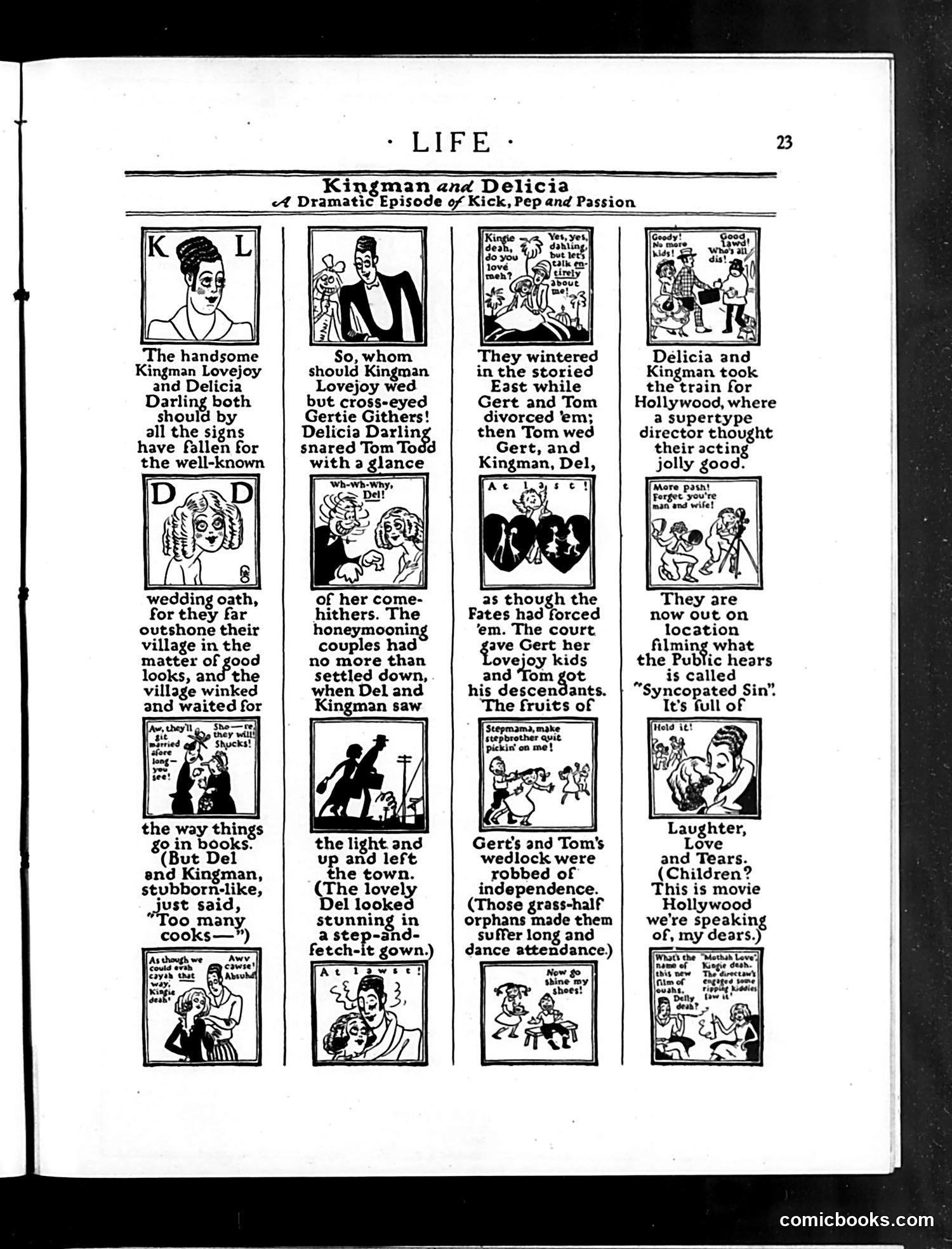
This is a satirical comic strip mocking melodramatic romance narratives and Hollywood's excesses. Two attractive young people (Kingman Lovejoy and Delicia Darling) inexplicably reject each other despite being perfectly matched, instead marrying other partners (cross-eyed Gertie and Tom Todd). The couples divorce, remarry each other in confused combinations, then flee to Hollywood where a director casts them in a film called "Syncopated Sin"—apparently exploiting their personal drama for entertainment. The satire targets: overwrought romantic fiction tropes ("the way things go in books"), Hollywood's sensationalism, and the era's fascination with scandal and passion. The "syncopated" reference likely alludes to jazz-age entertainment. The tone suggests Life magazine's skepticism toward both pulp romance conventions and the film industry's manufactured melodrama.
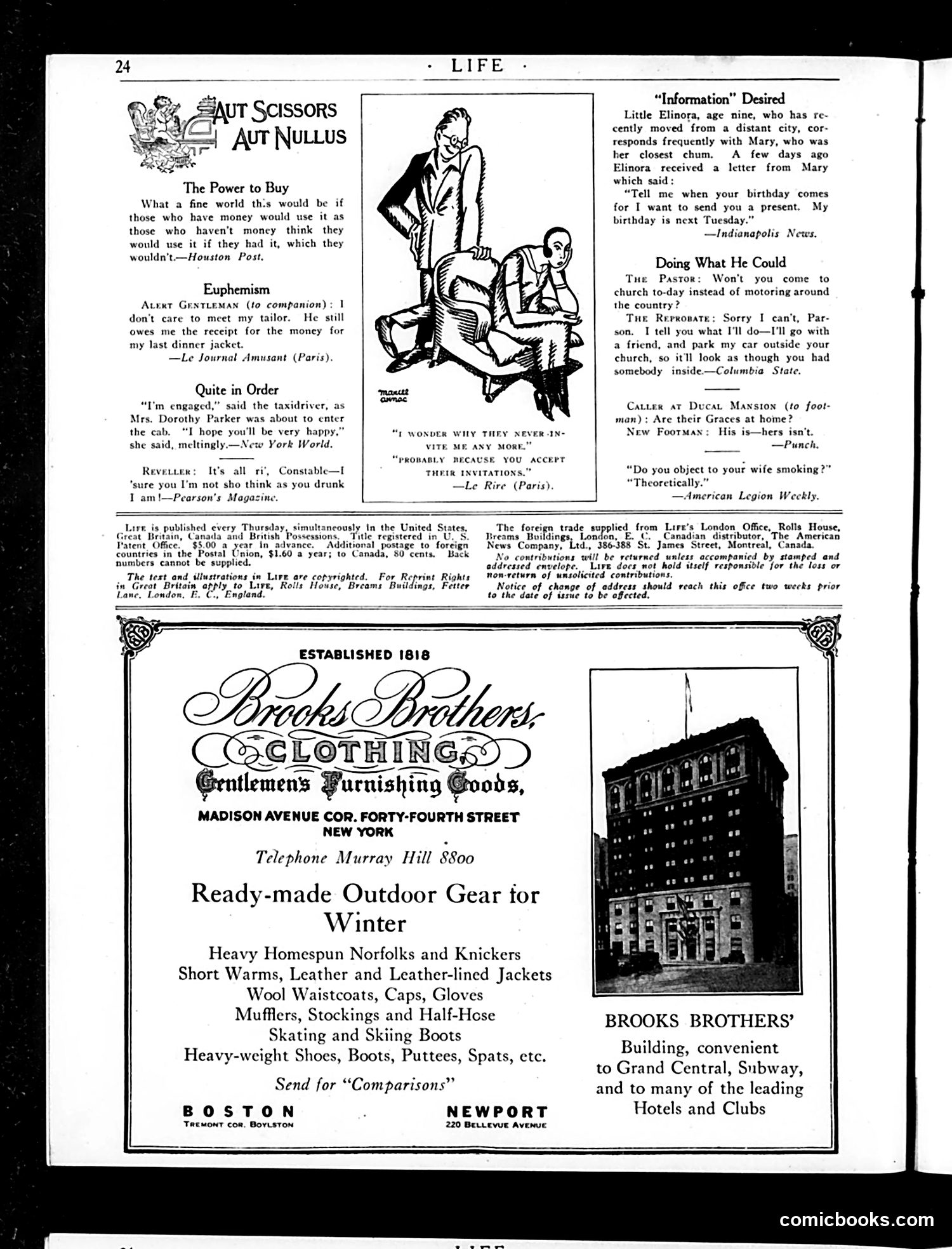
This page from *Life* (a satirical weekly) contains several brief humor pieces and advertisements typical of early 20th-century magazine format. The cartoons mock social pretense and marital dynamics. "Quite in Order" jokes about a taxi driver's engagement being acceptable despite his profession. "Doing What He Could" satirizes a wealthy parishioner who parks his car outside church to *appear* religious without actually attending. The exchanges about objecting to smoking "theoretically" and servants' presence poke fun at upper-class hypocrisy. Other pieces ridicule euphemism (a gentleman avoiding his tailor), the power of wealth, and a child's innocent request to know *when* to expect a birthday gift rather than *what*. The page is primarily **advertising** for Brooks Brothers' winter clothing and outdoor gear—a luxury clothier targeting wealthy New Yorkers, emphasizing proximity to Grand Central and prestigious hotels. The humor throughout reflects *Life's* focus on mocking American social conventions and class pretense.
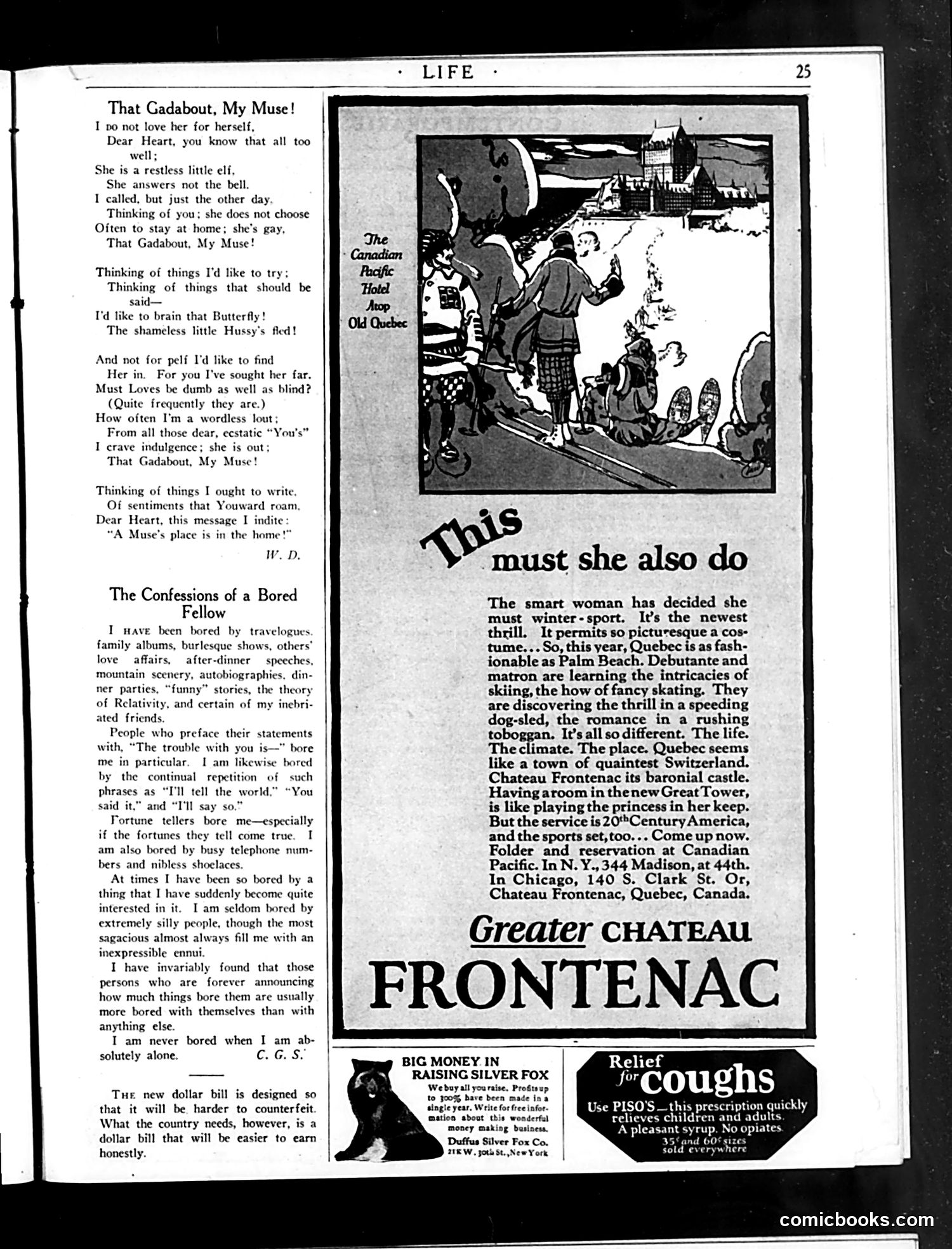
This page contains satirical poetry and social commentary typical of Life's editorial content, plus advertising. **Main Content:** "That Gadabout, My Muse!" is a humorous poem by W.D. complaining that his creative inspiration (personified as a fickle female muse) won't stay home—she's always out gallivanting. The joke plays on the romantic notion that artists need their muses, but his won't cooperate. **"The Confessions of a Bored Fellow"** is a satirical essay listing things that bore the author, concluding that people who constantly complain about boredom are actually just bored with themselves—a gentle jab at self-important complainers. **Advertisement:** The Chateau Frontenac ad promotes Quebec winter sports as the fashionable new trend for wealthy women, positioning skiing and dog-sledding as the season's excitement—replacing Palm Beach as the elite vacation destination. The page reflects 1920s attitudes about leisure, artistic temperament, and high-society fashions.
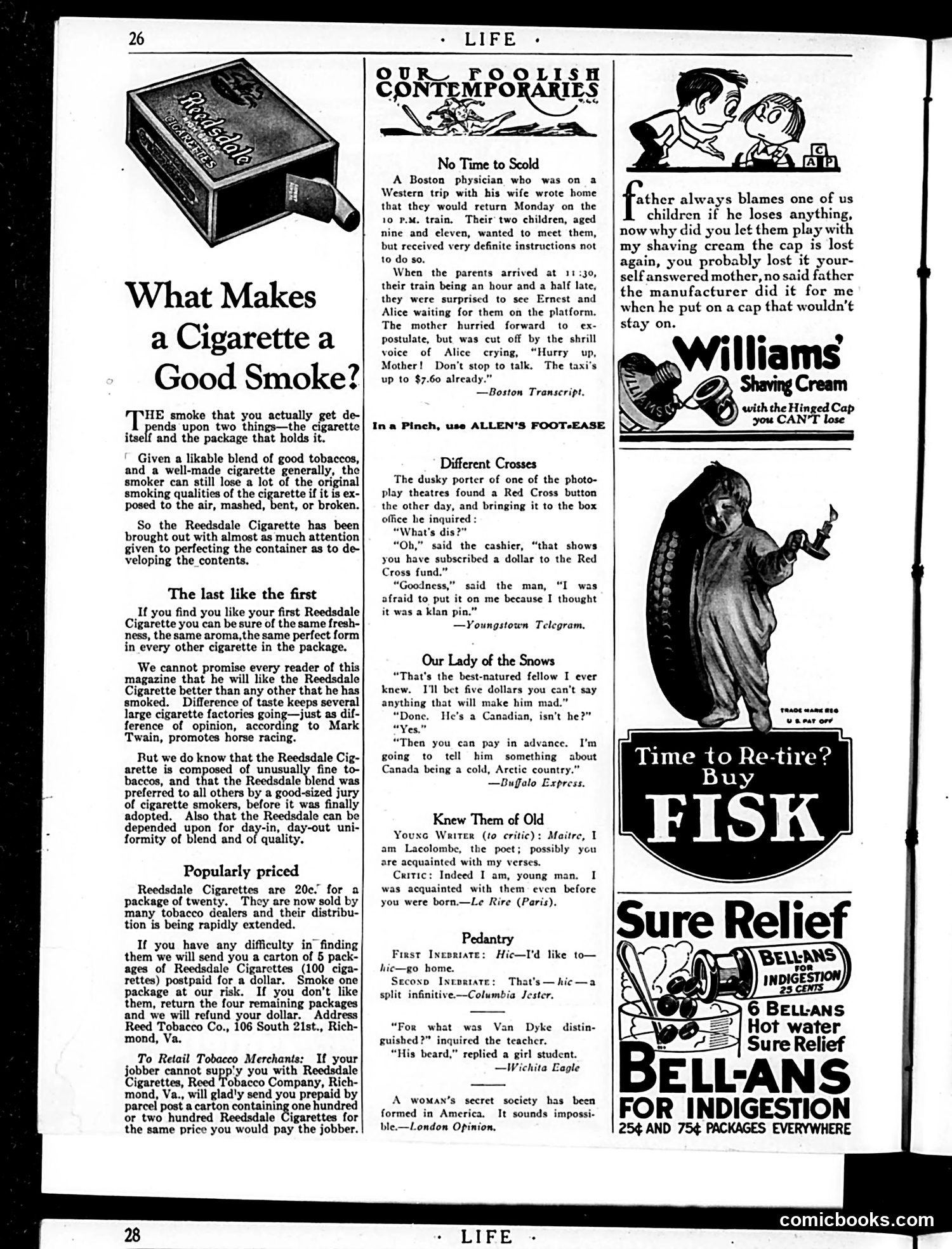
This *Life* magazine page contains mostly **advertising** (Reedsdale Cigarettes dominates the left side) mixed with a humor section titled "Our Foolish Contemporaries." The humor pieces are brief anecdotes mocking human behavior: - **"No Time to Scold"**: Children disobey their parents' instructions, but the mother can't scold them because the taxi meter is running expensively—priorities humorously inverted. - **"Different Crosses"**: A Black porter mistakes a Red Cross charity button for a KKK pin, reflecting contemporary racial anxieties and the KKK's actual prominence in 1920s America. - **"Our Lady of the Snows"**: A bet that Canadians are so even-tempered nothing upsets them—except insulting their country's climate. These pieces rely on gentle, period-specific satire about class, nationality, and social conventions. The magazine positions itself as sophisticated commentary on everyday foolishness among readers and public figures.
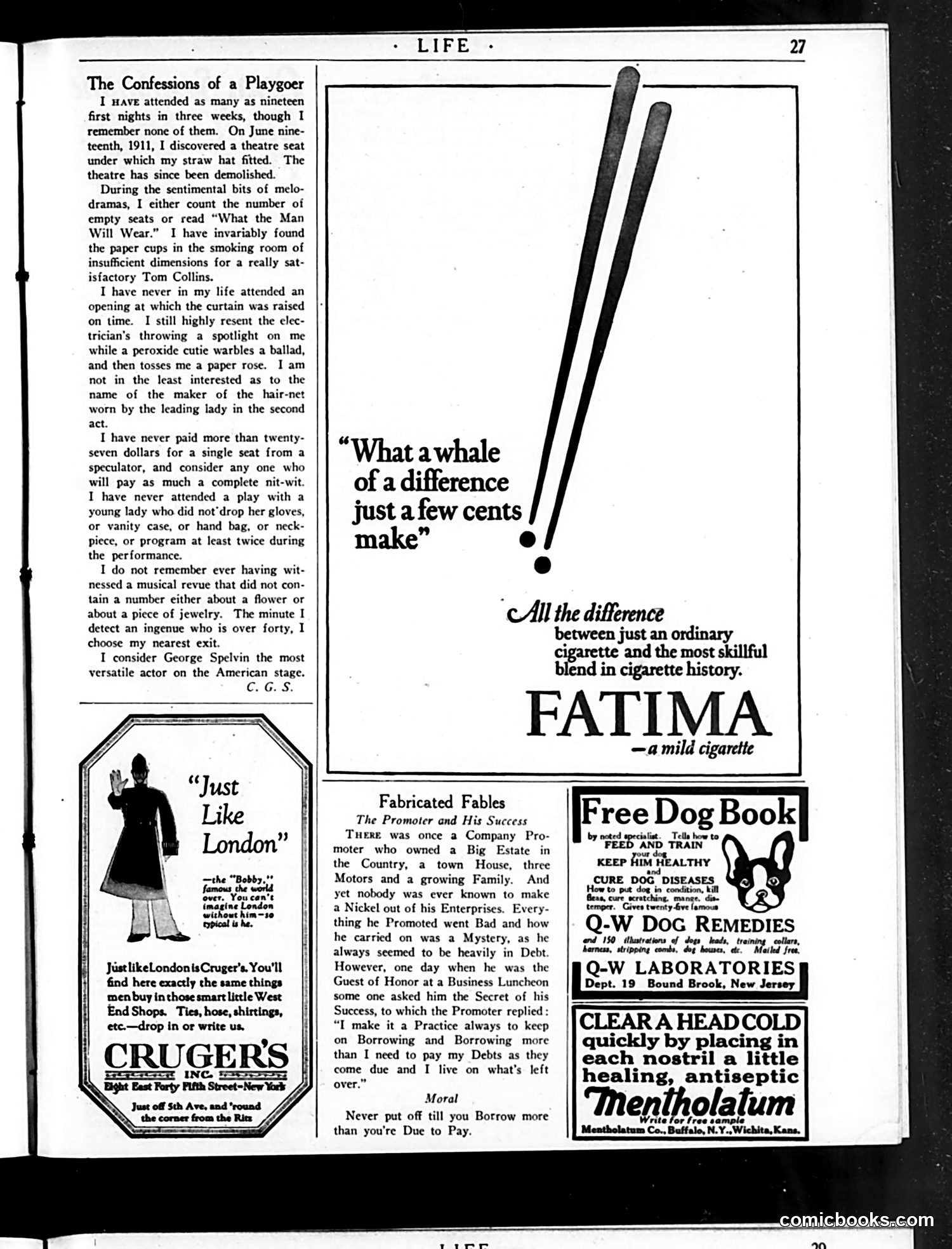
This is a humorous essay satirizing theatergoers' inattentiveness and poor theater etiquette in early 1910s New York. The unnamed narrator confesses he attends Broadway openings frequently but remembers nothing, admits to counting empty seats during sentimental scenes, resents being accidentally spotlit, and considers anyone paying over $27 for a speculator's ticket a "complete nit-wit." The satire targets both the audience (their superficiality, clumsiness—women perpetually dropping gloves and vanity cases) and theater itself (predictable musical numbers about flowers/jewelry, ingenues over forty). The reference to "George Spelvin" is a knowing joke—this was a standard pseudonym used in theater credits for minor or uncredited roles, implying even the most versatile American actor is fictional. The piece mocks the pretense and boredom surrounding high society's obligatory theater attendance, particularly among wealthy New Yorkers.
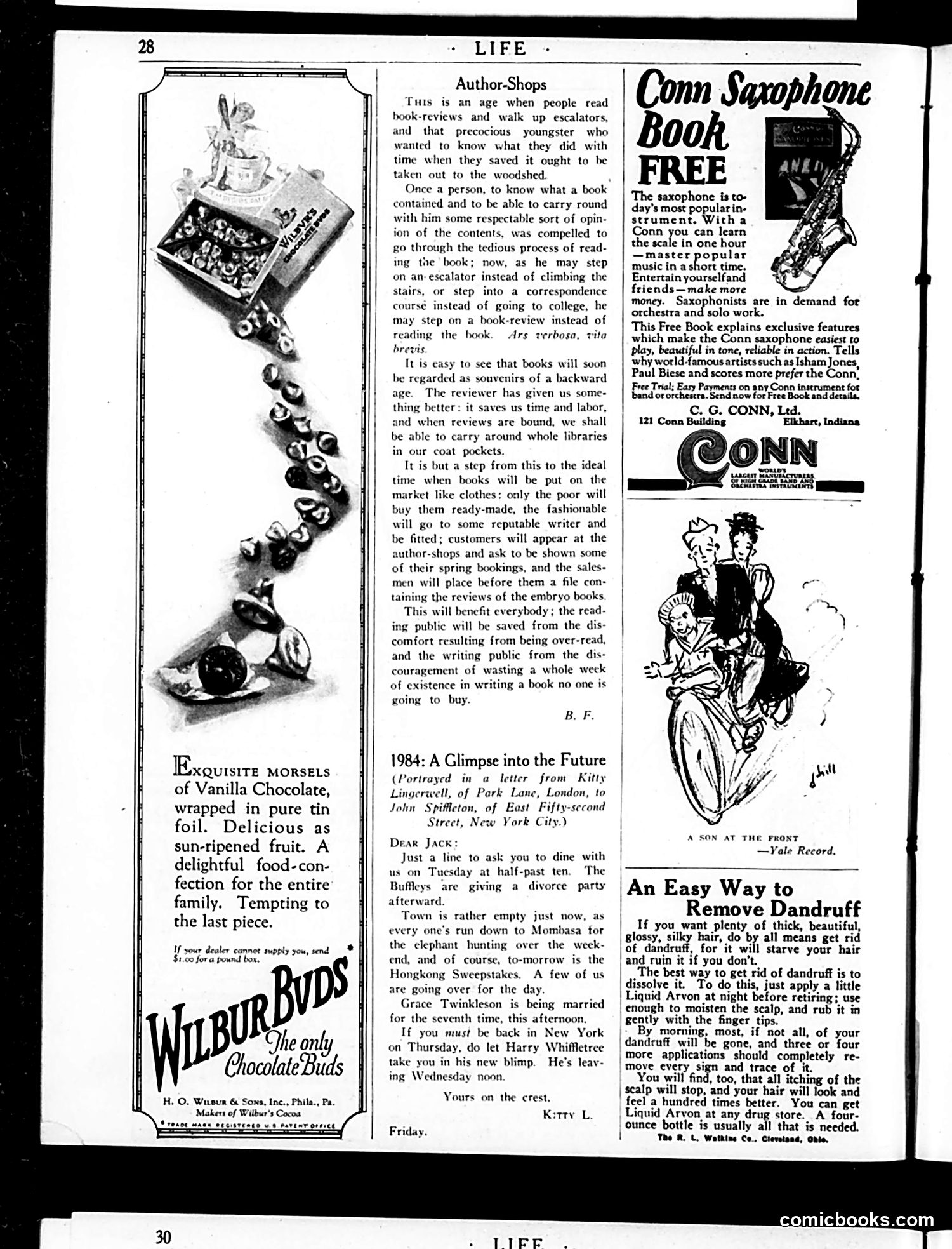
This page contains **satirical commentary on modern convenience culture**, circa 1920s-1930s. The main piece, "Author-Shops," mocks society's increasing reliance on shortcuts and summaries. The author (B.F.) sarcastically predicts a dystopian future where people read *book reviews instead of books*—skipping actual reading the way they skip stairs via escalators or forgo college for correspondence courses. The satire escalates absurdly: books will become "souvenirs of a backward age," and "author-shops" will sell custom-written reviews like tailored clothing, allowing lazy customers to carry "whole libraries in coat pockets" without reading anything. The accompanying fictional letter "1984: A Glimpse into the Future" extends this satire, depicting an absurdly frivolous upper-class life where people hunt elephants in Mombasa, attend divorce parties, and marry repeatedly—suggesting cultural decay alongside intellectual laziness. **The joke:** Modern readers skip actual engagement (reading, learning, thinking) in favor of passive consumption of summaries and reviews. The exaggerated predictions satirize contemporary shortcuts as symptoms of intellectual and moral decline.
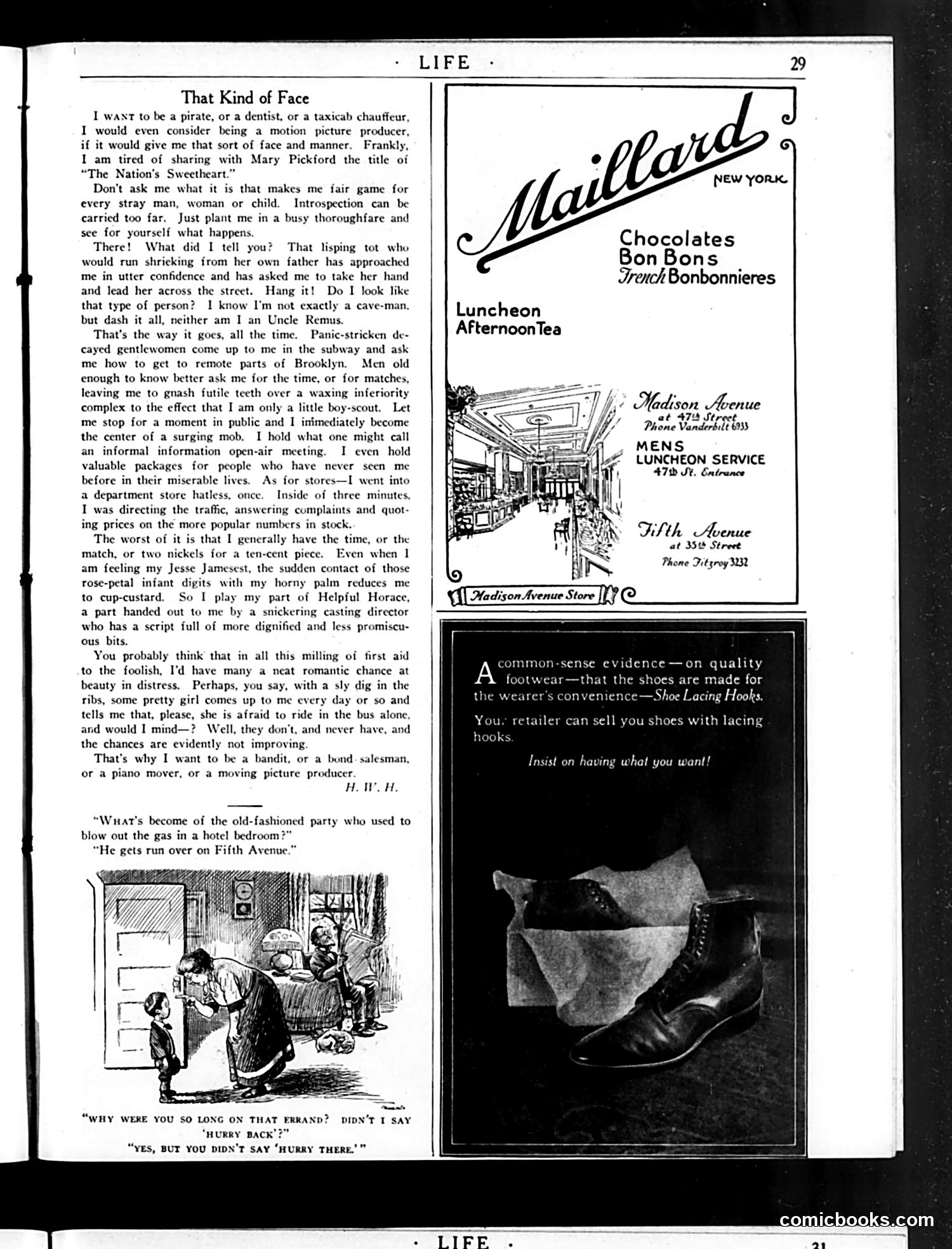
**Main Article:** "That Kind of Face" is a humorous first-person essay by H.W.H. complaining that his appearance makes him look perpetually helpful and trustworthy—like an "Uncle Remus" or Boy Scout type. Strangers constantly approach him asking for directions, the time, help crossing streets, and directions in department stores. He's frustrated that this "helpful Horace" appearance prevents him from looking dangerous or romantic, and he fantasizes about jobs (bandit, bond salesman, piano mover) that would give him a more commanding presence. The essay satirizes how facial features and demeanor typecast people in society. **Bottom Cartoon:** A brief joke about old-fashioned hotels: when asked what happened to people who used to blow out gas lamps in hotel bedrooms, the answer is they "get run over on Fifth Avenue"—a dark joke about the dangers of modern traffic replacing old hazards. **Advertisements:** The page features Maillard chocolates, Madison Avenue restaurants, and shoe lacing hooks—typical 1920s luxury goods.
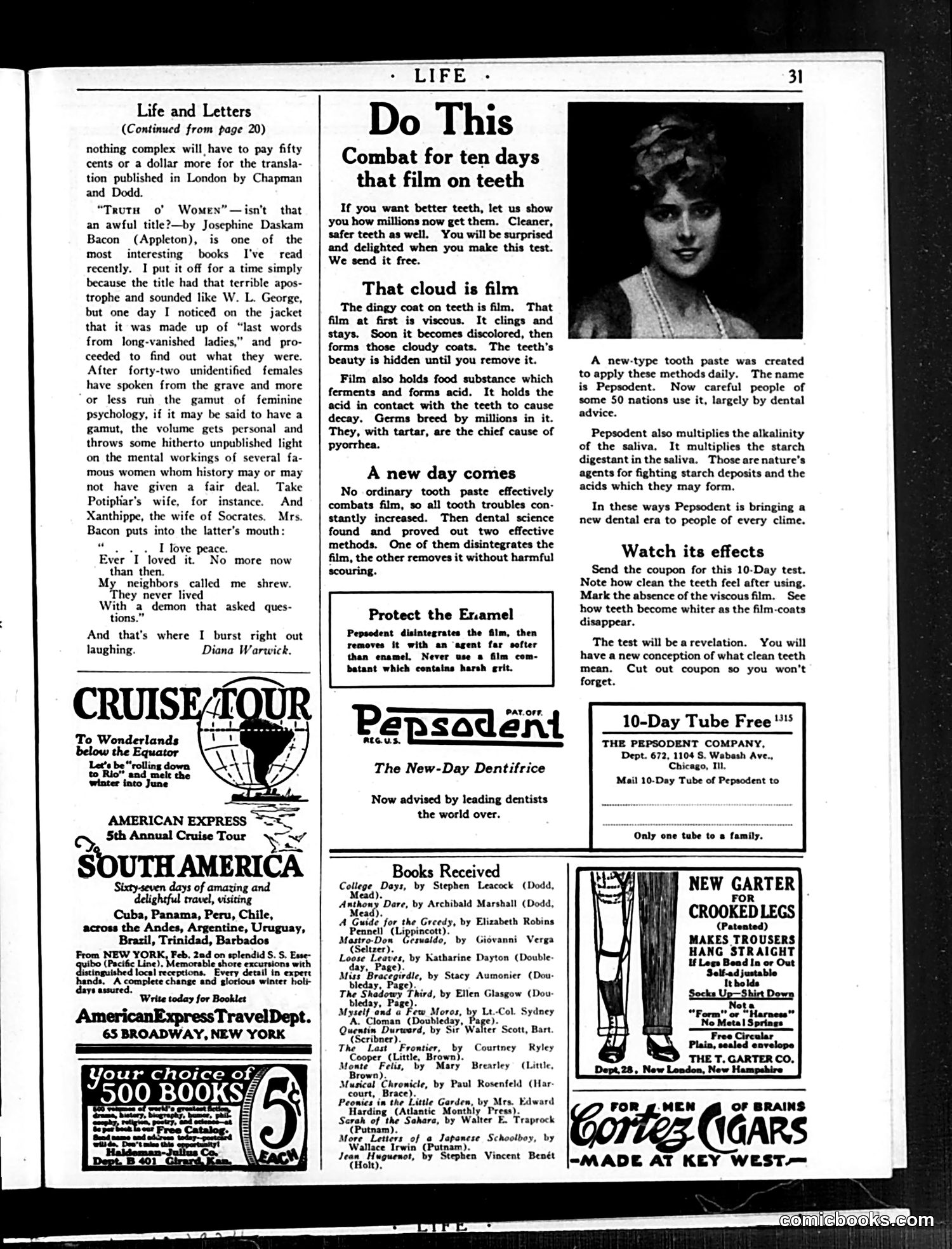
This page is primarily **advertising**, not political satire. The dominant content is a major advertisement for **Pepsodent toothpaste**, a new commercial product claiming revolutionary dental benefits. The ad's framing reflects early 20th-century marketing psychology: it uses pseudo-scientific language ("film," "alkalinity," "starch digestant") to explain tooth problems and position Pepsodent as a scientific solution. The offer of a free 10-day trial tube was a common advertising tactic to drive consumer adoption. The page includes minor editorial content—book reviews and a "Life and Letters" column discussing literary works—alongside period advertisements for cruise tours and other products. For modern readers: this demonstrates how magazines historically blended editorial content with advertising, and shows the emergence of aggressive consumer marketing using quasi-scientific claims to sell personal care products—practices that continue today but now face greater regulatory scrutiny.
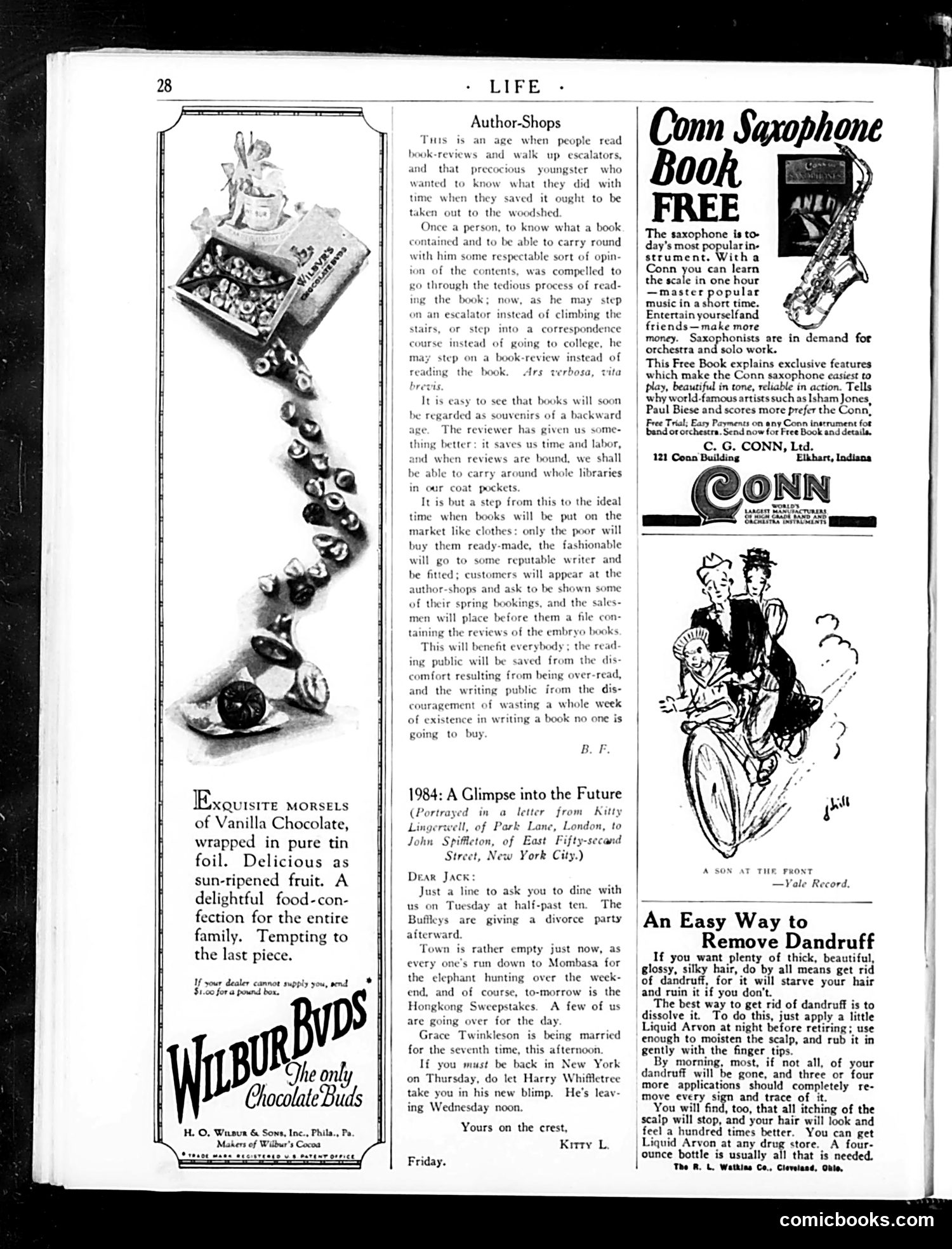
This page combines advertisements with satirical content typical of early 20th-century *Life* magazine. The main satire, "Author-Shops," mocks the modern trend of reading book *reviews* instead of actual books. The author suggests that people now climb escalators rather than stairs, take correspondence courses instead of college, and read reviews in their coat pockets rather than carry books. The piece satirizes the growing laziness and shortcut-taking of contemporary society, warning that books will soon be sold "ready-made" like clothing, fitted by salesmen showing customers files of reviews rather than actual manuscripts. The satire suggests this convenience culture will ultimately discourage both readers and writers. "1984: A Glimpse into the Future" presents a humorous speculative letter imagining 1984 as absurdly futuristic—featuring divorce parties, elephant hunting in Africa, and travel via "blimp." It's light social satire on upper-class frivolity. The page otherwise contains period advertisements for Wilbur's Chocolate, Conn Saxophones, and dandruff treatment—typical commercial content of the era.
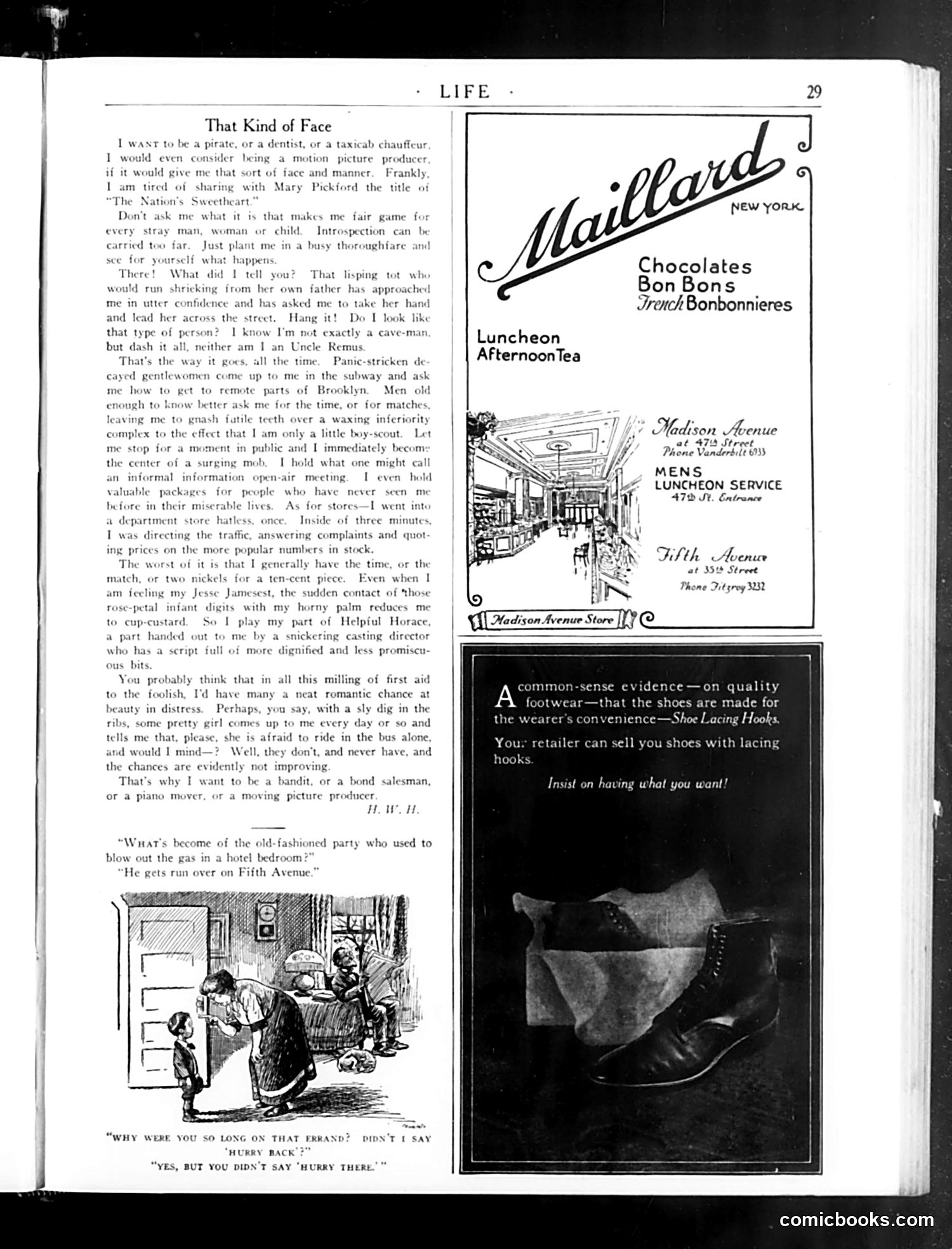
This page features a humorous essay by someone (likely male, given context) complaining about having an approachable, open face that invites strangers to impose upon him constantly. He's pestered for directions, the time, matches, and money by subway riders, store customers, and street urchins. Even trying to help in emergencies backfires when people assume he's a perpetual Good Samaritan. The satire mocks middle-class anxieties about urban anonymity and unsolicited social contact in early 20th-century New York City. The author fantasizes about becoming a pirate or cabdriver instead—occupations with less "approachable" personas. A small cartoon below depicts an old-fashioned person who "blew out the gas" in a hotel bedroom; someone quips he "gets run over on Fifth Avenue"—dark humor about outdated behavior. The page is otherwise filled with period advertisements (Maillard chocolates, Madison Avenue establishments).
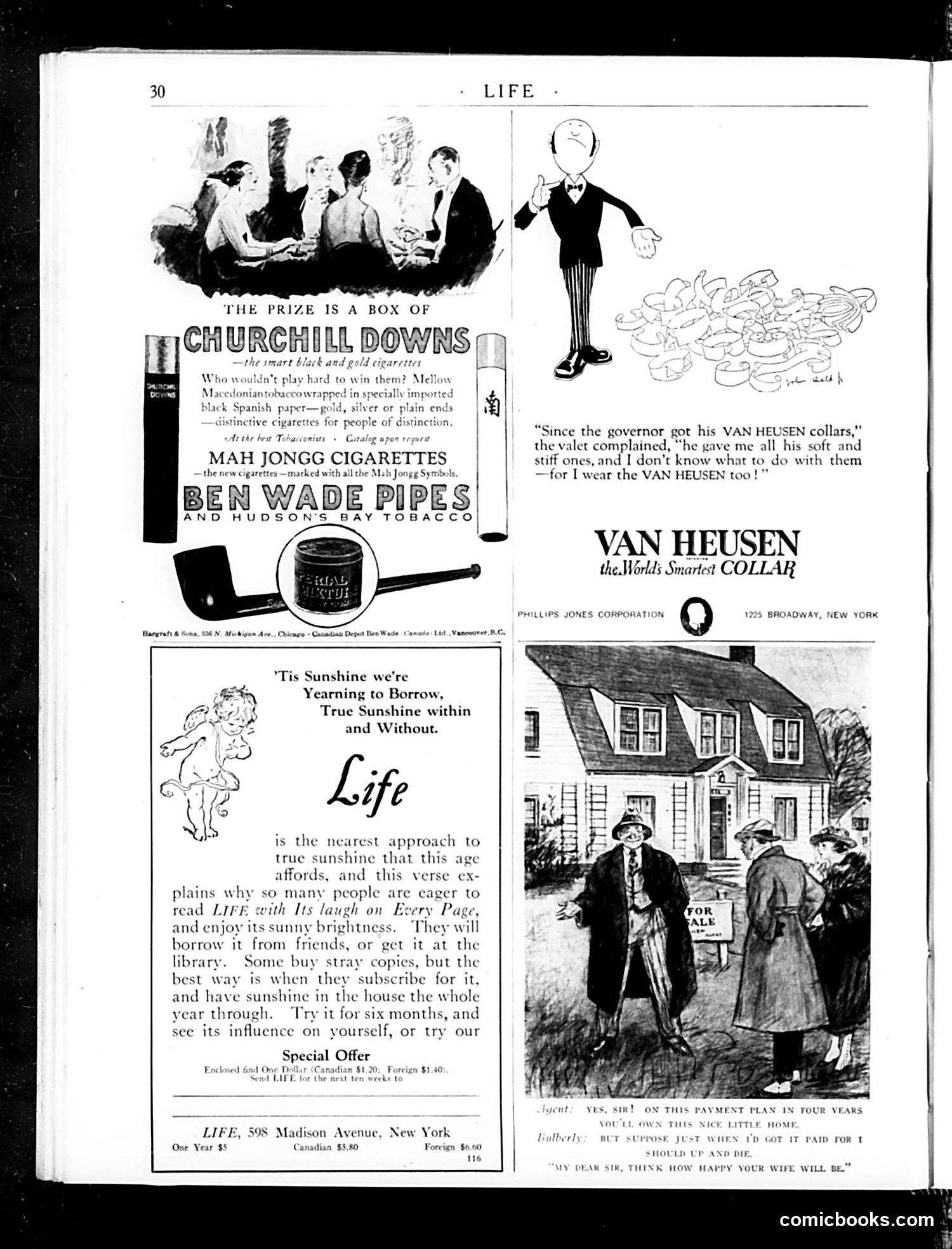
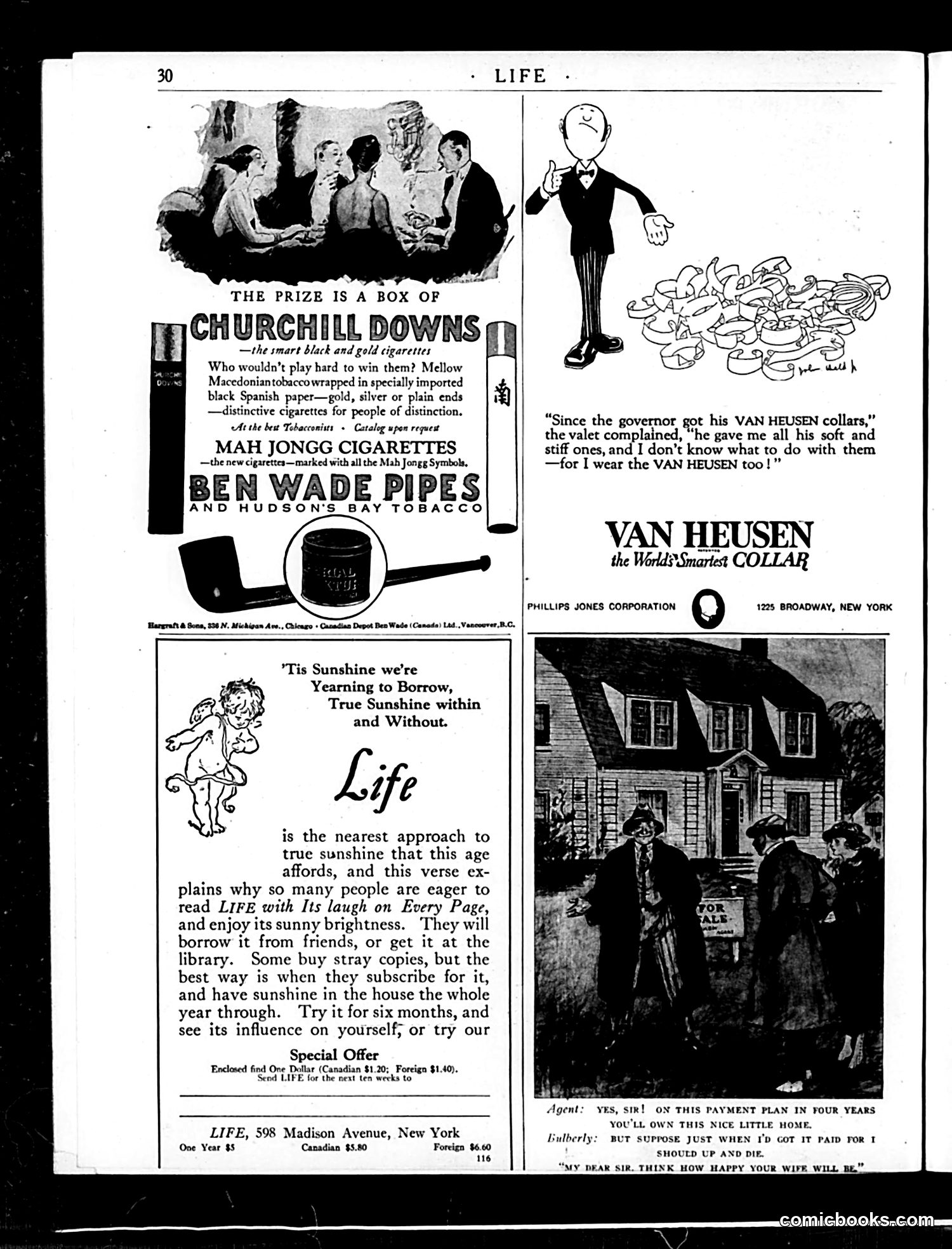
This is primarily an **advertising page** from Life magazine, with one small satirical cartoon. The main advertisements promote cigarettes (Churchill Downs, Mah Jongg), pipes, and collars (Van Heusen). Life itself advertises its magazine with a philosophical pitch about bringing "sunshine" and laughter into homes. The single cartoon (bottom right) shows a real estate agent pitching a modest house to a prospective buyer. The joke is darkly cynical: the agent suggests the buyer will finish paying for the house in four years, then quips he'll "up and die"—but reassures him his widow will be happy. This satirizes aggressive sales tactics and the grim reality that working people struggle under mortgage debt with little security. The Van Heusen collar ad includes a separate joke about a governor's valet receiving his discarded collars—implying status anxiety about wearing hand-me-downs. The overall page reflects 1920s consumer culture and gentle social satire typical of Life's humor.
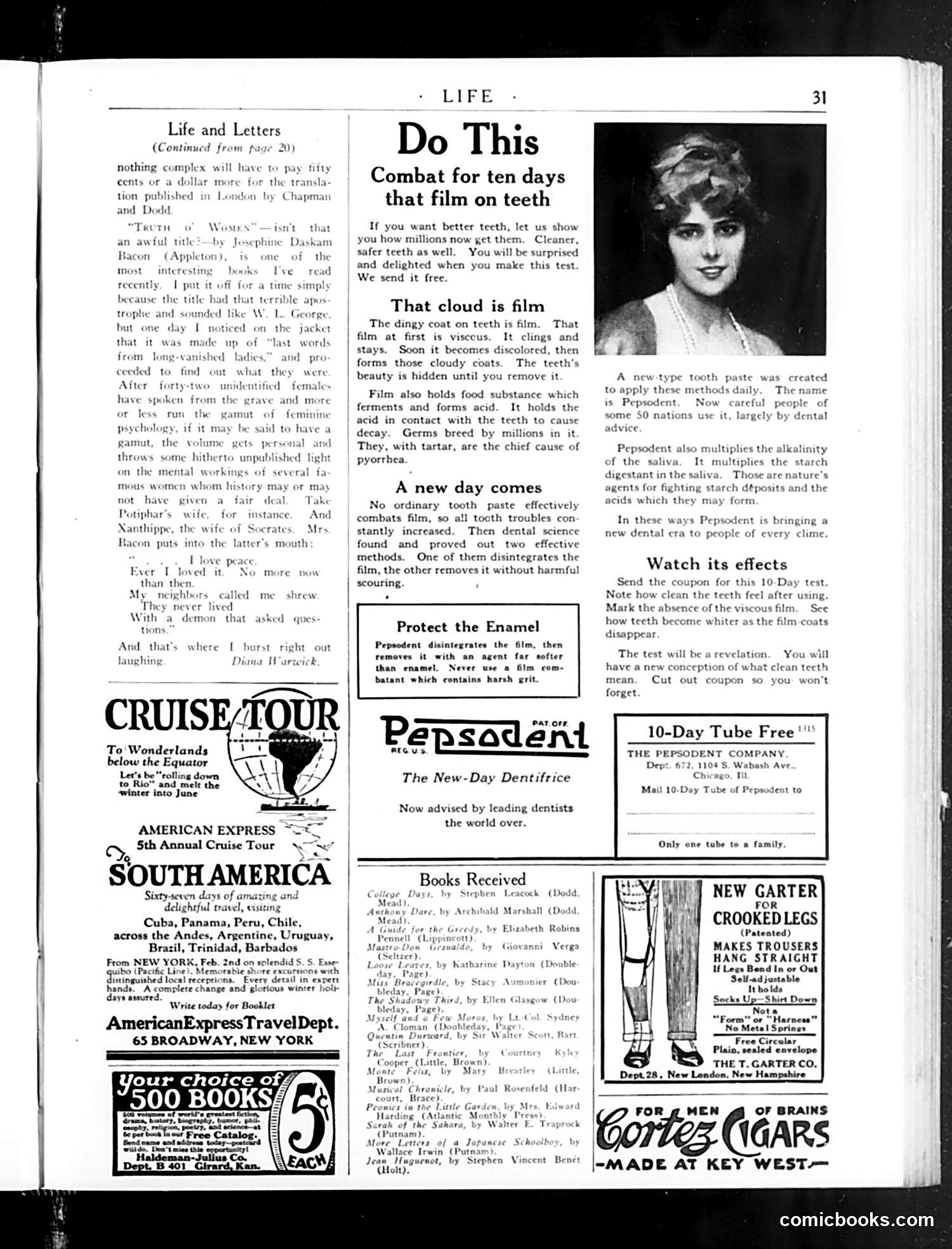
This page is primarily **advertising**, not satire or editorial cartoons. The main content is a lengthy advertisement for **Pepsodent toothpaste**—a new product introducing scientific dental care to consumers. The ad promotes a 10-day free trial and explains Pepsodent's claimed innovation: disintegrating tooth film (plaque) without harsh abrasives, while also multiplying alkalinity in saliva to fight decay. The page also features ads for an **American Express South American cruise tour** and general book advertisements. There's a brief "Life and Letters" column reprinting correspondence about books. The only noteworthy cultural reference is a humorous anecdote mentioning Xanthippe (Socrates' famously shrewish wife) from a book review—a classical reference suggesting wives' legendary complaints aren't new. The page reflects early 20th-century marketing: scientific language selling modern conveniences, exotic travel, and reading as leisure pursuits for the affluent.
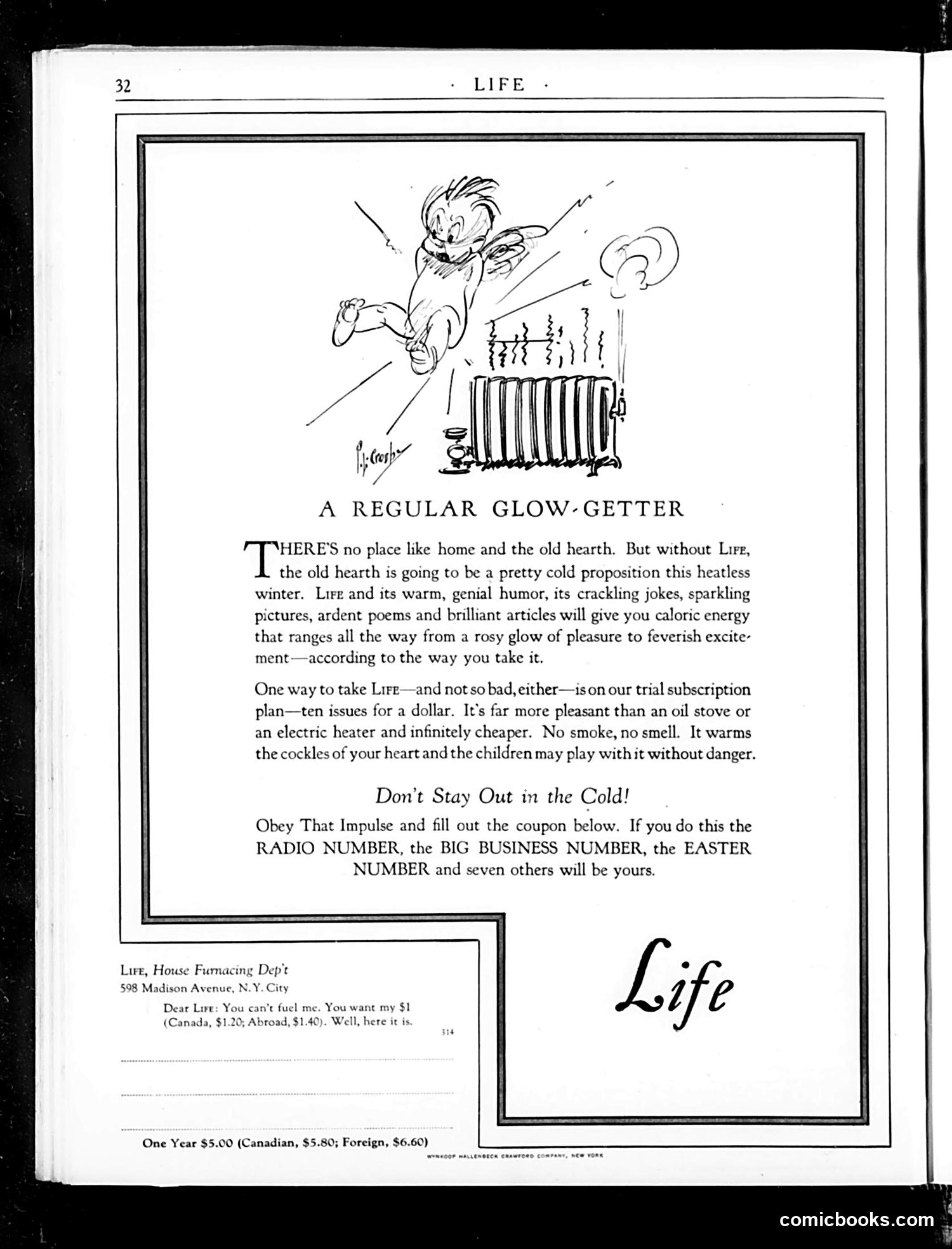
This is a subscription advertisement for *Life* magazine, disguised as satirical humor. The cartoon shows a cheerful child gleefully escaping from a radiator—a visual pun on the headline "A Regular Glow-Getter." The ad references a "heatless winter," likely alluding to fuel shortages or rationing during World War I (when *Life* was published). The joke claims *Life*'s entertaining content—humor, jokes, pictures, poems—provides warmth and comfort better than actual heating methods like oil stoves or electric heaters, and more cheaply. The copy humorously pitches a trial subscription (ten issues for one dollar) as preferable to real fuel. The ad promises readers access to special numbered issues: the "Radio Number," "Big Business Number," and "Easter Number." The underlying message: during scarcity, entertaining reading matter is a worthy substitute for material comfort—a clever marketing angle during wartime resource constraints.
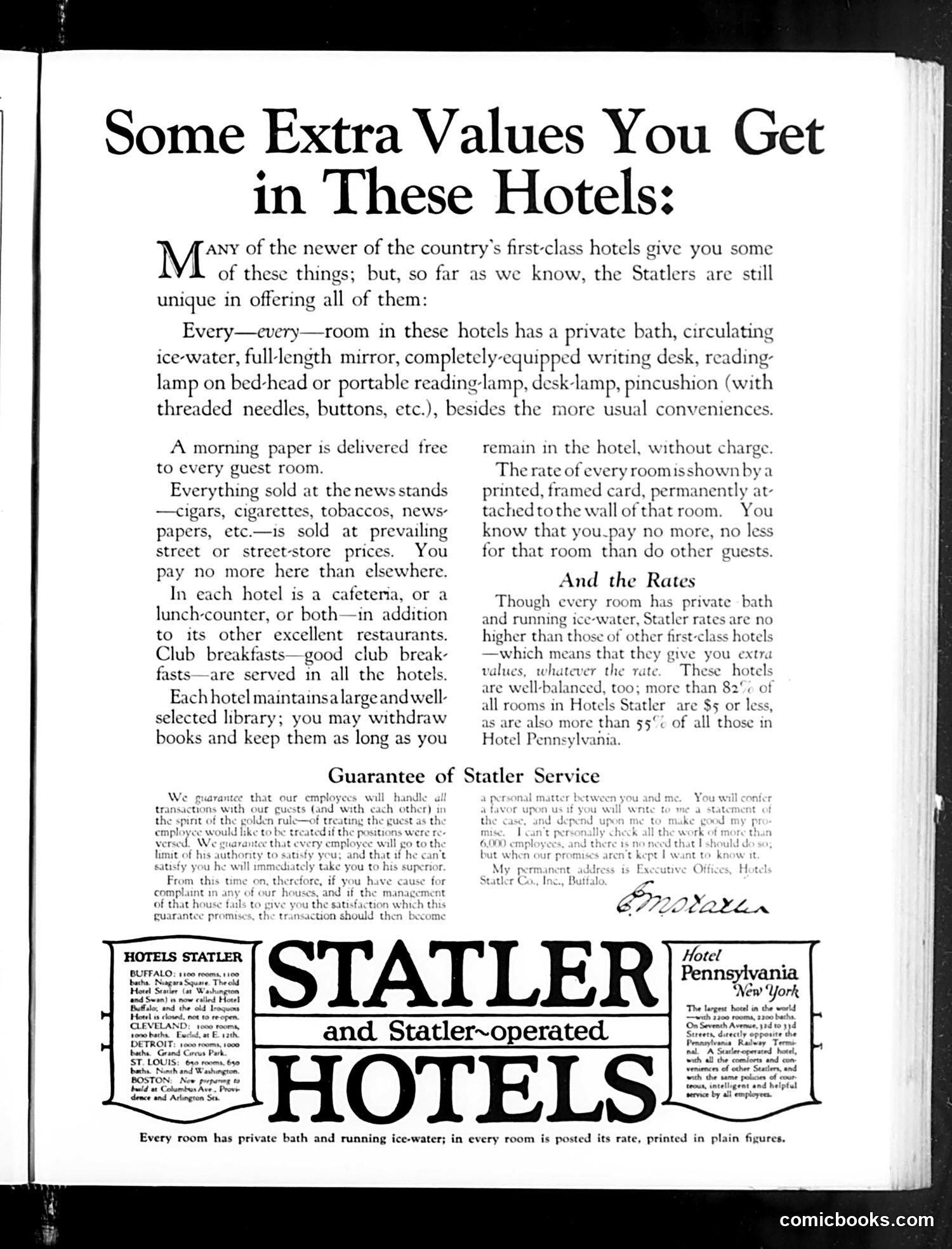
This is a full-page **advertisement for Statler Hotels**, not a political cartoon or satire. The page promotes the hotel chain's amenities and competitive pricing to early 20th-century travelers. The appeal emphasizes modernization and consumer transparency: private bathrooms in every room (a luxury feature then), free newspapers, standardized pricing posted visibly, and thoughtful details like desk lamps and sewing supplies. The text stresses that Statler rates match competitors despite superior amenities—a value proposition. The signature at bottom appears to be from a Statler executive guaranteeing service quality and employee conduct. Lists name several Statler properties (Buffalo, Detroit, Boston) and the Hotel Pennsylvania in New York. This reflects an era when hotel amenities were still novel selling points and when advertising emphasized reliability, fairness, and modern conveniences to appeal to business travelers.
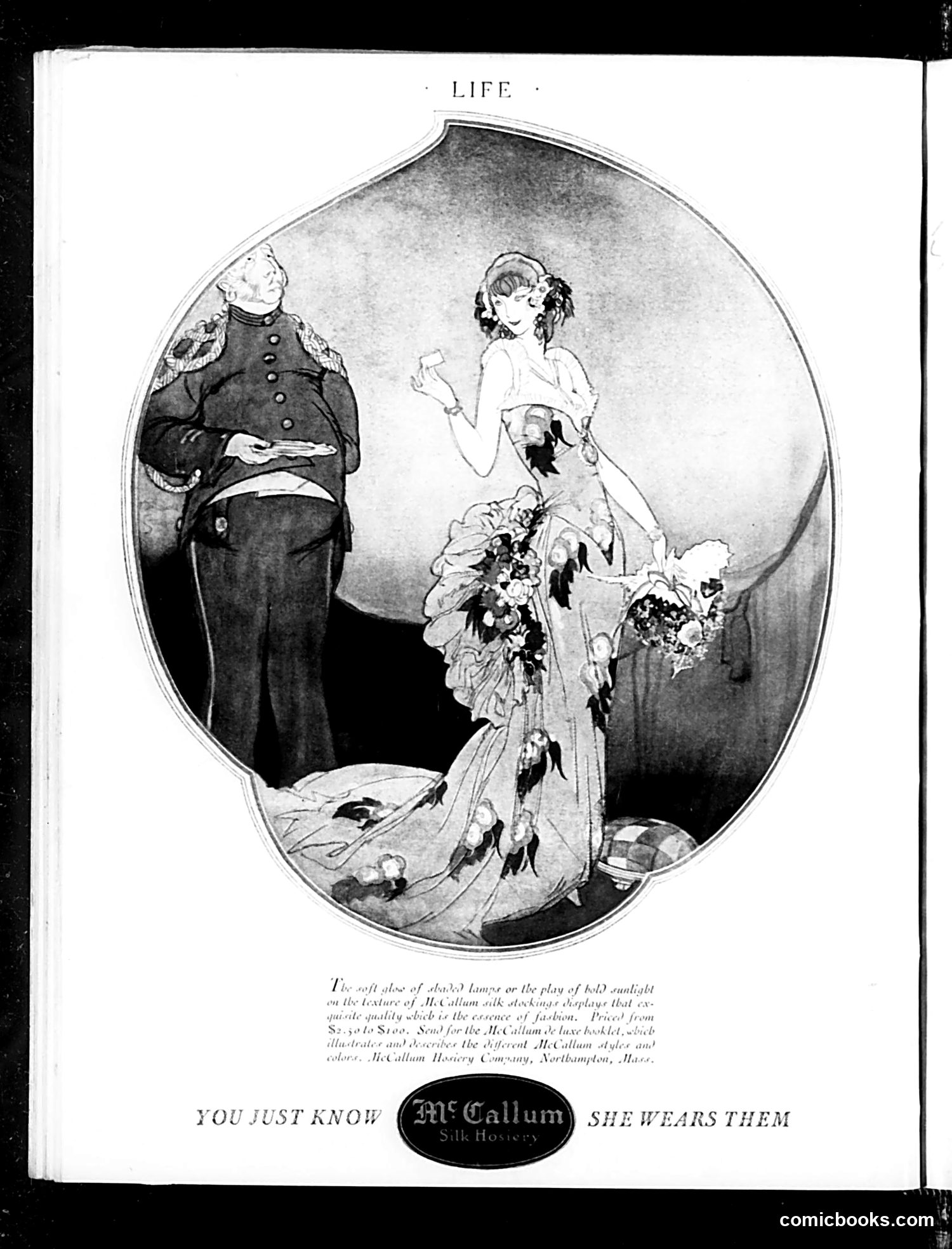
This is primarily a **McCallum Silk Hosiery advertisement** disguised as editorial content in *Life* magazine. The illustration depicts two figures in an oval frame: a military officer (left) and an elegantly dressed woman (right) wearing silk stockings and holding wilted flowers. The ad's tagline—"YOU JUST KNOW SHE WEARS THEM"—uses romantic/social innuendo: the implication is that a well-dressed, attractive woman would naturally wear quality silk stockings. The withered flowers suggest romantic disappointment, possibly playing on the idea that quality hosiery helps ensure romantic success. The ad emphasizes the stockings' texture and appearance, positioning McCallum silk hosiery as a luxury fashion item signaling elegance and desirability to potential male suitors—reflecting early 20th-century consumer advertising strategies targeting women.