
Life, 1924-01-10 · page 20 of 44
Life — January 10, 1924 — page 20: what you’re looking at
What you’re looking at
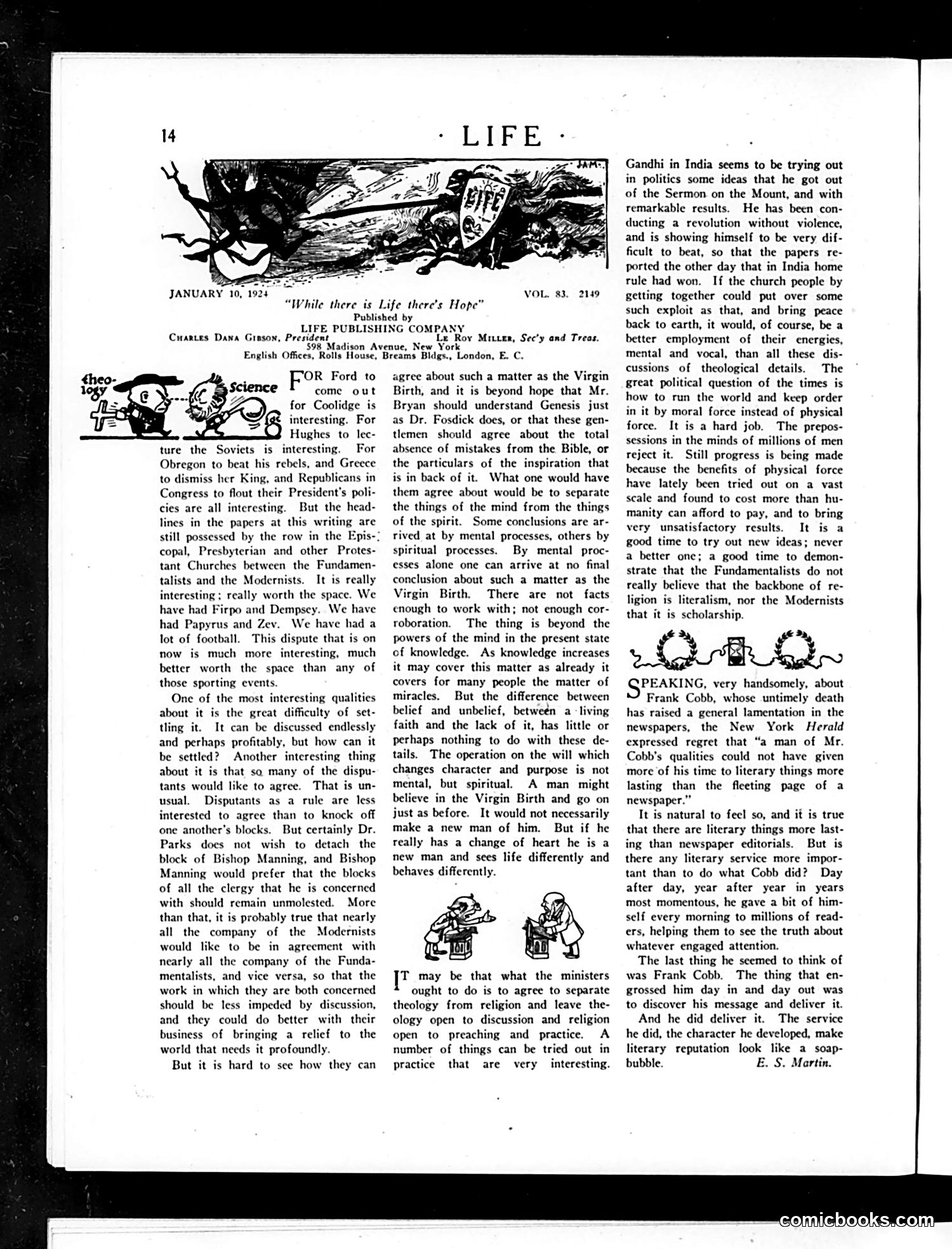
This page discusses the "Fundamentalist-Modernist Controversy," a major Protestant church split of the 1920s. The cartoon's title, "While there is Life there's Hope," plays on the magazine's name. The text sardonically notes that this theological dispute has captured more newspaper attention than major sporting events (boxing champion Dempsey, racehorses Papyrus and Zev). The author identifies key figures: Dr. Bryan (likely William Jennings Bryan, a Fundamentalist), Dr. Fosdick (likely Harry Emerson Fosdick, a Modernist preacher), and Bishop Manning—all real participants in this heated debate over literal Bible interpretation, the Virgin Birth, and modern theology versus traditional faith. The piece argues the real problem: Fundamentalists and Modernists can't agree on factual/intellectual matters, though both want church unity. The author suggests separating theology (open to debate) from religion (focused on spiritual practice and character change)—proposing Gandhi's non-violent approach as an example of practical religion over doctrine.
📄 Transcribed text from this page (OCR, searchable)
Machine-transcribed from the original scan — historical spelling and the odd misread are preserved.
While there is Life there’s Hope” Published by LIFE PUBLISHING COMPANY Cartes Dawa Giason, President Lx Roy Mutter, Sec’y and Treas. $98 Madison Avenue, New York English Offices, Rolls House, Breams Bldgs., London, E. C. ‘OR Ford to come out for Coolidge is interesting. For Hughes to lec- ture the Soviets is interesting. For Obregon to beat his rebels, and Greece to dismiss her King, and Republicans in Congress to flout their President's poli- cies are all interesting. But the head- lines in the papers at this writing are still possessed by the row in the Epis-? copal, Presbyterian and other Protes- tant Churches between the Fundamen- talists and the Modernists. It is really interesting ; really worth the space. We have had Firpo and Dempsey. We have had Papyrus and Zev. We have had a lot of football. This dispute that is on now is much more interesting, much better worth the space than any of those sporting events. One of the most interesting qualities about it is the great difficulty of set- tling it. It can be discussed endlessly and perhaps profitably, but how can it be settled? Another interesting thing about it is that so many of the dispu- tants would like to agree. That is un- usual. Disputants as a rule are less interested to agree than to knock off one another's blocks. But certainly Dr. Parks does not wish to detach the block of Bishop Manning, and Bishop Manning would prefer that the blocks of all the clergy that he is concerned with should remain unmolested. More than that, it is probably true that nearly all the company of the Modernists would like to be in agreement with nearly all the company of the Funda- mentalists, and vice versa, so that the work in which they are both concerned should be less impeded by discussion, and they could do better with their business of bringing a relief to the world that needs it profoundly. But it is hard to see how they can agree about such a matter as the Virgin Birth, and it is beyond hope that Mr. Bryan should understand Genesis just as Dr. Fosdick does, or that these gen- tlemen should agree about the total absence of mistakes from the Bible, or the particulars of the inspiration that is in back of it. What one would have them agree about would be to separate the things of the mind from the things of the spirit. Some conclusions are ar- rived at by mental processes, others by spiritual processes. By mental proc- esses alone one can arrive at no final conclusion about such a matter as the Virgin Birth. There are not facts enough to work with; not enough cor- roboration. The thing is beyond the powers of the mind in the present state of knowledge. As knowledge increases it may cover this matter as already it covers for many people the matter of miracles. But the difference between belief and unbelief, betweén a living faith and the lack of it, has little or perhaps nothing to do with these de- tails. The operation on the will which changes character and purpose is not mental, but spiritual. A man might believe in the Virgin Birth and go on just as before. It would not necessarily make a new man of him. But if he really has a change of heart he is a new man and sees life differently and behaves differently. T may be that what the ministers ought to do is to agree to separate theology from religion and leave the- ology open to discussion and religion open to preaching and practice. A number of things can be tried out in practice that are very interesting. Gandhi in India seems to be trying out in politics some ideas that he got out of the Sermon on the Mount, and with remarkable results. He has been con- ducting a revolution without violence, and is showing himself to be very dif- ficult to beat, so that the papers re- ported the other day that in India home rule had won. If the church people by getting together could put over some such exploit as that, and bring peace back to earth, it would, of course, be a better employment of their energies, mental and vocal, than all these dis- cussions of theological details. The great political question of the times is how to run the world and keep order in it by moral force instead of physical force. It is a hard job. The prepos- sessions in the minds of millions of men reject it. Still progress is being made because the benefits of physical force have lately been tried out on a vast scale and found to cost more than hu- manity can afford to pay, and to bring very unsatisfactory results. It is a good time to try out new ideas; never a better one; a good time to demon- strate that the Fundamentalists do not really believe that the backbone of re- ligion is literalism, nor the Modernists that it is scholarship. Oe ee ee PEAKING, very handsomely, about Frank Cobb, whose untimely death has raised a general lamentation in the newspapers, the New York Herald expressed regret that “a man of Mr. Cobb's qualities could not have given more of his time to literary things more lasting than the fleeting page of a newspaper.” It is natural to feel so, and it is true that there are literary things more last- ing than newspaper editorials. But is there any literary service more impor- tant than to do what Cobb did? Day after day, year after year in years most momentous, he gave a bit of him- self every morning to millions of read- ers, helping them to see the truth about whatever engaged attention. The last thing he seemed to think of was Frank Cobb. The thing that en- grossed him day in and day out was to discover his message and deliver it. And he did deliver it. The service he did, the character he developed, make literary reputation look like a soap- bubble. E. S. Martin.