
Life, 1924-01-10 · page 18 of 44
Life — January 10, 1924 — page 18: what you’re looking at
What you’re looking at
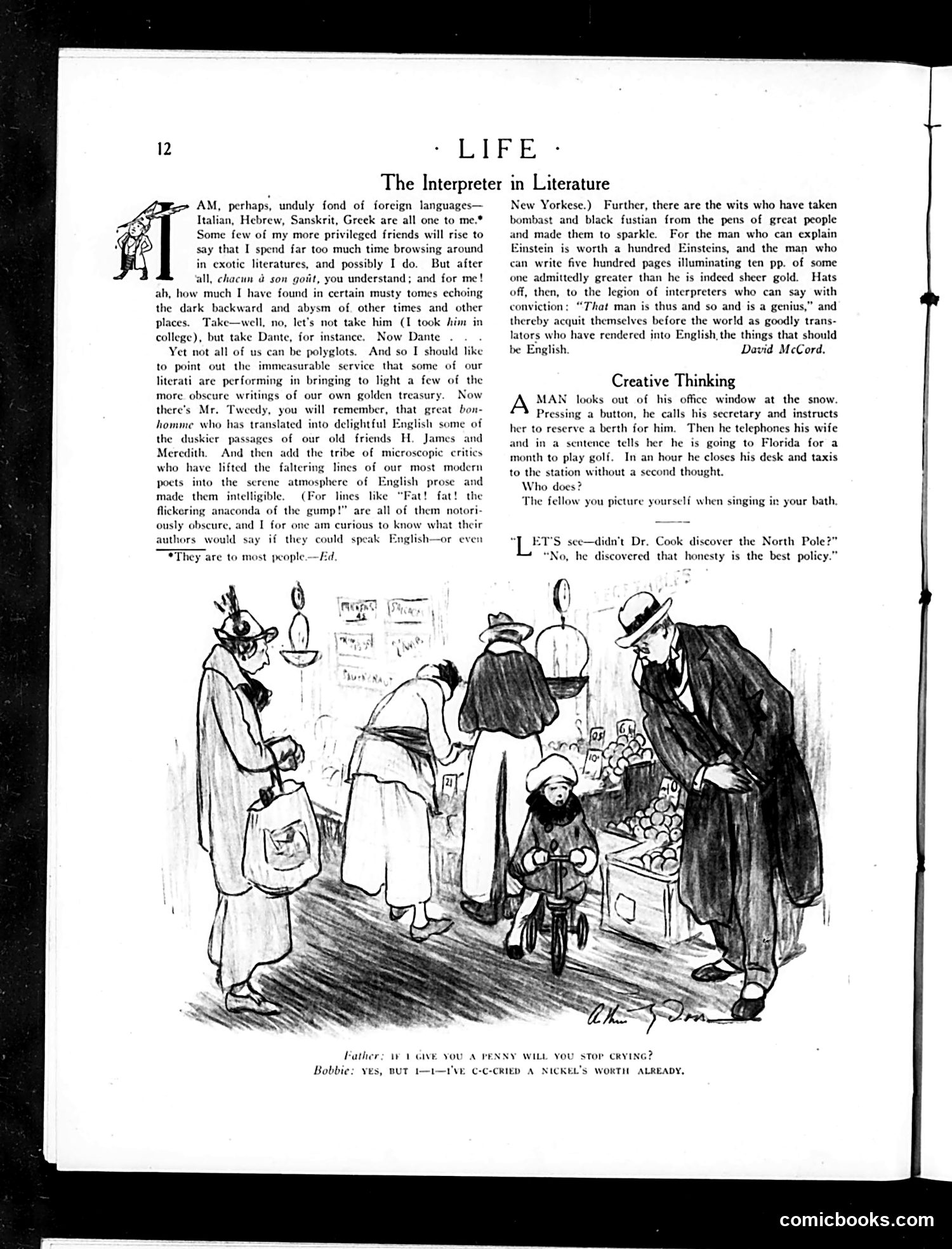
This page contains two satirical pieces about interpreting literature and creative thinking. **"The Interpreter in Literature"** mocks scholars and critics who obsess over translating obscure foreign texts and writing lengthy academic explanations of modern poetry. The author praises those who make difficult literature accessible to English readers, but the tone is tongue-in-cheek—suggesting such interpretive work, while valuable, borders on pedantic over-analysis. **"Creative Thinking"** section includes a cartoon showing a father offering his crying son a penny to stop crying. The boy replies he's already cried a nickel's worth—a joke about how children will negotiate and calculate their emotional labor for profit. It satirizes both parental bribery tactics and childhood shrewdness. The reference to "Dr. Cook discover the North Pole" appears to contrast discovering facts with discovering life principles, emphasizing practical wisdom over mere accomplishment. Both pieces gently mock intellectualism and adult assumptions about straightforward human behavior.
📄 Transcribed text from this page (OCR, searchable)
Machine-transcribed from the original scan — historical spelling and the odd misread are preserved.
LIFE: The Interpreter in Literature AM, perhaps, unduly fond of foreign languages— Italian, Hebre inskrit, Greek are all one to me.* Some few of my more privileged friends will rise to say that I spend far too much time browsing around in exotic literatures, and possibly I do. But after all, chacun d son gotit, you understand; and for me! ah, how much I have found in certain musty tomes echoing the dark backward and abysm of. other times and other places. Take—well, no, let's not take him (I took him in college), but take Dante, for instance. Now Dante Yet not all of us can be polyglots. And so I should like to point out the immeasurable service that some of our literati are performing in bringing to light a few of the © writings of our own golden treasury. Now Tweedy, you will remember, that great bon- homme who has translated into delightful English some of the duskier passages of our old friends H. James and Meredith. And then add the tribe of microscopic critics who have lifted the faltering lines of our most modern pocts into the serene atmosphere of ish prose and made them intelligible. (For lines like at! fat! the flickering anaconda of the gump!” are all of them notori- ously obscure, and I for one am curious to know what their authors would say if they could speak English—or even Father New Yorkese.) Further, there are the wits who have taken bombast and black fustian from the pens of great people made them to sparkle. For the man who can explain stein is worth a hundred Einsteins, and the man who can write five hundred pages illuminating ten pp. of some one admittedly greater than he is indeed sheer gold. Hats off, then, to the legion of interpreters who can say with conviction: “That man is thus and so and is a genius,” and thereby acquit themselves before the world as goodly trans- lators who have rendered into English, the things that should be English. David McCord. Creative Thinking A MAN looks out of his office window at the snow. Pressing a button, he calls his secretary and instructs her to reserve a berth for him. Then he telephones his wife and in a sentence tells her he is going to Florida for a month to play golf. In an hour he closes his desk and taxis to the station without a second thought. Who does? The fellow you picture yourself when singing in your bath. see—didn't Dr, Cook discover the North Pole? ‘0, he discovered that honesty is the best policy.” IY LGIVE YOU A PENNY WILL YOU sToP CRYING? Bobbie: yes, BUT 1—1—1'VE C-C-CRIED A NICKEL’S WORTH ALREADY, comicbooks.com