
Life, 1924-01-10 · page 28 of 44
Life — January 10, 1924 — page 28: what you’re looking at
What you’re looking at
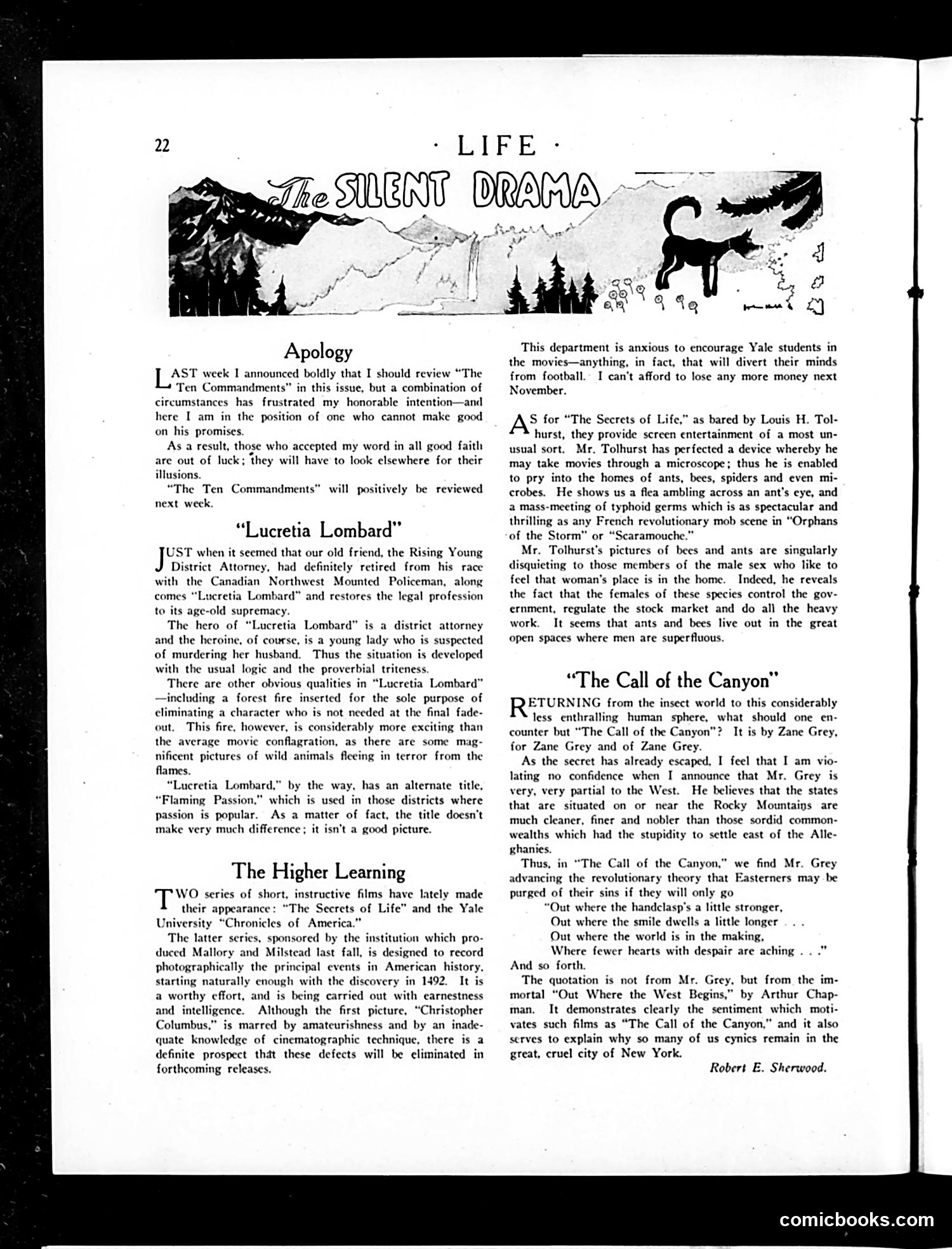
This page contains film criticism from Life's satirical movie column. The reviewer critiques contemporary silent films with sharp wit: **"Lucretia Lombard"** is dismissed as a tired courtroom melodrama featuring a district attorney and a woman accused of murdering her husband. The reviewer finds it derivative and poorly constructed, though acknowledges the forest fire sequence with fleeing animals is genuinely exciting—ironic praise since the fire merely eliminates an unnecessary character. **"The Secrets of Life"** celebrates Louis H. Tolhurst's microscopic cinematography showing insects (ants, bees, fleas) but uses this as a vehicle for satire about gender roles. The reviewer humorously notes that female insects "control the government, regulate the stock market," suggesting men are "superfluous"—mocking contemporary anxieties about women's increasing independence and power in the 1920s. **"Chronicles of America"** (Yale University series) receives measured praise for ambition despite technical flaws. The reviewer jokingly hopes such films distract Yale students from football to protect his gambling losses. The writing exemplifies Life's characteristic blend of entertainment criticism with social commentary.
📄 Transcribed text from this page (OCR, searchable)
Machine-transcribed from the original scan — historical spelling and the odd misread are preserved.
LIFE - SIU BRAVIA AST week I announced boldly that I should review “The Ten Commandments” in this issue, but a combination of circumstances has frustrated my honorable intention—and here I am in the position of one who cannot make good on his promises. As a result, those who accepted my word in all good faith are out of luck; they will have to look elsewhere for their illusions. “The Ten Commandments” will positively be reviewed next week. “Lucretia Lombard” UST when it seemed that our old friend, the Rising Young District Attorney, had definitely retired from his race with the Canadian Northwest Mounted Policeman, along comes “Lucretia Lombard” and restores the legal profession to its age-old supremacy. The hero of “Lucretia Lombard” is a district attorney and the heroine, of course, is a young lady who is suspected of murdering her husband. Thus the situation is developed with the usual logic and the proverbial triteness. There are other obvious qualities in “Lucretia Lombard” —including a forest fire inserted for the sole purpose of eliminating a character who is not needed at the final fade- out. This fire, however, is considerably more exciting than the age movie conflagration, as there are some mag- nificent pictures of wild animals fleeing in terror from the flames. “Lucretia Lombard,” by the way, has an alternate title, “Flaming Passion,” which is used in those districts where passion is popular. As a matter of fact, the title doesn’t make very much difference; it isn't a good picture. The Higher Learning WO series of short, instructive films have lately made their appearance: “The Secrets of Life” and the Yale University “Chronicles of America.” The latter series, sponsored by the institution which pro- duced Mallory and Milstead last fall, is designed to record photographically the principal events in American history, starting naturally enough with the discovery in 1492. It is a worthy effort, and is being carried out with earnestness and intelligence. Although the first picture, “Christopher Columbus,” is marred by amateurishness and by an inade- quate knowledge of cinematographic technique, there is a definite prospect that these defects will be eliminated in forthcoming releases. This department is anxious to encourage Yale students in the movies—anything, in fact, that will divert their minds from football. I can't afford to lose any more money next November. S for “The Secrets of Life,” as bared by Louis H. Tol- hurst, they provide screen entertainment of a most un- usual sort. Mr, Tolhurst has perfected a device whereby he may take movies through a microscope; thus he is enabled to pry into the homes of ants, bees, spiders and even mi- crobes. He shows us a flea ambling across an ant's eye, and a mass-meeting of typhoid germs which is as spectacular and thrilling as any French revolutionary mob scene in “Orphans of the Storm” or “Scaramouche.” Mr. Tolhurst’s pictures of bees and ants are singularly disquieting to those members of the male sex who like to feel that woman's place is in the home. Indeed, he reveals the fact that the females of these species control the gov- ernment, regulate the stock market and do all the heavy work. It seems that ants and bees live out in the great open spaces where men are superfluous. “The Call of the Canyon” ETURNING from the insect world to this considerably less enthralling human sphere, what should one en- counter but “The Call of the Canyon”? It is by Zane Grey, for Zane Grey and of Zane Grey. As the secret has already escaped, I feel that I am vio- lating no confidence when I announce that Mr. Grey is very, very partial to the West. He believes that the states that are situated on or near the Rocky Mountains are much cleaner, finer and nobler than those sordid common- wealths which had the stupidity to settle east of the Alle- in “The Call of the Canyon,” we find Mr. Grey advancing the revolutionary theory that Easterners may be purged of their sins if they will only go “Out where the handclasp’s a little stronger, Out where the smile dwells a little longer Out where the world is in the making, Where fewer hearts with despair are aching . . . And so forth. The quotation is not from Mr. Grey, but from the im- mortal “Out Where the West Begins,” by Arthur Chap- man. It demonstrates clearly the sentiment which moti- vates such films as “The Call of the Canyon,” and it also serves to explain why so many of us cynics remain in the great, cruel city of New York. Robert E. Sherwood. comicbooks.com