
Life, 1924-01-10 · page 24 of 44
Life — January 10, 1924 — page 24: what you’re looking at
What you’re looking at
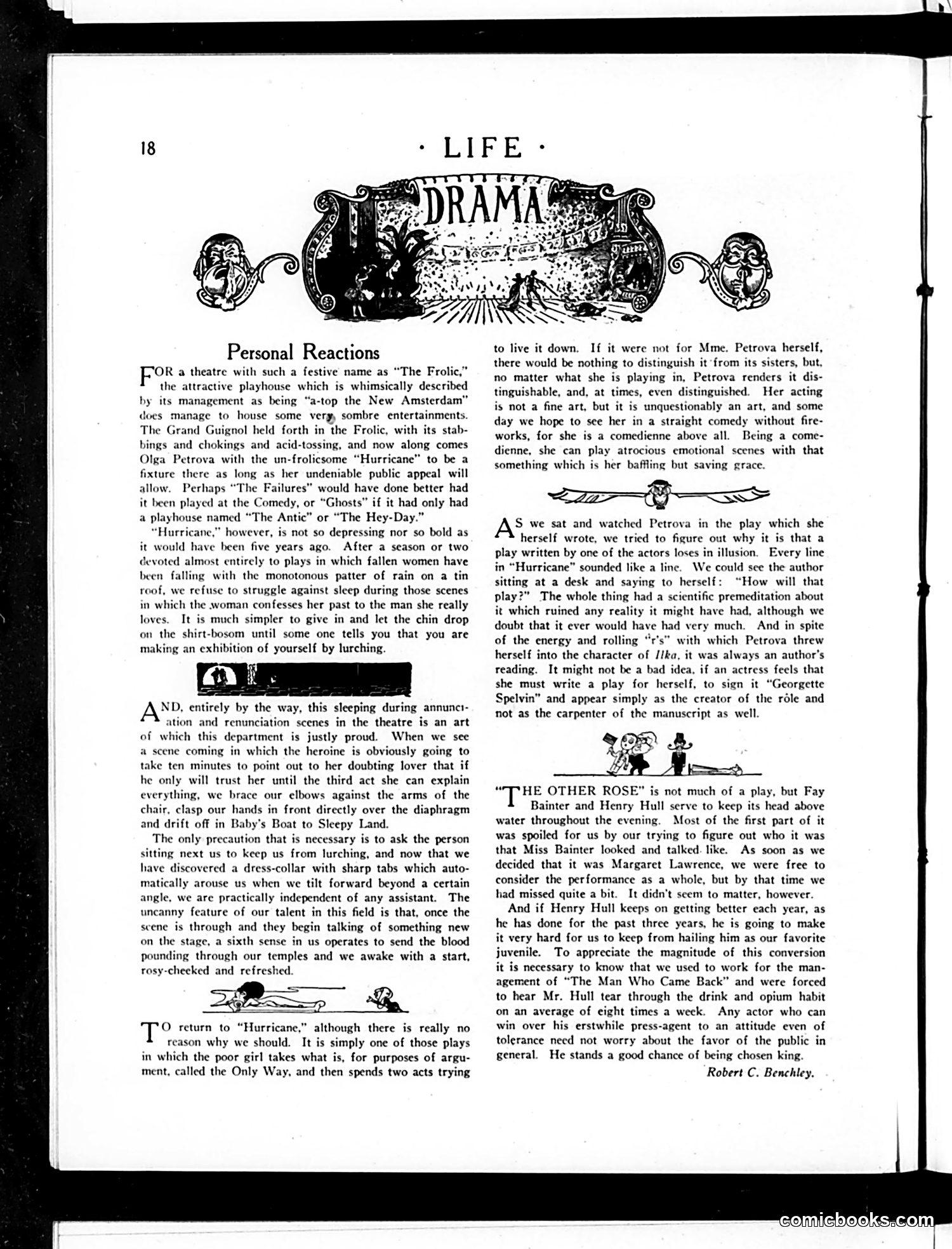
This theater criticism page reviews several Broadway productions, particularly Olga Petrova's play "Hurricane." The critic's main point: Petrova is a talented actress whose presence elevates weak material, but her own playwriting lacks authenticity—every line reads as obviously authored rather than natural dialogue. The humor is self-deprecating: the critic describes their technique for surviving tedious theatrical scenes (the tired "fallen woman confesses to her lover" trope) by deliberately falling asleep, complete with a mechanical collar-device to prevent embarrassing head-drops. The broader satire targets early 20th-century melodrama conventions—particularly plays obsessed with moral redemption through female suffering. By 1910s standards, these plots were exhausted clichés. Petrova's charisma masks "Hurricane's" fundamental triteness. The critic suggests she'd shine better in comedy than in overwrought emotional dramatics. The secondary review of "The Other Rose" praises Henry Hull's theatrical stamina.
📄 Transcribed text from this page (OCR, searchable)
Machine-transcribed from the original scan — historical spelling and the odd misread are preserved.
Personal Reactions OR a theatre with such a festive name as “The Frolic,” the attractive playhouse which is whimsically described its management as being “a-top the New Amsterdam” does manage to house some very, sombre entertainments. The Grand Guignol held forth in the Frolic, with its stab- bings and chokings and acid-tossing, and now along comes Olga Petrova with the un-frolicsome “Hurricane” to be a fixture there as long as her undeniable public appeal will allow. Perhaps “The Failures” would have done better had it been played at the Comedy, or “Ghosts” if it had only had a playhouse named “The Antic” or “The Hey-Day.” “Hurricane,” however, is not so depressing nor so bold as it would have been five years ago. After a season or two devoted almost entirely to plays in which fallen women have been falling with the monotonous patter of rain on a tin roof, we refuse to struggle against sleep during those scenes in which the woman confesses her past to the man she really loves. It is much simpler to give in and let the chin drop on the shirt-bosom until some one tells you that you are making an exhibition of yourself by lurching. ANY: entirely by the way, this sleeping during annunci- ation and renunciation scenes in the theatre is an art of which this department is justly proud. When we see scene coming in which the heroine is obviously going to take ten minutes to point out to her doubting lover that if he only will trust her until the third act she can explain everything, we brace our elbows against the arms of the chair, clasp our hands in front directly over the diaphragm and drift off in Baby's Boat to Sleepy Land. The only precaution that is necessary is to ask the person sitting next us to keep us from lurching, and now that we have discovered a dress-collar with sharp tabs which auto- matically arouse us when we tilt forward beyond a certain angle, we are practically independent of any assistant. The uncanny feature of our talent in this field is that, once the scene is through and they begin talking of something new on the stage, a sixth sense in us operates to send the blood pounding through our temples and we awake with a start, rosy-cheeked and refreshed. re T°? return to “Hurricane,” although there is really no reason why we should. It is simply one of those plays in which the poor girl takes what is, for purposes of argu- ment, called the Only Way, and then spends two acts trying to live it down. If it were not for Mme. Petrova herself, there would be nothing to distinguish it ‘from its sisters, but, no matter what she is playing in, Petrova renders it dis- tinguishable, and, at times, even distinguished. Her acting is not a fine art, but it is unquestionably an art, and some day we hope to see her in a straight comedy without fire- works, for she is a comedienne above all. Being a come- dienne, she can play atrocious emotional scenes with that something which is her baffling but saving grace. aa S we sat and watched Petrova in the play which she herself wrote, we tried to figure out why it is that a play written by one of the actors lose: illusion, Every line in “Hurricane” sounded like a line. We could see the author sitting at a desk and saying to herself: “How will that play?” The whole thing had a scientific premeditation about it which ruined any reality it might have had, although we doubt that it ever would have had very much. And in spite of the energy and rolling “r's” with which Petrova threw herself into the character of //ka, it was always an author's reading. It might not be a bad idea. if an actress feels that she must write a play for herself, to sign it corgette Spelvin” and appear simply as the creator of the role and not as the carpenter of the manuscript as well. “PT HE OTHER ROSE” is not much of a play, but Fay Bainter and Henry Hull serve to keep its head above water throughout the evening. Most of the first part of it was spoiled for us by our trying to figure out who it was that Miss Bainter looked and talked. like. As soon as we decided that it was Margaret Lawrence, we were free to consider the performance as a whole, but by that time we had missed quite a bit. It didn't seem to matter, however. And if Henry Hull keeps on getting better each year, as he has done for the past three years, he is going to make it very hard for us to keep from hailing him as our favorite juvenile. To appreciate the magnitude of this conversion it is necessary to know that we used to work for the man- agement of “The Man Who Came Back” and were forced to hear Mr. Hull tear through the drink and opium habit on an average of eight times a week. Any actor who can win over his erstwhile press-agent to an attitude even of tolerance necd not worry about the favor of the public in general. He stands a good chance of being chosen king. Robert C. Benchley.