
A complete issue · 44 pages · 1923
Life — October 4, 1923
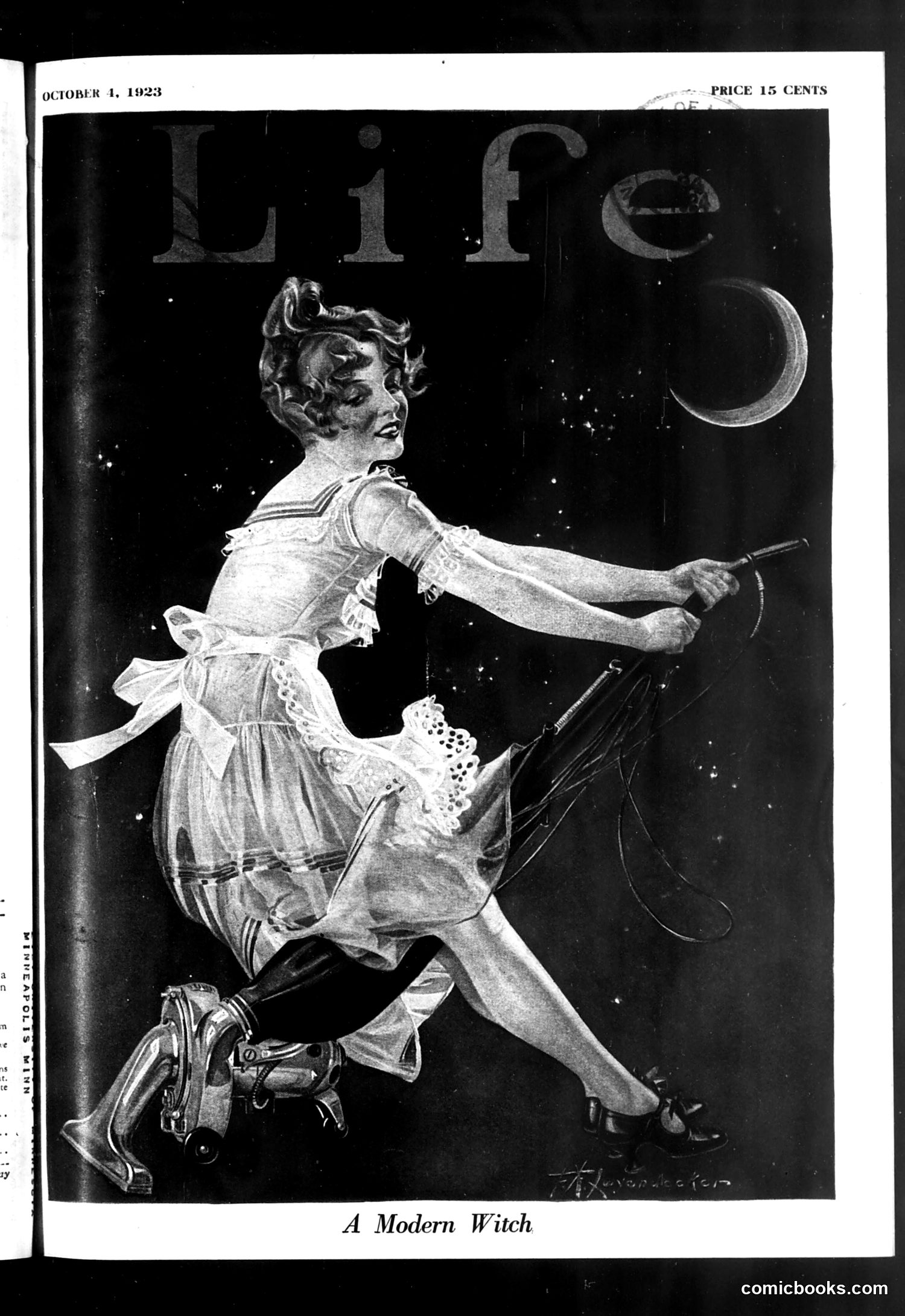
This satirical cover depicts a woman riding a broomstick against a starry night sky with a crescent moon. The title "A Modern Witch" suggests commentary on contemporary women, likely referencing the "New Woman" of the 1920s—the flapper era characterized by shortened skirts, bobbed hair, cosmetics, and increased independence. The image appears to criticize or mock these social changes. The broomstick and witch imagery use traditional folklore associations to satirize modern women's liberation and changing social roles as something dangerous or supernatural. This reflects conservative anxieties about women's evolving freedoms during the Jazz Age. The illustration style and composition are typical of Life's satirical covers from this period.
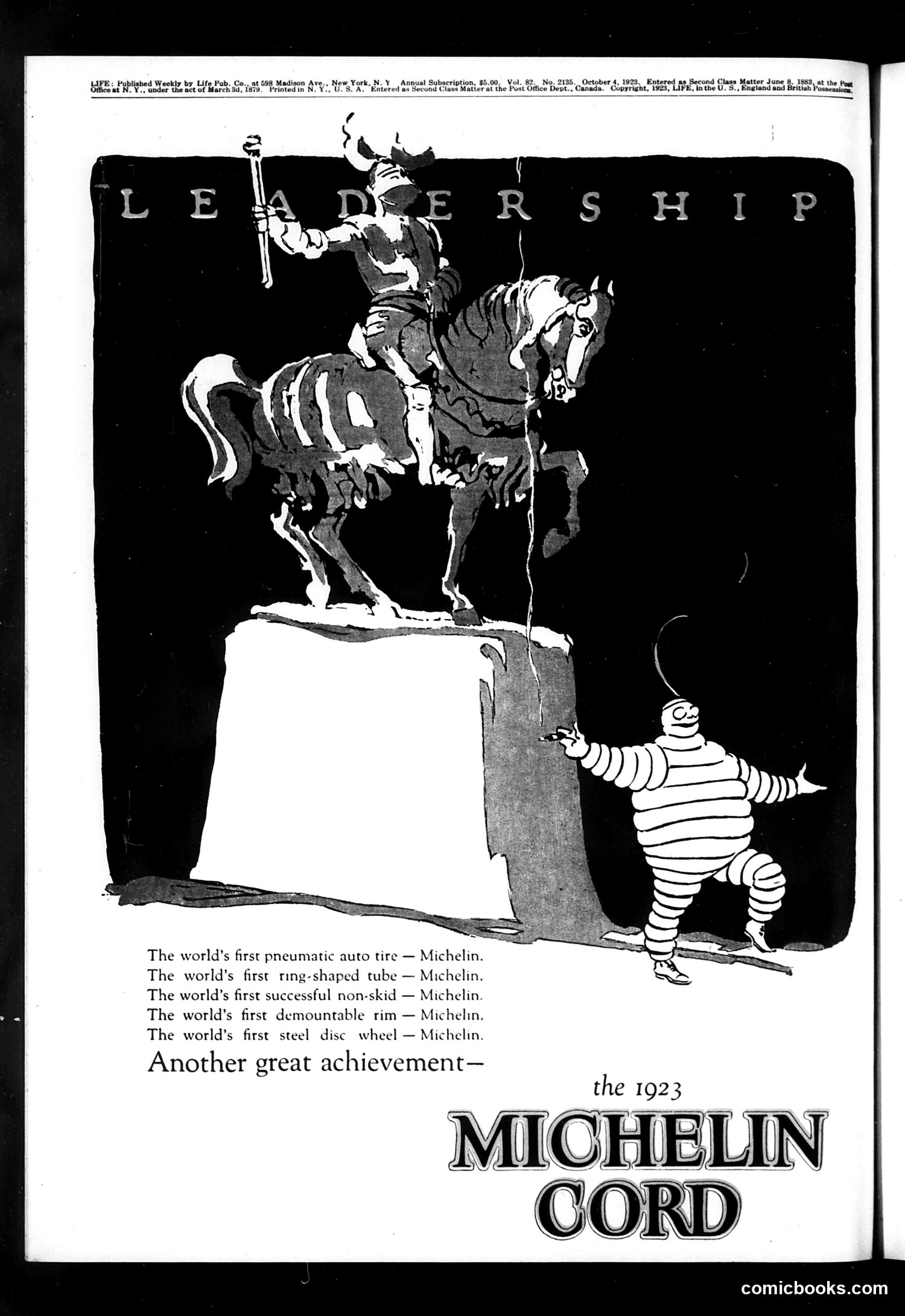
This is primarily a **Michelin tire advertisement**, not political satire. The image depicts the Michelin Man (Bibendum) as a triumphant leader on horseback, holding a torch or staff aloft. Below him stands the Michelin mascot character in his characteristic wrapped/bandaged appearance. The ad claims Michelin's historical "firsts": pneumatic auto tire, ring-shaped tube, non-skid tire, demonstrable rim, and steel disc wheel. These were genuine innovations in automotive tire technology during the early 1920s. The "Leadership" headline and militaristic imagery—the figure atop a pedestal like a monument, the torch suggesting authority—use patriotic, victorious symbolism to position Michelin as the dominant industry innovator. This is marketing strategy using nationalist imagery common to 1923 advertising, not political commentary.
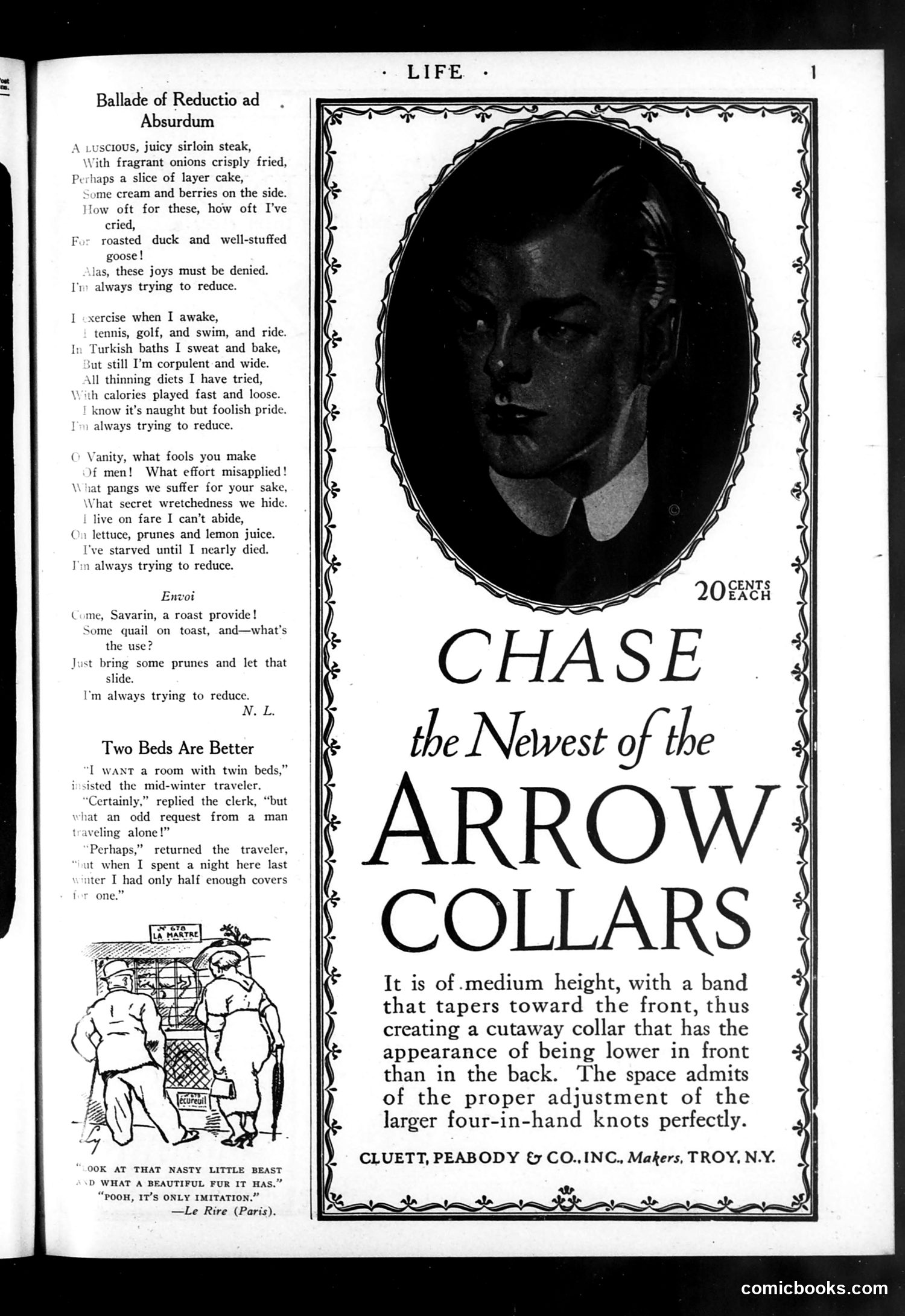
This page combines satirical poetry with advertising. The left side features "Ballade of Reductio ad Absurdum," a humorous poem mocking diet culture and weight-loss obsession. The speaker ironically catalogs luxurious foods while claiming constant dieting efforts—highlighting the contradiction between desire and discipline. A small cartoon at the bottom shows two figures discussing hotel accommodations, with a joke about bed-sharing. The right side is a full-page advertisement for Arrow Collars (20 cents each), featuring a portrait photograph of a well-dressed man. The ad emphasizes the collar's "cutaway" design that appears lower in front than back, accommodating "larger four-in-hand knots." This juxtaposes weight-loss satire with fashion advertising—both addressing masculine self-presentation and consumer culture anxieties.
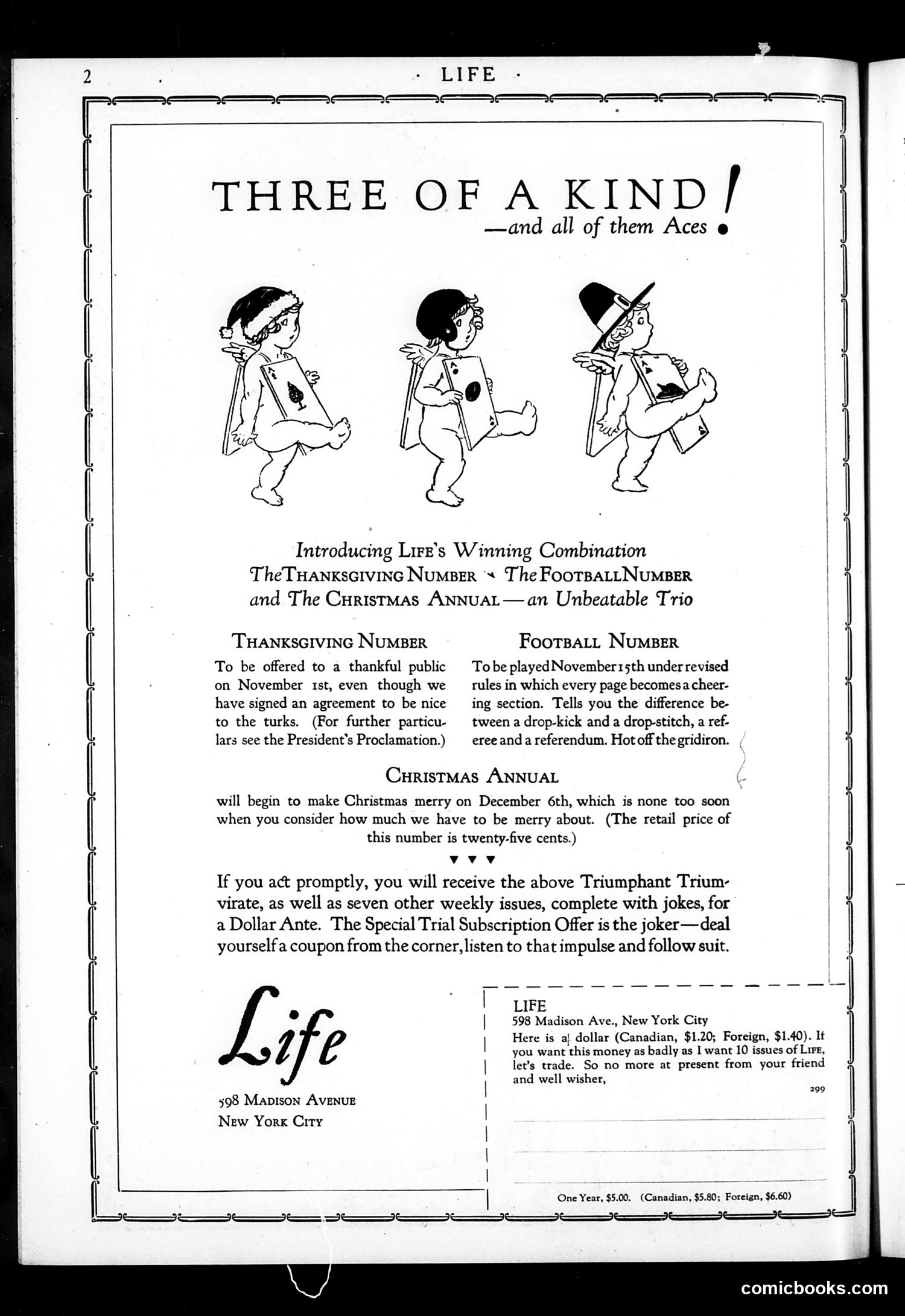
This is primarily a **subscription advertisement** for Life magazine, not a political cartoon. The "three of a kind" refers to three upcoming special issues Life was promoting: the Thanksgiving Number, Football Number, and Christmas Annual. The three cartoon figures at top are generic cherub-like characters representing these holiday/seasonal issues—depicted as playful "aces" in a card-game metaphor (the "unbeatable trio"). The page promotes a special trial subscription offer: eight issues (including the three special numbers) for one dollar. It includes pricing for Canadian and foreign subscriptions. The only contextual reference is a mention of the President's Proclamation regarding Thanksgiving timing, but this appears incidental to the main sales pitch. This is essentially a **house advertisement** encouraging readers to subscribe or gift subscriptions.
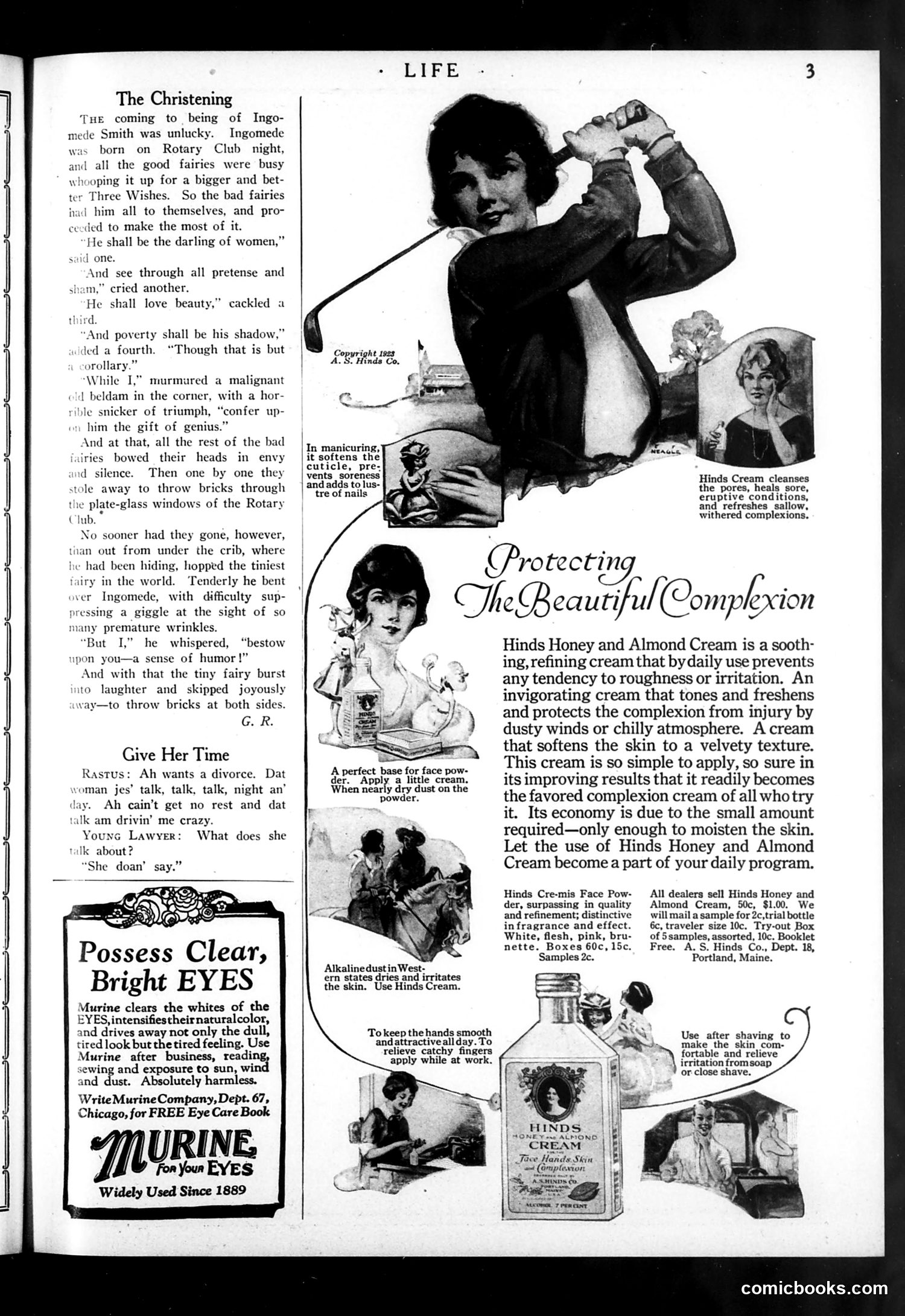
This page is primarily **advertising content**, not political satire. The left column contains "The Christening," a brief fictional story about a fairy's curse on an infant named Ingomede Smith, born at a Rotary Club event. It's whimsical rather than satirical. The dominant content features advertisements for beauty and personal-care products: **Murine eye drops** and **Hinds Honey and Almond Cream**. These ads use period-typical imagery of women to market complexion treatments and eye care. The only potentially satirical element is the story's gentle mockery of Rotary Club pretension, but this appears secondary to the magazine's primary function here: carrying paid advertisements alongside light entertainment content.
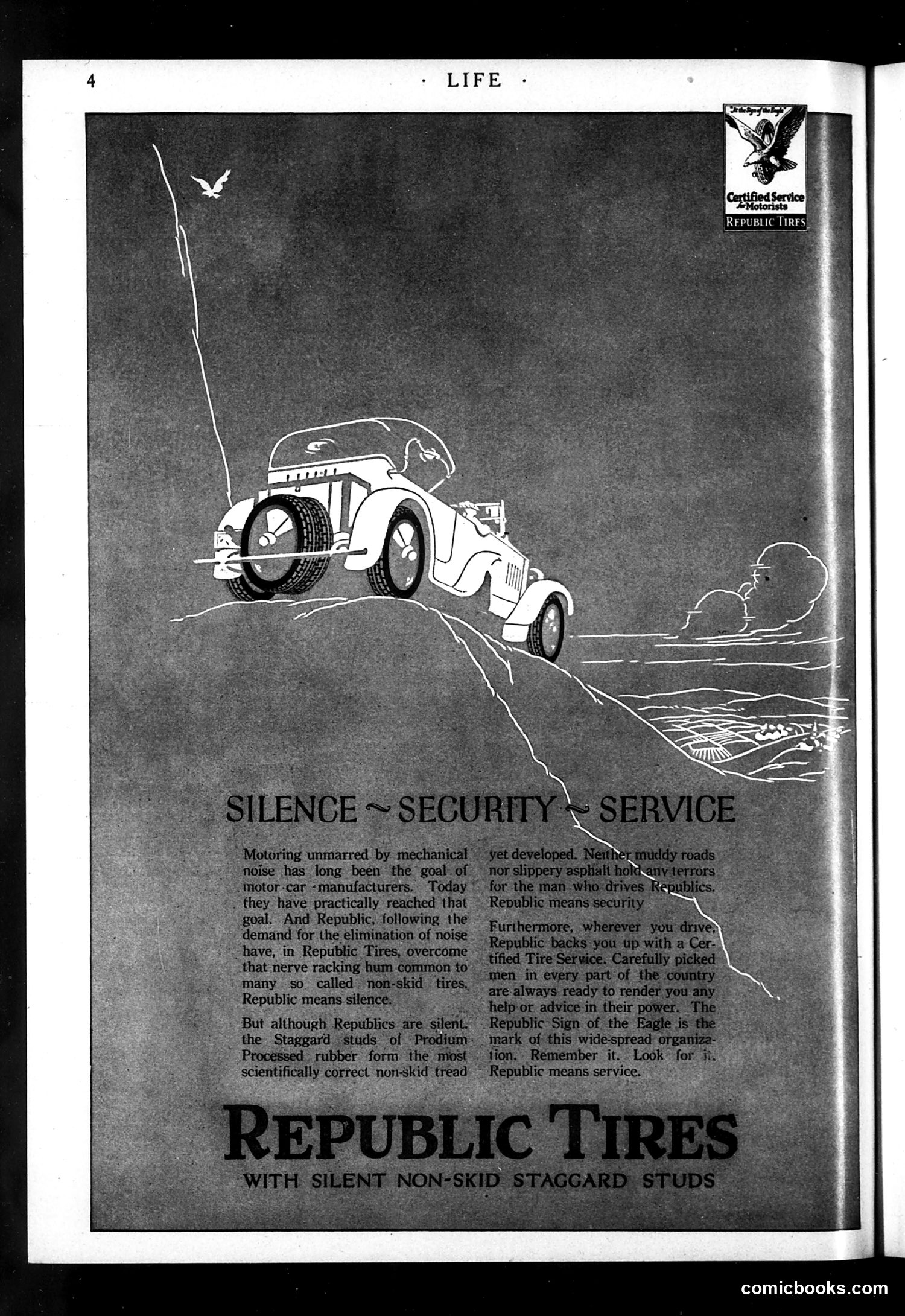
This is **advertisement, not satire or editorial content**. It's a Republic Tires company advertisement promoting their tires' reliability and service network. The illustration shows a stylized 1920s automobile navigating a mountain road, emphasizing safe driving. The ad's three-part message—"Silence ~ Security ~ Service"—highlights that Republic Tires offer quiet, non-skid performance and nationwide roadside assistance (marked by the "Sign of the Eagle"). The text emphasizes that while competitors focus on noise reduction, Republic combines silence with practical safety features (their "Staggered Studs" non-skid tread) and a widespread service organization ready to help stranded motorists. This reflects early automotive-era concerns: poor road conditions, tire reliability, and the relative novelty of organized roadside assistance networks.
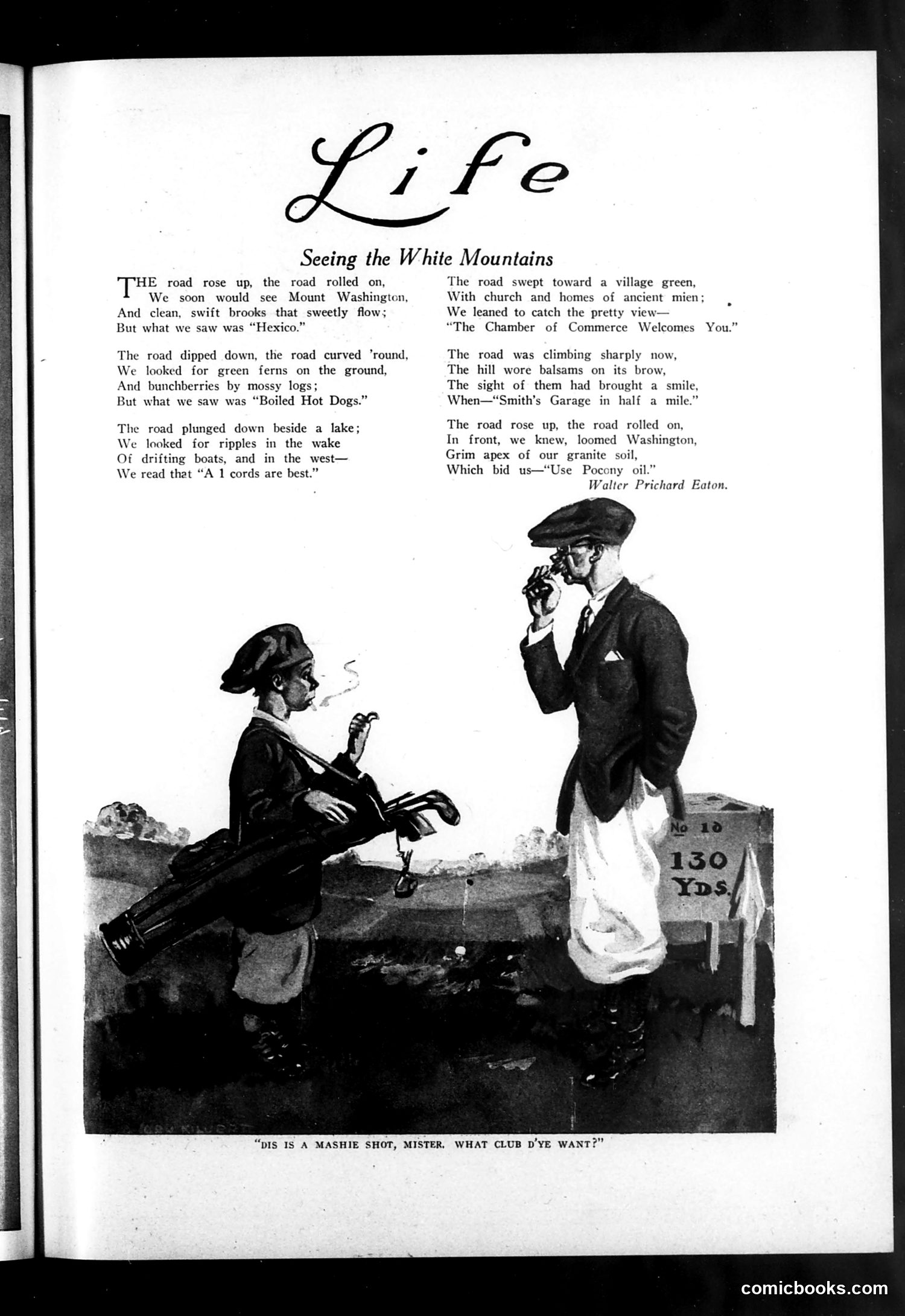
This page combines a poem by Walter Prichard Eaton with a single cartoon. The poem humorously chronicles a car journey through New England, cataloging roadside Americana: Mount Washington, "Boiled Hot Dogs," roadside inns, and a garage advertisement. The cartoon below depicts two men on a golf course near a distance marker reading "130 Yds." One seated man holds a golf club and smokes; the standing man gestures while appearing to speak. The caption reads: "DIS IS A MASHIE SHOT, MISTER. WHAT CLUB D'YE WANT?" The humor derives from the standing figure's apparent working-class accent ("D'ye") and demeanor—he appears to be a caddy offering golf advice in dialect, likely satirizing class differences and golf culture among early 20th-century Americans.
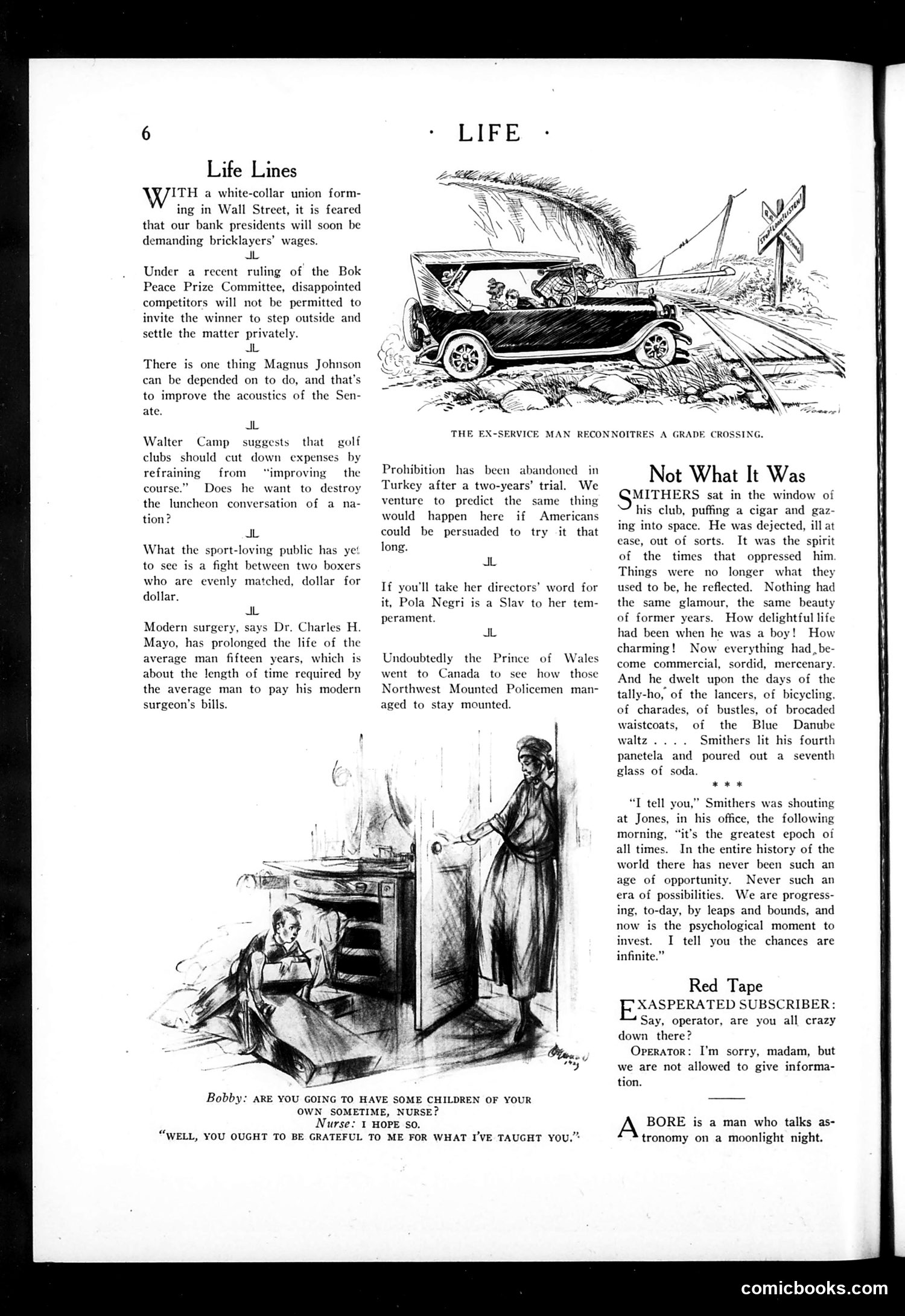
This page contains brief satirical commentary pieces and illustrations rather than a single political cartoon. **"Life Lines"** section includes quick observations on current events: concerns about bank presidents demanding bricklayers' wages, a Bok Peace Prize ruling preventing private settlement of disputes, and commentary on Magnus Johnson and acoustics. **"Not What It Was"** features a sketch of a man at his club reflecting nostalgically on how life has changed—things are now "commercial, sordid, mercenary" rather than charming as they were in his youth. He recalls fancier social activities like charades and waltzes. **"Red Tape"** mocks bureaucratic secrecy, with an exasperated switchboard operator unable to provide information. The page reflects 1920s American concerns about modernization, changing social values, and institutional opacity.
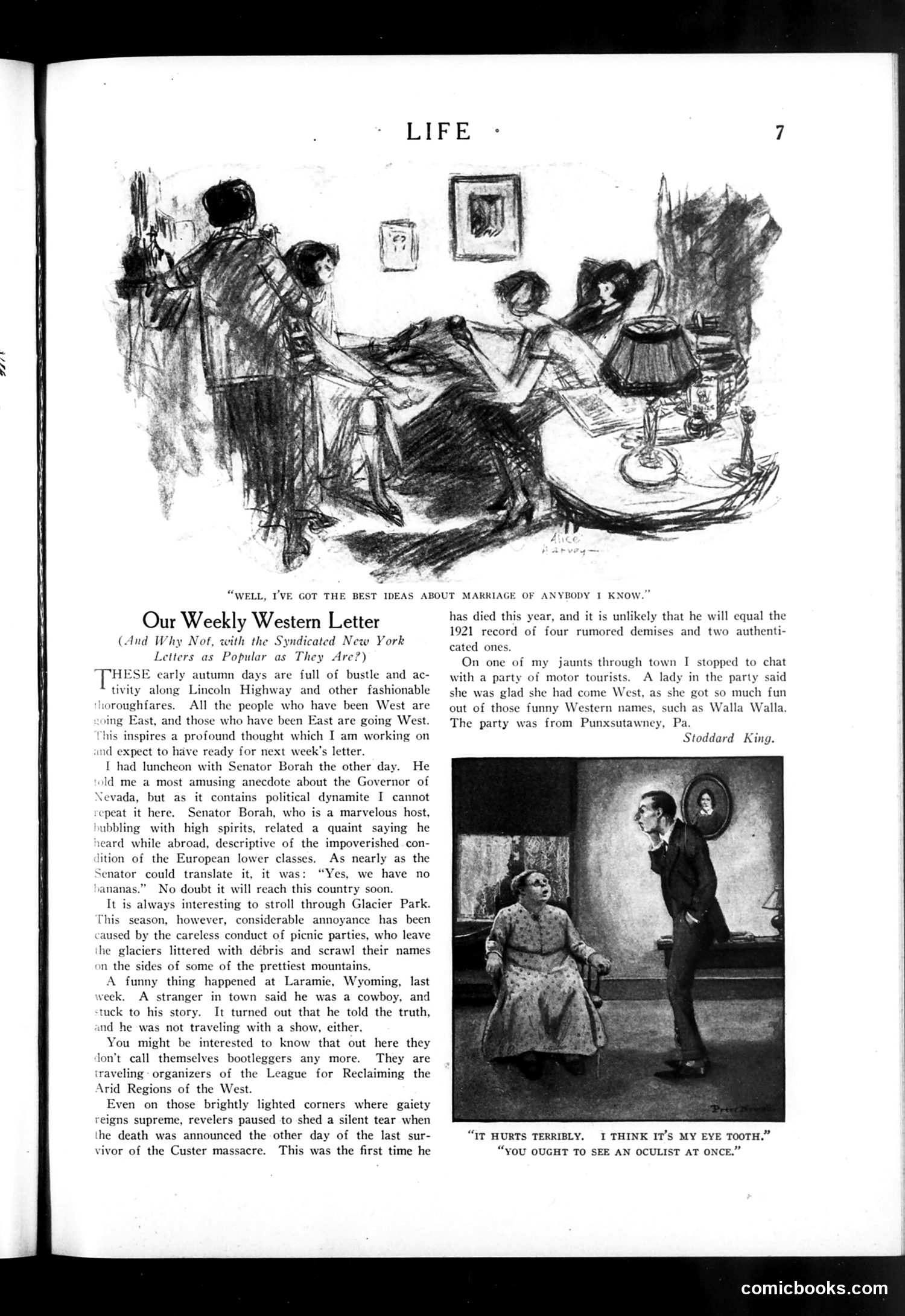
The top cartoon satirizes domestic life and marriage advice. A man in military uniform stands while a woman reclines dramatically, declaring "Well, I've got the best ideas about marriage of anybody I know." The joke mocks the pretentiousness of unsolicited marriage counsel—the woman's theatrical pose suggests her "best ideas" are overwrought and impractical. The accompanying article, "Our Weekly Western Letter" by Stoddard King, offers humorous anecdotes from the American West. References include Senator Borah (Nevada politician), bootleggers (Prohibition-era smugglers), and the Custer massacre—suggesting this is post-WWI content when such Western nostalgia and Prohibition were contemporary concerns. The lower photograph shows a domestic scene with caption about eye trouble and seeing an oculist, likely another marital comedy bit.
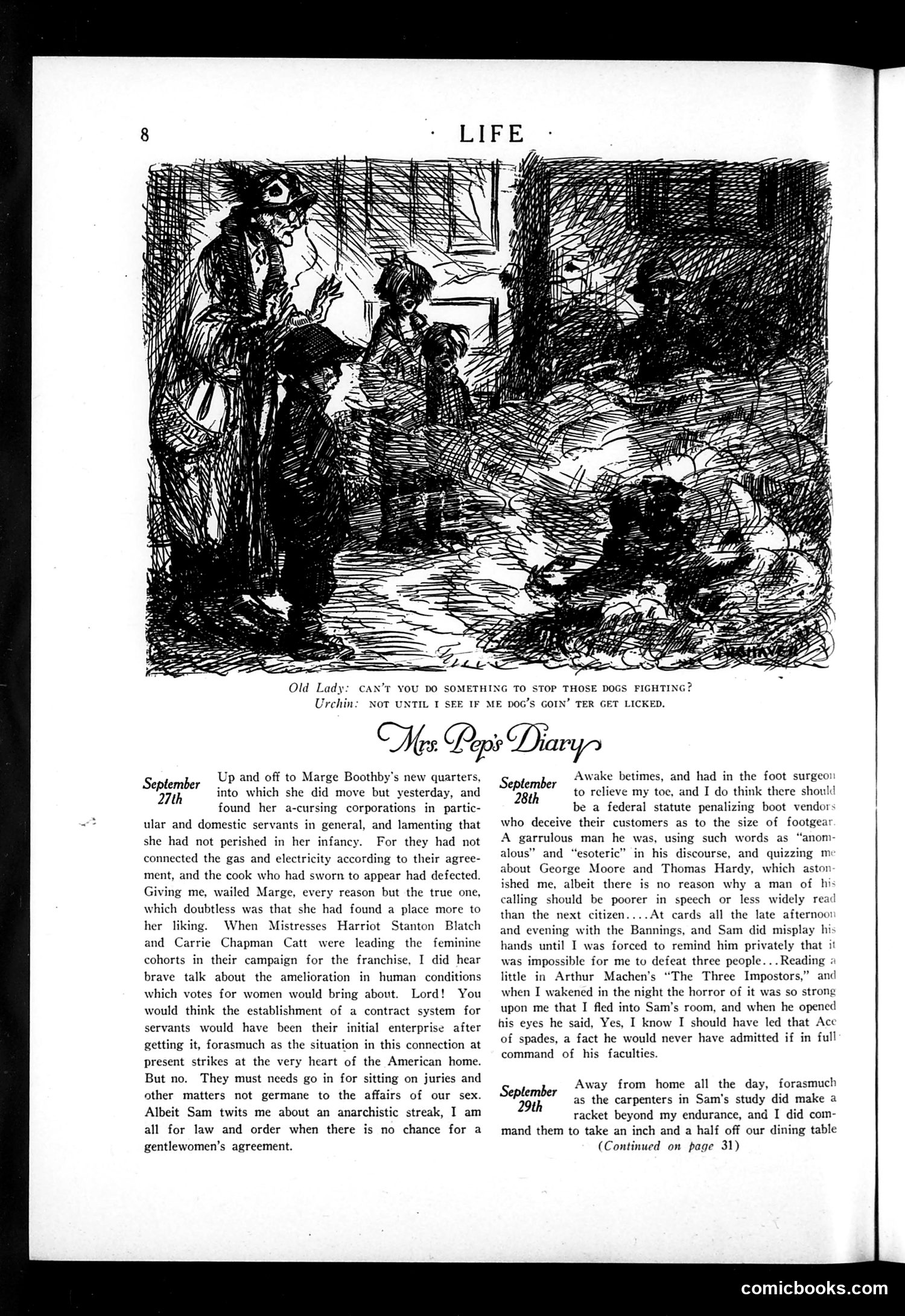
This page contains a satirical cartoon and the beginning of "Mrs. Pep's Diary," a serialized feature. **The Cartoon:** depicts an urban scene where street dogs are fighting while an old lady appeals to a man (labeled "Urchin") to stop them. The urchin's response—that he won't intervene until he sees "me dog's goin' ter get licked"—satirizes working-class indifference and the brutal street culture of urban youth. The humor targets both the casual cruelty of children and the chaos of city life. **Mrs. Pep's Diary:** This appears to be a gossipy domestic chronicle documenting servants' complaints, labor disputes, and household management problems. The September entries reference servant defections, anarchistic labor agitation, and disputes over wages—reflecting early 20th-century tensions between employers and workers regarding fair treatment and payment. Together, the page satirizes urban social disorder across class lines.
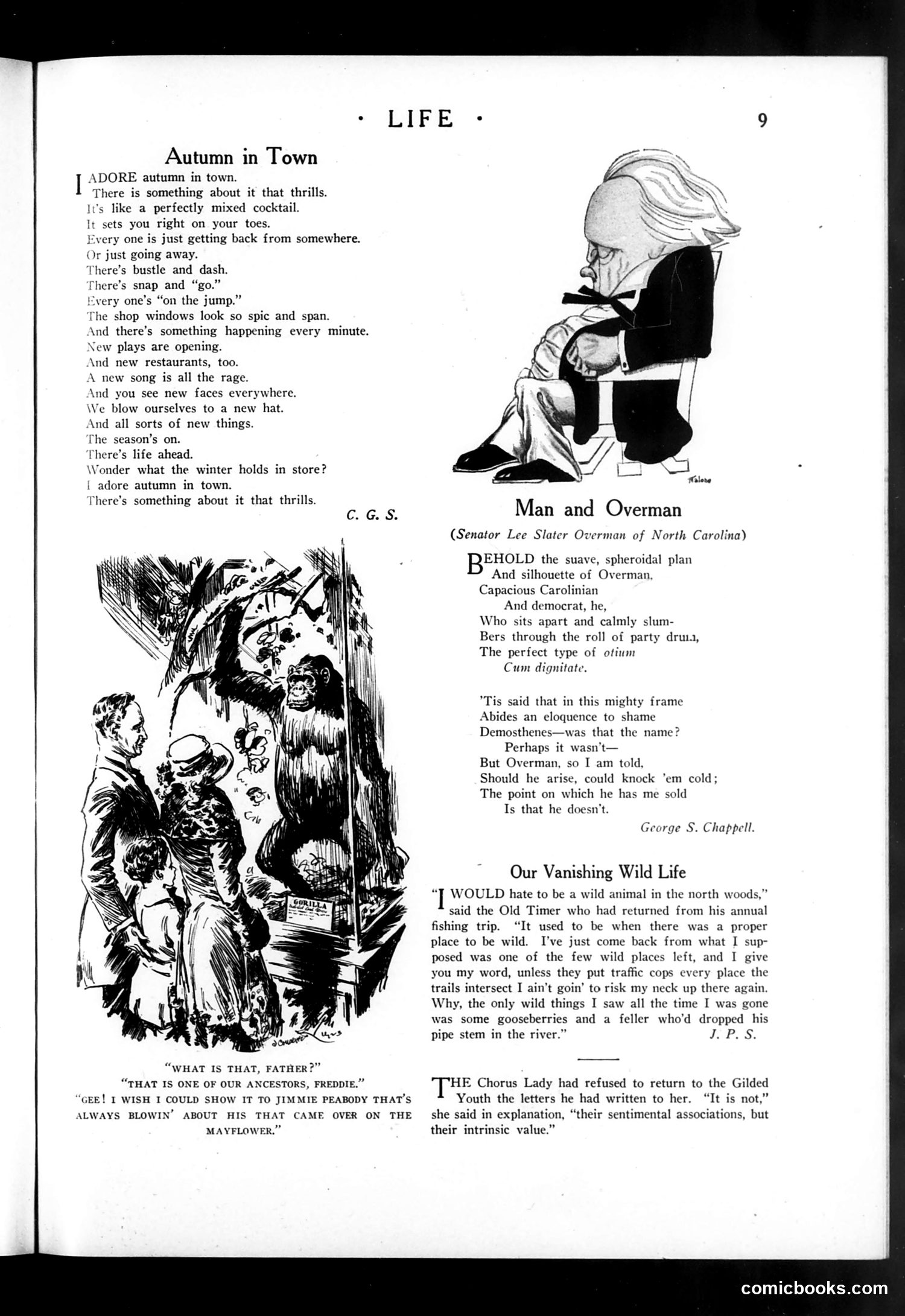
This page contains a poem by George S. Chappell praising Senator Lee Slater Overman of North Carolina. The accompanying sketch depicts a tall, imposing figure (Overman) towering over smaller men, illustrating the poem's theme of his commanding presence and political stature. The Latin phrase "otium cum dignitate" ("leisure with dignity") characterizes Overman as embodying aristocratic virtue. The poem suggests he commands respect through bearing rather than aggression—he "doesn't" need to use force to dominate. The cartoon's visual hierarchy emphasizes Overman's superiority and influence within Democratic Party politics. This appears to be straightforward political praise rather than satire, celebrating the senator as an exemplary statesman of his era.
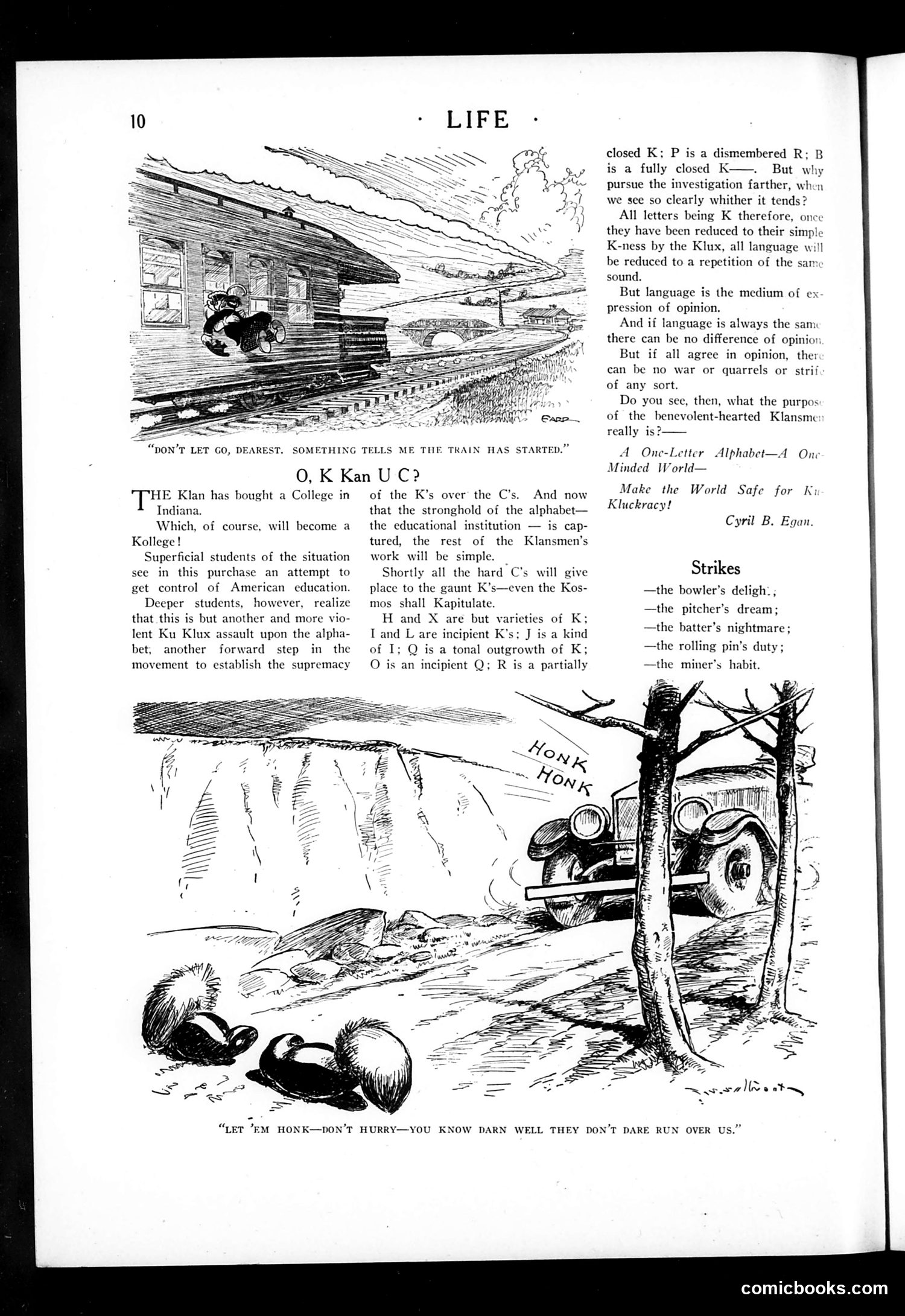
This page satirizes the Ku Klux Klan's establishment of a college in Indiana. The article "O, K Kan U C?" mocks the Klan's attempt to control American education by purchasing a college, presenting this as another "forward step" in their movement for supremacy. The text argues that standardizing language to a "K-ness" alphabet represents intellectual suppression disguised as education. The bottom cartoon shows two figures lounging near train tracks as a car honks approaching them, with the caption "Let 'em honk—don't hurry—you know darn well they don't dare run over us." This appears to reference the Klan's perceived power and immunity from consequences, satirizing their sense of untouchable authority in American society.
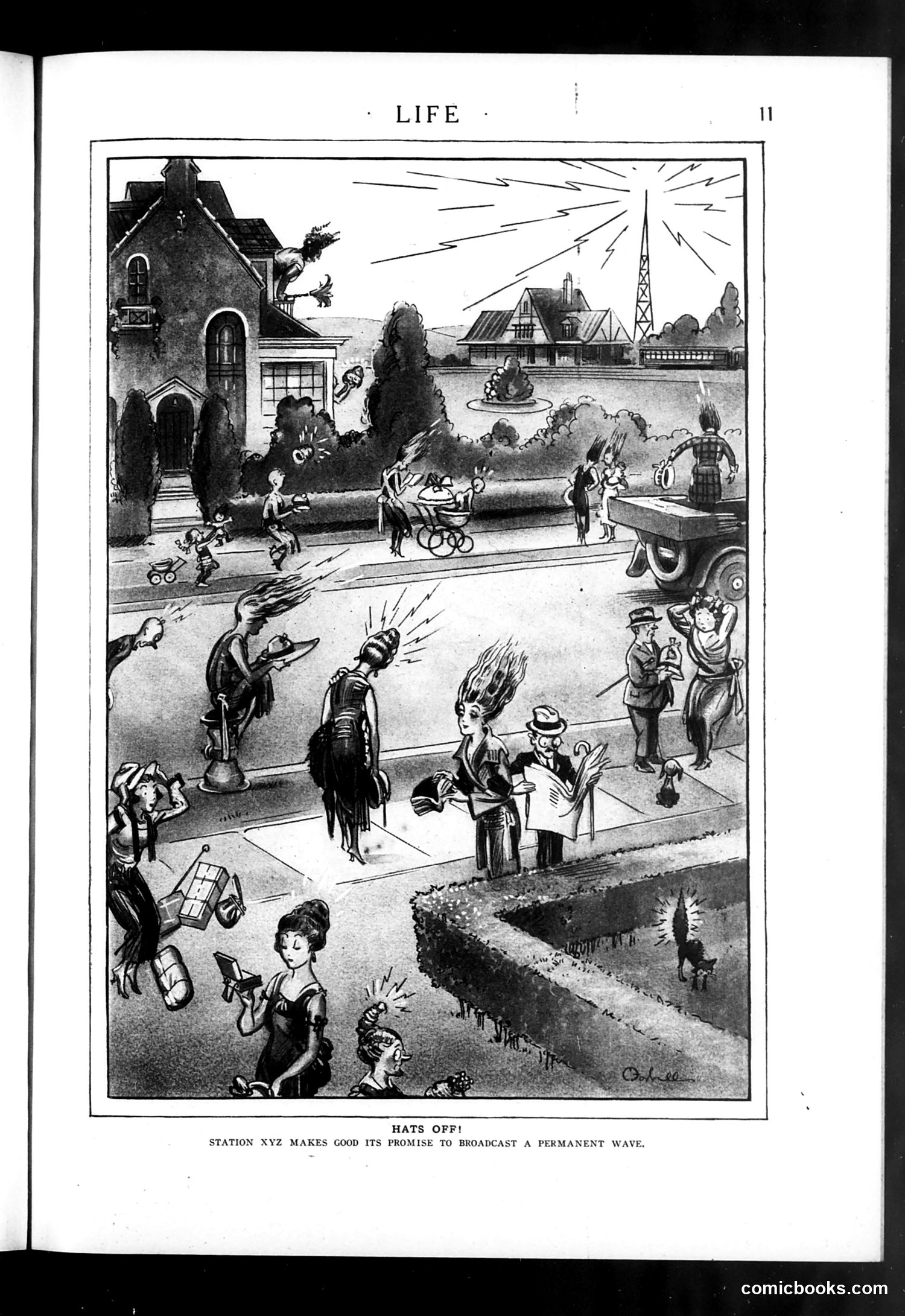
This satirical cartoon depicts a futuristic suburban scene where people celebrate a radio broadcast from "Station XYZ." The caption reads: "HATS OFF! STATION XYZ MAKES GOOD ITS PROMISE TO BROADCAST A PERMANENT WAVE." The joke plays on the double meaning of "permanent wave"—both a radio transmission concept and a hair-styling treatment. The cartoon satirizes early radio technology's promises and the enthusiastic public reception to broadcasting innovations. Citizens are shown excitedly removing their hats, suggesting the broadcast is so remarkable it warrants celebratory gestures. The modernist suburban setting with a radio tower, automobile, and contemporary dress situates this as optimistic commentary on 1920s-30s technological progress and consumer culture, mocking both the technology's grandiose promises and society's eager adoption.
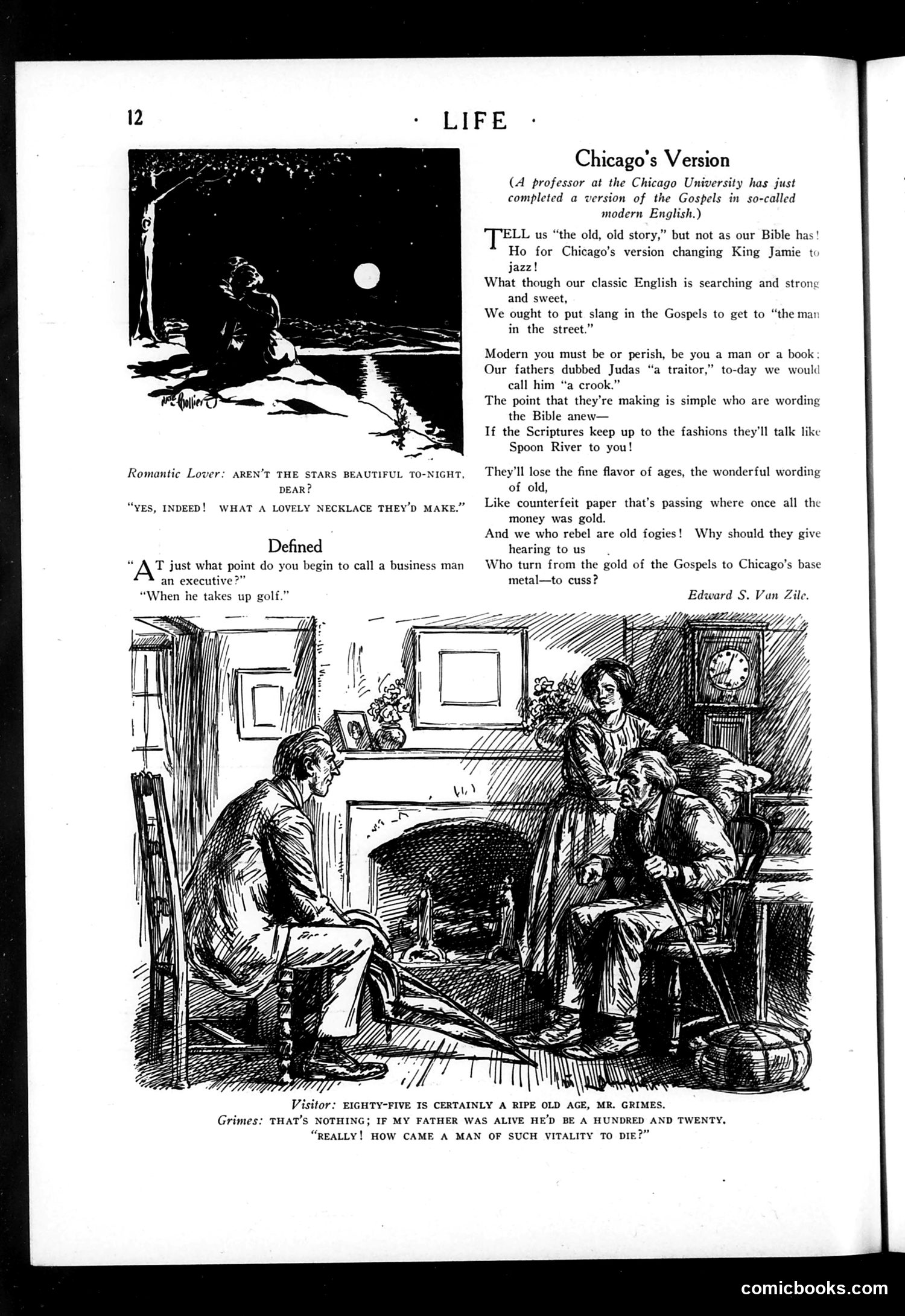
The page contains two separate satirical pieces: **"Chicago's Version"** mocks a University of Chicago professor's modernized translation of the Gospels into contemporary slang. The poem ridicules replacing King James Bible language with "jazz" and street vernacular ("crook" for "traitor"), arguing this degrades Scripture's timeless eloquence. The author (Edward S. Van Zile) sarcastically suggests that updating biblical language to match fashion trends betrays the text's spiritual and literary value. **"Defined"** is a brief comic sketch about when someone becomes a true "executive"—the punchline being "when he takes up golf," suggesting golf-playing represents the leisure and status markers of business success. Both pieces reflect 1920s anxieties about modernization, cultural change, and loss of traditional values.
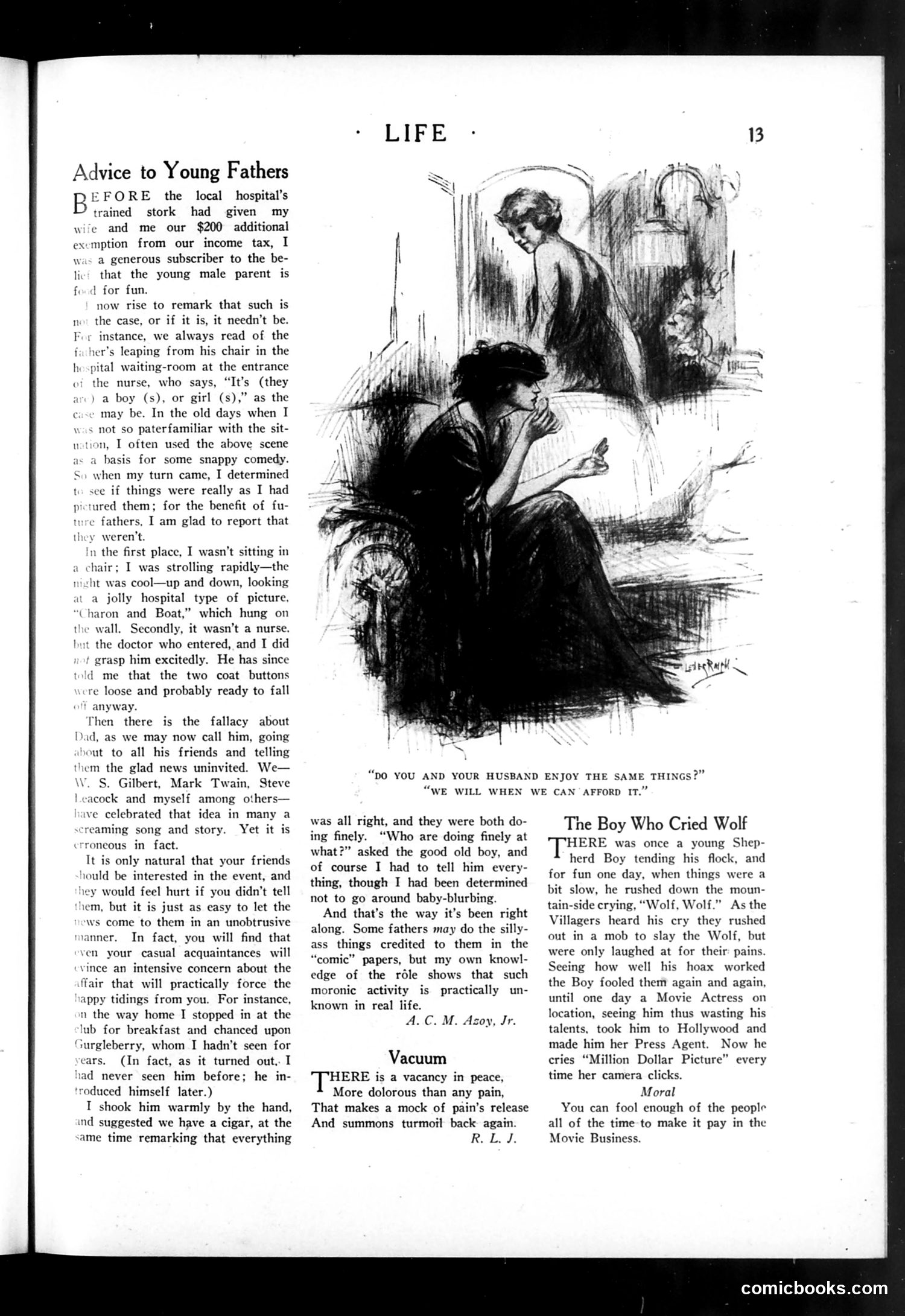
This page contains three separate pieces of satirical content: 1. **"Advice to Young Fathers"**: A humorous essay critiquing new fathers who boast about their newborns' sex to hospital staff, treating it as a personal achievement. The author satirizes this behavior as pretentious. 2. **The sketch illustration**: Shows a woman asking a man "Do you and your husband enjoy the same things?" with his response "We will when we can afford it." This jokes about class differences and financial strain in marriages—a common theme in early 20th-century humor. 3. **"The Boy Who Cried Wolf" and "Vacuum"** sections: Brief literary pieces, with the latter being a short poem about pain and peace. The overall tone reflects *Life*'s tradition of gentle social satire targeting middle-class behavior and marital dynamics, with no overtly political content visible.
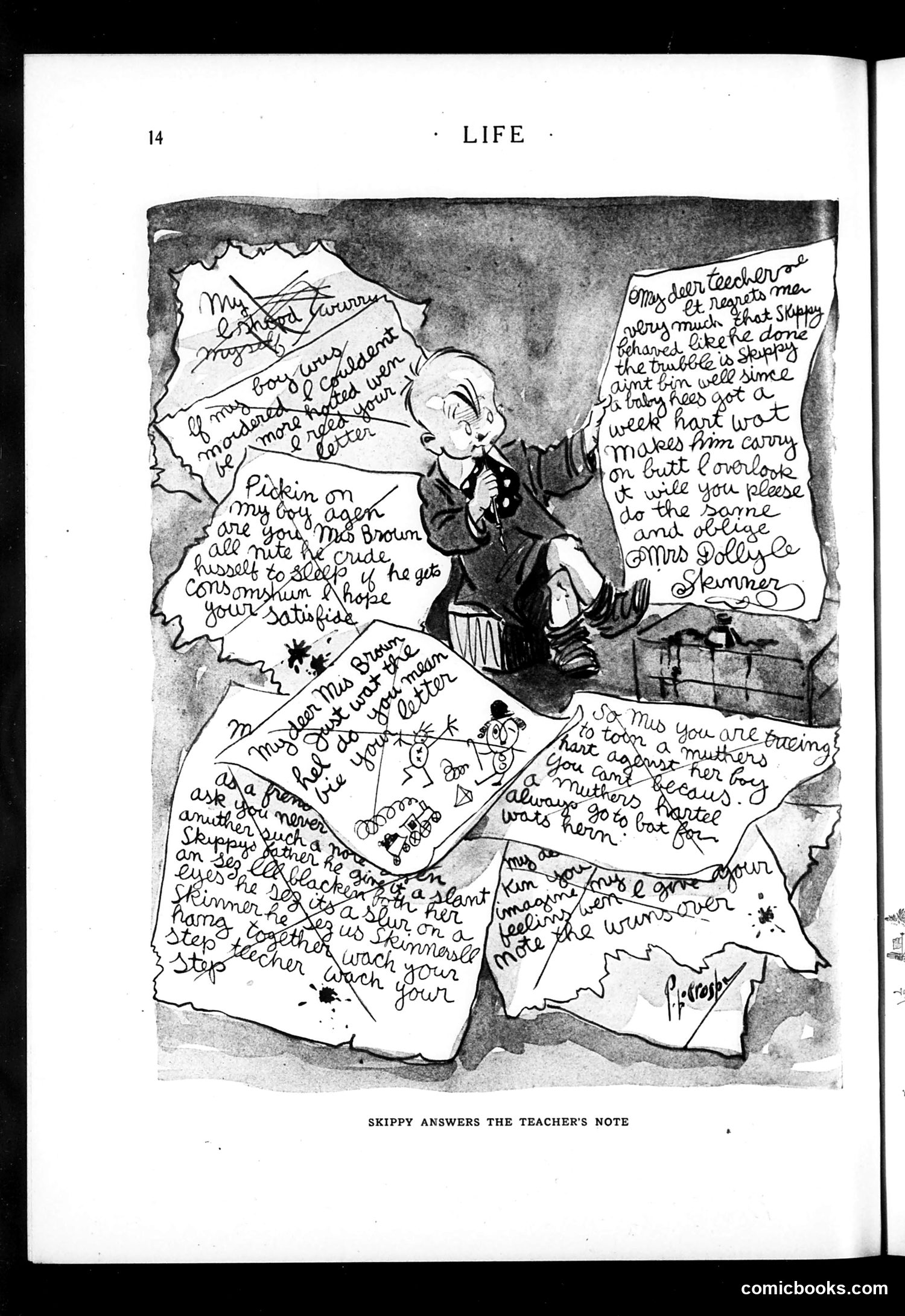
This is a humorous comic strip about a schoolboy named Skippy responding to his teacher's written complaints. The illustrated boy holds multiple handwritten note pages from his teacher detailing various misbehaviors—picking on classmates, sleeping in class, neglecting homework, and general classroom disruption. Skippy's responses, visible on the papers he holds, appear to be excuses or defensive replies to each accusation. The satire targets the universal dynamic between misbehaving students and frustrated teachers: the boy offers justifications rather than genuine contrition for his conduct. The humor lies in the implied futility of teacher-student communication—Skippy's explanations likely don't address the actual problems his teacher identified. This reflects common early-20th-century American school experiences and the timeless tension between student mischief and institutional discipline.
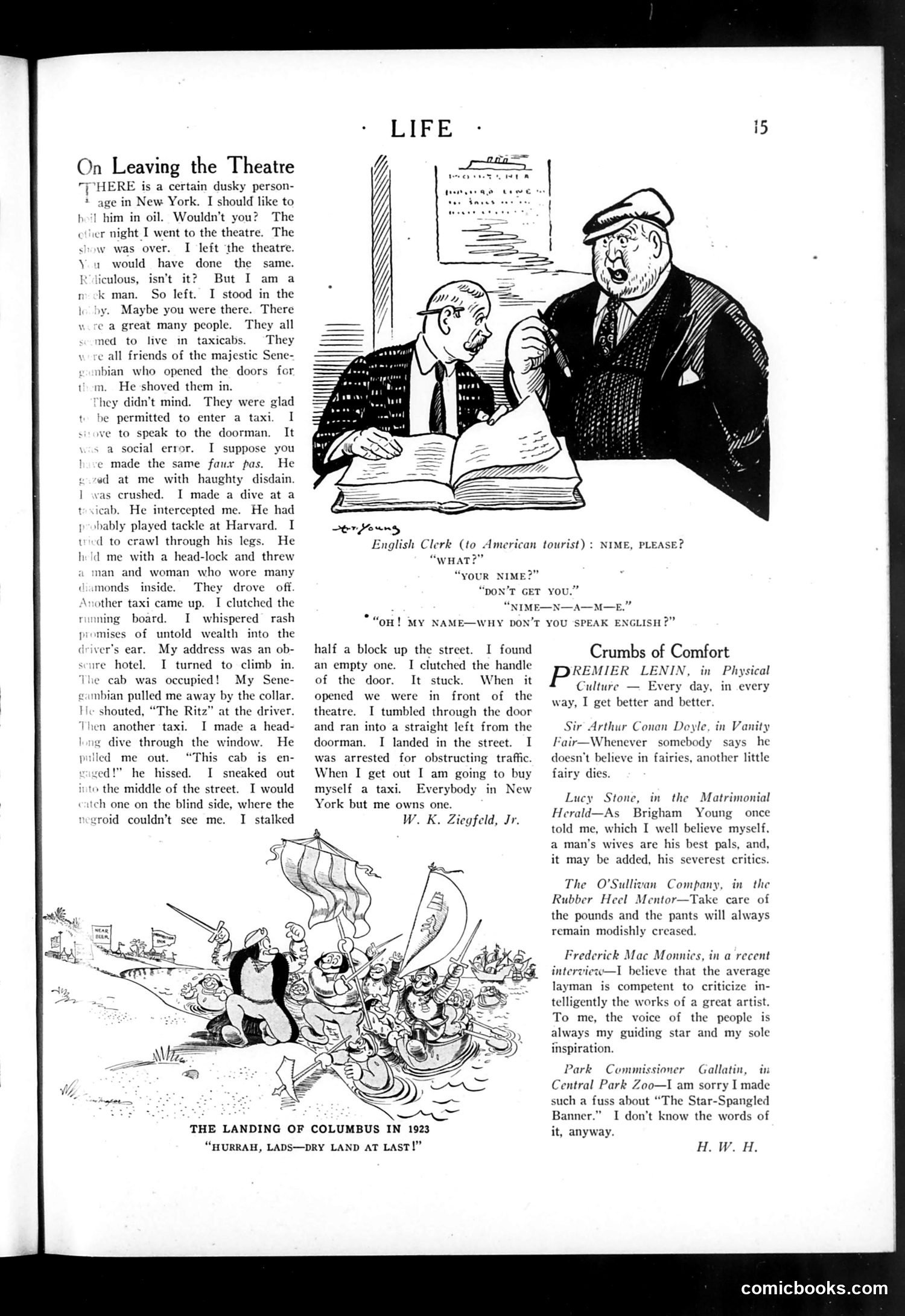
The cartoon depicts Columbus's 1923 landing as a chaotic scene of modern American commercialism and excess rather than historical solemnity. Native Americans are shown as cartoonish figures swarming around Columbus and his crew, who appear indifferent or opportunistic. The caption "HURRAH, LADS—DRY LAND AT LAST!" satirizes the 400th anniversary celebration of Columbus's voyage (1492-1923), suggesting that early 1920s America had devolved into crass materialism and national self-congratulation far removed from historical dignity. The top illustration shows an English clerk pestering an American tourist about proper names and English language, mocking both British pretension and American tourists abroad—a common satirical theme in this era.
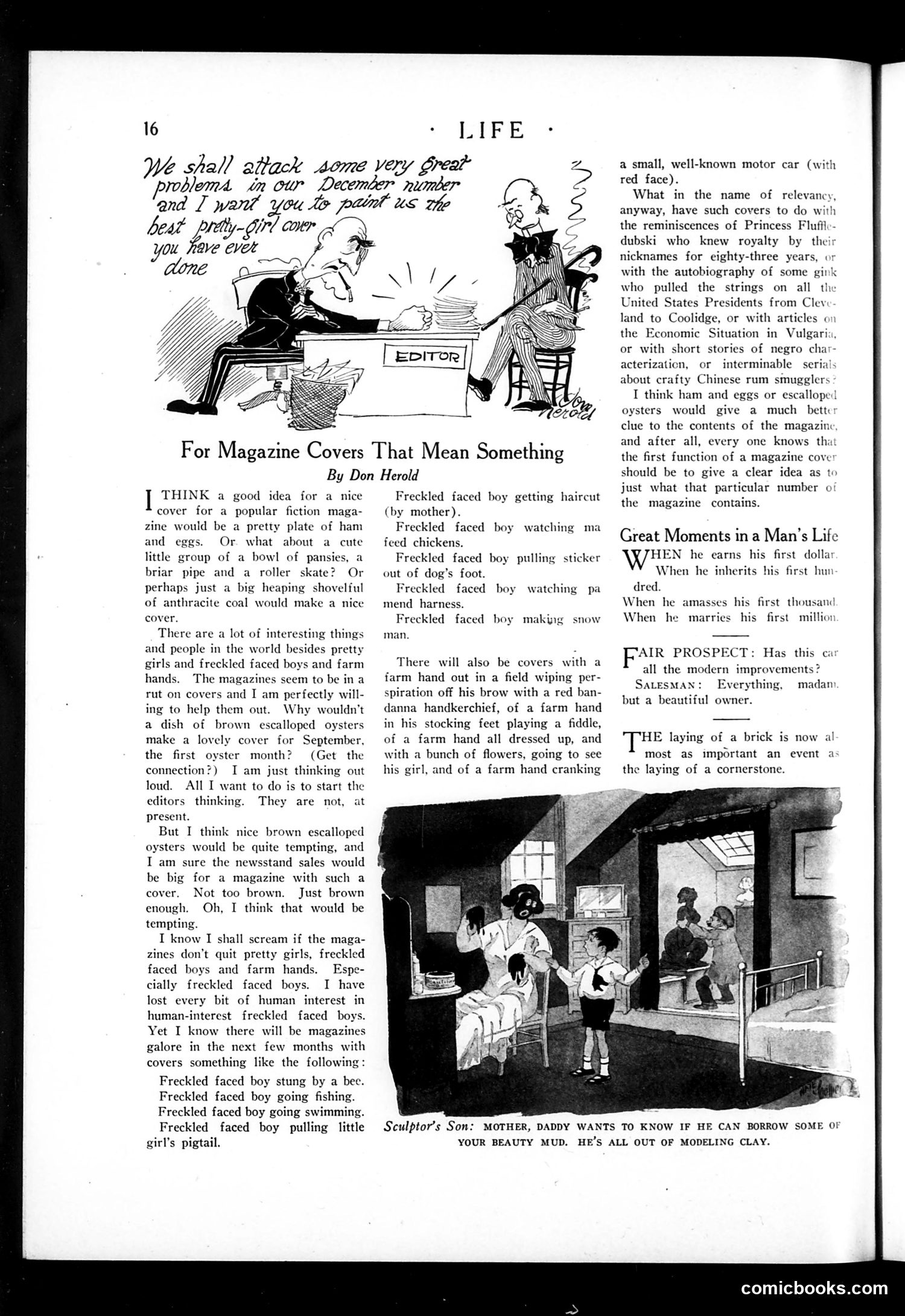
**Main Article: "For Magazine Covers That Mean Something"** Author Don Herold satirizes the predictable, formulaic cover designs of popular fiction magazines of his era. He mocks magazines' reliance on two stock image types: "pretty girls" and "freckled faced boys" engaged in rustic activities (fishing, swimming, farm work). Herold argues these covers bear no connection to the actual magazine contents—whether Princess memoirs, political articles, or serialized fiction. His solution: replace generic imagery with relevant visual clues (ham and eggs for food content, etc.) that actually preview what readers will find inside. The cartoon shows an editor at his desk receiving this pitch from a contributor, capturing the frustration of someone trying to convince magazine publishers to think more creatively about cover design rather than recycling tired clichés. **Secondary Items:** - "Great Moments in a Man's Life" humorously lists financial milestones - The bottom illustration ("Sculptor's Son") is a gentle joke about a child asking to borrow his mother's beauty products for modeling clay
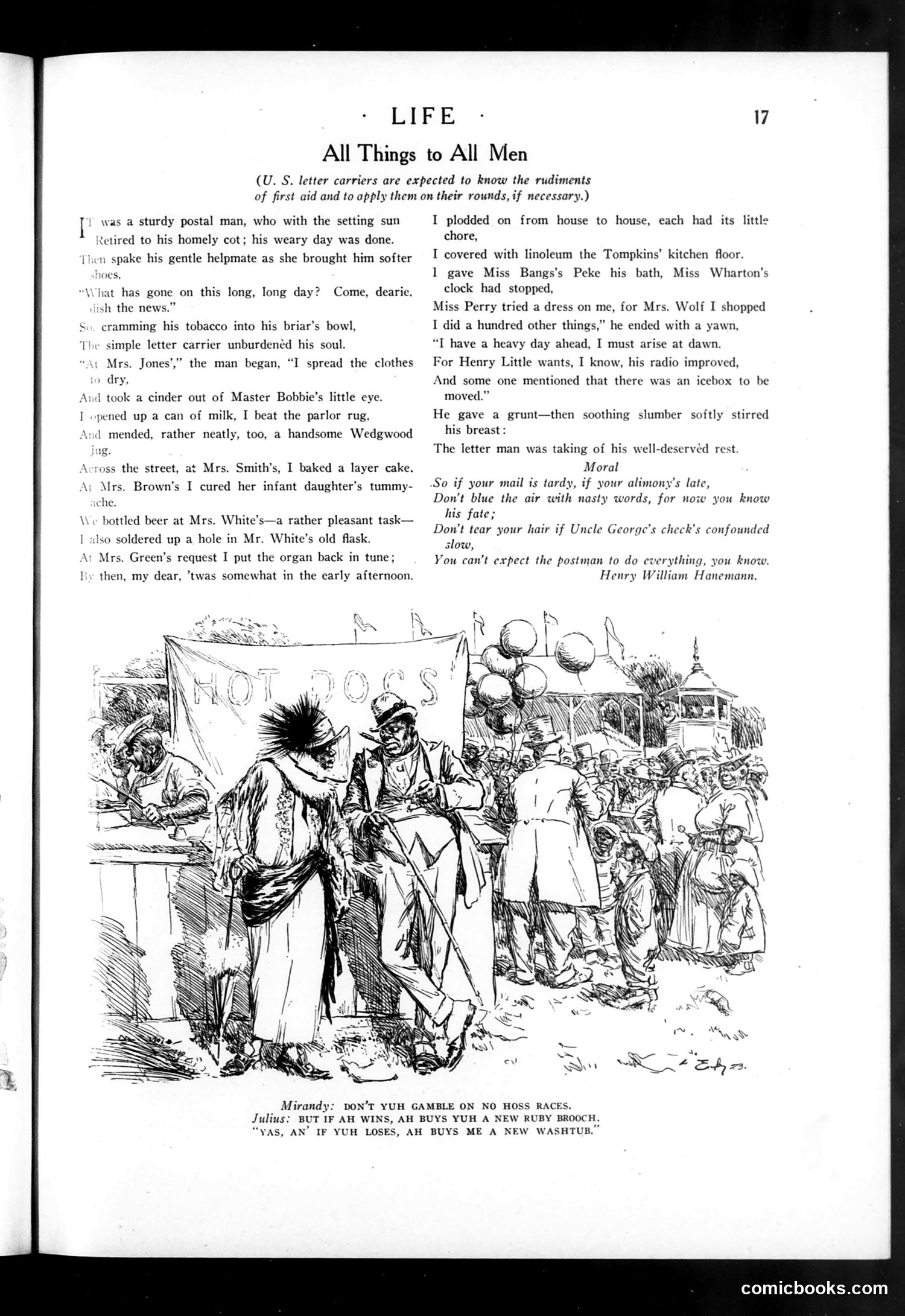
This page satirizes the unrealistic expectations placed on U.S. mail carriers. The main article, a humorous narrative poem, depicts a postal worker recounting his day to his wife. Beyond delivering mail, he has performed countless domestic tasks: spreading clothes, removing cinders from children's eyes, baking cakes, curing illnesses, soldering flasks, tuning organs, bathing dogs, and moving ice boxes. The satire's point—emphasized in the moral—is that the public unfairly blames mail carriers when deliveries are late, without understanding their impossible workload. The message urges patience with late mail, late alimony payments, and delayed checks. The accompanying cartoon (bottom) appears unrelated: it depicts two African American figures discussing gambling and gift-giving, using period dialect. This reflects the magazine's casual racial stereotyping typical of early 20th-century publications.
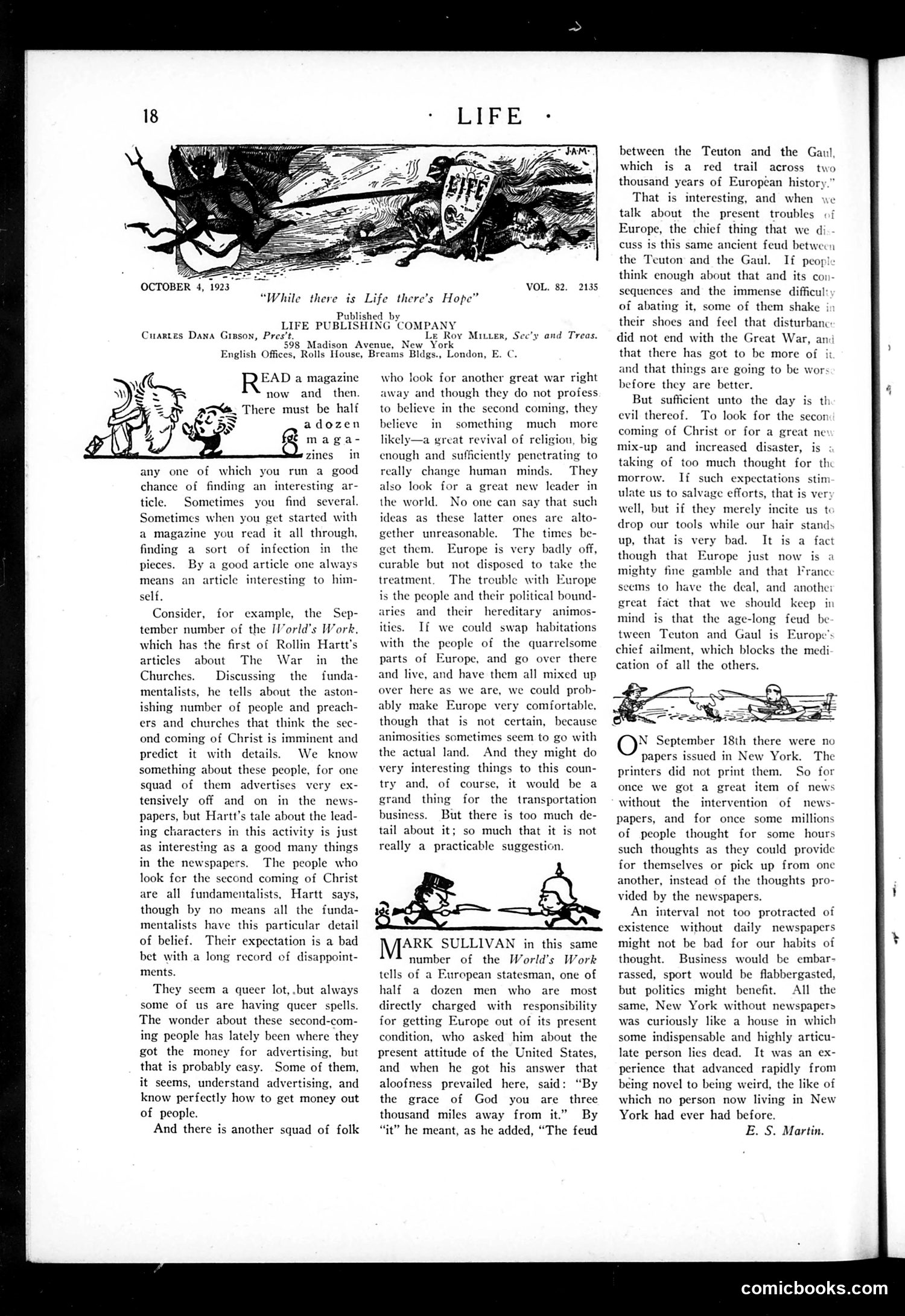
This page contains editorial commentary and no political cartoons, despite the header image showing a classical "Hope" figure. The content discusses religious and geopolitical concerns of 1923. The main topics referenced: 1. **Fundamentalist "Second Coming" movements**: Rollin Hart's article criticizes American religious groups predicting Christ's imminent return, noting their extensive (and well-funded) advertising campaigns promoting this belief. 2. **European instability**: The editors discuss the deep-rooted conflict between "Teuton and Gaul" (Germans and French)—described as "a red trail across two thousand years of European history." A European statesman expresses relief America is "three thousand miles away" from these ancient feuds. 3. **Post-WWI anxiety**: The piece reflects 1923 anxieties about potential new wars and religious revival movements, suggesting both are reactions to post-war trauma. The satire targets American gullibility regarding both religious prophecy and European problems—implying Americans naively discuss solutions while remaining blissfully distant from actual consequences.
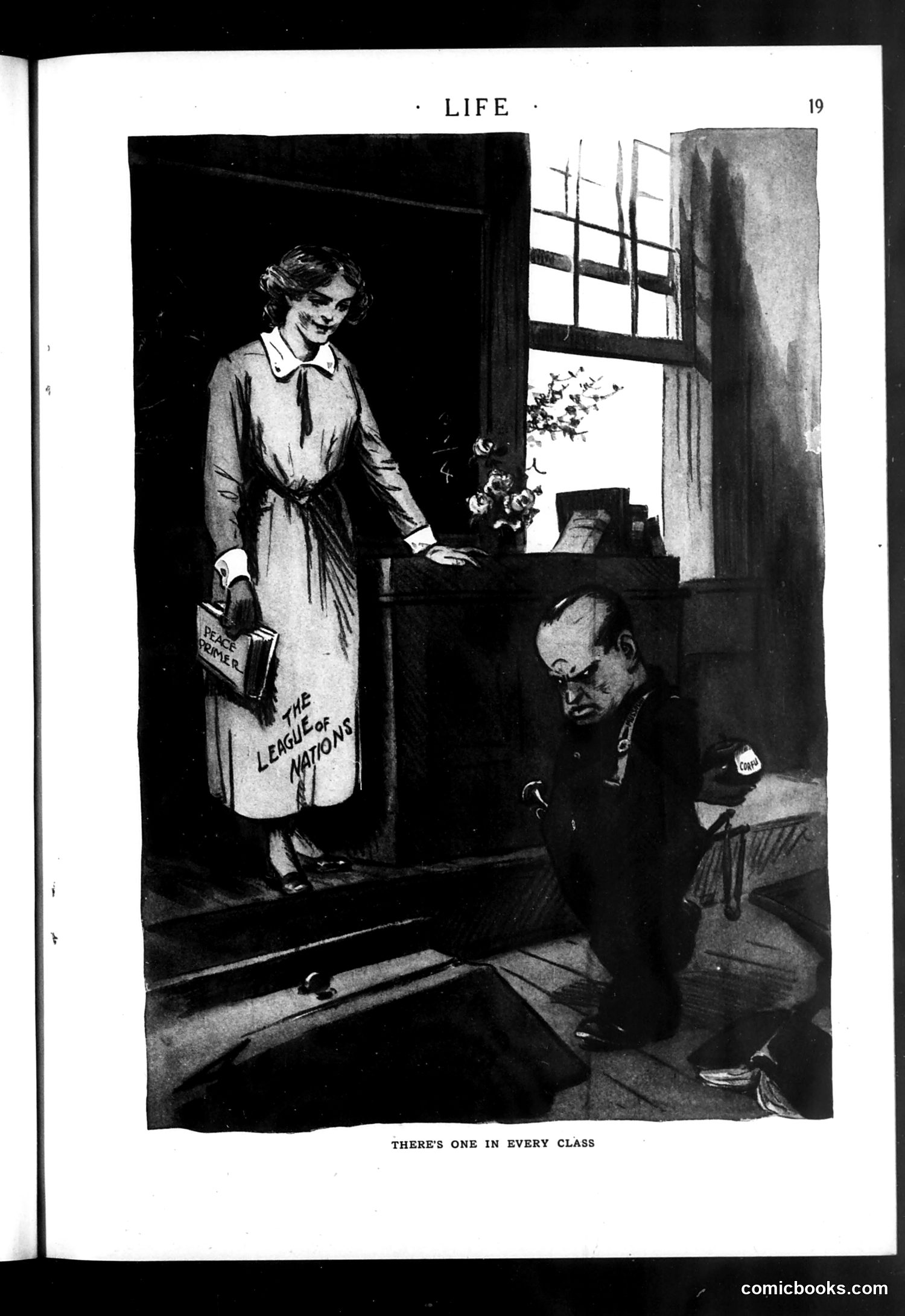
This page shows a classroom scene with the caption "There's One in Every Class." The image depicts a woman teacher standing in a doorway holding materials labeled "The League of Nations," while a male student sits at a desk appearing dismissive or inattentive. The satire targets public skepticism toward the League of Nations—likely during the 1920s-1930s when American isolationism was strong. The joke suggests that in every class, there's "one" student (representing the American public or certain politicians) who doesn't take the League of Nations seriously or refuses to engage with it. The teacher represents advocates for international cooperation, while the dismissive student embodies the prevalent American resistance to joining or supporting the League, reflecting the era's widespread isolationist sentiment.
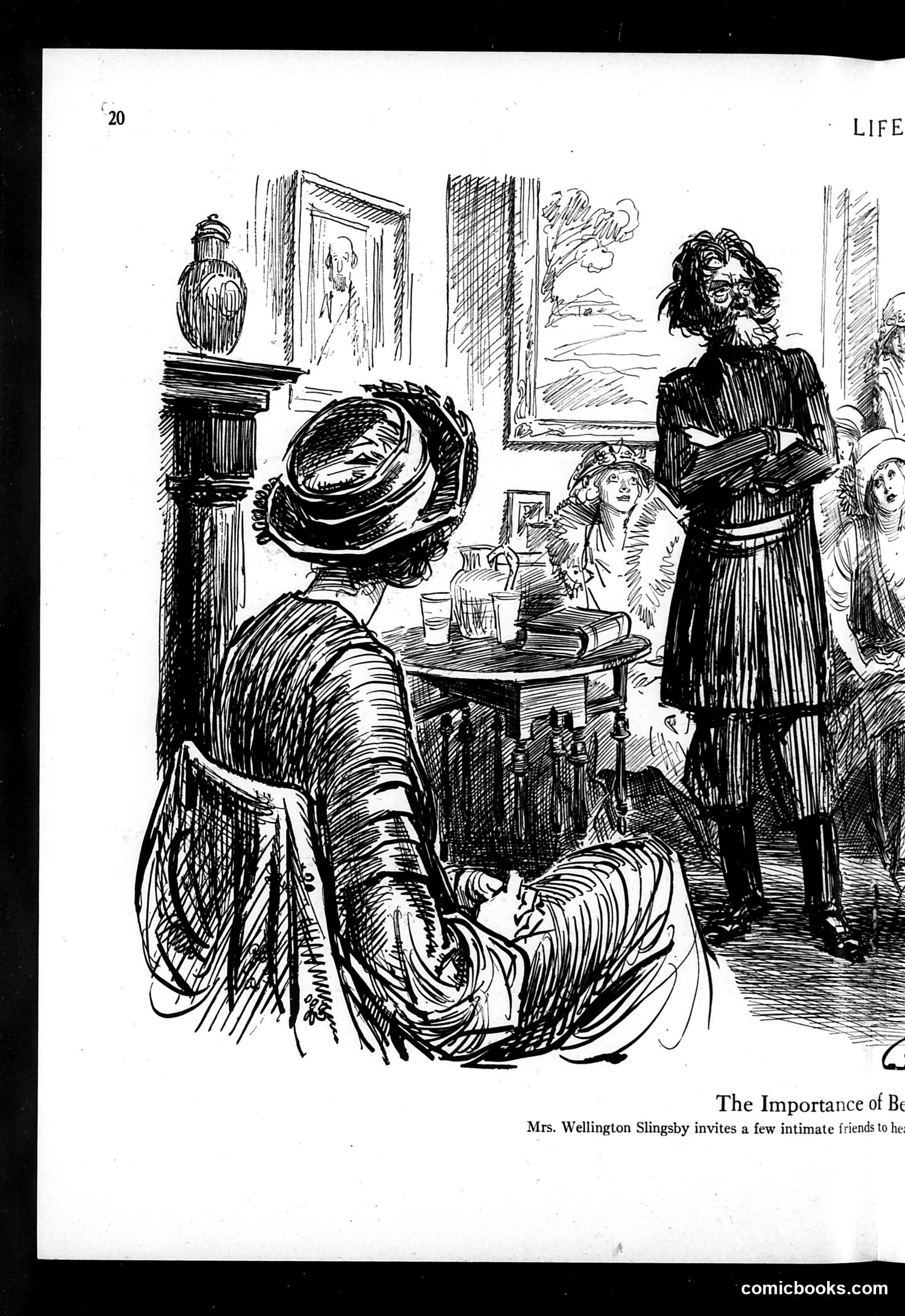
This page from *Life* magazine shows a satirical illustration titled "The Importance of Be[ing]"—likely referencing Oscar Wilde's *The Importance of Being Earnest*. The scene depicts Mrs. Wellington Slingsby hosting what appears to be an upper-class social gathering. The cartoon satirizes pretentious high-society behavior: a woman seated wears an elaborate hat while conversing with standing guests in formal dress. A portrait and landscape painting hang on the walls, emphasizing the domestic gentility being performed. The satire targets the artificial social rituals and snobbish etiquette of wealthy Americans, mocking how such "intimate friends" gatherings were really about displaying status and maintaining appearances of respectability. The exaggerated drawing style emphasizes the absurdity of these social performances.
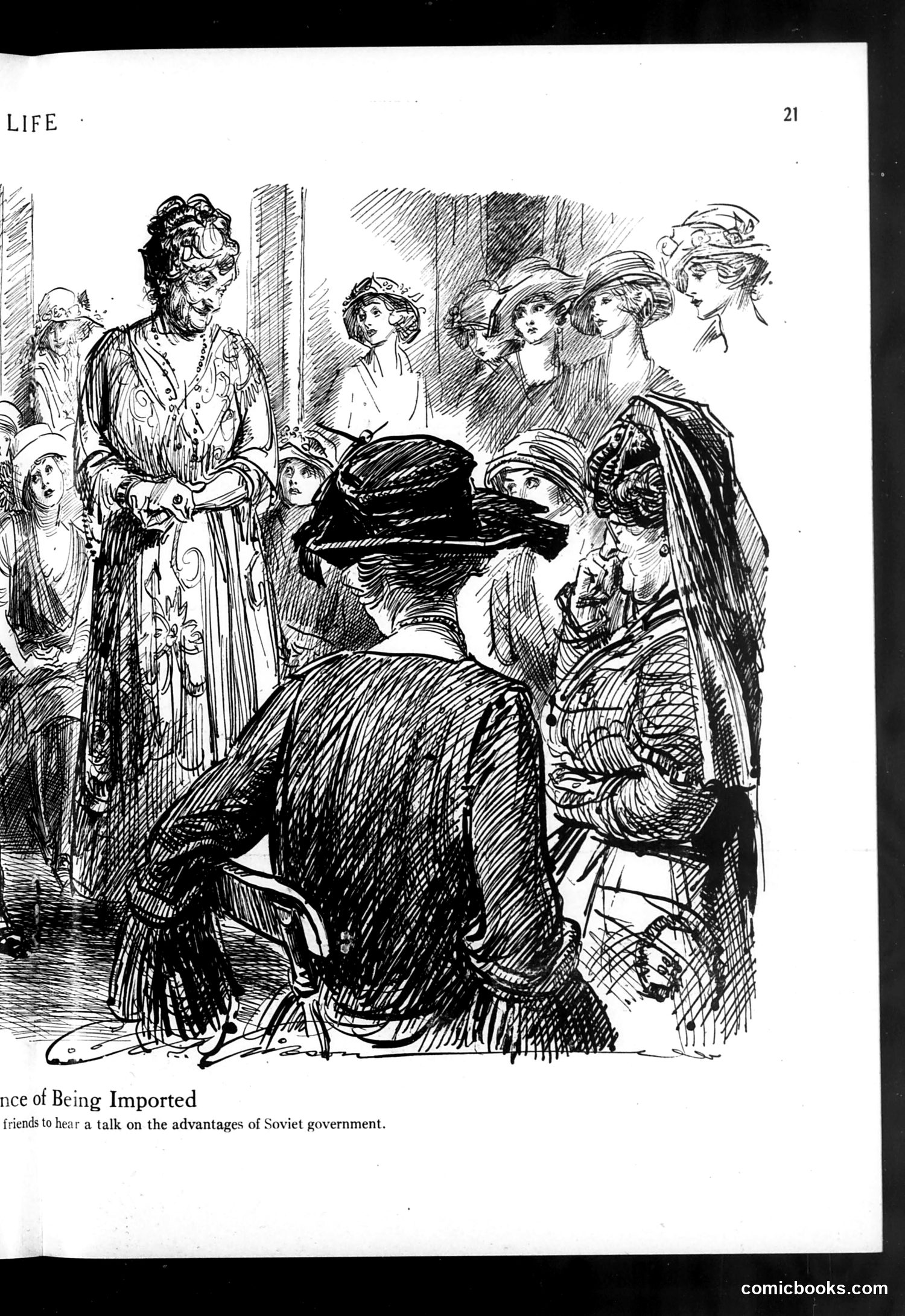
This cartoon satirizes Soviet propaganda efforts in America during the early Cold War period. The sketch shows a woman addressing a group of well-dressed American women indoors, apparently giving a lecture promoting Soviet government advantages. The satire targets wealthy, fashionable American women ("imported" Soviet sympathizers or communist propagandists) who were spreading pro-Soviet messaging to their social circles. The cartoon mocks both the messengers and their audience—suggesting that Soviet ideology was being promoted as a fashionable talking point among the American upper class, treating serious political ideology as casual social conversation. The title "nce of Being Imported" (likely "Menace of Being Imported") makes clear Life magazine's critical stance: Soviet communist advocacy was characterized as a foreign import threatening American values—something exotic and dangerous disguised as sophisticated discussion.
This drama criticism praises playwright Lee Wilson Dodd's recent play for featuring characters who speak intelligently—a rarity on Broadway that the critic finds shockingly refreshing. The piece defends the play against potential criticism, arguing that playwrights shouldn't be condemned for depicting improbable character actions or behaviors (like someone turning "bright lavender with gold trimmings" during emotional crisis). The critic also dismisses assumptions that character actions reflect authorial endorsement—a wife-strangler in a play doesn't mean the author advocates wife-strangling. The named cast members (Laura Hope Crews, Blanche Bates, Henry Miller, Ruth Chatterton, et al.) were prominent Broadway actors of the era whose star power elevated the production's prestige. The satirical tone criticizes Broadway audiences and critics for finding mere intelligence in dialogue extraordinary, suggesting the theatrical standard was dismayingly low.
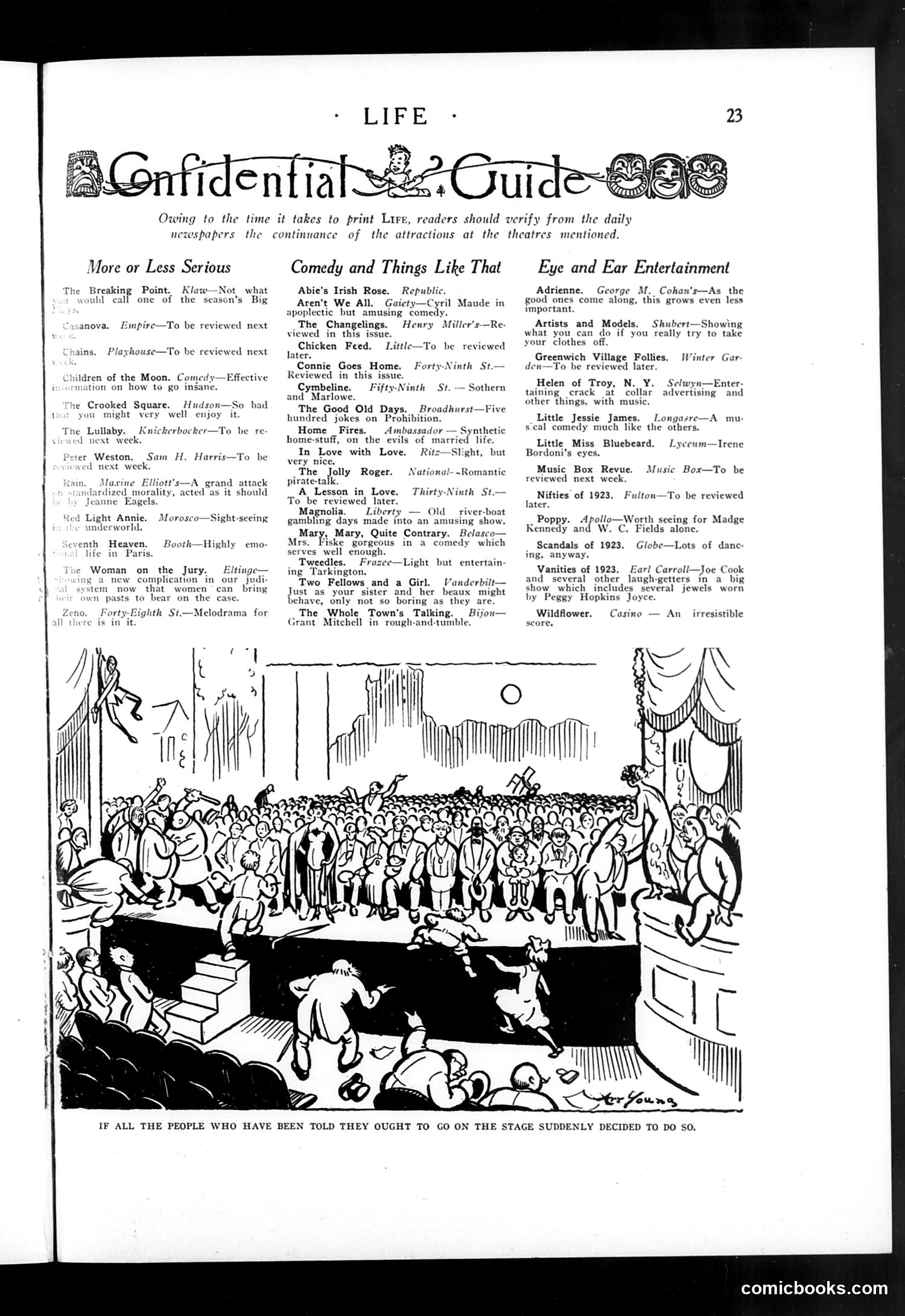
This is a theater listings and review page from Life magazine's entertainment section. The main cartoon illustrates a running joke about American theater culture: the caption reads "If all the people who have been told they ought to go on the stage suddenly decided to do so"—depicting a chaotic theater scene where the stage and audience have essentially merged into one massive, indistinguishable crowd. The humor targets the widespread, casual encouragement people received to pursue stage careers, suggesting that if everyone who'd been told "you should be in theater" actually followed that advice, it would create absurd pandemonium. The cartoon satirizes both the optimistic theater culture of the 1920s and the impracticality of such advice when applied universally. The surrounding text lists Broadway shows with brief reviews and recommendations—standard entertainment journalism for the era.
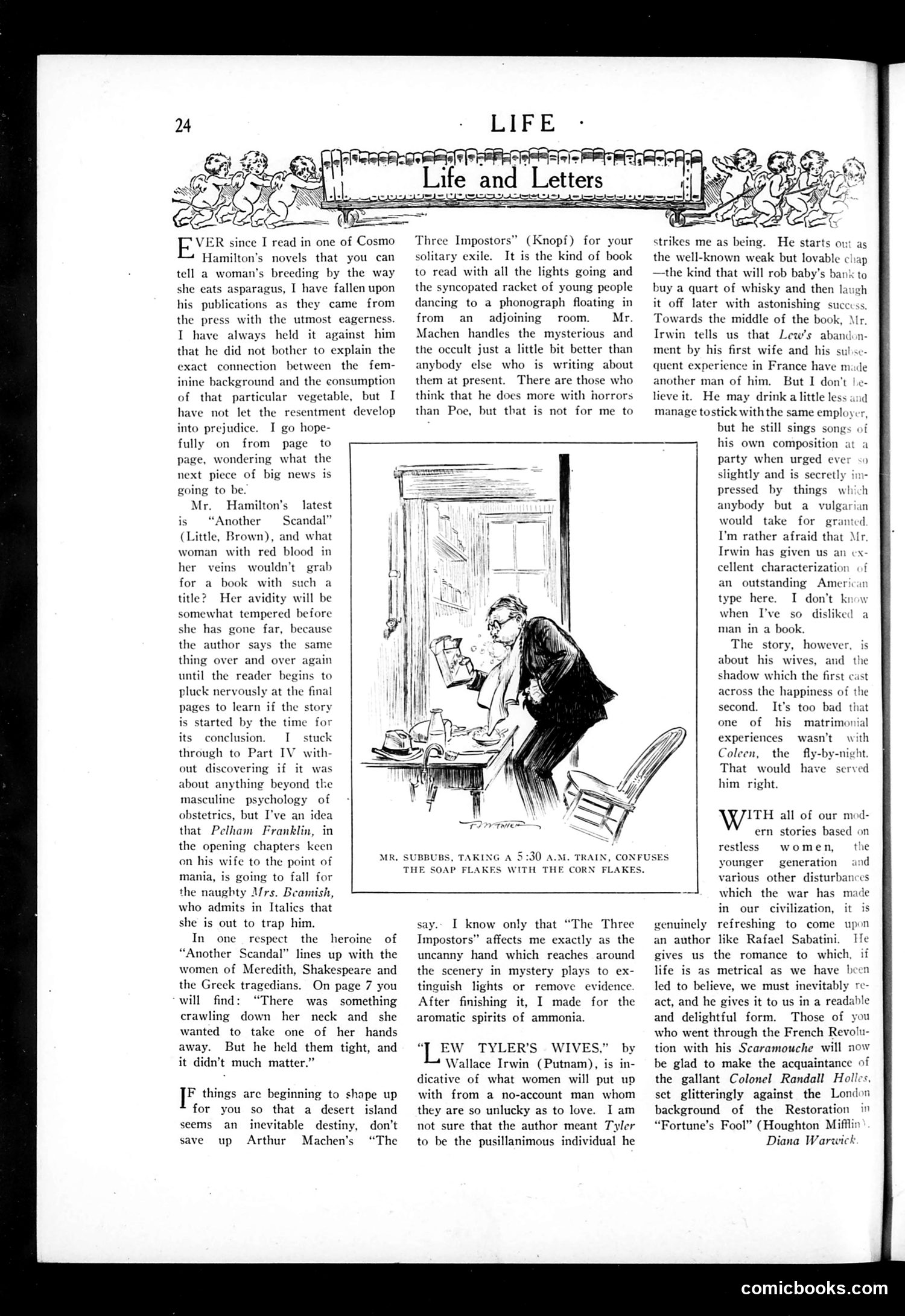
This is a literary review column titled "Life and Letters." The main illustration depicts a man at a desk in early morning (5:30 a.m., per the caption), confusing soap flakes with corn flakes—a visual gag about absent-minded confusion before dawn. The text reviews three books: Cosmo Hamilton's "Another Scandal," Arthur Machen's "The Three Impostors," and Wallace Irwin's "Lew Tyler's Wives." The reviewer critiques Hamilton for repetitive plotting, praises Machen's handling of the occult, and expresses strong dislike for Irwin's protagonist—a weak, alcoholic man who abandons his first wife, yet the author claims he's reformed. The reviewer remains skeptical of this character redemption. The satirical point is literary: mocking both author pretension (Hamilton's overwrought morality tales) and readers' gullibility regarding character development. The breakfast-time illustration serves as visual relief in the dense text.
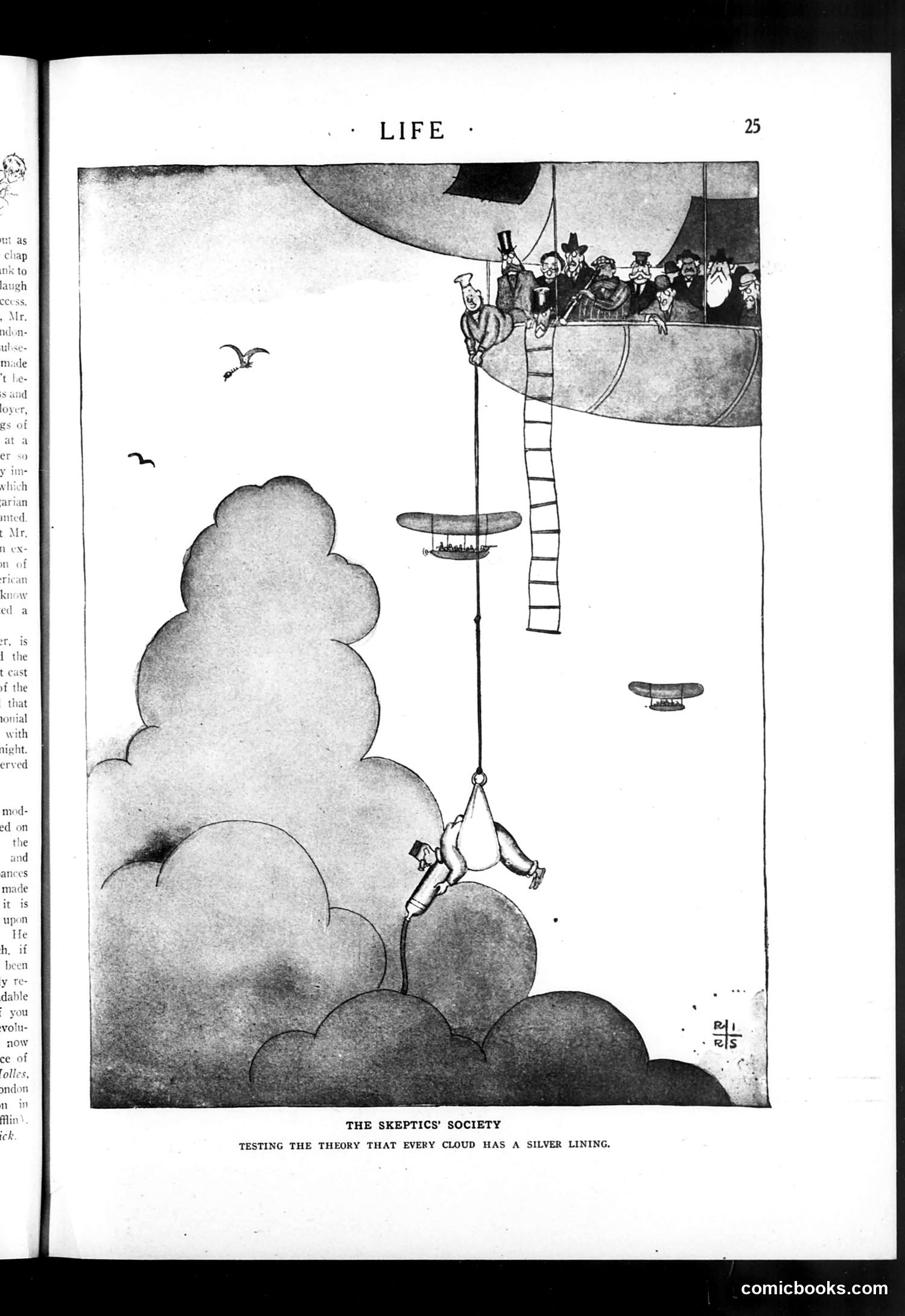
This Life magazine cartoon satirizes optimistic clichés through the phrase "every cloud has a silver lining." The image depicts a group of well-dressed skeptics in a hot-air balloon, descending via ladder into massive storm clouds below. They appear to be literally investigating whether the metaphorical promise holds truth. The joke mocks both naive optimism and those who question it. The "Skeptics' Society" members are testing a popular saying experimentally—suggesting that optimists accept platitudes without evidence, while skeptics demand empirical proof of even common wisdom. The cartoon humorously literalizes an abstract proverb, implying that pessimists will go to absurd lengths to disprove feel-good sayings.
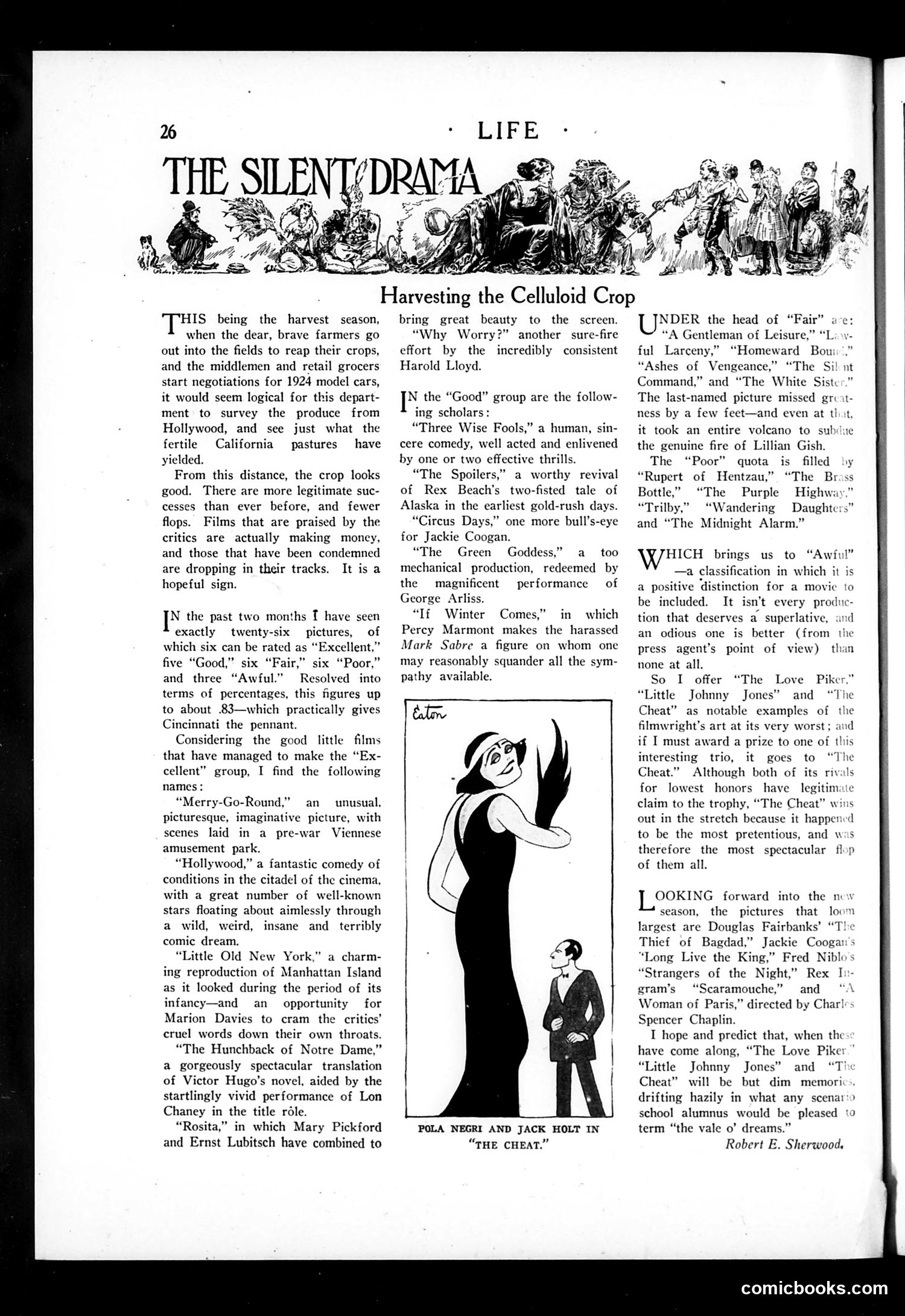
This is a film-industry satire column reviewing 1924 movies. The author uses an agricultural metaphor, comparing Hollywood's film output to a harvest season crop. He rates 26 recent films: six "Excellent," five "Good," six "Fair," six "Poor," and three "Awful." The humor lies in awarding prestige to genuinely terrible films—particularly "The Cheat" (illustrated with Pola Negri and Jack Holt)—because being "Awful" becomes a distinction itself. Bad films generate press attention, making them valuable to studios despite critical failure. Notable praised films include Lon Chaney's "Hunchback of Notre Dame" and Harold Lloyd comedies. The statistics joke—calculating percentages that equal ".83"—playfully references Cincinnati's baseball pennant standing. The satire targets both Hollywood's quantity-over-quality production system and the perverse publicity value of spectacular failures.
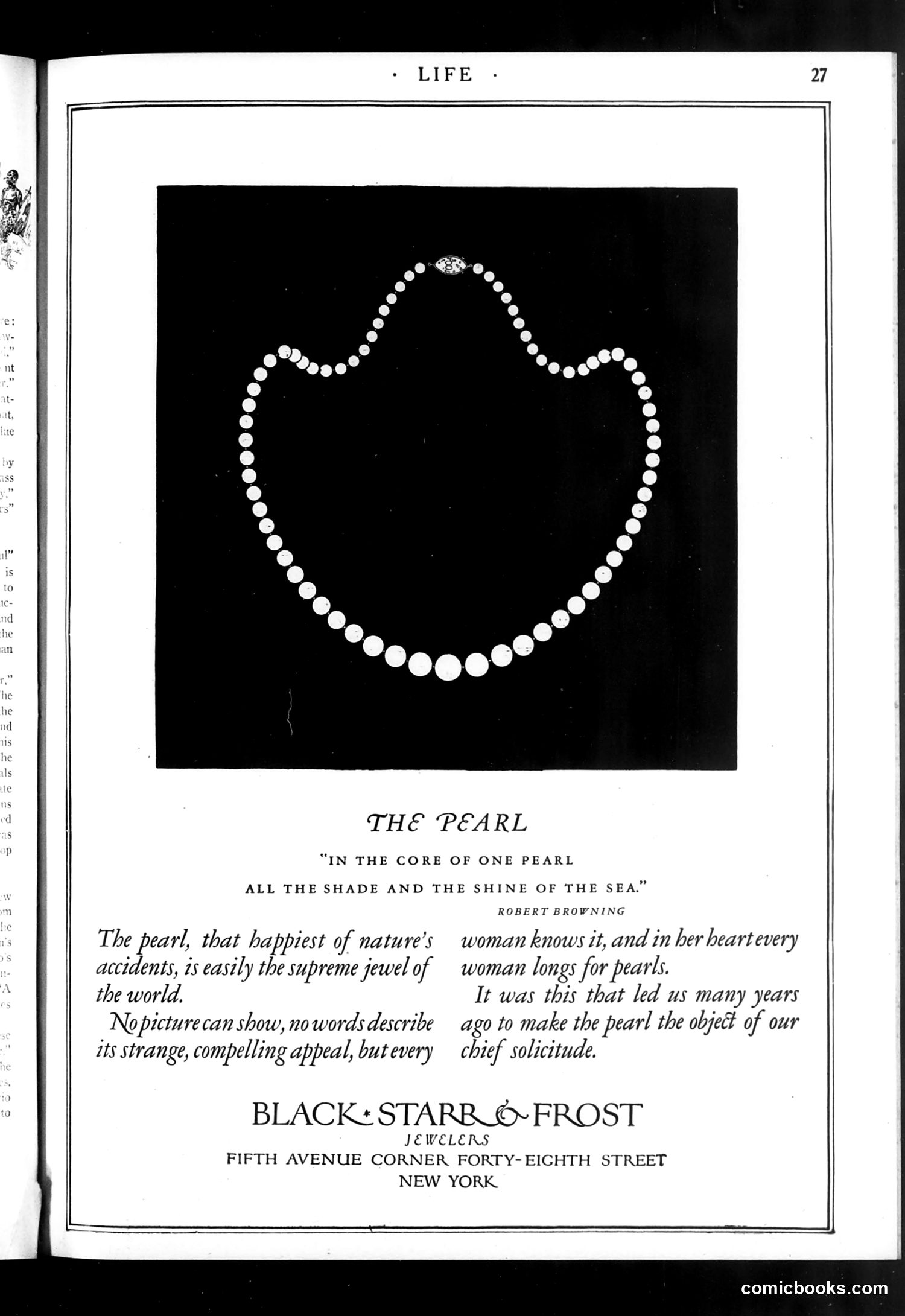
This is not a cartoon but a **luxury advertisement** for Black, Starr & Frost jewelers, a high-end New York firm. The page features a stylized image of a pearl rendered as white spheres arranged in an apple or heart shape against black background. The text is promotional, using romantic language to market pearls to women by appealing to desire and emotion rather than function. The Robert Browning quote lends literary prestige, while phrases like "every woman longs for pearls" and "objet of our chief solicitude" employ aspirational, emotional appeals typical of early 20th-century luxury advertising. The location—"Fifth Avenue corner Forty-Eighth Street"—emphasizes exclusivity and status. This represents the advertising model that financed *Life* magazine.
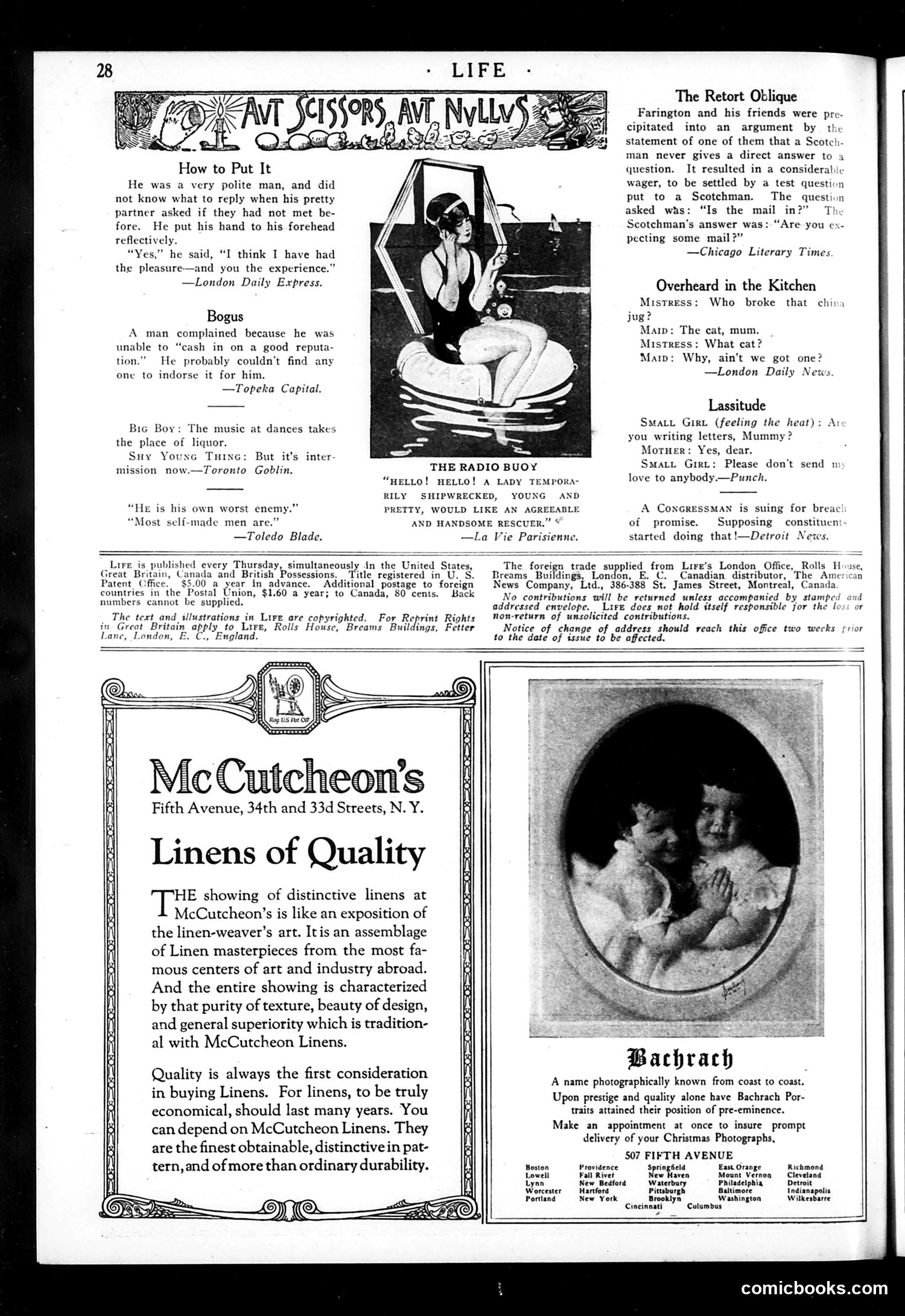
This page contains brief satirical jokes and humorous anecdotes typical of Life's format, plus advertisements. The cartoons and humor target social conventions and human nature: **"The Radio Buoy"** depicts a shipwrecked woman in a bathtub-like vessel—a visual gag playing on the then-novel radio technology and the absurdity of romantic rescue fantasies. The French caption suggests she's advertising for a handsome rescuer, mocking both radio advertising and dated romantic tropes. **The textual jokes** mock Scottish evasiveness, polite social awkwardness, and romantic pretense. "The Retort Oblique" references a cultural stereotype about Scottish people avoiding direct answers—settled by an actual test question. **"Bogus" and "His Own Worst Enemy"** comment on self-made men and reputation fraud—social concerns of the era about authenticity and status. The page is primarily **filler and advertising** (McCutcheon's linens, Bachrach photography studio), reflecting Life's mixed content of light satire, humor, and commercial promotion. The overall tone is genteel, inoffensive social comedy aimed at middle-class readers.
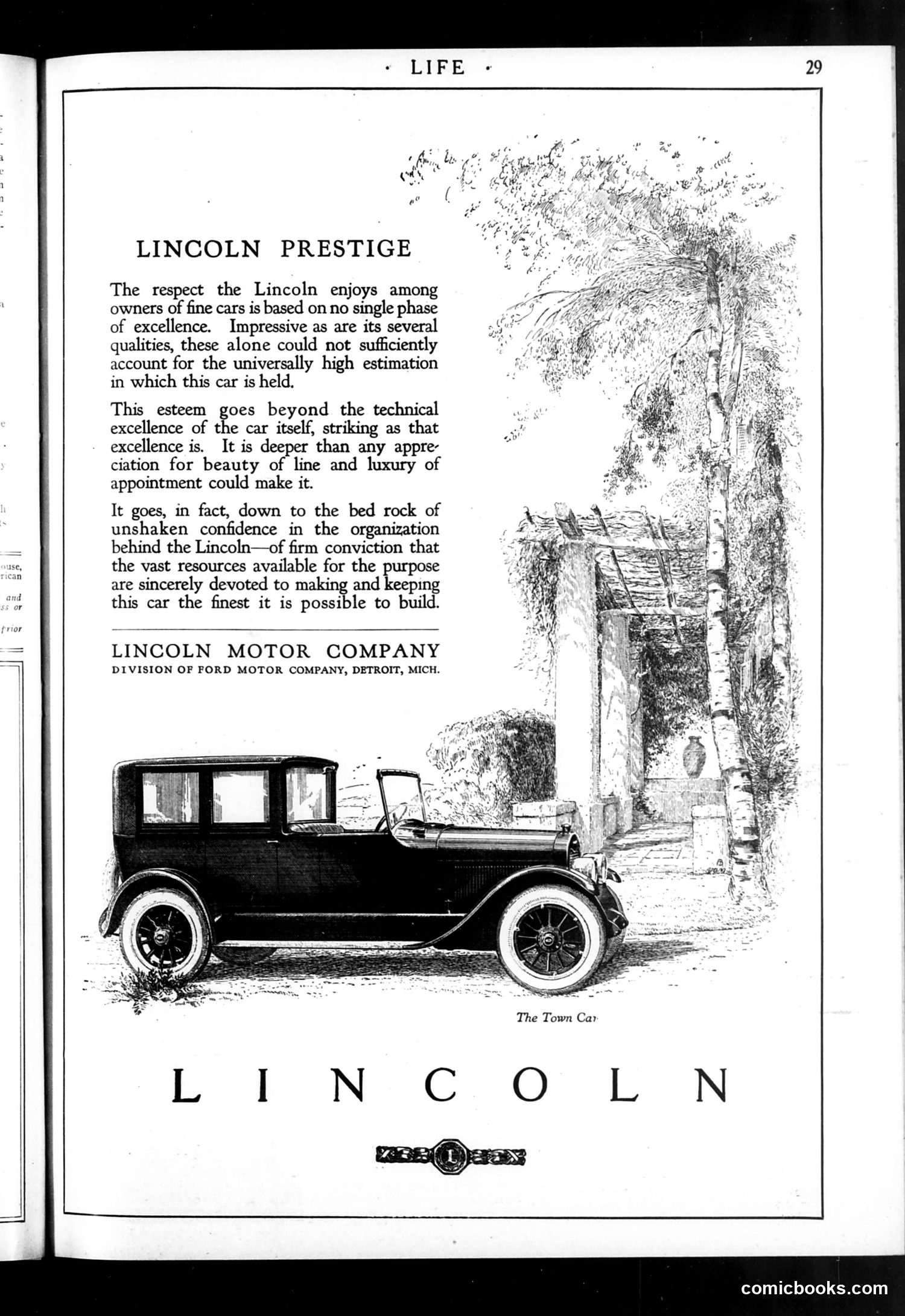
This is **not a political cartoon or satire**, but rather a **full-page automobile advertisement** for Lincoln Motor Company (a Ford division). The page promotes the Lincoln brand by arguing that its prestige among wealthy car owners stems not from any single feature, but from deep consumer confidence in the manufacturer's commitment to quality and resources. The accompanying illustration shows "The Town Car"—a luxury sedan positioned in an elegant residential setting with ivy-covered architecture, visually reinforcing the car's association with refined taste and established wealth. This represents early 20th-century marketing strategy: selling not just a product's technical merits, but the *organizational integrity* and reputation behind it. There is no satire present—the page straightforwardly positions Lincoln as the luxury choice for discerning owners.
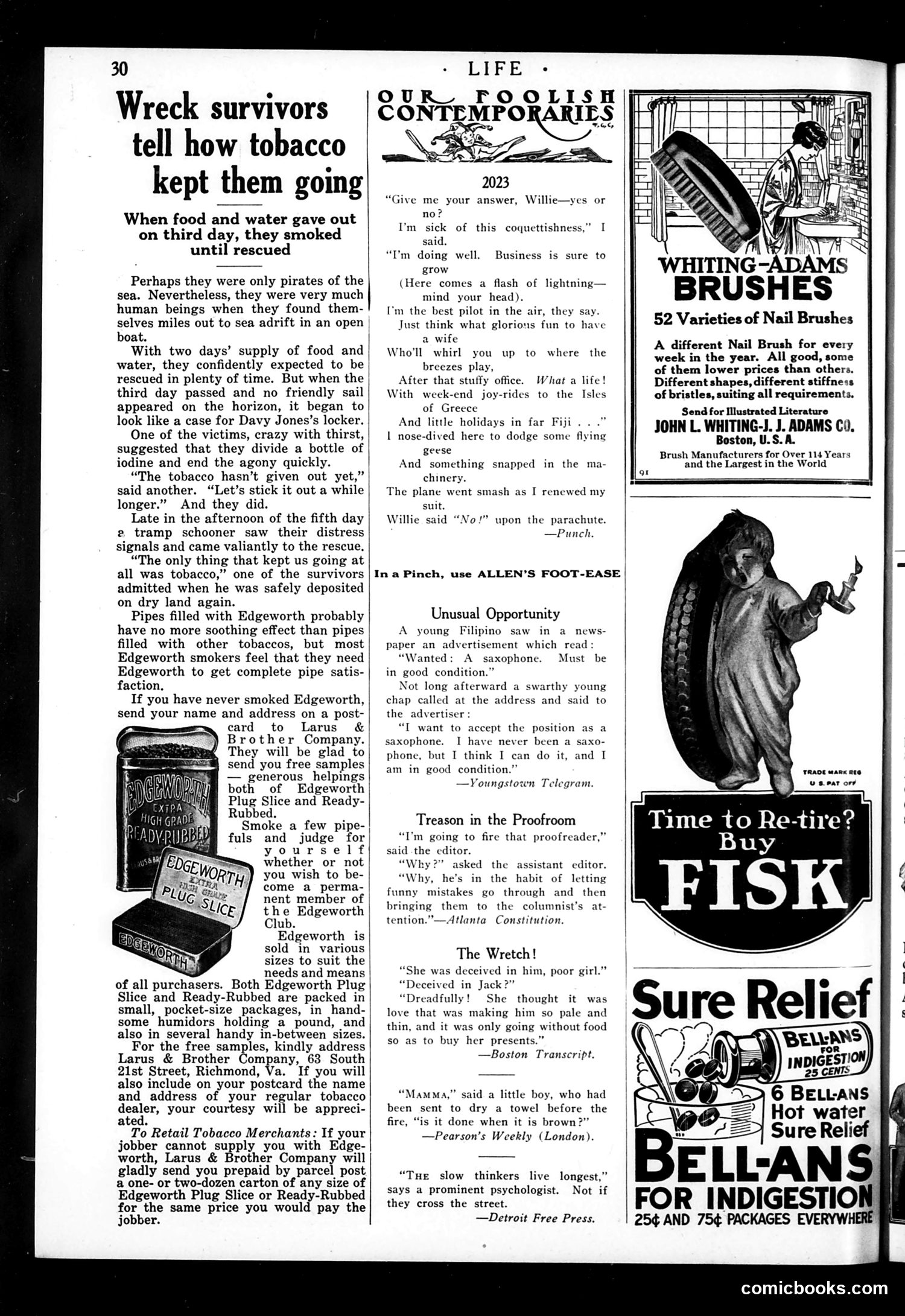
This page is primarily **advertising disguised as editorial content**, typical of early 20th-century magazines. The main article—"Wreck survivors tell how tobacco kept them going"—presents a dubious claim that shipwreck victims survived by smoking tobacco when food and water ran out. This is essentially **disguised advertising for Edgeworth tobacco**, presented as a human interest story. The piece romanticizes smoking as life-sustaining, a marketing tactic unthinkable today. The page includes genuine humor: a Punch cartoon about a pilot proposing to a woman, with comedic interruptions (lightning, dive-bombing geese). There's also a humorous anecdote about a Filipino misunderstanding a saxophone job advertisement, thinking he could become the instrument. The remaining content is straightforward advertising for brushes, foot powder, and digestive aids (Bellans). **The key point for modern readers**: This demonstrates how early advertising exploited editorial credibility and lacked today's regulatory separation between advertising and news.
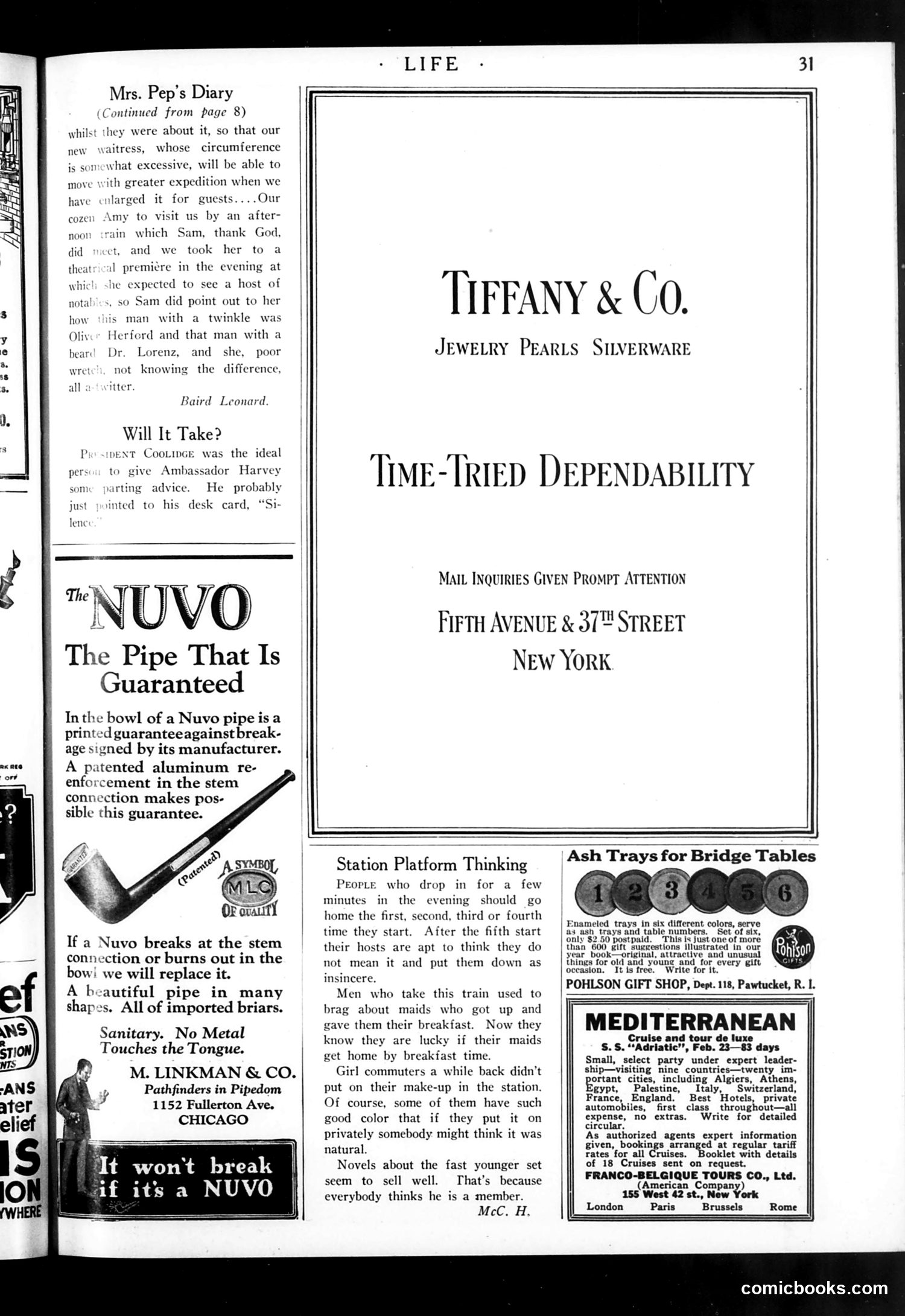
This page is primarily **advertising** with minimal satirical content. The main elements are: **Mrs. Pep's Diary** (upper left): A gossipy society column excerpt about a new waitress with an "excessive" circumference, attending a theatrical premiere, and confusing Oliver Herford with Dr. Lorenz. The humor is light social commentary on upper-class pretension and servant matters. **"Will It Take?"**: A brief anecdote about President Coolidge advising Ambassador Harvey, playing on Coolidge's famous terseness and inscrutability. **The bulk of the page** consists of advertisements: Nuvo pipes (guaranteed not to break), Tiffany & Co. jewelry, and travel/gift services. **"Station Platform Thinking"** (center): Satirical observations about commuter behavior—people overstaying visits, maids' declining reliability, women applying makeup, and young people affecting "fast" lifestyles. The humor reflects 1920s anxieties about changing social manners and class behavior. Overall, this is a typical Life magazine spread: light satire about contemporary social foibles mixed with high-end commercial advertising targeting affluent readers.
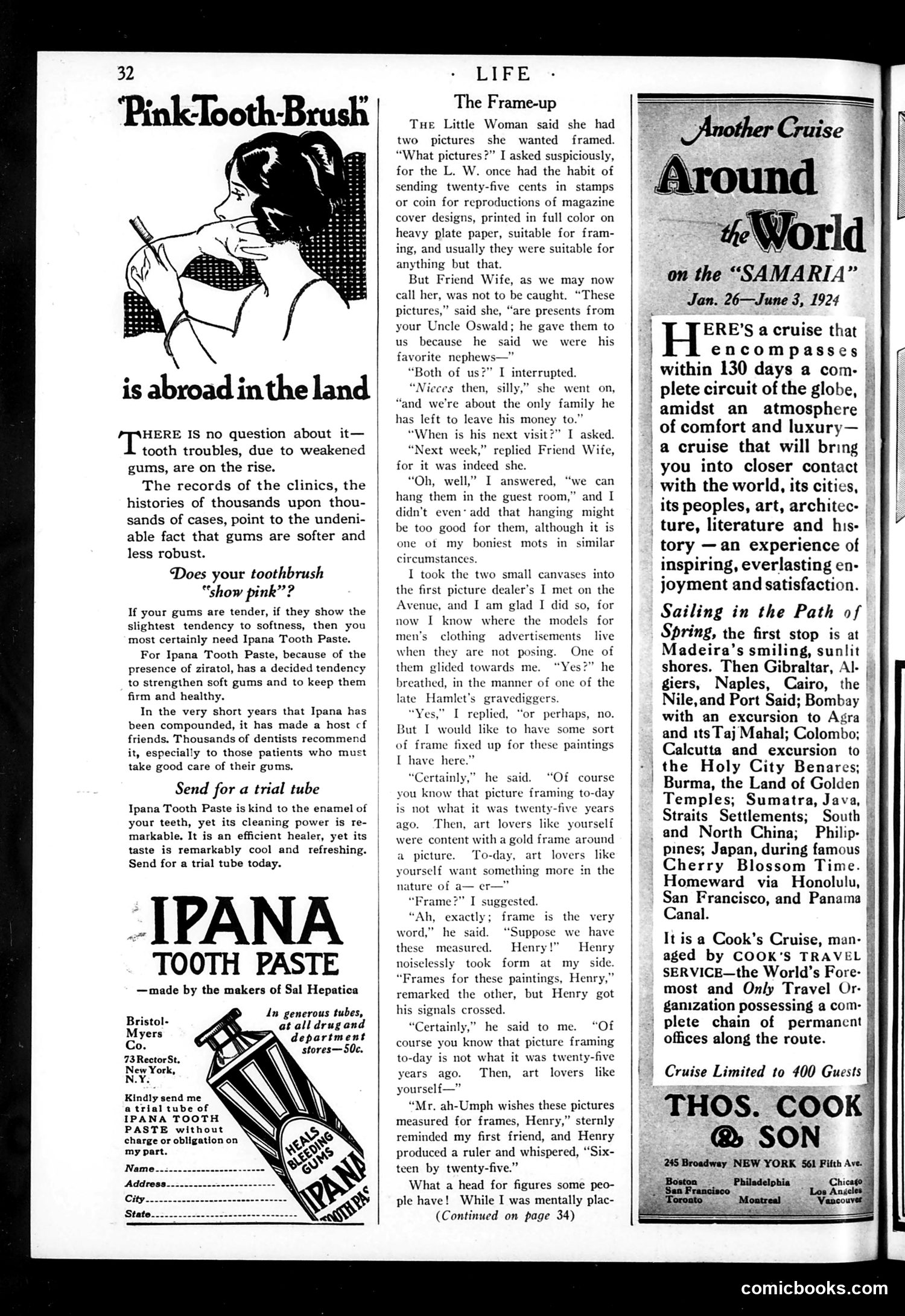
This page contains two distinct items: **Left side: "Pink-Tooth-Brush is Abroad in the Land"** is an advertisement for Ipana Tooth Paste. The headline's phrase "abroad in the land" is a sardonic reference to a widespread social problem—gum disease. The ad plays on contemporary health anxieties, claiming weakened gums are increasingly common and recommending their product (which contains "ziratol") as a solution. This represents early 20th-century advertising's strategy of manufacturing concern about health to sell products. **Right side: "The Frame-up"** is a humorous short story about a man taking paintings to be framed. The satire targets the pretentious art-dealing world—specifically, how dealers use elaborate jargon and affected sophistication to justify inflated prices. The punchline (continued on page 34) apparently involves miscommunication between two dealers, mocking their pompous manner. The cruise advertisement is straightforward travel marketing for Cook's Travel Service.

This page is primarily a **1923 advertisement**, not political satire. It promotes U.S. Royal Cord Tires, manufactured by United States Rubber Company. The ad claims the Royal Cord brand's success stems from three new technological innovations: the "Flat Band Process" (ensuring cord consistency), "Web Cord" (a rubber-impregnation method), and "Sprayed Rubber" (pure rubber construction). The headline's framing—why the dealer is "busiest in town"—uses a common advertising rhetorical device: the product's superiority supposedly drives customer demand and dealer business. The accompanying tire illustration emphasizes the product visually. The tagline "United States Tires are Good Tires" pairs patriotic branding with quality assurance—a marketing strategy common in early 1920s American advertising. This reflects the era's automobile boom and the emerging tire industry's competitive marketing through technical claims and brand loyalty appeals.
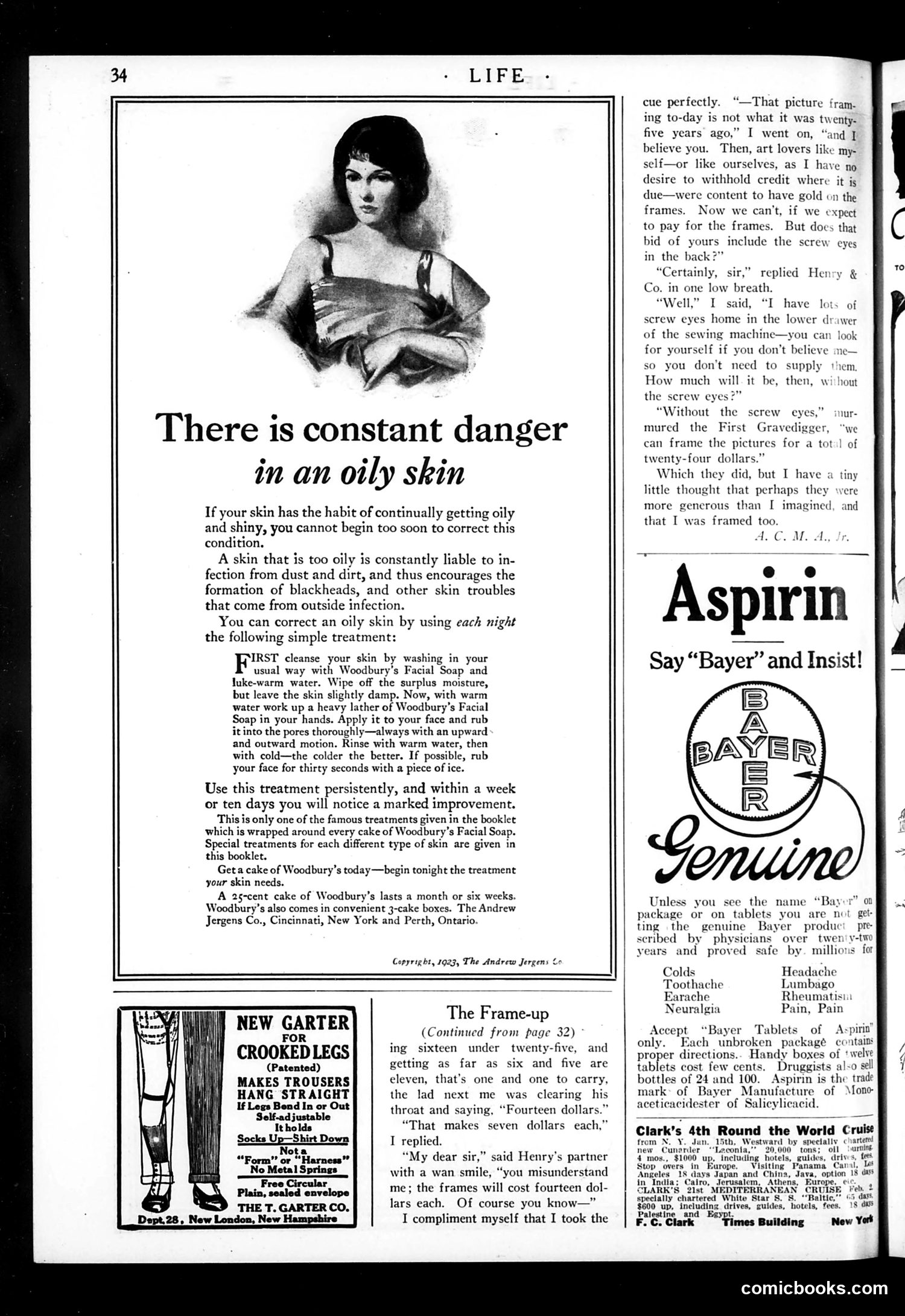
This page contains a short story continuation titled "The Frame-up" about negotiating picture-framing costs. A narrator discusses commissioning frames for artwork with a business called "Henry & Co." The humor derives from the narrator's penny-pinching negotiation—they offer to supply their own screw eyes (hardware) from their sewing machine to reduce the bill from twenty-four dollars to less. One character quips that the narrator's savings effort is ironic given they're willing to pay for expensive gold frames. The satire gently mocks both the rising costs of art framing and the mentality of cost-conscious consumers trying to economize on minor details while spending lavishly elsewhere—a relatable middle-class concern of the 1920s. The page is primarily **advertising**: Woodbury's Facial Soap (skincare for oily skin), Bayer Aspirin, Carter's device for straightening trouser legs, and Clark's world cruise promotion occupy most space.
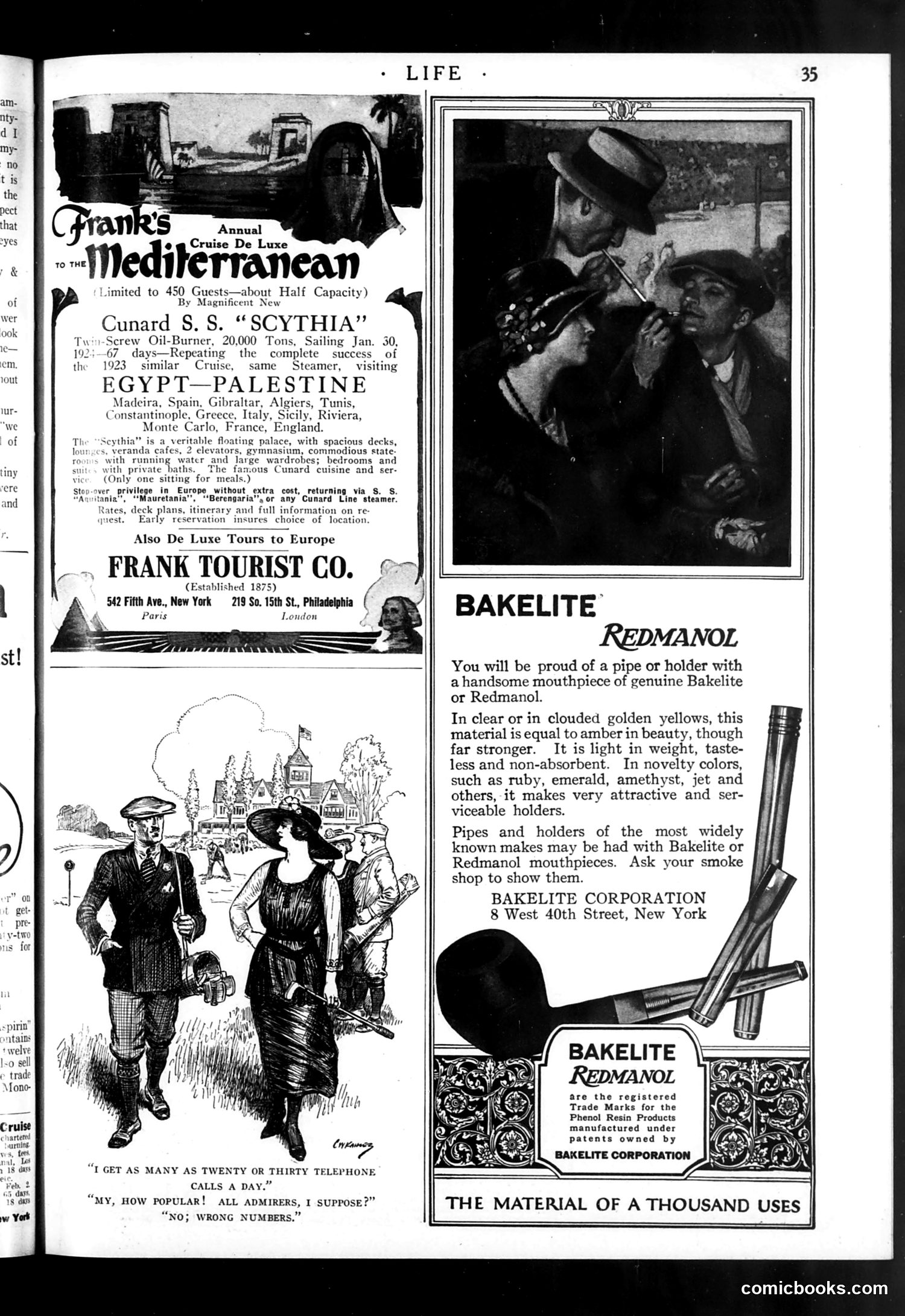
This page contains advertisements and a small cartoon rather than political satire. The cartoon at bottom left depicts a woman receiving constant unwanted telephone calls—"twenty or thirty a day"—which she clarifies are wrong numbers, not admirer calls. This joke reflects early-20th-century frustrations with the developing telephone system's inefficiency and shared party lines, which frequently resulted in misdirected calls. The page is dominated by travel and consumer product advertising: Frank Tourist Company promotes luxury Mediterranean cruises on the Cunard liner *Scythia* visiting Egypt and Palestine; Bakelite Corporation advertises early plastic pipe and cigarette holders as modern substitutes for amber, emphasizing durability and novelty colors. The humor relies on period-specific annoyances—poor telephone infrastructure—that modern readers might find quaint rather than relatable.
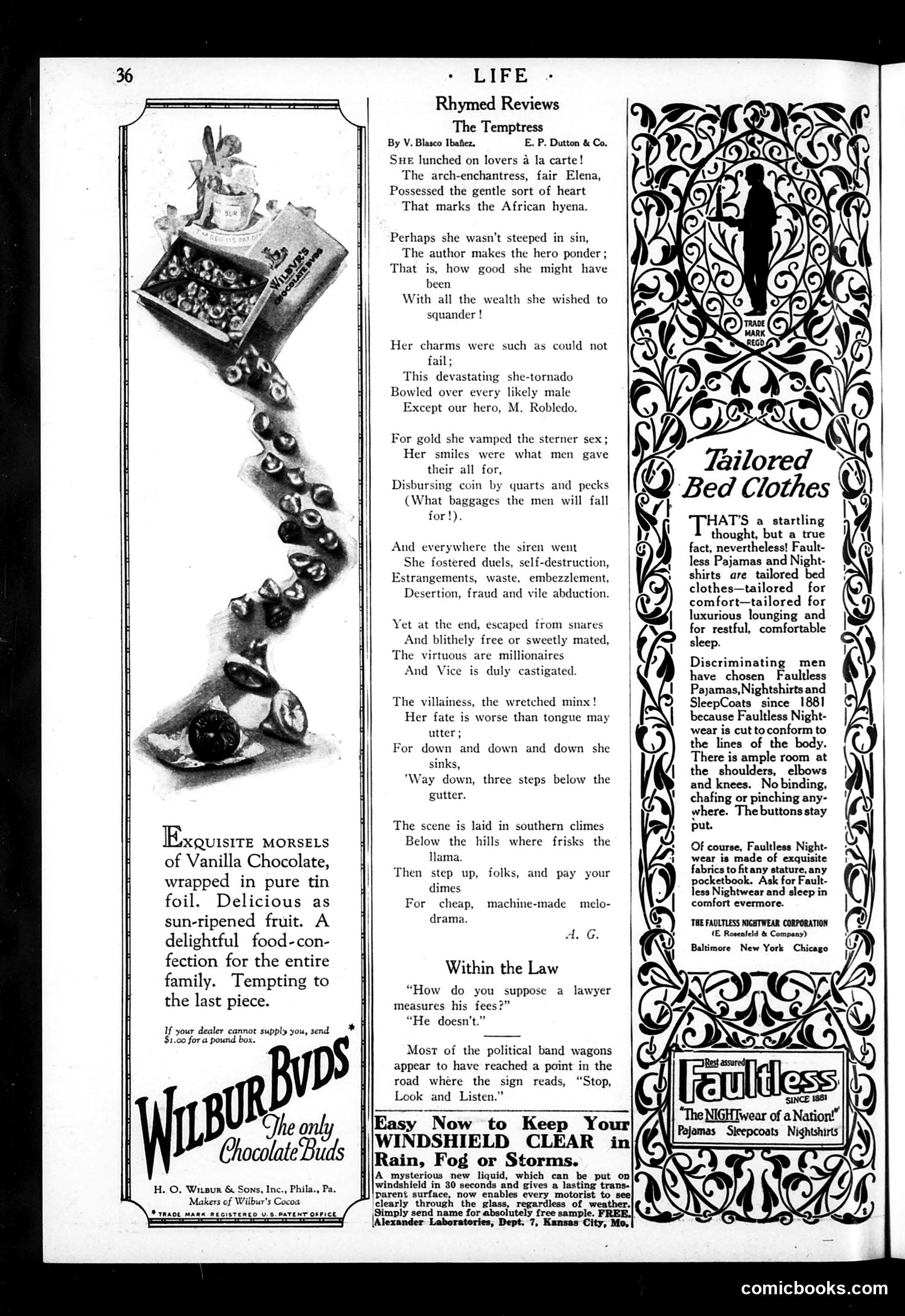
This page is primarily **advertising** with a satirical book review sidebar. The main content is a rhymed review of "The Temptress" by V. Blasco Ibáñez, a novel about Elena, a seductive woman who destroys men financially and morally through her charms—causing "duels, self-destruction, embezzlement, desertion, fraud." The satire mocks melodramatic "machine-made drama": the review notes the ironic moral ending where virtuous characters become millionaires while the villainess sinks "three steps below the gutter." A small joke about lawyers appears: when asked how lawyers measure fees, the answer is "He doesn't"—implying lawyers are dishonest or arbitrary in charging. The page is dominated by **period advertisements** for Wilbur chocolate candies, Faultless pajamas (emphasizing comfort and tailoring), a windshield treatment product, and bedclothes. These ads reflect early 20th-century consumer goods marketed to middle-class readers.
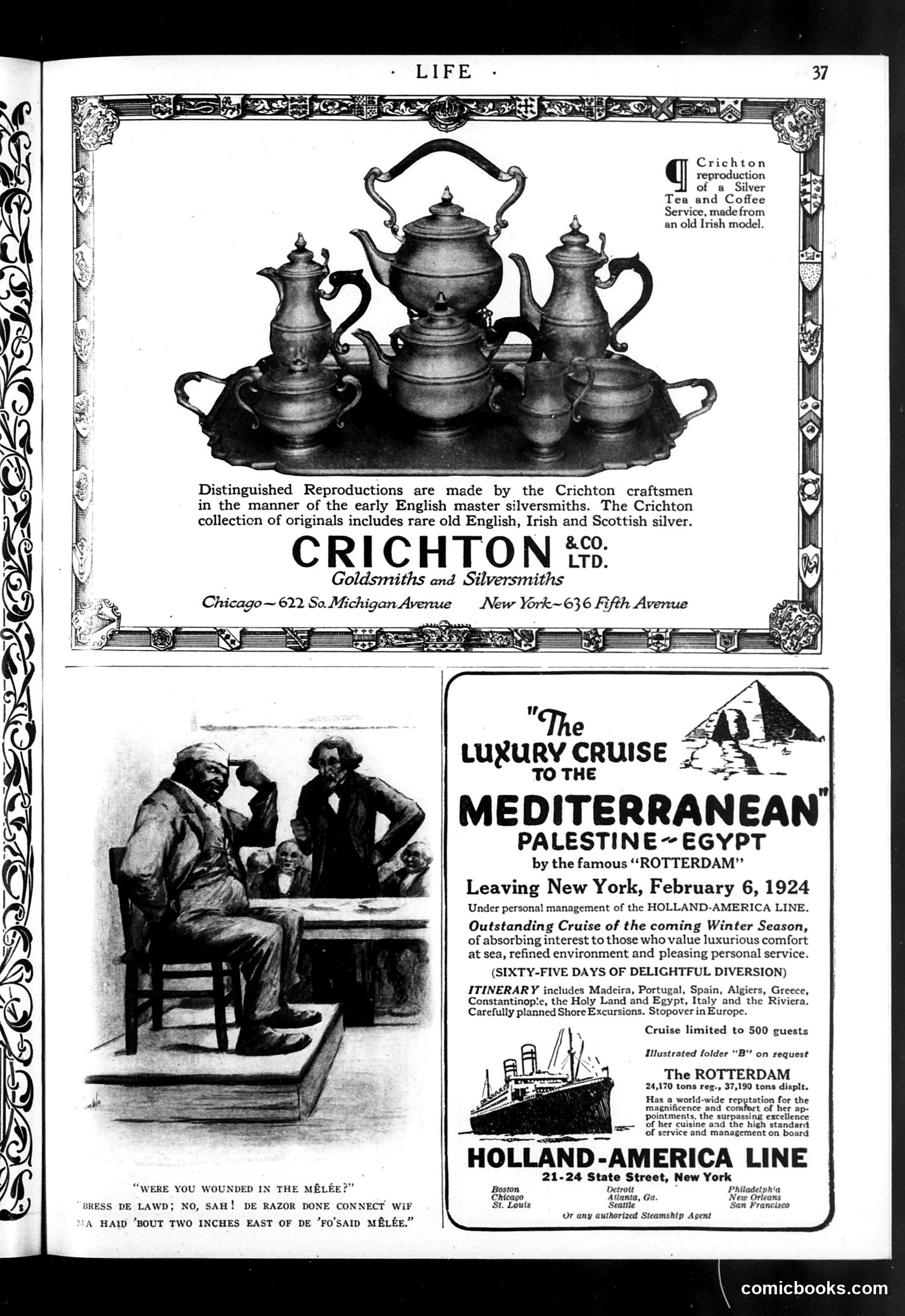
This page combines advertisements with a racist cartoon. The main comic depicts two figures in dialect, with one claiming a razor wound during "the melee" — using exaggerated African American vernacular ("Bress de Lawd," "WiF"). The humor relies on minstrel-show stereotypes: depicting Black Americans as violent, uneducated, and prone to razor fights. The page otherwise features luxury advertising: a Crichton & Co. silver tea service reproduction and a Holland-America Line Mediterranean cruise advertisement. These upscale ads contrast sharply with the demeaning racial caricature above them. This 1920s content reflects the casual racism endemic to mainstream American publications of the era, where such stereotypes appeared alongside polished consumer marketing without apparent contradiction to editors or intended audiences.
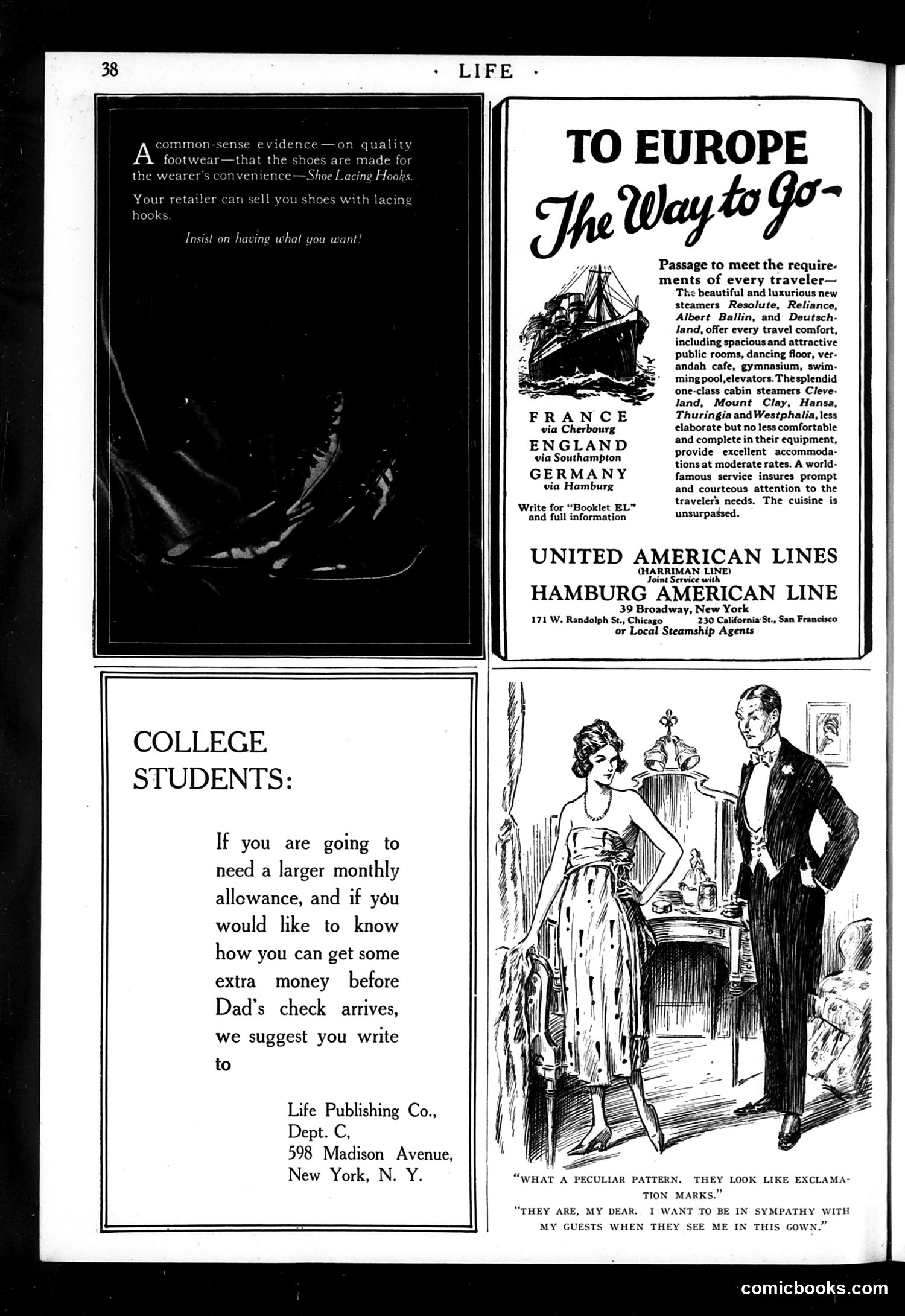
This is primarily an **advertising page** rather than political satire. It contains three distinct ads: 1. **Shoe Lacing Hooks** (top left): A product advertisement emphasizing quality footwear with functional lacing hooks. 2. **Transatlantic Steamship Travel** (top right): Promotes luxury ocean liners (United American Lines/Hamburg American Line) offering passage to Europe with amenities like dancing floors, gymnasiums, and swimming pools—appealing to wealthy travelers of the era. 3. **College Student Humor** (bottom left): Life Publishing Co. humorously solicits college students needing money before their fathers' checks arrive, suggesting they subscribe or advertise. 4. **Fashion Cartoon** (bottom right): A couple discusses the woman's patterned gown, with exclamation-mark-like designs. The humor lies in her wanting guests to sympathize with her fashion choice—gentle social satire about conspicuous display and seeking approval for clothing. The page reflects 1920s-30s consumer culture and upper-class leisure travel.
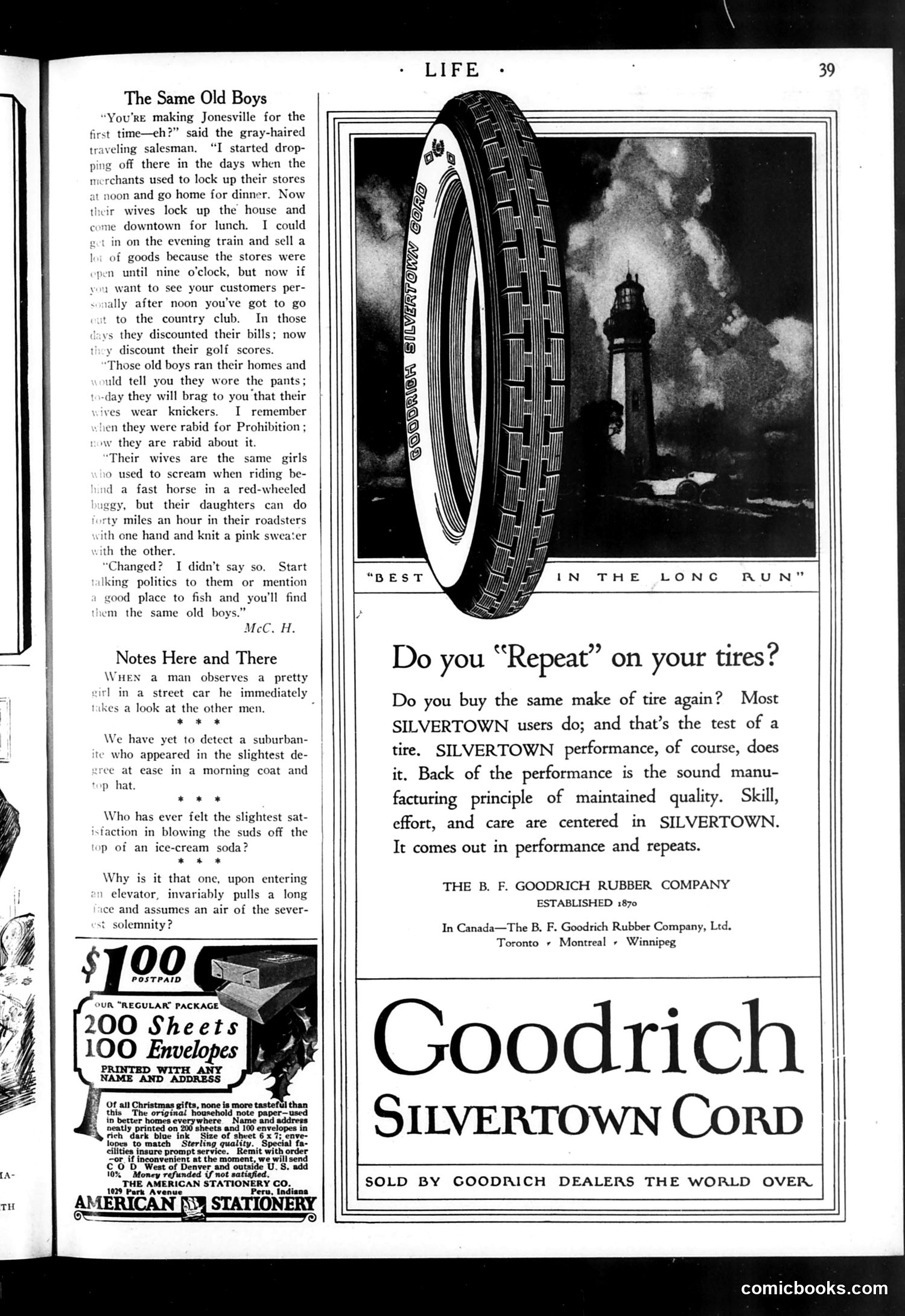
This page contains a humorous monologue by a traveling salesman observing social change in small-town America (Jonesville). The salesman catalogs how life has transformed yet remains fundamentally unchanged: **The satire's point:** Despite surface modernization—wives now go downtown for lunch instead of staying home, daughters drive fast cars and knit simultaneously, people wear knickers and visit country clubs—the core human nature of these "old boys" remains constant. They still care about fishing and politics; their wives are the same spirited women, just in modern dress. The joke critiques how Americans mistake *superficial* cultural shifts (automobiles, fashion, women's mobility) for genuine transformation while remaining essentially the same in values and behavior. The rest of the page is advertising (Silvertown tires, American Stationery) unrelated to the satire.
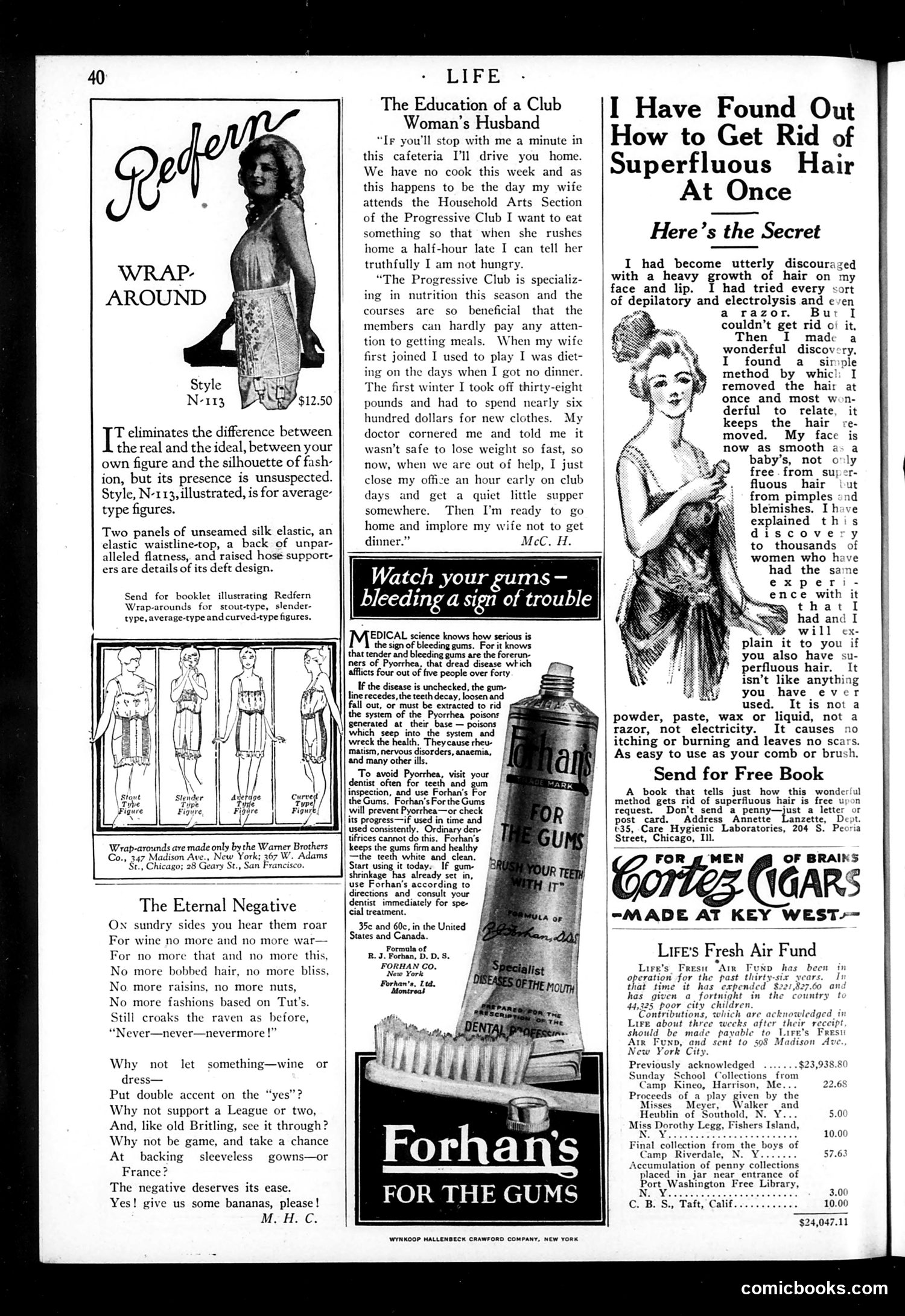
This page contains primarily **advertisements and light social commentary** rather than political cartoons. The main satirical piece is "The Education of a Club Woman's Husband," which humorously critiques women's club culture of the era. A husband describes how his wife's attendance at the Progressive Club's "Household Arts Section" for nutrition courses ironically leaves him without dinner—forcing him to eat out alone while she learns about beneficial meal planning. The joke satirizes the disconnect between women's new educational pursuits and traditional domestic duties, suggesting these clubs, while progressive, sometimes neglect the home they supposedly educate women to manage. The other content is advertising: Redfern corsets/wrap-arounds (promising to flatten the body for fashionable silhouettes), Forhan's toothpaste (warning of gum disease/pyorrhea), and a hair removal product. "The Eternal Negative" is a short poem mocking prohibition advocates and those opposing modern fashions (bobbed hair, sleeveless gowns). The page reflects 1920s anxieties about women's changing roles and modern consumer culture.
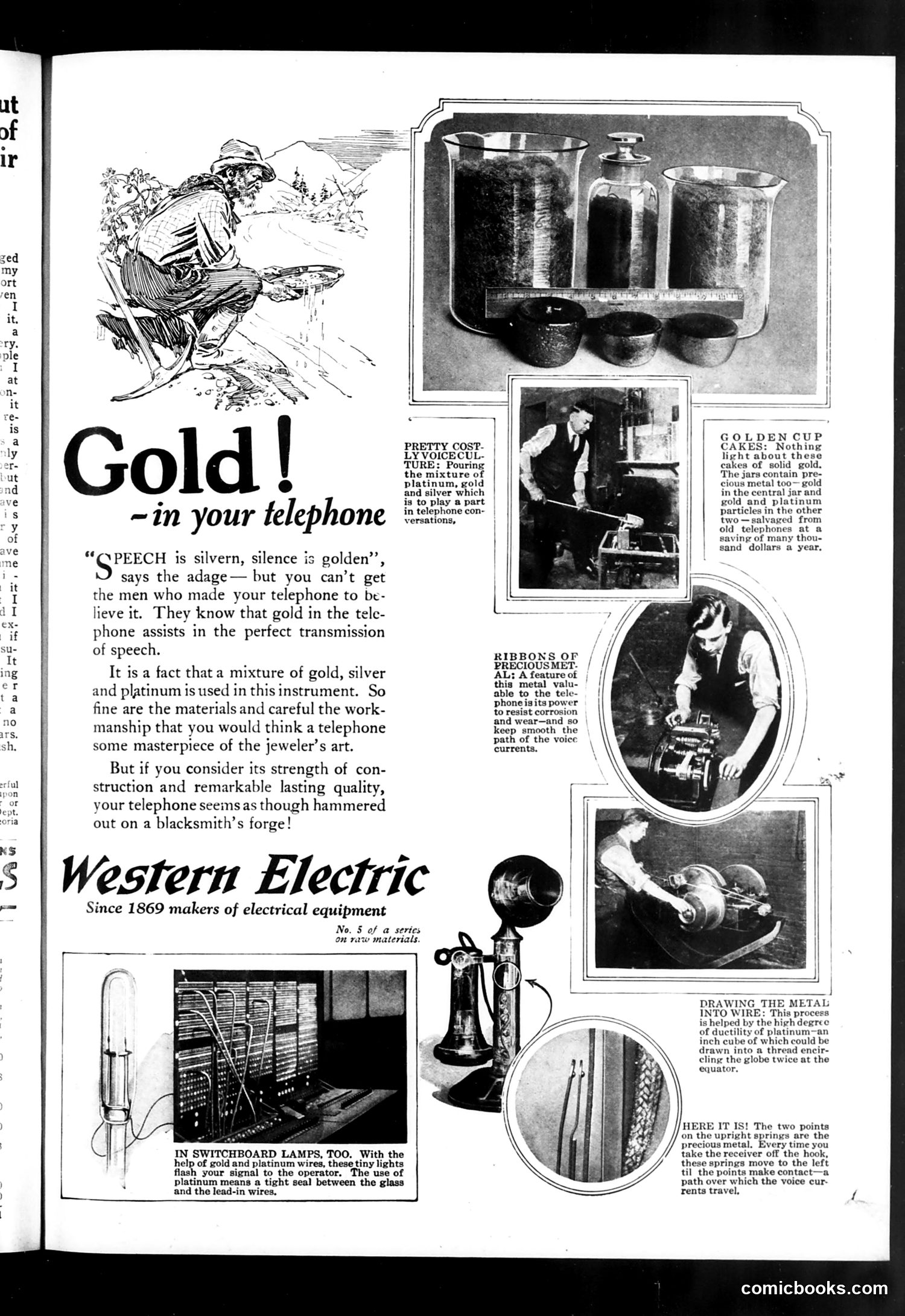
This is not political satire but rather a **corporate advertisement** for Western Electric, makers of telephone equipment. The page explains—with detailed photographs and diagrams—how precious metals (gold, silver, and platinum) are essential components in telephone technology. The opening quip ("Speech is silvern, silence is golden") is a pun on the proverb, used to justify why gold actually appears in phones. The content demonstrates how these metals improve electrical transmission, prevent corrosion, and enable the mechanical contacts that route calls through switchboards. The accompanying illustration of a miner appears to be purely decorative, evoking the "raw materials" theme stated at the bottom. This is a technical marketing piece aimed at educating readers about manufacturing quality—essentially saying: your telephone is as finely crafted as jewelry, justifying both its cost and reliability.
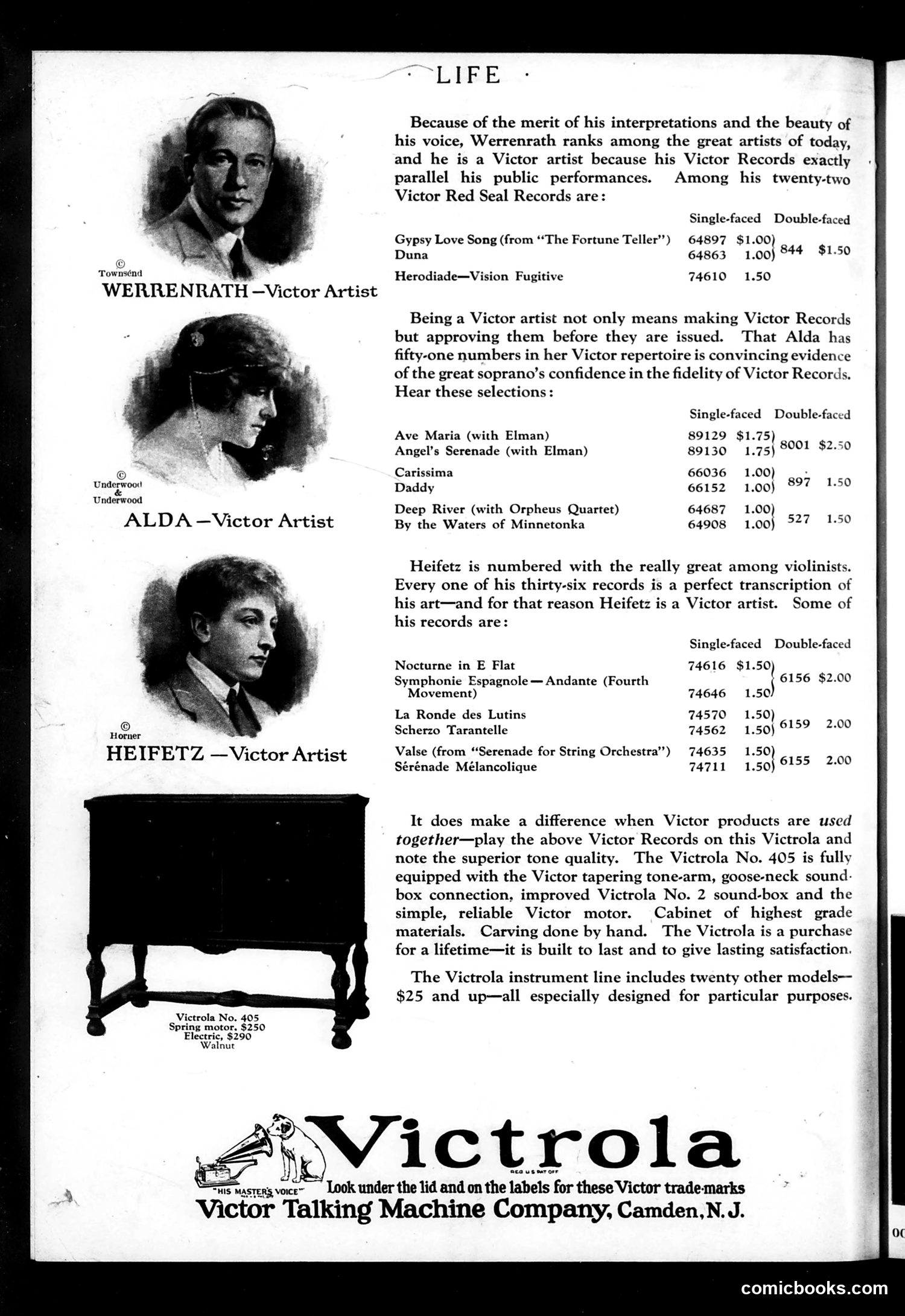
This is not a political cartoon but rather a **Victor Talking Machine Company advertisement** from *Life* magazine. It promotes Victrolas (phonographs) by featuring three prominent classical musicians of the era: Werrenrath (tenor), Alda (soprano), and Heifetz (violinist). The ad's strategy positions these "Victor artists" as endorsers—their recordings "exactly parallel" live performances, lending credibility to the technology. By listing their Victor Red Seal Records with catalog numbers and prices, the company suggests that owning a Victrola allows consumers to experience great artists in their homes. The featured Victrola No. 405 model, priced at $250–$290, is presented as a lifetime purchase with superior construction ("carving done by hand"). The implicit message: investing in this phonograph means access to world-class artistic performances. This reflects early 20th-century consumer marketing linking luxury goods to cultural prestige and celebrity endorsement.