
Life, 1923-10-04 · page 26 of 44
Life — October 4, 1923 — page 26: what you’re looking at
What you’re looking at
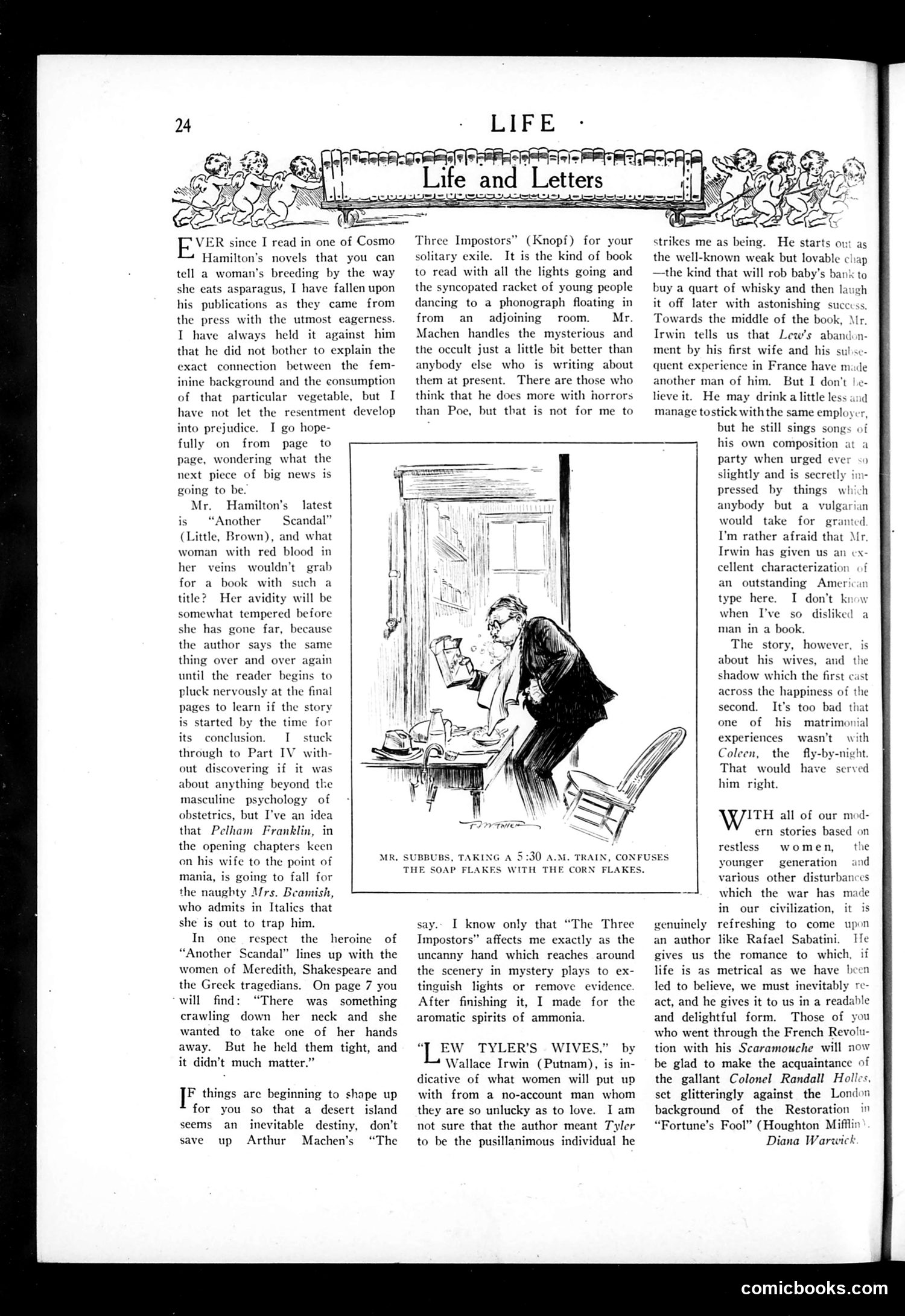
This is a literary review column titled "Life and Letters." The main illustration depicts a man at a desk in early morning (5:30 a.m., per the caption), confusing soap flakes with corn flakes—a visual gag about absent-minded confusion before dawn. The text reviews three books: Cosmo Hamilton's "Another Scandal," Arthur Machen's "The Three Impostors," and Wallace Irwin's "Lew Tyler's Wives." The reviewer critiques Hamilton for repetitive plotting, praises Machen's handling of the occult, and expresses strong dislike for Irwin's protagonist—a weak, alcoholic man who abandons his first wife, yet the author claims he's reformed. The reviewer remains skeptical of this character redemption. The satirical point is literary: mocking both author pretension (Hamilton's overwrought morality tales) and readers' gullibility regarding character development. The breakfast-time illustration serves as visual relief in the dense text.
📄 Transcribed text from this page (OCR, searchable)
Machine-transcribed from the original scan — historical spelling and the odd misread are preserved.
i Life and d_ Letters VER since I read in one of Cosmo Hamilton's novels that you can s breeding by the way she eats aragus, I have fallen upon his publications as they came from the press with the utmost eagerness. I have always held it against him that he did not bother to explain the exact connection between the fem- inine background and the consumption of that particular vegetable, but I the resentment develop into prejudice. I go hope- tell a woma have not let (Knopf) for your solitary exile. It is the kind of book to read with all the lights going and the syncopated racket of young people dancing to a phonograph floating in from an adjoining room. Mr. Machen handles the mysterious and the occult just a little bit better than anybody is writing them at present. There are those who think that he does more with horrors than Poe, but that is not for me to Three Impostors” else who about strikes me as being. He starts out as the well-known weak but lovable clap —the kind that will rob baby’s bank to buy a quart of whisky and then |. it off later with astonishing success. Towards the middle of the book, Mr. Irwin tells us that Lew’s abandon- ment by his first wife and his sul.se- quent experience in France have made another man of him. But I don’t lieve it. He may drink a little less an manage tostick withthe same employer, but he still sings fully on from page to page, wondering what the next piece of big news is going to be. Mr. Hamilton's _ latest is “Another Scandal” (Little, Brown), and what woman with red blood in her veins wouldn't for a book with such a title? Her avidity will be somewhat tempered before she has gone far, b the author says the thing over and over until the reader begins to pluck nervously at the final pages to learn if the story is started by the time for its conclusion. I stuck through to Part IV with- out discovering if it about anything beyond the masculine psychology of obstetrics, but I've an idea that Pelham Franklin, in the opening chapters keen on his wife to the point of mania, is going to fall for the naughty Mrs. Beamish, grab cause was TAKING A 5:30 a.m. SOAP FLAKES WITH THE CORN F his own composition at party when urged ever slightly and is secretly i pressed by things which anybody but a vulgarian would ke for granted I'm rather afraid that Mr Irwin has given us an cx- cellent characterizatior an outstanding Americ type here. I don’t ki when I’ve so disliked man in a book. The story, about his however, is wives, and the shadow which the first cast across the happiness of the second. It’s too bad that one of his matrimonial experiences wasn’t with Coleen, the fly-by-night. That would have him right. served ITH all of our mod- ern stories based on women, _ the generation and restles: younger various other disturbances who admits in Italics that she is out to trap him. In one respect the heroine of “Another Scandal” lines up with the women of Meredith, Shakespeare and the Greek tragedians. On page 7 you will find: “There was something crawling down her neck and she wanted to take one of her hands away. But he held them tight, and it didn’t much matter.” F things are beginning to shape up for you so that a desert island seems an inevitable destiny, don’t save up Arthur Machen’s “The say.- I know only that “The Three Impostors” affects me exactly as the uncanny hand which reaches around the scenery in mystery plays to ex- tinguish lights or remove After finishing it, I made for the aromatic spirits of ammonia. evidence EW TYLER’S WIVES,” by Wallace Irwin (Putnam), is in- dicative of what women will put up with from a no-account man whom they are so unlucky as to love. I am not sure that the author meant Tyler to be the pusillanimous individual he which the war has made in our civilization, it genuinely refreshing to come upon an author like Rafael Sabatini. He gives us the romance to which, if life is as metrical as we have been led to believe, we must inevitably re- act, and he gives it to us in a readable and delightful form. Those of you who went through the French Revolu- tion with his Scaramouche will y be glad to make the acquaintance © the gallant Colonel Randall Holles, set glitteringly against the London background of the Restoration in “Fortune’s Fool” (Houghton Mifflin Diana Warwick comicbooks.com