
Life, 1923-10-04 · page 17 of 44
Life — October 4, 1923 — page 17: what you’re looking at
What you’re looking at
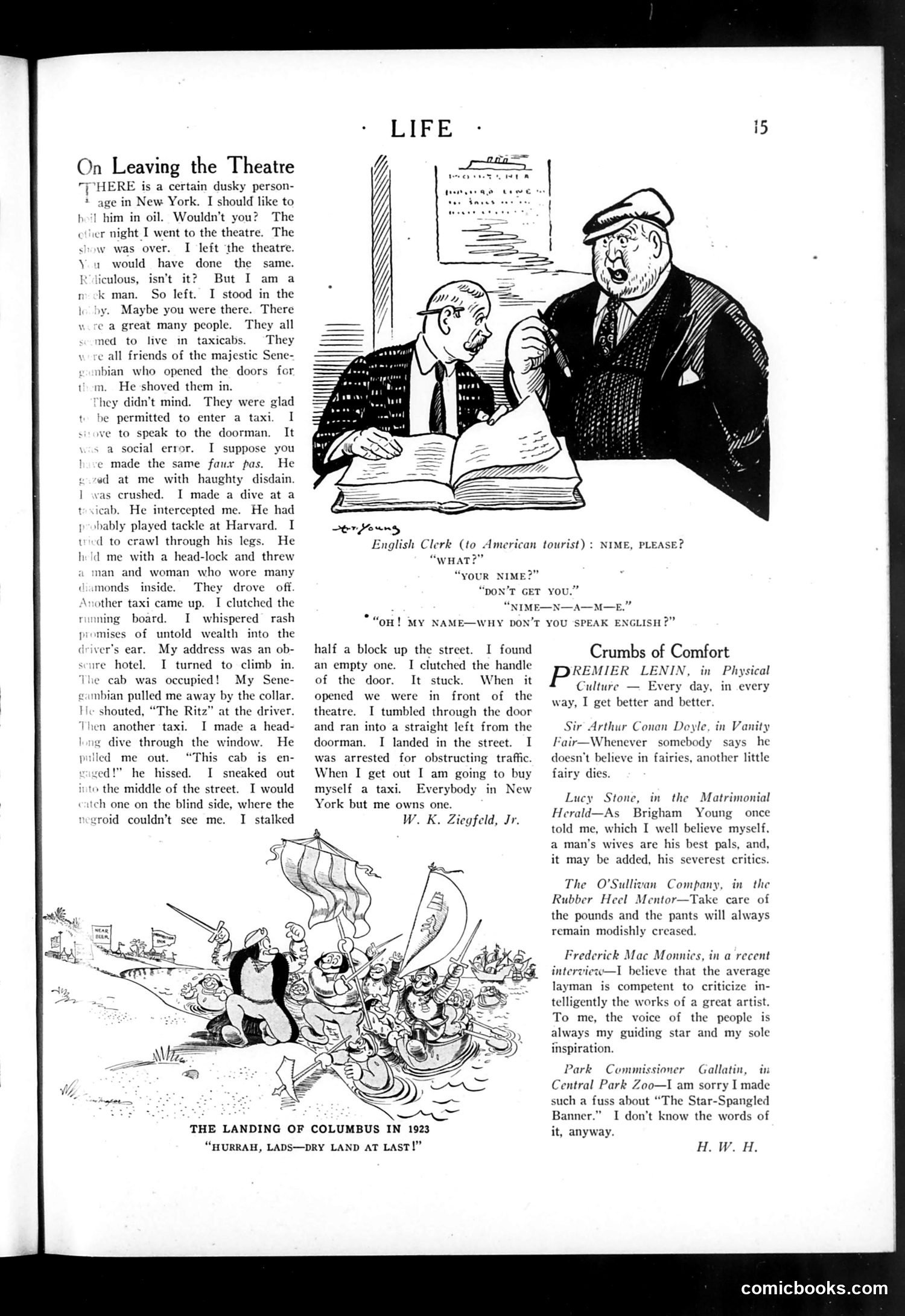
The cartoon depicts Columbus's 1923 landing as a chaotic scene of modern American commercialism and excess rather than historical solemnity. Native Americans are shown as cartoonish figures swarming around Columbus and his crew, who appear indifferent or opportunistic. The caption "HURRAH, LADS—DRY LAND AT LAST!" satirizes the 400th anniversary celebration of Columbus's voyage (1492-1923), suggesting that early 1920s America had devolved into crass materialism and national self-congratulation far removed from historical dignity. The top illustration shows an English clerk pestering an American tourist about proper names and English language, mocking both British pretension and American tourists abroad—a common satirical theme in this era.
📄 Transcribed text from this page (OCR, searchable)
Machine-transcribed from the original scan — historical spelling and the odd misread are preserved.
On Leaving the Theatre "THERE is a certain dusky person- * age in New York. I should like to boil him in oil. Wouldn't you? The ctier night I went to the theatre. The w was over. I left ‘the theatre. 1 would have done the same. iculous, isn’t it? But I am a k man. So left. I stood in the vy. Maybe you were there. There © a great many people. They all ned to live in taxicabs. They call friends of the majestic Sene- ibian who opened the doors for m. He shoved them in. hey didn’t mind. They were glad be permitted to enter a taxi. I ve to speak to the doorman. It a social error. I suppose you e made the same faur pas. He ed at me with haughty disdain. as crushed. I made a dive at a cab. He intercepted me. He had bably played tackle at Harvard. I men seuny d to crawl through his legs. He English Clerk (to American tourist) : NIME, PLEAS | me with a head-lock and threw “WHat?” nan and woman who wore many “yoUR NIME?” monds inside. They drove off. nother taxi came up. I clutched the ning board. I whispered rash mises of untold wealth into the ver’s ear. My address was an ob- half a block up the street. I found ire hotel. I turned to climb in. an empty one. I clutched the handle REMIER L cab was occupied! My Sene- of the door. It stuck. When it nbian pulled me a by the collar. opened we were in front of the shouted, “The Ritz” at the driver. theatre. I tumbled through the door en another taxi. I made a head- and ran into a straight left from the Sir Arthur Conan Deyle, in Vanity dive through the window. He doorman. I landed in the street. I | /air—Whenever somebody says he led me out. “This cab is en- was arrested for obstructing traffic. doesn’t believe in fairies, another little ved!" he hissed. I sneaked out When I get out I am going to buy fairy dies. to the middle of the street. I would myself a taxi. Everybody in New tch one on the blind side, where the York but me owns one. groid couldn't see me. I stalked W. K. Ziegfeld, Jr. in’ Physical Culture — ery day, in every way, I get better and better. Lucy Stone, in the Matrimonial Herald—As_ Brigham Young once told me, which I well believe myself. a man’s wives are his best pals, and, it may be added, his severest critics. The O’Sullivan Company, in the Rubber Heel Mentor—Take care of the pounds and the pants will always remain modishly creased. Frederick Mac Monnices, in a recent interview—I believe that the average layman is competent to criticize in- telligently the works of a great artist. To me, the voice of the people is always my guiding star and my sole inspiration. Park Commissioner Gallatin, in Central Park Zoo—I am sorry I made such a fuss about “The Star-Spangled seca —_—“ Banner.” I don’t know the words of THE LANDING OF COLUMBUS IN 1923 it, anyway. “HURRAH, LADS—DRY LAND AT LAST!” H.W. H. comicbooks.com