
Life, 1923-10-04 · page 28 of 44
Life — October 4, 1923 — page 28: what you’re looking at
What you’re looking at
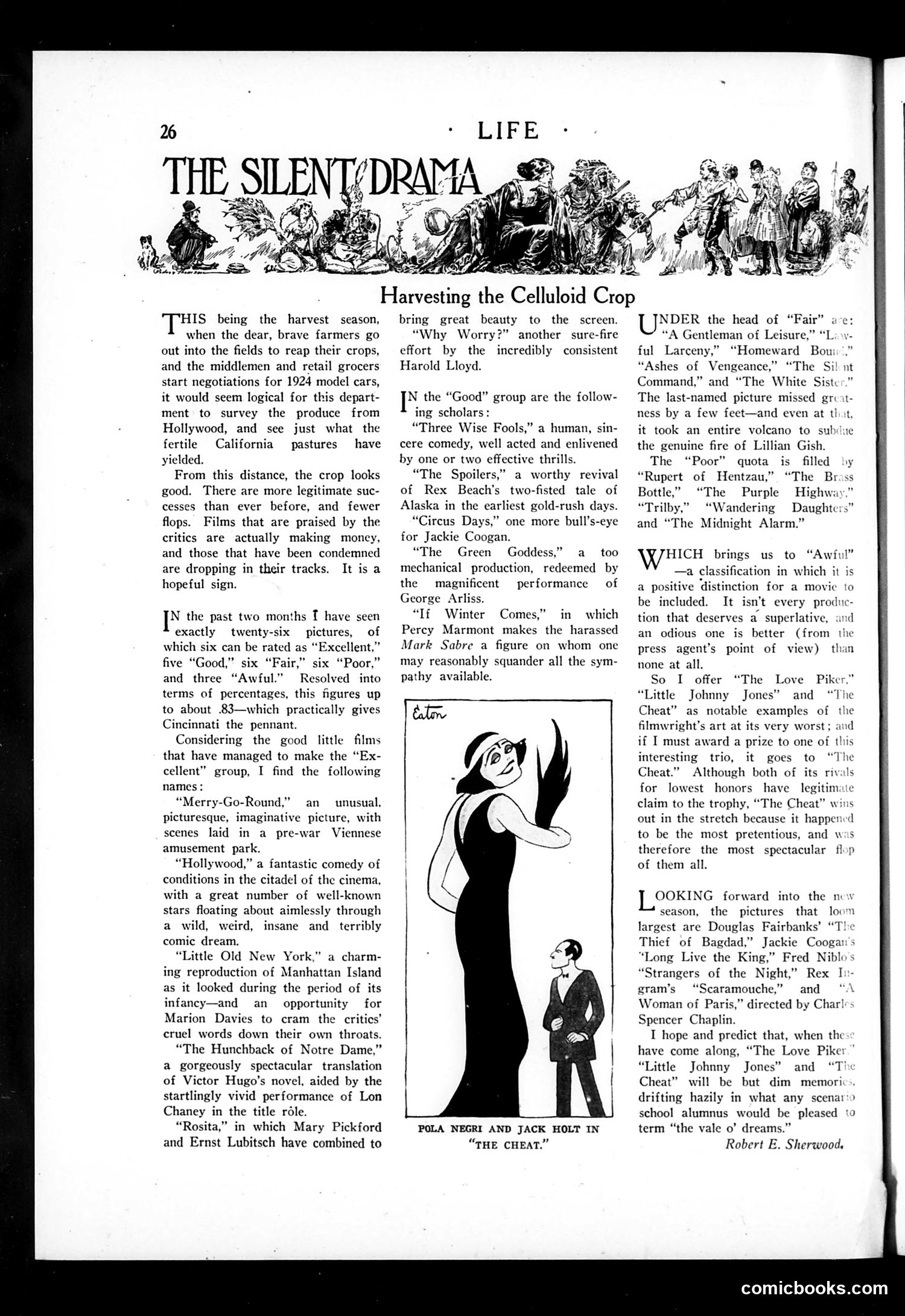
This is a film-industry satire column reviewing 1924 movies. The author uses an agricultural metaphor, comparing Hollywood's film output to a harvest season crop. He rates 26 recent films: six "Excellent," five "Good," six "Fair," six "Poor," and three "Awful." The humor lies in awarding prestige to genuinely terrible films—particularly "The Cheat" (illustrated with Pola Negri and Jack Holt)—because being "Awful" becomes a distinction itself. Bad films generate press attention, making them valuable to studios despite critical failure. Notable praised films include Lon Chaney's "Hunchback of Notre Dame" and Harold Lloyd comedies. The statistics joke—calculating percentages that equal ".83"—playfully references Cincinnati's baseball pennant standing. The satire targets both Hollywood's quantity-over-quality production system and the perverse publicity value of spectacular failures.
📄 Transcribed text from this page (OCR, searchable)
Machine-transcribed from the original scan — historical spelling and the odd misread are preserved.
THE _ SILENT = Wt? fig a aa i) hes Harvesting the Celluloid Grip THs being the harvest season, when the dear, brave farmers go out into the fields to reap their crops, and the middlemen and retail grocers start negotiations for 1924 model cars, it would seem logical for this depart- ment to survey the produce from Hollywood, and see just what the fertile California pastures have yielded. From this distance, the crop looks good. There are more legitimate suc- cesses than ever before, and fewer flops. Films that are praised by the critics are actually making money, and those that have been condemned are dropping in their tracks. It is a hopeful sign. N the past two months f have seen exactly twenty-six pictures, of which six can be rated as “Excellent,” five “Good,” six “Fair,” six “Poor,” and three “Awful.” Resolved into terms of percentages, this figures up to about .83—which practically gives Cincinnati the pennant. Considering the good little films that have managed to make the “Ex- cellent” group, I find the following names: “Merry-Go-Round,” an unusual, picturesque, imaginative picture, with scenes laid in a pre-war Viennese amusement park. “Hollywood,” a fantastic comedy of conditions in the citadel of the cinema, with a great number of well-known stars floating about aimlessly through a wild, weird, insane and_ terribly comic dream. “Little Old New York,” a charm- ing reproduction of Manhattan Island as it looked during the period of its infancy—and an opportunity for Marion Davies to cram the critics’ cruel words down their own throats. “The Hunchback of Notre Dame,” a gorgeously spectacular translation of Victor Hugo’s novel, aided by the startlingly vivid performance of Lon Chaney in the title rdle. “Rosita,” in which Mary Pickford and Ernst Lubitsch have combined to bring great beauty to the screen. “Why Worry?” another sure-fire effort by the incredibly consistent Harold Lloyd. N the “Good” group are the follow- ing scholars: “Three Wise Fools,” a human, sin- cere comedy, well acted and enlivened by one or two effective thrills. “The Spoilers,” a worthy revival of Rex Beach's two-fisted tale of Alaska in the earliest gold-rush days. “Circus Days,” one more bull’s-eye for Jackie Coogan. “The Green Goddess,” a too mechanical production, redeemed by the magnificent performance of George Arliss. “If Winter Comes,” in which Percy Marmont makes the harassed Mark Sabre a figure on whom one may reasonably squander all the sym- pathy available. POLA NEGRI AND JACK HOLT IN “THE CHEAT.” UNDER the head of “Fair” Gentleman of Leisure,” “L ful Larceny,” “Homeward Bou “Ashes of Vengeance,” “The Si Command,” and “The White Sist: The last-named picture missed gr ness by a few feet—and even at tl it took an entire volcano to sub: the genuine fire of Lillian Gish. The “Poor” quota is filled “Rupert of Hentzau,” “The Br Bottle,” “The Purple Highwa “Trilby,” “Wandering Daughter and “The Midnight Alarm.” HICH brings us to “Awful” —a classification in which it is a positive distinction for a movie to be included. It isn’t every produc- tion that deserves a superlative, and an odious one is better (from the press agent’s point of view) than none at all. So I offer “The Love Piker.” “Little Johnny Jones” and “The Cheat” as notable examples of the filmwright’s art at its very worst; and if I must award a prize to one of this interesting trio, it goes to “The Cheat.” Although both of its rivals for lowest honors have legitimate claim to the trophy, “The Cheat” wins out in the stretch because it happened to be the most pretentious, and was therefore the most spectacular flop of them all. OOKING forward into the now season, the pictures that loom largest are Douglas Fairbanks’ “T!x Thief of Bagdad,” Jackie Coogan's “Long Live the King,” Fred Niblos “Strangers of the Night,” Rex In- gram’s “Scaramouche,” and = “.\ Woman of Paris,” directed by Charl°s Spencer Chaplin. I hope and predict that, when the have come along, “The Love Pike “Little Johnny Jones” and “Ti Cheat” will be but dim memori drifting hazily in what any scenar‘o school alumnus would be pleased to term “the vale o’ dreams.” Robert E. Sherwood. comicbooks.com