
Life, 1923-10-04 · page 20 of 44
Life — October 4, 1923 — page 20: what you’re looking at
What you’re looking at
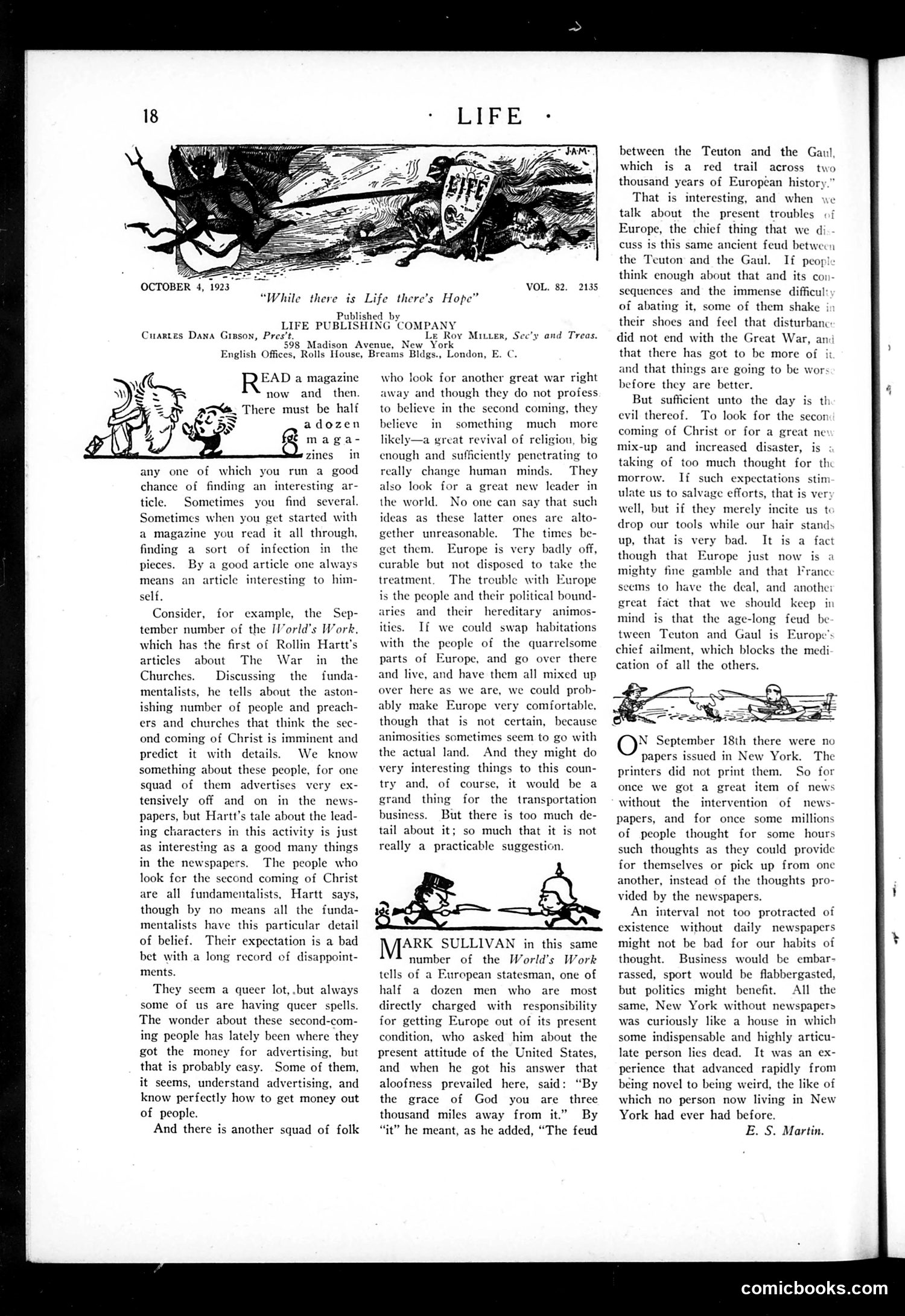
This page contains editorial commentary and no political cartoons, despite the header image showing a classical "Hope" figure. The content discusses religious and geopolitical concerns of 1923. The main topics referenced: 1. **Fundamentalist "Second Coming" movements**: Rollin Hart's article criticizes American religious groups predicting Christ's imminent return, noting their extensive (and well-funded) advertising campaigns promoting this belief. 2. **European instability**: The editors discuss the deep-rooted conflict between "Teuton and Gaul" (Germans and French)—described as "a red trail across two thousand years of European history." A European statesman expresses relief America is "three thousand miles away" from these ancient feuds. 3. **Post-WWI anxiety**: The piece reflects 1923 anxieties about potential new wars and religious revival movements, suggesting both are reactions to post-war trauma. The satire targets American gullibility regarding both religious prophecy and European problems—implying Americans naively discuss solutions while remaining blissfully distant from actual consequences.
📄 Transcribed text from this page (OCR, searchable)
Machine-transcribed from the original scan — historical spelling and the odd misread are preserved.
VOL. 82. 2135 “While there is Life there’s Hope” Published by LIFE PUBLISH Cuartes Dana Grnson, Pres’t. ING COMPANY Le Roy Miter, Sec’y and Treas. 598 Madison Avenue, New York English Offices, Rolls House, Breams Bldgs., London, REAP a magazine now and_ then. There must be half adozen ma ga- zines in any which you run a good chance of finding an interesting ar- ticle. Sometimes you find several. Sometimes when you get started with a magazine you read it all through, finding a sort of infection in the By a good article one always ing to him- one of pieces. means an article interes self. Consider, for example, the Sep- tember number of the [V’orld’s Work, which has the first of Rollin Hartt's articles about The War in the Churches. Discussing the funda- mentalists, he tells about the aston- ishing number of people and preach- ers and churches that think the sec- ond coming of Christ is imminent and predict it with details. We know something about these people, for one squad of them advertises very ex- tensively off and on in the news- papers, but Hartt’s tale about the lead- ing characters in this activity is just as interesting as a good many things in the newspapers. The people who look for the second coming of Christ are all fundamentalists, Hartt says, though by no means all the funda- mentalists have this particular detail of belief. Their expectation is a bad bet with a long record of disappoint- ments. They seem a queer lot, .but always some of us are having queer spells. The wonder about these second-com- ing people has lately been where they got the money for advertising, but that is probably easy. Some of them, it seems, understand advertising, and know perfectly how to get money out of people. And there is another squad of folk who look for another great war right away and though they do not profess to believe in the second coming, they something much likely—a great revival of religion, big enough and sufficiently penetrating to really change human minds. They also look for a great new leader in the world. No one can say that such ideas as these believe in more latter ones are alto- The times be- y badly off, curable but not disposed to take the treatment. The trouble with Europe is the people and their political bound- aries and their hereditary animos- ies. If we could swap habitations with the people of the quarrelsome parts of Europe, and go over there and live, and have them all mixed up over here as we are, we could prob- ably make Europe very comfortable. though that is not certain, because animosities sometimes seem to go with the actual land. And they might do very interesting things to this coun- try and, would be a grand thing for the transportation business. But there is too much de- tail about it; so much that it is not really a practicable suggestion gether unreasonable. get them. Europe is v of course, it ARK SULLIVAN in this same number of the World's Work tells of a European statesman, one of half a dozen men who are most directly charged with responsibility for getting Europe out of its present condition, who asked him about the present attitude of the United States, and when he got his answer that aloofness prevailed here, said: “By the grace of God you are three thousand miles away from it.” By “it” he meant, as he added, “The feud between the Teuton and the Gaul, which is a red trail across two thousand years of European history.” That is interesting, and when we talk about the present troubles Europe, the chief thing that we d cuss is this same ancient feud between the Teuton and the Gaul. If peop! think enough about that and its con- sequences and the immense difficul oi abating it, some of them shake j their shoes and feel that disturbanc did not end with the Great War, ani that there has got to be more of and that things are going to be wors before they are better. But sufficient unto the day is th evil thereof. To look for the secon coming of Christ or for a great ne mix-up and increased disaster, is taking of too much thought for th morrow. If such expectations stim ulate us to salvage efforts, that is ver well, but if they merely incite us t drop our tools while our hair stands up, that is very bad. It f though that Europe just now is a mighty fine gamble and that Franc: seems to have the deal, and anothe: great fact that we should keep in mind is that the age-long feud be tween Teuton and Gaul is Europe chief ailment, which blocks the medi cation of all the others. is a fact N September 18th there were no papers issued in New York. The printers did not print them. So for once we got a great item of news without the intervention of news- papers, and for once some millions of people thought for some hours such thoughts as they could provide for themselves or pick up from one another, instead of the thoughts pro- vided by the newspapers. An interval not too protracted of existence without daily newspapers might not be bad for our habits of thought. Business would be embar- rassed, sport would be flabbergasted, but politics might benefit. All the same, New York without newspaper> was curiously like a house in which some indispensable and highly articu- late person lies dead. It was an ex perience that advanced rapidly from being novel to being weird, the like of which no person now living in New York had ever had before. E. S. Martin. comicbooks.com