
Life, 1923-10-04 · page 24 of 44
Life — October 4, 1923 — page 24: what you’re looking at
What you’re looking at
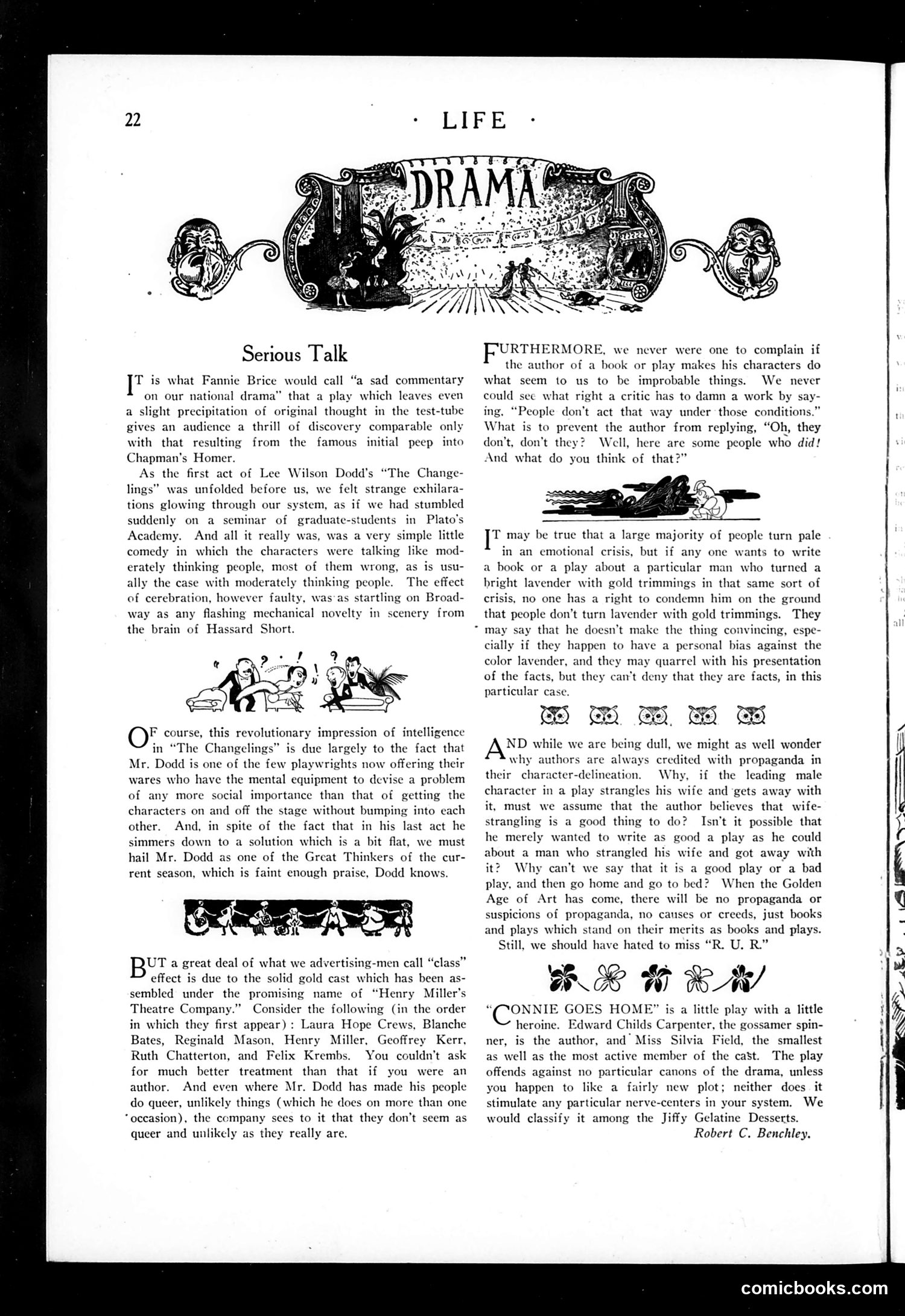
This drama criticism praises playwright Lee Wilson Dodd's recent play for featuring characters who speak intelligently—a rarity on Broadway that the critic finds shockingly refreshing. The piece defends the play against potential criticism, arguing that playwrights shouldn't be condemned for depicting improbable character actions or behaviors (like someone turning "bright lavender with gold trimmings" during emotional crisis). The critic also dismisses assumptions that character actions reflect authorial endorsement—a wife-strangler in a play doesn't mean the author advocates wife-strangling. The named cast members (Laura Hope Crews, Blanche Bates, Henry Miller, Ruth Chatterton, et al.) were prominent Broadway actors of the era whose star power elevated the production's prestige. The satirical tone criticizes Broadway audiences and critics for finding mere intelligence in dialogue extraordinary, suggesting the theatrical standard was dismayingly low.
📄 Transcribed text from this page (OCR, searchable)
Machine-transcribed from the original scan — historical spelling and the odd misread are preserved.
Serious Talk T is what Fannie Brice would call “a sad commentary on our national drama” that a play which leave a slight precipitation of original thought in the te: gives an audience a thrill of discovery comparable only with that resulting from the famous initial peep Chapman's Homer. As the first act of Lee Wilson Dodd's “The Change- lings” was unfolded before us, into we felt strange exhilara- em, as if we had stumbled suddenly on a seminar of graduate-students in Plato's Academy. And all it really was, was a very simple little comedy in which the characters were talking like mod- erately thinking people, most of them wrong, ally the case with moderately thinking people. tions glowing through our s usu- The effect of cerebration, however faulty, was’as startling on Broad- way as any flashing mechanical novelty in scenery from the brain of Hassard Short. F course, this revolutionary impression of intelligence in “The Changelings” is due largely to the fact that Mr. Dodd is one of the few playwrights now offering their wares who have the mental equipment to devise a problem of any more social importance than that of getting the characters on and off the stage without bumping into each other. And, in spite of the fact that in his last act he simmers down to a solution which is a bit flat, we must hail Mr. Dodd as one of the Great Thinkers of the cur- rent season, which is faint enough praise, Dodd knows. UT a great deal of what we advertising-men call “class” effect is due to the solid gold cast which has been as- sembled under the promising name of “Henry Miller's Theatre Company.” Consider the following (in the order in which they first appear): Laura Hope Crews, Blanche Bates, Reginald Mason, Henry Miller, Geoffrey Kerr, Ruth Chatterton, and Felix Krembs. You couldn't ask for much better treatment than that if you were an author. And even where Mr. Dodd has made his people do queer, unlikely things (which he does on more than one "occasion), the company sees to it that they don’t seem as queer and unlikely as they really are. 'URTHERMORE, we never were one to complain if the author of a book or play makes his characters do what seem to us to be improbable things. We could see what right a critic has to damn a work b ing. “People don’t act that way under those conditions. What is to prevent the author from replying, “Oh, they don’t, don’t they? Well, here are some people who did! And what do you think of that?” T may be true that a large majority of people turn pale in an emotional crisis, never s, but if any one wants to write a book or a play about a particular man who turned a bright lavender with gold trimmings in that same sort of crisis, no one has a right to condemn him on the ground that people don’t turn lavender with gold trimmings. They may say that he doesn’t make the thing convincing, espe- cially if they happen to have a personal bias against the color lavender, and they may quarrel with his presentation of the facts, but they can’t deny that they are facts, in this particular case. ND while we are being dull, we might as well wonder why authors are always credited with propaganda in their character-delineation. Why, if the leading male character in a play strangles his wife and gets away with it, must we assume that the author believes that wife- strangling is a good thing to do? Isn't it possible that he merely wanted to write as good a play as he could about a man who strangled his wife and got away with ? Why can’t we say that it is a good play or a bad play, and then go home and go to bed? When the Golden Age of Art has come, there will be no propaganda or suspicions of propaganda, no causes or creeds, just books and plays which stand on their merits as books and plays. Still, we should have hated to miss “R. U. R.” REE “CONNIE GOES HOME” is a little play with a little heroine. Edward Childs Carpenter, the gossamer spin- ner, is the author, and’ Miss Silvia Field, the smallest as well as the most active member of the cast. The play offends against no particular canons of the drama, unless you happen to like a fairly new plot; neither does it stimulate any particular nerve-centers in your system. We would cla: it among the Jiffy Gelatine Desserts. Robert C. Benchley, comicbooks.com