
Life, 1923-10-04 · page 8 of 44
Life — October 4, 1923 — page 8: what you’re looking at
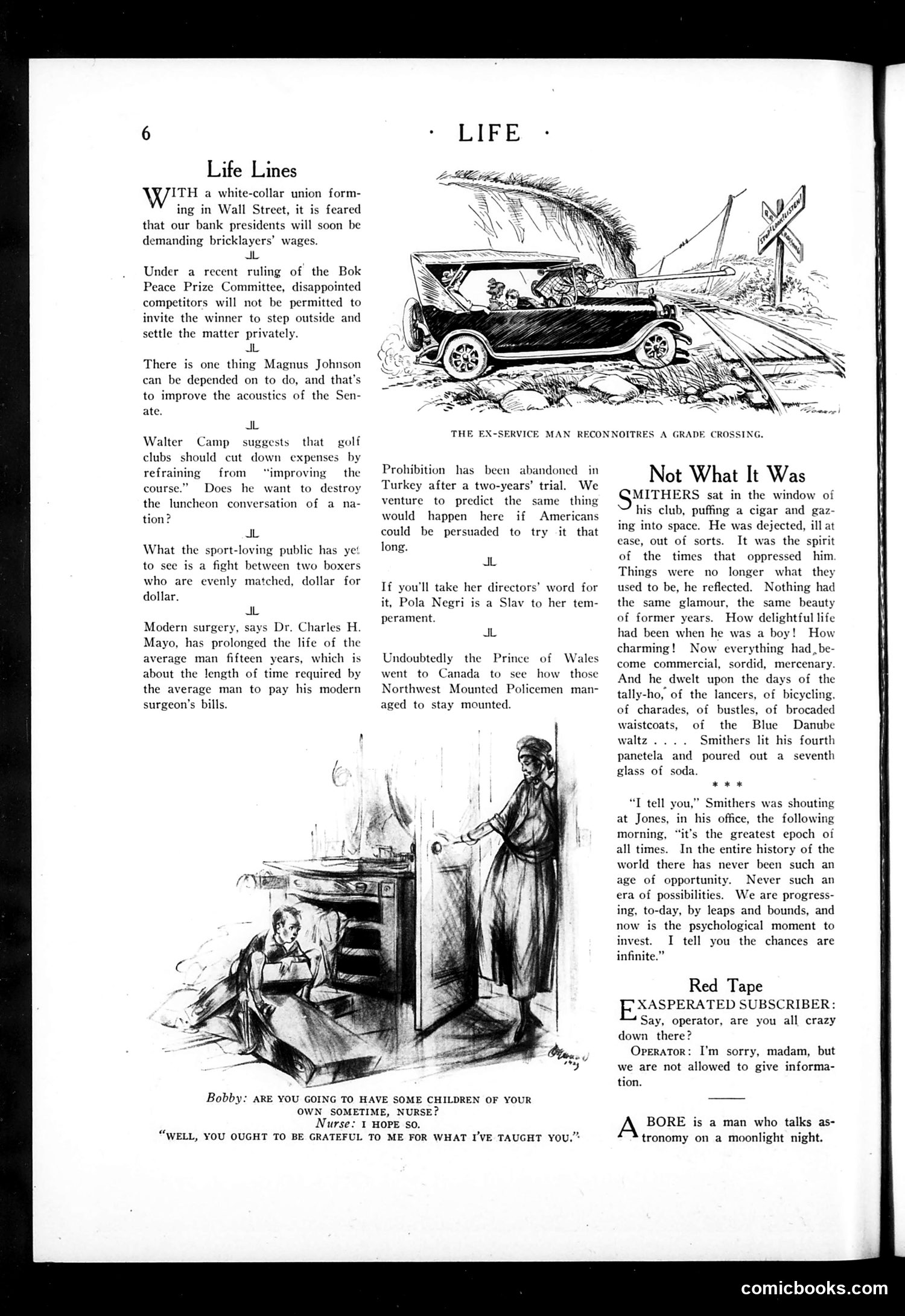
What you’re looking at
This page contains brief satirical commentary pieces and illustrations rather than a single political cartoon. **"Life Lines"** section includes quick observations on current events: concerns about bank presidents demanding bricklayers' wages, a Bok Peace Prize ruling preventing private settlement of disputes, and commentary on Magnus Johnson and acoustics. **"Not What It Was"** features a sketch of a man at his club reflecting nostalgically on how life has changed—things are now "commercial, sordid, mercenary" rather than charming as they were in his youth. He recalls fancier social activities like charades and waltzes. **"Red Tape"** mocks bureaucratic secrecy, with an exasperated switchboard operator unable to provide information. The page reflects 1920s American concerns about modernization, changing social values, and institutional opacity.
📄 Transcribed text from this page (OCR, searchable)
Machine-transcribed from the original scan — historical spelling and the odd misread are preserved.
Life Lines ITH a white-collar union form- ing in Wall Street, it is feared that our bank presidents will soon be demanding bricklayers’ wages. iL Under a recent ruling of the Bok Peace Prize Committee, disappointed competitors will not be permitted to invite the winner to step outside and settle the matter privately. iL. There is one thing Magnus Johnson can be depended on to do, and that’s to improve the acoustics of the Sen- ate. JIL Walter Camp suggests that clubs should cut down expenses by refraining from “improving — the course.” Does he want to destroy the luncheon tion? golf conversation of a na- JL What the sport-loving public has ye! to see is a fight between two boxers who are evenly matched, dollar for dollar. aL Modern surgery, says Dr. Charles H. Mayo, has prolonged the life of the average man fifteen years, which is about the length of time required by the average man to pay his modern surgeon’s bills. Prohibition has been abandoned in Turkey after a two-years’ trial. We venture to predict the same thing would happen here if Americans could be persuaded to try it that long. JL If you'll take her directors’ word for it, Pola Negri is a Slav to her tem- perament. JL Wales those Undoubtedly the Prince of went to Canada to see Northwest Mounted Policemen man- aged to stay mounted. how Bobby: ARE YOU GOING TO HAVE SOME CHILDREN OF YOUR OWN SOMETIME, NURSE? s Nurse: 1 HOPE so. WELL, YOU OUGHT TO BE GRATEFUL TO ME FOR WHAT I'VE TAUGHT YOU.” Not What It Was MITHERS sat in the window of his club, puffing a cigar and gaz- ing into space. He was dejected, ill at ease, out of sorts. It was the spirit of the times that oppressed him Things were no longer what they used to be, he reflected. Nothing had the same glamour, the same beauty of former years. How delightful life had been when he was a boy! How charming! Now everything had, be- come commercial, sordid, mercenary. And he dwelt upon the days of the tally-ho, of the lancers, of bicycling. of charades, of bustles, of brocaded waistcoats, of the Blue Danube waltz . Smithers lit his fourth panetela and poured out a_ seventh glass of soda. ee “T tell you,” Smithers was shouting at Jones, in his office, the following morning, “it’s the greatest epoch of all times. In the entire history of the world there has never been such an age of opportunity. Never such an era of possibilities. We are progress- ing, to-day, by leaps and bounds, and now is the psychological moment to invest. I tell you the chances are infinite.” Red Tape XASPERATED SUBSCRIBER: Say, operator, are you all crazy down there? Operator: I'm sorry, madam, but we are not allowed to give informa- tion. BORE is a man who talks as- tronomy on a moonlight night. comicbooks.com