
A complete issue · 40 pages · 1923
Life — March 29, 1923
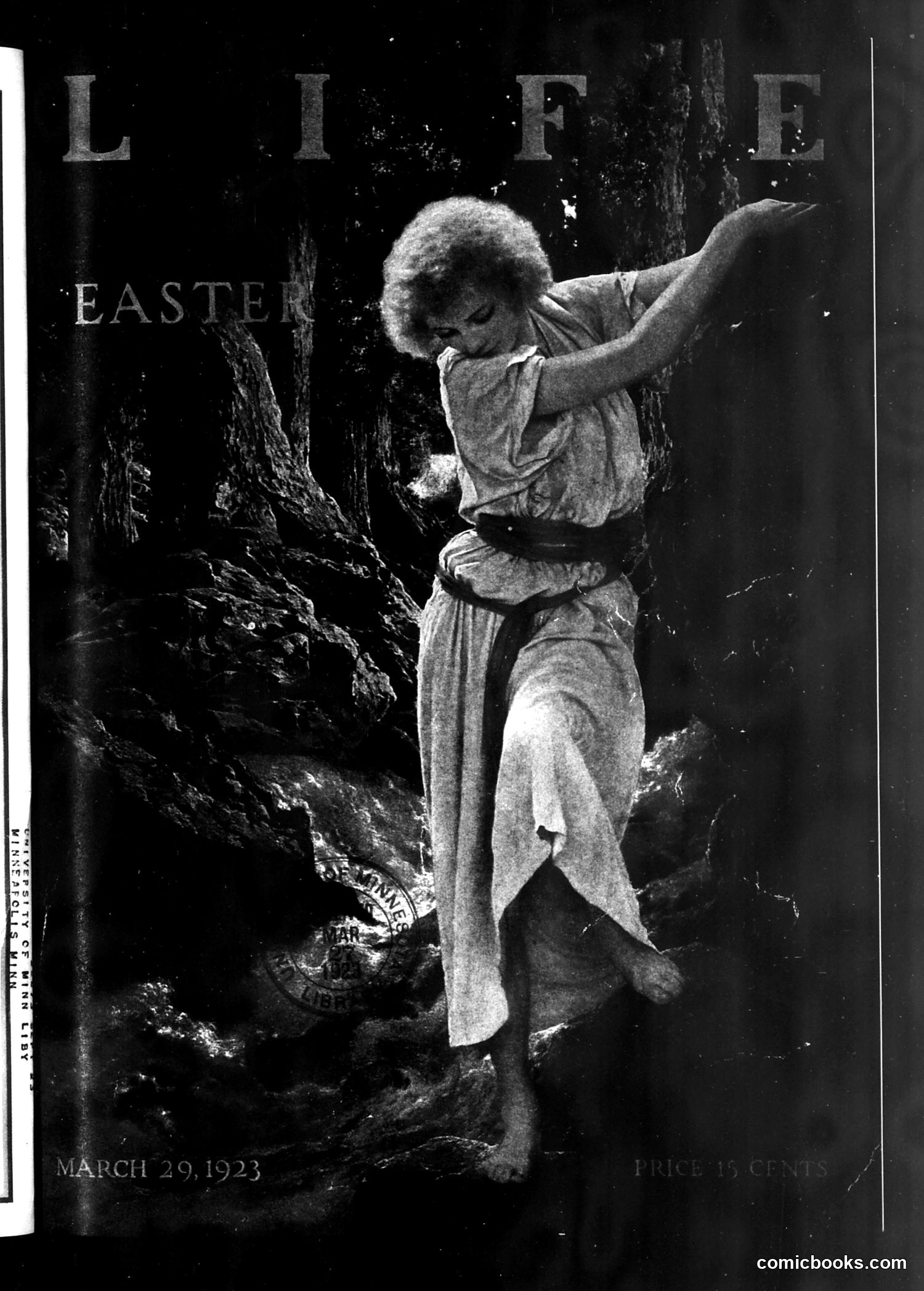
This is an **Easter cover** featuring a woman in period dress positioned among rocky terrain, her arm raised dramatically skyward. The composition evokes religious imagery—specifically the Resurrection narrative central to Easter celebration. The dramatic black-and-white photography, flowing garments, and posed gesture suggest **theatrical or cinematic representation** of a biblical scene. Given Life magazine's satirical nature and the 1923 date, this likely mocks either contemporary religious sentimentality or popular entertainment's treatment of sacred subjects—a common target of satire during the Jazz Age. The cover functions primarily as a seasonal/holiday issue marker rather than political commentary, though Life frequently used Easter imagery to satirize American culture's commercialization of religious observance.
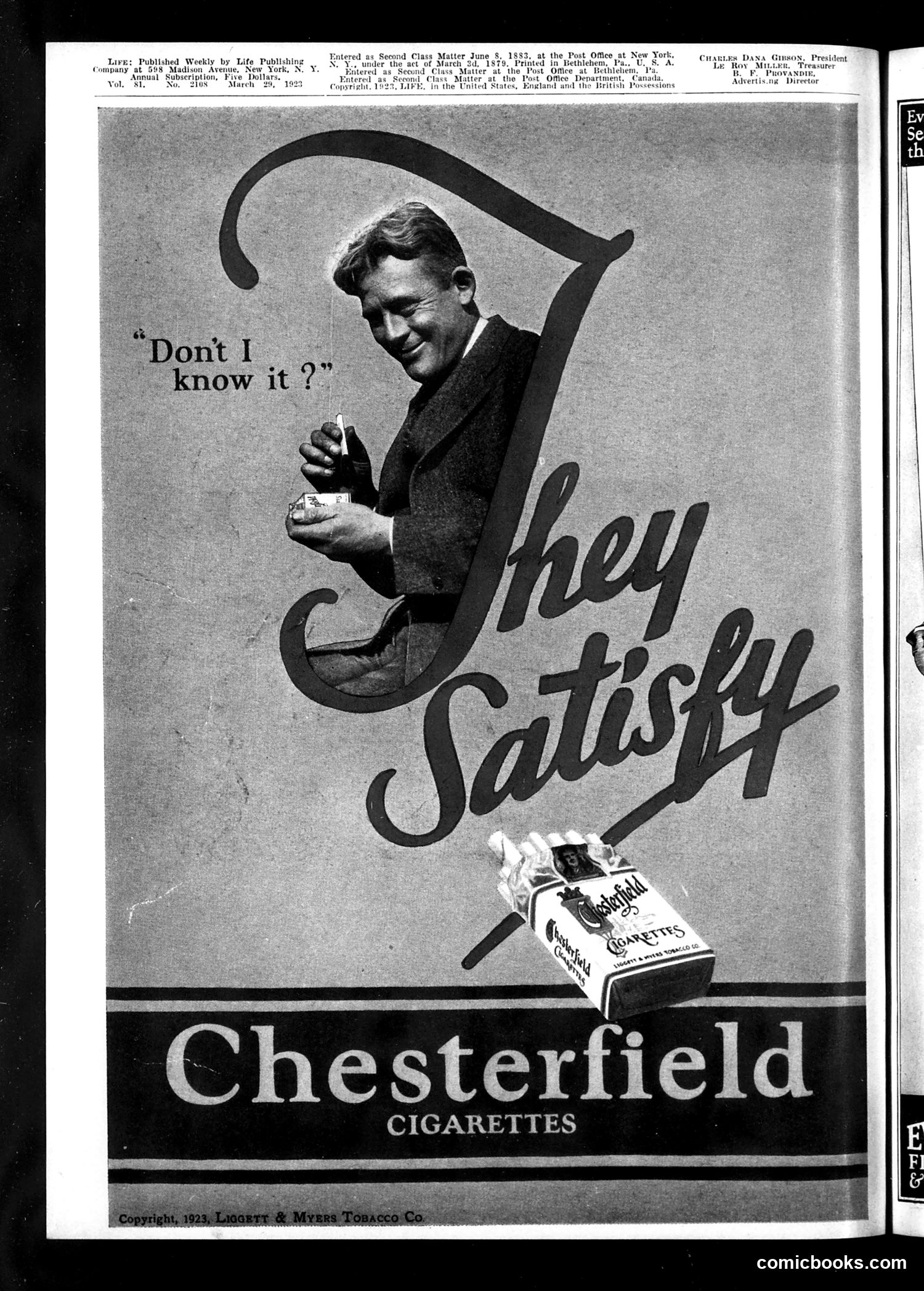
This is a **cigarette advertisement**, not political satire. A well-dressed man in a suit holds a cigarette and gestures with a questioning expression, saying "Don't I know it?" The ad plays on social satisfaction—suggesting that Chesterfield cigarettes are so satisfying that they speak for themselves. The phrase "they Satisfy" became Chesterfield's famous slogan. The decorative question mark frames the figure, emphasizing the rhetorical nature of the claim: the answer is obvious to anyone who's tried them. This represents early 20th-century cigarette marketing before health warnings, when such ads commonly appeared in magazines like *Life*, using charm and lifestyle appeal rather than explicit product claims.
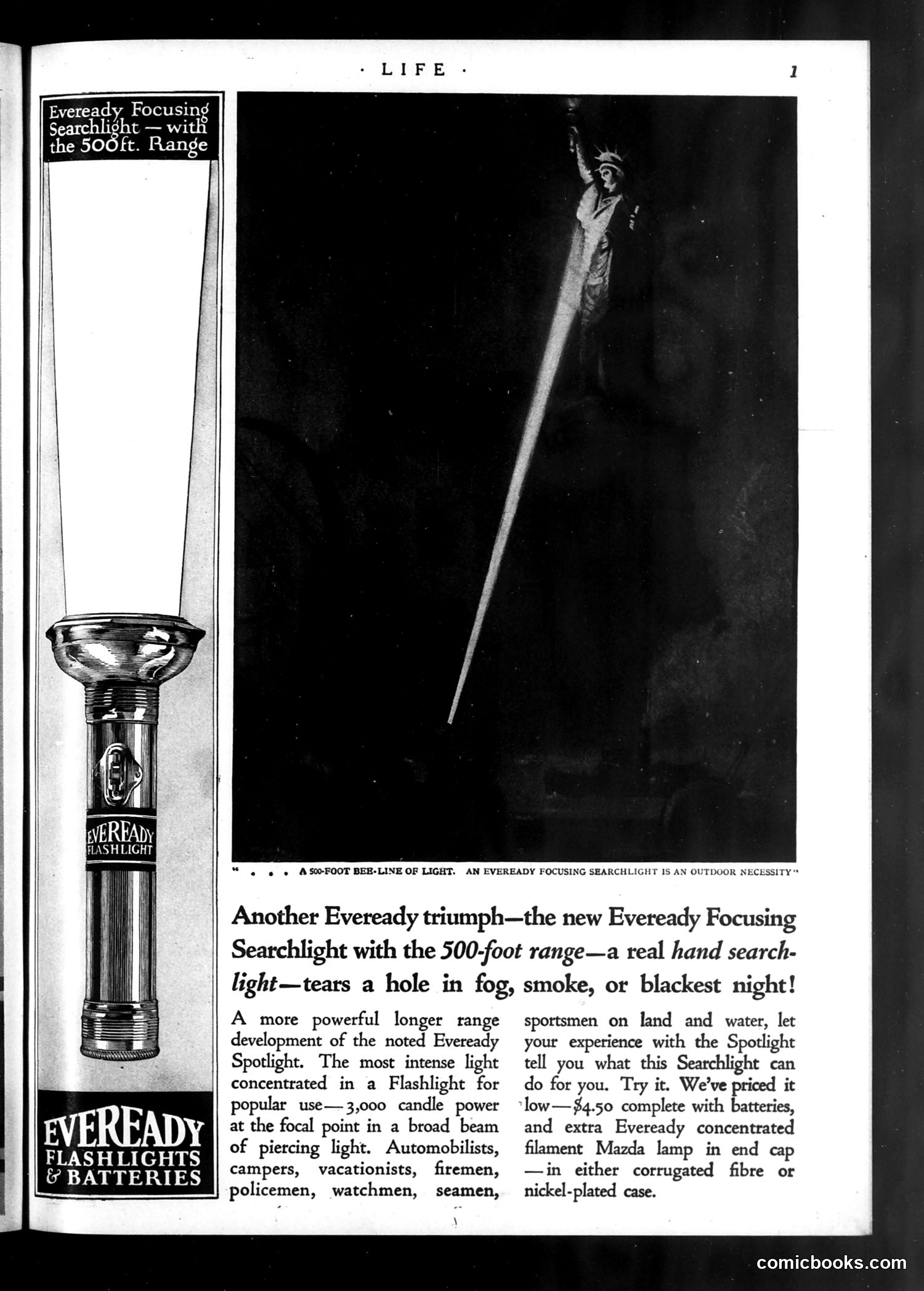
This page is **not a political cartoon or satire**—it's a **product advertisement** for Eveready Flashlights and Batteries, specifically their new "Focusing Searchlight with the 500-foot range." The image shows a dramatic nighttime scene: a person holding aloft an intense beam of light cutting through darkness, with the caption describing it as "a 500-foot bee-line of light." The ad targets outdoor professionals and enthusiasts—"automobilists, campers, vacationists, firemen, policemen, watchmen, seamen"—emphasizing the searchlight's practical utility for piercing fog, smoke, and darkness. The price is listed as $4.50 complete with batteries. This is straightforward commercial messaging, not editorial commentary or satire.
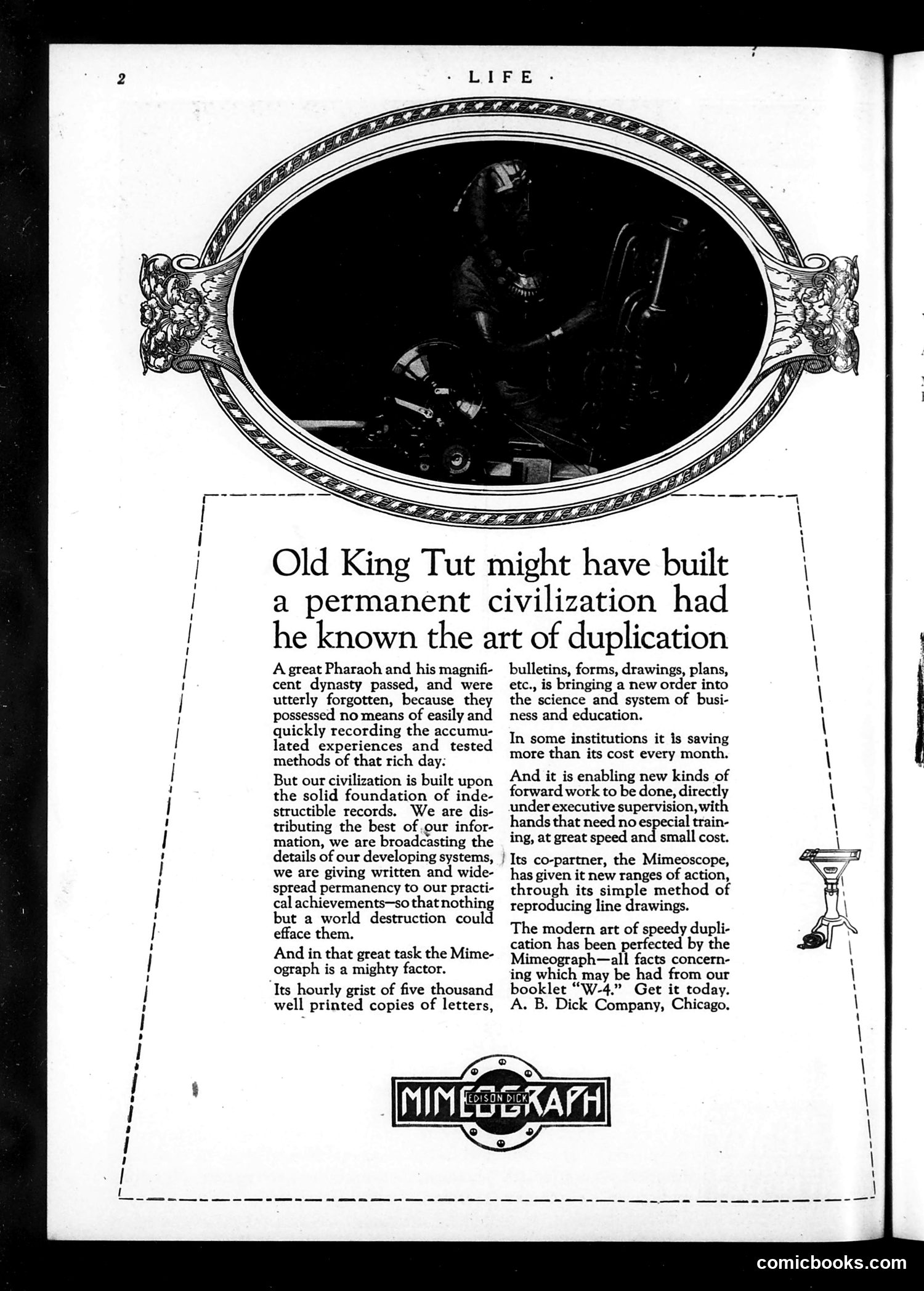
This page is primarily **advertising for the Mimeograph machine** by the A.B. Dick Company of Chicago, not political satire. The ad's headline makes a humorous comparison: King Tutankhamun might have built a lasting civilization if he'd possessed duplication technology. The joke is that ancient Egypt's achievements relied on manual record-keeping, while modern businesses using Mimeographs can efficiently reproduce documents at scale. The ornate oval frame containing an image of the Mimeograph device mimics Egyptian decorative style, reinforcing the Tut comparison. The ad emphasizes the machine's practical benefits: rapid copying of letters, bulletins, and forms that would otherwise require extensive manual labor. This reflects early 20th-century business culture, when mechanical duplication was revolutionary technology worth explaining to readers.
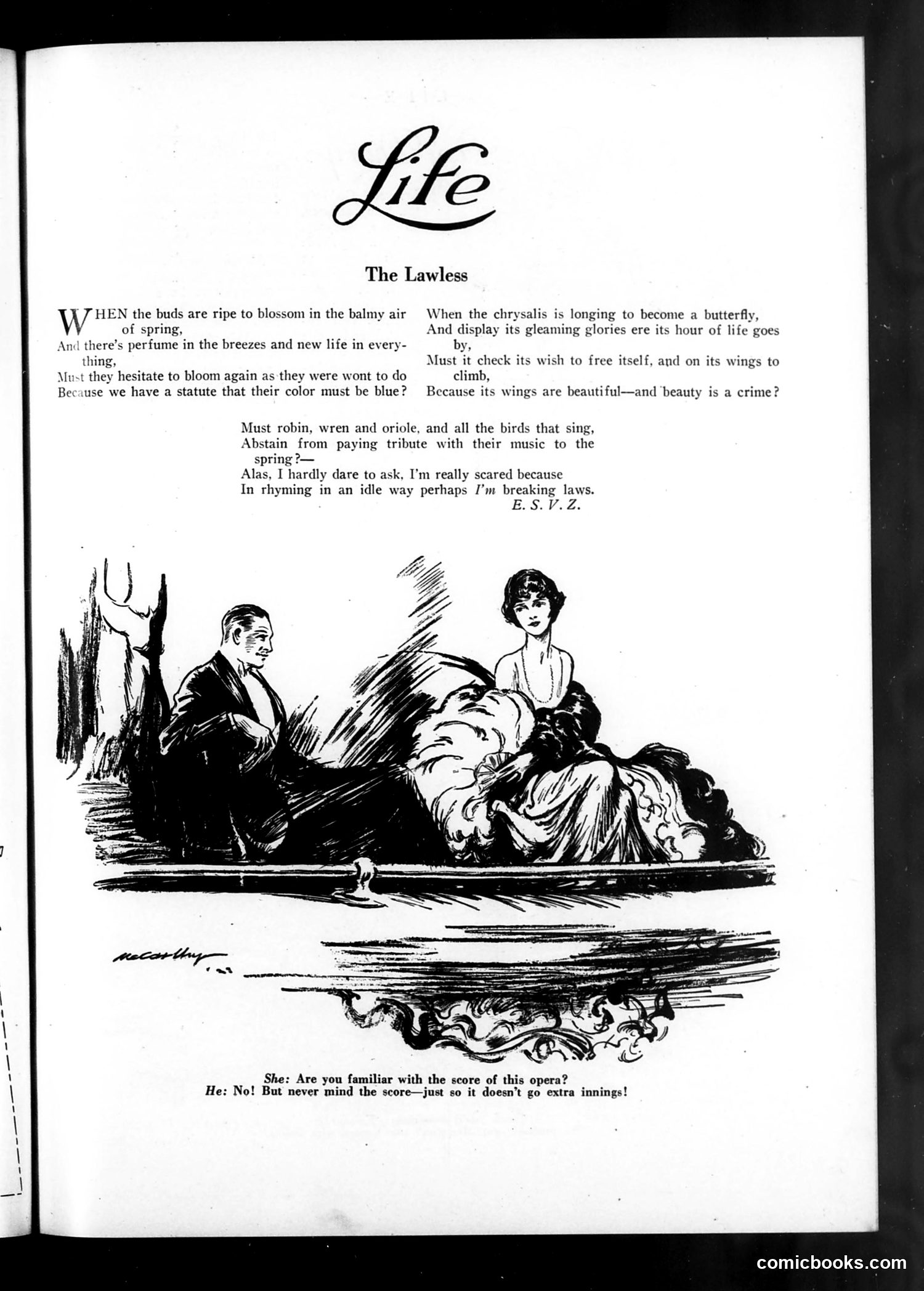
This page satirizes legal restrictions on artistic expression, likely regarding censorship or morality laws. The poem criticizes arbitrary regulations—questioning why flowers must be blue, why birds must refrain from singing in spring, why a chrysalis can't become a butterfly. The underlying complaint: beauty itself is being treated as criminal. The illustration shows a reclining woman being observed by two men in formal dress, suggesting voyeurism or scandal. The caption joke about opera scoring ("just so it doesn't go extra innings") appears to mock prudish audience concerns about length and propriety. The satire targets what the author considers absurd legal/social constraints on natural beauty and artistic freedom—the "lawless" title ironically referring to those enforcing arbitrary restrictions on life itself.
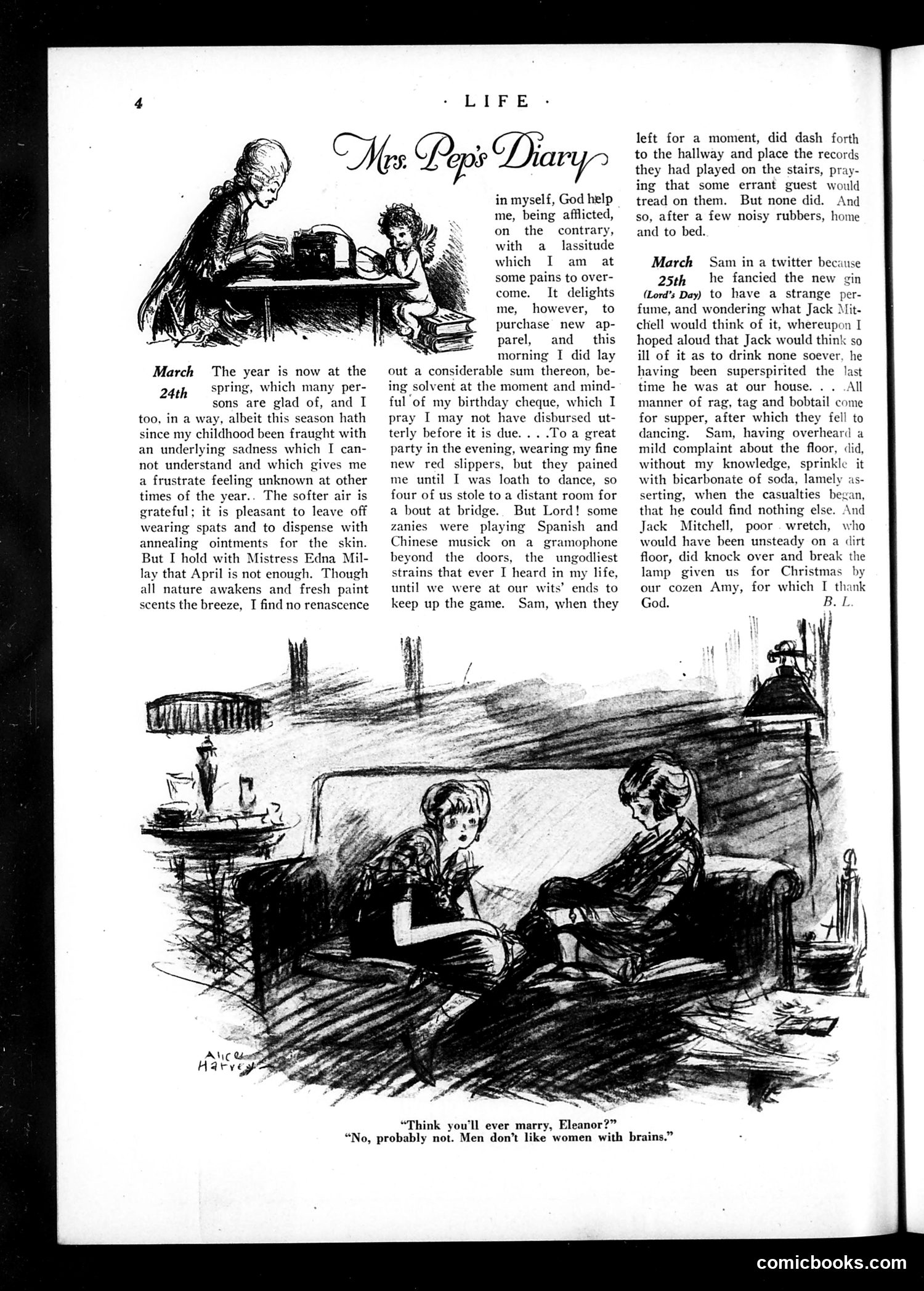
This page features a satirical diary entry dated March 24th, describing upper-middle-class domestic life. The main cartoon depicts two women on a sofa, with the caption: "Think you'll ever marry, Eleanor?" "No, probably not. Men don't like women with brains." **The satire targets**: Gender attitudes of the era—specifically the social expectation that intelligent women face marriage difficulties because men prefer less educated, more traditionally domestic wives. The joke ironically presents this as accepted wisdom, mocking both the limiting attitudes toward women's intellect and the assumption that intellectual women must sacrifice romantic prospects. The diary entries humorously chronicle mundane social events (parties, dancing) and domestic concerns, satirizing the triviality often expected of women's lives and interests.
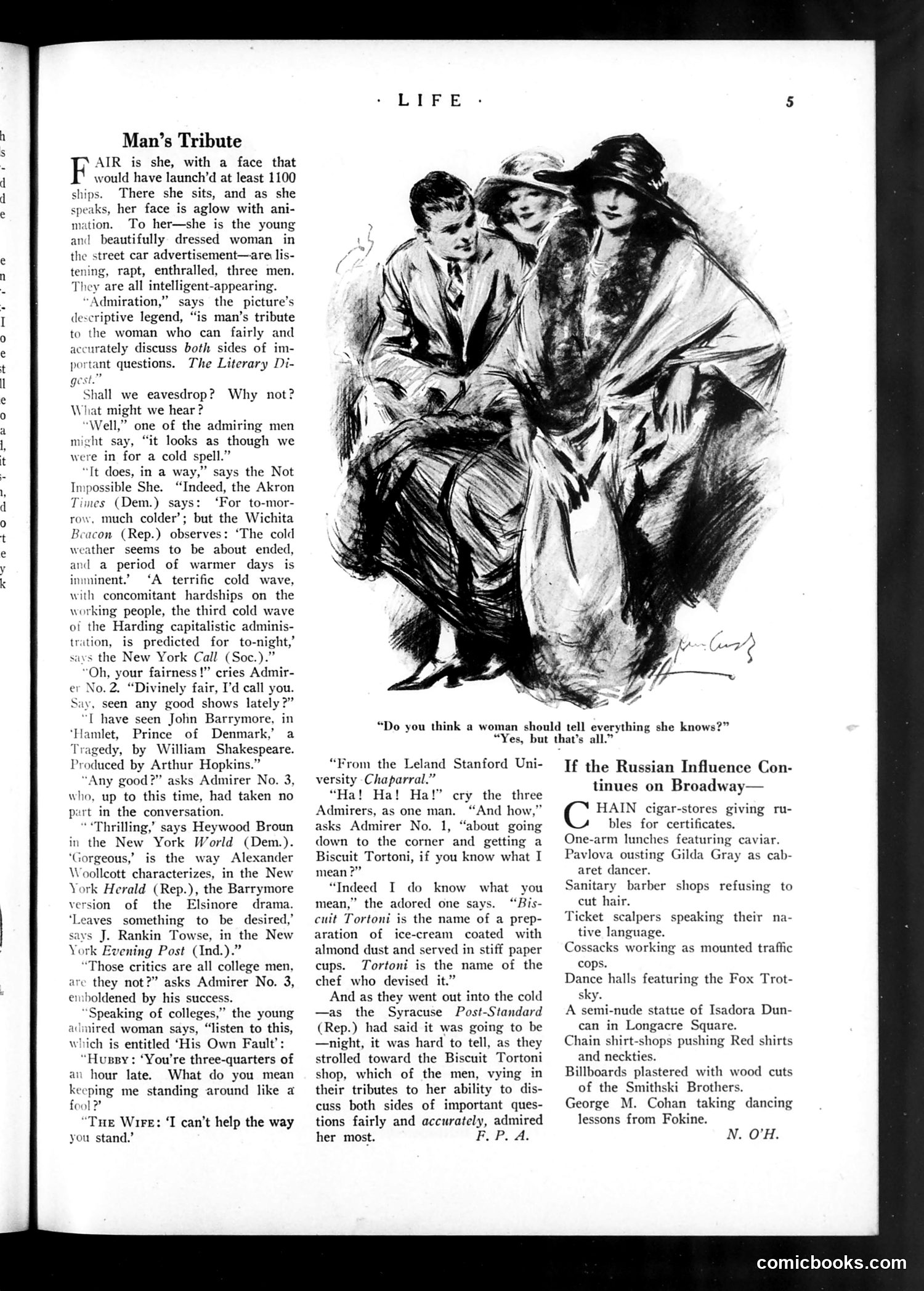
This cartoon satirizes men's admiration of women by depicting three well-dressed men engaged in serious discussion about a beautiful woman on a streetcar. The piece mocks how men discuss women with exaggerated reverence—calling their tribute "man's admiration of the woman who can fairly and accurately discuss both sides of important questions." The satire hinges on the caption: "Do you think a woman should tell everything she knows?" with the response "Yes, but that's all!" This reveals the cartoon's cynical point: men claim to admire intellectually capable women, yet the punchline suggests women possess limited knowledge worth discussing. The satire targets masculine hypocrisy—professing respect for female intelligence while simultaneously dismissing women's actual intellect.
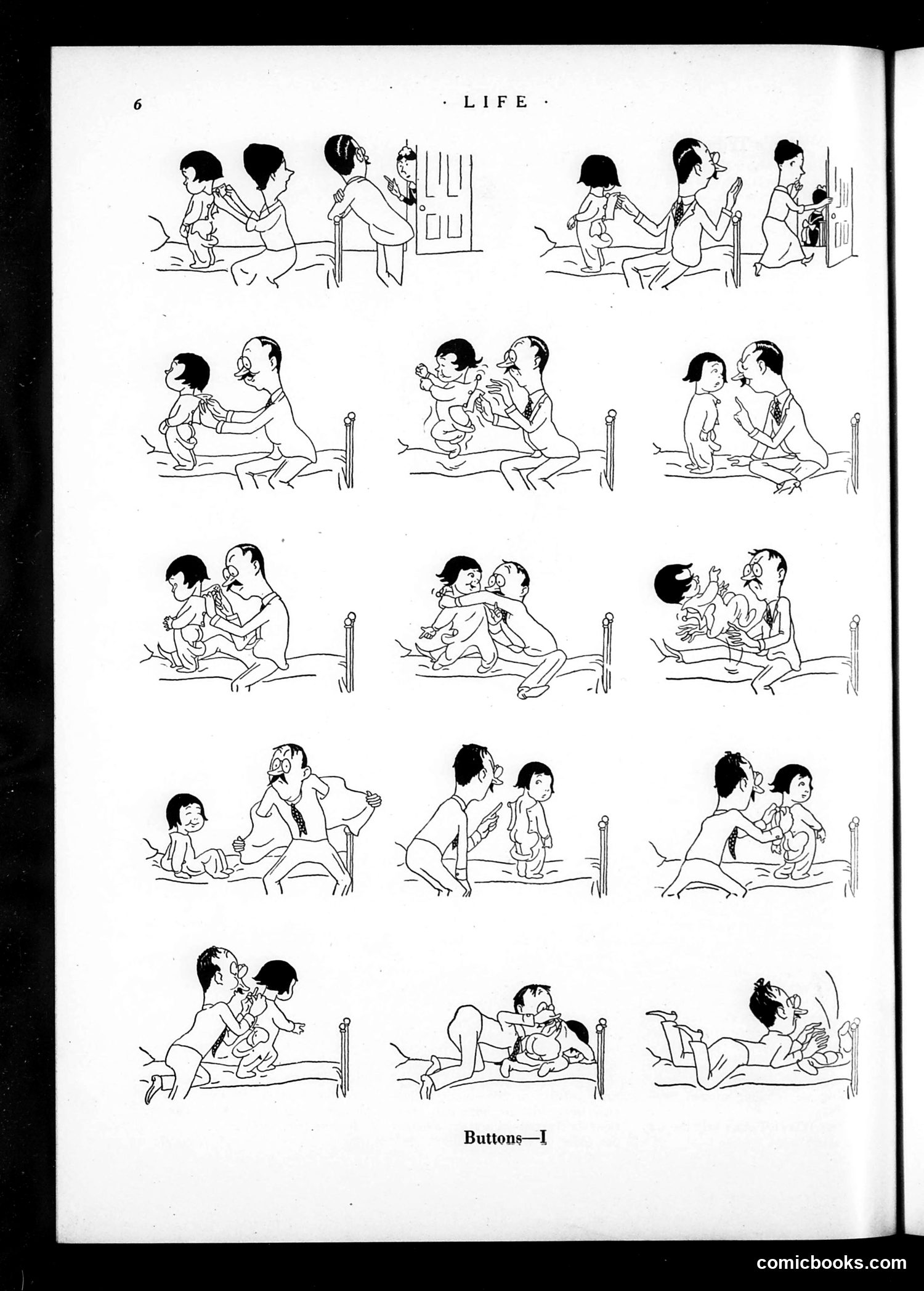
This page presents a sequential comic strip showing humorous domestic interactions between an adult (likely a parent or caregiver) and a young child. The title "Buttons—I" suggests this is part of a series about a character named Buttons. The strip depicts the adult attempting various child-care tasks—dressing, feeding, playing, and managing the child's behavior—with increasingly comedic results. The child appears mischievous and resistant, creating chaos and mess throughout the scenes. The humor derives from the relatable frustration of childcare: the gap between adult intentions and actual outcomes. This appears to be gentle, observational comedy about domestic life rather than political satire, reflecting early 20th-century American magazine humor focused on everyday family situations and parenting struggles.
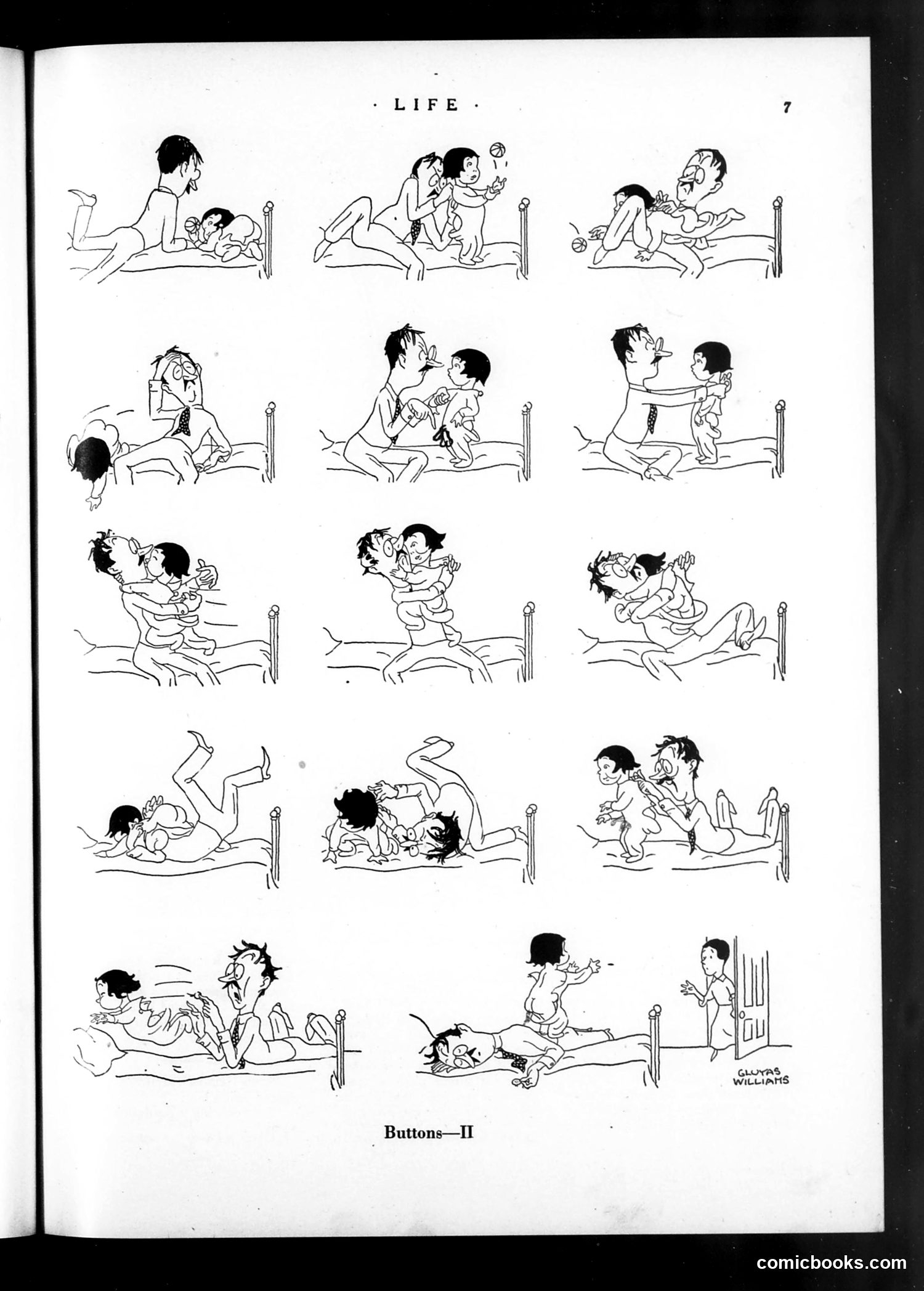
This is a humorous illustrated sequence depicting bedtime chaos between parents and young children. The cartoon shows a escalating series of scenes: a parent attempting to put a child to bed, the child resisting with increasing energy, multiple children joining the bedtime "battle," and the situation devolving into physical comedy with tangled bodies and complete disorder. The title "Buttons—II" (suggesting a sequel) likely refers to children's clothing, though the joke is universal—the exhausting difficulty of getting energetic kids to sleep. The satire targets parental struggles with bedtime routines, a relatable domestic situation. The artist is Gluyas Williams, known for depicting everyday family life humor in Life magazine during the early-to-mid twentieth century.
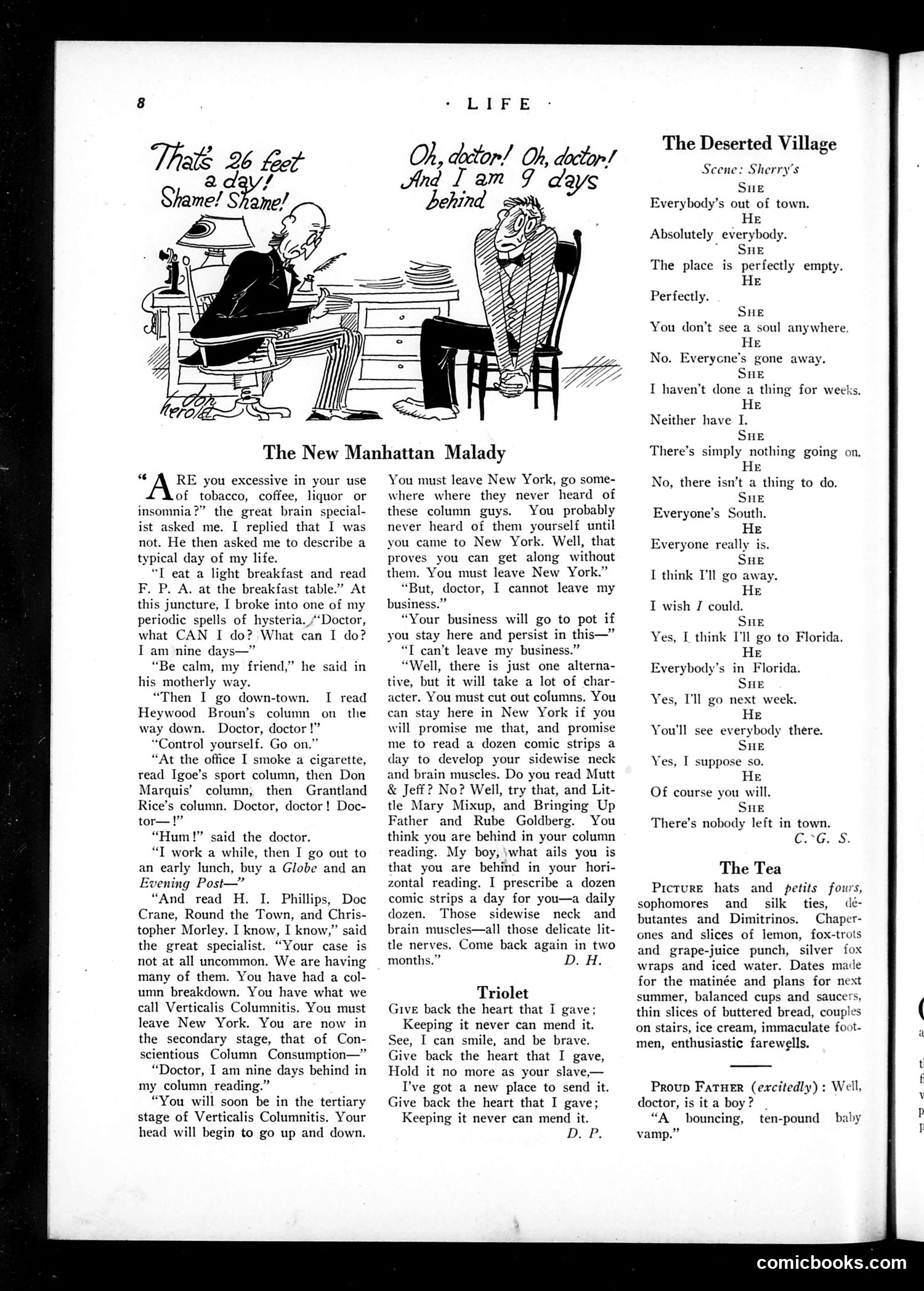
This cartoon satirizes a condition affecting New York journalists and writers suffering from excessive coffee and insomnia. The illustration shows a doctor at his desk confronted by a frantic patient complaining of nine days without sleep. The accompanying text describes the doctor's prescription: the patient must leave New York entirely, abandon his newspaper column work, and pursue comic strip reading in Florida or elsewhere—essentially a complete professional break. The satire targets the unhealthy work culture of Manhattan's publishing industry, where stimulants (coffee, cigarettes) and deadline pressure created what the piece calls a distinct urban malady. The "cure" humorously requires total geographic and professional escape rather than any medical treatment.
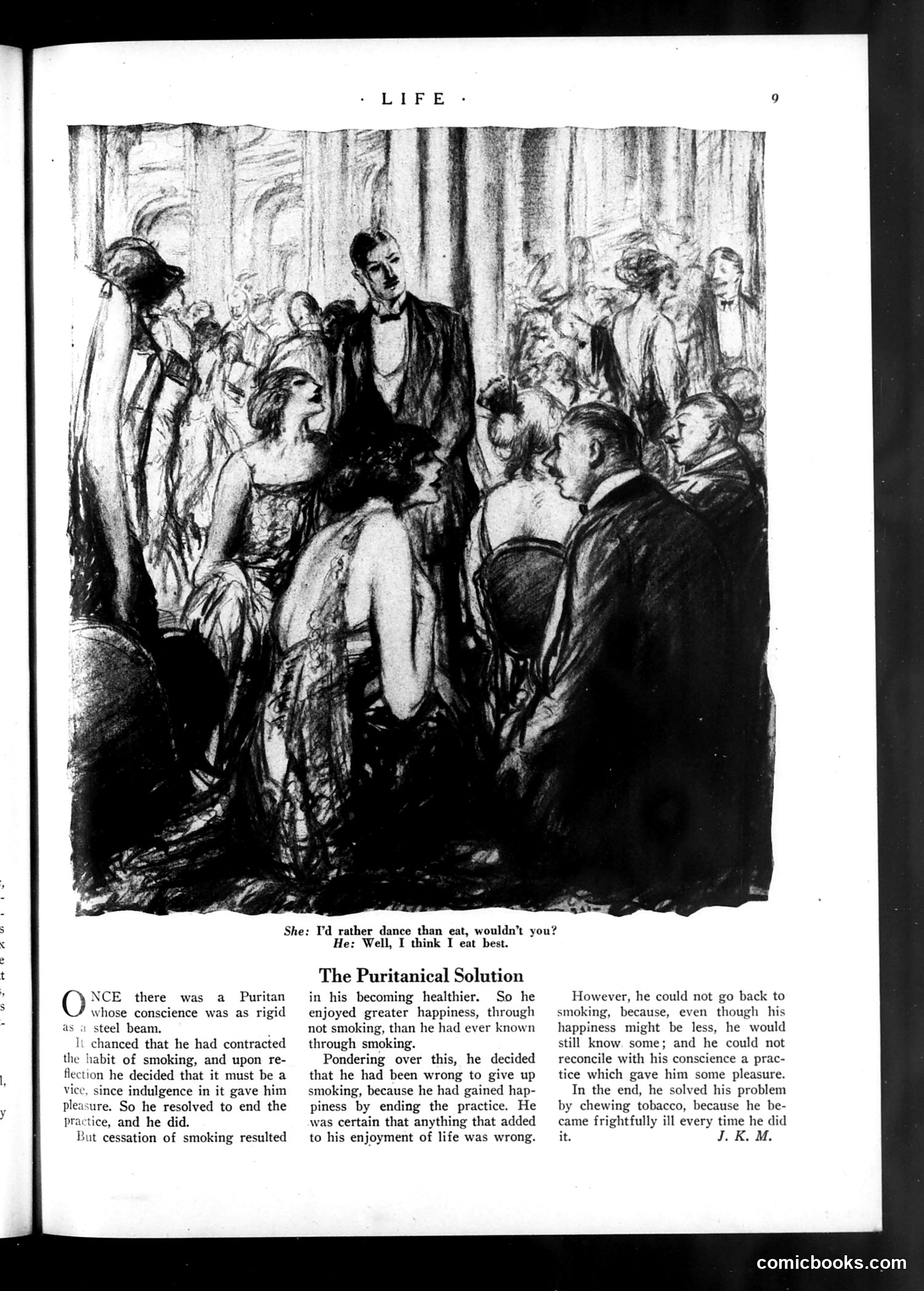
This page contains a satirical illustration and accompanying text mocking a Puritan's moral hypocrisy regarding smoking. The illustration shows an elegant social gathering—likely a fancy ball or party—with well-dressed attendees in formal attire. The caption presents dialogue between a woman and man: she'd "rather dance than eat," he responds "I think I eat best." The accompanying article describes a Puritan who struggled with smoking's pleasures, eventually deciding the habit was sinful. Unable to quit smoking outright, he found a compromise: chewing tobacco instead, reasoning that anything adding to life's enjoyment must be wrong. The satire targets rigid Puritanical morality—the absurdity of someone convinced that pleasure itself is sinful, leading to self-deluding "solutions" that preserve the vice while changing its form.
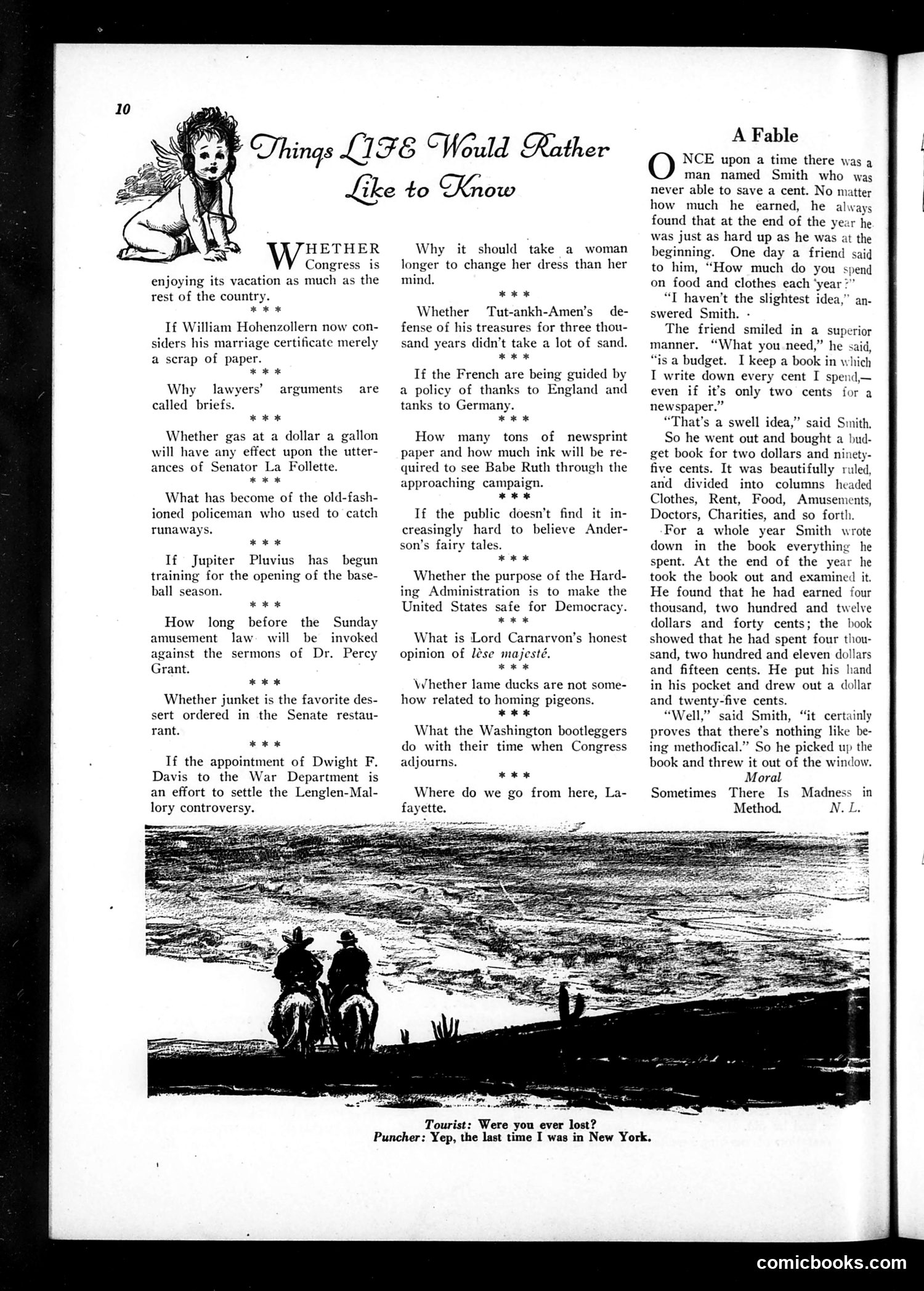
This page features a humorous satirical column listing absurdist questions and observations. The left column poses ridiculous hypotheticals—whether Congress enjoys vacation, if William Hollenbeck considers his marriage merely "a scrap of paper," whether gas prices affect utterances of "La Follette," and similar nonsensical inquiries. The right column contains "A Fable" about a man named Smith who saves pennies obsessively, earning $4,012.15 in a year, then throws his ledger out a window in frustration—suggesting the futility of penny-pinching. The bottom illustration shows two figures on horseback overlooking a landscape, with a caption about a tourist being lost in New York. The overall tone mocks contemporary politics, social pretensions, and human absurdity through surrealism and irony.
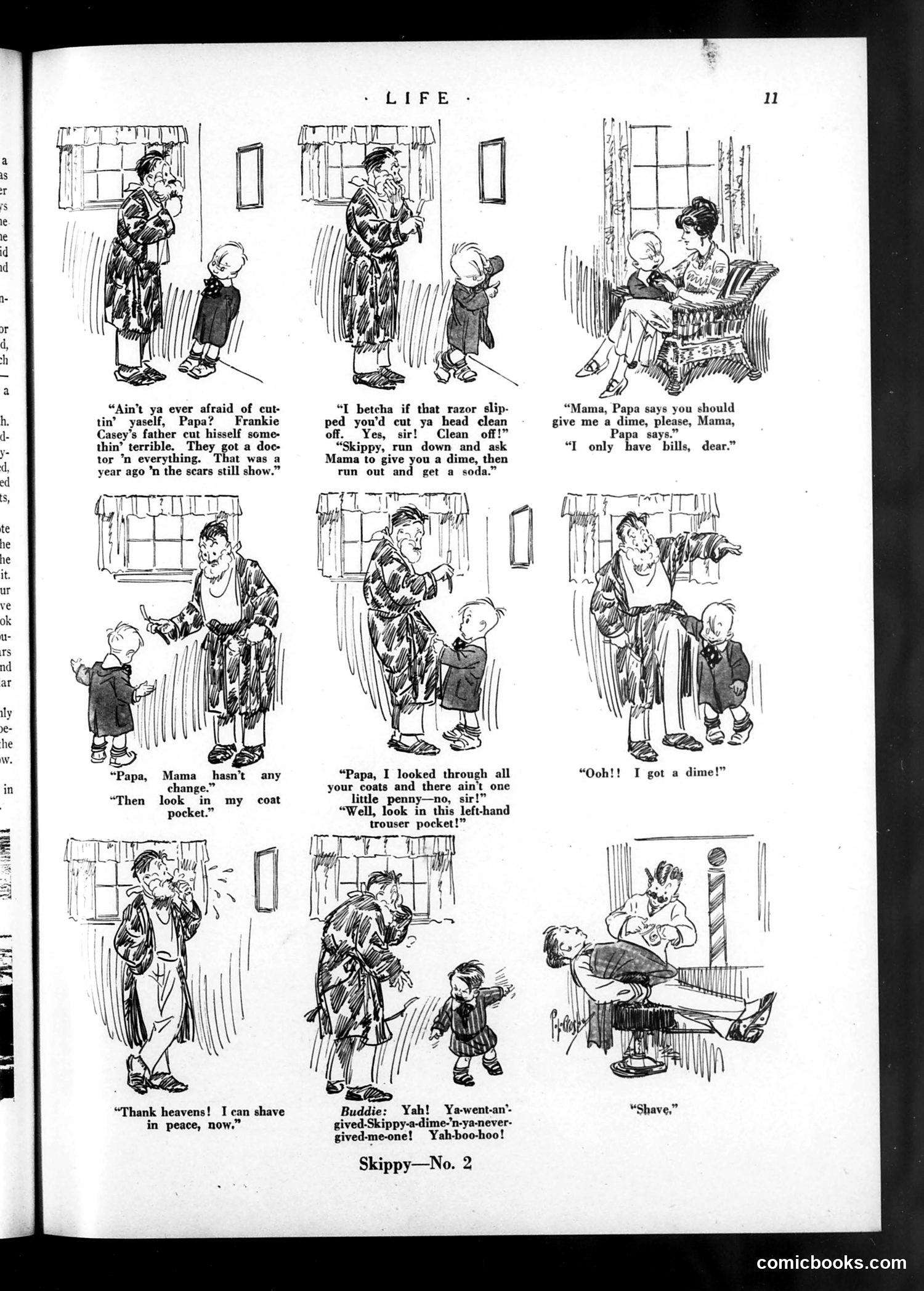
This is a humorous domestic comic strip about a young boy named Skippy and his parents. The narrative follows a classic comedic setup: Skippy asks his father for money ("give me a dime, please, Papa"), claiming his mother said he should. When the father refuses, saying he only has bills, Skippy suggests checking his coat pockets. The father reluctantly does and finds a dime, allowing Skippy to triumphantly declare "Ooh! I got a dime!" The joke relies on a child's clever manipulation of parental communication—playing one parent against the other and using misdirection to achieve his goal. The final panel shows Skippy getting a shave, a humorous exaggeration suggesting his newfound wealth. This depicts period-appropriate family comedy with no political content.
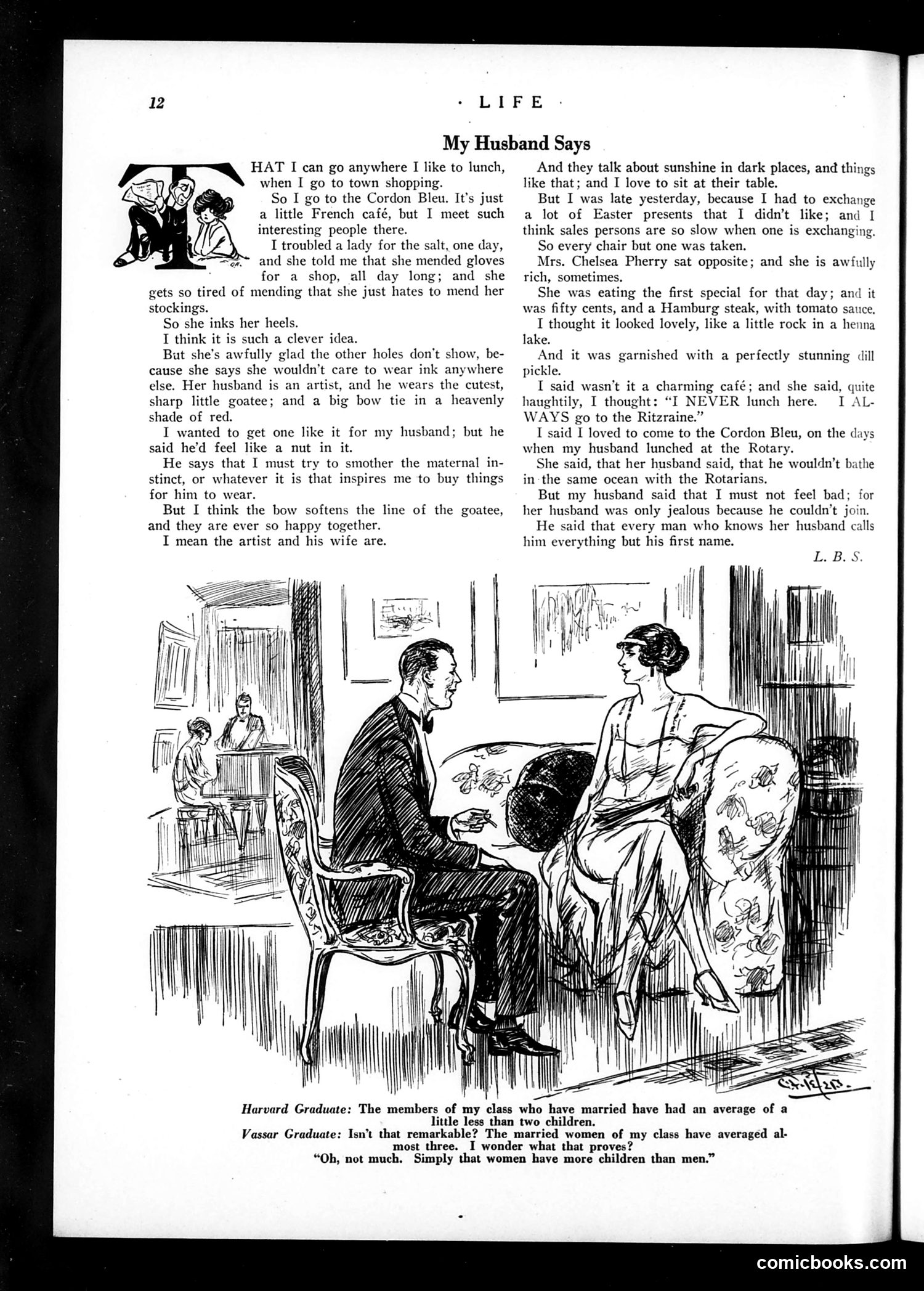
This is a humorous essay about a wife's shopping habits, particularly at the Cordon Bleu restaurant. The author describes her husband's complaint that she tires of mending socks and instead buys new things—illustrating how purchasing provides more satisfaction than domestic drudgery. The essay jokes about women's consumer behavior and includes a dig at other wives, particularly "Mrs. Chelsea Perry," described as "awfully rich" and pretentious. The author contrasts her own affordable lunch choices with Perry's expensive tastes. The bottom cartoon depicts a Harvard/Vassar graduate couple discussing marriage statistics. The joke reveals that married women average more children than men—a facetious punchline playing on obvious biological facts, satirizing academic pretension and gender roles in 1920s marriage.
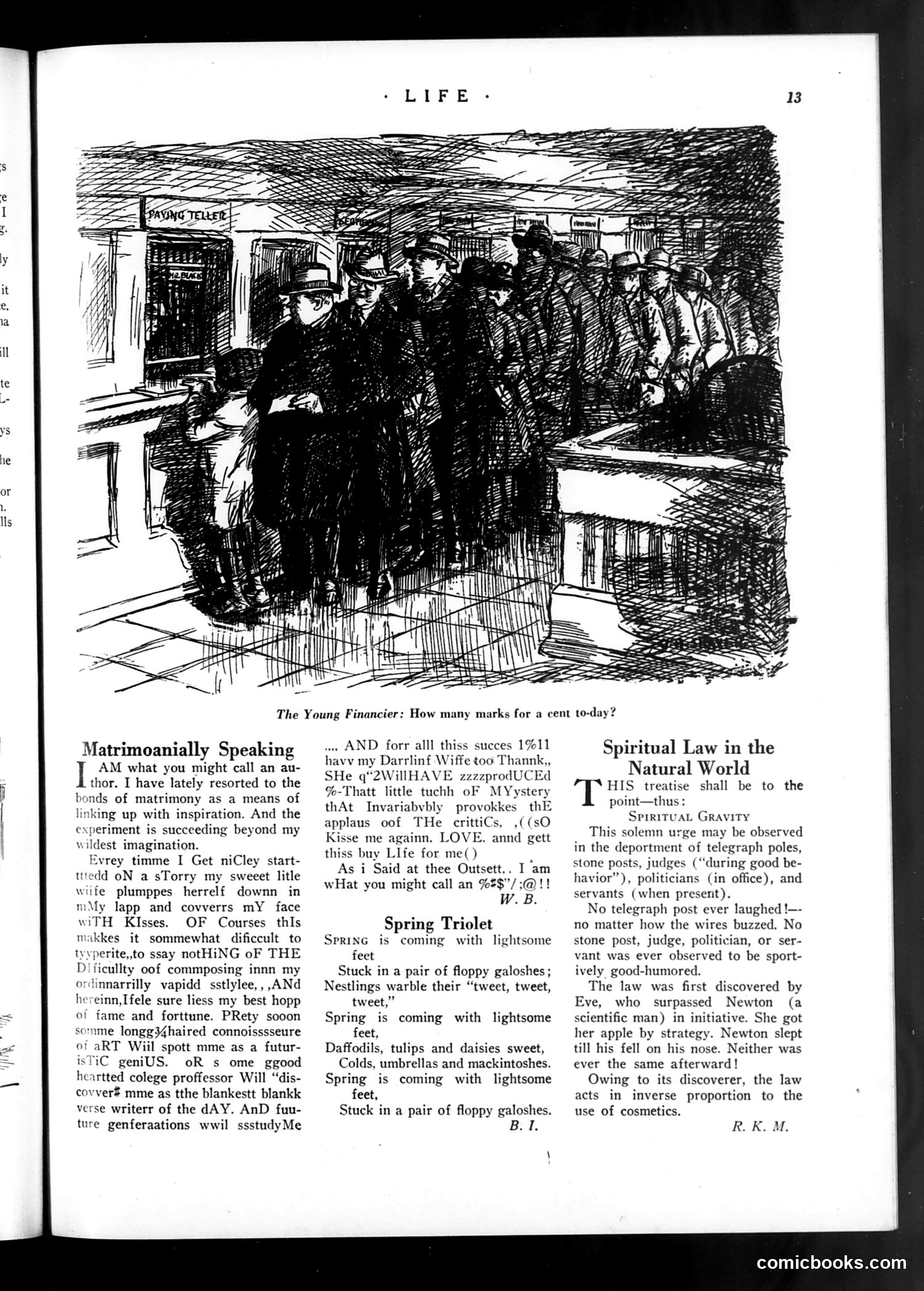
The main illustration shows a line of men at a "Paying Teller" window, captioned "The Young Financier: How many marks for a cent to-day?" This satirizes post-WWI currency chaos, likely German hyperinflation (the reference to "marks" for a "cent" suggests wildly unfavorable exchange rates). The joke mocks both young speculators trying to profit from currency fluctuations and the absurdity of wartime financial instability. The page also contains three humorous columns: one about matrimonial life using tortured wordplay; another celebrating spring with bad puns ("Spring is coming with lightsome feet"); and a piece on "Spiritual Law in the Natural World" ironically contrasting Newton's gravity with societal hypocrisy. These represent typical Life magazine satirical humor—social commentary wrapped in elaborate, deliberately terrible puns.
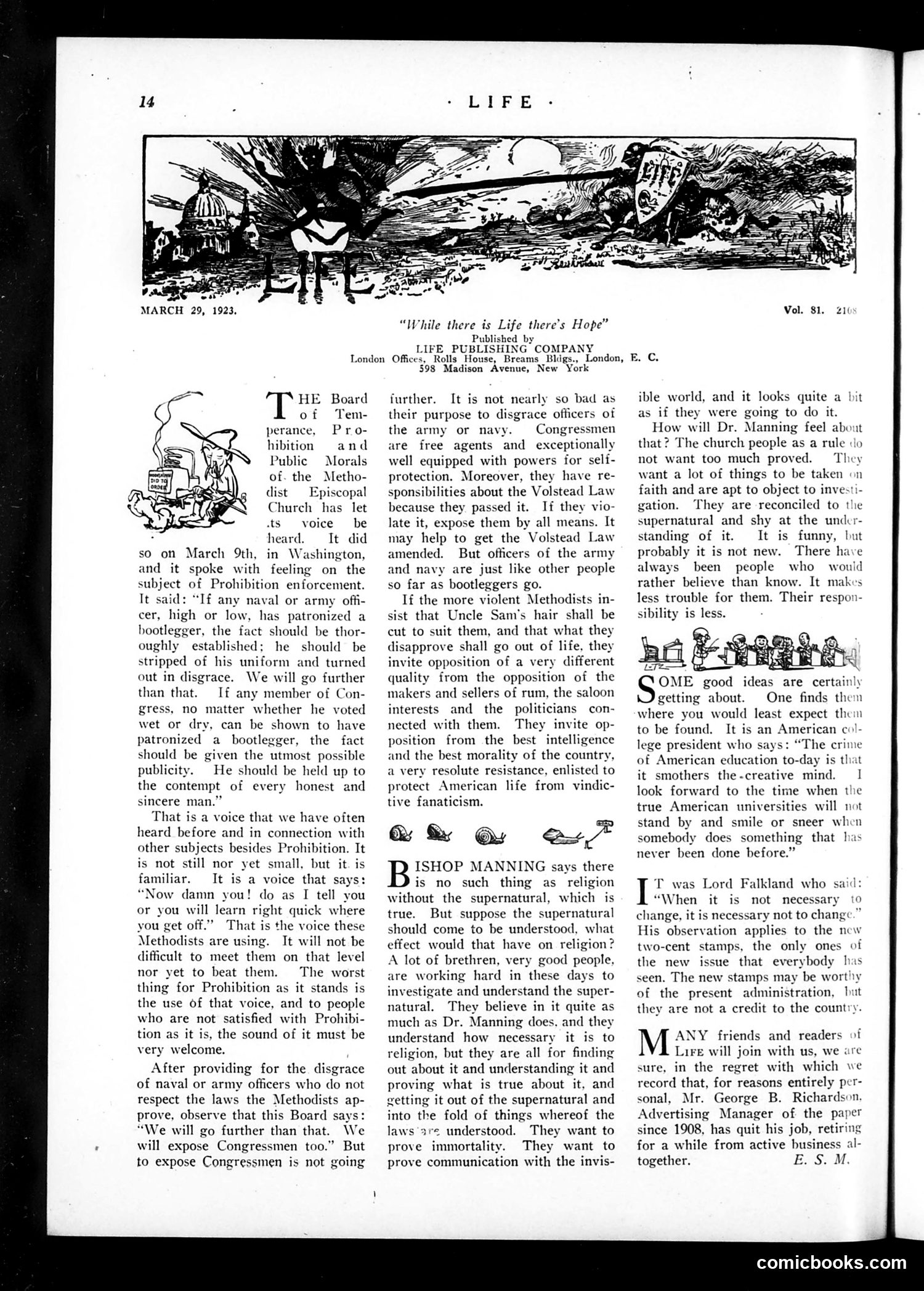
This page contains editorial commentary on Prohibition enforcement rather than a political cartoon. The main article criticizes the Methodist Church's board for demanding that military officers and congressmen be stripped of their uniforms if they patronize bootleggers—calling this stance disgraced and unenforceable. The piece argues that enforcing Prohibition through character attacks on public officials is ineffective and that the real issue involves "makers and sellers of rum" and corrupt politicians. It advocates instead for "revolute resistance" to protect American life from "vindictive fanaticism." The secondary article quotes Bishop Manning's views on reconciling religion with the supernatural, and notes the retirement of Life's advertising manager, George B. Richardson. No specific caricatures appear on this page.
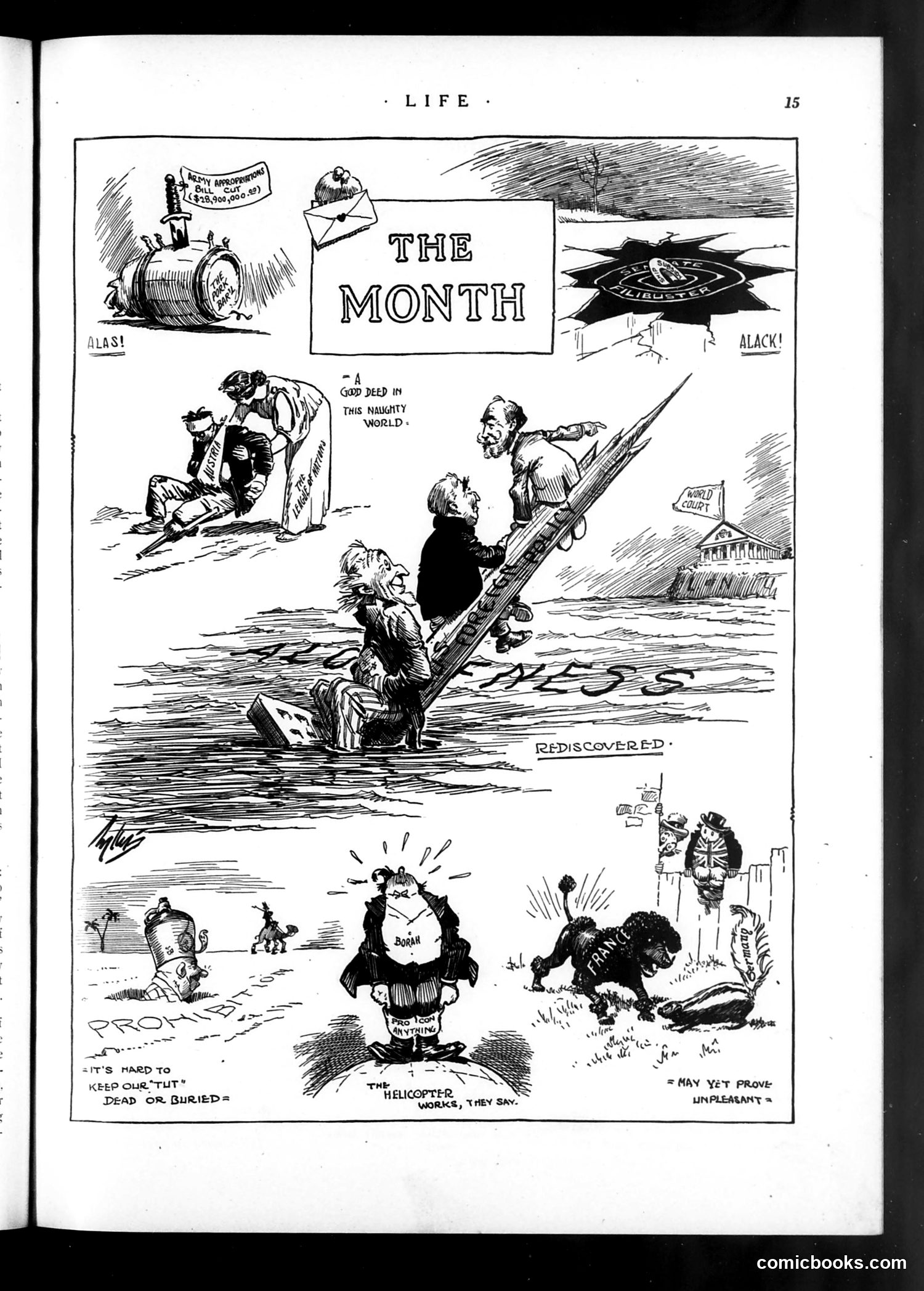
This satirical page mocks various contemporary troubles through interconnected vignettes. The central scene shows figures struggling in turbulent waters labeled "REDISCOVERED," apparently referencing a scandal or crisis that has resurfaced publicly. Key elements include: - A barrel labeled "PROSPERITY" at top left (marked "ALAS!") - A compass or navigation device at top right (marked "ALACK!") - Bottom panels showing ongoing problems: buried "TUT" (unclear reference), a figure labeled "RUSSIA" appearing distressed ("THE HELICOPTER WORKS, THEY SAY"), and what appears to be an unpleasant discovery The overall theme suggests multiple crises afflicting the nation simultaneously—economic, diplomatic, and social—with the "naughty world" caption implying widespread misbehavior or moral disorder. The specific historical context and some references remain unclear without additional dating information.
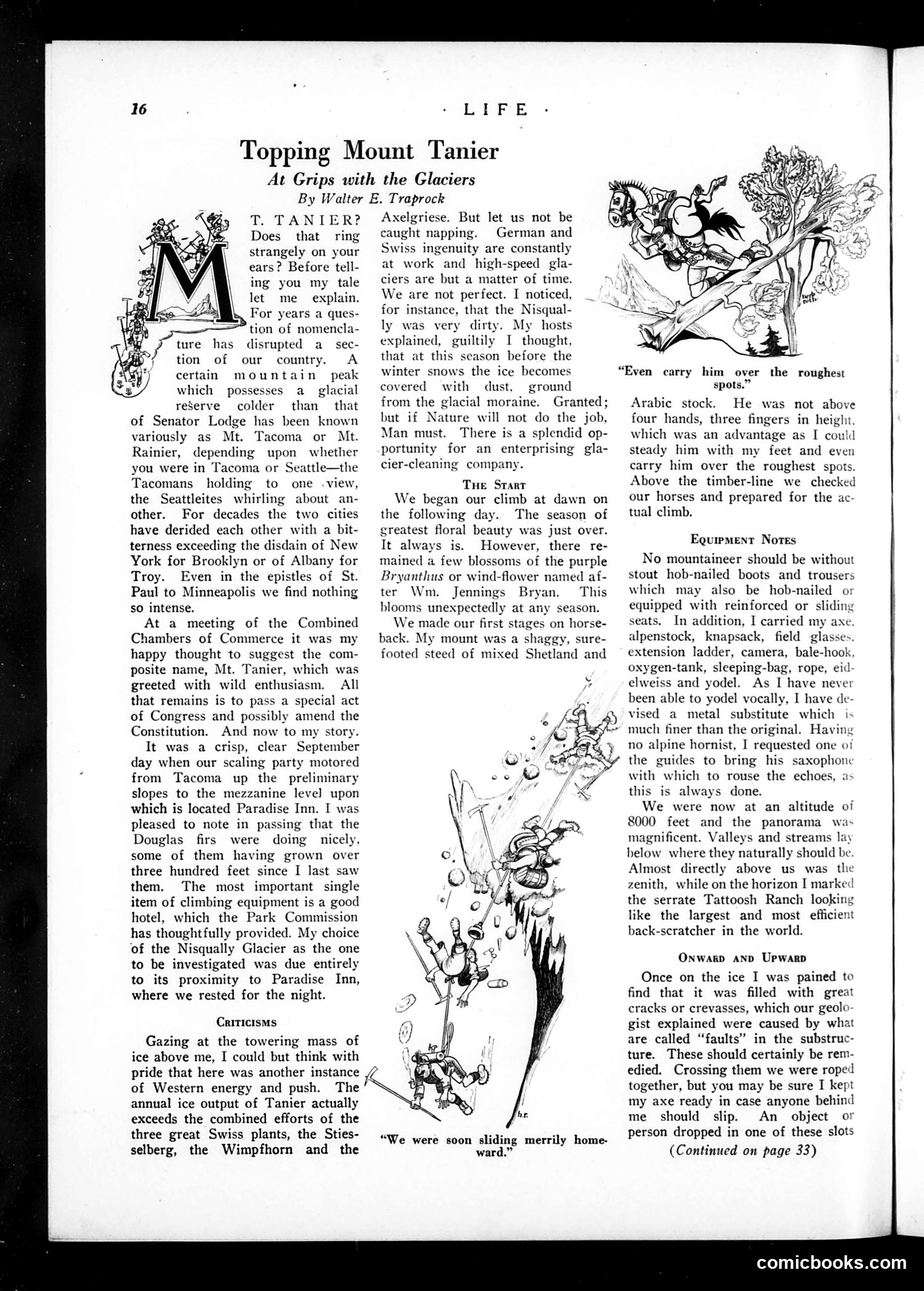
This is a humorous travel narrative by Walter E. Traprock (a pseudonym for a satirical writer), illustrated with comic drawings of mountain climbing mishaps. The satire targets Pacific Northwest civic rivalry: Tacoma and Seattle have feuded for decades over whether to call the peak "Mt. Tacoma" or "Mt. Rainier." Traprock proposes the compromise name "Mt. Tanier"—a joke about splitting differences. The narrator satirizes American boosterism and competitive anxiety, boasting that the glacier's ice output exceeds Swiss production, then worrying Germans and Swiss are developing "high-speed glaciers." He comically suggests hiring a "glacier-cleaning company" to remove dust. The equipment list parodies overwrought mountaineering guides, absurdly including "oxygen-tank," "extension ladder," and "elweiss and yodel"—the last item noted because he "cannot yodel vocally" so he invented a mechanical substitute. The cartoon illustrations show climbers in ridiculous situations, emphasizing the story's comedic tone about earnest but bumbling outdoor adventure.
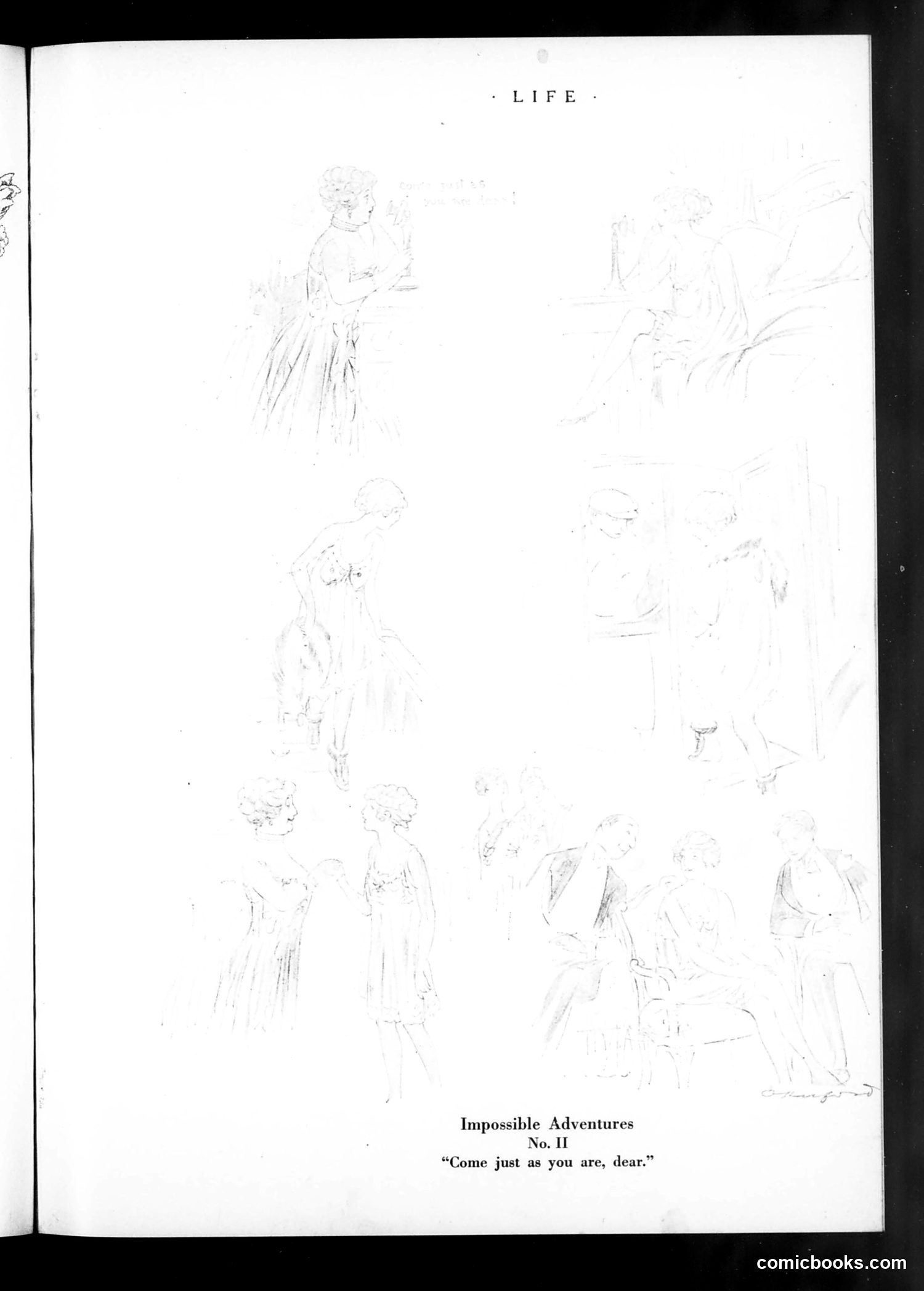
This is a satirical sketch series titled "Impossible Adventures," with this installment captioned "Come just as you are, dear." The faint pencil drawings depict multiple figures in what appears to be a social scenario. The sketch shows several people in formal dress, with one figure prominently positioned at the top left. The composition suggests a social gathering or invitation scenario. The satire likely plays on the tension between formal social expectations and the casual, modern sentiment of the caption. The "come as you are" phrase—suggesting informality and acceptance—contrasts with what appear to be formally-dressed figures, creating humor around changing social conventions or the gap between stated casual attitudes and actual social pretensions. Without clearer visual detail or additional context, the specific social critique remains somewhat ambiguous, though it appears to address early 20th-century social etiquette shifts.
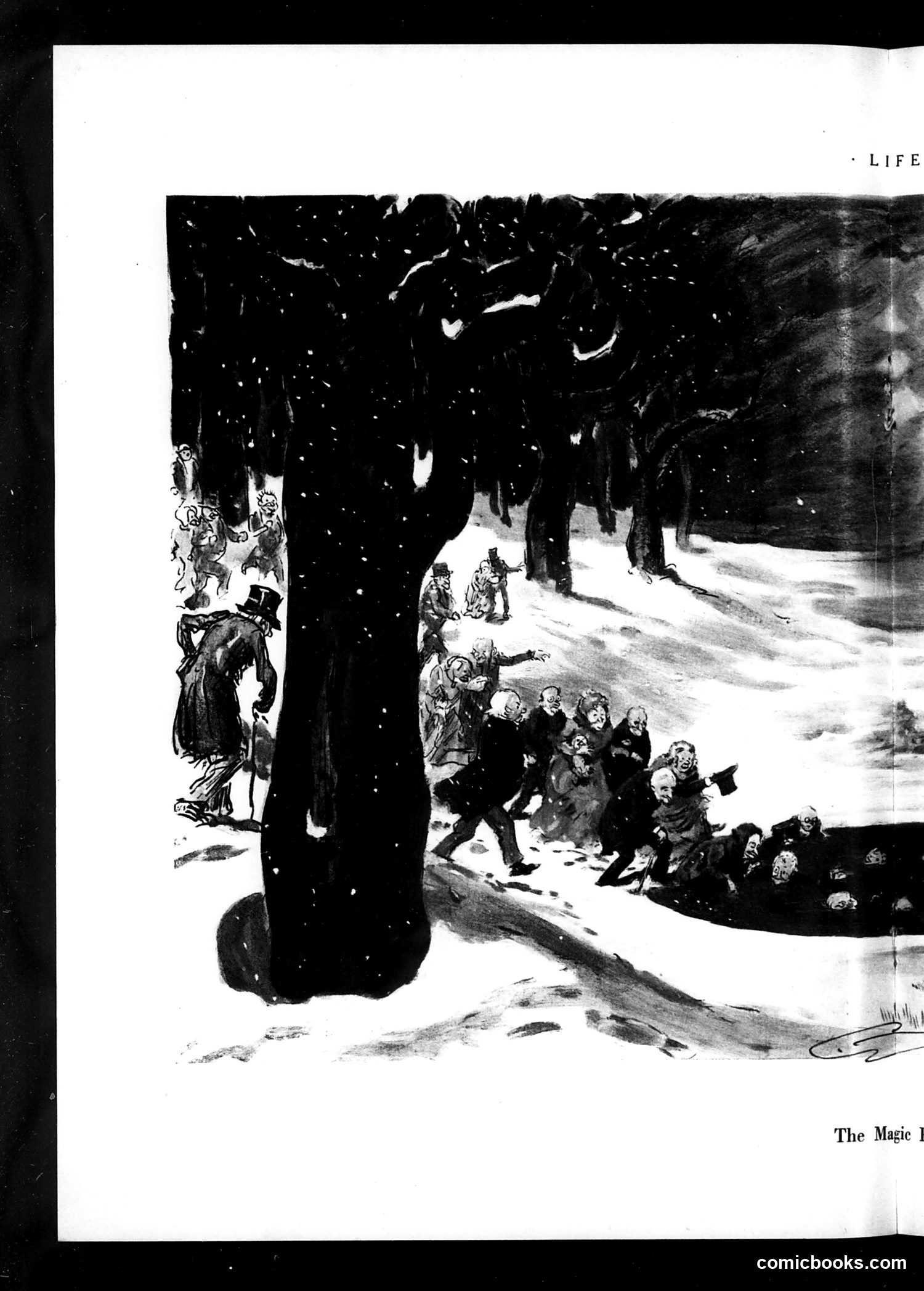
This appears to be an illustration titled "The Magic [...]" (title cut off) from *Life* magazine. The black and white drawing depicts a winter forest scene where a large group of people—appearing to be children and adults—gather in snow beneath dark evergreen trees. The composition suggests a magical or mysterious scene, possibly referencing a fairy tale or holiday tradition. The figures seem to be moving toward or gathered around something in the forest clearing, creating a sense of wonder or enchantment. Without the complete title or additional context visible on this page, the specific satirical or political reference remains unclear. The image could reference Christmas traditions, children's stories, or a contemporary social commentary, but the OCR text provides insufficient information to determine the exact meaning or target of any satire.
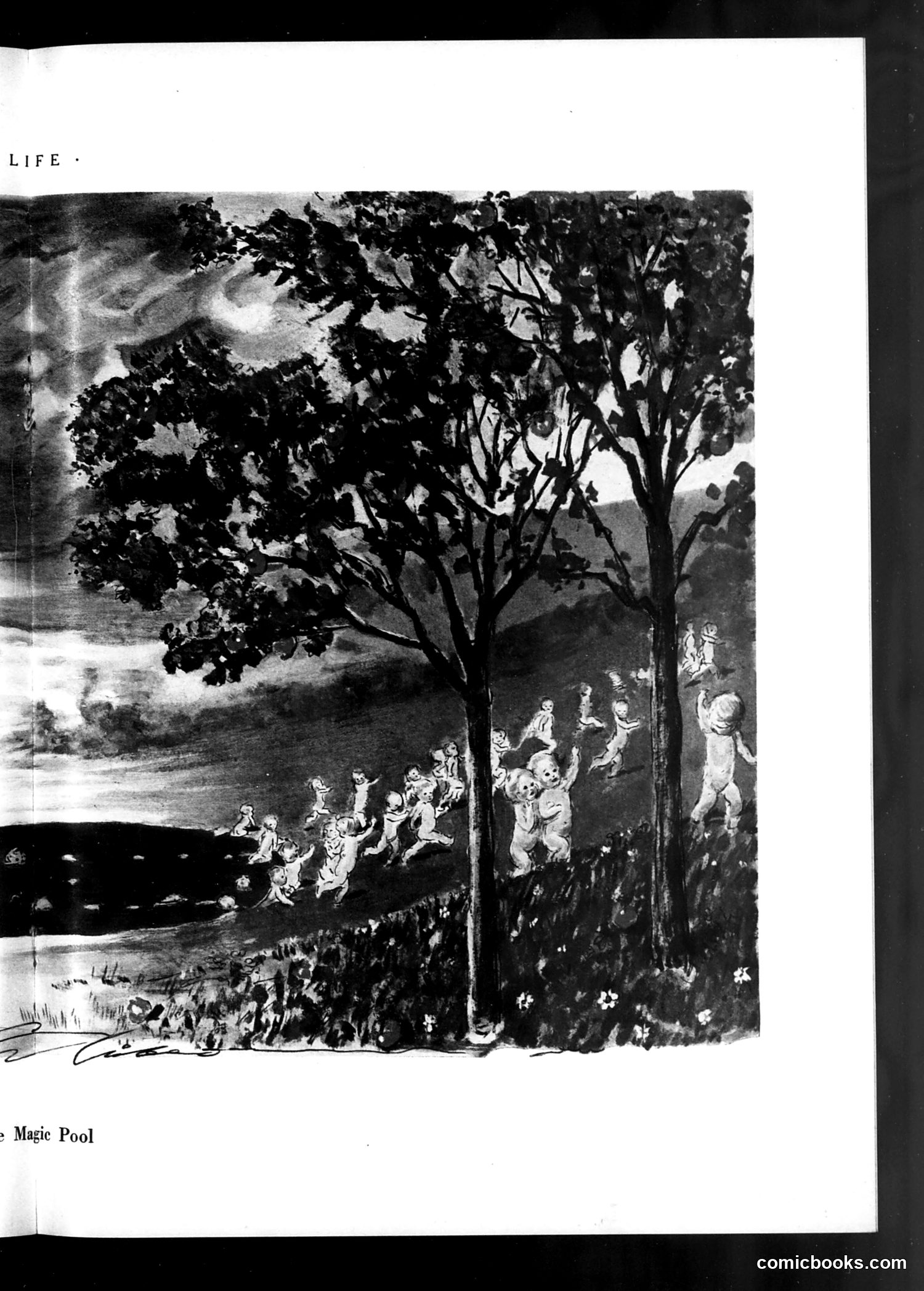
This appears to be a whimsical illustration rather than political satire. The image depicts cherubs or putti (baby angels/spirits common in classical and Renaissance art) gathered around a body of water beneath two large trees in a pastoral landscape. The figures seem to be engaged in playful activity near the water's edge. The title "The Magic Pool" suggests this is either a fairy tale illustration or allegorical artwork depicting an enchanted or mystical natural setting. Without additional context about the specific issue or artist, the exact satirical intent remains unclear. It may reference classical mythology or simply present romantic/fantastical imagery typical of Life magazine's humorous and artistic content from this era.
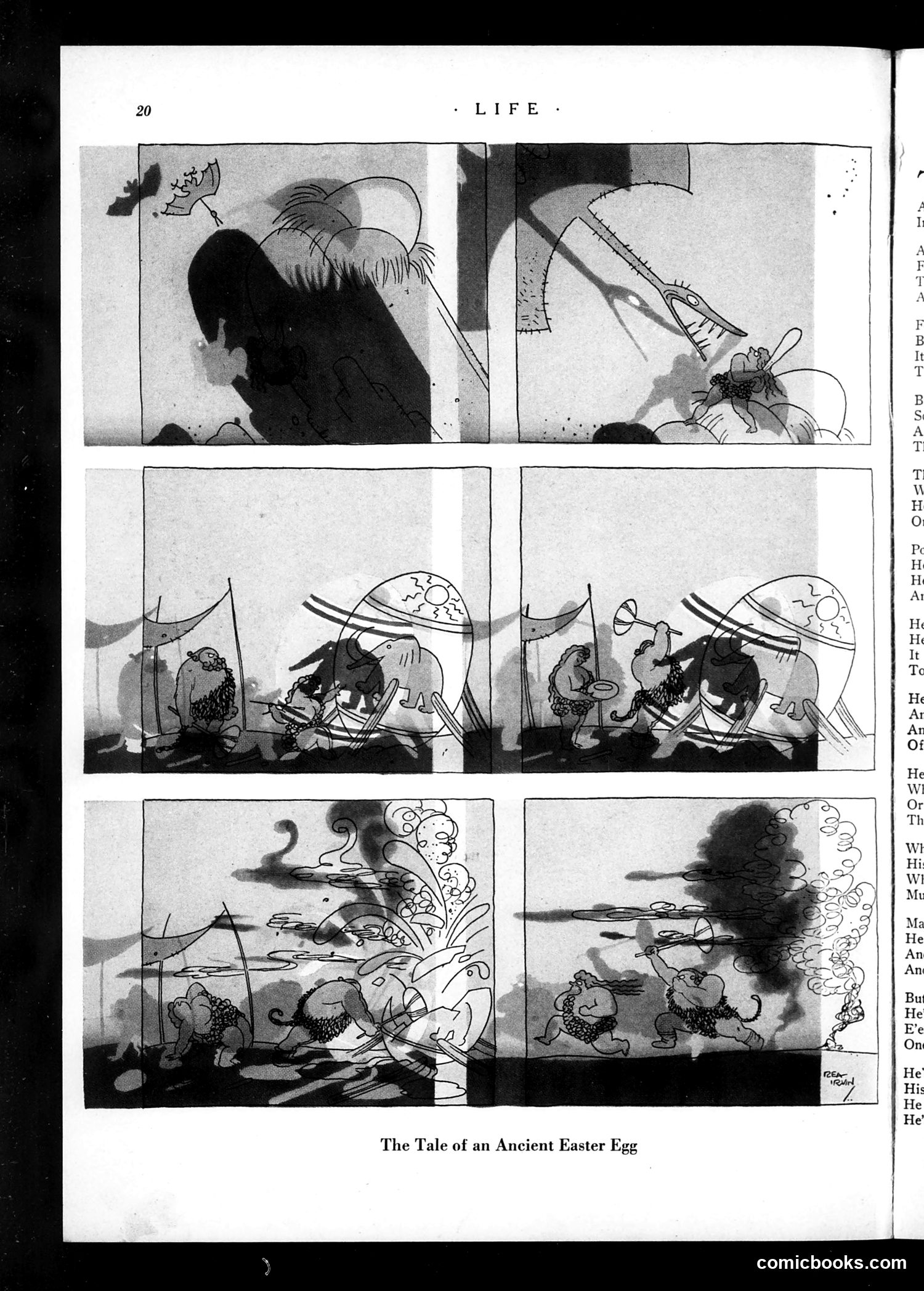
This appears to be a six-panel silhouette comic strip from Life magazine's satirical section. The narrative depicts what seems to be anthropomorphic creatures (possibly meant as commentary on human behavior) discovering and interacting with a large egg. The panels show escalating chaos: figures examining the egg, then appearing to argue or fight over it, and finally an explosion or violent confrontation. The silhouette style was common in early 20th-century comics for visual impact. Without additional context about the publication date or specific historical events referenced, the precise satirical target remains unclear. It could mock human greed, competition over resources, or some contemporary political/social conflict symbolized by the egg's discovery and disputed ownership. The title suggests ironic commentary on ancient history or origins.
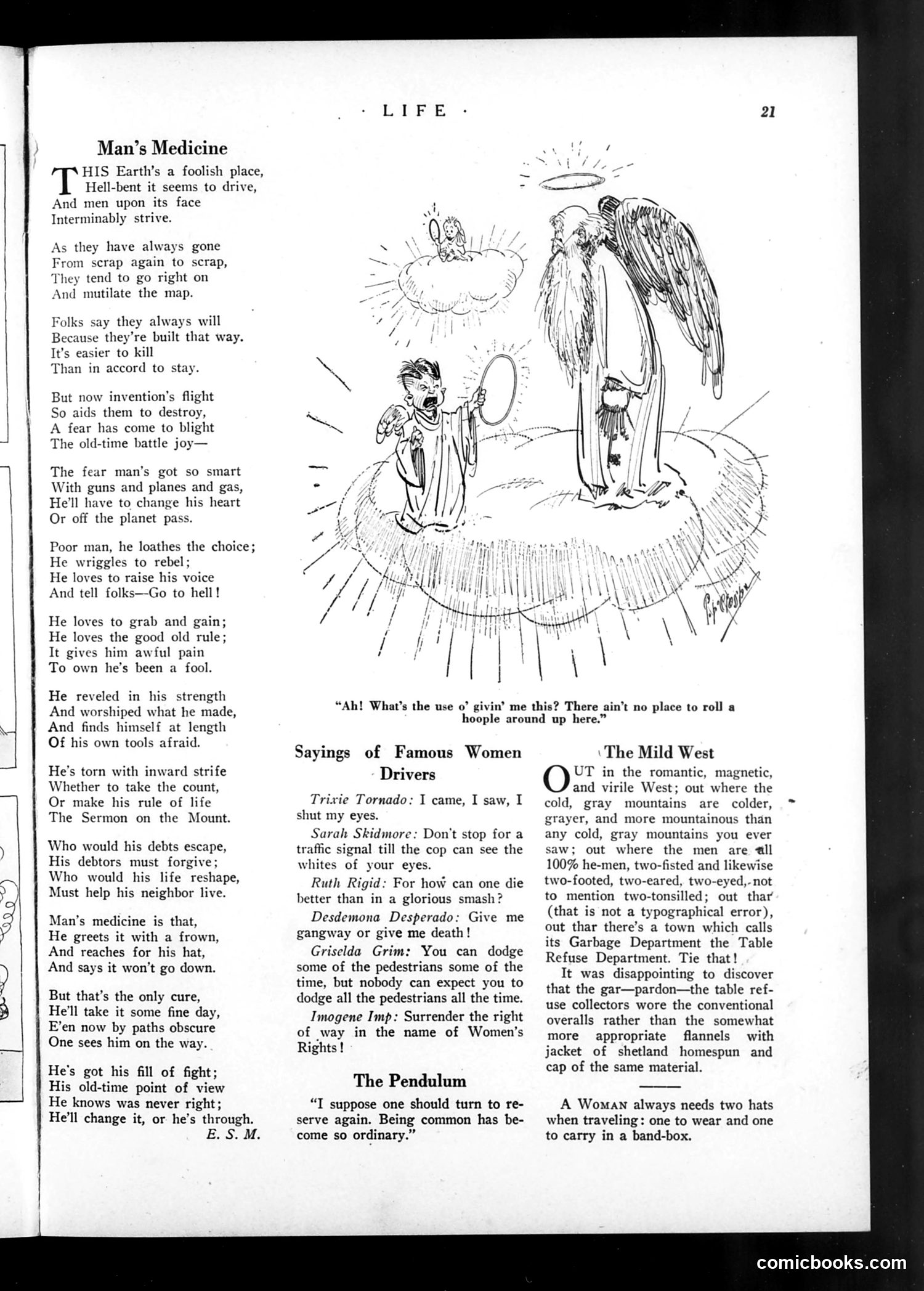
This page contains three distinct pieces of 1920s-30s satire: **"Man's Medicine"** (poem with cartoon): A lengthy moral critique of human nature. The accompanying cartoon shows a man confronting Death/an angel, complaining there's "no place to roll a hoople around up here"—suggesting man's earthly competitive nature persists even facing mortality. The poem argues mankind's only salvation is adopting Christian values (helping neighbors, forgiving debts) rather than pursuing military might and domination. **"Sayings of Famous Women Drivers"**: Mock quotes satirizing reckless female drivers as a social type—playing on 1920s anxieties about women's newfound independence and automobile access. The names (Tornado, Desperado) exaggerate dangerous behavior. **"The Mild West" & "The Pendulum"**: Light social commentary on fashion trends and pretension—poking fun at affected "reserve" becoming fashionable again, and rural Western culture. The overall page mixes serious moral warning with lighthearted social observation typical of Life's satirical approach.
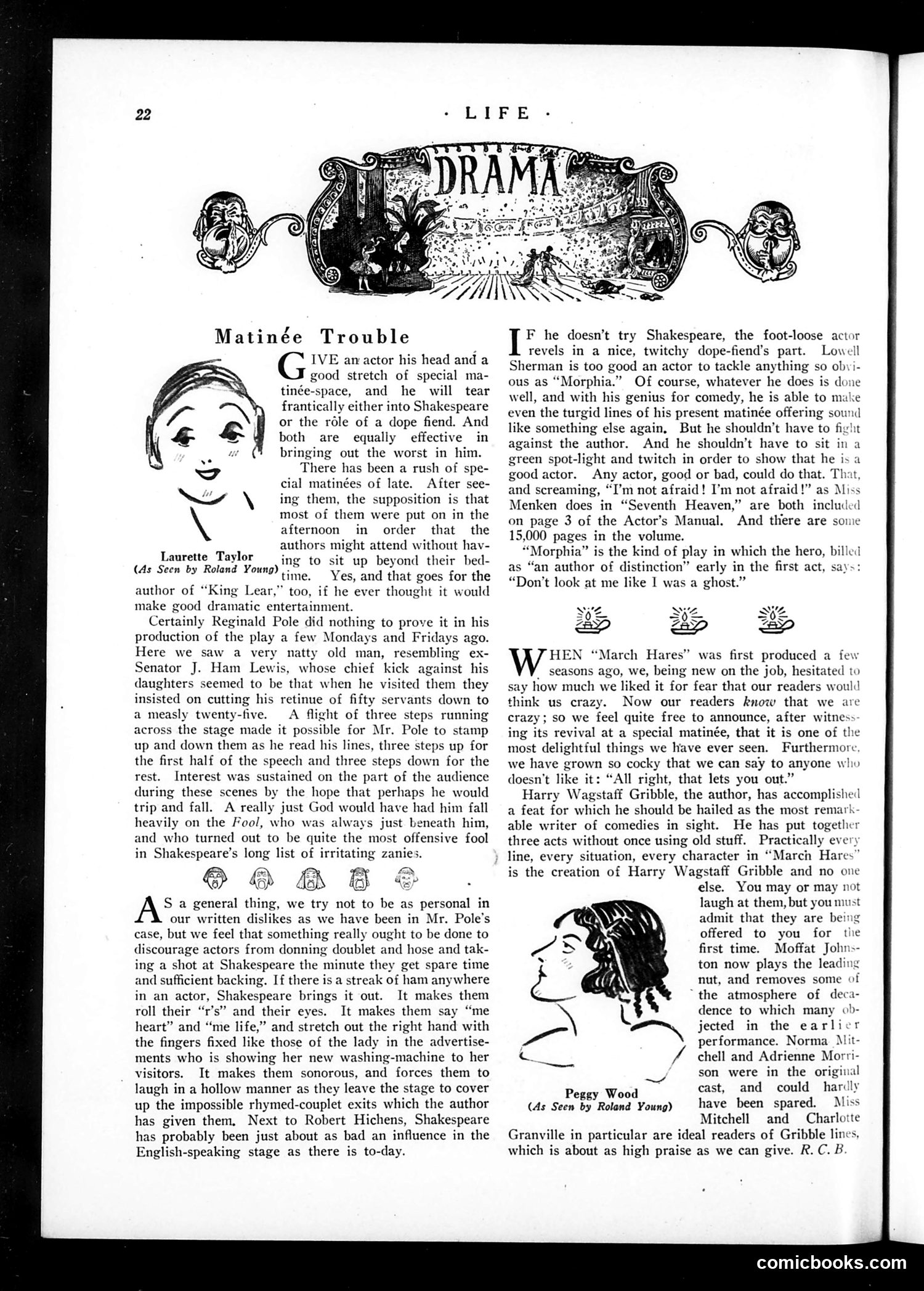
This is a theater criticism column attacking theatrical excess and poor playwriting. The page features two caricatured portraits: **Laurette Taylor** and **Peggy Wood**, contemporary actresses of the 1920s era. The critic (likely identified as "K.C.B." at column's end) satirizes three main problems: 1. **Shakespearean overreach**: Actors with ham tendencies donning period costumes to perform Shakespeare, turning the Bard's work into unintentional comedy through affected delivery ("me heart," exaggerated gestures). 2. **Poor direction**: A production of *King Lear* directed by Reginald Pole, where an old man merely climbs three stage steps repeatedly—absurd staging masquerading as drama. 3. **Melodramatic drug plays**: Actors like Lowell Sherman wasting talent on predictable "dope fiend" roles requiring obvious twitching and screaming ("I'm not afraid!"). The underlying point: good actors deserve better material and shouldn't compensate for bad writing through theatrical posturing. The satire targets not the performers but the system enabling mediocre productions.
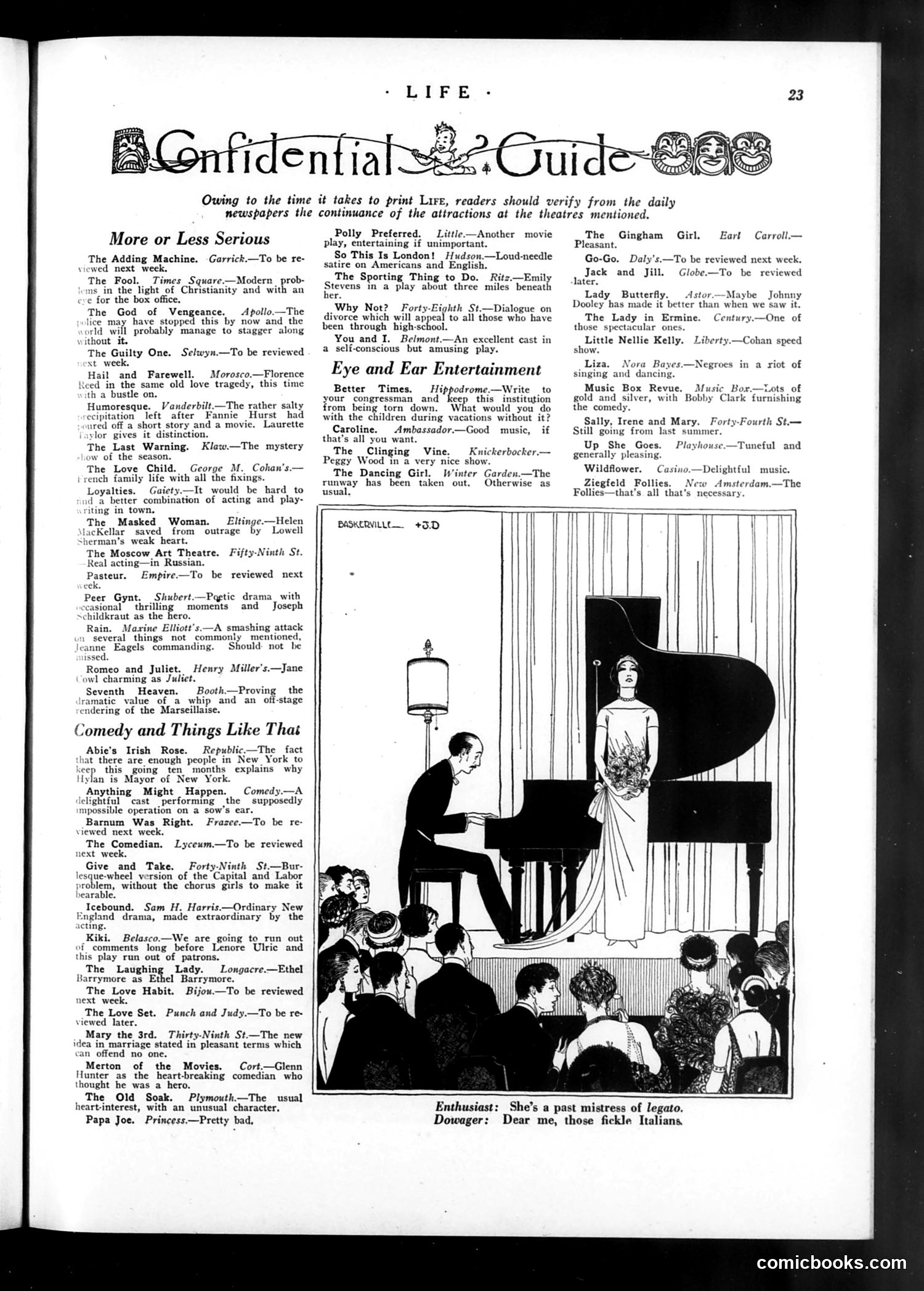
This is a theater review page from Life magazine's "Confidential Guide" section, listing Broadway productions with brief critical assessments. The main illustration shows a piano recital or musical performance attended by an elegant audience. The reviews employ satirical wit typical of Life's style. For instance, the critic suggests "Abie's Irish Rose" (a popular play) has run so long that its success "explains why Hylan is Mayor of New York"—a dig at Mayor John Hylan's perceived mediocrity. Another review notes "The Fool" considers "Modern problems in the light of Christianity and with an eye for the box office," mocking the show's attempt to combine spirituality with commercial appeal. The bottom cartoon caption jokes about Italian immigrants, suggesting dated ethnic stereotypes common to the 1920s. Overall, this reflects Broadway's cultural dominance and Life's role as arbiter of theatrical taste for educated, urban readers.
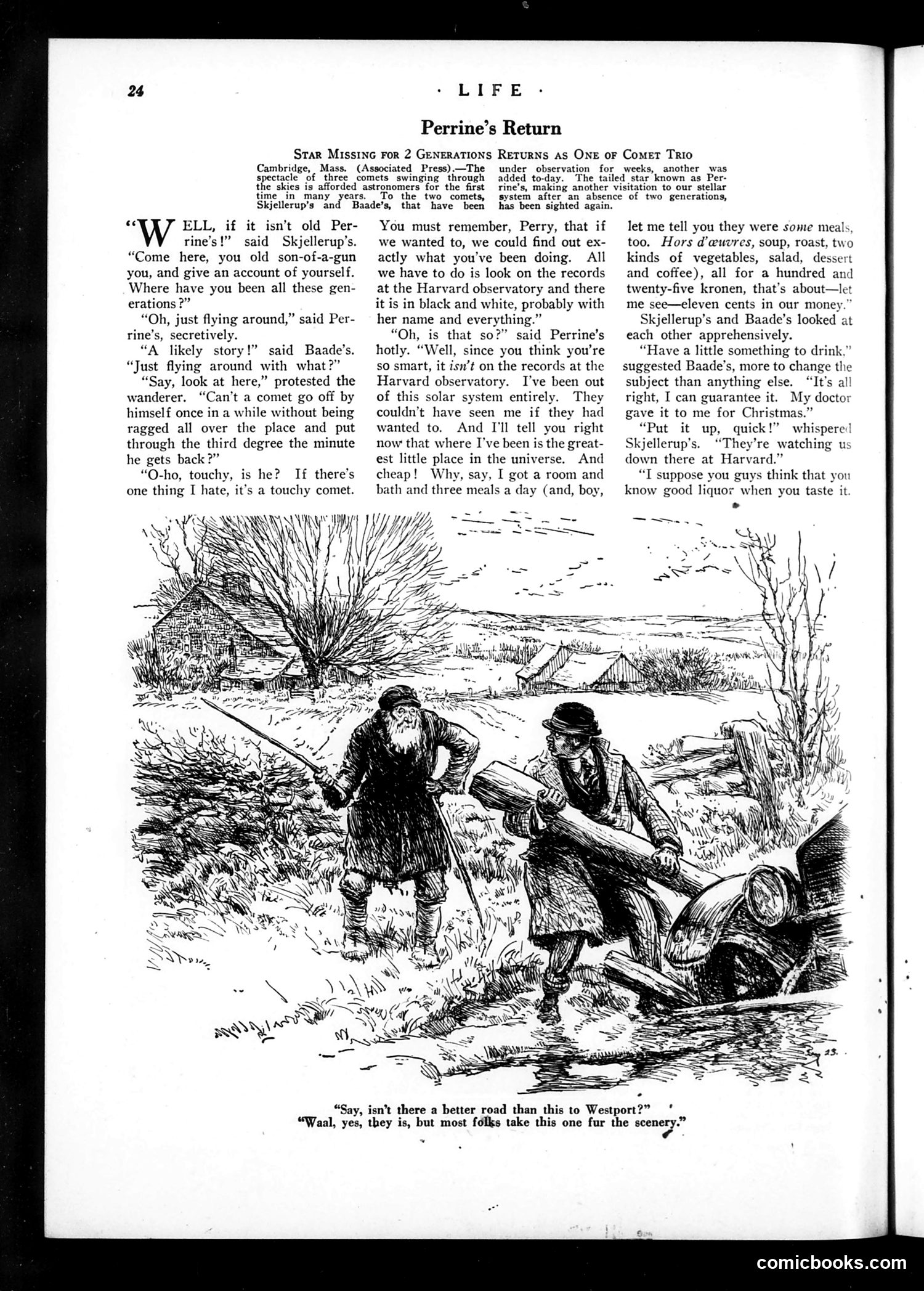
This is a humorous piece personifying three comets as characters—Perrine's, Skjellerup's, and Baade's—who are gossiping like old acquaintances. The joke plays on an actual astronomical event: Perrine's comet, missing from observation for two generations, has reappeared alongside two other comets. The satire mocks both the comets' behavior and human nature. Perrine's boasts about a cheap vacation "out of the solar system," bragging about meals costing "eleven cents in our money"—a relatable Depression-era joke about finding bargains. His companions grow nervous when he mentions Harvard Observatory might be watching, then urgently offer him liquor to keep him quiet, afraid of being observed. The bottom cartoon about the Westport road adds extra layer: travelers taking a scenic route despite it being inefficient. The humor targets human gossip, vanity, and surveillance anxiety wrapped in astronomical whimsy.
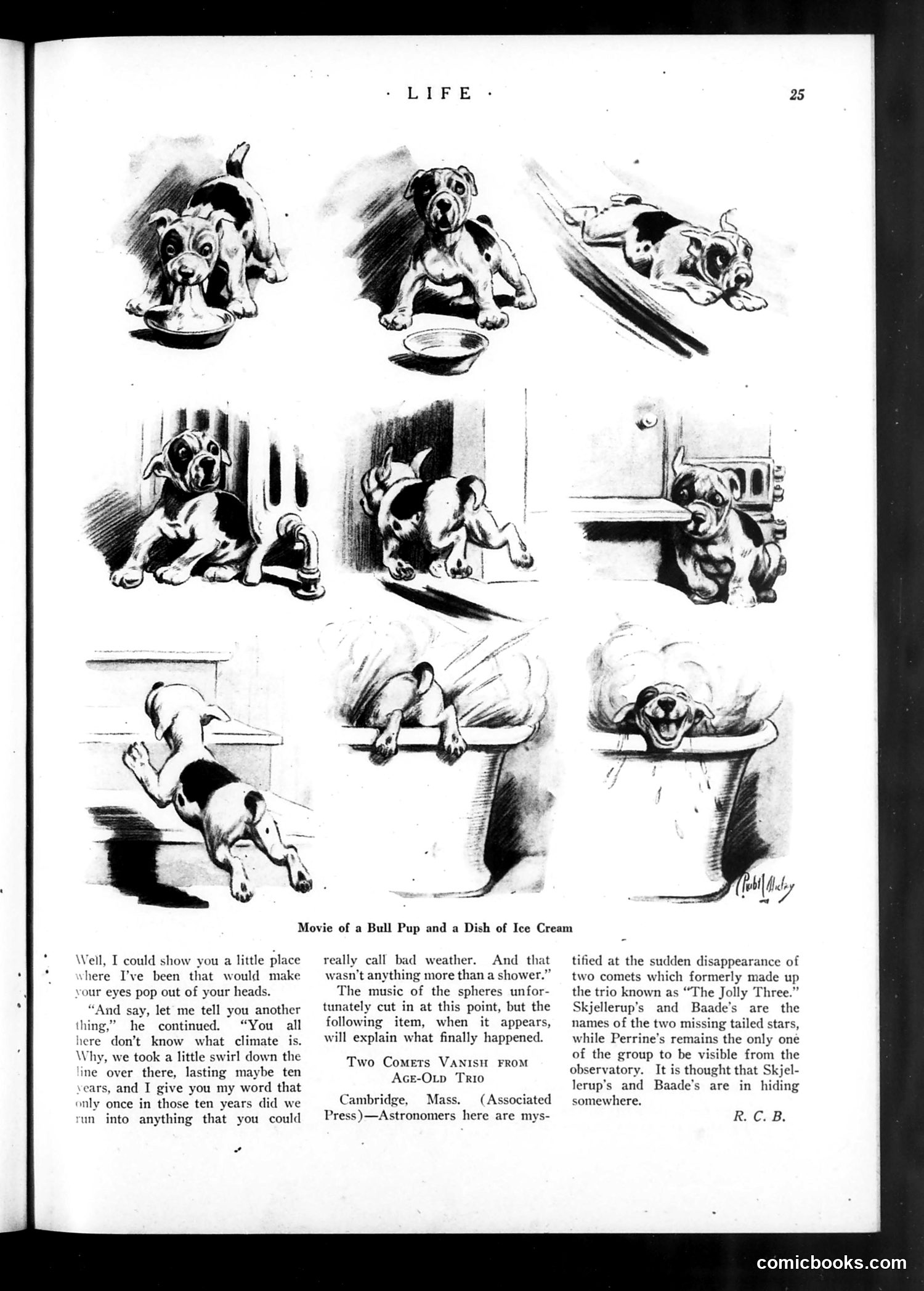
This page contains a humorous cartoon sequence titled "Movie of a Bull Pup and a Dish of Ice Cream," showing a small dog's various misadventures with a bowl of ice cream—eating it, chasing it, and ultimately ending up in a bathtub. The accompanying text is satirical. It presents a tall tale from someone boasting about an exotic location with perfect weather, interrupted by a mock news report about two comets vanishing from an astronomical trio called "The Jolly Three." The joke appears to be a play on words or absurdist humor: the speaker's narrative is cut off by "the music of the spheres," and we're told the next item will "explain what finally happened"—but the explanation is simply that two comets have disappeared, suggesting the comets are somehow responsible for interrupting the story, or that the story about perfect weather was itself interrupted by cosmic events. The humor relies on non-sequitur and incongruity—juxtaposing mundane earthly entertainment with cosmic mysteries.
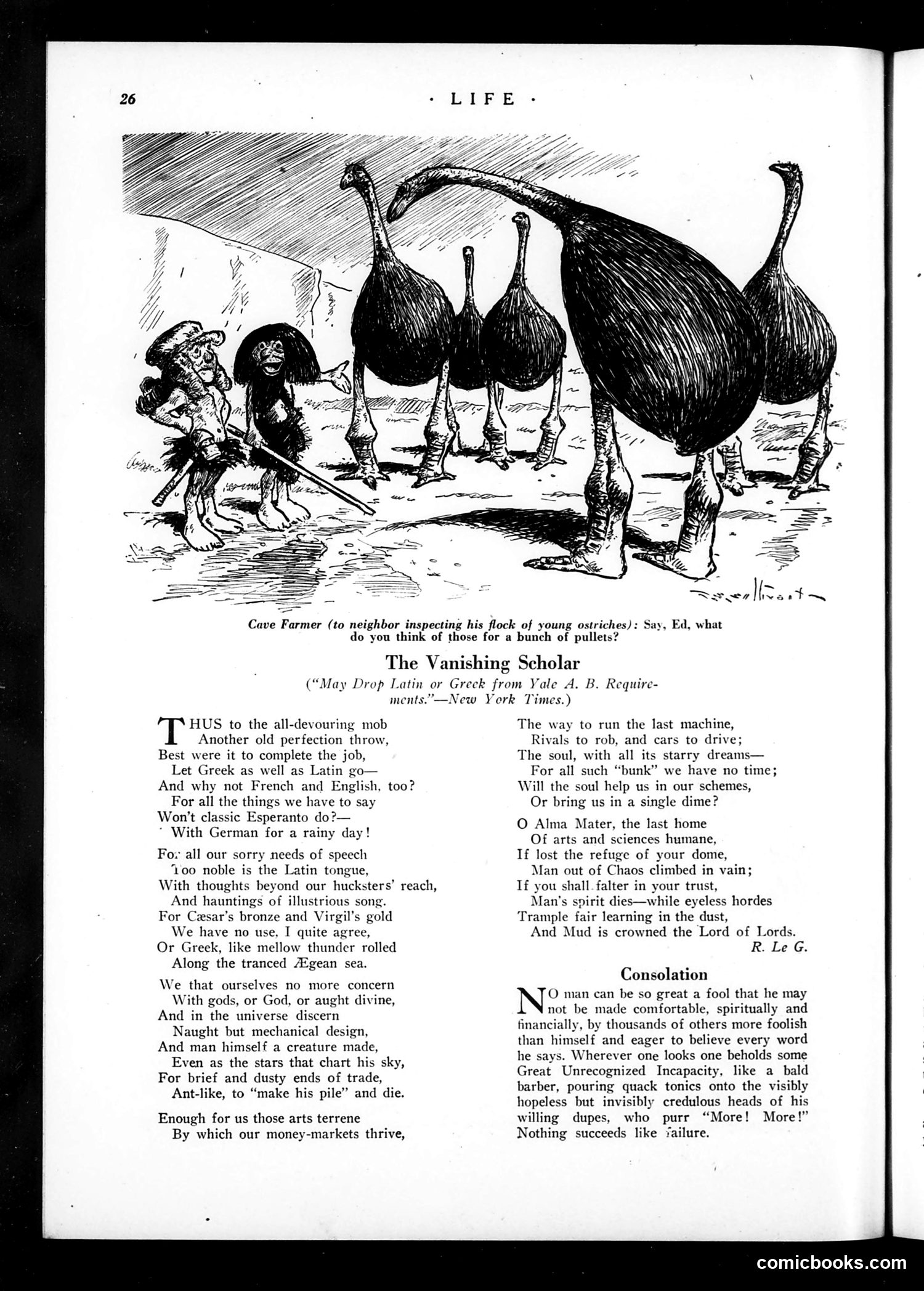
The cartoon depicts a farmer proudly showing off young ostriches to a neighbor, calling them "pullets" (young hens)—a joke about rural ignorance mistaking exotic birds for common poultry. The accompanying poem satirizes the erosion of classical education. Written as commentary on Yale's potential elimination of Latin and Greek requirements, it mocks the utilitarian mindset replacing humanistic learning. The speaker sarcastically endorses dropping classical languages in favor of Esperanto and German, arguing that only practical skills for commerce matter—"the way to run the last machine, / Rivals to rob, and cars to drive." The poem's real argument reverses this: it mourns that education has become purely transactional. By abandoning classical arts and spiritual learning, universities betray their purpose. The final lines warn that without "the refuge of your dome," civilization itself collapses into chaos where "Mud is crowned the Lord of Lords." This reflects early-20th-century anxiety about modernization eroding intellectual and moral foundations in favor of profit-driven pragmatism.
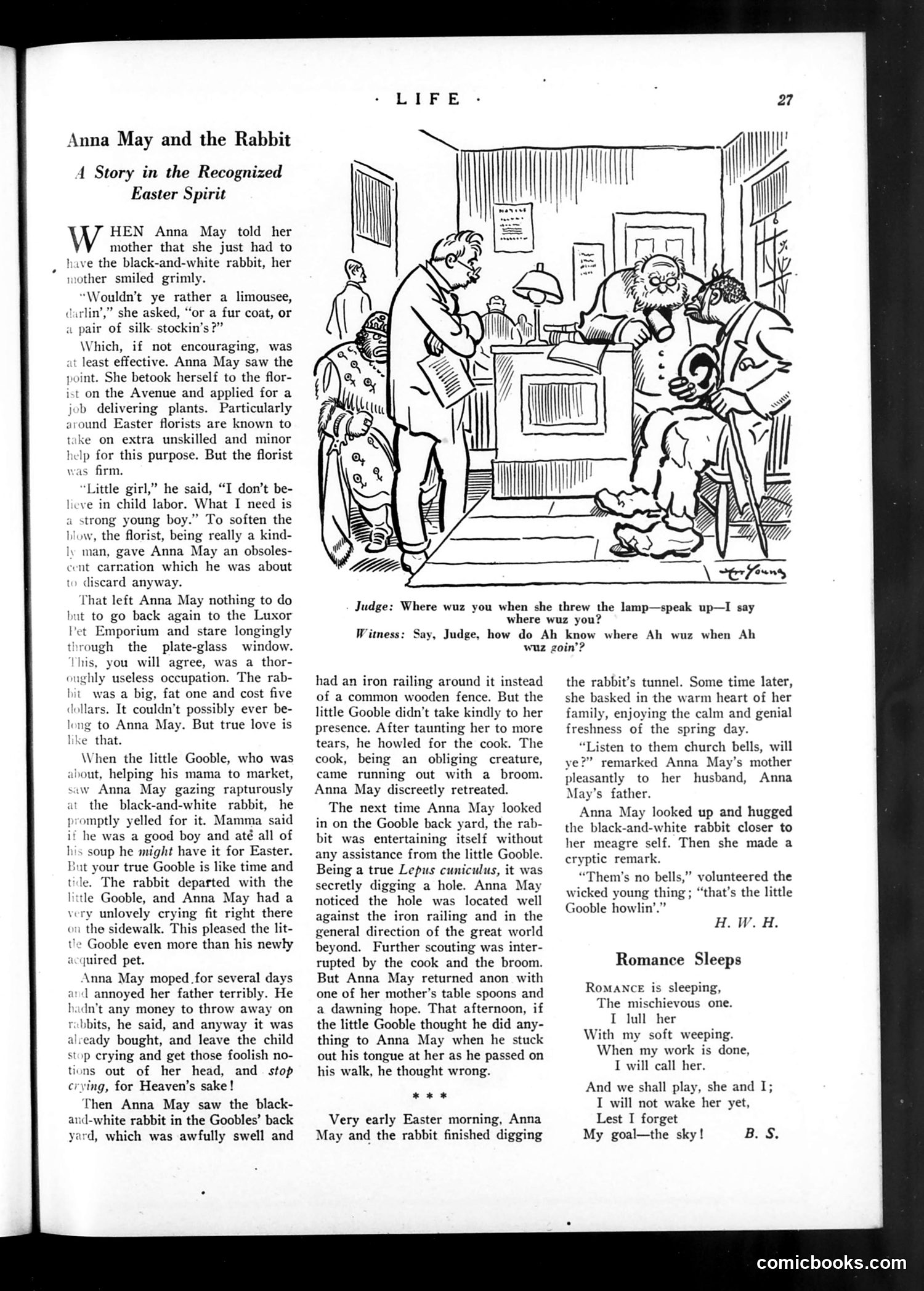
This is a satirical story about child poverty and resourcefulness during the Easter season. Anna May, a poor girl, desperately wants a five-dollar rabbit but cannot afford it. When a wealthy neighbor's child (the "Gooble") receives the same rabbit, Anna May devises a plan: she helps the rabbit escape by digging under the neighbor's iron fence using her mother's spoon. The satire targets class disparity—the florist refuses to hire her ("I don't believe in child labor"), yet the wealthy family casually acquires the same rabbit as an Easter gift. Anna May's ingenuity and determination overcome economic barriers through patience and cunning rather than money. The accompanying courtroom cartoon appears unrelated, depicting testimony about a lamp-throwing incident, likely satirizing unclear witness statements or legal absurdity.
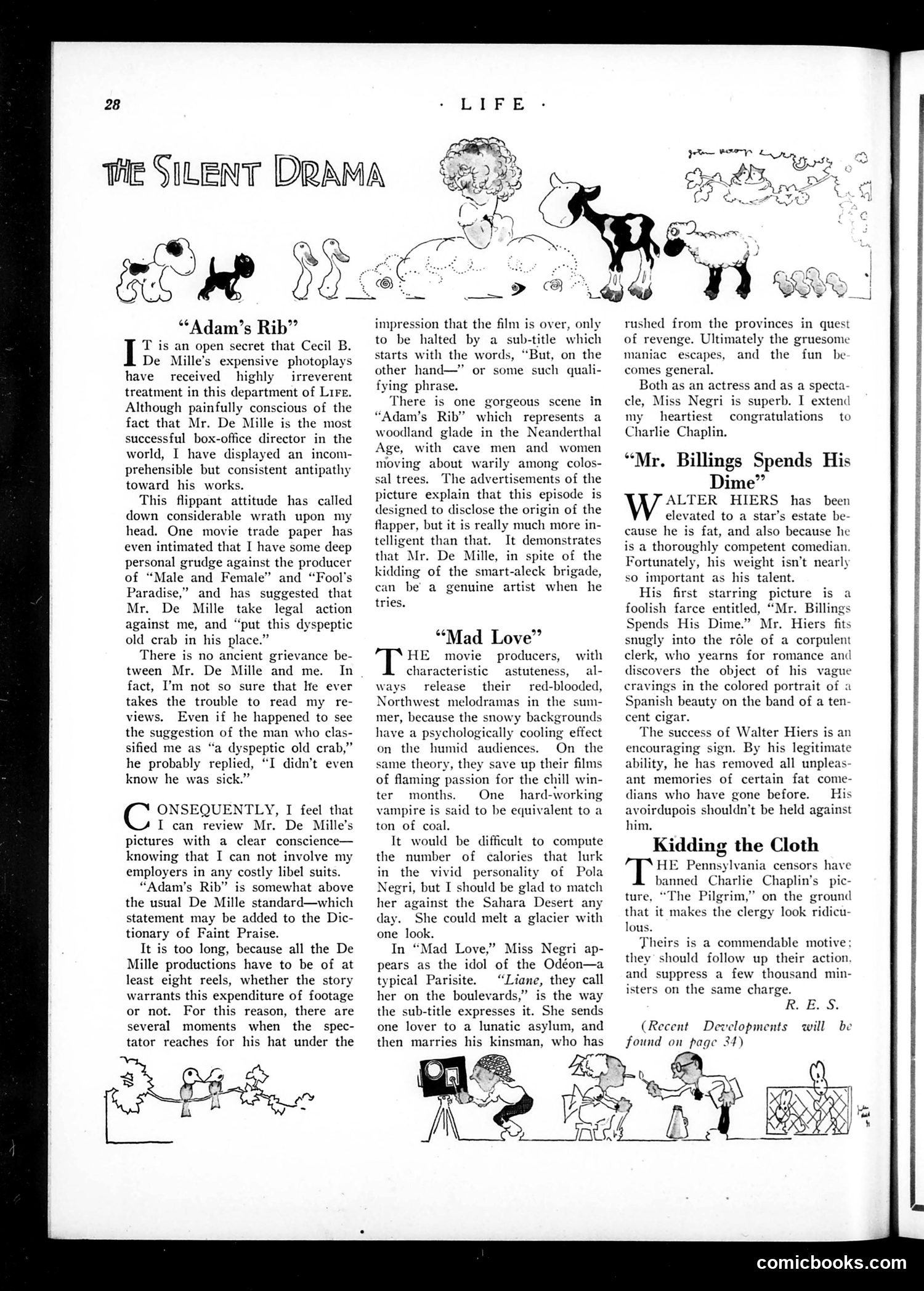
This page from *Life* magazine contains film reviews of three silent movies, accompanied by satirical commentary and small cartoon illustrations. The critic reviews Cecil B. De Mille's "Adam's Rib," praising one prehistoric forest scene while criticizing De Mille's characteristic tendency toward excessive length. He notes De Mille's habit of adding qualifying subtitle phrases like "But, on the other hand—" just when audiences think the film has ended. The second review covers "Mad Love," featuring actress Pola Negri, with the critic using hyperbolic language about her "vivid personality" to describe her screen presence—comparing her attractiveness to melting glaciers. The third reviews Walter Hiers' "Mr. Billings Spends His Dime," noting Hiers was elevated to stardom partly because of his weight, which he leverages for comedy. The small cartoon illustrations at bottom appear to humorously depict scenes from these films or the reviewing process itself.
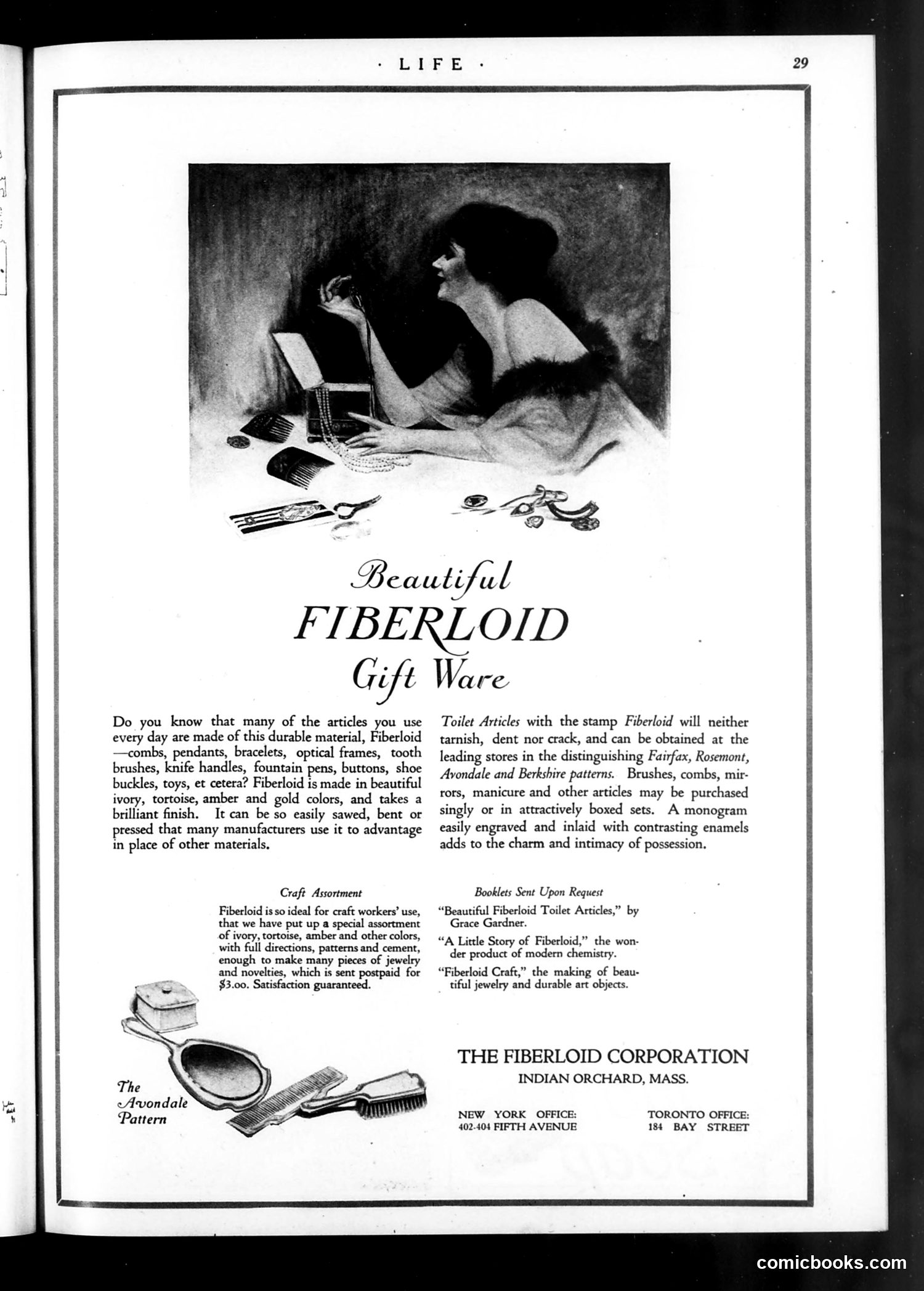
This is a **full-page advertisement**, not satire or political content. It promotes Fiberloid, an early plastic material manufactured by the Fiberloid Corporation (based in Indian Orchard, Massachusetts). The illustration shows a woman examining beauty and personal care items made from Fiberloid—combs, brushes, mirrors, and other toiletries displayed on a table. The advertisement emphasizes that Fiberloid is a durable, versatile synthetic material available in attractive colors (ivory, tortoise, amber, gold) that can replace traditional materials. The ad targets two audiences: consumers interested in purchasing finished Fiberloid goods, and craft hobbyists who could buy a $3.00 assortment kit to make jewelry and novelties themselves. The company also offers free booklets explaining the material's properties and craft applications. This represents early-20th-century consumer marketing for synthetic materials as modern, practical alternatives to natural substances.
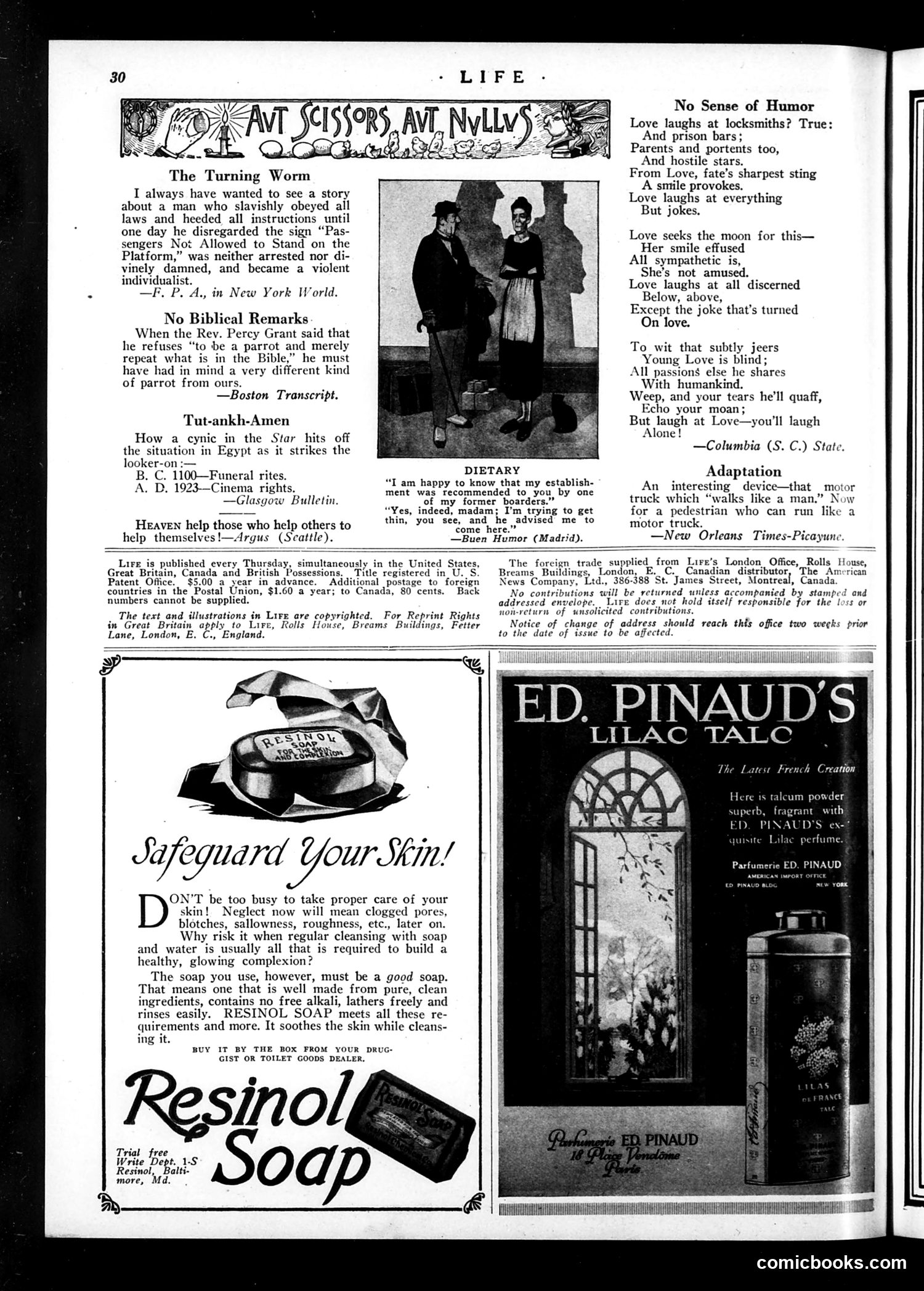
This page contains several short satirical pieces and advertisements typical of Life's format. The main content includes: **"The Turning Worm"**: A humorous observation about a man who becomes a "violent individualist" simply by ignoring a minor sign ("Passengers Not Allowed to Stand on the Platform"). The satire mocks how people equate trivial rule-breaking with genuine nonconformity. **"Tut-ankh-Amen"**: A cynical joke about ancient Egypt, contrasting funeral rites from 1100 B.C. with "Cinema rights" from 1923 A.D.—satirizing modern commercialization of historical artifacts (King Tutankhamun's tomb, famously discovered in 1922, was extensively photographed and publicized). **"No Sense of Humor"**: A poem suggesting that while Love tolerates many hardships, it cannot endure jokes made *about* love itself—a wry commentary on romance's sensitivity. The page also features advertisements for Resinol Soap and Ed. Pinaud's Lilac Talc, typical commercial matter for the era.

This is a 1923 advertisement, not a cartoon or satire. It promotes Royal Cord tires manufactured by United States Tire Company. The ad addresses new tire buyers (claiming approximately one million in 1923) and uses an unusual sales approach: it explicitly invites customers to test a Royal Cord on "the right hind wheel" of their vehicle. The text acknowledges this breaks conventional advertising rules against asking people to "buy a thing and try it." The ad's messaging emphasizes quality, simplicity, and leadership rather than exaggerated claims about mileage or discounts. It positions Royal Cords as the market standard against which other tire values are measured. The large tire image displays the product prominently with the brand name visible on the sidewall. The US Tire Company logo appears in the upper left corner. For modern readers, this reflects early automotive-era marketing and the novelty of consumer tire-testing practices in the 1920s.
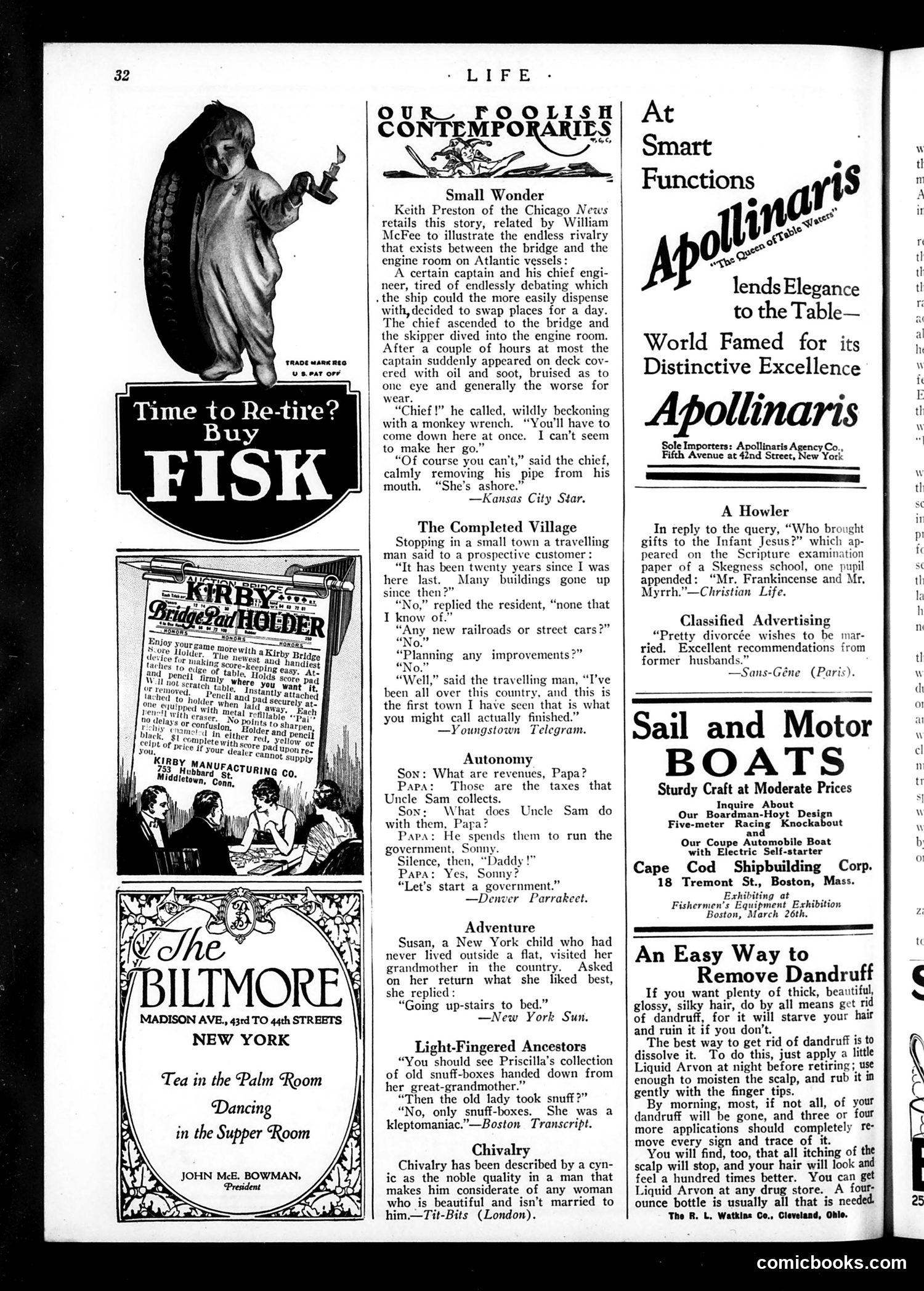
This is primarily a humor and advertising page from *Life* magazine. The main content includes several short joke pieces ("Our Foolish Contemporaries") satirizing everyday life and human nature. The jokes mock: workplace hierarchies (captain and engineer), small-town stagnation, children's misunderstandings of economics and religion, and social hypocrisy (the "light-fingered ancestors" jab at stolen heirlooms presented as family treasures). The page is dominated by advertisements for consumer goods typical of the era—a Fisk tire company ad, Kirby manufacturing, The Biltmore hotel, Apollinaris water, boats, and dandruff remedy. This reflects *Life*'s business model: mixing satirical editorial content with paid advertising to reach affluent readers. The humor is gentle and observational rather than politically pointed, reflecting *Life*'s role as a magazine of genteel satire for the American middle and upper classes.
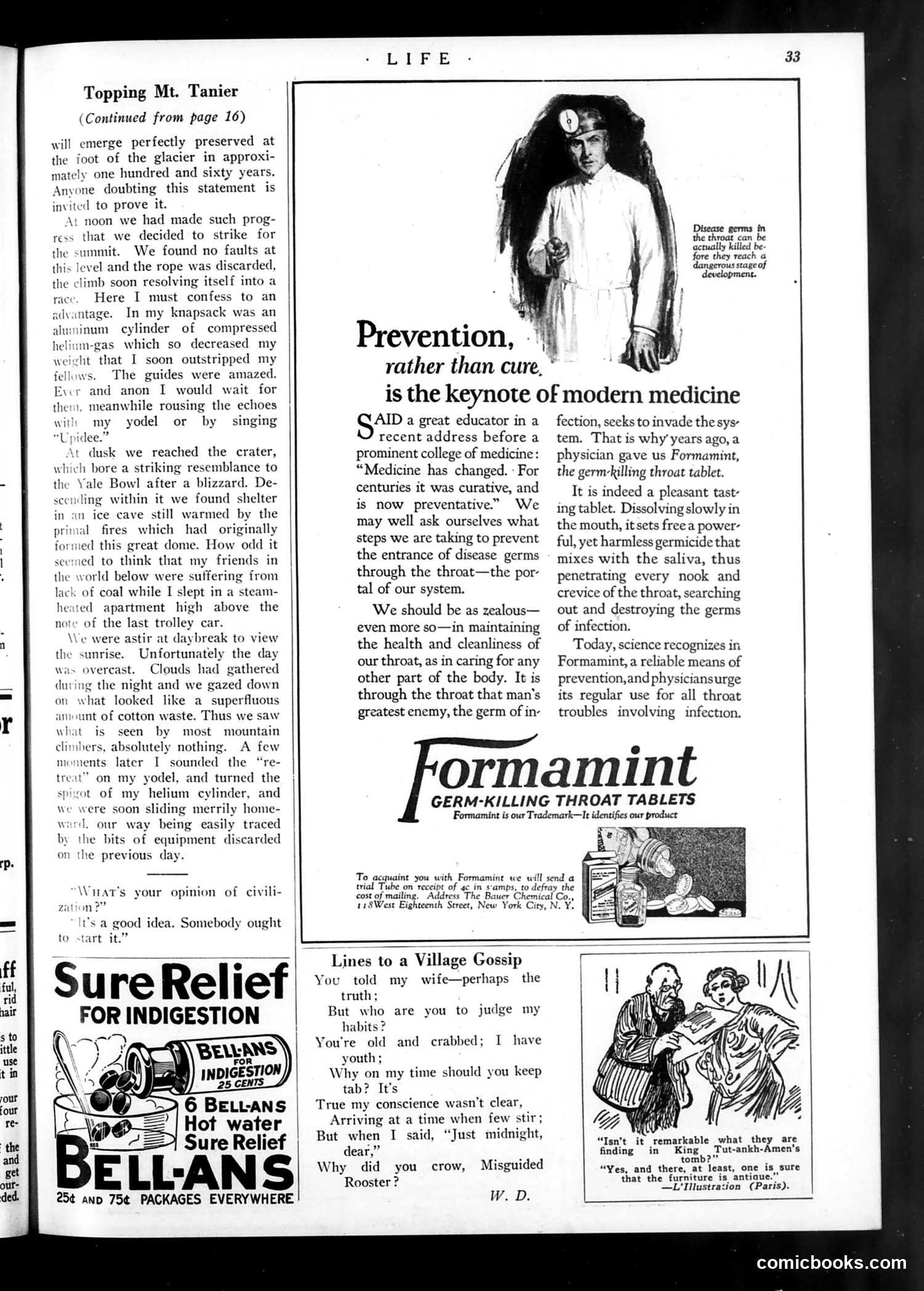
This page contains three distinct elements: **"Topping Mt. Tanier"** is a humorous mountaineering narrative satirizing both adventure literature and modern conveniences. The narrator climbs a peak using a compressed helium cylinder to reduce his weight, allowing him to outpace professional guides—a joke mocking the pretension that technology can replace skill or genuine achievement. The ironic ending notes that while mountaineers enjoy heated comfort, people below lack coal during winter. **The Formamint advertisement** promotes "germ-killing throat tablets," reflecting early 20th-century anxieties about infection and the era's enthusiasm for preventative medicine as scientific progress. **"Sure Relief" and "Lines to a Village Gossip"** are separate advertisements and light verse, typical of Life's satirical magazine format. The page's humor relies on exaggeration and the incongruity of applying modern technology to traditional pursuits—a common theme in 1920s satire about technological hubris.
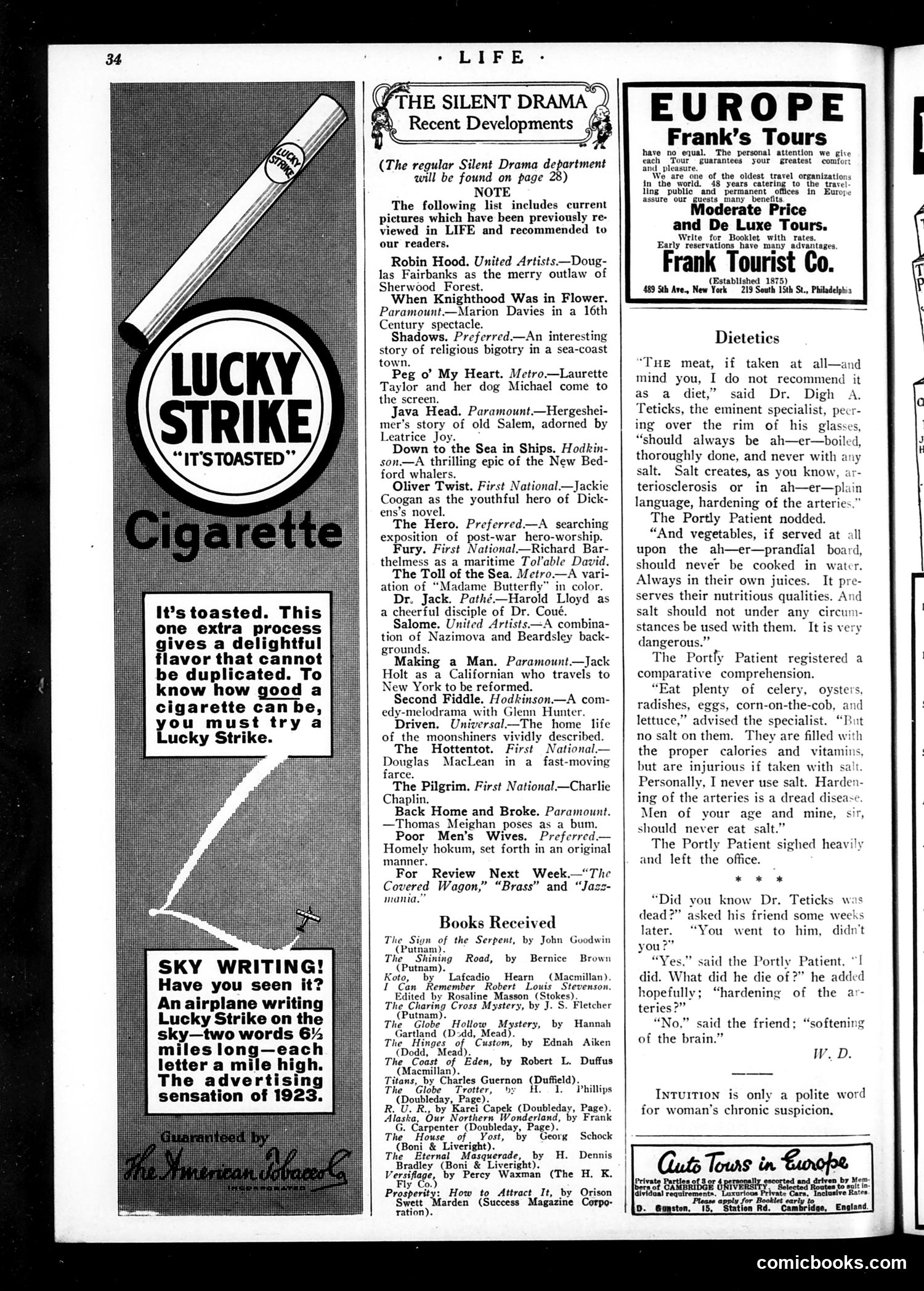
The page is primarily **advertising and entertainment listings**, with minimal editorial content. **The main advertisement** is Lucky Strike cigarettes, prominently featuring their "It's Toasted" slogan and boasting about a novel 1923 advertising stunt: **sky writing**—an airplane writing "Lucky Strike" across the sky in letters a mile high. This represented cutting-edge advertising technology of the era. **Secondary content** includes: - A "Silent Drama" review section listing recent film recommendations (Charlie Chaplin, Douglas Fairbanks, Harold Lloyd) - Book reviews - Tourist advertisement for Frank's Tours (Europe) - A brief medical column about dietetics **Historical context**: The sky-writing advertisement exemplifies 1920s commercial innovation and the era's excitement about emerging technologies. The film listings show early Hollywood's major stars. The page overall reflects 1920s consumer culture and entertainment priorities.
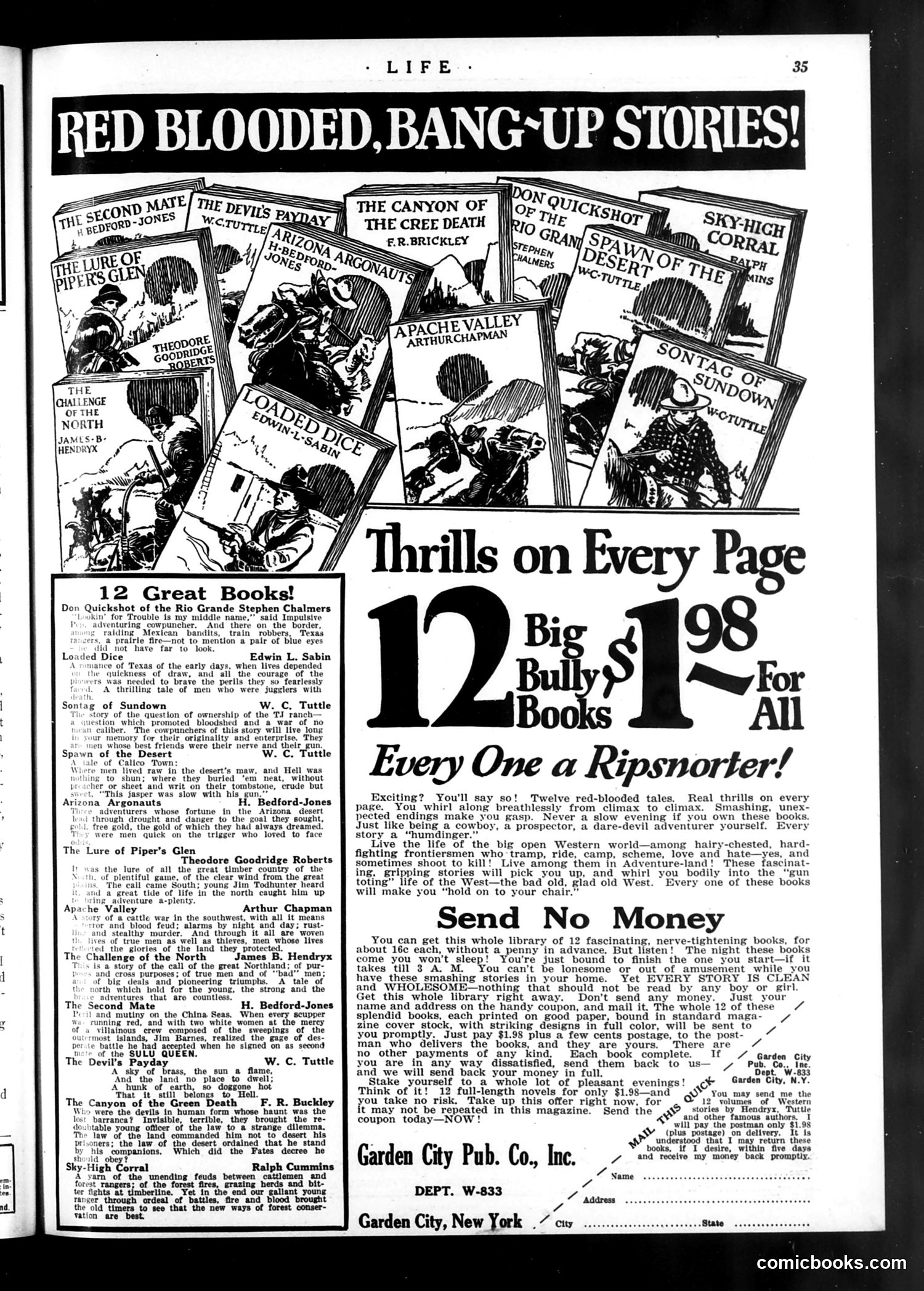
This is primarily a **book advertisement**, not a political cartoon. It promotes a mail-order collection of twelve Western adventure novels published by Garden City Publishing Company. The page showcases pulp fiction titles featuring classic early-20th-century Western tropes: cowboys, outlaws, desert violence, and frontier justice. Authors include Theodore Goodridge Roberts and W.C. Tuttle. Story titles emphasize action and danger ("Loaded Dice," "Devil's Payday," "Canyon of the Green Death"). The marketing language—"red-blooded," "bang-up stories," "ripsporter"—appeals to young male readers seeking escapist adventure literature. The phrase "Every One a Ripshorter!" and promises of "thrills on every page" typify pulp fiction advertising. The "Send No Money" offer (pay upon delivery) was a common direct-mail sales tactic of the era. This reflects American popular entertainment preferences during the early-to-mid twentieth century, when Western and adventure fiction dominated mass-market reading. There is no political satire present—this is straightforward commercial promotion.
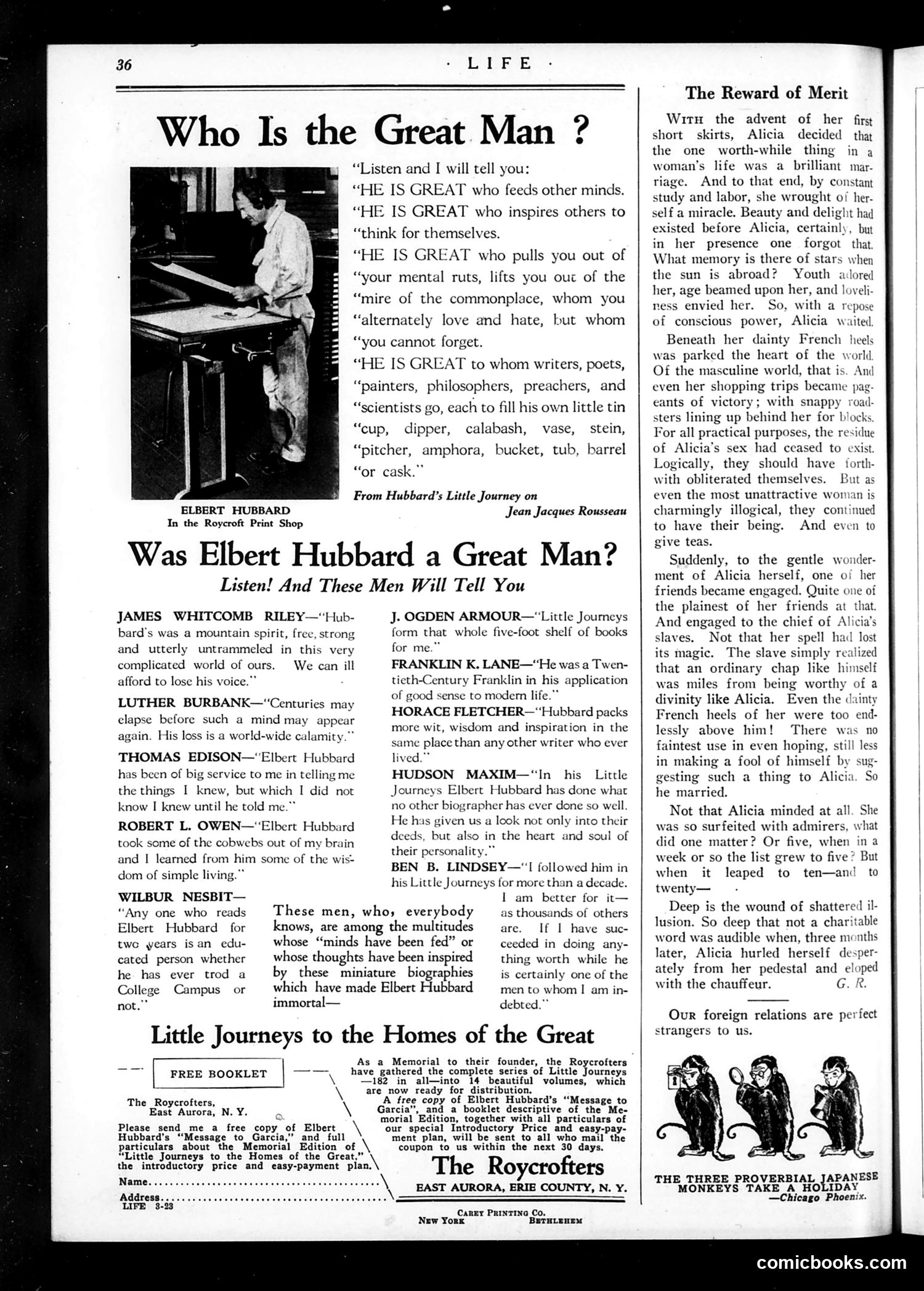
This page celebrates **Elbert Hubbard**, an early 20th-century writer and philosopher (visible in the photograph at left). The main content is a testimonial advertisement featuring famous contemporaries—Edison, Luther Burbank, James Whitcomb Riley—praising Hubbard's intellectual influence. The page satirizes **celebrity endorsement culture**. These titans of industry and innovation testify that Hubbard made them think better, despite their already-towering accomplishments. The implicit joke: even geniuses need a middleman philosopher to validate what they already know. Edison's quote ("things I knew, but which I did not know I knew") perfectly captures this absurdity. The right column contains an unrelated short story, "The Reward of Merit," about a beautiful woman named Alicia whose looks attract suitors until a plainer friend gets engaged—deflating Alicia's confidence. Overall, the page mixes promotional content with gentle mockery of self-help culture and vanity.
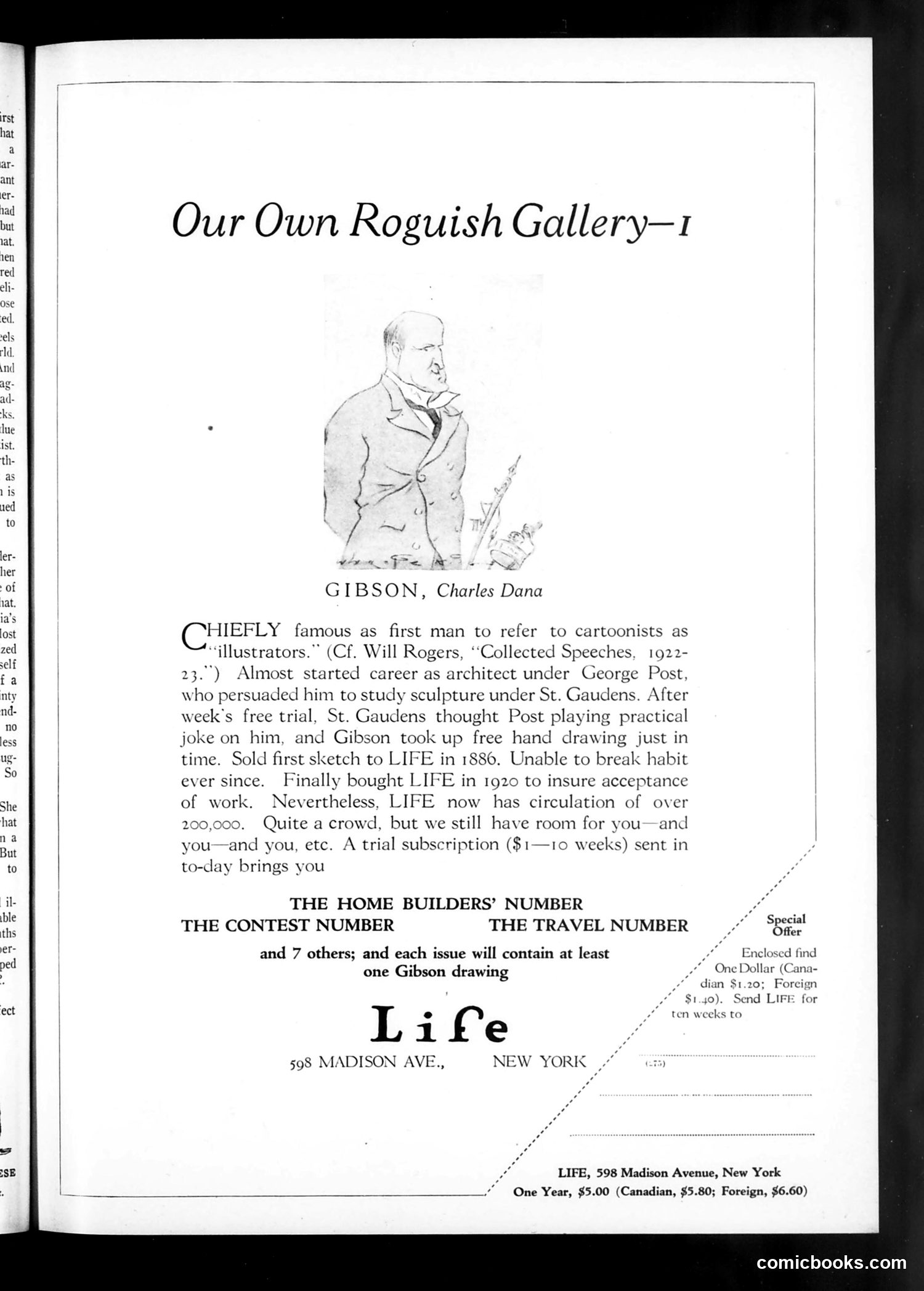
This is a Life magazine advertisement promoting the publication itself, featuring Charles Dana Gibson, the famous illustrator known for creating the "Gibson Girl." The text uses humorous self-promotion, claiming Gibson was "chiefly famous as first man to refer to cartoonists as 'illustrators'"—a joking assertion of professional dignity. It recounts Gibson's career trajectory: he nearly became an architect, briefly studied sculpture under Saint-Gaudens (who apparently thought it was a prank), then turned to drawing. The satire lies in Gibson's 1920 purchase of *Life* magazine itself to guarantee his work's acceptance—a comedic exaggeration suggesting even successful artists face rejection. The text playfully invites readers to subscribe, claiming room still exists despite 200,000 circulation. The accompanying sketch shows Gibson in profile, establishing him as the featured "rogue" in this gallery of prominent figures. The advertisement leverages Gibson's considerable prestige to sell subscriptions while maintaining *Life's* characteristic wit and self-deprecation.
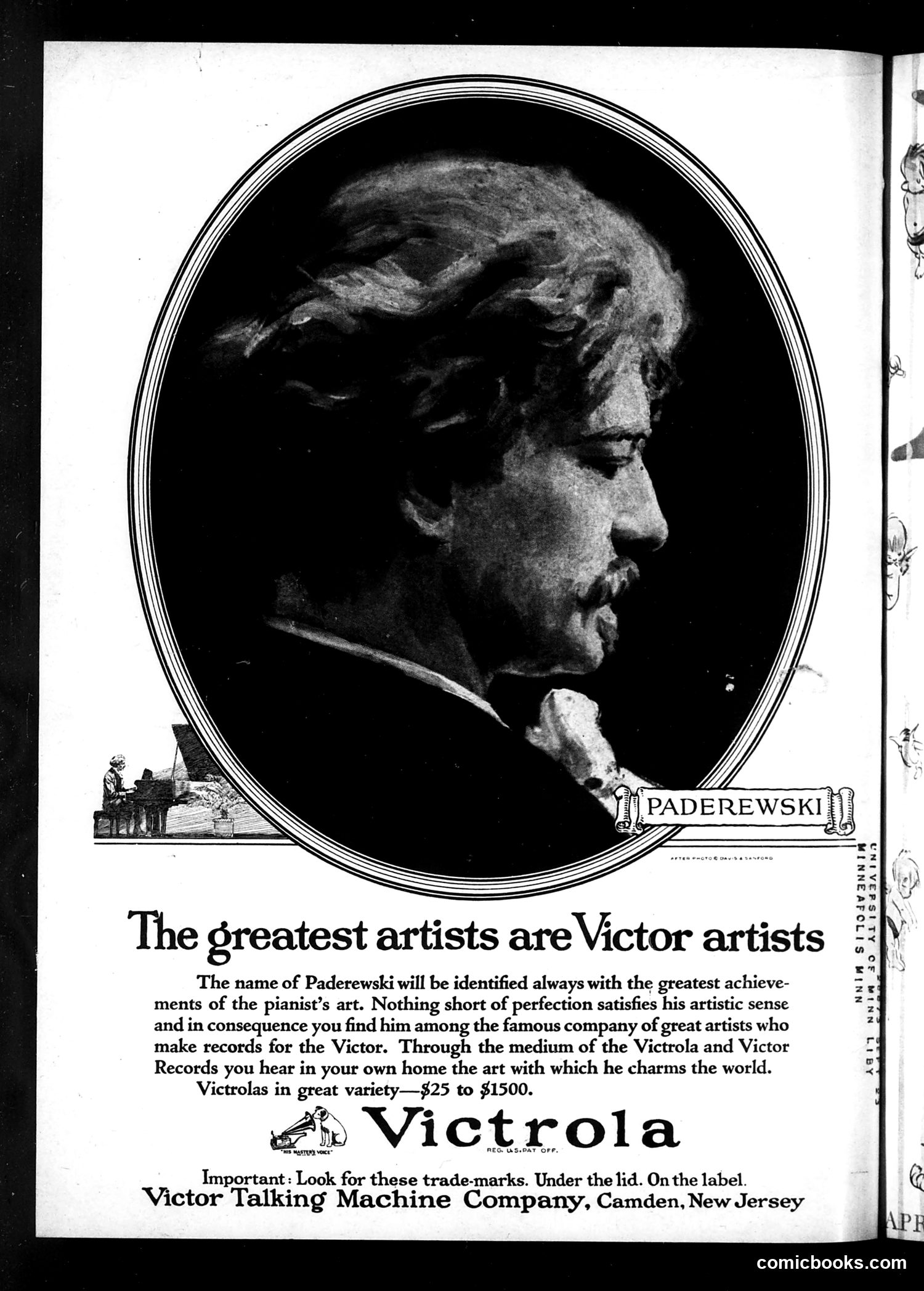
This is an advertisement, not political satire. It features a profile portrait of **Ignacy Jan Paderewski**, the famous Polish pianist and composer, identified by the nameplate below the oval frame. The ad promotes **Victrola phonographs** and **Victor Records** by claiming that "the greatest artists are Victor artists." It argues that Paderewski—presented as a pinnacle of artistic excellence—records exclusively for Victor, making his performances accessible to home listeners through their technology. The implicit message: owning a Victrola gives ordinary people access to world-class artistry. This was a common early-20th-century marketing strategy, using celebrity endorsements to validate a new consumer technology (the phonograph). The price range ($25–$1500) suggests Victrolas were luxury items for middle and upper-class households.